Hubbry Logo
ColorfulnessColorfulnessMain
Open search
Colorfulness
Community hub
Colorfulness
logo
8 pages, 0 posts
0 subscribers
Be the first to start a discussion here.
Contribute something
Colorfulness
Colorfulness
from Wikipedia

The red stripe exhibits higher brightness and colorfulness in the light than in the shadow, but is seen as having the same object color, including the same chroma, in both areas. Because the brightness increases proportionately to the colorfulness, the stripe also exhibits similar saturation in both areas.
7.5PB and 10BG Munsell hue pages of RGB colors, showing lines of uniform saturation (chroma in proportion to lightness) in red. Lines of uniform saturation radiate from near the black point, while lines of uniform chroma are vertical. Also compared to the 10BG colors, the 7.5PB colors attain higher saturation as well as higher chroma.
Original image, with relatively muted colors
L*C*h (CIELAB) chroma increased 50%
HSL saturation increased 50%; changing HSL saturation also affects the perceived lightness of a color
CIELAB lightness preserved, with a* and b* stripped, to make a grayscale image
Saturation scale (0% at left, corresponding to black and white)
Examples of saturation.Top left = original image.
Examples of saturation. Original image at top left.

Colorfulness, chroma and saturation are attributes of perceived color relating to chromatic intensity. As defined formally by the International Commission on Illumination (CIE) they respectively describe three different aspects of chromatic intensity, but the terms are often used loosely and interchangeably in contexts where these aspects are not clearly distinguished. The precise meanings of the terms vary by what other functions they are dependent on.

  • Colorfulness is the "attribute of a visual perception according to which the perceived color of an area appears to be more or less chromatic (Any color that is absent of white, grey, or black)[clarification needed]".[1][2] The colorfulness evoked by an object depends not only on its spectral reflectance but also on the strength of the illumination, and increases with the latter unless the brightness is very high (Hunt effect).
  • Chroma is the "colorfulness of an area judged as a proportion of the brightness of a similarly illuminated area that appears white or highly transmitting".[3][2] As a result, chroma is mostly only dependent on the spectral properties, and as such is seen to describe the object color.[4] It is how different from a grey of the same lightness such an object color appears to be.[5]
  • Saturation is the "colorfulness of an area judged in proportion to its brightness",[6][2] which in effect is the perceived freedom from whitishness of the light coming from the area. An object with a given spectral reflectance exhibits approximately constant saturation for all levels of illumination, unless the brightness is very high.[7]

As colorfulness, chroma, and saturation are defined as attributes of perception, they can not be physically measured as such, but they can be quantified in relation to psychometric scales intended to be perceptually even—for example, the chroma scales of the Munsell system. While the chroma and lightness of an object are its colorfulness and brightness judged in proportion to the same thing ("the brightness of a similarly illuminated area that appears white or highly transmitting"), the saturation of the light coming from that object is in effect the chroma of the object judged in proportion to its lightness. On a Munsell hue page, lines of uniform saturation thus tend to radiate from near the black point, while lines of uniform chroma are vertical.[7]

Chroma

[edit]

The naïve definition of saturation does not specify its response function. In the CIE XYZ and RGB color spaces, the saturation is defined in terms of additive color mixing, and has the property of being proportional to any scaling centered at white or the white point illuminant. However, both color spaces are non-linear in terms of psychovisually perceived color differences. It is also possible — and sometimes desirable — to define a saturation-like quantity that is linearized in term of the psychovisual perception.

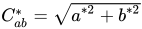
In the CIE 1976 LAB and LUV color spaces, the unnormalized chroma is the radial component of the cylindrical coordinate CIE LCh (lightness, chroma, hue) representation of the LAB and LUV color spaces, also denoted as CIE LCh(ab) or CIE LCh for short, and CIE LCh(uv). The transformation of to is given by: and analogously for CIE LCh(uv).

The chroma in the CIE LCh(ab) and CIE LCh(uv) coordinates has the advantage of being more psychovisually linear, yet they are non-linear in terms of linear component color mixing. And therefore, chroma in CIE 1976 Lab and LUV color spaces is very much different from the traditional sense of "saturation".

In color appearance models

[edit]

Another, psychovisually even more accurate, but also more complex method to obtain or specify the saturation is to use a color appearance model like CIECAM02. Here, the chroma color appearance parameter might (depending on the color appearance model) be intertwined with e.g. the physical brightness of the illumination or the characteristics of the emitting/reflecting surface, which is more sensible psychovisually.

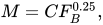
The CIECAM02 chroma for example, is computed from a lightness in addition to a naively evaluated color magnitude In addition, a colorfulness parameter exists alongside the chroma It is defined as where is dependent on the viewing condition.[8]

Saturation

[edit]

The saturation of a color is determined by a combination of light intensity and how much it is distributed across the spectrum of different wavelengths. The purest (most saturated) color is achieved by using just one wavelength at a high intensity, such as in laser light. If the intensity drops, then as a result the saturation drops. To desaturate a color of given intensity in a subtractive system (such as watercolor), one can add white, black, gray, or the hue's complement.

Various correlates of saturation follow.

CIELUV and CIELAB

[edit]

In CIELUV, saturation is equal to the chroma normalized by the lightness: where is the chromaticity of the white point, and chroma is defined below.[9]

By analogy, in CIELAB this would yield:

The CIE has not formally recommended this equation since CIELAB has no chromaticity diagram, and this definition therefore lacks direct connection with older concepts of saturation.[10] Nevertheless, this equation provides a reasonable predictor of saturation, and demonstrates that adjusting the lightness in CIELAB while holding (a*, b*) fixed does affect the saturation.

But the following verbal definition of Manfred Richter and the corresponding formula proposed by Eva Lübbe are in agreement with the human perception of saturation: Saturation is the proportion of pure chromatic color in the total color sensation.[11] where is the saturation, the lightness and is the chroma of the color.

CIECAM02

[edit]

In CIECAM02, saturation equals the square root of the colorfulness divided by the brightness:

This definition is inspired by experimental work done with the intention of remedying CIECAM97s's poor performance.[8][12] is proportional to the chroma thus the CIECAM02 definition bears some similarity to the CIELUV definition.[8]

HSL and HSV

[edit]

Saturation is also one of three coordinates in the HSL and HSV color spaces. However, in the HSL color space saturation exists independently of lightness. That is, both a very light color and a very dark color can be heavily saturated in HSL; whereas in the previous definitions—as well as in the HSV color space—colors approaching white all feature low saturation.

Excitation purity

[edit]
Excitation purity is the relative distance from the white point. Contours of constant purity can be found by shrinking the spectral locus about the white point. The points along the line segment have the same hue, with pe increasing from 0 to 1 between the white point and position on the spectral locus (position of the color on the horseshoe shape in the diagram) or (as at the saturated end of the line shown in the diagram) position on the line of purples.

The excitation purity (purity for short) of a stimulus is the difference from the illuminant's white point to the furthest point on the chromaticity diagram with the same dominant wavelength; using the CIE 1931 color space:[13] where is the chromaticity of the white point and is the point on the perimeter whose line segment to the white point contains the chromaticity of the stimulus. Different color spaces, such as CIELAB or CIELUV may be used, and will yield different results.

References

[edit]
Revisions and contributorsEdit on WikipediaRead on Wikipedia
from Grokipedia
Colorfulness is an attribute of according to which the perceived color of an area appears to be more or less chromatic. In , it quantifies the absolute intensity or vividness of a color stimulus, independent of surrounding or reference conditions, and is one of six key attributes of perceived color defined by the (CIE): hue, , , colorfulness, saturation, and chroma. For a color stimulus of given , colorfulness typically increases with , except at very high levels where it may plateau. Distinct from related attributes, colorfulness differs from chroma, which is the colorfulness of an area judged relative to the brightness of a similarly illuminated area that appears gray, , or highly transmitting, making chroma more constant across illuminance levels for related colors. Similarly, saturation measures colorfulness in proportion to the area's own brightness, emphasizing the perceived purity or freedom from achromatic dilution within the stimulus itself. These distinctions are formalized in the CIE International Lighting Vocabulary (ILV), which underpins color appearance models like and CIECAM16, where colorfulness is often denoted as a perceptual correlate (e.g., M) to predict how colors appear under varying viewing conditions such as adaptation luminance and background. In practical applications, colorfulness plays a critical role in fields like , display technology, and textile design, where accurate reproduction requires modeling its dependence on absolute to avoid perceptual distortions in rendered scenes. For instance, under dim illumination, colors may exhibit reduced colorfulness compared to brighter conditions, influencing judgments of vibrancy in environments from art conservation to .

Fundamentals

Definition

Colorfulness is the attribute of a visual perception according to which the perceived color of an area appears to be more or less chromatic. This perceptual attribute describes the intensity of the chromatic component in a visual sensation, which depends on the absolute of the stimulus. The term "colorfulness" was proposed by R. W. G. Hunt in to denote this distinct aspect of color appearance, distinguishing it from physical properties of and earlier terms like saturation. It was subsequently formalized in the (CIE) vocabulary as a key psychophysical attribute of color . For example, a vivid apple appears more colorful than a muted grayish under the same conditions, even though both share the same hue and . Colorfulness is perceived relative to the viewer's state of , which influences how chromatic the color seems in a given viewing . It is related but distinct from chroma, which quantifies colorfulness for object colors relative to a reference under specified viewing conditions.

Perceptual Aspects

The perception of colorfulness in the human visual system begins at the level, where three types of photoreceptors—long-wavelength-sensitive () cones peaking around 564 nm, medium-wavelength-sensitive () cones peaking around 534 nm, and short-wavelength-sensitive (S) cones peaking around 420 nm—respond to different portions of the . These cones generate signals based on the intensity of light they absorb, and colorfulness emerges from the magnitude of differences in their activation patterns, particularly the strength of the opponent signals in the chromatic channels (- for red-green and S-(+) for blue-yellow). This differential stimulation allows the to interpret the absolute chromatic content of a stimulus, distinguishing it from achromatic signals processed primarily by rod cells in low-light conditions. Viewing conditions significantly modulate perceived colorfulness, with higher levels amplifying the attribute even when the stimulus's remains unchanged. This phenomenon, known as the Hunt effect, results from the visual system's nonlinear scaling of chromatic responses with overall light intensity, making colors appear more vivid under brighter illumination. further influences this perception by adjusting cone sensitivities to the ambient spectral distribution, enhancing the relative colorfulness of stimuli that deviate from the adapting field; for instance, in dim environments with neutral adaptation, a brightly lit chromatic source like a can appear exceptionally vivid due to the contrast with the low-chromatic surround. Unlike relative attributes such as saturation, which scale colorfulness against a reference white or the stimulus's own achromatic component, colorfulness is inherently absolute and dependent on the stimulus's overall excitation level, making it sensitive to absolute photometric conditions rather than proportional purity. This scale-dependence underscores colorfulness as a holistic measure of chromatic strength, varying predictably with environmental luminance to support adaptive object recognition.

Chroma

Chroma refers to the of an area relative to the of a similarly illuminated area that appears , and it is primarily applied to the perceived colors of objects or surfaces rather than sources. This attribute quantifies the intensity of chromatic deviation from a neutral color of the same , providing a measure of how vivid or strong an object color appears under specified viewing conditions. In , chroma is essential for describing surface colors, such as those in paints, fabrics, or printed materials, where it captures the perceptual purity independent of absolute levels. A key distinction exists between chroma and colorfulness: while colorfulness pertains to the absolute chromatic intensity of stimuli or overall visual appearance, chroma is specifically relative and suited to object-mode , such as the hue strength in a pigmented viewed under daylight. This separation allows for more precise modeling of how colors are judged in real-world contexts, like assessing the vibrancy of a compared to a surface. In practice, chroma helps in applications requiring consistent object color reproduction, for instance, measuring chroma in the printing industry to match batches and maintain uniformity across productions. The exemplifies chroma's perceptual scaling, where it ranges from 0 for achromatic neutrals to 16 or higher for highly vivid colors, with steps designed to appear equally spaced to the . This scale reflects the limited strength of pigments, as stronger materials can extend beyond typical maxima, aiding artists and designers in specifying intense hues like a with high chroma. Historically, the CIE formalized the term chroma in its 1976 recommendations for uniform color spaces, establishing it as a distinct perceptual attribute to differentiate from saturation and enable better color specification.

Saturation

Saturation refers to the of a color relative to its own , representing the perceived intensity of the chromatic component normalized by the overall . Equivalently, it can be understood as the proportion of chromatic to achromatic components in the sensory response to a stimulus of a given hue. This attribute emphasizes the purity of the hue, independent of absolute brightness levels, allowing for consistent evaluation across varying illumination conditions. A key aspect of saturation is that it diminishes as the grayness of a color increases while maintaining the same hue and lightness; for instance, desaturating a vivid by mixing in gray results in a muted tone with reduced perceptual strength. A pure , such as a monochromatic of , exhibits maximum saturation due to its complete absence of achromatic dilution. In contrast, adding white to this progressively reduces saturation, yielding softer shades that appear less intense. In human color perception, saturation is not solely determined by the stimulus itself but is also influenced by the luminance of the surrounding field, as explained by , which posits that chromatic signals are processed in opposition to achromatic ones, modulating perceived purity based on contextual contrast. This contextual effect arises because higher surround luminance can enhance the relative prominence of chromatic channels, altering saturation judgments even for fixed stimuli. Unlike colorfulness, which measures absolute chromatic strength, saturation is a normalized attribute that facilitates comparisons between colors of differing , making it particularly valuable in perceptual studies and color . Saturation can be briefly contrasted with chroma, a related but non-relative measure that assesses color intensity for object colors in proportion to an equally bright white.

Excitation Purity

Excitation purity, denoted as pep_e, is a colorimetric measure that quantifies the degree to which a color stimulus approaches a pure in terms of its . It is calculated as the ratio of two collinear distances on the CIE 1931 xy diagram: the distance from the achromatic ( N to the color point C, divided by the distance from N to the point D on the spectrum locus (or purple boundary for non-spectral hues) along the same line through C. Mathematically, this is expressed as: pe=NCND=xxnxdxnoryynydynp_e = \frac{NC}{ND} = \frac{x - x_n}{x_d - x_n} \quad \text{or} \quad \frac{y - y_n}{y_d - y_n} where (x,y)(x, y) are the chromaticity coordinates of the color C, (xn,yn)(x_n, y_n) are those of the N (e.g., illuminant E at (1/3, 1/3)), and (xd,yd)(x_d, y_d) are those of point D; the formula using the coordinate yielding the larger numerator is preferred for . This metric is dimensionless and ranges from 0 for achromatic stimuli (pure , where C coincides with N) to 1 for colors (where C lies on the spectrum locus). It proves particularly valuable for evaluating the chromatic properties of sources, as it directly reflects their composition relative to ideal monochromatic emissions. The concept of excitation purity was introduced by the (CIE) in 1931 as part of the foundational CIE XYZ color space and diagram, providing a straightforward way to assess the "purity" or saturation-like quality of color stimuli without requiring perceptual scaling. For practical applications, excitation purity highlights differences in spectral bandwidth among sources. light, with its narrow emission approximating a single , achieves values close to 1, representing near-ideal spectral purity. In contrast, broadband sources like light-emitting diodes (LEDs) exhibit lower values, typically in the range of 0.3 to 0.7 for common colored LEDs, due to their wider spectral output; for example, high-quality LEDs can reach up to 0.95 under optimal conditions. As a physical metric derived from , excitation purity approximates perceptual attributes like saturation but remains tied to the diagram's rather than human vision models.

Color Models and Measurements

Uniform Color Spaces

Uniform color spaces, such as and CIELAB, provide a framework for quantifying chroma through metrics that approximate perceptual uniformity, allowing equal numerical steps to correspond to equal perceived differences in color attributes. These spaces transform tristimulus values into coordinates where deviations from the represent chroma, a relative measure of colorfulness, facilitating precise measurements independent of device-specific representations. Colorfulness, being an absolute attribute, is more directly addressed in appearance models. In the space, adopted by the CIE in 1976, chroma is measured by the Cuv=u2+v2C_{uv}^* = \sqrt{u^{*2} + v^{*2}}
Add your contribution
Related Hubs
Contribute something
User Avatar
No comments yet.