



Community hub
Recent from talks
Contribute something
Nothing was collected or created yet.
Color of chemicals
View on WikipediaThe color of chemicals is a physical property of chemicals that in most cases comes from the excitation of electrons due to an absorption of energy performed by the chemical.
The study of chemical structure by means of energy absorption and release is generally referred to as spectroscopy.
Theory
[edit]
All atoms and molecules are capable of absorbing and releasing energy in the form of photons, accompanied by a change of quantum state. The amount of energy absorbed or released is the difference between the energies of the two quantum states. There are various types of quantum state, including, for example, the rotational and vibrational states of a molecule. However the release of energy visible to the human eye, commonly referred to as visible light, spans the wavelengths approximately 380 nm to 760 nm, depending on the individual, and photons in this range usually accompany a change in atomic or molecular orbital quantum state. The perception of light is governed by three types of color receptors in the eye, which are sensitive to different ranges of wavelength within this band.
The relationship between energy and wavelength is determined by the Planck-Einstein relation
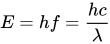
where E is the energy of the quantum (photon), f is the frequency of the light wave, h is the Planck constant, λ is the wavelength and c is the speed of light.
The relationships between the energies of the various quantum states are treated by atomic orbital, molecular orbital, Ligand Field Theory and Crystal Field Theory. If photons of a particular wavelength are absorbed by matter, then when we observe light reflected from or transmitted through that matter, what we see is the complementary color, made up of the other visible wavelengths remaining. For example, beta-carotene has maximum absorption at 454 nm (blue light), consequently what visible light remains appears orange .
Colors by wavelength
[edit]What is seen by the eye is not the color absorbed, but the complementary color from the removal of the absorbed wavelengths. This spectral perspective was first noted in atomic spectroscopy.
Below is a rough table of wavelengths, colors and complementary colors. This utilizes the scientific CMY and RGB color wheels rather than the traditional RYB color wheel.[1]
| Wavelength (nm) |
Color | Complementary color | ||
|---|---|---|---|---|
| 400–424 | violet | yellow | ||
| 424–491 | blue | orange | ||
| 491–570 | green | red | ||
| 570–585 | yellow | violet | ||
| 585–647 | orange | blue | ||
| 647–700 | red | green | ||
This can only be used as a very rough guide, for instance if a narrow range of wavelengths within the band 647–700 nm is absorbed, then the blue and green receptors will be fully stimulated, making cyan, and the red receptor will be partially stimulated, diluting the cyan to a greyish hue.
By category
[edit]The vast majority of simple inorganic (e.g. sodium chloride) and organic compounds (e.g. ethanol) are colorless. Transition metal compounds are often colored because of transitions of electrons between d-orbitals of different energy. (see Transition metal#Colored compounds). Organic compounds tend to be colored when there is extensive conjugation, causing the energy gap between the HOMO and LUMO to decrease, bringing the absorption band from the UV to the visible region. Similarly, color is due to the energy absorbed by the compound, when an electron transitions from the HOMO to the LUMO. Lycopene is a classic example of a compound with extensive conjugation (11 conjugated double bonds), giving rise to an intense red color (lycopene is responsible for the color of tomatoes). Charge-transfer complexes tend to have very intense colors for different reasons.
Examples
[edit]| Name | Formula | Color | |
|---|---|---|---|
| Magnesium(II) | Mg2+ | colorless | |
| Scandium(III) | Sc3+ | silver | |
| Titanium(III) | Ti3+ | purple | |
| Titanium(IV) | Ti4+ | silver | |
| Titanyl | TiO2+ | colorless | |
| Vanadium(II) | V2+ | light purple | |
| Vanadium(III) | V3+ | dark grey-green | |
| Vanadyl(IV) | VO2+ | blue | |
| Vanadium(IV) (vanadite) | V 4O2− 9 |
brown | |
| Vanadium(V) (pervanadyl) | VO+ 2 |
yellow | |
| Metavanadate | VO− 3 |
colorless | |
| Orthovanadate | VO3− 4 |
colorless | |
| Chromium(II) | Cr2+ | bright blue | |
| Chromium(III) | Cr3+ | blue-green-grey | |
| Chromium(III) hydroxide | Cr(OH)63− | yellowish | |
| Monochromate | CrO2− 4 |
yellow | |
| Dichromate | Cr 2O2− 7 |
orange | |
| Manganese(II) | Mn2+ | pale pink | |
| Manganese(III) | Mn3+ | crimson | |
| Manganate(V) | MnO3− 4 |
deep blue | |
| Manganate(VI) | MnO2− 4 |
dark green | |
| Manganate(VII) (permanganate) | MnO− 4 |
deep purple | |
| Iron(II) | Fe2+ | greenish | |
| Cobalt(II) fluoride | Co2+ | pink | |
| Cobalt(III) amine | Co(NH 3)3+ 6 |
yellow/orange | |
| Nickel(II) | Ni2+ | light green | |
| Nickel(II) amine complex | Ni(NH 3)2+ 6 |
lavender/blue | |
| Copper(I) amine complex | Cu(NH 3)+ 2 |
colorless | |
| Copper(II) | Cu2+ | blue | |
| Copper(II) amine complex | Cu(NH 3)2+ 4 |
indigo-blue | |
| Copper(II) chloride | CuCl2− 4 |
blue-green | |
| Zinc(II) | Zn2+ | colorless | |
| Silver(I) | Ag+ | colorless | |
| Silver(III) in conc. HNO3 | Ag3+ | dark brown | |
However, elemental colors will vary depending on what they are complexed with, often as well as their chemical state. An example with vanadium(III); VCl3 has a distinctive reddish hue, whilst V2O3 appears black.
Salts
[edit]Predicting the color of a compound can be extremely complicated. Some examples include:
- Cobalt chloride is pink or blue depending on the state of hydration (blue dry, pink with water) so it is used as a moisture indicator in silica gel.
- Zinc oxide is white, but at higher temperatures becomes yellow, returning to white as it cools.
| Name | Formula of the corresponding salts |
Color | Picture |
|---|---|---|---|
| Iron(III) chloride hexahydrate | FeCl3·6H2O | yellow/brown | _chloride_hexahydrate.jpg)
|
| Iron(III) chloride anhydrate | FeCl3 | black | _chloride_anhydrate.jpg)
|
| Chromium (III) sulfate | Cr2(SO4)3 | dark green | _sulfate.jpg)
|
| Copper(II) sulfate anhydrate | CuSO4 | white | 
|
| Copper(II) sulfate pentahydrate | CuSO4·5H2O | blue | 
|
| Copper(II) benzoate | Cu(C7H5O2)2 | blue | 
|
| Cobalt(II) chloride | CoCl2 | dep blue | _chloride.jpg)
|
| Cobalt(II) chloride hexahydrate | CoCl2·6H2O | deep magenta | _chloride_hexahydrate.jpg)
|
| Manganese(II) chloride tetrahydrate | MnCl2·4H2O | pink | _chloride_tetrahydrate.jpg)
|
| Copper(II) chloride dihydrate | CuCl2·2H2O | blue-green | _chloride_dihydrate.jpg)
|
| Nickel(II) chloride hexahydrate | NiCl2·6H2O | green | 
|
| Lead(II) iodide | PbI2 | yellow | 
|
| Ammonium dichromate | (NH4)2Cr2O7 | orange | 
|
Ions in flame
[edit]| Name | Formula | Color | |
|---|---|---|---|
| Lithium | Li | red | |
| Sodium | Na | yellow/orange | |
| Magnesium | Mg | brilliant white | |
| Potassium | K | lilac/violet | |
| Calcium | Ca | brick red | |
| Rubidium | Rb | red-violet | |
| Strontium | Sr | red | |
| Caesium | Cs | light blue | |
| Barium | Ba | green/yellow | |
| Copper | Cu | Blue/Green(Often with white flashes) | |
| Lead | Pb | Grey/White | |
Gases
[edit]| Name | Formula | Color | |
|---|---|---|---|
| Hydrogen | H2 | colorless | |
| Oxygen | O2 | pale blue | |
| Ozone | O3 | pale blue | |
| Fluorine | F2 | pale yellow | |
| Chlorine | Cl2 | greenish yellow | |
| Bromine | Br2 | red/brown | |
| Iodine | I2 | dark purple | |
| Chlorine dioxide | ClO2 | intense yellow | |
| Dichlorine monoxide | Cl2O | brown/yellow | |
| Nitrogen dioxide | NO2 | dark brown | |
| Trifluoronitrosomethane | CF3NO | deep blue | |
| Diazomethane | CH2N2 | yellow | |
Bead tests
[edit]A variety of colors, often similar to the colors found in a flame test, are produced in a bead test, which is a qualitative test for determining metals. A platinum loop is moistened and dipped in a fine powder of the substance in question and borax. The loop with the adhered powders is then heated in a flame until it fuses and the color of the resulting bead observed.
| Metal[3] | Oxidizing flame | Reducing flame |
|---|---|---|
| Aluminium | colorless (hot and cold), opaque | colorless, opaque |
| Antimony | colorless, yellow or brown (hot) | gray and opaque |
| Barium | colorless | |
| Bismuth | colorless, yellow or brownish (hot) | gray and opaque |
| Cadmium | colorless | gray and opaque |
| Calcium | colorless | |
| Cerium | red (hot) | colorless (hot and cold) |
| Chromium | dark yellow (hot), green (cold) | green (hot and cold) |
| Cobalt | blue (hot and cold) | blue (hot and cold) |
| Copper | green (hot), blue (cold) | red, opaque (cold), colorless (hot) |
| Gold | golden (hot), silver (cold) | red (hot and cold) |
| Iron | yellow or brownish red (hot and cold) | green (hot and cold) |
| Lead | colorless, yellow or brownish (hot) | gray and opaque |
| Magnesium | colorless | |
| Manganese | violet (hot and cold) | colorless (hot and cold) |
| Molybdenum | colorless | yellow or brown (hot) |
| Nickel | brown, red (cold) | gray and opaque (cold) |
| Silicon | colorless (hot and cold), opaque | colorless, opaque |
| Silver | colorless | gray and opaque |
| Strontium | colorless | |
| Tin | colorless (hot and cold), opaque | colorless, opaque |
| Titanium | colorless | yellow (hot), violet (cold) |
| Tungsten | colorless | brown |
| Uranium | yellow or brownish (hot) | green |
| Vanadium | colorless | green |
References
[edit]- ^ "SAP Fiori | SAP Community".
- ^ Flame Tests at chemguide.co.uk
- ^ CRC Handbook of Chemistry and Physics. CRC Press. 1985. ISBN 0-8493-0466-0.
Color topics | ||||||||||
|---|---|---|---|---|---|---|---|---|---|---|
| Color science |
|  | ||||||||
| Color philosophy |
| |||||||||
| Color terms |
| |||||||||
| Color organizations | ||||||||||
| Names |
| |||||||||
| Related | ||||||||||


Color of chemicals
View on GrokipediaPrinciples of Coloration
Light Absorption and Perception
Color is defined as the portion of the electromagnetic spectrum visible to the human eye, spanning wavelengths approximately from 400 to 700 nanometers.[4] This range corresponds to the frequencies that stimulate visual perception, with shorter wavelengths perceived as violet and longer ones as red. The color observed in chemicals arises from the selective absorption of light, where certain wavelengths are absorbed by the material while others are transmitted or reflected.[5] For instance, if a chemical absorbs red light (around 620-700 nm), the transmitted or reflected light appears blue, as the complementary color dominates the visual output.[6] This process underpins the coloration in solutions, solids, and gases, with absorption driven by interactions between light and molecular structures.[7] Human perception of these colors relies on the trichromatic system in the retina, where three types of cone cells are sensitive to red (approximately 560-580 nm peak), green (530 nm peak), and blue (420-440 nm peak) wavelengths.[8] The brain interprets the relative stimulation of these cones to perceive a wide array of colors, including complementary ones that emerge when specific wavelengths are absorbed, leaving the opposing hues to activate the cones.[6] For example, absorption in the green-yellow range (around 500-570 nm) results in a reddish appearance due to enhanced red and blue cone responses.[9] The intensity of color in chemical solutions is quantitatively described by Beer's Law, which states that absorbance is proportional to the concentration of the absorbing species: where is the absorbance, is the molar absorptivity (a constant specific to the substance and wavelength), is the path length of light through the sample, and is the concentration.[10] This relationship allows for precise measurement of color intensity and concentration in analytical chemistry.[11] The foundational understanding of light dispersion into colors traces back to Isaac Newton's experiments in 1666, where he used prisms to demonstrate that white light separates into a spectrum of distinct wavelengths when refracted.[12] By passing sunlight through a prism and recombining the colors with a second prism, Newton showed the composite nature of white light, laying the groundwork for studies of absorption and perception.[13]Electronic Transitions in Molecules
In molecules, electrons occupy discrete energy levels governed by quantum mechanics, leading to electronic transitions when photons of specific energy are absorbed to promote electrons between these levels. The energy difference ΔE between molecular orbitals corresponds to the absorbed photon's frequency ν via the relation ΔE = hν, where h is Planck's constant; this absorption occurs if the photon energy matches the transition energy, typically in the ultraviolet-visible range for colored compounds.[14] These transitions are responsible for the selective absorption of visible light, resulting in the observed color of chemicals as the complementary wavelengths are transmitted or reflected.[9] Common types of electronic transitions include n→π* and π→π* in organic chromophores, where non-bonding (n) electrons or π electrons are excited to antibonding π* orbitals. The π→π* transitions, prevalent in conjugated systems like alkenes and carbonyls, are intense and occur at higher energies (shorter wavelengths) in isolated chromophores but shift to lower energies with extended conjugation.[9] In transition metal coordination compounds, d-d transitions involve electrons moving between split d orbitals, while charge transfer transitions, such as ligand-to-metal (LMCT) or metal-to-ligand (MLCT), entail electron relocation between metal and ligand orbitals, often producing more intense colors due to their allowed nature.[15] For instance, LMCT transitions dominate in d⁰ complexes like permanganate [MnO₄]⁻, contributing to its purple hue through strong absorption in the green-yellow region.[15] Factors influencing the energy and thus the color include ligand field effects in metal complexes and conjugation length in organics. Ligand field theory describes how ligands split the degenerate d orbitals in transition metals; in octahedral complexes, the d orbitals divide into lower-energy t₂g and higher-energy e_g sets, with the splitting energy Δ_o determining the d-d transition wavelength—strong-field ligands like CN⁻ increase Δ_o, shifting absorption to shorter wavelengths compared to weak-field ligands like H₂O.[16] Tetrahedral complexes exhibit smaller splitting Δ_t (about 4/9 of Δ_o), often leading to different colors due to inverted orbital ordering.[16] In organic molecules, increasing conjugation length lowers the HOMO-LUMO gap, causing a bathochromic shift that extends absorption into the visible spectrum; for example, benzene (limited conjugation) absorbs in the UV and is colorless, while polyenes with longer conjugation appear yellow or orange.[9] Saturated organic compounds typically undergo transitions in the ultraviolet region, rendering them colorless, whereas unsaturated systems or those with metal centers absorb visible light. For instance, the hexaaquacopper(II) ion [Cu(H₂O)₆]²⁺ appears blue due to a d-d transition at approximately 800 nm, absorbing red light and transmitting blue, with the octahedral ligand field from water ligands causing the necessary d-orbital splitting for this d⁹ configuration.[17] In contrast, charge transfer in coordination compounds like [Cr(NH₃)₅Cl]²⁺ produces intense colors across a broad range, highlighting how these mechanisms differentiate colorless from vividly colored chemicals.[15]Color Categorization
By Spectral Wavelength
The color of chemicals can be classified based on the wavelengths of light they reflect or transmit within the visible spectrum, which spans approximately 400 to 700 nm. This approach provides a systematic categorization of hues independent of the molecular structure causing the color, focusing instead on the physical properties of light interaction. The visible spectrum is divided into distinct bands corresponding to primary colors: violet (400-420 nm), blue (420-490 nm), green (490-570 nm), yellow (570-585 nm), orange (585-620 nm), and red (620-700 nm). These ranges represent the approximate wavelengths perceived by the human eye as specific colors, though boundaries can vary slightly due to individual physiological differences.[9] The observed color of a chemical arises from the selective absorption of certain wavelengths, with the complementary wavelengths being transmitted or reflected to the observer. For instance, absorption primarily in the blue-violet region results in an appearance of yellow-orange, as these longer wavelengths dominate the reflected light. This complementary relationship is illustrated in the following table, which maps common absorbed wavelength bands to their corresponding observed colors:| Absorbed Wavelength Band | Approximate Range (nm) | Observed Color |
|---|---|---|
| Violet | 400-420 | Yellow-green |
| Blue | 420-490 | Orange |
| Green | 490-570 | Magenta/purple |
| Yellow | 570-585 | Blue |
| Orange | 585-620 | Blue-green |
| Red | 620-700 | Green |
By Chemical Composition
The coloration of chemicals varies significantly based on their chemical composition, with a fundamental divide between inorganic and organic compounds. Inorganic compounds frequently obtain vivid colors from transition metal ions in the d-block, where electronic transitions—such as d-d excitations or charge transfers between metal and ligands—absorb visible light, resulting in hues like blue, green, or purple.[21] In organic compounds, color arises primarily from chromophores involving extended conjugated systems of alternating single and double bonds, which delocalize π-electrons and enable absorption in the visible spectrum, often producing bright yellows, oranges, or reds.[3] This distinction highlights how inorganic coloration tends to stem from ionic or coordination interactions, while organic coloration relies on molecular orbital overlaps in carbon-based frameworks. Within inorganic classes, transition metal complexes exhibit particularly variable colors influenced by the metal's oxidation state and surrounding ligands; for instance, changes in these factors can shift absorption wavelengths, leading to diverse observed hues. Main group compounds, comprising elements outside the d-block, are rarely colored because their electronic transitions typically occur in the ultraviolet region; exceptions involve charge transfer processes, such as in diatomic halogens, yielding purple or brown shades.[22] Organometallic compounds, bridging inorganic and organic realms, display hybrid coloration from combined metal-ligand charge transfers and conjugated organic moieties, often resulting in intense, tunable colors used in dyes and catalysts.[23] Key factors influencing color by class include the intensity and wavelength of absorptions specific to each type. In inorganics, charge transfer mechanisms—where electrons move between ligands and metals—produce especially intense colors, as seen in permanganate ions appearing deep purple due to oxygen-to-manganese electron promotion.[21] For organics, chromophores like azo groups (-N=N-) in conjugated systems extend electron delocalization, shifting absorption from ultraviolet (as in benzene) to visible light with increasing conjugation length, enabling a broad palette from yellow to blue.[2] These class-specific features underscore how structural composition dictates not only the presence of color but also its vibrancy and spectral position.| Class | Typical Color Mechanism | Example Hue |
|---|---|---|
| Transition metal complexes | d-d transitions or charge transfer | Blue, green, red |
| Main group compounds | Charge transfer or band transitions | Purple, brown |
| Organic conjugated systems | π-π* excitations in chromophores | Yellow, orange, red |
| Organometallics | Hybrid metal-organic interactions | Variable intense shades |
Specific Chemical Examples
Inorganic Salts and Ions
Inorganic salts and ions often exhibit vibrant colors due to electronic transitions within their structures, particularly in transition metal compounds where partially filled d-orbitals enable d-d transitions that absorb visible light./Coordination_Chemistry/Complex_Ion_Chemistry/Origin_of_Color_in_Complex_Ions) These colors are prominent in aqueous solutions and solid forms, arising from the interaction of ions with ligands like water molecules. For instance, many transition metal cations form colored hydrated complexes, while certain anions display intense hues from charge-transfer processes.[25] Hydration plays a crucial role in determining the color of inorganic salts, as water molecules coordinate to metal ions, altering their electronic environment. Anhydrous copper(II) sulfate (CuSO₄) appears white because it lacks the ligand field splitting necessary for visible light absorption, but upon hydration to form the pentahydrate (CuSO₄·5H₂O), it turns deep blue due to the [Cu(H₂O)₆]²⁺ complex.[26] This reversible color change is a classic demonstration of hydration effects and is used in laboratory tests for water detection. Similar variations occur in other salts, such as cobalt(II) chloride, which shifts from blue (anhydrous) to pink (hydrated).[27] The color of ions in solution can also depend on oxidation states, as changes in electron configuration shift absorption wavelengths. For manganese, the +2 oxidation state (Mn²⁺) produces a pale pink aqueous solution from weak d-d transitions, while the +7 state in permanganate (MnO₄⁻) yields a deep purple color due to intense charge-transfer bands. Iron provides another example: Fe²⁺ is pale green, but Fe³⁺ appears yellow to brown in aqueous solutions, reflecting differences in d-orbital occupancy.[28] Anions like chromate (CrO₄²⁻) are yellow, contrasting with the orange dichromate (Cr₂O₇²⁻) in acidic conditions, both from ligand-to-metal charge transfer. In aqueous solutions, the observed color intensity follows Beer's Law, where absorbance (and thus perceived color depth) is proportional to ion concentration, allowing quantitative analysis via spectrophotometry./Instrumentation_and_Analysis/Beers_Law) For example, dilute Cu²⁺ solutions appear lighter blue than concentrated ones, aiding in concentration measurements without altering the fundamental hue.[25]| Ion | Color in Aqueous Solution | Brief Reason |
|---|---|---|
| Cu²⁺ | Blue | d-d transition in [Cu(H₂O)₆]²⁺ |
| Fe³⁺ | Yellow to brown | d-d transition, ligand effects |
| Ni²⁺ | Green | d-d transition in [Ni(H₂O)₆]²⁺ |
| Co²⁺ | Pink | d-d transition in [Co(H₂O)₆]²⁺ |
| Mn²⁺ | Pale pink | Weak d-d transition |
| MnO₄⁻ | Deep purple | Charge transfer |
| CrO₄²⁻ | Yellow | Charge transfer |
Flame Emission Colors
Flame emission colors result from the thermal excitation of metal ions in a high-temperature flame, where electrons are promoted to higher energy levels and subsequently emit photons of specific wavelengths upon returning to the ground state, producing sharp line spectra characteristic of atomic transitions. This process differs from the broad absorption bands seen in molecular solutions, as the flame volatilizes the sample into gaseous atoms or simple ions, minimizing vibrational broadening.[29][30] The standard procedure for a flame test involves cleaning a nichrome or platinum wire by dipping it in dilute hydrochloric acid and heating it until no color is observed, then dipping the wire into a concentrated solution of the metal salt and introducing it to the inner blue cone of a Bunsen burner flame for observation. Alternatively, a fine mist of the ethanolic salt solution can be sprayed into the flame using a trigger pump bottle for a more vivid display. Safety measures include performing the test in a well-ventilated area, wearing eye protection, and directing sprays away from personnel to avoid inhalation or eye exposure to fumes.[31] Characteristic emission colors serve as qualitative identifiers for specific ions, with the dominant wavelengths corresponding to key spectral lines. For instance, the sodium D-line at 589 nm produces the intense yellow hue, while potassium's principal line at 766 nm yields a violet appearance. Calcium exhibits brick-red emission primarily from lines around 622 nm, and copper ions generate green or blue colors through multiple bands in the 450-570 nm range. These colors arise from electronic de-excitation in isolated atoms, enabling rapid identification in analytical chemistry.[30][31][32]| Ion | Color | Principal Wavelength (nm) |
|---|---|---|
| Na⁺ | Yellow | 589 |
| K⁺ | Violet | 766 |
| Ca²⁺ | Brick-red | 622 |
| Cu²⁺ | Green/Blue | 450-570 (bands) |
Gases and Analytical Tests
Chemical gases often display vivid colors attributable to electronic transitions within their molecules that absorb specific wavelengths of visible light, allowing the transmitted or reflected light to determine the perceived hue. For instance, nitrogen dioxide (NO₂) manifests as a reddish-brown gas due to the absorption of blue-green light by its unpaired electron occupying a π* antibonding orbital.[33] This color intensity varies with temperature because NO₂ dimerizes to form the colorless dinitrogen tetroxide (N₂O₄), paling the gas upon cooling.[34] Among the halogens, chlorine (Cl₂) appears yellow-green as a gas, resulting from absorption primarily in the violet region of the spectrum; this trend intensifies down the group as the energy gap between highest occupied and lowest unoccupied molecular orbitals narrows, shifting absorption to longer wavelengths./Descriptive_Chemistry/Elements_Organized_by_Block/2_p-Block_Elements/Group_17:The_Halogens/Z=17_Chemistry_of_Chlorine(Z=17)) Iodine (I₂) vapor, in contrast, exhibits a striking purple coloration from absorption in the yellow-green region, consistent with the halogen series where heavier members show deeper hues./Descriptive_Chemistry/Elements_Organized_by_Block/2_p-Block_Elements/Group_17:The_Halogens/Z=17_Chemistry_of_Chlorine(Z=17)) In qualitative analysis, certain gas-phase reactions produce visible indicators, such as the white fumes formed when ammonia (NH₃) gas encounters hydrogen chloride (HCl) gas, yielding solid ammonium chloride (NH₄Cl) particles that scatter light and appear as dense smoke.[35] This test highlights gas diffusion and reactivity without relying on inherent molecular color, serving as a confirmatory tool for these species. The borax bead test, a longstanding qualitative method for detecting transition metal ions, involves heating borax (sodium tetraborate decahydrate, Na₂B₄O₇·10H₂O) with a sample to form colored metaborate glasses.[36] To perform the test, a platinum wire loop is cleaned by heating in a Bunsen burner flame and, if needed, dipping in concentrated hydrochloric acid followed by reheating to remove residues. The loop is then loaded with powdered borax and heated in the oxidizing (outer) flame until a clear, glassy bead forms; after cooling, the bead contacts the solid sample or its solution, and the process is repeated—heating first in the oxidizing flame to observe oxide-related colors, then in the reducing (inner) flame for reduced species colors—while noting hues both hot and cold.[37] These colors stem from the incorporation of metal ions into the borate matrix, where d-orbital transitions or charge-transfer processes produce characteristic absorptions.[38] Representative colors from the borax bead test for common metal ions are summarized below:| Metal Ion | Oxidizing Flame Color | Reducing Flame Color |
|---|---|---|
| Co²⁺ | Blue | Blue |
| Cu²⁺ | Blue | Opaque red |
| Fe³⁺ | Yellow | Green |
| Mn²⁺ | Violet | Colorless |
| Ni²⁺ | Reddish-brown | Grey |