Hubbry Logo
search
logo
2099041

Colorado State Capitol

logo
Community Hub0 Subscribers

Wikipedia

from Wikipedia

Colorado State Capitol
The Colorado State Capitol in Denver
Colorado State Capitol is located in Colorado
Colorado State Capitol
Colorado State Capitol is located in the United States
Colorado State Capitol
Map
Interactive map showing the location of Colorado State Capitol
Location200 East Colfax Avenue
Denver, Colorado, United States
Coordinates39°44′21″N 104°59′06″W / 39.7392321°N 104.9848677°W / 39.7392321; -104.9848677 (Colorado State Capitol)
Built1901; 124 years ago (1901)
ArchitectElijah E. Myers
Architectural styleneoclassical style
Part of
Significant dates
Designated NHLDCPOctober 16, 2012
Designated CPFebruary 27, 1974
The statue The Closing of an Era at the Colorado capitol.[1]

The Colorado State Capitol Building, located at 200 East Colfax Avenue in Denver, Colorado, United States, is the home of the Colorado General Assembly and the offices of the Governor of Colorado, Lieutenant Governor of Colorado, and the Colorado State Treasurer.

History

[edit]

The building is intentionally reminiscent of the United States Capitol. Designed by Elijah E. Myers, it was constructed in the 1890s from Colorado white granite, and opened for use in November 1894. The distinctive gold dome consists of real gold leaf, first added in 1908, commemorating the Colorado Gold Rush. The building is part of Denver's Civic Center area. It was listed on the National Register of Historic Places as part of the Civic Center Historic District in 1974,[2][3][4] and became part of the Denver Civic Center National Historic Landmark District in 2012.[5]

A major safety upgrade project, funded by the Colorado State Historical Fund, was started in 2001 and completed in 2009.[6] The design by Fentress Architects added modern safety features, like enclosed stair towers, that blended in with the original architecture.[7] The Colorado Capitol Building is featured on many of Denver's architectural tours.[8][9]

Building

[edit]

Serving as the beginning of the Capitol Hill district, the historic building sits slightly higher than the rest of downtown Denver. The main entrance hall is open 180 feet (55 m) to the top of the dome, about the height of an 18-story building. Additionally, the official elevation of Denver is measured outside the west entrance to the building, where the fifteenth step is engraved with the words "One Mile Above Sea Level". From this step, at 5,280 feet (1,609 m), the sun can be seen setting behind the Rocky Mountains. A second mile high marker was set in the 18th step in 1969 when Colorado State University students resurveyed the elevation. In 2003, a more accurate measurement was made with modern means, and the 13th step was identified as being one mile (1.6 km) high, where a 3rd marker was installed.[10]

Materials

[edit]

The superstructure of the building was constructed using granite from the Aberdeen Quarry near Gunnison, Colorado. Approximately 280,000 cubic feet (7,900 m3) or 24,000 tons of the granite were quarried for the building. This gray granite forms the exterior of the building. The interior of the building uses a large amount of Colorado Rose Onyx, a rare rose marble from a quarry near Beulah, Colorado. The amount used in the building consumed the entire known supply. White Yule Marble from the quarries near Marble, Colorado was also used throughout the capitol for the floors. Many designs have been found in the marble including an image resembling George Washington and another of Molly Brown.[11][12]

Many of the windows are made of stained glass, depicting people or events related to the history of Colorado. The halls are decorated with portraits of every president of the United States, with all the presidents from George Washington to George W. Bush being painted by Lawrence Williams. Painter Sarah A. Boardman took over from Williams, and has since painted Barack Obama and the original portrait of Donald Trump, which was removed after Trump criticized it and replaced with one by Arizonan artist Vanessa Horabuena.[13] Colorado artist Kirsten Savage painted President Joe Biden's portrait.[14] One of the contractors for the construction of the Colorado State Capitol building was Illinois building contractor William Douglas Richardson, who was the president of the W. D. Richardson Construction Company.[15] Richardson had participated in numerous major building contracts throughout the United States, and was interconnected with the Jacob Bunn and John Whitfield Bunn network of corporations.[16]

[edit]

See also

[edit]

References

[edit]
[edit]

Grokipedia

from Grokipedia
The Colorado State Capitol is the seat of Colorado's legislative and executive branches of government, located at the western edge of downtown Denver atop Capitol Hill.[1] Constructed from Colorado white granite in a neoclassical style intentionally reminiscent of the United States Capitol, the building houses the bicameral Colorado General Assembly—comprising the Senate and House of Representatives—as well as the offices of the governor and lieutenant governor.[2][1] Designed by architect Elijah E. Myers following a statewide competition, groundbreaking occurred in 1886, with initial wings completed by 1894, though the project faced significant delays and cost overruns that led to Myers's dismissal in 1890 and subsequent oversight by local architects like Frank Edbrooke.[1][3] The structure's defining feature is its low dome, originally intended to be copper-plated but gilded in 1908 with approximately 200 ounces of 24-karat gold leaf sourced from the Cripple Creek mining district to commemorate Colorado's 1859 Gold Rush and the contributions of its miners.[4][5] This gold has been reapplied multiple times due to weathering, most recently during restorations that also addressed structural issues in the cast-iron framework.[4] Internally, the capitol showcases native materials such as Yule marble and artworks depicting pioneer history, while serving as a working government facility open to public tours when the legislature is not in session.[6] As the only state capitol with LEED Gold certification, it balances historical preservation with modern sustainability efforts.[2]

History

Site Selection and Planning (1886–1890)

In 1868, following the relocation of Colorado's territorial capital to Denver, real estate developer Henry C. Brown donated a 10-acre tract of land on a prominent hill approximately one mile east of the city's center to serve as the site for the future state capitol building; this donation was accepted by the Territorial Capitol Commission amid competing offers, fulfilling legislative requirements for donated land to avoid taxpayer burden.[7][8] The elevated location, known as Capitol Hill, was chosen for its visibility, defensibility against flooding from the nearby South Platte River, and symbolic elevation above the commercial districts, aligning with urban planning principles favoring prominent civic sites.[7] By the mid-1880s, after years of post-statehood delays due to fiscal constraints and competing priorities, the Colorado General Assembly enacted legislation in 1883 to allocate initial funds and establish a Board of Capitol Managers to oversee planning and construction.[9] The board, comprising state officials and appointees, conducted material assessments in 1884, collaborating with engineers from the Denver Society of Civil Engineers and the Colorado School of Mines to test granite samples from various quarries for durability, workability, and aesthetic suitability, ultimately favoring local white granite to symbolize state resource self-sufficiency.[9] In 1886, the board organized an architectural design competition, which was won by Elijah E. Myers, a Detroit-based architect known for prior state capitol projects in Michigan and Texas; his Renaissance Revival-inspired plans emphasized a central dome, cruciform layout, and neoclassical elements echoing the U.S. Capitol, with an initial projected construction cost of $1 million.[9][10] Groundbreaking and excavation commenced that summer on the pre-selected site, marking the transition from planning to active development, though detailed site preparation revealed foundational challenges like uneven terrain requiring extensive grading.[8] Between 1886 and 1890, the board refined specifications for structural integrity, including deep foundations to mitigate seismic risks and soil instability inherent to the Front Range geology, while securing legislative appropriations amid debates over cost controls.[9]

Construction and Challenges (1890–1908)

Construction of the Colorado State Capitol commenced following the resolution of site acquisition disputes, with groundbreaking occurring in July 1886, though substantial work accelerated after the laying of the cornerstone on July 4, 1890.[9][3] The project, initially estimated at $1 million, employed approximately 240 workers under the direction of architects and contractors, utilizing Colorado white granite quarried from Gunnison County.[11] Designed by Elijah E. Myers, who had previously crafted capitols in Michigan and Texas, the structure drew neoclassical influences reminiscent of the U.S. Capitol, with construction focusing first on the foundational wings to allow partial occupancy.[1] By November 1894, the legislative chambers were sufficiently complete for the General Assembly to convene, marking an early operational phase despite unfinished elements like the full dome.[1] Significant challenges arose from escalating costs and design complexities, which ballooned expenditures to $3.7 million by completion—equivalent to over $100 million in contemporary terms—far exceeding initial projections due to material demands and structural ambitions.[3] Myers faced accusations of intentional over-design to inflate fees, leading the Board of Capitol Managers to terminate his involvement in June 1889 amid disputes over payments and progress.[9] Local architect Frank E. Edbrooke, who had placed second in the original 1886 design competition, assumed oversight thereafter, adhering largely to Myers's exterior plans while refining interiors and detailing to mitigate further overruns.[3][12] Delays persisted through the 1890s and into the 1900s, attributed to legal entanglements from prior landowner J.J. Brown, restrictive state funding statutes, and the logistical demands of sourcing granite and cast iron amid economic fluctuations.[9] The dome's erection, a focal engineering feat symbolizing state prestige, extended into the early 1900s, with full exterior completion not achieved until 1908, reflecting the protracted nature of public works in a frontier-era economy.[13] These hurdles underscored tensions between architectural grandeur and fiscal restraint, yet enabled phased utilization that supported governance continuity.[9]

Opening and Early Operations (1894–1910s)

The Colorado State Capitol partially opened for occupancy on November 9, 1894, when Governor Davis H. Waite and other state officials relocated from the previous capitol building despite ongoing construction.[14] [1] This move addressed impatience with the protracted building process, allowing administrative functions to commence amid incomplete features such as the grand staircase and rotunda.[13] [9] The first full legislative session in the new Capitol occurred in 1897, marking the Colorado General Assembly's transition to the facility for routine operations, including debates and lawmaking in the provisional chambers.[13] Early sessions operated under makeshift conditions, with construction noise and dust persisting as workers advanced on interior finishes and structural elements.[9] By the early 1900s, the building housed core legislative activities, though the iconic dome remained unfinished until 1908, when its completion enabled full symbolic and functional integration.[15] Into the 1910s, the Capitol served as the primary venue for state governance, accommodating the biennial sessions of the bicameral legislature and executive offices without major interruptions, even as minor expansions and maintenance addressed wear from initial use.[1] Historical records indicate steady operational adaptation, with the facility's neoclassical design facilitating public access and ceremonial events, though no significant overhauls were documented in this period.[16]

Architecture and Design

Overall Structure and Influences

The Colorado State Capitol exhibits a Greek cross plan, with four symmetrical wings radiating from a central rotunda beneath a towering dome that reaches 180 feet (55 meters) from the main entrance hall floor.[1] [17] This cruciform layout accommodates executive offices on the ground floor and legislative chambers on upper levels, reflecting functional requirements for state government operations.[17] The structure rises four stories overall, constructed on a prominent hilltop site to dominate the Denver skyline and symbolize institutional authority.[12] Architect Elijah E. Myers designed the building in 1886, intentionally emulating the United States Capitol to evoke the enduring principles of democracy and national unity in the post-Civil War era.[1] [17] Neoclassical in style, it incorporates Renaissance Revival elements such as Corinthian columns, pedimented porticos, and balanced proportions, drawing from classical Greek and Roman precedents adapted for 19th-century American public architecture.[18] [19] Myers' approach combined these historical influences with contemporaneous engineering, including cast-iron framing and fireproof materials, informed by his prior commissions for state capitols in Michigan and Texas.[12] [9] The design board's tours of Midwestern capitols, such as those in Wisconsin, Iowa, and Michigan, further shaped the project, emphasizing grandeur and material durability over ornate excess.[17] This synthesis prioritized symbolic permanence, with the dome—initially copper-sheeted and later gilded in 1908—serving as a focal point akin to its federal counterpart, while local granite ensured regional identity.[1] [17]

Exterior Elements

The Colorado State Capitol's exterior exemplifies neoclassical architecture, designed by Elijah E. Myers in a style reminiscent of the United States Capitol, with a cruciform plan measuring 383 feet in length by 315 feet in width.[8][1] The facade employs gray granite quarried from the Aberdeen Quarry in Gunnison County, selected for its durability and to symbolize Colorado's natural resources.[12] Complementing the stone, lighter granite-colored cast iron details ornament the three-story porticos, window surrounds, quoins, belt courses, and cornices, balancing aesthetic refinement with practical construction economics.[12] Monumental porticos project from pavilions on each of the four facades, featuring the Corinthian order to evoke classical grandeur.[20] The principal west entrance highlights a high Corinthian porch, framing the approach and aligning visually with Denver's Civic Center and the Rocky Mountains beyond.[21] These elements underscore the building's symmetrical massing and horizontal emphasis, achieved through rusticated base courses and layered entablatures that rise across its five-story height plus additional stories in the central tower.[22][12]

Dome and Iconic Features

The dome of the Colorado State Capitol stands at 272 feet from ground level to its pinnacle, forming a prominent feature of the Renaissance Revival structure designed by architect Elijah E. Myers.[23] Constructed primarily of cast-iron panels bolted together, the dome was initially sheathed in copper plating upon completion in 1894, which oxidized to a green patina before being replaced with gold leaf in 1908.[24][1] The gilding, applied using approximately 200 ounces of 24-karat gold leaf sourced from Colorado mines such as those in Cripple Creek, commemorates the state's 1859 Gold Rush and symbolizes its mining heritage.[25][5] This thin layer of gold, consisting of about 140,000 leaves in recent applications, covers copper panels beneath and requires periodic restoration due to exposure to the elements; re-gildings have occurred multiple times, including in 2013 when 60-65 ounces were used for the dome and lantern.[4][26] Crowning the dome is a steel-and-glass lantern, also gilded, which serves both aesthetic and functional purposes by admitting light to the interior rotunda below.[4] The dome's interior height measures 180 feet from the main entrance hall floor, equivalent to an 18-story building, allowing visitors to view intricate ironwork and decorative elements from the rotunda.[1] This gilded dome, visible across Denver's skyline, stands as an iconic emblem of Colorado's history and elevation precisely one mile above sea level.[27]

Materials and Construction Techniques

Granite and Stone Sourcing

The exterior walls and foundation of the Colorado State Capitol were built using gray granite sourced from the Aberdeen Quarry, located south of Gunnison in Gunnison County, Colorado.[28][12][13] This quarry, operated by the Zugelder family, supplied large blocks weighing up to 15 tons each, which were transported by rail to Denver for construction beginning in 1890.[11] The selection emphasized local materials to symbolize Colorado's rugged terrain and self-reliance, with the granite's durability contributing to the building's neoclassical permanence despite initial cost overruns that exceeded estimates by over double for the foundation alone.[13] Interior stone sourcing featured Colorado Rose Onyx, a rare pinkish-red metamorphosed limestone (often misclassified as marble) quarried exclusively from a deposit near Beulah in Pueblo County, approximately 100 miles south of Denver.[1][6] The Capitol incorporated nearly the entire known global supply of this stone—estimated at 99% of reserves—for wainscoting, columns, and decorative elements in the rotunda and hallways, with quarrying ceasing after depletion around 1894.[29][30] Its iron oxide tinting and veining patterns provided unique aesthetic value, though the stone's scarcity limited further use elsewhere.[31] White Yule Marble, Colorado's state rock since 2004, was employed for the building's floors and basement areas, sourced from quarries in the town of Marble, Gunnison County, about 80 miles southeast of the Aberdeen site.[1][29] This high-purity calcite marble (over 99% pure) was first significantly utilized in the Capitol around 1895, with blocks hauled by rail after initial extraction challenges in the West Elk Mountains.[32] Its uniform texture and brilliance enhanced the interior's opulence, aligning with the project's goal of showcasing state resources while adhering to practical engineering needs for polished, load-bearing surfaces.[33]

Gold Leaf Application

The gold leaf gilding of the Colorado State Capitol dome was first undertaken in 1908 to replace the original copper sheeting, which had oxidized and developed an unsightly green patina, while symbolizing the state's gold mining legacy from the 1859 Pikes Peak Gold Rush. Approximately 200 ounces of 24-karat gold, donated by Colorado mining interests including operations in Cripple Creek, was hammered into ultra-thin sheets—typically less than 3 microns thick—and applied by gilders to adhesive-coated copper panels that were then secured over the dome's cast-iron framework.[1][13][34] The application process involved meticulous hand-laying of the fragile leaf squares, often 3 inches across, onto the prepared surfaces using specialized tools like gilder’s tips and squirrel-hair brushes to minimize wrinkles and ensure adhesion against wind and weather exposure. This initial gilding required an estimated 140,000 such squares to fully cover the dome, with the gold sourced domestically to emphasize Colorado's mineral wealth, though later iterations incorporated international processing for consistency.[35][26] Subsequent regildings have occurred approximately every 20–40 years due to natural degradation from ultraviolet radiation, precipitation, and thermal expansion, with four reapplications documented since 1908 to maintain the dome's luster. For instance, the 2013 effort utilized 65 ounces of gold mined from the Cripple Creek & Victor operations in Teller County, valued at around $120,000, which was melted into ingots, shipped to Florence, Italy, for leaf production, and then repatriated for on-site application by specialized firms like EverGreene Architectural Arts. A more recent 2023–2025 project employed about 4 pounds (64 ounces) of donated gold from the same mining company, again processed abroad before local gilding to copper panels, underscoring ongoing reliance on high-purity, Colorado-origin metal despite global supply chains for fabrication.[36][37][4] Engineering adaptations in modern regildings include forensic assessments of the underlying structure for corrosion and the use of durable adhesives compatible with historic copper substrates, ensuring longevity without altering the original 1908 aesthetic. These efforts, often funded through state preservation budgets and private donations, highlight the dome's status as one of few U.S. capitol domes featuring genuine gold leaf, with total gold usage across applications exceeding 500 ounces.[26][5]

Engineering Considerations

The Colorado State Capitol's foundation was engineered to address the site's location on Capitol Hill, where soil stability and rock quality posed initial challenges; in 1884, the building commission collaborated with the Denver Society of Civil Engineers and experts from the Colorado School of Mines to test rock samples from multiple quarries, ultimately selecting sandstone from Fort Collins for the base due to its compressive strength and availability.[9] [38] Foundation floors incorporated gray granite from the Zugelder Quarry south of Gunnison, which exceeded original cost estimates by more than double owing to the material's volume and quarrying difficulties.[13] The five-foot-thick exterior walls, constructed from load-bearing Colorado white granite, provided structural rigidity and fire resistance, with engineering emphasizing masonry bonding techniques to mitigate settling on the uneven terrain at 5,280 feet elevation.[1] [38] The dome, completed in 1908 after the main structure opened in 1894, utilized a cast-iron framework of riveted and bolted panels to achieve a lightweight yet durable span rising approximately 270 feet from the base, integrating modern ironworking with the neoclassical design inspired by the U.S. Capitol.[24] [1] This material choice addressed weight distribution challenges, as cast iron's tensile strength supported the lantern and exterior covering without excessive load on the granite substructure, though subsequent analyses during restorations confirmed minimal replication needs for the original elements, indicating robust initial engineering.[39] Architect Elijah E. Myers incorporated fireproof elements throughout, including brick interior walls and iron reinforcements, to enhance longevity in Colorado's variable climate and seismic risks, though original plans did not include explicit earthquake retrofitting.[9] [13]

Interior Features

Legislative Chambers

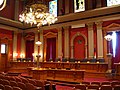
The legislative chambers of the Colorado State Capitol, situated on the third floor, serve as the meeting spaces for the bicameral Colorado General Assembly, comprising the House of Representatives with 65 members and the Senate with 35 members.[40][41] These chambers were first occupied by the General Assembly in 1894 following the building's partial completion.[16] Both feature ornate historic designs restored to their 1905 appearance through a three-phase project authorized by the legislature in 2014, which removed 1950s-era acoustic tiles, reinstated stenciling, coffered ceilings, and skylights, and incorporated modern acoustic enhancements while preserving architectural details.[42][43] The House of Representatives chamber includes seating for its 65 members, traditionally arranged with Democrats on the north side of the central aisle and Republicans on the south, along with public galleries equipped with historic-style seating installed during the restoration.[40][42] It houses one stained glass portrait and a grand chandelier weighing 1,700 pounds, originally sourced from Cincinnati, Ohio, and converted from gas and electric lighting; the chandelier was disassembled, restored in St. Louis, and rehanged by November 2015 as part of phase two of the restoration.[43][42] The Senate chamber, restored starting in 2013, features 14 windows—including 11 exterior and three interior—with 10 containing stained glass depictions of influential Coloradans, some over a century old; five of these windows were restored in 2013, and the balcony was reopened.[16][43] Its 1,700-pound chandelier underwent similar restoration in phase three, completed by late 2016, alongside updates to woodwork, flooring, and carpet using fire-resistant materials in 2022, which also integrated modern electrical and data systems and included a time capsule placed under the floor.[16][42][43]

Decorative Art and Furnishings

The eight murals adorning the walls of the first-floor rotunda depict the history and significance of water resources in Colorado's development, painted in oil on canvas by artist Allen Tupper True and completed in 1940.[8][15] Accompanying inscriptions consist of poetry composed by Thomas Hornsby Ferril.[8] These works, commissioned as a gift from the Boettcher Foundation in 1938, emphasize thematic elements of irrigation, mining, and Western expansion tied to water management.[21] Interior furnishings incorporate Beulah rose onyx in wainscoting and pilasters, sourced from a single quarry in southern Colorado whose deposits were fully exhausted during construction, rendering the material uniquely irreplaceable.[8] Hand-carved white oak woodwork from the Ozark Mountains details architectural elements such as the grand staircase's 176 brass balusters, featuring motifs of oak leaves and acorns, while light fixtures—originally gas-powered and converted to electricity by 1930—add brass accents throughout public spaces.[8] Early furnishings, installed post-1894 opening, required replacement by 1907–1908 due to wear from incomplete construction and heavy use.[21] Additional decorative elements include a hand-stitched wall hanging titled "Women's Gold," completed by over 3,500 contributors to commemorate prominent Colorado women from the state's first century, displayed on an interior wall.[8] These features collectively reflect a neoclassical aesthetic integrated with regional materials and motifs, prioritizing durability and symbolic representation over ornate excess.[12]

Stained Glass Windows and Portraits

The Colorado State Capitol features numerous stained glass windows throughout its interior, primarily depicting portraits and scenes from the state's history. In the rotunda dome, the Hall of Fame consists of 16 circular stained glass portraits honoring individuals who contributed to Colorado's early development, installed around 1900. These include Ute leader Ouray, governors William Gilpin and John Evans, newspaper editor William Byers, railroad builder General William Palmer, and philanthropist Frances Wisebart Jacobs, among others such as James William Denver, John Dyer, Richard Buckingham, Bela M. Hughes, Jim Baker, Benjamin Eaton, Alexander Majors, Casimiro Barela, Kit Carson, and Nathaniel Hill.[8][14] Additional stained glass windows are located in legislative chambers and other areas, portraying notable Coloradans like educator Emily Griffith and entrepreneur Barney L. Ford. The Senate chamber contains 10 such portraits in its 14 windows, some dating back over a century, which were rehabilitated in 2013 to restore visibility and structural integrity, including reopening a long-closed balcony.[16][29][44] In the former Supreme Court chambers, Heritage Windows commemorate ethnic and racial groups' contributions, donated for the state's 1959 centennial.[45] Portraits in the Capitol include a comprehensive collection of U.S. presidential likenesses, displayed in the third-floor rotunda and dedicated Gallery of Presidents, a feature uncommon among state capitols. These oil paintings, including works by artist Lawrence Williams, cover all presidents from George Washington onward.[6][46] In June 2025, the portrait of Donald Trump was replaced with a new version by Arizona artist Vanessa Horabuena, following the former president's criticism that the prior painting by Sarah A. Boardman distorted his appearance.[47][48] The halls also feature portraits of Colorado governors and other historical figures, enhancing the building's emphasis on civic and state legacy.[1]

Grounds and Monuments

Landscape Layout

The landscape layout of the Colorado State Capitol grounds embodies a symmetrical Beaux-Arts design, characterized by axial alignments that extend views westward down a sloping lawn toward the adjacent Civic Center.[49] This formal arrangement integrates the Capitol building as the eastern terminus of the Civic Center's grand axis, promoting pedestrian circulation through terraced lawns, sweeping promenades, and structured pathways.[49][12] Key features include sequential panoramic viewing points, sandstone stairs descending the hillside, and paved plazas that facilitate access while framing vistas of the Front Range of the Rocky Mountains to the west.[49] Formal tree allees and expansive open lawns contribute to the site's cultural landscape significance, established as part of the Capitol's development in the late 19th and early 20th centuries.[19] The grounds, encompassing approximately the area immediately surrounding the building at 200 East Colfax Avenue, were designed to harmonize with the building's architecture, using native and adapted plantings to enhance the monumental scale without overwhelming the primary structure.[50] Adjoining Lincoln Veterans Memorial Park to the southwest extends the landscape continuity, serving as a foreground element at the base of the slope, though the core Capitol grounds maintain a distinct terraced formality focused on ceremonial and visual prominence.[51] This layout, refined through early 20th-century civic planning efforts, underscores the site's role in Denver's urban fabric, balancing open space with symbolic elevation atop Capitol Hill. Maintenance of these elements preserves the historical integrity, with grassed slopes and hardscaped features periodically restored to mitigate erosion and urban pressures.[19]

Statues and Memorials

The Closing Era, a bronze sculpture created by Preston Powers in 1893, depicts a Native American hunter standing over a dying bison on the east lawn of the Colorado State Capitol grounds.[52] This monument symbolizes the decline of the American bison and the traditional Native American way of life amid westward expansion.[53] The statue, a life-size reproduction, was installed to reflect historical transitions in the American West.[54] The Civil War Monument, dedicated on July 24, 1909, originally featured a bronze statue of a Union cavalryman by sculptor Jack Howland, positioned on the west side of the Capitol.[55] It commemorated Colorado's 279 soldiers who died in the Civil War, including battles against Confederate forces and Native American tribes.[56] Flanked by two Civil War-era cannons—number 148 cast in 1862 by Revere Copper Company and number 268—the monument was toppled from its pedestal on June 25, 2020, during protests following George Floyd's death.[57] [19] The statue has not been reinstalled, with its pedestal remaining vacant pending decisions on future commemorations.[58] In March 2026, a time capsule sealed on September 6, 1907, beneath the pedestal of the Civil War Monument (removed in 2020) was discovered and opened, containing period newspapers and documents from the pedestal's installation.[59] In April 2015, the Armenian Genocide Memorial Khachkar—a traditional Armenian cross-stone—was unveiled in a memorial garden on the Capitol grounds to honor victims of the Armenian Genocide and all crimes against humanity.[60] The monument, dedicated on April 24, was vandalized in June 2020 amid widespread unrest but restored by April 2022.[61] It serves as a site for annual remembrances organized by the Armenian community.[62] In April 2025, the Colorado General Assembly approved House Joint Resolution 25-1024 for a Sand Creek Massacre Memorial on the west steps, replacing the site of the former Civil War Monument.[63] Designed by Cheyenne-Arapaho artist Harvey Pratt, the installation will include a 24-foot-tall bronze sculpture of an Arapaho chief, a Cheyenne chief, and a Native American woman holding a child, commemorating the November 29, 1864, massacre of over 200 Cheyenne and Arapaho people.[64] The memorial is scheduled for completion and dedication in 2026, led by descendants of survivors.[65]

Controversies and Incidents

Vandalism During 2020 Protests

During the George Floyd protests in late May and early June 2020, the Colorado State Capitol in Denver sustained significant vandalism, including extensive graffiti on its granite exterior walls, shattered second-floor windows from thrown rocks, and defacement of surrounding monuments.[66][67][68] Protesters and rioters targeted the building as a focal point, with acts escalating after curfew on nights such as May 30, leading to boarded-up entrances by June 1, when state lawmakers resumed sessions amid ongoing cleanup efforts.[69][70] The vandalism included politically charged messages spray-painted on walls, which crews attempted to remove using pressure washing and chemical cleaners, though re-tagging occurred rapidly, prolonging the process for months.[66][71] Notable damage extended to statues, such as the Union soldier monument on the west steps and others on the northeast side, which were graffitied or otherwise marred.[70] State officials reported that the building's iconic status made it a repeated target during the unrest, contributing to broader downtown Denver damages exceeding $5.5 million citywide, though Capitol-specific repairs focused on restoration to prevent permanent staining on the historic stone.[72][71] Repair costs for the Capitol were estimated at $1.1 million, covering graffiti removal, window replacement, door repairs, and monument restoration, with work extending into October 2020.[66][70][71] In response, Colorado lawmakers discussed enhanced security measures, including potential metal gates, to deter future incidents without fully restricting public access to the grounds.[73] No arrests directly tied to Capitol vandalism were highlighted in official tallies, amid a focus on overall protest-related policing rather than individual property crimes.[74]

Recent Protests and Damages (2024–2025)

In 2025, the Colorado State Capitol hosted multiple organized protests, largely directed against the Trump administration's policies on immigration, federal spending, and executive authority. The "No Kings" movement, framing opposition to perceived authoritarianism, drew thousands to the Capitol grounds on several occasions, including February 17, when demonstrators rallied against immigration enforcement, climate policy rollbacks, and federal workforce reductions.[75] On June 14, similar gatherings assembled outside the building before marching through downtown Denver, with participants decrying military parades and executive overreach on the date aligned with national events.[76] These events remained predominantly peaceful, though police dispersed an offshoot anti-ICE demonstration on June 11 using smoke munitions after protesters deviated from approved routes, resulting in arrests for non-compliance.[77] The largest "No Kings" protest at the Capitol occurred on October 18, 2025, with thousands converging on the grounds and marching along Colfax Avenue, part of a statewide turnout estimated in the tens of thousands opposing administration actions.[78] [79] Denver police reported 13 arrests during the event, primarily for traffic obstructions and failure to disperse, though specific charges remained under investigation and no widespread violence was documented.[80] Counter-protesters faced isolated incidents, including one assault captured on video leading to the arrest of a Denver resident for shouting slurs and physical aggression.[81] No structural damages to the Capitol building itself were reported from these 2024–2025 protests, contrasting with prior incidents like the 2020 unrest. However, on May 8, 2025—the final day of the legislative session—two state lawmakers' vehicles in the Capitol parking lot sustained vandalism: a Rivian SUV owned by Democratic Rep. Sean Camacho and a Ford Bronco belonging to Republican Sen. Byron Pelton, with damage including slashed tires and broken windows discovered around 7:35 p.m.[82] [83] The Colorado State Patrol classified the acts as random, not targeted at the owners, and launched an investigation without linking them to ongoing protests or session tensions.[84] Earlier in January 2024, a lone intruder caused extensive interior damage to the Colorado Supreme Court chambers within the Capitol—estimated at $3.5 million, rendering three floors unusable—by smashing windows and deploying fire extinguishers, motivated by discontent over the court's Trump ballot ruling, though this was an isolated break-in rather than a collective protest action.[85]

Restorations and Maintenance

Early 20th-Century Modifications

In 1908, the Colorado State Capitol's dome, originally clad in copper sheets since the building's partial opening in 1894, underwent a significant modification when it was gilded with approximately 200 ounces of 24-karat gold leaf donated by Cripple Creek miners.[5][13] This alteration commemorated Colorado's 1859 Gold Rush and addressed the copper's oxidation, which had turned the dome green and diminished its visual prominence.[35][25] The gilding process involved applying thin gold sheets to the copper panels, creating the iconic appearance that has since been maintained through periodic re-gildings.[37] The same year marked the functional completion of the Capitol's construction, initiated in 1886, with the final interior projects finished by January 1908, including the east wing expansions to accommodate growing legislative needs.[13] A glass ball was also installed atop the dome during this period, enhancing its architectural symbolism as a beacon of state pride.[13] Subsequent early 20th-century adjustments focused on alleviating overcrowding rather than structural overhauls. The opening of the Denver Public Library in 1910 and the State Museum in 1915 redirected public and administrative functions away from the Capitol, reducing wear on its interiors.[13] By 1921, the State Office Building's completion freed up 15 committee rooms within the Capitol, allowing for more efficient use of existing spaces without major alterations.[13] On the grounds, two Civil War cannons were added in 1909 to flank the newly erected Colorado Soldiers Monument, integrating military commemorations into the landscape layout.[49] These changes preserved the building's neoclassical integrity while adapting to post-statehood demands.

Modern Restoration Projects (2017–Present)

The restoration of the Colorado State Capitol's House and Senate chambers, a three-phase project authorized by the legislature in 2014, culminated in 2017 with efforts to return the spaces to their original 1905 appearance.[42] Work involved removing 1950s-era acoustic tiles that had obscured historic features, recreating wall stenciling based on surviving examples and archival records, conserving and replicating gallery wall stenciling, and refurbishing oversized chandeliers along with ornamental plaster elements.[86][26] A routine 2016 radiator repair inadvertently revealed long-hidden stencils under layers of paint, guiding conservators in authentic replication and highlighting the building's layered history of modifications.[87] The project earned a 2017 State Honor Award from Colorado Preservation, Inc., for its fidelity to historic materials and techniques.[88] Concurrent with chamber work, the Assembly galleries underwent restoration in 2017, featuring installation of custom Emerson model seating upholstered to match the era's aesthetic while meeting modern durability standards.[89] House committee rooms in the basement also received significant upgrades that year, addressing structural and functional needs amid broader maintenance efforts.[90] A multi-phase life and safety initiative, budgeted at $30 million, progressed through the late 2010s into the early 2020s, modernizing mechanical systems, enhancing fire suppression, and improving accessibility compliance without compromising the building's neoclassical integrity.[91] In 2022, the Senate chamber received targeted renovations, including woodwork refurbishment, replacement of the floor and carpet with fire-resistant materials, upgrades to electrical and data infrastructure for greater flexibility, and installation of a time capsule beneath the floor to document contemporary legislative context.[16] These interventions balanced preservation of historic fabric with operational enhancements, such as restored balcony access from prior window repairs.[16]

Post-Vandalism Repairs

Following the vandalism during the George Floyd protests in June and July 2020, which included graffiti on the building's exterior and interior surfaces, broken windows, damaged doors, and defaced monuments, repair efforts commenced in mid-July 2020 under the oversight of the Office of the State Architect.[71][66] The work encompassed meticulous graffiti removal using specialized chemical treatments to avoid damaging historic stone and marble, replacement of shattered second-floor windows, repair of bronze statues and landscaping in areas like Lincoln Park, and restoration of other affected elements such as fencing and signage.[92][93] Initial assessments projected costs exceeding $1 million, with $770,000 allocated immediately from state contingency funds, and the full scope funded through the state's Risk Management Property Fund to cover liabilities from civil unrest.[94][95] The restoration process was deliberately slow and methodical to preserve the Capitol's status as a National Historic Landmark, involving contractors trained in historic preservation techniques; for instance, graffiti on porous surfaces required testing multiple solvents to prevent residue or discoloration.[67] By August 2020, visible progress included cleared facades and initial monument polishing, though Lincoln Park repairs alone were estimated at over $200,000 and expected to extend into fall.[92] An updated tally in October 2020 raised the total damage and repair estimate to $1.1 million, reflecting ongoing discoveries of subsurface issues like etched paint on stone that necessitated additional abrasion and sealing.[70] Full completion stretched into December 2020, with state officials emphasizing that the extended timeline prioritized long-term structural integrity over expediency.[93] Subsequent incidents, such as vehicle vandalism in May 2025 and protests in June 2025 against Immigration and Customs Enforcement policies, resulted in no reported structural damage to the Capitol building itself requiring comparable repairs; investigations focused on minor property crimes without escalation to historic fabric alterations.[83][96] These events prompted enhanced security measures, including temporary barriers, but did not trigger major restoration projects akin to those post-2020.

Symbolic and Cultural Role

Representation of State Identity

The Colorado State Capitol embodies state identity through its architectural materials sourced exclusively from within Colorado, emphasizing self-reliance and the exploitation of local natural resources central to the state's economic origins. The building's exterior features rose granite quarried from Beulah, Colorado, and white granite from Gunnison County, while interiors incorporate Yule marble from near Marble, Colorado, highlighting the geological wealth that fueled settlement and development during the late 19th century.[1][22] Central to this representation is the dome, gilded in 1908 with approximately 200 ounces of 24-karat gold leaf donated by citizens, directly commemorating the Colorado Gold Rush of 1859 that precipitated territorial organization and statehood in 1876.[25][35] Rising 272 feet above street level, the dome functions as a statewide icon visible from afar, symbolizing the transformative role of mining in forging Colorado's prosperity and identity as a resource-driven frontier economy.[8][5] The neoclassical design, modeled after the U.S. Capitol with a Greek cross plan, integrates national architectural precedents with regional symbolism, such as stained-glass windows in legislative chambers depicting miners, pioneers, and key events like the 1859 gold discovery, thereby narrating Colorado's history of rugged individualism and industrial pioneering.[6][3] Positioned on Capitol Hill at precisely one mile above sea level—a marker embedded in the building's steps—the Capitol reinforces Colorado's geographic distinctiveness as the "Centennial State" defined by elevation and vast landscapes.[13]

Tourism and Public Access

The Colorado State Capitol provides public access Monday through Friday from 7:30 a.m. to 5:00 p.m., allowing visitors to observe legislative proceedings when in session and explore historic interiors.[2] The Visitor Information Desk, located in the North Foyer, operates Monday through Friday from 9:00 a.m. to 4:00 p.m., offering maps, brochures, and assistance for self-guided tours.[97] Free guided tours depart hourly from 10:00 a.m. to 3:00 p.m. on weekdays, led by state staff and covering the rotunda, legislative chambers, and—weather permitting—the dome observation deck for 360-degree views of Denver and the Front Range.[98] Tours accommodate up to 30 participants on a first-come, first-served basis, with reservations required for groups of 10 or more via email or phone.[99] Self-guided visits permit access to public areas like the galleries and exhibits, though chamber entry may be restricted during active sessions.[98] Annually, the Capitol receives approximately 300,000 visitors, including about 70,000 who join guided tours, underscoring its role as a key Denver attraction.[98] No admission fees apply, but visitors undergo security screening similar to airport procedures, including bag checks and metal detectors.[15] Accessibility accommodations, such as wheelchair loans and guided tours for those with disabilities, are available upon request at the Visitor Information Desk.[15] The building is closed on state holidays and weekends, though special events or legislative recesses may alter schedules.[2]

References

User Avatar
No comments yet.