


Community hub
Recent from talks
Contribute something
Nothing was collected or created yet.
Commerce, Georgia
View on Wikipedia
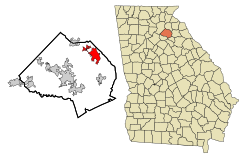
Commerce is a city in Jackson County, Georgia, 70 miles (110 km) northeast of Atlanta. As of the 2020 census, the city had a population of 7,387.
Key Information


History
[edit]Native American history
[edit]Before European settlers arrived, the area around present-day Commerce was inhabited by the Creek and the Cherokee people.[6] Historians describe a territorial war between the Creeks and Cherokees over the land in the county during the 1770s.[7]
The Lacoda Trail, which extended from present-day Athens to the north Georgia mountains, was a significant trade and travel route through this area. (Georgia State Route 334, which follows a 9-mile (14 km) section of this ancient trail, was designated the "Lacoda Trail Memorial Parkway" by the Georgia General Assembly in 1998.)
The Cherokee ceded their disputed lands east of the Oconee River in the Treaty of Augusta (1783) and the Creeks did likewise in their own Treaty of Augusta (1783) and the Treaty of Galphinton (1785).[8][9]
Early settlement
[edit] |
The first permanent white settlement in Jackson County began near present-day Commerce on January 20, 1784, when German immigrant William Dunson was awarded a land grant on Little Sandy Creek. The settlement was named "Groaning Rock",[6] supposedly because of a nearby hollow rock formation that produced a moaning sound when the wind passed over it. (Descendants of William Dunson are still living on the original tract of land.)
A trading post was established by Eli Shankle near Groaning Rock in 1808, named "Harmony Grove". The common explanation is that the name is a play on his wife, Rebecca's, maiden name: Hargrove. There is also an old Appalachian hymn tune called "Harmony Grove", found in an 1830 book called The Virginia Harmony. This tune is popular today as the melody to "Amazing Grace".
The Harmony Grove Female Academy, the first all-female school chartered in the state of Georgia, was chartered by the state legislature on December 20, 1824.
The Harmony Grove post office was established on October 14, 1825; Russell Jones was its first postmaster.
On September 1, 1876, the North Eastern Railroad opened its line from Athens to Lula, which passed through the heart of Harmony Grove. The railroad line had the most significant impact on the shape of the city, which began expanding both directions along the line. These tracks are now owned by the Norfolk Southern Railway.
City history
[edit]The Harmony Grove community was officially incorporated as a town on December 24, 1884, including all areas within a one-mile radius of the railroad depot, one half mile east, and 400 yards west.
Harmony Grove Mills, Inc. was organized under the laws of Jackson County on April 3, 1893, for the purpose of processing and producing cotton textiles.[10] It served various purposes over the years, including the manufacture of denim overalls and the earliest production of electricity in the city. The mill village created to house employees makes up a significant portion of the homes on the southeast end of Commerce today. The mill had been in operation under various corporations until the spring of 2004, when it closed operations and was sold; it has been used for warehouse storage space since, and is currently for sale. The building is still a major feature of the city.
Near the end of the 19th century, many began to feel that the name "Harmony Grove" was too long to write and sounded too much like a country village. In addition, many didn't like the fact that mail frequently went to another post office by the same name in Dawson County. Harmony Grove was reincorporated and renamed "Commerce" on August 6, 1904, in an effort to address these concerns and reflect the city's commercial dominance in the north Georgia cotton trade.[11][12]
In 1959, a series of controversial town hall meetings were held to try to convince members of the federal Interstate Highway System to re-route the proposed Interstate 85, originally planned to go through Gainesville (Hall County), through Commerce and Lavonia (Franklin County). The proposal was changed, and the interstate was routed through Jackson County. Even more so than the railroad nearly a century before, this major transportation artery brought tremendous commercial advantage to Commerce, at a time it desperately needed it.
Geography
[edit]Commerce is located in northeastern Jackson County at 34°12′23″N 83°27′40″W / 34.20639°N 83.46111°W (34.206520, -83.461203).[13] Interstate 85 runs through the northern part of the city, with access from Exits 147 and 149. I-85 leads southwest 70 miles (110 km) to Atlanta and northeast 78 miles (126 km) to Greenville, South Carolina. U.S. Route 441 runs along the eastern border of Commerce, leading north 27 miles (43 km) to Demorest and south 19 miles (31 km) to Athens.
According to the U.S. Census Bureau, Commerce has a total area of 11.8 square miles (30.6 km2), of which 11.7 square miles (30.3 km2) are land and 0.1 square miles (0.2 km2), or 0.77%, are water.[14] Commerce sits on a drainage divide between tributaries of the Oconee River to the southwest and tributaries of the Savannah River to the northeast.
Demographics
[edit]| Census | Pop. | Note | %± |
|---|---|---|---|
| 1890 | 611 | — | |
| 1900 | 1,454 | 138.0% | |
| 1910 | 2,238 | 53.9% | |
| 1920 | 2,459 | 9.9% | |
| 1930 | 3,002 | 22.1% | |
| 1940 | 3,294 | 9.7% | |
| 1950 | 3,351 | 1.7% | |
| 1960 | 3,551 | 6.0% | |
| 1970 | 3,702 | 4.3% | |
| 1980 | 4,092 | 10.5% | |
| 1990 | 4,108 | 0.4% | |
| 2000 | 5,292 | 28.8% | |
| 2010 | 6,544 | 23.7% | |
| 2020 | 7,387 | 12.9% | |
| U.S. Decennial Census[15] | |||
| Race | Num. | Pct. |
|---|---|---|
| White (non-Hispanic) | 5,311 | 71.9% |
| Black or African American (non-Hispanic) | 886 | 11.99% |
| Native American | 12 | 0.16% |
| Asian | 129 | 1.75% |
| Pacific Islander | 1 | 0.01% |
| Other/Mixed | 284 | 3.84% |
| Hispanic or Latino | 764 | 10.34% |
As of the 2020 United States census, there were 7,387 people, 2,547 households, and 1,824 families residing in the city.
Education
[edit]All portions of the Commerce city limits are in the Commerce City School District.[17]
The Commerce City School District oversees public education for pre-school to grade twelve. It consists of two elementary schools (the primary school includes a pre-school program), a middle school and a high school.[18] As of August 2010, district has 89 full-time teachers and over 1,358 students.[19]
- Commerce Primary School (pre-K through 2nd grade)
- Commerce Elementary School (3rd and 4th grades)
- Commerce Middle School (5th through 8th)
- Commerce High School (9th through 12th)
Jackson County School District includes areas outside of the city of Commerce.[17]
Notable people
[edit]- Terry Allen, former football running back in the National Football League; born in Commerce[20]
- Bill Anderson, country music singer, songwriter and television personality, famous for "City Lights" written in Commerce; raised in Commerce
- Chris Beck, Major League Baseball pitcher for the Chicago White Sox
- Clay Hendrix, current head football coach at Furman University; born in Commerce
- Mike Bowers, former Attorney General of Georgia; born in Commerce[21]
- Olive Ann Burns, award-winning author of Cold Sassy Tree, a novel loosely based on her experiences growing up in Commerce
- Spud Chandler, right-handed starting pitcher in major league baseball who played his entire career for the New York Yankees from 1937 through 1947; born in Commerce[22]
- Lamartine G. Hardman, served two terms as the 65th governor of the state of Georgia from 1927 to 1931; born in Commerce[23]
- Mary Hood, award-winning writer of predominantly Southern literature
- Dennis Law, former NFL wide receiver
- Sammy Brown, current Clemson linebacker [1]
References
[edit]- ^ "City of Commerce Georgia Website". City of Commerce Georgia Website. Retrieved September 6, 2012.
- ^ "2020 U.S. Gazetteer Files". United States Census Bureau. Retrieved December 18, 2021.
- ^ "U.S. Census website". United States Census Bureau. Retrieved January 31, 2008.
- ^ "Commerce". Geographic Names Information System. United States Geological Survey, United States Department of the Interior. Retrieved January 20, 2026.
- ^ "Commerce". Georgia Gov. Archived from the original on May 11, 2012. Retrieved September 6, 2012.
- ^ a b Wilson, Gustavus James Nash (1914). The Early History of Jackson County, Georgia: "The Writings of the Late G.J.N. Wilson, Embracing Some of the Early History of Jackson County". The First Settlers, 1784; Formation and Boundaries to the Present Time; Records of the Talasee Colony; Struggles of the Colonies of Yamacutah, Groaning Rock, Fort Yargo, Stonethrow and Thomocoggan (2nd ed.). Kessinger Publishing. ISBN 978-1165799794. Retrieved November 10, 2016.
{{cite book}}: ISBN / Date incompatibility (help) - ^ Wilson, Gustavus, Early History of Jackson County, GA. Atlanta: White Publishing, 1911.
- ^ "Creek Indian Land Cessions" (PDF). National Park Service.
- ^ Walter, Williams (1979). "Southeastern Indians before Removal, Prehistory, Contact, Decline". Southeastern Indians: Since the Removal Era. Athens, Georgia: University of Georgia Press.
- ^ "History of Commerce". City of Commerce Website. Retrieved July 11, 2023.
- ^ Watson, Stephanie; Wojna, Lisa (2008). Weird, Wacky, and Wild Georgia Trivia. Blue Bike Books. p. 60. ISBN 978-1-897278-44-4.
- ^ Krakow, Kenneth K. (1975). Georgia Place-Names: Their History and Origins (PDF). Macon, GA: Winship Press. p. 49. ISBN 0-915430-00-2.
- ^ "US Gazetteer files: 2010, 2000, and 1990". United States Census Bureau. February 12, 2011. Retrieved April 23, 2011.
- ^ "Geographic Identifiers: 2010 Census Summary File 1 (G001): Commerce city, Georgia". American Factfinder. U.S. Census Bureau. Retrieved May 2, 2018.
{{cite web}}: CS1 maint: deprecated archival service (link) - ^ "Census of Population and Housing". Census.gov. Retrieved June 4, 2015.
- ^ "Explore Census Data". data.census.gov. Retrieved December 17, 2021.
- ^ a b "2020 CENSUS - SCHOOL DISTRICT REFERENCE MAP: Jackson County, GA" (PDF). U.S. Census Bureau. pp. 5–6, 12 (PDF p. 6-7, 13/27). Retrieved May 7, 2023. - Text list
- ^ Georgia Board of Education[permanent dead link], Retrieved June 5, 2010.
- ^ School Stats, Retrieved June 5, 2010.
- ^ "Terry Allen". Pro-Football-Reference.com. Retrieved September 6, 2012.
- ^ "MICHAEL J. BOWERS". Balch & Bingham LLP. Retrieved September 6, 2012.
- ^ "Spud Chandler". Baseball-Reference.com. Retrieved September 6, 2012.
- ^ "Lamartine Hardman (1856-1937)". The New Georgia Encyclopedia. Retrieved September 6, 2012.
External links
[edit]Municipalities and communities of Jackson County, Georgia, United States | ||
|---|---|---|
| Cities |  | |
| Towns | ||
| Unincorporated communities | ||
| Footnotes | ‡This populated place also has portions in an adjacent county or counties | |
| International | |
|---|---|
| National | |
| Geographic | |

Commerce, Georgia
View on GrokipediaHistory
Native American Presence
The region now comprising Commerce, Georgia, within Jackson County, formed part of the northern periphery of Creek (Muscogee) territory during the historic period prior to widespread European-American settlement in the late 18th century.[5] Archaeological and historical records indicate a dense pre-1800 indigenous population in Jackson County dominated by branches of the Creek Confederacy, including groups such as the Lower Creeks, with evidence of villages, campsites, and stone structures suggesting sustained occupation tied to riverine resources along tributaries of the Oconee River.[6] Human remains and artifacts recovered from sites in the county, such as those near proposed developments, have been identified as consistent with Creek cultural practices, reflecting burial customs and material culture from the late prehistoric to protohistoric eras.[5] Adjoining Cherokee lands lay to the north and northwest, leading to overlapping use of border zones for hunting, trade, and seasonal camps, as documented in early settler accounts of shared grounds near river confluences like Hurricane Shoals on the North Oconee River, approximately 10 miles east of Commerce.[7] These interactions occurred amid Creek-Cherokee rivalries over hunting territories in the Piedmont, with no evidence of permanent Cherokee villages directly in the immediate Commerce vicinity, which fell within Creek-claimed lowlands suited for maize agriculture and fortified settlements.[8] Local oral traditions and limited excavations point to transient or semi-permanent Creek encampments rather than large mound-building Mississippian chiefdoms, consistent with the area's transitional ecology between upland forests and river valleys.[9] Creek cessions of Jackson County lands began with the 1785 Treaty of Galphinton and accelerated through the 1802 Treaty of Fort Wilkinson and 1817 treaties, culminating in removal pressures by the 1820s, prior to the 1830s Cherokee Trail of Tears that affected northern Georgia but had minimal direct impact on this Piedmont locale already vacated by Creeks.[6] Post-removal, physical traces persisted in the form of stone piles and potential ceremonial sites along rivers, though development has obscured much of the archaeological record, with ongoing consultations involving descendant communities emphasizing preservation over speculation.[8][10]Founding as Harmony Grove
The settlement known as Harmony Grove began forming in the early 1800s in what is now Jackson County, with pioneer families establishing homes amid lands ceded from Native American tribes following treaties in the late 18th century.[11] One of the earliest documented figures was Eli Shankle (1784–1852), who constructed one of the first houses and a trading post around 1808 near a site previously called Groaning Rock, facilitating exchange of goods like stoves and household items with incoming settlers.[12] [13] Other initial pioneers included Hardy Minish, who resided near the future town center.[12] The name Harmony Grove emerged by the 1820s, potentially linked to local features or institutions rather than a single event, though popular accounts attribute it to a linguistic play on Shankle's wife Rebecca Hargrove's maiden name.[13] By 1824, the Georgia legislature chartered the Harmony Grove Female Academy, which may have reinforced the designation for the growing community.[12] A post office opened on October 24, 1825, under postmaster Russell Jones, formalizing the name and serving settlers east of the Oconee River near Pittman's Bridge.[12] [14] Early growth centered on agriculture and basic trade, with families like the Shankles living in brush arbors or simple structures near natural springs before permanent cabins were built.[15] The community's location along emerging roads supported modest commerce, laying groundwork for later expansion, though it remained unincorporated until 1884.[14]Incorporation and Renaming
The community known as Harmony Grove was officially incorporated as a town on December 24, 1884, encompassing areas within a one-mile radius of the local railroad depot and extending half a mile beyond in each direction.[16][17] This incorporation followed the establishment of a post office in 1833 and the arrival of the railroad in the 1870s, which spurred initial growth around textile milling and agriculture.[11] By the early 1900s, residents sought to reincorporate the town to expand its boundaries and update its charter amid rapid economic expansion driven by cotton trading and manufacturing.[16] On August 6, 1904, Harmony Grove was reincorporated under the name Commerce, reflecting its emergence as a key commercial hub in northeast Georgia rather than its earlier pastoral connotations.[11][17] The renaming emphasized the town's role as a cotton market center, where weighers certified large volumes of the crop for regional trade, contributing to prosperity that outpaced its original identity.[14]Industrial Expansion and Poultry Dominance
The establishment of Harmony Grove Mills in 1893 marked the onset of significant industrial expansion in Commerce, initially focused on textile manufacturing as local entrepreneurs capitalized on the region's cotton production.[1] The mill, which produced cotton goods, grew to employ hundreds and expanded its facilities to 130,000 square feet by 1950, while constructing a dedicated mill village to house workers, thereby fostering population growth and economic stability.[18] Railroads, connecting Commerce to broader markets by the late 19th century, further enabled this development by facilitating the transport of raw materials and finished products, transforming the city from a primarily agricultural outpost into a commercial hub.[11] Poultry production emerged as a complementary industry in Jackson County during the 1920s, with M.E. Murphy initiating large-scale broiler farming in nearby Talmo in 1924, prompting widespread adoption among local farmers by 1928.[11] This aligned with Georgia's broader shift toward poultry as a cash crop, surpassing cotton in farm income by 1956, driven by vertical integration, technological advances in breeding and feed, and rising national demand for chicken over red meat. In Commerce, processing facilities capitalized on the county's early broiler output, establishing poultry as the dominant sector by integrating farming, hatching, and slaughter operations, which provided steady employment amid textile fluctuations. By the mid-20th century, poultry processing solidified its economic preeminence in Commerce, with major operations like Pilgrim's Pride establishing plants that handled raw product intake and distribution, employing thousands in labor-intensive roles.[19] The industry's resilience stemmed from north Georgia's favorable climate, low-cost labor, and proximity to feed sources, contributing to Georgia's position as the top U.S. broiler producer by the 1970s, with annual processing exceeding 5 billion pounds by 1995.[20] This dominance persisted, as evidenced by ongoing investments, including Pilgrim's $400 million prepared foods facility announced in July 2025, projected to add 630 jobs and underscore poultry's role in sustaining Commerce's industrial base.[21]Post-WWII Growth and Modern Transitions
Following World War II, Commerce participated in Georgia's broader economic expansion, particularly through the continued dominance of the poultry sector in Jackson County. Poultry production in the county had emerged in the 1930s and 1940s, with local farmers adopting broiler operations, but post-war technological advances in processing and feed efficiency fueled rapid scaling. By 1951, Georgia overtook other states to become the world's leading broiler producer, a position sustained by vertical integration and increased demand, benefiting Commerce's agricultural and processing economy.[11][22] The city's growth mirrored statewide trends, with nonagricultural payroll employment in Georgia expanding at an average annual rate of 3.1 percent from 1945 onward, shifting from farm dependency toward diversified industry while poultry remained a cornerstone. In Commerce, this manifested in sustained farm-level output and related jobs, though specific plant expansions in the 1950s tied to regional hubs like nearby Gainesville. Population and infrastructure developed incrementally, supported by proximity to emerging highways, though the economy stayed rooted in agribusiness amid Georgia's overall factory openings exceeding 500 between 1946 and 1955.[23][24] In modern decades, Commerce has pursued transitions toward diversified commerce and urban renewal to complement its poultry legacy. The city established an Economic Revitalization Committee to scout market opportunities, repurpose historic downtown structures, and offer incentives like grants and low-interest loans for business retention and recruitment. These efforts aim to adapt underutilized spaces for contemporary uses, fostering incremental investment in the traditional commercial district amid a low cost-of-living index of 85.1 and median property values reaching $285,450 as of recent assessments. Population stood at 7,387, reflecting steady growth tied to these initiatives and regional logistics advantages.[25][26]Geography
Location and Topography
Commerce is situated in Jackson County in northeastern Georgia, United States, at geographic coordinates 34°12′14″N 83°27′25″W.[27] The city occupies a position approximately 60 miles northeast of Atlanta, within the broader Piedmont physiographic region of the state.[28] Its municipal boundaries encompass about 13.4 square miles, predominantly land with minimal water coverage.[29] The topography of Commerce features gently rolling hills characteristic of the Piedmont plateau, with an average elevation of around 915 feet (279 meters) above sea level.[30] Elevations in the surrounding Jackson County vary modestly, typically between 750 and 950 feet, supporting a landscape of undulating terrain interspersed with forested areas and agricultural fields.[31] Local hydrology includes proximity to tributaries of the Oconee River system, contributing to drainage patterns that define valleys amid the hills.[32] This terrain facilitates mixed land uses, including urban development on higher ground and riparian zones along streams.[33]Environmental Features
Commerce occupies the Piedmont ecoregion of Georgia, featuring gently rolling hills formed from metamorphic and igneous rocks, with local elevations averaging 915 feet above sea level.[27] The terrain transitions from the higher Appalachian foothills to the northwest toward the flatter coastal plain to the southeast, supporting a landscape of moderate slopes and red clay soils derived from weathered granite and gneiss.[34] The predominant natural vegetation comprises oak-hickory-pine woodlands, including species such as white oak (Quercus alba), southern red oak (Quercus falcata), hickory (Carya spp.), and loblolly pine (Pinus taeda), which dominate undisturbed areas amid agricultural clearings.[35] Approximately 37% of the city's 8,560 acres consists of agriculture and forestry land uses, reflecting a mix of managed woodlands and open agrarian fields that have shaped the local ecology since European settlement.[36] These forests provide habitat for common Piedmont wildlife, including white-tailed deer (Odocoileus virginianus), wild turkey (Meleagris gallopavo), and various songbirds, though urban expansion has fragmented larger habitats.[34] Hydrologically, the area is drained by tributaries of the Oconee River system, with nearby features like Hurricane Shoals on the Mulberry River offering rocky shoals and riparian zones that enhance local biodiversity.[37] Wetlands, comprising small floodplain forests and streamside buffers, are present and subject to protective zoning ordinances updated in 2021 to mitigate development impacts on water quality and flood retention.[36] These aquatic and semi-aquatic environments support amphibians, fish like bass and sunfish, and riparian vegetation, contributing to the region's overall ecological resilience despite agricultural runoff pressures.[34]Climate
Seasonal Patterns
Commerce, Georgia, features a humid subtropical climate with four distinct seasons, marked by hot, humid summers, mild winters, and relatively even precipitation distribution throughout the year, averaging about 50 inches annually.[38][39] Temperatures typically range from lows around 31°F in winter to highs near 89°F in summer, with high humidity contributing to muggy conditions from mid-May through early October.[38] Winter (December–February) brings short, cool periods with average high temperatures of 53–57°F and lows of 36–39°F, occasionally dipping below freezing on 50–70 days per year in the region.[38][39] Precipitation averages 4.2–4.4 inches per month, mostly as rain, though light snowfall totals 1–2 inches annually with 1–2 snow events.[38][39] Cloud cover is highest in this season, with overcast skies about 50% of the time in January.[38] Spring (March–May) sees rapid warming, with highs rising from 66°F to 80°F and lows from 45°F to 61°F, marking the transition to humid conditions.[38] Rainfall averages 3.2–4.4 inches monthly, peaking in March as the wettest month regionally, often from frontal systems.[38][39] The last freeze typically occurs in early April, with about 120 rainy days annually across seasons.[39] Summer (June–August) is the warmest and most humid, featuring average highs of 87–89°F and lows of 68–71°F, with 30–60 days exceeding 90°F.[38][39] Precipitation holds steady at 3.3–3.5 inches per month, driven by frequent thunderstorms (50–60 days yearly), creating a wet season with over 32% chance of wet days.[38][39] High humidity peaks in July, with muggy days averaging 26.[38] Fall (September–November) cools gradually, with highs falling from 82°F to 64°F and lows from 64°F to 45°F, and the first freeze around late October.[38][39] Rainfall averages 3.6–3.7 inches monthly, with September–October as the driest periods regionally, and clearest skies in October (66% clear or partly cloudy).[38][39]Weather Extremes and Records
The highest temperature recorded in Commerce was 106 °F (41 °C) on July 2, 2012.[40] The lowest temperature on record was -5 °F (-21 °C), observed on January 21, 1985.[40] Precipitation extremes include a daily maximum of 6.3 inches (160 mm) on October 4, 1995, and a monthly record of 13.8 inches (351 mm) in March 1980.[40] The wettest year was 2020, with 70.4 inches (1,788 mm) of total precipitation.[40] Snowfall records show a single-day peak of 6.5 inches (165 mm) on January 22, 1987, and an annual total of 12.0 inches (305 mm) in 1960.[40]| Record Type | Value | Date/Year |
|---|---|---|
| Highest temperature | 106 °F (41 °C) | July 2, 2012 |
| Lowest temperature | -5 °F (-21 °C) | January 21, 1985 |
| Greatest daily precipitation | 6.3 inches (160 mm) | October 4, 1995 |
| Greatest monthly precipitation | 13.8 inches (351 mm) | March 1980 |
| Wettest year | 70.4 inches (1,788 mm) | 2020 |
| Greatest daily snowfall | 6.5 inches (165 mm) | January 22, 1987 |
| Snowiest year | 12.0 inches (305 mm) | 1960 |
Demographics
Population Trends
The population of Commerce has exhibited steady growth since the late 20th century, reflecting economic expansions in manufacturing, poultry processing, and proximity to Atlanta's metropolitan area. According to U.S. Census Bureau decennial data, the city recorded 5,347 residents in 2000, increasing to 6,544 by 2010—a 22.4% rise attributed to industrial job opportunities and housing development.[44][2] This upward trajectory continued into the 2020s, with the 2020 census enumerating 7,387 inhabitants, a 12.9% gain from 2010, amid broader regional migration patterns in Jackson County.[45][2] Post-2020 estimates indicate accelerated expansion, reaching 8,803 by July 1, 2024, equivalent to roughly 4.6% annual growth, driven by net domestic in-migration and labor demand in logistics and related sectors.[2]| Census/Estimate Year | Population | Percent Change from Prior Decade |
|---|---|---|
| 2000 | 5,347 | — |
| 2010 | 6,544 | +22.4% |
| 2020 | 7,387 | +12.9% |
| 2024 (est.) | 8,803 | +19.1% (from 2020) |
Racial, Ethnic, and Socioeconomic Composition
As of the 2022 American Community Survey estimates, Commerce's population of approximately 7,684 residents exhibited a racial composition of 71.6% White alone, 14.6% Black or African American alone, 1.5% Asian alone, 0.0% American Indian and Alaska Native alone, 8.0% two or more races, and the remainder in other categories.[2][47] Separately, 14.5% of the population identified as Hispanic or Latino (of any race), with non-Hispanic Whites comprising 67.4%.[2] These figures reflect modest shifts from the 2020 Census baseline, where similar proportions held amid population growth driven by industrial employment.[48]| Racial/Ethnic Group | Percentage (2022 est.) |
|---|---|
| White alone | 71.6% |
| Black or African American alone | 14.6% |
| Hispanic or Latino (any race) | 14.5% |
| Asian alone | 1.5% |
| Two or more races | 8.0% |
| White alone, non-Hispanic | 67.4% |