


Community hub
Computable function
View on WikipediaComputable functions are the basic objects of study in computability theory. Informally, a function is computable if there is an algorithm that computes the value of the function for every value of its argument. Because of the lack of a precise definition of the concept of algorithm, every formal definition of computability must refer to a specific model of computation.
Many such models of computation have been proposed, the major ones being Turing machines, register machines, lambda calculus and general recursive functions. Although these four are of a very different nature, they provide exactly the same class of computable functions, and, for every model of computation that has ever been proposed, the computable functions for such a model are computable for the above four models of computation.
The Church–Turing thesis is the unprovable assertion that every notion of computability that can be imagined can compute only functions that are computable in the above sense.
Before the precise definition of computable functions, mathematicians often used the informal term effectively calculable. This term has since come to be identified with the computable functions. The effective computability of these functions does not imply that they can be efficiently computed (i.e. computed within a reasonable amount of time). In fact, for some effectively calculable functions it can be shown that any algorithm that computes them will be very inefficient in the sense that the running time of the algorithm increases exponentially (or even superexponentially) with the length of the input. The fields of feasible computability and computational complexity study functions that can be computed efficiently.
The Blum axioms can be used to define an abstract computational complexity theory on the set of computable functions. In computational complexity theory, the problem of computing the value of a function is known as a function problem, by contrast to decision problems whose results are either "yes" or "no".
Definition
[edit]Computability of a function is an informal notion. One way to describe it is to say that a function is computable if its value can be obtained by an effective procedure. With more rigor, a function is computable if and only if there is an effective procedure that, given any k-tuple of natural numbers, will produce the value .[1] In agreement with this definition, the remainder of this article presumes that computable functions take finitely many natural numbers as arguments and produce a value which is a single natural number.


As counterparts to this informal description, there exist multiple formal, mathematical definitions. The class of computable functions can be defined in many equivalent models of computation, including
- Turing machines
- General recursive functions
- Lambda calculus
- Post machines (Post–Turing machines and tag machines).
- Register machines
Although these models use different representations for the functions, their inputs, and their outputs, translations exist between any two models, and so every model describes essentially the same class of functions, giving rise to the opinion that formal computability is both natural and not too narrow.[2] These functions are sometimes referred to as "recursive", to contrast with the informal term "computable",[3] a distinction stemming from a 1934 discussion between Kleene and Gödel.[4]p.6
For example, one can formalize computable functions as μ-recursive functions, which are partial functions that take finite tuples of natural numbers and return a single natural number (just as above). They are the smallest class of partial functions that includes the constant, successor, and projection functions, and is closed under composition, primitive recursion, and the μ operator.
Equivalently, computable functions can be formalized as functions which can be calculated by an idealized computing agent such as a Turing machine or a register machine. Formally speaking, a partial function can be calculated if and only if there exists a computer program with the following properties:
- If is defined, then the program will terminate on the input with the value stored in the computer memory.
- If is undefined, then the program never terminates on the input .
Characteristics of computable functions
[edit]The basic characteristic of a computable function is that there must be a finite procedure (an algorithm) telling how to compute the function. The models of computation listed above give different interpretations of what a procedure is and how it is used, but these interpretations share many properties. The fact that these models give equivalent classes of computable functions stems from the fact that each model is capable of reading and mimicking a procedure for any of the other models, much as a compiler is able to read instructions in one computer language and emit instructions in another language.
Enderton [1977] gives the following characteristics of a procedure for computing a computable function; similar characterizations have been given by Turing [1936], Rogers [1967], and others.
- "There must be exact instructions (i.e. a program), finite in length, for the procedure." Thus every computable function must have a finite program that completely describes how the function is to be computed. It is possible to compute the function by just following the instructions; no guessing or special insight is required.
- "If the procedure is given a k-tuple x in the domain of f, then after a finite number of discrete steps the procedure must terminate and produce f(x)." Intuitively, the procedure proceeds step by step, with a specific rule to cover what to do at each step of the calculation. Only finitely many steps can be carried out before the value of the function is returned.
- "If the procedure is given a k-tuple x which is not in the domain of f, then the procedure might go on forever, never halting. Or it might get stuck at some point (i.e., one of its instructions cannot be executed), but it must not pretend to produce a value for f at x." Thus if a value for f(x) is ever found, it must be the correct value. It is not necessary for the computing agent to distinguish correct outcomes from incorrect ones because the procedure is defined as correct if and only if it produces an outcome.
Enderton goes on to list several clarifications of these 3 requirements of the procedure for a computable function:
- The procedure must theoretically work for arbitrarily large arguments. It is not assumed that the arguments are smaller than the number of atoms in the Earth, for example.
- The procedure is required to halt after finitely many steps in order to produce an output, but it may take arbitrarily many steps before halting. No time limitation is assumed.
- Although the procedure may use only a finite amount of storage space during a successful computation, there is no bound on the amount of space that is used. It is assumed that additional storage space can be given to the procedure whenever the procedure asks for it.
To summarise, based on this view a function is computable if:
- given an input from its domain, possibly relying on unbounded storage space, it can give the corresponding output by following a procedure (program, algorithm) that is formed by a finite number of exact unambiguous instructions;
- it returns such output (halts) in a finite number of steps; and
- if given an input which is not in its domain it either never halts or it gets stuck.
The field of computational complexity studies functions with prescribed bounds on the time and/or space allowed in a successful computation.
Computable sets and relations
[edit]A set A of natural numbers is called computable (synonyms: recursive, decidable) if there is a computable, total function f such that for any natural number n, f(n) = 1 if n is in A and f(n) = 0 if n is not in A.
A set of natural numbers is called computably enumerable (synonyms: recursively enumerable, semidecidable) if there is a computable function f such that for each number n, f(n) is defined if and only if n is in the set. Thus a set is computably enumerable if and only if it is the domain of some computable function. The word enumerable is used because the following are equivalent for a nonempty subset B of the natural numbers:
- B is the domain of a computable function.
- B is the range of a total computable function. If B is infinite then the function can be assumed to be injective.
If a set B is the range of a function f then the function can be viewed as an enumeration of B, because the list f(0), f(1), ... will include every element of B.
Because each finitary relation on the natural numbers can be identified with a corresponding set of finite sequences of natural numbers, the notions of computable relation and computably enumerable relation can be defined from their analogues for sets.
Formal languages
[edit]In computability theory in computer science, it is common to consider formal languages. An alphabet is an arbitrary set. A word on an alphabet is a finite sequence of symbols from the alphabet; the same symbol may be used more than once. For example, binary strings are exactly the words on the alphabet {0, 1}. A language is a subset of the collection of all words on a fixed alphabet. For example, the collection of all binary strings that contain exactly 3 ones is a language over the binary alphabet.
A key property of a formal language is the level of difficulty required to decide whether a given word is in the language. Some coding system must be developed to allow a computable function to take an arbitrary word in the language as input; this is usually considered routine. A language is called computable (synonyms: recursive, decidable) if there is a computable function f such that for each word w over the alphabet, f(w) = 1 if the word is in the language and f(w) = 0 if the word is not in the language. Thus a language is computable just in case there is a procedure that is able to correctly tell whether arbitrary words are in the language.
A language is computably enumerable (synonyms: recursively enumerable, semidecidable) if there is a computable function f such that f(w) is defined if and only if the word w is in the language. The term enumerable has the same etymology as in computably enumerable sets of natural numbers.
Examples
[edit]The following functions are computable:
- Each function with a finite domain; e.g., any finite sequence of natural numbers.
- Each constant function f : Nk → N, f(n1,...nk) := n.
- Addition f : N2 → N, f(n1,n2) := n1 + n2
- The greatest common divisor of two numbers
- A Bézout coefficient of two numbers
- The smallest prime factor of a number
If f and g are computable, then so are: f + g, f * g, if f is unary, max(f,g), min(f,g), arg max{y ≤ f(x)} and many more combinations.

The following examples illustrate that a function may be computable though it is not known which algorithm computes it.
- The function f such that f(n) = 1 if there is a sequence of at least n consecutive fives in the decimal expansion of π, and f(n) = 0 otherwise, is computable. (The function f is either the constant 1 function, which is computable, or else there is a k such that f(n) = 1 if n < k and f(n) = 0 if n ≥ k. Every such function is computable. It is not known whether there are arbitrarily long runs of fives in the decimal expansion of π, so we don't know which of those functions is f. Nevertheless, we know that the function f must be computable.)
- Each finite segment of an uncomputable sequence of natural numbers (such as the Busy Beaver function Σ) is computable. E.g., for each natural number n, there exists an algorithm that computes the finite sequence Σ(0), Σ(1), Σ(2), ..., Σ(n) — in contrast to the fact that there is no algorithm that computes the entire Σ-sequence, i.e. Σ(n) for all n. Thus, "Print 0, 1, 4, 6, 13" is a trivial algorithm to compute Σ(0), Σ(1), Σ(2), Σ(3), Σ(4); similarly, for any given value of n, such a trivial algorithm exists (even though it may never be known or produced by anyone) to compute Σ(0), Σ(1), Σ(2), ..., Σ(n).
Church–Turing thesis
[edit]The Church–Turing thesis states that any function computable from a procedure possessing the three properties listed above is a computable function. Because these three properties are not formally stated, the Church–Turing thesis cannot be proved. The following facts are often taken as evidence for the thesis:
- Many equivalent models of computation are known, and they all give the same definition of computable function (or a weaker version, in some instances).
- No stronger model of computation which is generally considered to be effectively calculable has been proposed.
The Church–Turing thesis is sometimes used in proofs to justify that a particular function is computable by giving a concrete description of a procedure for the computation. This is permitted because it is believed that all such uses of the thesis can be removed by the tedious process of writing a formal procedure for the function in some model of computation.
Provability
[edit]Given a function (or, similarly, a set), one may be interested not only if it is computable, but also whether this can be proven in a particular proof system (usually first order Peano arithmetic). A function that can be proven to be computable is called provably total.
The set of provably total functions is recursively enumerable: one can enumerate all the provably total functions by enumerating all their corresponding proofs, that prove their computability. This can be done by enumerating all the proofs of the proof system and ignoring irrelevant ones.
Relation to recursively defined functions
[edit]In a function defined by a recursive definition, each value is defined by a fixed first-order formula of other, previously defined values of the same function or other functions, which might be simply constants. A subset of these is the primitive recursive functions. Another example is the Ackermann function, which is recursively defined but not primitive recursive.[5]
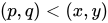
For definitions of this type to avoid circularity or infinite regress, it is necessary that recursive calls to the same function within a definition be to arguments that are smaller in some well-partial-order on the function's domain. For instance, for the Ackermann function , whenever the definition of refers to , then w.r.t. the lexicographic order on pairs of natural numbers. In this case, and in the case of the primitive recursive functions, well-ordering is obvious, but some "refers-to" relations are nontrivial to prove as being well-orderings. Any function defined recursively in a well-ordered way is computable: each value can be computed by expanding a tree of recursive calls to the function, and this expansion must terminate after a finite number of calls, because otherwise Kőnig's lemma would lead to an infinite descending sequence of calls, violating the assumption of well-ordering.


Total functions that are not provably total
[edit]In a sound proof system, every provably total function is indeed total, but the converse is not true: in every first-order proof system that is strong enough and sound (including Peano arithmetic), one can prove (in another proof system) the existence of total functions that cannot be proven total in the proof system.
If the total computable functions are enumerated via the Turing machines that produces them, then the above statement can be shown, if the proof system is sound, by a similar diagonalization argument to that used above, using the enumeration of provably total functions given earlier. One uses a Turing machine that enumerates the relevant proofs, and for every input n calls fn(n) (where fn is n-th function by this enumeration) by invoking the Turing machine that computes it according to the n-th proof. Such a Turing machine is guaranteed to halt if the proof system is sound.
Uncomputable functions and unsolvable problems
[edit]Every computable function has a finite procedure giving explicit, unambiguous instructions on how to compute it. Furthermore, this procedure has to be encoded in the finite alphabet used by the computational model, so there are only countably many computable functions. For example, functions may be encoded using a string of bits (the alphabet Σ = {0, 1}).
The real numbers are uncountable so most real numbers are not computable. See computable number. The set of finitary functions on the natural numbers is uncountable so most are not computable. Concrete examples of such functions are Busy beaver, Kolmogorov complexity, or any function that outputs the digits of a noncomputable number, such as Chaitin's constant.
Similarly, most subsets of the natural numbers are not computable. The halting problem was the first such set to be constructed. The Entscheidungsproblem, proposed by David Hilbert, asked whether there is an effective procedure to determine which mathematical statements (coded as natural numbers) are true. Turing and Church independently showed in the 1930s that this set of natural numbers is not computable. According to the Church–Turing thesis, there is no effective procedure (with an algorithm) which can perform these computations.
Extensions of computability
[edit]Relative computability
[edit]The notion of computability of a function can be relativized to an arbitrary set of natural numbers A. A function f is defined to be computable in A (equivalently A-computable or computable relative to A) when it satisfies the definition of a computable function with modifications allowing access to A as an oracle. As with the concept of a computable function relative computability can be given equivalent definitions in many different models of computation. This is commonly accomplished by supplementing the model of computation with an additional primitive operation which asks whether a given integer is a member of A. We can also talk about f being computable in g by identifying g with its graph.
Higher recursion theory
[edit]Hyperarithmetical theory studies those sets that can be computed from a computable ordinal number of iterates of the Turing jump of the empty set. This is equivalent to sets defined by both a universal and existential formula in the language of second order arithmetic and to some models of Hypercomputation. Even more general recursion theories have been studied, such as E-recursion theory in which any set can be used as an argument to an E-recursive function.
Hyper-computation
[edit]Although the Church–Turing thesis states that the computable functions include all functions with algorithms, it is possible to consider broader classes of functions that relax the requirements that algorithms must possess. The field of Hypercomputation studies models of computation that go beyond normal Turing computation.
See also
[edit]References
[edit]- ^ Enderton, Herbert (2002). A Mathematical Introduction to Logic (Second ed.). USA: Elsevier. p. 209. ISBN 0-12-238452-0.
- ^ Enderton, Herbert (2002). A Mathematical Introduction to Logic (Second ed.). USA: Elsevier. p. 208,262. ISBN 0-12-238452-0.
- ^ C. J. Ash, J. Knight, Computable Structures and the Hyperarithmetical Hierarchy (Studies in Logic and the Foundation of Mathematics, 2000), p. 4
- ^ R. Soare, Computability and Recursion Archived 2022-03-31 at the Wayback Machine (1995). Accessed 9 November 2022.
- ^ Péter, Rózsa (1935). "Konstruktion nichtrekursiver Funktionen". Mathematische Annalen. 111: 42–60. doi:10.1007/BF01472200. S2CID 121107217.
- Cutland, Nigel. Computability. Cambridge University Press, 1980.
- Enderton, H.B. Elements of recursion theory. Handbook of Mathematical Logic (North-Holland 1977) pp. 527–566.
- Rogers, H. Theory of recursive functions and effective computation (McGraw–Hill 1967).
- Turing, A. (1937), On Computable Numbers, With an Application to the Entscheidungsproblem. Proceedings of the London Mathematical Society, Series 2, Volume 42 (1937), p.230–265. Reprinted in M. Davis (ed.), The Undecidable, Raven Press, Hewlett, NY, 1965.
| General | |||||||||
|---|---|---|---|---|---|---|---|---|---|
| Theorems (list) and paradoxes | |||||||||
| Logics |
| ||||||||
| Set theory |
| ||||||||
| Formal systems (list), language and syntax |
| ||||||||
| Proof theory | |||||||||
| Model theory | |||||||||
| Computability theory | |||||||||
| Related | |||||||||

Computable function
View on GrokipediaFoundations
Definition
A computable function is one that can be calculated by a mechanical procedure or algorithm, which, when provided with any input from its domain, produces the corresponding output after a finite number of steps and always terminates.[2] This intuitive notion captures the idea of effective computability, where the procedure follows precise, step-by-step rules without reliance on intuition or infinite processes.[2] Formally, in terms of Turing machines, a function is computable if there exists a Turing machine that, starting from input encoded as a string, halts in a finite number of steps and outputs the representation of .[2] This definition extends Turing's original characterization of computable real numbers to functions on natural numbers, where the machine's tape serves as both input and output medium, and halting ensures termination.[2] Computable functions are distinguished as total or partial depending on their domain. A total computable function is defined and computable for every input in , always halting with an output. In contrast, a partial computable function may be undefined for some inputs, meaning the corresponding algorithm does not halt or produce an output for those cases; for example, the partial function that attempts to compute the output of a given Turing machine on empty input if it halts, but remains undefined (loops indefinitely) otherwise, is partial computable but not total.[4] The concept of computable functions emerged in the 1930s through parallel formalizations. Alonzo Church introduced -definability in 1936 as a precise notion of effective calculability, where functions are expressed via abstractions in the -calculus.[5] Independently, Stephen Kleene developed the theory of recursive functions in 1936, defining them through composition, primitive recursion, and the -operator for minimization.[4] The -operator, denoted , yields the smallest natural number such that the predicate holds, assuming such a exists; this allows construction of partial functions when no such is found.[4]Models of Computation
One of the foundational models for computable functions is the Turing machine, introduced by Alan Turing in 1936. A Turing machine consists of an infinite tape divided into cells, each capable of holding a symbol from a finite tape alphabet Γ, a read/write head that moves left or right along the tape, and a finite set of states Q. The machine's behavior is governed by a partial transition function δ: Q × Γ → Q × Γ × {L, R}, where L and R denote left and right head movements, respectively; the machine starts in an initial state q₀ with the input encoded on the tape (surrounded by blanks from a special blank symbol), and computation proceeds by repeatedly applying δ until reaching a halting state, at which point the tape contents represent the output. This model computes partial functions from natural numbers to natural numbers by encoding inputs and outputs as unary or binary strings on the tape, with the computation halting if the function is defined for the input.[2] Another key model is that of recursive functions, formalized by Stephen Kleene in 1936 building on Alonzo Church's earlier work. Primitive recursive functions form a subclass generated from basic functions—the zero function Z(n) = 0, the successor function S(n) = n + 1, and projection functions P_i^k (n_1, ..., n_k) = n_i—using two schemas: composition, where a new function h is formed as h(n) = g(f_1(n), ..., f_m(n)) for previously defined g and f_j, and primitive recursion, defining h(0, \vec{y}) = f(\vec{y}) and h(S(n), \vec{y}) = g(n, h(n, \vec{y}), \vec{y}) for base f and recursion step g. The full class of recursive (or general recursive) functions extends this by adding the μ-operator, which yields the least n such that a primitive recursive predicate P(n, \vec{y}) holds, allowing computation of partial functions via minimization; this captures all computable functions through effective enumeration and diagonalization arguments.[6] Alonzo Church's lambda calculus, developed between 1932 and 1936, provides a different formalism using untyped lambda terms for function definition and application. Terms are built from variables x, abstractions λx.M (functions taking input x to output M), and applications (M N); computation proceeds via β-reduction, substituting arguments into functions as (λx.M) N → M[x := N], with normal forms representing results after reductions. Natural numbers and operations are encoded via Church numerals, such as 0 = λf.λx.x, 1 = λf.λx.f x, successor S = λn.λf.λx.f (n f x), enabling arithmetic and recursion through fixed-point combinators like Y = λf.(λx.f (x x)) (λx.f (x x)) for general computability.[7] Additional models include register machines, as described by Marvin Minsky in 1967, which use a finite number of registers holding non-negative integers and a program of instructions including increment (R_i += 1), decrement (if R_i > 0 then R_i -= 1 else jump), zero-test (if R_i = 0 then jump), unconditional jump, and halt; Minsky showed that two registers suffice for universal computation equivalent to Turing machines. Post systems, introduced by Emil Post in 1936, operate on strings over an alphabet via a finite set of production rules that replace a designated substring P with another Q, starting from an initial string and generating outputs through repeated applications until no further rules apply, capturing computability through tag or canonical forms.[8] The equivalence of these models—Turing machines, recursive functions, lambda calculus, register machines, and Post systems—establishes that they all characterize the same class of partial computable functions, as demonstrated through mutual simulations in the 1930s and 1960s; this robustness underpins the Church-Turing thesis, conjectured by Church in his 1936 paper on lambda calculus and independently by Turing in his 1936 analysis of computable numbers, positing that these models capture all effectively computable functions. While classical models assume sequential computation, modern variants like linear bounded automata, introduced in the 1960s and still studied today, restrict tape length to the input size for context-specific computability relevant to context-sensitive languages.[7][2]Properties
Characteristics
Computable functions, also known as partial recursive functions, form a robust class characterized by strong closure properties under basic operations, which distinguish them from broader classes of mathematical functions. Specifically, the class is closed under composition: if $ g_1, \dots, g_m $ and $ h $ are partial computable functions, then so is $ f(\vec{x}) = h(g_1(\vec{x}), \dots, g_m(\vec{x})) $. It is also closed under primitive recursion: given computable functions $ \psi $ and $ \gamma $, the function defined by $ \phi(\vec{x}, 0) = \psi(\vec{x}) $ and $ \phi(\vec{x}, y+1) = \gamma(\vec{x}, y, \phi(\vec{x}, y)) $ is computable. Finally, closure under minimization holds: if $ \psi $ is computable, then $ \phi(\vec{x}) = \mu y [(\forall z \leq y) \psi(\vec{x}, z) \downarrow \land \psi(\vec{x}, y) = 0] $ (the least $ y $ satisfying the condition, if it exists) is computable. These closures can be established via simulation in equivalent models of computation, such as Turing machines. For composition, a Turing machine computing $ h $ can be modified to first simulate machines for each $ g_i $ on input $ \vec{x} $, then feed the outputs into the simulation of $ h $; primitive recursion follows by encoding iterative steps in the machine's tape management; and minimization by dovetailing searches over increasing $ y $ values until the condition halts. Such simulations preserve computability since Turing machines can effectively enumerate and combine descriptions of other machines. The domain of a partial computable function—the set of inputs on which it halts and produces an output—is always recursively enumerable, as it corresponds to the range of a total computable function enumerating valid inputs via the normal form theorem. The range (set of outputs) is also recursively enumerable, generated by applying the function to its enumerated domain. If the function is total (defined everywhere), its range remains recursively enumerable, though not necessarily recursive. Within this class, computable functions exhibit non-monotonic complexity behavior, as captured by Blum's speed-up theorem: for any total computable function $ r(x, y) $ serving as a time bound, there exists a total computable $ f(x) $ such that for infinitely many $ x $, $ f(x) $ is computed in time much faster than any $ r $-bounded program for $ f $. This implies no optimal algorithms exist universally across the class, highlighting inherent inefficiencies. Despite these closures, non-trivial semantic properties of computable functions—such as whether a function computes the zero function or has an infinite domain—are undecidable, per Rice's theorem: any such property is either trivial (holding for all or no computable functions) or its decision problem is undecidable. The integration of computability with resource-bounded complexity theory in the 1980s revealed that while the unrestricted class enjoys full closure, bounded analogs like polynomial-time computable functions exhibit uniform closure under operations such as polynomial-time reductions and composition, but lack closure under unrestricted minimization without additional nondeterminism.[9]Computable Sets and Relations
A set $ S \subseteq \mathbb{N} $ is recursive if its characteristic function $ \chi_S: \mathbb{N} \to {0,1} $, defined by $ \chi_S(n) = 1 $ if $ n \in S $ and $ \chi_S(n) = 0 $ otherwise, is total computable.[10] This means membership in $ S $ is decidable: a Turing machine can always halt and correctly output whether a given natural number belongs to $ S $ or not. Recursive sets form the core of decidable predicates in computability theory, extending the notion of total computable functions to decision problems over the naturals.[10] A set $ S \subseteq \mathbb{N} $ is recursively enumerable (r.e.), also known as computably enumerable, if there exists an index $ e $ such that the domain of the partial computable function $ \phi_e $ equals $ S $, i.e., $ \operatorname{dom}(\phi_e) = S $.[10] Equivalently, $ S $ is semi-decidable: there is a Turing machine that halts on input $ n $ if and only if $ n \in S $, but may loop indefinitely otherwise. R.e. sets can also be enumerated by a computable process, though the enumeration may include repetitions or require dovetailing over multiple machines.[10] Every recursive set is r.e., since its characteristic function allows semi-decision by halting on yes-instances and rejecting no-instances, but the converse fails: there exist r.e. sets that are not recursive.[10] For relations, an $ n $-ary relation $ R \subseteq \mathbb{N}^n $ is computable (recursive) if its characteristic function $ \chi_R: \mathbb{N}^n \to {0,1} $ is total computable, allowing uniform decision of membership for any tuple of natural numbers.[10] Similarly, $ R $ is r.e. if it is semi-decidable: a Turing machine exists that halts precisely when a given tuple is in $ R $. This generalizes the unary case to higher-arity predicates, capturing the computability of joint properties over multiple inputs.[10] The hierarchy of r.e. and recursive sets highlights fundamental limits: all recursive sets are r.e., but the inclusion is proper, as demonstrated by the halting set $ K = { e \mid \phi_e(e) \downarrow } $, which consists of indices of partial computable functions that halt on their own index.[2] The set $ K $ is r.e., since a universal Turing machine can simulate $ \phi_e(e) $ and halt if it does, but $ K $ is not recursive, as its complement encodes the undecidable halting problem.[2] This separation underlies the unsolvability of many decision problems in logic and computation.[2] Productive sets provide a stronger notion of non-recursiveness within the r.e. hierarchy: a set $ A \subseteq \mathbb{N} $ is productive if there exists a total computable function $ p: \mathbb{N} \to \mathbb{N} $ such that for every index $ e $, if $ W_e \subseteq A $ (where $ W_e = \operatorname{dom}(\phi_e) $), then $ p(e) \in A \setminus W_e $.[10] Thus, productive sets are r.e. sets equipped with a computable "witness producer" that outperforms any recursive approximation by finding elements outside any contained r.e. subset. No productive set can be recursive, and they capture maximal degrees of unsolvability among r.e. sets.[10] These concepts extend beyond discrete domains to continuous settings, such as computable analysis over the real numbers, where a real is computable if its decimal expansion (or rational approximations) is generated by a Turing machine.[2] Recent work in the 2020s has advanced verified exact real computation using proof assistants to formalize computable reals and operations, enabling rigorous analysis of continuous functions and sets.[11]Examples and Applications
Concrete Examples
Computable functions encompass a wide range of practical operations in arithmetic, where basic operations like addition and multiplication serve as foundational examples. These functions are primitive recursive, a subclass of the total computable functions built from zero, successor, and projection functions via composition and primitive recursion.[12] The addition function is defined primitively recursive as and , where .[13] Similarly, multiplication is primitive recursive, defined as and .[14] The factorial function , which multiplies all integers from 1 to , is also primitive recursive via bounded recursion on the multiplication operation.[15] A prominent example beyond primitive recursion is the Ackermann function, a total recursive function that grows faster than any primitive recursive function, illustrating the boundaries within the computable class. It is defined recursively for natural numbers and as follows:def factorial(n):
if n == 0:
return 1
result = 1
for i in range(1, n + 1):
result *= i
return result
def gcd(a, b):
    while b != 0:
        a, b = b, a % b
    return a