Hubbry Logo
Cooper SquareCooper SquareMain
Open search
Cooper Square
Community hub
Cooper Square
logo
8 pages, 0 posts
0 subscribers
Be the first to start a discussion here.
Cooper Square
Cooper Square
from Wikipedia

40°43′43″N 73°59′26″W / 40.72861°N 73.99056°W / 40.72861; -73.99056

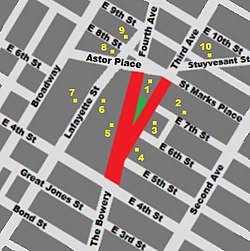
A map of Cooper Square (in red), showing some locations of interest in the area:
1. Cooper Union Foundation Building
2. McSorley's Old Ale House
3. Cooper Union New Academic Building
4. Cooper Square Hotel
5. Village Voice
6. Public Theater (Astor Library)
7. Colonnade Row / Astor Place Theatre (Blue Man Group)
8. Clinton Hall (site of the Astor Opera House)
9. KMart (Wanamaker Department Store Annex) (permanently closed as of 2021)
10. Hamilton Fish House

Cooper Square is a junction of streets in Lower Manhattan in New York City located at the confluence of the neighborhoods of Bowery to the south, NoHo to the west and southwest, Greenwich Village to the west and northwest, the East Village to the north and east, and the Lower East Side to the southeast.

Cooper Square looking uptown in 1957
Cooper Square looking uptown in 2008

Description

[edit]

Beginning at its southern end where the Bowery crosses East 4th Street, the road then splits in two, both with Cooper Square addresses, until they cross Astor Place between East 8th Street and St. Marks Place and become Fourth Avenue (the western street) and Third Avenue (the eastern street).[1][2]

Prior to the 2014-2016 redesign of the area, the intersection was difficult for pedestrians to navigate. Bowery, Third Avenue and both sides of Cooper Square were two-way streets, and the area was part of a city-approved through-truck route.[3] The New York City Department of Transportation announced plans in 2009 to "normalize" traffic, increase the size of the park in the middle of the square, and create a new community park in the area.[4] The redesign was completed in 2016. Lafayette Street, Cooper Square, and Fourth Avenue were converted to one-way streets with reduced lanes, and the park in the intersection was expanded.[5]

History

[edit]

When the square was initially opened as a public space in 1850, it was named "Stuyvesant Square", despite there already being a "Stuyvesant Square" about a half-mile north on Second Avenue. It was renamed for Peter Cooper, the 19th Century industrialist and philanthropist, after his death in 1883.[6][7] In 1853, Cooper had broken ground for Cooper Union for the Advancement of Science and Art, an institution founded on the belief that high-quality education should be available to all who qualified, including women – a radical notion at the time – without cost. It continued to provide every student with a full-tuition scholarship until 2014.[8] Frederick A. Peterson's Cooper Union Foundation Building on the north end of the square, the oldest existing American building framed with steel beams,[9] still stands where it was located when it opened in 1859, but the interior was extensively reconstructed in 1975 not only to modernize it, but also to fulfill one of Cooper's plans which was never realized at the time: the installation of a round elevator. The exterior of the building was restored in 1999 as well.[10]

Downtown of the Foundation Building is a small park, Cooper Triangle, which includes a monument dedicated to Peter Cooper.[11] Across the street, at 41 Cooper Square, is the school's newest building, the New Academic Building, designed by Thom Mayne of Morphosis.[12][13]

The Village Voice's old headquarters are on the western side of the square, as are classroom buildings of Grace Church School and Kaplan, Inc.[14][15][16] The sleek, modern high-rise Cooper Square Hotel at 25 is one of the newest buildings on the square.[17][18]

The New York City Department of Transportation's "Reconstruction of Astor Place and Cooper Square" plan[19] calls for some changes to be made to Cooper Square beginning in 2013. The western leg of the square will be a northbound bus-only lane, from a two-way multi-use roadway. The confusing intersection of the two legs at Fifth Street would become a simple "Village Plaza", with sidewalk extensions and a small amphitheater on the western sidewalk. Finally, Cooper Triangle would be renovated, and expanded to make a new "Cooper Walk" leading up to Cooper Union. New trees would be planted up and down the square on both sides.[19]

[edit]

See also

[edit]

References

[edit]
[edit]
Revisions and contributorsEdit on WikipediaRead on Wikipedia
from Grokipedia
Cooper Square is a triangular public square in the East Village neighborhood of , , bordered by to the north, St. Marks Place to the south, and East 4th Street to the east. Originally part of a larger area deeded to the city in 1828 and known as , it was acquired by the New York City Department of Parks in 1850. The square was renamed Cooper Square in 1883 to honor (1791–1883), the philanthropist, industrialist, and inventor whose for the Advancement of Science and Art institution anchors its northern end. At the heart of Cooper Square lies Cooper Triangle, a small park featuring a prominent bronze statue of Peter Cooper, sculpted by Augustus Saint-Gaudens with a canopy designed by Stanford White, dedicated on May 29, 1897. The monument was restored in 1987 through the city's Adopt-a-Monument Program. The square holds historical significance as the site of Abraham Lincoln's February 27, 1860, , where he outlined his anti-slavery views and helped secure the Republican presidential nomination. Early 20th-century redesigns added and walkways, while a 1938 renovation removed an underground restroom and improved pathways; further enhancements in 1999 introduced new benches and daytime public access. Beyond its physical features, Cooper Square encompasses a broader neighborhood area on Manhattan's Lower East Side, known for its progressive activism and diverse immigrant communities. In 1959, urban planner Robert Moses proposed a massive renewal project to raze 12 blocks—including over 2,400 low-income housing units and historic structures—for high-rise redevelopment, sparking widespread opposition. Led by activist Frances Goldin, the Cooper Square Committee formed that year, mobilizing residents through coalitions, demonstrations, and public hearings to advocate for preservation. Their 1961 Alternative Cooper Square Plan emphasized limited relocation, affordable housing rehabilitation, and mixed-income development without mass displacement, marking one of the city's first grassroots urban plans. Adopted by New York City in 1970, the plan faced delays due to fiscal crises but evolved into the Cooper Square Community Land Trust in 1994, which now stewards land under 328 preserved affordable units across 21 buildings between East 5th and Stanton Streets, from the Bowery to Second Avenue. Today, the area remains a vibrant hub of cultural institutions like the Public Theater and community-driven housing initiatives; in December 2024, the CLT closed on a joint venture to develop over 500 new low-income apartments.

Location and Description

Geographical Position

Cooper Square is situated in the East Village section of , , at the convergence of the , , Fourth Avenue, , and St. Mark's Place (East 8th Street). This convergence creates a distinctive urban junction where the avenues meet cross streets, forming the core of the square. The area functions as a traffic triangle, channeling vehicular and pedestrian flow through the angled alignment of these roadways, which complicates navigation but defines the spatial character of the site. Its approximate geographic coordinates are 40°43′45″N 73°59′25″W, placing it within the densely built grid of midtown-adjacent neighborhoods. Cooper Square marks the confluence of multiple adjacent neighborhoods, with the extending to the south, NoHo bordering to the west, touching the southwest, and the East Village encompassing the north and east. This positioning integrates it into the broader fabric of Lower Manhattan's evolving urban landscape.

Physical Layout and Features

Cooper Square comprises a triangular public plaza spanning approximately one acre in the East Village neighborhood of Manhattan, New York City, encompassing the area bounded by Third Avenue, Fourth Avenue, Stuyvesant Street, and Astor Place. Following the redesign completed in 2016, the space prioritizes pedestrian-friendly zones through widened sidewalks, interlinked open plazas, and reclaimed street areas that reduce vehicular dominance and enhance usability for foot traffic. Key features include granite blocks, stone steps, and distinctive "zipper benches" for seating, complemented by additional mature shade trees and perimeter plantings that provide greenery and shade across the plaza. The central Cooper Triangle park incorporates a historic monument to sculpted by with architectural elements by , surrounded by benches and enhanced with restored historical elements such as mosaic lampposts and a subway kiosk featuring plaques. Modern amenities like energy-efficient lighting designed in collaboration with Tillett Lighting Design, over 100 new bike racks, and e-bike battery swapping stations installed in 2024 as part of a city pilot program (expanded citywide starting 2027) support daily use by cyclists and visitors. Traffic in Cooper Square is managed through a configuration of (two-way) and Fourth Avenue (northbound one-way), along with narrowed streets, medians, and signalized intersections that separate pedestrian paths from vehicles while handling substantial daily volumes of both. These elements, including expanded curbs at key crossings, improve safety amid the area's high pedestrian activity near cultural and educational hubs. Accessibility is facilitated by its central location, with direct proximity to the subway station serving the 6 train on the , as well as nearby bus routes including the M15 and M101/M102/M103 along adjacent avenues. The restored historic subway kiosk at the plaza's edge further integrates public transit access with the pedestrian-oriented design.

History

Origins and Naming

Cooper Square emerged in the early 19th century as part of Manhattan's northward expansion under the , which established a rectilinear street grid extending to 155th Street to facilitate orderly urban growth. The area around what would become Cooper Square, located at the intersection of Third and Fourth Avenues and East Sixth and Seventh Streets, began to develop in the 1820s, transitioning from rural outskirts to an emerging urban zone. Prior to this, the land formed part of the vast bouwerij (farm) owned by Dutch colonial governor in the 17th century, subdivided among his descendants into estates that dominated the East Side landscape. In the early 1800s, the region's land use reflected a mix of agricultural holdings, grand estates belonging to prominent families like the Stuyvesants and Bayards, and nascent commercial ventures along routes such as the . By the 1820s, as the city grid took shape, the area saw initial residential and entertainment developments, including taverns and theaters, marking its role as a simple intersection in a burgeoning residential neighborhood on the edge of the growing metropolis. This evolution positioned Cooper Square as a connective hub between the more established and the developing northern wards. The square was originally known as Stuyvesant Square when the adjacent triangular park was acquired by the city in 1850, but to avoid confusion with the larger at 15th Street, it was renamed Cooper Square in 1883 following the death of (1791–1883), the influential industrialist, inventor, and philanthropist. Cooper, who founded The for the Advancement of Science and Art in 1859 at the square's northern end to provide to working-class New Yorkers, had deep ties to the area; his legacy in promoting accessible learning and civic improvement inspired the naming tribute.

Urban Renewal Threats in the Mid-20th Century

In the post-World War II era, New York City faced severe housing shortages exacerbated by returning veterans and urban population growth, prompting aggressive slum clearance initiatives under the federal Title I program of the 1949 Housing Act, which subsidized land acquisition and redevelopment to eliminate blighted areas. Robert Moses, as chairman of the city's Slum Clearance Committee, spearheaded these efforts, viewing neighborhoods like Cooper Square—characterized by aging tenements and diverse low-income residents—as prime targets for modernization. The 1959 Cooper Square Urban Renewal Plan, released by Moses' committee, proposed the demolition of 11 blocks in the area surrounding Cooper Square, from East 9th Street to and between the and Second Avenue, to make way for high-rise middle-income housing developments. The plan aimed to eradicate what officials deemed "slums" by constructing approximately 2,900 new housing units, while also allocating space for institutional expansions, including potential growth of the adjacent campus. However, it was sharply criticized for its potential to displace around 2,400 low-income tenants—predominantly immigrants, working-class families, and artists—along with 450 single-room occupancy residents and over 500 small businesses, without adequate relocation support. This proposal exemplified broader city-wide renewal campaigns, such as those in and the Cross-Bronx Expressway, which prioritized large-scale infrastructure over fabric, often resulting in the homogenization of diverse urban enclaves. opposition emerged swiftly, laying the groundwork for later preservation efforts, though the plan's implementation remained stalled amid mounting resistance.

Community Activism and Preservation

The Cooper Square Committee (CSC) was established in 1959 by local residents, business owners, and activists in response to New York City's Title I urban renewal plans under the , which targeted the area for large-scale and . As one of the earliest groups to challenge such initiatives, the CSC advocated for greater resident involvement in planning processes, marking a pivotal shift toward participation in urban policy decisions. This formation was driven by concerns over displacement, with organizers like Thelma Burdick and Frances Goldin mobilizing to protect the predominantly low-income, immigrant, and working-class population of the East Village neighborhood. Throughout the 1960s, the CSC led protests and public campaigns against ' slum clearance proposal, which aimed to demolish over 300 buildings and displace thousands of residents to make way for high-rise developments. These efforts included demonstrations, coalition-building with other tenant groups, and testimony at city hearings, successfully delaying implementation and highlighting the human costs of top-down renewal. By the , the committee advanced its vision through the Cooper Square Alternate Plan—often associated with innovative low-rise, mixed-use concepts like the "Cube" model—which emphasized preserving existing structures, integrating affordable housing, and fostering community-controlled development. Adopted by the Board of Estimate in 1970, this plan preserved much of the area's fabric and prevented widespread , serving as a model for alternative urbanism. In the and , the CSC achieved significant milestones in securing limited-equity cooperatives, which allowed residents to own shares while maintaining long-term affordability and blocking further large-scale displacement. Key successes included the development of the 22-unit Cube Building in 1988 for formerly homeless families and the establishment of the Cooper Square Mutual Housing Association in 1991, which, along with the Cooper Square formed in 1994, managed 356 affordable units across 22 buildings initially and, as of 2024, stewards 328 affordable units across 21 buildings through resident governance. These initiatives transformed threatened sites into stable, community-owned properties, ensuring economic and social continuity amid ongoing pressures from . This culminated in the formation of the Cooper Square in 1994, which owns and stewards the land under these properties to ensure long-term affordability. The CSC's activism aligned closely with broader civil rights and anti-displacement movements in the East Village, drawing on the era's push for racial equity and community empowerment as disproportionately impacted Black, Latino, and low-income households. By framing their fight against displacement as part of a larger struggle for , the committee influenced regional networks like the Good Old Lower East Side (GOLES) and contributed to national discourses on , underscoring the power of localized resistance to federal and city policies.

Redesign and Revitalization in the 2000s

In the mid-, the Department of Design and Construction (NYC DDC) initiated a comprehensive redesign of Cooper Square and adjacent , with planning efforts dating back to 2005 and focusing on enhancing pedestrian amenities amid increasing urban density in the East Village. The project, valued at approximately $16 million, involved widening sidewalks, creating new plazas, and implementing traffic-calming measures such as narrowed roadways and improved crosswalks to better accommodate foot traffic while maintaining vehicular access. These upgrades aimed to transform the area into a more pedestrian-oriented urban hub, balancing the flow of cars with expanded spaces to support the neighborhood's growing residential and commercial activity. A key component of the revitalization was the enhancement of Cooper Triangle, a small public at the square's core. The triangle had been reopened to the public in the summer of 1999 following renovations that added new benches and daytime access, restoring its role as a gathering spot after years of limited use. By 2009, as part of the broader redesign momentum, the saw further expansion in its pedestrian areas, including additional seating and plantings to integrate seamlessly with surrounding street improvements. The construction of , Cooper Union's new academic building from 2007 to 2009, further bolstered these efforts by prioritizing pedestrian connectivity. Designed by architect of Morphosis, the structure features ground-level openings and setback plazas that link directly to Cooper Square's sidewalks and pathways, fostering easier access for students and visitors while contributing to the area's overall vibrancy. This integration supported the redesign's goals of creating a cohesive public realm that could handle the East Village's rising without sacrificing .

Architecture and Landmarks

Cooper Union Complex

The Cooper Union Complex serves as the physical and intellectual core of , comprising the historic Foundation Building and the contemporary , both emblematic of the institution's evolution from its founding vision of accessible education in , , and . Established in 1859 by industrialist to offer free classes to the , the complex has anchored educational innovation in Cooper Square for over 160 years. The Foundation Building, located at 7 East 7th Street, is a seven-story Italianate structure of brownstone-faced masonry designed by architect Frederick A. Petersen and completed in 1859, making it one of New York City's earliest examples of fireproof construction with cast-iron framing and innovative rolled-iron I-beams. It was designated a in 1961, recognizing its architectural significance and role in hosting pivotal events, such as Abraham Lincoln's 1860 speech that helped propel his presidential candidacy. The building's robust design, featuring a and grand accommodating up to 900 people, has endured as a symbol of democratic learning, with its interior spaces adapted over time for classrooms, studios, and public lectures while preserving its mid-19th-century character. Adjacent to the Foundation Building, opened in 2009 as a state-of-the-art academic facility designed by Pritzker Prize-winning architect of , featuring cantilevered glass volumes clad in a high-performance double-skin facade that optimizes daylight, ventilation, and energy efficiency. Costing approximately $166 million, the eight-story structure houses engineering laboratories, reconfigurable classrooms, art studios, and collaborative spaces for the Irwin S. Chanin School of Architecture, School of Art, and Albert Nerken School of Engineering, fostering interdisciplinary work through flexible, technology-integrated environments. It achieved Platinum certification in 2010, marking it as New York City's first such academic laboratory building, with sustainable elements including , solar shading, and a geothermal system that reduces energy use by 35 percent compared to conventional designs. The development of sparked controversy among East Village residents, who opposed its large scale—rising nine stories and spanning a full —as potentially overwhelming the neighborhood's low-rise character and casting excessive shadows on adjacent public spaces like Cooper Square. Community meetings in and highlighted concerns over disruptions, traffic, and the of the existing two-story Hewitt Building, though proponents emphasized the project's necessity for modernizing outdated facilities. Historically, The provided tuition-free education to all admitted undergraduates from its until 2014, when financial pressures led to a shift toward half-tuition charges with need-based scholarships covering the remainder for most students, while maintaining its role as a premier hub for bachelor's and master's programs in , , and . As of October 2025, on average 89% of tuition costs are covered for undergraduates, with 57% attending tuition-free, and all seniors tuition-free through the 2027-28 ; the institution supports around 900 students through rigorous curricula that integrate and emphasize hands-on innovation, with initiatives aiming to restore full-tuition scholarships by the 2028-29 .

Other Significant Buildings

In addition to the prominent educational institutions, Cooper Square features several notable structures that reflect the area's evolving architectural and cultural landscape. At 18 Cooper Square, New York University's Grey Art Museum relocated in March 2024, transforming a portion of the modern Albert and Vera List Academic Center—designed by Architects—into a dedicated space for fine arts exhibitions. This expanded the museum's footprint by 40 percent compared to its previous Washington Square location, incorporating larger galleries, a study center, and enhanced visibility for NYU's collection of over 6,000 works, with the inaugural exhibition "Americans in " opening on March 2, 2024. Further along the square, 39 Cooper Square exemplifies ongoing in the neighborhood, owned by the Cooper Square Housing Development Fund Company. These updates build on the site's as part of community-led redevelopment efforts dating back decades, ensuring a blend of living spaces and ground-floor retail amid the East Village's dense urban fabric. Surrounding these sites are historic tenements and lofts from the late , which define much of Cooper Square's bohemian architectural character. Structures like those incorporated into the base of the Cooper Square Hotel (built around 2009) retain original facades from the , featuring cast-iron elements and narrow footprints typical of the era's working-class housing before the 1901 Tenement House Act reforms. These buildings, clustered along East 4th and 5th Streets, have housed artists and immigrants, contributing to the East Village's reputation as a hub for countercultural expression. The commercial vibrancy of Cooper Square is enhanced by nearby cafes, galleries, and performance venues, fostering a dense cultural ecosystem. For instance, the Orpheum Theatre at 126 Second Avenue, just blocks away, has operated since the early as an staple, hosting long-running productions like Stomp from 1994 to 2023 in its 599-seat auditorium originally dating to the 1880s Yiddish theater era. Local spots such as coffee shops on St. Marks Place and galleries along complement these, drawing visitors and underscoring the square's role as a lively intersection of history and modernity.

Community and Social Role

Cooper Square Committee and Housing Initiatives

The Cooper Square Committee (CSC), founded in 1959 to combat threats, evolved into a key steward of through the establishment of the Cooper Square Mutual (CSMHA) in 1991, which manages 356 apartments across 22 formerly city-owned buildings in the Cooper Square neighborhood. In 1994, CSC formed the Cooper Square (CSCLT), the oldest continuously operating in , to hold the underlying land and enforce long-term affordability restrictions on resales, ensuring units remain accessible to low-income residents. This structure separates land ownership from building improvements, preventing speculation and promoting community control over housing stability. The CSCLT operates primarily through limited-equity cooperatives, where residents purchase shares at below-market rates and are restricted from selling at full , thereby preserving affordability for while allowing modest wealth-building. Partnerships with the Department of Housing Preservation and Development (HPD) have been central, including the mid-1990s transfer of building ownership to CSMHA for rehabilitation and the provision of ongoing financing and tax exemptions to support operations. These collaborations have enabled the trust to maintain deeply in a rapidly gentrifying area of the . Recent initiatives highlight the CSCLT's forward-looking approach to expanding and safeguarding . In late 2024, CSC closed a with development partners to redevelop a vacant East Village church at 181 Avenue D into over 500 new low-income apartments, prioritizing formerly homeless individuals and integrating community services. Additionally, in 2025, CSC launched an interactive online mapping tool in partnership with BetaNYC, allowing tenants to assess risks in NYC buildings based on public data, addressing hazards in older stock and empowering residents with actionable information. The impact of these efforts is evident in the preservation of 22 buildings acquired from auctions and transfers, which now house low-income artists, families, and working-class residents who might otherwise face displacement. By prioritizing cultural and economic diversity, the CSCLT has sustained a mixed-income fabric, with units serving households earning as low as 30% of the area , fostering intergenerational stability amid broader urban pressures.

Public Spaces and Cultural Events

Cooper Square functions as a dynamic communal hub in the East Village, drawing diverse residents, workers, and visitors for everyday social interactions, relaxation, and spontaneous gatherings. Its central location at the intersection of major avenues facilitates pedestrian activity, with nearby green spaces like the triangular park providing benches and plantings that encourage lingering and community mingling. Local organizations host annual events that animate the area, including the Cooper Square Committee's summer riverboat cruise gala, held on August 21, 2025, from , featuring buffet dinner, open bar, live , and scenic views of the skyline and . Block parties, such as the Cooper Square Community Land Trust's annual event on June 15, 2024, unite neighbors with games, food vendors, children's activities, live performances, and local , transforming streets into festive communal zones. Art installations organized by these groups, often temporary and site-specific, further enrich the public realm, promoting creative expression amid the urban landscape. As a key node in East Village culture, Cooper Square hosts street performances, artisan markets, and protests that underscore the neighborhood's legacy of artistic innovation and social . Events like the 3rd Avenue / Cooper Square / East Village on July 5, 2025, showcase live music, crafts, and food stalls along the adjacent streets, drawing crowds to celebrate local creativity. Its close proximity to the Nuyorican Poets Cafe at 236 East 3rd Street amplifies this vibrancy, with the cafe's programs in poetry slams, hip-hop, theater, and spilling into the surrounding public areas through related outdoor gatherings and performances. In 2025, targeted activations revitalized vacant storefronts in Cooper Square through partnerships between the Van Alen Institute and the NYC Department of Services' Building Creative Capacity program. The Cooper Square Committee's "Placeholders" project, a pop-up exhibit co-designed with artists Scott Kelly and Delphine Le Goff, featured window installations at 165 and 169 Avenue C that spotlighted East Village small business owners and empty commercial spaces, on view through June 30, 2025. These initiatives fostered temporary cultural hubs, encouraging public engagement with neighborhood stories and economic vitality via guided tours and closing events.

References

Add your contribution
Related Hubs
User Avatar
No comments yet.