Hubbry Logo
search
logo
1926170

Course deviation indicator

logo
Community Hub0 Subscribers
Read side by side
from Wikipedia
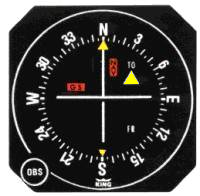
A mechanical VOR display

A course deviation indicator (CDI)[1] is an avionics instrument used in aircraft navigation to determine an aircraft's lateral position in relation to a course to or from a radio navigation beacon. If the location of the aircraft is to the left of this course, the needle deflects to the right, and vice versa.

Use

[edit]

The indicator shows the direction to steer to correct for course deviations. Correction is made until the vertical needle centres, meaning the aircraft has intercepted the given course line. The pilot then steers to stay on that line. Only the receiver's current position determines the reading: the aircraft's heading, orientation, and track are not indicated.

The deflection of the needle is proportional to the course deviation, but sensitivity and deflection vary depending on the system being used:

  • When used with a VOR or VORTAC, the instrument can be referred to as an "omni bearing indicator" ("OBI").[2] The course line is selected by turning an "omni bearing selector" or "OBS" knob usually located in the lower left of the indicator. It then shows the number of degrees deviation between the aircraft's current position and the "radial" line emanating from the signal source at the given bearing. This can be used to find and follow the desired radial. Deflection is 10° deviation at full scale (each side), with each dot on the CDI representing 2°. (See Using a VOR for usage during flight.)
  • When used with a GPS, or other RNAV equipment, it shows actual distance left or right of the programmed course line. Sensitivity is usually programmable or automatically switched, but 5 nautical miles (9.3 km) deviation at full scale is typical for en route operations. Approach and terminal operations have a higher sensitivity frequently up to 0.3 nautical miles (0.56 km) at full scale. In this mode, the OBS knob may or may not have an effect, depending on configuration.[3]
  • When used for instrument approaches using a LDA or ILS the OBS knob has no function because the course line is usually the runway heading, and is determined by the ground transmitter. A CDI might incorporate a horizontal needle to provide vertical guidance when used with a precision ILS approach where the glideslope is broadcast by another transmitter located on the ground.

A CDI is not used with an automatic direction finder (ADF), which receives information from a normal AM radio station or an NDB.

Operation

[edit]

The CDI was designed to interpret a signal from a VOR, LDA, or ILS receiver. These receivers output a signal composed of two AC voltages. When used with a VOR, a converter decodes this signal, and, by determining the desired heading or radial from a resolver connected to the OBS knob, provides a 150mV control signal to drive the CDI needle left or right. Most older units and some newer ones integrate a converter with the CDI. CDI units with an internal converter are not compatible with GPS units. More modern units are driven by a converter that is standalone or integrated with the radio. The resolver position is sent to the converter which outputs the control signal to drive the CDI. For digital units, the desired position of the needle is transmitted via a serial ARINC 429 signal from the radio or GPS unit, allowing the CDI design to be independent of the receiver and by multiple receiver types.

See also

[edit]

References

[edit]
[edit]
Revisions and contributorsEdit on WikipediaRead on Wikipedia
from Grokipedia
The Course Deviation Indicator (CDI) is an aircraft cockpit instrument that visually displays the aircraft's lateral deviation from a selected navigation course or track, using a needle or scale to indicate the direction and extent of the offset from the centerline.[1] The CDI consists of three main components: an omnibearing selector (OBS) for choosing the desired radial or course, a deviation needle that centers when on course and deflects up to full scale (usually ±10 degrees for VOR or ±2.5 degrees for ILS localizer), and a TO/FROM flag showing whether the aircraft is heading toward or away from the navigation source.[1][2] In operation, pilots tune a navigation receiver to a VOR frequency (108.0–117.95 MHz), select the course via the OBS, and adjust the aircraft's heading to center the CDI needle, compensating for wind drift to track the radial accurately.[1] The CDI's sensitivity scales automatically in modern systems for different phases of flight, such as en route (±2 nautical miles full scale for WAAS GPS), terminal (±1 nautical mile), or final approach (±0.3 nautical miles), ensuring precise guidance during instrument procedures.[3] Beyond VOR, the CDI integrates with other systems like the Instrument Landing System (ILS) localizer for lateral runway alignment, GPS for RNAV routes where deviations must stay within limits like 0.5 nautical miles for RNAV 1, and even horizontal situation indicators (HSI) in advanced cockpits for combined heading and course information.[4][5][6] This versatility makes the CDI essential for non-precision and precision approaches, reducing crosstrack error and enhancing situational awareness in instrument flight rules (IFR) operations.[7]

History and Development

Origins in Early Radio Navigation

The course deviation indicator (CDI) originated in the post-World War II period as an essential cockpit instrument for interpreting signals from VHF Omnidirectional Range (VOR) systems, which were developed to provide precise lateral navigation by measuring phase differences between reference and variable radio signals. VOR development began in 1937 under the auspices of the U.S. Civil Aeronautics Administration (CAA), with the first VOR station commissioned in 1947.[8] The CDI served as a standalone analog device in aircraft panels, displaying deviation from a selected course via a needle that deflected left or right based on the phase comparison, enabling pilots to maintain accurate headings without relying on older audio-based systems like the low-frequency radio range. This design built on earlier indicators used for Instrument Landing System (ILS) localizer guidance, developed in the 1930s and operational by the early 1940s. In the late 1940s and 1950s, the CAA and military entities collaborated on VOR expansion to establish a reliable en route navigation network, opening initial "Victor" airways by 1950. Military adaptations integrated VOR with Tactical Air Navigation (TACAN) systems, culminating in the joint VORTAC standard approved in 1956 by the Air Coordinating Committee to serve both civil and defense needs. Early CDIs were engineered as standalone instruments to process these signals, replacing rudimentary needle-based direction finders from pre-war era systems that lacked omnidirectional precision. The Omni Bearing Selector (OBS) knob, a standard feature of VOR receivers, allowed pilots to manually select desired radials on the CDI's course card for intuitive course setting and to/from indication.[9][10] Commercial implementations of the CDI gained traction in the late 1950s as civil aviation transitioned to jet aircraft and expanded VOR coverage exceeded 45,000 miles by 1953, facilitating safer cross-country flights for airlines like those operating Boeing 707s. This advancement simplified navigation compared to initial setups, where course selection relied on less user-friendly manual tuning.[11] Early CDIs employed analog electromechanical resolvers to convert the VOR receiver's AC phase signals into proportional mechanical movement of the deviation needle, ensuring reliable indication of up to 10 degrees full-scale deflection for course errors. These resolvers, functioning as variable coupling transformers, were standard in 1950s aviation electronics for their accuracy in angular position sensing within the harsh cockpit environment.[12][13]

Standardization and Technological Advancements

In the 1970s, the Federal Aviation Administration (FAA) collaborated with the aviation industry to standardize avionics interfaces through ARINC specifications, particularly the ARINC 400 series, to promote interoperability among navigation systems. These standards helped define analog signal characteristics for equipment like the course deviation indicator (CDI), with a typical ±150 mV output for full-scale needle deflection to ensure consistent performance across VOR receivers and display units.[14] This standardization facilitated reliable integration in diverse aircraft configurations, addressing variations in early analog designs. During the 1980s and 1990s, technological advancements shifted CDI designs from vacuum-tube electronics to solid-state components, enhancing reliability, reducing power consumption, and minimizing physical size for better cockpit integration. This transition mirrored broader upgrades in VOR ground stations and airborne receivers, where the FAA initiated contracts in 1979 for installing over 950 solid-state VOR units to replace aging tube-based systems, thereby improving overall navigation accuracy and maintenance efficiency.[15][16] Solid-state CDIs became prevalent in new installations, offering greater resistance to vibration and temperature extremes common in aviation environments. Standardization efforts also established precise operational parameters, such as full-scale deflection limits of 10° for VOR usage, with typical five-dot displays scaled at 2° per dot to provide pilots with intuitive lateral deviation cues. These limits ensured predictable sensitivity, allowing deviations greater than 10° to peg the needle at full scale for clear off-course indication. By the 1990s, FAR Part 23 and Part 25 certification requirements included approved navigation displays for aircraft equipped for instrument flight rules (IFR) operations, in accordance with general equipment standards such as §§ 23.1301, 23.1303, and 23.1309.[17]

Design and Components

Core Instrument Elements

The core instrument elements of a traditional course deviation indicator (CDI) include the course deviation needle, omnibearing selector (OBS) knob, TO/FROM flag indicator, and internal resolver/converter circuitry, which together form the electromechanical foundation for displaying navigation deviation in aircraft cockpits. The course deviation needle serves as the primary visual component, consisting of an electromechanical meter movement that deflects to indicate lateral offset from the selected course, with full-scale deflection typically calibrated at ±10° for VOR applications.[18] The OBS knob enables manual selection of the desired inbound or outbound course, mechanically linked to a resolver that aligns the instrument's reference with the pilot's input for accurate deviation computation.[19] Adjacent to the needle, the TO/FROM flag indicator provides a binary visual cue—displaying "TO" or "FROM"—to show the aircraft's radial relationship to the navigation station, driven by dedicated electrical thresholds for activation.[20] Electrically, the CDI interfaces with VOR or ILS navigation receivers through low-level DC voltages representing phase differences (for VOR) or amplitude modulation (for ILS localizer), with the left-right input typically requiring 150 mV ±10% for full-scale needle deflection and an input impedance of 1 kΩ ±10%.[19] These signals are processed by the internal resolver/converter circuitry, which demodulates and conditions the AC-derived inputs from the receiver into DC outputs suitable for the meter movement and flag solenoids, ensuring reliable operation at 400 Hz reference frequencies where applicable.[19] Mechanically, the needle's electromechanical assembly relies on a taut-band or pivot-and-jewel suspension for smooth, low-friction deflection, housed within a rugged case designed for vibration resistance in flight environments. Standalone CDI units adhere to standard mounting dimensions of 3 1/8 inches in diameter for the front panel cutout, with an overall depth of up to 4.75 inches behind the panel, facilitating installation in general aviation instrument panels via rear-mount screws.[19]

Display and Interface Variations

The traditional course deviation indicator (CDI) features an analog needle that deflects left or right from a central position to indicate lateral deviation from the selected course, with the instrument face marked by a scale typically consisting of five dots on each side of the center line, where each dot represents an incremental deviation of approximately 2 degrees for en route VOR navigation.[21] Full-scale deflection of the needle corresponds to ±10 degrees for standard VOR use, providing pilots with a visual cue to correct back to course by flying toward the needle.[21] Variations in CDI displays include fixed-scale models, where the deviation sensitivity remains constant (e.g., ±10 degrees full scale for standard VOR use), and adjustable-sensitivity versions that alter the scale based on flight phase, such as narrowing to ±2.5 degrees for localizer approaches or ±0.3 nautical miles for GPS RNAV precision.[21] Some units integrate a distance-to-station readout from Distance Measuring Equipment (DME), displaying slant-range distance in nautical miles alongside the deviation needle to enhance situational awareness during VOR/DME operations.[21] Modern analog CDIs often incorporate ARINC 429 digital interfaces to receive navigation data from avionics systems like GPS receivers, enabling seamless integration with other cockpit instruments while retaining the traditional needle display.[22] In combined instruments such as those used for ILS, needles may be color-coded—for example, green for VOR/localizer and magenta for GPS—to distinguish navigation sources and improve readability during precision approaches.[23] These core display elements, driven by internal resolvers and actuators, allow for reliable visual feedback in diverse cockpit environments.[21]

Principles of Operation

Signal Processing and Interpretation

The course deviation indicator (CDI) receives navigation signals from a VHF omnibearing selector (VOR) receiver, which processes the incoming radio frequency signals into low-frequency alternating current (AC) outputs representing phase or amplitude differences between the reference and variable signals transmitted by the ground station.[1] These AC signals, typically at 30 Hz for VOR, encode the aircraft's position relative to the station's radials, with the phase difference directly corresponding to the angular bearing from the station.[24] Within the CDI or associated circuitry, a resolver or synchro mechanism compares the received phase to the pilot-selected course (set via the omni-bearing selector, or OBS), generating an error signal that quantifies the deviation.[18] This error signal, initially in AC form, is rectified and amplified to produce a direct current (DC) voltage that drives the CDI's meter or needle mechanism.[24] The DC output is bipolar, typically ranging from -150 mV (full left deflection) to +150 mV (full right deflection), with the magnitude proportional to the deviation angle.[25] A centered needle indicates the aircraft is on the selected course, while deflections to the left or right provide steering corrections, directing the pilot to adjust heading accordingly; notably, this indication is independent of the aircraft's actual magnetic heading, focusing solely on course alignment.[1] The deflection angle θ\theta is given by
θΔϕ, \theta \approx \Delta \phi,
where Δϕ\Delta \phi is the angular deviation in degrees from the selected course, and full-scale deflection occurs at ±10\pm 10^\circ for VOR systems (across five dots, each representing 2°).[1] The corresponding electrical output provides approximately 150 mV per dot of deflection, ensuring precise visual feedback for navigation.[25] The TO/FROM flag on the CDI is determined by the reciprocity of VOR radials, where the flag logic interprets the phase relationship: it displays "TO" when the aircraft is inbound on the selected radial (phase indicating approach to the station) and "FROM" when outbound (phase indicating departure), flipping states at 90° and 270° relative to the OBS setting.[24] This binary indication, driven by a separate DC signal (typically 200-0-200 μA), alerts the pilot to the direction of travel along the course without requiring distance measurement.[24]

Deviation Scaling and Sensitivity

The course deviation indicator (CDI) provides pilots with visual feedback on lateral deviation from the selected course, with scaling calibrated to represent specific angular or linear distances for accurate navigation. For VHF omnidirectional range (VOR) systems in enroute operations, full-scale deflection corresponds to ±10° (10° either side of the course centerline), allowing the instrument to display deviations without overload while maintaining usability over long distances.[26] Typically, this scaling uses five dots on each side of the centerline, with each dot representing 2° of angular deviation, ensuring pilots can interpret corrections proportionally.[26] Sensitivity adjustments on the CDI vary by navigation aid to match operational phases. In VOR navigation, sensitivity is fixed and angular, with pilots manually selecting the course using the omnibearing selector (OBS) knob to center the needle and interpret deviations relative to the selected radial.[1] For GPS-based navigation, sensitivity is automatically scaled based on flight phase: 5 NM full-scale enroute for broad-area monitoring, 1 NM full-scale in terminal areas for closer precision, and 0.3 NM full-scale during approaches to provide fine-grained guidance near waypoints.[20] This automatic adjustment ensures the CDI remains appropriately responsive without manual intervention, transitioning smoothly (e.g., from 1 NM to 0.3 NM beginning 2 NM prior to the final approach waypoint).[20] Several factors influence CDI sensitivity to maintain reliability and prevent erroneous indications. Signal strength is critical; if the received signal falls below usable levels, an "OFF" flag appears on the instrument, warning pilots of weak or unreliable navigation data from sources like VOR stations or GPS satellites.[26] Additionally, full-scale limits are imposed to avoid instrument overload, where deviations beyond the calibrated range (e.g., greater than 10° for VOR) peg the needle at full deflection without further proportional movement, prompting pilots to select an alternative course or navigation method.[26] In instrument landing system (ILS) integration, localizer sensitivity is calibrated to 2.5° full-scale deflection near the runway threshold, with each of the five dots representing 0.5° to support precise alignment during final approach.[26] This angular scaling increases with distance from the threshold, providing broader usable coverage (up to 10°-18° either side) while maintaining consistent sensitivity for course corrections throughout the approach path.[20]

Applications in Navigation Systems

VHF Omnidirectional Range (VOR) Usage

The course deviation indicator (CDI) plays a central role in VHF omnidirectional range (VOR) navigation by providing pilots with visual guidance to maintain or intercept specific radials during enroute and terminal operations. To set up the system, the pilot tunes the VOR receiver to the appropriate station frequency, typically in the range of 108.0 to 117.95 MHz, and verifies the station's identification through its Morse code signal or voice transmission.[20] The pilot then rotates the omnibearing selector (OBS) on the CDI instrument to the desired radial, which represents a magnetic course emanating from the VOR station.[1] The CDI needle deflects to the left or right to indicate the aircraft's position relative to the selected radial, with a centered needle signifying alignment on course.[20] The TO/FROM flag on the instrument further clarifies the direction: "TO" when heading toward the station along the selected radial, and "FROM" when heading away, flipping upon station passage.[1] In practice, pilots use the CDI to track VOR radials for defining airways or direct routing in enroute and terminal phases. Full-scale deflection of the CDI needle typically represents ±10° of angular deviation from the selected course in standard VOR mode, though some systems integrate distance measuring equipment (DME) to display sensitivity in nautical miles, such as ±10 NM for enroute navigation.[20] To track a radial, the pilot adjusts the aircraft's heading to center the needle, applying corrections for wind drift while monitoring the OBS to ensure the selected course remains constant.[1] For reciprocal courses, selecting the opposite radial (e.g., 090° versus 270°) reverses the TO/FROM indication relative to the aircraft's position, aiding in outbound tracking after station passage.[20] One common application is intercepting a specific radial, such as when navigating to join an airway. For instance, to intercept the 090° radial from a VOR station while approaching from the northwest, the pilot selects 090° on the OBS and steers toward the CDI needle deflection (e.g., a left deflection indicates steering right) at an intercept angle of 30° to 45° relative to the radial, reducing the angle as the needle centers to avoid overshooting.[1] However, error sources must be considered, particularly the cone of confusion—a conical volume directly above the VOR station where signals become unreliable, causing the CDI needle to fluctuate or reverse erratically during overhead passage.[20] In such cases, pilots rely on DME for precise distance measurement to the station, ensuring accurate timing and positioning without angular guidance from the CDI.[1] This integration enhances reliability for enroute and terminal VOR procedures.

Instrument Landing System (ILS) Integration

The course deviation indicator (CDI) integrates with the Instrument Landing System (ILS) by receiving signals from the localizer transmitter to provide lateral guidance, displaying the aircraft's deviation from the runway centerline via a needle deflection. The localizer operates on frequencies between 108.10 and 111.95 MHz, transmitting two overlapping lobes modulated at 90 Hz and 150 Hz to create a difference in depth of modulation (DDM) that the onboard receiver processes into proportional needle movement. This setup ensures the CDI needle centers when the aircraft is aligned with the fixed ILS course, which corresponds to the runway heading, enabling pilots to maintain precise lateral alignment during precision approaches.[20] In ILS operations, the CDI is often combined with a glideslope indicator for vertical guidance, where the glideslope transmitter (329.15–335.00 MHz) provides a complementary deviation display, typically showing full-scale deflection at ±0.7 degrees from the nominal 3-degree glide path. The localizer CDI sensitivity is calibrated such that full-scale deflection represents ±2.5 degrees of angular error, corresponding to a course width of approximately 700 feet (±350 feet from the centerline) at the runway threshold, with each of the five dots indicating 0.5 degrees of deviation. This angular-based scaling remains proportional to the off-course angle rather than distance from the runway, allowing consistent sensitivity throughout the approach once captured, typically initiated at deviations within ±2 degrees for reliable course interception. A warning flag appears on the CDI if the localizer signal is lost or unreliable, such as due to interference or out-of-range conditions beyond the usable service volume of ±10 degrees and 18 nautical miles.[20][27] During an ILS approach, pilots monitor the CDI to keep the needle centered on the localizer course, adjusting heading to correct deviations and ensuring the aircraft tracks the runway centerline; for instance, a left deflection prompts a right heading correction until recentered, while maintaining the glideslope within limits for a stabilized descent. This integration supports Category I, II, or III approaches by providing the precision required for low-visibility landings, with the CDI's 150 microamp full-scale deflection threshold (0.155 DDM) ensuring reliable signal interpretation under standard conditions.[20]

GPS and Area Navigation (RNAV) Adaptations

The Course Deviation Indicator (CDI) has been adapted for use with Global Positioning System (GPS) receivers and Area Navigation (RNAV) systems by outputting lateral deviation as a linear distance off the desired track in nautical miles (NM), enabling precise guidance along user-defined waypoints rather than ground-based radials. This adaptation allows the CDI to serve as the primary lateral navigation display for RNAV procedures, where the GPS computes the aircraft's position relative to the programmed flight path.[28] In GPS and RNAV operations, the CDI tracks great-circle courses calculated by the navigation system, providing pilots with deviation information from the geodesic path between waypoints. Scaling of the CDI is typically ±2 NM for full-scale deflection during enroute phases under Required Navigation Performance (RNP) 2.0 criteria, ensuring appropriate sensitivity for long-distance oceanic and continental RNAV routes. Automatic scaling adjusts dynamically for different flight phases, such as ±1 NM in terminal areas (RNP 1.0) and ±0.3 NM during final approach segments (RNP 0.3), often transitioning smoothly beginning 2 NM prior to the final approach waypoint.[28][20] Receiver Autonomous Integrity Monitoring (RAIM) is integrated to ensure GPS signal integrity, continuously predicting and alerting if satellite geometry or errors could exceed 2×RNP limits, which is mandatory for IFR RNAV operations using TSO-C129-approved equipment. In GPS mode, the CDI depicts deviation from the desired track as a magenta line on compatible displays, facilitating visual alignment with the RNAV path. These adaptations were enabled by post-1990s developments, including the FAA's authorization of Technical Standard Order (TSO)-C129 in 1994, which established minimum performance standards for GPS supplemental navigation equipment suitable for IFR enroute, terminal, and non-precision approach use.[28][29]

Modern Implementations and Enhancements

Integration with Horizontal Situation Indicators (HSI)

The Horizontal Situation Indicator (HSI) integrates the course deviation indicator (CDI) functionality with a heading indicator, combining navigation deviation data with directional orientation to enhance pilot situational awareness during flight.[30] In HSI design, a rotating compass rose depicts the aircraft's current heading, centered around a fixed symbolic aircraft icon, while the CDI needle overlays this to show lateral deviations from the selected course relative to the heading. This configuration allows pilots to interpret course corrections in direct relation to the aircraft's orientation, unlike a standalone CDI where deviations are displayed independently of heading changes.[31] Key benefits of this integration include improved clarity during turns, where the relative positioning of the CDI needle to the compass rose prevents misinterpretation of deviation signals that could occur with isolated CDI displays.[30] The HSI also incorporates a heading bug—a movable marker on the compass rose—that pilots can set to a target heading, aiding in precise navigation and procedural turns. Developed in the early 1960s by Arthur A. Collins and Horst Schweighofer at Collins Radio Company, the HSI evolved from earlier gyrocompass systems and was introduced commercially around 1963 as part of the PN-101 navigation suite.[32] By the 1970s, it had become standard equipment in commercial airliners for its workload reduction in complex operations, while remaining an optional installation in general aviation aircraft.[33]

Role in Electronic Flight Instrument Systems (EFIS)

In Electronic Flight Instrument Systems (EFIS), the Course Deviation Indicator (CDI) is implemented as a software-rendered bar or needle on the Primary Flight Display (PFD) or Multi-Function Display (MFD), providing pilots with a dynamic visual representation of lateral deviation from the selected course. This digital format processes signals from navigation receivers to indicate the aircraft's position relative to the course line, including a To-From flag and source annunciation, allowing for flexible display customization without physical hardware adjustments.[34][35] The CDI supports integration with multiple navigation sources, such as VHF Omnidirectional Range (VOR), Global Positioning System (GPS), and Instrument Landing System (ILS), by selectively sourcing deviation data based on the active mode selected via the flight management system.[36] Key advancements in CDI functionality within EFIS leverage digital data buses like ARINC 429 for input from navigation units, ensuring accurate transmission of deviation scale, course information, and steering commands to the display system. Synthetic vision overlays integrate the CDI needle or bar directly onto a three-dimensional terrain model, combining course guidance with enhanced situational awareness during instrument flight conditions. Auto-scaling capabilities further refine CDI sensitivity by automatically adjusting the full-scale deflection—such as 5 nautical miles enroute, 1 nautical mile in terminal areas, or 0.3 nautical miles during GPS approaches—based on the current flight phase, reducing pilot workload and improving precision.[37][38][39][40] Following the introduction of integrated glass cockpit systems like the Garmin G1000 in 2004, digital CDI implementations have become standard in modern aircraft, with over 25,000 units delivered by 2022 and continued growth into 2025, including recent deliveries to training fleets.[41][42] These software-based designs exhibit reduced mechanical failure rates compared to traditional analog instruments, as they eliminate moving parts prone to wear, vibration-induced issues, and calibration drift, while benefiting from redundant electronic processing for higher overall reliability.[43] Looking ahead, trends in EFIS point to AI-assisted course deviation prediction within NextGen airspace, where machine learning algorithms analyze real-time trajectory, weather, and traffic data to forecast potential deviations and provide proactive alerts, enhancing safety and efficiency in high-density operations as of 2025.[44]

References

User Avatar
No comments yet.