Hubbry Logo
Criticism of hadithCriticism of hadithMain
Open search
Criticism of hadith
Community hub
Criticism of hadith
logo
8 pages, 0 posts
0 subscribers
Be the first to start a discussion here.
Criticism of hadith
Criticism of hadith
from Wikipedia
A manuscript copy of Sahih al-Bukhari, Mamluk era, 13th century, Egypt. Adilnor Collection, Sweden.

Criticism of ḥadīth[Note 1] or hadith criticism is the critique of ḥadīth—the genre of canonized Islamic literature made up of attributed reports of the words, actions, and the silent approval of the Islamic prophet Muhammad.[1][Note 2]

Mainstream Islam holds that the Sunnah—teachings and doings of Muhammad—are like the Quran, divine revelation to be obeyed, but the "great bulk" of the rules of Sharia (Islamic law) are derived from ḥadīth rather than the Quran. However, Quranists reject the authority of the hadiths, viewing them as un-Quranic; they believe that obedience to Muhammad means obedience to the Quran;[3][4] some further claim that most hadiths are fabrications (pseudepigrapha) created in the 8th and 9th century AD, and which are falsely attributed to Muhammad.[5][6][7] Historically, some sects of the Kharijites also rejected the hadiths, while Mu'tazilites rejected the hadiths as the basis for Islamic law, while at the same time accepting the Sunnah and Ijma.[8]

Criticism of ḥadīth has taken several forms. The classical Islamic science of ḥadīth studies was developed to weed out fraudulent accounts and establish a "core" of authentic (i.e., "sound" or ṣaḥīḥ) ḥadīth compiled in classical ḥadīth collections. But some Muslim thinkers and schools of Islam contend that these efforts did not go far enough. Among their complaints is that there was a suspiciously large growth in the number of ḥadīth with each early generation;[9][Note 3] that large numbers of ḥadīth contradicted each other; and that the genre's status as a primary source of Islamic law has motivated the creation of fraudulent ḥadīth.[12][13]

These critics range from those who accept the techniques of ḥadīth studies but believe a more "rigorous application" is needed (Salafi Jamal al-Din al-Qasimi)[14] in preparation for updating and re-establishing Sharia law; to those who believe it is important to follow the Sunnah but that the only handful of ḥadīth (mutawātir ḥadīth) are of sufficiently reliable basis to accept (19th-century modernist Sayyid Ahmad Khan);[15] to "deniers of hadith" or "Hadith rejectors" who believe that the ḥadīth are not part of the Sunnah and that what Muslims are required to obey is contained entirely in the Quran (20th-century Quranist Aslam Jairajpuri).[16] The term "Hadithist" is a term of reference or depiction, used by Hadith-rejecting Muslims to describe those who adhere to the Hadith.[17]

Emergence of hadith

[edit]

Background

[edit]

The earliest schools and scholars of Islamic law—starting around a century and a half after the death of Muhammad—did not all agree on the importance of Prophetic sunnah and its basis, being hadith ultimately attributed to Muhammad.[2] Opinion ranged from prophetic hadith being one source of law among others (such as caliphal tradition or reports going back to Muhammad's followers), as was held by the ahl al-raʿy[18] to outright rejection of hadith on the basis of their potentially tenuous historicity, as was held by the ahl al-kalām (referred to by some as "speculative theologians").[19]

Al-Shafi'i and the canonization of hadith

[edit]

A sizable shift in practice in favor of the tradition of prophetic hadith and its basis for Islamic law (fiqh) came with al-Shāfiʿī (767–820 CE), founder of the Shafi'i school of law.[20] According to this school of thought, prophetic hadith override all other hadith.[21][22] It is unlikely that consensus yet existed for this view at this time as Shafi'i would come to spend great effort on establishing and promulgating his views over other ones.[23] For those who criticized the reliability of hadith on the basis of their long phase of oral transmission,[24] al-Shafi'i responded by arguing that God's wish for people to follow Muhammad's example would result in God ensuring the preservation of the tradition.[25] Sunnah became a source of divine revelation (wahy) and the basis of classical Islamic law (Sharia), especially in consideration of the brevity dedicated to the subject of law in the Quran[26] (which, for example, does not comment in detail on ritual like Ghusl or Wudu,[27] or salat, the correct forms of salutations,[28] and the importance of benevolence to slaves.[29]) Al Shafi'is advocacy played a decisive role in elevating the status of hadith[30][31] although some skepticism along that of earlier lines would continue.[32]

Hadith sciences

[edit]

Once (authentic) hadith had attained their elevated status among the group inspired by al-Shafi'i who sought to establish Islamic practice on the basis of the Sunnah (Muhammad's deeds and sayings), the focus shifted amongst advocates of this group (who were called the ahl al-sunnah, or the "People of the Sunnah") to delineating between reliable or "sound" (ṣaḥīḥ) with unreliable hadith. The field that arose to meet this need came to be known as the hadith sciences (ʻilm al-ḥadīth), and this practice had entered into a mature stage by the 3rd century of Islam.[33][34][Note 4] The hadith sciences helped undergird the triumph of Al-Shafi'is prioritization of prophetic hadith[35] which became the primary sources of Islamic law and also became "ideological" tools[12][13] in political/theological conflicts.[24]

A challenge the hadith sciences had to confront was the massive scale of hadith forgery,[36][Note 5] with Muhammad al-Bukhari claiming that only ~7,400 narrations of 600,000 he investigated met his criteria for inclusion.[37] Even among those 7,400, a large fraction were variants of the same report, but with a different chain of transmitters (isnad).[37][Note 6] The criteria for establishing the authenticity (sihha) of hadith came down to corroboration of the same report but from different transmitters,[38] assessing the reliability and character of the transmitters listed in the chain[39] (although Muhammad's companions, the sahaba, were excluded from this as their association with Muhammad immediately guaranteed their character and competence[40]), and the lack of gaps in the chain.[39] By implication, defects in hadith might assumed to be associated with the lack of character (ʿadāla) or competence (ḍābiṯ) of its transmitters.[41] It was also thought that such faulty transmitters could be identified[41] and that the isnad was a direct reflection of the history of transmission of a tradition.[41] Evaluation rarely looked at the content (matn) of a narration as opposed to its isnad.[Note 7] Ultimately, evaluations of hadith remained haphazard between authors until the practice of the hadith sciences was standardized by Ibn al-Salah in the 13th century. It is through the lenses of this framework, supplemented by some additional work from Al-Dhahabi in the 14th century and Ibn Hajar al-Asqalani in the 15th century, that Muslim scholars since understood the discipline.[43]

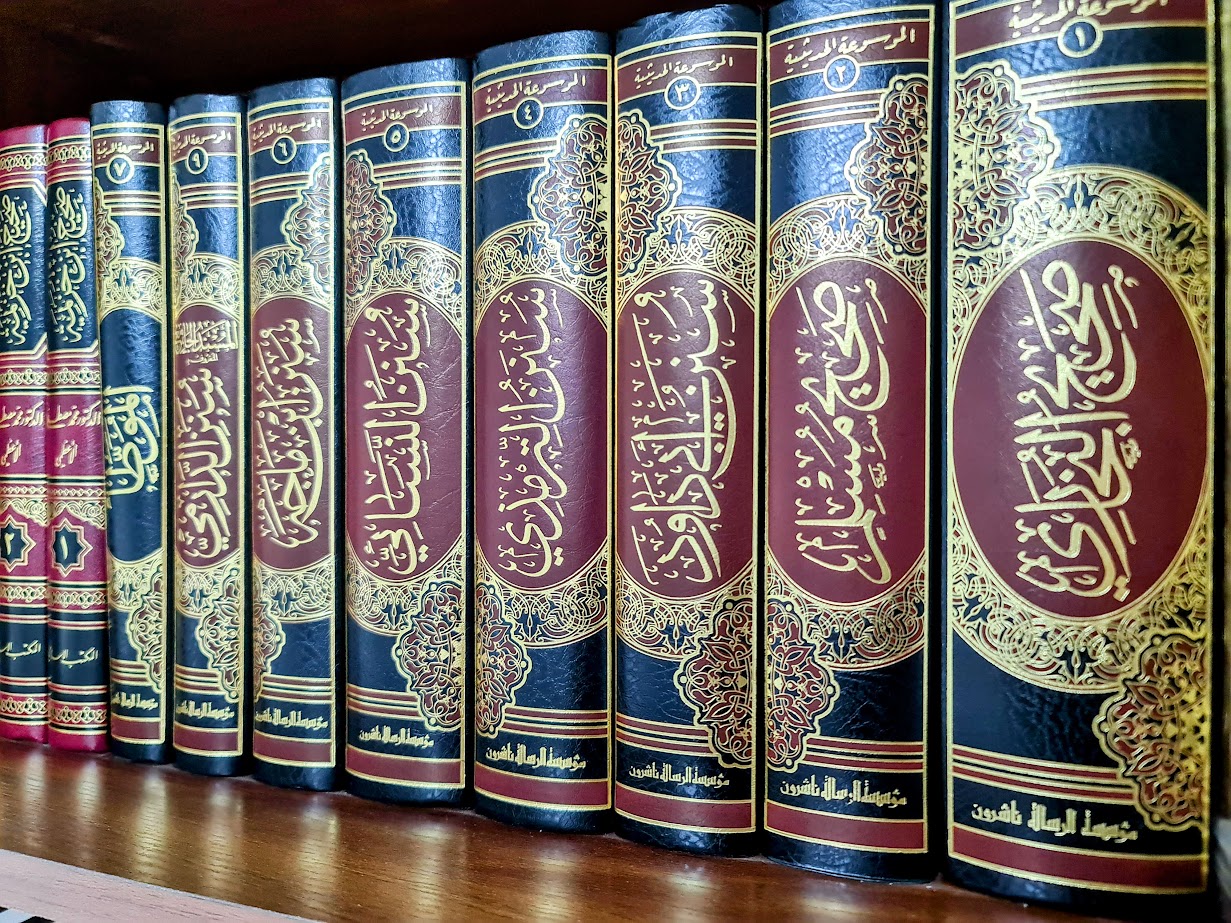
The first collections to be accepted as authoritative among Sunnis by the tenth century CE were the Sahihayn, referring to Sahih al-Bukhari and Sahih Muslim. Even as the set of canonical texts grew, the Sahihayn remained the core of the canon, with Sahih al-Bukhari typically being viewed as the most pre-eminent of the two. The tenth century CE also saw the inclusion of another two collections to form a Four-Book canon, including the Sunan Abi Dawud and Sunan al-Nasa'i. This grew into a Five-Book canon in the twelfth century, when Sunan al-Tirmidhi was added. In the same century, the modern Six-Book canon, known as the Kutub al-Sittah, emerged. Depending on the list, the sixth canonical book was the Sunan ibn Majah, the Sunan of Al-Daraqutni, or the Muwatta of Malik ibn Anas.[44]

History of Muslim criticism

[edit]

Historically, some sects of the Kharijites rejected the Hadith. There were some who opposed even the writing down of the Hadith itself for fear that it would compete, or even replace the Qur'an.[45] Mu'tazilites also rejected the hadiths as the basis for Islamic law, while at the same time accepting the Sunnah and ijma.[8] Under the Abbasid caliph Al-Ma'mun (r. 813-833), the adherents of Kalam were favoured and the supporters of Hadith were treated harshly. Al-Ma'mun was inclined towards rational inquiry in religious matters, supported the proponents of Kalam and persecuted the adherents of Hadith. His two immediate successors, Al-Mu'tasim (r. 833-842) and Al-Wathiq (r. 842-847), followed his policies. Unlike his three predecessors, Al-Mutawakkil (r. 847-861) was not inclined to rational inquiry in religious matters, and strove to bolster the Hadith as a necessary source of the Sunnah.[46]

Similarly, critics of collection and/or use of hadith in Islam can be found in the early era when the classical consensus of al-Shafiʿi was being developed and established (particularly by the ahl-i-kalam and Muʿtazilites) and many centuries later in the modern era when Islamic reformists (such as the ahl-i-Quran and thinkers such as Syed Ahmed Khan, Muhammad Iqbal) sought to revitalize Islam.[47]

Although scholars and critics of the Hadith such as Aslam Jairajpuri and Ghulam Ahmed Perwez)[16] have "never attracted a large following",[48] they and others who propose limitations on usage of ḥadīth literature outside of the mainstream include both early Muslims (Al-Nawawi, Wāṣil b. ʿAṭāʾ, Ibrahim an-Nazzam) and later reformers (Syed Ahmed Khan, Muhammad Iqbal). Both modernist Muslims and Quranists believe that the problems in the Islamic world come partly from the traditional elements of the hadith and seek to reject those teachings.[49]

Medieval criticism

[edit]

Sunnis

[edit]

Whether al-Bukhari and other traditional hadith scholars were successful in narrowing down hadith to its authentic "core" is disputed among Sunni Muslim scholars, especially prior to the early modern era.[50] Al-Nawawi wrote that "a number of scholars discovered many hadiths" in the two most authentic hadith collections known as the SahihaynSahih al-Bukhari and Sahih Muslim—"which do not fulfill the conditions of verification assumed" by the collectors of those works.[51] Al-Ghazali addresses questions from an unnamed "questioner" about a number of problems the questioner sees in several hadith,[52] such as "Satan runs in the blood vessels of one of you";[53] "satans nourish themselves from manure and bones"; and "Paradise is as wide as heaven and earth", yet it must be "contained somewhere within the bounds of those two?"[54]

In the fifteenth century, when Ibn Hajar al-Asqalani encountered the hadith

  • When `God created Adam, and he was sixty arms tall,' and that, after Adam fell, 'mankind has continued to shrink since that time.'[55]

he noted that the ancient inhabitants of houses carved out of cliffs he had seen must have been about the same size humans of his day, simply "admitted frankly that 'to this day, I have not found how to resolve this problem'", without doubting the hadith's authenticity.[56] However, with the rise of natural sciences and technology of the West, some Muslims came to a different conclusion.[57] Critics also complained of hadith that sound less like what a prophet would say than someone in the post-Shafiʿi era justifying fabricating hadith. Such as

  • '[Sayings attributed to me] which agree with the Koran, go back to me, whether I actually said them or not', and
  • 'Whatever good sayings there are, I said them.'[58][59]

Joseph Schacht argues that the very large number of contradictory hadith are very likely the result of hadith fabricated "polemically with a view to rebutting a contrary doctrine or practice" supported by another hadith.[12]

While criticism of the authenticity of any hadith in the Sahihayn ceased during the early modern era, it has been revived again by the Salafi movement, a prominent example of this being Al-Albani.[60]

Kalam theologians

[edit]

According to scholar Daniel W. Brown, the questioning of the authenticity, scholarship and importance of Hadith goes back to the second century of Islam when al-Shafiʿi was establishing the final authority of a hadith of Muhammad in Islamic law. An opposing group, known as Ahl al-Kalam (or the Kalam theologians), were "highly critical of both the traditionists' method and the results of their work",[61] doubting "the reliability of the transmission" of the hadith,[25] including the traditionists' evaluation of the "qualities of the transmitters" of hadith they considered "purely arbitrary",[61] and thought the collections of hadiths to be "filled with contradictory, blasphemous, and absurd traditions."[62]

They did not doubt that Muslims ought to follow the example of the prophet, but maintained his "true legacy" was found "first and foremost in following the Quran"[61]—an "explanation of all things" (Quran 16:89)—which hadith "should never be allowed to rule on".[61] If a question was "not referred to in the Qur'an", Ahl al-Kalam "tended" to regard it as "having been left deliberately unregulated by God."[61] They contended that obedience to the Prophet was contained in obeying only the Qur'an that God has sent down to him, and that when the Qur'an mentioned "the Book" together with "Wisdom" (4:113, 2:231, 33:34), "Wisdom" was not another word for hadith, but for "the specific rulings of the Book".[63]

Mutazilites

[edit]

Later, a similar group, the Mu'tazilites (which flourished in Basra and Baghdad in the 8th–10th centuries CE),[64] also viewed the transmission of the Prophetic sunnah as not sufficiently reliable. The Hadith, according to them, was mere guesswork and conjecture, while the Quran was complete and perfect, and did not require the Hadith or any other book to supplement or complement it."[65] Mutazilites believed that hadith were susceptible to ideological manipulation, that scrutiny of authenticity should be extended to the matn (content) of the hadith and not just the isnad, and that only mutawatir hadith should be accepted (i.e. hadith so widely transmitted that it was thought they could not be invented).[66][67] In later periods, it was still accepted (such as with Al-Nawawi in the thirteenth century CE) that ahad hadith (those with a single chain of transmitters) only yield theoretical probability of historicity and not certainty. However scholars like Ibn al-Salah (d. 1245 CE), al-Ansari (d. 1707 CE), and Ibn ‘Abd al-Shakur (d. 1810 CE) found "no more than eight or nine" hadiths that fell into the mutawatir category.[68] Wāṣil b. ʿAṭāʾ (700–748 CE) defined a mutawatir hadith as one passed on by four independent transmitters, inspired by the juridical notion of the necessary number of witnesses needed as proof that an event took place (and to the exclusion that they all collaborated on a lie). Abū l-Hudhayl al-ʿAllāf (d. 227/841) suggested that twenty transmitters were needed with at least one being a believer.[67] Some of the strongest skepticism was expressed by Ibrahim an-Nazzam (c. 775 – c. 845), for whom even mutawātir reports were insufficient for yielding knowledge. According to his analysis, the matn (content) of such hadith in some cases involved contradiction; they were the product of faulty human memory and bias. Relatedly, he did not believe that consensus among scholars yielded knowledge either.[69]

Modern criticism

[edit]

Since the 19th century Islamic scholar Syed Ahmed Khan, three important subjects concerning Islamic discourse on hadith included the character and competence of the Companions of the Prophet, scrutiny over the means of the preservation and transmission of hadith, and discourse on how efficacious sinad criticism itself was in parsing between genuine and unreliable traditions.[70] Many conservative revivalists and liberal modernists of 20th century believed that a recourse to the Quran should be made in evaluating the Sunnah, contrary to Al-Shafiʽi and classical hadith criticism.[71]

Revivalists

[edit]

Revivalists (like Shah Waliullah Dehlawi, Shibli Nomani, Rashid Rida,[Note 8] Salafi Jamal al-Din al-Qasimi, Abul A'la Maududi, and Mohammed al-Ghazali[73]), however, believed in the classical principles of hadith and Shariah law[74] and held highly negative views about those who express skepticism towards classical hadith collections. Nevertheless, some also believed in the re-examination of those classical collections[38] and enhancing emphasis on the content (matn) of hadith during evaluation.[75]

Later in the 20th century, Salafist revivalists Shibli Nomani, Rashid Rida, Abul A'la Maududi, and Mohammed al-Ghazali[73] also sought "to restore Islam to ascendency"[76] (not just in India) and in particular to restore Sharia to the law of the lands of Islam it had been before being replaced by "secular, Western inspired law codes" of colonialism and modernity.[77] At the same time they agreed that restoring relevant Sharia required "some reformulation" of the law, which would require a return to sources, which required agreement on how the sources were to be "interpreted and understand" and reassessment of hadith.[78]

Shibli Nomani (1857–1914) argued that the traditional science of Hadith had errored by ignoring legal scholarship when its work "required the participation of legal scholars" (fuqaha). Instead had been dominated by Hadith collectors (muhaddith).[79]

Applying legal scholarship involved examining hadith content (matn) for its spirit and relevance "within the context of the Sharia as a whole" according to the method of scholars of Islamic law (fuqaha) and weeding out corrupted hadith inconsistent with "reason, with human nature, and with historical conditions".[80] (Rather than hadith collectors being the scholars of hadith science, they more resembled "laborers" who provided the raw materials to the "engineers" of hadith—namely the scholars of Islamic law.)[81] Abul A'la Maududi (1903–1979), the leading South Asian revivalist of the 20th century, also argued matn was neglected and resulting in Hadith collectors accepting "traditions that ring false" and rejecting "traditions that ring true".[80][82]

Maududi also raised the question of the reliability of companions of the prophet as transmitters of hadith, saying "even the noble companions were overcome by human weaknesses, one attacking another",[83] and cited disputes among the companions:

Ibn Umar called Abu Hurayra a liar; Aisha criticized Anas for transmitting traditions although he was only a child during the life of the Prophet, and Hasan b. Ali called both Ibn Umar and Ibn al-Zubayr liars.[Note 9]

(Maududi's criticism clashed with the doctrine of classical hadith criticism that the collective moral character (ʿadāla) of the first generation of Muslims was above reproach, and though Maududi strongly opposed modernists who thought hadith should be used sparingly or not at all in Islamic law, he nonetheless came under attack from traditional Islamic scholars (ulama) for his views).[85]

Quranism

[edit]

Another development was the view that the Quran (and sometimes mutawatir traditions) should be used to re-evaluate the Sunnah,[71] as among Mohammed al-Ghazali (1917–1996).[86] While Shafīʿī and classical scholarship held that the "Sunnah rules on the Quran",[87] al-Ghazali (and Shibli, Rashid Rida, Maududi) believed that the Quran must be "the supreme arbiter of the authenticity" of hadith.[81] Rida "argued that all traditions at variance with the Quran should be discarded, irrespective of their chain of transmission".[88] Examples of conflicts between the two sources were

  • whether consumption of beef was haram, (The Quran gave permission to eat it, but muhaddith Muhammad Nasiruddin al-Albani declared it forbidden citing a hadith.)[86]
  • Whether the murder of a non-Muslim should be punished just as the murder of a Muslim was—with qiṣāṣ, or retribution. (When a non-Muslim engineer was attacked and killed in Saudi Arabia, a religious judge—qadi—ruled that qiṣāṣ could not be applied to his murderer, citing a hadith stating la yuqtalu muslimun fi kafirin. According to Muhammad al-Ghazali, this violated a Quranic principle of human dignity,[89] though others do not find it in disagreement with the Quran.)[90]

Modernists

[edit]

Later, in nineteenth century British Raj, Islamic modernists like Syed Ahmed Khan sought to deal with Western colonial influence and the decline of Muslim powers through greater understanding of science[91] and application of reason. They often favored reinterpretation of some doctrines, including sharia law in favor of modern norms like equal rights, peaceful coexistence, and freedom of thought.

Ahmed Khan "questioned the historicity and authenticity of many, if not most, traditions, much as the noted scholars Ignaz Goldziher and Joseph Schacht would later do."[92] He blamed corruption of hadith on transmission according to bi'l-ma'na (sense of the story rather than verbatim) in particular, and "came to believe" only mutawatir hadith as "a reliable basis for belief independent of the Quran".[42] Ahmed Khan was one of the pioneers of "the argument that the traditional hadith scientists (muḥaddithūn) neglected criticism of the matn (hadith content)—emersed in the difficulties of "examining the trustworthiness" of the narrators of the hadith, "they never got around" to the task of examining the hadith content.[93]

One of the most influential modernist critiques comes from Mahmoud Abu Rayya, who argued that the basis of Islam rests on the Quran, reason, and mutawatir (as opposed to merely sahih) hadith.[94] Other reports might find fault due to their emphasis on conveying the sense of the story as opposed to its exact meaning.[95] Likewise, others insisted that the Quran could be used to overrule hadith that are at variance with it, including Sayyid Ahmad Khan,[42] Rashid Rida,[88] and a number of Egyptian intellectuas.[88]

Recent political reforms in Saudi Arabia under King Salman bin Abdulaziz Al Saud also reflect trends towards the belief that hadith can be redundant and that religious law can more closely emphasize the Quran.[96]

Hadith limitations

[edit]

Arguments for unreliable hadith

[edit]

Internal contradictions

[edit]

Some examples of hadith members of the Muʿtazila found fault with include:[97]

  • "Whoever has a mustard seed's weight of pride (arrogance) in his heart, shall not be admitted into Paradise. And whoever has a mustard seed's weight of faith in his heart, shall not be admitted into the Fire."[Note 10][97]
  • There is none among the bondsmen who affirmed his faith in La illaha ill-Allah there is no God but Allah) and died in this state and did not enter Paradise ... even though he committed adultery and theft.[99][97]

In combination, the two hadith suggest God considers adultery and theft less serious than a grain of pride.[97]

Contradiction with science

[edit]

In the 19th and 20th century, controversy grew in Islamic sources over the interpretation of hadith (sometimes called mushkil al-ḥadīth) that came into conflict with the growing body of scientific knowledge, leading some, like Ahmud Abu Rayya, to question the corpus.[57][41] For example, one hadith in Sahih al-Bukhari describes the course of the sun involving a phase where it prostrates towards God after setting, which was difficult to reconcile with the finding that the sun was always visible from some part of the earth and that the phenomena of rising and setting is relative to one's position on the earth.[100][57] Other examples include descriptions of the activity of the devil in relation to Islamic ritual.[57]

Among the scholars who believe that even sahih hadith suffer from corruption or who proposed limitations on usage of hadith include early Muslims Al-Nazzam (775–845 CE), Ibn Sa'd (784–845 CE), Al-Nawawi (1233–1277 CE), Ibn Hajar (1372–1449 CE), later reformers Syed Ahmed Khan (1817–1898 CE), Muhammad Iqbal (1877–1938 CE); and scholars from the West such as Ignác Goldziher, Joseph Schacht, and G.H.A. Juynboll, (and in the present day Israr Ahmed Khan).[101]

Influence of other religions

[edit]

In hadith studies, narratives assumed to be of foreign import are known as Israʼiliyyat. Although the designation indicates such stories develop from Jewish/Israelite sources, they may derive from other religions such as Christianity or Zoroastrianism.[102] Some pre-modern scholars enthusiastically used them in exegisis while others condemned their use.[103][104] In modern times they have been criticized as unIslamic.[105]

Mahmud Abu Rayya (d. 1970), a friend and fellow disciple of Rashid Rida,[106] argued in a 1958 book entitled "Lights on Muhammad's Sunna" (Adwa' 'al al-sunna al-muhammadiyya) that "many supposedly authentic Hadiths were actually Jewish lore that had been attributed to Muhammad".[107]

The earliest Western scholar to note a relation between the hadith and Jewish influences was the French Orientalist Barthélemy d'Herbelot (d. 1695), who "claimed that most of the six books" (i.e. the "Kutub al-Sittah", the six collections of Sunni sahih/sound hadith) "and many parts of the hadith literature were appropriated from the Talmud" (the Talmud being recorded in Jerusalem at least a century before the birth of Muhammad—between the 2nd and 5th centuries CE—and later in what is now Iraq).[108] Later many others orientalists, like Aloys Sprenger (d. 1893), Ignaz Goldziher (d. 1921), etc. continued criticism in that direction.

A more elaborated study was "Al‐Bukhārī and the Aggadah" by W.R. Taylor. Taylor compared some hadiths from Sahih al-Bukhari with "haggadic texts from the Talmud and Midrash", and concluded that the "hadiths were appropriated from the Talmud and Midrash". Taylor argued that large amounts of Jewish "oral information, narrations, stories, and folkloric information" found its way into "Islamic literature in general, and hadith literature in particular, during the transcription of the Talmud and Mishnah and after the formation of hadiths via the Jews living in the Arabian Peninsula, as well as the church fathers and Christian community." Other scholars find different religious influences for hadith: Franz Buhl connects the hadith with a more Iranian/Zoroastrian background, David Samuel Margoliouth with Biblical apocrypha and Alfred Guillaume puts more stress on a generic Christian influence.[109]

Other criticisms

[edit]

Other criticisms of reliability of hadith have been made,[110] including that unlike the Quran, hadith were transmitted according to their gist or apparent meaning as opposed to exact wording;[111] that hadith were not put into writing until over a century after Muhammad's death leaving unknown the level of variation that occurred in this period;[112][111] and the idea that while Islamic law (Shariah) must be based on the highest standards of confidence, the "authentic" hadith even when rated as hasan (good) and daif (weak) hadith do not reach the epistemological status of "certainty of knowledge" with the possible exception of mutawatir hadith (defined as "a large number of narrators whose agreement upon a lie is inconceivable"), although mutawatir hadith are extremely scarce.[Note 11]

Explanations for unreliable hadith

[edit]
Flaws in traditional hadith science

For many critics, the contradictions of hadith with natural law and with other hadith demonstrated that the traditional scientists of hadith (muhaddithin) had failed to find all false hadith and there must be something wrong with their method.[113] Explanations of why this was included the neglect of hadith content (matn) by muhaddithin in favor of the evaluation of chain/isnad of the hadith.[101] But this did not mean critics accepted the traditional evaluation of hadith transmission with its supposed knowledge of the character and capacity of the reported narrators, that the scientists had focused on. How could the study of the character of transmitters (ʿilm al-rijāl) be an exact science when it was "difficult enough to judge the character of living people, let alone those long dead." Information on the narrators was scarce and often conflicting, hypocrites could be very clever, there was "no assurance that all the relevant information" had been gathered,[93] and if hadith could be falsified, could not the historical reports about transmitters be as well?[24]

And for that matter, if the content (matn) of a hadith could be forged, why could not the chain of transmitters—the isnad? This was an issue traditional scientists of hadith had "completely discounted" and was "perhaps the most serious challenge of all" to classical hadith criticism (according to Daniel Brown). How could a hadith be judged "reliable on the basis of its chain of transmission when we know that forgers commonly fabricated" these chains "in order to hide their forgery?" There was, after all, strong incentive "to attribute one's own information" to the most highly regarded authorities.[24]

Motivations/explanations for corruption

According to Bernard Lewis, "in the early Islamic centuries there could be no better way of promoting a cause, an opinion, or a faction than to cite an appropriate action or utterance of the Prophet." This gave strong incentive to fabricate hadith.[13]

According to Daniel W. Brown citing Syed Ahmed Khan and Shibli Nomani, the major causes of corruption of even the ṣaḥīḥ hadith of Bukhari and Muslim[79] are:

  1. political conflicts,[73]
  2. sectarian prejudice,[73] and
  3. the desire to translate the underlying meaning (bi'l-maʿnā), rather than the original words verbatim (bi'l-lafẓ).[114]

Unreliable transmitters

[edit]

The primary tool of orthodox ʻilm al-ḥadīth[broken anchor] (Hadith studies) to verify the authenticity of hadith is the hadith's isnad (chain) of transmitters. But in the oldest collections of hadith (which have had less opportunity to be corrupted by faulty memory or manipulation) isnad are "rudimentary", while the isnads found in later "classical" collections of hadith are usually "perfect",[115] suggesting the correlation between supposedly high quality isnads and authentic hadith is not good.

According to Muslim Islamic scholar Jonathan A.C. Brown, 20th century Egyptian scholar Mahmoud Abu Rayya[116][94] noted the problem of transmission of hadith from allegedly reliable companions of the Prophet. One Abu Hurairah, joined the Muslim community only three years before the Prophet's death (i.e. when the community was becoming triumphant) yet was the "single most prolific" transmitter of hadiths from among the companions, passing on "thousands of hadiths he claimed" to have heard—far more traditions than companions who had been with Muhammad since the beginning.[Note 12] Abu Rayya and others think it highly unlikely Abu Hurairah could have heard the thousands of hadiths he claimed to transmitted, nor that he learned the details of ritual and law to avoid mangling the meanings of hadiths on these issues he reported. (Abu Hurayra was also known to be obsessed with isr’iliyyat, i.e. tales from Jewish lore about earlier prophets,[94] see below).[107]

According to some narrations, Caliph ʿUmar discouraged the systematic documentation of Prophetic sayings. However, he would also send letters documenting rulings provided by Muhammad.[119] During the Umayyad dynasty, hadith forgeries that attacked their enemy Ali and supported dynasty founder Muʿāwiya were state sponsored.[113] The succeeding dynasty—the ʿAbbāsids—circulated hadith predicting "the reign of each successive ruler". Even traditionists whose job it was to filter out false hadith, cirulated fabricated hadith for causes they thought worthy—one Nūḥ b. Maryam "passed on false traditions [hadith] in praise of the Quran".[113]

Circumscribed application

[edit]

Another argument is that those verses of the Quran enjoining Muslims to obey/imitate Muhammad are directed at the Muhammad's contemporaries and not later generations. A least one group of Muslims (the Quranist Ahle-Quran movement) argue that the verses were directed towards the particular circumstances of the companions of the Prophet, Muhammad's contemporaries, and not to generations thereafter. As circumstances change so must details of the law, while the basic unchangeable principles of Islam are found in the Quran.[120] (In addition, while the Quran includes term sunnah several times, including in the phrase "sunnat Allah" (way of God),[121] it never talks about "sunnat al-nabi" (way of the prophet)—the phrase customarily used by proponents of hadith—or "sunnah" in connection with Muhammad or other prophets.)[122]

Later Quranists expanded on this. Early twentieth century scholar, Muhammad Tawfiq Sidqi (d. 1920) of Egypt argued that "even mutawatir connection" of a hadith was not enough to "prove that a practice is binding in every age and every place".[93] Sidqi called the hadith-based sunnah of Muhammad "temporary and provisional law", and offered several reasons why the sunnah was "intended only for those who lived during the Prophet's era":[120]

  • that the sunnah "was not written" down for safe keeping "during the time of the Prophet";
  • the companions of Muhammad "made no arrangement for the preservation of the Sunnah "whether in a book or in their memories";[120]
  • hadith were not transmitted from one generation to the next verbatim;[120]
  • the sunnah was "not committed to memory" like the Quran so that "differences developed among different transmitters";[120]
  • if the sunnah "had been meant for all people" this would not have happened and it "would have been carefully preserved and circulated as widely as possible";[120]
  • much of the sunnah obviously only applies to "Arabs of Muhammad's time and is based on local customs and circumstances".[120]

Alternative religious sources

[edit]

Across Islamic history, both prior to the rise of the use of hadith with the school of al-Shafi'i and among later Muslims who criticized the use of canonical hadith as a basis for religious belief and practice, other or more limited traditional sources have been used to establish the basis for Islamic thinking.

Living practice

[edit]

Malik ibn Anas, active in the second Islamic century, believed that the most reliable way to access the tradition and practice of Muhammad was to follow the living tradition as practiced in Medina, the city that dominated the locus of Muhammad's affairs in the last decade of his life.[123] Today, some critics (Fazlur Rahman Malik, Javed Ahmad Ghamidi) have attempted to working around the problem of hadith authenticity by establishing "a basis for sunnah independent of hadith".[40] Some of the most basic and important features of the sunnah—the five pillars of salat (ritual prayer) and zakat (alms), etc.—were known to Muslims from being passed down 'from the many to the many' (according to scholars of fiqh such as Al-Shafi'i) i.e. by Mutawatir practice[124] bypassing books of hadith. (Muhammad Tawfiq Sidqi[120] and Rashid Rida[125] also strongly embraced the five pillars of salat, zakat, sawm, etc. while questing the importance of hadith.) Fazlur Rahman Malik argued sunnah should be "a general umbrella concept"[126] but not one "filled with absolutely specific content"[126] of hadith. Though hadith and isnad (chain of transmitters) had been tampered with and could not be held at the level of vertatim divine revelation, nonetheless they should not be discarded because they passed on the "spirit" of Prophet and should be given high regard as ijma (consensus or agreement of the Muslim scholars—which is another classical source of Islamic law).[127]

Quran

[edit]

Associated with the argument that verses of the Quran enjoining Muslims to obey and imitate Muhammad apply only to contemporaries of The Prophet, is the idea that for modern Muslims, not only is hadith unnecessary, so is (much) of its basis, the Sunnah. Obedience to the Prophet is contained in obeying the Qur'an, the book that God sent down to Muhammad; that the Quran was an explanation of everything (16:89).[128] Quranists also appeal to Quranic self-descriptions of being detailed and/or fully explained (7:52 10:37 6:114), complete/perfect/fulfilled (6:115), a "detailed explanation of all things" (12:111) and as having not neglected anything (6:38).[129] In this tradition, some, like Muhammad Tawfiq Sidqi have argued that any matter of necessity in religion would have been included into the Quran whose preservation is believed to be guaranteed."[130] Some view the Quran as overruling hadith or any other content in disagreement with it.[88]

Mutawatir hadith

[edit]

Some believe that a small subset of hadith—known as mutawatir hadith—offer certainty in knowledge. Mutawātir involves something transmitted by "a large number of narrators whose agreement upon a lie is inconceivable. This condition must be met in the entire chain from the origin of the report to the very end."[131] Among sources of mutawatir tradition including some elements of living tradition (like ṣalāt prayer and the ceremonies of hajj pilgrimage), the entire Quran, and a few hadith.[132][88] However, mutawatir hadith are insufficient to substantiate the emergent tradition of Islamic jurisprudence.[133] The vast majority of hadith were ahad—i.e. hadith without "textually identical channels of transmission which are sufficiently numerous as to preclude any possibility of collaboration on a forgery".[134] The authenticity of these hadith "are known only with probability", not certainty.[135] The exact number of muawatir hadith were disputed due to debates about how many transmitters would be needed to classify a hadith as mutawatir, with candidate proposals ranging all the way from 5 to 313.[136][137][138][139]

Academic hadith studies

[edit]

Overview

[edit]

The academic study of hadith begins with Ignác Goldziher (1850–1921) and Joseph Schacht (1902–1969).[140][Note 13] The general sentiment has been that hadith do not constitute a reliable corpus of sources that go back to the historical Muhammad.[68] This includes the body of legal hadith, which was hard to trace back to a time before the end of the first century after the death of Muhammad.[142]

Goldziher, Schacht and other Western scholars have criticised traditional hadith sciences as being almost entirely focused on scrutinizing the chain of transmittors (isnad) rather than the actual contents of the hadith (matn), and that scrutiny of isnad cannot determine the authenticity of a hadith.[143] According to Wael B. Hallaq, as of 1999 scholarly attitude in the West towards the authenticity of hadith has taken three approaches:

since Schacht published his monumental work in 1950, scholarly discourse on this matter (i.e., the issue of authenticity) has proliferated. Three camps of scholars may be identified: one attempting to reconfirm his conclusions, and at times going beyond them; another endeavoring to refute them and a third seeking to create a middle, perhaps synthesized, position between the two. Among others, John Wansbrough, and Michael Cook belong to the first camp, while Nabia Abbott, F. Sezgin, M. Azami, Gregor Schoeler and Johann Fück belong to the second. Motzki, D. Santillana, G.H. Juynboll, Fazlur Rahman and James Robson take the middle position.[144]

These figures believed that forgery began very early and such forged material went on to contaminate what would be collected into the authentic group of hadith,[Note 14] with only a small number of hadith actually originated with Muhammad or his followers.[Note 15] In his Muslim Studies, Goldziher states: "it is not surprising that, among the hotly debated controversial issues of Islam, whether political or doctrinal, there is not one in which the champions of the various views are unable to cite a number of traditions, all equipped with imposing isnads".[147] In general, historians have cast doubt on the historicity and reliability of hadith for several reasons, including that the hadith sciences:[148]

  1. Hadith sciences arose long after hadith and isnads had originated and become widespread
  2. Often relied on vague or unspecified argumentation and criteria
  3. Produced a highly contradictory collection of texts
  4. Authenticated many hadith containing anachronism or manifestly false content
  5. Involves circular reasoning
  6. Often relied on intuition
  7. Involved motivated reasoning that, in turn, produced "a consequent denial of, disregard for, or even obfuscation of inexpedient evidence".

Lateness of prophetic attribution

[edit]

Also throwing doubt on the doctrine that common use of hadith of Muhammad goes back to the generations immediately following the death of the prophet is historian Robert G. Hoyland, who quotes acolytes of two of the earliest Islamic scholars:

  • "I spent a year sitting with Abdullah ibn Umar (d.693, son of the second Caliph, who is said to be the second most prolific narrator of ahadith, with a total of 2,630 narrations)[149] and I did not hear him transmit anything from the prophet";[150][151]
  • "I never heard Jabir ibn Zayd (d. ca. 720) say 'the prophet said ...' and yet the young men round here are saying it twenty times an hour".[152][151]

Historian Robert G. Hoyland, states during Umayyad times only the central government was allowed to make laws, religious scholars began to challenge this by claiming they had been transmitted hadith by the Prophet. Al-Sha'bi, a narrator of hadith, when hearing of this, criticizes people who just go around narrating many prophetic hadiths without care by saying he never heard from Umar I's son ‘Abdallah any hadith from the Prophet except just one.[153][151] Hoyland vindicates Islamic sources as accurately representative of Islamic history.[154] Gregor Schoeler writes:

"He [Hoyland] shows that they [non-Islamic sources] are hardly suitable to support an alternative account of early Islamic history; on the contrary, they frequently agree with Islamic sources and supplement them.[155]"

The creation of politically convenient hadith proliferated. Even in the present day, and in the buildup to the first Gulf War, a "tradition" was published in the Palestinian daily newspaper Al-Nahar on December 15, 1990, reading: "and described as `currently in wide circulation`", and it quotes the Prophet as predicting that "the Greeks and Franks will join with Egypt in the desert against a man named Sadim, and not one of them will return".[13][156] [Note 16]

Isnads

[edit]

Reza Aslan quotes Schacht's maxim: `the more perfect the isnad, the later the tradition`, which he (Aslan) calls "whimsical but accurate".[157]

Isnads are thought to have entered usage three-quarters of a century after Muhammad's death, before which hadith were transmitted haphazardly and anonymously. Once they began to be used, the names of authorities, popular figures, and sometimes even fictitious figures would be supplied.[158][159] Over time, isnads would be polished to meet stricter standards.[160] Additional concerns are raised by the substantial percentages of hadith that traditional critics are reported to have dismissed and difficulties in parsing out historical hadith from the vast pool of ahistorical ones.[161][162] This perspective casts doubt on traditional methods of hadith verification, given their presupposition that the isnad of a report offers a sufficiently accurate history of its transmission to be able to verify or nullify it[163] and the prioritization of isnads over other criteria like the presence of anachronisms in a hadith which might have an isnad that passes traditional standards of verification.[164]

Biographical evaluation

[edit]

Another criticism of isnads was of the efficacy of the traditional Hadith studies field known as biographical evaluations (ʿilm al-rijāl)—evaluating the moral and mental capacity of transmitters/narrators. John Wansbrough argues that the isnads are should not be accepted, because of their "internal contradiction, anonymity, and arbitrary nature":[165] specifically the lack of any information about many of the transmitters of the hadith other than found in these biographical evaluations, thus putting into question whether they are "pseudohistorical projections", i.e. names made up by later transmitters.[166][165]

Isnad-cum-matn analysis

[edit]

In the 1990s, hadith historians developed a method known as isnad-cum-matn analysis (ICMA) as an alternative approach compared with traditional hadith sciences towards identifying the origins and developmental stages of hadith traditions. ICMA seeks to date and trace the evolution of hadith by identifying how variation in the text or content (matn) of a hadith correlates with the variation in the listed chain of transmitters (isnād) across multiple versions of the same report.[167]

Traditionalist response

[edit]

Against critics claims that oral transmission of hadith for generations allowed corruption to occur, conservatives argue that it is not oral transmission that is unreliable but written transmission. In fact oral transmission was "superior to isolated written documents" which had "little value" unless "attested by living witnesses". In contrast, the reliability of oral transmission was "assured by the remarkable memories of the Arabs".[168]

Orthodox Muslims do not deny the existence of false hadith, but believe that through the work of hadith scholars, these false hadith have been largely eliminated.[169] al-Shafi'i himself, the founder of the proposition that "sunna" should be made up exclusively of specific precedents set by Muhammad passed down as hadith, argued that "having commanded believers to obey the Prophet" (citing Quran 33: 21),[170] "God must certainly have provided the means to do so."[25] Hadith defenders suggest that they were evaluated for forgeries from the beginning, before the science of hadith was established. Defenders of hadith also claim that the number of false hadith is exaggerated, and that many hadith not in sahih collections are perfectly authentic. They also assert that the science of hadith reached such a level of perfection that "no further research is necessary or fruitful".[171] Furthermore, they suggest that critics who cite hadith that criticize the use of hadith are "tacitly accepting its authority as a legitimate basis for argument" and so contradicting themselves.[172]

Orthodox hadith scholars (like Wael Hallaq and Ibn al-Salah) disagree with the idea that the basis for practice and belief must be limited to mutawatir hadith, finding non-mutawatir hadith adequate. "According to the majority of the ulama of the four Sunni schools, acting upon ahad is obligatory even if ahad fails to engender positive knowledge. Thus, in practical legal matters, preferable zann [meaning, speculative] "is sufficient as a basis of obligation", according to Mohammad Hashim Kamal.[173] (However, in "matters of belief", the bar is higher and ahad hadith are not sufficient.)[173] Ibn al-Salah (d. 643/1245), "one of the most distinguished traditionists of the muta'akhkhirun",[174] argues (according to Farooq), that because mutawatir type hadith is rare, "for much of Islamic praxis, certainty of knowledge is neither feasible nor required. Rather, probable or reasonable knowledge is adequate" for determining the gamut of Islamic practices.[131]

Traditionalist approaches are viewed by supporters as more reliable than modern academic ones[175] and those adhering to the former, such as Mustafa al-Siba'i and Muhammad Mustafa Al-A'zami, have produced works dedicated to demonstrating this. According to Jonathan Brown, more recent generations of modern hadith academics like Harald Motzki have taken a more positive view of the reliability of hadith compared to those from previous generations, like Ignaz Goldziher, Joseph Schacht, and G.H.A. Juynboll.[176]

References

[edit]
Revisions and contributorsEdit on WikipediaRead on Wikipedia
from Grokipedia
Criticism of involves scholarly scrutiny of the reliability and authenticity of the corpus, a vast collection of reports attributing sayings, actions, and approvals to the Prophet Muhammad, which forms the basis of much of Islamic and alongside the . These reports, transmitted orally for generations before being compiled in written form primarily during the 8th and 9th centuries CE, face challenges due to the absence of contemporaneous documentation and dependence on human and chains of known as isnad. Central arguments against hadith reliability highlight the potential for fabrication, as historical records indicate widespread motivated by political rivalries, sectarian agendas, and theological innovations from the early Islamic period onward. Even traditional hadith scholars categorized many narrations as weak (da'if) or outright fabricated (mawdu'), acknowledging inconsistencies with the , internal contradictions, and conflicts with empirical reason or established history. Notable critics include early rationalist groups like the Mu'tazila, who prioritized reason over uncorroborated traditions, and modern movements such as , which reject hadith authority entirely on the grounds that the provides complete guidance and warns against following unverified reports. This skepticism has persisted through Western orientalist analyses and contemporary Muslim reformers, emphasizing first-hand Quranic over secondary traditions prone to alteration.

Historical Development of Hadith and Early Criticism

Origins and Emergence of Hadith Collections

Following Muhammad's death in 632 CE, —reports of his sayings, actions, and approvals—were transmitted orally by his companions (sahaba), with no systematic written compilation during his lifetime or immediately thereafter. Early caliphs prioritized the Quran's codification, viewing writing as risky due to potential confusion with divine revelation and fears of fabrication amid tribal and political tensions. (r. 632–634 CE) reportedly gathered around 500 before burning them to prevent misuse, while (r. 634–644 CE) enforced a ban on recording, citing concerns over attributing false statements to the and the sufficiency of the for guidance. This policy delayed written preservation, fostering reliance on memory and live narration, which later critics argued introduced vulnerabilities to alteration over generations. Sporadic writing emerged during the (661–750 CE), but systematic efforts began under Umar II (r. 717–720 CE), who lifted restrictions and ordered officials to compile from provincial traditions. Ibn Shihab al-Zuhri (d. 742 CE), a key Medinan scholar, produced early collections under Umayyad patronage, marking the transition from pure orality to documented musannaf (topically arranged) works; however, these were often tied to state interests, raising questions about selective emphasis on rulings favoring rulers. The earliest surviving major collection, Muwatta by (d. 795 CE), compiled circa 767–795 CE in , drew on local consensus (amal ahl al-Madina) rather than exhaustive chains, reflecting regional practices over two centuries post-Muhammad but lacking verbatim Prophetic attestation from contemporaries. No 7th-century manuscripts exist, with the oldest fragments dating to the early , highlighting the retrospective nature of these origins. The Abbasid era (750–1258 CE) catalyzed the "emergence" of formalized hadith literature, driven by imperial expansion, theological debates, and the need for legal standardization amid diverse populations. Scholars like (d. 870 CE) and (d. 875 CE) undertook exhaustive travels, sifting millions of narrations to produce Sahih collections by the mid-9th century, establishing the as Sunni canons. This process developed isnad (transmission chains) as a verification tool, yet the 200+ year gap from Muhammad's era—coupled with civil wars (fitnas) and sectarian strife—enabled political and doctrinal fabrications, as evidenced by early Muslim critics like Ibn Abi Hatim (d. 938 CE) who rejected thousands despite rigorous criteria. Empirical analysis of surviving texts shows projections of later onto the Prophet, with no independent corroboration outside Islamic tradition, underscoring methodological challenges in tracing authentic origins.

Canonization Under Al-Shafi'i and Early Sciences

Muhammad ibn Idris (767–820 CE) played a central role in elevating the authority of prophetic to a foundational status in Sunni , arguing in his seminal work Al-Risala (composed around 815 CE) that authentic —even solitary reports (khabar wahid)—provided operative certainty for legal rulings and could interpret or specify injunctions. He contended that the itself mandated adherence to the Prophet's , positioning as a co-primary source with the and rejecting subordination to rational opinion (ra'y) prevalent among earlier Hanafi and Maliki scholars. This framework, compiled in his Musnad al-Shafi'i containing approximately 2,000 , marked a shift toward stricter reliance on transmitted reports over local consensus or analogy alone, influencing subsequent compilations like those of al-Bukhari (d. 870 CE). Al-Shafi'i's advocacy spurred the formalization of early sciences, including systematic evaluation of transmission chains (isnad) for continuity and reliability of narrators based on apparent truthfulness (sidq fi l-zahir), precision, and piety, alongside content (matn) scrutiny for consistency with established knowledge. He permitted transmission of general meaning (riwaya bi-l-ma'na) to account for verbal variations, defended ahad hadith against demands for mass-transmitted certainty, and outlined preferences for resolving apparent conflicts, such as prioritizing multiple corroborating chains. These principles, with minimal divergence from later scholars like (d. 875 CE), laid groundwork for ilm al-rijal (biographical transmitter evaluation) and ilm al-jarh wa-l-ta'dil (criticism and endorsement), assuming the general uprightness of early transmitters without requiring verbatim uniformity. Critics, including contemporary rationalists and later skeptics, argue that al-Shafi'i's institutionalized potential unreliability by accepting probabilistic amid oral transmission spanning over two centuries post-Prophet, where subjective narrator assessments—reliant on later biographical compilations—could embed biases or fabrications motivated by jurisprudential, sectarian, or political needs during the Abbasid . For instance, his conditional acceptance of incomplete (mursal) chains and tolerance for weak reports in pedagogical contexts acknowledged inherent ambiguities in wording and , yet prioritized doctrinal utility over empirical corroboration, such as cross-verification with non-transmitted historical records. Traditional , often committed to sunnah's , may understate these vulnerabilities, as doctrinal imperatives favored inclusion to support evolving over rigorous exclusion of doubtful material. This early thus amplified the corpus's volume and influence, but at the cost of embedding reports later deemed anomalous or contrived, as evidenced by al-Shafi'i's own rejections of certain companion-narrated from figures like . Subsequent critiques highlight how al-Shafi'i's elevation of —contrasting with predecessors' caution—facilitated a rapid proliferation of reports, with estimates of hundreds of thousands circulating by the , many traceable to forged attributions amid theological debates. While his system advanced chain-based scrutiny, it presupposed transmitter integrity without mechanisms for detecting systemic memory decay or intentional interpolations, limitations exacerbated by the absence of contemporaneous written standardization until the mid-. Modern analyses, drawing on historical transmission dynamics, question the causal realism of achieving prophetic through such chains, given human factors like forgetfulness and agenda-driven documented in early biographical sources.

Initial Muslim Critiques in the Medieval Period

The Mu'tazila, a rationalist theological movement that rose in Basra and Baghdad during the 8th and 9th centuries CE under Abbasid caliphs like al-Ma'mun (r. 813–833 CE), initiated systematic critiques of hadith by subordinating them to reason ('aql) and Quranic principles of divine unity (tawhid) and justice ('adl). These scholars rejected solitary (ahad) hadiths that implied anthropomorphism, such as descriptions of God "descending" or possessing literal hands, arguing they contradicted the Quran's portrayal of a transcendent, incomparable deity (Quran 42:11). They limited doctrinal authority to mass-transmitted (mutawatir) hadiths, deeming others unreliable for core beliefs due to risks of fabrication or misinterpretation, while permitting ahad reports for practical law if rationally coherent. Prominent Mu'tazili figures advanced this scrutiny through both intellectual and transmission-based analysis. Ibrahim ibn Sayyar al-Nazzam (d. 846 CE) challenged the fidelity of oral chains (isnad), positing that human memory decay and deliberate alterations rendered most prophetic attributions suspect absent corroboration. Similarly, Abu al-Qasim al-Balkhi (d. 931 CE) in his Qabul al-Akhbar outlined rejection criteria, including incompatibility with established facts or encouragement of moral evil, applying them to dismiss hadiths supporting predestination or unaccountable divine caprice. Such methods fueled polemics with traditionalists, whom Mu'tazila accused of credulity toward forgeries amid political rivalries, though Sunni sources later marginalized these views as heretical innovation (). By the , (994–1064 CE), a Zahiri in , extended critique via hyper-strict isnad evaluation, rejecting hadiths with even minor transmitter lapses like ambiguity in naming or disputed reliability. In Al-Muhalla, he impugned specific narrators for mendacity, excluding thousands of reports—including variants in canonical collections—if chains lacked absolute continuity or perfect biographical alignment, prioritizing unassailable proof over probabilistic acceptance. His approach, rooted in literalist aversion to (qiyas), amplified doubts about the broader corpus's integrity, influencing later selective authentications despite orthodox backlash against Zahirism's marginal status. Parallel skepticism appeared among fringe groups like certain Kharijite sects, who from the 7th century onward—but persisting medievally—eschewed for Quran-alone sufficiency, viewing supplemental traditions as human accretions vulnerable to tribal biases. These early medieval dissenters underscored causal vulnerabilities in hadith formation, such as incentives for fabrication during Abbasid-era factionalism, though mainstream scholarship countered via refined authentication sciences rather than wholesale endorsement.

Grounds for Criticizing Hadith Reliability

Internal Contradictions and Inconsistencies

Critics contend that the hadith corpus, even in its most venerated compilations like and , contains irreconcilable discrepancies on foundational biographical and doctrinal matters, suggesting human error or fabrication rather than infallible transmission. These internal conflicts persist despite rigorous isnad evaluation, as both contradictory narrations often feature comparable chains of trustworthy transmitters, challenging the notion of comprehensive authenticity. A prominent example involves the timeline of key conversions during the Prophet Muhammad's era. (Volume 4, Book 56, Hadith 662) reports that accepted before ibn Abdul-Muttalib, while Hadith 663 in the same volume states the opposite—that converted before —creating a direct chronological inconsistency without contextual resolution in the texts. Disagreements also arise on the Prophet's explicit instructions regarding the recording of his sayings. One narration in (Volume 1, Book 3, Hadith 113) attributes to the Prophet a prohibition on writing down any except the to avoid confusion, yet multiple sahih reports describe companions such as and ibn Thabit systematically documenting hadiths during his lifetime, implying selective or evolving policies not uniformly applied. Further inconsistencies appear in ritual practices, such as the conditions for selling food commodities. (Volume 3, Book 34, Hadith 415) permits selling unseen food items like dates on credit without specification, whereas another sahih narration (Volume 3, Book 34, Hadith 416) mandates inspection and weighing beforehand, reflecting divergent juristic attributions to the same prophetic authority. Basic facts about the Prophet's lifespan exacerbate these issues. Sahih narrations vary his age at death between 60, 63, and 65 years, while reports on his Meccan and Medinan residences conflict—some citing 10 years in followed by 10 in , others 13 in and 10 in —yielding incompatible totals when cross-referenced with migration dates around 622 CE. Such variances, documented across equally "sahih" chains, lead scholars like Asim Iqbal to argue that they refute claims of flawless hadith sciences, as no auxiliary criteria consistently resolve them without invoking unsubstantiated abrogation or hidden contexts. Apologists often harmonize via interpretive latitude, but critics maintain this undermines the empirical rigor expected of divine tradition, akin to inconsistencies in oral histories analyzed by modern historiography.

Conflicts with the Quran

Critics of hadith authenticity argue that numerous narrations in canonical collections, such as and , present rulings or descriptions that directly oppose explicit Quranic injunctions, undermining claims of prophetic origin since the is held as infallible divine . For instance, 24:2 mandates "the adulteress and the adulterer—flog each one of them with a hundred lashes" without distinction between married and unmarried offenders, emphasizing public application and mercy through evidentiary requirements. In contrast, hadith report the ordering to death for married adulterers, as in the case of Ma'iz ibn Malik, who confessed to and was stoned despite Quranic lashes, or a Jewish couple stoned for per Mosaic law allegedly confirmed by . These accounts, graded sahih by traditional scholars, introduce a capital penalty absent from the , leading Quranist critics to contend that such fabrications reflect pre-Islamic tribal customs rather than divine consistency. Further conflicts arise in theological matters, such as on . The explicitly denies Abraham the ability to intercede for his disbelieving father, stating "the prayer of Abraham for the forgiveness of his father was only because of a promise he had made to him, but when it became clear to him that he was an enemy of , he disowned him" ( 9:114). Yet in describe the interceding broadly for believers, including potentially for familial ties, which some interpret as expanding beyond Quranic limits on restricted to those approved by ( 2:254, 10:3). Similarly, Quranic verses affirm that prophets possess knowledge of the unseen only as revealed by ( 7:188, 72:26-27), precluding personal of future events unrelated to . , however, attribute to the detailed predictions, such as the exact timing of his death or specific eschatological signs not tied to , prompting critics to view these as post-hoc inventions by transmitters. On ritual practices, introduce variations conflicting with Quranic prescriptions for prayer. The outlines with recitations like al-Fatiha but does not specify additional surahs in every rak'ah; yet collections like narrate the reciting varying verses inconsistently across prayers, sometimes omitting al-Fatiha in certain units, which contradicts the verse "recite what is revealed to you of the " ( 73:4) interpreted by critics as emphasizing core Quranic content over accretions. ists further highlight permitting actions like the urinating while standing (), absent Quranic guidance and potentially clashing with hygiene emphases in verses like 5:6 on ritual purity, as such details are deemed extraneous to . These discrepancies, documented in early compilations from the CE, fuel arguments that corpora, despite isnad scrutiny, incorporated cultural norms over two centuries after the 's death in 632 CE, prioritizing empirical alignment with the as the sole unadulterated criterion for authenticity.

Discrepancies with Empirical Science and Historical Facts

Certain hadith in canonical collections describe natural phenomena in ways that conflict with empirical observations from modern astronomy. For example, records the Prophet stating that shooting stars are missiles hurled by angels at eavesdropping devils attempting to spy on heavenly councils, implying celestial bodies serve as projectiles in a supernatural cosmology. This portrayal contradicts astronomical evidence establishing as fragments of cosmic debris entering 's atmosphere and incinerating due to , with no observed mechanism for targeted expulsion against invisible entities. Similarly, another narration in the same collection depicts the sun traveling daily to prostrate beneath God's before rising from the east, presupposing a geocentric model where the sun orbits . Heliocentric models, confirmed by observations such as Kepler's laws and corroborated by missions, demonstrate revolving around the sun, rendering the hadith's incompatible with . Biological descriptions in also diverge from verified physiological processes. attributes to the Prophet a sequence of where a "drop" (nutfah) forms a "clot" (alaqah), then a "chewed lump" (mudghah), followed by bones created before being clothed in flesh. Empirical , as detailed in studies, shows musculoskeletal formation occurring concurrently, with initial somites differentiating into both skeletal precursors and muscle tissues simultaneously around weeks 4-8 of , not bones preceding flesh. Another advises dipping an entire into a beverage if it falls in, claiming one wing carries while the other bears its cure. Microbiological analysis reveals flies transmit multiple pathogens via legs, body, and wings without compartmentalized antidotes, and submerging exacerbates contamination rather than neutralizing it, as evidenced by vector-borne transmission models. Historical narratives in exhibit inconsistencies with corroborated timelines and events from 7th-century Arabia. For instance, recounts the Prophet's at a of 60 cubits (approximately 27-30 meters), with subsequent generations diminishing in stature. Paleoanthropological records from sites like , , indicate early sapiens averaged 1.6-1.7 meters in around 300,000 years ago, with no evidence of gigantic progenitors; fossil sequences show evolutionary continuity without abrupt size reductions matching the 's vertical descent model. In terms of specific events, describe the (circa 570 CE) as Abraha's army being decimated by flocks of birds dropping stones, averting an invasion of . Inscriptions and Ethiopian chronicles confirm Abraha's expedition but attribute its failure to disease and logistical collapse, not avian bombardment, with no archaeological traces of mass bird-dropped projectiles or corresponding casualties at the site. Further discrepancies arise in military and biographical details. reports over 300 Muslims participated in the (624 CE), facing 1,000 Meccans, with divine aid turning the tide. Cross-referencing with early sira accounts and limited Byzantine/Sassanian diplomatic records suggests smaller initial forces and protracted skirmishes rather than a decisive , as numismatic and settlement evidence from the Hijaz indicates gradual Meccan decline without singular cataclysmic markers. These variances highlight how hadith, compiled over a century after the events, incorporate legendary elements diverging from material traces like excavated weaponry or disruptions preserved in non-Islamic sources.

Evidence of Fabrication and External Influences

Islamic scholars have historically identified and cataloged fabricated hadiths (mawḍūʿāt), attributing them to motives such as political propaganda, sectarian advocacy, and theological innovation. During the Umayyad-Abbasid transition in 750 CE, Abbasid supporters disseminated hadiths purportedly predicting their dynasty's dominance, including narrations claiming the Prophet Muhammad foretold that "the will not leave the Banu Abbas until they return it to its rightful owners," which served to legitimize their overthrow of Umayyad rule. Similar fabrications occurred in Shia circles to exalt the Imams, with narrations diminishing the first three , and in Sunni responses to counter such claims, reflecting how political rivalries permeated transmission from the 7th century onward. Under Caliph (r. 786–809 CE), interrogations uncovered individuals who confessed to forging thousands of hadiths, leading to executions, as documented in historical accounts of Abbasid efforts to curb such practices. Sectarian and economic incentives further drove fabrication, with examples including hadiths invented to promote specific rituals or commercial interests, such as exaggerated virtues of certain prayers or charitable acts to bolster mosque attendance or almsgiving. Classical critics like Ibn al-Jawzi (d. 1201 CE) compiled extensive lists of forgeries in works such as Al-Mawḍūʿāt, estimating thousands of spurious narrations, while al-Dhahabi (d. 1348 CE) and others classified chains involving unreliable transmitters, including companions like Abu Hurayra, who was accused by contemporaries such as Ali ibn Abi Talib of inventing traditions. These admissions within the tradition underscore systemic vulnerabilities, as hadith collectors like al-Bukhari (d. 870 CE) reportedly sifted through 600,000 narrations but authenticated fewer than 10,000, rejecting the rest due to evidentiary shortcomings. Western scholarship, drawing on textual analysis, provides additional evidence of fabrication through patterns of back-projection. Ignaz Goldziher (1850–1921) argued in Muslim Studies (1889–1890) that many hadiths originated in the 2nd–3rd centuries AH (8th–9th centuries CE), reflecting the doctrinal needs of that era rather than the 's time, with early fabrications traced to figures like Muawiya ibn Abi Sufyan's governorship. extended this in The Origins of Muhammadan (1950), demonstrating via "common link" analysis that legal hadiths cluster around mid-2nd century AH transmitters, suggesting invention at those nodes and retroactive attribution to the to establish authority, a process facilitated by the absence of written records until over a century after Muhammad's death in 632 CE. While critiqued by some Muslim apologists for overemphasizing skepticism, these methods align with internal Islamic classifications of suspect isnads and have been partially corroborated by admissions of in primary sources. External influences manifest in hadiths incorporating Isrāʾīliyyāt—narratives derived from Jewish and Christian traditions—transmitted via converts or interlocutors during the early conquests. These include prophetic tales paralleling rabbinic or apocryphal gospels, such as detailed accounts of biblical figures absent from the , which Goldziher identified as adaptations shaped by interfaith polemics in Abbasid Baghdad's translation milieu. Political dynamics amplified this, as Abbasid rulers patronized scholars engaging Persian, Hellenistic, and Zoroastrian texts, leading to hybridized content; for instance, eschatological motifs in some hadiths echo Zoroastrian dualism encountered in conquered territories, though direct causation remains debated. Critics like Ibn Taymiyyah (d. 1328 CE) warned against such accretions, arguing they distorted core teachings, yet their persistence highlights how cultural exchanges under empire-building influenced hadith evolution beyond Arabian origins.

Methodological Limitations in Hadith Authentication

Problems with Isnad Chains

One major critique of the isnad system posits that chains of transmission were often retroactively extended or "projected back" to the Prophet Muhammad or his companions to lend authority to later-developed legal or doctrinal positions, rather than reflecting contemporaneous oral reports. Joseph Schacht, in his analysis of early Islamic jurisprudence, argued that isnad initially terminated with successors to the companions (tabi'un) around the late 7th to early 8th centuries CE, only later being elongated backward to the Prophet himself as jurisprudential needs evolved, a process evidenced by the "common link" phenomenon where multiple parallel chains converge on a single transmitter, suggesting fabrication or standardization at that juncture rather than authentic propagation. This back-projection theory implies that many sahih (authentic) isnad in canonical collections like Sahih al-Bukhari (compiled circa 846 CE) may represent editorial constructs from the 2nd-3rd centuries AH (8th-9th centuries CE), undermining claims of unbroken, verifiable lineages from the Prophet's era. Critics further highlight the vulnerability of isnad to deliberate forgery, as early Muslim scholars themselves documented widespread fabrication (tadlis or concealment of weak links) motivated by sectarian, political, or pietistic agendas, such as attributing pro-Umayyad or anti-Alid sentiments to the during the fitnas () of the 680s CE. Ignaz Goldziher noted that companions and their successors contributed to this by inventing traditions to justify contemporaneous practices, with isnad serving more as a rhetorical tool for validation than empirical proof, given the oral culture's emphasis on over documentation until the 8th century CE. Even in jarh wa ta'dil (narrator criticism), evaluations relied on subjective assessments of , , and reliability compiled in late biographical works like those of (d. 1449 CE), which often postdated the narrators by centuries and incorporated hearsay, creating circularity where a narrator's trustworthiness is inferred from the hadiths they transmit. Additional methodological weaknesses include the prevalence of interrupted or incomplete chains—such as mursal (omitting one or more links) or munqati' (broken)—which traditionalists graded as weak yet sometimes elevated if supported by parallel reports, revealing inconsistencies in application; for instance, al-Bukhari included some mursal hadiths despite stricter isnad ideals. Oral transmission over generations amplified errors like or scribal mistakes during later codification, as evidenced by variant isnad for identical matn (text) across collections, with no standardized verification akin to modern . Statistical analyses of isnad growth show an exponential increase in documented chains by the AH, correlating with institutionalization under Abbasid patronage rather than early prophetic dissemination, suggesting systematic elaboration over organic recall. These issues collectively challenge the isnad's role as a robust , as even proponents acknowledge that ahad (solitary, non-mass-transmitted) chains—comprising most sahih hadiths—cannot establish certainty (yaqin) for doctrinal matters.

Challenges in Biographical Evaluation of Transmitters

The biographical evaluation of hadith transmitters, central to ʿilm al-rijāl (the science of men), assesses narrators' traits such as moral uprightness (ʿadālah), precision (ḍabṭ), and absence of biases through compiled dictionaries detailing their lives, encounters, and reputations. These evaluations classify transmitters as trustworthy (thiqah), good (ṣadūq), or weak (daʿīf), influencing hadith grading. However, the process encounters fundamental methodological hurdles, as biographies for early transmitters—often from the first three Islamic centuries (7th–9th CE)—were systematically compiled starting in the 3rd–4th centuries AH (9th–10th CE), relying on aggregated reports rather than direct or contemporaneous records. A core challenge is the circularity inherent in sourcing biographical data: details about a narrator's reliability frequently derive from akhbār (reports) transmitted through chains akin to those of the hadiths under , presupposing the very authenticity the biographies aim to verify. For instance, assessments of or memory often stem from narrations by contemporaries or successors whose own is evaluated similarly, fostering interdependence that undermines independent validation. This loop is exacerbated by the absence of external, empirical corroboration, such as non-Islamic or artifacts, leaving evaluations vulnerable to projection or doctrinal tailoring. Inconsistencies among evaluators compound these issues, with the same narrator receiving divergent classifications across works like those of Yaḥyā ibn Maʿīn (d. 233 AH/847 CE) or al-Bukhārī (d. 256 AH/870 CE). A transmitter deemed thiqah by one scholar might be critiqued (jarḥ) for lapses in precision by another, reflecting subjective interpretations of traits like or personal encounters, which were often reported anecdotally generations later. Such variances arise partly from incomplete data—many biographies consist of brief entries lacking verifiable meetings (liqāʾ) between narrators—and partly from sectarian influences, where Sunni or Shiʿi affiliations could bias judgments, as seen in diminished reliability assessments for transmitters outside dominant madhabs. Moreover, the criteria themselves invite scrutiny: attributes like unwavering or flawless recall are inherently unverifiable without modern psychological or historiographical tools, and historical evidence suggests instances of biographical fabrication or enhancement to fortify isnads amid theological disputes, such as those during the Abbasid era's proliferation. Critics argue this renders jarḥ wa taʿdīl (criticism and endorsement) more a product of communal consensus than rigorous , with sparse documentation for thousands of lesser-known transmitters further eroding confidence in chain integrity.

Shortcomings of Matn-Content Analysis

Matn-content analysis in authentication involves scrutinizing the textual substance (matn) of reports for alignment with the , other , rational coherence, and absence of linguistic anomalies, yet this approach suffers from profound subjectivity, as evaluators' theological commitments and interpretive preferences dictate outcomes. For instance, determinations of whether a matn embodies "sound reason" or contradicts established doctrine frequently diverge among scholars, resulting in the same being deemed authentic by one evaluator and defective by another, without standardized criteria to resolve disputes. This lack of objective rules undermines the method's reliability, as early Sunni critics like al-Khaṭīb al-Baghdādī proposed guidelines such as logical consistency and Quranic harmony, but these proved elastic and prone to ad hoc application, often prioritizing doctrinal preservation over rigorous scrutiny. Traditionalists resisted heavy emphasis on matn evaluation precisely because its interpretive flexibility threatened to supplant the more verifiable isnad chains, potentially introducing toward prevailing and sidelining reports challenging legal or theological norms. A core limitation lies in its circularity: matn is assessed against a body of "sahih" hadith and principles largely derived from the same corpus, presupposing the authenticity of the evaluative framework itself, which begs the question of independent validation. Western scholars such as highlighted how this reinforces back-projections of later onto prophetic attributions, where content fitting Umayyad or Abbasid-era policies is upheld, while dissonant elements are rationalized away, obscuring historical fabrications tailored to contemporary needs. Moreover, formalized matn criticism emerged relatively late, around the fifth/eleventh century, after centuries of oral transmission and compilation, rendering it ill-equipped to retroactively detect subtle forgeries that mimic orthodox content or exploit evolving linguistic norms. Ignaz Goldziher observed that many contents reflect post-prophetic sectarian agendas rather than seventh-century Arabia, yet traditional matn often dismisses such contextual mismatches as interpretive errors, perpetuating acceptance of anachronistic reports under the guise of rational review. In practice, this method's dependence on subjective "experiential" judgment—drawing on the critic's training and cultural milieu—exacerbates inconsistencies, as evidenced by divergent rulings on involving evolving social norms, such as those on roles or , where modern reformists like Rashīd Riḍā invoked matn critique to challenge traditions, only to face accusations of overreach from conservatives. Ultimately, without empirical anchors like datable manuscripts or archaeological corroboration, matn analysis remains vulnerable to , favoring narratives that sustain institutional authority over falsifiable historical inquiry.

Lateness of Prophetic Attributions and Compilation Delays

died in 632 CE, yet the major canonical collections of hadith, such as and , were not compiled until the CE, over two centuries later. Al-Bukhari (d. 870 CE) completed his work around 846 CE, examining some 600,000 narrations but selecting only about 7,000 as authentic, while (d. 875 CE) produced a similar collection shortly thereafter. This extended delay in systematic written compilation, relying initially on oral transmission across multiple generations, has been critiqued for increasing risks of distortion, memory lapse, and deliberate fabrication. Critics argue that the lateness facilitates "back-projection," where later developments in Islamic law and practice were retroactively attributed to the Prophet to establish authoritative precedent. Joseph Schacht, in his 1950 analysis The Origins of Muhammadan Jurisprudence, contended that many legal hadith emerged in the 8th century CE or later, with isnad chains contrived to link them to Muhammad, as evidenced by the scarcity of Prophetic attributions in the earliest surviving legal texts from the 7th-8th centuries. Schacht traced how references to hadith in papyri and early fiqh works show a progressive increase, implying organic growth rather than faithful preservation from the Prophetic era. Earlier efforts, such as ibn Anas's Muwatta (d. 795 CE, about 163 years post-632 CE), incorporated some written traditions but still depended heavily on Medinan practice over direct Prophetic ascriptions, highlighting the gradual shift toward prophetic attribution. The absence of comprehensive codices in the first century AH (post-Hijra 622 CE) contrasts with the Quran's rapid under Caliph (d. 656 CE), underscoring methodological disparities that skeptics attribute to the 's secondary status and vulnerability to interpretive evolution. This chronological disconnect undermines claims of unbroken transmission, as generational oral relays—spanning 150-200 years before major —parallel patterns in other ancient traditions where mythic elements accrue over time. Schacht's examination of transmitter biographies and matn evolution further supports that many attributions crystallized amid Abbasid-era doctrinal needs, rather than originating contemporaneously with the . Such delays, critics maintain, compromise the historical verifiability of as direct Prophetic records.

Alternative Approaches to Islamic Authority

Quran-Centric Views and Rejection of Hadith

Quran-centric perspectives, often termed , maintain that the constitutes the exclusive and self-sufficient source of divine guidance for , rendering collections superfluous or unreliable for establishing religious doctrine and practice. Adherents argue that the explicitly describes itself as a complete, detailed exposition of all necessary principles, obviating the need for supplementary prophetic traditions. For instance, Quran 6:114 states, "Then is it other than I should seek as judge while it is He who has revealed to you the Book explained in detail?"—a verse interpreted by Quranists to affirm the 's comprehensive nature without requiring external authentication. Similarly, Quran 16:89 declares, "And We have sent down to you the Book as clarification for all things and as guidance and mercy and good tidings for the ," underscoring its role as an all-encompassing . Proponents further contend that several Quranic passages warn against following "" other than the divine revelation itself, using the term "hadith" pejoratively to denote fabricated or extraneous narratives. 45:6 asserts, "These are the verses of Allah which We recite to you in truth. Then in what statement () after and His verses will they believe?"—viewed as a rhetorical rejection of non-Quranic traditions. 77:50 similarly questions, "Then which other than this will they believe in?" implying the Quran's supremacy over competing claims. Quranists interpret verses like 31:6, which describes some as taking "unlawful amusements from to mislead from the way of ," as prophetic of later traditions that divert from scriptural purity. Obedience to the , they argue, is confined to adhering to the he delivered, as per 3:31-32: "Say, 'If you should love , then follow me, [so] Allah will love you and forgive your sins.'" This view posits that post-Quranic attributions risk introducing , given the oral transmission and delayed compilation of , which occurred over two centuries after Muhammad's death in 632 CE. Historically, while explicit Quran-only formulations gained prominence in the , traces of skepticism toward appear in early Islamic discourse. Muḥammad Tawfīq Ṣidqī's article Al-Islām Hūwa al-Qur’ān Waḥdahu marked the first categorical Arab rejection, arguing that reliance on fosters innovation () and contradicts the Quran's finality. Modern Quranist figures, such as Malaysian scholar Kassim Ahmad (1933–2017), critiqued for inconsistencies with Quranic ethics, advocating a rational, scripture-alone approach in works like his 1962 analysis of prophetic traditions. Turkish thinker Yaşar Nuri Öztürk (1951–2016) similarly promoted Quran-centrism, decrying as a barrier to (independent reasoning) in his 1999 book Kur'an'daki İslam (Islam in the Quran). These views have influenced online communities and reformist circles, particularly post-Arab Spring, though they remain marginal, comprising less than 1% of global Muslims per estimates from traditionalist analyses. Quranists counter authentication methods—such as isnad chains—as insufficient against fabrication risks, prioritizing empirical fidelity to the Quran's preserved text over probabilistic reports. Critics of Quranism, including Sunni scholars, respond that verses mandating obedience to the Prophet (e.g., Quran 4:59: "Obey Allah and obey the Messenger") imply acceptance of his sunnah beyond the Quran, but Quranists reframe this as following the Messenger's Quranic mission exclusively. This stance aligns with a first-principles emphasis on verifiable revelation, dismissing hadith's variable grading (sahih, hasan, da'if) as subjective and prone to sectarian bias, evidenced by divergences between Sunni and Shia collections. Empirical challenges, such as hadith contradicting Quranic timelines (e.g., stoning penalties absent in Quran but present in hadith), reinforce their position that the Quran alone ensures doctrinal coherence.

Reliance on Mutawatir Hadith and Consensus

In Sunni Islamic tradition, mutawatir hadith represent the highest category of prophetic reports, defined as those transmitted by such a large number of narrators at every level of the chain (isnad) that collective fabrication is deemed humanly impossible, yielding certain knowledge (yaqin). This criterion distinguishes them from ahad (singular) hadith, which rely on fewer narrators and thus provide only probable evidence (zanni). Examples include reports establishing the obligation of the five daily prayers and the prohibition of usury, conveyed through mass transmission from the Prophet Muhammad's companions onward. Proponents of selective hadith reliance argue that confining authority to mutawatir reports avoids the authentication pitfalls of weaker chains, as their volume ensures immunity to individual errors or inventions, aligning with empirical verification through widespread corroboration. The scarcity of undisputed mutawatir hadith—estimated by some scholars at fewer than 300, with only a core set universally accepted for doctrinal foundations—necessitates supplementation through scholarly consensus (ijma). Ijma, ranked as the third source of Islamic law after the Quran and Sunnah, constitutes the agreement of qualified mujtahids (independent jurists) across generations on a ruling, often derived from interpreting definitive texts but independent of specific hadith chains. In this framework, ijma provides binding certainty for unresolved matters, such as novel ethical or legal issues, by reflecting the collective preservation of prophetic guidance without dependence on potentially flawed isnad. Classical jurists like those in the Hanafi and Shafi'i schools maintain that mutawatir establishes usul al-din (roots of faith), while ijma extends to furu' (branches), mitigating reliance on ahad hadith criticized for historical accretions. Reformist thinkers, including Muhammad Abduh (1849–1905), have advocated prioritizing mutawatir hadith for Quranic exegesis (tafsir) and core beliefs, rejecting broader ahad attributions to curb interpretive excesses and fabrications observed in later compilations. This approach addresses methodological criticisms of hadith sciences by emphasizing mass transmission's causal reliability—large-scale reporting precludes conspiracy—and ijma's role in empirical consensus formation, akin to verifiable group knowledge. However, detractors note that even mutawatir classifications remain debated, with historical scholars like G.H.A. Juynboll questioning ambiguous criteria and the actual count of qualifying reports, potentially limiting jurisprudence to an insufficient evidentiary base. Similarly, establishing ijma post-early caliphs proves challenging due to divergent schools and unrecorded dissents, risking subjective claims of consensus. Despite these constraints, the paradigm upholds a minimalist, verifiable Sunnah, prioritizing sources least vulnerable to the transmission delays and biographical gaps plaguing ahad narratives.

Living Tradition, Ijma, and Practical Application

Some modernist Islamic thinkers, such as Fazlur Rahman, have advocated distinguishing between sunnah as a dynamic "living tradition" embodied in the ongoing practices and ethical principles of the Muslim community, and hadith as static textual reports that may not always faithfully capture the Prophet Muhammad's example. Rahman argued that the sunnah should be reconstructed through Quranic principles and rational inference from early Islamic history, rather than rigid adherence to hadith corpora, positing this approach as a way to adapt Islamic authority to contemporary contexts without fabricating traditions. However, critics contend that this living tradition lacks verifiable mechanisms for authentication, rendering it susceptible to cultural accretions and subjective reinterpretations that diverge from empirical historical evidence of seventh-century Arabia, much like the transmission flaws in hadith chains. Ijma, or scholarly consensus, serves as another proposed pillar in Sunni legal theory (usul al-fiqh), positioned after the Quran and sunnah as a source for deriving rulings where texts are silent. Proponents claim it preserves communal wisdom, with historical examples including the consensus on compiling the Quran under Caliph Uthman around 650 CE or on the impermissibility of usury in certain forms. Yet, verifiable instances of unanimous ijma are exceedingly rare post-Prophetic era; disputes over foundational issues like the caliphate succession immediately after Muhammad's death in 632 CE demonstrate its elusiveness, and many claimed consensuses rely implicitly on contested hadith for substantiation. Moreover, ijma's formation depends on the mujtahids (qualified jurists) of a given era, introducing risks of elite bias or political influence, as seen in medieval fatwas aligning with ruling dynasties, without empirical tests for infallibility akin to those demanded in hadith sciences. In practical application, reliance on living tradition and ijma emphasizes ijtihad (independent reasoning) and communal custom (urf) to implement Islamic norms, potentially bypassing weak hadith by prioritizing observable community practices or majority scholarly views on issues like governance or ethics. For instance, proposed reinterpreting ijma in the modern age as consensus within a Muslim legislative assembly, allowing adaptation to industrial societies without medieval hadith literalism. Nevertheless, this approach encounters causal challenges: the Quran provides general directives (e.g., establishing prayer five times daily in 4:103 and 30:17-18 but without specifying exact rakats, timings, or recitations), leaving practical details—such as the 2.5% zakat rate on wealth or hajj rituals—dependent on prophetic exemplars reported in hadith, whose rejection creates implementation gaps filled ad hoc by unverifiable customs. Empirical observation shows persistent sectarian divergences in application, from Shia-Sunni prayer variations to modernist reforms, underscoring how alternatives to hadith fail to yield uniform, evidence-based praxis without reverting to textual traditions.

Modern and Academic Perspectives on Hadith Criticism

19th-20th Century Revivalist and Modernist Critiques

In the 19th century, Indian Muslim reformer Sir Sayyid Ahmad Khan (1817–1898) mounted significant critiques against the reliability of hadith collections, arguing that many narrations attributed to the Prophet Muhammad contradicted rational inquiry, scientific evidence, and the itself. He challenged the methodologies of early compilers like al-Bukhari and Muslim, asserting that their acceptance of chains of transmission (isnad) overlooked fabrications introduced during periods of political turmoil and sectarian strife. Khan proposed limiting Islamic law primarily to Quranic injunctions, dismissing much of the sunnah as non-infallible and historically contaminated, a stance that positioned him as a pioneer of modernist skepticism toward hadith as a binding source. Egyptian scholar Muhammad Abduh (1849–1905), influenced by Jamal al-Din al-Afghani's revivalist call for renewal, advocated a selective approach to hadith, accepting only mutawatir (mass-transmitted) reports that aligned explicitly with Quranic principles and rational deduction. Abduh criticized over-reliance on ahad (solitary) hadiths, which he viewed as prone to error due to the two-century gap between the Prophet's death in 632 CE and the major compilations around 846–870 CE, during which oral transmission allowed interpolations reflecting later cultural biases. His emphasis on ijtihad (independent reasoning) over taqlid (imitation of predecessors) sought to revive authentic Islam by subordinating hadith to the Quran's eternal verities, though he maintained hadith's utility when corroborated by ethical and empirical standards. In the mid-20th century, Egyptian thinker Mahmud Abu Rayyah (d. 1970) extended these critiques in his 1958 work Adwa' ala al-Sunna al-Muhammadiyya, faulting classical hadith scholars for excessive focus on isnad evaluation at the expense of matn (content) scrutiny, which he argued could reveal inconsistencies with established historical facts or prophetic character. Abu Rayyah specifically questioned the volume and reliability of narrations from Abu Hurayrah (d. 681 CE), the most prolific transmitter with over 5,300 hadiths, suggesting that his short companionship with the Prophet (about three years) and later conversion from tribal affiliations raised doubts about unattributed inventions or exaggerations. This approach, rooted in modernist reform yet invoking traditional tools, aimed to authenticate sunnah through holistic criticism rather than rote acceptance. Pakistani-American scholar Fazlur Rahman (1919–1988) further radicalized these views by advocating a socio-historical reconstruction of sunnah, contending in works like Islamic Methodology in History (1965) that the hadith corpus largely reflected post-prophetic communal consensus rather than verbatim prophetic words, distorted by the 200-year transmission lag and Abbasid-era doctrinal agendas. He rejected literalist adherence to hadith as "filled with absolutely specific content," proposing instead a general sunnah derived from Quranic objectives (maqasid) and the Prophet's normative example, filtered through critical analysis of matn against historical context to discard anachronistic or ethically untenable reports. Rahman's framework, while defending Islam's adaptability, highlighted how uncritical perpetuated outdated rulings incompatible with modern causal realities.

Quranism as a Contemporary Movement

Quranism, a movement within Islam that privileges the Quran as the exclusive and infallible source of divine guidance, systematically rejects the authority of hadith literature on grounds of historical unreliability, potential contradictions with Quranic text, and the absence of explicit Quranic endorsement for supplemental traditions. Adherents argue that the Quran declares itself complete (mujmal and mufassal in guidance) and self-sufficient, as stated in verses such as 6:114 and 16:89, which describe it as a detailed explanation of all things without need for extraneous reports. This rejection stems from empirical observations of hadith compilation delays—often two centuries post-Muhammad—and inconsistencies in transmission chains, which Quranists view as insufficiently verifiable compared to the Quran's preserved oral and written attestation from the Prophet's lifetime. The contemporary iteration of Quranism crystallized in the late 19th and early 20th centuries amid colonial-era reformist impulses in British India, with Abdullah Chakralawi (d. 1914) founding the Ahl al-Qur'an group around 1880 in Lahore, explicitly denouncing all hadith as post-Quranic accretions that distorted pristine monotheism. Building on this, figures like Ghulam Ahmed Pervez (1903–1985) in Pakistan advanced Quran-centric exegesis, critiquing hadith for introducing un-Quranic practices such as ritual stoning for adultery or rigid prayer forms absent from scriptural mandates. In the late 20th century, (1935–1990) popularized a mathematical "code 19" verification of the Quran's integrity via computer analysis, further sidelining hadith as mathematically unverifiable and prone to forgery, though his approach drew accusations of numerological overreach from both traditionalists and fellow Quranists. Today, Quranism persists as a decentralized, often online-driven phenomenon, with communities on platforms like Reddit and dedicated forums fostering discussions on hadith's causal role in sectarian divisions and legal innovations misaligned with Quranic egalitarianism. Proponents such as Edip Yuksel emphasize rational, context-based Quranic interpretation over hadith-derived jurisprudence, arguing that the latter's matn analysis fails to filter out anthropomorphic depictions of God or gender hierarchies contradicted by verses like 49:13. While mainstream Sunni and Shia scholars dismiss Quranism as innovation (bid'ah) bordering on disbelief for undermining prophetic sunnah, its growth reflects broader skepticism toward hadith amid access to digital archives revealing transmission discrepancies. Adherents number in the low millions globally, concentrated in South Asia, North America, and scattered diaspora networks, though precise figures elude verification due to adherents' integration within broader Muslim identities.

Secular and Historiographical Scholarly Skepticism

Secular and historiographical scholars, employing methods akin to those used in classical and , have raised fundamental doubts about the historical authenticity of hadith collections, viewing them primarily as products of 2nd- and 3rd-century Islamic intellectual evolution rather than verbatim transmissions from the Prophet Muhammad in the 7th century CE. These critiques emphasize the absence of contemporaneous evidence for systematic hadith reporting during Muhammad's lifetime or the immediate post-conquest period, noting that the earliest surviving hadith compilations, such as those attributed to Malik ibn Anas around 179 AH (795 CE), postdate the events they describe by over a century and often conflict with non-Muslim contemporary accounts from Syriac, Armenian, and Greek sources. For instance, hadith depictions of early Islamic practices, including prayer rituals and conquest narratives, diverge from archaeological findings and 7th-century inscriptions, which show less doctrinal uniformity than later traditions assert. Ignaz Goldziher, in his seminal Muslim Studies (Volume 2, published 1889–1890), pioneered this skeptical approach by analyzing hadith as vehicles for legitimizing post-Prophetic doctrinal innovations, such as legal rulings on usury and marriage that mirrored Abbasid-era debates rather than Meccan or Medinan precedents. Goldziher argued that even "authentic" hadith often stemmed from taqiyya-like pious adaptations or outright fabrications by transmitters motivated by sectarian or jurisprudential agendas, with transmitters' biographies in works like Ibn Hajar's Tahdhib al-Tahdhib (15th century) revealing idealized rather than verifiable personal histories. This perspective posits that the hadith corpus, while rich in moral and cultural insights, functions more as a retrospective "living tradition" shaped by communal needs than as reliable historiography, a view supported by the tradition's own acknowledgment of widespread forgery, as in the classification of thousands of reports as mawdu' (fabricated) by scholars like Ibn al-Jawzi in his 12th-century catalog of over 1,400 forgeries. Building on Goldziher, Joseph Schacht's The Origins of Muhammadan Jurisprudence (1950) applied a rigorous isnad-cum-matn analysis to demonstrate "back-projection," wherein 8th–9th century (2nd–3rd AH) jurists invented transmission chains to attribute evolving fiqh opinions—such as those on contracts and inheritance—to Muhammad or early companions, with "common links" in isnads emerging around 120–150 AH as fabrication points rather than authentic origins. Schacht's dating, derived from cross-referencing legal texts like al-Shaybani's al-Muwatta (d. 189 AH) with earlier fragmentary sources, concludes that fewer than 1% of hadith likely preserve 7th-century material, as most legal hadith postdate the doctrines they purport to originate. Similarly, G.H.A. Juynboll in Muslim Tradition (1983) extended this by tracing "family isnads" and common-link evolution, arguing that even mutawatir (mass-transmitted) hadith, claimed by tradition to number around 200–300 core reports, often coalesced through 2nd-century clustering rather than unbroken oral chains, with transmitters' lifespans in biographical dictionaries exhibiting statistical anomalies like improbable centenarians in Kufan lineages. Revisionist historians like Patricia Crone further intensified skepticism by prioritizing extra-Islamic evidence, as in her co-authored Hagarism (1977), which reconstructs early Islam from 7th–8th century non-Muslim chronicles (e.g., Doctrina Jacobi, ca. 634 CE) that omit key hadith elements like Muhammad's biography or qibla change, suggesting these were retrojected in the 740s CE amid Abbasid consolidation to forge a unified Arabo-Islamic identity. Crone's later works, such as Meccan Trade and the Rise of Islam (1987), highlight economic and topographical implausibilities in hadith accounts of Meccan commerce, corroborated by sparse pre-Islamic Arabian epigraphy showing no trace of the prophetic sunna until Umayyad papyri from 700–750 CE. These analyses underscore a causal disconnect: hadith proliferation correlates with political fragmentation post-661 CE, when caliphal courts incentivized tradition-building, rather than with immediate prophetic authority, rendering the corpus unreliable for reconstructing events before 717 CE. While critiqued for over-reliance on silence in sources, this historiography privileges verifiable data—e.g., the 100+ year gap before dedicated hadith works like Muwatta—over faith-based acceptance of isnad integrity.

Recent Developments and Ongoing Debates

In the 2020s, hadith scholarship has increasingly incorporated digital tools and statistical analysis to evaluate transmission chains and content reliability, building on classical methods while challenging their sufficiency. For instance, computational approaches have been proposed to quantify isnād patterns and detect anachronisms in matn, as discussed in contributions to Modern Hadith Studies: Continuing Debates and New Approaches (Edinburgh University Press, 2020), which examines persistent gaps between early oral traditions and codified collections. These methods reveal inconsistencies, such as abrupt increases in hadith volume post-8th century, prompting debates on whether traditional grading overlooks systemic fabrication incentives during Abbasid-era political consolidation. A 2024 study on "distorsification" of hadith literature highlights how interpretive biases and selective transmissions have distorted original reports, influencing contemporary fiqh applications and necessitating reevaluation of sahih designations in light of historical contextual pressures. Similarly, surveys of modern Muslim intellectuals, including reformists in Indonesia and South Asia, critique overreliance on hadith for abrogating Quranic verses, arguing that empirical verification of narrators' biographies often yields unverifiable claims amid weak documentation before al-Bukhari's era (d. 870 CE). Secular historiography amplifies these concerns, with scholars like Oxford's Joshua Little outlining 21 evidentiary discrepancies—such as late-emerging prophetic attributions absent in 7th-century papyri or inscriptions—undermining the isnād-cum-matn paradigm's causal link to Muhammad's lifetime. Ongoing debates center on reconciling hadith with Quran-only paradigms amid rising online Quranist advocacy, where proponents cite unverifiable chains (e.g., only 2-3% mutawatir hadith per traditional estimates) as grounds for deprioritization in ethics and law. Traditionalists counter with refined ulum al-hadith metrics, yet critics note publication barriers in conservative institutions stifle empirical challenges, as evidenced by stalled reformist journals since 2020. These tensions extend to policy, with 2025 analyses of hadith trends in academic journals revealing polarized applications in gender and apostasy rulings, where matn-content contradictions (e.g., varying penalties) fuel calls for probabilistic authenticity models over binary sahih/da'if labels.

Traditionalist Rebuttals and Defenses

Rigor of Classical Hadith Sciences

Classical hadith sciences, known as 'ulum al-hadith, emerged in the second century AH (8th century CE) as a formalized discipline to authenticate prophetic traditions amid concerns over fabrication and error in oral transmission. Scholars developed rigorous criteria centered on the isnad (chain of transmission) and matn (textual content), evaluating narrators' reliability through biographical scrutiny and cross-verification of reports. This methodology prioritized empirical verification, requiring continuous chains from the Prophet Muhammad to the collector, with each narrator assessed for justice (adl, moral uprightness) and precision (dabt, accuracy in memory and reporting). A hadith qualifies as sahih (authentic) if its isnad is uninterrupted, free of irregularities (shadh), and devoid of hidden defects (illah), while the matn aligns with established Quran and Sunnah without logical contradictions. Ibn al-Salah al-Shahrazuri (d. 643 AH/1245 CE) systematized these principles in his Muqaddimah, classifying hadiths by transmission types and authenticity grades, influencing subsequent works like those of Ibn Hajar al-Asqalani. Narrator evaluation drew from vast biographical dictionaries; for instance, al-Dhahabi's Mizan al-I'tidal (d. 748 AH/1348 CE) profiles over 10,000 transmitters, rating them based on documented piety, scholarly consensus, and corroborative evidence from contemporaries. The scale of this scrutiny underscores the discipline's rigor: Muhammad al-Bukhari (d. 256 AH/870 CE) reportedly examined some 600,000 narrations over 16 years of travel and verification, selecting only about 7,275 for (including repetitions), equivalent to roughly 2,600 unique hadiths meeting his stringent standards of multiple authentic chains and narrator proximity to the Prophet. Similarly, Muslim ibn al-Hajjaj (d. 261 AH/875 CE) sifted through 300,000 reports for his , employing direct audition (sama') and ensuring no single weak link compromised authenticity. These processes involved physical journeys across Islamic lands to hear hadiths from primary sources, often requiring memorization of thousands of chains and contents, demonstrating a commitment to probabilistic certainty through redundancy and empirical testing. Traditionalists argue this framework exceeds contemporary historical methods in granularity, as it treats each narration as a testable hypothesis via intersecting chains, yielding collections deemed collectively reliable by scholarly consensus (ijma). Yet, the system's dependence on early communal memory and potential for sectarian influence in narrator assessments has drawn scrutiny, though proponents counter that cross-validation minimized such risks empirically. By the third century AH, this science had produced canonical compilations forming the Kutub al-Sittah (Six Books), vetted through generations of mutual critique among independent scholars.

Empirical Justifications for Reliability

The science of hadith criticism, known as ʿilm al-ḥadīth, employs empirical methods centered on verifiable chains of transmission (isnād), narrator evaluation, and cross-corroboration to authenticate reports. Traditional Sunni scholars developed these techniques by the mid-8th century, requiring a continuous isnād linking back to the Prophet Muhammad, assessment of each narrator's reliability through documented evidence of their meetings, character, and precision, and confirmation via parallel transmissions. This framework prioritized observable facts, such as chronological continuity (e.g., ensuring narrators lived contemporaneously and interacted) and consistency across independent sources, over mere acceptance of content. A key empirical demonstration lies in the scale of sifting undertaken by major collectors. Imam al-Bukhārī (d. 256/870 CE), during a 16-year compilation effort, reviewed around 600,000 narrations, retaining only 7,563 (or approximately 2,600 without repetitions) that met stringent criteria, including upright narrators (thiqāt) who had physically met predecessors and whose reports aligned without discrepancies. Similarly, Imam Muslim (d. 261/875 CE) scrutinized over 300,000 narrations for his Ṣaḥīḥ, emphasizing ḍabṭ (retentive accuracy) verified through comparisons of a narrator's reports in multiple contexts. These processes rejected thousands of reports on empirical grounds, such as gaps in chains or anachronisms, as seen in al-Bukhārī's exclusion of hadiths implying events post-dating the due to unverifiable transmission timelines. Narrator reliability was empirically grounded in jarḥ wa taʿdīl (disparagement and accreditation), drawing from extensive biographical compilations. Scholars like Ibn Ḥajar al-ʿAsqalānī (d. 852/1449 CE) cataloged over 12,300 Companions and evaluated tens of thousands of subsequent narrators based on testimonies from contemporaries regarding piety, memory (tested via recall of other hadiths), and avoidance of errors in legal or historical reports. Corroboration further bolstered this: a hadith required shāhid (supporting chains) or mutābaʿah (partial parallels), with the Six Canonical Books (Kutub al-Sittah) deriving from 962 Companions across diverse regions, reducing fabrication risks through geographical and temporal dispersion. Traditionalists contend this yielded high reliability, as evidenced by the consensus (ijmāʿ) on ṣaḥīḥ collections' core authenticity and their practical consistency in jurisprudence without systemic contradictions. For mass-transmitted (mutawātir) hadiths, empirical justification stems from overwhelming multiplicity of chains—often hundreds or thousands—making coordinated forgery implausible without detection, as in reports of prayer rituals preserved identically across early Muslim communities. While not infallible, the system's outputs have endured scholarly scrutiny for over a millennium, with later verifiers like al-Dāraquṭnī (d. 385/995 CE) identifying flaws in even Ṣaḥīḥayn hadiths via chain comparisons, underscoring its self-correcting nature.

Responses to Specific Modern Objections

Traditional scholars counter claims of widespread hadith fabrication by emphasizing the rigorous classical authentication processes that sifted through an estimated 600,000 narrations to yield approximately 7,397 in Sahih al-Bukhari, representing a rejection rate exceeding 98%, which demonstrates proactive filtering rather than unchecked proliferation. This methodology, including scrutiny of narrators' biographies, memory, piety, and precision—documented in works like Ibn al-Salah's Muqaddimah—identified and marginalized fabricators, with biographical dictionaries compiling data on over 500,000 transmitters to detect inconsistencies. Empirical analysis, such as Harald Motzki's "common link" technique applied to chains of the hadith on the stoning penalty, traces origins to the mid-8th century, predating alleged mass fabrication eras and refuting Joseph Schacht's "back-projection" theory that isnads were retroactively invented in the 2nd Islamic century. Objections from Quranists, who argue the Quran's self-sufficiency (e.g., Surah 6:114, 16:89) obviates hadith, are rebutted by traditionalists citing Quranic imperatives to obey the Prophet (e.g., Surah 4:59, 59:7), which necessitate extra-Quranic details for practices like the five daily prayers' timings and rituals, absent explicit form in the Quran yet universally observed in early Muslim communities. Sheikh Abdul Wahab Saleem notes that rejecting hadith undermines the Quran's command to follow the Prophet's example (Surah 33:21), as historical records show companions like Ibn Abbas and Aisha relying on prophetic reports to interpret verses, with no early precedent for Quran-only adherence until fringe 20th-century movements. Furthermore, mutawatir hadiths—mass-transmitted reports reaching certainty, such as the prayer formula—attest to unbroken oral chains from the Prophet's time, corroborated by archaeological evidence like 1st-century AH inscriptions aligning with hadith-described rituals. To charges of scientific inaccuracies, such as hadiths on embryology or cosmology conflicting with modern knowledge, defenders invoke contextual interpretation over literalism, arguing prophetic statements used 7th-century idiom (e.g., "clot" in reflecting observable stages, not denying later cellular details) and that miracles, like the ( 54:1), invite post-hoc empirical validation rather than predictive science. Jonathan Brown highlights that classical scholars prioritized doctrinal and legal utility over anachronistic fact-checking, with weak hadiths on peripheral matters tolerated only after disclosure, unlike core sahih reports vetted for coherence with established facts. Critiques alleging political motivations behind hadith, particularly Umayyad or Abbasid fabrications to legitimize rule, are addressed through narrator impartiality tests: transmitters known for bias against caliphs like Abu Hurairah faced downgrading unless corroborated, as in Ibn Hajar's , which cross-verifies reports against multiple chains to isolate agenda-driven variants. Motivational analysis in hadith sciences disqualified narrators with sectarian leanings, yielding a corpus where politically sensitive rulings, like the succession, rely on consensus (ijma) over isolated reports, mitigating forgery risks empirically demonstrated by the stability of sahih collections across rival empires from the 3rd AH century onward.

References

Add your contribution
Related Hubs
User Avatar
No comments yet.