Hubbry Logo
Crome YellowCrome YellowMain
Open search
Crome Yellow
Community hub
Crome Yellow
logo
8 pages, 0 posts
0 subscribers
Be the first to start a discussion here.
Crome Yellow
Crome Yellow
from Wikipedia

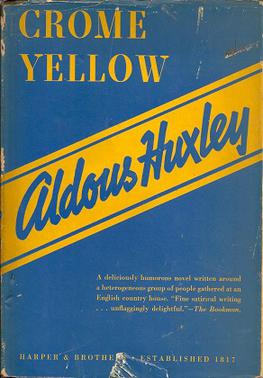
Crome Yellow is the first novel by British author Aldous Huxley, published by Chatto & Windus in 1921, followed by a U.S. edition by George H. Doran Company in 1922. Though a social satire of its time, it is still appreciated and has been adapted to different media.

Key Information

Publication and reception

[edit]

Crome Yellow was written during the summer of 1921 in the Tuscan seaside resort of Forte dei Marmi and published in November of that year. In view of its episodic nature, the novel was described in The Spectator as "a Cubist Peacock". This was in recognition of the fact that it was modelled on (and publicised as in the tradition of)[1] Thomas Love Peacock’s country-house novels.[2] There diverse types of the period are exhibited interacting with each other and holding forth on their personal intellectual conceits. There is little plot development. Indeed, H. L. Mencken questioned whether its comedy of manners could be called a novel at all but hailed with delight the author's "shrewdness, ingenuity, sophistication, impudence, waggishness and contumacy."[3]

At the same time F. Scott Fitzgerald observed how within the novel's ambiguous form Huxley created structures and then demolished them "with something too ironic to be called satire and too scornful to be called irony."[4] In addition, the open treatment of sexuality there appeared significant to Henry Seidel Canby. Although "Nothing important happens…the story floats and sails upon the turbid intensity of restless sex."[5]

Plot

[edit]

A house party at Crome is viewed largely through the eyes of Denis Stone. Described by his hostess as "one of our younger poets", he has been invited by Priscilla and Henry Wimbush to join their summer guests. Denis is secretly in love with their niece, Anne Wimbush, who appears more interested in the artist Gombauld. The rather naïve flapper, Mary Bracegirdle, decides to embark on an amorous adventure so as to overcome her repressions and makes unsuccessful advances to Denis and Gombauld before falling for the libertine Ivor Lombard one summer night.[a] The hard-of-hearing Jenny Mullion confines most of her thoughts on what goes on to her journal, in which Denis eventually discovers a devastating deconstruction of himself and fellow guests. Mr. Wimbush, the owner of Crome, has been writing a history of the house and its family, from which he gives two evening readings. His wife is obsessed with alternative spirituality and finds a fellow sympathiser in the prolific literary hack, Mr. Barbecue-Smith. Also part of the party is Henry's former schoolfriend, the cynical Mr. Scogan, who lies in wait for anyone he can waylay with his reductive criticisms of the time and his visions for a dystopian future. After several ludicrous failures in trying to capture Anne's affection, Denis despairingly arranges to be recalled home on 'urgent family business' at the very moment when he might have succeeded and departs on the same slow train that had brought him.

Themes

[edit]

Huxley's satire on the fads and fashions of the time is generally based on real places and people. The description of the country house at which the characters gather is recognisably based on Garsington Manor, while Ottoline Morrell has been taken for the model of Priscilla Wimbush.[7] Scogan has been identified with Bertrand Russell,[8] Gombauld with Mark Gertler, Mr. Calamy with H. H. Asquith,[9] and Mary Bracegirdle with Dora Carrington.[10] Even small comic details sometimes have a foundation in fact, as for example Mrs. Budge's massive consumption of peaches as part of the war effort. Osbert Sitwell claimed that this was based on an anecdote he had told Huxley about his own father.[11]

Some incidents in the novel allow others to grow out of them. The story of Sir Hercules Lapith, Henry Wimbush's predecessor at Crome, has imbedded within it some 64 lines in Augustan heroic couplets, far longer than all the parodies of modern verse in the book. Its function is to give an insight into its author’s motives for creating his alternative society for dwarfs at his home. At the same time it is a parody within a parody, since it appears as part Sir Henry's modern-day history of the house, itself a narrative within the main narrative.

Scogan's withering sketch of the contemporary novel whose subject is a sensitive young man’s development so appalls Denis Stone that he destroys the first two chapters of the novel he has brought with him to continue at Crome. On the one hand this may have been directed at James Joyce's Portrait of the Artist as a Young Man, which had been published in the previous decade. But it has also been conjectured that Crome Yellow itself is a parody of the sort of novel Denis is dissuaded from continuing.[12] Here too the comparatively recent past model encapsulates the present text.

Conversely, a future text is prefigured in Scogan's prophecy of the "impersonal generation" that will "take the place of Nature's hideous system" by raising its children in incubators. "The family system will disappear; society, sapped at its very base, will have to find new foundations; and Eros, beautifully and irresponsibly free, will flit like a gay butterfly from flower to flower through a sunlit world." It is an idea that Huxley would revisit at greater length in Brave New World (1932), but by that time he had passed from satirising the self-absorption and consequent lack of a vision of a positive way forward following the destructive barbarism of the First World War[13] to examining aspects of the failure of humanity manifested in that war and its inevitable result in the 'Rational State' that Scogan proposes.[14]

Adaptations

[edit]

The story of Sir Hercules Lapith, who briefly turned Crome into a haven for dwarfs, was later adapted as a 60-minute radio play by Peter Mackie. This was first broadcast on BBC Radio 4 in 1986 and has been repeated since.[15]

In 2014, the novelist Julian Davies wrote Crow Mellow, which he described as closely based on Aldous Huxley's novel. Set in contemporary Australia, it updates the satire to cover the hyper-capitalist 21st century in which the sex is more overt and art too has become a commodity.[16]

Virginity, an American musical taking its start from Crome Yellow, has lyrics written by Germaine Shames, music and additional lyrics by Daniel M. Lincoln. In this the deaf Jenny is given the leading role.[17][18]

References and notes

[edit]
[edit]
Revisions and contributorsEdit on WikipediaRead on Wikipedia
from Grokipedia
is the debut novel by English author , published in 1921 by Chatto & Windus. Set during a party at the fictional Crome estate, the narrative follows young poet Denis Stone as he navigates conversations and relationships among a group of eccentric intellectuals, artists, and aristocrats. The work employs to critique the pretensions, philosophical pretentiousness, and social conventions of Britain's post-World War I upper classes. Huxley drew inspiration from real-life figures and settings, including , the home of , a prominent hostess of the set, transforming these into caricatured portraits that expose the era's intellectual fads and personal vanities. Key characters such as the history-obsessed Henry Wimbush and the prophetic Mr. Scogan embody exaggerated archetypes of detachment and , respectively, highlighting themes of isolation, unfulfilled desire, and the futility of abstract theorizing divorced from practical reality. Upon release, Crome Yellow received positive critical acclaim for its wit and incisive social observation, establishing Huxley as a promising voice in early 20th-century despite its relatively modest commercial success compared to his later works like . The novel's significance lies in its foreshadowing of Huxley's mature concerns with human folly and societal decay, while its epistolary and dialogic structure showcases his early mastery of ironic .

Biographical and Historical Context

Huxley's Early Life and Intellectual Formation

Aldous Leonard Huxley was born on 26 July 1894 in , , , into a prominent family steeped in scientific and literary traditions. His paternal grandfather, , a leading biologist and advocate for Charles Darwin's theory of evolution through and rigorous observation, exemplified a commitment to rational inquiry that permeated the family. Huxley's father, Leonard Huxley, was a biographer, editor, and assistant master at , while his mother, Julia Arnold, descended from a lineage including poet and critic , further embedding intellectual pursuits in the household. This environment, shared with siblings including biologist Julian Sorell Huxley, cultivated an early emphasis on evidence-based reasoning and skepticism toward unverified assumptions, influences evident in Huxley's later satirical examinations of intellectual pretensions. In 1911, at age 16 while at —where he had enrolled in 1908—Huxley suffered from keratitis punctata, a staphylococcal corneal infection that severely impaired his vision, reducing one eye to mere light perception and the other to about 5% normal function for nearly two years. The condition, which caused scarring and required him to abandon traditional schooling temporarily, prompted reliance on audiobooks dictated by family, Braille transcription, and auditory learning, fostering habits of intense concentration, memory retention, and inward reflection over physical or social activities. Partial recovery allowed continuation of studies, but the experience redirected his focus toward abstract intellectual endeavors, reinforcing a detachment from superficial engagements and a preference for analytical depth, traits that underpinned his early literary output. Huxley entered , in October 1913 to study English literature, graduating in 1916 with first-class honors despite lingering visual challenges. At , he engaged with philosophical and literary discourses challenging Victorian certitudes, honing a first-principles approach that questioned dogmatic ideologies through logical scrutiny. Following graduation, amid the disillusionment pervading post-World War I Britain—marked by the war's exposure of prewar optimism's fragility—Huxley moved in literary circles, including tangential ties to the through acquaintances like , encountering bohemian experimentation and cultural critique that informed his skeptical lens on elite society without endorsing its excesses. These formative elements, blending familial , personal adversity, and era-specific intellectual ferment, provided the causal groundwork for the rationalist in his , Crome Yellow, published in 1921.

Real-Life Inspirations and Satirical Targets

The estate of Crome in the novel is modeled on Garsington Manor, the Oxfordshire home of Philip and Lady Ottoline Morrell, where Aldous Huxley was a frequent guest from 1917 to 1920. Garsington served as a gathering place for post-World War I intellectuals, including writers like D. H. Lawrence and Lytton Strachey, as well as artists such as Mark Gertler, fostering creative exchanges amid the estate's gardens and social salons. Lady Morrell's patronage enabled such interactions, supporting artistic output during a period of cultural recovery, though Huxley later caricatured the setting to highlight the disconnect between intellectual posturing and personal fulfillment. Several characters draw from composites of Garsington's visitors, with Mr. Scogan reflecting aspects of Bertrand Russell's advocacy for logical analysis and social engineering, including critiques of traditional and endorsements of rational that Huxley observed in Russell's writings and conversations around 1917–1920. The painter Gombauld is inspired by Mark Gertler, a young, intense artist frequenting Garsington whose experimental styles and romantic pursuits mirrored the trends Huxley lampooned as prioritizing shock over substance. Priscilla Wimbush, the hostess, caricatures Lady Morrell herself, portraying her as susceptible to esoteric fads despite her role in nurturing talent, a depiction rooted in Huxley's direct experiences of the manor's superficial discussions on and . Huxley's satire targets the era's intellectual currents, such as Freudian , which Scogan expounds upon in deterministic monologues echoing the pseudoscientific Huxley witnessed in Garsington's salons, where such ideas supplanted empirical rigor with unverified causal claims about the . art forms, exemplified by Gombauld's abstract works, critique the normalization of formless experimentation in circles, drawn from Huxley's observations of artists like Gertler who embraced radical aesthetics amid post-war disillusionment, often leading to isolated eccentricity rather than genuine innovation. These caricatures expose how real behaviors at hubs like Garsington—intense debates yielding personal aimlessness—illustrated the causal pitfalls of chasing transient ideologies over grounded realities.

Publication History

Initial Publication Details

, Aldous Huxley's , was published in November 1921 by Chatto & Windus in . Huxley, born on 26 July 1894, was 27 years old at the time. Prior to this, he had established himself as an emerging writer through short stories and poetry, including the 1920 collection . The book featured no dedication or prefatory notes, aligning with its direct approach to . A edition followed in 1922, published by George H. Doran Company. Released in the post-World War I period, the novel entered a literary market receptive to witty during economic readjustment, though initial commercial expectations remained modest for a first .

Editions, Reprints, and Translations

Crome Yellow has appeared in multiple collected editions of 's oeuvre, beginning with the 1949 Chatto & Windus Collected Works series, which reprinted the novel alongside his other early writings. A more extensive set, the 19-volume Collected Works published by Chatto & Windus between 1969 and 1975, further preserved the text within Huxley's broader canon, emphasizing its place in his satirical phase. Subsequent reprints targeted broader readerships through affordable formats, such as the 1971 Penguin Modern Classics , which maintained the original text for mid-20th-century audiences interested in modernist . Later editions include the 2004 Dover Publications , offering an inexpensive, unaltered version suited for students and casual readers. These persistent printings, spanning decades, indicate sustained niche demand driven by academic syllabi rather than blockbuster sales, as evidenced by the novel's exclusion from Huxley's most commercial compilations. In the digital era, the work's entry into the —owing to its pre-1929 publication—enabled free online distribution via , with the e-text (EBook #1999) facilitating global access without royalties since at least the late 1990s. Translations remain limited compared to Huxley's dystopias like , reflecting the novel's specialized appeal; a French edition, Jaune de crome, translated by Castier, appeared in from La jeune Parque in . No major textual variants exist across editions, though recent annotated versions, such as those from 2019 onward, incorporate footnotes on biographical inspirations like without altering the prose. This stability underscores the text's fidelity to Huxley's original intent, supporting scholarly reuse over commercial adaptation.

Plot Summary

Setting and Narrative Arc

Crome Yellow is set at the fictional Crome estate, a rural functioning as an isolated microcosm for a party among intellectuals and eccentrics in post-World War I Britain. The events unfold over several weeks during the summer, encompassing social gatherings, leisurely activities, and structured excursions within the estate's grounds, including gardens, a farmyard, and a nearby village fair. The narrative arc commences with protagonist Denis Stone's arrival by train and bicycle from Camlet-on-the-Water station to join the Wimbush family's . He engages in extended conversations and debates with the assembled guests, interspersed with key events such as tours of the estate's historical architecture and artifacts, narrated through chronicles compiled by host Henry Wimbush detailing centuries of ownership from monastic origins to Elizabethan reconstruction. Further encounters involve diverse visitors during activities like a , a , and a fair featuring tents, rides, and fortune-telling booths. Denis's pursuit of romance with Anne Wimbush builds tension, progressing to a climax marked by a failed seduction attempt in the gardens and a solitary prophetic vision from the estate's tower amid considerations of despair. The arc resolves with Denis's departure by train after dispatching a telegram, concluding the 's episodic sequence. The structure employs short, dialogue-driven chapters that advance through realistic portrayals of social interactions and , forming a loosely connected series of vignettes rather than a conventional linear progression, with each segment highlighting distinct conversations or incidents amid the estate's routines.

Characters

Protagonist and Central Figures

Denis Stone functions as the novel's and primary viewpoint character, a young aspiring invited to the Wimbush estate at Crome. Portrayed as sensitive, introspective, and intellectually curious, Denis observes the house party's intellectual exchanges while nursing unrequited affection for Wimbush, revealing his emotional vulnerability and tendency toward self-doubt. His repeated failures in composing —such as abandoning verses that devolve into clichés despite initial inspiration—illustrate the limits of passive without rigorous application, emphasizing causal factors like insufficient in hindering creative output. As a for Huxley's own early , Denis exhibits strengths in acute social perception, yet Huxley critiques his passivity and overreliance on abstract rumination, which leave him sidelined amid assertive figures. Mr. Scogan emerges as a central philosophical foil to Denis, embodying a materialist and deterministic shaped by scientific . He lectures on humanity's subjugation to biological and technological forces, predicting a future of engineered where individual agency dissolves into state-orchestrated efficiency, as in his vision of centralized breeding to eliminate variability. Huxley's targets Scogan's reductive certainty—dismissing romantic ideals as evolutionary relics lacking empirical grounding—yet acknowledges prescience in foreseeing and behavioral control, elements later realized in 20th-century totalitarian experiments. This duality underscores Scogan's role not merely as satiric excess but as a vector for probing causal realism against idealistic evasion. Gombauld, the visiting painter, contrasts Denis's cerebral hesitancy with robust sensuality and artistic , pursuing Anne through commissioned portraiture that accentuates physical allure. His traits highlight a hedonistic , prioritizing erotic impulse and aesthetic form over intellectual depth, as seen in his blunt advances rebuffed by 's indifference. While critiqued for —equating value to bodily without broader causal integration—Gombauld's tangible successes, like completing vivid canvases, expose Denis's , affirming of effort yielding results in domains demanding over mere contemplation.

Supporting Caricatures and Their Roles

Henry Wimbush, the elderly proprietor of Crome, embodies the detached antiquarian, devoting himself to compiling an exhaustive, anecdotal history of his ancestral estate, which he insists on reciting verbatim to house guests during evening gatherings. This fixation satirizes the futile indulgence in hereditary amid modern disillusionment, as Wimbush's monologues drone on with trivial details from centuries past, diverting attention from contemporary realities. His role as host contrasts with protagonist Denis Stone's introspective malaise, underscoring how historical provides illusory continuity in a fragmented . Priscilla Wimbush, Henry's wife and the manor's chatelaine, amplifies pretensions to the and frivolity; she consults cards for guidance, hosts séances, and pursues bridge with obsessive fervor, her credulity toward the supernatural highlighting the era's fad for as a balm for existential voids. Her interactions with guests, marked by superficial hospitality, foil Denis's earnest but inept social maneuvers, revealing interpersonal dynamics where charm masks intellectual vacancy. 's character draws from the eccentric hostess archetype observed at , where similar figures blended high society with esoteric pursuits. Mary Bracegirdle, a vigorous young visitor espousing socialist ideals, regimens, and eugenic reforms, serves as a of the earnest but repressed reformer; her for communal breeding and labor falters against her own inhibitions, culminating in a frantic, unfulfilled liaison attempt that exposes the between preached liberation and personal constraint. This portrayal critiques the impracticality of ideological fervor divorced from , as Mary's proselytizing clashes with Denis's poetic detachment, illustrating causal tensions in group dynamics where stifles genuine connection. Ivor Lombard, the facile , flits through the narrative as a superficial seducer, wielding a light and athletic grace to ensnare affections indiscriminately—from mistaking Jenny for in the dark to fleeting conquests—embodying the dilettante's hollow that prioritizes sensation over substance. His episodic romances disrupt Denis's aspirations, causally demonstrating how effortless allure undermines the introspective artist's resolve. Jenny Mullion, rendered mute by deafness, quietly sketches acerbic caricatures in her , her silent scrutiny symbolizing the alienated observer who penetrates facades yet remains socially marooned; her drawings later reveal unflattering truths about the guests, providing ironic commentary on their vanities without direct confrontation. Gombauld, the sensual Provençal painter, pursues Anne Wimbush with predatory directness, his unbridled contrasting the house's cerebral posturing and provoking Denis's , thereby highlighting divergent responses to desire as a force eroding intellectual pretensions. Collectively, these static yet vivid figures—partly inspired by Garsington's eclectic visitors—function as foils that propel the , their exaggerated traits enabling Huxley's dissection of archetypal flaws while limiting psychological depth in favor of typological critique.

Themes and Philosophical Critiques

Satire on Intellectual and Cultural Fads

In Crome Yellow, Huxley targets the bohemian lifestyle of post-World War I British , depicting the Crome as a microcosm of intellectual gatherings marked by , artistic posturing, and aimless , drawn from real-life venues like . These pursuits, prevalent in the amid wartime disillusionment, function as escapist mechanisms rather than avenues to substantive fulfillment, as evidenced by the guests' persistent dissatisfaction despite their engagements. A prime example is the parody of antiquarianism through Henry Wimbush, whose exhaustive "History of Crome" chronicles mundane estate anecdotes—such as petty quarrels and trivial renovations—elevating to pseudo-profound narrative, thereby mocking the fad's detachment from causal historical forces or practical insight. Huxley extends this critique to art, satirizing its shift toward via Mary Bracegirdle's effusive endorsement of Tschuplitski's (a stand-in for ) "pure primary colors and flat oblongs," which she hails as progression toward architectural essence, while dismissing representational works as insufficiently radical; this exposes the trend's prioritization of novelty over representational fidelity or empirical utility. Such portrayals achieve merit in unmasking the vanity inherent in fad-driven vanities, yet critics like observed the work's irony verges on unyielding scorn, risking dismissal of sporadic valid observations amid the . Empirically, these cultural distractions correlate with no verifiable advances in personal or societal , reinforcing their role as superficial diversions from underlying human predicaments.

Skepticism Toward Psychoanalysis and Determinism

In Crome Yellow, critiques deterministic psychological frameworks through the character of Mr. Scogan, who expounds a vision of a scientifically engineered society where and behavior are rigidly classified and controlled, reducing individuals to predictable biological and devoid of . Scogan's proposal, detailed in a with the Denis Stone, envisions "vast state incubators" and based on archetypal categories—evoking parodies of Freudian drives and emerging eugenic ideas—where personal agency is supplanted by empirical prediction and material causation, portraying such systems as a that ignores observable human unpredictability. This portrayal underscores Huxley's doubt in as a totalizing , favoring instead direct observation of behavioral variability, as Scogan's grand theories clash with the novel's depiction of erratic, non-conforming house-party interactions. Huxley further illustrates the practical failings of deterministic doctrines via Mary Bracegirdle's amateur application of Freudian , where she attributes symbolic sexual content to her subconscious visions in a manner that yields no genuine self-understanding or behavioral change, highlighting the theory's overreach in everyday contexts. Such scenes empirically debunk rigid causal models by privileging the novel's evidence of human inconsistency—Denis's romantic failures defy psychological forecasting, and the guests' intellectual posturing reveals theories as faddish rather than predictive—reflecting Huxley's 1921 challenge to the era's enthusiasm for Freudian ideas amid post-World War I intellectual ferment. While Sigmund Freud's theories exerted widespread influence on 1920s modernist literature and , shaping explorations of the unconscious in works by contemporaries like , Huxley's satire anticipates later empirical validations of its limitations, such as Karl Popper's 1963 argument that lacks and thus scientific rigor. By 1950s, shifts toward and diminished 's dominance, with meta-analyses showing weak evidence for core claims like repressed trauma universally driving neuroses, aligning with Huxley's early emphasis on causal realism over dogmatic materialism.

Individual Agency Versus Societal Influences

Denis Stone, the novel's introspective , embodies the struggle for individual agency within a web of societal, class-based, and ideological pressures during his stay at Crome estate. His persistent passivity—manifested in hesitant romantic overtures toward Wimbush and an inability to assert himself amid the house party's intellectual currents—highlights how environmental influences, such as aristocratic detachment and fleeting modern fads, erode personal initiative without fully extinguishing it. For instance, Denis's internal monologues reveal self-doubt rooted in middle-class origins contrasting with Crome's traditional , leading to inaction that empirically results in romantic failure, as favors bolder suitors like Ivor Lombard. Yet, causal outcomes affirm agency: Denis's rare decisive act of telegraphing his departure to after Mary's counsel demonstrates that while influences constrain, deliberate choice can interrupt stagnation, yielding personal satisfaction absent in prolonged submission to circumstance. The novel critiques deterministic views through characters like Mr. Scogan, whose prophecies of a future "Rational State"—featuring state incubators, engineered populations, and machine-mediated isolation—portray societal collectivism as antithetical to realism, reducing humans to managed units in a cycle of efficiency over . Scogan's discourse in Chapter XXII posits history as inexorable repetition, dismissing personal volition in favor of structural inevitability, but Huxley's exposes this as overly reductive, ignoring empirical variances in human response to . In contrast, Mary's socialist leanings—advocating unrepressed experience and logical pairings to counter Malthusian pressures—appear naive, as her own pursuits yield frustration rather than fulfillment, underscoring that ideological prescriptions fail against the complexities of and causal relational dynamics. These failed entanglements empirically delimit agency, bounded by class and emotional realities, yet reveal possibilities: Denis's pivot from to purposeful exit rejects , prioritizing self-directed realism over utopian or deterministic escapes. Crome's traditional estate life, with its ordered routines and historical continuity, implicitly valorizes stability as causally superior to modern intellectual volatility, where characters' absorption in fads yields disconnection rather than progress. Denis observes this tension acutely, noting in Chapter IV how life's "horribly complicated" facts defy simplistic ideas, fostering a about attainable —echoed in Scogan's mechanized —while rejecting collectivist fixes that amplify . Ultimately, the narrative grounds agency in empirical action over passive influence, affirming that societal shaping, though potent, yields to individual resolve when tested against real outcomes like relational voids or self-imposed isolation.

Literary Techniques

Narrative Style and Dialogue

The narrative employs a third-person limited perspective, primarily filtered through the of the , Denis Stone, who observes and internally reacts to the events and conversations at Crome. This focalization limits access to other characters' inner thoughts, emphasizing Denis's detachment and bemusement amid the house party's intellectual posturing, while occasional omniscient shifts provide broader contextual details without disrupting the core viewpoint. The structure is episodic, comprising 30 short chapters that unfold over a single weekend, each centering on discrete vignettes such as conversations, a village , or evening gatherings, which collectively evoke the fragmented chaos of social and ideological exchanges at the estate. This loose progression, reminiscent of Thomas Love Peacock's country-house satires, prioritizes anecdotal encounters over linear plot advancement, allowing for rapid shifts between scenes that mirror the disjointed nature of the guests' discourses. Dialogue drives much of the prose mechanics, featuring concise, aphoristic exchanges that expose logical inconsistencies and pretensions through rapid-fire wit rather than extended exposition. For instance, Mr. Scogan declares, "A serious book about artists regarded as artists is unreadable," underscoring the futility of earnest artistic commentary in a pithy dismissal. Similarly, monologues, such as Scogan's rationalist propositions on state-controlled reproduction or historical analogies to imperial figures, function as extended rhetorical tests, probing foundational assumptions about and with detached logic that highlights underlying absurdities. Published in , the style maintains a clarity and economy influenced by eighteenth-century satirists like , eschewing the stream-of-consciousness experimentation of contemporaneous modernists in favor of precise, observational prose suited to social critique. While this approach facilitates sharp satirical efficiency, it has been noted for potentially prioritizing surface-level exposure over deeper psychological penetration, rendering some interactions more caricatured than immersive.

Use of Irony and Wit

Huxley employs verbal irony extensively in the novel's debates among intellectuals, where characters' grandiose assertions about , , and cultural progress are subtly subverted through contradictory logic or historical precedents, thereby exposing the empirical fragility of their pretensions. For instance, in exchanges critiquing romantic love as a modern "vice" akin to historical indulgences, the speakers' earnest scientific solemnity is ironized by references to antiquity's lighter treatment, revealing causal inconsistencies between professed and impulses. This technique, rooted in counterpointed dialogues, heightens awareness of underlying follies without overt authorial intervention, privileging observational acuity over didacticism. Situational irony manifests potently in Mr. Scogan's prophetic monologues, such as the envisioning of a "Rational State" in which societal roles are stratified by into directing elites, faithful subordinates, and a conditioned herd—presented as enlightened yet implying dystopian through mechanistic control. This device underscores truth-revealing contrasts between avowed utopian intent and foreseeable causal outcomes like eroded agency, adapting 18th-century satirical traditions of speculative exaggeration—evident in Swift's projections of folly—to anxieties over and . The novel's wit operates in a dry, intellectual register, achieving precision through epigrammatic barbs that dissect pretensions with surgical economy, as in Scogan's hard-edged dissections of architectural whimsy or human vanity. While this yields incisive critiques of post-World War I intellectual fads, some contemporaries deemed it overly arch, blurring into scorn that borders on detachment rather than pure satire. Huxley's adaptation enhances exposure of causal hypocrisies, favoring empirical deflation over embellishment.

Reception and Analysis

Contemporary Reviews and Responses

F. Scott Fitzgerald, in a February 1922 review published in the St. Paul Daily News, praised Crome Yellow as a "loosely knit (but not loosely written) " marked by Huxley's "utterly ruthless habit of building up an elaborate... and then blowing it down with something too ironic to be called ." He highlighted the book's "yellow haze of mellow laughter" and Huxley's wit as rivaling Max Beerbohm's, positioning it as an "exquisite fable" of country-house antics rather than a conventional , though he noted it might "infuriate those who take things seriously" by failing to "mirror life." The Times Literary Supplement's unsigned November 1921 review commended its "fine ," appreciating the ironic detachment in portraying intellectual pretensions amid post-war disillusionment. Critics and those depicted in the novel offered mixed responses, with some faulting its emphasis on caricatures over deeper substance. , one of the real-life inspirations for the house-party figures, described the book in 1921 as "a which makes one feel very uncomfortable afterwards," reflecting discomfort among the Bloomsbury-adjacent circle satirized at . Raymond Mortimer, in contemporary commentary, observed that Huxley's "principal end and aim" appeared to be amusement, implying a cleverness that prioritized surface-level mockery over profound insight. Such views aligned with broader critiques viewing the novel's post-World War I cynicism as resonant yet potentially pessimistic and shallow, lacking the emotional heft of more realist works. The novel's reception indicated niche appeal rather than widespread commercial dominance; its debut success enabled Huxley to pursue writing full-time, but sales remained modest compared to later bestsellers like Point Counter Point (1928), with review coverage concentrated in literary periodicals rather than mass outlets. This trajectory underscored Crome Yellow's role in establishing Huxley's satirical voice amid the era's intellectual fads, though it drew limited empirical scrutiny in sales data or exhaustive contemporary tallies.

Modern Scholarly Interpretations and Criticisms

In reassessments marking the novel's centenary in , scholars have noted Crome Yellow's early foreshadowing of dystopian themes later amplified in Huxley's , portraying a post-World War I disillusionment that resonates with 21st-century crises such as pandemics and environmental collapse. Arianne Shahvisi argues that the protagonists' existential inertia mirrors contemporary youth facing global uncertainties, validating Huxley's prescience in capturing historical traumas like the 1918 influenza pandemic and the 1921-22 Russian famine, which claimed over five million lives. This hindsight perspective emphasizes the novel's seeds of cultural critique, though Shahvisi cautions that its cynicism—described as "laid on so thick"—can disorient readers seeking nuance. Modern analyses praise the work's enduring on intellectual fads, including early skepticism toward , which aligns with later empirical validations questioning Freudian determinism's scientific basis; Huxley's depictions of deterministic as reductive have held up against mid-20th-century behavioral critiques and 21st-century neuroscientific evidence favoring multifactorial human agency over unconscious drives. Jerome Meckier's 2005 examination in the Aldous Huxley Annual highlights achievements in debunking Georgian-era pretensions through Denis Stone's poetic failures, portraying the as a targeted assault on romantic versus mechanistic worldviews. Recent commentary, such as a 2024 literary , affirms the wit's persistence, crediting Huxley's concise prose for achieving "aesthetic perfection on a small scale" in exposing societal hypocrisies. Critics, however, fault the static, caricature-like figures—Denis as "navel-gazing" and ineffectual, others as mouthpieces for ideas—limiting emotional depth and rendering the narrative intermittently amusing rather than profoundly engaging. This flatness, evident in the house-party ensemble's lack of evolution, reflects Huxley's early reliance on intellectual dialogue over character arcs, a technique some view as prioritizing over psychological realism, though it imparts a degree of ironic vitality to the types. Such structural choices, while effective for , contributed to personal fallout, as the novel alienated figures like Ottoline Morrell through thinly veiled portraits.

Legacy

Influence on Subsequent Literature

Crome Yellow's satirical dissection of intellectual and social pretensions provided a template for later British novelists critiquing the interwar elite. incorporated allusions to the novel in (1934), transforming a Tarot-reading houseguest from Huxley's Crome estate into the character Mrs. Rattery, thereby echoing the original's ironic portrayal of eccentric guests and their detached amusements. This direct reference underscores the work's impact on Waugh's own brand of acerbic social comedy, which similarly targeted the absurdities of upper-class life in novels like Decline and Fall (1928). The novel's influence extended to Huxley's subsequent oeuvre, with Denis Scogan's extended in Chapter 28—envisioning a mechanized future of test-tube reproduction, behavioral conditioning, and state-controlled efficiency—serving as a proto-dystopian blueprint for the World State in (1932). Literary analyses highlight how this early deterministic , drawn from contemporary scientific and philosophical debates, anticipated Huxley's escalation toward anti-utopian warnings, influencing the trajectory of 20th-century speculative on technological . While Crome Yellow contributed to the Peacockian tradition of dialogue-driven country-house , its specific motifs of elite folly and futuristic rippled into interwar , as evidenced by scholarly examinations of thematic continuities in English novels debunking progressive intellectualism post-1921.

Adaptations and Cultural References

In 2024, released "The Dwarves," a full-cast of Chapter 13 from Crome Yellow, adapted by Peter Mackie and featuring David Learner as and Claire Faulconbridge as ; this production highlights the chapter's eccentric tale of a couple curating a haven for dwarves amid upper-class . No full dramatizations of the novel for radio, , television, or have been produced, consistent with its dialogue-driven structure centered on intellectual discourse rather than visual action. The novel's fortune-teller episode, where Mr. Scogan impersonates the fraudulent ", the Sorceress of ," directly influenced T.S. Eliot's (1922), in which the clairvoyante Madame Sosostris—depicted as a tawdry wielding cards—echoes Huxley's satirical portrayal of pseudoscientific . This allusion underscores Crome Yellow's critique of cultural pretensions, repurposed by Eliot to evoke postwar spiritual desolation. later referenced the same fortune-teller motif in (1934), transforming her into Mrs. Rattery to lampoon house-party absurdities akin to Huxley's Garsington-inspired setting. Such literary nods affirm the novel's niche endurance in modernist discourse, though broader cultural uptake remains limited beyond academic exegesis.

References

Add your contribution
Related Hubs
User Avatar
No comments yet.