
.jpg/250px-Forres_railway_station,_Moray_(geograph_6260345).jpg)


.jpg)
Community hub
Recent from talks
Contribute something
Nothing was collected or created yet.
Passing loop
View on Wikipedia | This article needs additional citations for verification. (April 2011) |
.jpg)
Passing loop | ||||||||||||||||||||||||||||||||||||||||||
|---|---|---|---|---|---|---|---|---|---|---|---|---|---|---|---|---|---|---|---|---|---|---|---|---|---|---|---|---|---|---|---|---|---|---|---|---|---|---|---|---|---|---|
| ||||||||||||||||||||||||||||||||||||||||||


A passing loop (UK usage) or passing siding (North America) (also called a crossing loop, crossing place, refuge loop or, colloquially, a hole) is a place on a single line railway or tramway, often located at or near a station, where trains or trams travelling in opposite directions can pass each other.[1] Trains/trams going in the same direction can also overtake, provided that the signalling arrangement allows it. A passing loop is double-ended and connected to the main track at both ends, though a dead end siding known as a refuge siding, which is much less convenient, can be used. A similar arrangement is used on the gauntlet track of cable railways and funiculars, and in passing places on single-track roads.
Ideally, the loop should be longer than all trains needing to cross at that point. Unless the loop is of sufficient length to be dynamic, the first train to arrive must stop or move very slowly, while the second to arrive may pass at speed. If one train is too long for the loop it must wait for the opposing train to enter the loop before proceeding, taking a few minutes. Ideally, the shorter train should arrive first and leave second. If both trains are too long for the loop, time-consuming "see-sawing" (or "double saw-by") operations are required for the trains to cross (see Tawa railway station).[2]
On railway systems that use platforms, especially high-level platforms, for passengers to board and disembark from trains, the platforms may be provided on both the main and loop tracks or possibly on only one of them.[3]
Systems of working
[edit]Main and loop (main track with platform)
[edit]
| |||||||||||||||||||||||||||||||||||||||||||||||||

| |||||||||||||||||||||||||||||||||||||||||||||||||||||||||||||||

The main line has straight track, while the loop line has low-speed turnouts at either end. If the station has only one platform, then it is usually located on the main line.
If passenger trains are relatively few in number, and the likelihood of two passenger trains crossing each other low, the platform on the loop line may be omitted.
If the passenger train from one direction always arrives first, the platform on the loop line may also be omitted by extending the platform past the loop in that direction.
Platform road and through road (main track without platform)
[edit]
| |||||||||||||||||||||||||||||||||||||||||||||||||


The through road has straight track, while the platform road has low-speed turnouts at either end.
A possible advantage of this layout is that trains scheduled to pass straight through the station can do so uninterrupted; they do not have to reduce their speed to pass through the curve. This layout is mostly used at local stations where many passenger trains do not stop.
Since there is only one passenger platform, it is not convenient to cross two passenger trains if both stop.
This type of passing loop is common in Russia and post-Soviet states. A disadvantage of the platform and through arrangement is the speed limits through the turnouts at each end.
Up and down working
[edit]
| |||||||||||||||||||||||||||||||||||||||||||||||||


In the example layout shown, trains take the left-hand track in their direction of running. Low-speed turnouts restrict the speed in one direction. Two platform faces are needed, and they can be provided either at a single island platform or two side platforms (as shown). Overtaking is not normally possible at this kind of up-and-down loop as some of the necessary signals are absent.
Crossing loops using up-and-down working are very common in British practice. For one thing, fewer signals are required if the tracks in the station are signaled for one direction only; also, there is less likelihood of a collision caused by signalling a train onto the track reserved for trains in the opposing direction. In France, they often use spring switches and the speed is equally restricted in both directions.
The speed restriction in one direction can be eliminated with higher-speed turnouts, but this may require power operation, as the longer and heavier high-speed turnouts may be beyond the capability of manual lever operation.
Dead-end siding
[edit]
| ||||||||||||||||||||||||||||||||||||||||||


Refuge sidings are used at locations with gradients too steep for heavy freight trains or steam haulage to depart from conventional passing loops, or confined spaces where a passing loop cannot be built. An extra parallel siding is often built at stations on refuge sidings so that two stopping trains can pass, and an extended catch point opposite the refuge siding may be added so as not to interfere with passing trains.
Overtaking siding
[edit]-
 Double platform road and through road: Passing loop configuration allowing local trains to serve the station and wait for an express service to pass straight through the station to overtake uninterrupted.
 -
 Double main and loop: Passing loop configuration allowing express and local trains to serve the station before the express service overtakes the local service.


Dynamic passing loop
[edit]If a crossing loop is several times the length of the trains using it, and is suitably signalled, then trains proceeding in opposite directions can pass (cross) each other without having to stop or even slow down. This greatly reduces the time lost by the first train to arrive at the crossing loop for the opposing train to go by. This system is referred to as a dynamic loop. For example, the Windermere branch line will be getting one to permit a 2tph service pattern.[4]
Overlaps and catch points
[edit]Some railways fit catch points at the ends of crossing loops so that if a train overruns the loop, it is derailed rather than collide with an opposing train.
Since the available space for crossing loops is usually limited, they do not normally have an overlap (safety margin) between the starting signals and the end of the double line. In Australia, the Australian Rail Track Corporation (ARTC) policy provides for overlaps of about 500 m and 200 m respectively in an effort to avoid derailment or collision.
Automatic operation
[edit]Many crossing loops are designed to operate automatically in an unattended mode. Such loops may be track-circuited with home signals cleared by the approaching train. Some loops have the points in and out of the loop operated manually, albeit more recent examples have so-called self-restoring switches that allow trains to exit a loop without needing to change the points.
Other forms of remote operation included centralized traffic control, in which a train controller changes points and signals from a remote office; and driver-operated points, which enable train crews to use a radio system to set the points from a distance.
Gradients
[edit]The design of crossing loops may have to be modified where there are severe gradients that make it difficult for a train to restart from a stationary position, or where the terrain is unsuitable for a normal loop.
A crossing loop on steep gradient may have catch points on the downhill end to reduce the impact of runaways.
Train length
[edit]Since central operation of the points and signals from a single signal box is convenient, and since there are practical limits for the distance to these points and signals, crossing loops can have a system-wide effect on train sizes.
Line capacity
[edit]Line capacity is partly determined by the distance between individual crossing loops. Ideally these should be located at inverse-integer intervals along the track by travel time. The longest section between successive crossing loops will, like the weakest link in a chain, determine the overall line capacity.
Short loops
[edit]Long and short trains can cross at a short loop if the long train arrives second but leaves first.
It is best if all crossing loops are longer than the longest train. Two long trains can cross at a short loop using a slow so-called see-saw process, which wastes time.
Right- and left-hand traffic
[edit]Countries generally have a principle on which side trains shall meet, either on the left or on the right, generally the same for the whole country. But this is generally valid only on double track. On passing loops this principle is not necessarily used. Often the train that shall not stop uses the straight track. See also Right- and left-hand traffic.
Gallery
[edit]-
 Trains in a passing loop at Penryn railway station in the United Kingdom
 -
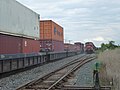 Passing sidings in North America can be very long. This one in Bolton, Ontario – the track on the right – measures some 3.5 km (2.2 mi).
 -
 A short passing track on a funicular in Pennsylvania
.jpg)

.jpg)
Accidents at crossing loops
[edit]| Date | Incident | Location | Details |
|---|---|---|---|
| 1900 | Casey Jones | Vaughan, Mississippi, USA | The legendary train driver (U.S.: engineer) John Luther "Casey" Jones was killed in an accident involving trains too long to cross at a passing loop. The trains trying to cross were occupying both the main and loop tracks, and in addition, the train doing the see-saw was standing outside station limits. Jones was traveling fast in order to make up lost time, and could not stop in time to avoid a collision. He was able to slow his train from an estimated 75 mph (121 km/h) to an estimated 35 mph (56 km/h) at the time of collision; none of the passengers on Jones's train was seriously injured, and Jones was the only fatality. |
| 1914 | Exeter crossing loop collision | Exeter, New South Wales, Australia | Occurred at Exeter railway station in fog: one train too long for loop; line duplicated soon after |
| 1917 | Ciurea rail disaster | Ciurea station, Romania | |
| 1947 | Dugald rail accident | Dugald, Manitoba, Canada | |
| 1963 | Geurie crossing loop collision | Geurie, New South Wales, Australia | Train in loop standing foul of main line, causing collision |
| 1969 | Violet Town | Violet Town, Victoria, Australia | Signal passed at danger after driver dies from heart attack |
| 1996 | Hines Hill train collision | Hines Hill, Western Australia | Driver appears to have misjudged distance to starting signal |
| 1999 | Zanthus train collision | Zanthus, Western Australia | Co-driver operated loop points prematurely |
| 2006 | Ngungumbane train collision | Zimbabwe | |
| 2023 | 2023 Odisha train collision | Balasore, | A passenger train was wrongly switched to a passing loop and hit a parked freight train at full speed; derailed coaches were then struck by another passenger train moving in the opposite direction. |
| 2024 | 2024 Talerddig train collision | Talerddig, Powys, Wales | A passenger train failed to stop at a passing loop due to poor wheel/rail adhesion, colliding with another train travelling in the opposite direction. |

Other names and types
[edit]- crossing loop or crossing place
- passing siding (US)
- passing track (Canada and US)
- refuge loop - used on double track lines
- A run-around loop enables a locomotive to change ends when a train has reached a terminus station.
- Spirals are sometimes called loops.
- Balloon loops are sometimes called loops.
See also
[edit]References
[edit]- ^ Jackson, Alan A. (2006). The Railway Dictionary (4th ed.). Sutton Publishing Ltd. p. 80. ISBN 0-7509-4218-5.
- ^ ""double saw-by"". Archived from the original on 2020-02-20. Retrieved 2010-11-29.
- ^ "Loop | Safety Central". 16 May 2016.
- ^ "Windermere passing loop heads South Cumbria rail plans". www.railmagazine.com. 2022-06-30. Retrieved 2023-04-26.
Passing loop
View on GrokipediaDefinition and Purpose
Basic Concept
A single-track railway consists of a single line of track shared by trains traveling in both directions, in contrast to a double-track railway, which provides separate parallel tracks for each direction to allow continuous movement without interruption.[3] This configuration is common on lower-traffic lines where cost constraints make full double-tracking impractical, but it requires mechanisms to manage opposing or overtaking traffic safely.[3] A passing loop, also known as a passing siding, is a section of auxiliary track parallel to the main single track, connected at both ends to enable two trains to pass each other without halting operations across the entire line.[4] Its primary purpose is to facilitate the crossing of trains moving in opposite directions or the overtaking of slower trains on single-track railways, as well as on tramways and light rail systems where similar constraints apply.[5] Key components include points (or switches) at each end to divert trains onto the loop, signaling systems to control movements and prevent collisions, and a length sufficient to accommodate at least one full train, typically ranging from 1,800 to 2,300 meters in modern networks to handle standard freight or passenger consists.[4][2] In operation, one train pulls into the passing loop via the switches, allowing the other to proceed unimpeded on the main track, with signals ensuring clear paths and adherence to speed restrictions during the maneuver.[4] This setup maintains line capacity while minimizing delays, though the loop's effectiveness depends on its strategic placement and integration with overall signaling infrastructure.[6] Loops often incorporate platforms for passenger convenience at stations, enhancing accessibility during stops.[6]Historical Development
The passing loop originated in the early 19th century as a practical solution for managing train movements on single-track railways, where cost constraints limited the construction of double tracks. The Stockton and Darlington Railway, the world's first public railway to use steam locomotives for both passengers and freight, opened in 1825 as a single-track line spanning 26 miles with passing loops at intermediate stations to facilitate train crossings.[7] In the United States, early railroads like the Delaware and Hudson Canal Company's gravity railroad operated a single-track line in 1829 with inclined planes worked by stationary engines.[8] These early implementations addressed bottlenecks on single-track sections, allowing opposing trains to pass safely while prioritizing the economic benefits of reduced land and material requirements over full duplication. The 1830s and 1840s saw the proliferation of single-track lines during the initial railway booms in Britain and America, necessitating standardized passing arrangements. The opening of numerous single-track routes around 1830, such as extensions of early American lines like the Baltimore and Ohio Railroad, highlighted the essential role of loops in enabling scheduled operations without constant delays.[9] In Britain, the Railway Mania of the 1840s led Parliament to authorize hundreds of miles of single-track railways, as seen in the rapid approval of over 1,500 miles of track between 1836 and 1840.[10] Colonial expansions amplified this trend; in India, the first railway from Bombay to Thane opened in 1853 as a 21-mile single-track line for bidirectional traffic to minimize construction costs in resource-limited territories.[11] Similarly, Australia's inaugural public railway, a short line in Melbourne launched in 1854 by the Melbourne and Hobson's Bay Railway Company, served local passenger and goods traffic economically. A pivotal advancement came in the 1850s with signaling improvements, including the introduction of electric telegraphs and the absolute block system, which coordinated train movements into fixed sections and enhanced safety at passing loops by preventing collisions on single lines.[12] In the 20th century, passing loops integrated with more sophisticated block signaling technologies, evolving from manual telegraphs to automated systems that optimized single-track efficiency. Post-1900 developments, such as electro-pneumatic interlocking and permissive block signaling, allowed loops to handle increased traffic volumes on mixed passenger-freight routes, as documented in early 20th-century American railway engineering reports. Following World War II, electrification efforts in Europe, particularly in countries like Italy and Poland, revitalized some single-track lines by enabling higher-speed operations through upgraded loops, though this often coincided with selective double-tracking on busier corridors.[13] Entering the 21st century, passing loops have declined in developed nations as double-tracking projects eliminate single-track constraints on high-demand routes, reducing reliance on sidings for overtaking. However, they persist in rural and remote areas, including segments of Amtrak's long-distance services where single-track infrastructure with passing loops accommodates freight priority and limited upgrades.[14][15]Track Configurations
Main and Loop with Platform
In the main and loop with platform configuration, the primary main track runs parallel to an adjacent loop track, with both equipped with dedicated platforms of sufficient length to serve passenger trains. This double-ended siding arrangement connects to the single main line at both ends via turnouts, allowing a stopping train to enter the loop while a through train continues on the main track. Platforms typically extend the full length of the loop to facilitate boarding and alighting, promoting efficient use of station facilities in remote or intermediate locations on single-track lines.[16] This design offers key advantages by enabling express or faster trains to overtake local services without halting passenger operations on the loop platform, thereby minimizing delays and enhancing overall line capacity. It is particularly suited to mixed-traffic routes where local stops must balance with through-running demands, as seen in configurations separating stopping tracks from passing tracks to maintain safety and speed. Coordinated signaling, including home and starting signals at each end, ensures that only one train enters the section at a time, with overlaps beyond the signals to prevent collisions during passing maneuvers.[16][17] A representative example appears at Williton station on the West Somerset Railway, a UK heritage line, where the passing loop includes two platforms serving as the primary crossing point for opposing trains on the single-track section. Loop lengths are generally sized to hold the longest operational train, often exceeding 200 meters in heritage and regional applications for operational flexibility. Modern UK stations incorporate tactile paving surfaces on platforms—using corduroy hazard patterns at edges and platform-to-train gaps—to meet accessibility standards for visually impaired users.[18][19]Platform Road and Through Road without Platform
In railway passing loop configurations featuring a platform road and through road without platform, the platform road designates the looped track equipped with passenger facilities, such as a station platform, enabling stopping trains to board and alight passengers while occupying the loop.[20] Conversely, the through road functions as the primary mainline track, optimized for uninterrupted high-speed transit and lacking any platform infrastructure to avoid delays for non-stopping services.[20] This arrangement proves ideal for lines supporting mixed traffic patterns, including semi-express operations where local or slower trains halt on the platform road to permit faster express trains to overtake seamlessly on the through road, thereby minimizing schedule disruptions for priority services.[21] Design considerations emphasize efficiency and safety: the through road is generally aligned straighter with superior grading to support elevated speeds, whereas the platform road may include minor curvature to accommodate station positioning.[22] Additionally, the through road often avoids steep gradients where feasible to maintain momentum for passing trains.[22] Such setups were prevalent on early 20th-century single-track branch lines in the United States, including those of the Pennsylvania Railroad, where passing sidings integrated with platforms facilitated operational meets on secondary routes like the Petersburg Branch.[23] In contemporary urban environments, integration of environmental measures on the through road, such as noise barriers, aligns with European Union regulations under the Environmental Noise Directive, which mandates action plans to mitigate rail noise exposure where Lnight exceeds 50 dB(A) or Lden exceeds 55 dB(A) in populated areas.[24]Up and Down Working
In railway operations, particularly in systems derived from British practices, the "up" direction refers to the route towards a principal terminus or major urban center, while the "down" direction refers to the route away from it. Passing loops enable safe crossings for trains operating in these opposing directions on single-track sections, where one train pulls into the loop to allow the opposing train to proceed unimpeded on the main line. This configuration ensures bidirectional traffic flow without collision risk, with loops typically positioned at intervals based on train schedules and terrain. Procedural coordination relies on token-based or signal-controlled systems to authorize movements. In token systems, prevalent on single lines, the block token—representing authority for the entire section—is issued to the train designated to enter the loop, preventing any other train from accessing the section until the crossing is complete and the token is returned at the far end. Signals or staff then guide the waiting train back onto the main line, and if the timetable requires, the up and down roles can reverse for the next pair of trains, with the previously main-line train now using the loop in the adjacent section. Absolute block signaling is essential for these operations, dividing the line into protected blocks and using instruments like electric token blocks or staff-and-ticket systems to enforce occupancy rules. During loop occupation, points are electrically or mechanically locked to maintain the train's position and prohibit conflicting routes, ensuring the section remains secure for the approaching train. Such up and down working is a cornerstone of single-line operations in British and Commonwealth railways, where it supports efficient scheduling on resource-constrained networks. In Indian Railways, for instance, section controllers oversee these crossings via VHF radio communications, issuing real-time instructions to loco pilots and station staff to synchronize arrivals at passing loops. European networks have integrated digital enhancements, with the Global System for Mobile Communications – Railway (GSM-R) rolled out from the early 2010s to improve up and down coordination through dedicated radio channels for train-to-control center voice and data exchange, reducing reliance on fixed lines and enhancing reliability during crossings.[25] In left-hand traffic regions like the UK, loop designs accommodate entry from the outer side for both directions to align with standard running rules.[1]Overtaking Siding
An overtaking siding is a specialized configuration of a passing loop on single-track railways, designed primarily to enable faster trains to pass slower ones traveling in the same direction without halting the mainline operation. Unlike general passing sidings used for meetings of opposing trains, overtaking sidings feature a double-ended layout that allows the slower train to pull clear of the main track from either end, minimizing reversal maneuvers. These sidings are typically longer than standard ones—often exceeding the length of the longest expected train by 50-100%—and incorporate alignments with reduced curvature and optimized gradients to support higher speeds on the main line during the pass. This design facilitates efficient throughput on lines where speed differentials between train types are common. Typical lengths accommodate trains up to 2000 meters on mainlines, per UIC standards.[3][26][27] Operationally, the slower train receives a signal to enter the siding, fully clearing the main track to allow the faster train to overtake at its operational speed. Signaling systems, such as absolute block or automatic block signaling, coordinate the movement by enforcing speed restrictions and ensuring adequate clearance distances, preventing rear-end collisions while accounting for braking and acceleration times. The siding must accommodate the combined lengths of both trains plus safety buffers, though the focus remains on enabling continuous motion for the overtaking train. This process is managed through dispatcher instructions or automated systems to maintain schedule adherence.[28][29] Overtaking sidings significantly reduce propagation delays on mixed-traffic single-track lines by isolating slower movements off the main path, thereby improving overall line capacity and reliability. They are especially prevalent in networks combining freight and passenger services, where freight trains often operate at lower speeds than expresses. In the United States, Class I railroads such as BNSF employ overtaking sidings extensively on secondary and branch lines to handle variable train speeds and enhance network fluidity; for instance, strategic siding placements allow multiple freights to proceed without bunching.[30][31]Specialized Types
Dynamic Passing Loops
Dynamic passing loops represent an advanced form of passing infrastructure on single-track railway lines, designed to facilitate the crossing of opposing trains without requiring either to halt completely. These loops are engineered to be substantially longer than standard configurations—typically three to five times the length of the trains operating on the route—enabling one train to enter or exit the loop while the other passes by at a controlled reduced speed, often preserving overall momentum to minimize delays. This setup contrasts with traditional static loops by prioritizing fluid motion, which is particularly beneficial on branch lines or regional routes where frequent stops would otherwise constrain service frequency.[32] The operational mechanics of dynamic passing loops demand meticulous coordination, including precise timing protocols and sophisticated signaling systems to manage train positions and speeds in real time. Advanced bi-directional signaling, such as color-light or LED-based setups, ensures clear authority for movements, while overlaps between signals and points provide safety margins to prevent conflicts during the pass. By allowing trains to maintain forward progress rather than accelerating from a standstill, these loops reduce energy consumption and wear on equipment, enhancing efficiency on capacity-limited networks; for instance, they can increase line throughput by facilitating more frequent services without proportional infrastructure expansion.[33][34] Notable implementations include the dynamic loop at Lugton on the Glasgow-Kilmarnock line in Scotland, commissioned in 2009 as part of a 5⅓-mile double-track section that supports half-hourly passenger services by permitting non-stop passes. Similarly, the planned dynamic loop on the UK's Windermere branch line, extending from Burneside station, aims to enable a two-trains-per-hour frequency on the Oxenholme-Windermere route, addressing current single-track limitations that restrict operations to hourly patterns.[34][35] Design requirements for dynamic passing loops emphasize extended track lengths to accommodate simultaneous train movements safely.Refuge and Crossing Loops
Refuge loops, often referred to as refuge sidings, are single-ended or dead-end tracks branching off the main line, designed to provide a temporary safe haven for a train to wait while another passes on the primary route. These structures are typically shorter than standard passing loops and are employed primarily for emergency stops or basic crossing maneuvers in low-traffic, remote environments, where full double-ended configurations would be impractical or cost-prohibitive. In rural settings, they are frequently unmanned, serving as simple refuges without dedicated station facilities.[36] In contrast to standard passing loops, refuge and crossing loops generally omit comprehensive signaling systems, instead depending on manual coordination methods like train orders issued via radio to ensure safe usage. This reliance on verbal or written directives from dispatchers allows flexibility in unmanned locations but requires strict adherence to protocols for entering and exiting the loop. Their length is usually calibrated to accommodate at least one full train, often around 1,000 to 1,500 meters depending on regional standards, sufficient for basic refuge without excess track.[1][37]Design Elements
Overlaps and Catch Points
In railway passing loops, overlaps refer to an additional section of track beyond the clearance points of turnouts, ensuring that trains can safely clear signals and providing a buffer to prevent collisions with following or opposing movements. This extra track length allows the entire train to pass the signal-holding point before the route is released, maintaining a predetermined separation distance for safety. In the Australian Rail Track Corporation (ARTC) network, overlap distances typically range from 200 to 500 meters, varying based on train speed and operational conditions; for instance, running signals at speeds up to 80 km/h require 200 meters, while higher speeds necessitate 300 meters or more.[38] The overlap distance is calculated using the formula for braking distance plus a safety buffer: where is the train speed, is the deceleration rate, and is the buffer zone for additional margins such as reaction time or track conditions. This equation derives from fundamental physics of stopping distance, ensuring the overlap accommodates worst-case overrun scenarios. In the Australian Rail Track Corporation (ARTC) network, a minimum overlap of 500 meters is mandated for train order working sections to enhance protection in regional single-line operations, as specified in their signalling design principles. International standards, such as those from the International Union of Railways (UIC), emphasize variable overlaps based on braking performance for interoperability.[39][38][40] Catch points, also known as trap points, are spring-loaded derailing devices installed at the ends of passing loops or sidings to halt unauthorized or runaway vehicles by tipping the wheels off the rails, thereby preventing incursions onto the mainline. These mechanisms consist of a pair of switch rails that default to the derailing position and are designed to activate under overrun conditions, directing derailed vehicles away from active tracks. In Australian standards, implementation of catch points is mandatory in high-risk areas such as steep gradients or freight sidings for unauthorized movement protection, where they serve as a final safeguard against SPAD (signal passed at danger) events or brake failures. In other regions, such as the UK, similar devices are used but requirements vary by network.[41][42] With the integration of European Rail Traffic Management System (ERTMS), overlaps can feature dynamic adjustments in some implementations, where lengths are automatically varied based on real-time factors like train speed, braking performance, and track occupancy to optimize safety and capacity. On steeper slopes, catch points require reinforced derailing mechanisms to ensure effective stopping despite gravitational forces.[43]Gradient Adaptation
Passing loops situated on steep gradients present significant operational challenges, primarily the risk of trains stalling when attempting to restart after stopping, due to reduced tractive effort on inclines.[30] To mitigate construction costs, the main track is frequently leveled or maintained at shallower slopes, while the passing loop may conform more closely to the natural terrain, potentially introducing steeper grades within the loop itself.[44] Engineers address these issues through partial leveling of the loop to limit gradients or by incorporating zig-zag alignments, which allow trains to ascend or descend mountains by reversing direction at switchbacks, effectively reducing the average slope. In North American freight networks like BNSF, design guidelines recommend maximum gradients of 1:200 (0.5%) for passing loops to ensure reliable operations, compared to 1:400 or gentler on main lines, though steeper sections may require additional safety measures like trap points if exceeding 1:500 (0.2%). Gradients vary by region and line type, with international standards like UIC allowing up to 1:300 in some contexts.[30][45][40] In Swiss mountain railways using rack systems like the Abt system (invented in 1879), operations on inclines up to 50% are possible with rack-and-pinion drives for traction, and passing loops can be integrated into such steep sections.[46] These adaptations adjust for elevation changes. Braking distances in such loops must account for gradients; a common adjustment formula incorporates the gravitational component as: where is the braking distance, is initial speed, is deceleration, is gravity, is the gradient angle, and is delay time, effectively scaling the base distance by a factor related to (positive for downgrades).[47] In the Andes, lines like the Transandine Railway in Bolivia and Argentina feature refuge loops adapted to sustained 3% grades (1:33), employing rack systems for sections exceeding 7-10% and zig-zag configurations to manage elevation gains up to 3,000 meters without full leveling.[48] As of 2025, designs emphasize climate resilience, incorporating elevated grading and drainage enhancements in passing loops to prevent flooding in monsoon-prone regions, as outlined in the International Union of Railways' Resilient Railways framework (launched March 2025), which promotes vulnerability assessments and adaptive infrastructure to withstand extreme rainfall.[49]Train Length Accommodation
Passing loops must be sized to accommodate the longest trains expected to use them, ensuring safe and efficient operations on single-track lines. The minimum loop length is generally calculated as the length of the longest train plus an overlap distance for signaling protection and additional clearance for safe shunting or coupling. Overlaps typically measure at least 200 meters to provide a buffer zone beyond the train's end where signals can be cleared without risk of fouling the main line.[50] This approach results in loop lengths that are often 1.2 to 1.5 times the longest train length, allowing for operational flexibility such as partial dynamic use where the stationary train does not fully occupy the loop.[2] Sizing varies significantly by train type and region due to differences in freight and passenger configurations. Freight trains, particularly heavy-haul operations like U.S. coal services, require longer loops—often up to 2 kilometers—to handle unit trains of 100 to 120 cars, which can exceed 1.8 kilometers in length.[2] In contrast, European passenger trains, with formations typically under 500 meters, necessitate shorter loops of around 500 to 750 meters to balance cost and capacity on denser networks.[51] International standardization efforts, such as those from the International Union of Railways (UIC), recommend loop lengths of at least 750 meters to support interoperability for mixed freight and passenger services across borders, facilitating longer formations up to 740 meters while maintaining consistent infrastructure.[51] In North American networks, passing sidings are designed for train lengths up to 1.8 km or more, with the longest section between sidings determining overall line capacity. As of 2025, adaptations in regions like India focus on extending loops to 1.5 kilometers or more for double-stack container trains exceeding 1,500 meters.[52]Automation and Control
Traditional Automatic Systems
Traditional automatic systems for passing loops relied on electromechanical technologies to detect train occupancy and facilitate remote control of switches, ensuring safe train routing on single- or double-track sections. Track circuits, invented by William Robinson in 1872 and first installed that year in Kinzua, Pennsylvania, formed the core of occupancy detection by completing an electrical circuit through the rails when unoccupied and breaking it upon train entry.[53] These circuits prevented conflicting movements by automatically updating signal aspects at loops, allowing slower trains to enter sidings while faster ones passed on the main line. Electric point machines, introduced in the early 20th century and powered by electricity or compressed air, enabled remote switching of points from centralized locations, replacing manual levers with motorized actuators for greater reliability and reduced operator exposure.[54] By the 1910s, systems like General Railway Signal's electric interlocking integrated these machines with levers and tappets to enforce route safety. Centralized Traffic Control (CTC), pioneered in North America during the 1920s, allowed a single dispatcher to oversee multiple passing loops across extended territories using a control panel connected via telegraph or telephone lines. The first CTC installation occurred in 1927 on the New York Central Railroad between Stanley and Berwick, Ohio, developed by the General Railway Signal Company, which consolidated routing decisions and improved coordination for overtaking maneuvers.[55] In this setup, the dispatcher manually authorized movements by throwing switches and clearing signals remotely, with track circuits providing real-time feedback on loop occupancy to avoid collisions. Early CTC panels displayed track status through lights and indicators, enabling efficient management of bidirectional traffic on single lines with passing facilities.[53] In regions like the United Kingdom, token block systems served as a foundational automatic method for single-line sections with passing loops, using physical tokens or staffs to authorize train entry and prevent unauthorized occupation. Electric token block instruments, evolved from earlier train staff systems, employed paired devices at section ends that released a unique token only when the line was clear, as confirmed by interlocking mechanisms and basic track detection.[56] For instance, the Great Western Railway's electric token apparatus included magazines holding multiple tokens, with pointers indicating line status to ensure one train at a time per section, facilitating safe crossings at loops during up and down working.[57] These systems, operational since the late 19th century and refined electrically by the early 1900s, minimized errors through mechanical failsafes but required train crews to handle token exchanges. Despite their advancements, traditional automatic systems had inherent limitations, including the need for manual dispatcher overrides during failures or complex routing, which could delay operations and introduce human error. Conventional CTC designs also struggled with expanding control areas due to wiring complexity and communication vulnerabilities, prompting gradual transitions to semi-automatic signaling in developing countries during the 1980s to balance cost and capacity. In North American examples from the 1920s, such as Erie Railroad implementations, CTC enhanced loop coordination but still depended on telegraph-based oversight, limiting scalability without frequent manual interventions.[53]Modern Automation Technologies
Modern automation technologies in passing loops have advanced significantly since the early 2000s, integrating digital signaling, artificial intelligence, and emerging sensor systems to enhance safety, enable dynamic operations, and boost efficiency on single-track lines. The European Train Control System (ETCS) under the European Rail Traffic Management System (ERTMS) at Level 2 represents a cornerstone of these developments, providing continuous radio-based supervision without lineside signals.[58] In passing loops, ETCS Level 2 facilitates automatic train protection by transmitting movement authorities via GSM-R, ensuring precise positioning and braking enforcement to prevent incursions into occupied sections.[58] The system's moving-block capability further allows dynamic entry into loops, where train positions are tracked in real-time, reducing the need for fixed blocks and enabling overtakes at closer intervals without compromising safety.[58] Artificial intelligence and predictive systems have emerged as key enablers for optimized loop usage, employing machine learning algorithms to allocate passing loops based on real-time data such as train speeds, delays, and traffic patterns.[59] These systems use techniques like reinforcement learning and genetic algorithms to forecast and adjust loop assignments, minimizing conflicts and improving throughput on congested single-track segments.[59] In the European Union, ongoing initiatives under the Europe's Rail Joint Undertaking explore AI-driven platforms for pan-European capacity enhancement, including traffic management optimization.[60] Practical implementations highlight these technologies' impact. India's Kavach system, rolled out progressively since 2023, incorporates automatic braking at passing loops to enforce speed restrictions and prevent collisions on single tracks, activating brakes if a train exceeds limits or approaches an occupied loop.[61] Complementing this, GPS integrated with GSM-R supports unmanned operations by providing high-accuracy localization for train integrity checks and loop coordination, fusing data from balises and inertial sensors to achieve sub-meter precision even in challenging environments.[62] In the United States, Positive Train Control (PTC) systems, required on most mainline tracks since 2020, use GPS and radio to enforce speed limits and movement authorities at passing sidings, preventing incursions into occupied loops.[63] These advancements yield substantial benefits, including headway reductions of up to 50% through optimized signaling and automation, as seen in ETCS Level 2 deployments that enable trains to operate at intervals below two minutes on equipped lines.[58] Conceptually, this can be modeled with the equation for headway reduction: where is the baseline headway, and is the automation factor (e.g., 1 for doubling capacity).[64]Capacity and Efficiency
Line Capacity Determination
The capacity of a single-track railway line is fundamentally determined by the placement and functionality of passing loops, which enable trains traveling in opposite directions to meet and pass without halting the entire line. A basic analytical model for estimating this capacity in trains per hour (tph) is given by , where is the distance between passing loops in kilometers, is the average train speed in km/min, and is the layover or crossing time in the loop in minutes (typically 5-10 minutes for deceleration, dwell, and acceleration).[65] This formula approximates the headway—the minimum time between successive train departures—as twice the round-trip travel time between loops plus the crossing time, often resulting in effective headways of 10-15 minutes per loop pair under optimal conditions with balanced scheduling.[65] Key factors influencing capacity include loop spacing and operational directionality. Optimal spacing balances travel time with infrastructure costs, generally ranging from 20-50 km depending on train speeds and traffic density; closer spacing (e.g., 8-15 km minimum) reduces meet delays but increases construction expenses, while bidirectional use on shared loops halves effective capacity compared to unidirectional configurations where loops serve overtaking only.[6] For instance, a single-track section with loops spaced approximately 10 km apart over 100 km can support 2-3 tph total, assuming average speeds of 60-80 km/h and heterogeneous traffic mixes.[65] In the UK, rural single-track lines often operate at 2 tph per direction following upgrades. Capacity can be optimized through strategic loop placement, such as staggering loops to minimize simultaneous meets and reduce buffer times.[6] Modern assessments increasingly rely on simulation software like OpenTrack, which models dynamic interactions for precise capacity forecasting as of 2025.[66]Short Loops and Limitations
Short passing loops, also known as short sidings, are sections of double track on single-track railway lines that are less than one full train length, typically designed to accommodate shorter trains of around 100 railcars (approximately 6,000–7,500 feet or 1,830–2,285 meters).[67] These are commonly employed on low-traffic lines or in light rail systems where full-length sidings are impractical due to space constraints.[68] A primary drawback of short passing loops is the need for partial shunting or mid-train uncoupling when longer trains must use them, leading to significant operational delays as portions of the train extend beyond the loop onto the main line.[67] This reduces effective line capacity, with routes featuring fewer than 50% extended sidings experiencing exponential increases in average train delay, potentially dropping practical capacity to as low as 18 trains per day (TPD) or 1–2 trains per hour (tph) in constrained sections.[67][68] Safety risks are elevated due to incomplete train clearance, increasing the potential for conflicts with oncoming traffic during passes.[2] Applications of short passing loops are prevalent in low-traffic freight corridors, such as segments of the Canadian National Railway where 150-car trains operate unidirectionally to bypass the limitations of existing short infrastructure.[67] In the United States, examples include short sidings at Lyons, Espanola, and Edwall on the Everett–Spokane route, which restrict operations for trains exceeding 7,400 feet and contribute to overall capacity bottlenecks.[68] Mitigation strategies include hybrid designs that combine short static loops with dynamic extensions, allowing partial train movement to simulate longer effective lengths, or selectively extending 50% of sidings to restore baseline delay performance for mixed train lengths.[67] An economic analysis reveals that short loops reduce construction costs compared to full extensions but impose ongoing operational penalties, such as limited speeds of 45–50 mph (72–80 km/h) through the siding and higher delay-related expenses; longer trains enabled by extensions can cut fuel and crew costs, though initial infrastructure investment is substantial.[2][68]Traffic Flow Optimization
Passing loops play a crucial role in optimizing traffic flow on single-track railway lines by enabling efficient train meets and overtakes, particularly in mixed traffic scenarios involving express and slower services. One key technique is priority scheduling, where express trains are granted precedence at loops to minimize delays for high-speed or time-sensitive operations, while slower freight or local trains are directed to wait. This approach ensures that faster trains maintain momentum, reducing overall journey times and improving throughput on constrained infrastructure. In high-density sections, loop clustering—placing multiple passing loops in close proximity—facilitates sequential overtakes and reduces bottlenecks, allowing for higher train frequencies without extensive line doubling.[69][70] Modeling these optimizations often relies on simulation tools such as OpenTrack, which predicts traffic flows by simulating train interactions, loop usage, and potential conflicts under varying schedules and speeds. These tools enable planners to evaluate scenarios and determine optimal loop placements, incorporating factors like train lengths and arrival intervals.[66][6] In freight-dominant networks like the U.S. Union Pacific Railroad, predictive dispatching systems use real-time data to anticipate meets and assign loops dynamically, enhancing reliability on long single-track segments. Conversely, European passenger-focused lines, such as those in the high-speed corridors of Germany and France, emphasize timetable integration with loops to prioritize intercity services, achieving smoother flows through coordinated scheduling. By 2025, AI-optimized routing in single-track corridors has emerged as a significant advancement, leveraging machine learning to adjust paths and reduce delays compared to traditional methods.[71][72][73] Seamless integration of passing loops with double-track transitions is essential for maintaining flow, where loops serve as buffer zones to stage trains before merging onto multi-track sections, preventing disruptions during mode changes. This design allows single-track efficiency to extend into denser networks without abrupt capacity drops.[74]Safety Considerations
Common Accident Scenarios
One common accident scenario involving passing loops is a signal passed at danger (SPAD), where a train disregards a stop signal and enters a loop occupied by another train, leading to collisions or derailments. In such cases, the incursion often results from driver misinterpretation of signals protecting the loop entrance. Another frequent type is overrun accidents, where a train fails to stop within the loop due to brake failure, potentially fouling the main line and endangering oncoming traffic.[75][76] Historical examples illustrate these risks. In the 1900 Casey Jones crash near Vaughan, Mississippi, United States, the passenger train, running late, sped through dense fog and misjudged a freight train protruding from a siding onto the main line, causing a head-on collision that killed the engineer.[77] More recently, the 2023 Balasore train collision in Odisha, India, involved the Coromandel Express entering a passing loop at high speed due to a signaling error, striking a stationary goods train, derailing, and then colliding with another passenger train, resulting in 296 deaths and over 1,200 injuries.[78] Analysis of causes shows that human error accounts for approximately 70-80% of railway accidents, with technical factors such as signaling faults and design flaws contributing to the remainder.[79][80] These statistics are drawn from UK Rail Safety and Standards Board (RSSB) reports and broader European analyses of incidents from 1945 to 2022.[80] A recent incident highlighting overrun risks occurred in the 2024 Talerddig collision in Wales, United Kingdom, where a passenger train entered a passing loop but slid past the stop due to brake failure from blocked sanders in wet conditions, colliding with a stationary train and killing the driver.[81] EU railway fatalities increased by about 5% from 803 in 2022 to 841 in 2023 (as of 2023 data), partly attributed to signaling and visibility issues.[82] As of 2025, comprehensive 2024 EU railway safety data is pending, with no reported major passing loop incidents globally in 2024-2025. Passing loops particularly amplify accident risks in conditions of fog or poor visibility, as reduced sightlines hinder timely detection of signals or occupied sections, contributing to both SPADs and overruns as seen in historical cases like Casey Jones.[83] In some overrun scenarios, catch points intended to derail errant trains have failed due to misalignment or overload, allowing fouling of adjacent tracks.[84]Prevention and Mitigation Measures
Prevention and mitigation measures for passing loop accidents primarily focus on automated systems, enhanced training, robust infrastructure, and adaptive technologies to address signal passed at danger (SPAD) scenarios and other risks.[85] In the United Kingdom, the Train Protection and Warning System (TPWS) serves as a key standard for automatic braking at passing loops, deploying overspeed sensors and train stop loops to enforce speed restrictions and apply emergency brakes if a signal is passed at danger. TPWS became mandatory on the UK network by 2003, following its initial rollout in the late 1990s to mitigate SPAD risks.[86][85] In the United States, Positive Train Control (PTC) provides similar functionality, preventing collisions and enforcing speed limits through continuous monitoring and automatic intervention; it was mandated by the Rail Safety Improvement Act of 2008, with full implementation required by 2020 on applicable lines.[63][87] Training protocols emphasize simulator-based exercises to prepare drivers for passing loop maneuvers, simulating high-risk conditions like SPAD approaches and speed compliance under varying visibility. These programs align with international standards, such as the International Union of Railways (UIC) safety codes, which promote human factors training to reduce error rates in complex track configurations.[88][89] Infrastructure enhancements include redundant signaling systems to ensure fail-safe operation during loop usage, where backup circuits prevent single-point failures in train detection and authorization. Closed-circuit television (CCTV) monitoring at passing loops provides real-time visual oversight, aiding in anomaly detection and rapid response to potential incursions. As of 2025, drone-based inspections have been integrated for remote sites, enabling efficient assessment of loop alignments and catch points without disrupting operations.[90][91][92] These measures have demonstrated significant effectiveness; for instance, TPWS implementation in the UK has been about 70% effective in preventing harm from SPAD-related accidents compared to pre-2000 levels.[75] Similarly, the European Train Control System (ETCS), a standardized automatic protection framework, has contributed to broader safety gains across Europe, with overall SPAD rates declining substantially since its deployment on key corridors.[75] To address environmental challenges, climate-adaptive measures such as anti-icing systems for catch points have been adopted on Nordic railway lines, where severe winter conditions can impair derailment prevention mechanisms. These include heated switch actuators and de-icing fluids to maintain functionality, reducing weather-related loop failures in regions like Norway and Sweden.[93][94]Variations and Terminology
Right- and Left-Hand Traffic
In railway operations, right-hand traffic (RHT) denotes the standard where trains proceed on the right-hand track relative to the direction of travel, a convention adopted in the United States, Canada, and the majority of continental European nations. Left-hand traffic (LHT), by contrast, directs trains to the left-hand track, as implemented in the United Kingdom, Australia, India, Japan, and various former British colonies. These directional norms stem from historical influences, including early British engineering practices for LHT and the spread of RHT through American and continental European railway development, shaping global infrastructure standards.[95][96] Passing loop designs are fundamentally adapted to align with the prevailing traffic direction to ensure operational fluidity and safety. In RHT systems, points (switches) and signals are positioned to favor the right side, allowing the through train to remain on the straight mainline with reduced crossover maneuvers, thereby facilitating smoother entries and exits for overtaking. LHT configurations mirror this setup on the left, orienting infrastructure to minimize deviations for the faster train while the slower one diverts into the loop. Such adaptations prevent conflicts and support efficient train passing without extensive reconfiguration.[95] Conversions between RHT and LHT are infrequent due to the high costs of altering extensive infrastructure. A notable example is Sweden's 1967 transition, known as Dagen H, which shifted road traffic from LHT to RHT on September 3 to harmonize with neighboring countries and accommodate imported left-hand-drive vehicles; however, the railway network retained its LHT operations, obviating the need for rebuilds to passing loops or related signaling. This decision preserved railway compatibility across borders while avoiding disruptions to established double-track alignments.[97][98] Operationally, LHT systems often integrate island platforms at passing loop stations to optimize passenger flow, enabling seamless access from either track side in alignment with door positions on the right of trains. This contrasts with RHT preferences for side platforms in some contexts, though both support bidirectional passing; up and down working aligns directly with the traffic convention to designate primary and secondary lines.[95][99] At international borders, particularly in Euro-Asian corridors like the Russia-China crossing at Manzhouli, both countries use RHT, but differences in gauge (Russian 1520 mm vs. Chinese 1435 mm) require bogie exchanges or transshipment facilities to maintain continuity, addressing mismatches that could impede cross-continental freight flows. These adaptations have grown in importance amid rising trade volumes along the Eurasian rail network.Regional Names and Types
In railway engineering, terminology for passing loops varies significantly by region, reflecting local conventions and historical development. In North America, these facilities are typically termed "passing sidings," which are parallel tracks connected at both ends to the main line, allowing trains to pass on single-track sections.[100] In the United Kingdom, the preferred term is "loop," a similar configuration used to enable one train to wait while another passes.[101] Australia employs "crossing loop" for the same purpose, often integrated into regional and freight networks to manage opposing traffic on single lines.[102] Other regions use distinct nomenclature influenced by linguistic and operational traditions. In France, the SNCF designates them as "voie de croisement," emphasizing the crossing function for train encounters on voie unique (single track).[103] Russia's extensive single-track network refers to them as "razyezd," short sidings or loops designed for efficient passing in remote areas, a term rooted in the imperial-era expansion of the Trans-Siberian Railway.[104] In Japan, "taihi-sen" (wait-avoid line) or informal translations like "wait track" describe specialized passing tracks, particularly on Shinkansen branch lines where high-speed services bypass slower regional trains.[105]| Region | Common Name | Key Characteristics |
|---|---|---|
| North America | Passing siding | Double-ended parallel track for overtaking on single lines; common in freight-heavy networks.[100] |
| United Kingdom | Loop | Short parallel section for passing; integrated with signaling for single-line sections.[101] |
| Australia | Crossing loop | Used on rural and interstate lines to handle bidirectional traffic.[102] |
| France | Voie de croisement | Avoidance track for train crossing; standard on SNCF single-track routes.[103] |
| Russia | Razyezd | Passing loop in vast single-track systems, often in isolated terrains.[104] |
| Japan | Taihi-sen (wait track) | High-speed compatible loops on branches for priority train overtaking.[105] |