Recent from talks
Contribute something
Nothing was collected or created yet.
Crumpet
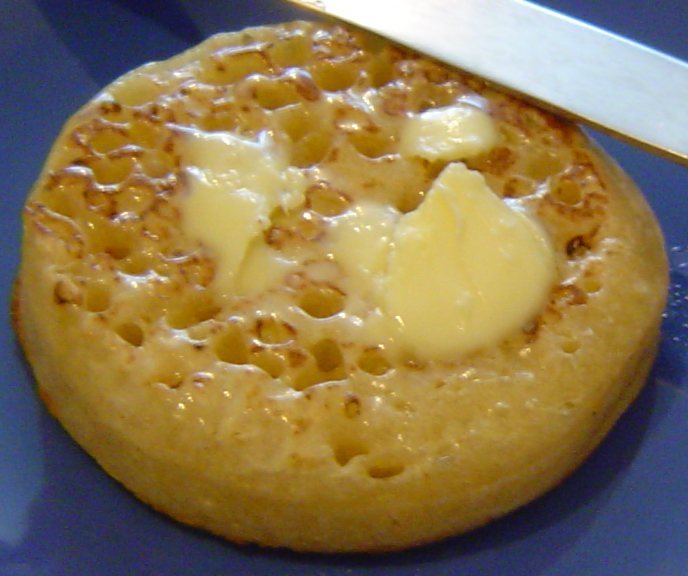
View on WikipediaA buttered crumpet | |
| Type | Bread |
|---|---|
| Place of origin | United Kingdom |
| Region or state | United Kingdom and other parts of the Commonwealth |
| Main ingredients | Flour, yeast, salt, butter, warm water |
A crumpet (/ˈkrʌmpɪt/ ⓘ) is a small griddle bread made from an unsweetened batter of water or milk, flour, and yeast originating from the United Kingdom. It has since become popular in Australia, Canada,[1] New Zealand, and South Africa.
Historically, crumpets are also regionally known as pikelets, however this is limited as pikelets are more widely known as a thinner, more pancake-like griddle bread;[2] a type of the latter is referred to as a crumpet in Scotland.[3]
History and etymology
[edit]Crumpets have been variously described as originating in Wales[4] or as part of the Anglo-Saxon diet,[5] based on proposed etymologies of the word. In either case, breads were, historically, commonly cooked on a griddle wherever bread ovens were unavailable.[6] The bara planca, or griddle bread, baked on an iron plate over a fire, was part of the everyday diet in Wales until the 19th century.[7]
Small, oval pancakes baked in this manner were called picklets,[7] a name used for the first recognisable crumpet-type recipe, published in 1769 by Elizabeth Raffald in The Experienced English Housekeeper.[8] This name was derived from the Welsh bara pyglyd or "pitchy [i.e., dark or sticky] bread", later shortened simply to pyglyd.[9][10] The early 17th century lexicographer Randle Cotgrave referred to "popelins, soft bread of fine flour, &c., fashioned like our Welsh barrapycleds".[11]
The word spread initially to the West Midlands of England, where it became anglicised as pikelet,[12] and subsequently to Cheshire, Lancashire, Yorkshire, and other areas of Northern England; crumpets are still referred to as pikelets in some areas. The word crumpet itself, of unclear origin, first appears in relatively modern times; it has been suggested as referring to a crumpled or curled-up cake, based on an isolated 14th century reference to a "crompid cake",[13] and the Old English word crompeht ('crumpled') being used to gloss Latin folialis, possibly a type of thin bread.[5]
Alternatively, crumpet may be related to the Welsh crempog or crempot, a type of pancake;[4] Breton krampouzh and Cornish krampoth for 'pancakes' are cognate with the Welsh. An etymology from French crompâte 'a paste of fine flour, slightly baked',[14] has also been suggested. However, a correspondent to Manchester Notes and Queries, writing in 1883, claimed that the crampet, as it was then locally known, simply took its name from the metal ring or "cramp" used to retain the batter during cooking.[15]
The early crumpets were hard pancakes cooked on a griddle, rather than the soft and spongy crumpets of the Victorian era, which were made with yeast.[13] From the 19th century, a little bicarbonate of soda was also usually added to the batter.[8] In modern times, the mass production of crumpets by large commercial bakeries has eroded some regional differences. As late as the 1950s, Dorothy Hartley noted a wide degree of regional variation, identifying the small, thick, spongy type of crumpet specifically with the Midlands.[8]
Characteristics
[edit]
Crumpets are distinguished from similar sized muffins by being made from a batter, rather than a dough.[16] English crumpets are generally circular, roughly 8 centimetres (3 in) in diameter and 2 centimetres (3⁄4 in) thick. Their shape comes from being restrained in the pan/griddle by a shallow ring. They have a characteristic flat top with many small pores and a spongy texture which allows butter or other spreads to permeate.[17]
Crumpets may be cooked until ready to eat warm from the pan, but are also left slightly undercooked and then toasted. While premade commercial versions are available in most supermarkets, freshly home-made crumpets are less heavy and doughy in texture.[18] They are usually eaten with a spread of butter, or with other sweet or savoury toppings.[19]
While in some areas of the country the word pikelet is synonymous with the crumpet,[2] in others (such as Staffordshire and Yorkshire) it refers to a different recipe. A pikelet is distinguished by containing no yeast as a raising agent and by using a thinner batter than a crumpet;[20] and as being cooked without a ring, giving a flatter result than a crumpet.[8][9][20] In Stoke-on-Trent, pikelets were once sold in the town's many oatcake shops and still are.[21] A 1932 recipe for Staffordshire pikelets specifies that they were made with flour and buttermilk, with bicarbonate of soda as a raising agent, and suggests cooking them using bacon fat.[22]
The term pikelet is used in Australian and New Zealand cuisine for a smaller version, served cold or just warm from the pan, of what in Scotland and North America would be called a pancake and, in England, a Scotch pancake, girdle or griddle cake, or drop scone.[23]
Scottish crumpet
[edit]
A Scottish crumpet is broadly similar to the crumpet of parts of Northern England. It is made from the same ingredients as a Scotch pancake, and is about 18 centimetres (7 in) diameter and 8 millimetres (0.3 in) thick. It is available plain, or as a fruit crumpet with raisins baked in, usually fried in a pan and served with a fried breakfast. It is also sometimes served with butter and jam. The ingredients include a leavening agent, usually baking powder, and different proportions of eggs, flour, and milk, which create a thin batter. Unlike a pancake, it is cooked to brown on one side only, resulting in a smooth darker side where it has been heated by the griddle, then lightly cooked on the other side which has holes where bubbles have risen to the surface during cooking.[24]
Ireland
[edit]While now relatively uncommon in Ireland, crumpets were once produced by Boland's Bakery in Dublin during the 19th and much of the 20th centuries; Boland's recipe was subsequently used by a number of other bakeries. Irish crumpets differed from most British recipes by having a yeastless batter and being cooked on both sides, giving a smooth rather than spongy top.[25]
See also
[edit]- Baghrir
- Blini
- Uttappam
- Lahoh
- Apam balik
- English muffin
- List of British breads
- Tea (meal)
- Thinking man's/woman's crumpet, a slang use of the word
Notes
[edit]- a.^ Planc is a borrowing of English 'plank' as in a board or plank. The Welsh word is also used of a griddle, therefore bara planc is 'griddle bread' and not 'plank bread'.
References
[edit]- ^ Moncada, Katlyn. "Crumpets vs. English Muffins: What's the Difference?". Better Homes & Gardens.
- ^ a b Ingram, Christine (1999). The Cook's Guide to Bread. Hermes. p. 50.
- ^ Kinnear, Audrey (2023-10-06). "The History of Crumpets". A Very British Catal. Retrieved 2025-03-07.
- ^ a b Shulman, Martha (1995). Great Breads. Houghton Mifflin. p. 240.
- ^ a b Ann Hagen, A Handbook of Anglo-Saxon Food Processing and Consumption, 1992, p. 20
- ^ "History of crumpets". crumpetman.com. Retrieved 2025-03-07.
- ^ a b Notes & Queries, 3rd. ser. VII (1865), 170
- ^ a b c d Davidson, A. The Penguin Companion to Food, 2002, p. 277
- ^ a b Edwards, W. P. The Science of Bakery Products, Royal Society of Chemistry, 2007, p. 198
- ^ Luard, E. European Peasant Cookery, Grub Street, 2004, p. 449
- ^ Darlington, Thomas (1887). The Folk-speech of South Cheshire. London: Trübner and Co.; English Dialect Society. p. 297. OCLC 3352236.
pikelet
- ^ Wilson, C. A. Food & drink in Britain, Barnes and Noble, 1974, p. 266
- ^ a b John Ayto (18 October 2012). The Diner's Dictionary: Word Origins of Food and Drink. Oxford University Press. pp. 106–107. ISBN 978-0-19-964024-9.
- ^ Notes & Queries, 16 (1850), 253
- ^ City News Notes and Queries, vol. V, (1883), 33 ("In Lancashire there are muffins, crampets, and pikelets. The crampet is so called because the batter is poured into a circular metal ring or "cramp" for baking, and the size is that of an ordinary tea-saucer".)
- ^ Braun, Emil (1901). The Baker's Book: A Practical Hand Book of the Baking Industry in All Countries, vol 1. p. 196.
- ^ "Crumpet: British, Toasted, Teatime". www.britannica.com. 2025-01-11. Retrieved 2025-03-07.
- ^ Ingram (1999), p.144
- ^ "Our Most Popular Crumpet Topping Ideas | Recipes". Warburtons. Retrieved 2025-03-07.
- ^ a b Banfield, Walter (1947). Manna: A Comprehensive Treatise on Bread Manufacture. Maclaren & Sons. p. 444.
- ^ Hopkins, Harry (1957). England is Rich. G.G. Harrap. p. 100.
- ^ Byron, May (1932). Pot-luck. Hodder & Staughton. p. 359.
- ^ The Concise Household Encyclopedia (ca. 1935) Fleetway House, The Amalgamated Press, London
- ^ Traditional Scottish Recipes - Scottish Crumpets
- ^ Cowan, C. and Sexton, R. (1997) Ireland's Traditional Foods, Teagasc, p.149
External links
[edit]- Description and recipe on history.uk at the Wayback Machine (archived February 16, 2011)
Crumpet
View on GrokipediaHistory and Etymology
Origins and Early References
The earliest known reference to a food item resembling the crumpet appears in 1382, when English theologian and Bible translator John Wycliffe rendered the biblical term from Hosea 7:8—a "cake not turned"—as "crompid cake" in his English translation of the Old Testament.[4] This term, derived from Old English "crump" meaning crooked or curled, described a flat cake cooked on a hot stone or griddle, with edges that likely curled during preparation, distinguishing it from simpler breads.[5] While not identical to the modern crumpet, this mention suggests an early precursor in medieval English culinary practices. Crumpets are believed to have early medieval roots as thin, hard pancakes baked directly on a griddle, forming part of the everyday diet in early medieval Britain.[2] These early versions may trace back to broader European flatbread traditions, potentially influenced by Celtic practices, such as the Welsh "crempog," a soft pancake made from a simple batter and cooked on a hot surface.[2] The linguistic similarity between "crumpet" and "crempog"—both evoking the curling or crumpling of the edges—supports a possible shared heritage across Celtic and Anglo-Saxon regions.[6] By the 17th century, crumpet-like items had evolved from basic flour, milk, and egg pancakes into slightly more structured griddle cakes, often using buckwheat flour for a denser texture.[7] This period featured flat and unleavened forms compared to later developments. The soft, spongy, yeasted crumpets familiar today emerged during the Victorian era (1837–1901), when bakers incorporated yeast and baking powder to create the characteristic holes and airy structure through controlled fermentation on the griddle.[8] The exact birthplace of the crumpet remains disputed, with some historians attributing its invention to Wales due to the crempog connection and early Celtic flatbreads, while others emphasize its development within early English traditions as a distinctly British griddle good.[2] These claims reflect broader cultural overlaps in British baking traditions, but no definitive evidence resolves the origin in favor of one region over another.[7]Development and Naming
The word "crumpet" originates from the late 17th century, deriving from the Middle English term crompid (cake), which referred to a curled or bent cake, likely stemming from the verb crumpen meaning "to curl up" or "to crumple." [9] This etymology reflects the early form of the crumpet as a thin, irregularly shaped griddle cake whose edges might curl during cooking. Some sources suggest a deeper root in Old English crompeht, denoting a crumpled pancake, while others propose a Celtic influence from the Welsh crempog, a traditional griddle-baked pancake. [10] [2] During the 19th century, particularly in the Victorian era, the crumpet underwent significant refinements that shaped its modern identity. Bakers incorporated yeast for fermentation and baking powder—developed in the 1840s as a rising agent—to produce the distinctive spongy texture and characteristic holes formed by escaping gas bubbles. [8] [11] [7] These innovations appeared in Victorian cookbooks, such as Isabella Beeton's Book of Household Management (1861), which provided one of the earliest printed recipes for the contemporary yeast-leavened version, emphasizing a batter of flour, milk, yeast, and bicarbonate of soda. Crumpet rings, metal molds for achieving uniform height and shape, were also introduced during this period, facilitating more consistent home preparation. [7] Industrialization further transformed the crumpet from a regional, hearth-baked specialty into a standardized product. The rise of commercial baking in the late 19th and early 20th centuries enabled mass production, with patented machinery for batter mixing and ring-based cooking emerging to support scalability. [8] By the early 20th century, these advancements had elevated crumpets to a ubiquitous British staple, integral to afternoon tea rituals and widely available through bakeries and households across the country. [12]Physical Characteristics
Ingredients and Composition
The traditional crumpet batter is composed primarily of plain wheat flour, water or milk, yeast, salt, and a leavening agent such as baking soda or baking powder.[13][14] In commercial recipes like those from Warburtons, the base includes wheat flour enriched with calcium, iron, niacin, and thiamin, water, yeast, raising agents (diphosphates, sodium and potassium carbonates), salt, and a small amount of sugar.[13] Each ingredient plays a specific role in achieving the crumpet's characteristic structure and flavor. Yeast ferments the batter, producing carbon dioxide bubbles that create the signature porous texture during proofing.[15] Baking soda or powder provides additional chemical leavening, reacting to produce further rise and a slight tangy flavor while helping form the open holes on the surface.[16] Salt enhances flavor and controls yeast activity, while the liquid (water or milk) hydrates the flour to form gluten, contributing to the crumpet's chewy consistency from the wheat flour's gluten content.[15] The standard British crumpet recipe remains unsweetened, with any sugar limited to a trace amount to activate the yeast, though variations may incorporate eggs for richness or additional sugar for sweetness.[14][16] Nutritionally, a typical crumpet (around 55g) provides approximately 90-100 calories, predominantly from carbohydrates (about 20g per serving), with low fat content (under 1g) and moderate protein (around 4g); it contains gluten due to the wheat flour base.[13][14]Appearance and Texture
A traditional crumpet is characteristically circular in shape, typically measuring about 4 inches (10 cm) in diameter and approximately ¾ inch (2 cm) thick, formed by cooking the batter within metal rings on a griddle.[17] The top surface features irregular holes created by carbon dioxide bubbles from the yeast fermentation, resulting in a distinctive porous texture often described as "nooks and crannies" that trap air pockets during cooking.[18] These holes vary in size depending on the batter's consistency, with thicker batters producing smaller, more uniform openings, while looser mixtures yield larger, more irregular voids.[19] Before toasting, the uncooked top remains uniformly pale and smooth, contrasting with the slightly browned bottom that develops a firmer, denser crust during griddle cooking.[20] Upon toasting, the exterior achieves a golden-brown hue, enhancing its visual appeal while preserving the soft, spongy interior that readily absorbs toppings like butter or jam.[21] This spongy quality arises from the open cellular structure, providing a light and yielding texture that differs markedly from the chewier consistency of similar baked goods.[22]Preparation and Cooking
Batter Preparation
The preparation of crumpet batter begins with activating the yeast to ensure proper fermentation and bubble formation, which contributes to the characteristic texture. Yeast is typically dissolved in a warm liquid mixture of milk and water, often with a small amount of sugar to feed the yeast, and allowed to sit for about 10 minutes until it becomes frothy, indicating activation.[14][16] In a large bowl, plain flour and salt are combined, forming the dry base; typical ratios include approximately 2 cups of flour to 1 teaspoon of salt for a standard batch serving 10-12 crumpets.[23] The activated yeast mixture is then gradually incorporated into the dry ingredients, whisking vigorously for 1-2 minutes to create a smooth, lump-free batter without overmixing, which could prematurely release trapped gases.[14][16] Baking soda, serving as a chemical leavener to enhance bubble formation during cooking, is dissolved separately in a small amount of warm water and added last to the batter, followed by a gentle stir to avoid deflating the developing bubbles.[23][15] Following mixing, the batter undergoes a fermentation process where it is covered and left to rest in a warm environment, typically for 1 to 2 hours, allowing the yeast to produce carbon dioxide and create a bubbly surface as the volume doubles.[14][16] This resting period is crucial for developing the light, spongy structure, with the batter ideally reaching a temperature around 75-80°F (24-27°C) to optimize yeast activity without killing it. The ideal consistency of the finished batter is thick yet pourable, akin to heavy cream or unset pancake batter, enabling it to hold shape while allowing bubbles to rise to the surface.[15][16] Adjustments may be necessary based on environmental factors: for altitudes of 3,000–5,000 feet, decrease baking soda by about 1/8 teaspoon per teaspoon called for, and add 1–2 tablespoons more flour to counteract excessive rising, while in high-humidity conditions, add 1-2 tablespoons more flour to prevent an overly loose batter.[24][25] Common pitfalls in batter preparation include overmixing after adding the baking soda, which bursts the yeast-generated bubbles and results in dense crumpets, or insufficient resting time, leading to inadequate fermentation and flat, hole-less outcomes.[26] To mitigate these, mix minimally post-leavener addition and ensure the batter ferments until visibly frothy before proceeding.[27]Griddle Cooking Process
The traditional method of cooking crumpets involves using a flat griddle or heavy-based frying pan preheated to medium-low heat, around 325°F (160°C), where metal rings—typically 3.5 to 4 inches (9–10 cm) in diameter and about 1 inch (2.5 cm) deep—are lightly greased and placed on the surface to contain the batter.[28][29] The rested batter is then spooned into each ring to fill it halfway, allowing space for expansion as the yeast activates and produces bubbles. Cooking proceeds over medium heat for 5 to 7 minutes, during which carbon dioxide bubbles rise to the surface, burst, and set into the characteristic honeycomb of holes once the edges firm up and the top appears dry but uncooked.[15][30] This low-and-slow heat prevents burning the base while ensuring even cooking through the batter's thickness. Once the bubbles have set, the rings are carefully removed, and the crumpets are flipped briefly—usually 1 to 2 minutes—to lightly brown the top side, though some methods omit flipping entirely for a softer, paler crown.[23] The cooked crumpets are then cooled on a wire rack to allow steam to escape and prevent sogginess from condensation.[15] Commercial production of crumpets, which began scaling up in the mid-20th century, employs automated conveyor-belt systems to achieve uniformity in the hole structure and output. Early patents, such as British Patent GB893202A granted in 1962, describe continuous machines where batter is precisely deposited into ring molds on endless conveyor chains that pass over heated surfaces, mimicking the griddle process at industrial speeds while ensuring consistent bubble formation.[31] Similarly, U.S. Patent US3093062A from 1963 outlines automated feeding of mold ring plates to conveyor setups for mass cooking.[32] These innovations enabled high-volume manufacturing, with modern facilities producing tens of thousands of crumpets per hour.[33] Crumpets are best consumed fresh on the day of cooking to maintain their soft, spongy texture, but they can be stored at room temperature for up to 2-3 days in an airtight container or frozen for longer preservation.[34] Frozen crumpets thaw and reheat effectively by direct toasting, which revives the nooks and crannies for butter absorption without compromising quality.[34]Regional Variations
Scottish Crumpet
The Scottish crumpet, also known as a pikelet or drop scone, differs markedly from its English counterpart by being thinner and flatter, typically cooked directly on a griddle without the use of metal rings, resulting in a shape and size resembling small pancakes about 4 inches in diameter.[35] This ringless method allows the batter to spread freely, producing a soft, even texture with minimal bubbling and no deep characteristic holes found in yeasted English crumpets.[2] Preparation begins with a simple batter incorporating self-raising flour, milk, eggs, and sugar for sweetness, often leavened with bicarbonate of soda to achieve a quick rise rather than relying on yeast for a slower fermentation.[36] Variations may include buttermilk for tanginess or oatmeal for added heartiness, enhancing the fluffy yet tender crumb.[37] Dollops of the batter are dropped onto a hot griddle, cooked until golden on both sides, yielding a lightly browned exterior with a moist interior.[38] Historically tied to the Scottish Borders region, where girdle-baked goods like scones originated in the 16th century, the Scottish crumpet evolved as a quick afternoon tea staple, reflecting Scotland's tradition of simple, hearth-cooked breads using local dairy and grains.[39] Its softer, less porous texture made it ideal for spreading with butter or jam during social gatherings, distinguishing it from denser regional breads.[40] In modern times, Scottish crumpets are widely available in supermarkets under names like "Scottish pancakes," pre-packaged and distinct from the yeasted English style, often marketed for easy toasting or direct consumption.[41] This accessibility has preserved their role in everyday Scottish cuisine while emphasizing the chemical leavening that sets them apart.[42]Irish Soda Farls
Soda farls are a traditional unleavened Irish flatbread that differs from the yeasted English crumpet, using baking soda as the leavening agent and resulting in a denser texture and quicker preparation time. Originating in the 1830s following the introduction of commercial baking soda to Ireland, these farls are typically made with soft wheat flour, salt, baking soda, and buttermilk, which imparts a tangy flavor due to its acidity reacting with the soda to produce carbon dioxide for lift.[43][44] The dough is mixed into a simple, sticky consistency, shaped into a round, and then cut into four triangular pieces—farls deriving from the Gaelic word fardel meaning "four parts"—before being cooked on a hot griddle or bakestone for about 5-7 minutes per side, yielding a golden crust and soft interior without the characteristic holes of yeasted crumpets.[45][46] Particularly prevalent in Ulster, especially Northern Ireland, soda farls reflect regional resourcefulness, with variations sometimes incorporating wholemeal flour for a nuttier, heartier profile known as wheaten bread.[45][47] This adaptation became a staple during the 19th century, influenced by the need for fast-baking breads in rural households without ovens, and persisted into the 20th century despite broader British culinary exchanges, maintaining its place as an everyday essential in areas reliant on traditional griddle cooking.[43][44] In Irish culinary tradition, soda farls hold a central role in the Ulster fry, a hearty breakfast featuring fried eggs, bacon, sausages, and puddings, where the farls are often fried in bacon fat for added crispness and served alongside potato bread.[46][47] This contrasts with the English crumpet's toasted, butter-absorbing style, emphasizing instead the farls' versatility in soaking up breakfast juices or simply buttered for a comforting start to the day, underscoring their enduring status in rural Irish diets.[45][48]International Adaptations
In Australia and New Zealand, crumpets remain closely aligned with their British counterparts in preparation and texture but have evolved through local commercial production to include sweeter variations that appeal to regional preferences for indulgent breakfast items. Major bakeries like Tip Top, operating in both countries since the mid-20th century, produce widely available crumpets in traditional plain forms as well as flavored options such as banana bread-infused and cinnamon varieties, which incorporate added sugars and fruits for a more dessert-like profile.[49][50] These adaptations reflect the integration of crumpets into everyday snacking culture, often toasted and topped with honey or fruit preserves rather than solely savory spreads. In the United States, crumpets are primarily imported from the UK and positioned as a premium alternative to the more common English muffin, emphasizing their unique bubbly texture for better absorption of toppings like butter or eggs. American consumers and bakers have experimented with enhancements, including savory infusions of cheese or fresh herbs directly into the batter or as baked-in elements, creating hybrid products that blend British tradition with local breakfast sandwich customs. Brands such as Sharrock's and Lakeland Bake distribute these through specialty retailers, highlighting their versatility in recipes beyond plain toasting.[51][52] Reflecting historical colonial connections between Britain and India, crumpets have inspired fusion dishes where the spongy base pairs with spiced elements like masala blends or curry sauces, transforming the mild bread into a vessel for bold, aromatic flavors. These adaptations often involve topping toasted crumpets with lentil masalas, coconut-infused curries, or herb-spiced butters, evoking Anglo-Indian culinary exchanges from the British Raj era when British staples encountered South Asian spices. Such recipes underscore crumpets' adaptability in multicultural contexts, served as appetizers or light meals.[53][54] Since 2020, global culinary trends have driven innovations in crumpet formulations to accommodate dietary restrictions, particularly vegan and gluten-free versions that substitute dairy with plant-based milks like almond or oat and wheat flour with blends of rice, tapioca, or chickpea alternatives. Commercial products, such as Liberate Crumpets from Australia, exemplify this shift by offering allergen-free options that maintain the signature holes and chewiness while appealing to health-conscious consumers worldwide. Market analyses indicate sustained growth in these categories, fueled by rising demand for inclusive baked goods amid broader plant-based movements.[55][56]Serving and Cultural Role
Traditional Accompaniments
Crumpets are traditionally prepared by splitting them horizontally and toasting both halves until golden, allowing toppings to be applied to the soft, porous interior. The most classic accompaniment is generous amounts of butter, which melts into the distinctive holes formed during cooking, creating a rich, indulgent texture that enhances the crumpet's mild, yeasty flavor.[57] This method dates back to at least the Victorian era, when crumpets gained popularity as a teatime treat, often paired with butter to provide a creamy contrast to their spongy consistency.[58] Sweet spreads complement the toasted crumpets beautifully, with marmalade, honey, or jam being longstanding favorites that seep into the nooks for even distribution. These pairings, simple yet evocative of British afternoon tea traditions, were well-established by the 19th century and remain staples today.[14] For optimal enjoyment, crumpets are served warm, as the heat preserves their characteristic sponginess and allows toppings to integrate seamlessly. Typically, 2 to 3 crumpets constitute a standard serving, balancing portion size with the item's light yet filling nature.[16] On the savory side, crumpets feature prominently in breakfast routines, topped with Marmite—a yeasty, umami-rich spread invented in 1902 that has become nostalgically tied to British cuisine—for a bold, salty kick.[59] Melted cheese, such as cheddar, offers another hearty option, often grilled atop the toasted surface for a gooey melt. Poached eggs provide a luxurious addition, their runny yolks pooling into the holes alongside the eggs for a protein-enriched meal, while baked beans or bacon can accompany for a fuller English-style breakfast.[57] At teatime, a more refined pairing involves clotted cream, whose thick, indulgent texture pairs elegantly with a dollop of jam, evoking high tea elegance.[60]Place in British Culture
Crumpets have long been an iconic teatime treat in Britain, particularly since the Victorian era, when the modern form of the soft, yeasted griddle cake became a staple of afternoon tea rituals. This period marked the evolution of crumpets into a symbol of refined domesticity and social gathering, often enjoyed with butter and preserves in drawing rooms as a light refreshment between meals. Their association with comfort food endures today, evoking nostalgia and coziness, as evidenced by surveys showing crumpets ranking highly among Britons' favorite comforting eats alongside classics like bacon sandwiches.[61][12][62] Commercially, crumpets enjoy widespread popularity, with major producer Warburtons baking approximately 124 million units annually to meet demand across the UK. During World War II, food rationing severely restricted commercial baking due to shortages of ingredients like flour, butter, and sugar, prompting a surge in home baking of traditional items such as crumpets using available staples and creative substitutions. Personal wartime accounts describe families toasting homemade crumpets over open fires as a simple yet morale-boosting treat amid hardships.[63][64][65] Since the 1930s, "crumpet" has also entered British slang as a euphemism for an attractive woman, often used collectively to denote women viewed as objects of sexual desire; this usage likely originated from schoolboy associations linking the food's appealing, soft texture to feminine allure, and may derive from Cockney rhyming slang for "strumpet." The term appears in the Oxford English Dictionary with earliest citations from 1937, reflecting its integration into everyday vernacular.[4][66] In modern media, crumpets frequently symbolize quintessential Britishness, appearing in literature such as Agatha Christie's Hercule Poirot novels, where the detective famously prefers his crumpets cut into perfect squares for symmetry. On television, baking competitions like The Great British Bake Off highlight crumpets through challenges and recipes, such as Paul Hollywood's traditional method or innovative chocolate variations, reinforcing their cultural status as a beloved national icon. Recent campaigns, including those featuring actress Olivia Colman, further celebrate crumpets as a cornerstone of British identity, with 71% of consumers viewing them as emblematic of the nation's culinary heritage. As of 2025, upcoming UK regulations restricting advertising of "less healthy" foods, including some crumpet varieties, are set to take effect in January 2026, potentially affecting their promotion in media and commerce.[67][68][69][70]References
- https://en.wiktionary.org/wiki/crumpet
