Hubbry Logo
Roti tissueRoti tissueMain
Open search
Roti tissue
Community hub
Roti tissue
logo
8 pages, 0 posts
0 subscribers
Be the first to start a discussion here.
Contribute something
Roti tissue
Roti tissue
from Wikipedia
Roti tissue
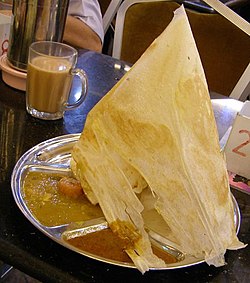
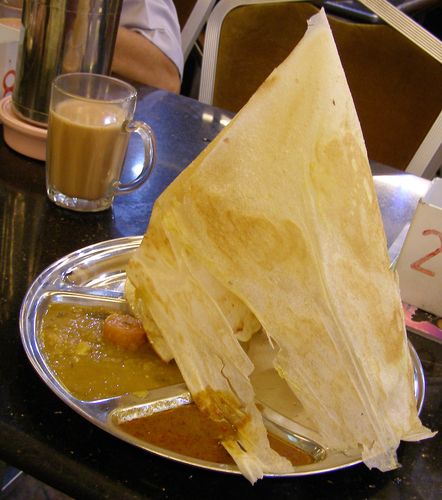
Roti Tissue and a glass of Teh tarik
Alternative namesRoti tisu, tissue prata, roti helikopter
TypeDessert
Associated cuisineMalaysia and Singapore
Created byTamil Muslim in Malaya

Roti tissue, roti tisu, or tisu prata is a sweet flatbread often sold at Mamak stalls in Malaysia and Singapore. It is also known as "roti helikopter" (helicopter bread). Roti tisu is a thinner and crispier version of the traditional roti canai or roti prata. It is as thin as a piece of 40–50 cm round-shaped tissue.

Roti tisu is available at most local Mamak stalls in Malaysia and Singapore[1] and may be coated with sweet substances, such as sugar and kaya (jam), or eaten with condiments such as ice cream.

The popularity of roti tissue has spread to neighbouring Indonesia, where it is found as street food in areas with significant Malays and Indian-Indonesian communities.[2]

See also

[edit]

References

[edit]
Revisions and contributorsEdit on WikipediaRead on Wikipedia
from Grokipedia
Roti tisu, also known as roti tissue or tissue prata, is a paper-thin, crispy variation of the traditional Malaysian roti canai, typically prepared by stretching to an extremely fine consistency before pan-frying and often served in a or shape with toppings like and . This staple, popular at mamak stalls across and , derives its name from its tissue-paper-like thinness and is celebrated for its buttery, flaky texture achieved through repeated folding and stretching of the . Originating as an adaptation of roti canai, which was introduced by Indian-Muslim immigrants from Tamil Nadu during Malaysia's colonial era in the 19th century, roti tisu emerged as a specialized variant emphasizing extreme crispiness and visual appeal, sometimes reaching heights of up to one meter when formed into a pyramid or "helicopter" shape. The base dough, made from wheat flour, water, salt, and oil or ghee, is kneaded until smooth, rested, and then meticulously pulled and clapped to create layers of air pockets that result in its signature crunch upon cooking on a hot griddle. While traditionally savory roti canai traces its roots to Sanskrit-derived terms for bread and the Malay "canai" meaning to roll or flatten the dough, roti tisu leans toward a sweet profile, often drizzled with condensed milk or chocolate syrup, making it a favored dessert or late-night snack in Malaysian culinary culture. Culturally, roti tisu embodies the fusion of Indian, Malay, and Tamil influences in Malaysian mamak , where it is enjoyed during casual "lepak" gatherings at 24-hour eateries, symbolizing communal bonding and affordability. Variations include savory options stuffed with eggs, bananas, or cheese, but the classic sweet version remains iconic, with some stalls in Kuala Lumpur's area specializing in oversized portions for dramatic presentation. Its global recognition grew when , including tisu variants, was ranked as the world's best bread by in 2023.

Overview

Description

Roti tissue is a thinner, crispier variant of the traditional or , a prominent in Malaysian and . The is meticulously stretched into a large round shape measuring 40-50 cm in diameter, resulting in an ultra-thin consistency akin to . Its basic composition revolves around a flour-based typically made with , salt, sugar, and fats such as oil, butter, or for flakiness. Upon cooking, roti tissue exhibits a distinctive lace-like, translucent appearance, characterized by a uniformly crunchy exterior and virtually no chewy interior due to its minimal thickness. It is commonly presented either folded or rolled into a compact for easy handling.

Key characteristics

Roti tissue is characterized by its exceptionally thin and delicate structure, stretched to a paper-thin consistency that results in a super crispy and brittle texture when freshly cooked. This ultra-thin profile, often likened to the fineness of , sets it apart from thicker flatbreads like , enabling it to achieve a light, airy crispiness upon frying. The flavor base of roti tissue derives from its simple wheat dough, offering a neutral taste with subtle buttery notes from the minimal oil used in , which readily absorbs the flavors of accompanying toppings such as for sweetness or for savoriness. While the dough itself is mildly neutral, the addition of sugar or sweetened imparts a mildly sweet profile to the finished product. Due to its delicate crispiness, roti tissue has a limited shelf life and is best consumed hot immediately after , softening and becoming chewy within 1-2 hours if left exposed to air; it is not ideal for long-term storage without additional crisping methods like reheating.

History

Origins in Malay cuisine

The name "roti tisu," meaning "tissue bread" in Malay, derives from the dish's exceptionally thin, paper-like texture, resembling a sheet of when stretched and cooked. In , it is commonly referred to as "tisu prata," reflecting the local adaptation of the term "prata" from the Indian paratha flatbread. Roti tisu traces its roots to the Indian flatbread roti canai, which was introduced to Malaya (present-day Malaysia) by Tamil Muslim immigrants in the late 19th century during British colonial rule. These immigrants, primarily from Tamil Nadu, brought paratha-style techniques using maida flour, ghee, and kneading methods to create flaky layers, adapting the dish to local conditions in rubber plantations and urban centers. By the 1920s, roti canai had become a staple at emerging mamak stalls, evolving from South Indian parottas into a multicultural Malaysian food. As a cost-effective , tisu emerged later as a specialized variant at mamak stalls in urban hubs like and , where vendors stretched the dough even thinner than traditional to maximize portions while incorporating local Malay preferences for sweetness through toppings like sugar and . This blending of Tamil Indian stretching techniques with Southeast Asian flavors marked its integration into culture, distinguishing it as an accessible dessert-like treat.

Rise in popularity

Roti tissue gained traction through mamak restaurants in and , where it emerged as an innovative variant of traditional , appealing to urban diners with its thin, crispy texture and versatility for sweet or savory toppings. Its affordability, typically priced at RM2 to RM5 per piece, combined with quick preparation methods that allow for rapid service to late-night crowds, drove its adoption as a staple menu item at these 24-hour eateries. By the 2000s, "giant" versions measuring up to 1 meter in diameter became popular, showcasing elaborate folding and tossing techniques that enhanced its visual spectacle and shareability. In the , amplified its appeal through videos of the dramatic preparation process, while the dish featured prominently in Malaysian food festivals, such as events highlighting national in 2010. The concept exported to neighboring markets, gaining popularity as in during the and appearing on menus in by the early . tissue has become a widespread offering at mamak stalls across , bolstering the economy by attracting both locals and tourists with its accessible pricing and cultural resonance. In recent years, as of 2025, it has seen viral popularity on platforms, with oversized versions gaining attention from tourists and celebrities.

Preparation

Ingredients and dough

The primary ingredients for roti tissue dough consist of wheat flour, water, salt, sugar, and a small amount of fat, with optional additions like eggs for added richness. A standard recipe yields dough for 4-6 pieces using approximately 500 grams of all-purpose or high-gluten wheat flour as the base, 250-300 milliliters of water, 1 teaspoon of salt, and 1-2 teaspoons of sugar to impart subtle sweetness and aid in browning. Optional inclusions are 1 egg for enhanced tenderness and flavor, along with 1-2 tablespoons of vegetable oil or ghee to improve handling without compromising stretchability. To prepare the dough, first combine the dry ingredients—flour, salt, and sugar—in a large to ensure even distribution. Gradually incorporate the liquid components, starting with water (and beaten if using), while mixing to form a shaggy mass, then add the oil or . Knead the mixture for 5-10 minutes by hand or with a stand mixer until it develops into a soft, smooth, and elastic consistency that pulls away from the bowl sides cleanly. This process activates formation, essential for the dough's later extensibility. Cover the dough and allow it to rest for at least 2 hours, preferably 4-8 hours or overnight at or refrigerated, which relaxes the gluten strands and improves pliability for extreme stretching. The ideal flour-to-water ratio is approximately 2:1 by weight, promoting a hydration level that enables the to be stretched thinly without tearing while maintaining structural integrity. High-gluten , such as bread flour with 12-14% protein content, is preferred for superior elasticity, allowing the to expand significantly during preparation. Conversely, minimal fat incorporation in the initial mix—limited to 1-2 tablespoons—prevents excessive tenderness that could lead to rips, while over-kneading should be avoided to preserve the 's supple texture and prevent toughness.

Cooking techniques

The rested dough for roti tissue is divided into small balls, typically weighing 50 to 100 grams each, to facilitate handling and uniform stretching. These balls are coated lightly with oil and rested briefly before shaping. The shaping process begins by gently pressing the ball flat on an oiled surface, then stretching it by hand—often using a or tossing motion akin to dough preparation—to achieve a tissue-thin layer without tearing, resulting in a very thin sheet, often 60-100 cm or larger in diameter, depending on skill and desired size. This technique requires skill to ensure even thickness and prevent holes, preserving the 's integrity for crisp cooking, and creates multiple thin layers and air pockets for the signature flakiness. Cooking tissue demands a hot surface to quickly crisp the thin while keeping the interior tender. A traditional hemispherical or convex tawa (griddle) is heated to 200–250°C for even heat distribution, though flat griddles are also used in modern settings; minimal oil or is applied to prevent sticking without sogginess. The stretched is placed on the hot tawa and cooked for 1–2 minutes per side, flipping once, until it turns golden brown with bubbly, charred spots that indicate crispiness. The high heat promotes rapid puffing and layering, essential for the texture. Upon removal from the heat, roti tissue is immediately brushed with melted or to add shine and enhance flavor while the surface is still hot. While pliable, it is folded into shapes such as a , roll, or fan to lock in the crispiness and facilitate serving; these forms are set as the bread cools, maintaining structure without additional cooking. Traditional hemispherical tawas aid in flipping large sheets evenly, but contemporary electric flat griddles offer consistent for home preparation.

Variations and serving

Sweet variations

Sweet variations of roti tissue transform the crispy into an indulgent dessert-like snack, commonly enjoyed at mamak stalls in and . The classic toppings include a spread of or for added richness, followed by a sprinkling of granulated and a drizzle of , which creates a glossy, caramelized coating as it seeps into the layers. These elements highlight the dish's simplicity and sweetness, with the sugar providing crunch and the condensed milk offering creamy indulgence. Kaya, a , is also a popular sweet topping. Among popular combinations, sugar-only versions provide a straightforward sugary treat, while chocolate variations incorporate or melted over the surface for a richer flavor profile. Banana slices may be incorporated, either folded inside or layered on top, adding a soft, fruity contrast to the crisp base ("tissue pisang"). These adaptations maintain the dish's lightweight structure while amplifying its appeal. The is typically presented rolled with the toppings enclosed to contain the sweetness or laid open-faced to display the attractive layering of sugar and , always served piping hot to ensure the tissue-thin layers retain their signature crunch. Such preparations underscore roti tissue's versatility as a quick, satisfying sweet.

Savory adaptations

Savory adaptations of , though less common than sweet versions, incorporate protein-rich fillings and toppings to transform the thin into a meal suitable for or as a . One popular variation is "roti tissue telur," where a cracked , often mixed with chopped onions, is added to the before cooking, creating a soft, custardy interior encased in the crispy layers. This adaptation is available at Malaysian mamak restaurants. Curry gravy, such as or chicken varieties, can be poured over the to add moisture and flavor, allowing the flaky texture to absorb the savory while maintaining its . Fusion versions feature melted cheese folded into the during preparation, providing a gooey contrast to the crisp exterior. In regional contexts, Singaporean adaptations pair with for a spicy, boost that enhances its neutral base. Preparation tweaks for savory uses include incorporating spices like into the for a subtle earthy base flavor, and cooking the slightly longer on lower heat to achieve a softer texture that better holds fillings. The thin stretching technique enables easy incorporation of fillings without tearing the .

Cultural significance

Role in Malaysian and Singaporean food culture

Roti tissue holds a prominent social role in Malaysian and Singaporean food as a late-night staple at mamak stalls, where it facilitates community gatherings and casual socializing among diverse groups, often shared by 2-4 people during extended hangouts. These open-air eateries, operating 24/7, embody a vibrant multicultural space that encourages "lepak" sessions—informal over food and drinks—particularly appealing to urban youth for late-night bonding after work or events, with typically between 10 PM and 2 AM. Its gender-neutral appeal extends to families, marketed as an accessible treat that unites people across ethnic lines in everyday urban life. Economically, roti tissue underscores the viability of immigrant-run mamak businesses, predominantly operated by Indian Muslims, by offering an affordable option—typically under RM5 in Malaysia and around SGD3-6 in Singapore— that sustains low-overhead street food operations amid high footfall. A 2018 study of 432 adults in Selangor found that 16.3% consumed roti tisu, with a mean intake of 0.8 g/day among consumers. Culturally, symbolizes the fusion of Indian and Malay culinary heritages, evolving from traditional techniques introduced by South Indian migrants into a distinctly localized, paper-thin that reflects Malaysia's multicultural fabric. It features in communal feasts, embedding it further in and as a nostalgic, shareable icon of innovation.

Global adaptations

Roti tissue has spread beyond its Southeast Asian origins through communities, particularly to and the , where immigration from surged in the 2000s. In , the Malaysian-born population grew substantially, with approximately 15% of arrivals occurring between 2006 and 2010, driven by skilled migration and family reunions. This migration facilitated the introduction of traditional Malaysian foods, including roti tissue, to urban centers like . eateries such as Mamak, a prominent Malaysian , feature roti tisu on their , prepared paper-thin and served tall with and sugar for A$16.50. Similarly, in the UK, Malaysian immigrants contributed to the establishment of authentic eateries in , where roti tissue is offered at venues like City, adapting the dish to local tastes while preserving its crispy texture. In fusion cuisines, roti tissue has been reimagined in various global contexts, blending its delicate layers with regional ingredients. , the dish appeared as early as 2016 at Laut Restaurant in , marketed as "Flying Bread" and paired with coconut to appeal to American preferences. This adaptation highlights its integration into urban Malaysian dining scenes in cities like New York. In the Middle East, particularly the UAE, roti tissue is served at Malaysian restaurants in for around AED 12, often with local twists; the broader tissue bread trend, inspired by similar thin-layered techniques, has incorporated Emirati flavors like sauce and cream at bakeries such as Break By Mara. Commercial availability has expanded access outside traditional settings, with frozen dough kits for similar thin parathas and becoming widely sold online since the mid-2010s through retailers like Amazon and specialty Asian grocers. Vegan adaptations have emerged, substituting with plant-based alternatives like oat or in recipes, allowing for dairy-free versions that maintain the dish's sweetness and crispiness. Despite its popularity, preparing roti tissue poses challenges in non-traditional kitchens, primarily due to the difficulty in achieving its signature paper-thin consistency without specialized tools like large flat griddles or expert stretching techniques typically found in mamak stalls. Home cooks often struggle with tearing or uneven layering, requiring practice to replicate the professional result.

References

Add your contribution
Related Hubs
Contribute something
User Avatar
No comments yet.