Recent from talks
Nothing was collected or created yet.
Culex
View on Wikipedia
| Culex | |
|---|---|
| |
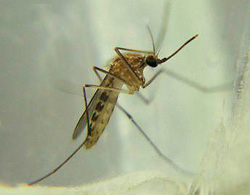
| Culex pipiens female | |
| Culex sp. male | |
| Scientific classification | |
| Kingdom: | Animalia |
| Phylum: | Arthropoda |
| Class: | Insecta |
| Order: | Diptera |
| Family: | Culicidae |
| Subfamily: | Culicinae |
| Tribe: | Culicini |
| Genus: | Culex Linnaeus, 1758 |
| Type species | |
| Culex pipiens Linnaeus, 1758
| |
| Diversity | |
| Over 1,000 species | |


Culex or typical mosquitoes are a genus of mosquitoes, several species of which serve as vectors of one or more important diseases of birds, humans, and other animals. The diseases they vector include arbovirus infections such as West Nile virus, Japanese encephalitis, or St. Louis encephalitis, but also filariasis and avian malaria. They occur worldwide except for the extreme northern parts of the temperate zone, and are the most common form of mosquito encountered in some major U.S. cities, such as Los Angeles.
Etymology
[edit]In naming this genus, Carl Linnaeus used the nonspecific Latin term for a midge or gnat: culex.[1]
Description
[edit]Depending on the species, the adult Culex mosquito may measure from 4–10 mm (0.2–0.4 in). The adult morphology is typical of flies in the suborder Nematocera with the head, thorax, and abdomen clearly defined and the two forewings held horizontally over the abdomen when at rest. As in all Diptera capable of flight, the second pair of wings is reduced and modified into tiny, inconspicuous halteres.[citation needed]
Formal identification is important in mosquito control, but it is demanding and requires careful measurements of bodily proportions and noting the presence or absence of various bristles or other bodily features.[2]
In the field, informal identification is more often important, and the first question as a rule is whether the mosquito is anopheline or culicine. Given a specimen in good condition, one of the first things to notice is the length of the maxillary palps. Especially in the female, palps as long as the proboscis are characteristic of anopheline mosquitoes. Culicine females have short palps. Anopheline mosquitoes tend to have dappled or spotted wings, while culicine wings tend to be clear. Anopheline mosquitoes tend to sit with their heads low and their rear ends raised high, especially when feeding, while culicine females keep their bodies horizontal. Anopheline larvae tend to float horizontal at the surface of the water when not in motion, whereas culicine larvae float with head low and only the siphon at the tail held at the surface.[3]
Life cycle
[edit]The developmental cycle of most species takes about two weeks in warm weather. The metamorphosis is typical of holometabolism in an insect: the female lays eggs in rafts of as many as 300 on the water's surface. Suitable habitats for egg-laying are small bodies of standing fresh water: puddles, pools, ditches, tin cans, buckets, bottles, unmounted tires, and water storage tanks (tree boles are suitable for only a few species). The tiny, cigar-shaped, dark brown eggs adhere to each other through adhesion forces, not any kind of cement, and are easily separated. Eggs hatch only in the presence of water, and the larvae are obligately aquatic, linear in form, and maintain their position and mostly vertical attitude in water by movements of their bristly mouthparts. To swim, they lash their bodies back and forth through the water.[4][5]
During the larval stage, the insect lives submerged in water and feeds on particles of organic matter, microscopic organisms or plant material; after several instars it then develops into a pupa. Unlike the larva, the pupa is comma-shaped. It does not feed, but can swim in rapid jerking motions to avoid potential predators. It must remain in regular contact with the surface to breathe, but it must not become desiccated. After 24–48 hours, the pupa ruptures and the adult emerges from the shed exoskeleton.[citation needed]
Vector of disease
[edit]Diseases borne by one or more species of Culex mosquitoes vary in their dependence on the species of vector. Some are rarely and only incidentally transmitted by Culex species, but Culex and closely related genera of culicine mosquitoes readily support perennial epidemics of certain major diseases if they become established in a particular region.[citation needed]
- Cat Que Virus (CQV) has been largely reported in Culex mosquitoes in China and in pigs in Vietnam. For CQV, domestic pigs are considered to be the primary mammalian hosts. Antibodies against the virus have been reported in swine reared locally in China.
- Arbovirus infections transmitted by various species of Culex include West Nile virus, Japanese encephalitis, St. Louis encephalitis, and Western and Eastern equine encephalitis. Brazilian scientists are investigating if Culex species transmit zika virus.[6]
- Nematode infections, mainly forms of filariasis may be borne by Culex species, as well as by other mosquitoes and bloodsucking flies.
- Protist parasites in the phylum Apicomplexa, such as various forms of avian malaria
Nonanal has been identified as a compound that attracts Culex mosquitoes, perhaps pheromonally.[7][8][9] Nonanal acts synergistically with carbon dioxide.[10]
Diversity
[edit]
Culex is a diverse genus. It comprises over 20 subgenera that include a total of well over 1,000 species. Publications of newly described species are frequent.[citation needed]
References
[edit]- ^ "culex". dictionary.com. Retrieved 2011-07-06.
- ^ Harbach, Ralph. "Culex Mosquito Taxonomic Inventory". Archived from the original on 2020-09-25. Retrieved 2014-12-16.
- ^ "Entomology and Acarology: Difference between Anopheline and Culicine mosquitoes". ecoursesonline.iasri.res.in.
- ^ "Mosquito Ecology and Surveillance Laboratory". Retrieved 7 August 2014.
- ^ Mike Service (21 February 2008). Medical Entomology for Students. Cambridge University. pp. 53–54. ISBN 978-0-521-70928-6.
- ^ Moraes, Priscilla (March 27, 2016). "Brazilian experts investigate if 'common mosquito' is transmitting zika virus". Retrieved 2016-03-07.
- ^ "UC Davis Researchers Identify Dominant Chemical That Attracts Mosquitoes to Humans". University of California, Davis. October 26, 2009. Retrieved 2011-07-06.
- ^ Syed, Z.; Leal, W. S. (2009). "Acute olfactory response of Culex mosquitoes to a human- and bird-derived attractant". Proceedings of the National Academy of Sciences. 106 (44): 18803–18808. Bibcode:2009PNAS..10618803S. doi:10.1073/pnas.0906932106. PMC 2767364. PMID 19858490.
- ^ Hill, Sharon R.; Hansson, Bill S.; Ignell, Rickard (January 15, 2009). "Characterization of Antennal Trichoid Sensilla from Female Southern House Mosquito, Culex quinquefasciatus Say". Chemical Senses. 34 (3): 231–252. CiteSeerX 10.1.1.319.1429. doi:10.1093/chemse/bjn080. PMID 19153252.
- ^ "Scientists Identify Key Smell that Attracts Mosquitoes to Humans". U.S. News & World Report. October 28, 2009. Retrieved 2011-07-06.
External links
[edit]- On the UF / IFAS Featured Creatures Web site
- Culex pipiens at MetaPathogen: facts, life cycle
- Mosquito Chapter in the National Public Health Pesticide Applicator Training Manual
Culex
View on GrokipediaEtymology and Taxonomy
Etymology
The genus name Culex derives from the Latin noun culex (genitive culicis), denoting a gnat or midge, which historically referred to small, biting dipterans.[8][9] This etymon, akin to Old Irish cuil for fly, underscores the ancient association of such insects with irritation and blood-feeding behavior observed in Mediterranean and European contexts.[10] Carl Linnaeus formalized the genus in his Systema Naturae (10th edition, 1758), applying the term to encompass species exhibiting siphonate mouthparts and two-winged flight, distinguishing them from other nematocerans.[8] The selection aligns with classical Roman usage, as evidenced in works like Pliny the Elder's Naturalis Historia, where culex described akin pestilent flies, though Linnaeus's binomial system shifted focus to morphological systematics over purely descriptive nomenclature.[9]Taxonomic Classification
The genus Culex Linnaeus, 1758, is classified within the kingdom Animalia, phylum Arthropoda, class Insecta, order Diptera, and family Culicidae.[11][12] This placement reflects its membership among true flies characterized by a single pair of wings and halteres, with Culicidae distinguished by piercing mouthparts adapted for blood-feeding in females.[13] Culex encompasses over 800 valid species, organized into approximately 26–28 subgenera, making it one of the most species-rich genera in Culicidae.[14][15] Subgenera such as Culex (sensu stricto) include medically significant species like C. pipiens and C. quinquefasciatus, while others like Lutzia and Neoculex exhibit morphological and ecological distinctions validated through systematic revisions.[15] Taxonomic boundaries within the genus rely on morphological traits (e.g., male genitalia, larval siphons) and molecular markers, though ongoing phylogenetic studies reveal polyphyletic groupings in some subgenera, prompting periodic reclassifications.[16] The genus exhibits a cosmopolitan distribution, with highest diversity in tropical and subtropical regions, though species richness varies by subgenus; for instance, subgenus Culex dominates in temperate zones of the Holarctic realm.[14]| Taxonomic Rank | Classification |
|---|---|
| Kingdom | Animalia |
| Phylum | Arthropoda |
| Class | Insecta |
| Order | Diptera |
| Family | Culicidae |
| Genus | Culex Linnaeus, 1758 |
Morphology
Adult Morphology
Adult Culex mosquitoes are small to medium-sized nematoceran flies, typically measuring 4–10 mm in body length, with minimal morphological variation across species characterized by a brown or grayish hue without prominent stripes on legs or body, contrasting with black Aedes species that feature white stripes on legs and body, and absence of pre-apical abdominal bands.[14] [6][17] Their body comprises a distinct head, thorax, and abdomen, covered in fine scales, with wings held horizontally at rest.[18] The head is broad, bearing large compound eyes occupying much of the dorsal surface, paired antennae that are plumose in males for mate detection and pilose with whorls in females, short dark maxillary palps (longer in males), and a straight proboscis formed by the labium enclosing piercing stylets for nectar or blood feeding.[18] [14] The proboscis is generally dark-scaled, often with pale ventral scales, and lacks prominent bands distinguishing many species from genera like Aedes.[19] The thorax features a scutum covered in uniform brown to reddish-brown scales and setae, a scutellum, and pleuron with spiracles; it supports three pairs of long slender legs, with the hind pair longest, segmented into coxa, trochanter, femur, tibia, and five-tarsomered tarsi ending in claws, typically without bold white bands.[18] [19] One pair of membranous wings arises from the thorax, scaled and fringed, with characteristic venation including veins such as the costa, subcosta, radius, media, cubitus, and anal, and small halteres for balance; hind wings are absent.[18] The abdomen consists of up to ten segments with tergites and sternites, more pointed in females to accommodate egg development, expandable for blood meals in females, and often dark-scaled without distinctive patterns.[18] [14] Sexual dimorphism is pronounced in antennal plume density and palp length, aiding species identification alongside subtle scale patterns on thorax or legs in certain taxa.[19]Immature Stages
Female Culex mosquitoes oviposit eggs in floating rafts consisting of 100 to 300 individual eggs arranged in parallel rows.[20] These eggs are typically boat-shaped or slightly curved, initially white and darkening to grayish-brown within hours, with a smooth exterior visible to the naked eye but granulate under magnification.[21] Egg rafts form on the surface of standing water bodies, such as ponds, containers, or vegetation, and hatch within 24 to 48 hours under favorable temperatures around 25–30°C.[2] [20] The larval stage comprises four instars, during which Culex larvae remain aquatic in nutrient-rich, stagnant water.[20] Larvae are distinguished by a prominent siphon—a breathing tube at the posterior end—allowing them to hang vertically downward from the water surface, with the siphon piercing the meniscus for atmospheric oxygen.[21] They possess a stout head with mouth brushes for filter-feeding on microorganisms, algae, and detritus, undergoing ecdysis between instars; the siphon length varies by species, often 4–7 times the width, and lacks certain sub-dorsal setae in some like C. territans.[20] Development spans 5 to 14 days, influenced by temperature and food availability, with larvae actively wriggling to evade predators.[21] Pupae are comma-shaped, non-feeding structures with a fused cephalothorax bearing respiratory trumpets and a mobile abdomen ending in paddles for locomotion.[20] They float at the water surface, respiring via trumpets, and exhibit limited activity, primarily darting when disturbed.[21] The pupal stage lasts 1 to 4 days at 25–30°C before the adult mosquito emerges through histolysis and eclosion.[20] All immature stages are confined to freshwater habitats with minimal flow, rendering them vulnerable to environmental controls like larvicides.[2]Life Cycle and Ecology
Developmental Stages
Culex mosquitoes exhibit a holometabolous life cycle comprising four distinct developmental stages: egg, larva, pupa, and adult.[22] The entire immature development from egg to adult typically spans 7 to 14 days under optimal conditions, with duration inversely related to temperature; for instance, Culex pipiens completes development in 6-7 days at 30°C but requires 21-24 days at 15°C.[6] In the egg stage, gravid females lay batches of 100 to 300 eggs arranged in a floating raft on stagnant or slow-moving water surfaces, such as ponds, ditches, or artificial containers.[2] [22] These eggs stand vertically due to specialized structures and hatch synchronously within 1 to 3 days, influenced by environmental temperature, with no dormancy period observed in Culex pipiens.[6] Egg rafts measure approximately 1/4 inch long and 1/8 inch wide, resembling specks of soot, and are not resistant to desiccation.[23] Larvae emerge as aquatic, comma-shaped organisms that progress through four instars, molting between each to increase in size.[22] [24] They are filter feeders, consuming bacteria, algae, and organic detritus, and maintain position parallel to the water surface by breathing air through a siphon tube featuring an apical crown of spines (siphon index 4.5–5.5 in species like Culex coronator).[22] Larval habitats include sunlit or partially shaded waters enriched with leaf litter or animal waste, which enhance survivorship and development speed; competition with other species, such as Aedes albopictus, can reduce survival by up to 50%.[22] Total larval development requires 4 to 10 days, varying with temperature and food availability.[25] The pupal stage is a non-trophic transitional phase lasting 1 to 4 days, during which the insect remains aquatic and comma-shaped, respiring via two respiratory trumpets at the water surface while actively diving to evade predators.[22] [23] Pupae do not feed but undergo internal reorganization to form adult structures, emerging when conditions allow the exoskeleton to split and the adult to escape to the air.[23] Adults eclose from the pupal skin, with males typically emerging first to form swarms for mating; females require a blood meal post-mating to develop eggs, though some species like Culex coronator can delay oviposition for weeks during dry periods until suitable water refills.[22] Adult longevity varies, but females may overwinter in sheltered sites, resuming activity with warmer temperatures and longer photoperiods in species such as Culex pipiens.[6]Habitat and Behavior
Species of the genus Culex inhabit diverse environments across tropical, subtropical, and temperate regions globally, with over 770 described species adapted to both urban and rural settings.[1] Breeding occurs predominantly in stagnant or slow-moving freshwater bodies, including natural habitats such as marshes, ponds, rice fields, and tree holes, as well as anthropogenic sites like artificial containers, catch basins, and sewage seepages.[2][26] Many Culex larvae thrive in waters with high organic content and low dissolved oxygen, tolerating pollution from decaying vegetation or sewage, and some species endure slight salinity in coastal areas.[6][27] Adult Culex mosquitoes exhibit behaviors suited to their aquatic larval origins and vector roles, with females laying eggs in rafts on the water surface to ensure larval access to air.[2] Larvae remain suspended vertically at the water-air interface, filtering microorganisms for feeding while respiting through a siphon tube.[28] Adults typically rest in shaded, humid microhabitats such as dense vegetation or indoor shelters during daylight hours, emerging at dusk or night for activity.[28][6] Dispersal is generally limited, with most individuals remaining within 500 meters of breeding sites, though wind-assisted flights can extend ranges.[6] Mating swarms form at dusk in open areas near breeding sites, primarily involving males, while females seek blood meals opportunistically from birds, mammals, or amphibians to support egg development.[29]Disease Vector Role
Transmitted Pathogens
Culex mosquitoes serve as primary vectors for several arboviruses, particularly flaviviruses, and certain filarial parasites, facilitating transmission through blood meals from infected vertebrate hosts to susceptible individuals.[4] Species within the genus, such as Culex pipiens and Culex quinquefasciatus, exhibit high vector competence for these pathogens due to their feeding preferences on birds and mammals, enabling enzootic amplification cycles that spill over to humans.[30] Transmission efficiency varies by species, environmental factors, and pathogen strain, with empirical studies confirming biological transmission rather than mechanical carriage.[31] The most prominent arbovirus transmitted by Culex is West Nile virus (WNV), a Flavivirus causing neuroinvasive disease in humans and equids. In the United States, Culex pipiens, Culex tarsalis, and Culex quinquefasciatus are key vectors, with C. pipiens predominant in eastern states where it maintains transmission cycles via avian reservoirs.[2] [32] WNV outbreaks, such as the 1999 New York epidemic, demonstrated Culex-mediated spread, with infection rates in mosquitoes reaching up to 30% in field collections during peaks.[33] Globally, Culex species sustain WNV in Europe, Africa, and Asia, though Aedes vectors play secondary roles in some areas.[34] St. Louis encephalitis virus (SLEV), another flavivirus, is vectored primarily by Culex quinquefasciatus in urban settings of the Americas, leading to epidemics like the 1933 St. Louis outbreak affecting over 1,000 cases.[30] [2] Culex species amplify SLEV in bird populations before human spillover, with vector competence studies showing extrinsic incubation periods of 8-14 days at 25°C.[4] Japanese encephalitis virus (JEV), endemic to Asia, relies on Culex tritaeniorhynchus as the main vector in rural rice-paddy ecosystems, transmitting from pigs and birds to humans and causing annual cases exceeding 10,000 in unvaccinated populations.[35] Laboratory and field data confirm JEV dissemination rates over 50% in infected Culex females.[27] Culex quinquefasciatus is the principal vector for Wuchereria bancrofti, the causative agent of lymphatic filariasis, in tropical regions of Africa, Asia, and the Pacific, where microfilariae develop into infective larvae within the mosquito over 10-14 days.[30] This filariasis transmission affects over 120 million people annually, with Culex facilitating urban spread due to its adaptation to polluted water breeding sites.[4] Other pathogens, including Usutu virus and Rift Valley fever virus, have been isolated from Culex in surveillance, but their transmission is less consistently documented compared to WNV and filariids, often requiring co-factors like high vector density.[3] Vector competence is not uniform across the genus; for instance, Culex modestus shows elevated WNV potential in Europe but limited filariasis role.[27]| Pathogen | Disease | Primary Culex Vectors | Key Regions |
|---|---|---|---|
| West Nile virus (WNV) | Encephalitis | C. pipiens, C. tarsalis, C. quinquefasciatus | Americas, Europe, Africa |
| St. Louis encephalitis virus (SLEV) | Encephalitis | C. quinquefasciatus | Americas |
| Japanese encephalitis virus (JEV) | Encephalitis | C. tritaeniorhynchus | Asia |
| Wuchereria bancrofti | Lymphatic filariasis | C. quinquefasciatus | Tropics (Africa, Asia) |

