Hubbry Logo
CutworkCutworkMain
Open search
Cutwork
Community hub
Cutwork
logo
8 pages, 0 posts
0 subscribers
Be the first to start a discussion here.
Cutwork
Cutwork
from Wikipedia
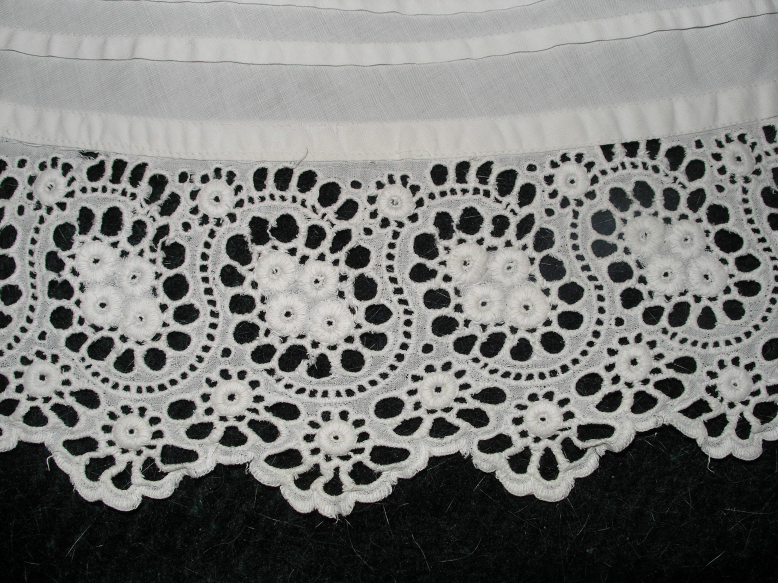
Cutwork frill on a cotton petticoat

Cutwork or cut work, also known as punto tagliato in Italian, is a needlework technique in which portions of a textile, typically cotton or linen,[1] are cut away and the resulting "hole" is reinforced and filled with embroidery or needle lace.

Cutwork is related to drawn thread work. In drawn thread work, typically only the warp or weft threads are withdrawn (cut and removed), and the remaining threads in the resulting hole are bound in various ways. In other types of cutwork, both warp and weft threads may be drawn. Cutwork is considered the precursor of lace.[2]

Different forms of cutwork are or have traditionally been popular in a number of countries. Needlework styles that incorporate cutwork include broderie anglaise, Carrickmacross lace, whitework, early reticella, Spanish cutwork, hedebo,[3] and jaali which is prevalent in India.

There are degrees of cutwork, ranging from the smallest amount of fabric cut away (Renaissance cutwork) to the greatest (Reticella cutwork). Richelieu cutwork in the middle.[4]: 378 

Eyelet fabrics

[edit]
Machine-sewn eyelet fabric
Hand-sewn eyelet embroidery

Eyelet is both a type of cutwork embroidery and the fabric made from embroidering cutwork. Cutwork is used to create eyelet fabrics by cutting small holes and embroidering the edges of those holes to finish them. Common base fabrics include broadcloth, batiste, lawn, linen, organdy, and pique.[5] Leather and pleather[5] can also be used in cutwork, but often they are not then finished with embroidery.

The amount and closeness of stitching, as well as the quality of the background fabric, may vary in different types. Eyelet fabrics are an ever-popular type of fabric[6] and are used for both entire clothing pieces or for trimming pieces made from other cloth. It is also commonly used to trim bedding, curtains, and table linens.[5]

Hand-sewn eyelet is labor-intensive to produce by hand and traditionally was only used as trim or, when used in large pieces, only for expensive items; machine-made eyelet fabric made the fabric affordable for everyday wear.

History

[edit]

The cutwork technique originated in Italy at the time of the Renaissance, approximately the 14th, 15th, and 16th centuries.[7] In Renaissance embroidery and Richelieu work, the design is formed by cutting away the background fabric.[8] In the Elizabethan era, cutwork was incorporated into the design and decoration of some ruffs. In a fashion sense, this type of needlework has migrated to countries around the world,[9] including the United Kingdom, India, and the United States. Dresden samplers contained white cutwork, along with needle lace.[10]: 195  Cutwork is still prevalent in fashion today, and although they are different, cutwork is commonly mistaken for lace. The eyelet pattern is one of the more identifiable types of cutwork in modern fashion. In eyelet embroidery, the design comes from the holes, rather than the fabric.[8]

Traditional cutwork by country

[edit]

Czech Republic

[edit]

Densely worked cutwork was traditional in many parts of the Czech Republic. Motifs might be circular, arc, or leaf-shaped. Because the motifs were often so close together, the embroidery looked like lace once all the motif centers were cut away.[11]: 120 

Cyprus

Lefkaritika is the characteristic type of embroidery art in Cyprus, dating back to at least the fourteenth century. The first Lefkara Lace was made from the local white cotton fabric produced in Cyprus. A combination of stitches and cuts is used. Women embroideresses in Pano Lefkara, called "ploumarisses" organised their production from home. Men from Lefkara, called "kentitarides", were merchants and they traveled across Europe and Egypt and other areas. [12]

Italy

[edit]

Embroidery pattern books after 1560 focused heavily on cutwork, as it became very popular in Italy. Initially, scrolling patterns worked in punto in aria were most evident, changing at the end of the century to reticella. The punto in aria technique involved laying threads over a linen ground, and then cutting the ground away. It was often use for freer patterns than the more geometric reticella, where squares of the ground cloth were cut out and embroidery was then applied.[13]: 138 

Madeira

[edit]

in the 1850s, an Englishwoman, Miss Phelps, arrived in Madeira to recuperate, and she gave lessons in broderie anglaise. In the 1920s, after noting many skilled needlewomen. the Madeira Embroidery Guild was formed. Amongst its purposes was to set the pay and standards for embroiderers on the island. As indicated by the existence of the guild, many women in Madeira engaged in embroidery as a way of earning money for their families.[14]

Netherlands

[edit]

Cutwork was popular throughout the Netherlands. An especially fine form of cutwork is called snee werk, used for decorating clothing such as aprons and blouses, and household items such as pillowcases.[4]: 185 

Poland

[edit]

The eyelet form of cutwork was popular in the Polish countryside from the 1700s, if not earlier. It was used to decorate costumes and textiles for the home. The execution of this hand embroidery reached its height in the late 1800s, a prosperous time with more money for clothing. Eyelet embroidery was found on men's clothing as well as women's. For those who couldn't afford larger garments, eyelet collars that could be used to adorn different blouses were popular. Cutwork was usually done on white fabric, but around Sieradz, a pink and white striped cloth was sometimes used. Eyelet patterns were geometrical until the late 1800s. With the introduction of machine embroidery, designs became more diverse.[8]: 125–132 

fragment of old fabric 14 x 45.4 cm (5 1/2 x 17 7/8 in.) with a diagonal pattern of fabric cut away
Fragment of Cutwork Lace, Italy, late 17th century (Cleveland Museum of Art). This is an example of eyelet cutwork.

Sweden

[edit]

Hålsöm, or cutwork, was a traditional form of embroidery in Sweden, and used for household linens.[4]: 257 

Hand cutwork

[edit]

Hand cutworks is the most traditional form of cutwork. Here, areas of the fabric are cut away and stitch is applied to stop the raw edges from fraying.[15]

Laser cutwork

[edit]

Laser cutwork allows for more precise and intricate patterns to be created. The laser also has the ability to melt and seal the edges of fabric with the heat of the laser. This helps against fabric fraying during the creation process.[15] Additionally, using a laser for cutwork enables the embroiderer or creator to achieve unique designs such as an 'etched look' by changing the depth of the laser cut into the fabric.

References

[edit]
[edit]
Revisions and contributorsEdit on WikipediaRead on Wikipedia
from Grokipedia
Cutwork is a decorative technique in which sections of a ground, typically or , are precisely cut away to create patterns, with the raw edges finished and reinforced using stitches such as , , or to prevent fraying and enhance the design. Often executed in white thread on white fabric as a form of whitework, it produces a lacy effect that contrasts light and shadow, distinguishing it from solid or drawn-thread work. Originating in during the in the 14th to 16th centuries, cutwork—known initially as punto tagliato or "cut point"—began in Roman Catholic monasteries where produced ecclesiastical textiles for church vestments and linens. The technique evolved from earlier drawn-thread methods, with larger areas of fabric removed to form geometric or floral motifs, laying the groundwork for reticella (a denser geometric style) and eventually by the 16th century. It spread across as a symbol of wealth and status, popularized among nobility through royal patronage, including Mary Tudor and in during the 16th century. In , cutwork gained prominence in the 17th century under King Louis XIII and was named Richelieu after , who favored it for collars, cuffs, and household linens; this variant emphasized fine outlines, connecting bars (brides), and sometimes picots for added delicacy. The process involves outlining the design with running stitches on fine fabrics like or , reinforcing edges with or stitches, carefully cutting away the interior fabric, and embroidering supportive bars to bridge open areas, ensuring structural integrity while achieving an airy, ornamental appearance. Beyond Europe, cutwork influenced regional styles, such as the Indian chikankari (featuring jaali mesh effects without cutting) and hakoba (eyelet ), adapting the aesthetic to local textiles and motifs from the onward. began in the mid-19th century with the invention of schiffli machines in 1863, which automated production for garments, tablecloths, and accessories, evolving further with computerized advancements in the late while preserving the technique's artisanal appeal. Today, cutwork remains valued for its elegance in fashion and home decor, bridging historical craftsmanship with modern applications.

Overview

Definition and Principles

Cutwork is a decorative technique in which portions of a , typically or , are precisely cut away to form open designs, with the resulting edges reinforced by stitches to prevent fraying and create a stable, ornamental structure. This method, also known as punto tagliato in Italian, produces intricate patterns that reveal the underlying surface, often resulting in a lightweight, airy appearance suitable for linens, garments, and household items. The fundamental principles of cutwork revolve around the careful removal of fabric to achieve effects, followed by the application of stabilizing stitches around the cut edges and within the voids. Common stitches include for edging the openings, for outlining motifs, and running stitches for initial marking or connecting elements, which collectively secure the design and mimic the delicacy of without the need for or knotting threads from scratch. These techniques emphasize precision to maintain fabric integrity, transforming solid cloth into patterned transparency through subtraction rather than addition. What distinguishes cutwork from other embroidery forms is its openwork nature, where negative space becomes an integral part of the aesthetic, contrasting with solid stitching that covers the fabric surface. Historically, it evolved from simple eyelet perforations in medieval textiles to more elaborate geometric and floral compositions during the , originating in 14th-century and spreading across . The basic process involves marking the design on stabilized fabric, cutting along the outlined areas, and then stitching to finish the edges, yielding a lace-like elegance that highlights the interplay of presence and absence in the material. Common variations, such as reticella with its grid-like voids or featuring scalloped edges, exemplify this evolution while adhering to the core mechanics of cutting and embroidering.

Types and Variations

Cutwork embroidery manifests in various types and variations, each defined by distinctive patterns, stitching methods, and visual effects that range from subtle perforations to expansive . One of the primary types is reticella, which employs grid-based geometric cuts to remove sections of fabric, creating a structured, lace-like network of threads that emphasizes angular motifs such as squares and rectangles. Originating in 15th-century , reticella resembles early through its partial fabric removal, resulting in floating shapes that produce a light, semi-transparent aesthetic. Renaissance cutwork builds on this foundation with elaborate floral motifs, where dense or stitching outlines and interconnects the cut areas to form intricate, interconnected designs. This variation achieves a balanced opacity and openness, often used to adorn linens with motifs that highlight natural forms like leaves and vines. represents another core type, featuring eyelet-style round or oval holes with scalloped edges finished in or overcasting stitches, typically arranged in floral patterns for a delicate, airy appearance. Popular in 19th-century and , it prioritizes clean, decorative perforations that enhance the fabric's lightness without extensive removal. Among other notable variations, Richelieu work involves bold cutouts filled with straight or radiating bars (brides) secured by stitches and picots, yielding a bold, lacy outcome ideal for tablecloths and garments. Eyelet fabrics simplify this further with isolated round holes edged in overcasting, often produced via machine for uniform, minimalist effects. Poltava-style cutwork, a Ukrainian geometric , integrates hemstitching along with overcast bars and cross stitches to frame cut motifs like zigzags or squares, creating a refined, translucent through combined flat and open elements. Variations differ markedly in complexity, with simple single-layer cuts focusing on basic fabric removal and edge finishing for straightforward patterns, contrasted by multi-layer approaches that overlap designs to build depth and shadow play through staggered stitching and voids. Over time, cutwork has evolved from opaque, stitch-dominant forms to increasingly transparent effects, where extensive fabric removal and bar connections paved the way for modern development by bridging and lacemaking traditions.

History

Origins and Early Development

Cutwork, known in its earliest form as punto tagliato, emerged in during the as an advanced evolution of drawn-thread work, where threads were withdrawn from fabric to create open patterns before cutting and edging the designs. This technique likely drew from earlier European practices. By the late , punto tagliato had become a refined , primarily executed on fine white using white thread to produce delicate, geometric motifs that mimicked the appearance of . During the 15th and 16th centuries, cutwork advanced significantly in Renaissance Italy, particularly through the development of reticella, a more intricate variant where larger sections of fabric were removed, leaving a grid of threads bridged by embroidery to form floating, lace-like patterns. Reticella gained prominence in ecclesiastical vestments and elite attire, symbolizing purity and sophistication in religious and courtly contexts, with examples appearing in Italian altar cloths and collars by the mid-1500s. A key technical milestone occurred in the late 16th century with the widespread adoption of buttonhole stitches to reinforce cut edges, enhancing durability and allowing for bolder, more expansive designs without fraying. This innovation marked cutwork's transition from a domestic embroidery skill to a luxury art form favored in royal Italian courts. By the , cutwork had spread across , reaching and through the dissemination of printed pattern books that standardized motifs and techniques for broader audiences. The first such books appeared in around 1520, followed by Italian publications in the 1530s and subsequent editions in and by the early 1600s, which adapted reticella-inspired designs for local needleworkers. This era also saw cutwork's interplay with emerging lacemaking traditions, as reticella served as a direct precursor to lace (punto in aria), where embroidery stitches were applied without a fabric ground to create free-standing networks. The printing press's role in proliferating these patterns democratized access, elevating cutwork from monastic and household production to a coveted status symbol in European nobility.

Regional Traditions

In Italy, punto tagliato emerged as a prominent form of cutwork during the , featuring intricate floral and geometric motifs such as foliage, blossoms, leaves, and vases that were buttonholed around cut sections of fabric. This technique was extensively used in ecclesiastical items like 16th-century Venetian altar cloths made with cutwork and punto in aria, showcasing elaborate patterns for liturgical decoration. It also appeared in secular , adorning collars and cuffs in early modern Italian attire as detachable whitework elements that highlighted status through fine . In , cutwork gained prominence in the 17th century under King Louis XIII and was named Richelieu after , who favored it for collars, cuffs, and household linens; this variant emphasized fine outlines, connecting bars (brides), and sometimes picots for added delicacy. In , cutwork was popularized among through royal patronage, including Mary Tudor and during the 16th century, where it symbolized wealth and status in attire and household textiles. Central European traditions, particularly in regions like the and , adapted cutwork into whitework styles with symmetrical patterns on , often incorporating eyelets and spiderweb fillings for decorative open areas. In Czech folk costumes, such as aprons from the Blata , cutwork borders with framed symmetrical motifs, contributing to the ornamental details of traditional attire and household linens. Polish variants, known as snutki or spiderweb , developed in the as imitations of Italian lace, featuring cut sections filled with web-like stitches in symmetrical designs for blouses and accessories in folk ensembles. On the Portuguese island of , cutwork evolved into variants during the , characterized by precise eyelet and bar techniques on fine cotton fabrics, often with floral-inspired . This style gained international recognition after the 1851 in , leading to its commercialization as luxury exports, particularly fine handkerchiefs that emphasized delicate white-on-white detailing for elite markets in and . Northern European adaptations, seen in and the , blended cutwork with drawn-thread techniques to create hybrids featuring minimalist geometric grids and open spaces on textiles. In , hålsöm emphasized open grid patterns through cut and hemstitched sections, commonly applied to traditional smocks and household items for subtle ventilation and decoration. Dutch examples from incorporated similar drawn-cut elements, such as satin-stitched borders with eyelets and withdrawn threads, in whitework for everyday garments and linens, reflecting regional influences from broader European whitework practices. In Ukraine's region, cutwork manifested in geometric patterns with simple shapes like triangles, rhombuses, and stars, often executed in white-on-white on for traditional , though some variants incorporated red thread accents for contrast in folk motifs. Non-European adaptations included influences in from the , where cutwork inspired regional styles such as hakoba eyelet embroidery and elements in chikankari featuring jaali mesh effects. Minor influences also appeared in colonial through who introduced basic cutwork techniques for household linens, blending them sparingly with local practices.

Techniques

Hand Cutwork Methods

Hand cutwork involves a meticulous process of preparing the fabric, outlining designs with stitches, carefully removing portions of the , and securing the edges with specialized techniques to create open, lacy patterns. This manual method requires precision to prevent fraying and ensure durability, distinguishing it from automated approaches by its reliance on hand tools and stitches. Preparation begins with transferring the onto the fabric using methods such as tracing with a disappearing ink pen or water-soluble marker, often against a light source like a window or to outline motifs with spaced about 1/8 inch apart and dotted lines indicating areas for supporting bars. To stabilize the fabric and maintain even tension, it is secured in an hoop or frame, which keeps the material taut during stitching. Initial outlining stitches, such as double running stitch, are worked along the design lines to define the areas to be cut, while buttonhole bars—formed by three long taut threads over the dotted lines—are added to bridge and support connected elements. Cutting techniques employ sharp, fine-pointed embroidery scissors or craft knives to remove the designated fabric portions precisely after the outlining and bar stitches are complete. Cuts can be straight for geometric shapes, curved for organic motifs, or intricate for detailed patterns; the process typically involves folding the fabric slightly, snipping from the center or reverse side, and trimming gradually to avoid damaging the stitches or bars, with care taken to cut only the marked threads in techniques like where four threads are removed at a time against satin-stitched blocks. Stitching methods focus on finishing the exposed edges and infills to prevent unraveling and enhance the decorative effect. The , worked at right angles to the outlining threads, is essential for edging cut areas, with the needle passing under the corded edge to create a neat, looped finish. For bridges between design elements, buttonhole bars are reinforced by densely stitching over the initial threads, often eye-first to tighten the loops evenly. fills solid areas within the design for contrast, while bar or spoke stitches—such as —form lacy connections in open spaces; overcasting may be used initially to handle fraying by loosely stitching around raw edges before final cutting. Finishing entails gently washing the piece in mild soapy water to remove any marking , stabilizers, or stray fibers, followed by rinsing, blocking if needed, and pressing while damp on a soft surface like terry cloth to achieve flatness. Common challenges include maintaining consistent thread tension to avoid puckering, correcting errors by re-stitching over minor cuts, and managing fraying through careful overcasting, with imperfections often embraced as part of the handmade charm. Skill levels in hand cutwork range from beginner projects featuring simple eyelets—small round cuts edged with buttonhole stitches in styles like —to advanced works involving multi-layer Renaissance-inspired designs with extensive bar networks and satin fillings for complex, translucent effects.

Machine and Laser Cutwork

Machine cutwork emerged during the 19th-century , adapting traditional openwork techniques like through innovations such as the Schiffli shuttle machines developed by Isaac Groebli in , which enabled large-scale production of lace-like effects mimicking hand . These early machines combined threaded needles with shuttles to stitch intricate patterns on fabric, allowing for programmed cuts and reinforcements that contrasted with labor-intensive hand methods by prioritizing efficiency and uniformity. Modern machine adaptations utilize machines equipped with or cutwork feet, where designs are first outlined with dense or stitches to secure edges before the inner fabric is carefully removed, often using fusible for stability during the process. Laser cutwork, developed in the late 20th century with the advent of computer-controlled CO2 lasers, revolutionized industrialized production by enabling precise fabric removal without physical contact, achieving speeds up to several times faster than mechanical methods while ensuring edge sealing through heat fusion to prevent fraying. In this technique, designs are digitized using software such as Wilcom EmbroideryStudio, where raster images are converted into cut paths via simple tools like auto-tracing, requiring minimal manual digitizing before exporting to laser systems for execution. The process integrates laser cutting with automated embroidery machines, where cuts create voids that are subsequently filled with programmed stitches or needle lace, followed by post-processing steps like washing to remove any residue and applying edge finishes if needed beyond the laser's natural sealing. Advancements in cutwork include integration with CNC (computer numerical control) systems for multi-axis precision and AI-optimized nesting, which maximize material utilization and support of complex patterns unattainable by hand. Environmentally, these methods reduce fabric from traditional 15-30% levels to 5-9% through exact cuts, conserve water by eliminating wet processing, and lower by approximately 50% compared to mechanical alternatives, though they require effective fume extraction to mitigate emissions. Limitations persist, including a less artisanal aesthetic due to uniformity and potential fabric scorching from laser heat, particularly on heat-sensitive synthetics, necessitating careful parameter adjustments.

Materials and Tools

Fabrics and Threads

Cutwork embroidery requires lightweight, tightly woven fabrics that provide a stable base for precise cutting while minimizing fraying around removed sections. Ideal options include cotton organdy, fine , and batiste, which offer a crisp structure suitable for creating intricate patterns. These fabrics typically feature thread counts between 100 and 200 threads per inch, allowing for fine detailing without excessive puckering during stitching. Even-weave constructions, such as those found in quality , are preferred to ensure uniform tension and ease in outlining cuts. Threads for cutwork must balance visibility for decorative edging with sufficient strength to secure the fabric's remaining edges against unraveling. Cotton or perle cotton in sizes #8 to #12 provides the necessary sheen and flexibility for hand stitching, enabling clear definition in both fine and bold designs. Mercerized threads are particularly valued for their enhanced tensile strength, which reinforces cut edges effectively without adding bulk. Color selection varies by style: white or neutral tones suit traditional whitework, while vibrant shades enhance colored motifs in modern interpretations. Key material properties influence suitability for cutwork, with high tensile strength essential to maintain integrity after cuts and during embroidery. Natural fibers like and exhibit good absorbency for dyes, allowing even color penetration in patterned areas. In contrast, synthetic blends such as polyester-infused fabrics offer durability for machine-based cutwork, resisting wear in high-production settings, though they may lack the natural drape of pure cottons. Proper preparation ensures optimal results, starting with pre-washing fabrics to eliminate shrinkage risks that could distort designs post-completion. Delicate options benefit from lightweight applied to the reverse side, providing added stability without altering the fabric's transparency or hand. Traditional regional styles, such as Italian punto tagliato, often employ fine for its inherent stability in hand techniques.

Tools and Supplies

Cutwork embroidery requires a selection of precise tools to ensure clean cuts and secure stitching, whether executed by hand or machine. For hand methods, essential basic tools include embroidery needles in sizes 7 to 10, which are suitable for fine work on delicate fabrics due to their sharp points and larger eyes that accommodate threads without fraying them. Sharp fabric scissors, such as 3.5-inch Dovo embroidery scissors with pointed blades, are indispensable for making accurate cuts in the fabric after outlining stitches, minimizing damage to surrounding areas. Seam rippers complement these by allowing for precise removal of threads or minor corrections without unraveling larger sections. Among supplies that maintain fabric tension and aid in preparation, embroidery hoops or frames—typically 6 to 8 inches in diameter—hold the work taut to prevent puckering during stitching and cutting. Water-soluble stabilizers, such as wash-away types like Wet N Gone, or are used underneath the fabric to support the design transfer and stabilize cut areas, dissolving cleanly after completion to reveal openwork effects. For advanced hand techniques, magnifying lamps provide illumination and enlargement for intricate detailing, reducing on fine motifs. Beeswax cakes condition threads by smoothing and strengthening them, preventing tangles during around cut edges. Cutting mats offer a protective surface for safe scissor work, safeguarding both tools and work surfaces from damage. These items are compatible with lightweight fabrics and fine threads commonly used in cutwork. Machine-specific tools expand precision for automated cutwork. Laser cutters, particularly CO2 models with 40-60 watt power, enable contactless cutting of fabric layers for complex patterns, ideal for modern applications. Embroidery machines equipped with cutwork modules, such as the BERNINA CutWork Tool—a rotating blade attachment that cuts up to 15 layers—integrate seamlessly with compatible models like the BERNINA 830 or aurora series. Accompanying software, including BERNINA CutWork Suite, allows users to design and sequence motifs for direct machine loading via USB, facilitating editable cut lines and integration. Proper maintenance extends tool longevity. Sharpening stones or professional services keep and seam rippers keen for clean cuts, while rust-preventive storage in padded cases or oil cloths protects metal components like needles and blades from corrosion, especially in humid environments.

Applications

Traditional Uses

Cutwork has long been integral to traditional apparel, particularly in where it adorned collars, cuffs, and hems of gowns to signify wealth and refinement. In and during the 16th and 17th centuries, reticella variants decorated ruffs and partlets, as seen in Queen Elizabeth I's wardrobe inventories, emphasizing geometric and floral patterns that enhanced the opulence of elite attire. In Central European folk costumes, eyelet cutwork featured prominently in Polish blouses, with intricate panels on cuffs and collars in regions like , reflecting regional craftsmanship in everyday and festive wear. For household and ceremonial purposes, cutwork embellished table , altar cloths, and christening gowns, often with symbolic motifs such as florals representing purity, , and spiritual devotion. Italian nuns produced reticella cutwork for vestments and frontals between 1480 and 1620, incorporating religious like wheels and leaves to honor divine worship and traditions. In , cutwork formed essential pieces from the onward, decorating and garments passed through generations as symbols of familial heritage and marital preparation. Socially, cutwork held significant status as a luxury indicator from the 16th to 18th centuries, adorning portraits of and signifying refined taste among the upper classes, while its creation underscored gender roles through domestic production by women and . These pieces also carried cultural weight in ceremonial contexts, such as christening gowns evoking innocence. Preservation efforts maintain examples in institutions like the , including 17th-century altar frontals, and as cherished heirlooms in private collections.

Modern and Commercial Uses

In contemporary , cutwork has experienced a revival through laser-cut panels and eyelet details, enhancing garments with delicate, modern transparency. Designers like Valentino have incorporated intricate cutwork in collections such as the Spring-Summer 2012 ready-to-wear line, where lace-like effects and subtle perforations created ethereal silhouettes in neutral tones accented by vibrant pops. Similarly, Red Valentino's 2020 Spring-Summer presentation featured cutwork holes alongside sangallo and , appearing in dresses, tops, and accessories to evoke playful, perforated motifs inspired by . In and accessories, laser-cut techniques offer seamless edges for comfort and durability, contributing to minimalist . As of 2025, cutwork remains a key trend in , with innovative designs in dresses, suits, and featured in seasonal collections and inspirations. For home decor, machine-embroidered cutwork adorns items like curtains and napkins, blending functionality with elegance in everyday settings. Sustainable applications utilize recycled fabrics, such as or upcycled linens, to create eco-conscious table linens and window treatments that reduce environmental impact while maintaining traditional motifs. Platforms like Spoonflower enable custom cutwork patterns on sustainable materials, allowing for personalized, mass-produced decor that aligns with modern interior trends. Commercial production of cutwork has scaled through embroidery software and automated machines, facilitating mass-market items like affordable apparel and home goods. Tools such as Wilcom and EmbroideryWare digitize cutwork designs for high-volume output, enabling efficient creation of eyelet panels and lace effects on industrial embroidery equipment. Handmade revivals thrive on marketplaces like and at craft fairs, where artisans offer bespoke cutwork pieces, contrasting with software-driven production for broader accessibility. Innovations in cutwork include fusions with techniques like , where digital patterns combine cutouts with fabric overlays for textured, layered effects suitable for both fashion and decor. Machine embroidery software now generates hybrid designs, such as cutwork corners, streamlining production for home sewers via downloadable files compatible with consumer machines. These advancements allow precise replication of intricate motifs without manual cutting. Current trends emphasize eco-friendly dyes and ethical sourcing, with cutwork producers adopting organic threads and recycled to minimize in garment and decor . Post-2000, social media has fueled a resurgence, with platforms sharing tutorials and inspiring a Gen Z-led revival of techniques, including cutwork, for and personal expression. This digital influence has boosted popularity, integrating cutwork into sustainable, customizable projects.

References

Add your contribution
Related Hubs
User Avatar
No comments yet.