Hubbry Logo
Cyclamen persicumCyclamen persicumMain
Open search
Cyclamen persicum
Community hub
Cyclamen persicum
logo
8 pages, 0 posts
0 subscribers
Be the first to start a discussion here.
Cyclamen persicum
Cyclamen persicum
from Wikipedia

Cyclamen persicum
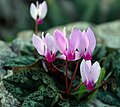
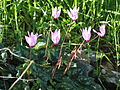
A typical wild form along the green path between Yagur and Nesher, Israel
Scientific classification Edit this classification
Kingdom: Plantae
Clade: Tracheophytes
Clade: Angiosperms
Clade: Eudicots
Clade: Asterids
Order: Ericales
Family: Primulaceae
Genus: Cyclamen
Species:
C. persicum
Binomial name
Cyclamen persicum
Synonyms[1]
  • Cyclamen albidum Jord.
  • Cyclamen aleppicum Fisch. ex Hoffmanns.
  • Cyclamen antiochium Decne.
  • Cyclamen hederaceum Sieber ex Steud.
  • Cyclamen latifolium Sm.
  • Cyclamen persicum f. albidum (Jord.) Grey-Wilson
  • Cyclamen punicum Pomel
  • Cyclamen pyrolifolium Salisb.
  • Cyclamen tunetanum Jord.
  • Cyclamen utopicum Hoffmanns.
  • Cyclamen vernale Mill.
  • Cyclamen vulgare Champy
  • Cyclaminus persica (Mill.) Asch.

Cyclamen persicum, the Persian cyclamen, is a species of flowering herbaceous perennial plant growing from a tuber, native to rocky hillsides, shrubland, and woodland up to 1,200 m (3,900 ft) above sea level, from south-central Turkey to the Levant.[1] Cultivars of this species are the commonly seen florist's cyclamen.

Description

[edit]

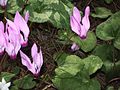
Cyclamen persicum is a perennial, herbaceous plant that reaches heights of about 32 cm (13 in). Wild plants have heart-shaped, fleshy leaves, up to 14 cm (6 in) usually green with lighter markings on the upper surface. The leaf underside may be pale green or reddish. The leaf margin is slightly thickened and usually serrated. As a storage and persistence organ, C. persicum forms a perennial hypocotyl tuber. It arises solely through a thickening of the hypocotyl, the shoot axis area between the root neck and the first cotyledon. The rounded, slightly flattened tuber is about 4 to 15 cm (1.6 to 5.9 in) or more in diameter. It is of corky consistency. The roots spring from the underside, and the tops of the spirally arranged, long-stalked leaves of the plant spring from the top.

Flowers

[edit]

Flowers bloom from winter to spring (var. persicum) or in autumn (var. autumnale) and have 5 small sepals and 5 upswept petals, usually white to pale pink with a band of deep pink to magenta at the base. Cyclamen carry on individual stems standing flowers that hang down but whose petals are bent strongly upwards. In the species, flowers are sweetly scented, but the scent has been lost in cultivated forms.[2]

A Botanical scan of Cyclamen persicum including tuber

Fruit

[edit]

After pollination, the flower stem curls downwards slightly as the pod develops, but does not coil as in other cyclamens. Plants go dormant in summer. The fruits are capsules, which are sunk into the ground with increasing maturity, by waxing and curling of the stem. The capsules only open when they are in the ground.[3]

Varieties and forms

[edit]

There are two natural varieties and several named forms, distinguished by flowering time and predominant petal color.

  • C. persicum var. persicum (winter- and spring-flowering — all of range)
  • C. persicum var. persicum f. persicum (white to pale pink)
  • C. persicum var. persicum f. albidum (pure white)
  • C. persicum var. persicum f. roseum (rose-pink)
  • C. persicum var. persicum f. puniceum (red to carmine)
  • C. persicum var. autumnale (autumn-flowering)

Distribution and habitat

[edit]

The natural range of C. persicum extends from North Africa across Southeast Europe to West Asia.[1] In particular, the following occurrences are documented: In North Africa, the species is represented in the northern and eastern parts of Algeria and in northern Tunisia. In Western Asia, stocks were confirmed in Cyprus, Lebanon, the Palestine region, western Syria and western Turkey. It also grows in Algeria and Tunisia and on the Greek islands of Rhodes, Karpathos, and Crete,[1] where it may have been introduced by monks.[citation needed]

The preferred habitats include pine forests, oak thickets and open rocky slopes mostly on calcareous soils up to an altitude of 1,000 metres (3,300 ft). In the summer months, the high temperature and the dryness lead to the death of the aerial plant parts. The plants outlast the dry season as shallow subterranean tubers. They then resume growth at the beginning of the colder season.[4]

Cultivars

[edit]
Cyclamen persicum cultivars in a Californian nursery operated by Japanese horticulturalists

The following is a selection of cultivars. All are frost-tender, and best grown under glass in temperate regions:

  • 'Concerto Apollo'[5]
  • 'Halios Bright Fuchsia'[6]
  • 'Halios Violet'[7]
  • 'Halios White'[8]
  • 'Laser Rose'[9]
  • 'Laser Salmon with Eye'[10]
  • 'Laser Scarlet'[11]
  • 'Laser White'[12]
  • 'Miracle Deep Rose'[13]
  • 'Miracle Scarlet'[14]
  • 'Miracle White'[15]
  • 'Sierra Fuchsia'[16]
  • 'Sierra Light Purple'[17]
  • 'Sierra Pink with Eye'[18]
  • 'Sierra Scarlet'[19]
  • 'Sierra White with Eye'[20]

Uses

[edit]

This species probably arrived in Paris before its first mention in 1620. Certainly, it has been cultivated since 1731 in France. The start of the variety breeding is dated to the 1860s, starting from England. The different varieties of it were created exclusively by breeding with variants of the wild species. An introgression of other species has not occurred.[21]

Cyclamen persicum has a dark-brown tuberous root which is semi-poisonous. In some cultures, the tubers were used in making soap, as they generate a lather when mixed with water.[22] The Bedouins of Mandate Palestine used to collect the root, and after grating it, would mix it with lime and sprinkle it over the surface of lakes or other large bodies of water known to contain fish. These poisonous mixtures would stun fish, which would then come to the surface and be collected by the fishermen. Such methods, as well as fishing with explosives, which came into use in the early 20th century, were banned by the British Mandate authorities.[23] Palestinians use the leaves of the plant to make stuffed leaves.[24]

Cyclamen are propagated by seeds. The seeds are most likely to germinate when very fresh, as they do not remain viable for long. Cyclamen are dark germs, so the seed is covered with soil and placed in near or total darkness. The best germination temperature is 18 °C (64 °F). The germination period is 20 to 30 days. After germination, the seed boxes are highlighted. With good care, the plants can live to about 20 to 30 years old.[25]

[edit]

References

[edit]
[edit]
Revisions and contributorsEdit on WikipediaRead on Wikipedia
from Grokipedia
Cyclamen persicum, commonly known as Persian cyclamen or florist's cyclamen, is a tuberous herbaceous in the primrose family (Primulaceae), native to rocky hillsides, scrublands, and woodlands in the region and . It grows from a rounded , producing heart-shaped leaves with distinctive silver marbling on dark green blades, and solitary, fragrant flowers with reflexed petals resembling , available in shades of white, pink, lavender, red, and magenta, blooming from late fall to early spring. The typically reaches 6-12 inches in height and width, entering summer dormancy when leaves yellow and wither in its natural hot, dry habitat. The native distribution of C. persicum spans , , (including and the East ), , , , , , , and western , where it thrives in cool, wet winters and arid summers under forests or thickets. Introduced to in the early 17th century, it quickly became a favored ornamental, with producing modern cultivars featuring larger blooms, fringed or double petals, and enhanced fragrance.

Taxonomy

Etymology

The genus name Cyclamen derives from the Ancient Greek kuklaminos (κυκλαμῖνος), which is thought to refer to the circular or whirl-like shape of the plant's tubers, evoking a circle or coiled form. The specific epithet persicum is a Latinized form meaning "of Persia," alluding to the species' historical association with the region of Persia (modern-day Iran), though its native distribution centers in the eastern Mediterranean and adjacent areas. The binomial Cyclamen persicum was formally established by Philip Miller in the eighth edition of his Gardeners Dictionary in 1768, building on earlier descriptions of the genus by Carl Linnaeus in Species Plantarum (1753). Common English names include Persian cyclamen, florist's cyclamen, and Persian violet, the latter reflecting its fragrant flowers reminiscent of violets despite no close relation. In regional languages, it is known in Arabic as Sabounat al-Raa'i (سبونة الراعي, meaning "soap of the shepherd"), derived from traditional uses, and bakhoor Maryam (بخور مريم, meaning "Mary's incense") in some contexts from tuber uses, and in Turkish as siklamen, a direct adaptation of the scientific name.

Classification and synonyms

Cyclamen persicum Mill. is classified in the kingdom Plantae, phylum Tracheophyta, class Magnoliopsida, order , family Primulaceae, genus , and rank. The was first described by in 1768 based on material from Persia (modern-day ). Within the genus , which comprises approximately 23-24 , C. persicum holds a distinct rank, differentiated from congeners such as C. hederifolium by its unique chromosome number of 2n=48, contrasting with the typical 2n=20–34 in most other , and supported by molecular data indicating genetic isolation. This higher level contributes to its taxonomic separation and limited successful interspecific hybridization with lower-chromosome . Accepted synonyms for C. persicum include several historical names reflecting early botanical collections and horticultural variants. Key synonyms are listed below:
SynonymAuthor and Year
Cyclamen albidumJord. (1903)
aleppicumFisch. ex Hoffmanns. (1824)
Cyclamen antiochiumDecne. (1855)
Cyclamen latifoliumSm. (1836)
Cyclamen punicumPomel (1889)
Cyclamen pyrolifoliumSalisb. (1796)
Cyclamen utopicumHoffmanns. (1824)
Cyclamen vernaleMill. (1768)
Cyclaminus persicaAsch. (1892)
Recent taxonomic revisions, informed by molecular phylogeny studies since the 2000s, have confirmed C. persicum's monophyletic status within . A study using nrDNA ITS and cpDNA sequences calibrated the genus divergence to approximately 12–13 million years ago, placing C. persicum in a with and western Asian species, reinforcing its accepted without proposing changes. in C. persicum is notable for its stable diploid chromosome complement (2n=48) across wild populations, though cultivars exhibit from breeding, highlighting low intraspecific variation but barriers to with other taxa.

Description

Vegetative characteristics

_Cyclamen persicum is a tuberous that forms a compact rosette of leaves arising from a central , exhibiting a mounded growth habit typically reaching 10-30 cm in height when in flower. The plant's vegetative structure supports its adaptation to Mediterranean climates through seasonal . The is rounded to slightly flattened, fleshy, and corky in texture, maturing to a of up to 15 cm, with a , roughened exterior in older specimens. emerge from the underside of the tuber, while flowering stems and leaves develop from the upper surface, enabling efficient resource storage and regrowth. Leaves are basal, arranged in a rosette, and borne on long petioles up to 20 cm in length. Each leaf is heart-shaped (cordate), measuring 3-10 cm long and 3-8 cm wide, with a fleshy texture; the upper surface is dark green, often featuring distinctive silver marbling or zonal patterns, while the underside is pale green or reddish. Variations include plain green forms alongside those with pronounced . The growth cycle is marked by summer dormancy, during which the leaves yellow and wither, allowing the tuber to conserve energy in dry conditions; new growth emerges in autumn, with leaves persisting through winter as evergreen or semi-evergreen depending on environmental moisture and temperature. This cyclical habit aligns with the plant's native seasonal rhythms.

Flowers

The flowers of Cyclamen persicum are solitary and nodding, arising from the base of the plant on slender scapes typically measuring 10–20 cm in length. These pendant blooms exhibit radial symmetry and feature five reflexed petals that twist markedly upon opening, creating a distinctive "swept-back" or butterfly-like appearance; the petals measure 2–3 cm long and 0.7–2 cm wide, with pointed tips and no auricles at the base. The corolla is five-lobed and joined into a short tube at the base, often emitting a strong fragrance that aids in pollinator attraction. In wild forms, flower colors vary from pure (forma albidum) to pale and deeper shades of , , or violet, with a characteristically darker pigmentation around the or base of the petals that may serve as visual cues for pollinators. This color contrast is particularly pronounced in forms like var. puniceum, where the petals display uniform deep without significant gradation. The blooming period in native habitats aligns with the Mediterranean winter, spanning to for autumn-flowering variants (var. autumnale) or to May for spring-flowering ones (var. persicum), depending on rainfall patterns. Pollination in C. persicum is primarily , as most populations exhibit , preventing self-fertilization despite the spatial separation between the stigma and poricidal anthers. Although the flowers produce no , their fragrance and darker bases attract a range of pollinators, including the moth Micropterix elegans (which feeds on pollen and may facilitate transfer during mating behaviors), large bees like Anthophora species via buzz-pollination, and opportunistic visitors such as and hoverflies. This diverse pollination strategy supports in the species' fragmented habitats.

Fruits and seeds

After pollination, the flower stem, or peduncle, coils in a clockwise manner, lowering the developing fruit to the ground surface to facilitate seed dispersal. The fruit is a spherical, dehiscent capsule measuring 1-2 cm in diameter, divided into five chambers that split open longitudinally when ripe, typically in early to mid-summer. This capsule forms an urn-like structure upon dehiscence, exposing the seeds within. Each capsule contains up to 50 seeds, though typically 5-40 are produced. The seeds are brown, ovoid, and 3-5 mm in length, featuring a sticky mucilaginous coating that becomes sugary and attractive when moistened. This coating functions as an , promoting , where carry the seeds to their nests, consume the appendage, and discard the intact seed nearby, aiding dispersal over distances of up to 1-2 meters. The hygroscopic twisting of the peduncle further assists by positioning the capsule close to the for ant access. Cyclamen persicum are orthodox, capable of to low levels and storage at subfreezing temperatures while maintaining viability. In the wild, can germinate soon after dispersal if conditions are suitable, though often delayed until the next autumn or spring due to environmental factors; fresh typically germinate within 20-30 days at 10-18°C in darkness, though it can be erratic; cold moist stratification for 4-6 weeks enhances uniformity, particularly for stored . In cultivation, these natural traits inform techniques, such as sowing fresh to mimic wild conditions.

Distribution and habitat

Native range

Cyclamen persicum is native to the eastern Mediterranean Basin, with primary wild populations occurring in Israel, Lebanon, Syria, and Turkey. Its range extends westward to include Greece (including Crete and the East Aegean Islands), Cyprus, and southward to Algeria and Tunisia, while reaching eastward to Palestine and western Jordan. These distributions are documented across subtropical biomes, reflecting the species' adaptation to diverse Mediterranean landscapes. Wild populations are found in specific locales such as coastal plains, rocky hillsides, and shrublands, often at elevations from sea level up to 1,200 meters. Historical records link the species to ancient Persia, as indicated by its binomial name persicum, though its true origins are in the eastern Mediterranean rather than modern Iran. Distribution patterns reveal fragmented populations, particularly in isolated areas like central Israel, largely attributable to ongoing habitat loss from urbanization and agricultural expansion. The estimated native range spans approximately 158,000 km², based on digitized distribution mapping. Climate models predict significant range shifts due to warming temperatures and altered precipitation, with projections indicating up to 55% habitat loss by 2050 (as of 2006 modeling), highlighting the need for updated monitoring to assess actual shifts in these vulnerable populations.

Ecological preferences

Cyclamen persicum is adapted to well-drained, rocky soils, particularly terra rossa formations over , where it often occupies water-worn pockets, crevices in bare rock, or open slopes. This preference for alkaline, humus-poor substrates supports its tuberous growth habit in nutrient-limited environments typical of the region. The flourishes in a classic regime, featuring hot, dry summers and mild, wet winters that provide the necessary seasonal moisture for its autumn-to-spring active phase. Annual precipitation, concentrated in the winter months, sustains its development without summer waterlogging, aligning with the 's during arid periods. It occurs across an altitudinal gradient from to approximately 1,200 meters, in habitats such as maquis shrublands, woodlands, and rocky coastal areas. Regarding light and temperature, C. persicum favors partial shade beneath shrubs or in dappled light within open rocky sites, avoiding intense full sun that could desiccate its foliage. It tolerates a broad thermal range of 5–25°C during its but is highly frost-sensitive, with damage occurring below -5°C, limiting its persistence in areas prone to severe winter freezes. Biotic interactions play a key role in its ecology; seeds bear an , a lipid-rich that attracts for myrmecochorous dispersal, enabling colonization of suitable microsites away from parent . The forms associations with arbuscular mycorrhizal fungi, which enhance absorption, particularly , in its oligotrophic soils. However, by poses a significant , as intensive herbivory in Mediterranean shrublands can trample tubers and reduce recruitment by consuming emerging foliage and competing seedlings.

Cultivation

History of cultivation

Cyclamen persicum has been utilized for medicinal purposes since ancient times in the , where it was documented in the AD by the Greek physician Pedanius Dioscorides in his work . Dioscorides described its applications as a purgative, emetic, and aid in , as well as an aphrodisiac, reflecting its early role in regional traditions. The species was introduced to Europe in the late 16th century through trade routes from the , with tubers arriving from as noted by botanist . By the early , it appeared in European botanical gardens, first documented in in 1654 by Jean Bauhin and later in the in 1672. It reached in 1731 via specimens from sent by John Sibthorp, marking the beginning of its cultivation as an beyond its native range. In Victorian England, Cyclamen persicum, commonly known as Persian cyclamen, surged in popularity from the mid-19th century onward, fueled by improved cultivation techniques and the era's fascination with exotic flora. Its fragrant, elegant flowers made it a staple in greenhouses and parlors, symbolizing refinement amid Britain's horticultural boom. Breeding efforts intensified in the 19th and early 20th centuries, primarily by Dutch and German nurseries, which developed larger-flowered varieties from the wild's smaller forms. English breeders like James Veitch and Henderson produced initial strains in the 1840s, but German firms such as Haage & Schmidt pioneered the "Giganteum" group in 1870, featuring blooms up to 5 cm across. Dutch nurseries gained prominence after , contributing to diverse colors and forms, while the German Cyclamen Growers Association, founded in 1923, standardized production. Post-World War II, mass production of Cyclamen persicum expanded globally, particularly in and , driven by advancements in greenhouse technology and seed propagation that shortened growth cycles to 13-18 months. This era solidified its status as a key florist's crop, with German and Dutch dominance giving way to international supply chains. Today, Cyclamen persicum is a major player in the global trade, with the market valued at approximately $620 million as of 2023, primarily as potted winter-blooming ornamentals. Cultivation emphasizes efficient, large-scale operations in regions like the and , supporting its widespread availability in retail.

Propagation methods

is primarily propagated by seeds, which should be fresh to achieve reliable . Fresh seeds germinate in 20 to 30 days under cool conditions around 15–18°C (59–64°F), though the process can be erratic and may take up to 1–2 months. For optimal results, occurs in late summer or early autumn in controlled environments, allowing to reach blooming size in 9–15 months under conditions. Vegetative propagation via division involves separating offsets or sections from mature during the summer period, when foliage has died back. The is carefully cut into pieces, each with at least one growing point, and replanted in well-drained medium with the top half exposed. This method is challenging due to the 's limited growing points and high risk of or rot, resulting in variable success rates typically around 50–70%. Tissue culture techniques, developed since the 1980s, enable for producing virus-free through culture and . Explants such as cotyledons, petioles, or tubers are cultured on Murashige-Skoog medium supplemented with cytokinins like benzyladenine (BA) and auxins like naphthaleneacetic acid (NAA) to induce shoots or embryos, yielding uniform, disease-free stock for commercial breeding. Germination of somatic embryos ranges from 11–60%, often improved by additives like activated charcoal. Key challenges in propagation include overcoming and preventing fungal contamination. can be broken by soaking in (GA3) solutions at 100–500 ppm for 24 hours, which enhances vigor and without stratification, though higher concentrations may cause expulsion. Fungal issues, such as Botrytis rot, are common during division and seeding; surface disinfestation with fungicides and sterile conditions mitigate contamination risks.

Growing conditions

Cyclamen persicum thrives in bright indirect , which supports healthy growth and flowering without scorching the foliage, though some full sun exposure may aid reblooming during the emergence of new leaves in autumn. Ideal daytime temperatures range from 10–18°C (50–65°F), with cooler nights of 5–13°C (41–55°F) preferred to prolong blooming and prevent premature ; temperatures exceeding 25°C (77°F) can trigger early leaf wilt and flower drop. For soil, a gritty, well-draining potting mix enriched with and slightly alkaline to neutral pH (around 6.5–7.5) mimics the plant's native rocky, habitats and prevents . Watering should be done from below when the feels dry, allowing the to dry out partially between waterings to replicate the Mediterranean wet-winter, dry-summer cycle that the species naturally endures. During active growth in autumn and winter, apply a low-nitrogen, balanced liquid diluted to half strength every two to four weeks to support flowering without excessive foliage. Repot annually in early autumn using breathable terracotta pots slightly larger than the , positioning the half-exposed above the surface for optimal and drainage. Overwatering is a primary issue, often leading to tuber rot from crown wetness, so ensure excess water drains fully after each session. In temperate climates, grow indoors in cool, bright spots or outdoors in USDA zones 9–11 where frost is absent, providing protection during summer .

Varieties and cultivars

Wild varieties and forms

Cyclamen persicum exhibits natural intraspecific variation primarily through recognized varieties distinguished by flowering time, color, and morphology. The typical variety, var. persicum, features flowers from December to May that range from white to deep carmine with a characteristic magenta or purple nose, accompanied by variably patterned leaves. In contrast, var. autumnale blooms earlier, from October to January, with pale pink petals and a magenta nose, often displaying hysteranthous growth where flowers appear before leaves; this variety is noted in populations from Israel, Jordan, and Lebanon. Geographic forms of C. persicum show adaptations tied to local environments, with populations in displaying smaller flowers and broader morphological variation in petal length and leaf dimensions compared to those in the . In , forms tend toward larger flowers, particularly in synanthous ecotypes where leaves emerge alongside blooms during winter. Leaf patterns vary regionally, including zonate marbling with silver or grey zones on a background, more pronounced in higher-elevation sites across the species' range. The genetic basis of these variations includes phenological ecotypes driven by genetic factors rather than solely environmental cues, as demonstrated by reciprocal transplantation experiments where fall- and winter-flowering populations retained their blooming seasons. Genome size analyses reveal microscale divergence, with up to 6.41% variation in DNA content among local populations, suggesting clinal adaptations along environmental gradients such as elevation and drought exposure. Studies using RAPD markers indicate moderate to wide intraspecific genetic diversity, supporting the persistence of these forms despite limited gene flow between ecotypes. Conservation efforts for wild forms focus on unique populations, such as the rare pure white form f. albidum from , which has been reintroduced through seed propagation to bolster . Broader threats include , which models predict could lead to habitat loss and declines across the Mediterranean range due to shifting temperature and precipitation patterns.

Horticultural cultivars

Horticultural cultivars of Cyclamen persicum have been selectively bred for enhanced ornamental qualities, including larger flowers, extended bloom periods, and a broader palette of colors derived from wild bases such as pale pink and forms. These developments cater to the nursery trade, emphasizing compact growth and reliability for potted plants and seasonal displays. Significant innovations in breeding occurred post-1950s, particularly in the , where growers focused on increasing flower size to up to 5 cm in diameter, elongating stems for better presentation, and incorporating disease resistance to improve commercial viability. Dutch breeders, building on earlier 19th-century efforts, produced F1 hybrids that ensure uniform flowering and vigor, revolutionizing production for the florist market. Major series include the series, F1 hybrids known for synchronized blooming and compact habits, available in colors ranging from pure white to scarlet with some scented varieties. The series features large-flowered types in mixed shades, ideal for high-density cultivation. Notable cultivars include 'Victoria' featuring ruffled petals in pink or white. Over 50 cultivars of C. persicum are documented in the Royal Horticultural Society's plant finder, reflecting extensive registration and trialing for garden merit. In the 2020s, breeding trends have shifted toward miniature forms under 15 cm tall for container versatility and scented varieties to enhance indoor appeal, alongside heat-tolerant strains for broader climate adaptability.

Uses and conservation

Ornamental and medicinal uses

Cyclamen persicum is widely cultivated as a winter-blooming , valued for its elegant, upswept flowers in shades of white, , , and that can persist for several months under suitable conditions. It serves as a popular accent plant indoors or as a potted , particularly during holiday seasons, with forcing techniques enabling blooms for displays and sales. Enhanced horticultural cultivars contribute to its appeal through larger flowers and extended bloom periods. In mild climates, such as Mediterranean regions or coastal areas, C. persicum can be used in outdoor landscape settings, including shady borders or winter pots, where it adds color during cooler months without extreme frost. The plant's are occasionally incorporated into floral arrangements, benefiting from a life of up to 10 days when properly handled, though they are less common in bouquets due to their delicate structure. Historically, C. persicum has been employed in across the and Mediterranean for treating conditions such as abdominal aches, , , abscesses, and disorders like eczema, often using extracts rich in triterpenoid including cyclamin. These , particularly cyclamin, exhibit , , and cytotoxic properties, supporting folk applications for and infections. All parts of C. persicum contain toxic triterpenoid , which can cause severe gastrointestinal irritation, , , and upon ingestion or skin contact, with tubers posing the highest risk. Pet owners should exercise caution, as even small amounts can lead to oral irritation and hemolytic effects in dogs and cats.

Conservation status

Cyclamen persicum is not globally assessed on the , indicating a lack of comprehensive evaluation at the species level, though local assessments reveal varying degrees of threat across its native range. In the of , the nominate variety is classified as Endangered (EN B1ab(i,ii,iii)+2ab(i,ii,iii)) due to its restricted extent of occurrence (approximately 120 km²), small area of occupancy (16 km² across four locations), and ongoing declines driven by and degradation. In , the subspecies Cyclamen persicum f. puniceum is regarded as rare and endangered, with populations exceeding 200 individuals in known sites but facing imminent risks from rapid and overcollection, rendering it locally vulnerable despite its limited distribution. The primary threats to wild populations of C. persicum stem from anthropogenic pressures, including through , agricultural expansion, and infrastructure development, which fragment rocky hillside and habitats essential for the . Illegal collection for the international horticultural has severely depleted populations in many native areas, as tubers and plants are harvested unsustainably to meet demand for ornamental cultivation, exacerbating local declines. Additionally, poses a long-term risk by altering Mediterranean precipitation patterns toward drier conditions, with C. persicum particularly vulnerable in southern portions of its range due to projected shifts in winter rainfall and summer aridity. Protection measures for C. persicum include its inclusion under the genus spp. in Appendix II since 1975, which regulates international trade in wild specimens to ensure it does not threaten survival; exports require permits confirming non-detrimental impacts, while artificially propagated cultivars are exempt except when traded as dormant tubers. Ex-situ conservation supports these efforts through living collections in botanic gardens, such as the Wildlife Society's garden in , where approximately 25% of holdings comprise including C. persicum to preserve and facilitate potential restoration. Recent initiatives emphasize monitoring and recovery, with platforms like enabling population tracking in —such as at Ramat Hanadiv —through volunteer-submitted observations that aid in mapping distributions and assessing trends amid ongoing threats.

References

Add your contribution
Related Hubs
User Avatar
No comments yet.