


Community hub
Recent from talks
Contribute something
Nothing was collected or created yet.
Cyclopteridae
View on Wikipedia
| Lumpsuckers or lumpfishes | |
|---|---|

| |
| Cyclopterus lumpus | |
Scientific classification 
| |
| Kingdom: | Animalia |
| Phylum: | Chordata |
| Class: | Actinopterygii |
| Order: | Perciformes |
| Suborder: | Cottoidei |
| Superfamily: | Cyclopteroidea |
| Family: | Cyclopteridae Bonaparte, 1831 |
| Genera | |
|
see text | |
The Cyclopteridae are a family of marine fishes, commonly known as lumpsuckers or lumpfish, in the order Scorpaeniformes. They are found in the cold waters of the Arctic, North Atlantic, and North Pacific oceans. The greatest number of species are found in the North Pacific. The family name Cyclopteridae derives from the Greek words κύκλος (kyklos), meaning "circle", and πτέρυξ (pteryx), meaning "wing" or "fin", in reference to the circle-shaped pectoral fins of most of the fish in this family.
Genera
[edit]Cyclopteridae includes the following valid genera:[1][2][3]
- Subfamily Cyclopterinae Bonaparte, 1831 (lumpsuckers)
- Cyclopterus Linnaeus, 1758
- Subfamily Liparopsinae Garman, 1892 (smooth lumpsuckers)
- Aptocyclus De la Pylaie, 1835
- Subfamily Eumicrotreminae Oku, Imamura & Yabe, 2017 (spiny lumpsuckers)
- Cyclopsis Popov, 1930
- Eumicrotremus Gill, 1862 (=Cyclopteropsis Soldatov & Popov, 1929)
- Lethotremus Gilbert, 1896
- Proeumicrotremus Voskoboinikova & Orlov, 2020
Description
[edit]
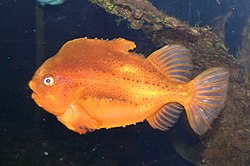
Lumpsuckers are named appropriately enough; their portly bodies are nearly spherical with generally drab coloration and lithic patterns. The "sucker" part refers to the fish's modified pelvic fins, which have evolved into adhesive discs (located ventrally, behind the pectoral fins); the fish use these discs to adhere to the substrate. Many species have bony, wart-like tubercles adorning the head and body; these are important taxonomic features of the family.
The simple, rounded fins are small with the exception of the broad, fan-like pectorals, which actually extend ventrally. The first of the two dorsal fins is spinous, with 4–8 spines; in some species, this fin is completely overgrown with skin and therefore not visible. While the lateral line in lumpsuckers is otherwise reduced or absent, it is well developed in the head; some species even have tubular, whisker-like external projections of the opercular canal, which is a part of the cranial lateral line system.
The relatively small mouths of lumpsuckers are lined with narrow rows of small conical teeth. The gas bladder is absent. In terms of length, lumpsuckers range in size from 2 cm (0.79 in) in the case of Eumicrotremus awae up to more than 50 cm (1 ft 8 in) in the case of the common lumpsucker Cyclopterus lumpus.

Habitat and diet
[edit]As their appearance might suggest, lumpsuckers are poor swimmers. Most species are benthic; that is, they spend most of their time on or near the bottom. The fish are found on rocky or muddy substrates, where their colouration allows for effective camouflage. Members of the family are found primarily on the continental shelf or slope, at depths down to 1,700 m (5,600 ft). Some of the deeper-living species are however pelagic, remaining some distance above the ocean floor.
Benthic species feed on sessile invertebrates such as polychaete worms, crustaceans and mollusks. Pelagic species target prey they are capable of overtaking, namely slow-moving jellyfish and ctenophores.
Before their yolk is completely absorbed, juvenile lumpsuckers consume the larvae of crustaceans, which grow on seaweed near the surface, and smaller halacarid mites. Juveniles consume larger harpacticoids and isopods after they have absorbed their yolk.[4]
Behaviour and reproduction
[edit]Lumpsuckers are a poorly studied group, with little known of their behaviour and biology. At least some species are known to travel great distances in order to spawn in shallow, intertidal waters (from December to June in the smooth lumpsucker); this may well be true of all species. Males are also known to guard the brood of spherical eggs.
One of the peculiarities of lumpsuckers' neural systems is that they lack Mauthner cell neurons in their hindbrain, while these cells are present in virtually all other teleost fish. Nevertheless, lumpsuckers do have a C-startle response, which is apparently mediated by other hindbrain cells.[5]
Hatchlings have well-developed pectoral fins and adhesive pelvic discs, which the fish use to cling to rocks in shallow water. Young fish remain in shallow, warmer water until fully developed. Pacific cod and sablefish are known predators of lumpsuckers.
Fishers and the lumpsucker industry
[edit]The only species that is targeted commercially is Cyclopterus lumpus, which is targeted primarily for its roe in Canada, Greenland, Iceland, and Norway, and to a lesser extent in Denmark and Sweden. Cyclopterus lumpus are also caught from the wild to provide broodstock for the aquaculture industry, where the fish is used as a cleaner fish to remove sea lice in salmon aquaculture.
Species
[edit]
.jpg)

There are about 30 species in eight genera:
- Genus Aptocyclus De la Pylaie, 1835
- Aptocyclus ventricosus (Pallas, 1769) (Smooth lumpsucker)
- Genus Cyclopsis Popov, 1930
- Cyclopsis tentacularis Popov, 1930
- Genus Cyclopteropsis Soldatov & Popov, 1929
- Cyclopteropsis bergi Popov, 1929
- Cyclopteropsis brashnikowi (P. Y. Schmidt, 1904)
- Cyclopteropsis inarmatus Mednikov (ru) & Prokhorov, 1956 (Bumpy lumpsucker)
- Cyclopteropsis jordani Soldatov, 1929 (Smooth lumpfish)
- Cyclopteropsis lindbergi Soldatov, 1930
- Cyclopteropsis mcalpini (Fowler, 1914) (Arctic lumpsucker)
- Cyclopteropsis popovi Soldatov, 1929
- Genus Cyclopterus Linnaeus, 1758
- Cyclopterus lumpus Linnaeus, 1758 (Lumpsucker)
- Genus Eumicrotremus T. N. Gill, 1862
- Eumicrotremus andriashevi Perminov, 1936
- E. a. aculeatus Voskoboinikova & Nazarkin, 2015 (Andriashev's spicular-spiny pimpled lumpsucker) [6]
- E. a. andriashevi Perminov, 1936 (Andriashev's spiny pimpled lumpsucker)
- Eumicrotremus asperrimus (S. Tanaka (I), 1912)
- Eumicrotremus awae D. S. Jordan & Snyder, 1902
- Eumicrotremus derjugini Popov, 1926 (Leather-fin lumpsucker)
- Eumicrotremus eggvinii Koefoed, 1956
- Eumicrotremus gyrinops (Garman, 1892)
- Eumicrotremus jindoensis S. J. Lee, J.-K. Kim, Y. Kai, S. Ikeguchi, & T. Nakabo, 2017
- Eumicrotremus orbis (Günther, 1861) (Pacific spiny lumpsucker)
- Eumicrotremus pacificus P. Y. Schmidt, 1904
- Eumicrotremus phrynoides C. H. Gilbert & Burke, 1912 (Toad lumpsucker)
- Eumicrotremus schmidti Lindberg & Legeza, 1955
- Eumicrotremus spinosus (J. C. Fabricius, 1776) (Atlantic spiny lumpsucker)
- Eumicrotremus taranetzi Perminov, 1936
- Eumicrotremus tartaricus Lindberg & Legeza, 1955
- Eumicrotremus terraenovae G. S. Myers & J. E. Böhlke, 1950
- Eumicrotremus uenoi S. J. Lee, J.-K. Kim, Y. Kai, S. Ikeguchi, & T. Nakabo, 2017
- Eumicrotremus andriashevi Perminov, 1936
- Genus Georgimarinus Voskoboinikova & Nazarkin, 2015 [7]
- Georgimarinus barbatus (Lindberg & Legeza, 1955)
- Genus Lethotremus C. H. Gilbert, 1896
- Genus Microancathus Voskoboinikova, 2015 [8]
- Microancathus fedorovi (Mandritsa, 1991) (Fedorov's lumpsucker)
- Microancathus tokranovi Voskoboinikova, 2015 (Tokranov's lumpsucker) [8]
- Genus Proeumicrotremus Voskoboinikova & Orlov, 2020
- Proeumicrotremus soldatovi (Popov, 1930) [9]
References
[edit]- ^ Froese, Rainer; Pauly, Daniel (eds.). "Family Cyclopteridae". FishBase. Februarty 2023 version.
- ^ J. S. Nelson; T. C. Grande; M. V. H. Wilson (2016). Fishes of the World (5th ed.). Wiley. pp. 467–495. ISBN 978-1-118-34233-6. Archived from the original on 2019-04-08. Retrieved 2022-11-30.
- ^ Fricke, Ron; Eschmeyer, William N. & van der Laan, Richard (eds.). "Genera in the family Cyclopteridae". Catalog of Fishes. California Academy of Sciences. Retrieved 15 December 2022.
- ^ Ingólfsson, Agnar; Kristjánsson, Bjarni K. (May 2002). "Diet of Juvenile Lumpsucker Cyclopterus lumpus (Cyclopteridae) in Floating Seaweed: Effects of Ontogeny and Prey Availability". Copeia. 2002 (2): 472–476. doi:10.1643/0045-8511(2002)002[0472:DOJLCL]2.0.CO;2. ISSN 0045-8511. S2CID 84451179.
- ^ Hale, M.E. (2000). "Startle responses of fish without Mauthner neurons: escape behavior of the lumpfish (Cyclopterus lumpus)". Biological Bulletin. 199 (2): 180–182. doi:10.2307/1542886. JSTOR 1542886. PMID 11081724.
- ^ Voskoboinikova O.S., Nazarkin M.V. (2015). "Redescription of Andriashev's Spiny Pimpled Lumpsucker Eumicrotremus andriashevi and Designation of a New Subspecies E. andriashevi aculeatus ssp. n. (Cyclopteridae)". Journal of Ichthyology. 55 (2): 155–161. doi:10.1134/s0032945215020174. S2CID 255270770.
- ^ Voskoboinikova O.S., Nazarkin M.V. (2015). "Georgimarinus gen. nov. A New Genus of the Family Cyclopteridae (Cottoidei)". Journal of Ichthyology. 55 (5): 630–635. doi:10.1134/s003294521505015x. S2CID 255280927.
- ^ a b Voskoboinikova O.S. (2015). "New genus of the family Cyclopteridae – Microancathus gen. n. (Pisces: Cottoidei: Cyclopteridae) with description of a new species Microancathus tokranovi sp. n.". Proceedings of the Zoological Institute of the Russian Academy of Sciences. 319 (2): 215–228.
- ^ Voskoboinikova, O.S.; Orlov, A.M. (December 2020). "Proeumicrotremus gen. nov.—a New Genus for Eumicrotremus soldatovi (Cyclopteridae)". Journal of Ichthyology. 60 (6): 943–946. doi:10.1134/S0032945220060119. S2CID 234670460 – via ResearchGate.

| National | |
|---|---|
| Other | |

Cyclopteridae
View on GrokipediaTaxonomy
Genera
The family Cyclopteridae is currently recognized as comprising six valid genera, distributed across three subfamilies as proposed in a comprehensive morphological phylogenetic analysis published in 2017. This classification, based on 32 osteological and external character states analyzed cladistically, confirmed the monophyly of the family and established the subfamilies Cyclopterinae, Liparopsinae, and the newly defined Eumicrotreminae, superseding earlier groupings that treated some as separate tribes or included additional synonymized taxa.[5] Further refinements occurred in 2020 with the erection of a new genus within Eumicrotreminae, supported by detailed comparisons of dermal spinules, fin rays, and cranial osteology. Subfamily Cyclopterinae Bonaparte, 1831 includes the type genus Cyclopterus Linnaeus, 1758, which is monotypic with C. lumpus, the largest member of the family (up to 61 cm standard length) distinguished by its robust body, high dorsal fin count (15–17 rays), and a prominent sucking disc formed by fused pelvic fins; the generic name derives from the Greek kyklos (circle or ring) and pteron (fin or wing), alluding to the circular adhesive structure.[6][7] Subfamily Liparopsinae Garman, 1892 contains the single genus Aptocyclus de la Pylaie, 1835, which is monotypic with A. ventricosus characterized by smooth skin lacking prominent tubercles, a low pectoral fin ray count (24–28), and inflated abdomens in some specimens due to enlarged urinary bladders; the etymology likely combines Greek hapto (to fasten or glue) and kyklos, referencing the ventral adhesive disc, though the exact derivation remains uncertain.[8][7][5] Subfamily Eumicrotreminae Oku, Imamura & Yabe, 2017, comprising spiny lumpsuckers with tuberculate or spinulose skin, includes four genera. Cyclopsis Popov, 1930, is monotypic (C. tentacularis) and notable for its oval body profile in longitudinal section, numerous small cephalic tentacles, and 13–14 dorsal fin rays; the name fuses Greek kyklos (circle) and opsis (appearance), highlighting the rounded form. Eumicrotremus Gill, 1862, is the most diverse with 23 species, featuring restricted gill openings, prominent body tubercles or spines, and variable disc morphology; etymologically, it combines Greek eu- (very or good), mikros (small), and trēma (hole), referring to the diminutive gill aperture. Lethotremus Gilbert, 1896, is monotypic (L. muticus) lacking lateral line pores and dermal spines, with 11–12 dorsal rays and a reduced disc; the name derives from Greek lḗthō (to forget or escape notice) and trēma (hole), denoting the absence of sensory pores. Finally, Proeumicrotremus Voskoboinikova & Orlov, 2020, is monotypic (P. soldatovi) and positioned as morphologically intermediate within the subfamily, with finer spinules, a distinct pectoral fin lobe, and 12 dorsal rays; it was segregated from Eumicrotremus based on unique combinations of cephalic and disc traits, with the prefix pro- (before or forward) indicating its basal placement.[9][5][7] Prior classifications, such as those in the early 20th century, recognized additional genera like Cyclopteropsis and Georgimarinus, but these have been synonymized into Eumicrotremus following the 2017 revisions and subsequent morphological studies, with no major molecular-based reclassifications altering the generic roster as of 2025. The family as a whole is placed within the suborder Cottoidei of the order Scorpaeniformes.[5][9]Species
The family Cyclopteridae comprises approximately 30 valid species distributed across six genera, primarily in northern hemisphere cold waters, with recent taxonomic revisions reflecting phylogenetic analyses and new discoveries in the North Pacific.[1][10] The following catalog lists all recognized species, including scientific names, authorities, notable synonyms where applicable, and unique distribution notes; recent additions or splits are highlighted based on updates through 2025.[1][9]Genus Cyclopterus
- Cyclopterus lumpus Linnaeus, 1758 (type species of the family); synonyms include Cyclopterus minutus Pallas, 1769, Cyclopterus caeruleus Mitchill, 1815, Lumpus vulgaris McMurtrie, 1831, and Lumpus anglorum DeKay, 1842; distributed in the North Atlantic and Arctic Oceans.[1]
Genus Aptocyclus
- Aptocyclus ventricosus (Pallas, 1769); endemic to the North Pacific, from Japan to the Bering Sea and Alaska.[1]
Genus Cyclopsis
- Cyclopsis tentacularis Popov, 1930 (originally described as Cyclolumpus asperrimus Tanaka, 1912); restricted to the Sea of Japan.[1][10]
Genus Eumicrotremus
- Eumicrotremus spinosus (Fabricius, 1776); synonyms include Cyclopterus spinosus Fabricius, 1776 and Lethotremus armouri Fowler, 1914; Arctic and North Atlantic Oceans.[1]
- Eumicrotremus orbis (Günther, 1861); synonyms include Cyclopterus orbis Günther, 1861 and Microtremus orbis (Günther, 1861); North Pacific, noted as one of the smaller species.[1][10]
- Eumicrotremus gyrinops (Garman, 1892); North Pacific, Bering Sea to Alaska.[1]
- Eumicrotremus awae (Jordan & Snyder, 1902); synonym Lethotremus awae Jordan & Snyder, 1902; smallest species in the family (maximum length ~2.5 cm), endemic to Japan.[1]
- Eumicrotremus phrynoides Gilbert & Burke, 1912; synonym Cyclopterocottus phrynoides (Gilbert & Burke, 1912); North Pacific, off Alaska.[1]
- Eumicrotremus lindbergi (Soldatov, 1930); North Pacific, Sea of Japan.[1]
- Eumicrotremus terraenovae Myers & Böhlke, 1950; western North Atlantic, off Newfoundland.[1]
- Eumicrotremus barbatus (Lindberg & Legeza, 1955); synonym Cyclopteropsis barbatus Lindberg & Legeza, 1955; North Pacific, Sea of Okhotsk.[1]
- Eumicrotremus schmidti Lindberg & Legeza, 1955; North Pacific, Sea of Okhotsk and Kuril Islands.[1]
- Eumicrotremus tartaricus Lindberg & Legeza, 1955; North Pacific, Sea of Japan.[1]
- Eumicrotremus fedorovi Mandrytsa, 1991; North Pacific, off Kuril Islands.[1]
- Eumicrotremus asperrimus (Tanaka, 1912); Japan Sea.[10]
- Eumicrotremus derjugini Popov, 1931; North Pacific, Bering Sea.[11]
- Eumicrotremus andriashevi Permitin, 1956; North Pacific, Sea of Okhotsk.[12]
- Eumicrotremus eggvinii Koefoed, 1956; North Atlantic, Iceland waters.[10]
- Eumicrotremus tokranovi (Voskoboinikova, 2015); synonym Microancathus tokranovi Voskoboinikova, 2015; recent addition, North Pacific.[1]
- Eumicrotremus jindoensis Lee & Kim, 2017; recent addition from taxonomic review of dwarf species, western North Pacific off South Korea.[1][13]
- Eumicrotremus uenoi Kai, Ikeguchi & Nakabo, 2017; recent addition from taxonomic review of dwarf species, western North Pacific off Japan.[1]
- Eumicrotremus jordani Soldatov, 1929; synonym Cyclopteropsis jordani Soldatov, 1929; North Pacific, Sea of Japan to Bering Sea.[1]
- Eumicrotremus popovi Soldatov, 1929; synonym Cyclopteropsis popovi Soldatov, 1929; North Pacific, off Russia.[1]
- Eumicrotremus inarmatus (Mednikov & Prokhorov, 1956); synonym Cyclopteropsis inarmatus Mednikov & Prokhorov, 1956; North Pacific, Sea of Okhotsk.[1]
Genus Lethotremus
- Lethotremus muticus Gilbert, 1896; North Pacific, Bering Sea to California.[1]
Genus Proeumicrotremus
- Proeumicrotremus soldatovi (Popov, 1930); recently split into new genus (2020) based on phylogenetic revision; North Pacific.[9]