Recent from talks
Nothing was collected or created yet.
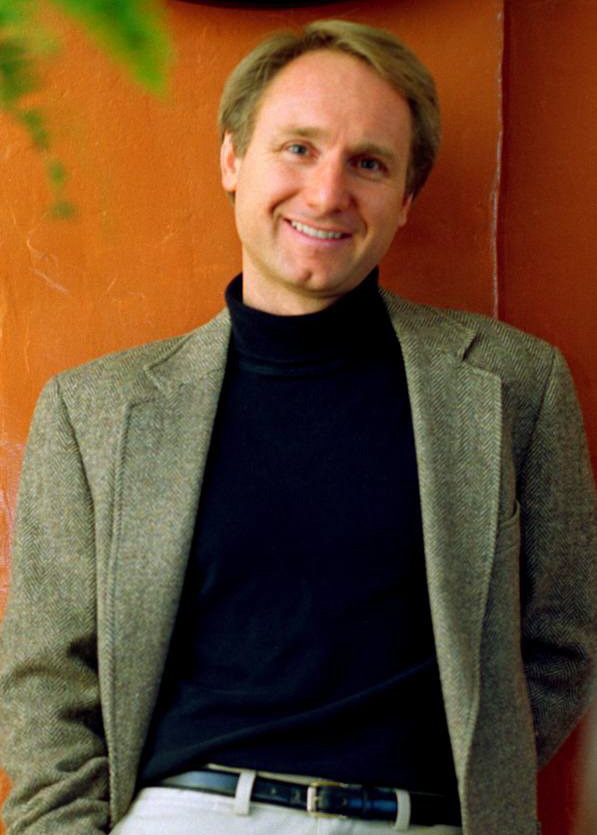
Dan Brown
View on Wikipedia
Daniel Gerhard Brown (born June 22, 1964) is an American writer best known for his thriller novels, particularly the Robert Langdon series Angels & Demons (2000), The Da Vinci Code (2003), The Lost Symbol (2009), Inferno (2013), Origin (2017) and The Secret of Secrets (2025).[3] His novels are treasure hunts that usually take place over a 24-hour period and center on recurring themes of cryptography, art, and conspiracy theories.[4]
Key Information
Brown's books have been translated into 57 languages and have sold over 200 million copies as of 2012. Three of his works—Angels & Demons, The Da Vinci Code, and Inferno—have been adapted into films, while one, The Lost Symbol, was adapted into a 2021 television series.
The Robert Langdon novels are deeply engaged with Christian themes and historical fiction, and have subsequently generated controversy. Brown states on his website that his books are not anti-Christian and that he is on a "constant spiritual journey" himself.[5] He states that his book The Da Vinci Code is "an entertaining story that promotes spiritual discussion and debate" and suggests that the book may be used "as a positive catalyst for introspection and exploration of our faith."[6]
Early life
[edit]Daniel Gerhard Brown was born on June 22, 1964, in Exeter, New Hampshire.[7] He has a younger sister, Valerie (born 1968) and brother, Gregory (born 1974). Brown attended Exeter's public schools until the ninth grade.[8] He grew up on the campus of Phillips Exeter Academy, where his father, Richard G. Brown, was a teacher of mathematics and wrote textbooks[9] from 1968 until his retirement in 1997.[10] His mother, Constance (née Gerhard), descended from Pennsylvania Dutch Schwenkfelders,[11] and trained as a church organist and student of sacred music.[8] Brown was raised an Episcopalian,[9] and described his religious evolution in a 2009 interview:
I was raised Episcopalian, and I was very religious as a kid. Then, in eighth or ninth grade, I studied astronomy, cosmology, and the origins of the universe. I remember saying to a minister, "I don't get it. I read a book that said there was an explosion known as the Big Bang, but here it says God created heaven and Earth and the animals in seven days. Which is right?" Unfortunately, the response I got was, "Nice boys don't ask that question." A light went off, and I said, "The Bible doesn't make sense. Science makes much more sense to me." And I just gravitated away from religion.[9]
When asked in the same interview about his then-current religious views, Brown replied:
The irony is that I've really come full circle. The more science I studied, the more I saw that physics becomes metaphysics and numbers become imaginary numbers. The further you go into science, the mushier the ground gets. You start to say, "Oh, there is an order and a spiritual aspect to science."[9]
Brown's interest in secrets and puzzles stems from their presence in his household as a child, where codes and ciphers were the linchpin tying together the mathematics, music, and languages in which his parents worked. The young Brown spent hours working out anagrams and crossword puzzles, and he and his siblings participated in elaborate treasure hunts devised by their father on birthdays and holidays. On Christmas, for example, Brown and his siblings did not find gifts under the tree, but followed a treasure map with codes and clues throughout their house and even around town to find the gifts.[12] Brown's relationship with his father inspired that of Sophie Neveu and Jacques Saunière in The Da Vinci Code, and Chapter 23 of that novel was inspired by one of his childhood treasure hunts.[13]
After graduating from Phillips Exeter, Brown attended Amherst College where he double majored in English and Spanish. At Amherst, he was initiated into the Psi Upsilon fraternity, along with Harlan Coben.[14][15] He played squash, sang in the Amherst Glee Club, and was a writing student of visiting novelist Alan Lelchuk. Brown spent the 1985 school year in Seville, Spain, where he was enrolled in an art history course at the University of Seville.[12] Brown graduated from Amherst in 1986.[16][17]
Career
[edit]Composer and singer
[edit]After graduating from Amherst, Brown dabbled with a musical career, creating effects with a synthesizer, and self-producing a children's cassette entitled SynthAnimals, which included a collection of tracks such as "Happy Frogs" and "Suzuki Elephants"; it sold a few hundred copies. He then formed his own record company called Dalliance, and in 1990 self-published a CD entitled Perspective, targeted to the adult market, which also sold a few hundred copies. In 1991 he moved to Hollywood to pursue a career as singer-songwriter and pianist. To support himself, he taught classes at Beverly Hills Preparatory School.[18][19]
Brown joined the National Academy of Songwriters and participated in many of its events. It was there that he met his wife, Blythe Newlon, who was the academy's Director of Artist Development. Though it was not officially part of her job, she took on the seemingly unusual task of helping to promote Brown's projects; she wrote press releases, set up promotional events, and put him in contact with people who could be helpful to his career. She and Brown also developed a personal relationship, though this was not known to all of their associates until 1993, when Brown moved back to New Hampshire, and it was learned that Newlon would accompany him. They married in 1997, at Pea Porridge Pond, near Conway, New Hampshire.[20] In 1994, Brown released a CD titled Angels & Demons. Its artwork was the same ambigram by artist John Langdon which he later used for the novel Angels & Demons. The liner notes also again credited his wife for her involvement, thanking her "for being my tireless cowriter, coproducer, second engineer, significant other, and therapist".[20] The CD included songs such as "Here in These Fields" and the religious ballad, "All I Believe".[21]
Brown and his wife Blythe moved to Rye, New Hampshire, in 1993.[20] Brown became an English teacher at his alma mater Phillips Exeter, and gave Spanish classes to 6th, 7th, and 8th graders at Lincoln Akerman School, a small school for K–8th grade with about 250 students, in Hampton Falls.[22] Brown has written a symphonic work titled Wild Symphony which is supplemented by a book of the same name.[23] The book is illustrated by Hungarian artist Susan Batori[24] which feature simple ambigrams for children, while the visuals trigger the corresponding music in an accompanying app.[25] The music was recorded by the Zagreb Festival Orchestra[26] and will receive its world concert premiere by the Portsmouth Symphony Orchestra in 2020.[27] On March 30, 2022, it was announced that Metro-Goldwyn-Mayer and Weed Road Pictures will turn Wild Symphony into an animated musical feature film in the vein of Walt Disney's Fantasia, with Brown writing the screenplay and songs, and Akiva Goldsman producing.[28]
Writing
[edit]While on vacation in Tahiti in 1993,[12] Brown read Sidney Sheldon's novel The Doomsday Conspiracy, and was inspired to become a writer of thrillers.[12][29][30] He started work on Digital Fortress, setting much of it in Seville, where he had studied in 1985. He also co-wrote a humor book with his wife, 187 Men to Avoid: A Survival Guide for the Romantically Frustrated Woman, under the pseudonym "Danielle Brown".[31] The book's author profile reads, "Danielle Brown currently lives in New England: teaching school, writing books, and avoiding men." The copyright to the book is attributed to Brown.[32]
In 1996, Brown quit teaching to become a full-time writer. Digital Fortress was published in 1998. His wife Blythe did much of the book's promotion, writing press releases, booking Brown on talk shows, and setting up press interviews. A few months later, Brown and his wife released The Bald Book, another humor book. It was officially credited to his wife, though a representative of the publisher said that it was primarily written by Brown. Brown subsequently wrote Angels & Demons and Deception Point, released in 2000 and 2001 respectively, the former of which was the first to feature the lead character, Harvard symbology expert Robert Langdon.[33]
Brown's first three novels had little success, with fewer than 10,000 copies in each of their first printings. His fourth novel, The Da Vinci Code, became a bestseller, going to the top of the New York Times Best Seller list during its first week of release in 2003. It is one of the most popular books of all time, with 81 million copies sold worldwide as of 2009.[34][35] Its success has helped push sales of Brown's earlier books. In 2004, all four of his novels were on the New York Times list in the same week,[36] and in 2005 he made Time magazine's list of the 100 Most Influential People of the Year. Forbes magazine placed Brown at No. 12 on their 2005 "Celebrity 100" list, and estimated his annual income at US$76.5 million. According to the article published in The Times, the estimated income of Brown after Da Vinci Code sales is $250 million.[37]
Brown's third novel featuring Robert Langdon, The Lost Symbol, was released on September 15, 2009.[38] According to the publisher, on its first day the book sold over one million in hardcover and e-book versions in the US, the UK and Canada, prompting the printing of 600,000 hardcover copies in addition to the five million first printing.[39] The story takes place in Washington D.C. over a period of twelve hours, and features the Freemasons. The book also includes many elements that made The Da Vinci Code a number one best seller. Brown's promotional website states that puzzles hidden in the book jacket of The Da Vinci Code, including two references to the Kryptos sculpture at CIA Headquarters in Langley, Virginia, give hints about the sequel. Brown has adopted a relevant theme in some of his earlier work.[40]
Brown's fourth novel featuring Robert Langdon, Inferno is a mystery thriller novel released on May 14, 2013, by Doubleday.[41] It ranked No. 1 on the New York Times Best Seller list for the first 11 weeks of its release, has sold more than 1.4 million copies in the US alone.[42] In a 2006 interview, Brown stated that he had ideas for about 12 future books featuring Robert Langdon.[43] Characters in Brown's books are often named after real people in his life. Robert Langdon is named after John Langdon, the artist who created the ambigrams used for the Angels & Demons CD and novel. Camerlengo Carlo Ventresca is named after On a Claire Day cartoonist friend Carla Ventresca. In the Vatican archives, Langdon recalls a wedding of two people named Dick and Connie, which are the names of his parents. Robert Langdon's editor Jonas Faukman is named after Brown's real life editor Jason Kaufman. Brown also said that characters were based on a New Hampshire librarian, and a French teacher at Exeter, André Vernet. Cardinal Aldo Baggia, in Angels & Demons, is named after Aldo Baggia, instructor of modern languages at Phillips Exeter Academy.[44]
In interviews, Brown has said his wife, Blythe, is an art historian and painter. When they met, she was the Director of Artistic Development at the National Academy for Songwriters in Los Angeles. During the 2006 lawsuit over alleged copyright infringement in The Da Vinci Code, information was introduced at trial that showed that Blythe did research for the book.[45] In one article, she was described as "chief researcher".[46] Doubleday published his seventh book, Origin, on October 3, 2017. It is the fifth book in his Robert Langdon series.[47]
Reception
[edit]Brown's prose style has been criticized as clumsy,[48][49] with The Da Vinci Code being described as "committing style and word choice blunders in almost every paragraph".[50] In his 2005 documentary for Channel 4, The Real Da Vinci Code, author and presenter Tony Robinson criticised both the accuracy of the author's historic research and the writing itself, considering the book to be not particularly well written. Much of the criticism was centered on Brown's claim in his preface that the novel is based on fact in relation to Opus Dei and the Priory of Sion, and that "all descriptions of artwork, architecture, documents and secret rituals in [the] novel are accurate".[51][52]
Influences and habits
[edit]In addition to Sidney Sheldon, Brown has been quite vocal about a number of other literary influences who have inspired his writing. Recurring elements that Brown prefers to incorporate into his novels include a simple hero pulled out of their familiar setting and thrust into a new one with which they are unfamiliar, an attractive female sidekick/ love interest, foreign travel, imminent danger from a pursuing villain, antagonists who have a disability or genetic disorder, and a 24-hour time frame in which the story takes place.[4]
Brown's work is heavily influenced by academic Joseph Campbell, who wrote extensively on mythology and religion and was highly influential in the field of screenwriting. Brown also states he based the character of Robert Langdon on Campbell.[53] Director Alfred Hitchcock appears to be another key influence on Brown. Like Hitchcock, the writer favors suspense-laden plots involving an innocent middle-aged man pursued by deadly foes, glamorous foreign settings, key scenes set in tourist destinations, a cast of wealthy and eccentric characters, young and curvaceous female sidekicks, Catholicism and MacGuffins. Brown does his writing in his loft. He told fans that he uses inversion therapy to help with writer's block. He uses gravity boots and says, "hanging upside down seems to help me solve plot challenges by shifting my entire perspective".[54]
Copyright infringement cases
[edit]In August 2005 author Lewis Perdue unsuccessfully sued Brown for plagiarism, on the basis of claimed similarity between The Da Vinci Code and his novels, The Da Vinci Legacy (1983) and Daughter of God (2000). Judge George B. Daniels said, in part: "A reasonable average lay observer would not conclude that The Da Vinci Code is substantially similar to Daughter of God."[55] In April 2006 Brown's publisher, Random House, won a copyright infringement case brought by authors Michael Baigent and Richard Leigh, who claimed that Brown stole ideas from their 1982 book Holy Blood Holy Grail for his 2003 novel The Da Vinci Code. It was in the book Holy Blood Holy Grail that Baigent, Leigh, and co-author Henry Lincoln had advanced the theory that Jesus and Mary Magdalene married and had a child and that the bloodline continues to this day. Brown apparently alluded to the two authors' names in his book. Leigh Teabing, a lead character in both the novel and the film, uses Leigh's name as the first name, and anagrammatically derives his last name from Baigent's. Mr Justice Peter Smith found in Brown's favor in the case, and as a private amusement, embedded his own Smithy code in the written judgment.[56]
On March 28, 2007, Brown's publisher, Random House, won an appeal copyright infringement case. The Court of Appeal of England and Wales rejected the efforts from Baigent and Leigh, who became liable for paying legal expenses of nearly US$6 million.[57] Brown has been sued twice in U.S. federal courts by the author Jack Dunn, who claims Brown copied a huge part of his book The Vatican Boys to write The Da Vinci Code (2006–07) and Angels & Demons (2011–12). Both lawsuits were not allowed to go to a jury trial and Jack Dunn claims the judge in both cases benefited from his decisions by becoming an author published and supported by people associated with Random House, Dan Brown's publisher. In 2017, in London, another claim was begun against Brown by Jack Dunn who claimed that justice was not served in the U.S. lawsuits.[58]
Charity work
[edit]In October 2004, Brown and his siblings donated US$2.2 million to Phillips Exeter Academy in honor of their father, to set up the Richard G. Brown Technology Endowment to help "provide computers and high-tech equipment for students in need".[59] On April 14, 2011, Dan and his wife, Blythe Newlon Brown, created an eponymous scholarship fund to celebrate the 25th anniversary of his graduation from Amherst College. It is a permanently endowed scholarship fund that provides financial aid to students at Amherst, with preference given to incoming students with an interest in writing.[17] On June 16, 2016, Brown donated US$337,000 to the Ritman Library in Amsterdam to digitize a collection of ancient books.[60]
Personal life
[edit]Brown and his wife, Blythe Newlon, were supporters of the New Hampshire Charitable Foundation.[61][20] In 2019, after 22 years of marriage, Brown and his wife acrimoniously divorced due to his alleged infidelities during the latter part of their marriage. This led to a lawsuit by Newlon.[62][63] After a series of delays, the couple agreed to settle the lawsuit in December 2021.[64] In the acknowledgments of his 2025 novel The Secret of Secrets, Brown refers to Dutch equestrian Judith Pietersen as his fiancée.[65]
Bibliography
[edit]Stand-alone novels
[edit]- Digital Fortress (1998) ISBN 0312335164, 978-0312335168
- Deception Point (2001) ISBN 1416524886, 978-1416524885
Robert Langdon series
[edit]- Angels & Demons (2000)
- The Da Vinci Code (2003)
- The Lost Symbol (2009)
- Inferno (2013)
- Origin (2017)
- The Secret of Secrets (2025)
Children's books
[edit]- Wild Symphony (2020)
Adaptations
[edit]In 2006, Brown's novel The Da Vinci Code was released as a film by Columbia Pictures, with director Ron Howard and starring Tom Hanks. It was widely anticipated and launched the 2006 Cannes Film Festival, though it received overall poor reviews. It currently has a 26% rating at the film review aggregator website Rotten Tomatoes, derived from 165 negative reviews of the 214 counted.[66] It was later listed as one of the worst films of 2006 on Ebert & Roeper,[67] but also the second highest-grossing film of the year, pulling in US$750 million worldwide.[68]
Brown was listed as one of the executive producers of the film The Da Vinci Code, and also created additional codes for the film. One of his songs, "Phiano", which Brown wrote and performed, was listed as part of the film's soundtrack. In the film, Brown and his wife can be seen in the background of one of the early book signing scenes.[69] The next film, Angels & Demons, was released on May 15, 2009, with Howard and Hanks returning. It, too, garnered mostly negative reviews, though critics were kinder to it than to its predecessor; it has a 37% meta-rating at Rotten Tomatoes.[70]
Filmmakers expressed interest in adapting The Lost Symbol into a film as well.[71][72] The screenplay was written by Danny Strong, with pre-production expected to begin in 2013.[73] According to a January 2013 article in Los Angeles Times the final draft of the screenplay was due sometime in February.[73] In July 2013, Sony Pictures announced they would instead adapt Inferno for a release date of October 14, 2016,[74] with Ron Howard as director, David Koepp adapting the screenplay and Tom Hanks reprising his role as Robert Langdon. Inferno was released on October 28, 2016.[75]
Imagine Entertainment was announced in 2014 to produce a television series based on Digital Fortress, written by Josh Goldin and Rachel Abramowitz.[76] In 2021, Dan Brown's The Lost Symbol was adapted into a television series repositioned as an origin story for Brown's Robert Langdon character with Ashley Zukerman playing Langdon.[77] It ran on the streaming service Peacock for one season.[78]
References
[edit]- ^ "The Dan Brown Enigma", Broward County, Florida Library; retrieved August 3, 2017.
- ^ CASEY, MICHAEL (June 30, 2020). "Ex-wife of 'Da Vinci Code' author Dan Brown alleges he led a double life". AP. Retrieved July 1, 2020.
- ^ "Dan Brown's next thriller, 'The Secret of Secrets,' to be published Sept. 9". AP News. January 29, 2025. Retrieved February 11, 2025.
- ^ a b Brown. Witness statement, pp. 17, 21.
- ^ Duttagupta, Ishani. "Dan Brown: I would love to write about Hinduism; but don't know enough about Indian culture". The Economic Times. Retrieved July 27, 2021.
- ^ Brown, Dan. "The Da Vinci Code FAQs". Official Website of Dan Brown. Archived from the original on April 11, 2006.
- ^ "Dan Brown | Biography, Books, & Facts". Encyclopedia Britannica. Retrieved January 5, 2021.
- ^ a b Rogak, Lisa (May 7, 2013). Dan Brown: The Unauthorized Biography, St. Martin's Press. pp. 6-8. Archived at Google Books; retrieved August 3, 2017.
- ^ a b c d Kaplan, James (September 13, 2009). "Life after 'The Da Vinci Code'". Parade. Retrieved February 25, 2022.
- ^ Rogak (2013), p. 122
- ^ Erb, Peter C. (June 5, 2006). "The Schwenkfelder Code". America. Retrieved January 28, 2024.
- ^ a b c d Lattman, Peter (March 14, 2006). "'The Da Vinci Code' Trial: Dan Brown's Witness Statement Is a Great Read". Wall Street Journal. Retrieved February 25, 2022.
- ^ Brown. Witness statement, p. 36.
- ^ "Harlan Coben Books in Order". Books Reading Order. September 13, 2019. Retrieved March 27, 2022.
- ^ "Authors". Psi Upsilon Fraternity. March 24, 2020. Retrieved March 27, 2022.
- ^ "Bestselling authors Dan Brown '86, Charles Mann '76 to speak Thursday" Archived April 3, 2015, at the Wayback Machine, amherst.edu, September 24, 2013.
- ^ a b "Dan Brown '86 Creates Scholarship Fund to Celebrate his 25th Reunion". Creating Connections: A Campaign for Amherst. Amherst College; retrieved August 9, 2012.
- ^ "Dan Brown Facts". Softschools.com. Archived from the original on June 16, 2015. Retrieved June 13, 2015.
- ^ "Dan Brown - Book Series In Order". Book Series In order. December 6, 2013. Retrieved June 13, 2015.
- ^ a b c d Walters, Joanna; O'Keeffe, Alice (March 12, 2006). "How Dan Brown's wife unlocked the code to bestseller success". the Guardian. Retrieved February 25, 2022.
- ^ Rogak, Lisa. The Man Behind the Da Vinci Code – an Unauthorized Biography of Dan Brown. Andrews McMeel Publishing, 2005; ISBN 0-7407-5642-7
- ^ "Dan Brown's Education Background". www.eduinreview.com. October 7, 2011. Archived from the original on April 19, 2023. Retrieved January 26, 2018.
- ^ "Wild Symphony by Dan Brown: 9780593123843 | PenguinRandomHouse.com: Books". PenguinRandomhouse.com. Retrieved January 5, 2021.
- ^ "Home". Wild Symphony. Retrieved January 5, 2021.
- ^ AuthorDanBrown (March 5, 2020). Wild Symphony - About the Book. Retrieved January 11, 2026 – via YouTube.
- ^ AuthorDanBrown (February 19, 2020). Wild Symphony - In the Studio. Retrieved January 11, 2026 – via YouTube.
- ^ Wild Symphony by Dan Brown
- ^ "MGM, Akiva Goldsman & Dan Brown Team for Animated Feature Take of Kids Book 'Wild Symphony'". March 30, 2022.
- ^ Sources differ on how Sheldon inspired Brown. He indicates on Page 3 of his witness statement that Sheldon's book was an attention-holding page turner that reminded him how fun it was to read, but the BBC source indicates that he thought he could "do better" than Sheldon.
- ^ "Decoding the Da Vinci Code author". BBC. August 10, 2004. Retrieved May 18, 2009.
- ^ Weaver, Caity (July 29, 2021). "Does 'The Da Vinci Code' Writer Have a Secret?". The New York Times. ISSN 0362-4331. Retrieved July 31, 2021.
- ^ "Dan Brown (born June 22, 1964) is an American author of thriller fiction","Bookchor"
- ^ "DAN BROWN’S BIOGRAPHY"[permanent dead link],"florenceinferno", August 24, 2015
- ^ Henninger, Daniel (May 19, 2006). "Holy Sepulchre! 60 Million Buy 'The Da Vinci Code'". WSJ. Retrieved February 18, 2019.
- ^ Marcus, Caroline (September 13, 2009). "Brown is back with the code for a runaway bestseller". Sydney Morning Herald. Retrieved September 13, 2009.
- ^ Mehegan, David (May 8, 2004). "Thriller instinct". The Boston Globe. Archived from the original on July 7, 2004. Retrieved April 20, 2009.
- ^ "Author Profile","The Daily Star", June 3, 2007
- ^ Carbone, Gina (April 20, 2009). "Dan Brown announces newbook, 'The Lost Symbol'". Boston Herald. Archived from the original on February 22, 2012. Retrieved April 20, 2009.
- ^ Rich, Motoko (September 16, 2009). "Dan Brown's 'Lost Symbol' Sells 1 Million Copies in the First Day". The New York Times. Retrieved September 16, 2009.
- ^ "Fans Of Dr. Dan Brown","Writers Cafe"
- ^ McLaughlin, Erin (January 15, 2013). "New Dan Brown Novel, 'Inferno', Set for May Release". ABC News. Retrieved April 19, 2013.
- ^ "Dan Brown". Forbes. Retrieved June 27, 2019.
- ^ Kirschling, Gregory (March 26, 2006). "'Da' Last Big Interview". Entertainment Weekly. Archived from the original on May 24, 2009. Retrieved May 18, 2009.
- ^ Rogak, p. 22
- ^ "Librarian comments on 'Da Vinci' lawsuit". USA Today. March 1, 2006. Retrieved May 18, 2009.
- ^ "Brown duels in court". The Standard. March 16, 2006. Archived from the original on May 24, 2009. Retrieved May 18, 2009.
- ^ Raynor, Madeline. "Dan Brown's Origin gets fall 2017 release date". Entertainment Weekly. Retrieved October 19, 2016.
- ^ Chivers, Tom (September 15, 2009). "The Lost Symbol and The Da Vinci Code author Dan Brown's 20 worst sentences". The Daily Telegraph. London, UK. Retrieved September 20, 2009.
- ^ Deacon, Michael (May 10, 2014). "Don't make fun of renowned Dan Brown". The Daily Telegraph. London, UK. Retrieved August 7, 2014.
- ^ Criticism of The Da Vinci Code, itre.cis.upenn.edu; accessed March 11, 2015.
- ^ Richard Abanes, The Truth Behind The Da Vinci Code (Harvest House Publishers, 2004; ISBN 0-7369-1439-0).
- ^ David F. Lloyd. "Facing Facts". Archived from the original on May 26, 2009. Retrieved May 18, 2009.
- ^ Dan Brown: By the Book. New York Times, June 20, 2013.
- ^ "Brown plays down Code controversy". BBC. April 24, 2006. Retrieved May 18, 2009.
- ^ "Author Brown 'did not plagiarise'". BBC. August 6, 2005. Retrieved May 18, 2009.
- ^ "Judge creates own Da Vinci code". BBC News. April 27, 2006. Retrieved September 13, 2009.
- ^ Herman, Michael (March 28, 2007). "Historians lose Da Vinci Code plagiarism appeal". The Times. London, UK. Archived from the original on March 31, 2007. Retrieved May 18, 2009.
- ^ "Dan Brown faces possible new plagiarism lawsuit over ‘The Da Vinci Code’","MarketWatch", December 14, 2017
- ^ "Da Vinci Code Author Dan Brown and Siblings, Valerie Brown '85 and Gregory Brown '93 Establish New Fund in Honor of their Father". November 1, 2004. Archived from the original on May 23, 2009. Retrieved May 18, 2009.
- ^ "Da Vinci Code Author Dan Brown donates to Ritman Library in Amsterdam". June 16, 2016. Archived from the original on July 26, 2019. Retrieved June 23, 2016.
- ^ "Bridges: The Foundation of Our Future: The New Hampshire Charitable Foundation 2009 Report to the Community". 2009. Archived from the original on August 7, 2010. Retrieved July 21, 2012.
- ^ "Da Vinci Code Author Dan Brown Accused Of Living A Double Life In Lawsuit That Sounds Like A Movie Plot". CINEMABLEND. July 1, 2020. Retrieved January 5, 2021.
- ^ Alter, Alexandra (September 1, 2020). "The Many Sides to Dan Brown (Published 2020)". New York Times. Retrieved September 20, 2025.
- ^ Casey, Michael (December 28, 2021). "'Da Vinci Code' author settles lawsuit alleging secret life". Associated Press. Retrieved June 7, 2022.
- ^ https://www.theaustralian.com.au/arts/review/mystery-and-clues-the-author-of-the-da-vinci-code-returns/news-story/7632b535450054be8831ff0c3316bdd4
- ^ "The Da Vinci Code". Rotten Tomatoes. Retrieved January 28, 2018.
- ^ Guest reviewer Michael Phillips, sitting in for Roger Ebert, listed The Da Vinci Code at No. 2 on his list, second to All the King's Men, "Worst Movies of 2006" Ebert & Roeper, January 13, 2007
- ^ The Da Vinci Code (2006), Box Office Mojo; accessed January 28, 2018.
- ^ 'The Da Vinci Code (1/8) Movie CLIP - Symbols (2006) HD 1:31; accessed November 28, 2023.
- ^ Angels & Demons (2009), Rotten Tomatoes; retrieved October 7, 2011.
- ^ Fleming, Michael (April 20, 2009). "Columbia moves on 'Symbol'". Variety. Retrieved August 12, 2010.
- ^ "The mystery of Dan Brown". The Guardian. London, UK. September 15, 2009. Retrieved August 12, 2010.
- ^ a b Nicole Sperling (January 15, 2013). "Dan Brown: What's the film status of his book 'The Lost Symbol'?". Los Angeles Times. Retrieved January 22, 2013.
- ^ "Tom Hanks' 'Inferno' Shifts Opening to 2016". The Hollywood Reporter. October 9, 2014. Retrieved February 25, 2022.
- ^ "Tom Hanks And Ron Howard To Return For Next Dan Brown Movie 'Inferno'; Sony Sets December 2015 Release Date". Deadline. July 16, 2013. Retrieved January 28, 2018.
- ^ Andreeva, Nellie (September 11, 2014). "ABC Nabs Adaptation Of Dan Brown's 'Digital Fortress' From Imagine & 20th TV". Deadline. Archived from the original on October 21, 2014. Retrieved October 21, 2014.
- ^ Ma, Wenlei (September 23, 2021). "Dan Brown's hero gets his origin story". news.com.au. Retrieved September 25, 2021.
- ^ DeVore, Britta (January 25, 2022). "'Dan Brown's The Lost Symbol' Cancelled After One Season by Peacock". Collider. Retrieved February 25, 2022.
External links
[edit]- Dan Brown Official Website
- Dan Brown at the Internet Book List
- Works by Dan Brown at Open Library
Dan Brown
View on GrokipediaEarly Life and Education
Childhood and Family Background
Daniel Gerhard Brown was born on June 22, 1964, in Exeter, New Hampshire, to Richard G. Brown, a mathematics professor at Phillips Exeter Academy, and Constance (Connie) Brown, a professional musician who served as a church organist and specialized in sacred music.[4][5][6] As the eldest of three siblings, Brown grew up alongside his younger sister Valerie (born 1968) and brother Gregory (born 1974), in a household marked by contrasting influences of rigorous analytical discipline from his father's academic career and artistic expression from his mother's musical pursuits.[4][7] The Brown family resided on the campus of Phillips Exeter Academy, where Richard Brown taught for decades, providing an intellectually stimulating environment steeped in preparatory school traditions and scholarly rigor.[8][9] This setting exposed young Brown to a community of educators and students, fostering early familiarity with advanced mathematics and classical studies, though he later described elements of his upbringing as paradoxical, blending strict academic expectations with creative outlets.[10] Constance Brown's role as choir director and organist at local churches further embedded religious and musical themes into the family's daily life, influencing Brown's later interests in history, symbolism, and cryptography.[11][12]Academic and Early Influences
Brown attended Phillips Exeter Academy in Exeter, New Hampshire, graduating in 1982, while living on campus due to his father's position as a mathematics instructor there.[6][13] This environment immersed him in an academic setting from an early age, with his father's profession exposing him to mathematical puzzles and logical problem-solving.[14] He subsequently enrolled at Amherst College, selecting it for its intimate scale, rural locale, and rigorous scholarly environment, which echoed the structure of Phillips Exeter that he appreciated.[15] Brown majored in English and Spanish, earning a B.A. in 1986, and during his undergraduate years spent time abroad studying art history at the University of Seville in Spain.[5][16][17] These formative experiences, combined with his mother's role as a church organist introducing him to musical notation and structure, cultivated Brown's enduring interest in codes, symbols, and the interplay between science, religion, and hidden patterns—elements that later permeated his thrillers.[14][18] Faculty at both institutions, known for their intellectual diversity, further shaped his appreciation for interdisciplinary inquiry, as reflected in his protagonist Robert Langdon's scholarly traits drawn from admired educators.[19]Pre-Literary Career
Music Composition and Performance
Following his graduation from Amherst College in 1986, Brown pursued music by self-producing a children's cassette tape titled Synthanimals in 1989, featuring synthesizer compositions such as "Happy Frogs" and "Suzuki Elephants," accompanied by poetry booklets.[20][21] He produced approximately 500 copies, which he sold on consignment at local bookstores with limited commercial success.[21] In 1991, Brown relocated to Hollywood to establish himself as a singer-songwriter and pianist, securing a record deal and releasing two soft rock albums in the early 1990s, though neither achieved significant sales or recognition.[22][23] One was a self-titled debut CD that included tracks like a song addressing phone sex, reflecting earnest but commercially unviable pop efforts.[23] To sustain himself during this period, he taught classes, including Spanish, at Beverly Hills Preparatory School from 1991 to 1993.[24] Brown's early performances centered on piano and vocals in pursuit of a songwriting career, influenced by his childhood exposure to classical music through piano lessons, choir participation, and concert attendance, as his family avoided television.[25] After three years of minimal breakthroughs, he abandoned professional music ambitions in 1993, returning to New Hampshire.[22][25]Early Professional Pursuits
Following his graduation from Amherst College in 1986, Brown initially pursued opportunities in music but supplemented his income through teaching roles. In 1991, he relocated to Los Angeles, where he taught Spanish at Beverly Hills Preparatory School while attempting to establish himself as a musician.[17] This position provided financial support during a period of limited success in songwriting and performance.[26] In 1993, Brown returned to New Hampshire and joined the faculty at Phillips Exeter Academy, his alma mater, as an English teacher.[5][17] He also instructed Spanish to sixth-, seventh-, and eighth-grade students at the nearby Lincoln Akerman School, a small public institution.[26] These roles lasted until the mid-1990s, when Brown transitioned to full-time writing, motivated in part by experiences at Exeter, such as developing puzzle-based activities for students that later influenced his narrative style.[8][5] During this period, he resided in New England and began conceptualizing his initial publications.[1]Literary Career
Initial Publications and Breakthrough
Dan Brown's first novel, Digital Fortress, a techno-thriller centered on a National Security Agency cryptographer racing to break an unbreakable code, was published by St. Martin's Press in August 1998.[27] The book received limited commercial attention, with sales reflecting modest interest in Brown's early work.[28] In 2000, Brown released Angels & Demons through Pocket Books, introducing Harvard symbologist Robert Langdon, who confronts a plot by the Illuminati to destroy the Vatican during a papal conclave.[29] While the novel blended historical facts with conspiracy elements, its initial sales were underwhelming compared to later successes, failing to establish Brown as a major author.[30] Deception Point, published by G.P. Putnam's Sons in 2001, shifted to a political thriller involving NASA scientist Rachel Sexton uncovering a meteorite hoax amid presidential election intrigue in the Arctic.[31] The work, like Digital Fortress and Angels & Demons, achieved only niche recognition and did not significantly boost Brown's profile.[28] Brown's breakthrough arrived with The Da Vinci Code, released by Doubleday on March 18, 2003, which revisited Robert Langdon in a narrative probing secrets of the Holy Grail, Opus Dei, and Leonardo da Vinci's symbology tied to Jesus Christ's bloodline.[2] The novel rapidly ascended bestseller lists, selling over 80 million copies worldwide and translated into more than 40 languages within years of release, catapulting Brown to global stardom and spawning a multimedia franchise including films.[2][32] Its success contrasted sharply with the subdued reception of prior works, attributed to provocative historical reinterpretations and fast-paced plotting that ignited public debate.[30]Robert Langdon Series Development
The Robert Langdon series commenced with Angels & Demons, published in 2000, introducing the protagonist as a Harvard University professor of symbology and religious iconology who is drawn into a conspiracy involving the Illuminati and a antimatter threat at the Vatican Observatory.[33] The novel established core elements of the series, including Langdon's expertise in decoding symbols, his reliance on historical and artistic knowledge to unravel plots, and recurring personal traits such as claustrophobia and a penchant for wearing a Mickey Mouse watch.[34] Dan Brown crafted Langdon as a relatable academic figure, partially inspired by ambigram designer John Langdon, whose work on symmetrical text influenced the character's fascination with visual puzzles.[35] The series achieved global prominence with The Da Vinci Code in 2003, shifting settings to Paris and London where Langdon pursues clues tied to Leonardo da Vinci's works and the Priory of Sion, blending cryptography, art history, and religious intrigue.[36] This installment expanded the formula by incorporating fast-paced chases, hidden codes in famous artworks, and provocative reinterpretations of Christian history, solidifying Langdon's role as an unwilling hero navigating institutional secrets.[34] Brown has noted in interviews his intent to feature Langdon as the central character across multiple works, leveraging the symbologist's analytical skills to explore intersections of faith, science, and power.[37] Subsequent novels extended the series' scope with longer publication intervals, reflecting Brown's research-intensive process. The Lost Symbol, released in 2009, relocated Langdon to Washington, D.C., delving into Masonic rituals, noetic science, and ancient wisdom hidden in the U.S. Capitol.[38] Inferno followed in 2013, inspired by Dante Alighieri's Divine Comedy, with Langdon racing through Florence, Venice, and Istanbul to avert a bioengineered plague addressing overpopulation.[39] The character's development emphasized resilience amid physical peril and intellectual deduction, maintaining consistency in his professorial demeanor while adapting to escalating global stakes. Origin, published in 2017, transported Langdon to Bilbao and Barcelona, where he investigates a tech mogul's revelations on the origins and future of humanity through artificial intelligence and evolutionary biology.[40] The narrative evolved to incorporate contemporary issues like transhumanism, with Langdon collaborating with allies to decode multimedia clues amid chases involving religious and scientific factions.[33] In 2025, The Secret of Secrets continued the arc, placing Langdon in scenarios probing precognition experiments and human consciousness, underscoring Brown's pattern of integrating cutting-edge science with historical mysteries to challenge readers' perceptions of reality.[41][34] Across the series, Langdon's evolution remains subtle, prioritizing puzzle-solving prowess over profound personal growth, as Brown prioritizes plot-driven adventures rooted in verifiable historical and scientific details.[42]Post-Fame Works and Evolution
Following the blockbuster success of The Da Vinci Code in 2003, Dan Brown returned to the Robert Langdon series with The Lost Symbol, published on September 15, 2009, by Doubleday.[36] In this installment, Harvard symbologist Robert Langdon is urgently called to Washington, D.C., to decode a trail of ancient symbols and hidden messages linked to Freemasonic traditions and the city's architectural secrets, amid a kidnapping and pursuit by a shadowy adversary.[43] The novel debuted at the top of bestseller lists worldwide, selling over 5 million copies in its first three months. Brown's next Langdon thriller, Inferno, released on May 14, 2013, shifts the action to Florence, Italy, where Langdon awakens with amnesia and pursues clues inspired by Dante Alighieri's Divine Comedy to thwart a plague-like bioterror threat aimed at addressing global overpopulation.[33] The book incorporates themes of bioengineering and demographic crisis, drawing on historical pathology and Renaissance art, and achieved first-week sales exceeding 3.9 million copies across 45 languages. In 2017, Origin appeared on October 3, exploring Langdon's involvement in unraveling a provocative presentation by a tech visionary in Bilbao, Spain, which poses existential questions about human origins and the future through artificial intelligence and genetic synthesis.[36] The narrative weaves quantum computing, religious iconography, and evolutionary biology, selling over 1 million copies in its debut week. Brown's most recent work, The Secret of Secrets, published in September 2025, brings Langdon back into a conspiracy involving a clandestine CIA initiative and ancient Prague mythology, as he partners with neuroscientist Katherine Solomon to decode symbols exposing unethical human experimentation.[44] Set against a backdrop of neural science and historical esoterica, the plot features high-tension pursuits and revelations about consciousness and power structures.[45] Brown's post-fame output has demonstrated continuity in structure and method, retaining short chapters, cliffhanger pacing, and a fusion of verifiable historical or scientific facts with speculative intrigue, while evolving to address contemporary anxieties like technological singularity and geopolitical secrecy rather than solely ecclesiastical mysteries.[30] This adherence to formula, informed by extensive research into diverse fields from cryptography to futurism, has sustained commercial dominance without venturing into non-Langdon narratives since his early career.[46]Writing Style, Themes, and Methods
Core Themes and Motifs
Dan Brown's novels recurrently examine the antagonism between institutional religion and empirical science, portraying religious authorities as guardians of suppressed truths that symbology and historical inquiry can unearth. This motif originates in Angels & Demons (2000), where the Illuminati—a fictionalized secret society of scientists—clashes with the Vatican over Galileo's heliocentric discoveries, symbolizing broader conflicts between dogma and evidence-based knowledge.[47] In Origin (2017), the narrative explicitly interrogates whether advancing technology and genetics render divine origins obsolete, with protagonist Robert Langdon navigating debates on human creation that pit artificial intelligence against theological narratives.[48] Brown has articulated this theme as a personal exploration of faith's challenges amid scientific progress, drawing from his shift toward scientific optimism after early religious upbringing.[49] Secret societies and conspiratorial cabals form another staple motif, functioning as custodians of esoteric knowledge withheld from the masses to preserve power structures. In The Da Vinci Code (2003), the Priory of Sion safeguards documents allegedly proving alternative origins for Christianity, including claims of Jesus's bloodline, which challenge canonical scriptures.[50] Similar groups recur, such as the Masonic elements in The Lost Symbol (2009), where ancient rituals encode truths about human potential and noetic science, blending historical fraternal orders with speculative enlightenment. These depictions evoke real historical entities like the Illuminati, founded in 1776 as a rationalist enclave opposing religious influence, though Brown amplifies their roles for dramatic effect.[47] Symbology, cryptography, and decoding ancient artifacts serve as structural motifs driving plot progression, with puzzles unlocking layered revelations about human history and consciousness. Langdon, a Harvard symbologist, deciphers icons—from Leonardo da Vinci's anagrams to alchemical symbols—revealing interconnected webs of suppressed wisdom across Angels & Demons, The Da Vinci Code, and Inferno (2013).[47] This recurs as treasure hunts confined to 24-hour timelines, emphasizing urgency in pursuing forbidden knowledge amid pursuits by antagonists.[50] Brown's integration of real cryptographic history, such as the Voynich manuscript or Fibonacci sequences, underscores a motif of mathematics and art as conduits for transcendent truths, often contrasting linear religious interpretations with nonlinear, interpretive symbology. Overarching motifs of hidden truths and the human quest for enlightenment critique institutional opacity, positing that elite guardians—whether ecclesiastical or scientific—obscure paradigm-shifting facts to maintain control. In The Lost Symbol, Masonic pyramids and biblical codes point to innate human divinity, echoing ancient mystery religions. This evolves in later works like Origin, extending to biotechnological conspiracies questioning life's origins, where motifs of heredity and forbidden manuscripts highlight causal chains from antiquity to modernity.[30] Brown's narratives consistently affirm that decoding symbols yields empowerment, though they risk sensationalizing unverified historical claims, as seen in debates over the Priory of Sion's fabricated lineage.[50]Research Practices and Fact-Fiction Blend
Dan Brown initiates his research with exploratory efforts to spark ideas, such as traveling to potential settings or reading non-fiction on intriguing topics like historical mysteries or scientific debates, allowing him to select a core theme that personally captivates him.[51] This phase transitions into focused, in-depth investigations, where he consults specialists with targeted questions, examines academic and technical materials, and conducts on-site visits to absorb sensory and contextual details for authenticity.[51] For Deception Point (2001), this involved a year-long study of glaciology, NASA protocols, and Arctic environments to integrate precise scientific elements.[52] He maintains that research must enhance credibility—incorporating specific jargon, artifacts, or procedures—while avoiding initial over-research that could stall drafting; instead, he outlines the narrative first and refines facts iteratively as discoveries reveal plot opportunities.[53] In blending fact and fiction, Brown anchors his thrillers in verifiable real-world foundations, such as historical events, artworks, or scientific concepts, to construct settings and symbols that propel fictional conspiracies and chases.[53] This approach uses researched details—like Leonardo da Vinci's cryptic techniques in The Da Vinci Code (2003) or Dante's Divine Comedy in Inferno (2013)—as authentic entry points to explore philosophical questions, intending to inform readers about overlooked aspects of history or science through high-stakes drama.[52] Fictional elements, including invented interpretations or speculative linkages, overlay these facts to heighten tension and moral ambiguity, with Brown emphasizing in prefaces that depictions of real entities remain his creative constructs rather than literal truths.[53] Ongoing research during writing ensures the fusion sustains suspense, though it prioritizes narrative momentum over exhaustive verification, enabling "facts" to serve the story's speculative core.[51]Influences on Craft and Habits
Brown's entry into thriller writing was markedly influenced by Sidney Sheldon's The Doomsday Conspiracy, which he encountered on vacation in Tahiti in 1993, prompting him to abandon his prior career pursuits and dedicate himself to crafting fast-paced, plot-driven narratives in the genre.[54][16] This exposure shaped his emphasis on high-stakes conspiracies, accessible prose, and relentless momentum, hallmarks evident in his adoption of Sheldon's technique of blending suspense with broad appeal to draw readers through intricate, revelation-heavy plots.[55] Brown has also cited admiration for Robert Ludlum's taut espionage thrillers, which likely contributed to his methodical integration of global intrigue and protagonist-driven decoding of hidden truths.[56] In terms of daily habits, Brown maintains a rigorously disciplined routine centered on early-morning writing to harness subconscious creativity, rising at 4 a.m. year-round to prepare a nutrient-dense smoothie of blueberries, spinach, banana, coconut water, seeds, and pea protein before commencing work.[52][57] He prioritizes transitioning directly from sleep to his desk to preserve dream-like ideation, sustaining sessions until mid-morning while inverting his body periodically—via handstands against a wall—to stimulate blood flow and combat sedentary fatigue.[58] This monastic consistency, applied 365 days annually regardless of external demands, underscores his commitment to volume and momentum in drafting, enabling the production of densely researched manuscripts amid his preference for solitary focus.[59]Commercial and Critical Reception
Sales Achievements and Market Impact
Dan Brown's novels have collectively sold over 250 million copies worldwide, translated into 56 languages.[34][60] This figure encompasses his primary works in the Robert Langdon series, which dominate his commercial output. The Da Vinci Code (2003) achieved the highest individual sales, exceeding 80 million copies globally by 2009, establishing it as one of the best-selling fiction titles ever.[61][62] Its rapid ascent to the top of bestseller lists, including 14 consecutive weeks at number one in some markets, propelled Brown's prior novels like Angels & Demons (2000) from modest sales to millions through renewed interest.[63] Subsequent releases reinforced this momentum: The Lost Symbol (2009) sold over 2 million copies in its first week in the United States alone and shattered one-day adult fiction sales records upon release.[64][65] Brown's market impact extended beyond personal sales, revitalizing the historical thriller genre by demonstrating viability for fast-paced narratives blending conspiracy theories with factual research, which publishers emulated in marketing campaigns.[66] His titles generated unprecedented pre-publication hype, as seen with The Lost Symbol, which disrupted supply chains and prompted retailers to stockpile copies, influencing industry logistics for major releases.[67] The controversy surrounding The Da Vinci Code's portrayals of religious history amplified visibility, boosting ancillary effects like tourism to featured sites—49% of visitors to Rosslyn Chapel in a 2024 survey cited the novel or its film adaptation as a key motivator.[68] Overall, Brown's success underscored the commercial power of serialized protagonists and multimedia tie-ins, contributing to heightened global demand for speculative fiction amid early 2000s cultural fascination with hidden knowledge.[69]Literary Critiques and Scholarly Analysis
Literary critics have consistently faulted Dan Brown's prose for its mechanical repetition, grammatical infelicities, and dependence on formulaic tropes, such as short chapters and contrived cliffhangers that propel action at the expense of stylistic finesse. Reviews describe his dialogue as expository and characters as archetypal without depth, with symbologist Robert Langdon serving as a cipher for intellectual authority rather than a fully realized protagonist.[3][70][71] Scholarly examinations frame Brown's Robert Langdon series as exemplars of hybrid genre fiction, merging thriller conventions with pseudo-historical speculation, as analyzed in studies questioning The Da Vinci Code's classification beyond mere pulp. Academic theses have dissected Langdon's personality traits—portrayed as analytical yet passive—revealing how Brown employs him to embody idealized scholarly detachment amid conspiratorial intrigue.[72][73] Thematic critiques highlight Brown's recurrent motifs of hidden knowledge and institutional secrecy, interpreting them through lenses of cultural mythology, where narratives like those in the series construct allegories of elite cabals influencing global events, though often unsubstantiated by rigorous historiography.[30] Such analyses underscore a tension between Brown's accessible fact-fiction synthesis, which democratizes esoteric topics for broad readership, and its superficial treatment, prioritizing sensational revelation over evidentiary precision.[2] Defenders in literary commentary argue that Brown's unpolished style—marked by tautological phrasing and adverb-heavy descriptions—facilitates rapid pacing suited to serialized intrigue, enabling mass engagement with symbology and history despite elite disdain for its "lowbrow" packaging of "highbrow" allusions.[74][75] This perspective posits commercial dominance as evidence of effective craftsmanship in popular genres, where plot velocity and thematic hooks outweigh prose polish in achieving cultural penetration.[76]Controversies and Criticisms
Historical and Factual Inaccuracies
Dan Brown's novels, especially The Da Vinci Code (2003), preface claims of factual precision by stating that "all descriptions of artwork, documents, and secret rituals in this novel are accurate."[77] Critics have identified numerous deviations from established historical records, particularly regarding early Christianity, ecclesiastical councils, and secret societies. For instance, the novel posits that the First Council of Nicaea in 325 AD debated and voted to invent Jesus' divinity, suppressing alternative views; in reality, the council addressed Arianism by affirming pre-existing orthodox beliefs in Christ's divinity without inventing doctrine or altering texts.[78] Similarly, Brown's depiction of the canonical Gospels as selected by Emperor Constantine to exclude goddess-worshipping texts ignores that the New Testament canon emerged gradually from second-century usage, predating Constantine by over a century.[79] The portrayal of the Holy Grail as Mary Magdalene's womb and a royal bloodline descending from her alleged marriage to Jesus lacks primary historical evidence, relying instead on discredited 20th-century forgeries like the Dossiers Secrets of the Priory of Sion, fabricated by Pierre Plantard in the 1950s.[80] Brown's narrative also misrepresents Opus Dei, claiming practices like routine self-flagellation and cilice use as normative for all members, whereas such mortifications are voluntary, rare, and confined to a small subset of numeraries, not the organization-wide norm.[81] Art historical errors include the assertion that Leonardo da Vinci encoded matriarchal symbols in The Last Supper, such as portraying John as Mary Magdalene; scholars note the figure is a youthful apostle John, consistent with Renaissance conventions for depicting beardless males.[82] In Angels & Demons (2000), inaccuracies extend to Vatican history and Roman topography. The novel fabricates an ongoing Illuminati presence as a Catholic-hating secret society engineering scientific sabotage; historically, the Bavarian Illuminati dissolved in 1785 after brief anti-clerical activity, with no evidence of survival or infiltration into the Vatican.[83] Brown's claim of factual accuracy for Roman tombs, tunnels, and architecture falters, as seen in the erroneous description of Raphael's Pantheon tomb plaque implying relocation of his body, which records no such event.[84] Scientific elements, like a viable antimatter bomb from CERN, exaggerate real physics: while CERN produces minuscule antimatter quantities (nanograms annually), containing and weaponizing kilograms as depicted defies current energy and containment constraints.[85] Later works perpetuate similar issues. The Lost Symbol (2009) distorts Masonic history by claiming ancient Egyptian roots and ties to biblical secrets, whereas Freemasonry originated in 18th-century England as a fraternal order without Egyptian precedents.[86] In Origin (2017), Brown's portrayal of evolutionary biology and AI as disproving divine origins relies on selective interpretations, ignoring peer-reviewed debates on fine-tuning and abiogenesis gaps.[87] These patterns reflect Brown's blend of verifiable trivia with speculative leaps, often prioritizing narrative pace over rigorous sourcing, as noted by historians who fault the works for groundless assumptions masquerading as erudition.[88]Religious and Ideological Backlash
Dan Brown's The Da Vinci Code (2003) provoked widespread condemnation from Christian groups for challenging foundational tenets of Christianity, including the divinity of Jesus Christ and the historical authenticity of the Gospels, by positing a conspiracy in which the Catholic Church suppressed evidence of Jesus's marriage to Mary Magdalene and their bloodline.[89] The novel's preface asserts that "all descriptions of artwork, documents, and secret rituals in this novel are accurate," blurring fiction and fact in a manner that critics argued misled readers into doubting scriptural reliability and ecclesiastical history.[90] Catholic organizations, such as Opus Dei—portrayed as a violent sect—denounced the book for stereotyping adherents as psychopathic killers and for fabricating a narrative of institutional cover-ups.[91] The 2006 film adaptation intensified reactions, with a Vatican official labeling it "slanderous" and urging a boycott, while global protests erupted, including Catholic demonstrations in the Philippines and demands by Christian groups in Thailand for censorship of subtitles and scenes deemed disrespectful to faith.[92][93] Evangelical critics, including those from Answers in Genesis, described the work as "the most serious assault against Christianity" due to its promotion of gnostic-like revisions that portrayed early church councils as inventing Christ's deity.[89] Protestant outlets echoed this, faulting Brown's depiction of biblical canon formation as a hijacking of Jesus's "human message" by power-hungry clerics.[94] Angels & Demons (2000) drew comparable ire for its anti-Catholic tropes, including the Illuminati as a suppressed truth-seeking society persecuted by the Church and cardinals engaging in ritualistic murders during a papal conclave. Ahead of the 2009 film, Vatican officials weighed a boycott, citing offensive misrepresentations of church history and science-religion tensions, though the Vatican's newspaper later dismissed the movie as "harmless entertainment" lacking the theological aggression of The Da Vinci Code.[95][96] Ideologically, conservative Christian commentators critiqued Brown's oeuvre for advancing religious relativism and human self-divinization, framing Christianity as a patriarchal myth supplanted by esoteric "truths" that prioritize personal enlightenment over orthodox doctrine.[97][98] While some surveys indicated limited faith erosion among readers— with about 75% of polled Catholics unaffected—others reported instances of shaken belief, attributing this to the novels' persuasive conspiracy framing over empirical historical evidence.[99][90]Plagiarism and Copyright Disputes
In 2006, authors Michael Baigent and Richard Leigh, co-writers of the 1982 nonfiction book The Holy Blood and the Holy Grail, filed a copyright infringement lawsuit against Dan Brown and his publisher Random House in the High Court of Justice in London, alleging that The Da Vinci Code (2003) appropriated their book's central thesis—that Jesus Christ had a bloodline descending from Mary Magdalene—constituting substantial copying of the "sequence of thought" and historical connections presented therein.[100] The plaintiffs sought damages and an injunction against further sales, arguing that Brown's novel relied on their work's unique framework rather than general historical ideas, which are not protectable under copyright law.[101] On April 7, 2006, Justice Peter Smith ruled in favor of Brown, determining that while The Holy Blood and the Holy Grail was referenced in The Da Vinci Code's acknowledgments and some facts overlapped, the novel's expression, plot, and characters were original, and copyright does not extend to historical themes or ideas.[100] Baigent and Leigh's appeal was dismissed by the Court of Appeal on March 28, 2007, affirming that no infringement occurred, as the shared elements were commonplace in prior literature on the subject.[102] Separately, in August 2004, American novelist Lewis Perdue initiated a plagiarism lawsuit in the U.S. District Court for the Southern District of New York against Brown and Random House, claiming The Da Vinci Code copied elements from his novels Daughter of God (2000) and The Legacy (1986), including plot devices involving secret societies, Vatican cover-ups, and cryogenic preservation of religious artifacts tied to Jesus's lineage. Perdue alleged over 100 parallels in themes, scenes, and phrasing, positioning his works as prior art that Brown had accessed.[103] On August 5, 2005, Judge George Daniels dismissed the case, ruling that any similarities involved unprotected ideas or historical facts rather than specific expressions entitled to copyright protection, and that Perdue failed to demonstrate access or substantial similarity in protectable elements. The U.S. Court of Appeals for the Second Circuit upheld the dismissal in July 2006, and the U.S. Supreme Court denied certiorari on November 13, 2006, effectively ending the litigation in Brown's favor.[104] These cases highlighted tensions between nonfiction historical speculation and fictional narrative under copyright law, with courts emphasizing that broad themes and facts remain in the public domain.[105] No damages were awarded against Brown, and the rulings reinforced precedents that ideas, even novelly connected, cannot be monopolized. Subsequent accusations, such as those raised in 2017 by author Jack Dunn regarding alleged borrowings from his unpublished works, did not result in formal litigation.[106] Brown's legal team consistently maintained that his research drew from widely available sources, and the outcomes underscored the challenges of proving infringement in works blending fact and fiction.[101]Legal and Ethical Challenges
Key Lawsuits and Outcomes
In 2006, authors Michael Baigent and Richard Leigh, co-writers of the 1982 nonfiction book The Holy Blood and the Holy Grail, sued Dan Brown and his publisher Random House for copyright infringement, alleging that Brown's novel The Da Vinci Code (2003) appropriated their "central theme" of a historical conspiracy involving Jesus Christ's bloodline and the Catholic Church's suppression of it.[100] The plaintiffs sought an injunction against further sales and damages, claiming Brown had copied the specific sequence of historical connections they presented as factual.[105] On April 7, 2006, the UK High Court ruled in Brown's favor, with Justice Peter Smith determining that copyright law protects expression, not ideas or historical theories, and that Brown's fictional narrative did not substantially copy the plaintiffs' work.[100] [107] Baigent and Leigh appealed the decision, but the Court of Appeal upheld the High Court's ruling on March 28, 2007, dismissing claims of a protectable "gist" or theme and ordering the plaintiffs to pay approximately 85% of Random House's legal costs, estimated at over £1 million.[102] [108] The case highlighted limitations on copyrighting nonfiction hypotheses, as Brown's use of similar historical speculations was deemed fair and transformative into fiction.[107] Separately, in 2004, author Lewis Perdue filed a copyright infringement suit against Brown and Random House in the U.S. District Court for the Southern District of New York, asserting that The Da Vinci Code plagiarized elements from his novels Daughter of God (2000) and The Da Vinci Deception (2004), including plot devices involving secret societies, religious artifacts, and Vatican conspiracies.[104] Brown preemptively sought a declaratory judgment of non-infringement. On August 4, 2005, Judge George Daniels granted summary judgment for Brown, ruling that no reasonable lay observer would find substantial similarity between the works beyond generic thriller tropes, and that Perdue's claims lacked evidence of direct copying.[109] [110] Perdue appealed and petitioned the U.S. Supreme Court, seeking $150 million in damages and an injunction against the book's distribution and film adaptation, but the Supreme Court denied certiorari on November 13, 2006, effectively ending the case in Brown's favor.[104] [110] Forensic linguistic analysis commissioned by Perdue, which identified alleged textual parallels, was rejected by the court as insufficient to prove infringement.[111] These rulings reinforced that common motifs in conspiracy fiction are not copyrightable, protecting Brown's creative synthesis of public-domain historical elements.Broader Implications for Authorship
The Baigent and Leigh v. Random House case, decided by the High Court of Justice in London on April 7, 2006, established a significant precedent regarding the scope of copyright protection in works blending historical research with fiction. Authors Michael Baigent and Richard Leigh, co-writers of the 1982 non-fiction book The Holy Blood and the Holy Grail, alleged that Dan Brown's The Da Vinci Code (2003) infringed their copyright by appropriating the central thesis—that Jesus Christ married Mary Magdalene and fathered a bloodline preserved by secret societies—without substantial original expression. Justice Peter Smith ruled that while Brown drew on the claimants' historical conjectures and research, copyright law safeguards only the specific literary expression of ideas, not the ideas, themes, or factual connections themselves, thereby dismissing the infringement claim.[100][112] The Court of Appeal upheld this decision on March 28, 2007, affirming that general historical narratives and hypotheses remain in the public domain for creative adaptation.[102] This ruling reinforced the longstanding idea-expression dichotomy in Anglo-American copyright jurisprudence, originating from cases like Baker v. Selden (1879) in the U.S., which distinguishes protectable original authorship from unprotectable facts or concepts. For Brown, it clarified that transforming non-fiction theories into a novel's plot, characters, and dialogue—even if reliant on the source's connective framework—does not constitute copying if the output exhibits independent creativity. Legal analysts noted the decision's narrow interpretation of "substantial taking," requiring verbatim or closely paraphrased reproduction rather than mere thematic overlap, which protected Brown's narrative innovations despite acknowledgments in the novel's preface to drawing from historical sources.[107][113] The case's implications extend to authorship broadly, particularly for genres like historical thrillers and speculative fiction, by lowering barriers to incorporating public or published historical interpretations without fear of monopoly claims on interpretive frameworks. It has been cited in subsequent discussions as discouraging attempts to copyright "historical facts" or conspiracy theories, fostering a marketplace where subsequent creators can build upon prior scholarship, much as Brown's work echoed elements from works predating Holy Blood, Holy Grail. However, it also sparked debate among scholars on the adequacy of existing protections for investigative labor; non-fiction authors investing in primary research may see diminished incentives if fiction yields disproportionate commercial success without compensatory mechanisms like compulsory licensing. Critics, including the claimants' legal team, argued the outcome undervalues the originality in synthesizing disparate facts into a coherent theory, potentially encouraging "free-riding" on others' intellectual toil, though courts prioritized doctrinal consistency over equitable redistribution.[113][107] This tension highlights ongoing challenges in balancing authorship incentives with cultural dissemination, influencing how writers attribute inspirations ethically even absent legal compulsion.Media Adaptations
Film and Television Versions
The primary film adaptations of Dan Brown's novels center on the Robert Langdon series, produced by Imagine Entertainment and distributed by Columbia Pictures. These include The Da Vinci Code (2006), based on the 2003 novel, directed by Ron Howard with a screenplay by Akiva Goldsman, and starring Tom Hanks as symbologist Robert Langdon alongside Audrey Tautou as Sophie Neveu.[114] The film, released on May 19, 2006, grossed over $760 million worldwide against a $125 million budget. It deviated from the book in several plot elements, such as altering the ending revelation about the Holy Grail, to heighten dramatic tension while retaining core symbology and conspiracy themes. Angels & Demons (2009), adapting the 2000 novel that chronologically precedes The Da Vinci Code, was also directed by Howard and written by Goldsman and David Koepp, with Hanks reprising Langdon opposite Ewan McGregor and Ayelet Zurer.[114] Released on May 15, 2009, it earned $485 million globally on a $150 million budget, incorporating extensive Vatican and Rome location shooting despite initial access denials. The adaptation expanded action sequences, including antimatter bomb threats, but compressed the novel's timeline to a single day for pacing. Inferno (2016), drawn from the 2013 novel, marked the third Langdon film under Howard's direction, with Goldsman and Tom Hanks returning, joined by Felicity Jones as Dr. Sienna Brooks.[114] Premiering on October 28, 2016, it generated $220 million worldwide from a $75 million budget, shifting emphasis toward biohazards and Dante's imagery while omitting certain book revelations about population control to streamline the narrative. In television, The Lost Symbol (2021), adapting the 2009 novel, aired as a 10-episode series on Peacock from September 16 to November 18, 2021, starring Scott Bakula as an older Langdon and produced by Universal Television after plans for a film sequel stalled.[115] The series explored Masonic secrets in Washington, D.C., but received mixed reviews for pacing and visual effects, leading to its cancellation after one season. As of May 2025, Netflix commissioned a new Robert Langdon series adapting Brown's forthcoming novel The Secret of Secrets, with Carlton Cuse as showrunner and executive producer alongside the author, marking the first small-screen continuation post-Lost Symbol.[116] No adaptations exist for Brown's standalone novels such as Digital Fortress (1998) or Origin (2017).[114]Other Adaptations and Merchandise
In addition to film and television adaptations, Dan Brown's The Da Vinci Code was adapted into an adventure puzzle video game developed by The Collective and published by 2K Games, released on May 19, 2006, for PlayStation 2, Xbox, and Microsoft Windows platforms.[117][118] The game follows the novel's plot, with players controlling Robert Langdon and Sophie Neveu as they solve riddles, engage in combat, and navigate locations in Europe, incorporating elements like anagrams and cryptex puzzles directly from the source material.[119][120] It received mixed reviews, praised for capturing the book's thriller atmosphere but criticized for repetitive gameplay and technical issues.[120] Smaller-scale digital adaptations include mobile and online puzzle games tied to the Robert Langdon series. For instance, Angels & Demons inspired a Nintendo DS title in 2009 featuring puzzle-solving and augmented reality elements, while Inferno launched an interactive online experience called "Inferno: Journey Through Hell" in 2016, where users solved Dante-inspired puzzles across virtual global landmarks.[121] Dan Brown's official website has hosted brain-teaser puzzles drawing from The Da Vinci Code, The Lost Symbol, Inferno, and Origin, encouraging fans to decode symbols and ciphers in a manner echoing the novels' themes.[122][123] Merchandise related to Brown's works primarily consists of licensed tie-ins and fan-oriented products rather than extensive official lines. Special edition book releases, such as signed first editions of Angels & Demons and puzzle-themed accessories inspired by cryptex devices from The Da Vinci Code, have appeared in collectible markets, though no dedicated official merchandise store exists on Brown's website.[124] Fan-created items like apparel, mugs, and stickers featuring Langdon series motifs are widely available through third-party platforms, reflecting the books' cultural impact but lacking direct endorsement from the author or publisher.[125][126]Personal Life
Family and Relationships
Dan Brown married Blythe Newlon in 1997 after meeting her in the early 1990s during his time in Los Angeles; Newlon, who later took the surname Brown, served as his research assistant and contributed to the development of his early works.[127][128] The couple resided primarily in New Hampshire, where Brown maintained a low public profile regarding his personal life.[129] Brown and Newlon divorced in 2019 after 21 years of marriage, with the proceedings remaining largely private until a subsequent lawsuit filed by Newlon in June 2020 in New Hampshire Superior Court.[130][128] In the suit, Newlon alleged that Brown had concealed marital assets worth up to $120 million, including by transferring funds to support extramarital affairs with multiple women—such as a hairdresser, a political official, a personal trainer, and a horse trainer—beginning around 2014, and that he had misrepresented his finances during the divorce settlement.[131][130] Brown countersued Newlon for libel and slander, denying the extent of the claims as exaggerated and asserting that any publicity from the allegations could inadvertently boost his book sales, while emphasizing that the divorce stemmed from irreconcilable differences rather than proven infidelity.[132][133] The couple has no children.[134] In September 2025, Brown became engaged to Judith Pietersen, a Dutch horse trainer approximately 27 years his junior, whom Newlon had identified in her lawsuit as one of Brown's alleged romantic interests during the marriage.[135][136] Details of their relationship prior to the engagement remain limited, with Pietersen described in media reports as a longtime acquaintance connected through equestrian activities.[137] Brown has not publicly commented extensively on the engagement or its ties to the prior divorce litigation.[138]Beliefs, Politics, and Lifestyle
Dan Brown was raised in the Episcopalian tradition, a Protestant denomination of Christianity.[139] However, in a 2017 interview, he stated that he had abandoned Christianity while maintaining curiosity about the existence of God, describing himself as neither an atheist nor anti-religious.[140] Brown has characterized his worldview as agnostic, noting in the same year, "I think I'm happily confused and a work in progress; I'm sort of more agnostic," and emphasizing a reluctance to assert definitively that no God exists.[48] He has portrayed his own perspective as involving a "constant spiritual journey," insisting that his novels, which often explore tensions between faith and science or critique institutional religion, are not intended to oppose Christianity.[52] Brown maintains a low public profile on political matters, with analyses describing him as largely non-political and avoiding explicit affiliations or endorsements.[139] In a 2018 interview, he commented on the presidency of Donald Trump by stating that "reality has surpassed fiction," implying a view of the political landscape as more extreme than his thriller narratives, though he acknowledged diverse readership across ideological lines without further elaboration.[141] No records indicate active involvement in political campaigns, donations, or partisan statements beyond such occasional remarks. Brown's daily routine centers on disciplined writing habits, beginning as early as 4 a.m. with exercise and preparation, followed by focused composition until late morning.[52] To address creative blocks, he employs inversion therapy by hanging upside down, a practice he credits with refreshing perspective and stimulating ideas.[142] His lifestyle incorporates health-conscious elements, such as consuming spinach smoothies, reflecting a structured approach oriented toward productivity rather than public socializing or extravagance.[52]Philanthropic Activities
Charitable Contributions and Causes
Dan Brown has made several notable charitable donations, primarily focused on education and cultural preservation. In October 2004, Brown, along with his siblings Valerie and Gregory, contributed $2.2 million to Phillips Exeter Academy, his alma mater in Exeter, New Hampshire, to establish the Richard G. Brown Technology Endowment in honor of their late father, Richard G. Brown, a former mathematics teacher at the school; the endowment supports the provision of computers and high-tech equipment for students.[143][144] Through the Dan and Blythe Brown Foundation, established as a philanthropic partnership with the New Hampshire Charitable Foundation, Brown and his wife donated $100,000 in 2007 to the Children's Museum of New Hampshire to support educational programs and exhibits for children.[145][146] In June 2016, Brown donated €300,000 (approximately $335,000) to the Ritman Library (Bibliotheca Philosophica Hermetica) in Amsterdam, an institution specializing in Hermetic and esoteric texts that informed his research for novels like The Da Vinci Code; the gift aided the library's digitization and preservation efforts amid financial challenges.[147] Brown has also publicly advocated for cancer research, motivated by the death of his mother, Constance Brown, from the disease; in 2017, he visited the Ohio State University Comprehensive Cancer Center to share her story and encourage donor support for research initiatives, though specific personal monetary contributions to this cause remain undisclosed.[148] His philanthropic efforts appear centered on educational access, technological resources for learning, and the safeguarding of historical knowledge, reflecting themes of inquiry and heritage in his writing, with limited public details on broader or ongoing commitments.[149]Impact and Motivations
Brown's philanthropic efforts have primarily focused on education, cultural preservation, and health research, yielding specific outcomes like endowed programs and digitized archives. In 2004, he and his siblings donated $2.2 million to Phillips Exeter Academy to establish the Richard G. Brown Technology Endowment, which supports advanced technological resources and initiatives in mathematics and science education at the institution where their father taught for decades.[150][151] This endowment has enabled ongoing enhancements in STEM facilities, directly benefiting students through improved access to computing and instructional tools. Similarly, a $100,000 grant from the Dan and Blythe Brown Foundation in 2007, channeled through the New Hampshire Charitable Foundation, facilitated the relocation and expansion of the Children's Museum of New Hampshire, increasing its capacity to serve thousands of local children annually with interactive learning exhibits.[145][146] In cultural preservation, Brown's €300,000 donation to Amsterdam's Bibliotheca Philosophica Hermetica (Ritman Library) in 2016 funded the digitization of its core collection, encompassing approximately 4,600 pre-1900 printed books and 300 manuscripts on hermeticism, alchemy, and mysticism.[152][153] This project has made rare esoteric texts publicly accessible online, broadening scholarly and public engagement with historical materials that influenced his own fiction, and by 2025, over 2,000 such volumes were available digitally.[154] His commitments extend to music education, with all U.S. royalties from the 2020 children's book Wild Symphony directed to the New Hampshire Charitable Foundation for global programs aiding underprivileged youth.[155] These contributions reflect motivations rooted in familial ties, personal experiences, and intellectual interests rather than public recognition. The Exeter endowment honors his father, Richard G. Brown, a longtime mathematics instructor, underscoring a drive to perpetuate educational legacies tied to family heritage.[151] Cancer research advocacy, highlighted in his 2017 endorsement of Ohio State University's programs, stems from his mother Connie's successful treatment there, emphasizing philanthropy as a means to foster scientific hope and advance therapies for patients.[148] Donations to cultural institutions like the Ritman Library arise from his research into historical symbology and esoterica for novels such as The Da Vinci Code, aiming to preserve sources that inform broader understanding of Western intellectual traditions. Overall, Brown's giving prioritizes low-profile, targeted support for New Hampshire-based and knowledge-disseminating causes, aligning with a pattern of quiet, impact-oriented benevolence informed by direct connections to education, health challenges, and scholarly pursuits.[145][152]Bibliography
Robert Langdon Series
The Robert Langdon series features recurring protagonist Robert Langdon, a Harvard professor of symbology and religious iconology, who deciphers ancient symbols amid global conspiracies involving science, religion, and history. Published by Doubleday (with initial Langdon novel by Pocket Books), the series has generated over 200 million copies sold worldwide across all Dan Brown titles, driven largely by its blend of factual historical details and speculative thriller elements.[156]- Angels & Demons (2000): Langdon's debut novel, released by Pocket Books, involves a plot centered on antimatter stolen by the Illuminati during a papal conclave in Vatican City. Initial sales were modest but surged post-Da Vinci Code success.[157]
- The Da Vinci Code (March 18, 2003): The series breakthrough, selling roughly 25 million copies in 44 languages by March 2005, propelled by intrigue around the Holy Grail, Opus Dei, and Leonardo da Vinci's works.[158]
- The Lost Symbol (September 15, 2009): Set in Washington, D.C., exploring Masonic secrets and noetic science; it sold over two million hardcover copies in its first week across the US, Canada, and UK.[159]
- Inferno (May 14, 2013): Involves a Dante-inspired plague threat in Europe; debuted with 369,000 US sales in its first week and 228,961 UK copies.[160][161]
- Origin (October 3, 2017): Focuses on artificial intelligence and human origins in Spain and beyond; recorded 100,095 UK sales by its fourth day on shelves.[162]
- The Secret of Secrets (September 9, 2025): Robert Langdon travels to Prague for a lecture by noetic scientist Katherine Solomon, leading to her disappearance and a chase involving ancient mythology and secrets of human consciousness.[44]
