Hubbry Logo
DaniteDaniteMain
Open search
Danite
Community hub
Danite
logo
8 pages, 0 posts
0 subscribers
Be the first to start a discussion here.
Danite
Danite
from Wikipedia

Key Information

The Danites were a fraternal organization founded by Latter Day Saint members in June 1838, in the town of Far West, Caldwell County, Missouri. During their period of organization in Missouri, the Danites operated as a vigilante group and took a central role in the events of the 1838 Mormon War. They remained an important part of Mormon and non-Mormon folklore, polemics, and propaganda for the remainder of the 19th century, waning in ideological prominence after Utah gained statehood. Notwithstanding public excommunications of Danite leaders by the Church and both public and private statements from Joseph Smith referring to the band as being both evil in nature and a "secret combination" (a term used in the Book of Mormon to signify corruption within a group of people such as gangs, organized crime, and politics, as well as used in general parlance to signify unlawful conspiracy), the nature and scope of the organization and the degree to which it was officially connected to the Church of Christ (Latter Day Saints) are not agreed between historians. Early in the group's existence, Joseph Smith appeared to endorse its actions, but later turned against it as violence increased and the actions of the Danites inspired a hysteria in Missouri that eventually led to the Extermination Order. According to an essay on the website of the Church of Jesus Christ of Latter-day Saints (LDS Church), "Historians generally concur that Joseph Smith approved of the Danites but that he probably was not briefed on all their plans and likely did not sanction the full range of their activities."[1]

In 1834, during the march of Zion's Camp, a military expedition from Kirtland, Ohio, to Clay County, Missouri, Joseph Smith organized the first Mormon militia known as the "Armies of Israel,", which pre-dated the Nauvoo Legion by eight years, to protect his community. Some historians have alleged this earlier militia to be the original formation of the Danite band. After the 1838 Missouri Mormon War, the term "Danite" was often connected with Latter Day Saint peacekeeping, including the Nauvoo, Illinois police, the bodyguards of Joseph Smith, and the "whistling and whittling brigades". Although some members of these later groups had been Danites in the Missouri period, leadership of the 1838 secret society, which came to be known as "Destroying Angels" in particular under group founder Sampson Avard, was not associated with leadership of the peace-keeping militias commonly referred to by the same name.

Background

[edit]

The Danites organized in the milieu of mutual hostility and conflict between the Mormon settlers and the more established Missourians, with numerous acts of violence perpetrated on both sides. They were active as a formal organization in Missouri in 1838. They began as a group of zealots determined to drive out internal dissention among the Mormons—dissenters which included former high ranking Mormons including the Three Witnesses—but progressed to becoming involved in militia and paramilitary conflicts with U.S. forces and both civilians and law enforcement of Missouri.

The Latter Day Saint movement had experienced periods of conflict and violence with neighboring communities. Prior to this period, Joseph Smith had promoted a non-violent policy,[2] but this era of pacifism was coming to an end. In August 1833, Smith recorded a revelation that stated:

And now verily I say unto you, concerning the laws of the land, it is my will that my people should observe all things whatsoever I command them. And that law of the land which is constitutional, supporting that principle of freedom in maintaining rights and privileges, belongs to all mankind, and is justifiable before me. Therefore, I, the Lord, justify you and your brethren of my church, in befriending that law which is the constitutional law of the land; And to the law of man, whatsoever is more or less than this, cometh of evil.[3]

This revelation encouraged church members "to bear it patiently and revile not" when "men will smite you, or your families"[4] yet also justified self-defense: If, after being endangered three times, "he has sought thy life and thy life is endangered by him, thine enemy is in thy hands and thou art justified."[5]

Prior to 1838, the Latter Day Saint movement had two centers—one in Kirtland, Ohio and the other in northwestern Missouri. The headquarters and First Presidency of the church were in Kirtland, while the Missouri church was led by a Stake Presidency made up of David Whitmer, W. W. Phelps, and John Whitmer. In 1836, John Whitmer and Phelps founded the town of Far West, Missouri, which became the headquarters of the church in Missouri. Throughout 1837, the church in Kirtland was experiencing internal conflicts over the failure of the church's bank. Ultimately, Joseph Smith and Sidney Rigdon of the First Presidency lost control of the headquarters, including the Kirtland Temple, to dissenters led by Warren Parish. Smith and his followers relocated to Far West, Missouri during the early part of 1838, beginning a period where Smith and other church leaders began to take the view that the church was fighting for its life.[6]

In spring 1838, events came to a boiling point as the number of Mormons swelled in Missouri and Ohio and rifts within the church itself developed.[7] Sudden heavy Mormon immigration, combined with their tendency to vote in a bloc, and their anti-slavery political and northern cultural views aroused hostility from the native Missourians. These tensions were escalated by the fact that Joseph Smith had been issuing prophecies that Missouri was meant to be the chosen place for Zion and the gathering of the Saints.[8] Joseph Smith encouraged the Saints to be unafraid and referred to a passage in the 18th chapter of Judges about the tribe of Dan, "If the enemy comes, the Danites will be after them, meaning the brethren in self-defense."[9]: 165  One of those who heard Joseph speak of the Danites was Sampson Avard. Sampson Avard secretly organized some of the brethren into companies for mutual defense and protection. He said he had the sanction of the First Presidency. He also taught those who would follow him that they should lead their companies against the gentiles, to rob and plunder them, and waste them away. With the loot, the kingdom of God would be built. The majority of Avard's followers left him in disgust, and soon Avard was excommunicated.

On the fourth of July in 1838, Mormon leader Sidney Rigdon delivered an oration in Far West, the county seat of Caldwell County. While not wishing or intending to start any trouble with his non-Mormon neighbors, Rigdon wanted to make clear that the Mormons would meet any further attacks on them—-such as had occurred in Jackson County during the summer and fall of 1833—with force. This however encouraged the Danites to offer resistance to the mobs that had driven them out of their homes in Jackson County. Latter Day Saints claims to rights to Missouri were countered back and forth with hostile rhetoric from non-Mormon news sources and politicians. Eventually the situation became dire, with one government agent writing:

The citizens of Daviess, Carroll, and some other normal counties have raised mob after mob for the last two months for the purpose of driving the Mormons from those counties and from the State. These things have at length goaded the Mormons into a state of desperation that has now made some members to become the aggressors instead of acting on the defensive.[10]

Formation

[edit]

In June 1838 under the direction of Joseph Smith and Sidney Rigdon[11], a group of Mormons began meeting together in Far West under the leadership of Sampson Avard, Jared Carter, and George W. Robinson to discuss the problem of Mormon dissenters.[12] The group organized under the name "The Daughters of Zion." A second group was formed in nearby Adam-ondi-Ahman where stake president and special counselor in the First Presidency John Smith recorded the name Danites in his diary and characterized the meetings as routine events.[13] The name "Danites" probably refers to a Biblical prophecy found in the Book of Daniel (Daniel 7:18). According to Albert P. Rockwood, a loyal Mormon writing in October 1838:

The Companies are called Danites because the Prophet Daniel has said that the Saints shall take the kingdom and possess it forever.[14]

Thomas B. Marsh, former President of the Quorum of the Twelve Apostles, left the church, citing improper handling of the church's finances by its leadership. He began writing and speaking critically of the church, which resulted in his formal excommunication. He left after hearing reports of the destruction of non-Mormon settlements, including Gallatin, by the Mormons. He was present at early Danite meetings and said that the Danites swore oaths "to support the heads of the church in all things that they say or do, whether right or wrong."[15] The newly formed Danites disagreed initially on what steps to take against the dissenters, who had left the church but still lived nearby on land that had murky legal status. The properties had been purchased with a mixture of common and private funds, and in the name of both the LDS Church and private individuals. Reed Peck, another ex-Mormon, alleged that Carter and Dimick B. Huntington proposed that the group "kill these men that they would not be capable of injuring the church."[16] Marsh (while still a practicing Mormon) and John Corrill successfully argued against the proposal.[16]

"Salt Sermon"

[edit]

John Corrill recalled that "the first presidency did not seem to have much to do with [the Danites] at first", and some of the Danites clearly saw this sermon as a sign of approval.[17] The matter was tabled until the following Sunday (June 17, 1838) when Sidney Rigdon preached his Salt Sermon, in which he likened the dissenters to "salt that had lost its savor." He went on to state that the dissenters would be "trodden under the foot of men."[18] Corrill stated that "although [Rigdon] did not give names in his sermon, yet it was plainly understood that he meant the dissenters or those who had denied the faith."[17] Rigdon's strongly worded sermon may have played a significant role in encouraging the dissenters to leave the county.[19]

Danite Manifesto

[edit]

Ebenezer Robinson (who remained with the church after 1838), recalled that the next day a letter was "gotten up in the office of the First Presidency,"[20] which Danite leader Sampson Avard later charged was written by Sidney Rigdon.[21] The letter was addressed specifically to the principal dissenters: Oliver Cowdery, David Whitmer, John Whitmer, William Wines Phelps, and Lyman E. Johnson. The letter demanded the dissenters depart the county, writing:

for out of the county you shall go, and no power shall save you. And you shall have three days after you receive this communication to you, including twenty-four hours in each day, for you to depart with your families peaceably; which you may do undisturbed by any person; but in that time, if you do not depart, we will use the means in our power to cause you to depart; for go you shall.

It made several accusations concerning the actions and character of these dissenters and then stated:

We have solemnly warned you, and that in the most determined manner, that if you do not cease that course of wanton abuse of the citizens of this county, that vengeance would overtake you sooner or later, and that when it did come it would be as furious as the mountain torrent, and as terrible as the beating tempest; but you have affected to despise our warnings, and pass them off with a sneer, or a grin, or a threat, and pursued your former course; and vengeance sleepeth not, neither does it slumber; and unless you heed us this time, and attend to our request, it will overtake you at an hour when you do not expect, and at a day when you do not look for it; and for you there shall be no escape; for there is but one decree for you, which is depart, depart, or a more fatal calamity shall befall you.[22]

The letter — later known as the "Danite Manifesto" — displayed the signatures of eighty-three Mormons, including that of Joseph Smith's brother, and fellow member of the First Presidency, Hyrum, but not Joseph or Rigdon. Robinson later said that all of the signers were Danites.[20]

The letter had the desired effect and the few named dissenters quickly fled the county, relocating to Liberty and Richmond in neighboring Clay and Ray counties. Despite the harsh treatment of the few vocal dissidents, a dozen others were permitted to peacefully remain in the community. One of the expelled dissenters, John Whitmer, said that they had been "driven from their homes" and robbed "of all their goods save clothing & bedding &c."[23] Reed Peck agreed, asserting that "the claims by which this property was taken from these men were unjust and perhaps without foundation cannot be doubted by any unprejudiced person acquainted with all parties and circumstances."[24]

Expanding role

[edit]

The Danites' role shifted from internal enforcement to external defense when the non-Mormon Missourian majority asked the Mormons to leave, at first making a request without threat of force. In coming months, hostilities between Mormons and Missourians would grow to the point that the Missouri State Militia drove most of the Mormons out of Missouri. Governor Lilburn Boggs issued Missouri Executive Order 44 on October 27, 1838, which expelled the Mormons from Missouri.

However, conflict developed between Smith and the Danites' leader, Sampson Avard. In Smith's account, Avard, while a new member to the Church, formed a "secret combination", an allusion to a nefarious society as discussed in the Book of Mormon. Smith further stated that Avard's pride and zeal prompted him to organize the group contrary to the will of Smith and the other leaders of the Church. According to this view, Avard illegitimately claimed to be the Lord's agent, and according to a quote Smith attributed to Avard, he wanted to profit from vigilantism by taking "spoils of the goods of ungodly Gentiles [non-Mormons]."[25][26]

Joseph Smith soon took action against Avard in the name of the church, removing him from all military duties and establishing him as a surgeon to help with the wounded; Avard mentions this demotion himself.[27] Avard was eventually excommunicated. Smith's History of the Church states: "When a knowledge of Avard's rascality came to the Presidency of the Church, he was cut off from the Church, and every means proper used to destroy his influence, at which he was highly incensed and went about whispering his evil insinuations, but finding every effort unavailing, he again turned conspirator, and sought to make friends with the mob."[26]

With the opposition leaders ousted and the hostilities increasing, the Danite group took on three additional primary functions, (1) enforcement of the Law of Consecration, (2) political activities, and (3) militia activities.[28][29][30]

Enforcers

[edit]

The law of consecration was a commandment given to the church to establish a kind of communitarian program whereby the saints were to give or "consecrate all their money and property to the Church" and lease it back, so that the church could purchase lands for settlement by the destitute converts continually pouring into northwestern Missouri. Corrill recalled that "shortly after the Danites became organized, they set out to enforce the Law of Consecration, but this did not amount to much".[31]

Political activities

[edit]

In the realm of politics, the Danites were called upon to distribute tickets containing the names of candidates approved by the Presidency for the election which was held on August 6. Church leader John Corrill was the approved candidate and consequently won election to the Missouri House of Representatives, but he conceded, "Many saw that it was taking unfair advantage of the election and were extremely dissatisfied".[32] Except for 15 or 20 votes, the election was nearly unanimous.[33]

A second outpost of Danites had been organized in Daviess County under the leadership of Lyman Wight, who was also a colonel in the state militia. The Danites in Daviess County took part in the Gallatin Election Day Battle, when a group of non-Mormons attempted to prevent any Mormons from voting.[34]

Militia

[edit]

Danite activity eventually progressed from political action to military action. On July 4, 1838, the Latter Day Saints in Far West held a large Independence Day celebration. As part of the celebration, a military review was held in which both the Mormons of the legal Caldwell County militia (led by Colonel George M. Hinkle), and the Danites (led by Jared Carter, Sampson Avard and Cornelius P. Lott) paraded.[35][36] The keynote address came from church spokesman, Sidney Rigdon, who gave an oration, sometimes referred to as the Mormons' "Declaration of Independence" from the "persecution of mobs."[citation needed] In it, Rigdon announced:

And that mob that comes on us to disturb us, it shall be between us and them a war of extermination; for we will follow them until the last drop of their blood is spilled; or else they will have to exterminate us, for we will carry the seat of war to their own houses and their own families, and one party or the other shall be utterly destroyed..."[37]

Although the First Presidency was generally pleased with the speech and had copies printed and distributed, Brigham Young later recalled that it was "the prime cause of our troubles in Missouri.[38]

Daviess Expedition

[edit]

The new policy of an "aggressive defense against mobs" was put into practice in Daviess County when a group of non-Mormon vigilantes, primarily from Clinton and Platte counties, began to harass Mormons in outlying areas. The vigilantes hoped to drive the Mormons from the county through a policy of intimidation, the burning of isolated homes, and the plundering of property. Seeing the mob violence as a repeat of the nightmares they went through in Independence, Missouri a half-dozen years earlier, the Latter Day Saints requested assistance from state authorities, with little success. On October 18, Joseph Smith called for the assistance of all men who could participate; elements of the Caldwell militia, as well as some of the Danites and their secret oaths of vengeance, gathered at Adam-ondi-Ahman, the Saints' headquarters in Daviess County. From there, Apostle David W. Patten led raiding parties against the settlements of Gallatin, Millport, and Grindstone Forks. The cannon with which the mob had promised to attack Far West was found buried in the ground, and the towns were basically deserted; remaining non-Mormons were expelled, and some stores and homes were burned. Additionally, the property left by the fleeing mobs was "consecrated" by the raiding parties and brought back to the bishop's storehouse in Adam-ondi-Ahman. These actions caused Apostles Thomas B. Marsh and Orson Hyde to dissent after this incident. They traveled to Richmond and swore out an affidavit concerning the existence of the Danites, and of a "destroying company" that had been set up with instructions to burn Richmond and Liberty.[39]

Battle of Crooked River

[edit]

1838 saw an escalation in tensions between the members of the Latter Day Saint church and their neighbors in northwestern Missouri. Ray County was located immediately south of the Mormon Caldwell County. The two counties were separated by a so called 'no man's land' measuring six miles by one mile, known as "Bunkham's Strip" or "Buncombe Strip." This unincorporated strip was attached to Ray County for administrative and military purposes. The citizens of Ray County and their neighbors to the west in Clay County, first began to have concerns about the Mormons to the north when a group of "dissenters" from the church were expelled from Caldwell County. These dissenters, including David Whitmer, W.W. Phelps, John Whitmer and Oliver Cowdery had been the leaders of the Latter Day Saint church in Missouri. They relocated their families to Richmond and Liberty, the county seats of Ray and Clay, respectively, and said that their lives had been threatened and their property had been stolen by the Mormons.[40]

Conflicts between the Mormons and non-Mormons in Carroll County and Daviess County throughout the summer put settlers in the more settled counties of Ray and Clay increasingly on edge. This unease reached a bursting point when further dissenters, Thomas B. Marsh and Orson Hyde of the Mormon Quorum of the Twelve Apostles, arrived in Richmond and reported that the Mormons had invaded Daviess County and sacked the county seat of Gallatin. They also charged that a Mormon group known as the Danites planned to burn Richmond and Liberty to the ground. This testimony sent the worried citizens into a near frenzy. Women, children and property were ferried across the Missouri River for protection against an imminent Mormon invasion, and the state militia was put on alert.

Lead-up to the battle

[edit]

General David Rice Atchison, of Clay County, commander of the state militia in northwestern Missouri ordered a company led by Captain Samuel Bogart of Clay County to patrol Bunkham's strip to "prevent, if possible, any invasion of Ray county by persons in arms whatever".[41] Bogart was not necessarily the best man for the job. According to Peter Burnett, a resident of Liberty, "Captain Bogart was not a very discreet man, and his men were of much the same character."[42] Bogart had previously participated in a vigilante group that harried the Mormons in Carroll County.

Bogart quickly exceeded his orders. He and his men began visiting the homes of Latter Day Saints living in Bunkham's Strip, forcibly disarming them and ordering them to leave Ray County. Bogart then apparently penetrated into Caldwell County and began to similarly harass Mormons there, advising them to remove to Far West, the county seat.[43] Returning to Ray County, his men captured three Mormons — Nathan Pinkham, Jr., William Seely, and Addison Green — who may have been acting as scouts against a potential invasion from Ray County.

Exaggerated reports quickly made it to Far West to the effect that a "mob" had captured and intended to execute a group of Mormon prisoners. The Mormons immediately assembled an armed rescue party. Although Colonel George M. Hinkle, head of the official Caldwell County militia was available, Joseph Smith placed Apostle David W. Patten in charge of the force.[44] Patten, who had come to be known as "Captain Fear-not", for his part in the attacks in Daviess County, was apparently a leader in the Danite organization, and the choice of him over Hinkle may indicate the rescue was planned as an unofficial excursion. The Mormon force quickly moved south along the main road connecting Far West and Richmond.

The battle

[edit]
Click the image for an enlarged map illustrating the Battle of Crooked River.

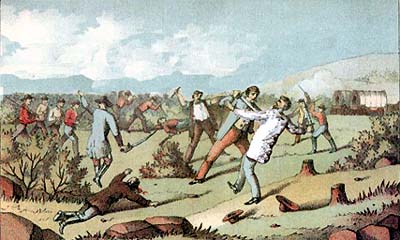
On the night of October 24, 1838, Captain Bogart's unit had camped along the banks of Crooked River in Bunkham's Strip. Patten and the Mormon rescue company approached from the north along the main road. At daybreak on the 25th, the Mormons encountered the militia's sentries. A brief firefight ensued with each side testifying that the other had fired first.[45] One of the sentries, John Lockhart, shot Patrick Obanion, the Mormons' scout. Obanion later died from this wound. Lockhart and the other guards then fled down the hill to the militia camp which took up a defensive position.[46]

The Mormon company approached the camp of the Ray militia and formed a battle line in three columns, led by David W. Patten, Charles C. Rich, and Patrick Durfee. Rich later recalled that soon after the Mormons had formed their lines, the militia "fired upon us with all their guns."[47] A general firefight commenced, but the militia were situated behind the riverbank and held the strategically superior position. Patten decided to charge the militia position, shouting the Mormon battle cry of "God and Liberty!" The Missourians were without swords and so broke their lines and fled across the river in all directions. During the retreat, the Mormons continued to fire and one of the militiamen, Moses Rowland, was killed.

During his charge, however, Patten was shot and mortally wounded. Ebenezer Robinson recalled that Patten had been "brave to a fault, so much so that he was styled and called 'Captain Fearnought'."[47] Although it was not immediately realized, Gideon Carter had also been killed, making three Mormon fatalities and one militiaman fatality. The Mormons collected their wounded as well as the baggage Bogart's unit had left in the camp and made their way back to Far West.[48]

Aftermath

[edit]

Although the battle resulted in only four fatalities, the effect was a massive escalation of the Missouri Mormon War. Exaggerated reports (some saying that half of Bogart's men had been lost) made their way to Missouri Governor Lilburn Boggs who responded by issuing Missouri Executive Order 44, known as the "Extermination Order," which stated that "[t]he Mormons must be treated as enemies, and must be exterminated or driven from the state." Boggs called out 2,500 state militiamen to put down what he perceived to be open rebellion by the Mormons. In the end, the leaders of the church were captured and the bulk of the membership were forced to leave the state.

Thousands of Latter Day Saints had flowed into Missouri in just a few years; they were against slavery and voted as a bloc. This led to the unease and the mob action against the Saints; Sidney Rigdon fueled the fire with his July 4 speech. The Missouri state officials considered the Mormons to be the aggressors in the war, and after the destitute saints were forced to flee to Illinois, their homes in Far West and Adam-ondi-Ahman were occupied by the mob. A large number of church leaders, including Joseph Smith, Sidney Rigdon, Hyrum Smith, Parley P. Pratt, and George W. Robinson were charged with many crimes including treason. It was during a preliminary hearing that Smith and the other defendants learned that Danite leader Sampson Avard had testified against them. As a result of the testimony, Judge Austin A. King of the Fifth Circuit of Missouri ruled that there was sufficient evidence to hold Smith, Rigdon and other leaders for trial; nevertheless, they waited for over six months in Liberty Jail for their trial. Despairing of ever being allowed to come to trial, Smith and the others escaped from the prison, and soon made their way to join the Latter Day Saints in Quincy, Illinois.

Number of Danites

[edit]

The two primary and opposing views concerning the extent of the Danite organization are represented by authors D. Michael Quinn and Alexander L. Baugh.

The Neal A. Maxwell Institute for Religious Scholarship at Brigham Young University has highly criticized the first position posited by researcher Quinn for its reliance on arguably unreliable sources. Quinn follows the affidavit of self-professed Danite John N. Sapp, who stated on September 4, 1838, that the number of Danites was "betwixt eight and ten hundred men, well armed and equipped...." He also credits the testimony of another Danite, Anson Call, who said that "the whole of the Military Force" at Far West belonged to the Danite organization. Based on these and other statements, Quinn concludes that nearly the entire fighting force of some 900 Mormon men in Caldwell and Daviess counties had become Danites, and that by end of summer 1838, to be a member in full standing a Mormon must also have been a Danite.[49]

In a second position, Baugh disagrees and argues with Quinn that the Danites were always "a select group." He finds the testimony of John Corrill, who gave the total number of Danites at 300, more reliable than that of Sapp or Call.[50]

Joseph Smith's involvement

[edit]

According to an essay on the website of the LDS Church, "Historians generally concur that Joseph Smith approved of the Danites but that he probably was not briefed on all their plans and likely did not sanction the full range of their activities."[1] Establishing the true leadership of an organization that self-identifies as secret and unofficial is problematic and has made establishing an accurate history surrounding the Danites difficult. While there are some primary accounts of the Danites and their activities, scholars of LDS church history largely hold that these sources are partisan (and quite often contradictory),[citation needed] with nearly all reports coming from disaffected Mormons such as Sampson Avard (ex-Mormon and former Danite with a well-documented vendetta against Smith and the church), John D. Lee (ex-Mormon who publicly said he had been scapegoated by the church), Fanny Stenhouse (an ex-Mormon who co-authored with her husband a series of exposés on Mormonism), and Ann Eliza Young (the ex-wife of Brigham Young and vocal opponent of the church).[citation needed] Certainly, the existence of the Danite band during the conflict known as the 1838 Mormon War is well established.

Joseph Smith never identified himself as a Danite. However, in 1834, Smith was elected as commander-in-chief of the Armies of Israel by the Kirtland high council. Though the Danite band self-identified as unofficial, there is confusion and controversy surrounding the independence of the Danite organization since its constitution states, "All officers shall be subject to the commands of the Captain General, given through the Secretary of War".[51] Smith had the title of Secretary of War during the three years prior to the year in which it is widely believed the Danites were first organized.[52] However, Smith did not attest to any affiliation with the Danite band, and none of the close contemporaries of Smith alleged otherwise.

In fact, despite likely originally approving of the Danites, Smith wrote of the actions of the Danites largely with disapproval and on more than one occasion.[1] However, in speaking on dissenting Mormons, Smith wrote in his Scriptory Book that after Sidney Rigdon spoke on the subject of "dissenters," they (according to Smith) "took warning, and Soon they were Seen bounding over the prairie like the Scape Goat to carry of[f] their own Sins we have not Seen them Since, their influence is gone, and they are in a miserable condition. So also it with all who turn from the truth to Lying Cheating defrauding & Swindeling."[53] It has been alleged by some historians that these comments evidenced Smith's approval of the Danites' actions.[citation needed]

Further, LDS Church leader Sidney Rigdon expressed disapproval of Danites, although he asserted his belief that the Mormons were within their rights to forcibly expel dissenters from their midst, saying that: "When a country, or body of people have individuals among them with whom they do not wish to associate and a public expression is taken against their remaining among them and such individuals do not remove it is the principle of republicanism itself that gives that community a right to expel them forcibly and no law will prevent it."[54] Again, like the statements made by Smith, that such statements made by Rigdon could be said to be made in reference to the Danites is only suggestive.

There is one statement made by Joseph Smith which endorsed the Danite band, apparently near its inception. In his journal, Smith wrote: "Thus far, according to the order of the Danites. We have a company of Danites in these times, to put to right physically that which is not right, and to cleanse the Church of every great evil which has hitherto existed among us inasmuch as they cannot be put to right by teachings and persuasyons [sic]. This company or a part of them exhibited on the fourth day of July [—] They come up to consecrate, by companies of tens, commanded by their captains over ten."[55]

Nonetheless, over time, as the prominence and violence of the group grew, Smith condemned the group, referring to them as "evil" in nature and a "secret combination" (a negative term in LDS Church usage). Since these condemnations largely appeared after Smith and the Church had been charged with treason in fall of 1838,[56] and after Smith and the Church leaders became concerned with the actions of alleged rogue groups and their potential negative effect on the Mormon community at large, it is unclear whether they reflected philosophical or political positions of the moment.

Smith and the Church leaders eventually were forced to publicly excommunicate the Danite leader, Sampson Avard.

Hyrum Smith

[edit]

Hyrum Smith, brother of Joseph Smith, was a member of the First Presidency of the church at the time that his signature appeared on the document known as the "Danite Manifesto."[20] There has been dispute about if he in fact signed the document, or if instead others used his name because of his prominent position in the church.[citation needed]

Sampson Avard

[edit]

Sampson Avard became the lead witness for the prosecution in a trial of Joseph Smith and other church leaders. As Avard was well known as the leader of the Danites, his role as a witness was a surprise to both the church and Missourians.[57] Avard testified that he considered "Joseph Smith, as the prime mover and organizer of the Danite band."[58]

Avard went on to implicate Smith as the overall commander of the Daviess Expedition and other Danite vigilante activities. He included a recitation of a Danite Constitution with eight articles, specifying that the "executive power" of the Danite society would be "vested in the president of the whole church."[59] However, Moses Clawson, John Corrill, Reed Peck, and others (all well-known Danites) all named Avard as the head of the organization and not Smith. George M. Hinkle testified under oath that Joseph and Hyrum Smith never commanded any Danites in the field.[60] Statements from known associates of Avard, including Ebenezer Robinson,[13] Morris Phelps,[61] and John D. Lee,[62] place Smith in a more commanding role. Several scholars have pointed to evidence which suggests that, to avoid prosecution, Avard may have promised prosecutors that he and his associates (i.e., Robinson, Phelps, and Lee) would implicate Smith in the Danite organization.[63]

While it is clear that Smith was aware of the existence of the Danites and, at least initially, approved of certain Danite activities, Smith's role in the creation of the Danites and especially his involvement in its later activities (particularly actions of escalating violence) remain unclear. After Avard's excommunication and disaffection from the Latter Day Saint community, Smith continued to publicly condemn both Avard individually and the Danite organization as a whole. No known documents show that the Danite band operated at any time during its history under official Latter Day Saint sanction, nor that the Danite band existed after Avard's excommunication and after 1838.[citation needed]

Allegations in Utah

[edit]

Historian Leland Gentry asserts that after Sampson Avard was captured in November 1838, the Danite movement "died a quick death."[64] Gentry cites numerous evidences supporting this position in his book, "The Danite Band of 1838." Nevertheless, after the Mormons settled in Nauvoo, Illinois and later in Utah, they were dogged by rumors the Danites continued to exercise influence within the Mormon community.[citation needed]

These beliefs were fueled by the fact that many former Danites occupied prominent paramilitary or law enforcement roles in the new settlements. For example, alleged former Danite Hosea Stout became the chief of police in Nauvoo. Then, after Joseph Smith was assassinated in 1844, Brigham Young made Stout head of the "Whistling and Whittling Brigade" – a group of young boys who intimidated strangers by following them around Nauvoo "whistling" until they left.[65] Another reported former Danite, Orrin Porter Rockwell, became a body guard to Joseph Smith in Nauvoo, and later to Brigham Young. Disaffected and dissenting ex-Mormon, Ann Eliza Young, stated that Rockwell gained fame as one of Young's "Destroying Angels".[66]: 269 

Despite the presence of purported former Danites within the LDS Church, there is no evidence they continued to exist as an organized body after 1838, or that they participated in any actions against dissenting and former Mormons in Utah. For instance, while former Danite John D. Lee's lengthy confessional describes the operations of the Danites in Missouri, he makes no indication to the continued existence of the organization after the Mormons left the state.[67]

When the expedition of Lt. John W. Gunnison was killed by Indians in 1853, some said that the Danites had a hand in the affair.[68] However, these claims were refuted by an official investigation led by Gunnison's second in command.[69]: 74  Similar reports circulated when Indians killed territorial official Almon W. Babbitt on the plains in 1856,[70] though there is no evidence supporting this allegation.

In the 1870s, Ann Eliza Young and Fanny Stenhouse (both former Mormons) authored exposés of Mormonism. Young and Stenhouse stated that the Danites were active, and primarily occupied with the task of discreetly murdering and disposing of Mormon dissenters and outsiders perceived to be a threat to Brigham Young's power.[66]: 274 [71]: 169–170 

Brigham Young

[edit]

Brigham Young denied that the Danites continued to exist. However, on July 5, 1857, just before the start of the Utah War, Young used language similar to the fiery sermons that preceded the 1838 Mormon War. In the address Young demanded military action against former Mormon persecutors, mobocrats, and the "priests, editors, and politicians" who were then denouncing the Mormons. Young declared that if these provocateurs came to the Utah Territory, the Mormons would "deal" with them. He stated that anyone who entered the territory and didn't "behave themselves," including any Mormon who "unlawfully disturbs anyone," would "find a 'Vigilance Committee.'" This was most likely a reference to the famous San Francisco Vigilance Committee of 1856, an organization that one writer called "the largest and most influential vigilante group in American history."[72]: 39, 58  Young also declared that any such men would find "not only the Danites, whom they talk so much about, biting the horses (sic) heels, but the scoundrels will find something biting 'their' heels."[73]

Otherwise, Young persistently denied the existence of Danitism in Utah. For instance, in June 1857, he said in a public address: "[people claim that the Danites] are in every town and city throughout the whole of the United States, and that their object is not known by the people. That they are all over the world; that there are thousands of them, and that the life of every officer that comes here is in the hands of the Danites. That even the President of the United States is not safe, for at one wink from Brigham the Danites will be upon him and kill him...It is all a pack of nonsense, the whole of it."[74]

Later, in September 1857, Young said in a private meeting of the church leadership,: "the world accuse !(sic) me of controlling the affairs of Calafornia (sic) & kansas (sic) &c. The people do believe that we have a Band Called the Danites but how Could they exist so long without shedding Blood? For we Cannot find that they have killed any body. But I do not know of any such men."[75]

A decade later, Brigham Young again denied the existence of violence by Danites. On April 7, 1867, he stated:

Is there war in our religion? No; neither war nor bloodshed. Yet our enemies cry out "bloodshed", and "oh, what dreadful men these Mormons are, and those Danites! how they slay and kill!" Such is all nonsense and folly in the extreme. The wicked slay the wicked, and they will lay it on the Saints.[76]

Historian Leonard Arrington attributes the stories of Danites in Utah to overzealous descriptions of the "Minute Men," a law enforcement organization created by Brigham Young to pursue marauding Indians and white criminals.[77] Arthur Conan Doyle and other authors had also popularized the idea of blood-thirsty Danites riding rough-shod through Utah in various fictional works.[78] At the same time, there is evidence that, purportedly in order to deter and punish crime in Utah Territory, Brigham Young occasionally authorized local church leaders to engage in vigilante actions on an ad hoc basis.[79] For instance, in early 1857, Young ordered local authorities to monitor two recently released convicts who were on the trail to California. If they were caught stealing livestock along the way, he authorized their summary execution. Historian Ardis Parshall believes that this led to an attack on an unrelated party which wounded several individuals in a case of mistaken identity.[79] Indeed, in the same sermon where he spoke of the Danites and Vigilance Committees in 1857, Young also stated: "There have been men here who have had their plans to arrange for robbing; and I will take the liberty to say that, when we find them, 'judgement will be laid to the line and righteousness to the plummet.' Those are my feelings, and I express them plainly, that the good and honest may be able to pass from the Eastern States to California, and back and forth, in peace...I want the people in the States to know that there are a few poor curses here, and to know that we do not want gangs of highwaymen here. And I say to such characters...we will send you home quick, whenever we can catch and convict you."[73]

These vigilante actions may have also been a source for the continued Danite myth.[79]

[edit]

Beginning in the 19th century, a number of authors, including the notable British fiction writers Arthur Conan Doyle and Robert Louis Stevenson, make references to "Danites" as a shadowy, secret group who terrorized the early LDS Church settlements in Utah. These references usually appear in popular fiction or works critical of the LDS Church, and rumors of Danites practicing some form of blood atonement often play a significant role in these accounts. The group has also been depicted on screen.

Washington Bailey, in his memoir, "A Trip To California In 1853",[80] reported local rumor that Brigham Young's "Destroying Angels" were conducting raids on wagon trains near Salt Lake City and blaming it on Indians. However he was not an eyewitness to these events.

Lavinia Honeyman Porter, in her memoir "By Ox Team to California: A Narrative of Crossing the Plains in 1860"[81] also reported rumors of raiding Mormons near Salt Lake City, but did not mention the raiding group by name, and herself passed safely through Salt Lake City and conducted trade and social visits with Mormons.

Danites feature prominently in Story of the Destroying Angel by Robert Louis Stevenson and Fanny Stevenson, part of the collection The Dynamiter. Danites are represented as a world-wide secret organization of spies and assassins, dedicated to enforcing the edicts of Brigham Young. They are described as the force that makes Utah a "strong prison [...] who can escape the watch of that unsleeping eye of Utah?"[82] They are described as bloodthirsty murderers, planning the "massacre of sixty German immigrants"[82] and with the ability of making dissenters disappear without a trace.

A particularly well-known example is Arthur Conan Doyle's fictionalization of the Danites in A Study in Scarlet,[83][non-primary source needed] the first Sherlock Holmes novel, published in 1887. In the story, the Danites constitute a brutal group of enforcing vigilantes operating under the direction of Brigham Young—and more particularly the fictional Sacred Council of Four, silencing criticism and questioning, and preventing dissenters from leaving the Salt Lake Valley. Doyle's embellishment of the folklore surrounding the original Missouri band transplanted to a romantic wild west setting, the established criminal notoriety of Rockwell, and rumors of Young's Avenging Angels made acceptance of the "authoritative" Sherlock story a simple matter for English readers.[citation needed] However, after a visit to Utah in 1923, Doyle is reported to have said "...he had been misled by writings of the time about the church."[citation needed] In 1991, Doyle's daughter stated that "Father would be the first to admit that his first Sherlock Holmes novel was full of errors about the Mormons."[84]

The Avenging Angel (1995) is a film featuring Brigham Young, Porter Rockwell, and Wild Bill Hickman that centers on the fictional character and his activities as a Danite.[85]

Sally Denton, in her 2003 history of the 1857 Mountain Meadows massacre, American Massacre, claims that the Danites and blood atonement had a prominent role in 19th century Utah society. Denton attributes the creation of the Danites to Joseph Smith as his "secret group of loyalists" and suggests that they became "one of the most legendarily feared bands in frontier America." According to Denton, this "consecrated, clandestine unit of divinely inspired assassins" introduced "the ritualized form of murder called blood atonement--providing the victim with eternal salvation by slitting his throat."[86] Denton said that "blood atonement" was one of the doctrines which Mormons held "most sacred" and that "[t]hose who dared to flee Zion were hunted down and killed."[87] Denton implies that large numbers of such "atonements" occurred during the Mormon reformation of 1856, although "none of the crimes were ever reported in the Deseret News", and that the "bloody regime…ended with [Jedediah] Grant's sudden death, on December 1, 1856."[88]

A major plot sequence of L. E. Modesitt Jr.'s 2009 science fiction novel Haze imagines a far future conspiracy of so-called "Danites" in the Utah city of St. George.[89]

Thriller writer Steve Berry incorporates Danite and blood atonement lore in a contemporary setting in his 2014 novel The Lincoln Myth.[90][91]

See also

[edit]

References

[edit]

Further reading

[edit]
Revisions and contributorsEdit on WikipediaRead on Wikipedia
from Grokipedia

The Danites, formally the Society of the Daughter of Zion, constituted a fraternal and defensive organization established by members of the Church of Jesus Christ of Latter-day Saints in Far West, Missouri, during June 1838, amid intensifying conflicts with non-Mormon settlers stemming from economic competition, political voting blocs, and prior expulsions from Jackson County. The group's constitution, drafted by Sampson Avard—a physician and church elder—outlined a hierarchical structure with oaths binding members to mutual aid, secrecy, and unwavering support for church presidency decisions, including the expulsion of internal dissenters who had criticized Joseph Smith and Sidney Rigdon. Initially focused on protecting Mormon communities from mob violence and regulating apostasy through intimidation rather than outright violence, the Danites expanded into paramilitary drills and contingency plans for retaliation, fostering perceptions among Missourians of an armed theocratic threat that precipitated the 1838 Mormon-Missouri War, including clashes like the Battle of Crooked River. Joseph Smith participated in early organizational meetings and endorsed defensive preparations, yet primary records indicate he rejected Avard's later escalatory schemes, such as systematic property destruction or assassination plots, leading to Avard's excommunication in September 1838 for false revelations and treachery; Avard's subsequent courtroom testimony against Smith, while detailing the oaths and ranks, bears marks of embellishment given his motives for leniency from Missouri authorities. The organization dissolved shortly thereafter, with surviving members absorbed into the broader Mormon legion, though its legacy endures in debates over the causal interplay between Mormon self-defense measures and the cycle of retaliation that culminated in the Saints' expulsion from the state under Governor Lilburn Boggs's extermination order.

Historical Context

Mormon Persecution in Missouri Prior to 1838

, members of the founded by , began settling in western in July 1831, viewing Jackson County as the location of the prophesied . By July 1833, their population in the county had grown to over 1,000 amid rapid immigration from the . Local non-Mormon residents, numbering around 3,000, expressed grievances over perceived economic competition, cultural differences, and rumors of Mormon abolitionist sympathies in the slave-holding state. On July 20, 1833, a mob of approximately 300 men destroyed the Mormon printing office and bookstore in , tarred and feathered Bishop Edward Partridge and printer Charles Allen, and issued a demanding the expulsion of all by the following spring. Violence intensified in the fall, with mobs burning homes, destroying crops, and driving families across the ; by early November 1833, during clashes known as the Battle of the Big Blue on November 4–6, state militia intervened but failed to halt the assaults or arrest perpetrators. Approximately 1,200 were ultimately expelled from Jackson County, suffering property losses estimated in the tens of thousands of dollars without legal compensation or prosecution of attackers, as county officials and courts declined to enforce protections. The displaced Saints relocated to neighboring Clay County, where they initially received aid but faced rising tensions as their numbers swelled to several thousand by 1836, prompting anti-Mormon meetings, threats, and economic boycotts. To avert further conflict, the created Caldwell County in December 1836 exclusively for Mormon settlement, leading to the founding of Far West as the . However, rapid growth to around 5,000 residents by early 1838, coupled with Mormon expansion into adjacent Daviess and Carroll counties for additional land, reignited hostilities through inflammatory newspaper editorials, patrols, and refusals to trade with Mormon businesses. Local sheriffs and units, often composed of anti-Mormon sympathizers, consistently failed to safeguard Mormon or , mirroring the inaction of 1833 and eroding trust in state mechanisms for redress. This pattern of mob dominance and official abdication, without federal intervention despite petitions to Daniel Dunklin, underscored the vulnerability of Mormon communities to extralegal violence.

Biblical and Doctrinal Foundations for Defensive Societies

In Mormon theology during the period, the principle of organized was grounded in revelations emphasizing retaliation only after repeated unprovoked injuries. 98:23–31, received August 6, 1833, instructs that if enemies smite thrice and repent not, the aggrieved may "renounce and proclaim peace" yet still "thrash" aggressors if invaded, framing resistance as a divine right to protect life and property rather than in the face of existential threats. This doctrine prioritized endurance and forgiveness initially but permitted defensive measures to preserve community integrity amid escalating persecutions, such as the 1833 expulsion from Jackson County, where non-resistance had failed to deter mob violence. Biblical precedents further informed the rationale, drawing from prophecies about the as a model for vigilant judgment and protection. Genesis 49:16–17 describes Dan as one who "shall judge his people" like a "serpent by the way" that strikes decisively to defend, evoking a role in safeguarding against threats. Similarly, 4:13 envisions Zion's daughter threshing nations with iron horns and brass hooves, symbolizing empowered resistance to conquerors whose spoils are consecrated to , which early Latter-day Saints interpreted as restoring ancient orders of collective defense in a latter-day context of and moral decay. These texts supported viewing defensive societies not as innovations but as fulfillments of scriptural patterns for covenant communities under siege. Joseph Smith's revelations in June 1838 reinforced covenant-keeping as essential for survival, urging adherence to divine laws amid threats without authorizing preemptive aggression. This aligned with broader Mormon affirmations of natural rights to , rooted in the belief that unchecked justified protective measures to maintain order and faith, contrasting claims by some contemporary critics that such doctrines masked theocratic ambitions rather than responding to verifiable mob expulsions and property seizures documented in church records. The emphasis remained on defensive retaliation proportional to repeated offenses, eschewing offensive violence to align with first-principles of and retribution limited by .

Formation

Founding in Far West, June 1838

The Society of the Daughter of Zion, soon renamed the Danites, was formally organized in Far West, , in late June 1838 as a defensive among Latter-day Saints facing imminent threats from non-Mormon mobs. Sampson Avard, a recent arrival to Far West who had migrated there by early June, played a central role in initiating the group alongside Jared Carter and George W. Robinson, with Avard serving as its primary spokesman and leader. The formation responded to reports of approaching vigilante forces from neighboring Daviess County, prompting the creation of an oath-bound structure for mutual defense and self-reliance independent of external authorities. A for the society was drafted circa late , outlining its into companies led by captains, with provisions for , collective aid to members in need, and armed resistance against aggressors. The name "Danites" drew from biblical precedents, including the of Dan's depiction as agile fighters in Judges 18 and prophecies in associating the saints with inheriting kingdoms through on oppressors. Initiates took binding oaths to uphold through signs and tokens, support one another economically and militarily, and oppose any force—whether mob or government—that violated the community's rights or property. Empirical corroboration of the Danites' inception and brief operational span comes from contemporary Mormon journals, including that of Albert Perry Rockwood, which documents organizational meetings and oaths administered in Far West during June and July 1838, with the society's structured activities persisting until its dissolution amid the Mormon expulsion from in . These records indicate the group began as a pragmatic, localized response to acute survival pressures rather than a premeditated expansive , limited initially to several hundred able-bodied men sworn in through sequential assemblies.

Key Figures and Initial Oaths

Sampson Avard, a physician and church member, emerged as the de facto organizer of the Society of the Daughter of Zion—later known as the Danites—in Far West, Missouri, during late June 1838, drawing on the group's constitution to establish its initial framework. Early leadership included David W. Patten, who assumed a captaincy under the "Fearnaught" and participated in defensive preparations, while Thomas B. Marsh, as senior apostle overseeing operations, held supervisory roles before his in October 1838. Avard's influence stemmed from his advocacy for a defensive society amid escalating persecutions, though his later —given after defecting to state authorities—painted the group as conspiratorial, a claim contested by contemporary Mormon accounts as exaggerated for self-justification. The initial oaths, administered during the society's formation meetings, bound members to sustain the church presidency in all actions, to seek vengeance against personal and collective enemies, and to preserve absolute , with punishable by death. These commitments, documented in the society's and corroborated by Avard's as well as affidavits from defectors like , integrated biblical references to the as avengers while incorporating recognition signs and penalties reminiscent of Masonic rituals, adapted ostensibly for operational rather than hierarchical control. Such oaths enhanced group cohesion by aligning individual loyalty with collective survival imperatives, mirroring standard pledges of the era, though Avard's accounts—potentially inflated post-defection—contrast with Mormon defenses portraying them as defensive necessities against mob violence.

Salt Sermon and Danite Manifesto

Sidney Rigdon delivered the Salt Sermon on June 17, 1838, at a public meeting in Far West, Missouri, addressing approximately 500 Latter-day Saints amid rising internal dissent and external hostilities. Drawing directly from Matthew 5:13, Rigdon likened unfaithful church members to "salt [that] hath lost its savour," declaring them "good for nothing" but to be "cast out, and... trodden under foot of men," thereby framing apostasy as a corrosive impurity requiring expulsion to preserve communal cohesion. This analogy targeted specific critics, including former church leaders like Oliver Cowdery, David Whitmer, and William W. Phelps, who had accused Joseph Smith of authoritarianism and economic mismanagement, exacerbating vulnerabilities during ongoing threats from non-Mormon settlers following the Saints' prior displacements from Jackson County in 1833 and Clay County in 1836. The sermon's immediate aftermath saw heightened enforcement against dissenters; Cowdery, already facing church charges since November 1837 for and denial of the , confronted veiled threats that accelerated his exit from Far West by late June, alongside other opponents who relocated to avoid confrontation. Approximately 83 Mormon men, including , responded by signing a known as the Danite on June 18, 1838, which reiterated the sermon's purification theme while pledging unwavering loyalty to Smith as prophet and vowing to "consecrate" their lives, properties, and efforts to establishing in against "invaders" or disloyal elements. The explicitly warned remaining dissenters in Caldwell County to "depart or a more fatal calamity shall befall you," linking religious covenant to territorial defense and internal discipline. On July 4, 1838, Rigdon followed with a public oration in Far West—attended by thousands—that echoed the manifesto's resolve, proclaiming as the divinely appointed and rejecting submission to "mobocratic" aggression, with pledges to "consecrate [lands] on this soil" and resist expulsion by force if necessary. This address, documented in contemporary journals as a "" from , unified the Saints by subordinating individual qualms to collective survival, as empirical records show no immediate internal violence but rather the coerced departure of about a dozen key dissenters, averting amid rumors of coordinated opposition with external foes. While critics, drawing from accounts by expelled members like Reed Peck, portrayed these events as incitements to theocratic vigilantism that foreshadowed the 1838 Mormon War's escalations, Mormon historical analyses emphasize their role in preemptively addressing disunity that could have invited exploitation by hostile militias, given documented patterns of prior unprovoked attacks on Saint settlements. The manifesto's signatories, largely Danite affiliates, viewed it as a binding oath for boundary-setting, with no verified instances of unprovoked aggression against civilians prior to retaliatory engagements later that year.

Organization and Operations

Internal Structure and Secrecy Protocols

The Danite society, initially known as the Society of the Daughter of , adopted a hierarchical structure inspired by biblical , dividing members into companies of tens and fifties, each commanded by appointed captains responsible for unit coordination and discipline. A central council, led by figures such as Sampson Avard, oversaw broader strategic decisions, ensuring unified action while maintaining operational flexibility across units in Far West and surrounding areas. This framework facilitated rapid mobilization for defensive purposes amid escalating threats, prioritizing internal loyalty and chain-of-command efficiency over open formations. Secrecy protocols were integral to the society's operations, enforced through binding oaths that compelled members to conceal its existence and activities from outsiders, including potential spies or dissenters within the broader Mormon community. Initiation involved ritualistic elements such as specialized grips, signs, and passwords—often described in contemporary accounts as cabalistic handshakes and —to verify identity and prevent unauthorized access or betrayal. Penalties for violating these oaths were severe, implied in the covenants as spiritual and communal retribution, though specifics varied in reports; Avard's later testimony, given amid his excommunication and prosecution motives, emphasized death-like consequences for disclosure, contrasting with church disavowals of such extremes. These measures aimed at operational rather than inherent conspiratorial aims, reflecting the precarious environment of Missouri persecutions where infiltration risked total compromise. The society's , drafted by Avard circa late June 1838, explicitly prohibited theft, plunder, or unprovoked violence, restricting actions to verifiable defense of Mormon property and persons against documented aggression. Members were oath-bound to uphold church leadership—covenanting support for the First Presidency "in all things"—which tied allegiance to perceived divine directives over secular s, setting the Danites apart from standard militias by embedding religious absolutism in their protocols. This loyalty clause, while fostering cohesion, later fueled accusations of when Avard, seeking in his November 1838 testimony, portrayed it as carte blanche for defiance; however, primary documents indicate intent focused on collective preservation amid verifiable mob encroachments, not offensive overreach.

Membership Size and Recruitment

The Danite society, established in Far West in June 1838, drew its membership primarily from loyal Latter-day Saints in Caldwell County, with estimates ranging from 200 to 500 active participants based on oath-taking records and participant accounts. Sampson Avard, the primary organizer, testified during the November 1838 Richmond hearings that the group included "several hundred" members organized into lodges for defensive purposes, though his credibility is undermined by his subsequent excommunication and self-serving accusations against church leaders to mitigate his own legal jeopardy. Contemporary journals, such as those from Danite John N. Sapp, suggested a peak of around 800 to 1,000 by early September, but these figures likely encompassed broader sympathizers rather than sworn oath-takers, as cross-verified by trial testimonies limiting the core band to fewer than 500. Recruitment proceeded through church networks, with Avard conducting private assemblies where able-bodied men pledged secrecy, mutual aid, and armed readiness against mob violence, often framing participation as fulfillment of biblical precedents for tribal defense. These oaths targeted ultra-loyal individuals from recent Kirtland emigrants and local frontiersmen experienced with firearms, enabling quick assembly without formal ; participation was voluntary but reinforced by communal pressure following the expulsion of dissenters in mid-June. The process avoided mass enrollment, reflecting logistical realities of a scattered population and emphasis on elite, mobilizable units rather than universal inclusion. The organization's brevity—effectively ending by late October amid leadership disavowals after Avard's exposure—imposed empirical caps on growth, as publicly denounced unauthorized oaths and vigilante excesses in church councils. With the overall Latter-day Saint population in totaling approximately 10,000, the Danites represented a modest fraction suited for rapid response, not expansive conquest. Scholarly assessments, drawing from primary documents like the Joseph Smith Papers, critique inflated non-Mormon narratives (e.g., claims of thousands forming a theocratic ) as products of in exposés, while conservative evaluations from archival sources align closer to 200-400 sworn members, prioritizing verifiable oaths over hearsay.

Enforcement Against Dissenters

The Danites, organized in Far West, Missouri, in June 1838, initially focused on intimidating and expelling church dissenters perceived as threats to communal unity amid escalating external persecutions. Sampson Avard, a key organizer, testified that the group targeted individuals like , , and John Whitmer for alleged , including charges of conspiring against and engaging in land speculation that undermined collective interests. These actions were framed by participants as necessary to safeguard resources and prevent internal sabotage, given the Saints' encirclement by hostile mobs following prior expulsions from Jackson County in 1833. A pivotal event occurred after Sidney Rigdon's "Salt Sermon" on June 17, 1838, which condemned dissenters as unfit for the community, likening them to salt that had lost its savor. This was followed by the Danite Manifesto, a letter signed by approximately 84 prominent Mormons, including Hyrum Smith, demanding that Cowdery and others "depart or be cut off from the church." Cowdery, formerly a church counselor, was disfellowshipped on April 12, 1838, for offenses including denying the faith and deeding church property to himself, leading to his formal excommunication on June 26; Danite members reportedly enforced his removal from Far West through warnings and physical pressure, though he departed without recorded injury. Similar measures applied to other dissenters, such as W.W. Phelps, who faced expulsion for past betrayals during the Jackson County crisis, with property claims scrutinized to recover assets allegedly misappropriated. Historians critical of the Danites interpret these enforcements as authoritarian purges establishing a theocratic order, suppressing free expression under oaths of secrecy and obedience. Defenders, including later church accounts, contextualize them as pragmatic responses to wartime exigencies, where dissenters' alliances with external antagonists risked espionage and resource diversion during a period of militia mobilization and economic strain in Caldwell County. Verifiable records, including affidavits from the 1838 Missouri trials, indicate no executions or widespread physical assaults; actions were confined to verbal threats, property audits, and coerced departures, affecting a limited number of about a dozen prominent figures rather than mass purges. This restraint aligns with the group's dissolution by late 1838, as Joseph Smith publicly disavowed unauthorized vigilante excesses.

Defensive and Political Activities

Protection Against External Mobs

In response to the escalating influx of armed non-Mormon settlers into northwestern during the summer of 1838, Danite members in Far West organized standing patrols and initiated the construction of defensive fortifications around the settlement to deter potential mob incursions. These preparations were necessitated by intelligence of vigilante assemblies, echoing the unchecked mob violence that had expelled approximately 1,200 from Jackson County in November 1833 without state intervention. Empirical records indicate Mormon communities exercised restraint by repeatedly petitioning Governor for protection, yet state responses favored non-Mormon complainants, creating a protective vacuum that groups like the Danites filled through self-reliant vigilance. A concrete instance of this defensive role occurred during the siege of DeWitt in Carroll County, where from to 11, 1838, an estimated 200-300 armed non-Mormons blockaded the Mormon enclave of about 150 residents, firing intermittently and preventing supplies from entering. Danite-led reinforcements from Far West, including at least 62 mounted and well-armed men dispatched in early October, reinforced the besieged settlers, enabling their organized evacuation on amid continued gunfire that wounded several but resulted in no fatalities on either side during the withdrawal. This intervention preserved lives in the short term, as DeWitt's isolation—150 miles from sympathetic aid—would have otherwise invited unchecked , yet non-Mormon eyewitnesses reported it as provocative, amplifying rumors of Mormon and contributing to heightened regional animosities. Such measures underscored the Danites' utility as a provisional amid institutional failures, where causal factors like gubernatorial inaction—evident in Boggs' deferral of Mormon petitions to local judges predisposed against them—necessitated private organization for survival; however, they inadvertently validated anti-Mormon narratives of , per militia dispatches decrying "armed bands" without distinguishing defensive from offensive intent.

Political Mobilization in Caldwell and Daviess Counties

In August 1838, Mormon settlers in Daviess County mobilized politically during the state elections, culminating in the Election Day confrontation at Gallatin on August 6. Approximately thirty Mormon men arrived to vote, but local candidate William Peniston mounted a barrel and denounced them, warning that their participation would ify the county's representation due to their numbers and alleged propensity for bloc voting under oath-bound groups like the Danites. This sparked a brawl when non-Mormons physically obstructed Mormon voters, leading John Lowe Butler, a Mormon, to wield oak staves in defense, injuring several opponents and enabling some Mormons to cast ballots. The incident highlighted fears of Mormon demographic dominance, with non-Mormons estimating that Mormon votes could sway outcomes in Daviess and adjacent counties. Danite organization, formed earlier in June 1838 for defensive purposes in Caldwell County, extended to supporting these voting drives by coordinating Mormon turnout and settlement to counter prior disenfranchisement patterns observed in Jackson County, where economic boycotts and expulsions from stemmed partly from Mormon electoral influence. While critics, including Peniston, accused Danites of promoting through and oaths that allegedly compelled unified action, contemporary accounts indicate the Gallatin originated from resistance to Mormon enfranchisement rather than proactive Mormon aggression. This mobilization reflected a strategic response to systemic exclusion, as Missouri laws nominally allowed preemption claims but local customs often favored established squatters over newcomers. Settlement strategies intertwined with politics as Mormons invoked to claim unsurveyed public lands in Daviess County, establishing and rapidly outnumbering gentiles, which enabled temporary sway over county seats like Gallatin. By September , to avert escalation, Mormon leaders negotiated buyouts of non-Mormon preemptive claims and improvements, acquiring possessions in Millport and elsewhere for reported sums exceeding $1,000 in some cases. Opponents decried this as undemocratic bloc voting that undermined local , yet it constituted a legal assertion of for a minority facing expulsion threats, with verifiable Mormon from negligible in early to dominating voter rolls by fall.

Interactions with Missouri Authorities

The Mormon settlers in Caldwell and Daviess Counties repeatedly petitioned Lilburn W. Boggs for against organized mob violence targeting their communities during the summer of 1838, including specific appeals from DeWitt residents in early October highlighting unprovoked attacks and property destruction, yet these entreaties received no substantive state intervention until Boggs issued 44 on October 27, 1838, directing that be treated as enemies and exterminated or expelled if necessary for public peace. This pattern of governmental neglect—exemplified by Boggs's earlier directive that conflicting parties "fight [their] own battles"—prompted the formation and activation of the Danites as a self-reliant defensive , organized to fill the void left by impartial failures. Danite units contributed to ad hoc negotiations and truces with local militia commanders amid escalating standoffs, such as preliminary parleys preceding the Haun's Mill settlement tensions, where assurances of safety from state-aligned forces proved illusory amid evident prejudice against Mormon pleas for restraint. State-called militias, intended for , often incorporated or tacitly allied with anti-Mormon irregulars, as revealed in postwar legislative inquiries and witness testimonies documenting irregulars' integration into official ranks, which eroded trust and justified private Mormon preparations like the Danites to counter perceived state favoritism toward mob factions. While isolated efforts at cooperation occurred—such as pro-Mormon militia leader Alexander Doniphan's temporary mediations—the broader institutional bias manifested in delayed responses and disproportionate blame on Mormon measures, culminating in the extermination order and exposing systemic enforcement disparities that privileged non-Mormon grievances over documented Mormon victimization.

Military Engagements

Daviess County Expedition

In mid-October 1838, amid escalating conflicts following the August 6 election-day brawl in Gallatin—where non-Mormon settlers obstructed Mormon voting and initiated physical altercations—Mormon leaders dispatched armed contingents, including Danite units, to Daviess County to safeguard expanding settlements and preempt mob incursions. Non-Mormon vigilance committees had formed in towns like Gallatin and Millport, issuing threats and conducting patrols to expel Mormons from purchased lands, prompting preemptive mobilization under state militia auspices. Joseph Smith, arriving in the county around October 8, coordinated these efforts to enforce Mormon property rights against reported depredations, framing them as reciprocal measures to prior non-Mormon aggressions such as home burnings and livestock thefts targeting isolated Mormon families. On October 18, Danite-affiliated commanders executed targeted strikes: David W. Patten led a force against Gallatin, the and hub of anti-Mormon organizing; Lyman Wight assaulted Millport, a settlement harboring members; and Seymour Brunson struck at Grindstone Fork. Contemporary accounts indicate residents had largely fled in advance, leaving structures vacant; Mormon detachments then razed homes, stores, and haystacks associated with mob leaders, confiscating arms and provisions while sparing unoccupied civilian property where possible. No fatalities occurred during these operations, with from participant testimonies and subsequent inquiries confirming minimal confined to property destruction—contrasting sharply with exaggerated claims of widespread plunder in biased non-Mormon affidavits. Defenders, drawing from natural rights to amid unchecked mob rule, justified the expedition as calibrated reciprocity to neutralize aggressor strongholds and deter further incursions, substantiated by the evacuation patterns suggesting non-Mormon foreknowledge of retaliation. officials and contemporary critics, however, decried it as offensive , charging and despite the absence of combat deaths or indiscriminate harm, a portrayal amplified in proceedings like Austin King's court of , which relied on partisan witness statements prone to inflation for political leverage. The actions effectively cleared opposition from key sites, bolstering Mormon control temporarily but intensifying state intervention.

Battle of Crooked River

On October 25, 1838, a company of approximately 60 Mormon militiamen from Caldwell County, commanded by Apostle David W. Patten, clashed with a smaller detachment of Missouri state militia led by Captain Samuel Bogart near the Crooked River in Ray County. Bogart's unit, numbering around 40 men, had been dispatched under state orders to patrol against reported armed Mormon groups, including rumors of Danite mobilization, and held three captured Latter-day Saint prisoners accused of scouting or theft. Perceiving the militia's movements as an aggressive incursion into Mormon settlements amid escalating tensions, Patten's force mobilized to intercept and potentially liberate the detainees, framing the engagement as a defensive measure to protect community interests. At dawn, the Mormon detachment approached Bogart's encampment along the riverbank, forming into three columns before advancing across the shallow waters in a coordinated charge. The militiamen, caught in a vulnerable position, returned fire as the opened with volleys from muskets and rifles, leading to a brief but intense exchange lasting about 15 minutes. Patten, leading from the front, sustained a severe abdominal during the assault, while the Mormon tactics emphasized rapid offensive pressure to disrupt the militia's position, though the terrain and surprise element favored an initial advantage that dissipated with mounting casualties. The skirmish concluded with the Mormon force executing a strategic withdrawal after inflicting disarray on Bogart's men, who retreated southward without pursuing. Casualties included one militiaman killed and several wounded on the state side, contrasted with higher Mormon losses of three men dead—Patten succumbing to his injuries later that day, alongside two others fatally wounded—highlighting the disproportionate impact despite the tactical retreat. No evidence supports claims of a one-sided ; the encounter involved in keeping with engagements of the era, though reports emphasized the Mormon initiation as evidence of insurrectionary intent.

Immediate Aftermath and Group Dissolution

Following the on October 25, 1838, and Avard's defection in mid-October, the Danite organization underwent swift repudiation and dissolution under Joseph Smith's directives. Avard's betrayal, which involved providing affidavits to authorities detailing alleged Danite plans, eroded internal cohesion and prompted Smith to publicly declare the society's extreme oaths non-binding and its unauthorized actions contrary to church teachings. By the on October 30, 1838, empirical records show no distinct Danite units operating independently; defensive responses had consolidated into broader Mormon militias under official command, reflecting the group's absorption or inactivation amid the escalating extermination crisis precipitated by Governor ' order on October 27. In early November 1838, prior to the surrender of Far West on November 1, Smith issued orders nullifying Danite oaths and redirecting members toward general evacuation preparations or integration into sanctioned forces, as the focus shifted from localized to collective flight from . This rapid disbandment, occurring within months of the group's June 1838 formation, aligns with primary accounts from the period's hearings and church records, which indicate no sustained organizational activity beyond . The Danites' short operational lifespan—confined to summer and early fall in Daviess and Caldwell counties—counters portrayals in some 19th-century anti-Mormon polemics of an enduring , for which post-1838 evidence remains absent in verifiable historical documentation.

Leadership Involvement and Denials

Joseph Smith's Association and Disavowal

exhibited awareness of the Danites through contemporaneous references in his personal records and public addresses. In a delivered around July 4, 1838, in Far West, Missouri, he acknowledged the existence of a "company of Danites" organized for defensive purposes amid escalating mob violence against Latter-day Saints, stating it served to protect the community and sustain church authority. This reflected broader context of formation during the 1838 Missouri conflicts, where , as of the Mormon forces, delegated operational authority amid chaotic threats from non-Mormon vigilantes, though primary documents show no explicit directive from him to institute the group's secret oaths or vigilante constitution. During the preliminary hearing on treason charges in Richmond, Missouri, from November 12–29, 1838, Smith testified to limited involvement, emphasizing that Danite activities under Sampson Avard exceeded authorized defensive measures and that he had not sanctioned unlawful pledges or expulsions. Avard, who had been excommunicated earlier that month and turned state's witness, claimed Smith directed Danite operations, including loyalty oaths to the and plans to eliminate dissenters and seize property, but Smith denounced these assertions as fabrications motivated by Avard's . Historians note Avard's as the for the Danite "constitution," yet question its reliability given his and incentives to implicate church leaders. Following these events, Smith explicitly disavowed the Danites' unauthorized elements, rejecting their secret combinations as antithetical to gospel principles and attributing excesses to Avard's independent scheming. echoed this in statements denouncing the group as operating without prophetic approval, a position reinforced in church portraying the Danites as a factional deviation rather than a sanctioned . Critics, drawing on Avard's account and expedition showing Smith's presence with Danite units, argue implicit complicity through his overarching command, though this interpretation hinges on interpreting in as endorsement of . Primary evidence thus supports Smith's knowledge of the group's defensive origins but underscores his post-facto repudiation of its extralegal oaths and operations.

Sampson Avard's Role and Testimony

Sampson Avard, a physician and recent Mormon convert, assumed a central organizational role in forming the Society of the Daughter of Zion in late June 1838, amid intensifying mob violence against Latter-day Saint settlements in . Collaborating with Jared Carter and George Robinson, Avard positioned himself as of the group—subsequently known as the Danites—and instructed its members, who expanded to around 300 by September, in structured oaths pledging secrecy, mutual defense, and obedience to directives. These oaths required participants to raise their right hands while invoking severe penalties, including , for revealing secrets or failing to uphold collective claims against perceived enemies, thereby enabling rapid for but incorporating ritualistic elements absent from scriptural precedents. Avard's framework supported short-term defensive operations, such as expelling internal dissenters and safeguarding against external raids, yet his emphasis on clandestine hierarchies and punitive vows deviated into unauthorized practices that later fueled internal distrust. After the Mormon forces' capitulation on , 1838, Avard deserted Far West, was apprehended in Platte County, and turned to evade charges. During the preliminary hearing in Richmond from November 12 to 29, 1838, he delivered an 11-page deposition as the prosecution's principal witness, asserting that the Danites systematically targeted apostates for property seizure, orchestrated assaults on non-Mormon communities like Gallatin and Millport to consecrate spoils to the church, and conspired to erect a sovereign Mormon dominion through revolutionary means. Avard's narrative strategically diminished his command while inflating the society's scope and external directives to for immunity, a tactic evident in claims of persistent October operations that clashed with records of the Danites' prior disbandment. Scholarly evaluations highlight these discrepancies—corroborated by conflicting witness accounts in the same proceedings—as indicative of opportunistic fabrication, with Avard's eccentric and self-interested character undermining his reliability and directly catalyzing the group's unraveling through implicated arrests.

Hyrum Smith and Other Leaders

, brother of and a member of the First Presidency, was linked to the early formation of the Danites through his association with the Society of the Daughter of Zion, a women's auxiliary organized in late 1838 to support the group's welfare and protective aims amid escalating threats in . Following the Mormon War, Hyrum publicly rejected secretive oaths and combinations, emphasizing in later statements that defensive measures were justified only as overt against mob violence, not covert . David W. Patten, an and Danite captain known as "Fear Not," played a direct military role, leading approximately 75 men in the October 24–25, 1838, expedition to Crooked River to rescue kidnapped Latter-day Saints from militiamen. Patten was mortally wounded during the skirmish on October 25, 1838, becoming the first killed in the church's conflicts. Thomas B. Marsh, the senior at the time, initially participated in church councils during the Danite organization but defected on October 18, 1838, and provided sworn testimony to authorities detailing the group's existence, oaths of loyalty, and involvement in Daviess County operations, including property destruction. His account, given amid personal disputes, portrayed the Danites as a structured force under local initiative rather than centralized command. Historical records indicate no enduring unified Danite leadership structure beyond the 1838 crisis, with actions reflecting responses by individuals like Patten to immediate perils, rather than a persistent . Critics, drawing from apostate testimonies such as Marsh's, have attributed oversight to familial influence via , while defenses highlight decentralized efforts driven by community survival needs, absent evidence of top-down perpetuation.

Controversies and Scholarly Debates

Accusations of Vigilantism and Violence

Sampson Avard, a former Danite leader excommunicated in late 1838, testified before Missouri authorities that the group organized into companies sworn by to plunder non-Mormon properties, assassinate dissenters, and eliminate perceived enemies without remorse, including plans to kill individuals like Grandison Newell for circulating anti-Mormon petitions. Thomas B. , the church's First President of the Apostles who apostatized in October 1838, submitted an claiming Danite oaths bound members to "sustain the heads of the church in all things," extending to violent retribution against apostates and outsiders, which he interpreted as endorsing extralegal enforcement and potential . These accounts, while central to accusations of , originated from disaffected witnesses potentially motivated by personal grudges or legal incentives, as Avard sought immunity and Marsh fled amid internal church strife. Critics have linked Danite activities to specific acts of property destruction during the 1838 Mormon War, including the expulsion of non-Mormons from Daviess County settlements like Gallatin and Millport in October 1838, where homes and businesses were burned, displacing hundreds and escalating regional hostilities. Such actions were portrayed as premeditated theocratic vigilantism aimed at establishing Mormon dominance, with Avard's testimony alleging systematic theft of livestock and goods to fund the group's operations. Although some modern historians, drawing on these affidavits, describe Danite involvement in broader war atrocities as evidence of a proto-militant order enforcing religious supremacy through intimidation and destruction, the Haun's Mill Massacre on October 30, 1838—where Missouri militia killed 17 Mormons—occurred after official Danite dissolution orders and involved no documented Danite perpetrators. Despite extensive allegations of squads and plots, no Danite members faced criminal convictions for in Missouri courts following the 1838 conflicts; prosecutions focused on and lesser disruptions, with key Mormon leaders like detained but released without trial due to lack of evidence or jurisdictional issues. Empirical records indicate Danite actions primarily manifested as civil —such as oath-bound patrols and property seizures—rather than verified killings, though critics in anti-Mormon literature amplify these claims to depict the group as an embryonic comparable to later extralegal enforcers. This pattern underscores the reliance on testimonial evidence over judicial outcomes, with biases in apostate accounts often highlighted by defenders but accepted by detractors as revealing underlying violent intent.

Defenses Emphasizing Self-Preservation Rights

Defenders portray the Danites as a defensive fraternity formed in June 1838 at Far West, Missouri, to safeguard Latter-day Saint communities amid escalating mob violence that included the burning of homes and expulsion attempts in counties like Daviess and Carroll. In a setting where local authorities often failed to protect citizens and sometimes aligned with aggressors, proponents invoke natural rights traditions of extralegal , arguing the group's structure echoed historical militias responding to threats of annihilation. This rationale aligns with Mormon assertions during legal examinations that their actions constituted legitimate under perceived state-sanctioned aggression. Official Church of Jesus Christ of Latter-day Saints publications describe the Danites as a short-lived entity, organized temporarily to counter verified persecutions rather than as a doctrinal , with its dissolution following internal repudiation of unauthorized activities. Sympathetic analyses emphasize that secrecy oaths, while risky and conducive to moral hazards like overreach against dissenters, mirrored fidelity pledges in contemporaneous defensive societies and were aimed at mutual aid during crises that peaked with Governor ' October 27, 1838, authorizing expulsion or extermination. Such measures, advocates contend, averted immediate community destruction by enabling organized resistance, including participation in engagements like the October 25 , thereby buying time for eventual evacuation to .

Exaggerations in Anti-Mormon Narratives

Anti-Mormon literature in the 19th century frequently depicted the Danites as a clandestine network of assassins extending their operations from Missouri into the Utah Territory, enforcing Brigham Young's directives through targeted killings and intimidation. Such portrayals appeared in sensational dime novels, which amplified stereotypes of Mormon secrecy and violence to captivate readers with tales of a shadowy "Destroying Angel" cadre responsible for numerous murders. These narratives, including works like those referencing Danite enforcers in Salt Lake City, lacked substantiation from contemporary records and served to heighten public fears of Mormon theocracy. Primary sources, including Latter-day Saint histories and trial testimonies from 1838–1839, demonstrate the Danites' rapid dissolution following Smith's explicit disavowal in a public address on November 18, 1838, where he condemned secret oaths and unauthorized oaths. No documented continuity exists beyond the conflicts, as state investigations and proceedings uncovered no organized Danite activity post-dissolution, with participants scattering or reintegrating into standard church militias. Avard's affidavits, the for extreme claims of bands, were delivered in exchange for prosecutorial leniency and contradicted by multiple Mormon witnesses, rendering them self-serving and inconsistent with verified events. Post-2000 scholarly analyses characterize the Danites as a short-lived, unauthorized vigilante faction rather than a sanctioned church policy, emphasizing Avard's opportunistic and the absence of official endorsement for violence in doctrinal texts or leadership directives. This consensus, drawn from archival reviews, counters earlier by prioritizing over anecdotal exaggerations, revealing how anti-Mormon accounts mirrored broader patterns of inflammatory reporting against religious dissenters to justify expulsion and legal .

Legacy and Interpretations

Place in LDS Church History

The Danites, organized in June 1838 amid escalating mob violence against Latter-day Saints in , played a brief role in defensive efforts during the Mormon- War, including participation in skirmishes like the on October 25, 1838, which heightened tensions leading to the Saints' expulsion from the state. Official Church historical narratives acknowledge this formation as a response to immediate threats, where the group, also known as the Daughter of , initially aimed to protect settlements and enforce amid internal and external , contributing to short-term survival by organizing armed resistance against documented militia attacks on Mormon communities. Following the group's dissolution by late 1838, coinciding with the Saints' forced exodus from under the terms of the 1839 non-aggression agreement after the and other conflicts, Church leadership repudiated extralegal vigilantism, emphasizing adherence to civil laws and authorized militias. publicly disavowed unauthorized oaths and intimidation tactics associated with the Danites in addresses and revelations, such as 134 issued in 1835 and reaffirmed post-Missouri, which stressed respecting governmental authority and pursuing redress through legal channels rather than self-appointed enforcers. In subsequent Church history, the Danites are framed as a cautionary episode illustrating the perils of defensive overreach in crisis, with no evidence of formal revival; instead, organized defense shifted to state-sanctioned entities like the Nauvoo Legion, chartered by Illinois in 1840 as a legal city militia numbering up to 5,000 by 1844, underscoring a doctrinal pivot toward institutional legitimacy over clandestine groups. While crediting the Danites' role in preserving community cohesion during existential threats—such as repelling raids on Far West—Church essays critique instances of intimidation against dissenters, viewing them as deviations from principles of forbearance and rule of law, lessons integrated into broader teachings on obedience to both divine and secular authority.

Allegations of Persistence in Utah Period

Critics of the Latter-day Saints in the alleged that the Danites, or a successor known as the "Destroying Angels" or "Avenging Angels," persisted under Brigham Young's leadership as a clandestine force enforcing through and , particularly during the 1850s amid tensions leading to the . These claims often linked such groups to Young's sermons on , interpreting rhetorical calls for severe penalties against apostasy or murder as directives for extrajudicial killings by a revived Danite band. However, no primary documents from the period, including over 85 eyewitness accounts and diaries related to events like the Mountain Meadows Massacre of September 11, 1857, reference Danite oaths, initiations, or command structures; instead, they describe actions by the open, legally authorized successor units. Brigham Young explicitly denied the continuity of the Danites beyond their Missouri origins, stating on April 7, 1867, "Is there war in our ? No; neither war nor bloodshed... We have no Danites here." This rejection aligned with the absence of any formalized in Utah records, contrasting with the 1838 group's documented vows of secrecy and mutual defense. Blood atonement references, peaking in Young's 1856–1857 discourses, emphasized personal repentance for sins like requiring literal bloodshed for full remission—a theological extrapolation from scriptures such as 10:28—rather than institutional policy or Danite operational revival; no executions under this rubric were tied to a persistent organization, and Young later clarified it as non-binding counsel. Attributions of the Mountain Meadows incident to Danites conflate local overreach with a nonexistent secret cadre; empirical review of participant testimonies, such as those from messengers James H. Haslam and Nephi Johnson, reveals decisions driven by frontier paranoia and Paiute alliances under ad hoc leadership, without evidence of Danite rituals or directives from Young. The , formalized by territorial statute in 1851 and commanded openly by figures like , served defensive purposes against perceived federal threats, differing fundamentally from the Danites' vigilante autonomy and lacking clandestine elements. In the 1870s, Young's excommunication of in 1870 for his role in Mountain Meadows and subsequent execution in 1877 demonstrated repudiation of unauthorized violence, echoing disavowals of Sampson Avard's earlier excesses without reviving any associated fraternity. Diaries from pioneers, such as those of Jesse N. Smith, further confirm routine militia drills and without allusions to enduring Danite bonds.

Representations in Modern Scholarship and Culture

In modern , the Danites are typically characterized as a transient defensive rather than a conspiratorial cabal, with scholars emphasizing their formation amid acute threats from Missouri vigilantes in and rapid dissolution following Smith's disavowal later that year. C. LeSueur, drawing on primary accounts from the , portrays the group as an extension of broader Mormon defensive strategies, including oaths for mutual protection against expulsion and plunder, rather than an aberration from communal norms. Archival reevaluations, such as those in BYU Studies analyzing prisoner examinations and journals from the period, reinforce this view by highlighting partisan biases in eyewitness testimonies—often from excommunicated dissenters like Sampson Avard—while confirming the organization's operational brevity confined to the fall of , with no verifiable continuation thereafter. Cultural representations, particularly in non-LDS media, frequently amplify the Danites as shadowy enforcers to evoke , perpetuating 19th-century stereotypes into 20th- and 21st-century and film. For instance, Arthur Conan Doyle's (1887) depicts them as a vengeful pursuing across continents, a motif echoed in dime novels from the 1870s–1910s that numbered at least 36 titles fixating on Mormon "destroying angels" as antagonists in tales of abduction and retribution. Recent productions like the 2024 series American Primeval portray Mormon paramilitary actions—including Danite-like violence—as brutal frontier excesses, though such depictions rely on aggregated historical rumors rather than distinguishing the group's limited scope. In contrast, LDS-affiliated media and contextualize the Danites within narratives of justified against documented mob aggressions, often subordinating discussion to themes of resilience and . Scholarly interpretations reveal interpretive divides influenced by ideological priors: progressive-leaning analyses, prevalent in secular academia, occasionally frame the Danites as symptomatic of authoritarian hierarchy and theocratic overreach in early , prioritizing critiques of internal dissent suppression over external provocations. Conservative or faith-aligned scholars counter by underscoring of the group's reactive nature—rooted in Second Amendment-like amid legalized disenfranchisement—dismissing exaggerated persistence claims as artifacts of anti-Mormon polemics lacking primary corroboration. No post-1900 discoveries have unearthed new evidence extending Danite activity beyond , with focus shifting to deconstructing biased sources like Avard's testimony, which trial records show was self-serving and contradicted by multiple Mormon affidavits.

References

  1. https://en.wikisource.org/wiki/The_Rocky_Mountain_Saints/Chapter_15
Add your contribution
Related Hubs
User Avatar
No comments yet.