Hubbry Logo
DaricDaricMain
Open search
Daric
Community hub
Daric
logo
8 pages, 0 posts
0 subscribers
Be the first to start a discussion here.
Daric
Daric
from Wikipedia
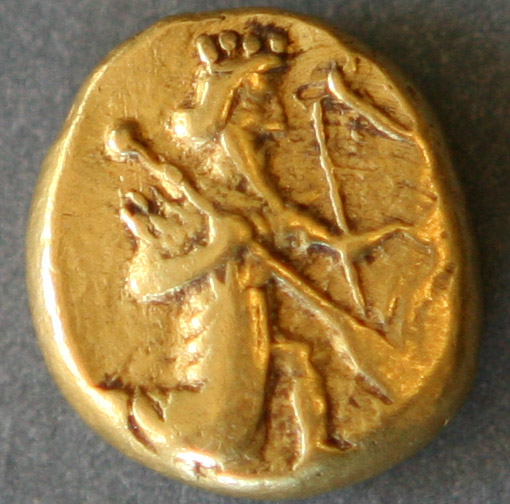
Type IIIb Achaemenid Daric, c. 420 BC.

The daric was a gold coin which, along with a similar silver coin, the siglos, represented the bimetallic monetary standard of the Achaemenid Empire.[1]

Cyrus the Great (550–530 BC) introduced coins to the Persian Empire after 546 BC, following his conquest of Lydia and the defeat of its king Croesus, who had put in place the first coinage in history.[2] It seems Cyrus initially adopted the Lydian coinage as such, and continued to strike Lydia's lion-and-bull coinage.[2]

Darius I (521–486 BC) introduced a new thick gold coin which had a standard weight of 8.4 grams,[3][4] equaling in value 20 silver coins. The gold used in the coins was of very high quality with a purity of 95.83%[5] and it bore the image of the Persian king or a great warrior armed with a bow and arrow. Their use ended with Alexander the Great's invasion in 330 BC, after which they were mostly melted down and recoined as coins of Alexander.[5]

Close to the end of the 5th century BC, the Persian satraps in Asia Minor decided to strike their own coins. Darius considered such encroachment a crime punishable by death since the right of coinage was treated as an exclusively royal prerogative. The numismatic evidence does not permit identification of the image on the darics and sigloi as anything but that of the king; it was adopted by Darius as a dynamic expression of his royal power expressly for his coin issues.

An Achaemenid daric, 4th century BC.

The coin is mentioned twice in the Hebrew Bible, where it is called the "adarkonim",[6] as the Israelites came into contact with it when their Babylonian conquerors were conquered by Persia. The first Book of Chronicles describes King David as asking an assembly of people to donate for the construction of the Temple. The people gave generously "for the service of the house of God five thousand talents and ten thousand darics of gold, ten thousand talents of silver, eighteen thousand talents of bronze, and one hundred thousand talents of iron."[7] Since David's reign is believed to be between c. 1048 and c. 1007 BC according to Old Testament chronology, the use of the daric is either an anachronism or a conversion by the writer into contemporary units.[8][9] The other instance is Ezra 8:27; also a derivative Greek term "darkemonium" is recorded in Ezra 2:69 and three times in Nehemiah 7:70-72.[10][11]

After bribes distributed by a Persian satrap to start the Corinthian War in Greece led to Spartan king Agesilaus II being recalled from a successful campaign in Asia Minor, he remarked that he had been driven out of Asia by "ten (alternately thirty) thousand archers" (referring to the image stamped on the daric).[12][13]

The ancient Greeks believed that the term dareikós (δαρεικός) was derived from the name of Darius the Great, who was believed to have introduced these coins.[1] Some scholars agree with this and constructed the Old Persian word as *dārayaka-,[14] while others have generally supposed that the Greek term can be traced back to Old Persian *dari- ("golden", which possibly evolved into the word زر [zar] in modern Persian) and that it was first associated with the name of Darius only in later folk etymology.[1]

See also

[edit]

References

[edit]
Revisions and contributorsEdit on WikipediaRead on Wikipedia
from Grokipedia
The daric was an ancient introduced by Darius I of the around 515 BCE, serving as the primary currency alongside the silver siglos in a bimetallic that facilitated trade and payments across the vast Persian realm from the Mediterranean to . Weighing approximately 8.4 grams and struck from high-purity based on the Babylonian standard, the daric featured a distinctive design: on the obverse, a kneeling figure of the Persian king—often depicted as an archer holding a bow, arrows, and sometimes a or , symbolizing royal authority and martial prowess; the reverse bore a simple incuse punchmark without inscriptions. Minted primarily at in (modern-day Turkey) after the Persian conquest of the region around 550 BCE, the coin's production continued through various types—such as Type II (c. 505–480 BCE), the most common Type III (c. 485–420 BCE), and Type IV (c. 455–420 BCE)—until the empire's fall to in 330 BCE, after which many darics were melted down. The daric's name likely derives from Darius I himself or the Old Persian term dari- meaning "gold," and it held significant economic and symbolic value, equivalent to a month's wages for a foot and exchangeable for 20 silver sigloi, enabling its widespread circulation in , military payments, and even biblical references like those in 2:69 for temple rebuilding contributions. Its standardized weight and purity marked a key innovation in ancient coinage, asserting the Achaemenid king's centralized control and influencing monetary practices in the ancient Near East.

History

Origins and Introduction

The daric was introduced by Darius I (r. 522–486 BCE) in the late 6th century BCE as a key element of his monetary reforms aimed at standardizing across the vast , which spanned from the Indus Valley to the . These reforms sought to centralize economic administration and facilitate imperial transactions, moving away from diverse local systems toward a unified bimetallic standard that promoted efficiency in taxation, trade, and military payments. Following his consolidation of power after suppressing the Gaumata usurpation in 522 BCE, Darius implemented broader administrative changes, including the reorganization of satrapies and tribute collection, which underpinned the daric's role in imperial cohesion. The term "daric" derives from Greek sources, most likely as a reference to Darius himself, with the earliest attestations appearing in 5th-century BCE texts such as those of , who describes the coin in the context of Persian military expenditures. refers to it as the dareikós statḗr, highlighting its recognition in the Greek world as a high-value piece used for payments like those to Xerxes' army. This nomenclature reflects the coin's association with Darius's reign and its rapid adoption beyond Persian borders, where it competed directly with Greek electrum and silver staters. Precursor influences on the daric included the Lydian coins developed in the 7th–6th centuries BCE, which the Achaemenids encountered after conquering around 546 BCE, providing a model for stamped in Asia Minor. Additionally, the daric adopted Babylonian weight standards, with its mass aligned to the of approximately 8.4 grams, restoring an ancient Mesopotamian metrological tradition adapted for imperial use. The coin's formal adoption is dated to circa 515 BCE, coinciding with Darius's efforts to centralize control over western satrapies and integrate conquered regions into a cohesive economic framework. Complementing the gold daric was the silver siglos, establishing a fixed exchange ratio that further stabilized the empire's monetary system.

Production and Minting

The daric was introduced by Darius I around 515 BCE as part of his monetary reforms to standardize . The primary mint for daric production was located at in , the empire's western satrapal capital and a center of earlier Lydian coin-making traditions, as evidenced by the concentration of early imperial issues and stylistic consistencies in surviving specimens. Possible secondary minting sites included and , inferred from hoard discoveries in those regions—such as the Apadana deposit at containing associated coinage—and references in ancient administrative texts to royal treasuries handling gold processing there. Darics were manufactured using a hammered striking technique, in which artisans prepared pre-cut blanks from refined , positioned them between an engraved lower die (fixed on an ) and an upper die (held in place), and struck the upper die with a to transfer the design in a single or multiple blows; this method represented a refinement of the struck coinage pioneered in , supplanting cruder punch-marked approaches used in some earlier Near Eastern pieces. Production occurred on a significant scale to meet imperial demands, with numerous examples surviving in museums and private collections, including 36 in the American Numismatic Society alone. was maintained through royal oversight, with the gold refined to a high purity of approximately 95.8% to ensure consistency and build confidence in the coin's value across the ; assays and weighing were conducted at the mints under satrapal administration to verify standards before release.

Circulation Until Conquest

The daric circulated widely throughout the from the late 6th century BCE until 330 BCE, serving as a key across a vast territory that extended from in the west to the Indus Valley in the east. Introduced under Darius I around 515 BCE, the coin's high purity and standardized facilitated its acceptance in diverse regions, including satrapies in Asia Minor, , and beyond, where it supported imperial administration and trade. Circulation peaked during the reign of (486–465 BCE), when large-scale minting enabled the funding of expansive military campaigns, reflecting the empire's economic mobilization at its height. The daric played a prominent role in key historical events, particularly the , where it was used to finance Persian invasions and secure alliances. During Darius I's expedition in 490 BCE and Xerxes I's major offensive in 480 BCE, vast quantities of darics were disbursed as payments to Greek mercenaries and as to city-states, enabling the assembly of massive armies and fleets that challenged Greek independence. This heavy deployment underscored the coin's utility in international diplomacy and warfare, with records indicating that such payments circulated even among Greek populations, blending Persian imperial currency into Hellenistic economic spheres. The consistent of the kneeling archer further aided its recognition and trust in these cross-cultural transactions. Archaeological evidence from hoard discoveries highlights the daric's export patterns and role in . For instance, announced in 2024 from a 2023 excavation at the city of Notion in western uncovered a of darics buried in the late BCE, likely representing payments to troops during regional conflicts, illustrating how the coin moved westward from Persian heartlands to support operations in the Aegean. Such finds demonstrate the daric's flow along and campaign routes, often amassed for strategic purposes before being hidden amid political instability. Daric production ceased abruptly following 's of in 330 BCE, marking the collapse of Achaemenid minting authority. As Macedonian forces seized the imperial treasury, containing immense stores of , the remaining darics were largely melted down to finance Alexander's campaigns or overstruck with Hellenistic imagery by successor rulers, effectively ending the coin's imperial issuance after over two centuries. This transition reflected the rapid dissolution of Persian economic structures under .

Design and Specifications

Physical Characteristics

The daric, the primary gold coin of the , had a standard weight of 8.4 grams, corresponding to one , though specimens exhibit minor variations ranging from 8.3 to 8.6 grams depending on the reign and minting conditions. This weight standardization facilitated its role in imperial transactions and international trade. Composed of nearly pure gold with a fineness of 95–99%, the daric's high purity has been confirmed through modern non-destructive analyses, including (PIXE) spectrometry, which reveals trace elements consistent with refining techniques. The gold was primarily sourced from alluvial deposits and mines in the region of , supplemented by supplies from Nubian regions accessed via Achaemenid control over . In terms of dimensions, the daric typically measured 13–17 in and 1–3.5 in thickness, resulting in a compact, somewhat irregular form with unfluted edges characteristic of hand-struck coins produced using hammered dies. While the full daric dominated production, fractional varieties such as 1/10 and 1/20 denominations are exceptionally rare and subject to scholarly debate regarding their official status, with limited evidence derived from 4th-century BCE hoards containing smaller pieces potentially linked to Achaemenid workshops. In the broader bimetallic system, the daric complemented the heavier silver siglos, establishing a fixed exchange ratio for and silver across the .

Iconography and Symbolism

The obverse of the daric typically depicts a kneeling or running figure, widely interpreted as the Persian king or a heroic archer, holding a in the left hand and a or arrows in the right. The figure is attired in garments, including the candys robe and the , emphasizing royal or elite status. This iconography draws from Achaemenid reliefs at and other sites, where similar archer figures symbolize martial readiness and imperial authority. The reverse features a plain punch mark or incuse square, a simple design that facilitated striking without additional engraving. In later issues under (r. 404–358 BCE), the incuse evolved into more defined patterns resembling anvil impressions from the minting process, reflecting refinements in production techniques at imperial workshops. Symbolically, the daric's imagery underscores Achaemenid imperial power, with the archer embodying the king's role as protector and conqueror. The , a central element, carries Zoroastrian connotations as a divine associated with , evoking cosmic order, truth, and victory over chaos in Avestan hymns like the Mihr . Post-Xerxes (after 465 BCE), stylistic shifts introduced greater dynamism and realism in the figure's pose, influenced by Greek artistic conventions encountered in western satrapies, blending Persian and Hellenistic elements. Rare variations from the 5th–4th centuries BCE include types with added Greek letters adjacent to the archer or altered poses, such as a more upright stance, attributed to satrapal mints in Asia Minor where local governors adapted imperial designs for regional circulation. These modifications maintained core symbolism while incorporating Graeco-Persian hybrid motifs, highlighting the coin's adaptability in diverse administrative contexts.

Economic and Military Role

Use in Payments and Trade

The daric played a central role in the Achaemenid Empire's military compensation system, serving as the primary medium for paying soldiers and mercenaries. Greek hoplite mercenaries, who formed a significant portion of the empire's auxiliary forces, received a standard wage of one daric per month, as detailed by the historian in his account of the Younger's campaign. This payment structure enabled the funding of large expeditions, including the 401 BCE march into , where employed over 10,000 Greek troops, illustrating the coin's capacity to mobilize substantial forces across vast distances. In taxation and collection, darics were integral to the empire's fiscal administration under Darius I, who standardized contributions from the satrapies to support central expenditures. Satrapies delivered fixed annual tributes, often in silver talents, which were melted down or exchanged to mint gold darics for royal use; for instance, the second satrapy encompassing , , and neighboring regions contributed 500 Euboic talents of silver yearly, equivalent to a substantial portion of the empire's . These funds were redistributed to key projects, such as the and of the Royal Road, a 2,500-kilometer network linking to that expedited administrative and . The daric's utility extended to , where its high purity and standardized weight made it a trusted medium for transactions within the empire and in international exchanges. It facilitated along Mediterranean ports and overland routes precursor to the , enabling the flow of goods like spices, textiles, and metals between Persian territories and Greek city-states. The coin's value was pegged at approximately 20 silver siglos, providing a reliable bimetallic exchange ratio that supported its acceptance in foreign markets. In the 5th century BCE, darics circulated widely in through commercial interactions and Persian diplomatic payments to Greek polities, resulting in notable hoards that reflect the coin's integration into Aegean economies. Circulation patterns of darics underscored their role in bolstering connectivity along imperial corridors.

Value and Economic Impact

The daric held significant within the Achaemenid , equivalent to one month's for a common , as recorded in contemporary accounts of payments. This value also aligned with approximately 20–30 days of labor for a skilled or , derived from Babylonian records converted at prevailing metal ratios, reflecting the coin's role as a high-value unit suitable for substantial transactions. Inflation remained minimal due to the scarcity of supplies and the daric's consistent high purity (approximately 95.8%), which preserved its reliability over centuries. The Achaemenid bimetallic system fixed the daric's value against silver at a of approximately 13:1 to 15:1, with one daric equivalent to 20 silver siglos, providing a stable exchange framework that facilitated long-distance trade and reduced risks across diverse regions. This is corroborated by Babylonian price lists from the period, which recorded values in shekels aligning closely with the siglos' weight (5.4–5.6 grams), demonstrating practical application in Mesopotamian markets for goods like and dates. By standardizing high-value payments, the daric accelerated the of the Achaemenid economy, shifting reliance from and in-kind tributes toward coin-based exchanges that enhanced administrative efficiency and market integration. Coinage, including darics, underpinned a substantial portion of imperial revenue through taxes assessed in precious metals, with overall taxation estimated at 15–20% of economic output, underscoring the currency's contribution to fiscal stability.

Legacy and Modern Study

Influence on Successor Currencies

The daric exerted significant influence on Hellenistic coinage following Alexander the Great's conquest of the Achaemenid Empire in 330 BCE. Alexander's gold staters, struck in weights approximating 8.4 grams, directly imitated the daric's standard mass and high-purity gold composition, serving as a bridge between Persian and Greek monetary traditions during his campaigns. This adoption ensured continuity in trade and military payments across the vast territories, where captured darics supplemented newly minted coins. Successor rulers, such as Lysimachus, perpetuated this legacy through tetradrachms with gold equivalents of 8.4 grams, blending the daric's functional design with Hellenistic portraiture to assert authority in former Persian domains. In the Parthian Empire, which succeeded Seleucid control in around 247 BCE, early coinage under Arsaces I (r. 247–211 BCE) featured silver issues akin to the Achaemenid siglos, maintaining the bimetallic framework of and established by the daric. These drachms, often depicting an archer or mounted figure, echoed the siglos' weight of about 5.4 grams and served similar roles in regional and taxation. The Sassanid dynasty, emerging in 224 CE, continued this tradition with high-purity dinars to symbolize imperial prestige and facilitate high-value transactions. The daric's legacy indirectly shaped Byzantine and early Islamic currencies through enduring gold standards. The Byzantine solidus, introduced by Constantine I in the CE and weighing around 4.5 grams, derived its consistent weight and fineness from earlier Roman aurei influenced by Persian prototypes like the daric, becoming the backbone of Mediterranean for centuries. After the Arab conquests, Umayyad dinars minted post-661 CE adopted comparable gold fineness levels, typically exceeding 95%, to integrate into existing Byzantine and Persian economic networks while asserting Islamic . Specific regional imitations further demonstrate the daric's iconographic impact in . Bactrian and Indo-Greek coins from the 3rd to 1st centuries BCE incorporated archer motifs directly drawn from daric prototypes, portraying kneeling figures with bows to evoke Persian royal authority amid Greek-style portraits and local adaptations. These hybrids facilitated cross-cultural exchange along trade routes, preserving the daric's symbolic power in diverse Hellenistic successor states.

Archaeological and Numismatic Analysis

Archaeological discoveries of darics have provided critical insights into Achaemenid economic practices and , with major hoards revealing patterns of circulation in border regions. One of the most significant recent finds occurred during the 2024 University of Michigan excavations at the ancient Greek city of Notion in western , where archaeologists uncovered a ceramic pot containing a hoard of darics dating to the late fifth century BCE. These coins, likely buried as payment for mercenary troops amid regional upheavals during the era, represent one of the few intact hoards recovered through controlled scientific excavation rather than . Additionally, historical records document larger illicit discoveries, such as enormous hoards numbering thousands of darics unearthed by treasure hunters in the nineteenth and twentieth centuries, including scattered reports of significant caches along the River basin, though precise contexts are often lost due to unregulated recovery. Authentication of darics relies on advanced numismatic techniques to verify composition and , addressing challenges posed by forgeries and degraded specimens. X-ray fluorescence (XRF) spectrometry has been instrumental in confirming the coins' high purity, with analyses consistently showing darics composed of approximately 95.8% and trace amounts of silver and that align with Achaemenid standards. Complementing this, die-link studies—comparing motifs across specimens—have identified over 200 distinct obverse dies, enabling scholars to trace production sequences and estimate mint output from and other imperial centers. These methods not only authenticate individual pieces but also refine chronological attributions by linking darics to earlier prototypes from sixth-century BCE Lydian coinage, which influenced the Achaemenid design transition around 520 BCE under Darius I. Scholarly interpretations of darics continue to evolve through debates centered on and historical context. A key controversy surrounds the kneeling archer figure on the obverse, traditionally viewed as a stylized representation of the Achaemenid king but debated by some as a or divine avatar, potentially embodying or a protective , given the absence of explicit royal labels and parallels in reliefs. Dating refinements further hinge on connections to pre-Achaemenid issues from the mid-sixth century BCE, such as Lydian staters, which share stylistic elements like incuse punches and helped establish the daric's introduction no later than the late sixth century. Major institutional collections, including significant holdings in the from acquisitions like the and more than 100 in the (), facilitate these analyses. In 2025, emerging AI-driven tools have enhanced detection, achieving up to 99% accuracy in identifying subtle deviations in die wear and alloy inconsistencies on ancient coins like darics.

References

Add your contribution
Related Hubs
User Avatar
No comments yet.