Hubbry Logo
Oxus TreasureOxus TreasureMain
Open search
Oxus Treasure
Community hub
Oxus Treasure
logo
8 pages, 0 posts
0 subscribers
Be the first to start a discussion here.
Oxus Treasure
Oxus Treasure
from Wikipedia
The Oxus Treasure at Room 52, the British Museum

The Oxus treasure (Persian: گنجینه آمودریا) is a collection of about 180 surviving pieces of metalwork in gold and silver, most relatively small, and around 200 coins, from the Achaemenid Persian period which were found by the Oxus river about 1877–1880.[1] The exact place and date of the find remain unclear, but is often proposed as being near Kobadiyan.[2] It is likely that many other pieces from the hoard were melted down for bullion; early reports suggest there were originally some 1500 coins, and mention types of metalwork that are not among the surviving pieces. The metalwork is believed to date from the sixth to fourth centuries BC, but the coins show a greater range, with some of those believed to belong to the treasure coming from around 200 BC.[3] The most likely origin for the treasure is that it belonged to a temple, where votive offerings were deposited over a long period. How it came to be deposited is unknown.[4]

As a group, the treasure is the most important survival of what was once an enormous production of Achaemenid work in precious metal. It displays a very wide range of quality of execution, with the many gold votive plaques mostly crudely executed, some perhaps by the donors themselves, while other objects are of superb quality, presumably that expected by the court.[5]

The British Museum now has nearly all the surviving metalwork, with one of the pair of griffin-headed bracelets on loan from the Victoria and Albert Museum, and displays them in Room 52. The group arrived at the museum by different routes, with many items bequeathed to the nation by Augustus Wollaston Franks. The coins are more widely dispersed, and more difficult to firmly connect with the treasure. A group believed to come from it is in the Hermitage Museum in Saint Petersburg, and other collections have examples.[6]

Objects

[edit]

Achaemenid style arose rapidly with the very quick growth of the huge empire, which swallowed up the artistic centres of the ancient Near East and much of the Greek world, and mixed influences and artists from these. Although continuing influences from these sources can often be detected the Achaemenids formed a distinct style of their own.[7]

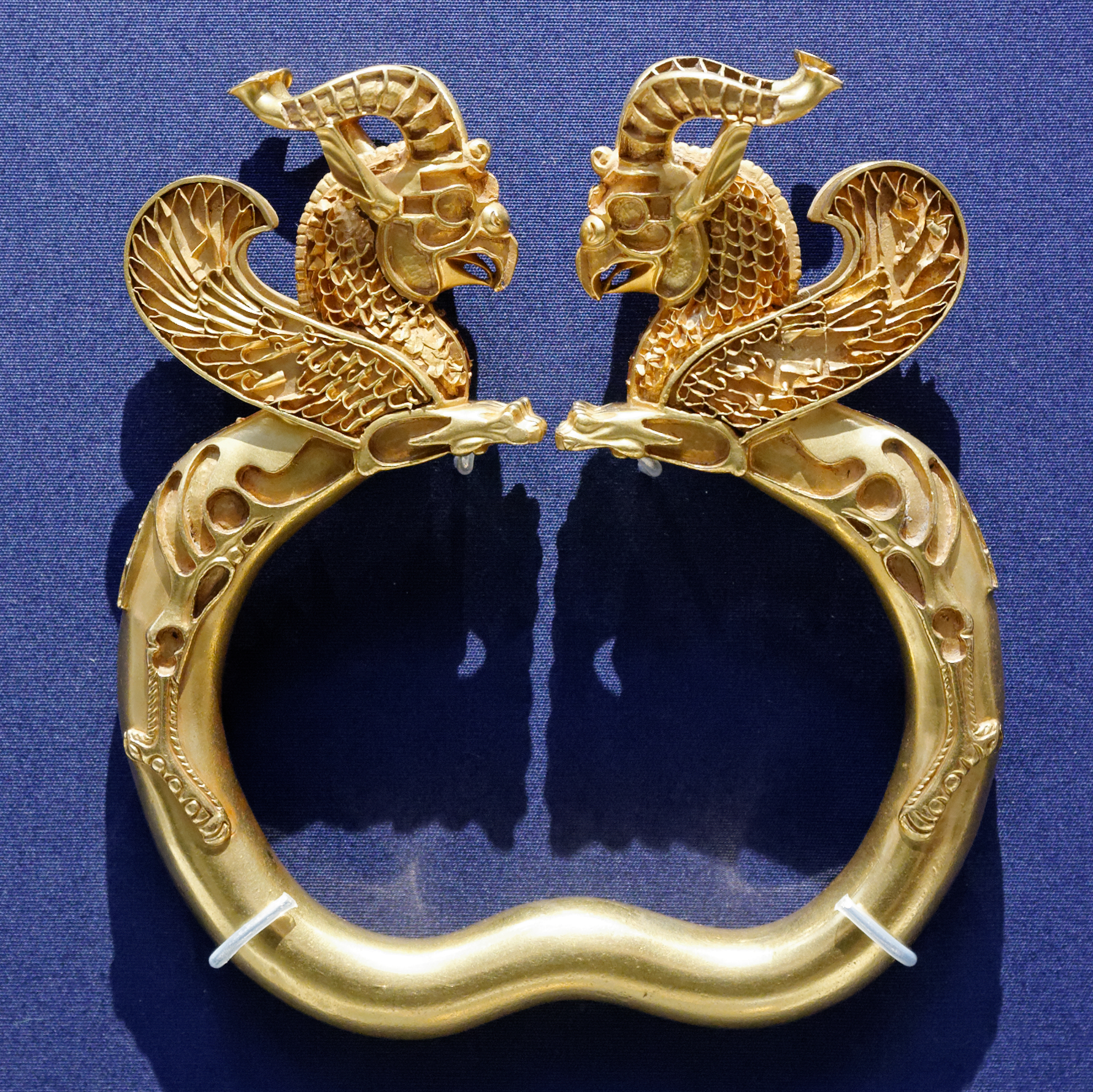
The griffin-headed bracelets from the hoard are typical of the 5th to 4th century BC court style of Achaemenid Persia. Bracelets of a similar form to ones from the treasure can be seen on reliefs from Persepolis being given as tribute, whilst Xenophon writes that armlets (among other things) were gifts of honour at the Persian court. Glass, enamel or semi-precious stone inlays within the bracelets' hollow spaces have now been lost.[8]

Sir John Boardman regards the gold scabbard, decorated with tiny figures showing a lion hunt, as pre-Achaemenid Median work of about 600 BC, drawing on Assyrian styles, though other scholars disagree, and the British Museum continues to date it to the 5th or 4th centuries.[9]

The surviving objects, an uncertain proportion of the original finds, can be divided into a number of groups.

Sculptures

[edit]

There are a number of small figurines, some of which may have been detached from larger objects. The single male figures appear to show worshippers rather than deities. The largest is most unusual for Persian art in showing a nude youth (in silver) standing in a formal pose, with a large conical hat covered in gold foil. The statuette shows Greek influence, in the figure and the fact of being nude, but is not typical of ancient Greek art. Two hollow gold heads of young males, rather crudely executed, probably belonged to composite statues with the main body in wood or some other material.[10] One figure in silver and gold has a headdress that suggests he may be a king.[11]

Other sculptural objects include two model chariots in gold, one incomplete, plus figures of a horse and a rider that may belong to this or other model groups, as may two other horses cut out from sheet gold.[12] The wheels of the complete chariot would originally have turned freely, and it had received at least one repair in antiquity. It is pulled by four horses (rather small, and with only nine legs surviving between them) and carries two figures, a driver and a seated passenger, both wearing torcs. The chariot has handrails at the open rear to assist getting in and out, while the solid front carries the face of the protective Egyptian dwarf-god Bes.[13] A leaping ibex was probably the handle of an amphora-type vase, and compares with handles shown on tribute vessels in the Persepolis reliefs, as well as an example now in the Louvre.[14]

Jewellery and fittings

[edit]
One of a pair of armlets from the Oxus Treasure, which has lost its inlays of precious stones or enamel
Gold animal statuettes from the Oxus Treasure

The two griffin-headed bracelets or armlets are the most spectacular pieces by far, despite lacking their stone inlays. There are a number of other bracelets, some perhaps torcs for the neck, several with simpler animal head terminals variously depicting goats, ibex, sheep, bulls, ducks, lions, and fantastic creatures. Many have inlays, or empty cells for them; it used to be thought that this technique was acquired from Ancient Egyptian jewellery (as in some of Tutankhamun's grave goods), but Assyrian examples are now known.[15] There are 12 finger rings with flat bezels engraved for use as signet rings, and two stone cylinder seals, one finely carved with a battle scene.[16]

The griffin-headed bracelets were also the most complex objects to manufacture, being cast in several elements, then worked in many different techniques, and soldered together. Some of the surfaces are very thin, and show signs of damage, and in one place repair with a soldered patch.[17]

A "Gold plaque in the form of a lion-griffin, with the body of an ibex and a leaf-shaped tail", with missing inlay, has two prongs behind for attaching it, and may have been an ornament for a cap or the hair, or part of an object. The animal's legs are folded beneath its body in a way characteristic of the Scythian animal style of the southern Russian steppes, an influence also seen in other pieces such a ring with a lion.[18]

A stylized birds-head ornament can be recognised, like the finely-decorated scabbard of "Median" shape, as very similar to that of a soldier from a Persepolis relief, where it forms the crest to his bow-case.[19] These seem to be the only items relating to weapons, though other pieces may have decorated horse harness.[20] Another group of plaques were probably bracteates intended to be sewn onto clothing through the small holes round their edges. These have a variety of motifs, including the face of the Egyptian dwarf-god Bes, lion-griffins, a sphinx, and a cut-out figure apparently showing a king (see illustration below; Bes is centre in the top row, the king at bottom right).[21]

Votive plaques

[edit]
Votive plaques

The British Museum has 51 thin gold plaques with incised designs, which are regarded as votive plaques left by devotees at a temple as an offering to the deity. They are mostly rectangular with the designs in a vertical format, and range from 2 to 20 cm (0.79 to 7.87 in) tall. Most show a single human figure facing left, many carrying a bunch of twigs called a barsom used in offerings; these probably represent the offeror. The dress of the figures shows the types known as "Median" and "Persian" to modern historians, and the quality of the execution is mostly relatively low, but varies greatly, with some appearing to have been incised by amateurs. Three show animals, a horse, a donkey and a camel; possibly it was their health that was the subject of the offering.[22] One large figure is in shallow relief within its incised outline (illustrated).

Vessels

[edit]

The London group includes bowls, a gold jug, and a handle from a vase or ewer in the form of a leaping ibex,[23] which is similar to a winged Achaemenid handle in the Louvre.[24] No rhyton drinking vessels were found, but the British Museum has two other Achaemenid examples, one ending in a griffin's head similar to that on the bracelets in the treasure.[25] A hollow gold fish, apparently representing a species of carp found only in the Oxus, has a hole at its mouth and a loop for suspension; it may have contained oil or perfume, or hung as one of a group of pendants.[26]

Coins

[edit]

The association of surviving coins with the treasure is less generally accepted than for the other items, and O. M. Dalton of the British Museum, author of the monograph on the treasure, was reluctant to identify any specific coins as part of it, while Sir Alexander Cunningham (see below) disagreed, identifying about 200. The Russian scholar E.V. Zeymal associated 521 surviving coins with the treasure, without extending the terminus post quem for deposition of the treasure beyond Cunningham's figure of about 180 BC.[27] The coins associated with the treasure include examples from various Achaemenid mints and dates, but also later ones from after the conquest of the Empire by Alexander the Great, with the latest being of the reigns of Antiochus the Great (r. 223–187 BC) and Euthydemus I of Bactria (r. c. 235–200 BC).[28]

History

[edit]
Assorted small objects from the Oxus treasure

The treasure was evidently discovered by local people somewhere on the north bank of the Oxus in what is today Tajikistan but was in the 1870s in the Emirate of Bokhara, which was in the process of being swallowed up by the Russian Empire. Then as now, the south bank of the Oxus was Afghanistan; at the period when the treasure originated the whole area was part of the Persian Empire. The approximate area of the discovery is fairly clear; it was near, perhaps some three miles south of, Takhti-Sangin, where an important temple was excavated by Soviet archaeologists in the 20th century, producing a large number of finds of metalwork and other objects, which seem to have been deposited from about 300 BC to as late as the third century AD. While it is tempting to connect the temple and treasure, as some scholars have proposed, the range of objects found, and a founding date for the temple proposed by the excavators of about 300 BC, do not neatly match up. The area was a major ancient crossing point for the Oxus, and the treasure may have come from further afield.[29]

The first mention in print of the treasure was an article in a Russian newspaper in 1880, written by a Russian general who in 1879 was in the area enquiring into the Trans-Caspian railway that the Russians had just begun to construct. He recounted that local reports said that treasure had been found in the ruins of an ancient fort called "Takht-i Kuwad", which was sold to Indian merchants.[30] A later report by Sir Alexander Cunningham, the British general and archaeologist who was the first Director of the Archaeological Survey of India, described the finds, which he said began in 1877, as being in the river itself, "scattered about in the sands of the river", in a place exposed in the dry season, though another account he later gave, based on new information, rather confused the issue. Cunningham acquired many pieces himself through dealers in northern India (modern Pakistan).[31] Another account by a British general owning some objects said that they had been discovered in 1876, exposed by "a land slip of the river bank".[32] Hopeful diggers continued to excavate the site for years afterwards, and perhaps objects continued to be found; accounts from locals mention many gold "idols", a gold tiger, and other objects not tallying with the surviving pieces.[33]

Gold plaques for attaching to clothing

One large group of objects, perhaps the bulk of the treasure, was bought from locals by three merchants from Bokhara in 1880, who unwisely left their convoy on the road south from Kabul to Peshawar and were captured by Afghan tribesmen, who carried them and their goods into the hills, but allowed a servant of the merchants to escape. News of the episode reached Captain Francis Charles Burton, a British political officer in Afghanistan, who immediately set out with two orderlies. About midnight he came upon the robbers, who had already begun to fight among themselves, presumably over the division of the loot, with four of them lying wounded on the ground. The treasure was spread out on the floor of the cave they were sheltered in. In a parlay Burton recovered a good part of the treasure, and later a further portion, which he restored to the merchants. In gratitude, they sold him the bracelet which he sold to the Victoria and Albert Museum (now on loan to the British Museum) for £1,000 in 1884. The merchants then continued to Rawalpindi in modern Pakistan to sell the rest of the Treasure; Cunningham acquired many of these pieces, and through dealers, Franks others. The robbers evidently considered the objects as bullion, and had cut up some larger ones, such as a gold scabbard now in the British Museum.[34] Other pieces may have been cut up in antiquity (like hacksilver), or upon discovery at the site. Franks later bought Cunningham's collection, and bequeathed all his objects to the British Museum at his death in 1897.[35]

The incomplete model chariot and a detached figure of a rider were presented to the Viceroy of India at the time, Robert Bulwer-Lytton, 1st Earl of Lytton (son of the bestselling novelist) by Sir Louis Cavagnari, the British representative in Kabul after the Second Anglo-Afghan War. Cavagnari, his mission and their guards were all massacred in Kabul on 3 September 1879. Lytton's rider was acquired by the British Museum in 1931, and the chariot group in 1953.[36]

Religious context

[edit]

The Achaemenid kings, at least after Cyrus the Great and Cambyses, describe themselves in inscriptions as worshippers of Ahuramazda, but it is not clear if their religious practice included Zoroastrianism. It is also evident that it was not the Persian way to impose the royal religious beliefs on their subjects (as for example the Jews, whose religious practices were not interfered with after they were conquered). Other Persian cults were the worship of Mithra and of Zurvan, and other local cults seem to have continued under the empire. The religious context of the treasure is unclear, although it is thought to have come from a temple.[37]

Authenticity

[edit]
Comparable objects in the "Apadama" reliefs at Persepolis: armlets, bowls, and amphorae with griffin handles are given as tribute

The circumstances of the discovery and trading of the pieces, and their variety of styles and quality of workmanship, cast some doubt on their authenticity from the start, and "necessitate a cautious treatment of the Oxus Treasure, for it has passed through places of evil repute and cannot have come out quite unscathed", as Dalton put it in 1905.[38] Indeed, Dalton records that Indian dealers initially made copies of items and tried to pass them off to Franks, who though not deceived, bought some "at a small percentage over the gold value" and then received the genuine objects, which were easily distinguished.[39] Considerable comfort has been received from the objects' similarity to later Achaemenid finds, many excavated under proper archaeological conditions, which the Oxus Treasure certainly was not. In particular, finds of jewellery including armlets and torcs in a tomb at Susa by a French expedition from 1902 onwards (now in the Louvre) are closely similar to the Oxus finds.[40]

As the quality and style of the objects was generally considered to have stood the test of time, concerns over the antiquity of the great majority of the objects reduced over the years. The issue was revived in 2003 when the archaeologist Oscar Muscarella, employed by the Metropolitan Museum of Art in New York for 40 years, was reported in The Times, in a story by Peter Watson, to have "labelled as mostly fake" the treasure.[41] However he was attacked by the Director of the Metropolitan, Philippe de Montebello, who said Muscarella, a long-standing critic of museums' tolerance and even encouragement of the trade in illegal antiquities, only remained there because of the "exigencies of academic tenure", and was himself criticised for suppressing debate.[42] In an article on the Oxus Treasure published in 2003 Muscarella goes nothing like as far, but does fiercely attack the assumed unity of the treasure and the narratives of its provenience, and is sceptical of the authenticity of some of the votive plaques (especially the largest in the illustration above).[43] In a follow-up article, John Curtis has argued there is overwhelming contemporary evidence that the Treasure was discovered on the north bank of the River Oxus between 1877 and 1880, and he also maintains that most if not all of the objects in the Treasure are genuine.[44]

Tajik government

[edit]

In 2007, Emomalii Rahmon, President of Tajikistan, was reported as calling for the repatriation of the treasure, despite the fact that it had been recovered and sold by local peoples and acquired by museums in the art market.[45] However, no formal claim has been made by the Tajik government, and in 2013, "high-quality golden replicas" of pieces from the Oxus Treasure were presented to the Tajik government by the British Museum, intended for the new Tajik National Museum.[46]

References

[edit]

Further reading

[edit]
Revisions and contributorsEdit on WikipediaRead on Wikipedia
from Grokipedia
The Oxus Treasure is a comprising approximately 180 gold and silver artifacts and around 200 coins, dating primarily to the 5th and 4th centuries BCE during the Achaemenid Persian Empire. It constitutes the most significant surviving assemblage of Achaemenid precious metalwork, featuring items such as armlets, statuettes, model chariots, vessels, and votive plaques that reflect advanced craftsmanship and iconographic motifs blending Persian imperial styles with local Central Asian influences. The collection, now housed in the , was acquired piecemeal between 1877 and 1897 through purchases by British officers from local traders near the Oxus River in present-day . Contemporary accounts associate its discovery with the ruins of a fortified site at Takht-i Kuwad, though scholarly analysis suggests it likely originated as votive deposits from the nearby Temple of the Oxus at Takht-i Sangin, a major religious center in ancient . This provenance underscores the treasure's role in illuminating Achaemenid religious practices, artistic production, and cultural exchanges across the empire's eastern satrapies.

Discovery and Acquisition

Circumstances of Discovery

The Oxus Treasure consists of artifacts recovered informally between approximately 1877 and 1880 from the northern bank of the Oxus River (modern ) near Takht-i Kuwad, in what is now , close to the Afghan border. Local accounts, derived from regional oral reports and early dealer testimonies, describe the items as unearthed by Tajik or Afghan villagers, likely during seasonal riverbed scavenging or near ancient shrine ruins, amid the political fragmentation of under Bukharan and Afghan influences. No controlled excavation occurred, resulting in the gradual surfacing of over 170 gold and silver objects, which were dispersed piecemeal rather than retrieved as a unified . The absence of contemporary documentation from the finders themselves—typical for such illicit recoveries in a remote, unstable frontier zone—leaves precise details elusive, though consistent traditions link the deposit to a possible temple or fort site at Takht-i Kuwad, where artifacts may have accumulated as votive offerings before erosion or looting exposed them. Initial handling involved local handlers selling pieces to Bokharan merchants, who transported them southward through markets like those in , capitalizing on the era's gold trade networks and weak central authority. This fragmented dispersal preserved few records, but cross-corroboration from multiple 19th-century merchant accounts supports the riverine origin over contrived narratives.

Path to Western Acquisition

The principal artifacts of the Oxus Treasure entered Western collections through purchases made by British officials from antiquities dealers in British India during the late 19th century. Major-General , Director-General of the , acquired a significant portion of the gold and silver objects around 1880 from merchants in , who had sourced them via overland trade networks extending from into the . These transactions occurred amid regional instability in the Oxus River valley, where tribal conflicts and economic hardship prompted local families to sell heirlooms and temple votives on open markets, rather than through any organized excavation or seizure by colonial authorities. Cunningham's holdings, comprising dozens of metalwork pieces including armlets, statuettes, and vessels, were subsequently acquired by Sir Augustus Wollaston Franks, a prominent collector of and keeper at the . Upon Franks's death in , he bequeathed this core collection—totaling approximately 170 gold and silver artifacts—to the , where it forms the nucleus of the surviving Oxus Treasure assemblage. A smaller number of related items, such as additional coins and fragments, were donated or purchased by the museum in subsequent years, but the bequest established British institutional control without evidence of direct imperial looting or coercive appropriation. The acquisitions reflect standard market practices of the era, predating modern international conventions on , and originated from voluntary sales rather than battlefield confiscation.

Documentation and Early Records

The initial records of the Oxus Treasure derive from Cunningham's articles in the Journal of the Asiatic Society of , published in 1881 (pp. 151 ff.) and 1883 (pp. 64 ff., 358-260), which detail the 1877 discovery near the Oxus River in , between Khulm and Kabadian, where artifacts were reportedly scattered in river sands, possibly exposed by floods, with further pieces found 1-2 years later. These accounts, based on merchant testimonies including a deposition from Wazi ad-Din, describe transport by Bokhara traders via and to Hindu dealers in Rawal Pindi, without European witnesses at the findspot. A 1880 report by Captain F. C. Burton documents the recovery of approximately three-quarters of the hoard after a en route, with the remainder apportioned by weight among claimants, highlighting disruptions in early custody typical of informal regional markets. Sales in the involved dealers such as C. M. Cursetjee, who facilitated piecemeal transactions to collectors including and Sir A. W. , as noted in Franks' acquisition notes and Cunningham's correspondence. Franks bequeathed the bulk of the collection to the in 1897, where registration occurred in the late , with entries logging individual weights—such as 580 grains for certain armlets, 1,135 grains for plaques, and up to 15.5 ounces for larger items—alongside notations of inscriptions like on rings (e.g., personal names such as "Pahashp") and Pehlevi script on select pieces. Initial attributions to the Achaemenid era (5th-4th century BCE) stemmed from these records' stylistic analyses, cross-referenced with known Persian sites, though without excavation context. Formal cataloging followed in O. M. Dalton's 1905 British Museum publication, incorporating earlier Archaeologia (Vol. LVIII) and Proceedings of the Society of Antiquaries of London (2nd Ser., Vol. VIII, pp. 374 ff.) references, which compiled dealer reports and weights for tracking. Chain-of-custody gaps arise from undocumented dealer handling in Rawal Pindi's unregulated trade, including suspicions of added counterfeits, yet primary consistencies in artifact styles align with verified Achaemenid assemblages from , bolstering overall authenticity despite incomplete records.

Description of Artifacts

Jewelry and Personal Ornaments

The jewelry and personal ornaments in the Oxus Treasure include gold armlets and bracelets featuring animal-head terminals, crafted with advanced techniques such as chasing, chiselling, and applied cloisons for inlays during the Achaemenid 5th-4th centuries BCE. A prominent penannular armlet terminates in confronting griffin heads with winged monster bodies in low relief, originally adorned with colored stone inlays in cup-shaped cells, measuring 12.3 cm in height and weighing 396.5 grams. These pieces exemplify repoussé embossing and , creating intricate details on mythical beasts with open beaks, horns, and feathers. Bracelets similarly display zoomorphic motifs, such as ram's heads with necks decorated by parallel rows of cloisons holding inlays, on plain rounded hoops with a of 7.25 cm and total weight of 67 grams. Penannular designs facilitated wearing, with solid construction and chased decoration suggesting functionality for elite adornment rather than exclusive votive deposition. Earrings consist of hollow gold penannular forms embossed on the exterior with patterns, alongside beads and fittings incorporating animal motifs like lions and griffins for assembly into necklaces or attachments. Collectively, these items demonstrate high craftsmanship, with detailing via and , and evidence of practical use through wearable forms and surface polishing.

Figurines and Miniature Sculptures

The figurines and miniature sculptures of the Oxus Treasure comprise small-scale figures and vehicular models crafted in and silver, dating to the Achaemenid period between the 5th and 4th centuries BCE. These artifacts demonstrate technical proficiency in , chasing, and work, with stylistic features such as elongated proportions and detailed surface treatments aligning with broader Persian imperial artistic conventions observed in monumental reliefs. Silver statuettes, typically ranging from 14 to 29 cm in height, depict standing human forms including nude and bearded men, produced through hollow or solid followed by chased detailing and occasional inlays for accents. A cast silver example of a nude measures 29.2 cm tall, with arms extended forward in clenched fists, exemplifying the restrained pose and anatomical idealization characteristic of Achaemenid figural art. Similarly, a 14.5 cm silver statuette portrays a figure in a comparable upright stance, weighing 386.5 grams and refined through surface chasing. Gold variants, such as a chased statuette of a bearded man with short hair and a stiff headdress, further illustrate the use of precious metals for elite miniature representations. Miniature sculptures extend to equestrian and vehicular models symbolizing high status, including harness fittings and components from chariots indicative of Achaemenid and processional imagery. A prominent model of a four-horse , approximately 30 cm long, features an open cab, rotating wheels, a with four bays, and figures of a and , crafted from sheet with soldered elements to evoke imperial-scale conveyances. Associated fittings, such as pierced plates for horse attachments, complement these models and highlight specialized for functional yet ornamental elite accessories. These items, numbering in the dozens among the treasure's corpus, owe their survival to burial within the oxygen-poor sediments of the Oxus River bed near Takht-i Kuwad, which inhibited oxidative degradation of the metals over centuries.

Votive Plaques and Reliefs

The votive plaques of the Oxus Treasure comprise approximately 51 thin rectangular sheets of , typically measuring 4-5 cm in height and width, decorated with figural motifs related to and ritual offerings. These flat items differ from the treasure's three-dimensional sculptures by their stamped or punched designs, intended for dedicatory purposes at a temple site, as evidenced by recurring scenes of devotees in Median-style dress holding barsom bundles—twigs used in Zoroastrian fire rituals. Production involved hammering gold sheets over dies to create embossed low-relief figures, followed by chasing from the reverse to refine details and punching outlines for silhouettes of animals such as horses or camels in some examples. Many plaques feature integral suspension loops at the top, facilitating attachment to temple furnishings or garments as ex-votos, with weights ranging from 77 to 82 grams for larger specimens, indicating standardized yet variable craftsmanship. Motifs often depict clean-shaven male figures advancing rightward in belted tunics, presenting offerings, or isolated symbols like recumbent beasts, reflecting Achaemenid religious without narrative complexity. Variations in execution, from finely chased details to cruder punching, point to hierarchical production across satrapal workshops, where elite centers produced higher-quality pieces while peripheral ones yielded simpler repetitions for mass dedication. Silver examples are rarer, but follow analogous flat formats, underscoring the plaques' role as affordable votive media distinct from costlier reliefs or cast works.

Vessels and Functional Items

The vessels and functional items from the Oxus Treasure consist primarily of small and silver bowls, drinking cups, jugs, ladles, and strainers, totaling fewer than 20 pieces designed for practical use such as libations or serving liquids. These objects, dated to the Achaemenid period (5th-4th centuries BCE), feature shallow hemispherical or low-umbo forms typical of Persian metalwork, often hammered from with embossed or chased surface details for decoration without compromising utility. Silver examples, including phiales for pouring libations, exhibit gilded elements and applied motifs, while pieces demonstrate alloy variations akin to for durability in repeated handling. Metallurgical techniques evident include for repairs—such as patches on damaged surfaces—and riveting for attachments like handles, indicating these items endured wear from non-ceremonial use rather than purely votive deposition. Utility marks, including traces and deformation from , further suggest functional roles in daily or serving, distinct from the treasure's predominantly ornamental artifacts. One notable outlier is a hollow hammered fish-shaped object, possibly a or small vessel, showcasing sheet-forming and to create a lightweight, portable form.

Associated Coins

The Oxus Treasure incorporates approximately 200 coins, chiefly Achaemenid gold darics and silver sigloi, recovered alongside the gold and silver artifacts near the Oxus River. These coins, standardized under Darius I around 520 BCE and continuing until the empire's fall in 330 BCE, weigh approximately 8.4 grams for darics (pure ) and 5.4 grams for sigloi (silver), reflecting the bimetallic imperial standard. The obverse designs depict a Persian royal figure in dynamic motion—typically striding right, clad in a serrated crown and , wielding a bow and or —which mirrors sigillographic conventions from Achaemenid seals and glyptic , emphasizing continuity in royal rather than individualized portraits. Reverse sides remain incuse or blank, prioritizing symbolic over narrative detail. Such elements, absent earlier local currencies, mark these as official imperial issues from or other western mints, circulated across the satrapies. As chronological anchors, the coins' span from the reigns of Darius I (522–486 BCE) through (359–338 BCE) constrains the hoard's deposition to the late Achaemenid phase, likely circa 400–330 BCE, when the latest issues predominated before disruptions from Alexander's campaigns. This numismatic profile aligns the treasure with heightened regional temple dedications or elite hoarding amid eastern frontier instabilities, without implying broader monetary functions here.

Historical and Cultural Context

Achaemenid Empire Framework

The Oxus Treasure comprises artifacts produced during the , which extended from its founding by in 550 BCE to its fall to in 330 BCE. This period encompassed vast territories organized into satrapies, with eastern provinces like and Margiana incorporated as the twelfth satrapy following Cyrus's campaigns around 545 BCE. The empire's administrative structure under Darius I (r. 522–486 BCE) and his successors standardized tribute collection, channeling precious metals from peripheral regions to imperial centers, thereby enabling the accumulation and artisanal processing of gold and silver in satrapal workshops. Bactria-Margiana's integration into the Achaemenid domain tied local production centers to imperial oversight, where regional metallurgical expertise adapted to Persian stylistic canons, reflecting causal dependencies on satrapal revenues for raw material supply. Artifacts from the treasure, dated primarily to the 5th–4th centuries BCE, align with the peak of this system, during which Darius I's reforms enhanced fiscal extraction from Central Asian satrapies to fund imperial projects and elite consumption. Persepolis treasury records provide empirical corroboration, documenting inflows of gold and silver bullion from eastern districts, including quantities processed into finished goods akin to those in the Oxus hoard. These administrative tablets, inscribed in circa 500–330 BCE, detail deposits and disbursements that mirror the treasure's material composition, underscoring the empire's role in aggregating and redistributing wealth across its geography. Such mechanisms ensured that peripheral workshops, operating under Persian aegis, contributed to a unified artistic output while drawing on locally sourced metals refined through imperial tribute flows.

Regional Production and Trade

![Gold model chariot from the Oxus Treasure][float-right] The artifacts of the Oxus Treasure demonstrate manufacturing techniques characteristic of Achaemenid goldsmithing adapted in Central Asian workshops, as evidenced by scientific examinations conducted at the . Analyses of nine objects, including armlets and figurines, reveal the use of , hammering, and , with alloy compositions typically comprising 90-95% alloyed with silver and copper, consistent with regional production capabilities in and adjacent satrapies during the 5th-4th centuries BCE. The inclusion of platinum-group minerals in the gold artifacts points to sourcing from local placer deposits along the River, indicating that raw materials were primarily procured regionally rather than imported from distant imperial centers. This local availability facilitated production in workshops under Achaemenid oversight, where artisans in areas like Takht-i Kuwad processed into votive items, supported by the empire's administrative integration of Central Asian territories. Stylistic hybrids in the treasure, blending Achaemenid Persian elements with n and Greek features, suggest collaborative practices in Sogdian and n centers, reflecting enforced imperial standards amid local traditions. The empire's control over these satrapies enabled the oversight of such workshops, ensuring output aligned with prototypes while incorporating regional motifs. The hoard's scale—approximately 180 metalwork pieces and 200 coins—implies accumulation from trade activities along Achaemenid-managed routes traversing , which connected to Mediterranean and Indian networks, generating through in precious metals and . These pathways, precursors to later systems, funneled resources to local temples or depots near the Oxus, underscoring the region's role as a under imperial trade regulation.

Comparative Artifacts from Contemporaries

The Oxus Treasure's gold and silver artifacts exemplify the sedentary craftsmanship of Achaemenid imperial workshops, marked by symmetrical motifs and precise execution that set them apart from the contemporaneous goldwork of nomadic artisans. Scythian pieces, such as those recovered from 5th- to 3rd-century BCE kurgans in the Altai region, emphasize dynamic animal combats and hybrid beasts rendered in hammered repoussé sheets with vigorous, asymmetrical compositions reflective of mobile pastoralist life, whereas Oxus items like griffin-headed armlets feature rigidly hierarchical, courtly designs achieved through controlled chasing and punching in fixed ateliers. This precision underscores Persian dominance in metallurgical standardization, enabling of elite across satrapies without the variability inherent in Scythian decentralized forging. In contrast to Babylonian and Lydian hoards, which show localized echoes of Persian influence—such as Achaemenid-style figured friezes on early 6th- to 5th-century BCE Lydian silver vessels from Sardis burials—the Oxus collection displays unmatched uniformity in form and iconography, attributable to centralized oversight from Persepolis and Susa that subordinated provincial traditions to imperial prototypes. Babylonian metalwork, often retaining Neo-Babylonian cuneiform-inscribed vessels from mid-6th-century hoards, lacks this cohesive stylistic canon, prioritizing regional Mesopotamian palmette and rosette patterns over the synthesized hybridity of Achaemenid output. The post-Alexander dispersal of Achaemenid wealth after the 330 BCE conquest facilitated the survival of peripheral caches like the Oxus hoard, deposited in remote eastern riverbanks beyond the reach of Macedonian looting campaigns that targeted core treasuries, resulting in higher preservation rates for votive assemblages in zones compared to melted-down central reserves.

Religious and Iconographic Analysis

Votive Dedication Evidence

Numerous artifacts in the Oxus Treasure feature suspension loops, indicating they were designed to be hung, a common feature in ritual offerings at ancient shrines. For instance, the hollow gold fish vessel, depicting a barbel species native to the Oxus River, includes an applied loop above its fin for suspension or attachment, suggesting use as a pendant in temple rituals potentially linked to riverine worship. Similarly, over 50 gold votive plaques, often depicting figures in ritual attire, bear evidence of attachment mechanisms consistent with suspension for dedicatory purposes. The grouped deposition of approximately 180 metal objects and 200 coins, discovered together near the Oxus River bank around 1877-1880, points to intentional ritual accumulation rather than accidental loss or plunder. This hoard-like assembly aligns with practices of accumulating votives over time in sacred contexts, as opposed to dispersed or trade caches. Excavations at the nearby Takht-i temple, a probable site associated with the Oxus River, reveal parallels in Achaemenid-period votive deposits, including and silver items placed in pits (bothroi) and corridors, often fragmented or stored in containers for decommissioning rituals. These finds, spanning metalwork and inscriptions invoking river cults, mirror the Oxus Treasure's composition and support interpretation as temple offerings from a similar regional tradition. Dating evidence from stylistic analysis and associated coins clusters the majority of Oxus artifacts to the 5th-4th centuries BCE, with a notable concentration post-400 BCE, coinciding with intensified Achaemenid provincial administration in . This temporal pattern reflects ritual practices influenced by imperial Zoroastrian frameworks, emphasizing structured depositions in fire temples or riverine shrines without implying uniform orthodoxy.

Deities and Motifs Represented

The Oxus Treasure features prominent motifs of composite mythical creatures, including griffins and lion-griffins, which appear on armlets, plaques, and figurines as symbols of divine guardianship and imperial power in Achaemenid iconography. These hybrid animals, blending leonine bodies with avian or bovine elements, recur across multiple artifacts, evoking protective entities akin to those in broader traditions where such forms ward off chaos and affirm royal authority. ![Gold griffin-headed armlet from the Oxus Treasure][float-right] Winged figures, often interpreted as representations of or guardian spirits, are depicted in dynamic poses on gold plaques and statuettes, emphasizing flight and celestial oversight without anthropomorphic directness that might conflict with Zoroastrian aniconism. Figures holding barsom twigs—bundles of ritual tamarisk—suggest votive appeals to Iranian deities, as these implements signify purity and mediation in offerings, though no explicit female forms link directly to despite the treasure's riverine provenance. Syncretic influences manifest in motifs like the Egyptian protective deity adorning the model, indicating cultural exchange within the Achaemenid realm rather than pure Zoroastrian orthodoxy. The paucity of overt Zoroastrian fire altar depictions points to localized cults blending imperial Persian elements with regional Bactrian practices, prioritizing apotropaic animal guardians over ritual pyres. Animal-derived motifs dominate, comprising lions, bulls, and horses as amulets symbolizing strength and fertility, underscoring of cosmic order amid the empire's diverse satrapies.

Artistic Techniques and Styles

The Oxus Treasure showcases sophisticated Achaemenid metallurgical techniques, particularly in and silver processing, where artisans achieved high-purity through repeated refining and hammering. and work on items like armlets and figurines involved applying minute beads and twisted wires, fused via precise low-temperature heating to form seamless decorative patterns without visible joints, reflecting advancements in furnace control and composition for optimal adhesion. inlays on silver vessels, such as bowls with motifs filled with a fused silver-sulfide , provided durable black contrasts against the metal surface, requiring skilled and heat management to prevent warping. Complex constructions, as seen in the gold four-horse chariot model (c. 400 BCE), employed sheet forming, raising, , and to assemble fragile components like wheels and harnesses, with microscopic revealing cold-worked edges and annealed joins for structural integrity. techniques dominated plaque production, where thin gold sheets were hammered from the reverse and detailed from the front to depict figures in profile, emphasizing linear contours and garment folds typical of Persian . Stylistic evolution within the treasure spans 5th- to 4th-century BCE pieces, transitioning from more proportionate, naturalistic forms—evident in early statuettes—to elongated, stylized proportions in later works, akin to refinements in coin imagery under successive Achaemenid rulers. Evidence of workshop standardization appears in clusters of near-identical embossed plaques, likely produced using reusable punches or dies for consistent motifs, enabling efficient output of devotional items while maintaining imperial artistic canons.

Authenticity and Provenance

Material and Stylistic Verification

Scientific examinations employing X-ray fluorescence (XRF) and scanning electron microscopy (SEM) have confirmed the high purity of gold in Oxus Treasure artifacts, with compositions ranging from 90-99% gold alloyed with silver, copper, and trace elements like lead and tin, aligning precisely with metallurgical profiles from Achaemenid workshops as evidenced in analyzed Persepolis deposits. Silver objects similarly display alloys of 90-95% purity with consistent impurities, matching regional production standards without modern contaminants such as zinc or cadmium that would suggest forgery. These metrics refute claims of fabrication, as replicating such elemental ratios requires ancient refining techniques unavailable to 19th-century forgers. Stylistic attributes further validate authenticity, with figural representations—such as griffins, sphinxes, and robed figures—employing Achaemenid conventions like rigid frontality, floral rosettes, and proportional hierarchies identical to those on verified reliefs from the 5th-4th centuries BCE, absent any post-Achaemenid traits like Hellenistic naturalism or Sassanian flourishes. Manufacturing techniques, including , , and , observed via SEM, mirror those in dated Achaemenid metalwork from sites like , demonstrating technical continuity without anachronistic tool marks or adhesives. Surface patinas and corrosion layers, analyzed through , exhibit stratified cuprite and formations typical of centuries-long in oxygenated alluvial soils, with penetration depths exceeding 100 micrometers—patterns incompatible with artificial patination methods, which produce uniform, shallow oxidation lacking the structure of natural aging. These verifiable degradation signatures, cross-corroborated with contexts of comparable Achaemenid hoards, affirm the artifacts' ancient origin against rooted in untested .

Debates on Exact Findspot

The Oxus Treasure's discovery occurred between 1877 and 1880 on the northern bank of the Oxus River (modern Amu Darya) near Takht-i Kuwad (also spelled Takht-i Qobad or Kobadiyan) in southern Tajikistan, according to contemporary reports from antiquities dealers who acquired and sold the pieces piecemeal to European collectors, including the British Museum. These accounts describe the artifacts emerging during low water levels or erosion, suggesting deposition in a riverine context rather than an intact temple vault. Excavations at the nearby Takht-i Sangin temple site, conducted from the 1970s onward by Soviet archaeologists including B. A. Litvinsky, uncovered Achaemenid-period votive deposits including and silver items stylistically akin to the Oxus Treasure, prompting proposals—such as by I. R. Pichikyan—that the hoard originated from this Zoroastrian or Oxus cult center and dispersed via river drift or looting. Matching ceramic sherds and ivory rhyta from Takht-i Sangin excavations bolstered this link, as the site's proximity (a few kilometers upstream) aligns with potential fluvial transport during floods. Scholarly dissent, notably from John Curtis in his 2004 analysis, emphasizes that dealer testimonies consistently reference Takht-i Kuwad—a fortified mound distinct from Takht-i Sangin—as the locus, questioning a single-site hoard due to the artifacts' gradual dispersal across multiple sales over two decades, which implies opportunistic collection from river gravels possibly aggregating multi-source votives rather than wholesale temple removal. Curtis argues this pattern undermines retroactive attributions to Takht-i Sangin, prioritizing primary 19th-century provenance over later interpretive associations. Absence of precise geospatial data from the pre-modern discovery precludes resolution, though hydrological models of the Amu Darya's meandering flow indicate that while lightweight ceramics might drift several kilometers, the dense gold and silver objects (totaling over 5 kg) would likely settle locally, favoring accumulation near Takht-i Kuwad from upstream temple outflows or without necessitating a singular origin. This causal dynamic supports viewing the as a composite of regional dedications exposed by river action, rather than a unified cache.

Scholarly Consensus and Dissent

The Oxus Treasure has enjoyed near-universal scholarly acceptance as a genuine collection of Achaemenid-period (circa 5th–4th centuries BCE) gold and silver artifacts since its initial cataloging by O.M. Dalton in 1905, who attributed the pieces to Persian imperial workshops based on stylistic parallels with reliefs and known Achaemenid metalwork techniques such as and . Dalton's , drawing on acquisition records from Russian merchants between 1877 and 1880, positioned the treasure as the premier surviving assemblage of such metalwork, a view reinforced by subsequent experts through comparisons to excavated Achaemenid sites. A minority dissent, primarily from Oscar White Muscarella in 2003, questioned the authenticity of select items and the overall narrative, alleging potential 19th-century fabrications or misattributions to inflate value amid emerging markets; however, these claims lack empirical support from metallurgical data and overlook contemporaneous of the pieces' gradual sale by Tajik traders. Scientific examinations at the , including scanning electron microscopy (SEM) and energy-dispersive analysis on artifacts like armlets and the four-horse model, have confirmed ancient fabrication methods—such as depletion and consistent with Achaemenid practices—debunking hypotheses by demonstrating compositions and microstructures incompatible with modern replication. Aude Mongiatti's 2017 study of eight pieces further validated their antiquity through profiling, aligning with regional sources and pre-modern casting defects. Provenance uncertainties persist regarding the precise findspot near the Oxus River (modern ), with debates centering on whether the deposit was votive or looted, yet these gaps do not undermine authenticity, as 19th-century market incentives for large-scale faking were minimal given the modest prices paid (e.g., equivalent to a few hundred pounds sterling for bulk lots) compared to the era's gold bullion values. The data-driven consensus prioritizes verifiable material evidence over speculative provenance critiques, affirming the treasure's role in illuminating Achaemenid craftsmanship.

Modern Preservation and Study

Conservation in the British Museum

Since its bequest to the in 1897, the Oxus Treasure has undergone systematic conservation to maintain its structural integrity and aesthetic condition. Interventive treatments, including cleaning and stabilization of and silver components, have addressed issues such as missing inlays and surface degradation, with documented interventions on specific artifacts like armlets occurring on December 29, 2004, and February 2, 2022. These efforts prevent and common in ancient metalwork exposed to fluctuating environmental conditions. The 's preventive conservation strategies emphasize controlled storage environments, regulating temperature, humidity, and light exposure to minimize chemical reactions in the precious metals. Artifacts from the Treasure have been housed in dedicated cases within secure galleries, such as Room 52, transitioning from earlier displays in the Gold Ornament Room post-1900 to more modern setups. This stable custodianship has averted the physical losses and damage inflicted on comparable regional antiquities during 20th- and 21st-century conflicts, including the of Afghanistan's National Museum collections amid civil wars and invasions. Long-term loans of Oxus Treasure items remain rare, reflecting a policy that prioritizes on-site preservation over external circulation to reduce handling risks and environmental stresses. The retains nearly all surviving metalwork, with only isolated pieces, such as one griffin-headed , involved in reciprocal arrangements like loans from the . This conservative approach ensures sustained empirical outcomes in artifact longevity, evidenced by the collection's overall pristine state relative to unrestored Achaemenid parallels susceptible to oxidative decay.

Scientific Examinations and Findings

Non-destructive analyses conducted by the British Museum's Department of Scientific Research have focused on the Oxus Treasure's material composition and fabrication techniques using (XRF) and (SEM). A 2017 study by Aude Mongiatti examined nine objects, revealing alloys of high purity, exceeding 90% , with silver and as principal impurities, consistent with Achaemenid-era refining methods from regional ores. These examinations identified primary manufacturing techniques including repoussé, chasing, and for decoration, alongside for assembly in complex items like armlets and models. SEM imaging disclosed microscopic details such as tool marks and , affirming ancient production without evidence of modern replication. profiles from XRF align with gold sources in , supporting the artifacts' regional during the 5th-4th centuries BCE. Detailed investigation of the gold four-horse chariot model, the first such scientific scrutiny, confirmed its construction from hammered sheet gold, drawn wire, and cast components joined by hard , with surface and minimal patterns indicative of votive dedication rather than prolonged wearable use. distinguished static votive pieces, showing negligible abrasion, from potentially functional jewelry exhibiting subtle polishing from handling. Digital imaging and further corroborated antiquity through examination of fractures and layers, revealing natural degradation patterns incompatible with recent fabrication. These empirical findings underscore the Treasure's authenticity as a coherent Achaemenid votive assemblage.

Exhibitions and Academic Research

The Oxus Treasure has formed part of the permanent display in the 's Room 52, focusing on ancient Iranian civilizations, since its acquisition between 1897 and 1908. Select artifacts, including the gold griffin-headed armlet (British Museum inventory 1897,1231.116), have appeared in temporary exhibitions, such as the British Museum's "Luxury and Power: Persia to " from May 4 to August 13, 2023, which highlighted Achaemenid luxury goods. One griffin-headed armlet from the treasure resides in the Victoria and Albert Museum's collection (V&A M.354-1910), reflecting early 20th-century divisions of the assemblage acquired by Sir Augustus Wollaston . Scholarly research on the Oxus Treasure has progressed through detailed cataloging and contextual analyses, notably O.M. Dalton's 1905 publication The Treasure of the Oxus, with Other Examples of Early Oriental Metal-Work, which documented the artifacts' forms and stylistic features. St John Simpson's 2004 study in Ancient Civilizations from to (vol. 10, nos. 3-4, pp. 293-338) reassessed acquisition histories and supported attributions to the Achaemenid-period Bactria-Margiana by integrating numismatic and metallurgical evidence with regional finds. Simpson's subsequent analyses, including examinations of specific items like the gold four-horse chariot model, have linked the treasure's techniques to empire-wide Achaemenid production centers, as detailed in peer-reviewed contributions around 2010-2014 that compare it to reliefs and other provincial hoards. These works, often presented in Central Asian archaeology conferences affiliated with journals like Ancient Civilizations from to , have refined understandings of votive deposition practices and artistic exchanges across the Achaemenid realm without resolving all debates.

Ownership and Repatriation Debates

The British Museum acquired the core of the Oxus Treasure through a series of open-market purchases spanning the late 19th and early 20th centuries, with the majority of items obtained in 1897 from the Reverend Edward Smith, who had procured them from dealers in Rawalpindi (present-day Pakistan) following their recovery from the Oxus River region around 1880. Additional pieces, such as a winged beast figure, were purchased in 1913 from an Iranian dealer via the National Art Collections Fund. These transactions involved no violations of contemporary legal frameworks, as the artifacts were treated as private property sold by local finders or merchants in territories lacking antiquities export restrictions or national ownership claims at the time—the region fell under loose emirate control or Russian influence, with sales often routed through British India. Title to the objects transferred validly via these purchases, establishing clear chains documented in records, without evidence of illicit trade or state expropriation prior to acquisition. International norms of the era permitted such commerce in antiquities, predating modern conventions like the 1970 treaty, and aligned with practices where artifacts from unexcavated or privately held contexts entered global markets legally. The absence of enforceable ownership laws in the origin area at the point of sale—where no centralized state asserted cultural patrimony over riverbed finds—affirmed the legitimacy of these transfers under 19th-century standards. Holdings are further secured by the , which vests objects in the trustees' collection and restricts disposal to narrow exceptions (e.g., duplicates or irreparably damaged items), none of which apply to intact cultural artifacts like the Oxus Treasure. This statutory protection underscores perpetual stewardship based on verified title, paralleling precedents such as the , legally obtained by the museum in 1802 from British forces under the Capitulation of Alexandria terms, where origin-state claims have been deemed non-retroactive absent contemporary illegality.

Tajik Government Assertions

In April 2007, Tajik President Emomali Rahmon publicly called for the repatriation of the Oxus Treasure from the British Museum, asserting that the artifacts originated near Takht-i Sangin in southern Tajikistan and thus constituted part of the nation's ancient heritage. Rahmon instructed government researchers and officials to pursue the necessary measures for the treasure's return, emphasizing its cultural significance to Tajikistan despite the collection's Achaemenid Persian origins and uncertain exact provenance along the Amu Darya River. This demand aligned with broader post-Soviet efforts under Rahmon's administration to reclaim and highlight pre-Islamic archaeological legacies as symbols of national continuity and identity, particularly in a resource-poor country facing economic stagnation and regional instability. Despite the 2007 pronouncement, the Tajik government did not file any formal legal claim against the for ownership or restitution of the artifacts. Instead, in 2011, accepted high-quality replicas of select Oxus items—specifically five pieces donated by the museum—as a gesture marking the 20th anniversary of the country's independence from the . These replicas were presented for display in Tajik institutions, reflecting a pragmatic approach to cultural access amid ongoing rhetoric, without escalating to litigation or diplomatic confrontation. Official statements from framed the replicas as a step toward preserving national heritage awareness, though they stopped short of relinquishing demands for the originals.

Arguments on Cultural Heritage Stewardship

Proponents of retaining the in the argue that its secure environment has ensured the collection's physical integrity for over 125 years since acquisition between 1877 and 1897, with ongoing conservation treatments preventing deterioration. Scientific analyses, including metallurgical studies, have been facilitated by the museum's facilities, enhancing understanding of Achaemenid metalwork without risk to the originals. Global accessibility is cited as a key benefit, with the artifacts displayed to millions of visitors annually and available for international scholarly , contrasting with limited viewership in Tajikistan's National Museum. Critics of highlight Tajikistan's historical instability, including the from 1992 to 1997, which inflicted major damage and destruction on cultural sites nationwide, compounded by the Ministry of Culture's inability to undertake restorations since the conflict's end. Regional museums have suffered ongoing losses, such as the of 40 jewelry exhibits from Hissar in 2007, underscoring vulnerabilities to amid weak enforcement. Spatial risk assessments in southern identify persistent anthropogenic threats like and natural hazards, with inadequate local for high-value artifact conservation. Empirical evidence favors retention, as the treasure remains intact under British Museum stewardship, while return to Tajikistan poses hypothetical but substantiated risks given documented heritage losses and authoritarian governance constraints on institutional capacity. The museum's provision of facsimiles to Tajikistan since 2011 demonstrates collaborative stewardship without compromising original preservation. These factors prioritize causal preservation outcomes over nationalistic claims, as echoed in broader debates on universal museums safeguarding artifacts from origin-state perils.

References

Add your contribution
Related Hubs
User Avatar
No comments yet.