Hubbry Logo
Hearst CommunicationsHearst CommunicationsMain
Open search
Hearst Communications
Community hub
Hearst Communications
logo
8 pages, 0 posts
0 subscribers
Be the first to start a discussion here.
Hearst Communications
from Wikipedia

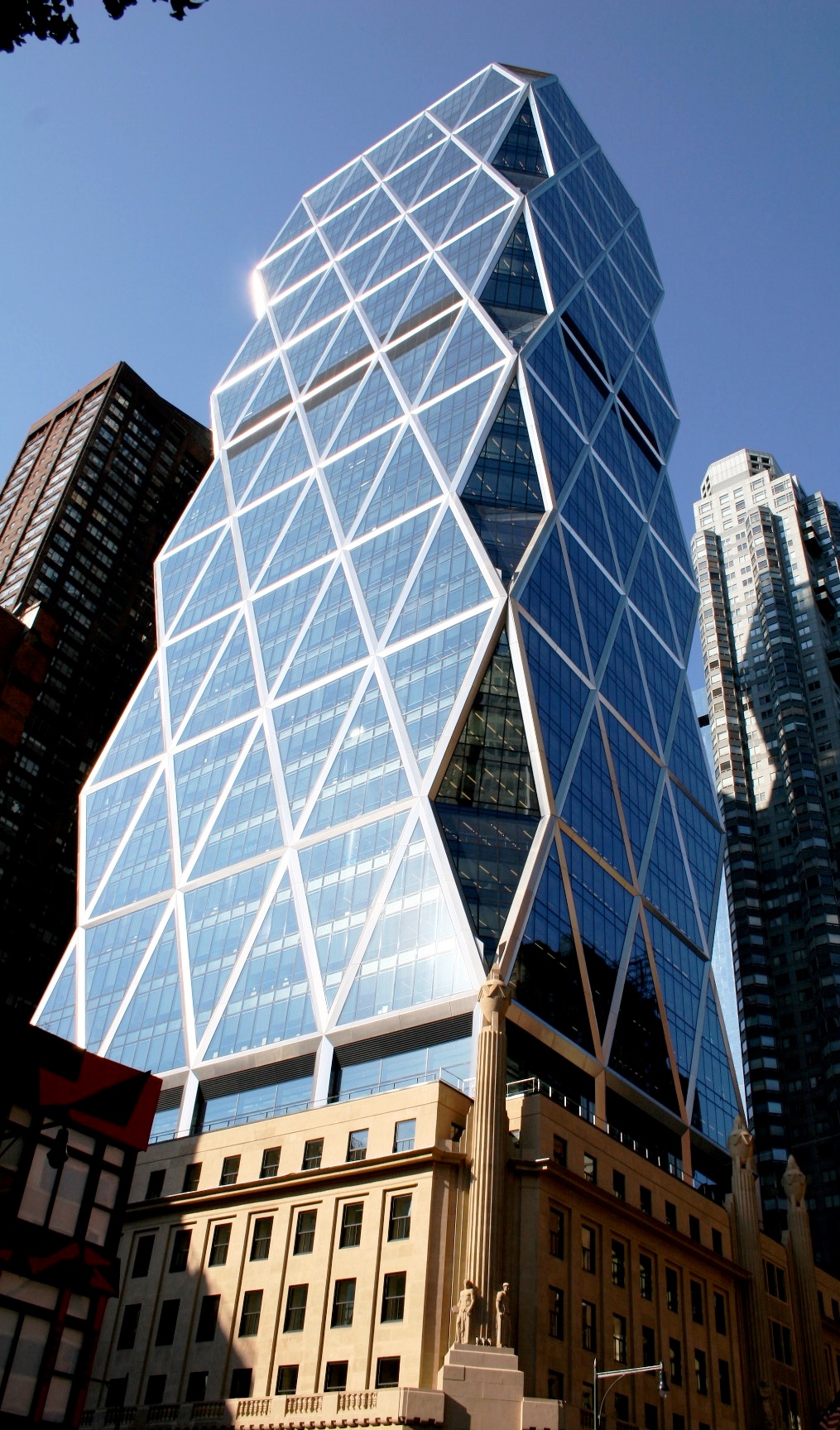
Hearst Corporation, Hearst Holdings Inc. and Hearst Communications Inc.[3] comprise an American multinational mass media and business information conglomerate owned by the Hearst family and based in Hearst Tower in Midtown Manhattan in New York City.[4]

Key Information

Hearst owns newspapers, magazines, television channels, and television stations, including the Albany Times-Union, Houston Chronicle, San Francisco Chronicle, Cosmopolitan and Esquire. It owns 50 percent of the A&E Global Media cable network group and 20 percent of the Walt Disney Company's sports division ESPN Inc..[5] The conglomerate also owns Fitch Group and First Databank.[6]

The company was founded by William Randolph Hearst, a newspaper owner most well known for use of yellow journalism. The Hearst family remains involved in its ownership and management.[7]

History

[edit]

Formative years

[edit]

In 1880, George Hearst, mining entrepreneur and U.S. senator, bought the San Francisco Daily Examiner.[8] In 1887, he turned the Examiner over to his son, William Randolph Hearst, who that year founded the Hearst Corporation. The younger Hearst eventually built readership for Hearst-owned newspapers and magazines from 15,000 to over 20 million.[9] Hearst began to purchase and launch other newspapers, including the New York Journal in 1895[10] and the Los Angeles Examiner in 1903.[8]

In 1903, Hearst created Motor magazine, the first title in his company's magazine division. He acquired Cosmopolitan in 1905, and Good Housekeeping in 1911.[11][12] The company entered the book publishing business in 1913 with the formation of Hearst's International Library.[13][14] Hearst began producing film features in the mid-1910s, creating one of the earliest animation studios: the International Film Service, turning characters from Hearst newspaper strips into film characters.[15]

Hearst bought the Atlanta Georgian in 1912,[16] the San Francisco Call and the San Francisco Post in 1913, the Boston Advertiser and the Washington Times (unrelated to the present-day paper) in 1917, and the Chicago Herald in 1918 (resulting in the Herald-Examiner).[17]

In 1919, Hearst's book publishing division was renamed Cosmopolitan Book.[13]

Peak era

[edit]
An ad asking automakers to place ads in Hearst chain, noting their circulation

In the 1920s and 1930s, Hearst owned the biggest media conglomerate in the world, which included a number of magazines and newspapers in major cities. Hearst also began acquiring radio stations to complement his papers.[18] Hearst saw financial challenges in the early 1920s, when he was using company funds to build Hearst Castle in San Simeon and support movie production at Cosmopolitan Productions. This eventually led to the merger of the magazine Hearst International with Cosmopolitan in 1925.[19]

Despite some financial troubles, Hearst began extending its reach in 1921, purchasing the Detroit Times, The Boston Record, and the Seattle Post-Intelligencer.[20] Hearst then added the Los Angeles Herald and Washington Herald, as well as the Oakland Post-Enquirer, the Syracuse Telegram and the Rochester Journal-American in 1922. He continued his buying spree into the mid-1920s, purchasing the Baltimore News (1923), the San Antonio Light (1924), the Albany Times Union (1924),[20] and The Milwaukee Sentinel (1924). In 1924, Hearst entered the tabloid market in New York City with New York Daily Mirror, meant to compete with the New York Daily News.[21]

In addition to print and radio, Hearst established Cosmopolitan Pictures in the early 1920s, distributing his films under the newly created Metro-Goldwyn-Mayer.[22] In 1929, Hearst and MGM created the Hearst Metrotone newsreels.[23]

Retrenching after the Great Depression

[edit]

The Great Depression hurt Hearst and his publications. Cosmopolitan Book was sold to Farrar & Rinehart in 1931.[13] After two years of leasing them to Eleanor "Cissy" Patterson (of the McCormick-Patterson family that owned the Chicago Tribune), Hearst sold her The Washington Times and Herald in 1939; she merged them to form the Washington Times-Herald. That year he also bought the Milwaukee Sentinel from Paul Block (who bought it from the Pfisters in 1929), absorbing his afternoon Wisconsin News into the morning publication. Also in 1939, he sold the Atlanta Georgian to Cox Newspapers, which merged it with the Atlanta Journal.

Following Adolf Hitler's rise to power in Germany, William Randolph Hearst personally instructed his reporters in Germany to only give positive coverage to Hitler and the Nazis, and fired journalists who refused to write stories favourable of German fascism.[24] During this time, high ranking Nazis were given space to write articles in Hearst press newspapers, including Hermann Göring and Alfred Rosenberg.[24]

Hearst, with his chain now owned by his creditors after a 1937 liquidation,[25] also had to merge some of his morning papers into his afternoon papers. In Chicago, he combined the morning Herald-Examiner and the afternoon American into the Herald-American in 1939. This followed the 1937 combination of the New York Evening Journal and the morning American into the New York Journal-American, the sale of the Omaha Daily Bee to the World-Herald.

Afternoon papers were a profitable business in pre-television days, often outselling their morning counterparts featuring stock market information in early editions, while later editions were heavy on sporting news with results of baseball games and horse races. Afternoon papers also benefited from continuous reports from the battlefront during World War II. After the war, however, both television news and suburbs experienced explosive growth; thus, evening papers were more affected than those published in the morning, whose circulation remained stable while their afternoon counterparts' sales plummeted.

In 1947, Hearst produced an early television newscast for the DuMont Television Network: I.N.S. Telenews, and in 1948 he became the owner of WBAL-TV in Baltimore.

The earnings of Hearst's three morning papers, the San Francisco Examiner, the Los Angeles Examiner, and The Milwaukee Sentinel, supported the company's money-losing afternoon publications such as the Los Angeles Herald-Express, the New York Journal-American, and the Chicago American. The company sold the latter paper in 1956 to the Chicago Tribune's owners, who changed it to the tabloid-size Chicago Today in 1969 and ceased publication in 1974. In 1960, Hearst also sold the Pittsburgh Sun-Telegraph to the Pittsburgh Post-Gazette and the Detroit Times to The Detroit News. After a lengthy strike it sold the Milwaukee Sentinel to the afternoon Milwaukee Journal in 1962. The same year Hearst's Los Angeles papers – the morning Examiner and the afternoon Herald-Express – merged to become the evening Los Angeles Herald-Examiner. The 1962–63 New York City newspaper strike left the city with no papers for over three months, with the Journal-American one of the earliest strike targets of the Typographical Union. The Boston Record and the Evening American merged in 1961 as the Record-American and in 1964, the Baltimore News-Post became the Baltimore News-American.

In 1953, Hearst Magazines bought Sports Afield magazine, which it published until 1999 when it sold the journal to Robert E. Petersen. In 1958, Hearst's International News Service merged with E.W. Scripps' United Press, forming United Press International as a response to the growth of the Associated Press and Reuters. The following year Scripps-Howard's San Francisco News merged with Hearst's afternoon San Francisco Call-Bulletin. Also in 1959, Hearst acquired the paperback book publisher Avon Books.[26]

In 1965, the Hearst Corporation began pursuing joint operating agreements (JOAs). It reached the first agreement with the DeYoung family, proprietors of the afternoon San Francisco Chronicle, which began to produce a joint Sunday edition with the Examiner. In turn, the Examiner became an evening publication, absorbing the News-Call-Bulletin. The following year, the Journal-American reached another JOA with another two landmark New York City papers: the New York Herald Tribune and Scripps-Howard's World-Telegram and Sun to form the New York World Journal Tribune (recalling the names of the city's mid-market dailies), which collapsed after only a few months.

The 1962 merger of the Herald-Express and Examiner in Los Angeles led to the termination of many journalists who began to stage a 10-year strike in 1967. The effects of the strike accelerated the pace of the company's demise, with the Herald Examiner ceasing publication November 2, 1989.[27]

Newspaper shifts

[edit]

Hearst moved into hardcover publishing by acquiring Arbor House in 1978 and William Morrow and Company in 1981.[28][29]

In 1982, the company sold the Boston Herald American — the result of the 1972 merger of Hearst's Record-American & Advertiser with the Herald-Traveler — to Rupert Murdoch's News Corporation,[30] which renamed the paper as The Boston Herald,[31] competing to this day with The Boston Globe.

In 1986, Hearst bought the Houston Chronicle and that same year closed the 213-year-old Baltimore News-American after a failed attempt to reach a JOA with A.S. Abell Company, the family who published The Baltimore Sun since its founding in 1837. Abell sold the paper several days later to the Times-Mirror syndicate of the Chandlers' Los Angeles Times, also competitor to the Los Angeles Herald-Examiner, which folded in 1989. In 1990, both King Features Entertainment and King Phoenix Entertainment were rebranded under the collective Hearst Entertainment umbrella. King Features Entertainment was renamed to Hearst Entertainment Distribution, while King Phoenix Entertainment was renamed to Hearst Entertainment Productions.[32]

In 1993, Hearst closed the San Antonio Light after it purchased the rival San Antonio Express-News from Murdoch.[33]

On November 8, 1990, Hearst Corporation acquired 20% stake of ESPN, Inc. from RJR Nabisco (now a subsidiary of Mondelez International) for a price estimated between $165 million and $175 million.[34] The other 80% has been owned by The Walt Disney Company since 1996. Over the last 25 years, the ESPN investment is said to have accounted for at least 50% of total Hearst Corp profits and is worth at least $13 billion.[35]

In April 1995, Netscape Communications Corporation announced Hearst was part of a group of private investors who purchased stake in the company.[36][37]

On July 31, 1996, Hearst and the Cisneros Group of Companies of Venezuela announced its plans to launch Locomotion, a Latin American animation cable television channel.[38][39][40]

On March 27, 1997, Hearst Broadcasting announced that it would merge with Argyle Television Holdings II for $525 million, the merger was completed in August to form Hearst-Argyle Television (later renamed as Hearst Television in 2009).[41]

In 1999, Hearst sold its Avon and Morrow book publishing activities to HarperCollins.[42]

In 2000, the Hearst Corp. sold its flagship and "Monarch of the Dailies", the afternoon San Francisco Examiner, and acquiring the long-time competing, but now larger morning paper, San Francisco Chronicle from the Charles de Young family. The San Francisco Examiner is now published as a daily freesheet.

In December 2003, Marvel Entertainment acquired Cover Concepts from Hearst, to extend Marvel's demographic reach among public school children.[43]

In 2006, Hearst acquired an interest in Fitch Group, a global financial services company. Hearst increased its ownership of Fitch Group to 80% in 2015, and to 100% in 2018.[44]

In 2009, A&E Networks acquired Lifetime Entertainment Services, with Hearst ownership increasing to 42%.[45][46]

In 2010, Hearst acquired digital marketing agency iCrossing.[47]

In 2011, Hearst absorbed more than 100 magazine titles from the Lagardère Group for more than $700 million and became a challenger of Time Inc ahead of Condé Nast. In December 2012, Hearst Corporation partnered again with NBCUniversal to launch Esquire Network.

On February 20, 2014, Hearst Magazines International appointed Gary Ellis to the new position, Chief Digital Officer.[48] That December, DreamWorks Animation sold a 25% stake in AwesomenessTV for $81.25 million to Hearst.[49]

In January 2017, Hearst announced that it had acquired a majority stake in Litton Entertainment; Litton entertainment was rebranded as Hearst Media Production Group in 2022.[50] Its CEO, Dave Morgan, was a former employee of Hearst.[51][52]

On January 23, 2017, Hearst announced that it had acquired the business operations of The Pioneer Group from fourth-generation family owners Jack and John Batdorff. The Pioneer Group was a Michigan-based communications network that circulates print and digital news to local communities across the state. In addition to daily newspapers, The Pioneer and Manistee News Advocate, Pioneer published three weekly papers and four local shopper publications, and operated a digital marketing services business.[53] The acquisition brought Hearst Newspapers to publishing 19 daily and 61 weekly papers.

Other 2017 acquisitions include the New Haven Register and associated papers from Digital First Media,[54][55] and the Alton, Illinois, Telegraph and Jacksonville, Illinois, Journal-Courier from Civitas Media.[56][57]

In October 2017, Hearst announced it would acquire the magazine and book businesses of Rodale in Emmaus, Pennsylvania with some sources reporting the purchase price as about $225 million. The transaction was expected to close in January following government approvals.[58][59]

In 2018, Hearst acquired the global health and wellness magazine brands owned by Rodale, Inc.[60]

In June 2020, Hearst Autos announced the acquisition of Bring a Trailer, a digital auction platform and auto enthusiast community.[61]

In April 2023, Hearst bought WBBH-TV, an NBC-affiliated television station in Fort Myers, Florida, from Waterman Broadcasting Corporation.[62] In June 2023, Hearst acquired the Journal Inquirer[63] and later in October 2023 bought San Antonio Magazine. The company paid $150,000 in cash plus an amount equal to 90% of the magazine's accounts receivable[64]

In November 2023, Hearst acquired all print and digital operations owned by RJ Media Group, including the Record-Journal, seven weekly newspapers and a digital advertising agency.[65] In December 2023, Hearst bought Puzzmo, a puzzle games website.[66]

In April 2024, Hearst acquired the Texas magazines Austin Monthly and Austin Home from Open Sky Media. A new organization called was created Hearst Texas Austin Media to manage the titles along with the Austin Daily newsletter which was created early that year.[67] Hearst bought a majority of the Motor Trend Group, including Motor Trend and its TV network counterpart, Hot Rod, Roadkill, and Automobile, in December 2024.

In August 2024, Hearst announced it would acquire QGenda, a provider of healthcare workforce management software solutions, from investment firms Francisco Partners and ICONIQ Growth.[68] QGenda became the sixth business in the Hearst Health division[69] following the acquisition of MCG (formerly Milliman Care Guidelines) in 2012,[70] majority stakes in Homecare Homebase in 2013[71] and MHK (formerly MedHOK) in 2016.[72]

In July 2025, Hearst announced its purchase of the Dallas Morning News.[73]

Chief executive officers

[edit]
  • In 1880, George Hearst entered the newspaper business, acquiring the San Francisco Daily Examiner.
  • On March 4, 1887, he turned the Examiner over to his son, 23-year-old William Randolph Hearst, who was named editor and publisher. William Hearst died in 1951, at age 88.
  • In 1951, Richard E. Berlin, who had served as president of the company since 1943, succeeded William Hearst as chief executive officer. Berlin retired in 1973.[74] William Randolph Hearst Jr. claimed in 1991 that Berlin had suffered from Alzheimer's disease starting in the mid-1960s and that caused him to shut down several Hearst newspapers without just cause.[75]
  • From 1973 to 1975, Frank Massi, a longtime Hearst financial officer, served as president, during which time he carried out a financial reorganization followed by an expansion program in the late 1970s.[76]
  • From 1975 to 1979, John R. Miller was Hearst president and chief executive officer.[77]
  • Frank Bennack served as CEO and president from 1979 to 2002, when he became vice chairman, returning as CEO from 2008 to 2013, and remains executive vice chairman.[78]
  • Victor F. Ganzi served as president and CEO from 2002 to 2008.[79]
  • Steven Swartz has been president since 2012 and CEO since 2013.[80]

Operating group heads

[edit]
  • Debi Chirichella became president of Hearst Magazines in 2020.[81] David Carey previously served as group head of Hearst Magazines.[82] Since 2019, Carey has served as senior vice president of public affairs and communications for Hearst.
  • Jeffrey M. Johnson[83] became president of Hearst Newspapers in 2018 upon the promotion of Mark Aldam to executive vice president and chief operating officer of the parent company.[84]
  • Michael J. Hayes became president of Hearst Television in 2023 in succession to Jordan Wertlieb on Wertlieb's promotion to succeed Aldam as Hearst COO.[85]
  • Greg Dorn, MD, is president and group head of Hearst Health, overseeing Hearst’s healthcare businesses since 2014.[86]
  • Tom Cross became president of Hearst Transportation in 2021.[87]
  • Paul Taylor is chief executive officer and group head of Fitch Group.[88]

Assets

[edit]

A non-exhaustive list of its current properties and investments includes:

Magazines

[edit]

Newspapers

[edit]

(alphabetical by state, then title)

Broadcasting

[edit]

Internet

[edit]

Transportation

[edit]

Other

[edit]

Trustees of William Randolph Hearst's will

[edit]

Under William Randolph Hearst's will, a common board of thirteen trustees (its composition fixed at five family members and eight outsiders) administers the Hearst Foundation, the William Randolph Hearst Foundation, and the trust that owns (and selects the 26-member[102] board of) the Hearst Corporation (parent of Hearst Communications which shares the same officers). The foundations shared ownership until tax law changed to prevent this.[103][104]

In 2009, it was estimated to be the largest private company managed by trustees in this way.[105] As of 2017, the trustees are:[106]

Family members

[edit]

Non-family members

[edit]
  • James M. Asher, chief legal and development officer of the corporation
  • David J. Barrett, former chief executive officer of Hearst Television, Inc.
  • Frank A. Bennack Jr., former chief executive officer and executive vice chairman of the corporation
  • John G. Conomikes, former executive of the corporation, preceded Barrett at Hearst-Argyle Television
  • Gilbert C. Maurer, former chief operating officer of the corporation and former president of Hearst Magazines died April 6th 2025[107]
  • Mark F. Miller, former executive vice president of Hearst Magazines
  • Mitchell Scherzer, executive vice president and chief financial officer of the corporation
  • Steven R. Swartz, president and chief executive officer of the corporation
  • Paul G. Taylor, senior vice president of the corporation and president and chief executive officer of Fitch Group.[108]

The trust dissolves when all family members alive at the time of Hearst's death in August 1951 have died.

See also

[edit]

References

[edit]

Further reading

[edit]
[edit]
Revisions and contributorsEdit on WikipediaRead on Wikipedia
from Grokipedia
Hearst Communications, Inc., commonly known as Hearst, is a privately held American multinational conglomerate specializing in , information services, and diversified publishing, founded on March 4, 1887, by with the acquisition of the . The company, controlled by descendants of its founder through a family trust, operates businesses across 40 countries, encompassing magazines, newspapers, broadcast television, digital platforms, and data services. In 2024, Hearst reported record revenue of $13 billion, driven by strong performance in political advertising, bond ratings via its Fitch subsidiary, and expansions in B2B information services, which now constitute the majority of its profits. Hearst Magazines, a core division, maintains a portfolio of more than 25 brands in the United States—including titles like Cosmopolitan, Elle, and —alongside over 200 international editions and 175 websites, positioning it as the world's largest publisher of lifestyle magazines. Hearst Television owns and operates stations serving 26 U.S. media markets across 39 states, reaching approximately 24 million television households, while its newspapers include major dailies such as the and . The company has pursued digital innovation, being the first major magazine publisher to offer all titles on tablet devices, and has expanded through acquisitions like the MotorTrend Group in late 2024. Despite its commercial successes, Hearst has faced criticisms, including historical associations with sensationalist "" practices under its founder and more recent internal controversies over workplace culture and social media policies restricting employee expressions of personal political views, which some outlets framed as amid global events like the Israel-Palestine conflict. These policies, implemented in 2023, prohibit "liking" or sharing controversial content and aim to maintain journalistic neutrality, though they have drawn accusations of limiting free speech from progressive-leaning sources. Additionally, the company has navigated industry challenges with layoffs, such as nearly 200 staff reductions across brands in November 2024, amid shifting landscapes post-election cycles.

History

Founding and Early Years

Hearst Communications traces its origins to March 4, 1887, when , then 23 years old, assumed proprietorship of the , a struggling originally acquired by his father, U.S. Senator , in 1880 as repayment for a $12,000 loan. , a self-made magnate who amassed a fortune in silver and gold, had minimal interest in the paper's operations and gifted control to his son upon William's return from , where he had been expelled for poor academic performance and extracurricular pranks. Under William's direction, the Examiner shifted from a politically oriented to a sensationalist publication emphasizing , scandal, and human-interest stories, which dramatically boosted circulation from approximately 2,000 daily copies to over 30,000 within two years through aggressive marketing, such as free distribution tactics and eye-catching layouts. Hearst's early strategies at the Examiner included hiring top talent poached from competitors like Joseph Pulitzer's , expanding page sizes to accommodate more illustrations and banner headlines, and pioneering the use of pseudonyms for reporters to sensationalize content without personal accountability. These innovations, often termed "" precursors, prioritized visual appeal and emotional engagement over traditional reporting depth, reflecting Hearst's belief in newspapers as tools for mass influence rather than mere information dissemination. By 1895, emboldened by the Examiner's success, Hearst relocated to and purchased the faltering New York Morning Journal for $180,000, launching a fierce circulation war with Pulitzer that introduced full-color Sunday comic supplements, including Richard Outcault's "" in 1896—the first recurring character—and Rudolf Dirks's "" in 1897. This period of expansion solidified Hearst's model of chain journalism, with acquisitions like the Chicago American in 1900 extending his reach beyond the West Coast, while syndication efforts began laying groundwork for national distribution. Hearst's approach yielded rapid financial gains but drew criticism for exaggerating facts to drive sales, as evidenced by inflated coverage of events like the 1896 graft trials in , which exposed municipal but blurred lines between advocacy and fabrication. By the early , these tactics had established Hearst as a dominant force in American , with revenues supporting further diversification into magazines and wire services.

Expansion and Peak Era

Following the success of the San Francisco Examiner, William Randolph expanded eastward by acquiring the New York Morning Journal in 1895 for approximately $180,000, transforming it into a rival to Joseph Pulitzer's . This acquisition sparked a fierce circulation war characterized by sensational headlines, exaggerated reporting, and innovative features such as color , including the debut of "" in 1896, which helped drive daily circulations into the millions. Hearst's papers emphasized human-interest stories, crusading against , and vivid illustrations, tactics that boosted readership and enabled further geographic expansion into cities like , where he launched the Chicago American in 1900. By 1910, Hearst controlled eight daily newspapers and two magazines, reaching nearly three million readers through centralized editorial control and syndicated content. Diversification into magazines accelerated with the 1905 purchase of Cosmopolitan for $400,000, which under Hearst shifted from literary focus to serialized fiction and mass-market appeal, and the 1911 acquisition of , establishing the Good Housekeeping Institute in 1900 for product testing and consumer advocacy. In 1915, Hearst founded to distribute like "" (introduced in 1897) and other strips to newspapers nationwide and internationally, enhancing revenue through licensing and bolstering the chain's uniformity. Ventures into visual media included the launch of Hearst newsreels in 1913 and the International Film Service for animated shorts based on comic properties in 1915. The era culminated in the as Hearst's holdings grew to over 20 newspapers and magazines across major U.S. markets, achieving daily circulation exceeding 13 million and establishing the largest globally at the time. By the late , the portfolio encompassed 28 dailies, 13 magazines, and initial radio stations, with innovations like full-page weekday comics in 1912 sustaining dominance through reader engagement and advertising revenue. This peak reflected Hearst's strategy of aggressive acquisition, content innovation, and , though it relied heavily on debt financing amid rising operational costs.

Challenges During the Great Depression

The onset of the in 1929 severely strained Hearst Communications' operations, as advertising revenues for its newspapers plummeted by 15 percent in 1930 alone, despite relatively stable circulation figures. This revenue collapse was exacerbated by the company's pre-Depression overexpansion, which included aggressive acquisitions of newspapers, magazines, and , alongside substantial personal expenditures by on art collections and properties like San Simeon. By the early , these factors had ballooned the corporation's debt to approximately $78 million, prompting initial asset sales and loans, including a $1 million personal advance from actress . Debt levels escalated further amid prolonged economic contraction, reaching $110 million to $126 million by the mid-1930s, equivalent to roughly $1.5 billion in contemporary terms. Hearst's publications, heavily reliant on advertising from consumer goods and luxury sectors that evaporated during the downturn, incurred ongoing losses; for instance, individual titles like the Atlanta Georgian operated at a deficit, contributing to broader empire-wide . Political tensions compounded financial woes, as Hearst's initial support for President Franklin D. Roosevelt's shifted to opposition, alienating some advertisers and readership amid organized boycotts. By 1937, with imminent, Hearst relinquished direct control, appointing a conservation committee to oversee restructuring and enforce measures. This led to widespread asset liquidations, including sales of newspapers in cities such as New York, , and , portions of the art collection at auction through Gimbel's , and other non-core holdings to service debts and stabilize operations. The court-mandated reorganization reduced Hearst's influence over the empire he had built, marking a pivotal contraction from its peak of 28 newspapers and diversified media ventures earlier in the decade.

Post-War Recovery and Diversification

Following , Hearst's newspaper operations experienced a financial rebound, driven by heightened circulation and advertising revenues stimulated by wartime demand, which persisted into the postwar economic expansion and helped offset earlier fiscal pressures from the era. In 1943, the company's diverse assets were restructured into a centralized holding entity known as The Hearst Corporation to streamline management and facilitate recovery. William Randolph Hearst's death on August 14, 1951, marked a pivotal transition, with his $57 million estate divided into charitable trusts and family-controlled entities per his will, while operational control shifted to Richard E. Berlin as president and chief executive officer. Under Berlin's leadership, the company pursued aggressive cost rationalization, divesting underperforming assets including six unprofitable newspapers, the Chicago American (sold to the in 1956), the International News Service (merged with United Press in 1958), the New York Mirror (closed in 1963), and the (folded in 1966). These measures reduced overhead and refocused resources on viable operations, culminating in a debt-free by Berlin's retirement in 1973. Diversification accelerated in the late 1940s and 1950s, with Hearst entering television broadcasting in 1948 by acquiring in , one of the early U.S. stations to experiment with color transmission by 1952. The magazine division expanded through acquisitions such as Sports Afield in 1953 and Avon Publications in 1959 for paperback books, alongside enhancements to existing titles like and a 1965 revamp of Cosmopolitan targeting professional women, which broadened revenue streams beyond declining circulations. This strategic pivot mitigated risks from print media volatility and positioned Hearst for growth in emerging electronic and consumer publishing sectors.

Modern Expansion and Acquisitions

Under the leadership of Frank A. Bennack Jr., who became president in 1979, Hearst pursued an aggressive acquisition strategy in the 1980s, focusing on magazines, newspapers, and broadcasting to diversify beyond traditional print media. In 1980, the company acquired First Databank, a medical information database serving healthcare providers. By 1986, Hearst purchased Boston's WCVB-TV, expanding its television holdings, and acquired Esquire magazine. The following year, it bought the Houston Chronicle for approximately $415 million, adding a major daily newspaper to its portfolio. This period also saw Hearst as a founding partner, alongside ABC, in the cable networks that evolved into A&E and Lifetime in 1981. The 1990s marked further entry into high-growth media sectors, including sports programming and additional local outlets. On November 9, 1990, Hearst acquired a 20% stake in from for an estimated $165–175 million, securing a position in the burgeoning cable sports market. In 1993, it added the , bolstering its newspaper presence. Hearst also launched the U.S. edition of in 1994 through a partnership with France's Marie Claire Album Group. Toward the decade's end, Hearst merged its six television stations with Argyle Communications to form a larger broadcast group, enhancing operational scale. Entering the 2000s, Hearst extended into lifestyle magazines and early digital-adjacent health data services, while the 2010s and 2020s emphasized global scale and non-media information businesses. In 2000, it partnered with Harpo Entertainment to launch O, The Oprah Magazine. The 2004 acquisition of Zynx Health provided clinical decision support software to over 500 U.S. hospitals. By 2011, Hearst bought nearly 100 international magazine titles from Lagardère Active in 14 countries, including editions of Elle and . In 2016, it acquired CAMP Systems, aviation maintenance software used by over 19,000 aircraft worldwide, and in 2018 took full ownership of Fitch Group (parent of ) and Rodale's health brands, encompassing 62 print titles and 57 websites across 31 countries. These moves reflected a pivot toward B2B information services, with over 30 acquisitions totaling at least $15 billion in the decade leading to 2025, predominantly in data and software. Recent deals include the 2024 agreement to acquire QGenda, a healthcare platform, and expansions like the newspaper and MotorTrend Group. This diversification has driven revenue growth to $12.8 billion in 2024, with segments now comprising the majority of profits.

Business Operations

Newspapers

Hearst Newspapers, the division overseeing the company's print and digital newspaper operations, publishes 28 daily newspapers and more than 50 weekly publications nationwide, supported by over 2,300 employees focused on , production, and distribution. This portfolio emphasizes local and regional coverage, with integrated digital platforms for audience engagement and revenue from subscriptions, advertising, and marketing services. Key holdings include the San Francisco Chronicle, the largest newspaper in and second-largest on the West Coast, which reaches over 6 million monthly users through its print edition and website. The Houston Chronicle serves as a flagship in , contributing to Hearst's regional dominance with a combined weekly print circulation exceeding 520,000 in the Houston area and digital reach surpassing 4 million. Other major dailies encompass the Albany Times Union in New York, Connecticut Post and affiliates under the Connecticut Media Group (including Greenwich Time and ), and smaller-market titles like The Telegraph in , and Edwardsville Intelligencer. In 2025, Hearst accelerated expansion in through acquisitions, including the Dallas Morning News and its associated marketing agency Medium Giant on July 10, alongside two additional publishers, positioning the company to control every major metropolitan newspaper in the state by September. These moves increased Hearst's operational scale to approximately 26 and 52 weeklies earlier in the year, reflecting a strategy to consolidate local markets amid declining industry-wide circulation. To counter print revenue pressures, Hearst Newspapers initiated a multi-market advertising campaign in May 2025, targeting growth in digital subscriptions and readership for flagship titles like the and . The effort, branded "There's More with the Chronicle," highlights journalistic innovations via the Hearst DevHub, a cross-newsroom team aiding local reporting enhancements. Overall U.S. newspaper circulation for top titles, including Hearst properties, declined 14% in recent years, underscoring the shift toward digital models.

Magazines

Hearst Magazines, the publishing division of Hearst Communications, operates as the world's largest publisher of lifestyle magazines, maintaining a portfolio exceeding 25 brands in the United States alongside 175 associated websites and more than 200 global editions. Key domestic titles include Autoweek, Bicycling, Car and Driver, Cosmopolitan, Country Living, Elle, Esquire, Good Housekeeping, Harper's Bazaar, Men's Health, and Popular Mechanics, spanning categories such as fashion, health, automotive, and home. The division emphasizes print-digital integration, with brands generating revenue through advertising, subscriptions, and e-commerce extensions. The origins of Hearst's magazine operations date to 1903, when the company launched Motor magazine, marking the inception of its publishing efforts in periodicals beyond newspapers. Expansion followed with the 1905 acquisition of Cosmopolitan, repositioned under Hearst toward popular fiction and later women's lifestyle content, and the 1911 purchase of Good Housekeeping, which introduced consumer product testing via its Research Institute. By the mid-20th century, additional acquisitions like Harper's Bazaar in 1960 and Esquire in 1986 diversified the lineup into fashion and men's interests, reflecting strategic shifts toward high-circulation, advertiser-friendly formats amid rising competition from television. Major growth in scale occurred through the 2011 acquisition of approximately 100 titles from Lagardère Active for over $700 million, incorporating international editions of Elle and others, which elevated Hearst's global footprint and positioned it as a direct competitor to publishers like . This deal expanded licensing partnerships, enabling localized content adaptations. More recently, in 2024, Hearst acquired the Motor Trend Group and select assets from , integrating automotive publications such as and to strengthen its niche verticals. Hearst Magazines International, a dedicated unit, oversees seven owned businesses, five joint ventures, and 46 licensing agreements across 47 countries, facilitating over 200 territorial editions tailored to regional markets.
Key Magazine TitlesCategoryNotable Acquisition/Launch Year
CosmopolitanWomen's Lifestyle1905
Home and Consumer1911
Men's Lifestyle1986
ElleFashionVia 2011 Lagardère deal
AutomotiveInherited/expanded portfolio
Health and FitnessAcquired 2004 (core assets)
The division's strategy has adapted to digital disruption by prioritizing multimedia extensions, though print circulation has declined industry-wide; for instance, Cosmopolitan's U.S. paid circulation stood at around 1.2 million as of recent audits, underscoring resilience in premium segments.

Broadcasting and Television

Hearst's involvement in broadcasting originated in radio with the 1928 acquisition of WSOE in , which later formed the basis for . The company expanded into television in the late 1940s, acquiring in in 1948, one of the nation's early stations. By the , Hearst operated additional outlets, including 's early adoption of color . Significant growth occurred through mergers and acquisitions, notably the 1997 combination of Hearst's broadcasting division with Argyle Television Holdings II for $525 million, creating Hearst-Argyle Television (renamed Hearst Television in 2011). This positioned Hearst among major U.S. broadcasters, emphasizing local stations affiliated with networks like ABC, NBC, and CBS. As of 2025, Hearst Television owns or operates 35 television stations and two radio stations across 27 media markets in 39 states, serving approximately 24 million U.S. households. Its portfolio includes prominent affiliates such as WCVB-TV (ABC) in Boston, KCRA-TV (NBC) in Sacramento, WTAE-TV (ABC) in Pittsburgh, and WESH-TV (NBC) in Orlando, alongside digital multicast channels and local news production. These assets focus on local programming, news, and advertising, contributing to Hearst's diversified media revenue without reliance on national cable networks.

Digital and Internet Media

Hearst Magazines maintains a robust digital footprint, operating over 175 websites that extend its lifestyle publishing brands into online formats, delivering content across print, digital, social, and experiential channels. These platforms, part of Hearst Magazines Digital Media, attract 146 million monthly unique visitors and garner 254 million social media followers, enabling targeted advertising and programmatic sales to connect brands with engaged audiences. The division emphasizes data-driven strategies, including e-commerce integrations that transform traditional publishing into revenue-generating digital retail experiences through memberships offering exclusive content and shopping perks. In recent years, Hearst has pursued digital expansion via acquisitions that bolster its internet media capabilities, such as the 2025 integration of DallasNews Corporation, which added services and online operations to Hearst Newspapers' portfolio. Complementing this, Hearst launched multi-market campaigns in May 2025 to promote digital subscriptions and showcase advances in across its newspaper sites. The company has also incorporated AI into its digital platforms, developing a human-centered strategy for content personalization and within its network of local publications. Hearst's internet media efforts extend to video and streaming partnerships, including collaborations with to launch branded channels like Hello Style in April 2024 and Channel in May 2024, focusing on scalable, on-demand content distribution. Additionally, initiatives like , announced in recent press releases, aim to create original digital content brands for broader online scalability. Under leadership transformations, such as the appointment of digital executives from platforms like in April 2025, Hearst prioritizes user engagement and revenue growth through integrated product strategies.

Non-Media Holdings

Hearst's non-media holdings primarily encompass , healthcare technology, and , which have increasingly driven the company's profitability amid challenges in traditional media. As of 2024, operations, including these sectors, accounted for over 50% of Hearst's , reflecting a strategic shift toward diversified streams less dependent on cycles. In financial services, Hearst wholly owns the Fitch Group, acquired in stages culminating in the purchase of the remaining 20% stake from Fimalac SA for $2.8 billion in April 2018. The Fitch Group operates , one of the three major global agencies alongside Moody's and S&P, and Fitch Solutions, which provides financial data, research, and analytics to institutional investors and corporations. This segment benefited from a robust in , contributing to Hearst's overall revenue growth to $13 billion. Hearst Health manages a suite of businesses delivering data analytics, software, and information services to healthcare providers, payers, and pharmaceutical firms, emphasizing improved patient outcomes and . Key activities include investments in startups and acquisitions such as QGenda, LLC, a scheduling and platform for physicians and staff, agreed to in December 2024 from and ICONIQ Growth. The division's focus aligns with Hearst's broader B2B priorities in healthcare, alongside and transportation-related ventures. Hearst Real Estate Holdings oversees a portfolio of commercial properties and development projects, including the company's headquarters, the Hearst Tower in , a 46-story Gold-certified completed in 2006. Additional non-media interests include an 80% stake in KUBRA Data Transfer Ltd., a provider of management solutions for utilities, , and sectors, acquired to expand data services capabilities. Hearst Ventures, the arm established in 1995, further supports diversification through equity investments in early-stage companies, particularly in health tech and .

Leadership and Governance

Chief Executive Officers

Frank A. Bennack Jr. served as president and of Hearst Corporation from 1979 to 2013, during which time the company expanded significantly through acquisitions in magazines, , and , transforming it from a primarily newspaper-focused entity into a diversified with revenues growing from approximately $500 million to over $8 billion by the end of his tenure. Prior to his CEO role, Bennack had been executive vice president and since 1974. Steven R. Swartz succeeded Bennack as president and in June 2013, having previously served as president and since 2011. Under Swartz's leadership, Hearst reported revenues of $11.95 billion in 2023 and projected $12.8 billion for 2024, with a growing emphasis on services contributing the majority of profits and acquisitions such as the 2024 purchase of a firm. Swartz has overseen adaptations to digital disruption, including investments in ESPN partnerships and print magazine sustainability amid declining political advertising post-2024 elections. Earlier chief executives included E. Berlin, who assumed the role in 1951 following the death of founder and led until his retirement in 1973, focusing on stabilizing operations during post-war diversification into magazines and . Frank Massi briefly served as president from 1973 to 1975 during a transitional period before Bennack's ascension. The CEO position evolved from the founder's direct control, with effectively directing the company from its 1887 inception until 1951 without a formalized title equivalent to modern CEO.

Operating Group Leaders

Hearst Communications' operating groups, encompassing its core media and information services divisions, are overseen by presidents and senior vice presidents who report to the . These leaders manage strategic direction, operations, and financial performance across portfolios such as newspapers, magazines, and . Key appointments reflect internal promotions and external hires aimed at navigating industry challenges like digital transitions and fragmentation. Jeffrey M. Johnson serves as president of Hearst Newspapers, a role he assumed in February 2018 following his tenure as CEO and publisher of the , where he drove revenue growth through cost efficiencies and digital innovations. Under his leadership, Hearst Newspapers operates 24 dailies and 52 weeklies, reaching over 20 million monthly unique visitors digitally as of 2023. Debi Chirichella holds the position of president of Hearst Magazines since November 2020, after serving as president of advertising and partnership sales. She oversees a portfolio of 25 magazines in the U.S., including titles like Cosmopolitan and , with a focus on diversifying revenue streams amid print declines; in , the division reported digital revenue exceeding print for the first time. Michael J. Hayes was elevated to president of in May 2023, succeeding Jordan Wertlieb, who transitioned to . Hayes, previously executive vice president of the group, directs 33 stations across 26 markets serving 21% of U.S. households, emphasizing and programming; the division generated approximately $800 million in annual revenue as of 2022. Other operating segments, such as Hearst Health and initiatives, fall under group heads like Greg Dorn for health information services, which include and MCG Health, prioritizing data-driven healthcare solutions over broader media narratives. These roles underscore Hearst's emphasis on specialized expertise to sustain profitability in fragmented markets.

Family Trustees and Succession

The Hearst Trust, established under the will of upon his death in 1951, governs the family's controlling interest in Hearst Corporation through a board of 13 trustees, structured to include five seats reserved for family descendants and eight for independent professionals to ensure managerial expertise and prevent familial disputes over control. This composition reflects Hearst's intent to prioritize professional stewardship, as he explicitly avoided direct to his five sons and subsequent generations, instead vesting authority in a self-perpetuating board where trustees elect successors, thereby maintaining operational continuity amid family growth to over 100 descendants. Family trustees have included figures such as William R. Hearst III, grandson of the founder and current chairman of Hearst Corporation's board since 2008, who represents the third generation; Anissa B. Balson, a great-granddaughter; and George R. Hearst III, elected in 2012. Non-family trustees, often long-serving executives like Frank A. Bennack Jr., who joined in 1974 and holds the executive vice chairman role, provide the majority influence, with recent additions such as Paul G. Taylor elected on July 14, 2025, underscoring the board's emphasis on experienced outsiders. This balance has sustained the company's private status and strategic decisions, including major acquisitions, without the fragmentation observed in other media dynasties. Succession within the trust operates through trustee self-selection, with family seats filled by electing qualified descendants to uphold the five-member quota, while non-family positions prioritize proven to mitigate risks of unqualified heirs assuming power. The structure, intended as semi-permanent, delays full family control until potential trust expiration—projected to allow descendants majority ownership post-termination—ensuring interim professional dominance that has preserved asset value exceeding $20 billion as of recent estimates. This model has empirically outperformed direct generational handovers by averting litigation and dilution, as evidenced by the absence of major internal challenges since inception, though it limits family veto power to advisory levels on key matters like CEO appointments.

Controversies and Criticisms

Yellow Journalism and Editorial Influence

The term emerged in the late 1890s to describe the sensationalist reporting style popularized by Hearst's newspapers, characterized by exaggerated headlines, unsubstantiated claims, and a focus on scandal over factual accuracy to boost circulation. Hearst acquired the New York Journal in and intensified competition with Pulitzer's New York World, employing large, illustrated front pages and dramatic narratives about crime, corruption, and foreign atrocities, which increased daily sales from 30,000 to over 1 million by 1898. Critics, including contemporary journalists, condemned this approach for prioritizing profit-driven hype over ethical standards, as Hearst himself instructed reporters to emphasize emotional appeal regardless of verification. A pivotal example occurred following the explosion of the in on February 15, 1898, which killed 266 American sailors. Without evidence, Hearst's Journal published headlines on February 17 declaring "DESTRUCTION OF THE WAR SHIP MAINE WAS THE WORK OF AN ENEMY" and explicitly accusing Spanish authorities, while offering a $50,000 reward for culprits and printing fabricated atrocity stories from . These tactics, including multiple extra editions, drove circulation surges but relied on unproven sabotage theories later contradicted by U.S. naval inquiries attributing the blast to an internal coal bunker fire. Hearst's coverage exemplified the style's disregard for sourcing, as artists and correspondents were directed to illustrate events sensationally even when eyewitness accounts were absent. Hearst's amplified public outrage over Spanish colonial policies in , contributing to war fervor that culminated in the Spanish-American War's declaration on April 25, 1898. However, while sensational reports shaped舆论 by portraying U.S. intervention as a , empirical analyses by historians reject claims that Hearst's papers singularly provoked the conflict, attributing primary causation to strategic interests like naval expansion and Cuban instability rather than media alone. The style's legacy includes widespread criticism for eroding journalistic credibility, as Hearst's empire—reaching 20% of the U.S. population by 1930—prioritized reader engagement through over balanced reporting. Beyond sensationalism, Hearst exerted editorial influence by aligning his publications with personal political ambitions, endorsing candidates such as in 1896 and in 1932 while serving as a U.S. Representative from 1903 to 1907. He controlled content across his outlets to advocate pre-World War I, progressive reforms against elites, and later anti-communist stances, often blending opinion with news to advance his views on tariffs, labor, and . Despite this reach, econometric studies of elections from 1880 to 1938 find no statistically significant impact of Hearst paper introductions on vote shares or turnout, with effect estimates near zero in county-level data. Detractors argued such interventions compromised independence, as Hearst leveraged his media for influence, including syndicating columns from figures like and to shape elite discourse. This pattern fueled ongoing debates about media proprietor's self-interest overriding public interest.

Workplace and Labor Issues

Hearst Communications has encountered multiple labor disputes, particularly in its magazine and newspaper operations, often involving unionization efforts and contract negotiations. In November 2019, editorial staff at Hearst Magazines titles such as Elle, Cosmopolitan, and Men's Health voted to unionize under the Writers Guild of America East, reflecting a broader trend in media toward collective bargaining amid industry instability. Similarly, at Hearst-owned A+E Networks' factual studios, production staff initiated unionization drives in September 2024, seeking representation for workers on shows like Dance Moms and Cold Case Files. These efforts have been met with resistance, as evidenced by the Writers Guild of America East filing three unfair labor practice charges against Hearst in 2023, alleging deficiencies in negotiations over compensation, layoffs, severance, and anti-harassment policies that lagged industry standards. Layoffs have been a recurring issue, frequently criticized by unions as abrupt and inadequately handled. In July 2023, Hearst Magazines cut 41 unionized positions through "," prompting union statements of disappointment and anger over the lack of severance or advance notice. More significantly, in November 2024, the company laid off nearly 192 employees across editorial, advertising sales, product, and roles, with up to 75 from editorial staff alone; the Writers Guild described these as "needless, irresponsible, and cruel" actions by an "anti-union" employer reallocating resources amid digital shifts. At the , Guild members ratified a five-year in 2023 after 16 months of bargaining, securing raises in pay and healthcare contributions, though prior disputes required court-mandated arbitration on individual pay claims against Hearst. Discrimination and harassment allegations have also surfaced in lawsuits. In September 2020, Lauren Johnson, a former advertising executive at , filed suit against Hearst in New York federal court, claiming age (52) and gender discrimination, as well as a created by her supervisor's derogatory comments and favoritism toward younger male colleagues, leading to her demotion and termination. Earlier, in 2012, Hearst Television's distribution of resulted in a settlement of up to $250,000 for unpaid interns alleging minimum-wage violations under the Fair Labor Standards Act, marking an early resolution in a wave of similar media intern lawsuits. These cases highlight tensions over equity, though Hearst has disputed broader claims of systemic cultural issues influencing editorial decisions.

Political Bias Allegations and Media Policy

Hearst Communications' historical media practices under drew significant allegations of political bias through , characterized by sensationalism, exaggerated headlines, and partisan agendas to influence public opinion and policy, most notably in promoting U.S. intervention in the Spanish-American War of 1898. Empirical analysis of Hearst newspapers from 1880 to 1938 reveals a consistent slant that was pro-labor, pro-immigrant, and generally anti-Republican, aligning with Democratic positions, though with occasional deviations such as support for in 1928; however, this slant did not demonstrably alter election outcomes or , as evidenced by difference-in-differences models showing insignificant causal effects despite the papers' reach to 20% of the U.S. population by 1930. In modern operations, Hearst maintains editorial standards emphasizing factual reporting, anonymity restrictions for political opinions, and avoidance of personal commentary that could imply bias, as outlined in its newspapers' general practices updated in 2021. Some Hearst-owned outlets, including the , have endorsed Democratic candidates in recent elections, such as in Connecticut Media Group papers citing concerns over the , 2021, Capitol events as disqualifying in 2024. Media bias evaluators have rated the Chronicle as left-center based on story selection and editorial positions favoring progressive policies, though it scores high for factual accuracy. A 2023 social media policy update prohibited employees, including journalists, from expressing personal political opinions online—even through likes or shares—and encouraged reporting colleagues for "controversial" posts, prompting allegations of suppressing free speech, particularly amid heightened solidarity with Palestinians following the October 7, 2023, Hamas attacks on Israel. Critics, including union organizers and opinion writers, argued the policy stifled dissent and reflected corporate caution against perceived employee biases in a polarized environment, while Hearst framed it as safeguarding journalistic neutrality. Hearst's political contributions via individuals in the 2024 cycle were split, with $100,778 to Republicans and $50,069 to Democrats, alongside annual lobbying expenditures exceeding $500,000 on media policy issues without explicit partisan tilt. These measures underscore Hearst's efforts to mitigate bias perceptions, though historical precedents and selective endorsements continue to fuel scrutiny from conservative commentators who view the company's outlets as reflecting progressive leanings.

Strategic Adaptations and Impact

Key Acquisitions and Financial Growth

Hearst Corporation has expanded through strategic acquisitions in media, , and information services, with over 30 deals in the decade leading to 2025 totaling at least $15 billion. These moves have diversified revenue beyond traditional print into stable sectors like credit ratings and local television, contributing to sustained financial growth amid industry disruptions. A pivotal early expansion occurred in 1990 with the acquisition of a 20% stake in , providing Hearst entry into premium sports broadcasting and long-term affiliation with . Subsequent investments included full control of Fitch Group: starting with a 20% interest in 2006, increasing to 80% in 2014, and completing 100% ownership in 2018 for $2.8 billion on the final 20% stake, bolstering non-cyclical revenue from global credit ratings. In 2011, Hearst acquired approximately 100 magazine titles across 14 countries from , enhancing its international publishing footprint. The company also maintains a 50% stake in A+E Networks (jointly with ), solidified after the 2012 of NBCUniversal's share for $3.03 billion alongside Disney, encompassing channels like A&E, Lifetime, and . Recent acquisitions emphasize local media and specialized content: in 2018, Hearst purchased 's health and wellness brands; in 2023, it acquired WBBH-TV in ; in 2024, MotorTrend Group; and in 2025, the from Gannett followed by for $16.50 per share. These bolstered Hearst's dominance in markets, now covering the state's four largest cities via newspapers like the (acquired 1987) and (1993). Financially, these expansions have driven revenue from $11.4 billion in 2018 to a record $13 billion in 2024, a 9% year-over-year increase, with projections for $12.8 billion in 2024 later exceeded. Growth stems primarily from Fitch's stable ratings business and television affiliates, offsetting print declines, yielding record profits for multiple consecutive years. As a private entity, Hearst's metrics reflect resilience, with Fitch alone contributing significantly to the uptick via digital and data services.

Response to Digital Disruption

Hearst Communications responded to the erosion of print media revenue by accelerating investments in digital infrastructure and content platforms starting in the mid-2000s. The company established Hearst Magazines Digital Media in 2006 to oversee online and mobile strategies for its magazine brands, launching initiatives such as a private audience exchange with PubMatic in 2012 for targeted digital advertising and a 20-person studio in 2018 to enhance advertiser capabilities. In 2010, Hearst acquired iCrossing, a firm, to build expertise in , paid search, , and mobile services, thereby integrating advanced into its operations. Subsequent moves targeted high-growth digital ecosystems, including a $21 million minority stake in Complex Networks in 2015 to leverage its strengths in digital publishing and streaming video amid rising online video consumption. By 2025, Hearst intensified efforts to counter print declines—evident in falling circulation and ad dollars—through local media consolidation and subscription growth, acquiring DallasNews Corporation for $16.50 per share to fortify digital assets in competitive regional markets and launching a multi-market campaign in May to drive digital readership. These steps supported overall revenue expansion, with diversification offsetting legacy print losses reported as early as 2009 when internal directives aimed to transform newspapers into digital enterprises. Technological integration further underpinned adaptation, as articulated by CTO Mahendra Durai in 2021, who highlighted AI, , and chat technologies for personalizing content and operational efficiency in a disrupted dominated by on-demand consumption. In 2025, Hearst Networks introduced Hearst , a London-based unit for commissioning scalable unscripted content tailored to platforms like , audio, and emerging formats, with initial productions slated for 2026 to capture and on-demand revenue. This venture builds on prior digital content experiments, prioritizing rapid testing with independent producers to navigate algorithmic shifts and audience fragmentation, though challenges persist from events like updates impacting traffic.

Broader Influence on Media Industry

Hearst Communications has shaped the media industry by exemplifying successful diversification beyond traditional print media, integrating newspapers, magazines, , digital platforms, and information services to mitigate risks from sector-specific disruptions. This approach has generated sustained growth, with the company reporting $13 billion in annual as of 2025, an 8% increase over three years, primarily driven by expansions in and non- segments rather than legacy publishing. Such strategies have influenced competitors facing similar print declines, demonstrating how conglomerates can offset advertising volatility through multi-platform operations and acquisitions, including the 2025 purchases of the and MotorTrend Group to bolster local news and automotive content portfolios. The company's early ventures into broadcasting in the 1920s, including newsreels and radio, prefigured modern media convergence, while its contemporary television operations—encompassing over 30 stations—have set benchmarks for local coverage, such as committing as the first major group to guarantee minimum daily airtime for candidate discourse starting in recent cycles. Hearst's accelerated , faster and more comprehensive than many peers, has emphasized subscription models and multi-market advertising campaigns to expand readership, influencing industry shifts toward audience-direct revenue amid platform algorithm dependencies. Innovations in content production, such as the 2024 launch of Producer-P—an AI-assisted tool requiring human oversight for optimization—have promoted scalable yet accountable practices, potentially guiding ethical AI adoption across newsrooms wary of automation's risks. Additionally, Hearst's sponsorship of competitions and partnerships, like the annual Innovative awards program since and collaborations on student design challenges, have fostered talent pipelines and experimental solutions to real-world media problems, indirectly elevating industry standards for storytelling and innovation.

References

Add your contribution
Related Hubs
User Avatar
No comments yet.