


Community hub
Recent from talks
Contribute something
Nothing was collected or created yet.
Demasduit
View on Wikipedia


Demasduit (c. 1796 – January 8, 1820[3]) was a Beothuk woman, one of the last of her people on Newfoundland.
Biography
[edit]Demasduit was born around 1796, near the end of the 18th century. It was once believed that the Beothuk population had been decimated by conflict with European settlers. However, the most reliable research[by whom?] today[when?] suggests[citation needed] instead that the Beothuk population was very small, between 500 and 1,000 people at the time of European contact, and when European settlers arrived permanently, the Beothuk were cut off from their traditional coastal hunting grounds. Furthermore, there was no one to promote peaceful relations between the Beothuk and the settlers. As Newfoundland's population was small,[quantify] a missionary effort could not be supported, and the European governments were mainly interested in marine resources, so no agents were appointed to liaise with the native population. Further contributing to the Beothuk's demise was the arrival of European diseases in North America.[4]
In the fall of 1818, a small group of Beothuks had captured a boat and some fishing equipment near the mouth of the Exploits River. The governor of the colony, Sir Charles Hamilton, authorized an attempt to recover the stolen property. On March 1, 1819, John Peyton Jr. and eight armed men went up the Exploits River to Beothuk Lake in search of the Beothuks and their equipment. A dozen Beothuk fled the campsite, Demasduit among them. Bogged down in the snow, she exposed her breasts, a nursing mother, begging for mercy. Nonosabasut, her husband and the leader of the group, was killed while attempting to negotiate for Demasduit’s release. Her infant son died two days after she was taken.[5]
Peyton and his men were absolved of the murder of Nonosabasut by a grand jury in St. John's, the judge concluding that "[there was] no malice on the part of Peyton's party to get possession of any of [the Indians] by such violence as would occasion bloodshed".[citation needed]
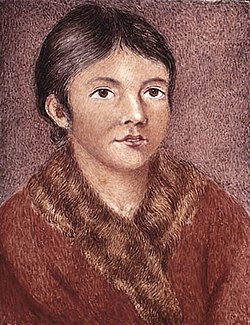
Demasduit was taken to Twillingate and for a time lived with the Anglican priest there, Rev. John Leigh. He learned that she was also called Shendoreth and Waunathoake, but he renamed her Mary March, after the Virgin Mary and the month in which she was kidnapped. Demasduit was brought to St. John's and spent much of the spring of 1819 in St. John's, brought there by Leigh and John Peyton Jr. While there, Lady Hamilton painted her portrait.[6]
During the summer of 1819, a number of attempts were made to return her to her people, without success. Captain David Buchan was to go overland to Beothuk Lake with Demasduit in November, the people of St. John's and Notre Dame Bay having raised the money to return the Beothuk to her home. However, she was taken ill and died of tuberculosis at Ship Cove (now Botwood) aboard Buchan's vessel Grasshopper, on 8 January 1820. Her body was left in a coffin on the lakeshore, where it was found by members of her tribe and returned to her village in February.[7] Demasduit’s body was initially placed in a burial hut beside her husband and child, before her remains and her husband's were later removed by William Cormack and brought to Scotland, where eventually their remains were held in the National Museum of Scotland.[8]
There were only thirty-one of the Beothuk remaining at that time.[citation needed]
Legacy
[edit]In 2007, the Government of Canada recognized Demasduit as a Person of National Historic Significance.[9]
In 2020, the remains of Demasduit and her husband Nonosabasut were repatriated from Scotland after years of advocacy.[8] Chief Mi'sel Joe of the Miawpukek First Nation in Conne River first began the push for repatriation in 2015, and he was joined by other Indigenous leaders. Premier of Newfoundland and Labrador Dwight Ball and Heritage Minister Mélanie Joly made formal requests to National Museums Scotland in 2016, with Ball crediting Chief Mi'sel Joe specifically for beginning the process by bringing the issue to public attention.[10] Their remains had been in Scotland for 191 years when they were returned to Newfoundland and were stored at The Rooms, a provincial museum and archive in St. John's.[11] This return was praised and recognized by Canadian politicians including Premier Ball and Minister of Canadian Heritage Steven Guilbeault, as well as by leaders from the Miawpukek First Nation, Innu Nation, Nunatsiavut, NunatuKavut, and Qalipu First Nation.[12] In 2022, CBC News reported that the government of Newfoundland and Labrador was planning a new cultural centre at Beothuk Lake to serve as a final resting place for the remains.[13]
Demasduit's niece, a young woman named Shanawdithit (1801–1829), was the last known Beothuk.[10]
The song "Demasduit Dream", recorded by Newfoundland band Great Big Sea, is named after Demasduit and alludes to her life and capture.[14]
The Demasduit Regional Museum, formerly known as the Mary March Provincial Museum, in the town of Grand Falls-Windsor, Newfoundland and Labrador, is named after her. The museum's exhibits "look at the history of the Beothuk, early European settlers, and the stories of a thriving, vibrant Mi’kmaq population in this area."[15] In May 2006, a group of local grade 2 students, led by student Conor O'Driscoll, helped collect more than 500 signatures on a petition to rename the museum to Demasduit's original identity, rather than the name she was given after her capture.[16] The director of The Rooms, which owns and operates in the museum, announced in December 2021, that they would rename it using Demasduit's original name rather than Mary March.[17] They considered multiple options for renaming the museum, including the Demasduit Regional Interpretation Centre, before deciding on the new name of Demasduit Regional Museum.[18]
In November 2022, the governments of Canada and Newfoundland and Labrador announced plans for a commemoration project recognizing 200 years since the death of Demasduit. The project was delayed due to the COVID-19 pandemic.[19] The plans include a bronze statue of Demasduit, Nonosabasut, and their child, as well as a surrounding healing garden, to be located in Botwood. Funding from this project was contributed by the federal and provincial governments through the Department of Canadian Heritage, as well as additional funding from the Town of Botwood, Miawpukek First Nation, Botwood Heritage Society, Botwood Mural Arts Society and the United Church of Canada.[20]
Genetic testing
[edit]In 2007, DNA testing was conducted on material from the teeth of Demasduit and her husband Nonosabasut. The results assigned them to Haplogroup X (mtDNA) and Haplogroup C (mtDNA), respectively, which are also found in current Mi'kmaq populations in Newfoundland.[21][22]
See also
[edit]
.svg)
- List of people of Newfoundland and Labrador
- Shanawdithit and Demasduit were the last members of the Beothuk people of Newfoundland and Labrador
- Ishi, the last known member of the Yahi people of California
- Squanto, the last member of the Patuxet people of Massachusetts
- The Man of the Hole, last member of an uncontacted people of Brazil
- Juana Maria, the last known member of the Nicoleño tribe
References
[edit]- ^ Charlotte Gray 'The Museum Called Canada: 25 Rooms of Wonder' Random House, 2004
- ^ Mullen, Gary R., "Philip Henry Gosse Archived 2011-09-14 at the Wayback Machine," Encyclopedia of Alabama, 26 August 2008, retrieved 9 September 2011
- ^ G. M. Story. "DEMASDUWIT". University of Toronto/Université Laval. Archived from the original on October 4, 2013. Retrieved October 2, 2013.
- ^ "Disappearance of the Beothuk". www.heritage.nf.ca. Archived from the original on 2019-10-21. Retrieved 2019-10-21.
- ^ Marshall, Ingeborg. "History". beothukinstitute.ca. Retrieved 2023-09-27.
- ^ "Disappearance of the Beothuk". www.heritage.nf.ca. Retrieved 2023-09-27.
- ^ MacLean, John. Canadian Savage People, 1896. pp 318.
- ^ a b Cowan, Peter (26 May 2017). "Indigenous leaders unite for return of Beothuk remains, inclusion in MMIWG inquiry". CBC.
- ^ "Demasduit". The Canadian Encyclopedia. Retrieved 2025-08-03.
- ^ a b "Remains of 2 Beothuk people to be transferred from Scotland to Canada". CBC. 21 January 2019.
- ^ Quinn, Mark (12 March 2020). "Beothuk remains returned to Newfoundland after 191 years in Scotland". CBC.
- ^ "Nonosabasut and Demasduit Returned to Newfoundland and Labrador". Government of Newfoundland and Labrador. 11 March 2020. Retrieved 26 September 2023.
- ^ Cooke, Ryan (9 June 2022). "Stolen skulls returning to Beothuk Lake, as N.L. plans for new cultural centre". CBC. Retrieved 26 September 2023.
- ^ "Great Big Sea - CanadianBands.com". 2022-04-11. Retrieved 2023-09-27.
- ^ "Demasduit Regional Museum". The Rooms.
- ^ CBC News (May 31, 2006). "N.L. children petition to rename museum". CBC News. Archived from the original on August 20, 2022. Retrieved March 1, 2021.
- ^ CBC News (December 27, 2021). "Mary March museum changing name out of respect for Beothuk woman, director says". CBC News. Archived from the original on December 27, 2021. Retrieved December 28, 2021.
- ^ CBC News (10 March 2022). "Panel picks Demasduit Regional Museum as new name for Mary March museum". CBC.
- ^ Executive Council (4 November 2022). "Project Commemorates the 200th Anniversary of the Death of Demasduit". Government of Newfoundland and Labrador.
- ^ The Canadian Press (4 November 2022). "N.L. statue pays homage to one of the last of the Beothuk". CTV News.
- ^ Kuch, M; et al. (2007). "A preliminary analysis of the DNA and diet of the extinct Beothuk: A systematic approach to ancient human DNA" (PDF). American Journal of Physical Anthropology. 132 (4): 594–604. Bibcode:2007AJPA..132..594K. doi:10.1002/ajpa.20536. PMID 17205549. Archived from the original (PDF) on 2015-02-14.
- ^ Pope, A (2011). "Mitogenomic and microsatellite variation in descendants of the founder population of Newfoundland: high genetic diversity in an historically isolated population" (PDF). Genome. 54 (2): 110–119. doi:10.1139/g10-102. PMID 21326367. Archived (PDF) from the original on 2021-04-11. Retrieved 2020-01-30.
External links
[edit]
Demasduit
View on GrokipediaHistorical Context
Beothuk Society and Conflicts with Europeans
The Beothuk were an Indigenous, Algonkian-speaking people inhabiting Newfoundland as insular hunter-gatherers organized in mobile bands of 35 to 50 individuals, typically comprising 7 to 10 families, with leadership emerging through consensus among skilled hunters or knowledgeable elders rather than formal hierarchy.[4] Their subsistence economy relied on seasonal migrations to exploit marine and terrestrial resources, including fall caribou hunts using fences and bows, spring harp seal harvests, salmon fishing during river runs, and gathering of shellfish, sea birds, and plants; these activities supported a diet dominated by protein from seals, fish, and caribou supplemented by gathered foods.[4] Dwellings consisted of conical wigwams 6–7 meters in diameter, framed with poles and covered in birch bark, moss, and turf, while lightweight birch-bark canoes enabled coastal navigation and long-distance travel; tools initially of stone were increasingly supplemented by reworked iron obtained from Europeans.[4] A hallmark practice involved coating bodies, clothing, and artifacts with red ochre, symbolizing cultural identity and possibly spiritual significance, which led Europeans to term them "Red Indians."[4] Initial European contacts in the 1500s occurred through indirect silent barter at fishing stations, where Beothuk exchanged furs for valued iron items like nails, needles, and hatchets, which they reforged into superior projectile points and blades absent in their pre-contact stone toolkit.[3] By 1612, as documented in John Guy's expedition to Trinity Bay, such exchanges persisted but evolved into opportunistic raids on unattended premises when Beothuk avoided direct interaction, prioritizing isolation to evade perceived threats.[3] This pattern of pilfering European iron—essential for efficient hunting and processing but unobtainable through sustained trade—provoked retaliatory destruction of Beothuk canoes, traps, and stages by settlers and furriers, initiating a cycle of escalation rooted in mutual resource claims rather than unprovoked aggression.[3] Conflicts intensified in the 18th century as English settlement expanded into Bonavista and Notre Dame Bays, appropriating coastal salmon rivers and seal haul-outs previously accessed by Beothuk during seasonal incursions, while inland trapping and livestock reduced game availability.[3] Beothuk responses included targeted raids on traps and boats, such as the 1818 incident involving John Peyton Senior's vessel, met with armed pursuits; governors like Hugh Palliser (1768) and William Waldegrave (1797) issued proclamations against violence and offered contact rewards, but enforcement failed amid ongoing territorial friction.[3] Concurrent Mi'kmaq influx from Nova Scotia, accelerating in the 1720s, introduced further competition for marine mammals and fish stocks, with historical accounts recording hostilities including Mi'kmaq hunting parties clashing over overlapping territories, exacerbating Beothuk displacement.[5] By the early 1800s, Beothuk confinement to interior rivers like the Exploits yielded malnutrition from scarce caribou and forfeited coastal staples, compounded by indirect exposure to European pathogens—tuberculosis foremost, evidenced in skeletal remains and fatalities like those in 1820–1829—lacking immunity due to deliberate contact avoidance.[6] Population estimates plummeted from around 350 in 1768 to 72 by 1811, per settler surveys, as resource denial and disease converged causally with the Beothuk's adaptive strategy of inland retreat, rendering coastal competition decisive in their marginalization.[6]Capture
The Peyton Expedition of 1819
In response to repeated thefts by Beothuk groups from European fishing and trapping stations along the Exploits River, including the September 1818 pilfering of John Peyton Jr.'s salmon boat, nets, and gear at the river's mouth, Newfoundland Governor Sir Charles Hamilton authorized Peyton to lead an expedition to recover stolen property and, if possible, capture a Beothuk individual alive to facilitate future communication and trade.[1][6] This effort followed earlier unsuccessful peace initiatives by Lieutenant David Buchan in 1810 and 1812, which had aimed at contact but encountered Beothuk hostility and thefts.[7] On March 1, 1819, Peyton Jr., accompanied by his father John Sr. and eight armed settlers—furriers and fishermen—departed from the mouth of the Exploits River on snowshoes, traveling up the frozen waterway toward interior Beothuk wintering grounds at Red Indian Lake (now Beothuk Lake).[1][2] The group reached a Beothuk encampment of about ten conical birch-bark wigwams on the lake's shore by March 5, where they discovered evidence of recent thefts, including Peyton's own marked copper kettle.[6] The settlers approached stealthily at dawn but fired warning shots at approaching wolves, alerting the camp's occupants, who fled into the woods armed with bows and arrows.[8] Peyton's men pursued, seizing Demasduit—a Beothuk woman carrying her infant daughter—after she fell behind the others near the frozen lake; she dropped to her knees in apparent surrender as a younger Peyton overtook her.[9] Her husband, Nonosbawsut, the apparent group leader, returned to challenge the captors, firing arrows and wounding at least one settler before being shot and bayoneted in the ensuing skirmish; he died on the ice.[1][10] The party recovered additional stolen items from the abandoned camp, including iron tools and utensils, and removed Beothuk artifacts such as Demasduit's copper pendants and sealskin clothing, which were later documented as evidence of their material culture.[6] Peyton and his men faced no immediate reprisal from other Beothuk but were later charged with murder upon returning to St. John's; a grand jury acquitted them, citing self-defense against Nonosbawsut's armed resistance.[7] The capture yielded no broader peace but provided the first living Beothuk contact in years, amid ongoing conflicts driven by resource competition and mutual raids.[3]Captivity
Arrival and Renaming in St. John's
Demasduit was transported by schooner from Twillingate to St. John's in April 1819, shortly after her capture on 5 March at Red Indian Lake in the Bay of Exploits region.[1][2] Accompanied by her captor John Peyton Jr. and Anglican missionary Rev. John Leigh, the journey occurred once spring navigation opened along Newfoundland's coast.[1] Upon arrival, Demasduit was grief-stricken from witnessing her husband Nonosabasut's fatal shooting during the capture and the separation from her infant daughter, though she sustained no physical injuries.[2] She was placed under the care of Rev. John Leigh in St. John's, where initial efforts focused on her basic sustenance and adjustment.[1] Provisions included European-style food, replacement of her traditional caribou-skin garments with settler clothing, and medical attention to address any immediate needs.[2] In St. John's, authorities renamed her Mary March, drawing from the Christian figure of the Virgin Mary and the March timing of her seizure, as part of broader attempts to integrate her into colonial society.[1] Described as gentle and intelligent yet initially distressed, she exhibited tractability that enabled early cooperative exchanges, including sketching Beothuk symbols and sharing rudimentary vocabulary with Leigh.[1][2] These interactions marked the onset of documented ethnographic engagement amid the cultural imposition she faced.[2]
Daily Life, Adaptation, and Interactions
Following her transport to Twillingate in March 1819, Demasduit was placed under the care of Anglican missionary Reverend John Leigh and resided with the family of John Peyton Jr., who had led her capture expedition. She adapted to European attire and provisions, consuming food sparingly and maintaining a routine of late rising, typically around 9 a.m., often rolling herself tightly in bedding. Despite initial grief over her husband's death, she displayed resilience, engaging positively with her hosts and attempting escape twice by concealing herself in a deer-skin robe, though she was recaptured and reconciled under supervision.[11] Demasduit demonstrated practical Beothuk skills, including canoe construction techniques, and produced items such as moccasins and stockings from available materials. She recounted aspects of Beothuk existence, describing a population of about 300 living in dispersed wigwams and their strategic avoidance of Europeans through inland retreat and mobility, reflecting a deliberate isolation to evade conflict. These exchanges occurred amid her acquisition of rudimentary English via mimicry and gestural communication, enabling clearer interactions over time.[11] Relocated to St. John's by spring 1819, she received humane treatment from Governor Sir Charles Hamilton, who provided presents and facilitated her limited freedom to shop in the town. Demasduit developed a devoted attachment to Peyton Jr., perceiving him as a protector, and was visited by Lady Hamilton, who created a portrait of her—the only known depiction of a Beothuk from life. Officials like Hamilton viewed her presence as an opportunity for intercultural bridge-building, though her transition from sparse woodland isolation to crowded coastal settlements exposed her to novel pathogens, including tuberculosis, against which Beothuk populations lacked acquired resistance due to minimal prior contact; her health, already delicate from the capture ordeal, deteriorated progressively without indications of abuse.[11][1]Death and Aftermath
Illness, Death, and Medical Context
In late 1819, while held in captivity in St. John's, Demasduit exhibited symptoms initially attributed to a severe cold, which soon manifested as consumption, the contemporary term for pulmonary tuberculosis.[2] This disease, likely contracted through contact with European settlers lacking quarantine measures, progressed rapidly in the absence of effective treatments; 19th-century interventions for respiratory ailments commonly included bloodletting to reduce supposed inflammation and depleting therapies, though records do not specify their application to her case and such methods proved futile against the bacterial infection Mycobacterium tuberculosis. Her condition reflected the vulnerability of isolated indigenous groups to Old World pathogens, where genetic and epidemiological evidence indicates minimal prior exposure fostered no herd immunity, enabling unchecked spread via airborne droplets in confined colonial settings.[12] Demasduit died on January 8, 1820, at approximately 24 years of age, succumbing to advanced pulmonary tuberculosis without documented autopsy, though clinical observations aligned with characteristic lung cavitation and hemorrhage typical of the disease's terminal stage.[13] No contemporary accounts suggest physical mistreatment hastened her decline beyond incidental pathogen transmission during captivity; rather, the illness mirrored tuberculosis epidemics decimating other indigenous populations globally, driven by susceptibility rather than intentional extermination.[1] Efforts by her custodians, including provision of European-style care under figures like Reverend John Leigh, failed to arrest the infection, underscoring the era's medical limitations against novel epidemics in immunologically naive communities.[6]Fate of Her Infant Daughter
Demasduit's infant son died in 1819 shortly after her capture on March 26 near the Exploits River, likely within days of the event that left him orphaned following his father's death.[14][1] During the confrontation led by John Peyton Jr., Nonosbawsut seized the child and fled but was fatally shot, abandoning the infant at the Beothuk encampment without immediate care.[1] The exact cause remains unknown but may have involved exposure to harsh spring conditions, congenital issues, or absence of maternal protection in the remote interior.[2] Reverend John Leigh, the Anglican missionary in Twillingate who initially housed Demasduit after her arrival there in early April, observed her profound distress over the child's fate and sought to reunite them, reflecting her repeated inquiries and mourning.[1] Leigh's accounts highlight Demasduit's emotional attachment, as she communicated through gestures and emerging English words her anxiety for the infant's welfare amid captivity's stresses. No retrieval efforts succeeded, and the child's body was not recovered or documented in settler records beyond presumptions of death at the site.[2] This outcome aligns with elevated infant mortality in early 19th-century Newfoundland, where rates often surpassed 150-200 deaths per 1,000 live births due to infectious diseases, nutritional deficits, and climatic exposures—factors intensified for an isolated Indigenous child lacking familial support.[1] The loss underscored vulnerabilities in Beothuk-settler interactions, though primary accounts from Leigh and Peyton emphasize the child's pre-existing frailty rather than direct settler intervention post-capture.Peace Efforts
The 1820 Expedition to Return Her People
In early 1820, following Demasduit's death from tuberculosis on January 8 aboard HMS Grasshopper, British naval authorities organized an expedition under Lieutenant David Buchan to return her body and personal effects to Beothuk territory near Red Indian Lake, aiming to signal goodwill and facilitate peaceful contact amid ongoing settler-Beothuk tensions.[12] The effort reflected pragmatic recognition of Beothuk elusiveness and dispersal, with hopes that returning kin would mitigate distrust rooted in prior violent encounters rather than attributing scarcity solely to settler actions.[3] Buchan's party, comprising about 50 men including Royal Navy personnel, John Peyton Jr. (involved in her capture), and Mi'kmaq and Montagnais guides for their tracking expertise, departed from the Bay of Exploits in February, navigating harsh winter conditions through the Newfoundland interior.[15][1] The expedition traversed snow-covered terrain to the lake's shores, where recent Beothuk campsites with abandoned fires and implements indicated proximity but no living occupants, underscoring the Beothuk's tactical avoidance honed from decades of evasion against European incursions.[6] Unable to locate surviving kin—likely her band having scattered due to persistent threats— the group interred Demasduit's coffin, dressed in traditional Beothuk attire with red ochre applied, inside a constructed wigwam alongside her sewing implements, clothing, and other gifts intended to convey non-hostile intent.[1][16] The return journey extended via an alternate route to evade potential ambushes, but yielded no encounters, reinforcing empirical evidence of Beothuk demographic decline and their strategic withdrawal into remote areas rather than extinction from direct malice.[17] This initiative's failure highlighted causal factors like entrenched Beothuk wariness—evident in their rapid abandonment of sites upon detecting outsiders—over simplistic narratives of aggressive pursuit, as the Beothuk's small population and mobility precluded sustained engagement.[18] Reports from the trek documented sparse signs of habitation, aligning with later surveys confirming population scarcity by the 1820s, though the gesture laid groundwork for subsequent searches without altering the trajectory of Beothuk isolation.[12][3]Ethnographic Contributions
Recorded Beothuk Vocabulary and Artifacts
During her captivity in Twillingate from spring 1819 until her death in January 1820, Demasduit collaborated with the Anglican missionary Rev. John Leigh to document approximately 180 words of the Beothuk language, representing a significant portion of the roughly 350 known terms overall.[12][19] These included nouns for body parts such as arms (watheek) and ankles (geijebursut), animals like beaver (maumshet), and environmental concepts, reflecting everyday Beothuk nomenclature as elicited through direct translation efforts once Demasduit acquired basic English proficiency.[20] The phonetic transcriptions, derived from European observers, captured the language's distinctive sounds, including glottal stops and alveolar clicks unfamiliar to English speakers, though accuracy was constrained by the informants' linguistic barriers and the absence of standardized orthography.[20] Material artifacts linked directly to Demasduit were limited but included elements of her traditional attire and camp possessions seized during her capture on March 5, 1819, near the Exploits River, such as caribou- or moose-skin garments adorned with red ochre, which exemplified Beothuk textile techniques using sinew sewing and waterproofing.[12] These items, along with adapted European copper kettles and needles found in her possession—repurposed into Beothuk tools—offered tangible evidence of cultural adaptation and scavenging practices; similar copper pendants and ornaments, hammered from salvaged metal, are preserved in Newfoundland collections as representative of late Beothuk craftsmanship associated with her era.[6] The recorded vocabulary remains fragmentary due to Demasduit's short time in captivity and her focus on survival amid illness and cultural dislocation, yielding no systematic grammar, verbs beyond basic forms, or idiomatic expressions essential for full linguistic reconstruction.[19] This paucity highlights the Beothuk language's status as an isolate, distinct from Algonquian languages spoken by neighboring Indigenous groups despite superficial resemblances in some lexical items, with no evidence of mutual intelligibility or shared structure.[20] Primary reliance on Leigh's notes, preserved in Anglican archives, underscores the value of such firsthand documentation while noting potential transcription errors from cross-cultural elicitation.[21]Insights into Beothuk Culture from Her Accounts
Demasduit conveyed through interpreted gestures and limited verbal exchanges during her captivity in 1819 that Beothuk groups practiced seasonal migrations, wintering in interior locations such as Red Indian Lake for access to trapped fish and game under ice cover, and shifting to coastal estuaries and river mouths in summer to exploit salmon runs and marine resources.[1] These patterns reflected adaptation to Newfoundland's variable ecology, where interior winters minimized exposure to coastal winds and predators, while summer coasts provided abundant but competitive foraging grounds increasingly pressured by European fishing stations. Her descriptions, relayed to missionary John Leigh via an interpreter between June and September 1819, underscored a mobile, non-sedentary existence without fixed villages or cultivated fields, consistent with archaeological evidence of temporary campsites rather than permanent agriculture.[1] Social organization, as indicated in her communications, centered on small, kin-related bands numbering perhaps 30 to 50 individuals, led by figures like her husband Nonosbawsut, who coordinated hunts, defenses, and relocations.[1] [3] These units emphasized self-sufficiency in hunting caribou, seals, and birds, with no accounts from Demasduit suggesting larger confederacies or hierarchical institutions beyond familial authority. Such structures enabled flexibility in a harsh, low-population-density environment but limited scalability against external threats. Demasduit's relayed perspectives framed Europeans as existential enemies, attributing Beothuk raids on settlements—such as thefts of traps, axes, and nets—to survival imperatives amid resource depletion from settler encroachments and retaliatory killings, including Nonosbawsut's death during her capture on March 5, 1819.[1] [6] These incursions were tactical acquisitions of iron tools essential for skinning and boat-building, not unprovoked aggression, in a context where Beothuk avoidance of direct confrontation stemmed from recognition of European firearms' superiority—muskets outranging bows and enabling ambushes from fortified positions. This rational retreat preserved short-term safety but exacerbated long-term demographic decline by enforcing isolation, hindering access to trade, intermarriage, or disease resistance, and accelerating starvation as coastal habitats were monopolized by fisheries from the late 1700s onward.[6] Empirical records of dwindling Beothuk sightings post-1800, corroborated by her own failed 1820 expedition signals, illustrate how such dynamics compounded low birth rates and high infant mortality in small populations.[1]Legacy
Symbolic Role in Beothuk History
Demasduit symbolizes the final documented encounters between Beothuk and European settlers, serving as a key figure in preserving linguistic and cultural records of a people facing extinction by the early 19th century. Captured alive in March 1819 during a period of escalating tensions, she provided settlers with Beothuk vocabulary lists, drawings, and artifacts that offered rare insights into their traditions, positioning her as a pivotal source for historical documentation rather than merely a passive victim.[22][6] In recognition of these contributions, the Government of Canada designated Demasduit a Person of National Historic Significance in 2007, highlighting her role alongside her niece Shanawdithit in aiding the understanding of Beothuk history. This status underscores her enduring value as an ethnographic bridge, enabling analysis of Beothuk practices amid their decline, which stemmed from multiple interacting factors including European-introduced diseases like tuberculosis, competition for marine resources, and interpersonal violence with both settlers and neighboring Indigenous groups such as the Mi'kmaq.[23][6][24] Interpretations of her symbolic role vary: some Indigenous viewpoints frame her capture and the broader Beothuk fate as emblematic of irreversible cultural erasure due to colonial pressures, emphasizing the tragedy of lost autonomy and knowledge transmission. In contrast, settler-era records depict mutual animosities, with Beothuk raids on fisheries and livestock prompting organized pursuits that culminated in her seizure after her husband Nonosabasut's fatal resistance, thus complicating narratives of one-sided aggression and illuminating failed attempts at reconciliation through her intended return to her people. Her legacy thus balances evidentiary utility against romanticized extinction motifs, fostering causal realism in assessing Beothuk demise over simplified displacement theories.[25]