Hubbry Logo
Miawpukek First NationMiawpukek First NationMain
Open search
Miawpukek First Nation
Community hub
Miawpukek First Nation
logo
8 pages, 0 posts
0 subscribers
Be the first to start a discussion here.
Miawpukek First Nation
from Wikipedia

Miawpukek First Nation
Band No. 47
PeopleMiꞌkmaq
HeadquartersSamiajij Miawpukek
ProvinceNewfoundland and Labrador
Land[1]
Reserve(s)
Samiajij Miawpukek
Land area28.39 km2
Population (2023)[1]
On reserve836
On other land2
Off reserve2263
Total population3101
Government[1]
ChiefBrad Benoit
Council
  • Vice Chief Frank Benoit
Website
mfngov.ca

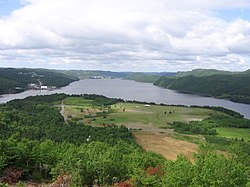
Miawpukek First Nation is a Mi'kmaq First Nations band government in Conne River, Newfoundland and Labrador, Canada, with a registered population of 836 living on-reserve as of May 2023, with another 2,265 living off-reserve. [4][5] They control the reserve of Samiajij Miawpukek in Bay d'Espoir on the island of Newfoundland. It was formerly known as Conne River Indian Reserve until the mid-1980s.[6] Samiajij Miawpukek was established as a federal Indian reserve in 1987, the first in Newfoundland and Labrador. In 1991, Miawpukek was one of the poorest communities in Atlantic Canada. Due in part to increased education of its members, it has gone on to become the most well-off First Nation in Atlantic Canada after Membertou.[7][8]

Key Information

Attractions

[edit]

The powwow, started in 1996, is held every year.[9]

In 2019, the Miawpukek First Nation opened the "Cannabis Boutique", which they claim is "the first Indigenous-owned and -operated marijuana store in Newfoundland".[10]

See also

[edit]

References

[edit]
[edit]
Revisions and contributorsEdit on WikipediaRead on Wikipedia
from Grokipedia
Miawpukek First Nation, officially known as Miawpukek Mi'kamawey Mawi'omi, is a situated at the mouth of the Conne River on the south coast of , . The community has been a since approximately 1822 and was designated as a federal in 1987, marking the first such reserve in . As of 2022, it has an on-reserve population of 822 and an off-reserve population of 2,238, with members tracing ancestry to , , , and European lineages. Historically part of the broader territory, Miawpukek's residents engaged in traditional activities like hunting, trapping, and fishing before European contact, adapting to seasonal migrations within the Algonquian-speaking cultural framework. The reserve's formal establishment followed decades of advocacy for recognition under the , culminating in federal acknowledgment after oral traditions and community persistence demonstrated continuous occupation dating back to at least 1870. operates through the Miawpukek First Nation Government, aligned with the Grand Council of , emphasizing local decision-making in areas such as natural resources and community services. Since 1987, Miawpukek has achieved near-full employment, transforming from a community with 90% rates to a model of economic self-sufficiency through initiatives in training, , and , including a guardians program for species monitoring. This progress includes signing a Self-Government Agreement-in-Principle in 2013 with and , advancing negotiations toward greater autonomy outside the framework. The band's economic diversification, such as equity in projects and ventures, underscores its focus on while addressing infrastructure challenges like water systems.

Geography and Demographics

Location and Environment

The Miawpukek First Nation occupies the reserve of Samiajij Miawpukek at the mouth of the Conne River on the south coast of Newfoundland island, within the province of Newfoundland and Labrador, Canada. This coastal-riverine setting provides direct access to estuarine habitats and the Atlantic Ocean, supporting traditional fisheries and marine resource utilization. The local terrain encompasses forested uplands, river valleys, and tidal flats characteristic of Newfoundland's southern shoreline, fostering in freshwater and marine ecosystems. The Conne River watershed sustains key species such as (plamu in ), for which the community conducts ongoing monitoring and habitat assessment programs to track population health and environmental pressures. Community-led initiatives also oversee species at risk, including caribou, migratory birds, bats, and riverine wildlife, emphasizing ecological amid regional forestry and activities. Environmental challenges include a persistent long-term drinking water advisory issued on December 20, 2022, affecting 36 homes in the Bernard Road area due to low water pressure in the distribution system; this advisory remained active as of August 29, 2025.

Population Statistics

As of the latest federal records from Indigenous Services Canada, Miawpukek First Nation has a total registered population of 3,154 members under the . Of these, approximately 833 reside on the band's reserve (Samiajij Miawpukek), comprising 444 registered males and 389 registered females, while the remainder live off-reserve. Recent government reports confirm around 836 on-reserve residents as of 2023, reflecting minor fluctuations in residency data.
Residency CategoryMalesFemalesTotal
On Own Reserve444389833
Off Reserve~1,160~1,161~2,321
The band's own records indicate an on-reserve of 822 as of February 2022. census data for the Samiajij Miawpukek reports a total enumerated of 955 in 2021, down slightly from 960 in 2016, encompassing both registered members and other residents such as non-status Indigenous individuals or non-Indigenous spouses. Since the reserve's formal establishment in , the on-reserve population has shown growth, rising from approximately 700 residents in the mid-1990s to over 800 in recent years, attributable in part to initiatives that have encouraged return migration for employment opportunities within the community. This trend aligns with broader band membership increases, from around 2,877 total members reported in 2012 to over 3,100 by 2023.

History

Pre-Contact and Early European Interactions

Archaeological investigations in Newfoundland have yielded no definitive evidence of permanent settlements prior to European contact around 1497, with pre-contact sites primarily attributed to earlier cultures such as the or ancestors of the . oral traditions, however, assert seasonal migrations to Ktaqmkuk (their term for Newfoundland) for exploiting marine and terrestrial resources, including and cod, hunting caribou, and gathering berries, potentially dating back centuries before sustained European presence. These claims lack corroboration from empirical artifacts distinctly linked to , such as specific tool styles or hieroglyphic inscriptions, which are more abundantly documented in mainland (, , and ). Initial European interactions with in Newfoundland began in the early 1500s, as French explorers recorded sightings of Indigenous groups using birchbark canoes along the southern coast, likely including from Cape Breton making cross-Gulf voyages. By the mid-16th century, engaged in trade with seasonal European fishermen, exchanging furs, fish, and meat for metal tools, cloth, and beads, which facilitated adaptation to European technologies like shallops for faster coastal travel. These exchanges occurred amid competition for resources, with occasionally clashing with English settlers and over hunting grounds; for instance, in the late 1600s to early 1700s, raids targeted French-allied positions during Anglo-French conflicts, including attacks on Placentia settlements around 1713 following the Treaty of . Unlike mainland , who entered multiple with the British Crown between 1725 and 1779 affirming trade rights and non-interference, Newfoundland Mi'kmaq lacked equivalent formal agreements, leaving their seasonal activities unregulated by colonial authorities. Sporadic renewals, such as Mi'kmaw Chief Jeannot Pequidalouet's 1765 affirmation of friendship on Codroy Island, occurred but did not extend land or resource guarantees specific to the island. This absence contributed to escalating pressures from European expansion, as Mi'kmaq presence grew more permanent in southern areas like Conne River by the 1700s, driven by declining mainland resources and alliances with French forces.

Period of Assimilation and Cultural Suppression (1800s–Mid-1900s)

During the , groups in Newfoundland, including ancestors of the Miawpukek First Nation, underwent significant dispersal as nomadic hunters and fishers established seasonal camps across southern, western, and northern regions, often hundreds of kilometers apart, with migrations to Cape Breton continuing only until the mid-1800s. Intermarriage with and remnants became widespread, particularly in areas like St. George's Bay, eroding distinct communal boundaries and facilitating integration into settler economies through roles such as guiding explorers (e.g., William Cormack in 1822) and labor on infrastructure projects like telegraph lines in the 1850s and mail delivery in the 1860s. Population estimates for Newfoundland remained low at approximately 150–200 individuals during this period, though unreliable due to high mobility and lack of formal enumeration, contributing to perceptions of demographic decline amid resource competition from expanding settler activities. Missionary efforts, predominantly by Roman Catholic , intensified cultural suppression from the late 1800s onward; for instance, a at St. Alban's near Conne River sought to eliminate "pagan" practices by banning the in favor of English or French and abolishing traditional chiefs, disrupting knowledge transmission and leadership structures. These interventions, coupled with church-led that prioritized European norms, accelerated the loss of oral traditions and spiritual practices, as Mi'kmaq children were compelled to adopt missionary prayers over indigenous ceremonies. Economic pressures further drove assimilation, with the completion of the in 1898 enabling encroachment that depleted caribou herds—from an estimated 200,000–300,000 in 1900 to near by the 1930s—undermining traditional subsistence and . Newfoundland's status as a separate British until confederation with in excluded from federal protections afforded to mainland indigenous groups, leaving them without reserves or targeted policies that might have preserved communal identity. The Terms of Union omitted any provisions for aboriginal peoples, with Canadian officials asserting that Newfoundland's had "merged with other citizens" through prior assimilation, denying access to federal services and reinforcing dispersal into non-indigenous society. This policy vacuum, combined with ongoing intermarriage and wage labor in logging and pulpwood during the era (1940s), solidified the erosion of distinct cultural markers by the mid-20th century, as communities like those at Conne River appeared nearly fully integrated by the 1970s.

Modern Revival and Push for Federal Recognition (1970s–1980s)

In the early 1970s, residents of Conne River initiated organized efforts to revive governance structures and assert claims to federal recognition under the , amid a broader North American movement that emphasized and treaty rights. Influenced by these pan-Indigenous trends, which gained momentum following events like the policy reversal and rising awareness of historical treaty obligations, the Conne River community elected its first chief and band council in 1972. This local action marked a shift from informal to formalized , enabling petitions to federal authorities for status as an Indian band—a status denied to Newfoundland's Indigenous peoples since the province's 1949 , which omitted provisions for administering the or establishing reserves. Conne River leaders, including John N. Jeddore elected as president of the newly formed Conne River Native Council in 1973, participated initially in province-wide Indigenous organizations such as the Native Association of , which evolved into the Federation of Newfoundland Indians (FNI) by 1975. The FNI advocated collectively for recognition across scattered communities, submitting joint petitions to for registration and land claims covering southern and central Newfoundland on behalf of approximately 1,400 . However, Conne River representatives increasingly pursued a distinct path, emphasizing their community's continuous presence and cultural continuity at Miawpukek as grounds for targeted federal band status, separate from the FNI's broader, multi-community approach that faced repeated rejections due to evidentiary disputes over descent and historical ties. These lobbying efforts highlighted Newfoundland's anomalous position without federal reserves or status Indians, contrasting with mainland provinces where Mi'kmaq bands had long operated under the . Conne River delegations met with Department of Indian Affairs officials throughout the decade, presenting genealogical and anthropological evidence of pre-confederation Mi'kmaq occupancy to counter government inertia rooted in the 1949 Terms of Union. By the late , sustained grassroots pressure, including resolutions from the Conne River council, had begun to shift federal deliberations toward acknowledging isolated communities like Miawpukek, though full recognition remained elusive amid bureaucratic scrutiny of aboriginality criteria.

The 1983 Hunger Strike and Immediate Aftermath

In April 1983, nine members of the Miawpukek First Nation, including newly elected Chief Misel Joe, initiated a hunger strike in St. John's, Newfoundland, to compel the provincial government to release over $800,000 in withheld federal transfer payments intended for community services. The protesters, who subsisted solely on juice for the duration, highlighted the community's year-long deprivation of essential funding amid ongoing federal denial of status recognition as an Indian band under the Indian Act, exacerbated by Newfoundland's lack of treaties and historical jurisdictional resistance to aboriginal claims. The participants included Misel Joe, Billy Joe, Andy Joe, Ches Joe, George Drew, Wilfred Drew, Rick Jeddore, Aubrey Joe, and Michael G. Benoit. The provincial administration under Premier initially resisted, citing doubts about the continuity of identity and presence in Newfoundland following centuries of assimilation policies and the absence of federal-provincial agreement on band status. This standoff reflected broader governmental skepticism toward claims lacking foundations, prioritizing fiscal and jurisdictional control over immediate relief despite the federal origin of the funds. , lasting nine days and concluding on April 30, 1983, pressured authorities into negotiation, framing the action as a high-stakes, self-imposed escalation born of administrative neglect rather than formalized legal entitlement. Immediate outcomes included the release of the impounded funds, providing short-term operational relief and averting further hardship, though without resolving underlying recognition disputes. This pragmatic concession averted escalation while underscoring the strike's role as a catalyst for dialogue, later reflected in narratives such as the 2024 documentary The Forgotten Warriors by Noel Joe, which portrays the event as a collective act of endurance against systemic oversight. The resolution marked a tactical victory in securing interim aid, bypassing ideological barriers through public demonstration of resolve.

Formal Reserve Establishment and Post-1987 Developments

In June 1987, the Conne River community was designated as the Samiajij Miawpukek under the , becoming the first federal reserve in . This formal establishment followed the 1985 recognition of its residents as status Indians, enabling the community to access and benefits under federal Indigenous policy. The reserve encompassed approximately 1,240 hectares along the Conne River, providing a legal land base absent prior to this designation. The reserve status prompted the immediate formation of a band council under the framework, with the Miawpukek Mi'kamawey Mawi'omi serving as the governing body. This structure allowed the community to administer federal funding streams, including those for , , and programs previously unavailable. Initial council priorities included registering band members—totaling around 1,200 at the time—and establishing administrative offices to manage these resources. Post-1987, the community confronted significant infrastructural deficits stemming from decades of isolation and , with nearing 90% and limited access to basic utilities. Federal grants supported early projects such as housing construction, road improvements, and water systems, marking a shift from subsistence reliance to program-funded development. These efforts, however, were hampered by bureaucratic delays and the need to build capacity in a newly formalized entity, resulting in phased implementation through the late and early .

Band Council Structure

The Miawpukek First Nation band council is structured under the provisions of the Indian Act, comprising an elected chief and six councillors responsible for the administration of reserve affairs. Elections for chief and council occur periodically, with band members voting to select leadership; the most recent election on June 4, 2024, resulted in the re-election of Chief Brad Benoit alongside councillors Frank Benoit, Mike Drew, Susan Hill, Fernando Jeddore, Barry Joe, and Yvonne John. As an Indian Act band, the default term for chief and councillors is two years unless altered by band custom or by-law, with processes managed by an electoral officer to oversee nominations, voting, and appeals. The chief provides overall leadership and represents in external relations, while councillors oversee designated portfolios encompassing key operational areas such as community services, , and natural resources management. These roles include responsibilities for , annual budgeting, program implementation, financial oversight, and monitoring service delivery to ensure alignment with community needs. The council collectively approves budgets, by-laws, and major decisions affecting the reserve, drawing on departmental input to maintain effective governance. Accountability mechanisms include regular meetings, some designated as open to band members for input and information sharing, alongside public publication of meeting records and decisions on the band's official website to promote transparency in operations. This approach addresses potential concerns over opacity by facilitating community access to proceedings and fiscal details, though ultimate authority remains with elected officials under federal band framework requirements.

Self-Government Negotiations and Agreements

In November 2013, Miawpukek First Nation signed a Stand-Alone Self-Government Agreement-in-Principle (AIP) with the and the Government of , initiating formal negotiations for enhanced autonomy outside the framework of comprehensive land claims. This AIP, developed through extensive community consultations, outlines a pathway to a final agreement delegating law-making authority to the First Nation in core areas such as membership, governance structures, elections, and , while maintaining federal and provincial oversight in fiscal and certain resource matters. The agreement emphasizes political and fiscal through a Miawpukek to be upon finalization, aiming to enable the band council to enact bylaws enforceable on reserve lands without conflicting with federal or provincial laws. However, progress toward a final self-government agreement has been limited, with no reported as of 2025, reflecting ongoing dependencies on tripartite negotiations and federal approval processes that have delayed for over a decade. This stand-alone approach, distinct from integrated treaty settlements, underscores Newfoundland First Nations' later entry into self-government talks, stemming from the province's 1949 confederation without prior reserves or treaties, unlike earlier processes in other regions. Such negotiations highlight persistent hurdles, including the need for mutual consent on jurisdictional boundaries and funding mechanisms, which tie Miawpukek's expanded powers to continued federal transfers and provincial coordination rather than independent sovereignty. Compared to over 25 self-governing First Nations elsewhere in with ratified agreements by the mid-2010s, Miawpukek's process illustrates the protracted nature of autonomy pursuits in jurisdictions with historical treaty gaps, where delegated authority remains subordinate to overarching Canadian constitutional frameworks.

Disputes Over Aboriginal Rights

In R. v. Drew (2003 NLSCTD 105), members of the Miawpukek First Nation were prosecuted for constructing and occupying cabins used for and in Newfoundland's Bay du Nord Wilderness Area without provincial permits, prompting claims of aboriginal and rights to those activities. The Supreme Court Trial Division rejected the claims, ruling that the defendants failed to demonstrate that such practices were integral to a distinct pre-contact society prior to British assertion of over Newfoundland, nor that an unbroken of continuity existed to the present day amid historical assimilation into settler economies and populations. The court emphasized evidentiary shortcomings, including the absence of specific historical records tying ancestral practices to the disputed area, and noted that provincial laws regulating use for conservation purposes—aimed at preventing of wildlife stocks—had not been shown to unjustifiably infringe any proven rights. The Court of Appeal upheld the trial decision on October 11, 2006 (2006 NLCA 53), affirming the denial of aboriginal rights and reinforcing that claims in the province require rigorous proof of cultural specificity and continuity, which historical factors like population intermarriage, economic shifts to wage labor, and lack of reserved lands had disrupted. The dismissed the appeal without reasons on May 3, 2007, leaving the lower courts' rationales intact and precluding broader recognition of unregulated access to and across 21% of Newfoundland's land base as sought by the claimants. This outcome compelled the band to dismantle the cabins and adhere to standard licensing regimes, prioritizing of sustainable yields over asserted historical entitlements in a where populations had faced documented declines from unregulated harvest. These rulings have constrained Miawpukek operations by subjecting , , and related pursuits to provincial conservation mandates, such as quotas and seasons designed to rebuild depleted species like caribou and , rather than inherent exemptions. Provincial authorities have consistently challenged similar claims, citing the 1949 Terms of Union with , which omitted explicit protections for aboriginal peoples in Newfoundland—unlike mainland provinces—and historical legislation integrating into non-status categories without safeguards. Consequently, commercial ventures tied to these activities face evidentiary hurdles for priority allocations, forcing reliance on general frameworks that emphasize data-driven over unproven ancestral precedents.

Economy and Resource Management

Traditional and Modern Economic Activities

Historically, the Miawpukek First Nation's economy centered on subsistence activities including in the Conne and adjacent coastal waters, hunting caribou and seals, trapping for , gathering, and forestry for resources such as timber and habitat materials, with seasonal migrations between coastal and inland areas to optimize harvests. Early European contact introduced fur trading, particularly beaver pelts exchanged for metal tools and goods, supplementing traditional practices without initially disrupting core . Guiding non-Indigenous hunters and trappers also emerged as a complementary activity, leveraging local of the landscape. Following federal recognition under the in 1987, the community transitioned to regulated commercial fisheries, securing enterprise licences for groundfish like in the 3Ps area, snow crab, pelagics, and other species as of 2016. Through Netukulimk Fisheries Ltd., operations expanded to a one-million-pound snow crab quota by via licence acquisitions and fleet growth, focusing on inshore harvesting. In 2020, Miawpukek partnered with Membertou First Nation to acquire 50% ownership of Clearwater Seafoods, a major processor, marking a strategic entry into larger-scale processing and export. Diversification included support services, such as net cleaning launched in 2018 to service regional salmon farms, enhancing fisheries-related revenue. Contemporary ventures extend beyond fisheries to small-scale enterprises under the Tribal Economic Development Department, including the Miawpukek Service Centre—encompassing a gas bar, liquor outlet, boutique, and automotive garage—and Conne River Building Supplies for construction materials. Cultural tourism initiatives promote community heritage sites and events, drawing visitors to experience history and sustainable practices while generating supplementary income. These efforts have driven economic independence, with the community producing an estimated $102 million in annual activity by 2023, reflecting substantial growth from prior subsistence constraints through targeted commercial investments and training programs.

Natural Resource Stewardship and Challenges

Miawpukek First Nation's Natural Resource Department oversees the Indigenous Guardians program, which employs community members to monitor and research at risk within traditional territories, including bats, , , caribou, and populations in local rivers. This initiative, supported by federal funding such as nearly $3 million allocated in 2022 for area-based conservation, involves on-the-ground documentation of ecological values, habitat restoration for fish, and sustainable practices grounded in empirical monitoring data rather than solely cultural assertions. Guardians also conduct site checks and educate on resource importance, contributing to evidence-based amid broader efforts. The Nation faces tensions with provincial resource regulations, particularly in and sectors, where it advocates for conservation measures informed by site-specific environmental . In the Valentine Gold Project environmental assessment, Miawpukek officials raised concerns over potential acid-generating materials from mine construction and impacts to , emphasizing the need for rigorous monitoring to mitigate ecological risks. Despite such issues, the community has entered socio-economic agreements with developers like Marathon Gold in 2023, balancing economic benefits with demands for -driven safeguards against habitat disruption, reflecting a pragmatic approach over blanket opposition. Provincial plans, such as those in Forest Management Planning Zone 6, incorporate consultations with Miawpukek, though historical rulings limiting certain aboriginal in Newfoundland underscore reliance on federal recognition and for influence. Soil contamination poses a specific ecological challenge, as revealed in 2025 testing for community garden sites, where inorganic levels exceeded Canadian guidelines at multiple locations, complicating efforts to enhance security in this remote area. These findings, from peer-reviewed analysis, highlight legacy contamination risks from historical activities, prompting solutions like raised-bed with imported to avoid direct exposure while prioritizing verifiable safety . Compounding this, a long-term advisory affects 36 homes as of July 2025, tied to system vulnerabilities, with ongoing upgrades aimed at empirical resolution through infrastructure improvements.

Culture and Community Life

Mi'kmaq Language, Traditions, and Revival Efforts

The (Mi'kmawi'simk) within Miawpukek First Nation has faced near-extinction due to assimilation pressures, including English-only schooling imposed on children in nearby St. Alban's and suppression by the in the early 1900s, which banned its use. Recent data indicate low retention, with only 10 fluent speakers among the band's 2,455 registered members, equating to 0.4% proficiency and classifying the language in a reclamation phase requiring intensive community-led restoration. Revival initiatives commenced in 1987, coinciding with federal reserve recognition, through weekly classes for grades K-9 at the community's school, initially taught by Priscilla Drew and later by educators such as Angela Christmas at Se't A'newey Kina'matino'kuom, a K4-12 facility opened in 2017. These programs emphasize basic fluency, with students frequently instructing parents, supplemented by elder involvement, video resources developed during the period, and a dedicated language committee of youth, elders, and community members pursuing federal funding for expanded immersion schooling. Such efforts reflect a generational commitment to countering historical linguistic erosion, though spoken use remains largely confined to educational settings. Traditional practices, revitalized post-1987, include annual powwows featuring songs, dances, and drumming, which serve as platforms for cultural transmission and community cohesion. Workshops on heritage crafts such as basket-weaving and porcupine quillwork, alongside elder-led sessions on oral histories, reinforce these elements, fostering identity amid broader gains. Ceremonial activities tied to seasonal cycles and further underpin preservation, integrated into school curricula to instill continuity for younger generations despite prior disruptions from external influences.

Social Issues and Community Initiatives

According to the 2021 Census, 27.6% of individuals aged 15 and older in Miawpukek First Nation lack a high school diploma, exceeding the Newfoundland and Labrador provincial rate of 20.4%. Earlier 2016 Census data indicate that among those aged 25 and over, 26% had less than high school completion, with 13% holding a high school diploma, 22% trade certificates, 32% college credentials, and 8% university degrees. These figures reflect ongoing challenges in educational attainment, potentially linked to reserve-specific factors such as geographic isolation and limited access to advanced programming, though community efforts have driven improvements, including the 2017 opening of a new facility co-locating education, dental care, and early childhood services to foster integrated learning and wellness. Health services in Miawpukek are delivered through Conne River Health and Social Services, which operates community-based programs emphasizing awareness, chronic disease management, and nutritional support, including weekly supplements for residents. The community experiences elevated rates of chronic diseases and comorbidities at younger ages compared to broader populations, prompting proactive wellness visits and holistic approaches incorporating cultural practices for and substance treatment. Substance use issues appear less prevalent in Miawpukek than in other Atlantic First Nations communities, attributed in part to economic stability reducing associated risk factors, though broader regional challenges persist. Programs draw on traditional cultural activities for prevention and recovery, with access to external supports like the Native Alcohol and Abuse Counselling Association's online wellness initiatives. Youth initiatives include through the Indigenous Guardians program, which engages community members, including , in to build skills and cultural connection. These efforts aim to promote self-reliance and address welfare by integrating with modern programming, contrasting with higher vulnerability in less economically developed First Nations reserves.

Controversies and Identity Debates

Questions of Historical Continuity and Authenticity

The presence of in Newfoundland prior to European contact remains a subject of historical debate, with archaeological and ethnohistorical evidence indicating seasonal or post-contact migrations from the mainland rather than unbroken indigenous occupation by a distinct island population. Oral traditions assert continuous habitation, but archival records from the 16th to 18th centuries describe primarily as visitors or allies recruited by French forces, with limited evidence of permanent pre-1763 settlements in southern Newfoundland. By the , the population in Newfoundland had dwindled due to , displacement, and intermarriage with , resulting in that obscured distinct lineage continuity into the . Genetic analyses of populations reveal extensive admixture, with aboriginal groups including showing significant European ancestry from early intermarriages, particularly French- unions that became common in the colonial period. Studies of in descendants trace some lineages to maternal haplogroups like A2, but highlight high diversity and founder effects from isolated interbreeding rather than preserved endogamous communities, challenging claims of unmixed historical continuity. Archival censuses and colonial reports pre-1949 document sparse identifiers, often reclassified as "settler" families without reserve-based status, reflecting a pragmatic blending that prioritized survival over cultural isolation. Canadian government assessments in the mid-20th century questioned the authenticity of Newfoundland Mi'kmaq identity claims, citing the absence of federal recognition before 1949 and reliance on revived assertions rather than documented pre-Confederation communities. These doubts, echoed in official fact-finding missions, extended to groups like Miawpukek, where historical records show Conne River residents as mixed-heritage fishers without formal band structures until the 1980s recognition. Historians note that such revivals, while culturally significant, face scrutiny for conflating ancestral ties with continuous indigeneity, especially amid broader Newfoundland Mi'kmaq enrollment controversies that underscore evidentiary gaps in lineage verification. Empirical prioritization of genetic and archival data over narrative traditions reveals causal factors like colonial intermarriage and non-recognition as primary disruptors of any purported unbroken chain.

Relations with Other Mi'kmaq Groups in Newfoundland

In 1984, the community at Conne River, now known as Miawpukek First Nation, separated from the of Newfoundland Indians (FNI) to independently negotiate federal recognition under the . This split was motivated by a desire for greater in managing land, resources, and community services, diverging from the FNI's collective approach to advocating for Newfoundland's broader population. The separation enabled Miawpukek to achieve band status that year and establish the province's first , Samiajij Miawpukek, by 1987, with approximately 800 on-reserve members at the time. The divergence created distinct paths within Newfoundland's Mi'kmaq organizations: Miawpukek pursued and secured reserve-based status, while the FNI's efforts culminated in the 2011 recognition of the Qalipu Mi'kmaq First Nation as a landless band representing over 24,000 members without territorial reserves. This structural difference has influenced inter-group dynamics, with some non-reserve Mi'kmaq factions, such as the Ktaqamkuk Mi'kmaq Alliance formed in 2002, criticizing landless models like Qalipu's and advocating for reserve designations akin to Miawpukek's to enhance control over resources and rights. Such preferences highlight strategic competitions in federal negotiations, where reserve status provides tangible benefits like dedicated funding and land management authority, potentially fragmenting unified advocacy for across the province. Despite historical separations, relations have shown elements of ; in 2017, Miawpukek's chief described Qalipu's large membership as beneficial, reflecting shared interests in advancement amid broader federation politics. However, the reserve versus landless divide continues to shape interactions, as Miawpukek's model serves as a benchmark in debates over identity validation and resource allocation within Newfoundland's entities.

Recent Developments (2000s–Present)

Infrastructure and Environmental Projects

In December 2023, Miawpukek First Nation initiated a major upgrade to its water distribution system, funded by Indigenous Services Canada, to address low water pressure and ensure safe for the entire community of approximately 836 on-reserve residents. Despite these efforts, as of July 2025, one long-term advisory persists, affecting 36 homes due to ongoing pressure issues in the system. conducted on July 29–30, 2025, informed updates to the advisory status on August 2, 2025. Housing developments have included construction of new homes supported by the First Nations Market Housing Fund, where young homeowners participated in on-site programs in , electrical work, and to build skills alongside their residences. Road infrastructure improvements encompass the replacement of a at the Miawpukek First Nation Centre, involving resurfacing of approximately 115 of road, 20 of , and stabilization of 175–200 of roadside slope to enhance durability and safety. On the environmental front, the Miawpukek First Nation operates an Indigenous Guardians program, including land and fisheries guardians who monitor traditional salmon rivers, such as , caribou, and bats, and culturally significant across traditional territories. These guardians collect data using Two-Eyed Seeing approaches—integrating Indigenous with scientific methods—to support protection and negotiations for agreements. In 2022, the federal government allocated nearly $3 million to advance area-based conservation, culminating in the 2024 announcement of the Little River Indigenous Protected and Conserved Area (IPCA) to preserve ecological and cultural integrity. In November 2013, Miawpukek First Nation signed a stand-alone Self-Government Agreement-in-Principle (AIP) with the Governments of and , establishing a framework for expanded autonomy without addressing land claims. The AIP delineates specific jurisdictions for Miawpukek laws, including and , , services, and family services, adoptions, and the management of reserve lands and resources, with provisions for Miawpukek law to prevail over conflicting in designated areas. This tripartite accord initiated formal negotiations toward a final self-government agreement, potentially enabling Miawpukek to enact enforceable legislation in these domains while respecting enumerated federal limitations, such as and . Progress beyond the AIP has remained limited, with no final self-government agreement ratified as of late 2025, leaving Miawpukek's governance enhancements reliant on the interim framework and existing band council authorities under the . In federal court proceedings, Miawpukek has pursued cases affirming internal administrative boundaries, such as the 2022 decision in Miawpukek Band v. Howse, where the court ruled that Canada Labour Code adjudicators lack jurisdiction to order reinstatement to a different position than the original role in unjust dismissal claims, thereby constraining remedial powers in band employment disputes. These rulings underscore ongoing tensions between First Nation and federal labor oversight but do not alter core assertions. The Qalipu Mi'kmaq First Nation's protracted membership controversies, including mass revocations post-2013 supplemental agreement and associated class actions challenging enrollment criteria, have indirectly reinforced Miawpukek's distinct legal standing as Newfoundland's sole status Mi'kmaq reserve community with pre-existing federal recognition since 1990. Federal policy shifts, notably the October 2024 Fisheries and Oceans Canada decision to transition northern cod from stewardship to commercial quotas without proportional allocation for moderate livelihood fisheries, prompted criticism from Newfoundland Mi'kmaq groups including Miawpukek, citing inadequate fulfillment of treaty-based harvesting rights affirmed in the 1999 Marshall ruling.

References

Add your contribution
Related Hubs
User Avatar
No comments yet.