Hubbry Logo
UtnapishtimUtnapishtimMain
Open search
Utnapishtim
Community hub
Utnapishtim
logo
8 pages, 0 posts
0 subscribers
Be the first to start a discussion here.
Utnapishtim
Utnapishtim
from Wikipedia
Utnapishtim
𒌓𒍣
Utnapishtim Makes Offering to the Gods by Allan Stewart, 1916
First appearanceSumerian King List
c. 2000 BC
Last appearanceEpic of Gilgamesh
c. 1200 BC
In-universe information
OccupationKing of Shuruppak (c. 2900 BC)
FamilyUbara-Tutu (father)
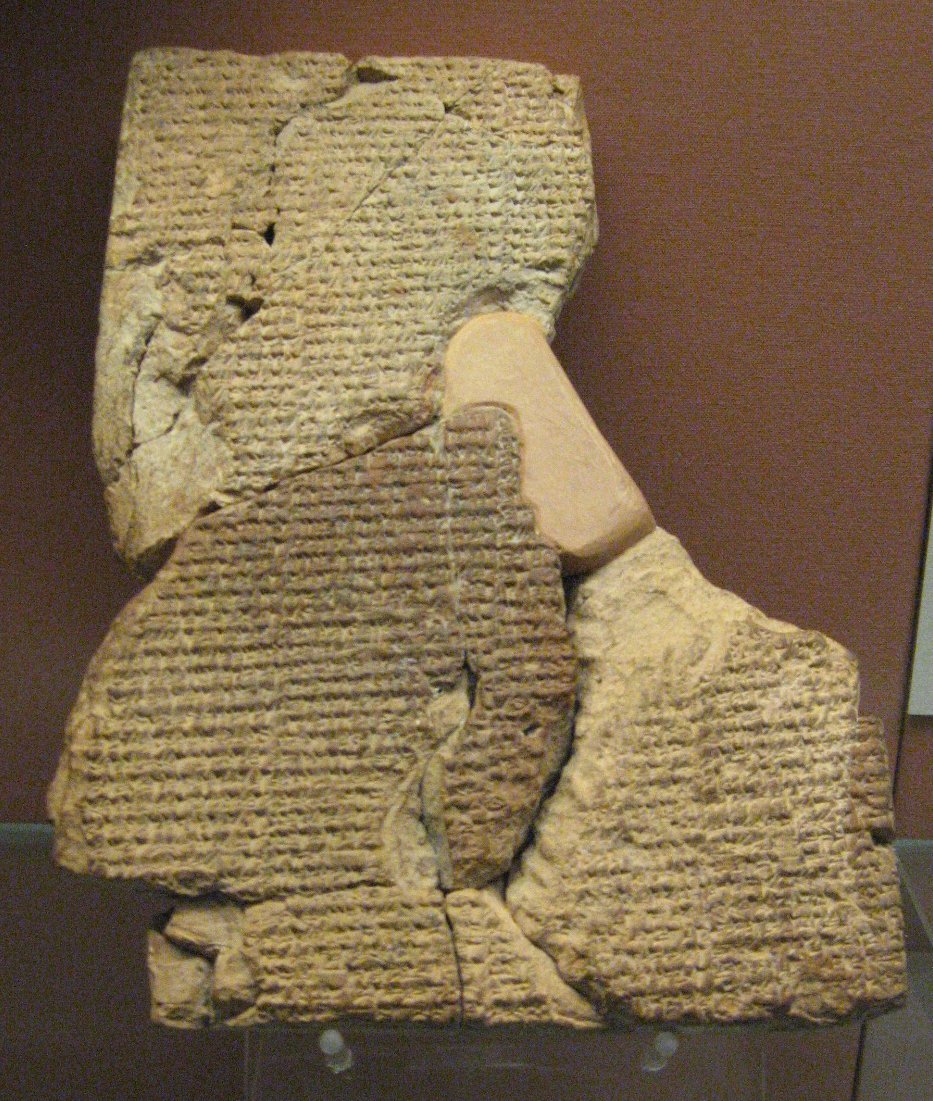
Cuneiform tablet with the Atra-Hasis epic in the British Museum

Uta-napishtim or Utnapishtim (Akkadian: 𒌓𒍣, "he has found life") was a legendary king of the ancient city of Shuruppak in southern Iraq, who, according to the Gilgamesh flood myth, one of several similar narratives, survived the Flood by making and occupying a boat.

He is called by different names in different traditions: Ziusudra ("Life of long days", rendered Xisuthros, Ξίσουθρος in Berossus) in the earliest, Sumerian versions, later Shuruppak (after his city), Atra-hasis ("exceeding wise") in the earliest Akkadian sources, and Uta-napishtim ("he has found life") in later Akkadian sources such as the Epic of Gilgamesh.[1] His father was the king Ubar-Tutu ("Friend of the god Tutu").

Uta-napishtim is the eighth of the antediluvian kings in Mesopotamian legend.[1] He would have lived around 2900 BC, corresponding to the flood deposit at Shuruppak between the Jemdet Nasr and Early Dynastic levels.[1]

In Mesopotamian narratives he is the Flood Hero, tasked by the god Enki (Akkadian Ea) to create a giant ship to be called Preserver of Life in preparation for a giant flood that will wipe out all life. The character appears in Tablet XI of the Standard Babylonian Epic of Gilgamesh, at the culmination of Gilgamesh's search for immortality.[2] The story of Uta-napishtim has drawn scholarly comparisons due to the similarities between it and the storylines about Noah in the Book of Genesis.[2]

Story

[edit]

Uta-napishtim is tasked by the god Enki to abandon his worldly possessions and create a giant ship to be called Preserver of Life. In Erra and Išum,[3] Marduk is said to have been the originator of the flood and the Seven Sages.

The Preserver of Life was made of solid timber, so that the rays of Shamash (the sun) would not shine in, and of equal dimensions in length and width. The design of the ship was supposedly drawn on the ground by Enki, and the frame of the ark, which was made in five days, was 200 feet in length, width and height, with a floor-space of one acre.[4] The ark interior had seven floors, each floor divided into 9 sections, finishing the ark fully on the seventh day. The entrance to the ship was sealed once everyone had boarded the ship.

He was also tasked with bringing his wife, family, and relatives along with the craftsmen of his village, baby animals, and grains.[4] The oncoming flood would wipe out all animals and people not on the ship. After twelve days on the water, Uta-napishtim opened the hatch of his ship to look around and saw the slopes of Mount Nisir, where he rested his ship for seven days. On the seventh day, he sent a dove out to see if the water had receded, and the dove could find nothing but water, so it returned. Then he sent out a swallow, and just as before, it returned, having found nothing. Finally, Uta-napishtim sent out a raven, and the raven saw that the waters had receded, so it circled around, but did not return. Uta-napishtim then set all the animals free, and made a sacrifice to the gods.

The gods came, and because he had preserved the seed of man while remaining loyal and trusting of his gods, Uta-napishtim and his wife were given immortality, as well as a place among the heavenly gods. Enki (Ea) also claims that he did not tell "Atrahasis" (apparently referring to Uta-napishtim) about the flood, but rather that he only made a dream appear to him.[5]

Role in the epic

[edit]

In the epic, overcome with the death of his friend Enkidu, the hero Gilgamesh[6] sets out on a series of journeys to search for his ancestor Uta-napishtim (Xisouthros) who lives at the mouth of the rivers and has been given eternal life.

Uta-napishtim counsels Gilgamesh to abandon his search for immortality, but gives him a trial to defy sleep if he wishes to obtain immortality. Gilgamesh failing at his trial to defy sleep, Uta-napishtim next tells him about a plant that can make him young again. Gilgamesh obtains the plant from the bottom of the sea in Dilmun (often considered to be current-day Bahrain) but a serpent steals it, and Gilgamesh returns home[7] to the city of Uruk, having abandoned hope of either immortality or renewed youth.

See also

[edit]

References

[edit]
Revisions and contributorsEdit on WikipediaRead on Wikipedia
from Grokipedia
Utnapishtim is an ancient Mesopotamian mythological figure renowned as the survivor of a cataclysmic flood and the only human granted immortality by the gods. Known by the Akkadian name meaning "He Who Found Life," he appears prominently in the Epic of Gilgamesh as a wise king of the city of Shuruppak, son of Ubara-Tutu, who receives divine instructions from the god Ea to construct a massive, cube-shaped boat to withstand the deluge decreed by Enlil to eradicate noisy humanity. After enduring seven days and nights of tempestuous waters, Utnapishtim releases birds to confirm the land's drying, offers sacrifices to appease the gods, and, along with his wife, is bestowed eternal life, relocating to a paradisiac realm at the mouth of the rivers. In the , particularly Tablet XI, Utnapishtim recounts his story to the questing hero , who seeks the secret of after the of his companion . The narrative unfolds as , guided by the innkeeper Siduri and the ferryman , journeys to to meet Utnapishtim, only to learn that true eternity is unattainable for mortals through human effort. Utnapishtim tests with a challenge to stay awake for six days and seven nights, symbolizing the vigilance required during the , but fails, underscoring themes of human finitude and of . This encounter highlights Utnapishtim's role as a mediator between divine and mortal realms, embodying wisdom from before the that separated eras in Mesopotamian king lists. Utnapishtim's flood account draws from earlier Mesopotamian traditions, serving as the Akkadian version of the Sumerian hero and paralleling the sage from the Atra-hasis Epic, where and human clamor prompt divine intervention. These stories, preserved in tablets dating back to the early second BCE with standard versions from the 7th century BCE under , reflect broader Near Eastern motifs of cosmic renewal and divine caprice. Archaeological evidence, including flood layers at sites like around 2900 BCE, suggests possible historical inspirations for the myth, though its primary function remains etiological and moral, explaining the origins of immortality's exclusivity and humanity's post-flood order.

Etymology and Identity

Name Origins

Utnapishtim's name originates from the , where it is typically rendered as Uta-napištim (or Utnapištim), meaning "he who found life" or "finder of life." This compound is formed from ūta, derived from a verb root connoting "to find" or "to obtain," and napištim, the genitive form of napīštu, which signifies "life," "breath," or "vital force." The name thus symbolically evokes the figure's attainment of following the great . Across ancient Mesopotamian texts, the name exhibits variations in spelling and , reflecting both logographic and syllabic conventions. In syllabic Akkadian script, it appears as ut-na-pi-iš-tim, while logographic forms sometimes incorporate the UD (or UTU, denoting "day" or "sun") with elements for "," such as ZI in Sumerian-influenced writings. These orthographic differences occur in tablets from diverse scribal traditions, adapting the name to phonetic and semantic nuances. The name's historical development is tied to Babylonian and Assyrian literary contexts in the BCE, emerging prominently in Old Babylonian compositions around 1800 BCE, such as versions of the . It evolved from earlier Sumerian precedents, with the Akkadian form standardizing in narratives during this period, and persisting in Neo-Assyrian and Neo-Babylonian recensions through the BCE. Variant names like (Sumerian for "life of long days") in the Eridu Genesis and ("exceedingly wise") in the Akkadian epic illustrate parallel traditions from the late 3rd to early BCE.

Connections to Other Mythical Figures

Utnapishtim serves as the Akkadian counterpart to the Sumerian flood hero , as evidenced in the Genesis, a Sumerian text from around the 17th century BCE that describes Ziusudra as the king and priest of who receives divine warning of the deluge and survives to be granted eternal life in the paradise of . In this tradition, Ziusudra's role as the sole human survivor aligns directly with Utnapishtim's narrative function in later , where the name "Utnapishtim" (meaning "he who found life") reflects the same post-flood conferral of . Similarly, Utnapishtim corresponds to , the "exceedingly wise" hero of the Akkadian Epic (circa 18th century BCE), who is warned by the god Enki/Ea to build a boat and preserve life through the ; textual parallels in the epic's flood tablet show Atrahasis as a pious ruler whose survival enables human renewal, mirroring Utnapishtim's archetype without the explicit immortality motif. In the Standard Babylonian , Utnapishtim is often called Utnapišti rīqū, or "Utnapishtim the Faraway," highlighting his exile to a remote, immortal . A key distinction lies in Utnapishtim's unique status as the only Mesopotamian flood hero granted full immortality by the gods in the Standard Babylonian (circa 12th century BCE), where he resides eternally at the world's edge, unlike the mortal survivors in the Atrahasis Epic—who repopulate the earth but face divine limits on human lifespan—or even , whose "eternal life" in functions more as exile to a distant rather than deified permanence. This elevation sets Utnapishtim apart from other epic heroes, such as those in the Enuma Elish or earlier Sumerian tales, who achieve wisdom or favor but remain subject to death. Beyond flood narratives, Utnapishtim appears in non-cataclysmic contexts as the last ruler of in variants of the (circa 2100 BCE), where he is equated with as the final pre-flood king reigning for an extraordinary 36,000 years before the deluge sweeps kingship away; this listing underscores his historical-mythical role as a bridge between divine and human eras in Mesopotamian chronology.

The Flood Narrative

Divine Warning and Ark Construction

In the , the god (also known as ) conveys a divine warning to Utnapishtim, the pious king of , about an impending deluge orchestrated by the assembly of gods led by to eradicate noisy humanity. Speaking indirectly to the reed wall of Utnapishtim's house to circumvent his oath of secrecy, Ea instructs: "Reed house, reed house! Wall, wall! O man of , son of Ubartutu: Tear down the house and build a ! Abandon and seek living beings! Spurn possessions and keep alive living beings! Make all living beings go up into the ." This method of communication through the reed wall echoes the earlier epic, where similarly warns the hero (Utnapishtim's precursor) via the wall, emphasizing the theme of divine favoritism toward a select wise individual amid collective destruction. Ea provides precise instructions for the ark's , specifying a cube-shaped vessel with equal length and width, roofed over like the Apsu (the subterranean waters). The ark measures 120 cubits (approximately 60 meters) per side, with walls 120 cubits high, divided into seven levels (six decks plus the roof) and nine compartments to house provisions and inhabitants. Materials include wood framed with reeds, sealed with vast quantities of and pitch—10,800 units each—poured into kilns for waterproofing, alongside tackle, punting poles, and oils for maintenance. Provisions encompass Utnapishtim's family, craftsmen, animals of all kinds, and ample food supplies, such as slaughtered oxen, sheep, ale, , and wine distributed to workers during the seven-day build. In the version, Enki's directives similarly call for a roofed like the Apsu to block sunlight, with strong gear, firm pitch, upper and lower decks, and provisions including birds and fish, though without the epic's numerical specificity. Utnapishtim obeys without question, demonstrating his and trust in Ea, but employs to gather labor from the elders and populace. When questioned about the project, he claims Enlil has rejected him, forcing relocation to the Apsu to dwell with Ea, and promises the people abundant rains of , , , and as compensation—falsely attributing prosperity to Ea rather than revealing the catastrophic . This ruse secures their unwitting assistance from carpenters, reedworkers, and porters, underscoring themes of selective salvation and the 's role as a mediator between divine secrecy and human ignorance. In , a comparable occurs, with the informing the elders of a supposed rift between and to explain his departure and construction efforts.

The Deluge and Survival

In the , the deluge commences as a cataclysmic storm orchestrated by the god , who seeks to eradicate humanity due to their noise and . A hurricane from the south, accompanied by a deluge and tempest, sweeps over the land, with rain falling in torrents and winds howling relentlessly; the sky darkens completely as Adad thunders within a rising cloud, and the gods wield torches that transform day into night, evoking terror among the divine assembly who cower like dogs. This onslaught persists for six days and seven nights, submerging mountains and annihilating all life on earth. During this period of isolation, Utnapishtim remains sealed within the ark alongside his family, kindred, cattle, wild beasts of the field, and the craftsmen who aided in its construction, with the vessel entrusted to his pilot, Puzur-Amurri, who secures the hatchway. The narrative emphasizes the ark's role as a self-contained world adrift in chaos, where the survivors endure the ceaseless battering of waves and gales, hearing no human voices amid the roar of the flood. In the related Atrahasis epic, where the flood corresponds to Utnapishtim, the deluge similarly rages for seven days and nights, described as a roaring and screaming in total darkness without sunlight. As the storm abates on the seventh day in the account, Utnapishtim opens a window to release a dove, which returns finding no resting place; next, a is sent forth but likewise returns; finally, a departs, feeding on the receding waters and not returning, signaling the emergence of dry land. The ark then grounds on Mount Nimush, where it lodges amid the range, allowing Utnapishtim to glimpse dry terrain and prepare for disembarkation.

Post-Flood Renewal

Upon landing on after the floodwaters receded, Utnapishtim offered a to the gods, slaughtering oxen and sheep, and setting out seven and seven vessels arranged in a circle, pouring libations of cane, cedar, and myrtle over them, which filled the air with a pleasing aroma that drew the gods like flies to the offering. , arriving late, became enraged upon discovering that a had survived the deluge he had intended to eradicate humanity entirely, and he accused the other gods of betrayal. (also known as Ea) intervened to appease , rebuking him for the overzealous destruction and proposing alternative methods to curb , such as sending lions, , or disease, rather than a total , which led the assembly to vow against unleashing another such cataclysm. In reconciliation, touched the throats of Utnapishtim and his wife, blessing them and granting them eternal life, elevating their status to that of the gods as a reward for their piety and survival. The gods then relocated Utnapishtim and his wife to dwell far away at the mouth of the rivers, a remote paradise-like realm identified with in Mesopotamian tradition, where they would live immortally apart from mortal humanity. This resolution symbolizes the renewal of humanity, as Utnapishtim's with his ensured the continuation of the human line through their descendants, while the gods' shift to partial measures against —such as limiting births or inflicting targeted afflictions—marked a tempered divine approach to preserving rather than annihilating humankind.

Role in the Epic of Gilgamesh

Gilgamesh's Encounter

Following the death of his companion , , overwhelmed by grief and fear of his own , embarks on a desperate quest for eternal life, determined to seek out Utnapishtim, the sole human granted by the gods after surviving a great . This motivation drives him across vast wildernesses and grasslands, pushing him toward the remote paradise of , where Utnapishtim resides in eternal isolation beyond the known world. Gilgamesh's journey is fraught with supernatural perils that test his endurance and resolve. He first approaches the twin-peaked Mashu mountain, which reaches the heavens and foundations of the , guarded by whose gaze is deathly and whose appearance inspires terror, yet they permit his passage after recognizing his divine lineage. Inside the mountain lies a of utter , which he traverses for twelve double-hours, emerging into jeweled gardens before continuing onward, slaying lions in mountain passes and invoking the moon god for protection. Directed by the alewife Siduri, he reaches the edge of the Waters of Death, where he encounters Urshanabi, Utnapishtim's ferryman, accompanied by stone giants that serve as his boat's propulsors; in a rash act, Gilgamesh destroys these figures, compelling them to improvise with punting poles for the crossing. With Urshanabi's aid, crosses the perilous —a toxic expanse deadly to any who touch it—using one hundred and twenty sixty-cubit poles to propel the boat without contact, completing in three days a voyage that spans a month's distance. They arrive at , at the mouth of the rivers in , where Utnapishtim dwells in a lush, distant realm untouched by decay. Exhausted and ragged from his trials, appears before Utnapishtim, who, seated in repose and resembling an ordinary man despite his , immediately questions the intruder's disheveled state: ", why are thy cheeks shrunken, thy face dejected?" In their initial exchange, Utnapishtim probes Gilgamesh's worthiness, challenging the king's audacity in pursuing what the gods reserve for themselves alone. He remarks on the futility of the quest, asking who could convene the divine assembly to grant such a boon to a mortal like , thereby testing his resolve and underscoring the boundaries between human ambition and divine prerogative. This confrontation at the world's edge marks the culmination of Gilgamesh's arduous , setting the stage for deeper revelations.

Utnapishtim's Counsel on Immortality

In Tablet XI of the , Utnapishtim recounts the narrative to as a of divine caprice and human vulnerability, explaining that the gods—led by an impulsive —decreed the deluge due to humanity's noisy , nearly eradicating mankind in a fit of arbitrary wrath. Warned by the Ea, Utnapishtim built a massive to preserve life, enduring six days and seven nights of catastrophic storm before the waters receded, at which point the gods, regretting their hasty decision, granted him and his wife as a singular exception to human mortality. This abridged retelling underscores the frailty of humankind, dependent on fleeting divine favor, and the rarity of eternal life, which the gods reserved for themselves while assigning death to mortals. To test Gilgamesh's suitability for immortality, Utnapishtim challenges him to remain awake for six days and seven nights, a symbolizing the endurance required to transcend human limits; however, Gilgamesh succumbs to sleep immediately, with loaves of baked daily beside him growing progressively stale as proof of his lapse. This failure illustrates the inescapable boundaries of , as even a hero like cannot overcome the natural pull of rest, reinforcing Utnapishtim's lesson that humans are inherently bound by such frailties. Utnapishtim advises Gilgamesh to embrace mortality by finding joy in daily life—eating, celebrating, and honoring one's family—rather than futilely pursuing eternal life, a privilege granted only once in human history. As a final , he reveals the existence of a thorny at the sea's bottom that restores , which Gilgamesh retrieves during a dive but later loses to a snake while bathing, the creature shedding its skin and thus gaining rejuvenation while Gilgamesh returns empty-handed. This incident epitomizes the theme of inevitable loss, affirming that remains elusive and an unalterable human destiny.

Comparative Mythology

Parallels with Biblical and Sumerian Flood Heroes

Utnapishtim, the flood hero in the Epic of Gilgamesh, shares numerous motifs with Noah from the biblical Book of Genesis, reflecting a common ancient Near Eastern tradition of cataclysmic deluge narratives. Both figures receive a divine warning to construct a vessel for survival: Ea instructs Utnapishtim to build a boat coated with pitch, while God commands Noah to fashion an ark similarly sealed with pitch. Each preserves animals aboard the craft to repopulate the earth, with pairs or sevens entering the vessel under divine guidance. After the flood subsides, both send out birds to test the waters—Utnapishtim releases a dove, swallow, and raven, while Noah dispatches a dove multiple times—culminating in the ark's landing on a mountain (Mount Nimush for Utnapishtim, Ararat for Noah). Post-flood, each offers a sacrifice that pleases the divine assembly, leading to a covenant-like promise against future destruction by flood. The Sumerian counterpart to Utnapishtim is , the pious king from the Eridu Genesis (c. 1600 BCE), whose story forms the earliest known flood account and directly influences the Akkadian versions. Like Utnapishtim, is warned by (Ea) to build a boat and preserve life amid the deluge decreed by the gods, including ; he too emerges to offer sacrifices that appease the deities. 's narrative emphasizes royal piety, with the hero prostrating himself before and after the flood, earning divine favor as the last king of . Key differences distinguish these figures: Utnapishtim and are granted and relocated to a paradisiacal —Utnapishtim to the mouth of the rivers, to with eternal kingship—rewards absent in Noah's tale, where the hero remains mortal and resumes earthly life without divine elevation. The Mesopotamian floods stem from divine annoyance over human noise or , contrasting Noah's story of for . Textually, the dates to c. 2100–1200 BCE, with its flood episode drawing from earlier Sumerian sources like Ziusudra's, while the Hebrew Bible's Genesis account, composed in the post-exilic period (c. 6th–5th centuries BCE), shows influence through circulating Mesopotamian traditions, evidenced by fragments unearthed at (a Canaanite site) and in Hittite archives.

Influences on Later Traditions

The flood narrative associated with Utnapishtim in the exerted influence on later , particularly the myth of and , where motifs such as a divine warning of impending catastrophe, construction of a vessel for survival, and refuge on a mountain parallel Mesopotamian elements. Scholars suggest this transmission occurred through cultural exchanges in the during the 6th century BCE or earlier, adapting the story to fit Greek cosmological frameworks while retaining core features like post-flood human repopulation. Possible echoes of Utnapishtim's tale appear in Zoroastrian literature, notably in the , where the flood saga involving Yima's vara—a fortified enclosure built to preserve life amid destruction—mirrors the ark's role in Mesopotamian accounts, including divine instructions for survival and a 40-day deluge. This Iranian variant likely drew from Mesopotamian flood legends, as the vara's narrative is described as substantially influenced by Babylonian traditions, reflecting broader Indo-Iranian adaptations of Near Eastern motifs during the Achaemenid period. Medieval Islamic interpretations of the , as in the Quran's account of Nuh, incorporated Babylonian elements via Syriac Christian intermediaries, such as details of the prophet's preaching to disbelievers and during ark , drawn from texts like Ephrem's Commentary on Genesis and Narsai's on the . These Syriac sources, prevalent in , bridged Mesopotamian origins with Islamic theology, emphasizing prophetic righteousness amid divine judgment. In the , the 19th-century rediscovery of Utnapishtim's story through George Smith's 1872 translation of the tablet at the revitalized scholarly interest in ancient myths, providing the first non-biblical confirmation of a Mesopotamian deluge narrative and influencing comparative studies across global traditions. This breakthrough, detailed in Smith's The Chaldean Account of Genesis (1876), established as a field and underscored the epic's role in tracing cultural transmissions of lore.

Scholarly Interpretations

Historical and Archaeological Context

Archaeological excavations in southern have uncovered evidence of significant events that may have inspired the narrative associated with Utnapishtim, the Akkadian counterpart to the Sumerian hero . At the site of (modern Fara), a stratum consisting of approximately 15 inches of water-deposited silt separates late Protoliterate and Early Dynastic I remains, dated to around 2950–2850 BCE. This layer was identified during excavations led by Erich Schmidt in 1931, suggesting regional inundations rather than a universal deluge, and 's identification as 's home city in Sumerian traditions links these findings directly to the myth's origins. Similar deposits have been noted at other sites, such as Kish (c. 3000–2900 BCE) and (c. 3500 BCE), indicating recurrent environmental challenges in the Euphrates-Tigris floodplain during the late fourth and early third millennia BCE. The primary textual sources for Utnapishtim's story survive on cuneiform tablets from Mesopotamian sites, providing the earliest written attestations of the flood myth. Fragments of the Sumerian version, featuring Ziusudra as the survivor granted eternal life, were excavated at Nippur between 1889 and 1900, with the key tablet (CBS 10673) dating to the early second millennium BCE and likely composed around 2000 BCE or earlier. This narrative describes the god Enki warning Ziusudra of the gods' plan to flood humanity, his construction of a boat, and his relocation to Dilmun after the deluge. The Standard Babylonian version of the Epic of Gilgamesh, where Utnapishtim recounts the flood to Gilgamesh, appears on twelve tablets from the Library of Ashurbanipal in Nineveh, inscribed in the 7th century BCE and discovered in the mid-19th century by Austen Henry Layard and Hormuzd Rassam. These tablets, part of over 30,000 cuneiform artifacts in the royal collection, represent the most complete rendition of the story and were systematically gathered by Ashurbanipal to preserve scholarly knowledge. The myth of Utnapishtim reflects broader socio-political concerns in early dynastic (c. 2900–2350 BCE), particularly the king lists that structured historical memory around divine kingship and . The , compiled from multiple manuscripts, delineates eight rulers across cities like and with exaggerated reigns totaling 241,200 years, ending with the flood that sweeps over the land and transitions to postdiluvian dynasties. This framework portrays kingship as descending from heaven, emphasizing a unified political order amid rival city-states such as Kish, , and , where intensified through temple complexes and irrigation systems. The inclusion of as the last king underscores anxieties over environmental threats to emerging urban societies and the divine legitimacy of rulers in the Early Dynastic period.

Literary and Symbolic Analysis

Utnapishtim's portrayal in the symbolizes the unattainability of for humanity, embodying passive survival granted as a singular divine exception rather than a reward for heroic endeavor. Unlike , whose exploits define active heroism and quest for eternal life, Utnapishtim represents an ordinary man elevated to godlike status through obedience during the , underscoring that true immortality eludes human aspiration and serves as a divine prerogative. This contrast highlights Mesopotamian views on mortality, where Utnapishtim's eternal life at the world's edge mirrors the futility of 's journey, transforming the hero's pursuit into a meditation on human limits. Within the epic's structure, Utnapishtim functions as a pivot, shifting the tale from Gilgamesh's adventurous exploits to introspective , with his account acting as a microcosm of cosmic order's disruption and restoration. The narrative interrupts the divine-human equilibrium through the gods' impulsive decision to eradicate humanity, reflecting themes of chaos and renewal that parallel Gilgamesh's personal turmoil after Enkidu's death. By recounting this event, Utnapishtim situates Gilgamesh's quest within a broader universal history, emphasizing of fate over defiance, and reinforcing the epic's from heroic saga to philosophical reflection on existence. Utnapishtim's unnamed embodies complementary renewal and subtle agency, serving as a nurturing counterpart that highlights dynamics in post-catastrophe restoration. Her intervention—urging Utnapishtim to aid the exhausted and revealing the rejuvenating plant—contrasts her husband's initial dismissal, symbolizing the restorative role of feminine benevolence in balancing male-driven survival narratives. This portrayal subtly critiques divine injustice, particularly Enlil's role in unleashing the without distinction between guilty and innocent, as the gods' post-flood exposes the arbitrariness of such destruction, with Ea's rebuke underscoring the ethical tensions in Mesopotamian .

References

Add your contribution
Related Hubs
User Avatar
No comments yet.