Hubbry Logo
DevotaDevotaMain
Open search
Devota
Community hub
Devota
logo
8 pages, 0 posts
0 subscribers
Be the first to start a discussion here.
Devota
Devota
from Wikipedia

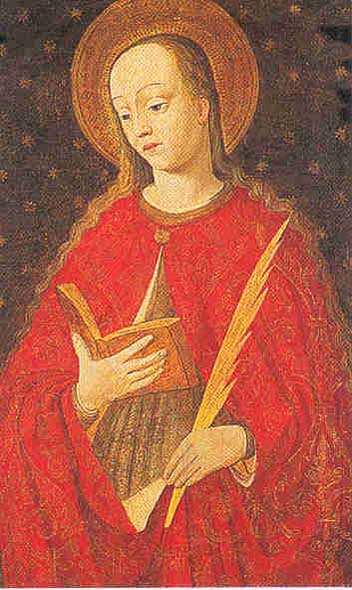
Devota (French: Sainte Dévote; Corsican: Santa Divota; died ca. 303 AD) is the patroness saint of Corsica and Monaco. She was killed during the persecutions of the Roman Emperors Diocletian and Maximian. She is sometimes identified with another Corsican saint named Julia, who was described in Latin as Deo devota ("devoted to God"). The description was misinterpreted as a proper name.[1] The legend connected with her is similar to those told of other saints of the region, such as Reparata[2] and Torpes of Pisa.

Key Information

Legend

[edit]

Tradition holds that she was a Corsican woman born around 283 AD at Mariana in northeastern Corsica. A young virgin, she had decided to devote herself fully to the service of God. Devota was part of the household of senator Eutychius. During the Diocletian persecution, the prefect Barbarus arrived in Corsica with a fleet and when he learned that the senator was harboring a Christian in his house, demanded that she be given up and compelled to perform the requisite sacrifice to the imperial cult. Eutychius refused, and not wishing to confront him directly, Barbarus arranged to have him poisoned. Devota was imprisoned and tortured for her faith. She was martyred at Mariana by being racked or stoned to death.[3]

After her death, the governor of the province ordered for her body to be burnt to prevent its veneration. However, it was saved from the flames by Christians. Her body was placed on a boat bound for Africa. Gratianus (Graziano), the boat's pilot; Benedict (Benenato), a priest; and Apollinaris, his deacon; believed it would receive proper Christian burial there. However, a storm overtook the boat. A dove appeared and guided the boat to present-day Les Gaumates, today part of the Principality of Monaco, where a chapel dedicated to Saint George stood.[4]

In her honor a chapel was built, which stands in Monaco still.[5] Traditionally, flowers are said to bloom before their season on January 27, the saint's feast day.

Sainte-Dévote Chapel

[edit]
Sainte-Dévote Chapel in Monaco.

The Sainte-Dévote Chapel is first mentioned about 1070, belonging to the abbey of Saint Pons. The chapel was rebuilt and expanded several times. It became a priory in the 13th century and in 1536 was acquired by Honoré I, Lord of Monaco. The chapel became the parish church in 1887.[6]

Veneration in Monaco

[edit]

The "Legend of Saint Devota" is one of the Principality of Monaco's oldest traditions – it has influenced national culture in fields as diverse as religion, folklore and popular beliefs, history, literature, the arts, painting, music, coins and stamps. This legend, passed on through a medieval document, holds a special place in the heart of Monaco's people and over the centuries has been awarded a permanent place in the city's history.[7] Reports of miracles soon sprung in connection with the tomb. During incursions by Moors, Devota's relics were translated to safety at the monastery of Cimiez. They were returned to Monaco, to a church restored much later by Antonio I, prince of Monaco.

In 1070, Antinope, the captain of a Florentine ship, attempted to steal the reliquary containing Devota's relics. The legend states that a violent wind impeded him from escaping with the relics. Arrested, Ugo Grimaldi ordered his ears and nose to be cut off. Antinope's boat was then burnt on the beach of Monaco.[3]

In the 16th century, Devota was invoked for protection against the Genoese and the Pisans. Their ultimate failure to take away the independence of Monaco was attributed to the divine protection of Devota. An end to the outbreak of the plague in 1631 was attributed to Devota, as well as the expulsion of the Spanish on the night of 17 November 1641 a galley taken from the Spanish was rebaptized "Devota." Monégasque coins bearing the effigy of Devota were issued in the 16th century, beginning in the reign of Honoré II, Prince of Monaco. During his reign, Devota became the patroness of Monaco.[7]

A series of postage stamps bearing Devota's likeness were issued in 1944 as well as 1992.

However, as the Sainte-Dévote Chapel lends its name to the first corner of the Circuit de Monaco, one source has commented that "Saint Devota's name is unfortunately heard on the radio waves solely for the Monaco's Grand Prix Formula 1 for the famous bend of Saint Devota."[8]

Joseph Méry put the legend of Saint Devota into verse. The first book written in Monegasque language by the Monegasque poet, Louis Notari, is entitled A legenda de Santa Devota (The Legend of Saint Devota). It was composed in 1927 and is important because until then the Monégasque language, had been utilized for speech.[9]

Feast day

[edit]
Reliques of Saint Devota.

Her cult became important to Monaco and the Grimaldis. Since 1874 it has been the custom that on the evening before her feast day a symbolic fishing boat is brought in procession into Port-Hercule and set alight outside the Église Sainte Dévote. This is followed by a fireworks display that lights up Port-Hercule.[7]

On January 27, Mass is celebrated in the Cathedral of Our Lady of the Immaculate Conception attended by Prince Albert II and Princess Charlene. It is followed by a Solemn Procession of the Relics, to request protection for the Royal Family and the Principality. Receptions in the Monte Carlo Opera House also take place.

In 2014 the Monegasque Rugby Federation, in association with the Princess Charlene of Monaco Foundation, organized the Saint Devota Rugby Challenge. Including teams from Spain and Italy, the free program includes educational workshops and circuits for disabled children, to introduce them to the game.

Diffusion of cult in Corsica

[edit]

In the 1687, some of Devota's relics were transported from Monaco to the Jesuit church of Sant'Ignazio on the island. Between 1727 and 1751, attempts were made to receive from the Vatican official recognition of Devota as special patroness of Corsica. These were refused because there was scant evidence of her existence. However, the diffusion of her cult continued and Pasquale Paoli created a short-lived "Order of Saint Devota" in 1757 during the movement for Corsican independence.

In 1820, the first bishop of the diocese of Corsica proclaimed both Saint Devota and Saint Julia to be the principal patron saints of Corsica. In 1893, a church was dedicated to Saint Devota on the island. Her cult was officially approved in 1984 by the bishop of Ajaccio. The new Roman Martyrology commemorates her on January 27, with the description, "At Mariana, on the island of Corsica, in memory of Saint Devota, virgin and martyr."[3]

Legacy

[edit]

Saint Devota was recently selected as the main motif of a high value collector's coin; the €5 silver 1700th anniversary of Saint Devota's death commemorative coin, minted in 2004. On the reverse of the coin, a statue of the saint can be seen. Next to it is a representation of the dove guiding the boat to the coast of Monaco, as recorded in the legend.

Notes

[edit]

Sources

[edit]
[edit]
Revisions and contributorsEdit on WikipediaRead on Wikipedia
from Grokipedia

Sainte Dévote, anglicized as Saint Devota (died c. 303), is the of , venerated as a virgin martyr from Roman-era who refused to renounce amid the persecutions.
According to longstanding hagiographical tradition, the young Devota, a native of Mariana in , was betrayed to authorities, subjected to including crushing of her mouth and dragging over rocks, and ultimately executed by order of Barbarus for declining to offer sacrifices to pagan deities.
Her corpse was reportedly placed on a with an and dove, which miraculously guided it to the harbor of ancient Portus Herculis Monoeci—now —where fishermen discovered and buried it, establishing the locus of her cult.
While no contemporary historical records confirm these events, distinguishing legend from verifiable fact, Devota's relics—bone fragments authenticated as human remains—reside in Monaco's 19th-century Église de Sainte-Dévôte, symbolizing Monegasque heritage and unity, with her feast day on 27 marked by public processions and the ceremonial burning of a symbolic .

Historical Context

Diocletianic Persecutions and Corsican Christianity

The Great Persecution initiated by Emperor on February 24, 303 AD consisted of four successive edicts aimed at eradicating across the . The first edict ordered the demolition of Christian churches, the burning of sacred scriptures, and the cessation of Christian assemblies, while stripping Christians of legal rights such as the ability to petition courts or inherit property. Subsequent edicts escalated enforcement, requiring universal sacrifices to Roman gods under threat of imprisonment, torture, or execution, with provincial officials tasked with compliance through administrative coercion rather than mass military action. This policy persisted until Galerius's in 311 AD, though enforcement varied by region and governor zeal. Corsica, administered as part of the joint Roman province of since the 3rd century BC, fell under the oversight of a proconsular appointed by the , who reported to the praetorian prefects in the late empire's reformed hierarchy. Provincial governors wielded to enforce imperial edicts, including those against , by mobilizing local magistrates, tax collectors, and military detachments to identify non-compliant subjects and compel participation in pagan rituals. In peripheral islands like , with its rugged terrain and sparse urban centers such as Aleria and Mariana, enforcement likely prioritized compliance among elites and traders while overlooking isolated rural holdouts, reflecting the empire's logistical challenges in remote senatorial provinces. Archaeological and textual records indicate that reached by the late at the latest, probably via maritime trade routes from , , or , though communities remained small and overshadowed by entrenched pagan cults like , evidenced by a 3rd-century unearthed at Mariana. No dedicated Christian structures or from this era have been confirmed, with the earliest verifiable sites—such as a in and basilica remnants—dating to the 4th-5th centuries post-persecution, suggesting prior presence was clandestine and limited to house-based gatherings among a minority. Eusebius's Ecclesiastical History documents widespread provincial persecutions but omits Corsica-specific references, underscoring the island's marginal role in early Christian narratives amid dominant Roman polytheism. Thus, any Diocletianic measures in Corsica would have targeted nascent, undocumented groups, fostering conditions of suppression that later hagiographies retroactively amplified.

Evaluation of Historicity

No contemporary records from the early attest to Devota as a specific during the Diocletianic Persecutions (303–313 CE), despite the era's documented violence against in Roman provinces including . Surviving administrative and documents from the period, such as imperial edicts and early Church correspondence, mention provincial martyrdoms in aggregate but provide no named Corsican virgin martyr matching her profile. The absence of epigraphic evidence, such as inscriptions on tombs or altars, further underscores this evidentiary gap, as verified martyrs from the persecutions often left such traces in regions with stronger archaeological preservation. Devota receives no entry in foundational martyrological compilations like the Depositio Martyrum (c. 354 CE), a enumerating confirmed martyrs, or subsequent 5th-century lists such as those by or the Hieronymian Martyrology, which prioritize figures with liturgical or testimonial backing. Her narrative emerges instead in the Passio Sanctae Devotae, a hagiographical text preserved in an 11th-century manuscript (, BnF), which recounts her story in formulaic terms typical of medieval passiones designed for devotional rather than historical purposes. This temporal disconnect—over 700 years post-persecution—mirrors the development of many local saints' cults, where late accounts retroject piety onto undefined historical suffering to consolidate communal reverence. From a methodological standpoint, hagiographies like Devota's prioritize edification over empirical fidelity, embedding miraculous elements and archetypal motifs (e.g., steadfast under ) that prioritize causal narratives of divine intervention over verifiable sequences. While the persecutions generated real, anonymous victims in peripheral locales like —where had taken root by the late —the attribution of individualized biographies without corroboration suggests legendary elaboration, possibly aggregating unrecorded martyrs or fabricating a figure to anchor emerging monastic and civic identities in medieval and . Scholarly assessments treat her as a construct of folkloric , lacking the multi-source validation afforded to centrally documented saints like Perpetua or Agnes.

Hagiographical Tradition

Account of Martyrdom

According to the hagiographical tradition preserved in the medieval Passio Devotae, Saint Devota was born around 283 AD in Mariana, the principal Roman city of , and dedicated herself as a young virgin to Christian devotion. During the circa 303-304 AD, the local governor or named Barbarus summoned her for , demanding she offer to the Roman gods and the as a test of loyalty. Devota steadfastly refused, affirming her exclusive worship of the Christian , which led to her immediate . The narrative details a sequence of escalating tortures inflicted by Barbarus's order to coerce compliance. These included crushing her mouth, dragging her body across rocks and brambles, and or stretching her limbs to extremity. Some variants specify flogging with iron-tipped whips and burning her feet with heated oil, emphasizing her endurance without recantation. Execution followed when torments failed, reportedly by or to death at Mariana, after which her corpse was denied and exposed to prevent . This martyrdom account embodies pious legend, highlighting themes of virginal purity, unyielding fidelity under coercion, and divine protection, with the unburied body miraculously guarded by angels until retrieval. It relies on formulaic topoi recurrent in Acta Martyrum, such as the virgin's confrontation with a pagan , progressive tortures mirroring judicial escalation, and steadfast , lacking distinctive historical markers verifiable beyond the tradition itself.

Legend of Relics' Translation

According to hagiographical accounts, following Devota's martyrdom in circa 303 AD, her body was secretly placed by on a intended for transport to for proper , to evade Roman desecration. A sudden storm arose during the voyage, but a dove—emerging from her mouth or guiding the vessel—miraculously directed the unmanned to the shores of Monoecus, the ancient name for the site of modern , where it ran aground in the Vallon des Gaumates. This event is portrayed in the tradition as an act of , with the dove symbolizing the and the boat representing a sacred, unpiloted linking Corsican origins to Monegasque destiny. Local inhabitants, identified in the legend as Christian fishermen or shepherds, discovered the relics and buried them in a grotto at what was then known as Portus Herculis Monoeci, the Roman port. An olive branch clutched in her hand, blooming despite the winter season, is described as a sign of peace and sanctity, prompting the immediate establishment of veneration at the site. These motifs—the guiding dove and protective relics—form a foundational myth reinforcing Monaco's identity as a divinely chosen haven, distinct from its Corsican martyrdom roots yet symbolically unified under her patronage. The narrative evolved in medieval hagiographies, such as those circulating by the , to emphasize protective miracles associated with the relics, thereby cementing Devota's role as Monaco's patroness and bridging early Christian resistance in with emerging local devotion. This translation legend, while lacking contemporary historical corroboration, served to legitimize the cult's continuity amid later threats like Moorish incursions, during which the relics were temporarily safeguarded elsewhere before return.

Sites of Veneration

Sainte-Dévote Chapel in

The Sainte-Dévote Chapel in Monaco-Ville constitutes the central shrine for Saint Devota's cult within the Principality, enshrining relics purportedly from the martyr and linking her to the local landscape through its cliffside location. First attested in historical records around 1070, the chapel initially fell under the auspices of the of Saint-Pons in and was erected to house Devota's remains, which tradition holds were translated there following maritime perils off Corsica's coast. Constructed in the Romanesque style characteristic of early medieval Mediterranean chapels, the original edifice integrated seamlessly into the rocky cliffs of Monaco-Ville, reflecting pragmatic adaptation to the terrain rather than ostentatious design. Over centuries, it endured restorations and enlargements, including a span added in 1606 by Prince Honoré II of the Grimaldi family, who thereby affirmed princely patronage of the site as protector of Monaco's ruling house. Further modifications occurred in the , with a appended in 1637, and major 19th-century rebuilds: a 15-meter erected in 1870 under Prince Charles III, followed by facade reconstruction and Neo-Greek stylistic refurbishments between 1885 and 1891. The chapel safeguards Devota's relics, including skeletal fragments symbolizing her martyrdom, which have anchored the site's significance despite recurrent threats. In 1070, an attempted by was thwarted by a sudden violent storm, enabling recapture of the relics and punitive burning of the perpetrators' vessel on the beach below, an event interpreted as divine intervention safeguarding the translation legend's endpoint. A similar 17th-century piracy attempt met recapture by local fishermen, reinforcing the chapel's role as unassailable guardian of the saint's physical legacy amid Monaco's strategic coastal position. Grimaldi endorsements extended beyond structural , with the invoked as familial guardian, evidenced by historical appeals during sieges where her purportedly repelled invaders, thus embedding the chapel in Monaco's defensive identity without reliance on formal papal bulls, though the site's antiquity aligns with broader medieval patterns.

Churches and Shrines in Corsica

The cult of Sainte Dévote in manifests primarily through a small number of later historical sites, with no verified archaeological evidence of dedications predating the medieval period despite traditions linking her martyrdom to the island. Her legendary birthplace is placed at Mariana (ancient port site near Lucciana), yet excavations there, including early Christian ruins, yield no inscriptions or artifacts specifically tied to her veneration. The earliest documented site is the in Piedicroce, erected in the as part of a larger building for penitents, reflecting the cult's gradual importation via seafaring networks from , where her primary relics reside. This chapel underscores the subordinate role of Corsican , as medieval prioritize Ligurian-Monégasque maritime dissemination over local insular development during Pisan (11th–13th centuries) or Genoese (13th–18th centuries) rule. No contemporary inscriptions confirm widespread early medieval propagation on the island. A later addition, the Église Sainte Dévote de Pietranera in San Martino di Lota (), constructed in 1893, represents the first purpose-built church consecrated to her, located in a rural setting tied to traditions of her Corsican origins at sites like Querciu or Mariana. These sparse dedications—confined to confraternal chapels and isolated parishes—highlight the cult's limited diffusion, amplified only after 17th-century relic distributions from but overshadowed by the principality's centralized prominence. Today, active sites persist modestly amid rural depopulation and secular trends, with Pietranera remaining a focal point for local devotion, though fewer than in and without the relic-driven draw that sustains Ligurian sites. This pattern aligns with broader Corsican Christian heritage, where saintly cults often yielded to dominant Marian or apostolic devotions under foreign influences.

Devotional Practices

Feast Day in Monaco

The feast of Sainte-Dévote on January 27 constitutes 's foremost national religious commemoration, emphasizing communal unity and the saint's role as patroness of the and its ruling family. Celebrations commence on the evening of January 26 with a vigil mass conducted in the Monegasque language at the Église de Sainte-Dévote, followed by a torchlight procession to Port Hercule. There, participants symbolically burn a boat on a , reenacting the of the saint's relics arriving by after thwarting pagan attempts; this ritual, instituted in 1924 under Prince Louis II, underscores themes of divine preservation and territorial integrity. The burning concludes with fireworks over the port, including a pyro-melodic display in 2024 synchronized to narrate the saint's life through Corsican . On January 27, a pontifical high mass occurs at Cathedral, attended by the sovereign Prince and Princely Family, affirming Devota's intercessory status for the state's sovereignty—a role formalized when Prince Honoré II designated her patroness in the . This is followed by a and official reception, with state orchestration evident in the consistent princely participation, as seen in 2025 when Prince Albert II, Princess Charlene, and their twins joined the boat-burning rite. The observance traces medieval roots, with invocations of Devota documented during 16th-century sieges by Genoese and Pisan forces; residents credited her apparition with bolstering defenses, leading to victory on March 15, 1507, after prolonged assaults. Contemporary iterations incorporate security protocols, such as restrictions on access to Sainte-Dévote Valley from 17:30, bag inspections at checkpoints, and designated viewing zones at Port Hercule to manage crowds during the public rituals. These measures maintain the event's continuity as a state-endorsed affirmation of Monegasque identity, distinct from broader devotional practices elsewhere.

Cult Observances in Corsica

In , the feast of Saint Dévote on January 27 features modest liturgical observances centered on sites associated with her legendary martyrdom, such as Lucciana, where a is celebrated in the Church of Saint-Michel followed by a through the village. Similarly, in Pietranera (a hamlet in San Martino di Lota, ), where she serves as , a dedicated honors her memory on the same date. These rituals emphasize simplicity and local devotion, often incorporating elements of Corsican religious tradition like polyphonic chants, which draw from the island's ancient sacred music heritage to evoke early Christian . The cult's spread in traces to medieval hagiographical texts from the 11th and 12th centuries, which disseminated her legend among regional and , though it received less centralized promotion than in . Unlike the princely spectacles across the , Corsican practices remain tied to rural piety, with processions linking devotees to purported martyrdom locations amid the island's rugged terrain. In contemporary France's secular context, these observances have marginalized, sustained primarily through and sporadic brotherhood-led gatherings rather than widespread institutional fervor, reflecting the cult's niche endurance in Corsican identity. Additional commemorations, such as Pentecost Monday processions in Lucciana involving confraternities, underscore seasonal ties to agrarian cycles but do not overshadow the focus.

Attributed Roles and Legacy

Legends of Protective Interventions

One prominent legend attributes to Sainte Dévote the repulsion of a Genoese-Pisan on in 1507, during which her was invoked by defenders facing a prolonged naval . According to , sudden and violent storms repeatedly scattered the enemy fleet over six months, preventing assaults and ultimately forcing the withdrawal of forces under Andrea Doria's command, thus preserving Monegasque independence. These meteorological disruptions, while aligned with frequent Mediterranean weather patterns that historically disrupted naval operations, were retrospectively interpreted by devotees as divine protection, reinforcing her role as guardian against territorial threats. Another medieval tradition recounts failed attempts to steal Dévote's relics from their , thwarted by providential winds and tempests. When seized the relics intending to sell them, a sudden reportedly arose as their vessel departed Monaco's harbor, compelling return of the remains intact and stranding the perpetrators. Such narratives echo broader hagiographical motifs of furta sacra—sacred thefts justified or foiled by —but lack contemporaneous documentation, suggesting post-hoc rationalizations of coincidental adverse weather common to the region's seafaring perils. These unverified accounts, preserved in oral and lore rather than empirical records, nonetheless motivated communal resilience and , framing natural adversities as causal affirmations of Dévote's protective patronage amid recurrent invasions and . Fewer traditions invoke Dévote against plagues or other wars, with no detailed historical attributions beyond generalized protective invocations during conflicts like the 16th-century struggles with . Empirical scrutiny reveals no verifiable causation, as failures often stemmed from logistical strains, supply issues, and unpredictable gales rather than ; yet these legends culturally embedded a of , bolstering identity and devotion in a vulnerable .

Cultural and National Significance

Saint Devota holds a central place in Monégasque as the of the , its Princely Family, and the of , embodying protection and unity against external threats. Her veneration reinforces the sovereignty of and the enduring legitimacy of the Grimaldi dynasty, which has observed her feast day since the as a of state . This extends to symbolic acts invoking her for the nation's , distinguishing 's Catholic heritage from surrounding secular influences and prioritizing doctrinal fidelity to her martyrdom over diluted folkloric retellings. In , Devota's cult reflects secondary ethnic ties rooted in her birthplace near Mariana, yet lacks the integrated national symbolism seen in , where her relics and legends underpin civic oaths and collective resilience. Her role there supports traditional moral frameworks amid regional identity debates, but empirical continuity favors 's model of saintly patronage as a bulwark for cultural cohesion, evidenced by low erosion rates in devotional participation compared to broader European secularization trends. Recent observances affirm this legacy's vitality; on January 27, 2025, Prince Albert II, Princess Charlene, Prince Jacques, and Princess Gabriella attended the Pontifical Mass at Monaco Cathedral, followed by family participation in the January 26 , signaling unbroken transmission of values despite pressures. Such events cultivate societal moral unity, countering interpretations that subordinate her theological significance to mere by sustaining active of her protective intercessions in public life.

References

Add your contribution
Related Hubs
User Avatar
No comments yet.