
.jpg/250px-Port_Tino_Rossi_-_Ajaccio_(15148706455).jpg)


.jpg/2000px-Port_Tino_Rossi_-_Ajaccio_(15148706455).jpg)
Community hub
Recent from talks
Contribute something
Nothing was collected or created yet.
Ajaccio
View on Wikipedia
Ajaccio[note 1] is the capital and largest city of Corsica, France. It forms a French commune, prefecture of the department of Corse-du-Sud, and head office of the Collectivité territoriale de Corse (capital city of Corsica). It is also the largest settlement on the island. Ajaccio is located on the west coast of the island of Corsica, 210 nautical miles (390 km) southeast of Marseille.
Key Information

.jpg)


The original city went into decline in the Middle Ages, but began to prosper again after the Genoese built a citadel in 1492, to the south of the earlier settlement. After the Corsican Republic was declared in 1755, the Genoese continued to hold several citadels, including Ajaccio, until the French took control of the island.
The inhabitants of the commune are known as Ajacciens (men) or Ajacciennes (women).[5] The most famous of these is Napoleon Bonaparte, who was born in Ajaccio in 1769, and whose ancestral home, the Maison Bonaparte, is now a museum. Other dedications to him in the city include Ajaccio Napoleon Bonaparte Airport.[6]
Toponymy
[edit]Several hypotheses have been advanced as to the etymology of the name Ajaccio (Aiacciu in Corsican, Addiazzo on old documents). Among these, the most prestigious suggests that the city was founded by the Greek legendary hero Ajax and named after him. Other more realistic explanations are, for example, that the name could be related to the Tuscan agghiacciu meaning "sheep pens". Another explanation, supported by Byzantine sources from around the year 600 AD called the city Agiation which suggests a possible Greek origin for the word,[7] agathè could mean "good luck" or "good mooring" (this was also the root of the name of the city of Agde).
Geography
[edit]Location
[edit]Ajaccio is located on the west coast of the island of Corsica, 210 nautical miles (390 km) southeast of Marseille. The commune occupies a sheltered position at the foot of wooded hills on the northern shore of the Gulf of Ajaccio[8] between Gravona and the pointe de la Parata and includes the îles Sanguinaires (Bloody Islands). The harbour lies to the east of the original citadel below a hill overlooking a peninsula which protects the harbour in the south where the Quai de la Citadelle and the Jettée de la Citadelle are. The modern city not only encloses the entire harbour but takes up the better part of the Gulf of Ajaccio and in suburban form extends for some miles up the valley of the river Gravona. The flow from that river is nearly entirely consumed as the city's water supply. Many beaches and coves border its territory and the terrain is particularly rugged in the west where the highest point is 790 m (2,592 ft).
-
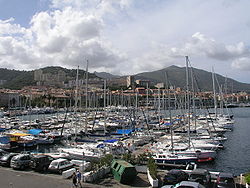 Ajaccio Marina
 -
 The Bay
 -
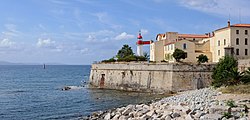 The lighthouse of the citadel of Ajaccio overlooking the bay
 -
 Îles Sanguinaires
 -
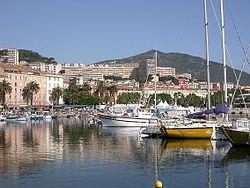 The market
 -
 A satellite image of the city and surrounding water.


Urbanism
[edit].jpg)
Although the commune of Ajaccio has a large area (82.03 km2), only a small portion of this is urbanized. Therefore, the urban area of Ajaccio is located in the east of the commune on a narrow coastal strip forming a densely populated arc. The rest of the territory is natural with habitation of little importance and spread thinly. Suburbanization occurs north and east of the main urban area.
The original urban core, close to the old marshy plain of Cannes was abandoned in favour of the current city which was built near the Punta della Lechia. It has undergone various improvements, particularly under Napoleon, who originated the two current major structural arteries (the Cours Napoleon oriented north–south and the Cours Grandval oriented east–west).
Ajaccio experienced a demographic boom in the 1960s, which explains why 85% of dwellings are post-1949.[9] This is reflected in the layout of the city which is marked by very large areas of low-rise buildings and concrete towers, especially on the heights (Les Jardins de l'Empereur) and in the north of the city - e.g. the waterfront, Les Cannes, and Les Salines. A dichotomy appears in the landscape between the old city and the imposing modern buildings. Ajaccio gives the image of a city built on two different levels.
Climate
[edit]The city has a Mediterranean climate which is Csa in the Köppen climate classification. The average annual sunshine is 2,726 hours.
There are important local climatic variations, especially with wind exposure and total precipitation, between the city centre, the airport, and the îles Sanguinaires. The annual average rainfall is 645.6 mm (25.4 in) at the Campo dell'Oro weather station (as per the chart) and 523.9 mm (20.6 in) at the Parata: the third-driest place in metropolitan France.[10] The heat and dryness of summer are somewhat tempered by the proximity of the Mediterranean Sea except when the sirocco is blowing. In autumn and spring, heavy rain-storm episodes may occur. Winters are mild and snow is rare. Ajaccio is the French city which holds the record for the number of thunderstorms in the reference period 1971–2000 with an average of 39 thunderstorm days per year.[11]
On 14 September 2009, the city was hit by a tornado with an intensity of F1 on the Fujita scale. There was little damage except torn billboards, flying tiles, overturned cars, and broken windows but no casualties.[12]
| Town | Sunshine (hours/yr) |
Rain (mm/yr) |
Snow (days/yr) |
Storm (days/yr) |
Fog (days/yr) |
|---|---|---|---|---|---|
| National average | 1,973 | 770 | 14 | 22 | 40 |
| Ajaccio | 2,735 | 616 | 2 | 39 | 3[14] |
| Paris | 1,661 | 637 | 12 | 18 | 10 |
| Nice | 2,724 | 767 | 1 | 29 | 1 |
| Strasbourg | 1,693 | 665 | 29 | 29 | 56 |
| Brest | 1,605 | 1,211 | 7 | 12 | 75 |
Weather Data for Ajaccio
| Climate data for Ajaccio (AJA), elevation: 5 m (16 ft), 1991–2020 normals, extremes 1949–present | |||||||||||||
|---|---|---|---|---|---|---|---|---|---|---|---|---|---|
| Month | Jan | Feb | Mar | Apr | May | Jun | Jul | Aug | Sep | Oct | Nov | Dec | Year |
| Record high °C (°F) | 22.4 (72.3) |
25.3 (77.5) |
29.6 (85.3) |
32.2 (90.0) |
34.6 (94.3) |
41.6 (106.9) |
40.3 (104.5) |
39.5 (103.1) |
40.0 (104.0) |
35.0 (95.0) |
29.4 (84.9) |
22.7 (72.9) |
41.6 (106.9) |
| Mean daily maximum °C (°F) | 14.0 (57.2) |
14.2 (57.6) |
16.0 (60.8) |
18.5 (65.3) |
22.1 (71.8) |
25.9 (78.6) |
28.6 (83.5) |
29.2 (84.6) |
26.1 (79.0) |
22.8 (73.0) |
18.3 (64.9) |
15.1 (59.2) |
20.9 (69.6) |
| Daily mean °C (°F) | 9.4 (48.9) |
9.2 (48.6) |
11.0 (51.8) |
13.4 (56.1) |
17.0 (62.6) |
20.7 (69.3) |
23.2 (73.8) |
23.7 (74.7) |
20.8 (69.4) |
17.7 (63.9) |
13.6 (56.5) |
10.5 (50.9) |
15.8 (60.4) |
| Mean daily minimum °C (°F) | 4.7 (40.5) |
4.3 (39.7) |
5.9 (42.6) |
8.4 (47.1) |
11.8 (53.2) |
15.4 (59.7) |
17.7 (63.9) |
18.1 (64.6) |
15.4 (59.7) |
12.6 (54.7) |
9.0 (48.2) |
5.8 (42.4) |
10.8 (51.4) |
| Record low °C (°F) | −7.0 (19.4) |
−8.1 (17.4) |
−5.6 (21.9) |
−1.7 (28.9) |
3.0 (37.4) |
6.8 (44.2) |
9.2 (48.6) |
9.1 (48.4) |
7.6 (45.7) |
1.6 (34.9) |
−3.2 (26.2) |
−4.9 (23.2) |
−8.1 (17.4) |
| Average precipitation mm (inches) | 54.1 (2.13) |
48.1 (1.89) |
50.4 (1.98) |
53.1 (2.09) |
49.8 (1.96) |
25.9 (1.02) |
8.6 (0.34) |
15.8 (0.62) |
57.8 (2.28) |
85.7 (3.37) |
111.8 (4.40) |
73.9 (2.91) |
635.0 (25.00) |
| Average precipitation days (≥ 1.0 mm) | 7.0 | 6.7 | 6.3 | 7.2 | 5.0 | 2.8 | 1.2 | 1.4 | 5.1 | 7.4 | 9.3 | 8.6 | 68.0 |
| Average snowy days | 0.8 | 0.6 | 0.3 | 0.0 | 0.0 | 0.0 | 0.0 | 0.0 | 0.0 | 0.0 | 0.1 | 0.3 | 2.1 |
| Average relative humidity (%) | 81 | 80 | 80 | 80 | 80 | 78 | 76 | 76 | 78 | 80 | 81 | 82 | 79 |
| Mean monthly sunshine hours | 135.8 | 155.6 | 210.8 | 230.4 | 288.3 | 332.3 | 373.6 | 343.3 | 260.6 | 206.9 | 140.2 | 124.0 | 2,801.7 |
| Source 1: Meteo France[15][16] | |||||||||||||
| Source 2: Infoclimat.fr (relative humidity 1961–1990)[17] | |||||||||||||
| Parameter | Jan | Feb | Mar | Apr | May | Jun | Jul | Aug | Sep | Oct | Nov | Dec |
|---|---|---|---|---|---|---|---|---|---|---|---|---|
| Average number of days with thunder | 2.1 | 2.7 | 2.9 | 3.1 | 2.6 | 3.1 | 2.7 | 3.1 | 3.8 | 4.3 | 4.3 | 2.0 |
| Mean number of days with hail | 0.7 | 0.9 | 0.9 | 0.5 | 0.2 | 0.2 | 0.2 | 0.1 | 0.0 | 0.1 | 0.5 | 0.6 |
| Number Days with air frost | 3.8 | 3 | 1.4 | 0.0 | 0.0 | 0.0 | 0.0 | 0.0 | 0.0 | 0.0 | 0.4 | 2.6 |
| Number Days with no Sunshine | 3.7 | 2.5 | 2.4 | 1.3 | 1 | 0.1 | 0.1 | 0.0 | 0.3 | 1 | 2.5 | 4.3 |
| No. of days with mean temperature > 18.0 °C (64.4 °F) | 0.0 | 0.0 | 0.1 | 0.6 | 4.8 | 20.5 | 30.0 | 30.6 | 25.1 | 9.8 | 0.7 | 0.0 |
| No. of days with max temperature > 30.0 °C (86.0 °F) | 0.0 | 0.0 | 0.0 | 0.0 | 0.1 | 1.1 | 4.7 | 4.5 | 1.1 | 0.5 | 0.0 | 0.0 |
Heraldry
[edit] |
In 1575, the Senate of Genoa granted to the city of Ajaccio Arms of blue with a silver column sumounted by the Arms of Genoa between two white greyhounds. This is not the current Arms.
Blazon:
|
History
[edit]

Antiquity
[edit]The city was not mentioned by the Greek geographer Ptolemy of Alexandria in the 2nd century AD despite the presence of a place called Ourkinion in the Cinarca area. It is likely that the city of Ajaccio had its first development at this time. The 2nd century was a period of prosperity in the Mediterranean basin (the Pax Romana) and there was a need for a proper port at the head of the several valleys that lead to the Gulf able to accommodate large ships. Some important underwater archaeological discoveries recently made of Roman ships tend to confirm this.
Further excavations conducted recently led to the discovery of important early Christian remains suggest that an upwards reevaluation might be necessary of the size of Ajaccio city in Late Antiquity and the beginning of the Middle Ages. The city was in any case already significant enough to be the seat of a diocese, mentioned by Pope Gregory the Great in 591. The city was then further north than the location chosen later by the Genoese - in the location of the existing quarters of Castel Vecchio and Sainte-Lucie.
The earliest certain written record of a settlement at Ajaccio with a name ancestral to its name was the exhortation in Epistle 77 written in 601AD by Gregory the Great to the Defensor Boniface, one of two known rectors of the early Corsican church,[19] to tell him not to leave Aléria and Adjacium without bishops. There is no earlier use of the term and Adjacium is not an attested Latin word, which probably means that it is a Latinization of a word in some other language. The Ravenna Cosmography of about 700 AD cites Agiation,[20] which sometimes is taken as evidence of a prior Greek city, as -ion appears to be a Greek ending. There is, however, no evidence at all of a Greek presence on the west coast and the Ionians at Aléria on the east coast had been expelled by the Etruscans long before Roman domination.[citation needed]
Ptolemy, who must come the closest to representing indigenous names, lists the Lochra River just south of a feature he calls the "sandy shore" on the southwest coast. If the shore is the Campo dell'Oro (Place of Gold) the Lochra would seem to be the combined mouth of the Gravona and Prunelli Rivers, neither one of which sounds like Lochra.
North of there was a Roman city, Ourchinion. The western coastline was so distorted, however, that it is impossible to say where Adjacium was; certainly, he would have known its name and location if he had had any first-hand knowledge of the island and if in fact it was there. Ptolemy's Ourchinion is further north than Ajaccio and does not have the same name. It could be Sagone.[21] The lack of correspondence between Ptolemaic and historical names known to be ancient has no defense except in the case of the two Roman colonies, Aleria and Mariana. In any case the population of the region must belong to Ptolemy's Tarabeni or Titiani people, neither of which are ever heard about again. [citation needed]
Archaeological evidence
[edit]The population of the city throughout the centuries maintained an oral tradition that it had originally been Roman.[22] Travellers of the 19th century could point to the Hill of San Giovanni on the northwest shore of the Gulf of Ajaccio, which still had a cathedral said to have been the 6th-century seat of the Bishop of Ajaccio. The Castello Vecchio ("old castle"), a ruined citadel, was believed to be Roman but turned out to have Gothic features. The hill was planted with vines. The farmers kept turning up artifacts and terracotta funerary urns that seemed to be Roman.
In the 20th century, the hill was covered over with buildings and became a part of downtown Ajaccio. In 2005 construction plans for a lot on the hill offered the opportunity to the National Institute for Preventive Archaeological Research (Inrap) to excavate. They found the baptistry of a 6th-century cathedral and large amounts of pottery dated to the 6th and 7th centuries AD; in other words, an early Christian town. A cemetery had been placed over the old church. In it was a single Roman grave covered over with roof tiles bearing short indecipherable inscriptions. The finds of the previous century had included Roman coins. This is the only evidence so far of a Roman city continuous with the early Christian one.[23]
Medieval Genoese period
[edit]It has been established that after the 8th century the city, like most other Corsican coastal communities, strongly declined and disappeared almost completely. Nevertheless, a castle and a cathedral were still in place in 1492 which last was not demolished until 1748. [citation needed]
Towards the end of the 15th century, the Genoese were eager to assert their dominance in the south of the island and decided to rebuild the city of Ajaccio. Several sites were considered: the Pointe de la Parata (not chosen because it was too exposed to the wind), the ancient city (finally considered unsafe because of the proximity of the salt ponds), and finally the Punta della Lechia which was finally selected.
Work began on the town on 21 April 1492 south of the Christian village by the Bank of Saint George at Genoa, who sent Cristoforo of Gandini, an architect, to build it. He began with a castle on Capo di Bolo, around which he constructed residences for several hundred people.[24]

The new city was essentially a colony of Genoa. The Corsicans were restricted from the city for some years.
Nevertheless, the town grew rapidly and became the administrative capital of the province of Au Delà Des Monts (more or less the current Corse-du-Sud). Bastia remained the capital of the entire island.
Although at first populated exclusively by the Genoese, the city slowly opened to the Corsicans while the Ajaccians, almost to the French conquest, were legally citizens of the Republic of Genoa and were happy to distinguish themselves from the insular paesani who lived mainly in Borgu, a suburb outside the city walls (the current rue Fesch was the main street).
Attachment to France
[edit]Ajaccio was occupied from 1553 to 1559 by the French, but it again fell to the Genoese after the Treaty of Cateau Cambresis in the latter year.[8]
Subsequently, the Republic of Genoa was strong enough to keep Corsica until 1755, the year Pasquale Paoli proclaimed the Corsican Republic. Paoli took most of the island for the republic, but he was unable to force Genoese troops out of the citadels of Saint-Florent, Calvi, Ajaccio, Bastia and Algajola. Leaving them there, he went on to build the nation, while the Republic of Genoa was left to ponder prospects and solutions. Their ultimate solution was to sell Corsica to France in 1768 and French troops of the Ancien Régime replaced Genoese ones in the citadels, including Ajaccio's.
Corsica was formally annexed to France in 1780.
Napoleon
[edit]Napoleon Bonaparte (born as Napoleone di Buonaparte) was born at Ajaccio in the same year as the Battle of Ponte Novu, 1769. The Buonaparte family at the time had a huge four-story home in town (now a museum known as Maison Bonaparte) and a rarely used country home in the hills north of the city (now site of the Arboretum des Milelli). The father of the family, attorney Carlo di Buonaparte, was secretary to Pasquale Paoli during the Corsican Republic.

After the defeat of Paoli, the Comte de Marbeuf began to meet with some leading Corsicans to outline the shape of the future and enlist their assistance. The Comte was among a delegation from Ajaccio in 1769, offered his loyalty and was appointed assessor.
Marbeuf also offered Carlo di Buonaparte an appointment for one of his sons to the Military College of Brienne, but Napoleone did not speak French which was a requirement and he had to be at least ten years of age. There is a dispute concerning Napoleon's age because of this requirement; the emperor is known to have altered the civic records at Ajaccio concerning himself and it is possible that he was born in Corte in 1768 when his father was there on business. In any case Napoleon was sent to a school in Autun to learn basic French, then after a year went to Brienne from 1779 to 1784.[25][26]
At Brienne Napoleon concentrated on studies. He wrote a boyish history of Corsica. He did not share his father's views but held Pasquale Paoli in high esteem and was at heart a Corsican nationalist. The top students were encouraged to go into the artillery. After graduation and a brief sojourn at the Military School of Paris Napoleon applied for a second-lieutenancy in the artillery regiment of La Fère at Valence and after a time was given the position. Meanwhile, his father died and his mother was cast into poverty in Corsica, still having four children to support. Her only income was Napoleon's meager salary.[27]
The regiment was in Auxonne when the revolution broke out in the summer of 1789. Napoleon returned on leave to Ajaccio in October, became a Jacobin and began to work for the revolution. The National Assembly in Paris united Corsica to France and pardoned its exiles. Paoli returned in 1790 after 21 years and kissed the soil on which he stood. He and Napoleon met and toured the battlefield of Paoli's defeat. A national assembly at Orezza created the department of Corsica and Paoli was subsequently elected president. He commanded the national guard raised by Napoleon. After a brief return to his regiment Napoleon was promoted to first lieutenant and came home again on leave in 1791.

All officers were recalled from leave in 1792, intervention threatened and war with Austria (Marie-Antoinette's homeland) began. Napoleon returned to Paris for review, was exonerated, then promoted to captain and given leave to escort his sister, a schoolgirl, back to Corsica at state expense. His family was prospering; his estate increased.
Napoleon became a lieutenant-colonel in the Corsican National Guard. Paoli sent him off on an expedition to Sardinia, ordered by France, under Paolis's nephew but the nephew had secret orders from Paoli to make sure the expedition failed.[28] Paoli was now a conservative, opposing the execution of the king and supporting an alliance with Great Britain. Returning from Sardinia Napoleon with his family and all his supporters were instrumental in getting Paoli denounced at the National Convention in Paris in 1793. Napoleon earned the hatred of the Paolists by pretending to support Paoli and then turning against him (payment, one supposes, for Sardinia).
Paoli was convicted in absentia, a warrant was issued for his arrest (which could not be served) and Napoleon was dispatched to Corsica as Inspector General of Artillery to take the citadel of Ajaccio from the royalists who had held it since 1789. The Paolists combining with the royalists defeated the French in two pitched battles and Napoleon and his family went on the run, hiding by day, while the Paolists burned their estate. Napoleon and his mother, Laetitia, were taken out by ship in June 1793, by friends while two of the girls found refuge with other friends. They landed in Toulon with only Napoleon's pay for their support.

The Bonapartes moved to Marseille but in August Toulon offered itself to the British and received the protection of a fleet under Admiral Hood. The Siege of Toulon began in September under revolutionary officers mainly untrained in the art of war. Napoleon happened to present socially one evening and during a casual conversation over a misplaced 24-pounder explained the value of artillery. Taken seriously he was allowed to bring up over 100 guns from coastal emplacements but his plan for the taking of Toulon was set aside as one incompetent officer superseded another. By December they decided to try his plan and made him a Colonel. Placing the guns at close range he used them to keep the British fleet away while he battered down the walls of Toulon. As soon as the Committee of Public Safety heard of the victory Napoleon became a brigadier general, the start of his meteoric rise to power.
The Bonapartes were back in Ajaccio in 1797 under the protection of General Napoleon. Soon after Napoleon became First Consul and then emperor, using his office to spread revolution throughout Europe. In 1811 he made Ajaccio the capital of the new Department of Corsica. Despite his subsequent defeat by the Prussians, Russians, and British, his exile and his death, no victorious power reversed that decision or tried to remove Corsica from France. Among the natives, though Corsican nationalism is strong, and feeling often runs high in favour of a union with Italy; loyalty to France, however, as evidenced by elections, remains stronger.
19th and 20th centuries
[edit]In the 19th century Ajaccio became a winter resort of the high society of the time, especially for the English, in the same way as Monaco, Cannes, and Nice. An Anglican Church was even built.
The first prison in France for children was built in Ajaccio in 1855: the Horticultural colony of Saint Anthony. It was a correctional colony for juvenile delinquents (from 8 to 20 years old), established under Article 10 of the Act of 5 August 1850. Nearly 1,200 children from all over France stayed there until 1866, when it was closed. Sixty percent of them perished, the victims of poor sanitation and malaria which infested the unhealthy areas that they were responsible to clean.[29]
Contemporary history
[edit]
On 9 September 1943, the people of Ajaccio rose up against the Nazi occupiers[30] and became the first French town to be liberated from the domination of the Germans. General Charles de Gaulle went to Ajaccio on 8 October 1943 and said: "We owe it to the field of battle the lesson of the page of history that was written in French Corsica. Corsica to her fortune and honour is the first morsel of France to be liberated; which was done intentionally and willingly, in the light of its liberation, this demonstrates that these are the intentions and the will of the whole nation."[31]
Throughout this period, no Jew was executed or deported from Corsica through the protection afforded by its people and its government. This event now allows Corsica to aspire to the title "Righteous Among the Nations", as no French region except for the commune Le Chambon-sur-Lignon in Haute-Loire carries this title. Their case is being investigated as of 2010[update].[32]
Since the middle of the 20th century, Ajaccio has seen significant development. The city has seen population growth and considerable urban sprawl. Today Ajaccio is the capital of Corsica and the main town of the island and seeks to establish itself as a true regional centre.[33]
Ajaccio was a hotspot for violence during the violent unrest in March 2022.[34]
Economy
[edit]

The city is, with Bastia, the economic, commercial and administrative centre of Corsica. Its urban area of nearly 90,000 inhabitants is spread over a large part of the Corse-du-Sud, on either side of the Gulf of Ajaccio and up the valley of the Gravona. Its business is primarily oriented towards the services sector.
The services sector is by far the main source of employment in the city. Ajaccio is an administrative centre comprising communal, intercommunal, departmental, regional, and prefectural services.
It is also a shopping centre with the commercial streets of the city centre and the areas of peripheral activities such as that of Mezzavia (hypermarket Géant Casino) and along the ring road (hypermarket Carrefour and E. Leclerc).
Tourism is one of the most vital aspects of the economy, split between the seaside tourism of summer, cultural tourism, and fishing. A number of hotels, varying from one star to five star, are present across the commune.
Ajaccio is the seat of the Chamber of Commerce and Industry of Ajaccio and Corsica South. It manages the ports of Ajaccio, Bonifacio, Porto-Vecchio, Propriano and the Tino Rossi marina. It also manages Ajaccio airport[35] and Figari airport as well as the convention centre and the Centre of Ricanto.
Secondary industry is underdeveloped, apart from the aeronautical company Corsica Aerospace Composites CCA, the largest company on the island with 135 employees at two sites.[36] The storage sites of GDF Suez (formerly Gaz de France) and Antargaz in the district of Vazzio are classified as high risk.
Energy
[edit]The Centrale EDF du Vazzio, a heavy oil power station, provides the south of the island with electricity. The Gravona Canal delivers water for consumption by the city.
Transport
[edit]Road access
[edit]
By road, the city is accessible from National Route NR194 from Bastia and NR193 via NR196 from Bonifacio.
These two main axes, as well as the roads leading to suburban villages, connect Ajaccio from the north - the site of Ajaccio forming a dead end blocked by the sea to the south. Only the Cours Napoleon and the Boulevard du Roi Jerome cross the city.
Along with the high urban density, this explains the major traffic and parking problems especially during peak hours and during the summer tourist season. A bypass through several neighbourhoods is nearing completion.
Communal bus services
[edit]The Muvistrada provide services on 21 urban routes, one "city" route for local links and 20 suburban lines. The frequency varies according to demand with intervals of 30 minutes for the most important routes:[37]
A park and ride with 300 spaces was built at Mezzana in the neighbouring commune of Sarrola-Carcopino in order to promote intermodality between cars and public transport.[38] It was inaugurated on 12 July 2010.[39]
Airport
[edit]
The city is served by an Ajaccio Napoleon Bonaparte Airport which is the headquarters of Air Corsica, a Corsican airline. It connects Ajaccio to a number of cities in mainland France (including Paris, Marseille, Nice, and Brive) and to places in Europe to serve the tourist industry.
The airline CCM Airlines also has its head office on the grounds of the Airport.[40]
Port
[edit]
The port of Ajaccio is connected to the French mainland on an almost daily basis (Marseille, Toulon, Nice). There are also occasional links to the Italian mainland (Livorno) and to Sardinia, as well as a seasonal service serving Calvi and Propriano.[41] The two major shipping companies providing these links are Corsica Linea and Corsica Ferries.

Ajaccio has also become a stopover for cruises with a total of 418,086 passengers in 2007—by far the largest in Corsica and the second-largest in France (after Marseille, but ahead of Nice/Villefranche-sur-Mer and Cannes). The goal is for Ajaccio to eventually become the premier French port for cruises as well as being a main departure point.[41]

The Port function of the city is also served by the commercial, pleasure craft, and artisanal fisheries (3 ports).[41]
Railways
[edit]The railway station in Ajaccio belongs to Chemins de fer de la Corse and is located near the port at the Square Pierre Griffi. It connects Ajaccio to Corte, Bastia (3 h 25 min) and Calvi.
There are two optional stops:
- Salines Halt north of the city in the district of the same name
- Campo dell'Oro Halt near the airport
In addition, the municipality has introduced an additional commuter service between Mezzana station in the suburbs and Ajaccio station located in the centre.[42]
Administration
[edit]
Ajaccio was successively:
- Capital of the district of the department of Corsica in 1790 to 1793
- Capital of the department of Liamone from 1793 to 1811
- Capital of the department of Corsica from 1811 to 1975
- Capital of the region and the collectivité territoriale de Corse since 1970 and the department of Corse-du-Sud since 1976
Ajaccio remained (with some interruptions) an electoral stronghold of the Bonapartist (CCB) party until the municipal elections of 2001. The outgoing municipality was then beaten by a left-wing coalition led by Simon Renucci which gathered Social Democrats, Communists, and Charles Napoleon - the pretender to the imperial throne.
List of Successive Mayors of Ajaccio[43]
| Mayors from the French Revolution to 1935 | ||||
|---|---|---|---|---|
| From | To | Name | Party | Position |
| 1790 | 1790 | Jean Jèrome Levie | ||
| 1791 | 1796 | Vincenté Guitera | ||
| 1796 | 1796 | Lodovico Ornano | ||
| 1798 | 1798 | François Marie Levie | ||
| 1798 | 1798 | Thomas Tavera | ||
| 1798 | 1798 | Antoine Tagliafico | ||
| 1799 | 1800 | J. B. Pozzo di Borgo | ||
| 1800 | 1801 | Jean Jèrome Levie | ||
| 1801 | 1805 | Pierre Stephanopoli | ||
| 1805 | 1815 | François Levie | ||
| 1815 | 1815 | Jean Noël Martinenghi | ||
| 1815 | 1816 | François Levie | ||
| 1816 | 1817 | Georges Stephanopoli | ||
| 1817 | 1819 | Adorno de Baciocchi | ||
| 1819 | 1822 | J. B. Colonna de Bozzi | ||
| 1822 | 1826 | J. B. Spotorno | ||
| 1826 | 1832 | Constantin Stephanopoli | ||
| 1832 | 1837 | Cunéo d'Ornano | ||
| 1837 | 1848 | Paul François Peraldi | ||
| 1848 | 1848 | Bernardin Poli | ||
| 1848 | 1855 | Laurent Zevaco | ||
| 1855 | 1860 | Antoine Decosmi | ||
| 1860 | 1867 | François Xavier Braccini | ||
| 1867 | 1870 | Louis Nyer | ||
| 1870 | 1870 | Joseph Fil | ||
| 1870 | 1871 | Nicolas Peraldi | ||
| 1871 | 1871 | Joseph Fil | ||
| 1871 | 1873 | Nicolas Peraldi | ||
| 1873 | 1876 | F. X. Forcioli Conti | ||
| 1876 | 1877 | Nicolas Peraldi | ||
| 1877 | 1877 | Joseph Fil | ||
| 1877 | 1884 | Nicolas Peraldi | Republicain | |
| 1884 | 1893 | Joseph Pugliesi | CCB[44] | |
| 1893 | 1896 | Pierre Petreto | CCB | |
| 1896 | 1900 | Joseph Pugliesi | CCB | |
| 1900 | 1904 | Pierre Bodoy | CCB | |
| 1904 | 1919 | Dominique Pugliesi Conti | CCB | |
| 1919 | 1925 | Jérôme Peri | Radical | |
| 1925 | 1931 | Dominique Paoli | CCB | |
| 1931 | 1931 | Joseph Marie François Spoturno | ||
| 1931 | 1934 | François Coty | CCB | |
| 1934 | 1935 | Hyacinthe Campiglia | CCB | |
| Mayors from 1935 | ||||
|---|---|---|---|---|
| From | To | Name | Party | Position |
| 1935 | 1943 | Dominique Paoli | CCB | |
| 1943 | 1945 | Eugène Macchini | CCB | |
| 1945 | 1947 | Arthur Giovoni | PCF | |
| 1947 | 1949 | Nicéphore Stephanopoli de Commene | CCB | |
| 1949 | 1953 | Antoine Serafini | CCB | |
| 1953 | 1959 | François Maglioli | CCB | |
| 1959 | 1964 | Antoine Serafini | CCB | |
| 1964 | 1975 | Pascal Rossini | CCB | |
| 1975 | 1994 | Charles Napoléon Ornano | CCB | |
| 1994 | 2001 | Marc Marcangeli | CCB | Doctor |
| 2001 | 2014 | Simon Renucci | CSD[45] | Doctor |
| 2014 | 2014 | Laurent Marcangeli | ||
| 2014 | 2015 | vacant | ||
| 2015 | 2022 | Laurent Marcangeli | ||
| 2022 | 2026 | Stéphane Sbraggia | ||
Quarters
[edit]10 Quarters are recognized by the municipality.[46]
- Cannes-Binda: an area north of the city, consisting of Housing estates, classed as a Sensitive urban zone (ZUS) with Les Salines, subject to a policy of urban renewal
- Centre Ville: The tourist heart of the city consisting of shopping streets and major thoroughfares
- Casone: a bourgeois neighbourhood with an affluent population located in the former winter resort on the heights of the southern city.
- Les Jardins de l'Empereur: a neighbourhood classified as a Sensitive urban zone (ZUS) on the heights of the city, consisting of housing estates overlooking the city
- Mezzavia: northern quarter of the town with several subdivisions and areas of business and economic activities
- Octroi-Sainte Lucie: constitutes the northern part of the city centre near the port and the railway station
- Pietralba: quarter northeast of the city, classified ZUS
- Résidence des Îles: quarter to the south of the city near the tourist route of Sanguinaires in a quality environment
- Saint-Jean: collection of buildings for a population with low incomes, close to the historic urban core of the city, classified as a Sensitive urban zone (ZUS)
- Saline: quarter north of the city, consisting of large apartment blocks, classed as a Sensitive urban zone (ZUS) with Les Cannes, subject to a policy of urban renewal
- Vazzio: quarter northeast of the city, near the airport, the EDF Central, and the Francois Coty stadium.
Intercommunality
[edit]Since December 2001, Ajaccio has been part of the Communauté d'agglomération du Pays Ajaccien with nine other communes: Afa, Alata, Appietto, Cuttoli-Corticchiato, Peri, Sarrola-Carcopino, Tavaco, Valle-di-Mezzana, and Villanova.
Origins
[edit]The geopolitical arrangements of the commune are slightly different from those typical of Corsica and France. Usually an arrondissement includes cantons and a canton includes one to several communes including the chef-lieu, "chief place", from which the canton takes its name. The city of Ajaccio is one commune, but it contains four cantons, Cantons 1–4, and a fraction of Canton 5. The latter contains three other communes: Bastelicaccia, Alata and Villanova, making a total of four communes for the five cantons of Ajaccio.[47]
Each canton contains a certain number of quartiers, "quarters". Cantons 1, 2, 3, 4 are located along the Gulf of Ajaccio from west to east, while 5 is a little further up the valleys of the Gravona and the Prunelli Rivers. These political divisions subdivide the population of Ajaccio into units that can be more democratically served but they do not give a true picture of the size of Ajaccio. In general language, "greater Ajaccio" includes about 100,000 people with all the medical, educational, utility and transportational facilities of a big city. Up until World War II it was still possible to regard the city as being a settlement of narrow streets localized to a part of the harbour or the Gulf of Ajaccio: such bucolic descriptions do not fit the city of today, and travelogues intended for mountain or coastal recreational areas do not generally apply to Corsica's few big cities.
The arrondissement contains other cantons that extend generally up the two rivers into central Corsica.
Twin towns – sister cities
[edit] La Maddalena, Italy (1991)

Demographics
[edit]The population of Ajaccio increased sharply after 1960 due to migration from rural areas and the coming of "Pied-Noirs" (French Algerians), immigrants from the Maghreb and French from mainland France.
|
| ||||||||||||||||||||||||||||||||||||||||||||||||||||||||||||||||||||||||||||||||||||||||||||||||||||||||||||
| Source: EHESS[49] and INSEE (since 1968)[50] | |||||||||||||||||||||||||||||||||||||||||||||||||||||||||||||||||||||||||||||||||||||||||||||||||||||||||||||
Health
[edit]Ajaccio has three hospital sites:
- the Misericordia Hospital, built in 1950, is located on the heights of the city centre. This is the main medical facility in the region.
- The Annex Eugenie.
- the Psychiatric Hospital of Castelluccio is 5 kilometres (3 miles) west of the city centre and is also home of cancer services and long-stay patients.[51]
Education
[edit]Ajaccio is the headquarters of the Academy of Corsica.
The city of Ajaccio has:[52]
- 18 nursery schools (16 public and 2 private)
- 17 primary schools (15 public and 2 private)
- 6 colleges
- 5 Public Schools:
- Collège Arthur-Giovoni
- Collège des Padule
- Collège Laetitia Bonaparte
- Collège Fesch
- EREA
- 1 Private School: Institution Saint Paul
- 5 Public Schools:
- 3 sixth-form colleges/senior high schools
- 2 public schools:
- Lycée Laetitia Bonaparte
- Lycée Fesch
- 1 private: Institution Saint Paul
- 2 public schools:
- 2 LEP (vocational high schools)
- Lycée Finosello
- Lycée Jules Antonini
Higher education is undeveloped except for a few BTS and IFSI, the University of Corsica Pascal Paoli is located in Corte. A research facility of INRA is also located on Ajaccio.[53]
Culture and heritage
[edit]Ajaccio has a varied tourism potential, with both a cultural framework in the centre of the city and a natural heritage around the coves and beaches of the Mediterranean Sea, as well as the Natura 2000 reserve of the îles Sanguinaires.
Civil heritage
[edit]

The commune has many buildings and structures that are registered as historical monuments:
- The Monument to General Abbatucci in the Place Abbatucci (1854)
 [54]
[54] - The Monument to Napoleon I in the Place d'Austerlitz (20th century)[55]
- The Baciocchi Family Mansion at 9 Rue Bonaparte (18th century)[56]
- The Fesch Palace at 48 bis Rue Cardinal-Fesch (1827)[57]
- The Monument to the First Consul in the Place Foch (1850)[58]
- The Peraldi House at 18 Rue Forcioli-Conti (1820)[59]
- The Grand Hotel at Cours Grandval (1869)[60]
- The old Château Conti at Cours Grandval (19th century)[61]
- The Monument to Napoleon and his brothers in the Place du General de Gaulle (1864)[62]
- The Monument to Cardinal Fesch at the Cour du Musée Fesch (1856)[63]
- The old Alban Factory at 89 Cours Napoleon (1913)[64]
- The Milelli House in the Saint-Antoine Quarter (17th century)[65]
- The Hotel Palace-Cyrnos (1880),[66] an old Luxury Hotel from the 19th century and a famous palace of the old days in the quarter "for foreigners" now converted into housing.
- The Lantivy Palace (1837),[67] an Italian palace now headquarters of the prefecture of Corsica.
- The Hotel de Ville (1836)[68]
- Napoleon Bonaparte's House (17th century)[69] now a national museum: the Maison Bonaparte
- The old Lazaretto of Aspretto (1843)[70]
- The Citadel (1554)[71]
- The Sawmill at Les Salines (1944)[72]
- The Lighthouse on the Sanguinaires Islands (1844)[73]

- Other sites of interest
- The Monument in the Place du Casone
- The old town and the Borgu are typically Mediterranean with their narrow streets and picturesque buildings
- The Place Bonaparte, a quarter frequented chiefly by winter visitors attracted by the mild climate of the town[8]
- The Musée Fesch houses a large collection of Italian Renaissance paintings
- The Bandera Museum, a History Museum of Mediterranean Corsica
- The Municipal library, in the north wing of Musée Fesch, has early printed books from as early as the 14th century[74]
- The area known as the Foreigners' Quarter has a number of old palaces, villas, and buildings once built for the wintering British in the Belle Époque such as the Anglican Church and the Grand Hotel Continental.[75] Some of the buildings are in bad condition and very degraded, others were destroyed for the construction of modern buildings.[76]
- The Genoese towers: Torra di Capu di Fenu, Torra di a Parata, and Torra di Castelluchju in the Îles Sanguinaires archipelago
- The Square Pierre Griffi (in front of the railway station), named after a hero of the Corsican Resistance and one of the members of the Pearl Harbour secret mission, the first operation launched in occupied Corsica to coordinate resistance
- The Statue of Commandant Jean L'Herminier (in front of the ferry terminal), commander of the French submarine Casabianca (1935) which actively participated in the struggle for the liberation of Corsica in September 1943
Religious heritage
[edit]
The town is the seat of a bishopric dating at least from the 7th century. It has tribunals of first instance and of commerce, training colleges, a communal college, a museum and a library; the three latter are established in the Palais Fesch, founded by Cardinal Fesch, who was born at Ajaccio in 1763.[8]
The commune has several religious buildings and structures that are registered as historical monuments:
- The former Episcopal Palace at 24 Rue Bonaparte (1622)[77]
- The Oratory of Saint Roch at Rue Cardinal-Fesch (1599)[78]
- The Chapel of Saint Erasme or Sant'Erasmu at 22 Rue Forcioli-Conti (17th century)[79]
- The Oratory of Saint John the Baptist at Rue du Roi-de-Dome (1565)[80]
- The Cathedral of Santa Maria Assunta at Rue Saint-Charles (1582)[81] from the Renaissance which depended on the diocese of Ajaccio and where Napoleon was baptized with its organ from Cavaillé-Coll.[82]
- The Chapel of the Greeks on the Route des Sanguiunaires (1619)[83]
- The Early Christian Baptistery of Saint John (6th century)[84]
- The Imperial Chapel (1857)[85] houses the graves of Napoleon's parents and his brothers and sisters.

- Other religious sites of interest
- The Church of Saint Roch, Neoclassical architecture by Ajaccien project architect Barthélémy Maglioli (1885)
Environmental heritage
[edit]- Sanguinaires Archipelago:
- The Route des Sanguinaires runs along the southern coast of the city after the Saint François Beach. It is lined with villas and coves and beaches. Along the road is the Ajaccio cemetery with the grave of Corsican singer Tino Rossi.
- At the mouth of the Route des Sanguinaires is the Pointe de la Parata near the archipelago and the lighthouse.
-
 The Saint François Beach
 -
 Gulf of Ajaccio
 -
 The iles sanguinaires and views of la Parata from the sentier des crêtes
 -
 Along the sentier des crêtes: Skull Rock


- The Sentier des Crêtes (Crest Trail) starts from the city centre and is an easy hike offering splendid views of the Gulf of Ajaccio. The shores of the Gulf are dotted with a multitude of small coves and beaches ideal for swimming and scuba diving.
- Many small paths traversing the maquis (high ground covered in thick vegetation) in the commune from which the Maquis resistance network was named.
Interests
[edit]- The city has two marinas and a casino.
- The main activities are concentrated in the city centre on the Route des Sanguinaires (cinemas, bars, clubs etc.).
In popular culture
[edit]Films made in Ajaccio include:
- Napoléon, one of the last successful French silent films by Abel Gance in 1927.
- Les Radonneurs, a French film directed by Philippe Harel in 1997.
- Les Sanguinaires, a film by Laurent Cantet in 1998.
- The Amazing Race, an American TV series by Elise Doganieri and Bertram van Munster in 2001 (season 6 episode 9).
- L'Enquête Corse, directed by Alain Berberian in 2004.
- Trois petites filles, a French film directed by Jean-Loup Hubert in 2004.
- Joueuse (Queen to Play), a French film directed by Caroline Bottaro in 2009.[86]
Sports
[edit]There are various sports facilities developed throughout the city.
- AC Ajaccio is a French Régional 2 football club which plays at the Stade Michel Moretti (10,660 seats) in the north-east of the city
- Gazélec Football Club Ajaccio, in Championnat National 3, football club which plays at the Stade Ange Casanova (8,000 seats) located in Mezzavia
- GFCO Ajaccio handball
- GFCO Ajaccio Volleyball
- GFCO Ajaccio Basketball
- Vignetta Racecourse
Notable people
[edit]
- Carlo Buonaparte (1746–1785), politician, father of Napoleon Bonaparte
- Felice Pasquale Baciocchi (1762–1841), general of the armies of the Revolution and the Empire, brother in law of the Emperor Napoleon 1st, Grand Duke of Tuscany
- Joseph Fesch (1763–1839), cardinal
- Joseph Bonaparte (1768–1844), French statesman, King of Naples, King of Spain
- Napoleon Bonaparte (1769–1821), Emperor of France
- Lucien Bonaparte (1775–1840), Prince of Canino and Musignano, Interior Minister of France
- Elisa Bonaparte (1777–1820), Grand Duchess of Tuscany
- Louis Bonaparte (1778–1846), King of Holland
- Pauline Bonaparte (1780–1825), Duchess of Guastalla, Princess Consort of Sulmona and Rossano
- Caroline Bonaparte (1782–1839), Queen Consort of Naples and Sicily
- Jérôme Bonaparte (1784–1860), King of Westphalia
- Danielle Casanova (1909–1943), Resistance member
- Emma Choury (1916–2001), trade unionist
- François Coty (1874–1934), perfumer, businessman, newspaper publisher and politician
- Irène Bordoni (1895–1953), singer and actress
- Tino Rossi (1907–1983), singer and actor
- Michel Giacometti (1929–1990), ethnomusicologist
- François Duprat (1941–1978), writer
- Michel Ferracci-Porri (born 1949), writer
- Jean-Michel Cavalli (born 1959), football player and manager
- Alizée (born 1984), singer
- Rémy Cabella (born 1990), football player
- Wahbi Khazri (born 1991), football player
- Evann Guessand (born 2001), football player
Military
[edit] |
Units that were stationed in Ajaccio:
- 163rd Infantry Regiment, 1906
- 173rd Infantry Regiment
- The Aspretto naval airbase for seaplanes 1938–1993
Gallery
[edit]![[icon]](https://en.wikipedia.org/wiki/File:Wiki_letter_w_cropped.svg) | This section needs expansion. You can help by adding to it. (January 2024) |
-
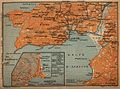 1914 city map
 -
 Napoleon's birth house


See also
[edit]Notes
[edit]- ^
- /ˈaɪətʃoʊ/,[3][4] UK also /əˈdʒæ(k)sioʊ/, US also /ɑːˈjɑːtʃ(i)oʊ/
- French: [aʒaksjo] ⓘ
- Italian: Aiaccio or Ajaccio [aˈjattʃo]
- Corsican: Aiacciu [aˈjattʃu], locally: Aghjacciu [aˈɟattʃu]
- Latin: Adiacium [ädɪˈaːkiʊ̃ː]
References
[edit]- ^ "Répertoire national des élus: les maires" (in French). data.gouv.fr, Plateforme ouverte des données publiques françaises. 13 September 2022.
- ^ "Populations légales 2022" (in French). National Institute of Statistics and Economic Studies. 19 December 2024.
- ^ Wells, John C. (2008). Longman Pronunciation Dictionary (3rd ed.). Longman. ISBN 978-1-4058-8118-0.
- ^ Jones, Daniel (2011). Roach, Peter; Setter, Jane; Esling, John (eds.). Cambridge English Pronouncing Dictionary (18th ed.). Cambridge University Press. ISBN 978-0-521-15255-6.
- ^ "Le nom des habitants du 2A - Corse-du-Sud - Habitants". www.habitants.fr.
- ^ "What's in an eponym? Celebrity airports - could there be a commercial benefit in naming?". Centre for Aviation.
- ^ Manuscript variants are Agration and Agiagium but the use of a Greek ending does not necessarily indicate anything at all about ethnicity. At this late date geographers used either Greek or Latin forms at will. The word is no more decipherable in Greek than it is in Latin; attempts to connect two or three letters with Indo-European roots amount to speculation.
- ^ a b c d One or more of the preceding sentences incorporates text from a publication now in the public domain: Chisholm, Hugh, ed. (1911). "Ajaccio". Encyclopædia Britannica. Vol. 1 (11th ed.). Cambridge University Press. p. 451.
- ^ The Cities of France, by Fabriès-Verfaillie et Stragiotti, 2000 (in French)
- ^ France, Meteo. "PREVISIONS METEO FRANCE - Site Officiel de Météo-France - Prévisions gratuites à 15 jours sur la France et à 10 jours sur le monde". www.meteofrance.com. Retrieved 31 May 2017.
- ^ MétéoFrance Archived 24 August 2010 at the Wayback Machine.
- ^ "Quand les tornades "rafalent" l'île". www.corsematin.com (in French). Archived from the original on 11 July 2019. Retrieved 11 July 2019.
- ^ Paris, Nice, Strasbourg, Brest
- ^ "Normales climatiques 1981-2010 : Ajaccio". www.lameteo.org. Retrieved 31 May 2017.
- ^ "Climatological Information for Strasbourg, France". Meteo France. 7 August 2019. Archived from the original on 25 July 2020. Retrieved 31 December 2021.
- ^ "AJACCIO (20)" (PDF). Fiche Climatologique: Statistiques 1991–2020 et records (in French). Meteo France. Retrieved 7 September 2022.
- ^ "Normes et records 1961–1990: Ajaccio - Campo dell'Oro (20) – altitude 4m" (in French). Infoclimat. Archived from the original on 15 March 2016. Retrieved 7 August 2019.
- ^ "Ajaccio normals for 1961-1990". ncei.noaa.gov. NOAA. Retrieved 11 April 2024.
- ^ Richards, Jeffrey (1979). The Popes and the Papacy in the Early Middle Ages, 476–752. London: Routledge & Kegan Paul. p. 318. ISBN 0-7100-0098-7.
- ^ Anonymous of Ravenna; Guido; Gustav Parthey; Moritz Pinder (1860). Ravennatis Anonymi Cosmographia et Guidonis Geographica. Berolini: in aedibvs Friderici Nicolai. p. 413. (in Latin). Downloadable Google Books.
- ^ Massimi, Pierre; Jose Tomazi (2002). "A corsica in la carta geografica di Ptolomey" (PDF). InterRomania. Centru Culturale, Universita di Corsica. Archived from the original (PDF) on 29 May 2008. Retrieved 18 May 2008. (in Corsican).
- ^ "History of Europe - Romans, Empire, Legacy | Britannica". www.britannica.com. Retrieved 28 June 2024.
- ^ "Discovery of an Early Christian Baptistery in Ajaccio". Inrap. 9 June 2005. Archived from the original on 21 July 2011. Retrieved 9 June 2008.
- ^ "History of the city of Ajaccio". Retrieved 16 May 2008.
- ^ "Napoleon > Who was Napoleon?". www.ngv.vic.gov.au.
- ^ Baring-Gould, Sabine (2006). The Life of Napoleon Bonaparte. Adamant Media Corporation. Chapter 1. ISBN 0-543-95815-9.
- ^ Sloane, William Milligan (1894). Life of Napoleon Bonaparte. pp. 27–30.
- ^ Cinti, Maurizio (20 April 1995). "La Maddalena, 22/25 February 1793". Military Subjects: Battles & Campaigns. The Napoleon Series. Retrieved 25 May 2008.
- ^ "Créer un site web gratuit - pages perso Orange". site.voila.fr. Archived from the original on 30 March 2009. Retrieved 31 May 2017.
- ^ "Préfecture of Corsica: The Liberation of Corsica". Archived from the original on 24 June 2008.
- ^ Rotterdam – 91 Day Far East Cruise: Volume 2. (2022). (n.p.): Kalman Dubov.
- ^ Nicolaï, Denis (27 April 2010). "Des Corses veulent que l'île soit "Juste parmi les nations"". Le Figaro.fr.
- ^ "French Cities" by Fabriès-Verfaillie et Stragiotti, 2000. (in French)
- ^ "Cars Set Alight as Protests Continue on Corsica". uk.style.yahoo.com. 11 March 2022. Retrieved 13 March 2022.
- ^ CCI of Ajaccio: Airport Archived 26 January 2010 at the Wayback Machine (in French)
- ^ "Corse Composites Aéronautiques cca.fr". corse-composites-aeronautiques.com.
- ^ "Accueil - Muvistrada".
- ^ Communauté d'Agglomération of Pays Ajaccien Archived 20 October 2007 at the Wayback Machine (in French)
- ^ www.ca-ajaccien.fr and Archived 18 October 2013 at the Wayback Machine (in French)
- ^ "Relations Clientèle Archived 18 August 2009 at the Wayback Machine." CCM Airlines. Retrieved 12 February 2010.
- ^ a b c "Chambre de Commerce et d'Industrie d'Ajaccio et de la Corse-du-Sud". www.corse-du-sud.cci.fr.
- ^ "Schedules | Le train Corse - Chemin de fer de la Corse". www.train-corse.com. Retrieved 21 August 2020.
- ^ Weinland, Robert. "francegenweb.org - votre service benevole d'assistance genealogique". www.francegenweb.org. Retrieved 31 May 2017.
- ^ Comité central bonapartiste
- ^ Corse social-democrate
- ^ "Site officiel de la Ville d'Ajaccio - Bienvenue à Ajaccio". Site officiel de la Ville d'Ajaccio - Bienvenue à Ajaccio.
- ^ "Décret n° 2014-229 du 24 février 2014 portant délimitation des cantons dans le département de la Corse-du-Sud". Retrieved 31 May 2017.
- ^ "Jumelage Ajaccio – La Maddalena: 29 ans déjà". ajaccio.fr (in French). Ajaccio. 2020. Archived from the original on 20 April 2021. Retrieved 20 April 2021.
- ^ Des villages de Cassini aux communes d'aujourd'hui: Commune data sheet Ajaccio, EHESS (in French).
- ^ "Growth and structure of the population in 2021". INSEE.
- ^ Castelluccio - Public Establishment of Health Archived 21 July 2011 at the Wayback Machine (in French)
- ^ "Académie de Corse". Académie de Corse.
- ^ French Cities" by Fabriès-Verfaillie et Stragiotti, 2000 (in French)
- ^ Ministry of Culture, Mérimée IA2A001904 Monument to General Abbatucci (in French)

- ^ Ministry of Culture, Mérimée IA2A001900 Monument to Napoleon I (in French)
- ^ Ministry of Culture, Mérimée PA00099141 Baciocchi Family Mansion (in French)
- ^ Ministry of Culture, Mérimée PA00099071 Fesch Palace (in French)
- ^ Ministry of Culture, Mérimée IA2A001905 Monument to the First Consul (in French)
- ^ Ministry of Culture, Mérimée PA00099067 Peraldi House (in French)
- ^ Ministry of Culture, Mérimée PA00099134 Grand Hotel (in French)
- ^ Ministry of Culture, Mérimée PA00099063 Château Conti (in French)
- ^ Ministry of Culture, Mérimée IA2A001903 Monument to Napoleon and his brothers (in French)
- ^ Ministry of Culture, Mérimée IA2A001902 Monument to Cardinal Fesch (in French)
- ^ Ministry of Culture, Mérimée PA00099142 Alban Factory (in French)
- ^ Ministry of Culture, Mérimée PA00099065 Milelli House (in French)
- ^ Ministry of Culture, Mérimée PA00099135 Hotel Palace-Cyrnos (in French)
- ^ Ministry of Culture, Mérimée PA00099128 Lantivy Palace (in French)
- ^ Ministry of Culture, Mérimée PA00099127 Hotel de Ville (in French)
- ^ Ministry of Culture, Mérimée PA00099066 Napoleon Bonaparte's House (in French)
- ^ Ministry of Culture, Mérimée PA00099064 Lazaretto of Aspretto (in French)
- ^ Ministry of Culture, Mérimée PA00099062 Citadel (in French)
- ^ Ministry of Culture, Mérimée IA2A001311 Sawmill (in French)
- ^ Ministry of Culture, Mérimée IA2A001274 Lighthouse (in French)
- ^ "Histoire de la Bibliothèque Fesch". Retrieved 2 January 2021.
- ^ "Ajaccio, the quarter for foreigners". Pays d'Ajaccio. Archived from the original on 17 January 2021. Retrieved 2 January 2021.
- ^ "Ajaccio : quelle mutation pour le quartier des Etrangers?". Corse-Matin. 27 February 2016. Archived from the original on 1 August 2021. Retrieved 2 January 2021.
- ^ Ministry of Culture, Mérimée PA00099070 Episcopal Palace (in French)
- ^ Ministry of Culture, Mérimée PA00099069 Oratory of Saint Roch (in French)
- ^ Ministry of Culture, Mérimée PA00099061 Chapel of Saint Erasme or Sant'Erasmu (in French)
- ^ Ministry of Culture, Mérimée PA00099068 Oratory of Saint John the Baptist (in French)
- ^ Ministry of Culture, Mérimée PA00099058 Cathedral of Santa Maria Assunta (in French)
- ^ Ajaccio Cathedral, Organ of the Cathedral of Cavaillé-Coll (1849) - Cicchero (1997) (in French)
- ^ Ministry of Culture, Mérimée PA00099059 Chapel of the Greeks (in French)
- ^ Ministry of Culture, Mérimée PA2A000004 Baptistery of Saint John (in French)
- ^ Ministry of Culture, Mérimée PA00099060 Imperial Chapel (in French)
- ^ Mingotaud, Mélanie (2009). "Dossier de presse - Joueuse" [Press Release - Joueuse] (PDF) (in French). Archived from the original (PDF) on 29 December 2017. Retrieved 27 December 2017.


External links
[edit]

- Official website Archived 19 April 2021 at the Wayback Machine (in French)
- The Communauté d'Agglomération du Pays Ajaccien (CAPA) website (in French)
- Tourism Office of Ajaccio website (in French)
- Tourist Info Visit Ajaccio (in English)
Neighbouring communes and towns[1] | ||||||||||||||||
|---|---|---|---|---|---|---|---|---|---|---|---|---|---|---|---|---|
| ||||||||||||||||


| Metropolitan regions |
|
|---|---|
| Overseas regions | |
| |
|

| International | |
|---|---|
| National | |
| Geographic | |
| Other | |

- ^ "Google Maps". Google Maps. Retrieved 31 May 2017.
Ajaccio
View on GrokipediaEtymology
Name Origins and Evolution
The name Ajaccio derives from the Latin Adiacium or Adjacium, first attested in the 5th-century Cosmography of Ravenna, an anonymous geographical compilation listing places in the Roman world.[6][7] This form likely stems from the Latin verb ad-iaceo, meaning "to lie near" or "adjacent," possibly referring to the site's position relative to ancient coastal features or settlements.[7] Alternative linguistic hypotheses link it to Tuscan Italian agghiacciu, denoting a "sheep pen," reflecting pastoral use of the marshy area before urbanization, though this remains speculative without direct epigraphic evidence.[6] A legendary etymology attributes the name to the Greek hero Ajax (son of Oileus), suggesting ancient Greek colonists named the site after him during the Trojan War era; however, this lacks archaeological support and contrasts with evidence of Phocaean Greek presence elsewhere in Corsica without specific ties to Ajaccio.[7] Roman-era references imply an earlier settlement north of the modern port, potentially a pastoral halt (Adjaccium as "resting place" for shepherds descending mountains), but no pre-5th-century inscriptions confirm this.[8] Under Genoese rule from the 15th century, the name evolved to Old Italian Addiazzo, reflecting Ligurian phonetic shifts, as the Genoese rebuilt the citadel in 1492 on the ancient site.[9] By the French annexation in 1768, it standardized as Ajaccio in French administrative records, while retaining Aiacciu in Corsican vernacular, preserving nasal and palatal sounds from Latin roots.[10] This dual form persists today, with Aiacciu used in local toponymy despite official French dominance.[6]Geography
Location and Topography
Ajaccio is situated on the west coast of Corsica, a French island in the Mediterranean Sea, at coordinates 41°55′36″N 8°44′13″E.[11] The city serves as the prefecture of the Corse-du-Sud department and lies approximately halfway along Corsica's western shoreline, within a region characterized by coastal gulfs and rising interior terrain.[12] Corsica itself measures 183 km in length and up to 83.5 km in width, with Ajaccio positioned at a latitude comparable to Barcelona and Rome.[12] The commune occupies a low-lying coastal strip at an average elevation of 12 meters above sea level, extending along the northern shore of the Gulf of Ajaccio.[13] This gulf, the largest on the island, stretches from Capo di Feno in the south to Capu di Muro in the north, forming a sheltered bay between the Sagone and Valinco regions.[14][15] The immediate topography features a narrow alluvial plain fringed by beaches and urban development, which ascends abruptly into wooded hills and maquis-covered slopes.[16] These hills transition eastward into Corsica's central granite mountain chain, where elevations exceed 2,000 meters, including peaks like Monte Cinto at 2,706 meters.[17] The gulf's configuration, enclosed by promontories and backed by steep relief, creates a natural harbor conducive to maritime activity, while the surrounding terrain limits inland expansion and emphasizes vertical development in higher districts.[18] This interplay of sea, plain, and mountains defines Ajaccio's physiographic setting, with the urban core clustered around the citadel and port before giving way to rugged, forested uplands.[15]
Climate Patterns
Ajaccio experiences a hot-summer Mediterranean climate (Köppen classification Csa), marked by prolonged dry summers with high temperatures and mild, relatively rainy winters influenced by its coastal position on Corsica's west side.[19][20] The annual average temperature stands at 16.3 °C, while precipitation averages 879 mm, concentrated primarily in the cooler months.[20] Summers, from June to September, feature low rainfall and abundant sunshine, with daytime highs reaching 27 °C in August and nighttime lows around 20 °C; the dry season spans approximately 4.2 months with minimal wet days.[21][22] Winters, peaking in November with up to 8.8 days of measurable precipitation (at least 1 mm), bring milder conditions, with February averages of 12 °C daytime and 6 °C nighttime, rarely dipping below 0 °C.[21][23] Extreme temperatures underscore the climate's variability: the record high of 40.3 °C occurred on July 26, 1983, during a heatwave, while lows seldom fall below freezing due to maritime moderation.[24] Precipitation patterns reflect seasonal contrasts, with wetter periods driven by westerly winds bringing moisture from the Atlantic, though annual totals remain moderate compared to continental Europe.[23] Breezes, including occasional sirocco winds from the south, temper summer heat but can introduce humidity.[25] Over the year, temperatures typically range from 4 °C to 28 °C, with rare excursions beyond 31 °C or below 0 °C, supporting a landscape of maquis shrubland and facilitating tourism year-round.[21]Urban Layout and Expansion
Ajaccio's urban layout originated with its Genoese foundation in 1492 on the Capo di Bolo promontory, featuring a fortified citadel and simple one-story slate-roofed houses clustered within protective ramparts, accommodating an initial population of around 700 inhabitants.[6] The compact design emphasized defense against Mediterranean threats, with the citadel at the peninsula's tip overlooking the bay, limiting early expansion to the enclosed area south of the ancient settlement.[26] By the late 18th century, population growth to approximately 5,000 rendered the walled city overcrowded, prompting major expansions in the 19th century.[6] In 1801, under Napoleonic influence, ramparts were demolished to facilitate outward growth, leading to the creation of Place Bonaparte (inaugurated 1802, now Place Foch) and axial roads like Cours Napoléon and Cours Grandval, achieved by flattening a nearby hill whose material filled a new seafront below Rue Fesch, forming the Pughjolu quarter.[26] [6] Subsequent plans included the 1830 Padovani scheme, which extended Cours Grandval, developed Place d’Austerlitz, and established upscale districts such as King Jérôme (1855) and the Foreigners’ Quarter (1860), the latter attracting British tourists with luxury hotels and an Anglican church.[6] The 1865 Jérôme Maglioli plan further incorporated a railway station and courthouse districts, while the U Borgu suburb, originating in the 17th century, expanded to Place Abbatucci.[6] Post-World War II, Ajaccio experienced rapid urban sprawl driven by demographic surges, transforming surrounding parks, gardens, and olive groves into residential and commercial zones, with much of the modern agglomeration developing upslope from the historic lower town.[27] This growth, accelerating in the 1960s, resulted in 85% of dwellings post-1949 and challenges in connectivity between the dense old core and elevated peripheries.[28] To address topographic barriers, the city initiated the Angelo urban cable car project in 2022, linking lower historic areas to upper neighborhoods with four stations, scheduled for operation in late 2025 to enhance mobility amid ongoing expansion.[29]History
Ancient and Pre-Genoese Periods
The site of modern Ajaccio exhibits traces of prehistoric human activity, consistent with broader Neolithic settlements across Corsica dating to approximately 6000 BCE, though specific artifacts or structures attributable to the area remain sparsely documented and unexcavated in detail.[8] Phoenician and Greek maritime presence in Corsica from the 6th century BCE onward facilitated trade along the western coast, but no direct evidence links these cultures to a permanent settlement at Ajaccio; the island's strategic position likely saw intermittent use as a waypoint rather than a founded colony.[30] Roman incorporation of Corsica followed the First Punic War's conclusion in 241 BCE, when the island became part of the province of Sardinia and Corsica, promoting economic integration through agriculture, mining, and coastal ports. Ajaccio's precursor, known as Adjacium—possibly deriving from Latin ad jactum, implying a "place of casting" or anchorage—emerged as a modest Roman-era outpost, likely serving as a pastoral resting point for transhumant shepherds and a minor harbor for regional trade, with archaeological hints of Roman occupancy including pottery and structural remnants.[31] [8] The settlement's scale remained limited, subordinate to larger centers like Aleria, and persisted under imperial administration until the Western Roman Empire's collapse around 476 CE. Post-Roman Ajaccio transitioned through Vandal (455–534 CE), Ostrogothic, and Byzantine rule, with the name Adjacium first attested in written records during the 5th century in the Ravennatis Anonymus Cosmographia and explicitly in 600 CE via Pope Gregory the Great's correspondence referencing a local bishopric.[7] [28] By the early Middle Ages, the town contracted amid invasions and economic fragmentation, reducing to a cluster of rural habitations overshadowed by Pisan influence from the 11th century, which introduced feudal structures but did not revive urban prominence until Genoese intervention.[31] This pre-Genoese phase underscores Ajaccio's role as a peripheral coastal node rather than a thriving polity, shaped by Corsica's rugged isolation and successive imperial overlays.Genoese Dominion
In 1492, the Bank of Saint George, the Genoese financial institution responsible for administering Corsica since 1453, established the Citadel of Ajaccio on its current site to secure control over the strategic bay and counter threats from pirates and local unrest.[6] This marked the refounding of the city, shifting it southward from its earlier Roman-era settlement, which had declined in the Middle Ages, and transforming it into a fortified commercial outpost under direct Genoese oversight.[8] The Citadel's construction emphasized defensive architecture, including robust walls completed by 1502 to enclose the growing settlement and protect maritime trade routes.[26] Genoese governance, exercised through the Bank of Saint George's officials, prioritized military fortification and revenue extraction via port duties, though it faced recurrent challenges from Corsican resistance and external incursions. In 1553, the Corsican military leader Sampiero Corso, supported by French and Ottoman allies, briefly captured the Citadel, prompting modifications to its structures during the six-year French interlude.[26] Genoese forces recaptured Ajaccio in 1559 under the terms of the Treaty of Cateau-Cambrésis, which restored Corsican territories to Genoa, leading to a ban on Corsican residency in the city until 1592 and subsequent expansions to the Citadel for enhanced resilience against rebellions.[8] Throughout the 17th and early 18th centuries, Ajaccio served as a key Genoese stronghold, with the Citadel anchoring defense against sporadic uprisings and Barbary pirate raids, while the port facilitated exports of olive oil, wine, and chestnuts.[32] Despite these efforts, Genoese authority eroded amid growing Corsican nationalism; following the declaration of the Corsican Republic in 1755 under Pasquale Paoli, Genoa retained control of coastal citadels like Ajaccio through garrisons until financial exhaustion prompted the sale of the island to France via the Treaty of Versailles on May 15, 1768, with full French conquest completed by 1769.[33][32]French Annexation and Early Modern Era
In 1768, the Republic of Genoa, unable to quell the Corsican independence movement led by Pasquale Paoli since 1755, ceded sovereignty over Corsica to France via the Treaty of Versailles signed on 15 May.[33] French expeditionary forces under Lieutenant General the Comte de Vaux began landing in June 1768, securing key coastal positions including the port of Ajaccio, where Genoese garrisons in the citadel were promptly replaced by French troops without significant initial resistance in the town itself.[33] Paoli, rejecting the treaty as illegitimate, organized armed opposition across the island, but French numerical superiority—bolstered by over 20,000 troops against Paoli's roughly 12,000 irregulars—proved decisive.[32] The campaign culminated in the Battle of Ponte Nuovo on 9 May 1769, where Vaux's forces routed Paoli's army, killing or capturing around 1,000 Corsicans while suffering fewer than 100 casualties, leading to Paoli's flight into exile in Britain.[33] In Ajaccio, French consolidation involved suppressing lingering Paolist sympathizers, including clashes between the local 2nd Battalion of the Ajaccio National Guard and insurgents, though the town transitioned relatively smoothly to direct French military governance.[33] Carlo Bonaparte, a lawyer and minor noble who had served in Paoli's administration but pragmatically aligned with the French victors, secured positions such as assessor of the royal domain, facilitating his family's integration into the new regime; his son Napoleon was born in Ajaccio on 15 August 1769, amid this turbulent transition.[33] Under initial French rule through the 1770s and 1780s, Ajaccio functioned primarily as a fortified naval base and administrative outpost in the Department of Corsica (later split into two departments in 1790), with governance emphasizing military pacification over civil reforms.[34] The French suppressed vendettas and banditry—endemic under prior Genoese neglect—through harsh policing, while introducing Bourbon administrative structures, though Corsican resentment fueled underground Paolist networks.[26] Economically, Ajaccio's harbor supported trade in olive oil, wine, and chestnuts, with population estimates around 5,000–6,000 residents by the late 18th century, bolstered by French investment in infrastructure like road improvements linking the town to the interior.[32] This era laid groundwork for deeper integration, yet local elites like the Bonapartes navigated dual loyalties, reflecting Corsica's uneasy assimilation into the Ancien Régime.[33]Napoleonic Influence
Ajaccio served as the birthplace of Napoleon Bonaparte on August 15, 1769, in the family home known as Maison Bonaparte, which became a focal point of his personal ties to the city.[35] During his early years, the Bonaparte family navigated turbulent local politics, aligning with French revolutionary forces against Corsican nationalists led by Pasquale Paoli, which culminated in their flight from Ajaccio in 1793 amid violence targeting pro-French residents.[33] Napoleon's subsequent rise to power as First Consul in 1799 elevated Ajaccio's status within the French administrative framework, as Corsica was reorganized into departments with Ajaccio designated as the principal town of Liamone.[26] As First Consul and later Emperor, Napoleon directed modernization initiatives in his hometown, prioritizing urban expansion to overcome the constraints of Genoese-era fortifications. In the early 19th century, he oversaw the demolition of the city's ramparts and the Bastion du Diamant, facilitating connectivity between the historic Genoese quarter and the expanding U Borgu district.[35] [26] These efforts, implemented under prefect Jean-Baptiste Miot de Melito starting in 1801–1802, included the creation of key thoroughfares such as the Cours Napoléon—a north-south artery—and Place Bonaparte, transforming Ajaccio from a fortified outpost into a more open, administratively functional port city.[26] Napoleon's administrative favoritism extended to institutional enhancements, though direct educational foundations in Ajaccio are more attributable to family members like his uncle Cardinal Joseph Fesch. The city's role as departmental capital from 1793 to 1811 underscored its integration into Napoleonic governance, with appointments of loyalists like General Morand as governor enforcing centralized control and quelling separatist remnants.[26] Posthumously, Ajaccio's identity became inextricably linked to Napoleonic heritage, evidenced by monuments like the statue of Napoleon as Roman consul in Place Foch, reflecting his self-fashioned imperial legacy.[35]19th–20th Century Developments
In the early 19th century, Ajaccio experienced structured urban expansion under French administration, building on prior imperial initiatives. Ramparts were demolished as part of an extension plan initiated in 1801, leading to the creation of Place Bonaparte (later Place Foch) by 1802, which facilitated growth beyond the historic core.[6] By 1826, key public structures including the prefecture, town hall, and Saint-Gabriel theater were constructed, enhancing administrative and cultural functions.[6] Architectural plans in 1830 extended the Cours Grandval to Place d’Austerlitz, while residential districts such as those of King Jérôme and Les Étrangers emerged between 1855 and 1860, accommodating population increases and affluent newcomers.[6] A 1865 urban scheme further incorporated a railway station and courthouse areas, integrating modern infrastructure.[6] Economically, Ajaccio benefited from Corsica's wine export boom through much of the century, with the port serving as a hub for shipments that drove regional prosperity and urban momentum.[8] However, the phylloxera epidemic, arriving in Corsica by the late 1870s and peaking into the 1890s, devastated vineyards across the island, including the Ajaccio region, causing widespread crop failure, income collapse, and mass emigration to mainland France and the Americas.[36] This crisis exacerbated rural depopulation and shifted local reliance toward diversified agriculture and emerging tourism, as British visitors began arriving mid-century for the mild climate—boasting approximately 2,700 annual sunshine hours—establishing Ajaccio as a winter resort destination with nearly 1,000 seasonal tourists by 1890.[6] An English expatriate community developed, constructing amenities like an Anglican church and the Grand Hôtel Continental.[6] The 20th century brought geopolitical upheaval and modernization. During World War II, following the 1940 armistice, Italian forces occupied Ajaccio and much of Corsica from November 1942 until an island-wide resistance uprising began on September 9, 1943, marking Ajaccio as the first French metropolitan city liberated without direct Allied intervention.[6][37] Full liberation followed by early October 1943 under Operation Vésuve, involving Free French forces and local maquisards against retreating Italian and minor German elements, after which the island served briefly as an Allied airbase.[37] Post-1945 reconstruction spurred demographic and urban growth, with the city's population expanding significantly from the mid-century onward amid economic recovery and tourism expansion, leading to suburban sprawl and transformation into a regional economic center.[28]Post-1945 to Present
Following the Second World War, Ajaccio underwent reconstruction efforts amid broader Corsican recovery from occupation and resistance activities, with the city serving as a key administrative hub. In 1945, the port area experienced France's last recorded plague outbreak, claiming 10 lives before containment measures halted its spread.[38] Post-war growth accelerated, driven by infrastructure improvements and economic integration into metropolitan France, transforming the urban landscape from its pre-war configuration.[39] The 1960s marked a demographic surge in Ajaccio, fueled by rural-to-urban migration within Corsica and the influx of approximately 20,000 pied-noirs—French settlers repatriated from Algeria after independence in 1962—who settled on the island, straining resources and heightening local resentments over perceived continental dominance.[40] This period saw rapid urban expansion, with new housing and commercial developments sprawling beyond the historic center, establishing Ajaccio as Corsica's primary economic and political node. Tensions from these changes contributed to the emergence of Corsican nationalist movements, which framed mainland policies as colonial exploitation, leading to organized protests by the late 1960s. The 1970s escalated into armed separatism, with the National Liberation Front of Corsica (FLNC), founded in 1974, launching its inaugural campaign of 21 bombings across towns including Ajaccio on May 4, 1976, targeting symbols of French authority.[41] Violence intensified in the 1980s; on April 16, 1981, FLNC operatives detonated two bombs at Ajaccio Napoleon Bonaparte Airport in an assassination attempt on French Interior Minister Gaston Defferre, though he escaped unharmed. Over 375 bombings were attributed to the group island-wide in 1980 alone, with Ajaccio frequently hit due to its government institutions. The 1998 kidnapping and murder of Prefect Claude Érignac in Ajaccio by nationalist militants, including Yvan Colonna, underscored the city's role as a flashpoint, prompting a state of emergency and military reinforcements.[42] Separatist activities persisted into the 2000s, with sporadic attacks on infrastructure and pied-noir properties, though intra-nationalist factionalism fragmented the movement. The FLNC announced a unilateral ceasefire in 2014, shifting focus to political negotiations, yet low-level violence continued. In March 2022, riots erupted in Ajaccio following the prison assault on Colonna—convicted for Érignac's murder—and his death on March 21, resulting in arson against vehicles, assaults on the prefecture and courthouse, and clashes injuring dozens, including 44 police officers.[43][44] These events, described as urban guerrilla warfare by observers, renewed autonomy demands, leading French President Emmanuel Macron to engage in direct talks with Corsican leaders in 2022–2023, though full resolution remains elusive as of 2025.[45]Politics and Governance
Administrative Structure
Ajaccio is a commune in the French overseas department of Corse-du-Sud (department code 2A), functioning as its prefecture and hosting the regional prefecture for Corsica, which oversees state services including civil registration, public security, and administrative coordination.[46][47] At the local level, the commune is governed by a mayor elected for a six-year term and a municipal council of 49 members, responsible for services such as urban planning, education, and cultural affairs, with decisions made through council votes and executive implementation by the mayor's office.[48] The current mayor is Stéphane Sbraggia, who assumed office on July 4, 2020, following the resignation of Laurent Marcangeli and was confirmed in a special election; Sbraggia also holds the presidency of associated intercommunal bodies.[49][48] The commune participates in the Communauté d'agglomération du Pays Ajaccien (CAPA), an intercommunal authority established on December 31, 2001, comprising 10 municipalities including Ajaccio as the central urban pole, with a combined population of 92,766 residents as of 2022.[50][51] CAPA manages shared competencies such as waste collection, water supply via its SADE subsidiary, economic development, and public transport, funded by member contributions and operating under a council led by the president, who is elected from among the delegates of the participating communes.[50] This structure coordinates infrastructure across an area of approximately 268.8 km², emphasizing Ajaccio's role in regional agglomeration policies while preserving communal autonomy in core functions.[51] As the departmental capital, Ajaccio houses the prefecture at Palais Lantivy on Cours Napoléon, which implements national policies and liaises with the Collectivité de Corse, the island's unique territorial assembly-based authority that handles devolved powers like education and transport since its 2018 reorganization.[52] The commune's administrative offices, located at Hôtel de Ville on Avenue Antoine-Serafini, process local services including civil status records and urban permits, supported by specialized directorates for finance, human resources, and public works.[53]Corsican Nationalism and Separatism
Corsican nationalism emerged in the mid-20th century amid grievances over economic marginalization and cultural erosion under French rule, evolving into organized separatism with the founding of the National Liberation Front of Corsica (FLNC) in 1976. The FLNC pursued independence through an armed campaign, conducting over 20,000 attacks, primarily bombings against military, administrative, and economic targets symbolizing French control. In Ajaccio, the island's political and administrative capital, such actions included bombings on November 19, 1996, and the killing of a separatist activist there on January 2, 1996, highlighting the city's role as a focal point for militant operations due to its status as the seat of regional governance.[54][55] Violence intensified periodically, as seen in the 2022 unrest following the prison death of Yvan Colonna, an FLNC member convicted in 1998 of assassinating French prefect Claude Érignac in 1998. Protests in Ajaccio rapidly escalated into riots, with demonstrators hurling stones and flares at police, setting fire to public buildings including the prefecture, and injuring dozens of officers; similar clashes occurred across Corsica, resulting in over 100 arrests island-wide. These events underscored persistent tensions but also marked a decline in sustained armed separatism, as the FLNC declared a ceasefire in 2014 and splinter groups have since waned in activity.[56][57] By the 2020s, nationalist momentum shifted toward electoral and institutional channels, with pro-autonomy parties securing control of the Corsican Assembly since 2017 and garnering over 56% of votes in regional elections as early as 2017. Ajaccio, hosting the assembly, became the venue for pivotal negotiations; in September 2023, French President Emmanuel Macron addressed lawmakers there, proposing "a form of autonomy" for Corsica within the Republic, emphasizing legislative powers on local matters without secession. This led to a March 2024 agreement between French and Corsican officials on enhanced self-rule, followed by parliamentary approval of a constitutional bill in July 2025, reflecting broader public preference for autonomy—evidenced by nationalist electoral dominance—over outright independence, which commands limited support amid economic reliance on France.[58][59][60]Autonomy Movements and Conflicts
Ajaccio, as the political capital of Corsica, has been a focal point for tensions arising from Corsican autonomy movements, which seek greater self-governance from mainland France while rooted in broader nationalist sentiments dating to the island's 1768 annexation.[59] These movements have oscillated between political advocacy and violent actions, with the city serving as a hub for protests, attacks on state symbols, and negotiations.[61] A pivotal conflict occurred on February 6, 1998, when Claude Érignac, the prefect of Corsica, was assassinated in central Ajaccio by a commando linked to Corsican separatists, including Yvan Colonna, who was later convicted as the shooter.[62] The killing, carried out with three gunshots as Érignac walked to a concert, marked the first assassination of a French prefect since 1871 and intensified the island's low-level insurgency led by groups like the FLNC (National Liberation Front of Corsica), which had conducted over 20,000 attacks since 1976 targeting infrastructure and symbols of French authority.[63] [54] In Ajaccio, such violence included bombings of public buildings and banks, though the FLNC declared a ceasefire in 2014, reducing overt militancy but not underlying grievances.[61] Tensions resurfaced in March 2022 following the prison death of Colonna, convicted in the Érignac case, sparking riots in Ajaccio where protesters attacked the courthouse, set cars ablaze, and clashed with police, injuring dozens amid demands for autonomy and the repatriation of Corsican inmates.[64] These events, part of broader unrest across Corsica, prompted French President Emmanuel Macron to propose "a form of autonomy" in September 2023, framing it as integration within the Republic rather than separation.[65] By March 2024, French and Corsican officials agreed on a constitutional draft recognizing Corsica's "autonomous status" within France, debated in Ajaccio's Regional Assembly, which would enhance local legislative powers under national oversight without full sovereignty.[59] This followed years of nationalist electoral gains, with parties like Corsica Libera advocating resident status for land ownership and bilingual policies, though hardline independence calls persist amid sporadic protests in the city.[66] As of July 2025, the French government approved a bill advancing this autonomy framework toward parliamentary review, positioning Ajaccio as the administrative center for implementation despite ongoing debates over judicial and fiscal limits.[60]Demographics
Population Dynamics
The population of Ajaccio, the prefecture of Corse-du-Sud, has increased from 43,438 residents in 1968 to 75,343 in 2022, reflecting an overall upward trajectory amid periodic fluctuations.[67] This growth accelerated post-1999, with the commune gaining over 22,000 inhabitants in two decades, driven predominantly by net in-migration as the city functions as Corsica's primary administrative, economic, and service hub attracting rural-to-urban movers from the island and inflows from mainland France.[67] Density rose correspondingly from 529.5 inhabitants per km² in 1968 to 918.5 in 2022, underscoring urbanization pressures on the 82.03 km² commune area.[67]| Year | Population | Annual Growth Rate (Average, %) | Density (hab/km²) |
|---|---|---|---|
| 1968 | 43,438 | - | 529.5 |
| 1975 | 49,065 | 1.8 | 598.1 |
| 1982 | 54,089 | 1.4 | 659.4 |
| 1990 | 58,949 | 1.1 | 718.6 |
| 1999 | 52,880 | -1.2 | 644.6 |
| 2006 | 63,723 | 2.7 | 776.8 |
| 2011 | 66,809 | 1.0 | 814.4 |
| 2016 | 69,075 | 0.7 | 842.1 |
| 2022 | 75,343 | 1.5 | 918.5 |
Ethnic, Linguistic, and Cultural Composition
The population of Ajaccio is predominantly ethnic Corsicans, a Romance-speaking group native to the island with historical roots in Ligurian and Italian settlers during centuries of Genoese rule from the 13th to 18th centuries, fostering a distinct identity separate from mainland French populations.[70][71] This core group forms the majority, though precise ethnic breakdowns are unavailable due to France's policy against collecting such data in censuses; instead, birthplace indicators show that over 70% of Corsica's residents, including Ajaccio's urban core, were born on the island as of 2021 INSEE figures.[68] Significant minorities include pied-noirs repatriated from Algeria post-1962 independence (estimated at tens of thousands island-wide), alongside immigrants from Morocco, Tunisia, Italy, Portugal, and mainland France, comprising roughly 20-25% of Corsica's total population of about 340,000 and influencing Ajaccio's cosmopolitan port demographics.[72] Linguistically, French serves as the official and dominant language, spoken fluently by virtually 100% of Ajaccio's residents, reflecting state education and administration policies since annexation in 1768.[73] The regional Corsican language (Corsu), an Italo-Dalmatian tongue closely related to Tuscan Italian dialects, is spoken competently by approximately 25-36% of Corsica's adult population, with higher proficiency in rural areas than urban Ajaccio, where a 2020 Collectivité de Corse survey reported around 36% island-wide usage among adults but lower transmission rates to younger generations due to French monolingualism in schools.[74][75] Over half the population understands Corsu passively, often mixing it with French in informal settings, while Italian comprehension persists among older residents from historical ties, though active use remains marginal at under 5%.[76] Culturally, Ajaccio embodies a hybrid Mediterranean identity shaped by prolonged Italian (Genoese and Pisan) governance until 1768, evident in architectural styles, cuisine (e.g., charcuterie and chestnut-based dishes akin to Tuscan fare), and folk traditions like polyphonic singing (pagghjella), overlaid with French legal and institutional frameworks post-annexation.[77] This duality fosters a strong regionalist sentiment, with Corsican symbols (e.g., the island's Moorish head flag) prominent in public life, yet integrated into French republican norms; historical vendetta customs have waned since the 19th century due to state policing, replaced by modern expressions of autonomy through festivals and language revitalization efforts, though surveys indicate declining cultural distinctiveness among youth amid tourism-driven globalization.[78][79]Economy
Primary Industries and Tourism
Agriculture in the Ajaccio region primarily involves wine production, olives, citrus fruits, and chestnuts, though it remains small-scale and supplementary to other economic activities. Vineyards like Clos Ornasca span nearly 13 hectares, producing wines that contribute to Corsica's overall agricultural output, where wine accounts for about 50% of farming production across roughly 8,500 hectares island-wide.[80][81] Local markets feature seasonal produce from surrounding areas, emphasizing quality and direct farmer-producer links.[82] Fishing constitutes a traditional primary sector, centered on small-scale operations in Ajaccio's dedicated fishing port adjacent to the citadel. Artisanal catches include red lobster, a longstanding staple for local fishermen, and sea urchins, harvested seasonally from mid-February to mid-April under strict quotas to prevent overexploitation.[83][84] These activities supply fresh seafood to markets and restaurants but represent a minor economic share compared to services, with Corsican fisheries focusing on diverse species amid declining Mediterranean stocks.[85] Tourism overwhelmingly drives Ajaccio's economy as the island's primary hub, leveraging its status as Napoleon Bonaparte's birthplace, scenic bay, beaches, and proximity to the Îles Sanguinaires. The sector benefits from the commercial port's ferry and cruise operations, positioning Ajaccio as a gateway for visitors, alongside Napoleon Bonaparte Airport. In Corsica, tourism supports about 10.6% of employment and 11% of GDP based on 2015 data, with annual visitor numbers reaching around 8 million, concentrated in summer months.[86][87] Recent trends indicate sustained growth, though seasonal dependency and environmental pressures, such as water scarcity during peaks, pose challenges.[88]Economic Challenges and Dependencies
Ajaccio's economy exhibits pronounced dependencies on public sector employment and tourism-driven services, limiting diversification. In 2022, public administration, education, health, and social services represented 41% of jobs (16,118 positions), while trade, transport, accommodation, and food services accounted for 45.6% (17,939 positions), reflecting heavy reliance on state payrolls and seasonal visitor spending.[47] Industrial activity remains marginal at 5.5% (2,146 jobs), with agriculture negligible at 0.5% (180 jobs).[47] These dependencies are compounded by insularity, which elevates transport and logistics costs, hindering industrial growth and private investment.[88] The economy receives substantial subsidies from mainland France, funding public jobs and infrastructure but fostering structural reliance that constrains fiscal autonomy and exposes the region to mainland policy shifts.[34] Tourism's seasonality amplifies employment volatility, with off-peak periods straining local revenues despite the sector's role in sustaining service-oriented activity.[88] Unemployment in Ajaccio reached 7.7% in 2022 (2,573 individuals), exceeding Corsica's regional rate of approximately 6%, amid an activity rate of 76.2% for the 15-64 age group.[47] Corsica's GDP per capita of €29,260 in 2022—below France's national average—underscores productivity gaps tied to service dominance and subsidy inflows, with Ajaccio as the island's economic hub mirroring these metrics.[89] Efforts to mitigate challenges include infrastructure upgrades, though persistent high living costs and limited non-tourist sectors perpetuate vulnerabilities.[88]Recent Fiscal and Sectoral Data
In 2023, the City of Ajaccio's operating revenues totaled €109.8 million, while operating expenses reached €107.5 million, yielding a surplus of approximately €2.3 million.[90] For 2024, the primitive budget projected operating revenues at €111.4 million, reflecting a 6.3% increase from the prior year, driven by sustained fiscal policies amid regional economic pressures.[91] Personnel costs constituted 69% of operating expenses in 2024, highlighting the public sector's dominant role in local fiscal outlays, with overall expenses rising 8.5%.[92] Ajaccio's labor market in 2022 featured 39,478 total jobs, with an employment rate of 70.3% for the 15-64 age group and an unemployment rate of 7.7%.[67] The median income per consumption unit stood at €23,320 in 2021, supporting a service-oriented economy.[67] By late 2023, the commune hosted 3,160 business establishments, of which 72.7% operated in commerce, transport, and services, underscoring sectoral concentration in tourism-dependent activities.[67]| Sector | Jobs (2022) | Share (%) |
|---|---|---|
| Commerce, Transport, Services | 17,939 | 45.6 |
| Public Administration, Education, Health | 16,118 | 41.0 |
| Other (incl. Construction, Industry) | 5,421 | 13.4 |
Infrastructure
Transportation Networks
Ajaccio Napoleon Bonaparte Airport (AJA), located 5 kilometers east of the city center, serves as the primary air gateway to southern Corsica, handling approximately 1.42 million passengers in 2023.[94] The airport, operated mainly by Air Corsica, connects to major French mainland cities such as Paris, Marseille, and Lyon, with additional seasonal routes to European destinations. Access from the airport to downtown Ajaccio is provided by bus line 8 operated by TCA (Transports Communautaires Ajacciens), taking about 20-30 minutes, alongside taxi and car rental options.[95][96] The Port of Ajaccio functions as a vital maritime hub, accommodating ferries to mainland France and Italy, as well as cruise ships. In 2024, it recorded 910,000 ferry passengers, marking a 6.8% increase from the previous year, with key operators including Corsica Linea serving routes to Marseille and proprietary services to Nice.[97] The port also handles significant cruise traffic, with multiple ship calls annually, contributing to tourism influx. Freight throughput stands at around 940,000 tons per year, supporting island logistics.[98] Road transport relies on the RN 193, the main national route linking Ajaccio northward to Bastia via Corte over approximately 150 kilometers of winding terrain through central Corsica's mountains. This artery forms the backbone of the island's limited highway system, with some segments reclassified as T20 for territorial management. Local and intercity bus services by TCA connect Ajaccio to surrounding areas and the airport, though coverage is sparse outside peak seasons, often necessitating private vehicles for flexibility.[99][100] Rail services are operated by Chemins de Fer de la Corse (CFC) on a narrow-gauge network, with Ajaccio station serving as the southern terminus of the 157-kilometer central line to Bastia via Ponte Leccia and Corte. Typically two daily trains run each direction, offering scenic but slow journeys averaging 3-4 hours, primarily for passengers and limited freight. Additional halts near the airport, such as Campo dell'Oro, facilitate integrated travel, though the network's meter-gauge tracks limit speed and capacity compared to mainland standards.[101][102]Energy and Utilities
Ajaccio's electricity supply forms part of Corsica's insular grid, primarily managed by EDF Production Electrique Insulaire (PEI), with local generation centered on the Vazzio thermal power station in the city, boasting a total capacity of 133 MW across multiple units fueled mainly by heavy fuel oil.[103] This facility addresses peak demands but contributes to Corsica's reliance on fossil fuels, supplemented by imports via interconnections with Sardinia and intermittent renewables like solar and hydro.[103] To transition toward sustainability, EDF initiated construction of the 130 MW Ricanto bioenergy plant near Ajaccio in November 2024, designed to replace Vazzio using liquid biomass from forestry and agricultural residues, targeting 20% of the island's annual electricity needs and a 65% reduction in CO2 emissions relative to the incumbent station.[104][105] Water utilities in Ajaccio fall under the Communauté d’Agglomération du Pays Ajaccien (CAPA), which oversees potable water production, distribution, and quality control for the city's agglomeration encompassing 10 communes as of 2024.[106] Sources include surface and groundwater reservoirs, with treatment ensuring compliance with EU standards, though seasonal tourism strains supply, prompting investments in infrastructure like desalination pilots amid Corsica's variable hydrology.[106] Natural gas is unavailable in Corsica due to the absence of mainland pipelines; instead, Ajaccio maintains a localized distribution network delivering a propane-air mixture as "gaz de ville" for residential and commercial heating, managed by ENGIE GPL from storage at Loretto.[107][108] This system, imported as liquefied petroleum gas (LPG) via tankers to Ajaccio's terminal, supports peak thermal output of 53 MW, serving urban zones but limiting scalability compared to continental piped natural gas.[109]Port and Airport Operations
The Port of Ajaccio functions primarily as a passenger and vehicle ferry terminal connecting Corsica to mainland France, Sardinia, and other Mediterranean ports, with operators including Corsica Ferries and Moby Lines providing regular services to Marseille, Nice, and Livorno.[97] In 2024, the port handled 910,000 passengers, marking a 6.8% increase from the prior year, driven by seasonal tourism demand.[97] Freight operations remain limited, focusing on roll-on/roll-off traffic for vehicles and goods rather than bulk cargo, with Corsica's overall maritime logistics emphasizing short-sea routes over deep-water handling.[110] Cruise ship operations occur at the dedicated Quai de Croisières, a T-shaped pier capable of berthing up to four vessels simultaneously, accommodating ships up to 300 meters in length.[111] The port welcomed increased cruise traffic post-2023 recovery, supporting excursions to Napoleonic sites and coastal areas, though volumes are modest compared to larger Mediterranean hubs.[112] Facilities include passenger terminals, customs services, and proximity to the city center, facilitating tendering for larger vessels unable to dock directly.[113] Ajaccio Napoleon Bonaparte Airport (IATA: AJA, ICAO: LFKJ), located 5 km southeast of the city, operates a single runway (02/20) measuring 2,535 meters, supporting commercial jet and turboprop flights primarily on domestic and seasonal European routes.[114] In 2023, it processed 1,412,091 total passengers, including 1,308,726 on national flights and 591,588 via low-cost carriers, with operations peaking in summer due to tourism from Paris, Lyon, and international hubs like London and Oslo.[115] Major operators include Air Corsica for year-round public service obligation routes to Paris-Orly and Marseille, alongside Air France, easyJet, Volotea, and seasonal services from Norwegian Air Shuttle, Luxair, and Transavia.[116] Cargo handling is negligible, with freight under 1,000 metric tons annually, as the airport prioritizes passenger traffic over logistics.[115]Culture and Heritage
Architectural and Civil Sites
Ajaccio's architectural landscape features Genoese fortifications, Baroque religious structures, and 19th-century neoclassical buildings tied to Napoleonic heritage. The city's core developed around defensive citadels and ecclesiastical sites from the late 15th to 16th centuries, with later expansions reflecting French imperial influences. Civil sites include public squares and administrative buildings that blend functionality with monumental design.[117] The Citadel of Ajaccio, constructed in 1492 by the Genoese Bank of Saint George as a fortress to control the bay, originally comprised a keep and lower walls. Expanded in 1553 by French troops under Sampiero and further fortified in 1559 with six bastions by engineer Giovan Giacomo Palearo, it served military purposes until ceded to the municipality in 2019. Its strategic peninsula location facilitated surveillance of the gulf, evolving from a medieval stronghold into a symbol of Genoese colonial architecture.[117][118] Maison Bonaparte, the birthplace of Napoleon I born on August 15, 1769, is an 18th-century residence owned by the Bonaparte family from 1682 until 1923. Classified as a historic monument, it became a national museum in 1967, preserving period furnishings, family portraits, and artifacts illustrating Corsican domestic life of the era. The structure exemplifies modest Genoese-influenced urban housing typical of Ajaccio's old quarter.[119][120] The Palais Fesch, initiated in 1827 under Cardinal Joseph Fesch—Napoleon's uncle—and completed in 1837 by architect Frassato, features a rectangular corps-de-logis with enclosing wings around a courtyard. Built in neoclassical style using local stone, it houses the Musée Fesch's Italian Renaissance and Baroque art collection, with the adjacent Imperial Chapel's Latin cross plan and trompe-l'œil dome added in the mid-19th century.[121] Ajaccio Cathedral, dedicated to the Assumption of the Virgin Mary, was erected between 1577 and 1593 in Baroque-Mannerist style, attributed to Italian architect Giacomo della Porta. Replacing earlier 6th- and 12th-century churches, its compact Latin cross layout includes intricate stucco work and modest proportions reflective of Counter-Reformation influences under Genoese rule. Napoleon was baptized here on July 21, 1771.[122][123] The Hôtel de Ville, or City Hall, constructed from 1824 to 1830 during Charles X's reign, incorporates the Salon Napoléonien displaying Napoleonic relics within a neoclassical facade. Place Foch, a central square with palm-lined promenades and the 19th-century Monument to Napoleon I, serves as a civil hub blending public space with commemorative architecture.[124]Religious Monuments
The Cathedral of Our Lady of the Assumption, known locally as Cathédrale Notre-Dame-de-l'Assomption or Santa Maria Assunta, stands as Ajaccio's principal religious monument. Constructed between 1577 and 1593 to replace earlier cathedrals from the 6th and 12th centuries, it exemplifies Counter-Reformation Baroque architecture influenced by Italian Renaissance styles.[125][126] Attributed to the Italian architect Giacomo della Porta, the compact structure features intricate stucco work, frescoes, and a notable painting by Eugène Delacroix depicting the Virgin Mary.[127][123] Designated a historic monument in 1906, it remains an active place of worship and draws visitors for its role in the baptism of Napoleon Bonaparte on August 15, 1769.[123][28] Adjacent to the Fesch Museum, the Imperial Chapel (Chapelle Impériale), also called the Palatine Chapel, serves as another key religious site tied to the Bonaparte legacy. Commissioned by Napoleon III and completed in 1859, this neoclassical structure was built to house the remains of Bonaparte family members originally buried in Corsica, including Letizia Bonaparte, Napoleon's mother, whose tomb lies within.[128][129] Featuring ornate interiors with marble and sculptures, it functions as a memorial chapel rather than a parish church, underscoring the enduring imperial veneration in Ajaccio's religious landscape.[129] Other churches, such as the Sacred Heart Church (Église du Sacré-Cœur), contribute to the city's ecclesiastical heritage but lack the historical prominence of the cathedral and chapel; the former, a 20th-century build, primarily serves local parishioners without notable architectural or event-based significance.[130] Maritime churches in the broader Ajaccio area, like those dedicated to fishermen's patron saints, reflect devotional practices but are not central monuments within the urban core.[131]Cultural Traditions and Language Debates
Ajaccio's cultural traditions are deeply intertwined with Corsican heritage, featuring annual festivals that blend music, history, and local customs. The Jazz in Aiacciu Festival, held annually in summer, combines jazz with world music performances, underscoring the city's role in promoting Corsican openness to global influences while preserving regional sounds like polyphonic singing, a tradition recognized by UNESCO as intangible cultural heritage for Corsica as a whole.[132] In August, the Napoleonic Days feature costumed animations, theatrical shows, and military re-enactments commemorating the city's most famous native son, drawing on historical pageantry to evoke 18th- and 19th-century customs.[133] Other events, such as the October Ritmovu festival, showcase emerging Corsican music and creativity, often incorporating traditional instruments like the cetera and vocal styles rooted in pastoral and religious origins.[134] Religious and communal customs remain prominent, including processions tied to patron saints and seasonal fairs that highlight artisanal crafts such as pottery and woodworking, practiced in nearby villages but celebrated in Ajaccio's markets.[135] These traditions reflect a fusion of Genoese, French, and indigenous influences, with gastronomic elements like brocciu-based dishes and myrtle liqueur featured in family and festive gatherings, emphasizing communal self-sufficiency historically shaped by the island's rugged terrain.[136] Language debates in Ajaccio center on the Corsican language (lingua corsa), a Romance tongue spoken in its Ajaccian dialect, which differs phonetically from northern variants and serves as a marker of cultural identity amid French dominance.[137] As the seat of the Assembly of Corsica, Ajaccio has been the focal point of disputes over official language use; in March 2023, France's Constitutional Council declared unconstitutional the assembly's practice of conducting debates in Corsican alongside French, affirming the 1992 constitutional amendment that French alone governs parliamentary proceedings.[138] This ruling, upheld by a Marseille administrative court in November 2024, prohibited Corsican in assembly debates, prompting protests from nationalists who argue it undermines regional autonomy and the language's vitality, estimated at fewer than 10% fluent daily speakers island-wide.[139][140] Advocates, including Corsican nationalists, have long demanded mandatory Corsican instruction in schools and co-official status, viewing suppression as cultural assimilation; however, central government resistance prioritizes constitutional unity, with data showing declining transmission rates despite revival efforts like immersion programs.[141] These tensions, exacerbated post-2017 nationalist electoral gains, highlight causal frictions between Paris's centralism and local demands for bilingual policies, without altering French's legal primacy in administration.[142]Sports and Recreation
Football and AC Ajaccio
Association Sportive de l'Arrondissement d'Ajaccio, commonly known as AC Ajaccio, is the primary professional football club based in Ajaccio, Corsica, founded on March 1, 1910.[143] The club has historically competed in the upper tiers of French football, achieving promotion to Ligue 1 for the 2001–02 season after winning Ligue 2 and maintaining top-flight status intermittently thereafter.[144] AC Ajaccio recorded eight Corsican regional championships between 1920 and 1964, establishing itself as one of the island's leading teams alongside SC Bastia and Gazélec Ajaccio.[145] The club's home matches are played at Stade Michel Moretti, formerly known as Stade François-Coty, which opened on December 1, 1969, with a capacity of 10,446 spectators.[146] [147] Notable record holders include Johan Cavalli, who amassed the most appearances for the club, followed by defenders Riad Nouri and Cédric Avinel.[148] Despite periods of success, such as reaching the Ligue 1 relegation/promotion play-offs in 2018 against Toulouse, AC Ajaccio has not secured major national titles and has experienced frequent relegations.[149] In recent seasons, the club struggled with financial instability, finishing 12th in Ligue 2 during 2024–25 but facing administrative relegation to Championnat National, the third tier, confirmed on August 7, 2025.[150] Further disciplinary actions by the French Football Federation on August 13, 2025, excluded AC Ajaccio from national competitions, potentially dropping it to regional levels pending appeals.[151] This marks a significant decline from its last Ligue 1 campaign in 2022–23, where it was relegated after finishing 16th.[152] The club's trajectory reflects broader challenges in Corsican football, including limited infrastructure and reliance on youth development amid competitive imbalances in mainland leagues.[153]Other Athletic Pursuits
Ajaccio supports a range of organized sports beyond football, with basketball clubs emphasizing community participation and youth training. The Ajaccio Basket Club, established in 2011, operates as a multifaceted organization promoting basketball through competitive teams and developmental programs for all ages.[154] Similarly, ACA Basket-Ball, founded in January 2020 under president Bruno Magne, fields teams in regional leagues and focuses on local talent cultivation.[155] Handball maintains a presence via the Handball Ajaccio Club (HAC), an amateur entity active in youth categories such as under-11 and under-13 mixed teams, participating in regional matches against clubs like GFCA and Sartène.[156] The ASPTT Ajaccio, a longstanding multi-sport association, historically included handball sections dating back to the mid-20th century, contributing to the city's broader athletic infrastructure before it became one of Corsica's largest omnisports clubs.[157] Water-based pursuits thrive due to Ajaccio's coastal setting, with the Société Nautique d'Ajaccio offering structured programs in sailing schools, rowing, sea kayaking, and introductory underwater activities like snorkeling.[158] These initiatives support both recreational and competitive levels, leveraging the Gulf of Ajaccio for training in disciplines such as windsurfing and stand-up paddleboarding.[159] Judo also features through ASPTT Ajaccio's section, initiated in 1959, providing martial arts training integrated into the club's athletic offerings.[157]Notable Figures
Napoleon Bonaparte's Early Life
Napoleon Bonaparte was born on 15 August 1769 in Ajaccio, the capital of Corsica, shortly after the island's cession to France by the Republic of Genoa in 1768.[33] [160] His parents, Carlo Maria Buonaparte, a lawyer of minor Tuscan nobility who had settled in Corsica, and Maria Letizia Ramolino, daughter of a local Corsican family, resided in the family home known as Casa Buonaparte.[161] [162] He was the second surviving son among eight children, following his brother Joseph; the family's first two children had died in infancy.[163] The Buonaparte family spoke primarily Corsican Italian at home, reflecting their Genoese and Tuscan roots amid the island's recent transition to French rule.[33] Carlo Buonaparte, who initially supported Corsican independence leader Pasquale Paoli but later aligned with French authorities, secured noble status recognition for the family, enabling access to French educational opportunities.[164] On 21 July 1771, nearly two years after his birth, Napoleon was baptized in Ajaccio Cathedral (Cathédrale Notre-Dame-de-l'Assomption), alongside his infant sister Maria-Anna, in a ceremony recorded in the parish registers that confirmed his birth date.[122] [165] From age five in 1774, Napoleon attended a primary boarding school in Ajaccio operated by Beguine lay sisters, where his routine included basic instruction in reading, writing, and arithmetic alongside playtime, though records note his occasional truancy for outdoor activities.[33] [164] This local education lasted until 1779, when, at age nine, his father arranged scholarships for him and Joseph to pursue military training in mainland France, marking the end of Napoleon's childhood in Ajaccio.[163] The family's modest circumstances and Carlo's advocacy in Versailles facilitated these placements, though the move exposed Napoleon to French culture and language, contrasting with his Corsican upbringing.[164]Other Prominent Individuals
Constantino Rossi, known professionally as Tino Rossi, was born in Ajaccio on April 29, 1907, to a Corsican family of Italian origin.[166] He rose to prominence as a singer of romantic ballads and Neapolitan songs, recording over 2,000 tracks and starring in more than 30 films, with hits like "Petite Maman" selling millions of copies in France during the 1930s and 1940s.[167] Rossi's career spanned cabaret, opera-influenced tenor performances, and holiday standards such as "Ave Maria," establishing him as one of France's best-selling artists of the pre-war era, though his popularity waned post-World War II amid collaboration allegations, which he denied.[168] He died in Neuilly-sur-Seine on September 26, 1983. Achille Peretti, born in Ajaccio on June 13, 1911, pursued a career in law before entering politics as a Gaullist deputy.[169] Elected to the National Assembly in 1958 representing Corsica's 1st constituency, he served as Mayor of Ajaccio from 1947 to 1965 and again briefly in 1983, while holding ministerial posts under Georges Pompidou, including Minister of Overseas Departments and Territories from 1969 to 1971.[170] Peretti chaired the National Assembly from 1969 to 1972 and 1973 to 1978, influencing legislative reforms during France's Fifth Republic transition, though criticized for centralizing tendencies that clashed with Corsican autonomist sentiments.[171] He died in Neuilly-sur-Seine on April 14, 1983. Alizée Jacotey, born in Ajaccio on August 21, 1984, gained international fame as a pop singer after winning a talent competition on French television in 1999 at age 15.[172] Her debut single "Moi... Lolita," released in 2000, topped charts in France and several European countries, driven by over 3 million album sales for Alizée and Mes courants électriques by 2003, characterized by dance-pop with electronic and Latin influences. Despite a career hiatus for family, she has released seven studio albums as of 2023, maintaining a niche following in France and Japan, with performances blending vocals and choreography.[173]References
- https://en.wiktionary.org/wiki/Ajaccio
- https://en.wiktionary.org/wiki/Aiacciu