


Community hub
Recent from talks
Contribute something
Nothing was collected or created yet.
Dianthus superbus
View on Wikipedia
| Dianthus superbus | |
|---|---|

| |
Scientific classification 
| |
| Kingdom: | Plantae |
| Clade: | Tracheophytes |
| Clade: | Angiosperms |
| Clade: | Eudicots |
| Order: | Caryophyllales |
| Family: | Caryophyllaceae |
| Genus: | Dianthus |
| Species: | D. superbus
|
| Binomial name | |
| Dianthus superbus | |

Dianthus superbus, the fringed pink or large pink, is a species of Dianthus native to Europe and northern Asia, from France north to arctic Norway, and east to Japan; in the south of its range, it occurs at high altitudes, up to 2,400 m.[1][2][3][4]
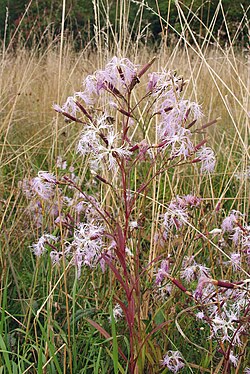
It is a herbaceous perennial plant growing to 80 cm tall. The leaves are green to greyish green, slender, up to 8 cm long. The flowers are sweetly scented, 3–5 cm in diameter, with five deeply cut fringed petals, pink to lavender with a greenish base; they are produced in branched clusters at the top of the stems from early to late summer.[3][5]
There are six subspecies:[1][2][3][4]
- Dianthus superbus subsp. superbus. Most of the species' range.
- Dianthus superbus subsp. autumnalis Oberd. Southwestern France.
- Dianthus superbus subsp. sylvestris Čelak. Germany.
- Dianthus superbus subsp. alpestris Kablík. ex Čelak. (syn. D. s. subsp. speciosus). Alps, Carpathians, at high altitudes. Shorter stems; leaves greyer; flowers large.
- Dianthus superbus subsp. stenocalyx (Trautv. ex Juz.) Kleopow. Southern Russia, Ukraine.
- Dianthus superbus subsp. longicalycinus (Maxim.) Kitam. Japan. Also called nadeshiko (ナデシコ).
It is the only food source of the large moth Coleophora musculella.
Cultivation and uses
[edit]_(30389744122).jpg)
Dianthus superbus is a popular garden plant and several cultivars and hybrids have been selected, with flower colour varying from white to red or purple, usually with a green centre. It thrives in ordinary to dry soil in full sun; partial shade is preferred in hot climates. It is self-sowing and can be propagated by seed, by division of the roots, layering of the stems or cuttings from growing shoots.[5] Deadheading extends the blooming period. The flowers sit atop stems approximately 25–45 cm tall, while the gray-green linear leaves form a mat at the base of the plant 20–30 cm wide. Because D. superbus is low to the ground, those who want to enjoy its fragrance find planting it in groups desirable.
The leaves are edible when young, and can be eaten when boiled. The flowers contain sweet nectar, and the foliage can be eaten or boiled to make a drink. The plant contains toxic saponins, but not enough to be harmful. It has historically been used in Chinese herbology as a contraceptive, diuretic, and anti-infective; its Chinese name is qúmài (瞿麦).[6]
Cultural significance
[edit]The yamato nadeshiko (D. superbus longicalycinus) is metaphorically associated with traditional, idealized feminine beauty, in Japanese culture.
References
[edit]
- ^ a b Den Virtuella Floran: Dianthus superbus (in Swedish, with maps)
- ^ a b Flora Europaea: Dianthus superbus
- ^ a b c Blamey, M. & Grey-Wilson, C. (1989). Flora of Britain and Northern Europe. ISBN 0-340-40170-2
- ^ a b Euro+Med Plantbase Project: Dianthus superbus Archived 2011-07-18 at the Wayback Machine
- ^ a b Huxley, A., ed. (1992). New RHS Dictionary of Gardening. Macmillan. ISBN 0-333-47494-5.
- ^ Plants for a Future: Dianthus superbus
Dianthus superbus
View on GrokipediaTaxonomy
Etymology
The genus name Dianthus derives from the Greek words dios, meaning "divine" or "of Zeus," and anthos, meaning "flower," a term coined by the ancient Greek botanist Theophrastus to honor the plant's revered beauty, with historical associations including dedications to the goddess Aphrodite in ancient Greece.[5][6][7] The species epithet superbus originates from Latin, where it signifies "superb," "proud," or "showy," a descriptor chosen to highlight the plant's elegant, fringed blooms.[1] This binomial nomenclature was established by the Swedish botanist Carl Linnaeus in the first edition of his seminal work Species Plantarum, published in 1753.[8]Classification and subspecies
Dianthus superbus belongs to the family Caryophyllaceae in the order Caryophyllales, specifically within the subfamily Caryophylloideae and tribe Caryophylleae of the genus Dianthus.[3] According to Plants of the World Online (POWO), the species comprises four accepted subspecies: subsp. superbus (nominotypical, widespread across temperate Eurasia), subsp. alpestris (montane regions from Europe to northern and central Japan), subsp. silvestris (western and central Europe), and subsp. stenocalyx. Subspecies differ in traits such as calyx length, flower diameter (ranging from 3–5 cm across variants), and petal fringe length, with East Asian forms exhibiting longer calyces compared to European ones. Historical names like subsp. autumnalis are now synonymized with subsp. silvestris, while subsp. longicalycinus is often treated as a distinct species, Dianthus longicalyx, based on phylogenetic evidence.[3][9][10] Historical taxonomic revisions have refined these classifications, with an integrative study of 147 Eurasian accessions supporting subsp. alpestris as a distinct ecotype due to stable morphometric differences in flower size and petal fringes, alongside variations in volatile scents and phenology, while questioning subsp. silvestris as likely phenotypic plasticity rather than a valid taxon. Dianthus longicalyx (formerly subsp. longicalycinus) shows greater differentiation based on phylogenetic and biochemical evidence. Synonymy includes historical names like D. superbus var. oreadum (now under D. longicalyx) and forms such as f. leucanthus, reflecting ongoing adjustments in delimitation since Linnaeus's original description in 1753.[10][11]Description
Morphology
Dianthus superbus is a herbaceous perennial with a loosely tufted habit, typically reaching heights of 20-80 cm. The stems are decumbent at the base, becoming erect and branched in the upper portions.[1] The leaves are arranged oppositely, linear to lanceolate in shape, and measure 2-8 cm in length, displaying a green to medium green coloration.[1] They are stalkless and united at the base, with entire margins and parallel venation.[7] Flowers are borne singly, in pairs, or in small inflorescences of several to 15 blooms in some populations, each measuring 3-5 cm in diameter. These feature five petals that are pink to lavender, deeply fringed along the edges, and emit a sweet scent.[1][7][12] The calyx is tubular, up to 2.5 cm long, and often violet-tinged.[7] The fruit is a cylindrical, four-valved capsule that contains numerous small seeds.[7]Growth and phenology
Dianthus superbus is a herbaceous perennial species characterized by a loosely tufted growth habit, forming clonal groups through creeping rhizomes and a strong primary root system. It overwinters as persistent roots and basal rosettes, allowing it to persist for several years, though it is often short-lived, typically lasting up to four years before central die-out occurs. The plant exhibits moderate growth rates, developing numerous vegetative shoots that form loose tufts, with stems reaching heights of 20–80 cm during the active season.[13][12][1] The phenological cycle of D. superbus is tied to seasonal cues, with vegetative growth initiating in spring from overwintering rosettes. Flowering occurs primarily from early to late summer, spanning June to September depending on latitude and local climate, with northern populations like those in Latvia blooming later in the season. Generative shoots produce solitary or clustered inflorescences, and flowering initiation requires adequate light exposure, as reduced light levels from habitat overgrowth inhibit shoot elongation and bud development. The species responds flexibly to soil nutrients, adapting to a wide range of conditions, for example organic matter contents of 2.85–8.55% and calcium-to-magnesium ratios of 5–8:1 in habitats such as those in Latvia, which support robust flowering without strict requirements.[12][4][13] Seed production follows pollination, with fruits developing as four-valved capsules containing numerous seeds that exhibit high viability (70.7–98%) and rapid germination (up to 84% within two days under suitable conditions). Dispersal occurs primarily via gravity, with seeds falling near parent plants and self-sowing in disturbed gaps, contributing to local population recruitment; viability declines after five years. This gravity-mediated dispersal limits long-distance spread, emphasizing the importance of suitable microhabitats for establishment.[12][13]Distribution and habitat
Geographic range
Dianthus superbus is native to temperate regions of Europe and northern Asia, spanning a broad longitudinal and latitudinal extent. In Europe, its distribution covers areas including France, extending northward to arctic Norway, Finland, and Sweden, and eastward through Central and Eastern Europe to Russia, including regions such as the Baltic States, Poland, Belarus, Ukraine, and the Caucasus. Southern European occurrences include Albania, Bulgaria, Greece, Italy, Romania, and the Northwest Balkan Peninsula (including Bosnia and Herzegovina, Croatia, Montenegro, North Macedonia, Serbia, and Slovenia), while in northern and central parts, it is found in Austria, Czechia and Slovakia, Denmark, Germany, Hungary, and Switzerland. The species is extinct in the Netherlands and rare in Britain.[3][2] In Asia, the species ranges across Siberia and the Russian Far East, including regions like Altay, Amur, Buryatiya, Chita, Khabarovsk, and the Kuril Islands, as well as Kazakhstan, Kyrgyzstan, Mongolia, Tajikistan, Turkmenistan, and Uzbekistan in Central Asia. It extends further east to China (North-Central, South-Central, Southeast, Inner Mongolia, Manchuria, Qinghai, and Xinjiang), Korea, Japan, and Vietnam in Southeast Asia. This wide native distribution reflects its adaptability to varied temperate conditions across Eurasia.[3] The altitudinal range of Dianthus superbus varies from near sea level in northern populations to elevations up to 2,400 m in southern areas, such as montane grasslands in Asia.[14] It has been introduced to North America, where it occurs in some regions of the contiguous United States.[15]Habitat preferences
Dianthus superbus thrives in well-drained soils, ranging from sandy and loamy to calcareous substrates, which support its preference for neutral to slightly alkaline pH levels typically between 6.5 and 8.0.[12] These conditions prevent waterlogging while allowing sufficient nutrient availability, as the species favors mineral-rich grounds with moderate organic matter content.[16] In its native range across Europe and temperate Asia, it avoids heavy clay unless drainage is adequate, emphasizing substrates that mimic open, aerated environments.[2] Regarding moisture, the plant prefers dry to moderately moist regimes, adapting to both arid sandy habitats and mesic meadows but consistently requiring good drainage to avoid root rot.[17] It exhibits tolerance for fluctuating conditions, from xerophilous grasslands to hygrophilous edges near water tables, yet optimal growth occurs in sites where soil humidity remains balanced without extremes.[18] For light, Dianthus superbus demands full sun to partial shade, with a strong affinity for open, brightly lit areas that minimize competition from taller vegetation; indicator values suggest a high light requirement (around 7.5 on a 1-9 scale).[17] It commonly inhabits plant communities such as dry calcareous grasslands, woodland edges, and rocky slopes within scrub or sparsely vegetated zones, associating with species like Thymus serpyllum and Agrostis species in these ecosystems.[2][12]Ecology
Reproduction and pollination
Dianthus superbus is a gynodioecious species, featuring both hermaphroditic and female (male-sterile) individuals in natural populations, which influences its reproductive strategies.[19] Primarily, reproduction occurs sexually through seed production, with flowers developing into four-valved capsules that release self-sowing seeds.[20] Hermaphroditic plants are self-compatible, allowing self-pollination primarily via geitonogamy due to strong protandry, where anthers mature before stigmas within flowers; however, female plants rely entirely on cross-pollination from hermaphrodites for seed set.[21] Experimental bagging of hermaphroditic flowers resulted in 70-72% fruit set from autonomous self-pollination, while artificial self- and cross-pollination yielded over 90% fruit set in both morphs, indicating no significant barriers to compatibility.[21] Female plants often produce equal or higher seed numbers per fruit compared to hermaphrodites, supporting their maintenance in populations.[19] Pollination is entomophilous, mediated by insects attracted to the flowers' strong, sweet scent—which peaks in the evening—and sucrose-dominant nectar with moderate sugar and amino acid concentrations.[22] In subalpine habitats, nocturnal hawkmoths (such as Herse convolvuli) and native noctuid moths serve as primary pollinators, with floral traits like deeply divided, brightly colored petals and elongated calyces adapted for these crepuscular and nocturnal visitors rather than butterflies or diurnal hawkmoths.[22] Observations in other populations confirm large-bodied butterflies and hawkmoths as frequent visitors to both flower morphs, with no differences in visitation rates; nectar availability ensures consistent pollination success across sexual forms.[19] Seed production per capsule varies by habitat but typically ranges from 40 to 62 seeds, highlighting the efficacy of insect-mediated pollen transfer.[23] Asexual reproduction is limited but present through clonal growth, with the perennial forming loosely tufted rosettes via vegetative stem proliferation and fragmentation, producing numerous non-flowering shoots that enable local spread and resource capture.[20] This vegetative propagation supplements sexual recruitment, particularly in disturbed meadow gaps where ramet clusters can expand to 4.7-11.3 above-ground units, though it is less dominant than seed-based dispersal in maintaining population persistence.[20]Ecological interactions
Dianthus superbus interacts with a range of organisms in its grassland habitats, serving as a host for both herbivores and parasites. The plant is susceptible to fungal infection by Microbotryum superbum, an anther smut fungus that invades the flowers, producing teliospores within the anthers and potentially reducing host fitness. This parasitic relationship is documented in European populations. Additionally, D. superbus experiences herbivory from generalist insects, including damage to flowerheads that can limit reproductive output, as evidenced by field studies in semi-natural meadows showing higher herbivory rates on rarer plants like this species.[24][25][26] Beyond antagonistic interactions, D. superbus contributes to mutualistic relationships by providing nectar as a resource for various insects in grassland ecosystems. The flowers secrete sucrose-dominant nectar, supporting a diversity of visitors beyond primary pollinators and enhancing overall insect activity in mesotrophic hay meadows where the plant is emblematic. In these environments, often on well-drained slopes, D. superbus engages in competitive interactions with co-occurring species, influenced by factors such as mowing regimes and succession stages. Its establishment and persistence can be limited by interspecific competition for light and nutrients in overgrown meadows, though it thrives in moderately disturbed sites that mimic traditional hay management. These dynamics underscore its integral role in maintaining biodiversity within European semi-natural grasslands.[27][18][28][18][23]Conservation
Status and threats
Dianthus superbus is not formally assessed on the global IUCN Red List of Threatened Species, but it is regarded as Least Concern at the European level and in certain national contexts, such as Switzerland, where it faces no immediate extinction risk across its broader range.[29][30] However, the species holds regionally endangered statuses in multiple countries, including critically endangered in Latvia, the Czech Republic, and Romania, Near Threatened in France, vulnerable in Sweden and Poland, and possibly extinct in the Netherlands.[12][31] In Asia, the species is more widespread and generally not assessed as threatened at national levels, such as in Japan.[3] Primary threats to Dianthus superbus include habitat loss and degradation driven by agricultural intensification, urbanization, and changes in land use, which fragment its preferred meadow and grassland habitats.[30] While invasive species are not prominently documented as a major threat, habitat fragmentation indirectly intensifies competition and reduces population viability across Europe and Asia.[18] Population trends for Dianthus superbus indicate declines in fragmented habitats, particularly in regions with intensified human activity, leading to reduced genetic diversity and smaller, isolated subpopulations that heighten extinction risks locally.[18] In Latvia, for instance, only a few small populations persist, underscoring the urgency of monitoring in vulnerable areas.[12]Conservation efforts
Conservation efforts for Dianthus superbus primarily focus on protecting remaining wild populations through a combination of in situ and ex situ strategies, particularly in regions where the species faces local extinction risks. In Europe, the plant is included in several protected areas to safeguard its habitats from agricultural intensification and habitat loss. For instance, in France, D. superbus occurs within the Réserves Naturelles de Strasbourg, where wet meadows are managed to prevent enrichment and support the species' persistence.[32] In Latvia, ongoing monitoring and habitat management efforts target the few surviving sites, emphasizing the maintenance of mesotrophic grasslands essential for the plant.[33] While specific nature reserves in Asia are less documented due to the species' wider distribution in northern regions, conservation aligns with broader grassland protection initiatives in countries like Japan and China, where D. superbus contributes to native floral diversity.[14] Ex situ conservation plays a crucial role in preserving genetic material and enabling potential reintroductions. Seed banking and propagation programs are integrated into botanical garden initiatives, such as those at the National Botanic Garden in Salaspils, Latvia, where collections of D. superbus are maintained through in vitro cultures and field plantings to ensure viable propagules for future restoration.[30] Similarly, in Estonia, botanic gardens have incorporated the species into recovery programs, focusing on ex situ cultivation to bolster populations on the brink of extinction.[34] Advanced micropropagation techniques, including tissue culture protocols, have been developed to produce disease-free plants for conservation, with success rates supporting the scaling of efforts for endangered Dianthus taxa.[35] Research and monitoring initiatives provide foundational data for targeted interventions, including genetic assessments and reintroduction trials. Genetic studies in European populations reveal moderate diversity levels that inform breeding strategies to enhance resilience against threats like fragmentation.[18] In Latvia, comprehensive inventories and growth condition evaluations have guided reintroduction projects, testing site suitability and propagation methods to restore populations in semi-natural grasslands.[36] These efforts, often combining in situ protection with ex situ resources, aim to stabilize declining numbers and promote long-term viability across the species' range.[30]Cultivation
Requirements and propagation
Dianthus superbus performs best in well-drained soils with a neutral to slightly alkaline pH, ranging from mildly acidic to basic conditions, and tolerates very alkaline substrates. It requires full sun for optimal growth, though it can endure light shade in woodland-like settings or hot climates with some afternoon protection. This perennial is hardy in USDA zones 3 to 8, making it suitable for a wide range of temperate gardens.[37][38][1] Propagation of Dianthus superbus can be achieved through several methods. Seeds are sown in spring, either indoors 4-6 weeks before the last frost or directly outdoors after frost danger passes, lightly covered with soil and germinating in 1-3 weeks at around 20°C (68°F) without needing cold stratification. Division of established clumps is done in early spring or after flowering, separating the root mass to create new plants every 2-3 years to maintain vigor. Softwood stem cuttings, taken from non-flowering shoots in summer, root readily in well-drained medium within 3-4 weeks when provided with bottom heat and high humidity.[39][40][41][42] Ongoing maintenance involves moderate watering, providing about 1 inch per week for newly planted specimens to establish roots, while mature plants are drought-tolerant and require less frequent irrigation once settled. Deadheading spent flowers promptly encourages continuous blooming throughout the season and prevents self-seeding. These cultivation practices align closely with the plant's native habitat preferences for open, well-drained grasslands in temperate Asia and Europe.[38][43][44]Cultivars and varieties
Dianthus superbus has been utilized in breeding programs to create cultivars and hybrids prized for their sweetly scented, fringed flowers in a spectrum of colors from white to deep crimson, often with enhanced reblooming capacity and more compact growth suitable for ornamental gardens.[38] These selections typically emphasize deeply serrated petals and spicy fragrance, distinguishing them from the wild species, and have been crossed with other Dianthus species such as D. arenarius, D. callizonus, D. plumarius, and D. chinensis to produce vigorous hybrids.[38] Notable cultivars include:- 'Ambrosia': Features feathery petals in lilac, pale pink, or white with a sweet-spicy scent; grows 10-18 inches tall, ideal for borders.[38]
- 'Crimsonia': A compact form reaching 20 inches tall with showy, fragrant crimson-red flowers; suitable for rock gardens and containers.[45]
- 'Kahori': Produces star-shaped rosy-pink blooms on 8-12 inch stems amid dense silvery foliage; known for heavy flowering in late spring.[38]
- 'Kahori Pink' (D. x ‘Holkahoripink’): Bright pink flowers with a white eye on 6-8 inch plants; compact and border-friendly.[38]
- 'Kahori Scarlet' (D. x ‘Holkahoriscarlet’): Carmine-red blooms with a white eye on 6-8 inch drought-tolerant plants.[38]
- 'Rainbow Loveliness': Displays spidery multi-colored flowers in carmine, mauve, pink, purple, and white; 12-15 inches tall.[38]
- 'Spooky': Offers mauve, pink, scarlet, and white flowers with rose eyes; reaches 16-20 inches in height, hardy in zones 3-8.[38]