


Community hub
Recent from talks
Contribute something
Nothing was collected or created yet.
Opossum
View on Wikipedia
| Didelphidae[2] Temporal range: [1]
| |
|---|---|

| |
| Virginia opossum, Didelphis virginiana, the only U.S. and Canadian species (mother with nine young) | |
Scientific classification 
| |
| Kingdom: | Animalia |
| Phylum: | Chordata |
| Class: | Mammalia |
| Infraclass: | Marsupialia |
| Superorder: | Ameridelphia |
| Order: | Didelphimorphia Gill, 1872 |
| Family: | Didelphidae J. E. Gray, 1821 |
| Type genus | |
| Didelphis Linnaeus, 1758
| |
| Genera | |
| Diversity | |
| 126 species | |
Opossums (/əˈpɒsəmz/) are members of the marsupial order Didelphimorphia (/daɪˌdɛlfɪˈmɔːrfiə/) endemic to the Americas. The largest order of marsupials in the Western Hemisphere, it comprises 126 species in 18 genera. Opossums originated in South America and entered North America in the Great American Interchange following the connection of North and South America in the late Cenozoic.
The Virginia opossum is the only species found in the United States and Canada. It is often simply referred to as an opossum; in North America, it is commonly referred to as a possum[3] (/ˈpɒsəm/; sometimes rendered as 'possum in written form to indicate the dropped "o"). The Australasian arboreal marsupials of suborder Phalangeriformes are also called possums because of their resemblance to opossums, but they belong to a different order. The opossum is typically a nonaggressive animal and almost never carries the virus that causes rabies.[4]
Etymology
[edit]The word opossum is derived from the Powhatan language and was first recorded between 1607 and 1611 by John Smith (as opassom) and William Strachey (as aposoum).[5] Possum was first recorded in 1613. Both men encountered the language at the English settlement of Jamestown, Virginia, which Smith helped to found and where Strachey later served as its first secretary.[6] Strachey's notes describe the opossum as a "beast in bigness of a pig and in taste alike," while Smith recorded it "hath an head like a swine ... tail like a rat ... of the bigness of a cat."[6] The Powhatan word ultimately derives from a Proto-Algonquian word (*wa·p-aʔθemwa) meaning "white dog or dog-like beast."[6]
Following the arrival of Europeans in Australia, the term possum was borrowed to describe distantly related Australian marsupials of the suborder Phalangeriformes,[7] which are more closely related to other Australian marsupials such as kangaroos.
Didelphimorphia comes from Ancient Greek δι- (di-), meaning "two", δελφύς (delphús), meaning "womb", and μορφή (morphḗ), meaning "form".[8]
Evolution
[edit]Opossums are often considered to be "living fossils",[9] and as a result they are often used to approximate the ancestral therian condition in comparative studies.[9][10] But the oldest opossum fossils are from a more recent epoch, the early Miocene (roughly 20 million years ago).[11] The last common ancestor of all living opossums dates approximately to the Oligocene-Miocene boundary (23 million years ago) and is at most no older than Oligocene in age.[12][13] Many extinct metatherians, such as Alphadon, Peradectes, Herpetotherium, and Pucadelphys, were once considered to be early opossums, but it has since been recognized that this was solely on the basis of plesiomorphies; they are now considered to belong to older branches of Metatheria that are only distantly related to modern opossums.
Opossums probably originated in the Amazonia region of northern South America, where they began their initial diversification.[14] They were minor components of South American mammal faunas until the late Miocene, when they began to diversify rapidly.[12] Before that time, the ecological niches presently occupied by opossums were occupied by other groups of metatherians such as paucituberculatans[15] and sparassodonts.[13][16][17] Large opossums like Didelphis show a pattern of gradually increasing in size over geologic time as sparassodont diversity declined.[16][17] Several groups of opossums, including Thylophorops, Thylatheridium, Hyperdidelphys, and sparassocynids developed carnivorous adaptations during the late Miocene-Pliocene, before the arrival of carnivorans in South America. Most of these groups, with the exception of Lutreolina, are now extinct.[18] It has been suggested that the size and shape of the ancestral didelphid's jaw would most closely match that of the modern Marmosa genus.[19]
Characteristics
[edit]
Didelphimorphs are small to medium-sized marsupials that grow to the size of a house cat. They tend to be semi-arboreal omnivores, although there are many exceptions. Most members of this order have long snouts, a narrow braincase, and a prominent sagittal crest. The dental formula is: 5.1.3.44.1.3.4 × 2 = 50 teeth. By mammalian standards, this is an unusually full jaw. The incisors are very small, the canines large, and the molars are tricuspid.
Didelphimorphs have a plantigrade stance (feet flat on the ground) and the hind feet have an opposable digit with no claw. Like some New World monkeys, some opossums have prehensile tails. Like most marsupials, many females have a pouch. The tail and parts of the feet bear scutes. The stomach is simple, with a small cecum.[9] Like most marsupials, the male opossum has a forked penis bearing twin glandes.[20][21][9]
Although all living opossums are essentially opportunistic omnivores, different species vary in the amount of meat and vegetation they include in their diet. Members of the Caluromyinae are essentially frugivorous; whereas the lutrine opossum and Patagonian opossum primarily feed on other animals.[22] The water opossum or yapok (Chironectes minimus) is particularly unusual, as it is the only living semi-aquatic marsupial, using its webbed hindlimbs to dive in search of freshwater mollusks and crayfish.[23] The extinct Thylophorops, the largest known opossum at 4–7 kg (8.8–15.4 lb), was a macropredator.[24][25][26] Most opossums are scansorial, well-adapted to life in the trees or on the ground, but members of the Caluromyinae and Glironiinae are primarily arboreal, whereas species of Metachirus, Monodelphis, and to a lesser degree Didelphis show adaptations for life on the ground.[27] Metachirus nudicaudatus, found in the upper Amazon basin, consumes fruit seeds, small vertebrate creatures like birds and reptiles and invertebrates like crayfish and snails, but seems to be mainly insectivorous.[28]
.jpg)
Reproduction and life cycle
[edit]As marsupials, female opossums have a reproductive system that includes a bifurcated vagina and a divided uterus; many have a pouch.[29] The average estrous cycle of the Virginia opossum is about 28 days.[30] Opossums do possess a placenta,[31] but it is short-lived, simple in structure, and, unlike that of placental mammals, not fully functional.[32] The young are therefore born at a very early stage, although the gestation period is similar to that of many other small marsupials, at only 12 to 14 days.[33] They give birth to litters of up to 20 young.[34] Once born, the offspring must find their way into the marsupium, if present, to hold on to and nurse from a teat. Baby opossums, like their Australian cousins, are called joeys.[35] Female opossums often give birth to very large numbers of young, most of which fail to attach to a teat, although as many as 13 young can attach,[36] and therefore survive, depending on species. The young are weaned between 70 and 125 days, when they detach from the teat and leave the pouch. The opossum lifespan is unusually short for a mammal of its size, usually only one to two years in the wild and as long as four or more years in captivity. Senescence is rapid.[37] Opossums are moderately sexually dimorphic with males usually being larger, heavier, and having larger canines than females.[36] The largest difference between the opossum and non-marsupial mammals is the bifurcated penis of the male and bifurcated vagina of the female (the source of the term didelphimorph, from the Greek didelphys, meaning "double-wombed").[38] Opossum spermatozoa exhibit sperm-pairing, forming conjugate pairs in the epididymis. This may ensure that flagella movement can be accurately coordinated for maximal motility. Conjugate pairs dissociate into separate spermatozoa before fertilization.[39]
Behavior
[edit]
Opossums are usually solitary and nomadic, staying in one area as long as food and water are easily available. Some families will group together in ready-made burrows or even under houses. Though they will temporarily occupy abandoned burrows, they do not dig or put much effort into building their own. As nocturnal animals, they favor dark, secure areas. These areas may be below ground or above.[40][41]

When threatened or harmed, they will "play possum", mimicking the appearance and smell of a sick or dead animal. This physiological response is involuntary (like fainting), rather than a conscious act. In the case of baby opossums, however, the brain does not always react this way at the appropriate moment, and therefore they often fail to "play dead" when threatened. When an opossum is "playing possum", the animal's lips are drawn back, the teeth are bared, saliva foams around the mouth, the eyes close or half-close, and a foul-smelling fluid is secreted from the anal glands. The stiff, curled form can be prodded, turned over, and even carried away without reaction. The animal will typically regain consciousness after a period of a few minutes to four hours, a process that begins with a slight twitching of the ears.[42]
Some species of opossums have prehensile tails, although dangling by the tail is more common among juveniles. An opossum may also use its tail as a brace and a fifth limb when climbing. The tail is occasionally used as a grip to carry bunches of leaves or bedding materials to the nest.[43] A mother will sometimes carry her young upon her back, where they will cling tightly even when she is climbing or running.
Threatened opossums (especially males) will growl deeply, raising their pitch as the threat becomes more urgent. Males make a clicking "smack" noise out of the side of their mouths as they wander in search of a mate, and females will sometimes repeat the sound in return. When separated or distressed, baby opossums will make a sneezing noise to signal their mother. The mother in return makes a clicking sound and waits for the baby to find her. If threatened, the baby will open its mouth and quietly hiss until the threat is gone.[44]
Diet
[edit]Opossums eat insects, rodents, birds, eggs, frogs, plants, fruits and grain. Some species may eat the skeletal remains of rodents and roadkill animals to fulfill their calcium requirements.[45] In captivity, opossums will eat practically anything including dog and cat food, livestock fodder and discarded human food scraps and waste.
Many large opossums (Didelphini) are immune to the venom of rattlesnakes and pit vipers (Crotalinae) and regularly prey upon these snakes.[46] This adaptation seems to be unique to the Didelphini, as their closest relative, the brown four-eyed opossum, is not immune to snake venom.[47] Similar adaptations are seen in other small predatory mammals such as mongooses and hedgehogs. Didelphin opossums and crotaline vipers have been suggested to be in an evolutionary arms race. Some authors have suggested that this adaptation originally arose as a defense mechanism, allowing a rare reversal of an evolutionary arms race where the former prey has become the predator,[48] whereas others have suggested it arose as a predatory adaptation given that it also occurs in other predatory mammals and does not occur in opossums that do not regularly eat other vertebrates.[15] The fer-de-lance, one of the most venomous snakes in the New World, may have developed its highly potent venom as a means to prey on or a defense mechanism against large opossums.[48]
Range and habitat
[edit]
Opossums are found in North, Central, and South America. The Virginia opossum lives in regions as far north as Canada and as far south as Central America, while other types of opossums only inhabit countries south of the United States.[50] The Virginia opossum can often be found in wooded areas, though its habitat may vary widely.[51] Opossums are generally found in areas like forests, shrubland, mangrove swamps, rainforests and eucalyptus forests.[52] Opossums have been found moving northward.[49][53]
Hunting and foodways
[edit]Until the early 20th century, the Virginia opossum was widely hunted and consumed in the United States.[54][55][56][57] Opossum farms have been operated in the United States in the past.[58][59][60] Sweet potatoes were eaten together with the opossum in the American South.[61][62] In 1909, a "Possum and 'Taters" banquet was held in Atlanta to honor President-elect William Howard Taft.[63][64] South Carolina cuisine includes opossum,[65] and President Jimmy Carter hunted opossums[66][67] in addition to other small game.[68][69]
In Dominica, Grenada, Trinidad, Saint Lucia and Saint Vincent and the Grenadines, the common opossum or manicou is popular and can only be hunted during certain times of the year owing to overhunting.[70] The meat is traditionally prepared by smoking, then stewing. It is light and fine-grained, but the musk glands must be removed as part of preparation. The meat can be used in place of rabbit and chicken in recipes. Historically, hunters in the Caribbean would place a barrel with fresh or rotten fruit to attract opossums that would feed on the fruit or insects.
In northern/central Mexico, opossums are known as tlacuache or tlacuatzin. Their tails are eaten as a folk remedy to improve fertility.[71] In the Yucatán peninsula they are known in the Yucatec Mayan language as "och"[72] and they are not considered part of the regular diet by Mayan people, but still considered edible in times of famine.
Opossum oil (possum grease) is high in essential fatty acids and has been used as a chest rub and a carrier for arthritis remedies given as salves.[73][74][75]
Opossum pelts have long been part of the fur trade.
Classification
[edit]| Phylogeny of a 5,911 species 31 gene supertree[76][77] | |||||||||||||||||||||||||||||||||||||||||||||
|
Classification based on Voss (2022), species based on the American Society of Mammalogists (2023)[78][79][80]
- Family Didelphidae
- Subfamily Glironiinae
- Genus Glironia
- Bushy-tailed opossum (Glironia venusta)
- Genus Glironia
- Subfamily Caluromyinae
- Genus Caluromys

Bare-tailed woolly opossum, Caluromys philander 
Derby's woolly opossum, Caluromys derbianus - Subgenus Caluromys
- Bare-tailed woolly opossum (Caluromys philander)
- Subgenus Mallodelphys
- Derby's woolly opossum (Caluromys derbianus)
- Brown-eared woolly opossum (Caluromys lanatus)
- Subgenus Caluromys
- Genus Caluromysiops
- Black-shouldered opossum (Caluromysiops irrupta)
- Genus Caluromys
- Subfamily Hyladelphinae
- Genus Hyladelphys
- Kalinowski's mouse opossum (Hyladelphys kalinowskii)
- Genus †Sairadelphys Oliveira et al. 2011
- †Sairadelphys tocantinensis Oliveira et al. 2011
- Genus Hyladelphys
- Subfamily Didelphinae
- Tribe Metachirini

Brown four-eyed opossum, Metachirus nudicaudatus - Genus Metachirus
- Aritana's brown four-eyed opossum (Metachirus aritanai)
- Common brown four-eyed opossum (Metachirus myosuros)
- Guianan brown four-eyed opossum (Metachirus nudicaudatus)
- Genus Metachirus
- Tribe Didelphini

Water opossum, Chironectes minimus - Genus Chironectes
- Water opossum or yapok (Chironectes minimus)
- Genus Lutreolina
- †Lutreolina biforata (Ameghino 1904) Goin & Pardiñas 1996[18]
- Big lutrine opossum or little water opossum (Lutreolina crassicaudata)

Big lutrine opossum, Lutreolina crassicaudata - †Lutreolina materdei Goin & De los Reyes 2011[81]
- Massoia's lutrine opossum (Lutreolina massoia)[82]
- †Lutreolina tracheia Rovereto 1914
- †Genus Hyperdidelphys Ameghino 1904
- †Hyperdidelphys dimartinoi Goin & Pardiñas 1996[18]
- †Hyperdidelphys inexpectata (Ameghino 1889) Marshall 1982[18]
- †Hyperdidelphys parvula Ameghino 1904[18]
- †Hyperdidelphys pattersoni (Reig 1952) Marshall 1982[18]
- Genus Didelphis

White-eared opossum, Didelphis albiventris 
Big-eared opossum, Didelphis aurita 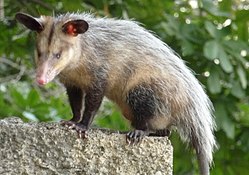
Common opossum, Didelphis marsupialis 
Andean white-eared opossum, Didelphis pernigra - White-eared opossum (Didelphis albiventris)
- Big-eared opossum (Didelphis aurita)
- Guianan white-eared opossum (Didelphis imperfecta)
- Common opossum (Didelphis marsupialis)
- Andean white-eared opossum (Didelphis pernigra)
- †Didelphis solimoensis[83]
- Virginia opossum (Didelphis virginiana)
- Genus Philander
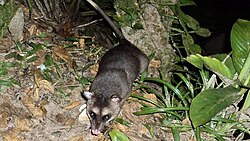
Gray four-eyed opossum, Philander opossum - Anderson's four-eyed opossum (Philander andersoni)
- Common four-eyed opossum (Philander canus)
- Deltaic four-eyed opossum (Philander deltae)
- Southeastern four-eyed opossum (Philander frenatus)
- McIlhenny's four-eyed opossum (Philander mcilhennyi)
- Dark four-eyed opossum (Philander melanurus)
- Mondolfi's four-eyed opossum (Philander mondolfii)
- Black four-eyed opossum (Philander nigratus)
- Olrog's four-eyed opossum (Philander olrogi)
- Gray four-eyed opossum (Philander opossum)
- Pebas four-eyed opossum (Philander pebas)
- Southern four-eyed opossum (Philander quica)
- Northern four-eyed opossum (Philander vossi)
- †Genus Thylophorops Reig 1952
- †Thylophorops chapadmalensis Reig 1952[18]
- †Thylophorops lorenzinii Goin et al. 2009[24]
- †Thylophorops perplana (Ameghino 1904) Goin & Pardiñas 1996[18]
- Genus Chironectes
- Tribe Marmosini
- Genus †Hesperocynus Forasiepi et al. 2009
- †Hesperocynus dolgopolae (Reig 1952) Forasiepi et al. 2009
- Genus Marmosa
- †Marmosa contrerasi Mones 1980
- Subgenus Eomarmosa
- Red mouse opossum (Marmosa rubra)
- Subgenus Exulomarmosa
- Isthmian mouse opossum (Marmosa isthmica)
- Mexican mouse opossum (Marmosa mexicana)
- Robinson's mouse opossum (Marmosa robinsoni)
- Simon's mouse opossum (Marmosa simonsi)
- Guajira mouse opossum (Marmosa xerophila)
- Zeledon's mouse opossum (Marmosa zeledoni)
- Subgenus Marmosa
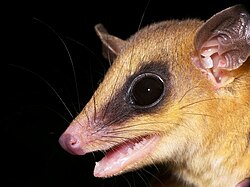
Robinson's mouse opossum, Marmosa robinsoni - Quechuan mouse opossum (Marmosa macrotarsus)
- Linnaeus's mouse opossum (Marmosa murina)
- Tyler's mouse opossum (Marmosa tyleriana)
- Waterhouse's mouse opossum (Marmosa waterhousei)
- Subgenus Micoureus

Tate's woolly mouse opossum, Marmosa paraguayanus - Adler's mouse opossum (Marmosa adleri)
- Alston's woolly mouse opossum (Marmosa alstoni)
- White-bellied woolly mouse opossum (Marmosa constantiae)
- Northeastern woolly mouse opossum (Marmosa demerarae)
- Northwestern woolly mouse opossum (Marmosa germana)
- Jansa's woolly mouse opossum (Marmosa jansae)
- †Marmosa laventica Marshall 1976[84]
- Brazilian woolly mouse opossum (Marmosa limae)
- Merida woolly mouse opossum (Marmosa meridae)
- Nicaraguan woolly mouse opossum (Marmosa nicaraguae)
- Tate's woolly mouse opossum (Marmosa paraguayana)
- Peruvian woolly mouse opossum (Marmosa parda)
- Anthony's woolly mouse opossum (Marmosa perplexa)
- Little woolly mouse opossum (Marmosa phaea)
- Bolivian woolly mouse opossum (Marmosa rapposa)
- Bare-tailed woolly mouse opossum (Marmosa rutteri)
- Subgenus Stegomarmosa
- Heavy-browed mouse opossum (Marmosa andersoni)
- Rufous mouse opossum (Marmosa lepida)
- Genus Monodelphis

Yellow-sided opossum, Monodelphis dimidiata 
Gray short-tailed opossum, Monodelphis domestica - Subgenus Microdelphys
- Northern three-striped opossum (Monodelphis americana)
- Gardner's short-tailed opossum (Monodelphis gardneri)
- Ihering's three-striped opossum (Monodelphis iheringi)
- Chestnut-striped opossum (Monodelphis rubida)
- Long-nosed short-tailed opossum (Monodelphis scalops)
- Southern three-striped opossum (Monodelphis theresa)
- Red three-striped opossum (Monodelphis umbristriata)
- Subgenus Monodelphiops
- Yellow-sided opossum (Monodelphis dimidiata)
- Southern red-sided opossum (Monodelphis sorex)
- One-striped opossum (Monodelphis unistriata)
- Subgenus Monodelphis
- Arlindo's short-tailed opossum (Monodelphis arlindoi)[85]
- Northern red-sided opossum (Monodelphis brevicaudata)
- Gray short-tailed opossum (Monodelphis domestica)
- Amazonian red-sided opossum (Monodelphis glirina)
- Marajó short-tailed opossum (Monodelphis maraxina)
- Hooded red-sided opossum (Monodelphis palliolata)
- Santa Rosa short-tailed opossum (Monodelphis sanctaerosae)[86]
- Touan short-tailed opossum (Monodelphis touan)[85]
- Voss's short-tailed opossum (Monodelphis vossi)
- Subgenus Mygalodelphys
- Sepia short-tailed opossum (Monodelphis adusta)[85]
- Handley's short-tailed opossum (Monodelphis handleyi)[87]
- Pygmy short-tailed opossum (Monodelphis kunsi)
- Osgood's short-tailed opossum (Monodelphis osgoodi)
- Peruvian short-tailed opossum (Monodelphis peruviana)
- Long-nosed short-tailed opossum (Monodelphis pinocchio)
- Reig's opossum (Monodelphis reigi)
- Ronald's opossum (Monodelphis ronaldi)
- Saci short-tailed opossum (Monodelphis saci)[86]
- Subgenus Pyrodelphys
- Emilia's short-tailed opossum (Monodelphis emiliae)
- Subgenus Microdelphys
- Genus †Sparassocynus Mercerat 1898[13]
- †Sparassocynus bahiai Mercerat 1898
- †Sparassocynus derivatus Reig & Simpson 1972
- †Sparassocynus maimarai Abello et al. 2015
- †Sparassocynus heterotopicus Villarroel & Marshall 1983
- Genus †Thylatheridium Reig 1952
- †Thylatheridium cristatum Reig 1952
- †Thylatheridium hudsoni Goin & Montalvo 1988
- †Thylatheridium pascuali Reig 1958
- Genus Tlacuatzin[88]
- Balsas gray mouse opossum (Tlacuatzin balsasensis)
- Tehuantepec gray mouse opossum (Tlacuatzin canescens)
- Yucatan gray mouse opossum (Tlacuatzin gaumeri)
- Tres Marías gray mouse opossum (Tlacuatzin insularis)
- Northern gray mouse opossum (Tlacuatzin sinaloae)
- †Genus Zygolestes Ameghino 1898
- †Zygolestes paramensis Ameghino 1898
- †Zygolestes tatei Goin, Montalvo & Visconti 2000
- Genus †Hesperocynus Forasiepi et al. 2009
- Tribe Thylamyini
- Genus Chacodelphys
- Chacoan pygmy opossum (Chacodelphys formosa)
- Genus Cryptonanus
- Agricola's gracile opossum (Cryptonanus agricolai)
- Chacoan gracile opossum (Cryptonanus chacoensis)
- Guahiba gracile opossum (Cryptonanus guahybae)
- †Red-bellied gracile opossum (Cryptonanus ignitus)
- Unduavi gracile opossum (Cryptonanus unduaviensis)
- Genus Gracilinanus
- Aceramarca gracile opossum (Gracilinanus aceramarcae)
- Agile gracile opossum (Gracilinanus agilis)
- Wood sprite gracile opossum (Gracilinanus dryas)
- Emilia's gracile opossum (Gracilinanus emilae)
- Northern gracile opossum (Gracilinanus marica)
- Brazilian gracile opossum (Gracilinanus microtarsus)
- Peruvian opossum (Gracilinanus peruanus)
- Genus Lestodelphys
- Patagonian opossum (Lestodelphys halli)
- †Lestodelphys juga (Ameghino 1889)
- Genus Marmosops

Gray slender opossum, Marmosops incanus - Subgenus Marmosops
- Tschudi's slender opossum (Marmosops caucae)
- Creighton's slender opossum (Marmosops creightoni)
- Dorothy's slender opossum (Marmosops dorothea)
- Andean slender mouse opossum (Marmosops impavidus)
- Gray slender opossum (Marmosops incanus)
- Neblina slender opossum (Marmosops neblina)
- White-bellied slender opossum (Marmosops noctivagus)
- Spectacled slender opossum (Marmosops ocellatus)
- Brazilian slender opossum (Marmosops paulensis)
- Soini's slender opossum (Marmosops soinii)
- Subgenus Sciophanes
- Bishop's slender opossum (Marmosops bishopi)
- Carr's slender opossum (Marmosops carri)
- Cordillera slender opossum (Marmosops chucha)
- Narrow-headed slender opossum (Marmosops cracens)
- Dusky slender opossum (Marmosops fuscatus)
- Handley's slender opossum (Marmosops handleyi)
- Panama slender opossum (Marmosops invictus)
- Junin slender opossum (Marmosops juninensis)
- Río Magdalena slender opossum (Marmosops magdalenae)
- Silva's slender opossum (Marmosops marina)
- Ojasti's slender opossum (Marmosops ojastii)
- Pantepui slender opossum (Marmosops pakaraimae)
- Delicate slender opossum (Marmosops parvidens)
- Pinheiro's slender opossum (Marmosops pinheiroi)
- Woodall's slender opossum (Marmosops woodalli)
- Subgenus Marmosops
- Genus Thylamys

Elegant fat-tailed mouse opossum, Thylamys elegans - Subgenus Thylamys
- Cinderella fat-tailed mouse opossum (Thylamys cinderella)
- Mesopotamian fat-tailed mouse opossum (Thylamys citellus)[89]
- Elegant fat-tailed mouse opossum (Thylamys elegans)
- Paraguayan fat-tailed mouse opossum (Thylamys macrurus)
- White-bellied fat-tailed mouse opossum (Thylamys pallidior)
- Dry Chaco fat-tailed mouse opossum (Thylamys pulchellus)[90]
- Chacoan fat-tailed mouse opossum (Thylamys pusillus)
- Argentine fat-tailed mouse opossum (Thylamys sponsorius)
- Tate's fat-tailed mouse opossum (Thylamys tatei)
- Buff-bellied fat-tailed mouse opossum (Thylamys venustus)
- Subgenus Xerodelpys
- Karimi's fat-tailed mouse opossum (Thylamys karimii)
- Dwarf fat-tailed mouse opossum (Thylamys velutinus)
- †Thylamys colombianus Goin 1997[84]
- †Thylamys minutus Goin 1997[84]
- †Thylamys pinei Goin, Montalvo & Visconti 2000[91]
- †Thylamys zettii Goin 1997[92]
- Subgenus Thylamys
- Genus Chacodelphys
- Tribe Metachirini
- Subfamily Glironiinae

_male.jpg)
.jpg)


See also
[edit]References
[edit]- ^ Goin, Francisco; Abello, Alejandra; Bellosi, Eduardo; Kay, Richard; Madden, Richard; Carlini, Alfredo (2007). "Los Metatheria sudamericanos de comienzos del Neógeno (Mioceno Temprano, Edad-mamífero Colhuehuapense). Parte I: Introducción, Didelphimorphia y Sparassodonta". Ameghiniana. 44 (1): 29–71.
- ^ Gardner, A. (2005). Wilson, D.E.; Reeder, D.M. (eds.). Mammal Species of the World: A Taxonomic and Geographic Reference (3rd ed.). Johns Hopkins University Press. pp. 3–18. ISBN 978-0-8018-8221-0. OCLC 62265494.
- ^ "Opossums". National Geographic. Archived from the original on February 21, 2017. Retrieved September 21, 2018.
- ^ "Rabies: A Forgotten Killer Greatest Risk from Wildlife, Especially Bats" (PDF). CDC.
- ^ Mithun, Marianne (2001). The Languages of Native North America. Cambridge University Press. p. 332. ISBN 978-0-521-29875-9.
- ^ a b c Siebert, Frank T. Jr. (1975). "Resurrecting Virginia Algonquian from the Dead: The Reconstituted and Historical Phonology of Powhatan". In Crawford, James Mack (ed.). Studies in Southeastern Indian Languages. University of Georgia Press.
- ^ "possum". The American Heritage Dictionary of the English Language, Fifth Edition. Houghton Mifflin Harcourt. 2014. Retrieved 12 July 2014.
- ^ "Didelphimorphia". Wordnik. Retrieved 14 June 2024.
- ^ a b c d Krause, William J.; Krause, Winifred A. (2006).The Opossum: Its Amazing Story Archived 2012-12-11 at the Wayback Machine. Department of Pathology and Anatomical Sciences, School of Medicine, University of Missouri, Columbia, Missouri. p. 39
- ^ Crompton, A. W.; Hiiemae, Karen (February 1970). "Molar occlusion and mandibular movements during occlusion in the American opossum, Didelphis marsupialis L." Zoological Journal of the Linnean Society. 49 (1): 21–47. doi:10.1111/j.1096-3642.1970.tb00728.x.
- ^ Goin, Francisco; Abello, Alejandra; Bellosi, Eduardo; Kay, Richard; Madden, Richard; Carlini, Alfredo (2007). "Los Metatheria sudamericanos de comienzos del Neógeno (Mioceno Temprano, Edad-mamífero Colhuehuapense). Parte I: Introducción, Didelphimorphia y Sparassodonta". Ameghiniana. 44 (1): 29–71.
- ^ a b Jansa, Sharon A.; Barker, F. Keith; Voss, Robert S. (March 2014). "The Early Diversification History of Didelphid Marsupials: A Window into South America's "splendid Isolation"". Evolution. 68 (3): 684–695. doi:10.1111/evo.12290. PMID 24125654. S2CID 10274949.
- ^ a b c Beck, Robin M. D.; Taglioretti, Matias L. (2019). "A Nearly Complete Juvenile Skull of the Marsupial Sparassocynus derivatus from the Pliocene of Argentina, the Affinities of "Sparassocynids", and the Diversification of Opossums (Marsupialia; Didelphimorphia; Didelphidae)". Journal of Mammalian Evolution. 27 (3): 385–417. doi:10.1007/s10914-019-09471-y. S2CID 198190603.
- ^ Castro, Mariela C.; Dahur, Murilo J.; Ferreira, Gabriel S. (2021-09-01). "Amazonia as the Origin and Diversification Area of Didelphidae (Mammalia: Metatheria), and a Review of the Fossil Record of the Clade". Journal of Mammalian Evolution. 28 (3): 583–598. doi:10.1007/s10914-021-09548-7. ISSN 1573-7055. S2CID 237866763.
- ^ a b Engelman, Russell K.; Anaya, Federico; Croft, Darin A. (9 November 2016). "New palaeothentid marsupials (Paucituberculata) from the middle Miocene of Quebrada Honda, Bolivia, and their implications for the palaeoecology, decline and extinction of the Palaeothentoidea". Journal of Systematic Palaeontology. 15 (10): 787–820. doi:10.1080/14772019.2016.1240112. S2CID 88758358.
- ^ a b Engelman, Russell K.; Croft, Darin A. (6 May 2014). "A new species of small-bodied sparassodont (Mammalia, Metatheria) from the middle Miocene locality of Quebrada Honda, Bolivia". Journal of Vertebrate Paleontology. 34 (3): 672–688. Bibcode:2014JVPal..34..672E. doi:10.1080/02724634.2013.827118. S2CID 84680371.
- ^ a b Engelman, Russell K.; Anaya, Federico; Croft, Darin A. (27 June 2018). "Australogale leptognathus, gen. et sp. nov., a Second Species of Small Sparassodont (Mammalia: Metatheria) from the Middle Miocene Locality of Quebrada Honda, Bolivia". Journal of Mammalian Evolution. 27 (1): 37–54. doi:10.1007/s10914-018-9443-z. S2CID 49473591.
- ^ a b c d e f g h Goin, Francisco J.; Pardinas, Ulyses F. J. (1996). "Revision de las especies del genero Hyperdidelphys Ameghino, 1904 (Mammalia, Marsupialia, Didelphidae. Su significacion filogenetica, estratigrafica y adaptativa en el Neogeno del Cono Sur sudamericano". Estudios Geológicos. 52 (5–6): 327–359. doi:10.3989/egeol.96525-6275.
- ^ das Chagas Silva-Neto, Francisco; Pavan, Silvia E.; Astúa, Diego (26 June 2023). "Evolution, divergence, and convergence in the mandibles of opossums (Didelphidae, Didelphimorphia)". Current Zoology. 70 (4): 488–504. doi:10.1093/cz/zoad027. PMC 11336674. PMID 39176066.
- ^ Martinelli, P.M.; Nogueira, J.C. (1997). "Penis morphology as a distinctive character of the murine opossum group (Marsupialia Didelphidae): A preliminary report". Mammalia. 61 (2). doi:10.1515/mamm.1997.61.2.161. S2CID 84674547.
- ^ De Barros, M. A.; Panattoni Martins, J. F.; Samoto, V. Y.; Oliveira, V. C.; Gonçalves, N.; Mançanares, C. A.; Vidane, A.; Carvalho, A. F.; Ambrósio, C. E.; Miglino, M. A. (2013). "Marsupial morphology of reproduction: South America opossum male model" (PDF). Microscopy Research and Technique. 76 (4): 388–97. doi:10.1002/jemt.22178. PMID 23362127. S2CID 27200317.
- ^ Vieira, Emerson R.; De Moraes, D. Astua (2003). "Carnivory and insectivory in Neotropical marsupials". Predators with Pouches: the biology of carnivorous marsupials. Csiro Publishing. pp. 267–280. ISBN 978-0-643-06634-2.
- ^ Marshall, Larry G. (1978). "Chironectes minimus". Mammalian Species. 109 (99): 1–6. doi:10.2307/3504051. JSTOR 3504051.
- ^ a b Goin, Francisco J.; Natalia Zimicz; Martin de los Reyes; Leopoldo Soibelzon (2009). "A new large didelphid of the genus Thylophorops (Mammalia: Didelphimorphia: Didelphidae), from the late Tertiary of the Pampean Region (Argentina)". Zootaxa. 2005: 35–46. doi:10.11646/zootaxa.2005.1.3. hdl:11336/67625. Archived from the original on 2013-12-17. Retrieved 2013-12-17.
- ^ Prevosti, Francisco J.; Forasiepi, Analía; Zimicz, Natalia (2011). "The Evolution of the Cenozoic Terrestrial Mammalian Predator Guild in South America: Competition or Replacement?". Journal of Mammalian Evolution. 20: 3–21. doi:10.1007/s10914-011-9175-9. hdl:11336/2663. S2CID 15751319.
- ^ Cenizo, Marcos; Soibelzon, Esteban; Magnussen Saffer, Mariano (2015). "Mammalian predator–prey relationships and reoccupation of burrows in the Pliocene of the Pampean Region (Argentina): New ichnological and taphonomic evidence". Historical Biology. 28 (8): 1026–1040. doi:10.1080/08912963.2015.1089868. S2CID 83862150.
- ^ Flores, David A. (2009). "Phylogenetic analysis of postcranial skeletal morphology in didelphid marsupials". Bulletin of the American Museum of Natural History. 320: 1–81. doi:10.1206/320.1. hdl:2246/5953. S2CID 54177473.
- ^ Gardner, Alfred. Mammals of South America Volume 1. University of Chicago Press. p. 34.
- ^ Campbell, N. & Reece, J. (2005) Biology. Pearson Education Inc.
- ^ Reproduction – Life Cycle. opossumsocietyus.org.
- ^ Enders, A.C. & Enders, R.K. (2005). "The placenta of the four-eyed opossum (Philander opossum)". The Anatomical Record. 165 (3): 431–439. doi:10.1002/ar.1091650311. PMID 5346723. S2CID 85011250.
- ^ Krause, W.J. & Cutts, H. (1985). "Placentation in the Opossum, Didelphis virginiana". Acta Anatomica. 123 (3): 156–171. doi:10.1159/000146058. PMID 4061035.
- ^ O'Connell, Margaret A. (1984). Macdonald, D. (ed.). The Encyclopedia of Mammals. New York: Facts on File. pp. 830–837. ISBN 978-0-87196-871-5.
- ^ "Opossums | National Geographic". Animals. 11 November 2010. Archived from the original on February 21, 2017.
- ^ Mellor, D. J.; Lentle, R. G. (2015). "Survival implications of the development of behavioral responsiveness and awareness in different groups of mammalian young". New Zealand Veterinary Journal. 63 (3): 131–40. doi:10.1080/00480169.2014.969349. PMID 25266360. S2CID 24045688.
- ^ a b Virginia Opossum. Didelphis virginiana. Smithsonian National Museum of Natural History.
- ^ Opossum Facts. opossum.org.
- ^ "Possum Hunt". Archived from the original on 2013-11-10.
- ^ Moore, H.D. (1996). "Gamete biology of the new world marsupial, the grey short-tailed opossum, monodelphis domestica". Reproduction, Fertility, and Development. 8 (4): 605–15. doi:10.1071/RD9960605. PMID 8870084.
- ^ Hamilton, W. J. Jr. (1958). "Life history and economic relations of the opossum (Didelphis marsupialis virginiana) in New York State". Cornell Univ. Agric. Exp. Sta. Memoirs. 354: 1–48.
- ^ "Opossums – Living with Wildlife | Washington Department of Fish & Wildlife". wdfw.wa.gov. Retrieved 2017-05-14.
- ^ Found an Orphaned or injured Opossum?. Opossumsocietyus.org. Retrieved on 2012-05-03.
- ^ González, E.M.; Claramunt, S. (2000). "Behaviors of captive short-tailed Opossums, Monodelphis dimidiata (Wagner, 1847) (Didelphimorphia, Didelphidae)". Mammalia. 64 (3): 271–286. doi:10.1515/mamm.2000.64.3.271. S2CID 84782113.
- ^ "Opossum Sounds & Noises: What Do Opossums Sound Like?". www.crittercontrol.com. Retrieved 2022-01-24.
- ^ "What Do Possums Eat? Facts About Their Diet | Terminix". Terminix.com. Retrieved 2020-05-29.
- ^ Voss, Robert S.; Jansa, Sharon A. (November 2012). "Snake-venom resistance as a mammalian trophic adaptation: lessons from didelphid marsupials". Biological Reviews. 87 (4): 822–837. doi:10.1111/j.1469-185X.2012.00222.x. PMID 22404916. S2CID 21264310.
- ^ Perales, Jonas; Moussatché, Haity; Marangoni, Sergio; Oliveira, Benedito; Domont, Gilberto B. (October 1994). "Isolation and partial characterization of an anti-bothropic complex from the serum of South American Didelphidae". Toxicon. 32 (10): 1237–1249. Bibcode:1994Txcn...32.1237P. doi:10.1016/0041-0101(94)90353-0. PMID 7846694.
- ^ a b Voss, Robert S. (May 2013). "Opossums (Mammalia: Didelphidae) in the diets of Neotropical pitvipers (Serpentes: Crotalinae): Evidence for alternative coevolutionary outcomes?". Toxicon. 66: 1–6. Bibcode:2013Txcn...66....1V. doi:10.1016/j.toxicon.2013.01.013. PMID 23402839.
- ^ a b Gardner, A.L.; Sunquist, M.E. (2003). "Opossum: Didelphis virginiana". In Feldhamer, G.A.; Thompson, B.C.; Chapman, J.A. (eds.). Wild Mammals of North America: Biology, Management, and Conservation. JHU Press. pp. 3–29. ISBN 978-0-8018-7416-1.
- ^ "opossum | marsupial". Encyclopedia Britannica. Retrieved 2017-04-03.
- ^ "Virginia Opossum – Didelphis virginiana – NatureWorks". www.nhptv.org. Retrieved 2017-04-03.
- ^ "Animals in the Temperate Rainforest Biome". Sciencing. 22 November 2019. Retrieved 2021-05-18.
- ^ "Maine's marsupials: Opossums continue to move north". Bangor Daily News. 2012-10-26.
- ^ Sutton, Keith (January 12, 2009) Possum days gone. ESPN Outdoors.
- ^ Wild Game Recipes online. Retrieved 2009-12-29.
- ^ Powell, Bonnie Azab (2006-10-14) The joy of the 'Joy of Cooking,' circa 1962 Archived 2006-10-30 at the Wayback Machine. ethicurean.com.
- ^ Apicius (2012). Cookery and Dining in Imperial Rome. Courier Corporation. pp. 205–. ISBN 978-0-486-15649-1.
- ^ McNulty, Timothy (September 6, 1978). "Possums Are His Passion". The Evening Independent.
- ^ "'Possum Man' is Mayor". The Hour. September 29, 1978.
- ^ Moser, Mike (August 6, 2004). "King of the possums is dead". Crossville Chronicle.
- ^ Jones, Evan (2007). American Food: The Gastronomic Story. Overlook Press. ISBN 978-1-58567-904-1.
- ^ "Possum Recipes". 11 November 1999. Archived from the original on 11 November 1999.
- ^ "Over 'Possums Comes A Clash". Atlanta Constitution. February 4, 1909. Retrieved July 19, 2020.
- ^ History of Worth County, Georgia: For the First Eighty Years, 18-54-1934. J.W. Burke Company. 1934. pp. 83–84.
- ^ "Cooking a Possum". 9 November 1999. Archived from the original on 9 November 1999.
- ^ Carter, Jimmy (1995). Always a Reckoning, and Other Poems. Times Books. pp. 39–. ISBN 978-0-8129-2434-3.
- ^ Raum, Elizabeth (13 September 2011). Gift of Peace: The Jimmy Carter Story: The Jimmy Carter Story. Zonderkidz. pp. 15–. ISBN 978-0-310-72757-6.
- ^ "President Jimmy Carter Inducted into Georgia Hunting and Fishing Hall of Fame". 7 April 2016.
- ^ Doolittle, Leslie (February 11, 2001). "Carter Shares Times". Orlando Sentinel.
- ^ "Southern Caribbean: Islands of Martinique, Dominica, Grenada, Saint Lucia, Saint Vincent and the Grenadines | Ecoregions | WWF". World Wildlife Fund. Retrieved 2017-05-14.
- ^ "tlacuache". Biblioteca Digital de la Medicina Tradicional Mexicana (in Spanish). Biblioteca Digital de la Medicina Tradicional Mexicana.
- ^ Worley, Paul M. (2013). Telling and Being Told: Storytelling and Cultural Control in Contemporary Yucatec Maya Literatures. University of Arizona Press. ISBN 978-0-8165-3026-7 – via Google Books.
- ^ Silva, Andréa Leme da (2008). "Animais medicinais: Conhecimento e uso entre as populações ribeirinhas do rio Negro, Amazonas, Brasil". Boletim do Museu Paraense Emílio Goeldi. Ciências Humanas. 3 (3): 343–357. doi:10.1590/S1981-81222008000300005. hdl:11449/27066.
- ^ Pinto, Angélica Auxiliadora da Costa; Maduro, Cice Batalha (2003). "Produtos e subprodutos da medicina popular comercializados na cidade de Boa Vista, Roraima". Acta Amazonica. 33 (2): 281–290. Bibcode:2003AcAma..33..281P. doi:10.1590/1809-4392200332290.
- ^ Barros, Flávio B.; Varela, Susana AM; Pereira, Henrique M.; Vicente, Luís (2012). "Medicinal use of fauna by a traditional community in the Brazilian Amazonia". Journal of Ethnobiology and Ethnomedicine. 8 37. doi:10.1186/1746-4269-8-37. PMC 3502351. PMID 23013927.
- ^ Upham, Nathan S.; Esselstyn, Jacob A.; Jetz, Walter (2019). "Inferring the mammal tree: Species-level sets of phylogenies for questions in ecology, evolution and conservation". PLOS Biol. 17 (12) e3000494. doi:10.1371/journal.pbio.3000494. PMC 6892540. PMID 31800571.
- ^ Upham, Nathan S.; Esselstyn, Jacob A.; Jetz, Walter (2019). "DR_on4phylosCompared_linear_richCol_justScale_ownColors_withTips_80in" (PDF). PLOS Biology. 17 (12) e3000494. doi:10.1371/journal.pbio.3000494. PMC 6892540. PMID 31800571.
- ^ Voss, Robert S. (2022-04-04). "An Annotated Checklist of Recent Opossums (Mammalia: Didelphidae)". Bulletin of the American Museum of Natural History. 455 (1): 1–76. doi:10.1206/0003-0090.455.1.1. ISSN 0003-0090.
- ^ Mammal Diversity (2023-04-15). "Mammal Diversity Database". doi:10.5281/zenodo.7830771. Retrieved 2023-12-11.
- ^ McClure, Sonny R. (8 December 2021). "New opossum species named after UWO biologist Greg Adler". www.abigailgroff.com. Archived from the original on 2021-12-13. Retrieved 2021-12-13.
- ^ Goin, Francisco J.; de los Reyes, Martin (2011). "Contribution to the knowledge of living representatives of the genus Lutreolina Thomas, 1910 (Mammalia, Marsupialia, Didelphidae)". Historia Natural. 1 (2): 15–25. JSTOR 20627135.
- ^ Martínez-Lanfranco, Juan A.; Flores, David; Jayat, J. Pablo; d'Elía, Guillermo (2014). "A new species of lutrine opossum, genus Lutreolina Thomas (Didelphidae), from the South American Yungas". Journal of Mammalogy. 95 (2): 225. doi:10.1644/13-MAMM-A-246. hdl:11336/29722. S2CID 85599660.
- ^ Cozzuol, Mario A.; Goin, Francisco J.; de los Reyes, Martin; Ranzi, Alceu (2006). "The oldest species of Didelphis (Mammalia, Marsupialia, Didelphidae) from the late Miocene of Amazonia". Journal of Mammalogy. 87 (4): 663–667. doi:10.1644/05-MAMM-A-282R2.1. S2CID 85646145.
- ^ a b c Goin, Francisco J. (1997). "New clues for understanding Neogene marsupial radiations". Vertebrate Paleontology of the Miocene in Colombia. A History of the Neotropical Fauna. Smithsonian Institution Scholarly Press. pp. 185–204. ISBN 978-1-56098-418-4.
- ^ a b c Pavan, Silvia Eliza; Rossi, Rogerio Vieira; Schneider, Horacio (2012). "Species diversity in the Monodelphis brevicaudata complex (Didelphimorphia: Didelphidae) inferred from molecular and morphological data, with the description of a new species". Zoological Journal of the Linnean Society. 165: 190–223. doi:10.1111/j.1096-3642.2011.00791.x.
- ^ a b Voss, Robert S.; Pine, Ronald H.; Solari, Sergio (2012). "A New Species of the Didelphid Marsupial Genus Monodelphis from Eastern Bolivia". American Museum Novitates (3740): 1–14. doi:10.1206/3740.2. S2CID 83545414.
- ^ Solari, S. (2016). Monodelphis handleyi. The IUCN Red List of Threatened Species doi:10.2305/IUCN.UK.2016-3.RLTS.T199833A22171921.en
- ^ Voss, Robert S.; Jansa, Sharon A. (2009). "Phylogenetic relationships and classification of didelphid marsupials, an extant radiation of New World metatherian mammals". Bulletin of the American Museum of Natural History. 322: 1–177. doi:10.1206/322.1. hdl:2246/5975. S2CID 85017821.
- ^ Flores, D. & Teta, P. (2016). Thylamys citellus. The IUCN Red List of Threatened Species doi:10.2305/IUCN.UK.2016-2.RLTS.T199835A22172943.en
- ^ Flores, D. & Teta, P. (2016). Thylamys pulchellus. The IUCN Red List of Threatened Species doi:10.2305/IUCN.UK.2016-2.RLTS.T199834A22172571.en
- ^ Goin, Francisco J.; Montalvo, C.I.; Visconti, G. (2000). "Los marsupiales (Mammalia) del Mioceno Superior de la Formacion Cerro Azul (Provincia de La Pampa, Argentina)". Estudios Geológicos. 56 (1–2): 101–126. doi:10.3989/egeol.00561-2158. hdl:11336/108700.
- ^ Goin, Francisco J. (1997). "Thylamys zettii, nueva especie de marmosino (Marsupialia, Didelphidae) del Cenozoico tardio de la region Pampeana". Ameghiniana. 34 (4): 481–484.
External links
[edit]
- "Possums or Opossums?"—on Museum of New Zealand Te Papa Tongarewa
- View the monDom5 genome assembly in the UCSC Genome Browser


| National | |
|---|---|
| Other | |

Opossum
View on GrokipediaIntroduction
Definition and Scope
Opossums are New World marsupials belonging to the order Didelphimorphia, characterized as primarily nocturnal omnivores native to Central and South America, with some species extending into North America.[6] This order represents the largest group of marsupials in the Western Hemisphere, encompassing 126 species distributed across 18 genera within the family Didelphidae.[1] These mammals are distinguished by their pouch for rearing underdeveloped young, a key marsupial trait, and their opportunistic feeding habits that include insects, fruits, small vertebrates, and carrion.[7] The scope of opossums highlights their diversity in form and distribution, with the Virginia opossum (Didelphis virginiana) standing out as the sole marsupial species native to North America north of Mexico.[2] Body sizes range widely, from diminutive mouse opossums such as those in the genus Marmosa weighing approximately 10 grams to robust species like the Virginia opossum, which can reach up to 6 kilograms in adulthood.[8] Their general body plan includes a elongated snout for foraging, a prehensile tail in many species that aids in grasping branches, and opposable hallux (thumbs) on the hind feet for enhanced climbing ability.[2] A prevalent misconception equates opossums with "possums," but true possums refer to members of the Australian family Phalangeridae, which are unrelated Old World marsupials; in North America, "possum" is a colloquial shorthand for the Virginia opossum, stemming from early European settlers' naming conventions.[9]Etymology
The word "opossum" originates from the Powhatan language, a dialect of the Virginia Algonquian family, where it was recorded as opassom or aposoum, meaning "white animal" or "white dog."[10][11] This term was first documented in English by English explorer John Smith in 1610 during his accounts of the Jamestown colony in Virginia, marking the earliest known European reference to the animal.[12] Over time, the spelling evolved from early forms like opassom and apossoun to the modern "opossum," reflecting phonetic adaptations in English orthography.[12] In the United States, the term was colloquially shortened to "possum" by the 1610s, a usage that became widespread by the 19th century and persists today, often leading to informal references.[13] This abbreviation contributed to confusion with unrelated Australian marsupials, known as "possums" since around 1830, when European colonists named the phalangers after the North American opossum due to superficial resemblances in appearance and arboreal habits, despite their distinct evolutionary lineages.[13] In South America, where most opossum species are native, indigenous naming traditions vary by language family; for instance, in Old Tupi (a lingua franca of the region), the animal was called sarigûé, a term adopted into Portuguese as sariguê or sarigue and used in early colonial descriptions to denote various didelphid species.[14] Early European explorers, such as those in 16th- and 17th-century expeditions, incorporated these local names into their records, blending them with Algonquian-derived terms as knowledge of the animals spread from North to South America through trade and colonization.[14]Taxonomy and Evolution
Classification
Opossums are classified within the order Didelphimorphia, which belongs to the subclass Marsupialia of the class Mammalia.[15] This order is exclusively New World and encompasses the single extant family Didelphidae, comprising 18 genera and 126 species as of 2025 assessments.[16][17] The family Didelphidae represents the largest radiation of marsupials in the Western Hemisphere, with species distributed from southern Canada to northern Argentina.[1] Didelphidae is subdivided into four subfamilies: Didelphinae, which includes the larger, more terrestrial opossums such as those in the genus Didelphis; Caluromyinae, encompassing the woolly opossums of genera like Caluromys and Caluromysiops, noted for their arboreal habits and dense fur; Glironiinae, represented solely by the bushy-tailed opossum (Glironia venusta); and Microbiotheriinae, a basal lineage featuring the monito del monte (Dromiciops gliroides), the only living member of this subfamily and confined to temperate forests in southern South America.[16][1] These subfamilies reflect phylogenetic groupings supported by morphological and molecular evidence, with Didelphinae being the most species-rich, containing over 90 species across multiple genera.[16] Among the notable species are the Virginia opossum (Didelphis virginiana), the northernmost-ranging didelphid and the only marsupial without human introduction in the United States, characterized by its adaptability to diverse habitats. The common opossum (Didelphis marsupialis), a widespread Neotropical species, exhibits similar omnivorous tendencies and is often found in human-modified landscapes across Central and South America. The water opossum (Chironectes minimus), unique within Didelphidae for its semiaquatic lifestyle, possesses fully webbed hind feet that facilitate propulsion through water during foraging dives.[18] Taxonomic revisions in the 2010s and 2020s, driven by molecular phylogenetic analyses, have refined opossum diversity by splitting polytypic species into narrower taxa; for instance, the former Philander opossum complex has been divided into several distinct species based on genetic divergence and geographic isolation. For example, in 2025, Marmosa chachapoya was described as a new species from the Peruvian Andes based on morphological and genetic analyses.[19] These updates, informed by mitochondrial and nuclear DNA sequences, have increased the recognized species count and highlighted cryptic diversity, particularly in genera like Marmosa and Monodelphis, as documented in comprehensive checklists.[16] Ongoing IUCN assessments continue to incorporate such molecular insights to address incomplete prior classifications.[20]Evolutionary History
Opossums belong to the order Didelphimorphia within the infraclass Marsupialia, part of the larger clade Metatheria, which originated during the Late Cretaceous period around 70 million years ago.[21] Metatherians underwent significant diversification in the Late Cretaceous, occupying diverse ecological niches across what is now North and South America, with evidence from dental and skeletal fossils indicating an adaptive radiation among early therian mammals.[22] Unlike many placental mammals that faced high extinction rates, metatherians, including ancestors of opossums, survived the Cretaceous-Paleogene (K-Pg) extinction event approximately 66 million years ago, likely due to their versatile diets and reproductive strategies that allowed persistence in post-extinction environments.[23] This survival enabled metatherians to become dominant in South America, where placental mammals were initially scarce until later dispersals. The fossil record of opossum-like metatherians begins in the early Paleocene of North America, with genera such as Peradectes representing some of the earliest known forms, dating to about 65 million years ago.[24] These fossils, primarily from isolated teeth and postcranial elements, suggest arboreal and insectivorous habits similar to modern opossums, and they document a northern origin for early didelphimorphs before southward dispersal.[25] The crown group Didelphidae, comprising modern opossums, diversified in South America during the Miocene, remaining isolated on the continent after the breakup of Gondwana.[26] Approximately 3 million years ago, during the Great American Biotic Interchange following the formation of the Isthmus of Panama, didelphids migrated northward into Central and North America, marking a key biogeographic milestone that expanded their range while competing with invading placental mammals.[27] Key evolutionary adaptations in opossums include the retention of primitive marsupial traits, such as epipubic bones—paired structures projecting from the pelvis that support the pouch in females and aid in locomotion.[28] These features, inherited from early metatherians, reflect minimal morphological change over millions of years, earning opossums a reputation as "living fossils" due to their conservative body plan.[29] During South America's isolation, which began approximately 35 million years ago following separation from Antarctica, didelphids underwent evolutionary radiation, adapting to varied habitats from forests to grasslands, which fostered speciation into over 100 extant species.[30][31] Recent molecular studies provide deeper insights into opossum phylogeny, with relaxed clock analyses estimating the divergence of Didelphimorphia from Australidelphia (the clade including Australian marsupials) at approximately 70 million years ago, aligning with Late Cretaceous fossil evidence.[32] Genomic research has further revealed adaptations like resistance to snake venoms, driven by positive selection on genes such as von Willebrand factor (vWF), which evolved to counter toxin-binding in pitviper prey, highlighting coevolutionary dynamics in Neotropical ecosystems.[33] These findings underscore the ancient, resilient lineage of opossums amid shifting continental configurations.Physical Characteristics
Morphology
Opossums, belonging to the order Didelphimorphia, exhibit a diverse array of morphological features adapted to their primarily nocturnal and arboreal lifestyles across the Americas. Their body structure typically includes an elongated, pointed snout that facilitates foraging and sensory perception, and a dental formula resulting in 50 teeth. Most species possess a prehensile tail, which aids in grasping branches and balancing during climbing, though its degree of prehensility varies; species vary greatly in size, from the 10-20 g mouse opossums to over 5 kg in larger didelphines like the Virginia opossum, and while many have prehensile tails, some semi-arboreal species have less specialized tails. For instance, in the Virginia opossum (Didelphis virginiana), the tail is scaly and hairless, comprising about 50% of total body length. Fur texture ranges from coarse and sparse in larger, ground-dwelling forms like D. virginiana to thick and woolly in arboreal species such as the Central American woolly opossum (Caluromys derbianus), providing insulation and varying in density across individuals and environments.[34][35][36][37] The limbs of opossums are well-suited for climbing, featuring five digits on each foot with strong, curved claws on the fore and hind feet except for the opposable hallux on the hind feet, which lacks a claw and functions like a thumb for enhanced grip on substrates. This opposable hallux, present in all didelphimid species, allows precise manipulation of objects and is a key adaptation for arboreal locomotion. Sensory adaptations include relatively poor vision suited to low-light conditions, compensated by acute hearing via large, sensitive ears and an exceptional sense of smell enabled by a keen olfactory system and numerous vibrissae around the snout. Sexual dimorphism is evident in many species, with males generally larger and heavier than females, often exhibiting more robust canines and a pendulous scrotum; for example, in D. virginiana, adult males average 40.8 cm in head-body length compared to 40.6 cm in females, though this difference can be more pronounced in body mass.[2][38][39][40][4] Physiologically, opossums maintain a lower core body temperature than most mammals, averaging around 34.4–35.5°C, which contributes to their metabolic efficiency but also limits certain pathogen replications. They demonstrate notable resistance to snake venoms, particularly from vipers, through endogenous circulating inhibitors such as peptides that neutralize metalloproteinases and serine proteases in the venom, including those targeting prothrombin activators; this trait is especially pronounced in larger didelphine species that prey on venomous snakes. Regarding immunity, opossums possess a unique repertoire of immune genes, including divergent chemokines and defensins, though empirical data indicate variable cancer susceptibility across species without a consistently lower incidence compared to other mammals. Coloration is typically cryptic, with grayish to brownish pelage often mottled with white guard hairs for disruptive patterns that enhance camouflage against forest floors and bark, as seen in the variable dorsal tones of D. virginiana that blend with leaf litter and shadows.[41][42][43][44][45]Reproduction and Life Cycle
Opossums, as marsupials, exhibit a distinctive reproductive strategy characterized by a brief gestation period followed by extended lactation in a pouch. In the Virginia opossum (Didelphis virginiana), gestation lasts 12 to 13 days, after which underdeveloped young, known as joeys, are born at a size of approximately 14 mm long and weighing 0.13 to 0.20 grams.[2][4] These altricial newborns, blind and hairless, instinctively crawl from the birth canal to the mother's pouch using their forelimbs in a swimming-like motion, a journey that takes about 2 to 3 minutes.[46][4] Upon reaching the pouch, each joey attaches to one of the 13 teats, where it remains firmly latched for nourishment; litters can number 4 to 25, but only up to 13 typically survive due to the limited number of teats, with excess young perishing shortly after birth.[2][4][46] Females are polyestrous, with an estrous cycle of about 28 to 30 days and estrus lasting roughly 36 hours, enabling multiple breeding opportunities.[4][46] Breeding occurs from late fall to early summer, often January or February through June or July, depending on climate, resulting in 1 to 3 litters per year in warmer regions.[2][4] Sexual maturity is reached relatively early: females at around 6 months and males at 8 months, though breeding often begins at 10 to 11 months.[4] Unlike monotremes, opossums do not lay eggs, relying instead on viviparous birth within the marsupial framework.[4] The life cycle progresses through distinct developmental stages centered on maternal care. Joeys spend 50 to 70 days in the pouch, during which their eyes open around 55 to 70 days and they grow fur; they begin detaching intermittently to explore after about 2 months.[46][2][4] Weaning occurs at 3 to 4 months (93 to 105 days), when joeys transition to solid food around 85 days and become independent by 120 days, often riding on the mother's back post-pouch for protection and transport.[46][4] Parental investment is primarily lactational, with milk providing essential nutrients and passive immunity; recent studies indicate that immunoglobulin G (IgG) in opossum milk originates from maternal circulation, with transfer timing aligning with neonatal immune system maturation to enhance joey survival.[47] Infant mortality is high, with only 1 to 3 joeys per litter typically surviving to independence due to competition for teats and environmental factors, contributing to a 60% post-weaning mortality rate.[4] In the wild, opossums have a short lifespan of 1.5 to 2 years, limited by predation, disease, and harsh conditions, while in captivity, they can live 3 to 4 years, with exceptional individuals reaching 8 to 10 years.[2][4]Behavior
Activity Patterns and Senses
Opossums, particularly the Virginia opossum (Didelphis virginiana), exhibit primarily nocturnal and crepuscular activity patterns, emerging at dusk to forage and remaining active through the night until dawn.[48] They typically den during the day in tree hollows, abandoned burrows, or dense vegetation to avoid predators and extreme weather, though they do not hibernate and may reduce activity in cold periods. As opportunistic scavengers, they cover home ranges of approximately 10 to 50 acres, with males often having larger ranges that overlap minimally with others.[49] These animals rely heavily on their senses for survival in low-light conditions. Their keen sense of olfaction, supported by a long muzzle and numerous olfactory receptors, enables detection of food sources such as carrion and insects from considerable distances.[50] Sensitive vibrissae, or whiskers, on the snout, face, and body provide tactile feedback for navigation through dark or cluttered environments, detecting air currents and obstacles.[51] Auditory cues are also critical, with acute hearing allowing them to identify predator movements and respond accordingly.[52] Socially, opossums are largely solitary outside of breeding seasons, showing little territorial aggression and tolerating range overlap when resources are abundant.[4] During mating, which occurs in one or two annual periods, individuals may interact briefly, using vocalizations such as soft clicks for courtship and hisses or growls during conflicts.[52] In urban settings, Virginia opossums tend to show increased nocturnal and crepuscular activity with higher human population density.[53] Opossums demonstrate versatile locomotion suited to diverse terrains, including arboreal climbing using sharp claws and a prehensile tail for balance, terrestrial waddling at speeds up to 7 km/h, and competent swimming across water bodies when necessary.[50] These abilities facilitate their opportunistic lifestyle across varied habitats.[4]Defensive Strategies
Opossums employ thanatosis, also known as tonic immobility or death feigning, as a primary anti-predator defense mechanism, in which they enter an involuntary catatonic state characterized by muscle relaxation, slowed heart rate, shallow breathing, and a limp posture to mimic a deceased animal.[54] This response is triggered by extreme fear or intense stimulation, such as being grasped or threatened, and can last from several minutes to up to two hours, allowing the predator to lose interest and abandon the "prey."[55] During this state, opossums often secrete a foul-smelling fluid from their anal glands, which enhances the illusion of decay and deters further investigation by carnivores that prefer fresh kills.[56] The lowered metabolic activity during thanatosis, a trait linked to the opossum's generally low basal metabolic rate as a marsupial, further reduces detectable signs of life and aids endurance in this shutdown.[52] In addition to thanatosis, opossums exhibit bluff displays as initial defenses, including baring their teeth in a wide gape, hissing aggressively, and producing excessive saliva that drips from the mouth to simulate the foaming associated with rabies, making them appear diseased and unpalatable.[3] These vocal and visual threats serve to intimidate or confuse predators before escalating to flight; opossums are adept climbers, using their prehensile tails and opposable toes to rapidly ascend trees or structures as a preferred escape route when possible.[57] If cornered on the ground, they may also growl or roll onto their backs to expose their vulnerable underbelly in a deceptive show of submission.[52] Opossums are generally non-aggressive and unlikely to attack kittens or other domestic pets unprovoked. As opportunistic omnivores, they prefer insects, fruits, and carrion over confronting larger animals, typically avoiding such interactions through flight or thanatosis. Rare defensive bites may occur if the opossum is cornered or threatened. Greater risks to pets involve parasite transmission, such as fleas and ticks carried by opossums.[58][34] Common predators of opossums include great horned owls, hawks, foxes, coyotes, bobcats, and domestic dogs, which exploit the opossum's nocturnal habits and slow terrestrial movement.[3] These defenses are evolutionarily rooted in the opossum's status as a basal metatherian, with thanatosis representing a conserved "last resort" trait among many invertebrates and vertebrates, adapted in marsupials like the Virginia opossum (Didelphis virginiana) to counter predation pressures in diverse habitats.[54] Contrary to popular myth, opossums do not consciously "play dead" but undergo an automatic, stress-induced physiological response akin to a faint, lacking voluntary control and driven by neural shutdown rather than strategic deception.[59] Recent neurobiological insights emphasize this as an innate survival adaptation, not a learned behavior, distinguishing it from intentional camouflage in other species.[60]Ecology
Habitat and Distribution
Opossums of the family Didelphidae are native to the Americas, with their geographic range extending from southern Canada in the north to northern Argentina in the south, encompassing diverse regions across North, Central, and South America as well as some Caribbean islands.[8] This vast distribution reflects their adaptability, as the family includes approximately 125 species across 18 genera, making it the most diverse group of New World marsupials.[16] The highest species diversity occurs in South America, where nearly 90% of didelphid species are found, concentrated in tropical and subtropical environments.[61] These marsupials inhabit a wide array of environments, demonstrating remarkable versatility from rainforests and woodlands to grasslands, deserts, and mountainous regions up to 3,000 meters in elevation.[8] Many species prefer forested areas, including tropical evergreen and gallery forests, while others, such as arboreal forms, thrive in tree-rich canopies, and semiaquatic species like the water opossum (Chironectes minimus) occupy wetlands and riverine habitats.[8] A new mouse opossum species, Marmosa chachapoya, was described in 2025 from high-elevation Andean forests in Peru at around 2,700 meters, underscoring ongoing discoveries in elevational ranges.[62] In North America, the Virginia opossum (Didelphis virginiana) has expanded its range northward since the Pleistocene epoch, reaching southern Ontario, Canada, and favoring bottomland forests near water sources.[4] Introduced populations of the Virginia opossum have established in California since around 1910, originally brought from the eastern United States, and now occupy coastal and urban areas west of the Sierra Nevada.[63] Human activities, including urban sprawl, have facilitated further range expansions by providing shelter, food sources, and transportation corridors, allowing opossums to colonize cities and suburbs across their native and introduced ranges.[64] Additionally, climate change has contributed to northward migrations in the United States, with milder winters reducing snow cover and enabling survival in previously unsuitable northern latitudes, as evidenced by sightings extending 137 miles farther north in regions like North Dakota.[64]Diet and Foraging
Opossums are opportunistic omnivores with a highly varied diet that includes invertebrates, vertebrates, plant matter, and carrion, adapting to seasonal and environmental availability. Studies of the Virginia opossum (Didelphis virginiana) indicate that animal matter often comprises a significant portion, with vertebrates such as small mammals accounting for 14-27% of the diet by volume, while invertebrates like gastropods (up to 10%), earthworms (5.5-9%), and insects (3-13.5%) make up another substantial share. Plant material, including fruits and seeds (10-18%), grasses and leaves (6-11%), and other vegetation, typically constitutes 30-50% of consumption, though proportions vary by location and season. Carrion scavenging is prominent but limited, representing up to 5% of the diet in some analyses.[4] Foraging occurs primarily at night, with opossums conducting opportunistic searches on the ground and in trees, covering home ranges that allow access to diverse food sources. They employ their sense of smell to locate prey and use flexible foraging strategies, such as digging for earthworms or climbing for fruits, which enable them to exploit temporary abundances. Seasonal shifts are evident, with greater reliance on fruits and plant matter in summer and fall, and increased consumption of vertebrates during colder periods when invertebrate availability declines. In urban settings, stable isotope analysis of hair and blood samples reveals diets largely mirroring those in natural areas, with limited incorporation of anthropogenic foods like garbage (around 9% by volume in one study), indicating conservative foraging preferences despite proximity to human waste.[4][65][66] Opossums play a key ecological role in pest control through their consumption of invertebrates, including disease vectors like ticks, which helps mitigate the spread of illnesses such as Lyme disease. Laboratory studies show that Virginia opossums groom and ingest over 90% of larval ticks that attach to them, potentially removing thousands per season in extrapolated field conditions, though recent examinations of wild individuals found no ingested ticks in stomach contents, suggesting the behavior may not significantly reduce overall tick populations. Their scavenging of carrion and pests like snails and insects further contributes to ecosystem health by recycling nutrients and controlling invertebrate outbreaks.[67][68][69] Dietary variations exist among species; for instance, the water opossum (Chironectes minimus) is primarily piscivorous, feeding on fish, crustaceans, frogs, and other aquatic prey caught during nocturnal dives, with minimal plant consumption.[70]Human Interactions
Cultural and Economic Role
Opossums hold varied cultural significance across indigenous traditions, often symbolizing cleverness and resourcefulness. In Native American folklore, particularly among tribes in eastern North America and Mexico, opossums are depicted as tricksters or thieves who use wit to outmaneuver stronger animals, embodying themes of survival through deception. For instance, in some Mesoamerican stories, the opossum is portrayed as a sympathetic culture hero akin to Robin Hood, stealing fire or resources for the benefit of others. In certain South American indigenous narratives, the opossum plays a venerated role as the Fire-Bringer, a mythological figure who risks peril to deliver fire to humanity, highlighting its bravery and ingenuity. The English idiom "playing possum," meaning to feign death or inactivity to avoid danger, originates from the opossum's well-known defensive behavior of thanatosis and emerged in American English around the early 19th century. Economically, opossums have been hunted for meat, especially in the rural South of the United States, where they provide a lean, high-protein source comparable to chicken or rabbit in texture and flavor. Traditional dishes like possum stew, incorporating root vegetables and slow-cooked meat, trace back to Native American practices that were later adopted by European and African American communities, with the animal's abundance making it a staple during lean times. Historically, opossum hides have seen limited use in crafting, though not as prominently as in other regions for fur garments. In modern contexts, opossums serve as research subjects due to their unique physiological traits, such as resistance to certain snake venoms; studies have isolated peptides from their blood serum that neutralize toxins from species like rattlesnakes, informing potential antivenom development. Opossums are often perceived as pests in urban and suburban settings for raiding gardens, compost piles, and trash, where they consume fruits, vegetables, and pet food, leading to conflicts with homeowners. A common misconception is that they aggressively attack household pets like kittens; however, opossums are generally non-aggressive, do not prey on cats or other larger mammals, and only bite defensively if cornered or competing for food, with such incidents being rare and unprovoked. Their ecological benefits by preying on ticks, with recent research indicating that opossums act as "ecological traps" by grooming off and killing up to 90-97% of attached ticks in laboratory settings, potentially removing thousands from the environment annually and reducing populations of disease vectors like those carrying Lyme disease, outweigh these perceived threats.[58][34] Vehicle collisions contribute significantly to opossum mortality, with millions killed annually on U.S. roads, exacerbating their vulnerability in human-dominated landscapes.[71] In contemporary media, opossums appear in cartoons and memes as chaotic, endearing characters symbolizing resilience and humor, often depicted in exaggerated "playing dead" poses or scavenging antics to represent everyday struggles. Urban wildlife programs in the 2020s, such as those by humane societies and conservation groups, promote coexistence by educating residents on securing waste to deter foraging while highlighting opossums' role in pest control, encouraging tolerance rather than removal in cities like San Diego and Detroit.Conservation and Threats
The majority of opossum species within the order Didelphimorphia are classified as Least Concern by the IUCN Red List, reflecting their wide distributions and adaptability to varied environments, though 18 species (11 Threatened and 7 Near Threatened) out of 127 recognized species face greater risks.[20] The Virginia opossum (Didelphis virginiana), the most widespread North American species, maintains a stable population and is listed as Least Concern due to its opportunistic habits and expanding range.[4] In contrast, habitat specialists face greater risks; for instance, the monito del monte (Dromiciops gliroides), a relictual species endemic to temperate rainforests in Chile and Argentina, is classified as Near Threatened owing to its restricted distribution and vulnerability to environmental changes.[72] Primary threats to opossum populations include habitat loss from deforestation and agricultural expansion, particularly in tropical regions of South America where many species reside. Road mortality represents a substantial human-induced hazard, often cited as the leading cause of death for urban and suburban populations, with studies indicating it accounts for the majority of reported fatalities in areas like the northeastern United States and parts of Brazil. Hunting for bushmeat or fur persists in localized areas, exacerbating declines for smaller, less common species, while climate change disrupts foraging patterns and suitable habitats through altered precipitation and temperature regimes. A common misconception portrays opossums as significant disease vectors, but they rarely carry rabies—the virus struggles to replicate in their lower body temperature of 34–35°C—resulting in confirmed cases being exceptionally rare compared to other mammals.[73][74] Conservation measures emphasize habitat protection, with protected areas in the Amazon Basin and Andean regions safeguarding critical ecosystems for multiple opossum species, including efforts to mitigate fragmentation through reforestation initiatives. Research into reintroduction has focused on threatened taxa, such as monitoring released individuals in restored habitats to assess viability, though programs remain limited compared to other marsupials. Opossums provide ecological benefits by consuming ticks and carrion, potentially lowering the incidence of tick-borne diseases like Lyme disease in human-populated areas, as recent studies confirm their grooming removes and kills most attached ticks without significant ingestion.[75] Knowledge gaps persist, particularly in updating IUCN assessments for invasive impacts of non-native species like the Virginia opossum in California and Europe, and advancing genomic tools for monitoring genetic diversity in fragmented populations.[76][77]References
- https://en.wiktionary.org/wiki/sarigue