Hubbry Logo
search
logo
2150888

Diminishing returns

logo
Community Hub0 Subscribers
Read side by side
from Wikipedia
A curve of output against input. The areas of increasing, diminishing and negative returns are identified at points along the curve. There is also a point of maximum yield which is the point on the curve where producing another unit of output becomes inefficient and unproductive.

In economics, diminishing returns means the decrease in marginal (incremental) output of a production process as the amount of a single factor of production is incrementally increased, holding all other factors of production equal (ceteris paribus).[1] The law of diminishing returns (also known as the law of diminishing marginal productivity) states that in a productive process, if a factor of production continues to increase, while holding all other production factors constant, at some point a further incremental unit of input will return a lower amount of output.[2][3] The law of diminishing returns does not imply a decrease in overall production capabilities; rather, it defines a point on a production curve at which producing an additional unit of output will result in a lower profit. Under diminishing returns, output remains positive, but productivity and efficiency decrease.

The modern understanding of the law adds the dimension of holding other outputs equal, since a given process is understood to be able to produce co-products.[4] An example would be a factory increasing its saleable product, but also increasing its CO2 production, for the same input increase.[2] The law of diminishing returns is a fundamental principle of both micro and macro economics and it plays a central role in production theory.[5]

The concept of diminishing returns can be explained by considering other theories such as the concept of exponential growth.[6] It is commonly understood that growth will not continue to rise exponentially, rather it is subject to different forms of constraints such as limited availability of resources and capitalisation which can cause economic stagnation.[7] This example of production holds true to this common understanding as production is subject to the four factors of production which are land, labour, capital and enterprise.[8] These factors have the ability to influence economic growth and can eventually limit or inhibit continuous exponential growth.[9] Therefore, as a result of these constraints the production process will eventually reach a point of maximum yield on the production curve and this is where marginal output will stagnate and move towards zero.[10] Innovation in the form of technological advances or managerial progress can minimise or eliminate diminishing returns to restore productivity and efficiency and to generate profit.[11]

This idea can be understood outside of economics theory, for example, population. The population size on Earth is growing rapidly, but this will not continue forever (exponentially). Constraints such as resources will see the population growth stagnate at some point and begin to decline.[6] Similarly, it will begin to decline towards zero but not actually become a negative value, the same idea as in the diminishing rate of return inevitable to the production process.

Figure 2: Output vs. Input [top] & Output per unit Input vs. Input [bottom] Seen in [top], the change in output by increasing input from L1 to L2 is equal to the change from L2 to L3. Seen in [bottom], until an input of L1, the output per unit is increasing. After L1, the output per unit decreases to zero at L3. Together, these demonstrate diminishing returns from L1.

History

[edit]

The concept of diminishing returns can be traced back to the concerns of early economists such as Johann Heinrich von Thünen, Jacques Turgot, Adam Smith,[12] James Steuart, Thomas Robert Malthus, and [13] David Ricardo. The law of diminishing returns can be traced back to the 18th century, in the work of Jacques Turgot. He argued that "each increase [in an input] would be less and less productive."[14] In 1815, David Ricardo, Thomas Malthus, Edward West, and Robert Torrens applied the concept of diminishing returns to land rent. These works were relevant to the committees of Parliament in England, who were investigating why grain prices were so high, and how to reduce them. The four economists concluded that the prices of the products had risen due to the Napoleonic Wars, which affected international trade and caused farmers to move to lands which were undeveloped and further away. In addition, at the end of the Napoleonic Wars, grain imports were restored which caused a decline in prices because the farmers needed to attract customers and sell their products faster.[15]

Classical economists such as Malthus and Ricardo attributed the successive diminishment of output to the decreasing quality of the inputs whereas Neoclassical economists assume that each "unit" of labor is identical. Diminishing returns are due to the disruption of the entire production process as additional units of labor are added to a fixed amount of capital. The law of diminishing returns remains an important consideration in areas of production such as farming and agriculture.

Proposed on the cusp of the First Industrial Revolution, it was motivated with single outputs in mind. In recent years, economists since the 1970s have sought to redefine the theory to make it more appropriate and relevant in modern economic societies.[4] Specifically, it looks at what assumptions can be made regarding number of inputs, quality, substitution and complementary products, and output co-production, quantity and quality.

The origin of the law of diminishing returns was developed primarily within the agricultural industry. In the early 19th century, David Ricardo as well as other English economists previously mentioned, adopted this law as the result of the lived experience in England after the war. It was developed by observing the relationship between prices of wheat and corn and the quality of the land which yielded the harvests.[16] The observation was that at a certain point, that the quality of the land kept increasing, but so did the cost of produce etc. Therefore, each additional unit of labour on agricultural fields, actually provided a diminishing or marginally decreasing return.[17]

Examples

[edit]
Figure 2 [OLD]: Total Output vs. Total Input [top] & Output per unit Input vs. Total Input [bottom] Seen in TOP, the change in output by increasing output from L1 to L2 is equal to the change from L2 to L3. Seen in BOTTOM, until an output of L1, the output per unit is increasing. After L1, the output per unit decreases to zero at L3. Together, these demonstrate diminishing returns from L1.

A common example of diminishing returns is choosing to hire more people on a factory floor to alter current manufacturing and production capabilities. Given that the capital on the floor (e.g. manufacturing machines, pre-existing technology, warehouses) is held constant, increasing from one employee to two employees is, theoretically, going to more than double production possibilities and this is called increasing returns.

If 50 people are employed, at some point, increasing the number of employees by two percent (from 50 to 51 employees) would increase output by two percent and this is called constant returns.

Further along the production curve at, for example 100 employees, floor space is likely getting crowded, there are too many people operating the machines and in the building, and workers are getting in each other's way. Increasing the number of employees by two percent (from 100 to 102 employees) would increase output by less than two percent and this is called "diminishing returns".

At some (maybe much later) point (perhaps with 200 employees), each additional employee will actually decrease production. This is called "negative returns".[18]

Through each of these examples, the floor space and capital of the factor remained constant, i.e., these inputs were held constant. By only increasing the number of people, eventually the productivity and efficiency of the process moved from increasing returns to diminishing returns.

To understand this concept thoroughly, acknowledge the importance of marginal output or marginal returns. Returns eventually diminish because economists measure productivity with regard to additional units (marginal). Additional inputs significantly impact efficiency or returns more in the initial stages.[19] The point in the process before returns begin to diminish is considered the optimal level. Being able to recognize this point is beneficial, as other variables in the production function can be altered rather than continually increasing labor.

Further, examine something such as the Human Development Index, which would presumably continue to rise so long as GDP per capita (in purchasing power parity terms) was increasing. This would be a rational assumption because GDP per capita is a function of HDI. Even GDP per capita will reach a point where it has a diminishing rate of return on HDI.[20] Just think, in a low income family, an average increase of income will likely make a huge impact on the wellbeing of the family. Parents could provide abundantly more food and healthcare essentials for their family. That is a significantly increasing rate of return. But, if you gave the same increase to a wealthy family, the impact it would have on their life would be minor. Therefore, the rate of return provided by that average increase in income is diminishing.

Mathematics

[edit]

Signify

Increasing Returns:

Constant Returns:

Diminishing Returns:

Production function

[edit]

There is a widely recognised production function in economics: Q= f(NR, L, K, t, E):

  • The point of diminishing returns can be realised, by use of the second derivative in the above production function.
  • Which can be simplified to: Q= f(L,K).
  • This signifies that output (Q) is dependent on a function of all variable (L) and fixed (K) inputs in the production process. This is the basis to understand. What is important to understand after this is the math behind marginal product. MP= ΔTP/ ΔL. [21]
  • This formula is important to relate back to diminishing rates of return. It finds the change in total product divided by change in labour.
  • The marginal product formula suggests that MP should increase in the short run with increased labour. In the long run, this increase in workers will either have no effect or a negative effect on the output. This is due to the effect of fixed costs as a function of output, in the long run.[22]
[edit]

Start from the equation for the marginal product:

To demonstrate diminishing returns, two conditions are satisfied; marginal product is positive, and marginal product is decreasing.

Elasticity, a function of input and output, , can be taken for small input changes. If the above two conditions are satisfied, then .[23]
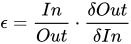
This works intuitively;

  1. If is positive, since negative inputs and outputs are impossible,
  2. And is positive, since a positive return for inputs is required for diminishing returns
  • Then
  1. is relative change in output, is relative change in input
  2. The relative change in output is smaller than the relative change in input; ~input requires increasing effort to change output~
  • Then

Returns and costs

[edit]

There is an inverse relationship between returns of inputs and the cost of production,[24] although other features such as input market conditions can also affect production costs. Suppose that a kilogram of seed costs one dollar, and this price does not change. Assume for simplicity that there are no fixed costs. One kilogram of seeds yields one ton of crop, so the first ton of the crop costs one dollar to produce. That is, for the first ton of output, the marginal cost as well as the average cost of the output is per ton. If there are no other changes, then if the second kilogram of seeds applied to land produces only half the output of the first (showing diminishing returns), the marginal cost would equal per half ton of output, or per ton, and the average cost is per 3/2 tons of output, or /3 per ton of output. Similarly, if the third kilogram of seeds yields only a quarter ton, then the marginal cost equals per quarter ton or per ton, and the average cost is per 7/4 tons, or /7 per ton of output. Thus, diminishing marginal returns imply increasing marginal costs and increasing average costs.

Cost is measured in terms of opportunity cost. In this case the law also applies to societies – the opportunity cost of producing a single unit of a good generally increases as a society attempts to produce more of that good. This explains the bowed-out shape of the production possibilities frontier.

Justification

[edit]

Ceteris paribus

[edit]

Part of the reason one input is altered ceteris paribus, is the idea of disposability of inputs.[25] With this assumption, essentially that some inputs are above the efficient level. Meaning, they can decrease without perceivable impact on output, after the manner of excessive fertiliser on a field.

If input disposability is assumed, then increasing the principal input, while decreasing those excess inputs, could result in the same "diminished return", as if the principal input was changed certeris paribus. While considered "hard" inputs, like labour and assets, diminishing returns would hold true. In the modern accounting era where inputs can be traced back to movements of financial capital, the same case may reflect constant, or increasing returns.

It is necessary to be clear of the "fine structure"[4] of the inputs before proceeding. In this, ceteris paribus is disambiguating.

See also

[edit]

References

[edit]
Revisions and contributorsEdit on WikipediaRead on Wikipedia
from Grokipedia
In economics, the law of diminishing returns, also referred to as the law of diminishing marginal returns, states that in a production process, as one factor of production is increased while all other factors remain constant, the marginal output from each additional unit of the variable input will eventually decrease after a certain point.[1] This principle implies that beyond an optimal level of input, further additions yield progressively smaller increments in total output, leading to higher average costs per unit produced.[2] The concept applies primarily to the short run, where at least one input is fixed, and is foundational to understanding production functions and efficiency in resource allocation.[2] The historical origins of the law trace back to the 18th century, with early formulations by French economist Anne Robert Jacques Turgot, who applied it to agricultural productivity in his 1767 work Réflexions sur la formation et la distribution des richesses.[2] It was further developed in the early 19th century by British classical economists such as David Ricardo and Thomas Malthus, who used it to explain rent theory and population pressures on land resources, arguing that intensive farming on fixed land leads to declining yields.[2] Nassau Senior refined the idea in 1827, emphasizing its role in cost structures, while later neoclassical economists like Alfred Marshall integrated it into marginal analysis, solidifying its place in modern microeconomics.[2] This law holds significant importance across economic theory and practice, informing decisions in agriculture, manufacturing, and service industries where over-investment in one input—such as labor on a fixed factory floor—can reduce overall productivity.[2] It underpins analyses of marginal cost curves, which rise due to diminishing productivity, and helps explain phenomena like economic convergence between nations, where poorer economies initially grow faster before facing similar constraints.[3] In broader applications, the principle extends beyond economics to fields like medicine and environmental policy, highlighting trade-offs in resource use and the limits of scaling efforts without proportional adjustments to all inputs.[1][4]

Core Concepts

Definition

The law of diminishing returns, also referred to as the law of diminishing marginal returns, is a core economic principle stating that, in a production process where at least one input is fixed, the addition of successive units of a variable input will, after a certain point, result in progressively smaller increases in output.[5][1] This occurs because the fixed inputs—such as capital or land—eventually become constraints, limiting the efficiency of additional variable inputs like labor.[6] The concept highlights the bounded nature of production efficiency, explaining why simply scaling up one factor does not yield proportionally endless gains in output.[7] Diminishing marginal returns specifically describe the incremental output from each extra unit of the variable input, which diminishes relative to prior units once the optimal input combination is surpassed.[5] Production often progresses through distinct phases: an initial stage of increasing or constant marginal returns, where output rises at an accelerating or steady rate due to improved specialization and efficiency, followed by the diminishing returns stage where gains taper off.[8][9] If the variable input is increased excessively, marginal returns may even turn negative, reducing total output.[1] This dynamic is commonly visualized through the total product curve, which depicts output as a function of the variable input and typically assumes an S-shape under standard production functions: the curve rises gradually at first (reflecting initial inefficiencies or increasing returns), then steepens before transitioning to a diminishing slope as bottlenecks emerge.[7][9] The flattening slope in the later phase illustrates how additional inputs contribute less to overall production, emphasizing the principle's role in understanding resource allocation limits.[10]

Marginal and Total Returns

In economics, marginal returns refer to the additional output generated by employing one more unit of a variable input, such as labor, while holding other inputs fixed; this is formally calculated as the change in total output divided by the change in input, or ΔOutput / ΔInput.[11] Total returns, in contrast, represent the aggregate or cumulative output produced by the total quantity of inputs utilized up to that point.[12] A numerical illustration of these concepts can be seen in a hypothetical production process, such as assembling widgets with fixed capital equipment and varying labor units. The following table demonstrates how marginal product declines as labor increases, while total product rises but at a slowing pace:
Labor UnitsTotal Product (Widgets)Marginal Product (Widgets per Additional Labor Unit)
00-
11010
2188
3246
4284
5302
6300
728-2
In this example, the marginal product decreases progressively from 10 to 2 widgets per additional worker before reaching zero and turning negative, reflecting the law of diminishing returns.[13] The production process typically unfolds in three stages based on the behavior of marginal returns. The first stage features increasing returns, where marginal product rises as additional inputs enhance efficiency through better specialization or resource utilization./10%3A_Production_Function) The second stage involves diminishing returns, with marginal product positive but declining, causing total product to increase at a decreasing rate.[9] The third stage marks negative returns, where further input additions reduce total output, as marginal product becomes negative due to overcrowding or interference among inputs. Conceptually, these relationships are often depicted graphically: the total product curve begins rising steeply in the increasing returns phase, then bends to rise more gradually during diminishing returns, and may flatten or decline in the negative returns phase. The marginal product curve, meanwhile, starts high, reaches a peak early on, and then slopes downward, intersecting the x-axis where it equals zero before becoming negative./10%3A_Production_Function)

Historical Context

Origins in Classical Economics

The concept of diminishing returns first emerged in economic thought during the 18th century, with early observations rooted in agricultural analysis. French economist Anne-Robert-Jacques Turgot, in his 1767 work Reflections on the Formation and Distribution of Wealth, provided one of the initial articulations by examining how successive investments of capital and labor on fixed land in agriculture lead to progressively smaller increases in output, laying the groundwork for the idea of diminishing marginal returns.[14] Similarly, Scottish agriculturist James Anderson, in his 1777 publication Observations on the Means of Exciting a Spirit of National Industry, explored variations in land fertility as determinants of rent, noting that produce prices influence land values and implying differential yields from lands of varying quality, which served as a precursor to formalizing returns in cultivation.[15] Thomas Malthus incorporated these ideas into demographic theory in his 1798 An Essay on the Principle of Population, where he argued that population tends to grow geometrically while food production increases only arithmetically, constrained by the finite supply of arable land and resulting limits on agricultural output.[16] This linkage highlighted how expanding population pressures on fixed resources would eventually outstrip subsistence capabilities, foreshadowing broader applications of declining productivity. David Ricardo formalized the principle in his 1817 On the Principles of Political Economy and Taxation, applying it explicitly to explain land rent and the dynamics of population growth in an expanding economy. He posited that as capital and labor are added to agriculture, the yield from additional inputs diminishes due to the fixed quantity and varying quality of land, with rent arising from the difference between the produce of the best and worst lands under cultivation.[17] Ricardo illustrated this by stating that "an acre of land of [inferior] quality will yield... a smaller produce" compared to more fertile acres when equal capital is applied, emphasizing the progressive decline in returns.[18] Nassau William Senior further refined the concept in 1827, emphasizing its role in understanding cost structures and abstinence in production.[2] In the context of 18th- and 19th-century agrarian economies, where land was the primary fixed factor of production, the principle addressed how increasing labor inputs on limited arable areas—driven by population pressures and capital accumulation—resulted in declining marginal yields per worker or per unit of input, influencing theories of distribution and resource allocation.[19] This framework was particularly relevant in pre-industrial societies reliant on agriculture, where soil exhaustion and intensive farming practices amplified the effects of fixed land supplies on overall productivity.[20]

Evolution in Modern Theory

In the late 19th century, the neoclassical synthesis integrated the law of diminishing returns into broader economic frameworks, with Alfred Marshall popularizing its application beyond agriculture to manufacturing and general production processes in his seminal work.[21] Marshall extended the concept to illustrate how additional inputs in industrial settings, such as labor or capital applied to fixed machinery, yield progressively smaller output increments, influencing supply curves and cost structures.[21] Complementing this, John Bates Clark developed the marginal productivity theory of distribution in 1899, positing that factors of production receive payments equal to their marginal product, where diminishing returns ensure that the value of additional units of labor or capital decreases, justifying income shares in a competitive economy. By the mid-20th century, diminishing returns played a central role in macroeconomic growth models, notably the Solow-Swan model introduced in 1956, which incorporated diminishing marginal returns to capital accumulation as a key mechanism driving economies toward a steady-state equilibrium.[22] In this framework, higher capital stocks in richer economies lead to lower marginal returns, facilitating convergence as poorer nations with higher returns catch up through investment, assuming similar technological and savings rates.[23] This application shifted focus from static production to dynamic long-term growth, explaining cross-country income differences without relying on exogenous technological progress alone.[23] Post-World War II economic thought increasingly emphasized diminishing returns in contexts beyond traditional land and labor, pivoting toward technology and human capital as critical inputs in advanced economies. The human capital revolution, gaining traction in the 1950s and 1960s, highlighted investments in education and skills as drivers of growth, where initial returns to human capital augmentation were high but subject to diminishing marginal productivity as economies matured. This era saw analyses extend to technological adoption, recognizing that while physical capital faced strict diminishing returns, innovations in knowledge-intensive sectors could temporarily mitigate them, influencing policy toward R&D and workforce development in the U.S. and Europe. As of 2025, modern economic theory has integrated diminishing returns with endogenous growth models, challenging its universality in knowledge-based economies through frameworks like Paul Romer's 1990 model of endogenous technological change.[24] These models argue that ideas and innovations exhibit non-rivalry and partial non-excludability, generating increasing returns to scale in research and human capital, thus sustaining long-term growth without the convergence implied by strict diminishing returns to reproducible factors.[24] Recent extensions, incorporating human capital dynamics, further suggest that in high-tech sectors, spillovers from knowledge accumulation can offset diminishing returns, reshaping growth predictions for digital and innovation-driven economies.[25]

Mathematical Formulation

Production Functions

In economics, a production function mathematically represents the relationship between inputs and outputs, specifying the maximum output achievable from given quantities of inputs. A general form is expressed as $ Q = f(L, K) $, where $ Q $ denotes output, $ L $ is labor, and $ K $ is capital, with the analysis often assuming one input as variable while holding the other fixed to illustrate diminishing returns.[26][12] A widely used functional form that exhibits diminishing returns is the Cobb-Douglas production function, given by $ Q = A L^\alpha K^\beta $, where $ A > 0 $ is a technology parameter, and $ 0 < \alpha < 1 $ and $ 0 < \beta < 1 $ ensure diminishing marginal products for labor and capital, respectively. This form, originally estimated using U.S. manufacturing data from 1899 to 1922, captures how additional units of an input yield progressively smaller increments in output when other inputs are held constant.[27][28] Production functions differ in the short run and long run based on input variability. In the short run, at least one input (such as capital) is fixed, leading to diminishing returns as the variable input (like labor) increases, since the fixed factor becomes a constraint on efficiency. In the long run, all inputs are variable, allowing for returns to scale—often constant—where output scales proportionally with inputs, avoiding the strict diminishing returns of the short run.[29][12] Isoquant curves provide a graphical depiction of production functions, illustrating combinations of labor and capital that yield the same output level, with their convex shape to the origin reflecting the diminishing marginal rate of technical substitution (MRTS), the rate at which one input can substitute for another while maintaining output. This convexity arises because, as more of one input is used relative to the other, the MRTS decreases due to the uneven productivity contributions of inputs under diminishing returns.[30] The marginal product of labor (MPL), derived from the production function, measures the additional output from one more unit of labor and is calculated as $ MP_L = \frac{\partial Q}{\partial L} $. For functions exhibiting diminishing returns, MPL decreases as labor input rises, confirmed by the second derivative condition $ \frac{\partial^2 Q}{\partial L^2} < 0 $, indicating concavity in the production function with respect to labor.[12][30]

Output Elasticity and Derivations

Output elasticity measures the responsiveness of output to changes in a specific input in a production process. Formally, for output $ Q $ and input $ X $, the output elasticity $ \varepsilon_X $ is defined as
εX=Q/QX/X=QXXQ, \varepsilon_X = \frac{\partial Q / Q}{\partial X / X} = \frac{\partial Q}{\partial X} \cdot \frac{X}{Q},
where $ \partial Q / \partial X $ is the marginal product of the input. This formulation captures the proportional change in output resulting from a proportional change in the input, providing a dimensionless measure independent of units.[31] In the framework of diminishing returns, an output elasticity $ \varepsilon_X < 1 $ indicates diminishing marginal returns to the input, as the percentage increase in output is smaller than the percentage increase in the input. This occurs because the marginal product falls below the average product ($ \partial Q / \partial X < Q / X $), reflecting reduced efficiency from additional units of the input when other factors are held constant.[30] For the Cobb-Douglas production function, commonly expressed as $ Q = A L^\alpha K^\beta $, the output elasticity with respect to labor is $ \varepsilon_L = \alpha $, and with respect to capital is $ \varepsilon_K = \beta $; these elasticities are constant across input levels. Diminishing marginal returns to labor (or capital) arise from the functional form when one input varies while the other is fixed, with $ \alpha < 1 $ and $ \beta < 1 $ ensuring that marginal products decline as the variable input increases.[31] This elasticity property can be derived through logarithmic differentiation of the production function. Taking the natural logarithm yields
lnQ=lnA+αlnL+βlnK. \ln Q = \ln A + \alpha \ln L + \beta \ln K.
Differentiating both sides with respect to $ \ln L $ (or $ \ln K $) gives $ d \ln Q / d \ln L = \alpha $, confirming that the exponents directly represent the output elasticities. This logarithmic approach generalizes to other production functions, facilitating empirical estimation of elasticities from log-linear regressions.[31][32] Empirically, an output elasticity dropping below 1 in data analysis signals the transition to the diminishing returns phase, where further input augmentation yields disproportionately smaller output gains, guiding assessments of production efficiency.[30]

Economic Applications

Relation to Costs

In the short run, the law of diminishing marginal returns directly influences the behavior of a firm's costs by causing marginal costs to rise as output increases beyond a certain point. When a firm adds more variable inputs, such as labor, to fixed factors like capital, the marginal product of labor (MP_L) eventually declines. The marginal cost (MC) of producing an additional unit of output is derived as the wage rate (w) divided by the marginal product of labor: $ MC = \frac{w}{MP_L} $. As MP_L diminishes, a larger amount of labor is required to produce each extra unit of output, leading to an increase in MC, assuming constant input prices. This relationship holds because the cost of the additional input is spread over fewer additional units of output.[33] The average cost (AC) curve, which includes both average total cost (ATC) and average variable cost (AVC), typically exhibits a U-shape in the short run due to the interplay of fixed costs and diminishing returns. Initially, as output rises from low levels, AC declines because fixed costs are spread over more units, and marginal returns may still be increasing or constant. However, once diminishing returns set in, the rising MC pulls up AC, causing it to increase after reaching a minimum point. The U-shaped ATC curve reflects this dynamic: the downward portion stems from economies in utilizing fixed capacity, while the upward portion arises from the inefficiency of diminishing marginal productivity.[33] In the short-run cost-output relationship, diminishing returns imply that beyond an optimal output level, further increases in production require disproportionately larger inputs, thereby inflating total costs. For instance, hiring additional workers in a fixed-size factory leads to overcrowding and reduced efficiency, raising variable costs per unit and shifting the supply curve upward. Graphically, this is illustrated by the standard short-run cost curves, where the MC curve rises due to declining MP_L and intersects the U-shaped ATC and AVC curves at their minimum points; the MC curve lies below ATC when ATC is falling and above it when rising, directly linking the onset of diminishing returns to the cost minimum. Diminishing returns primarily affect variable costs, as fixed costs remain unchanged regardless of output level, but the overall cost structure is distorted by the need for more variable inputs to achieve marginal output gains.[2][33]

Implications for Production Decisions

Firms apply the principle of diminishing returns to achieve profit maximization by producing output where marginal cost (MC) equals marginal revenue (MR), as the diminishing marginal product of inputs causes the MC curve to slope upward beyond a certain point.[34] This upward-sloping MC reflects the increasing cost of additional units due to reduced efficiency from extra inputs, ensuring that production halts when the cost of the last unit exceeds its revenue contribution. In determining the optimal mix of inputs, such as labor, firms hire additional workers until the value of the marginal product (VMP), calculated as the product price times the marginal product (VMP = P \times MP), equals the wage rate.[35] Diminishing returns ensure that the marginal product (MP) declines as more labor is added, holding other inputs fixed, which makes the VMP curve downward-sloping and guides efficient resource allocation to avoid over-hiring where the added worker's contribution falls below their cost.[36] Scale decisions incorporate diminishing returns through cost structures influenced by average variable cost (AVC); in the short run, firms shut down production if the market price falls below AVC, as continuing operations would exacerbate losses given the rising costs from diminishing productivity. In the long run, firms exit the market if persistent losses occur without opportunities for economies of scale to offset the inefficiencies from diminishing returns, allowing reallocation of resources to more viable sectors.[37] For inventory and capacity planning, awareness of diminishing returns helps firms avoid overproduction by limiting input use to the stage where marginal returns remain positive, preventing entry into the irrational third stage of production where additional inputs yield negative marginal products and waste resources on unsellable output.[38] Policy implications arise in labor markets, where minimum wages can amplify employment effects in low-skill sectors due to diminishing marginal products; if the wage exceeds the VMP for low-productivity workers, firms reduce hiring to maintain profitability, potentially increasing unemployment among those with the lowest marginal contributions. This dynamic underscores how diminishing returns heighten the trade-offs in wage policies for sectors reliant on unskilled labor.[39]

Examples Across Fields

Agriculture and Resource Use

In agriculture, the principle of diminishing returns manifests prominently when applying inputs like fertilizer to a fixed land area, where initial additions markedly increase crop yields, but subsequent applications yield progressively smaller gains until marginal productivity turns negative. For instance, global fertilizer consumption surged from 14 million tons in 1950 to 144 million tons by 1988, driving rapid grain yield growth, yet by the late 20th century, yield responses per unit of fertilizer began to plateau in many regions as efficiency waned. In the United States, nitrogen fertilizer use increased approximately fourfold between 1960 and 1980, boosting corn yields by approximately 70 percent, but partial factor productivity trends reflect ongoing improvements in efficiency due to better management practices.[40][41] Continuous cropping without rotation further exemplifies negative returns through soil nutrient depletion, as repeated extraction of the same nutrients exhausts soil fertility, leading to yield stagnation or decline despite sustained or increased inputs. Empirical studies on long-term maize monoculture in China demonstrate significant decreases in soil organic matter, available nitrogen, and phosphorus availability, resulting in lower crop yields compared to rotated systems. This exhaustion occurs via mechanisms such as reduced microbial activity and increased erosion, turning marginal returns negative and necessitating costly amendments to maintain output.[42] In natural resource extraction, such as oil drilling, diminishing returns arise as additional wells in a depleting field access lower-quality reserves, yielding less incremental output per investment. In mature reservoirs, each new well typically produces 20-50 percent less than predecessors due to falling pressure and fragmented reservoirs, as observed in U.S. fields post-1970 peak. The peak oil theory formalizes this, predicting a production plateau followed by decline as global extraction encounters geological limits, with energy return on investment (EROI) for conventional oil dropping from over 100:1 in the mid-20th century to around 10:1 by 2020.[43][44] Environmental applications include overfishing and groundwater pumping, where intensified effort leads to declining productivity per unit input. In fisheries, catch per unit effort (CPUE) has globally decreased to approximately 20 percent of 1950 levels (an 80 percent decline) despite technological improvements, as overexploited stocks reduce fish density; for example, FAO assessments indicate that 35 percent of monitored stocks were overfished in 2020, with CPUE in tropical tuna fisheries falling 60-80 percent over decades. Similarly, excessive aquifer pumping lowers water tables, increasing energy costs per unit of water extracted due to greater lift in regions like the U.S. High Plains, eventually rendering marginal lands unproductive.[45][46] Recent empirical evidence underscores these patterns in global agriculture, with the FAO's 2025 State of Food and Agriculture report revealing that land degradation—often from cultivating marginal soils—affects 1.7 billion people across 1.5 billion hectares, causing average crop yield reductions of 10 percent or more compared to undegraded lands. This stagnation in yields on expanding marginal areas, despite rising inputs, highlights systemic diminishing returns, particularly in sub-Saharan Africa and South Asia, where productivity gains have slowed to under 1 percent annually since 2000.[47][48]

Technology and Innovation

In software development, the principle of diminishing returns manifests prominently when scaling team sizes, as additional programmers introduce coordination challenges and communication overhead that outweigh productivity gains. Frederick Brooks articulated this in his seminal work, observing that "adding manpower to a late software project makes it later," due to the exponential increase in intercommunication paths—scaling as n(n-1)/2 for n team members—which leads to more bugs, training time, and task repartitioning.[49] This effect deviates from classical economic models by emphasizing intangible costs in knowledge work, where sequential dependencies in coding and debugging limit parallelization. In research and development (R&D), particularly pharmaceutical drug discovery, diminishing returns arise from the scarcity of novel ideas and the complexity of biological targets, where each additional researcher yields progressively fewer breakthroughs despite rising investments. Eroom's law captures this trend, showing that the number of new drugs approved per billion dollars of R&D (adjusted for inflation) has halved roughly every nine years since 1950, reflecting an 80-fold decline in efficiency due to exhausted low-hanging fruit in therapeutic targets and increasing regulatory hurdles.[50] Viable novel drug candidates have become scarce, as firms deplete the pool of promising molecular innovations, forcing reliance on higher-risk, lower-yield pursuits.[51] The slowing of Moore's law exemplifies physical diminishing returns in hardware innovation, where transistor density on integrated circuits, once doubling every two years, has decelerated to a three-year cadence by 2025 due to atomic-scale limits and escalating manufacturing costs. This shift invokes fundamental constraints like quantum tunneling and heat dissipation, compelling the industry to explore alternatives such as 3D chip stacking rather than continued planar scaling.[52] In artificial intelligence (AI) training, scaling compute resources for large language models encounters similar walls from data quality degradation; beyond certain thresholds, additional flops yield marginal improvements in performance, as high-quality training data becomes scarce and synthetic alternatives introduce noise.[53] Tech firms like Google address these dynamics by optimizing team sizes to mitigate diminishing returns, maintaining engineering squads at 5-9 members to minimize communication overhead and preserve agility, informed by empirical studies on software productivity. This approach aligns with production decisions in tech contexts, where smaller, cross-functional teams enhance innovation velocity without the coordination pitfalls of larger groups.[54]

Medicine

In medicine, diminishing returns appear in drug dosing, where increasing the dose of a medication beyond an optimal point yields smaller additional therapeutic benefits while raising risks of side effects. For example, in pain management with opioids, initial doses provide substantial relief, but further increases often result in minimal extra analgesia due to receptor saturation, alongside heightened tolerance and adverse effects like respiratory depression. Studies on analgesics show that doubling the dose after the therapeutic window may only increase efficacy by 10-20%, illustrating the law's role in guiding safe prescribing practices and personalized medicine.[55]

Assumptions and Limitations

Ceteris Paribus Condition

The ceteris paribus condition, derived from the Latin phrase meaning "all other things being equal," serves as a core assumption in the analysis of diminishing returns by holding constant all other inputs, such as capital and labor, as well as technological levels, to isolate the marginal effect of increasing a single variable factor of production.[5] This isolation ensures that any observed decrease in additional output can be attributed solely to the incremental addition of that one factor, rather than confounding influences from other sources.[56] The condition is essential because, in real-world scenarios, failing to maintain ceteris paribus could lead to misattribution of declining returns; for instance, a drop in productivity might result from shifting market prices, supply chain disruptions, or policy changes rather than the intrinsic diminishing impact of the added input.[57] Without this assumption, empirical observations would lack the clarity needed to validate the law, as multiple variables could interact and obscure causal relationships. In experimental contexts, the ceteris paribus condition is operationalized through controlled setups that vary only the target input while fixing others, such as laboratory simulations of production processes or agricultural field trials where land area and machinery remain unchanged during tests of fertilizer application or labor hours.[58] These designs allow researchers to measure marginal productivity changes precisely, providing empirical support for the law under idealized conditions.[29] Violations of the ceteris paribus assumption occur when external factors like technological progress intervene, potentially masking diminishing returns by enhancing overall efficiency or even reversing them through innovations that improve factor complementarity.[5] For example, advancements in machinery or processes can sustain or increase marginal output despite higher input levels, rendering the short-run focus of the law inapplicable in dynamic long-run environments.[59] Philosophically, the ceteris paribus condition is grounded in methodological individualism, the economic principle that social and production phenomena should be explained via individual agents' actions and decisions, achieved by abstracting away collective or systemic interdependencies to focus on isolated contributions.[60] This approach aligns with the discipline's emphasis on micro-level analysis, enabling predictive models while acknowledging the complexity of holistic systems.[61]

Criticisms and Extensions

One key criticism of the law of diminishing returns is its assumption of static technology, which overlooks dynamic processes such as learning curves and knowledge spillovers that can generate increasing returns, particularly in knowledge-intensive sectors.[62] In digital economies, network effects exemplify this limitation, as the value of platforms like social media or marketplaces grows exponentially with user adoption, leading to positive feedback loops that contradict diminishing marginal productivity.[63] These mechanisms, rooted in non-rivalry and scalability of digital goods, shift economic behavior from diminishing to increasing returns, challenging the law's universality in modern contexts.[64] Empirically, isolating the effects of diminishing returns proves challenging due to confounding factors in real-world data, such as technological change and market structures, making it difficult to attribute productivity declines solely to input increments. Post-2000 studies highlight this context-dependence; for instance, research on automation shows that returns to labor and capital vary by task displacement and reinstatement, with diminishing effects emerging only under specific automation intensities rather than universally.[65] Similarly, analyses of knowledge production indicate that diminishing returns parameters evolve with innovation, underscoring how returns are not fixed but influenced by economic transitions.[66] Extensions of the law appear in environmental economics, where diminishing returns to scale inform climate models by capturing how additional emissions abatement yields progressively smaller reductions in global warming potential due to biophysical limits. In these frameworks, scaling mitigation efforts encounters thresholds from resource constraints and nonlinear climate responses, emphasizing the need for integrated policy design. Behavioral economics further extends the concept by incorporating worker fatigue, where productivity declines nonlinearly with hours worked, but motivation—such as intrinsic rewards or opportunity costs—can modulate the rate of diminishment, leading to heterogeneous returns across individuals.[67][68][69][70] Recent applications in the 2020s reveal gaps in traditional analyses, particularly regarding AI ethics, where unchecked scaling of models yields diminishing societal returns amid rising energy demands, ethical risks like bias amplification, and limited performance gains beyond certain compute thresholds. In sustainability, green technologies exhibit similar limits, as incremental innovations in emissions reduction face diminishing marginal impacts due to technological plateaus and systemic barriers, prompting calls for paradigm shifts beyond scaling alone.[71][72][73][67][74] Alternatives to diminishing returns include constant returns to scale in perfectly competitive markets, where firm entry and exit ensure long-run efficiency without productivity declines from input expansion. In contrast, monopolistic markets often feature increasing returns, driven by fixed costs and demand variety, leading to market concentration and higher welfare costs from imperfect competition.[75][76]

References

User Avatar
No comments yet.


