Hubbry Logo
Drop pointDrop pointMain
Open search
Drop point
Community hub
Drop point
logo
8 pages, 0 posts
0 subscribers
Be the first to start a discussion here.
Contribute something
Drop point
Drop point
from Wikipedia
Drop point knife blade

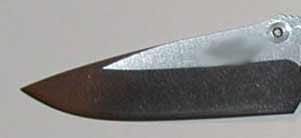
Drop point is a style of knife blade that slopes on the spine of the blade from the handle of the knife to the tip of the blade. This allows the spine of the blade (where the blade is thicker, and thus stronger) to continue forward to the tip of the blade. This way the point is also aligned with the center axis of the knife, eliminating any pitch momentum when stabbing.

The curve on the top of a drop-point blade is always convex, which is what distinguishes it from a clip point blade. The drop point is a common design for hunting. [1]

See also

[edit]

References

[edit]
Revisions and contributorsEdit on WikipediaRead on Wikipedia
from Grokipedia
A drop point is a type of blade characterized by a convex curve along the spine that slopes downward toward the tip, resulting in a lowered and controllable point relative to the blade's centerline. This design typically features a broad belly for slicing and a strong, thick tip for durability, making it versatile for various cutting tasks. Commonly found in , , and knives, the drop point excels in activities like and field dressing game due to its predictable edge and reduced risk of accidental punctures. The drop point blade's geometry provides a balance of strength and functionality, with the spine often dropping in the final third of the blade length, which is usually between 3.5 and 6 inches for fixed-blade models. Unlike sharper, more pointed designs such as the , the drop point's broader tip prioritizes robustness over fine piercing, ideal for heavy-duty use like wood or processing meat without damaging internal organs. Its continuous cutting edge enhances efficiency in long strokes, contributing to its popularity in tactical and outdoor applications. Historically associated with traditional knives, the drop point remains a staple in modern knife manufacturing for its all-purpose reliability, appearing in products from established brands like and Montana Knife Company. While not the most aggressive for or deep penetration, its controlled handling makes it a preferred choice for ethical game processing and general utility in settings.

Overview

Definition

The drop point is a knife blade style characterized by a spine that slopes downward from the toward the tip, with the point positioned roughly along the blade's centerline to provide balanced control during use. This geometry features a convex curve along the upper edge, or spine, that gradually descends to converge with the sharpened edge near the tip, forming a lowered and reinforced point. The design emphasizes a pronounced belly—a curved section of the cutting edge that enhances slicing performance—while the point serves as a versatile feature for piercing tasks. The term "drop point" derives from the distinctive dropping profile of the spine, which differentiates it from blade shapes with elevated or clipped tips. This configuration is commonly employed in hunting knives for its practical geometry in field applications.

Key Characteristics

The drop point 's tip aligns directly with the centerline of the blade's axis, resulting in centered that promotes balanced handling and minimizes rotational during piercing or prying tasks. This geometric alignment enhances user control, particularly in precision-oriented activities, by reducing the leverage that could otherwise stress the blade or hand. A defining is the reinforced spine, which maintains substantial thickness from the to the tip, providing exceptional durability against impacts and lateral forces. This robust construction prevents tip breakage, making the drop point suitable for demanding uses where weaker points might fail. Complementing the spine is the curved belly along the edge, which offers an expansive cutting surface optimized for smooth slicing motions. The belly's gradual curve facilitates controlled draws, improving efficiency in tasks requiring extended edge contact. Drop point blades typically feature lengths of 3 to 5 inches for (EDC) models, balancing portability with functionality, while variants often extend to 4 to 6 inches for greater reach in field work. General-purpose edge angles range from 20 to 25 degrees per side, striking a balance between sharpness retention and wedge resistance for versatile cutting. variations further tailor performance; a full flat enhances slicing efficiency by reducing drag and promoting a thin, uniform edge, whereas a hollow lightens the blade overall without sacrificing much strength.

History

Origins

In the , European settlers and Native American refined similar shapes in their knives, where the dropping spine enhanced control during field dressing of and minimized breakage under stress from tough hides and sinew. This design proved essential in rugged environments, allowing for efficient skinning while maintaining structural integrity. The drop point became closely associated with early survival knives carried by American frontiersmen, who valued its strong, controllable tip for versatile wilderness tasks amid the demands of and . Its convex curve contributed to overall blade strength, supporting heavy use without compromising the point.

Modern Development

In the mid-20th century, custom knifemaker Robert W. Loveless played a pivotal role in refining and popularizing the drop point blade, particularly through his hollow-ground "Drop Point Hunter" design introduced in the . Loveless enhanced the traditional form with a sharper belly curve, creating what became known as the "Americanized" drop point, which emphasized improved slicing capability while maintaining control and strength for hunting tasks. This innovation gained widespread recognition among collectors and enthusiasts, influencing subsequent custom and production knife designs. The 1970s outdoor recreation boom further propelled the drop point's adoption into mass-produced knives by major brands such as Buck and Gerber, standardizing it as a versatile option for and . Buck's Model 110 Folding Hunter, launched in 1964 with its signature drop point blade, saw explosive popularity during this decade, becoming a staple for due to its reliable lock and ergonomic handle. Similarly, Gerber incorporated drop point profiles into models like the Folding Sportsman series, aligning with the era's demand for durable, portable tools amid rising interest in and survival gear. Advancements in during the 1980s marked another key evolution, as manufacturers shifted toward stainless steels such as 420 and 440 series for drop point blades, significantly improving corrosion resistance and edge retention for broader applications beyond traditional field use. This transition, exemplified by Buck's adoption of 425M stainless in for folders, reduced maintenance needs and expanded the design's appeal to urban and wet-environment users. In the , the drop point integrated into tactical folding knives, particularly in the , with features like assisted-opening mechanisms catering to military and demands. The Griptilian, introduced in 2001, exemplifies this trend with its drop point blade, AXIS lock, and lightweight construction, becoming a benchmark for modern EDC-tactical hybrids.

Design and Construction

Geometry and Variations

The drop point blade features a core geometry defined by a convex curve along the spine that slopes downward from the handle to meet the cutting edge, typically at a position one-third to one-half of the blade length from the tip, resulting in a lowered point relative to the spine height at the handle. This design creates a reinforced tip with enhanced structural integrity while maintaining a curved belly along the edge for versatile cutting. Variations of the drop point include the standard subtype, characterized by a gentle, gradual spine that prioritizes utility tasks through balanced slicing and piercing capabilities. The American drop point, popularized by knifemaker Bob Loveless, is often paired with a hollow grind for refined edge retention. A modified drop point introduces a swedge—a tapered, unsharpened along the upper spine near the tip—to reduce overall blade weight without compromising strength. Edge configurations in drop point blades vary between straight edges, which provide uniform and general-purpose cutting, and recurve edges, where the cutting edge dips inward near the before sweeping outward, enhancing draw cuts and effective edge length in compact designs. Point height variations further adapt the : a low drop, with the tip positioned closer to the edge line, emphasizes control for detailed slicing and , while a high drop, featuring a more elevated tip relative to the lowered spine, facilitates piercing tasks with reduced risk of glancing. The drop point's geometry influences balance by distributing mass toward the through the descending spine, lowering the center of to support precise, controlled cuts in utility and field applications. This configuration enhances maneuverability, allowing users to maintain steady pressure during intricate work without excessive blade flex.

Materials Used

Drop point blades are commonly crafted from high-carbon steels such as 1095, valued for their exceptional toughness and edge retention in applications, where they achieve hardness levels of 58-60 HRC through precise . For (EDC) and environments prone to moisture, stainless steels like provide reliable corrosion resistance alongside adequate edge-holding capabilities, making them suitable for the blade's versatile cutting profile. Premium options such as CPM S30V, introduced in 2001 by , offer superior balance of wear resistance and rust prevention, enhancing the drop point's durability for prolonged use. Handle materials for drop point knives prioritize grip and ergonomics, with Micarta—a composite of layered canvas and epoxy resin—frequently used in outdoor models for its textured, non-slip surface even when wet. G10, a fiberglass-epoxy laminate, provides similar robust traction and lightweight strength, ideal for fixed-blade designs that demand secure handling during field tasks. In tactical variants, titanium handles are preferred for their low weight and high strength-to-weight ratio, contributing to overall portability without compromising the blade's stability. Construction techniques emphasize the drop point's , which features a thicker spine for strength; full tang designs extend the through the in fixed-blade models, ensuring structural under lateral stress. For folding drop point knives, liner locks employ a spring-loaded metal liner that secures the blade's tang upon deployment, preventing unintended closure and supporting the shape's controlled cutting action. This method aligns with the blade's descending tip by maintaining precise alignment during use. Heat treatment processes for drop point blades often incorporate differential hardening, where the edge is selectively quenched to achieve high hardness (up to 60 HRC) while the spine remains tougher and more flexible, mitigating brittleness in the reinforced upper section. This technique, applied particularly to high-carbon steels like 1095, leverages clay coatings or edge-only quenching to optimize performance for the shape's dual role in slicing and piercing.

Advantages and Disadvantages

Strengths

The drop point blade's design features a thickened spine that extends toward the tip, providing exceptional reinforcement that enhances its durability for tasks involving pressure or impact. This distributes stress more evenly across the , making the tip significantly less prone to snapping or chipping compared to finer points like those on clip or designs. A key strength lies in the pronounced belly curve along the edge, which offers a broader cutting surface than straight-edged blades, enabling smoother and more efficient slicing motions. This curved profile allows for greater edge engagement during draw cuts, improving overall cutting performance without requiring excessive force. The centered positioning of the point relative to the contributes to balanced handling, promoting better control and reducing user fatigue during extended sessions of precise work. This alignment facilitates stable manipulation, particularly for controlled incisions or detailed maneuvering. Due to its gradual drop from spine to edge, the drop point excels in versatility, accommodating both push cuts for straight penetration and draw cuts for lateral slicing with equal efficacy. The convex spine further supports this adaptability by maintaining structural integrity across varied cutting angles.

Limitations

The drop point blade features a broader tip compared to spear points, resulting in a less acute angle that demands greater force for fine piercing tasks, such as penetrating tough hides. This design prioritizes tip strength over sharpness, making it less efficient for precise or deep punctures relative to more pointed geometries like or clip points. While robust drop point designs with thicker spines enhance durability, they may contribute to a heavier profile in some models; however, many lightweight variants are suitable for (EDC) and delicate work. Sharpening a drop point presents unique challenges due to its curved belly, which requires more frequent and careful maintenance than straight-edged designs to preserve the . Convex grinds, common in drop points for added strength, are particularly susceptible to uneven honing, often necessitating specialized techniques or tools to achieve consistent results.

Applications

Hunting and Field Use

Drop point blades are particularly valued in hunting for their ability to perform precise skinning and field dressing tasks, where the curved belly allows for controlled slices that follow the contours of the animal, thereby minimizing damage to the meat and hide. This design facilitates efficient processing of big game, with the lowered, reinforced tip providing the strength needed to navigate internal organs without accidental punctures. The drop point configuration has been a staple for such applications for generations, as exemplified by knives like the Trekker Elk Hunter, which features a long skinning radius optimized for these purposes. In scenarios, the robust tip of the drop point blade supports demanding tasks such as wood to split kindling or digging for roots and small trenches, thanks to its lowered point that enhances durability under lateral stress. Models like the Bark River Bravo LT and Cold Steel Master Hunter illustrate this utility, offering full-tang construction suitable for heavy outdoor processing of and materials without compromising control. For camp utility, drop point knives provide versatile performance in food preparation, such as slicing meats and vegetables, and in shelter building by trimming branches or cordage, making them a preferred inclusion in survival kits for their all-purpose balance of cutting edge and tip strength. The BURI Drop Point Knife, with its dual straight and serrated edges, exemplifies this role, doubling as a reliable tool for everyday camp chores like opening packages and cutting line. Legally, fixed-blade drop point knives are commonly permitted under hunting regulations in the United States due to their non-aggressive, utility-focused profile, which aligns with exemptions for tools used in lawful pursuits like field dressing game. Fixed-blade drop point knives are generally permitted for hunting use across the United States when carried openly in a lawful hunting context, although specific regulations vary by state and concealed carry is often restricted. Users should consult local laws for compliance.

Everyday Carry and Tactical

Drop point blades are highly regarded in everyday carry (EDC) applications due to their compact, versatile design that facilitates portability and quick access. Folding knives featuring drop point blades, such as the Spyderco Delica 4, are popular for routine tasks like opening packages, cutting cardboard, and performing minor repairs, thanks to their lightweight fiberglass-reinforced (FRN) handles and ergonomic shape that ensures comfortable handling without bulk. These models often include reversible pocket clips for secure, low-profile attachment to belts or pockets, enhancing accessibility in urban environments. In tactical contexts, drop point knives serve and emergency responders for utility purposes, including rapid cuts on seatbelts during vehicle extrications. The Kershaw , introduced in the , exemplifies this with its assisted-opening flipper mechanism for one-handed deployment and a durable 8Cr13MoV drop point coated in carbo-nitride for resistance and reduced visibility. Such designs prioritize speed and reliability in high-stress scenarios, complementing the blade's inherent balanced handling for precise control. For urban survival, drop point blades excel in discreet, multi-purpose roles like food preparation during commutes or extractions in confined spaces, where their controlled belly aids slicing without excessive penetration risk. Their low-profile aesthetics, often in matte finishes, allow inconspicuous carry in professional settings, making them suitable for city dwellers facing unexpected disruptions. Customization trends for drop point knives since the 2000s have emphasized handle scales made from materials like G10 and , which provide textured surfaces for enhanced grip in wet or sweaty conditions without absorbing moisture. These composites, layered for strength and often contoured for , have become staples in aftermarket modifications to improve traction during prolonged use in variable weather.

Comparisons

Versus Clip Point

The drop point blade features a along the spine that slopes downward to meet , resulting in a lowered, thicker tip that provides enhanced structural integrity. In contrast, the blade incorporates a concave swedge or clip near the tip, narrowing the spine to create a sharper, more acute point. This geometric difference leads to the drop point's tip being broader and more robust, better resisting breakage during prying or heavy use, while the clip point's design prioritizes a finer edge for penetration. In terms of performance, blades offer superior piercing and stabbing capabilities due to their acute tip, enabling quicker and more precise punctures, though this comes at the cost of increased vulnerability to under or lateral stress. Drop point blades, conversely, provide greater and control for slicing and heavy-duty tasks, with their reinforced tip handling stress and tough materials more effectively than the clip point's thinner profile. For use cases, drop points are favored for general utility and slicing applications, such as camp chores, everyday cutting, and field dressing game, owing to their balanced belly and control. Clip points, however, shine in scenarios requiring rapid penetration, like detailed piercing or tactical operations, drawing from their heritage in classic Bowie knives designed for and . Regarding popularity, drop points dominate modern (EDC) folders for their versatility, often cited as a top choice among users for all-around tasks. Clip points remain prevalent in traditional designs, exemplified by iconic models like the Buck 110, which has been a for over six decades.

Versus Other Blade Shapes

The drop point blade's lowered tip and pronounced belly provide superior slicing capabilities compared to the spear point, which features a symmetrical profile aligned with the blade's centerline for balanced thrusting. While the drop point excels in controlled cuts on organic materials due to its curved edge, the spear point's double-edged symmetry makes it preferable for daggers and stabbing applications where precision penetration is prioritized over broad slicing. In contrast to the tanto blade, the drop point offers a smoother, curved cutting action ideal for processing organic materials like skinning game, as its continuous belly facilitates draw cuts without abrupt transitions. The tanto's angular secondary and reinforced tip, however, provide exceptional strength for piercing and prying tasks, such as breaching hard surfaces in urban or tactical scenarios, though it sacrifices slicing efficiency due to the lack of a dedicated belly. Compared to the wharncliffe blade, the drop point's convex curve enhances performance in draw cuts and general slicing, making it more adaptable for varied everyday tasks, whereas the wharncliffe's straight edge and tapering spine excel at scraping and precise, controlled incisions like . The drop point's broader tip adds durability for light utility work, while the wharncliffe's finer point suits detail-oriented applications but can be more fragile under stress. Overall, the drop point ranks highly for all-around utility among common blade shapes, demonstrating strong performance in slicing (due to its belly) and moderate effectiveness in piercing, positioning it as a versatile choice for general-purpose knives over more specialized profiles.

References

Add your contribution
Related Hubs
Contribute something
User Avatar
No comments yet.