Hubbry Logo
Egg rollEgg rollMain
Open search
Egg roll
Community hub
Egg roll
logo
8 pages, 0 posts
0 subscribers
Be the first to start a discussion here.
Egg roll
Egg roll
from Wikipedia
Egg roll
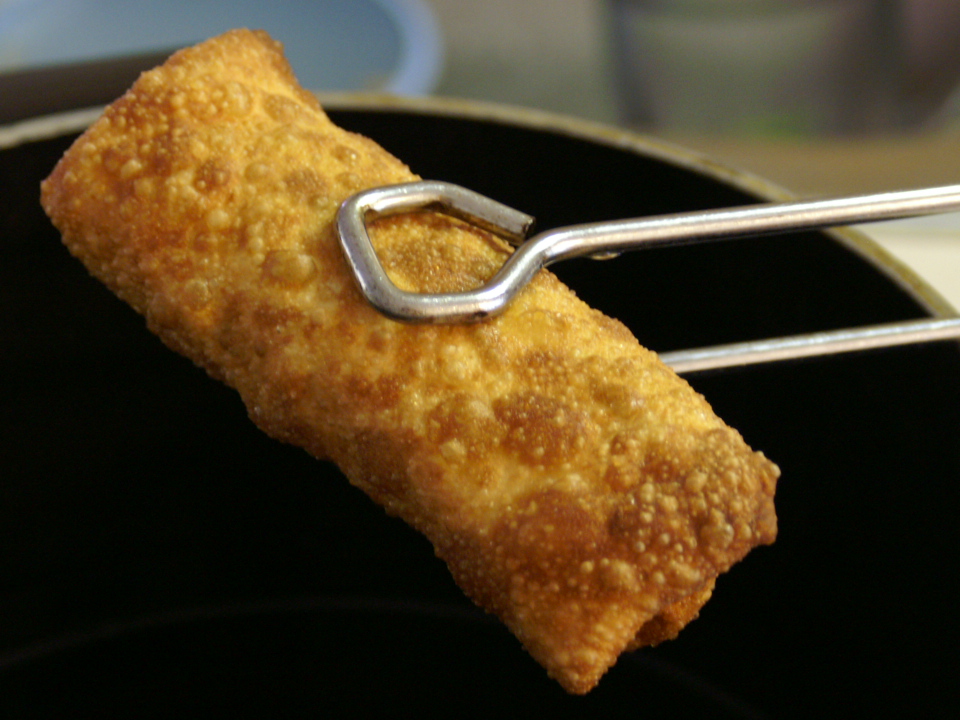
Fried egg roll with rough, bubbly outer skin
TypeAmerican Chinese cuisine
CourseHors d'oeuvre or side dish
Place of originUnited States
Created byUndetermined. Generally attributed to Henry Low in New York City in the 1930s
Main ingredientsWheat pastry skin, cabbage, pork (or other meat)
  • Cookbook: Egg roll
  •   Media: Egg roll
Egg roll
Chinese蛋卷
Literal meaning"egg roll"
Transcriptions
Standard Mandarin
Hanyu Pinyindàn juǎn
IPA[tân.tɕɥɛ̀n]
Yue: Cantonese
Jyutpingdaan6-gyun2
Southern Min
Hokkien POJtàn-kòan

The egg roll is a variety of deep-fried appetizer served in American Chinese restaurants. It is a cylindrical, savory roll with shredded cabbage, chopped meat, or other fillings inside a thickly wrapped wheat flour skin, which is fried in hot oil.[1] Despite its name, egg rolls generally do not contain egg.

The dish is served warm, and is usually eaten with the fingers, dipped in duck sauce, soy sauce, plum sauce, or hot mustard,[2] often from a cellophane packet.[3] Egg rolls are a ubiquitous feature of American Chinese cuisine.

Origins

[edit]
Egg roll filling is mostly cabbage with a small amount of chopped meat and other ingredients

The origins of the egg roll are unclear and remain disputed. Egg rolls are very similar to, but distinct from, the spring rolls served in mainland China; they were first seen in the early 20th century in the United States.

Andrew Coe, author of Chop Suey: A Cultural History of Chinese Food in the United States, has stated that the modern American egg roll was probably invented at a Chinese restaurant in New York City in the early 1930s, by one of two chefs who both later claimed credit for the creation: Lung Fong of Lung Fong's, or Henry Low of Port Arthur. According to Coe, Low's recipe, printed in a 1938 cookbook, Cook at Home in Chinese, included "bamboo shoots, roast pork, shrimp, scallions, water chestnuts, salt, MSG, sugar, palm oil, and pepper;" notably, they did not include cabbage, which is the main filling ingredient in modern egg rolls.[4]

Ingredients

[edit]
Egg rolls cut open

Despite the name, egg rolls do not typically contain egg in the filling.[5] It is unclear how the word "egg" appeared in the name, since the predominant flavor in American egg rolls is cabbage, not eggs. A 1979 article in The Washington Post offered two theories: 1) that the word for "egg" in Chinese, (, Mandarin:dàn, Cantonese:daan6), sounded similar to the word for "spring", (, Mandarin:chūn, Cantonese:ceon1), and 2) that southern Chinese chefs used eggs in the thin wrapper skin.[6] Another possible origin of the name is from a recipe for "egg roll" (also labeled as "dan gun") in the 1917 cookbook The Chinese Cook Book by Shiu Wong Chan. This recipe called for meat and vegetables rolled inside a layer of fried egg rather than a flour-based wrapper. [7]

Nom Wah Tea Parlor in New York City claims the oldest or original egg roll. The restaurant has been in operation since 1920 and states they have been making their very large egg rolls using a thin omelette or 'egg crêpe' wrapper since 1929 (unlike modern variations which use a wheat dough wrapper). [8]

Other varieties

[edit]
Egg rolls with shrimp filling

While there are many types of spring rolls native to East Asia and available in authentic Chinese, Thai, and Vietnamese restaurants in the United States,[9] American egg rolls are distinctive.[10] A typical "New York–style" egg roll measures two inches in diameter by six inches in length, with a thick, chewy, crispy, bumpy exterior skin.[11] Egg rolls, like other Americanized Chinese food specialties,[12] may contain ingredients and flavors that are not common in China,[13] including broccoli. A particularly American variety of egg roll is the pizza log, which is not associated with American Chinese cuisine, instead being filled with pepperoni pizza ingredients and served as a deep-fried tavern appetizer.[14]

Restaurants that serve egg rolls occasionally also offer spring rolls as a separate menu option, and these spring rolls may be served with a cold filling wrapped in banh trang rice paper wrappers (particularly at Vietnamese restaurants that serve both egg rolls and spring rolls as appetizers), or fried, as seen in some Thai and Chinese restaurants. When fried, spring rolls served in Asian restaurants in the United States usually have a smaller diameter and a lighter, crispier skin made out of thinner sheets of wheat or rice dough.[15][16][17]

[edit]

See also

[edit]

References

[edit]
Revisions and contributorsEdit on WikipediaRead on Wikipedia
from Grokipedia
An egg roll is a deep-fried appetizer originating from Chinese-American cuisine, consisting of a cylindrical wrapper made from wheat flour and egg dough that encases a filling typically comprising shredded , carrots, sprouts, and other , often combined with proteins such as , , , or , seasoned with and spices. The dish is distinguished by its thick, crispy exterior achieved through deep-frying, setting it apart from thinner, steamed or lightly fried found in traditional . The origins of the egg roll trace back to early 20th-century Chinese-American communities, particularly in New York City's Chinatown, where immigrants adapted traditional recipes to local tastes and ingredients. The earliest documented recipe appears in the 1917 cookbook The Chinese Cook Book by Shiu Wong Chan, describing "dan gun" (egg roll) as a filling of and wrapped in a thin egg omelet, pan-fried, and served in slices, resembling a simplified for Western palates. By the mid-20th century, the recipe evolved into the fully wrapped, deep-fried form popularized in takeout menus and restaurants across the , becoming an iconic symbol of Americanized Chinese food. Egg rolls are commonly served as an appetizer or , often accompanied by dipping sauces like , mustard, or soy-based varieties, and remain a staple in Chinese-American eateries, reflecting the fusion of influences with American preferences for bold, crispy textures. Variations may include vegetarian options or regional twists, such as seafood-focused fillings in coastal areas, but the core emphasis on vegetable-heavy, savory profiles endures.

History

Origins in Chinese Cuisine

The origins of what would later evolve into egg rolls trace back to ancient Chinese culinary traditions centered on rolled pastries filled with vegetables, symbolizing the arrival of spring and renewal. Early references appear in historical texts from the Jin Dynasty (265–420 AD), where thin pancakes made from flour were prepared to mark the Beginning of Spring, often filled with seasonal greens and lightly cooked to celebrate the harvest. These precursors, known initially as "spring plates" or simple wrapped dishes, were not the deep-fried versions familiar today but rather steamed or pan-fried items intended as light, symbolic foods during festivals. By the (618–907 AD), similar vegetable-filled rolled pastries had gained prominence in imperial banquets, as noted in classical literature such as the poem by Tang poet Yuan Zhen, which evokes the seasonal delight of fresh, wrapped delicacies resembling budding spring. These early forms distinguished themselves from modern egg rolls by their preparation methods—lightly pan-fried or steamed to preserve a delicate texture—and their role as dim sum-style appetizers in , emphasizing fresh ingredients like bean sprouts and over heavier fillings. In southern regions, particularly province, these rolls became integral to communal meals, reflecting the province's emphasis on light, flavorful snacks. A key development occurred during the (960–1279 AD), when "dough cocoons"—thin wheat flour wrappers shaped like silkworms and filled with vegetables—were introduced, aiming for a crispier outer layer through refined batter techniques that incorporated minimal binding agents for better texture. The term "chun juan" (), appearing in classical Chinese literature as early as the Song era, further solidified this dish's identity, evolving by the 19th century in into more standardized variants that laid the groundwork for global adaptations while retaining their steamed or lightly fried essence.

Adaptation in American Chinese Cuisine

The adaptation of egg rolls in American Chinese cuisine began with waves of Cantonese immigration during the California Gold Rush of the 1840s and 1850s, when over 25,000 Chinese workers arrived in San Francisco by 1852, primarily from Guangdong Province, seeking fortune in mining and later railroad construction. These immigrants brought concepts akin to traditional Chinese spring rolls, but adapted them using locally available ingredients like cabbage and carrots to suit American tastes and limited resources, transforming delicate, steamed wrappers into heartier versions suitable for a new cultural context. The earliest documented American recipe for egg rolls appeared in the 1917 cookbook The Chinese Cook Book by Shiu Wong Chan, describing "dan gun" (egg roll) as a filling of and wrapped in a thin egg omelet, pan-fried, and served in slices. By the 1920s, in bustling Chinatowns such as those in and , egg rolls evolved further into a deep-fried form to enhance crispiness and appeal to Western preferences for bolder textures, diverging from the lighter, pan-fried or steamed originals in . This innovation is often attributed to immigrant restaurateurs like Lum Fong, who opened Lum Fong's Restaurant in New York in 1925 and is credited with popularizing the fried egg roll, with the first documented reference to a deep-fried version appearing in a 1934 Brooklyn newspaper. Such modifications reflected broader efforts by Chinese American chefs to create accessible fusion dishes amid growing demand from non-Chinese patrons. The dish gained widespread popularity in the 1940s and 1950s through urban takeout menus, particularly in Chinatowns like Chicago's, where restaurants such as Hoe Sai Gai advertised egg rolls as early as 1943, experimenting with larger sizes to serve as portable appetizers. Family-owned establishments in the Midwest, including those run by figures like Monica Eng's grandfather, proliferated during this postwar boom, incorporating egg rolls into combo plates that emphasized convenience and familiarity for American families. This period also marked a cultural shift, elevating egg rolls from a modest to a signature appetizer in American Chinese dining. The popularity of Chinese restaurants surged during the era (1920–1933), as they became accessible dining options without alcohol service, attracting diverse crowds and promoting fusion dishes.

Composition

Wrapper Characteristics

Egg roll wrappers consist of thin sheets made primarily from , water, eggs, and salt, which are combined into a and rolled out to form squares measuring approximately 6 to 7 inches per side. The eggs in the mixture impart elasticity to the dough, facilitating easy handling during assembly, while also promoting a golden hue when fried. These wrappers are generally 0.5 to 1 mm thick, presenting a semi-translucent appearance in their raw state that transforms into a shatteringly crisp texture post-frying, owing to the gelatinization of starches within the flour. This crispiness arises from the evaporating rapidly in hot oil, creating bubbled, blistered surfaces that trap air for added lightness. Commercial varieties, such as those produced by brands like Nasoya, are pre-made, frozen sheets designed for convenience and often exclude eggs to ensure vegan compatibility; Nasoya's formulation includes , water, white distilled , cornstarch, and . In contrast, homemade wrappers require mixing the and resting it for around 30 minutes to allow development, reducing the risk of tearing when rolled thin. The presence of eggs in traditional wrappers distinguishes them from rice paper used in many spring rolls, yielding a chewier, more substantial bite rather than the delicate, glutinous softness of rice-based alternatives.

Filling Components

The filling of an egg roll primarily consists of shredded , carrots, and bean sprouts, which serve as the core providing bulk, texture, and moisture while contributing a crisp contrast to the fried wrapper. These form the majority of the filling, ensuring a balanced bite that emphasizes freshness and crunch without overpowering other elements. Proteins such as ground pork, , or are incorporated to add substance and savory depth, typically seasoned with for saltiness, and ginger for aromatic pungency, and for nutty richness. In pork-based fillings, is commonly added to enhance and introduce subtle warm notes of star , , and . This combination creates a harmonious flavor profile where the proteins complement the ' mild sweetness and earthiness, avoiding heaviness through restrained seasoning. To prepare the filling, the are briefly stir-fried or blanched to wilt them slightly while preserving their crispness, then cooled and drained thoroughly before mixing with proteins and seasonings; this step prevents excess moisture that could lead to sogginess during wrapping and frying. American-style egg roll fillings emphasize as the dominant vegetable for its affordability and volume, differing from traditional Chinese fillings that prioritize and mushrooms for a more subtle, earthy nuance.

Preparation

Assembly Process

The assembly of egg rolls begins with preparing the workspace on a clean, flat surface such as a wooden or a parchment-lined to prevent sticking and ensure even pressure during rolling. Egg roll wrappers, typically square and made from dough, are positioned in a diamond orientation—with one corner pointing toward the assembler—for optimal uniformity and a tight seal. A small amount of filling, approximately 2-3 tablespoons of the prepared mixture (such as , carrots, and protein, as detailed in the filling components), is placed on the lower third of the wrapper, positioned about 1-2 inches from the bottom corner to allow room for folding without spillage. The filling should be gently squeezed beforehand to remove excess moisture, preventing sogginess or breakage during handling. To form the roll, the bottom corner of the wrapper is folded upward over the filling, tucking it snugly underneath to enclose the mixture securely and eliminate air pockets. The left and right sides are then folded inward toward the center, overlapping slightly to create a tight envelope shape that holds the filling in place. The wrapper is rolled diagonally upward from the bottom, applying firm but even pressure to maintain a cylindrical form, until the top corner reaches the opposite edge. For sealing, a (typically 1 tablespoon cornstarch mixed with 2 ) or an (1 beaten egg diluted with 1 ) is brushed along the top flap and edges; the vegan cornstarch option is preferred for plant-based preparations. This adhesive ensures the roll remains intact, with the sealed side placed downward on the surface to set. Common pitfalls in assembly include overfilling the wrapper, which exceeds 3 tablespoons and leads to bursting during handling or later processes due to on the seams. Under-sealing, often from insufficient or rushed folding, results in leaks from unsecured edges. To achieve uniformity, the diagonal rolling technique is essential, as it distributes the filling evenly and produces consistent cigar-shaped rolls approximately 4-5 inches long. If a wrapper tears, it can be patched with a small piece from another wrapper, adhered using the or . Tools like a bamboo mat can provide additional support for even pressure, though a simple flat surface suffices for most home or professional settings. A standard package of 20-24 egg roll wrappers typically yields that number of assembled rolls, assuming efficient use of filling without waste. Assembled rolls should be covered with a damp cloth if not cooked immediately to prevent drying out.

Cooking Techniques

The primary method for cooking assembled egg rolls is deep-frying, which yields a crispy exterior while ensuring the filling is thoroughly cooked. Oil is heated to between 325°F and 375°F (160–190°C), with 350°F (175°C) being a common target to achieve golden browning without excessive oil absorption. Egg rolls are fried for 3 to 6 minutes, turning occasionally, until they reach an internal temperature of 165°F (74°C) to ensure , particularly for fillings containing , ground meats, or . This temperature kills potential pathogens like , as recommended by USDA guidelines for stuffed or mixed-meat dishes. Frying time can vary by roll size, with smaller appetizer versions typically requiring 3 to 4 minutes and larger dinner-sized rolls needing up to 6 to 8 minutes for even cooking. For healthier alternatives that reduce oil use while approximating the crisp texture of frying, or air-frying are effective options. In , egg rolls are brushed or sprayed lightly with oil and placed on a parchment-lined baking sheet, then cooked at 400°F (200°C) for 15 to 20 minutes, flipping halfway through to promote even browning and crispiness. Air-frying involves preheating the appliance to 380°F (193°C) and cooking the rolls for 10 to 12 minutes, again flipping midway and using minimal oil spray to minimize absorption compared to deep-frying, which can cut fat content by up to 70–80% in some preparations. After cooking, egg rolls should be drained immediately on wire racks or paper towel-lined plates to remove excess oil and preserve their crispiness, avoiding stacking to prevent sogginess. For reheating leftovers, an at 350°F (175°C) for 8 to 10 minutes is preferable to restore texture without moisture buildup, whereas microwaving should be avoided as it often results in a chewy or soggy outcome.

Variations

Regional Differences

In from southern , egg rolls—known locally as chun guen or —are typically smaller and more delicate than their Western counterparts, often prepared by or light frying to preserve a tender texture, with minimal fillings centered on , greens like bean sprouts, and subtle seasonings to highlight fresh flavors; these are commonly featured in meals as bite-sized appetizers. The Vietnamese adaptation, , diverges by employing thin rice paper wrappers that yield an exceptionally crispy exterior when deep-fried, incorporating fillings such as ground pork or blended with noodles, mushrooms, carrots, and aromatic herbs for a balanced savory profile; this version gains a distinctive from the accompanying nuoc cham , made with fermented fish sauce, lime, garlic, chilies, and sugar. In the , represents a localized evolution with notably thinner wrappers derived from or , available in both fresh (unfried) and fried forms, and stuffed with —often or —alongside potatoes, onions, and for a hearty, textured bite; this variation traces its roots to Chinese influences introduced via trade, but bears the imprint of over three centuries of Spanish colonial rule, which shaped broader Filipino culinary fusions of Asian and Iberian elements. Hawaii's egg rolls emerged as a fusion dish following waves of Chinese immigration in the mid-19th century, when laborers arrived to work on sugar and emerging plantations, leading to adaptations that integrate chunks of pineapple into traditional meat and vegetable fillings for a signature sweet-savory contrast reflective of the islands' tropical bounty.

Modern Adaptations

In recent years, egg rolls have seen adaptations aimed at health-conscious consumers, incorporating or methods to minimize oil use and employing low-carb wrappers made from almond flour or coconut flour to reduce overall and content. Traditional deep-fried egg rolls typically contain around 11 grams of per serving due to the oil absorption during . In contrast, air-fried or baked versions using these alternative wrappers can lower the content to approximately 2-4 grams per roll, making them suitable for keto, paleo, or low-carb diets. These modifications maintain the crispy texture while appealing to those seeking lighter appetizers. Fusion variations have emerged, blending egg rolls with global flavors, particularly in street food scenes since the 2010s. Korean-inspired egg rolls often feature fillings like , , and for a spicy, fermented twist, reflecting the broader trend popularized by s. Similarly, Mexican-influenced versions incorporate chorizo, , black beans, and corn, creating savory, Southwest-style rolls that highlight bold, smoky profiles and have gained popularity in casual dining and food truck menus. Commercially, frozen pre-made egg rolls have become widely available in supermarkets, with brands like offering varieties such as chicken, pork, and vegetable options that emphasize quality ingredients and convenient preparation. Vegan lines using plant-based proteins, such as those from Feel Good Foods and Ai Vy Springrolls, have proliferated post-2020, catering to dietary restrictions and expanding accessibility in retail frozen sections. Plant-based egg rolls incorporating products like for meat-like textures gained notable traction in recipes and home cooking starting around 2015, aligning with the rise of plant-based meat alternatives.

References

Add your contribution
Related Hubs
User Avatar
No comments yet.