Hubbry Logo
PopiahPopiahMain
Open search
Popiah
Community hub
Popiah
logo
8 pages, 0 posts
0 subscribers
Be the first to start a discussion here.
Popiah
Popiah
from Wikipedia

Popiah
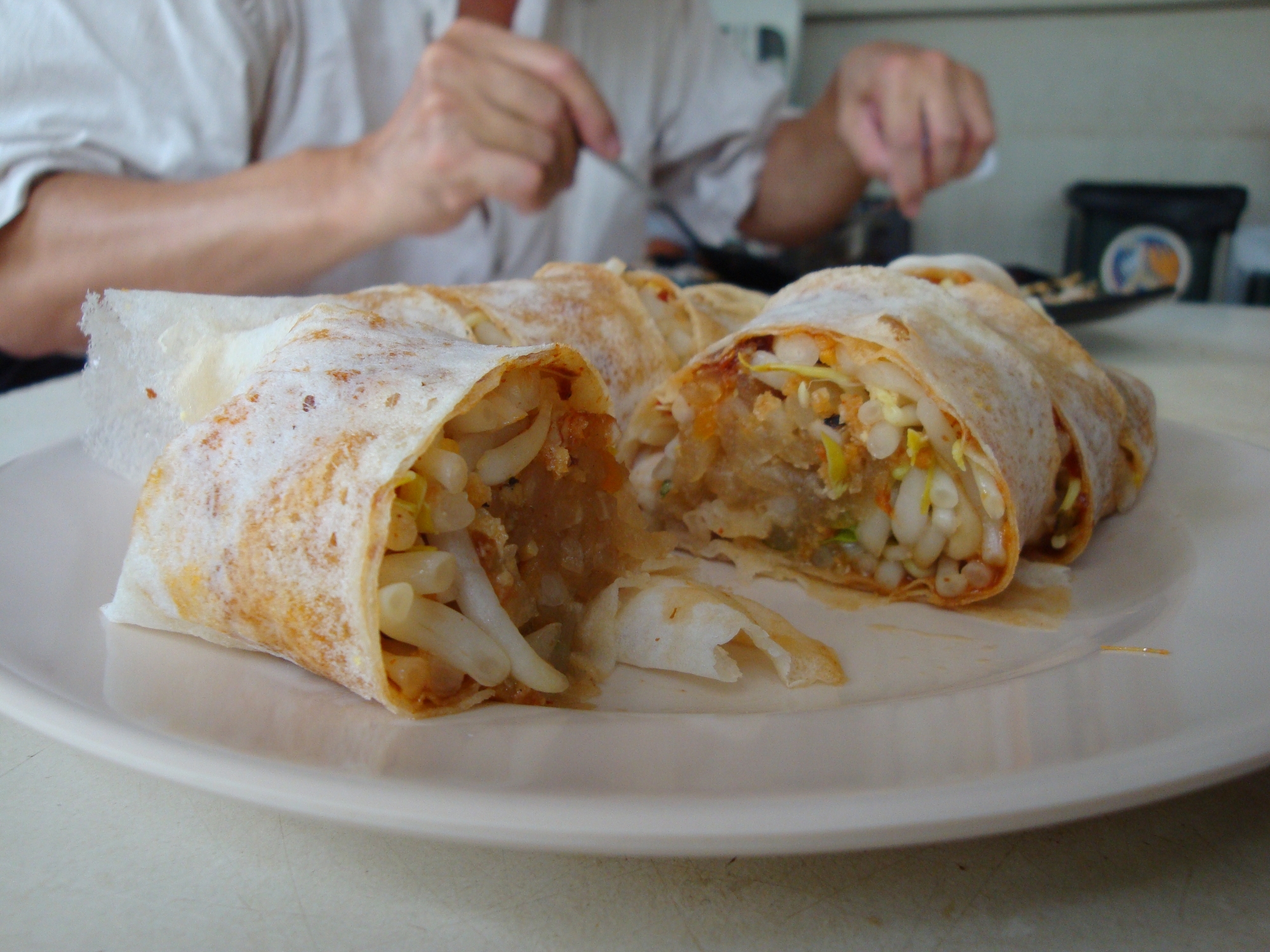
A popiah roll with a filling of bean sprouts and other ingredients
Alternative namespo̍h-piáⁿ
Place of originMinnan, China
Region or stateEast Asia (Teochew and Hokkien-speaking communities), Southeast Asia
Associated cuisineSingapore, Indonesia, Malaysia, Mainland China, Taiwan, Thailand, Vietnam, Philippines, Myanmar, Cambodia
Main ingredientsPopiah skin, bean sauce, filling of finely grated and steamed or stir-fried turnip, jicama, bean sprouts, French beans, lettuce leaves, grated carrots, Chinese sausage slices, thinly sliced fried tofu, chopped peanuts or peanut powder, fried shallots, and shredded omelette
VariationsLumpia, bò bía, ปอเปี๊ยะทอด popia thot
Other informationEaten during Qingming Festival
  •   Media: Popiah
Popiah
Popiah in Simplified Chinese (top) and Traditional Chinese character (below)
Traditional Chinese薄餅
Simplified Chinese薄饼
Hokkien POJpo̍h-piáⁿ
Transcriptions
Standard Mandarin
Hanyu Pinyinbóbǐng
Southern Min
Hokkien POJpo̍h-piáⁿ
Alternative Chinese name
Chinese潤餅
Simplified Chinese润饼
Hokkien POJjūn-piáⁿ or lūn-piáⁿ
Transcriptions
Standard Mandarin
Hanyu Pinyinrùnbǐng
Southern Min
Hokkien POJjūn-piáⁿ or lūn-piáⁿ

Popiah (Pe̍h-ōe-jī: po̍h-piáⁿ, Teochew Peng'im: boh⁸ bian²) is a Fujianese/Teochew-style fresh spring roll filled with an assortment of fresh, dried, and cooked ingredients, eaten during the Qingming Festival and other celebratory occasions. The dish is made by the people and diaspora of Fujian province of China (in Quanzhou, Xiamen, and Zhangzhou), neighbouring Chaoshan district, and by the Teochew and Hoklo diaspora in various regions throughout Southeast Asia and in Taiwan (due to the majority of Taiwanese being Hoklo), The origin of popiah dates back to the 17th century.[1][2]

Etymology

[edit]

In the Chaoshan dialect and Hokkien language, popiah is pronounced as /poʔ˩piã˥˧/ (薄餅),[3] which means "thin flatbread/cake". Depending on the regions in Fujian, it is also commonly referred to as /lun˩piã˥˧/ (潤餅), which is the etymological origin of "lumpia" in the Philippines and Indonesia. It is referred to as rùnbǐng (潤餅) or báobǐng (薄餅) in Mandarin, and also as bópíjuǎn (薄皮卷).

Wrapper and fillings

[edit]

A popiah "skin" (薄餅皮) is a soft, thin paper-like crêpe or pancake made from wheat flour. The method of producing the wrapper involves making an extremely wet and viscous dough. A ball of this dough is held to the right hand, then quickly "rubbed" (擦薄餅皮, Hokkien: chhat po̍h-piáⁿ phê, literally "to rub a popiah crepe") against a hot steel plate in a circular fashion, and lifted.[4][5] Through this process, a very thin layer of the wet dough adheres to the plate and begins to cook. The upper surface of the crêpe is then usually cleaned of excess pieces of dough using the dough ball through a dabbing process.[5] When the dough has been cooked to completion, it is peeled off from the hot steel plate before being removed. The rubbing is typically done over two or three plates at once, which allows the baker to continuously produce crepes and gives enough time for each crepe to be properly cooked.[6]

A popiah vendor in Keelung, Taiwan. Popiah crêpes are produced through "rubbing" (foreground) and then filled and rolled (background)

It is eaten in accompaniment with a sweet sauce (often a bean sauce), a blended soy sauce or hoisin sauce or a shrimp paste sauce (蝦膎, hae-ko, Pe̍h-ōe-jī: hê-ko, Tâi-lô: hê-kê), and optionally with hot chilli sauce before it is filled. The filling is mainly finely grated and steamed or stir-fried turnip, jicama (known locally as bangkuang, 芒光, Tâi-lô: bâng-kuang), which has been cooked with a combination of other ingredients such as bean sprouts, French beans, and lettuce leaves, depending on the individual vendor, along with grated carrots, slices of Chinese sausage, thinly sliced fried tofu, chopped peanuts or peanut powder, fried shallots, and shredded omelette. Other common variations of popiah include pork (lightly seasoned and stir-fried), shrimp or crab meat. Seaweed is often included in the Xiamen (Amoy) versions. Some hawkers in Malaysia and Singapore, especially in non-halal settings, will add fried pork lard. As a fresh spring roll, the popiah skin itself is not fried.

Two common ways of eating this are holding them like a burrito, which some prefer, while others cut the popiah roll into slices and pick them up with chopsticks. It requires some skill to pick the pieces up with chopsticks. Spoons are seldom provided at the establishments.

Types

[edit]

In China, Taiwan, Singapore and Malaysia there are "popiah parties" at home, where the ingredients are laid out and guests make their own popiah with proportions of ingredients to their own personal liking.

Taiwanese

[edit]
Ingredients for making a popiah in Taiwan

In Taiwan, popiah is called runbing (潤餅) in Mandarin, jūn-piánn(-kauh) in Taiwanese Hokkien.

The stuffing itself is quite diverse among different places. The basic stuffing includes vegetables that grow in spring, meat and thinly shredded omelette. In some places, they also add noodles, Chinese sausages, stewed vegetables instead of blanched ones, tofu, seafood, sticky rice, and so on.

Furthermore, the way of cooking the stuffing is very different as well. In northern Taiwan, the stuffing is flavoured, stir-fired, sometimes it goes with peanut powder, and the sauce is salty. In southern Taiwan, the popiah stuffing is water blanched without additional seasoning, and flavoured primarily with sugar and peanut powder. For people who live in southern Taiwan, the addition of sufficient sugar is key for popiah. Moreover, some people like to heat or steam the spring roll again after it is made.

Some food stalls serve popiah filled with ice cream. This is a sweet and savory treat - the ice cream is commonly pineapple, peanut and taro flavored, or these three flavors swirled together. The vendor will have a giant block of peanut candy nearby. They will shave this in front of you to create a bed of peanut shavings on the popiah skin. Then the three scoops of ice cream are placed on the bed. It is customary to add a piece of cilantro before the whole thing is wrapped up and handed to you. Some people have dubbed it an ice-cream burrito.[7]

Southeast Asian

[edit]
Making of popiah

In Malaysia and Singapore, popiah is part of Chinese cuisine of these two countries. However, in both countries, as well as in Brunei, popiah (especially the fried variant) is also popular as part of local street food. In Vietnam, bò bía is the Vietnamese variant of popiah, introduced by Teochew immigrants. It is common to see an old Teochew man or woman selling bò bía at their roadside stand. In Cambodian cuisine, popiah is known as num por pia (Khmer: នុំពពៀ). In Thai cuisine, two types of popia (Thai: เปาะเปี๊ยะ) are popular: popia sot (fresh spring roll) and popia thot (deep-fried spring roll). In addition, Thai cuisine has also incorporated the Vietnamese summer roll under the name kuaitiao lui suan (Thai: ก๋วยเตี๋ยวลุยสวน). While in Burma/Myanmar, it is known as kawpyan (ကော်ပြန့်). Similar foods in other cuisines include the Filipino lumpiang sariwa and the Indonesian Lumpia Basah spring rolls which are served with peanut sauce, etymologically derived from the Hokkien name Lum Pia. Majority of ethnic Chinese in both countries are of Hokkien origin.

See also

[edit]

References

[edit]
[edit]
Revisions and contributorsEdit on WikipediaRead on Wikipedia
from Grokipedia
Popiah is a traditional fresh of Fujianese origin from southeastern , characterized by a thin, crepe-like wrapper made from wheat flour, water, and salt, filled with a savory medley of stir-fried , proteins, and fresh garnishes. The filling typically includes sautéed , jicama (bangkuang), carrots, bean sprouts, and , combined with optional additions like , , or , and topped with elements such as shredded , cucumber slices, , and sweet or chili sauces for flavor. Unlike fried , popiah is served uncooked and fresh, emphasizing its light, crisp texture and emphasis on seasonal , which traces back to its roots as a springtime dish celebrating abundance in Province. Introduced to by Chinese immigrants, particularly from and Teochew regions, in the early , popiah has become a staple in Singaporean and Malaysian cuisines, where it is commonly sold at hawker centers and prepared as a communal dish during family gatherings or festivals like . In these locales, variations incorporate local ingredients, such as additional prawns or crabmeat in Penang-style popiah, while maintaining the DIY assembly process: the wrapper is laid flat, coated with hoisin or sweet sauce, layered with to prevent sogginess, piled with the warm filling and garnishes, then rolled tightly and sliced for sharing. This hands-on preparation fosters social bonding, turning popiah-making into a festive activity, as seen in Singapore's tradition of "popiah parties." Culturally, popiah symbolizes prosperity and unity in multicultural societies like and , evolving from a seasonal Chinese to an everyday that reflects immigrant adaptation and fusion with Peranakan (Nonya) influences, such as enhanced spice levels. Notable milestones include Singapore's 2002 Guinness for the longest popiah at 108 meters, organized by the Thomson Community Club, highlighting its communal appeal. Today, commercial production by companies like Tee Yih Jia, led by entrepreneur Goi Seng Hui—known as the "Popiah King"—has globalized the dish, making frozen wrappers and kits widely available while preserving its authentic flavors.

History and Origins

Chinese Roots

Popiah traces its origins to Fujian province in southeastern China, particularly among the Hokkien and Teochew communities in regions like Quanzhou, Xiamen, Zhangzhou, and neighboring Chaoshan areas. The dish evolved as a simple vegetable wrap during the spring season, when abundant fresh produce from agricultural harvests made light, wrapped meals practical and celebratory. This timing aligned with traditional practices around the Qingming Festival, where popiah served as an offering in ancestral worship rituals and a communal food emphasizing seasonal renewal and familial bonds. Local ingredients such as played a central role, providing a crisp, earthy filling that complemented the thin wheat-flour wrappers and underscored the dish's ties to the province's fertile lands. These elements contributed to popiah's reputation as a light, balanced meal, often vegetable-forward to promote well-being during periods. While firmly rooted in Fujianese traditions, popiah's concept later spread through migration to and in the 20th century, adapting to new environments while retaining its core as a fresh .

Spread to Taiwan and Southeast Asia

The migration of Hokkien and Teochew communities from Province in southeastern China to and began in the 19th century, driven by economic opportunities and colonial labor demands. In , following the island's cession to in 1895, the existing Hokkien population—established during migrations—grew through internal developments under Japanese rule, with further reinforcement after 1945 when approximately 1.2 million people, including many from and other southern provinces, relocated from alongside the Republic of China government. In , Hokkien migrants settled in , particularly from 1786 onward, dominating trade, tin , and revenue farming, while Teochew communities followed similar paths; in the Dutch East Indies, Hokkien arrivals in Batavia (modern ) from the early expanded into and plantations by the 18th and 19th centuries, with waves continuing into the early . Popiah was introduced to these regions through these diaspora networks, with significant establishment during the 1920s and 1930s labor migrations amid colonial economic expansion. In and , Hokkien and Teochew immigrants brought the dish as a portable suited to urban and work, leading to early stalls; for instance, Kway Guan Huat Joo Chiat Popiah, a Hokkien-run , began operations in in 1938, specializing in handmade skins and fillings. Post-World War II, refinements emerged in and during and independence movements (Malaya in 1957, in 1965), as returning migrants and new vendors adapted popiah to urban hawker culture, emphasizing fresh, affordable assembly. Early adaptations varied by region, reflecting local environments while preserving core elements like sprouts. In , popiah retained traditional Fujianese forms among Hokkien communities. In contrast, Southeast Asian versions incorporated local ingredients, influenced by regional fusions. Fujianese immigrants played a pivotal role in establishing popiah stalls in 1950s , capitalizing on postwar recovery and growing demand for . Notable examples include Ann Chin Popiah, founded in 1958 by Lim Kam Chwee, who immigrated from in the 1940s and focused on handmade skins to maintain authenticity amid rising commercialization. These ventures solidified popiah as a staple in cuisine, bridging Fujianese heritage with local hawker traditions.

Etymology and Names

Linguistic Origins

The word "popiah" derives from the Hokkien term po̍h-piá (薄餅), literally meaning "thin " or "skin ," where po̍h (or variant po̍͘) denotes thinness and piá refers to baked goods or s. This etymology reflects the dish's characteristic thin, crepe-like wrapper, central to its preparation. The term belongs to the Minnan language family, a branch of Chinese spoken primarily in province, , where dialects originated and where the food itself has deep . As an etymological parallel, the po̍h-piá shares conceptual roots with Vietnamese bánh tráng, both evoking thin, spreadable flatbreads used as wrappers, though the latter derives from Sino-Vietnamese influences on rice-based preparations. In Mandarin, a related term is rùnbǐng (潤餅), meaning "moist cake," highlighting broader Chinese linguistic variations for similar foods.

Regional Variations in Terminology

In , the dish is known as rùnbǐng (潤餅) in Mandarin, a term derived from the pronunciation lūn-piánn, which emphasizes the moist and elastic quality of the thin wrapper. Across , terminology reflects local phonetic adaptations of the original po̍h-piáⁿ. In and , particularly within English-speaking contexts, it is commonly called "popiah," a direct borrowing that has become standard in multicultural urban settings. In , the fresh version is referred to as popia sot (เปาะเปี๊ยะสด), distinguishing it from the fried popia thot, with the name tracing back to Teochew influences among early Chinese communities. In , it is termed bò bía, a phonetic rendering of "popiah" introduced by and Teochew immigrants, who adapted the concept using rice paper wrappers while preserving the core rolling technique. Among communities, such as the Peranakan (Straits Chinese) in and , naming evolved in the mid-20th century toward hybrid forms like "Nyonya popiah," blending roots with local Malay descriptors to denote the culturally fused preparation style. In and the , similar rolls fall under the term "," stemming from the same etymology but diverging as a predominantly fried variant, unlike the fresh popiah tradition.

Ingredients and Components

Wrappers

Popiah wrappers consist of thin, translucent crepes prepared from a simple batter of , , , and salt. These wrappers typically measure 7 to 8 inches in diameter, providing an ideal size for encasing fillings without excess overlap. The texture of popiah wrappers is soft and pliable when steamed or briefly heated, exhibiting a slight chewiness and resilience that allows them to hold contents securely during assembly. Their nearly transparent quality is essential, enabling the vibrant colors of the fillings to be visible through the skin, enhancing the visual appeal of the rolled popiah. In traditional production, particularly in and styles, the batter is mixed and churned by hand before being applied to a hot , where it cooks for 10 to 20 seconds per side to achieve the desired thinness. This hand-made method, passed down through generations, involves either rubbing a wet ball against the griddle surface for ultra-thin sheets or spreading the batter evenly like a crepe, contrasting with modern machine-pressing techniques used in commercial settings.

Fillings and Sauces

The fillings of popiah form the heart of its fresh, vibrant flavor profile, typically featuring a medley of julienned vegetables and proteins that provide crunch, texture, and subtle sweetness. Core components include finely shredded jicama (also known as bangkuang or ), bamboo shoots, bean sprouts, carrots, and fried , which serve as the base for a savory, lightly cooked mixture often stir-fried with and shallots to enhance aroma without overpowering the natural freshness. Roasted ground are commonly added for a nutty crunch, while non-vegetarian variations incorporate optional elements like , thinly sliced , or scrambled for added protein and richness. Proteins in popiah fillings emphasize balance and accessibility, with fried tofu providing a chewy, absorbent base that soaks up surrounding flavors. In Hokkien-style versions, additions like pork and Chinese sausage (lap cheong) introduce a smoky depth, while Peranakan adaptations might include seafood such as prawns or crabmeat for a coastal twist. These elements are prepared by cooking the mixture in a light broth derived from shrimp shells and pork, then squeezing out excess moisture to ensure the fillings remain crisp and not soggy when wrapped. Sauces are essential for tying the fillings together, with a hoisin-like sweet bean sauce—made from fermented soybeans, sugar, and wheat—spread thinly on the wrapper to add and gloss. This is often mixed with minced and a touch of fermented soy for depth, complemented by a spicy chili paste that introduces heat and tang. Fried bits are frequently sprinkled in for extra zest. Nutritionally, popiah fillings contribute to a high-fiber profile from the abundance of like jicama and bean sprouts, supporting digestive while keeping the overall dish light. A typical roll, relying on these veggie-heavy fillings, registers approximately 200 calories, making it a low-calorie option compared to fried alternatives.

Preparation Methods

Making the Wrappers

Traditional popiah wrappers, also known as skins, are thin, pliable pancakes made from a simple batter or dough, essential for enclosing the fresh fillings without overpowering their flavors. The basic involves mixing with water and a pinch of salt to form a smooth batter, which is then rested for 30 minutes to allow the to relax and ensure even texture. In some variations, a small amount of flour is added for added elasticity, but the core ingredients remain minimal to maintain the delicate, translucent quality. To cook the wrappers, heat a non-stick pan or flat over medium heat, then ladle or a thin layer of the rested batter onto the surface, spreading it evenly to form a circle about 6-8 inches in . Bubbles will form quickly, indicating it's time to cook for 30 seconds to 1 minute until the edges lift and the surface turns opaque and firm, at which point the wrapper is gently peeled off without flipping, as only one side needs cooking for the fresh style. The process requires practice to achieve uniform thinness, with each wrapper cooling slightly before stacking under a damp cloth to prevent drying and maintain softness through if prepared in advance. In commercial or traditional settings, specialized popiah molds—flat, round hot plates with a textured surface—are used to produce even thinner skins at high volumes, often heated to a precise to avoid sticking or uneven cooking. A common pitfall is tearing, which can be avoided by controlling the heat to medium-low during spreading and ensuring the batter is not too thick; over-high heat leads to brittleness, while insufficient heat results in raw patches. A single batch typically yields 20-30 wrappers, sufficient for a family-sized popiah , and the skins can be tested for integrity by lightly wrapping a small amount of filling to check pliability.

Assembling and Rolling

The assembling and rolling of popiah involves a straightforward yet precise to create a balanced, handheld roll that showcases the contrast between crisp , savory proteins, and tangy . To begin, a single popiah wrapper is placed flat on a clean plate or , with its edges aligned for even folding. A thin layer of sweet hoisin or bean and chili is spread down the center of the wrapper. A leaf is then placed over the sauce as a base layer to prevent the wrapper from sticking and to add crunch. Next, the prepared fillings—starting with about 2-3 tablespoons of shredded like jicama, carrots, or for a fresh base—are added on top of the , followed by proteins such as shredded , , or for added texture and flavor, along with garnishes. The sides of the wrapper are then folded inward over the ends of the filling, and the roll is tightly wrapped from the bottom upward, similar to a , tucking the filling securely to avoid spillage during eating. This tight rolling helps maintain the structural integrity of the popiah, allowing it to be eaten whole or sliced into bite-sized pieces. Customization during assembly allows for personalization, particularly in the layering order, where are positioned over the to form a barrier that balances the moisture from sauces and proteins, preventing sogginess and ensuring even distribution of flavors and textures. For instance, diners may adjust the quantity of sauces or garnishes like crushed or fried shallots based on preference. Popiah is typically served fresh, with 1-2 rolls per person as a light or appetizer, and should be consumed within a few hours to preserve the wrapper's slight chewiness and the fillings' crispness.

Regional Variations

Taiwanese Popiah

Taiwanese popiah, known locally as rùn bǐng (潤餅), distinguishes itself through its substantial size, with rolls typically measuring 12 to 14 inches long, allowing for generous fillings that evoke comparisons to a . The wrapper, crafted from a thin batter of , , and salt using a pan-swipe technique, yields a soft yet chewy texture ideal for encasing hearty combinations of sautéed and proteins. Preparation emphasizes freshness, with the assembled rolls often served immediately after the wrapper is pan-cooked, though or provides variations for added tenderness or crispness; some adaptations involve light grilling of components like meats for enhanced flavor. Taiwanese versions include optional proteins such as or pork floss alongside traditional fillings like shredded turnips, carrots, bean sprouts, and . Unique elements include shredded or crepes for added texture and a thicker, sweeter —often a hoisin-based blend—drizzled generously to balance the dish's earthiness. The dish's development in traces back to the post-1949 migration of over two million fleeing the Communist victory, which infused local cuisine with diverse influences and evolved popiah into sweeter, heartier forms adapted to Taiwanese ingredients and preferences. It holds particular cultural prominence during the (Tomb-Sweeping Day), when families prepare cold run bing to honor ancestors, adhering to traditions that avoid hot foods near gravesites. Since the 1970s, as night markets proliferated across , run bing has become a ubiquitous , with vendors rolling millions of portions annually to meet demand from locals and tourists alike.

Southeast Asian Popiah

Southeast Asian popiah, prevalent in , , and , features smaller steamed rolls emphasizing fresh vegetables wrapped in thin, chewy skins. These rolls prioritize a vegetable-forward filling, including jicama (bangkuang), , bean sprouts, carrots, and , often complemented by for subtle seafood flavor and chili for heat, creating a balance of crunchy textures and savory-spicy notes. Unlike larger Taiwanese variants, which tend to be more substantial, Southeast Asian popiah is lighter and designed for quick, communal consumption. In , popiah incorporates regional tweaks such as belacan, a spicy chili paste made from chilies, , and lime, adding a pungent heat that enhances the vegetable base and distinguishes it from plainer versions. Singaporean popiah has been a staple at hawker stalls since the , with iconic vendors like Kway Guan Huat, established in 1938, popularizing it as an affordable option amid the post-independence urban food culture. Indonesian popiah, particularly in areas like , mirrors this vegetable-centric approach but often includes garnishes like pearl onions and minced herbs for added freshness. The dish reflects cultural integration through Peranakan cuisine, a fusion of Chinese and Malay influences in and , where versions are enhanced with local spices and seafood like prawns or crabmeat to evoke heritage flavors. This Peranakan adaptation, known as Nyonya popiah, highlights a non-fried, delicate wrapper stuffed with rich, layered fillings passed down through generations. Post-2010s health movements in urban areas of and have spurred vegan adaptations of popiah, replacing and eggs with , additional vegetables, and plant-based sauces to cater to growing vegetarian and vegan demographics. These modifications maintain the dish's fresh, customizable appeal while aligning with sustainable eating trends, as seen in recipes emphasizing jicama and hoisin for flavor without animal products.

Cultural Significance

Role in Festivals and Daily Life

In , popiah, known locally as run bing (潤餅), holds a prominent place in the , also called Tomb-Sweeping Day, where families prepare and offer these fresh spring rolls as ancestral tributes during grave-cleaning rituals. This tradition underscores popiah's role in honoring the deceased, with the rolls symbolizing renewal and the arrival of spring through their vegetable fillings sourced from the season's harvest. In , particularly and , popiah features in celebrations, where its rolled form is believed to represent prosperity and good fortune, akin to ingots of gold. Families gather to assemble the rolls, turning the activity into a communal ritual that fosters unity and optimism for the year ahead. Originating from province in , popiah embodies values of and in traditional daily life, relying on affordable, seasonal like jicama and sprouts for its core filling, which promotes balanced nutrition without excess. This simplicity encourages family bonding, as "do-it-yourself" popiah parties allow members to customize and roll their own, strengthening social ties across generations. The dish's name, derived from for "thin flatbread," evokes themes of renewal and fresh beginnings, as it originated as a springtime during periods when abound. Vegetarian variants, omitting and , are prepared for religious observances aligning with principles of non-violence and purity. In the 21st century, popiah has evolved to feature in multicultural events in , serving as a shared culinary of ethnic unity and diversity.

As Street Food and Home Cooking

Popiah has long been a staple in Southeast Asian culture, particularly in hawker centers of and , where it emerged as a popular offering from the onward as these communal food markets consolidated independent vendors into regulated spaces. In these bustling centers, vendors prepare popiah fresh to order, wrapping the thin crepe-like skin around fillings to serve busy urban crowds. Popiah is part of 's hawker culture, recognized by in 2020 as an Intangible Cultural Heritage of Humanity, emphasizing its role in community bonding and multicultural heritage. Typically priced between 1.5 and 3 USD per roll as of 2025, it provides an affordable, handheld meal that appeals to workers seeking quick nourishment during lunch breaks. In home settings, popiah transitioned into a communal activity, with DIY kits becoming widely available in supermarkets across since the post-1990s era, allowing families to assemble rolls with pre-packaged skins, fillings, and sauces for interactive meals. Among diaspora communities in places like , , and beyond, family recipes are passed down generations, adapting traditional Teochew methods to local ingredients while preserving the dish's role in bonding rituals. Economically, popiah serves as an accessible protein-rich option for urban laborers in Southeast Asia, its fillings of shrimp, eggs, and tofu offering sustenance at low cost amid rising living expenses. The trade supports numerous vendors, from hawker stalls to night markets, generating employment in family-run operations that sustain local economies in cities like Singapore and Kuala Lumpur. Modern adaptations enhance popiah's convenience, such as frozen wrappers sold in supermarkets, which can be thawed and used quickly for home preparation without the need for on-site batter cooking. In the 2020s, fusion trends have emerged, including cheeseburger-inspired popiah with beef and cheese fillings wrapped in the traditional skin, reflecting innovative blends in urban eateries.

References

Add your contribution
Related Hubs
User Avatar
No comments yet.