Hubbry Logo
logo
Emergency landing
Community hub

Emergency landing

logo
0 subscribers
Read side by side
from Wikipedia
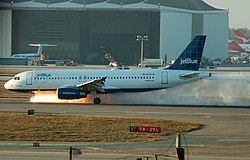
JetBlue Flight 292 makes an emergency landing at Los Angeles International Airport.

An emergency landing is a premature landing made by an aircraft in response to an emergency involving an imminent or ongoing threat to the safety and operation of the aircraft, or involving a sudden need for a passenger or crew on board to terminate the flight (such as a medical emergency). It typically involves a forced diversion to the nearest or most suitable airport or airbase, or an off airport landing or ditching if the flight cannot reach an airfield. Flights under air traffic control will be given priority over all other aircraft operations upon the declaration of the emergency.

Types

[edit]

There are several different types of emergency landings for powered aircraft: planned landing or unplanned landing.

  • Forced landing – the aircraft is forced to make a landing due to technical problems. Landing as soon as possible is a priority, no matter where, since a major system failure has occurred or is imminent. It is caused by the failure of or damage to vital systems such as engines, hydraulics, or landing gear, and so a landing must be attempted where a runway is needed but none is available. The pilot is essentially trying to get the aircraft on the ground in a way which minimizes the possibility of injury or death to the people aboard. This means that the forced landing may even occur when the aircraft is still flyable, in order to prevent a crash or ditching situation.
  • Precautionary landing may result from a planned landing at a location about which information is limited, from unanticipated changes during the flight, or from abnormal or even emergency situations. This may be as a result of problems with the aircraft, or a medical or police emergency. The sooner a pilot locates and inspects a potential landing site, the less the chance of additional limitations being imposed by worsening aircraft conditions, deteriorating weather, or other factors.
  • Ditching is the same as a forced landing, only on water. After the disabled aircraft makes contact with the surface of the water, the aircraft will most likely sink if it is not designed to float, although it may float for hours, depending on damage.

Procedures

[edit]

If there is no engine power available during a forced landing, a fixed-wing aircraft glides, while a rotary winged aircraft (helicopter) autorotates to the ground by trading altitude for airspeed to maintain control. Pilots often practice "simulated forced landings", in which an engine failure is simulated and the pilot has to get the aircraft on the ground safely, by selecting a landing area and then gliding the aircraft at its best gliding speed.

If there is a suitable landing spot within the aircraft's gliding or autorotation distance, an unplanned landing will often result in no injuries or significant damage to the aircraft, since powered aircraft generally use little or no power when they are landing. Light aircraft can often land safely on fields, roads, or gravel river banks (or on the water, if they are float-equipped); but medium and heavy aircraft generally require long, prepared runway surfaces because of their heavier weight and higher landing speeds. Glider pilots routinely land away from their base and so most cross-country pilots are in current practice.

UAV forced landing research

[edit]

Since 2003, research has been conducted on enabling unmanned aerial vehicles to perform a forced landing autonomously.[1]

Notable examples

[edit]

Large airliners have multiple engines and redundant systems, so forced landings are extremely rare for them, but some notable ones have occurred. A famous example is the Gimli Glider, an Air Canada Boeing 767 that ran out of fuel and glided to a safe landing in Gimli, Manitoba, Canada on July 23, 1983. In June 1982, British Airways Flight 9, a Boeing 747 en route from Kuala Lumpur to Perth flew into a plume of volcanic ash and lost power in all four engines, three of which subsequently recovered, eventually diverting to Jakarta. On April 28, 1988, Aloha Airlines Flight 243 experienced an explosive decompression when approximately 35 square metres (380 sq ft) of aluminium skin separated from the fuselage. The flight was successfully diverted to Kahului Airport with only one casualty, flight attendant Clarabelle "C.B." Lansing who was sucked out when the cabin depressurized.[2]

Flight 1549 landing on the waters of the Hudson River

Less than a month later, another 737, TACA Flight 110, lost both engines due to bad weather but was able to make a successful deadstick landing on a grass levee on the grounds of NASA's Michoud Assembly Facility outside New Orleans, with minor injuries to the passengers and minor damage to the aircraft. Investigations drove the engine manufacturer, CFM International, to modify the engine design to prevent future power loss.

One year later, United Airlines Flight 811, a Boeing 747, suffered a cargo door failure in-flight, separating a section of fuselage with 9 passengers and resulted in cabin depressurization. The plane made a successful emergency landing at Honolulu International Airport.[3] More recently, Air Transat Flight 236, an Airbus A330, ran out of fuel over the Atlantic Ocean on August 24, 2001, and made a successful forced landing in the Azores. On November 1, 2011, a Boeing 767 LOT Polish Airlines Flight 016 made a belly landing after a central hydraulic system failure at Warsaw, Poland's Frederic Chopin International Airport, with no injuries.[4]

A less successful crash landing involved Southern Airways Flight 242 on April 4, 1977. The DC-9 lost both of its engines due to hail and heavy rain in a thunderstorm and, unable to glide to an airport, made a forced landing on a highway near New Hope, Georgia, United States. The plane made a hard landing and was still carrying a large amount of fuel, so it burst into flames, killing the majority of the passengers and several people on the ground.

Airliners frequently make emergency landings, and almost all of them are uneventful. However, because of their inherent uncertain nature, they can quickly become crash landings or worse. Some notable instances include United Airlines Flight 232, which broke up while landing at Sioux City, Iowa, United States on July 19, 1989; and Air Canada Flight 797, which burned after landing at Cincinnati/Northern Kentucky International Airport on June 2, 1983, after a fire started in the cabin.

Shannon Airport in Ireland has a high number of emergency landings from trans-Atlantic flights, as it is the first major airport after the eastbound ocean crossing.[5][6]

On April 29, 2007, a bird was ingested into the right engine of a Boeing 757 departing Manchester (UK) airport, just as the plane rotated off the runway (flight Thomson 253H). The pilot subsequently made a successful precautionary landing.[7]

See also

[edit]

References

[edit]
Revisions and contributorsEdit on WikipediaRead on Wikipedia
from Grokipedia
An emergency landing is an unscheduled landing of an aircraft necessitated by a sudden and serious condition that compromises the safety of continued flight, such as engine failure, structural damage, severe weather, or medical emergencies, and may occur on or off an airport runway, including in fields, water, or other unprepared surfaces.[1][2] Emergency landings are categorized into three primary types based on the circumstances and available options. A forced landing requires an immediate touchdown, on or off an airport, due to the complete inability to continue flying, often resulting from total power loss or critical system failures.[3] A precautionary landing, in contrast, is a deliberate decision to land when further flight is possible but deemed unwise, such as due to deteriorating weather, low fuel, or minor malfunctions, allowing pilots to retain some control and power during the approach.[3][2] Finally, ditching refers to any forced or precautionary landing on water, which introduces unique hazards like waves and flotation requirements.[3][2] Despite their high-stakes nature, emergency landings reflect aviation safety protocols, with precautionary landings in general aviation showing a fatality rate of just 0.06 percent, while forced landings and ditchings have rates around 10 percent and 20 percent, respectively.[2]

Fundamentals

Definition

An emergency landing is a premature, unplanned landing of an aircraft necessitated by an imminent threat to the safety of the aircraft or its occupants, such as mechanical failure, medical emergencies, or environmental hazards, where the priority is to achieve ground contact as soon as possible, often under sub-optimal conditions.[1][3] Key characteristics of an emergency landing include the declaration of an emergency by the pilot, typically via a Mayday radio call to air traffic control, which signals grave and imminent danger and requests immediate assistance and priority handling.[4] This often results in a deviation from the planned flight route and may involve potential damage to the aircraft or injury to occupants, distinguishing it from routine landings by its high urgency and elevated risk level.[1][3] The definition encompasses various forms, such as on-airport, off-airport, and water landings (ditching).[1] Investigations into emergency landings that culminate in accidents or serious incidents are standardized internationally under ICAO Annex 13, first adopted by the ICAO Council on April 11, 1951, to ensure consistent procedures for determining causes and preventing recurrences.[5] Success rates—measured by minimal injury or damage—vary by aircraft type, with commercial airliners generally achieving higher outcomes than smaller general aviation planes due to robust design and support systems.[2]

Causes

Emergency landings in aviation are triggered by a range of factors that compromise the safety or operability of an aircraft, often necessitating immediate action to prevent further risk. These causes are typically classified into mechanical failures, medical emergencies, environmental hazards, human factors, and other incidents, with mechanical issues being among the most frequent according to aviation safety analyses.[6] Mechanical failures, such as engine shutdowns, hydraulic system malfunctions, or structural damage, frequently lead to emergency landings by impairing critical flight controls or propulsion. Engine failures can result from bird strikes, where birds are ingested into the engines, causing loss of thrust; fuel exhaustion due to miscalculations or leaks; or internal component breakdowns. A notable example is the 2009 incident involving US Airways Flight 1549, where a bird strike led to dual engine failure shortly after takeoff from New York, forcing a ditching on the Hudson River. Hydraulic issues may disable landing gear or flight surfaces, while structural damage from impacts or fatigue can compromise airframe integrity, all requiring pilots to select suitable landing sites promptly.[3][7] Medical emergencies involving passengers or crew members account for a significant portion of diversions, often involving sudden incapacitation that demands rapid descent and landing for treatment. Common scenarios include heart attacks, severe allergic reactions, or decompression sickness from cabin pressurization issues, with cardiac events being the leading cause of aircraft diversions in such cases, occurring in approximately 58% of in-flight medical emergencies that result in landings. As of 2025, in-flight medical emergencies occur in approximately 1 in 212 flights, though only 1.7-7% lead to full diversions, highlighting the role of onboard medical kits and crew training in mitigation.[8][9][10] Environmental hazards pose uncontrollable threats that can force emergency landings by affecting aircraft performance or visibility. Severe weather, including thunderstorms with high winds or lightning, icing that accumulates on wings and reduces lift, and turbulence causing structural stress or control difficulties, are primary culprits; turbulence is a leading cause of nonfatal injuries in commercial aviation. Volcanic ash clouds, which abrade windshields, engines, and instruments, have historically led to multiple engine failures and emergency descents, as seen in incidents where aircraft encountered ash plumes from eruptions. These factors underscore the importance of pre-flight weather monitoring to avoid hazardous conditions.[11][12] Human factors, though less common than mechanical or environmental issues, can precipitate emergency landings through errors or intentional acts that disrupt normal operations. Pilot error, such as misjudging fuel loads or failing to extend landing gear, contributes to around 80% of aviation incidents when combined with fatigue, stress, or communication breakdowns. Security-related events like hijackings or bomb threats, while rare in modern aviation—with global incidents dropping to near zero annually post-2001 due to enhanced screening—have historically forced diversions to secure locations, often involving coordinated ground responses.[13][14] Other causes include cargo fires from hazardous materials, sudden pressurization losses leading to hypoxia, navigation errors due to system glitches, and rare events like space debris impacts that damage critical components. These miscellaneous factors, while infrequent, can escalate quickly and require immediate landing protocols. Recent trends indicate a rise in bird strikes post-2020, with U.S. civil aircraft reporting 22,372 incidents in 2024—a 14% increase from 2023—attributed partly to resuming flight volumes after the COVID-19 downturn and urban expansion near airports attracting more wildlife.[15]

Types

On-Airport Landings

On-airport emergency landings occur when pilots elect or are compelled to touch down at a designated airport facility, typically involving a return to the departure airport after issues during takeoff or a diversion to the nearest suitable alternate airport. These scenarios prioritize rapid coordination to secure priority clearance, allowing the aircraft to bypass standard traffic queues and proceed directly to landing. For example, engine failure shortly after departure often prompts such returns or diversions to ensure controlled operations on prepared runways.[3][16] Air traffic control (ATC) plays a pivotal role by vectoring the aircraft toward the active runway, clearing all conflicting traffic, and initiating the deployment of emergency services such as rescue and firefighting teams upon declaration of the emergency. Pilots, in turn, configure the aircraft for the approach—often opting for high-speed landings to maintain momentum in cases of partial power loss or short-field techniques to utilize available runway length effectively—while adhering to ATC directives for separation and sequencing.[17][1][18] The primary advantages of on-airport landings include immediate access to full airport rescue and firefighting infrastructure, as well as smoother, paved surfaces that reduce the risk of structural damage or injury compared to unprepared sites. These factors contribute to exceptionally high success rates; for precautionary on-airport landings, where issues are anticipated in advance, the fatality rate stands at approximately 0.06 percent, reflecting near-total survivability in controlled environments.[2][19] Challenges in executing on-airport emergency landings encompass maneuvering through congested airspace, where multiple aircraft may complicate priority routing, and contending with suboptimal weather conditions at the target airport that could limit options for alternates. To mitigate low-visibility scenarios, standard protocols incorporate the Instrument Landing System (ILS), which provides precise vertical and lateral guidance to enable safe approaches down to runway visual ranges as low as 1,800 feet (550 meters) for Category I operations.[20][21][22]

Off-Airport Landings

Off-airport landings, also known as forced or precautionary landings away from established airfields, occur when pilots must select and utilize unprepared terrain due to emergencies such as engine failure or fuel exhaustion. These maneuvers demand rapid assessment and execution to prioritize occupant survival over aircraft preservation, contrasting with on-airport procedures that benefit from runways and air traffic control support. Pilots typically aim for sites that allow a controlled touchdown, using the aircraft's structure to absorb impact energy.[3][2] Site selection is critical and focuses on key criteria to maximize safety: sufficient length (ideally 500–1,000 feet for light general aviation aircraft), width to accommodate wingspan, minimal slope (flat or slightly downhill preferred to aid deceleration), and absence of obstacles like power lines, trees, or rocks. Suitable surfaces include open fields, highways, or beaches, with pilots prioritizing a clear approach path even if the touchdown area is imperfect; visual reconnaissance from the air, supplemented by GPS or onboard mapping tools, guides the choice. Proximity to populated areas is favored to facilitate post-landing assistance, while energy-absorbing features like tall crops or soft soil can mitigate impact forces. Hazards such as uneven ground, livestock, or foreign objects must be avoided, as they can exacerbate damage during rollout.[23][2][24] Techniques for off-airport landings emphasize minimizing groundspeed and impact severity, often involving a gear-up configuration on rough or soft terrain to prevent landing gear collapse and reduce the risk of the aircraft flipping or catching fire from ruptured fuel lines. Pilots execute a low-angle approach, touching down at the lowest controllable airspeed just above stall, with full flaps deployed for better control and a nose-high attitude to protect the propeller and cabin. These methods evolved from early 20th-century bush piloting in remote regions like Alaska, where pilots during and after World War II adapted improvised landings on gravel bars, beaches, and frozen surfaces without formal runways, honing skills in short-field operations and obstacle avoidance that remain foundational today. Survival gear, such as emergency kits with signaling devices and first-aid supplies, should be stowed aft to maintain balance and accessibility post-landing.[25][3][26][27][28] Risks in off-airport landings primarily stem from terrain irregularities, which can cause the aircraft to cartwheel, nosedive, or erupt in post-impact fire, compounded by factors like high sink rates or pilot hesitation leading to stalls. Federal Aviation Administration studies on general aviation indicate a fatality rate of approximately 10% for forced off-airport landings, implying a survival rate of about 90% when proper techniques are employed, though outcomes worsen in mountainous or obstructed areas due to delayed egress or injury from uneven surfaces. Psychological pressures, such as reluctance to commit to a site, further elevate hazards by prompting unsafe maneuvers.[3][2][29] Notable examples illustrate the challenges and successes of off-airport landings in remote settings, such as Alaskan wilderness operations where bush pilots routinely face engine-outs over tundra or rivers. Such incidents underscore the emphasis on carrying comprehensive survival equipment in high-risk areas, including cold-weather gear and emergency locators, to bridge the gap until help arrives.[30][31]

Ditching

Ditching refers to the controlled emergency landing of a land-based aircraft on a water surface, distinguishing it from planned water operations of seaplanes or amphibious aircraft.[32] The term "ditching" originated in the early era of aviation, particularly during the seaplane age and transoceanic flights of the 1930s and 1940s, when landplanes were forced to make unplanned water contacts akin to abandoning a vessel in a ditch.[32] Modern instances include commercial flights like Pan American World Airways Flight 6 in 1956, where a Boeing 377 Stratocruiser successfully ditched in the Pacific Ocean after engine failures, with all 31 aboard surviving.[33] Preparation for ditching emphasizes rapid cabin securing and passenger readiness to mitigate post-impact hazards. Crew instruct passengers to don life vests without inflating them until after exiting the aircraft, secure loose items to prevent injury during impact, and assume brace positions.[34][32] These protocols evolved significantly after World War II, informed by incidents involving Pan American's flying boat Clippers, such as the 1942 ditching of the Yankee Clipper, which highlighted the need for structured evacuation drills and improved fuselage integrity.[35] Ditching procedures focus on hydrodynamic stability to minimize structural damage and facilitate evacuation. Pilots approach parallel to swells or into the wind for optimal control, retracting landing gear and deploying full flaps to achieve a touchdown speed just above stall—typically 10-20% higher than normal landing speed to maintain lift without stalling.[34][3] Aircraft with hull-like designs, such as U.S. Navy flying boats from the mid-20th century (e.g., the PBY Catalina), exhibit superior flotation and reduced breakup risk compared to conventional landplanes due to their reinforced, boat-shaped fuselages.[36] Key risks during and after ditching include rapid sinking, often within minutes due to fuselage breaches, leading to drowning as the primary cause of fatalities.[37] Cold water immersion poses severe threats like hypothermia and cold shock, impairing escape and survival, while in tropical regions, shark encounters have historically compounded dangers amid blood and debris.[34][38] Survival rates for ditching events from 1989 to 2022 stand at approximately 76% overall, with 95% surviving the initial impact but post-evacuation factors determining outcomes; commercial jet ditchings, such as US Airways Flight 1549 in 2009, achieve near-100% survival when executed in populated areas with swift rescue.[37][39]

Procedures

Preparation

Upon identifying an emergency situation, such as engine failure or other critical malfunction, pilots immediately declare the nature of the distress to air traffic control (ATC) via radio to alert ground services and receive assistance. For conditions involving grave and imminent danger requiring immediate aid, the international distress signal "Mayday" is transmitted three times, followed by the aircraft's identification, current position, number of souls on board, and intended actions, such as the selected landing site. In cases of urgency where assistance is needed but the situation is not immediately life-threatening, the signal "Pan-Pan" is used in the same manner to indicate a potential emergency without full distress protocols.[17] Pilots then conduct a rapid systems assessment and configuration to optimize the aircraft for landing while minimizing risks. If sufficient time and altitude permit, fuel dumping is initiated to reduce the aircraft's weight, thereby lowering landing speed and the potential for post-impact fire, with systems designed to jettison fuel at a rate of at least 1% of maximum takeoff weight per minute from designated wing points. Aircraft controls are adjusted by extending flaps to increase lift and decrease stall speed for better maneuverability, and landing gear is prepared for deployment unless a gear-up landing is deemed safer for off-airport terrain, as per the aircraft flight manual. Simultaneously, the cabin crew briefs passengers on emergency procedures, instructing them to adopt brace positions—such as head down against the seatback, hands protecting the head, and feet flat on the floor—to reduce injury risk during impact.[40][3][41] Decision-making focuses on selecting the most suitable landing site within the aircraft's operational envelope, prioritizing factors like wind direction, terrain suitability, and obstacle clearance to ensure the safest possible outcome. For powered glides or remaining flight endurance, pilots calculate estimated endurance time (EET) using the formula EET = Fuel Remaining / Fuel Burn Rate, which helps determine reachable airports or fields before fuel exhaustion. This assessment adapts to the specific emergency trigger, such as engine failure limiting glide range, to identify options like nearby runways or open fields.[42][3] Crew coordination is critical under crew resource management (CRM) principles, where roles are clearly divided to maintain aircraft control and efficient response. The captain typically assumes the pilot flying (PF) role to direct the aircraft, while the first officer serves as pilot monitoring (PM), handling radio communications with ATC, executing checklists, and relaying updates. Cabin crew members manage passenger conduct, securing the cabin and preventing panic through calm instructions and monitoring for compliance with safety directives.[43]

Execution

The execution of an emergency landing encompasses the dynamic phases from the final approach to touchdown, emphasizing precise control to ensure a survivable outcome. During the approach phase, pilots establish a stabilized descent at the aircraft's best glide speed, which maximizes the lift-to-drag ratio to extend gliding range while conserving energy. For instance, in a Cessna 172, this speed is 65 knots indicated airspeed (KIAS), allowing the aircraft to cover approximately 1.5 nautical miles per 1,000 feet of altitude lost.[3] Energy management is paramount to prevent stalls, requiring pilots to avoid excessive deceleration or configuration changes that could reduce airspeed below this threshold, thereby maintaining a sink rate under 500 feet per minute for controllability.[3] Fundamental to this phase is the physics of gliding flight, where the glide ratio—defined as the horizontal distance traveled divided by the altitude lost—determines reachable landing sites. This ratio equals the maximum lift-to-drag (L/D) value, as lift balances weight and drag opposes forward motion in unpowered flight:
Glide Ratio=LD=Horizontal DistanceAltitude Loss \text{Glide Ratio} = \frac{L}{D} = \frac{\text{Horizontal Distance}}{\text{Altitude Loss}}
For light general aviation aircraft like the Cessna 172, the glide ratio is typically 8:1 to 9:1 at best glide speed. In commercial jets, it reaches 15:1 to 17:1, enabling extended glides from cruise altitudes; for example, a Boeing 747-200 can travel about 150 kilometers from 10,000 meters. Drag, governed by the equation $ D = \frac{1}{2} \rho V^2 C_D S $ (where ρ\rho is air density, VV is velocity, CDC_D is the drag coefficient, and SS is wing area), must be minimized relative to lift $ L = \frac{1}{2} \rho V^2 C_L S $ (with CLC_L as the lift coefficient) to achieve this efficiency.[44] As the aircraft transitions to touchdown, the pilot executes a controlled flare to minimize vertical speed and groundspeed, aiming for a flat attitude upon impact. Spoilers, if available on the aircraft, are deployed immediately after main gear contact to spoil lift and augment drag, reducing stopping distance.[45] Reverse thrust, standard on turbine engines, is engaged promptly following main gear touchdown to redirect exhaust forward, providing deceleration proportional to engine power; its effectiveness increases if deployed within seconds of wheels-on.[46] Gear extension timing is dictated by the landing surface: on soft or uneven terrain, a gear-up configuration may be selected to slide rather than snag, preserving structural integrity, while gear-down is preferred on firm runways to absorb initial impact and protect the fuselage.[3] Procedures vary by aircraft configuration. In single-engine aircraft, execution relies solely on aerodynamic gliding with no propulsion option, demanding immediate pitch adjustments to best glide upon power loss. Multi-engine aircraft protocols differ if only partial power is lost, involving shutdown of the failed engine and asymmetric thrust management, but revert to identical glide techniques in total power failure scenarios.[3] Post-2010 advancements have emphasized automation integration, such as autothrottle systems in modern airliners, which can maintain approach speeds autonomously during emergencies when pilots disengage other modes, enhancing precision under stress.[47] Execution adapts briefly for on-airport versus off-airport scenarios, with the former leveraging runway markings for alignment.[3]

Post-Landing

Following touchdown during an emergency landing, the primary focus shifts to rapid evacuation of the aircraft to minimize risks from potential fire, structural instability, or other hazards. Crew members initiate evacuation using designated slides, doors, or overwing exits, ensuring a headcount of all passengers and crew to account for everyone. Priority is given to assisting injured individuals first, with the goal of completing the evacuation within 90 seconds, as mandated by Federal Aviation Administration (FAA) certification standards under 14 CFR § 25.803, which require demonstration that an aircraft can be evacuated under simulated emergency conditions in this timeframe.[48] Hazard mitigation begins immediately upon stopping the aircraft, with pilots shutting down all engines and electrical systems to reduce the risk of ignition sources. Crews activate built-in or portable fire extinguishers if flames are present, targeting any visible fire at its base to prevent spread, while monitoring for fuel leaks or signs of structural collapse that could exacerbate dangers. These actions align with standard post-touchdown protocols outlined in the FAA's Airplane Flying Handbook, emphasizing the shutdown of systems to eliminate fire hazards after landing.[49] Coordination with external responders involves activating the emergency locator transmitter (ELT), which automatically triggers upon impact or can be manually engaged to broadcast distress signals on 406 MHz for search and rescue location via GPS coordinates. Crews may also deploy flares or other visual signals from survival kits to alert nearby rescuers, facilitating quicker arrival of emergency services. On-scene medical triage follows, where crew or first responders assess and prioritize victims based on injury severity—such as treating life-threatening conditions like severe bleeding or fractures before less critical issues—to optimize survival outcomes in the initial response phase.[50][51][52] Legally, operators must notify the National Transportation Safety Board (NTSB) immediately by telephone for accidents involving serious injury or substantial aircraft damage, followed by a written report on Form 6120.1 within 10 days, as required under 49 CFR Part 830; certain incidents, including forced landings, may necessitate reporting within 24 hours if they meet criteria for immediate notification. The classification of the event as a "forced landing" influences insurance implications, often triggering coverage for salvage, removal, and hull repairs under standard aviation policies that include forced landing clauses, without necessarily deeming it a total loss if takeoff is impossible post-incident.[53][54][55]

Training and Technology

Pilot and Crew Training

Pilot and crew training for emergency landings is governed by stringent regulatory frameworks to ensure proficiency in handling critical situations. In the United States, the Federal Aviation Administration (FAA) under 14 CFR Part 121 requires air carriers to implement recurrent training programs that include simulator sessions for emergency procedures, such as single-engine failures in multi-engine aircraft, conducted at least every 12 calendar months to maintain crew competence.[56] This training encompasses initial, transition, and recurrent phases, with emphasis on abnormal and emergency scenarios to simulate real-world failures like powerplant issues or system malfunctions.[57] Internationally, similar standards from the International Civil Aviation Organization (ICAO) Annex 6 mandate refresher training on emergency procedures, including coordination among crewmembers, integrated into ongoing qualification programs.[58] Training methods prioritize realistic replication of emergencies to build muscle memory and decision-making skills. Full-motion simulators, certified to FAA Level C or higher, are widely used to recreate scenarios such as engine-outs, rapid decompressions, or off-airport landings, allowing pilots to practice without risk to life or aircraft.[59] These devices provide six degrees of freedom in motion, visual cues, and auditory feedback to mimic the physical sensations of an actual emergency, enhancing spatial orientation and procedural adherence.[60] Crew Resource Management (CRM) is a core component, focusing on interpersonal communication, leadership, and threat/error management during high-stress events like forced landings; FAA Advisory Circular 120-51D outlines its integration into simulator sessions to foster effective team dynamics.[43] This approach reinforces non-technical skills, such as situational awareness and workload distribution, which are critical for successful outcomes in dynamic emergencies.[61] Certification processes for pilots include demonstrations of emergency procedures as part of type ratings and ongoing qualifications. The FAA's Airline Transport Pilot (ATP) Airplane Airman Certification Standards (ACS) requires candidates to explain and execute emergency procedures, including those for engine failure and ditching, during practical tests in simulators or aircraft.[62] Recurrent training, mandated every 6 to 12 months depending on the operation and carrier program, ensures sustained proficiency through proficiency checks that cover emergency landings and evacuations.[63] These requirements apply to both pilots and cabin crew, with emergency training repeated at least every 24 months under Part 121 to cover assignments like fire suppression and evacuation coordination.[64] However, challenges persist for low-hour pilots, where gaps in experience can affect performance; post-2022 advancements in virtual reality (VR) technology have addressed this by enabling immersive, cost-effective practice of emergency procedures, leading to faster skill acquisition and higher confidence levels in initial flights.[65] VR systems, integrated into ab initio training, allow repeated exposure to rare events like engine failures without aircraft usage, bridging experience deficits for novice crews.[66]

Aircraft and System Features

Modern commercial aircraft incorporate multiple layers of redundancy in their hydraulic and electrical systems to ensure continued operation during emergencies, such as power loss that could necessitate an emergency landing. Large transport-category airplanes typically feature two to four independent hydraulic systems, each powered by dedicated pumps and capable of operating essential flight controls, landing gear, and brakes even if one or more systems fail. [67] Electrical redundancy includes multiple engine-driven generators, auxiliary power units, and battery backups to maintain critical avionics and instruments. [67] In cases of total power failure, a ram air turbine (RAT) automatically deploys from the fuselage, using airflow to generate hydraulic pressure and electrical power for primary flight controls and basic instrumentation, enabling pilots to execute a controlled descent and landing. [68] Aircraft certified for overwater operations are equipped with specialized emergency gear to support survivability during ditchings or off-airport landings. Life rafts, stowed adjacent to usable exits, must accommodate all occupants with excess capacity to account for potential loss of one unit, and include survival kits with emergency locator transmitters (ELTs) for rapid rescue signaling. [69] Fire suppression systems, such as halon agents in engine nacelles and smoke detectors in cargo holds and lavatories, activate automatically to contain outbreaks that could complicate landings. [70] Fuselage designs undergo ditching certification under FAR 25.801, requiring structural integrity to withstand water impacts with vertical descent rates up to 3 m/s and horizontal speeds up to 9 m/s, decelerations up to 15g, minimizing breach risks and ensuring occupant flotation for at least 2 minutes to allow evacuation. [71][72] Automation features in contemporary jets enhance precision during high-stress emergency scenarios. Autoland systems, standard on aircraft like the Boeing 787, use dual autopilots, radio altimeters, and instrument landing systems to fully automate approaches and touchdowns in low-visibility conditions, reducing pilot workload for potential emergency diversions. [73] Integrated auto-brake functionality on the 787 applies maximum deceleration upon wheel spin-up, coordinated with spoilers and reverse thrust for shorter stopping distances on contaminated runways. [73] The ground proximity warning system (GPWS), evolved into terrain awareness and warning systems (TAWS), provides aural and visual alerts for imminent terrain conflicts, prompting immediate pull-up maneuvers to avert controlled flight into terrain during off-airport landings. [74] These features have evolved significantly since the 1970s, driven by lessons from major accidents. The 1977 Tenerife runway collision, the deadliest in aviation history, prompted regulatory mandates for standardized phraseology and crew resource management, indirectly bolstering system reliability by improving overall operational safety. [75] Subsequent enhancements, including mandatory GPWS installation by the late 1970s and reinforced fuselage crashworthiness standards, addressed vulnerabilities exposed in earlier incidents. By 2025, European Union Aviation Safety Agency (EASA) standards integrate AI-driven predictive maintenance into continuing airworthiness programs, using machine learning to forecast system failures and preempt emergencies through real-time data analysis from onboard sensors. [76]

Research and Innovations

UAV and Autonomous Systems

Unmanned aerial vehicles (UAVs) and autonomous systems encounter unique challenges during emergency landings, primarily due to the lack of an onboard pilot capable of making real-time decisions. These platforms must depend entirely on autonomous algorithms and pre-programmed protocols to manage critical failures, such as rapid battery drain or sudden GPS signal loss, which can compromise navigation and energy estimation for safe descent.[77][78] Battery limitations, often restricting flight times to 20-30 minutes, exacerbate the risk of uncontrolled power loss, while GPS denial—due to jamming or urban interference—forces reliance on inertial measurement units (IMUs) and vision-based alternatives for positioning.[79] These issues demand robust, low-latency autonomy to prevent crashes, as human intervention via remote control may be delayed or infeasible in beyond-visual-line-of-sight (BVLOS) operations.[80] To address these challenges, UAV emergency landing methods emphasize rapid, automated interventions like parachute deployment and autorotation for rotorcraft designs. Parachute systems, often rocket-assisted for quick inflation, enable controlled descent from altitudes up to 400 feet, minimizing impact damage and protecting payloads in fixed-wing or multirotor UAVs.[81][82] For rotary-wing UAVs, autorotation allows unpowered glides by leveraging rotor inertia to generate lift, a technique adapted from helicopter practices and tested in small UAS for energy-efficient emergency descents.[83] Research from DARPA's 2010s initiatives, including the 2010 flight tests under the Engine Monitoring and Management System (EMMS) program, demonstrated engine-out landing capabilities for UAVs, achieving successful recoveries in simulated damage scenarios to enhance survivability.[84] Regulatory frameworks mandate pre-programmed failsafes to ensure UAV safety during emergencies. Under FAA Part 107, remote pilots in command must prioritize safe landings in in-flight emergencies, and many systems include lost-link procedures such as return-to-home (RTH) functions that autonomously navigate to a designated site upon signal loss.[85][86] In the European Union, 2022 updates to EASA regulations (via Regulation (EU) 2019/947) enforce geo-awareness through digital geographical zone data, enabling geofencing to restrict operations near hazards and guide autonomous rerouting to safe landing areas during failures.[87][88] Case studies highlight the efficacy of these approaches in practical settings. In urban tests of vision-based autonomous landing systems for commercial drones like those from DJI, success rates exceeded 90% in cluttered environments, demonstrating reliable obstacle avoidance and precise touchdown via onboard cameras and AI processing.[89] Military UAV recoveries, such as those using parachute systems in battlefield simulations, have achieved near-100% deployment success, allowing safe retrieval of assets like the RQ-20 Puma during operations in contested areas.[90][91]

Emerging Technologies

Emerging technologies in emergency landing focus on enhancing prediction, resilience, and precision to mitigate risks in aviation scenarios. Artificial intelligence (AI) and machine learning (ML) are advancing predictive analytics to detect potential failures early, while advanced materials aim to improve aircraft survivability during impacts. Sensor fusion techniques integrate multiple data sources for better site selection, and climate-adaptive innovations address rising weather-related threats, such as intensified turbulence. These developments, primarily in research and prototype stages, build on foundational autonomous systems to improve outcomes across manned and unmanned aircraft.[92] AI and ML enable predictive analytics for failure detection, allowing systems to anticipate issues like engine degradation or structural weaknesses before they necessitate an emergency landing. For instance, ML models analyze sensor data to estimate remaining useful life (RUL) of components and detect anomalies in real-time, reducing the likelihood of sudden failures.[93] NASA's research on ML-based autonomous emergency braking systems demonstrates how deep neural networks can process visual data to initiate safe descents, enhancing safety in critical situations.[92] Similarly, AI algorithms for engine failure prediction use historical and real-time data to forecast risks, with applications tested in predictive maintenance programs that could extend to emergency protocols.[93] These tools, often integrated into flight management systems, prioritize early intervention to guide pilots toward safer landing options. Advanced materials, particularly self-healing composites, are being developed to withstand impacts during emergency landings, repairing minor damage autonomously to maintain structural integrity. NASA's healable carbon fiber reinforced composites exhibit rapid self-repair after low- to mid-velocity impacts, retaining mechanical strength without external intervention.[94] Research at institutions like the University of Alabama focuses on integrating damage-detection sensors with self-healing polymers, enabling aircraft to heal microcracks from hail or bird strikes, which are common in forced landings.[95] A 2024 review highlights how these polymers, with low environmental impact, improve impact resistance in aviation structures, potentially reducing post-landing casualties.[96] European projects under Horizon Europe are testing such materials for hail resistance, aiming for composites that recover up to 90% of original strength after impact.[97] Sensor fusion combining LiDAR, GPS, and inertial systems supports precise emergency landing site selection by generating real-time 3D terrain maps and obstacle avoidance data. In eVTOL prototypes, LiDAR-assisted algorithms optimize terrain-aided navigation, enabling autonomous identification of safe landing zones in urban or unprepared areas with centimeter-level accuracy.[98] NASA's datasets for eVTOL approaches integrate visual, inertial, and GPS inputs to simulate emergency descents, improving fusion models for low-altitude operations.[99] These technologies, as seen in ongoing UAV research, enhance site evaluation by factoring in slope, vegetation, and wind, minimizing risks during unplanned landings.[100] Climate-adaptive technologies counter the increasing frequency of weather-induced emergencies, such as severe turbulence linked to climate change, which has risen by up to 55% in some corridors since 1979. AI-driven turbulence forecasting tools allow real-time route adjustments, integrating satellite and radar data to avoid hazardous zones and prevent forced descents.[101] ICAO's adaptation strategies emphasize resilient infrastructure and predictive modeling to handle extreme events like icing or storms, with post-2020 research focusing on ML for clear-air turbulence detection.[102] These advancements, including enhanced weather sensor integration, aim to mitigate weather-related emergency landing risks.[103]

Notable Examples

Historical Cases

One of the earliest notable examples of emergency landing challenges in aviation history occurred during Charles Lindbergh's pioneering flights in the 1920s, where fuel exhaustion forced multiple unplanned landings, underscoring the risks of long-distance travel with limited refueling capabilities. In his 1927 solo transatlantic attempt, while not resulting in a forced landing, Lindbergh's meticulous fuel management—carrying over 450 gallons in custom tanks—highlighted the critical need for precise calculations to avoid exhaustion mid-flight, influencing early standards for overwater navigation.[104] During World War II, numerous bomber ditchings in the Pacific Ocean exemplified the perils of emergency water landings for military aircraft. For instance, B-29 Superfortress crews often faced engine failures over vast expanses, leading to controlled ditchings where survival rates varied widely due to rough seas and delayed rescues; historical accounts note that while some crews, like those in 1945 incidents off Saipan, survived intact, many others perished from exposure or shark attacks, prompting initial advancements in life raft deployment and signaling equipment.[105] These events, involving thousands of overwater operations, revealed recurring themes of fuel and mechanical failures, shaping post-war ditching protocols for both military and civilian aviation.[106] A landmark civilian case was the 1956 ditching of Pan American World Airways Flight 6, a Boeing 377 Stratocruiser en route from Honolulu to San Francisco, which lost two engines due to overspeed and fuel issues, forcing a controlled water landing in the Pacific. All 31 aboard survived, aided by calm seas and rapid U.S. Coast Guard rescue via the cutter Pontchartrain, but the incident exposed vulnerabilities in multi-engine reliability and evacuation procedures, leading to enhanced FAA guidelines on ditching simulations and emergency flotation gear.[107] This event provided key survival lessons, including the importance of maintaining airspeed during descent, that informed design changes in subsequent airliners.[33] In 1983, Air Canada Flight 143, dubbed the "Gimli Glider," experienced total fuel exhaustion mid-flight from Montreal to Edmonton due to a miscalculation in metric-to-imperial fuel conversion, causing both engines to fail at 41,000 feet. The crew successfully glided the Boeing 767 over 75 miles to a dead-stick landing on the abandoned Gimli runway in Manitoba, with no fatalities among the 69 aboard, though the aircraft skidded into a barrier.[108] The Canadian Aviation Safety Board investigation revealed systemic errors in fuel gauging and training, resulting in industry-wide reforms such as standardized fuel quantity indication systems on Boeing aircraft and mandatory dual-unit verification protocols to prevent similar conversion mishaps. Similarly, Air Transat Flight 236 in 2001 faced a fuel leak from a fractured line—due to improper maintenance—causing both engines on the Airbus A330 to flame out over the Atlantic while en route from Toronto to Lisbon. Captain Robert Piché and First Officer Dirk DeJager glided the aircraft 65 nautical miles to a safe landing at Lajes Air Base in the Azores, saving all 306 people on board.[109] The Transportation Safety Board of Canada report emphasized maintenance oversight flaws, leading to global regulatory updates on fuel system inspections and high-pressure line integrity checks for wide-body jets.[110] These historical cases collectively drove significant aviation safety enhancements, particularly in fuel management and ditching techniques, contributing to a marked decline in emergency landing fatality rates from the mid-20th century onward; for example, U.S. commercial fatal accident rates dropped from about 40 per million departures in 1959 to under 2 by 1969, partly through lessons on precise fueling and crew resource management derived from such incidents.[111] Pre-2000 analyses indicate that procedural reforms inspired by events like the Gimli Glider and Pan Am ditching reduced overall risks in overwater operations, though exact attribution varies, with general aviation forced landing survivability improving through better training and equipment.[112]

Recent Incidents

One of the most notable emergency landings in the early 2000s occurred on January 15, 2009, when US Airways Flight 1549, an Airbus A320, ditched in the Hudson River shortly after takeoff from New York LaGuardia Airport due to a bird strike causing dual engine failure. All 155 passengers and crew survived with only minor injuries, thanks to the pilots' rapid decision-making and the aircraft's successful water landing, an event dubbed the "Miracle on the Hudson."[7] The incident highlighted advancements in crew resource management and led to enhanced FAA guidelines on bird strike mitigation for commercial aircraft.[7] In 2010, Qantas Flight 32, an Airbus A380 en route from Singapore to Sydney, experienced an uncontained engine failure in one of its Rolls-Royce Trent 900 engines shortly after takeoff, resulting in debris damage to the fuselage, wings, and fuel systems. The crew safely returned to Singapore's Changi Airport, where the aircraft landed without further incident, and all 469 people on board emerged uninjured. The Australian Transport Safety Bureau's investigation emphasized the effectiveness of the aircraft's redundant systems and crew training in averting disaster.[113] The 2020s have seen continued challenges, exemplified by the August 7, 2020, overrun of Air India Express Flight 1344, a Boeing 737-800, at Kozhikode Airport in India during heavy rain. The aircraft veered off the tabletop runway, fell into a 30-foot gorge, and broke apart, killing 21 of the 190 people on board, including both pilots. The Aircraft Accident Investigation Bureau attributed the crash primarily to pilot error in landing long amid poor weather, compounded by the airport's challenging terrain. This tragedy prompted 43 safety recommendations, influencing India's Directorate General of Civil Aviation to issue stricter runway safety protocols, including enhanced wet runway friction assessments and mandatory grooving standards by 2025.[114][115] Another significant 2020s event involved LATAM Airlines Flight 800, a Boeing 787-9 flying from Sydney to Auckland on March 11, 2024, which encountered a sudden mid-flight drop due to a technical fault, injuring 50 of the 272 people on board, with 12 requiring hospitalization after landing. Passengers and crew were thrown against the ceiling during the incident, underscoring vulnerabilities to in-flight disruptions despite seatbelt usage. The Chilean Directorate General of Civil Aeronautics investigated the event, focusing on the aircraft's movement control systems.[116] Overall trends in emergency landings since 2000 reflect marked improvements in survival rates for commercial jet operations, exceeding 95% in survivable incidents, driven by technological advancements like improved engine reliability and structural integrity. Airbus data from 1958 to 2024 indicates a 65% decline in fatal accident rates over the past two decades, with emergency landings benefiting from enhanced automation and materials.[117] However, traditional encyclopedic coverage often overlooks recent 2023-2025 incidents in emerging sectors, such as the July 30, 2023, incident with Vertical Aerospace's VX4 eVTOL prototype due to loss of control from uncommanded collective pitch increase during testing in the UK, resulting in a hard landing and pilot injury.[118] These cases highlight ongoing certification challenges for electric vertical takeoff and landing vehicles. Key lessons from these incidents include a growing emphasis on post-event mental health support for crews, as pilots can experience PTSD, anxiety, and survivor guilt following high-stress emergencies. Aviation organizations like the Flight Safety Foundation advocate for peer support programs and routine psychological debriefings to address these risks. Additionally, the International Civil Aviation Organization's 2025 Safety Report identifies adverse weather—such as turbulence and reduced visibility—as the leading cause of global aviation incidents, accounting for over 30% of reported events in commercial operations from 2019 to 2024, prompting renewed focus on forecasting technologies.[119][120]

References

User Avatar
No comments yet.