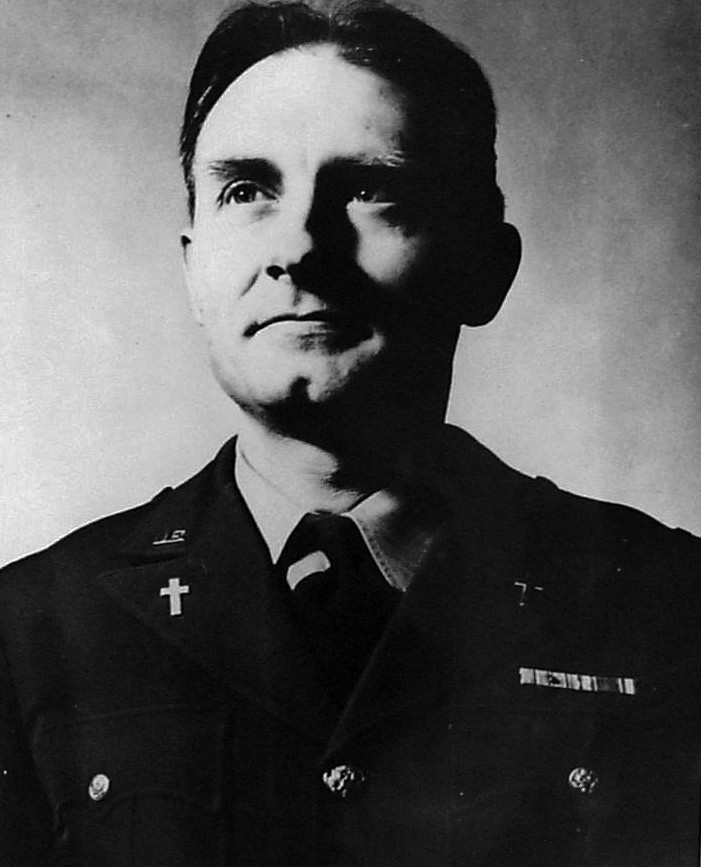

Emil Kapaun
View on Wikipedia
Emil Joseph Kapaun (April 20, 1916 – May 23, 1951) was an American Catholic priest and United States Army captain who served as a chaplain during World War II and the Korean War.
Key Information


Kapaun was a chaplain in the Burma Theater of World War II, then served again as a chaplain with the U.S. Army in Korea, where he was captured. He died in a prisoner of war camp. In 2013, Kapaun posthumously received the Medal of Honor for his actions in Korea. He is the ninth American military chaplain awarded the Medal of Honor. The Defense POW/MIA Accounting Agency (DPAA) announced Kapaun's body was accounted for on March 2, 2021.[4]
In 1993, Pope John Paul II declared him a Servant of God, the first stage on the path to canonization in the Catholic Church. In 2025, Pope Francis declared him Venerable, the next stage on the path to canonization.[5]
Early life
[edit]Emil Joseph Kapaun was born on April 20, 1916, and grew up on a farm 3 miles (4.8 km) southwest of Pilsen, Kansas, on rural 260th Street of Marion County, Kansas.[3][6] His parents, Enos and Elizabeth (Hajek) Kapaun, were Czech immigrants.[7][8] He graduated from Pilsen High School in May 1930.[9] Kapaun also graduated from Conception Abbey seminary college (College of New Engleberg; Conception Seminary College) in Conception, Missouri, in June 1936 and Kenrick Theological Seminary in St. Louis, Missouri, in 1940.
Priesthood
[edit]On June 9, 1940, Kapaun was ordained a Catholic priest of the Diocese of Wichita by Bishop Christian Herman Winkelmann at what is now Newman University in Wichita, Kansas. He celebrated his first Mass at St. John Nepomucene Catholic Church in Pilsen, Kansas. In January 1943, Kapaun was appointed auxiliary chaplain at the Herington Army Airfield near Herington, Kansas.[6]
U.S. Army service
[edit]World War II
[edit]Kapaun entered the U.S. Army Chaplain School at Ft. Devens, Massachusetts in August 1944, and after graduating in October began his military chaplaincy at Camp Wheeler, Georgia. He and one other chaplain ministered to approximately 19,000 servicemen and women.[9] He was sent to India and served in the Burma Theater from April 1945 to May 1946.[6] He ministered to U.S. soldiers and local missions, sometimes traversing nearly 2,000 miles (3,200 km) a month by jeep or airplane.[10] He was promoted to captain in January 1946.[6] He was released from active duty in July 1946. Under the G.I. Bill, he earned a Master of Arts degree in Education at the Catholic University of America in February 1948.[11][12] In September 1948, he returned to active duty in the U.S. Army and resumed his chaplaincy at Fort Bliss near El Paso, Texas. In December 1949, Kapaun left his parents and Pilsen for the last time, bound for Japan.[6]
Occupation of Japan
[edit]In January 1950, Kapaun became a chaplain in the 8th Cavalry Regiment, 1st Cavalry Division, often performing battle drills near Mount Fuji, Japan.[10] On July 15, 1950, the 1st Cavalry Division embarked and left Tokyo Bay sailing for Korea, less than a month after North Korea invaded South Korea, setting off the Korean War.[9]

Korean War
[edit]1st Cavalry Division
[edit]The 1st Cavalry Division made the first amphibious landing in the Korean War on July 18, 1950. The Division was soon moved up to help slow the North Korean Korean People's Army (KPA)'s advance until more reinforcements could arrive. The division engaged in several skirmishes with the KPA but had to retreat each time. Kapaun and his assistant learned of a wounded soldier stranded by enemy machine gun and small arms fire during one of these retreats. Knowing that no litter bearers were available, the two braved enemy fire and saved the man's life, for which Kapaun was awarded the Bronze Star Medal with a "V" device for valor.
The KPA drove the U.S. forces back into a perimeter around the port city of Pusan. Kapaun continued to make the rounds to encourage and pray with the troops of the 8th Regiment.[13] His main complaint was lack of sleep for several weeks at a time.[9] Finally, in mid-September and after the landing at Inchon, Kapaun and the rest of the United Nations Command forces broke out of the perimeter and pursued the KPA northward. On October 9, the division crossed the 38th parallel into North Korea, capturing the capital of Pyongyang and advancing to within 50 miles (80 km) of the Chinese border.
Throughout the months of fighting, Kapaun gained a reputation for bravely serving the troops, rescuing the wounded and dead, and ministering to the living by performing baptisms, hearing confessions, offering Holy Communion and celebrating Mass on an improvised altar set up on the front end of a Jeep. Several times his Mass kit Jeep and trailer were destroyed by enemy fire. In letters home, he shared that he was thoroughly convinced other soldiers' prayers helped him survive.
Prisoner of war
[edit]The United Nations forces progressed northward but were met by a surprise intervention by the Chinese People's Volunteer Army (PVA). The first engagement with this new enemy took place at the Battle of Unsan near Unsan, North Korea, on November 1–2, 1950.[14][15] Nearly 20,000 PVA soldiers attacked Kapaun's 8th Cavalry Regiment. Despite pleas for him to escape, he stayed behind with 800 men of the 3rd Battalion as the rest of the regiment retreated. During the battle, he braved enemy fire and rescued nearly 40 men, for which he was later awarded the Medal of Honor. The U.S. 5th Cavalry Regiment attempted several times to rescue the beleaguered 3rd Battalion, but was unsuccessful. Kapaun and other members of the 3rd Battalion were taken prisoner and marched 87 miles (140 km) to a temporary prison camp at Sombakol, near the permanent camp (Prison Camp 5) at Pyoktong in North Korea, where they were later held.[16] Kapaun was able to persuade some prisoners, who had ignored orders from officers, to carry the wounded.[16][17]
In the prison camp, sometimes up to two dozen men died each day from malnutrition, disease, lice, and extreme cold. Kapaun refused to give in to despair. He dug latrines, mediated disputes, gave away his food and raised morale.[18][19] He was noted among his fellow POWs as one who would steal food for the men to eat. He also stood up to communist indoctrination, smuggled dysentery drugs to the doctor, Sidney Esensten, and led the men in prayer.[20]
Death and burial
[edit]Kapaun developed a blood clot in one of his legs, besides having dysentery and pneumonia.[21] Weakened as the months passed, he managed to lead an Easter sunrise service on Sunday, March 25, 1951.[22]
He was so weak the prison guards took him to a place in the Pyoktong camp they called the "hospital," where he died of malnutrition and pneumonia on May 23, 1951. It was originally reported Father Kapaun was buried in a mass grave near the Yalu River.[9] However, in 2005 one of Kapaun's fellow POWs, William Hansen, said he and other prisoners had buried Kapaun separately in a single grave on higher ground, marking the gravesite with stones.[23]
He was one of twelve chaplains to die in Korea. Four U.S. Army chaplains were taken prisoner in 1950, all of whom died while in captivity.[24]
As part of the 1953 Korean Armistice Agreement, Kapaun's remains were among the 1,868 returned to U.S. custody in Operation Glory, although they could not be identified. His remains were buried at the National Memorial Cemetery of the Pacific (NMCP) in Honolulu, Hawaii, around 1956. His remains were disinterred and identified as part of the Defense POW/MIA Accounting Agency’s Korean War Disinterment Project, a seven-phase plan begun in 2018, to disinter all remaining Korean War Unknowns from the NMCP.[25][26]
On March 4, 2021, U.S. senator Jerry Moran and the Catholic Diocese of Wichita confirmed the remains of Emil Kapaun were identified.[27]
On September 29, 2021, a Mass of Christian Burial was held in Kapaun's home state of Kansas at the Hartman Arena in Park City, near Wichita.[28] Afterwards, a horse-drawn caisson carried his remains to the Cathedral of the Immaculate Conception in Wichita, where he was buried with full military honors inside the church.
Citations
[edit]Medal of Honor
[edit]
On August 18, 1951, he was posthumously awarded the Distinguished Service Cross for extraordinary action on November 1–2, 1950.[29] However, his fellow soldiers and POWs felt Kapaun deserved the Medal of Honor. In 2001, U.S. representative Todd Tiahrt began a campaign to award the Medal of Honor to Kapaun.[30] Before leaving office on September 16, 2009, Secretary of the Army Pete Geren sent Tiahrt a letter, agreeing Kapaun was worthy of the honor. Admiral Michael Mullen, Chairman of the Joint Chiefs of Staff, also agreed.
The National Defense Authorization Act for Fiscal Year 2012 (Senate Bill 1867, Section 586) contained an authorization and a request to the president to upgrade Kapaun's Distinguished Service Cross to the Medal of Honor for acts of bravery during the Battle of Unsan on November 1–2, 1950, and while a prisoner of war until his death on May 23, 1951.[31] President Obama presented the medal awarded on behalf of Kapaun to Kapaun's nephew at the White House on April 11, 2013.[32][33]
His Medal of Honor citation reads:[34]
The President of the United States of America, authorized by Act of Congress, March 3, 1863, has awarded in the name of Congress the MEDAL OF HONOR to
CHAPLAIN (CAPTAIN) EMIL. J, KAPAUN
UNITED STATES ARMYfor conspicuous gallantry and intrepidity at the risk of his life above and beyond the call of duty:
Chaplain Emil J. KAPAUN distinguished himself by acts of gallantry and intrepidity above and beyond the call of duty while serving with the 3rd Battalion, 8th Cavalry Regiment, 1st Cavalry Division during combat operations against an armed enemy at Unsan, Korea, from November 1–2, 1950. On November 1, as Chinese Communist Forces viciously attacked friendly elements, Chaplain KAPAUN calmly walked through withering enemy fire in order to provide comfort and medical aid to his comrades and rescue friendly wounded from no-man's land. Though the Americans successfully repelled the assault, they found themselves surrounded by the enemy. Facing annihilation, the able-bodied men were ordered to evacuate. However, Chaplain KAPAUN, fully aware of his certain capture, elected to stay behind with the wounded. After the enemy succeeded in breaking through the defense in the early morning hours of November 2, Chaplain KAPAUN continually made rounds, as hand-to-hand combat ensued. As Chinese Communist Forces approached the American position, Chaplain KAPAUN noticed an injured Chinese officer among the wounded and convinced him to negotiate the safe surrender of the American Forces. Shortly after his capture, Chaplain KAPAUN, with complete disregard for his personal safety and unwavering resolve, bravely pushed aside an enemy soldier preparing to execute Sergeant First Class Herbert A. Miller. Not only did Chaplain KAPAUN'S gallantry save the life of Sergeant Miller, but also his unparalleled courage and leadership inspired all those present, including those who might have otherwise fled in panic, to remain and fight the enemy until captured. Chaplain KAPAUN'S extraordinary heroism and selflessness, above and beyond the call of duty, are in keeping with the highest traditions of military service and reflect great credit upon himself, the 3rd Battalion, 8th Cavalry Regiment, the 1st Cavalry Division, and the United States Army.
Barack Obama
Legion of Merit
[edit]Whereas the Medal of Honor is an award given to recognize extraordinary courage during battle, the Legion of Merit is awarded not primarily for heroism, but for exceptionally meritorious service in some other capacity. It was awarded to Chaplain Kapaun in recognition for his extraordinary actions as a prisoner of war, even while sick and suffering himself.
The President of the United States of America, authorized by Act of Congress July 20, 1942, has awarded the Legion of Merit, posthumously, to
CHAPLAIN (CAPTAIN) EMIL. J, KAPAUN, USAfor exceptionally meritorious conduct in the performance of outstanding services:
Chaplain (Captain) Emil J. Kapaun, Chaplains, United States Army, a member of the 8th Cavalry Regiment, 1st Cavalry Division, distinguished himself by exceptionally meritorious service while a prisoner of war at Pyoktong, Korea, from November 4, 1950, to May 23, 1951. Though seriously ill during the entire period of his internment, he continuously and unselfishly cared for fellow prisoners, sought food and clothing and daily conducted Catholic and general services under exceptionally difficult circumstances. By his material assistance to interned doctors, and through the unhesitating performance of the most menial tasks, the death rate in the camp was held at a rate far lower than another nearby camp under similar conditions. Chaplain Kapaun's spiritual guidance assisted many to defy communist instructions and maintain the hope necessary to remain alive, and physically and mentally to withstand Communists' brutalities. Chaplain Kapaun's outstanding religious and humanitarian activities and determination of purpose resulted in a marked benefit to other internees reflecting great credit upon himself and the military service.
— Legion of Merit Citation, Official Military Personnel File for Emil J. Kapaun, p. 587 https://catalog.archives.gov/id/57289559
Bronze Star Medal
[edit]Kapaun was awarded the Bronze Star Medal with "V" Device on September 2, 1950, for his actions on August 2, 1950:[35]
HEADQUARTERS 1ST CAVALRY DIVISIONSeptember 2, 1950AWARD OF THE BRONZE STAR MEDAL – By direction of the President under the provisions of Executive Order 9419, and pursuant to the authority contained in AR-600-45, the Bronze Star Medal with "V" Device for heroic achievement in connection with military operations against an enemy of the United States is awarded the following named officer:
CHAPLAIN (CAPTAIN) EMIL J. KAPAUN 0558217, CHAPLAIN CORPS, UNITED STATES ARMY, a member of Headquarters and Headquarters Company, 8th Cavalry Regiment, 1st Cavalry Regiment, displayed heroism in action against the enemy near Kumchung, Korea on August 2, 1950. Chaplain KAPAUN received information that there was a wounded man in an exposed position on the left flank of the first battalion that could not be removed as there were no litter bearers available. Chaplain KAPAUN, together with another officer, immediately proceeded to the front lines, where he contacted the Battalion Commander in order to obtain the approximate location of the wounded man. With total disregard for personal safety, Chaplain KAPAUN and his companion went after the wounded man. The entire route to the wounded soldier was under intense enemy machinegun and small arms fire. However, Chaplain KAPAUN successfully evacuated the soldier, thereby saving the soldier. This heroic action on the part of Chaplain KAPAUN reflects great credit on himself and the military.
BY COMMAND OF MAJOR GENERAL GAY
Taegeuk Order of Military Merit (Republic of Korea)
[edit]Kapaun was awarded the Taegeuk Order of Military Merit from President Moon Jae-in on behalf of the Republic of Korea on July 27, 2021. This is the highest military recognition awarded by the Republic of Korea.[36]
Awards and Decorations
[edit]Kapaun's Distinguished Service Cross was upgraded by the U.S. Army to the Medal of Honor on April 11, 2013. He was awarded the following U.S and foreign military awards:[37][38][39]

|

| |
  |

|

|

|
  |

|

|

|
 |

|

|

|

|

|
| 1st row | Medal of Honor
Upgraded from Distinguished Service Cross in 2012 |
Legion of Merit | ||
|---|---|---|---|---|
| 2nd row | Bronze Star Medal
with "V" Device |
Purple Heart | Prisoner of War Medal
Retroactively Awarded, 1986 | |
| 3rd row | American Campaign Medal | Asiatic-Pacific Campaign Medal
with 1 Campaign star |
World War II Victory Medal | |
| 4th row | Army of Occupation Medal
with 'Japan' clasp |
National Defense Service Medal | Korean Service Medal
with 2 Campaign stars | |
| 3rd row | United Nations Service Medal Korea | Korean War Service Medal
Retroactively Awarded, 2003 |
Order of Military Merit
Taeguk Cordon Medal | |
| Presidential Unit Citation | Korean Presidential Unit Citation | |||
Cause of beatification and canonization
[edit]The following is a general narrative from the many reports of Kapaun's ordeal as a prisoner of war given by many repatriated American soldiers after their release from prison camps. He was most remembered for his great humility, bravery, constancy, love, kindness, and solicitude for his fellow prisoners. "He was their hero... their admired and beloved "padre." He kept up the POWs' morale, and most of all, helped a lot of men to become good Catholics." Reports noted Kapaun's feet had become badly frozen, but he continued to administer to the sick and wounded. He continuously went out under heavy mortar and shelling to rescue wounded and dying soldiers, risking capture or death. Many accounts have been given of the many creature comforts he provided his comrades of the 8th Cavalry Regiment during imprisonment. They were both spiritual and physical. He provided endless hours of prayer and what nourishment he could find to all he could to keep them from starving to death.[9]
A detailed account of Kapaun's life is recounted in Arthur Tonne's Chaplain Kapaun: Patriot Priest of the Korean Conflict:
In a very definite sense, we are all beneficiaries from the life of Fr. Kapaun. He has left us a stirring example of devotion to duty. He has passed on to us a spirit of tolerance and understanding. He has given us a share of dauntless bravery – of body and soul. He has transmitted to every one of us a new appreciation of America and a keener, more realistic understanding of our country's greatest enemy – godlessness, now stalking the world in the form of communism. He has bequeathed a picture of Christ-like life. What Fr. Kapaun willed to us cannot be contained in memorials, however costly or beautiful. It is a treasure for the human soul – the spirit of one who loved and served God and man – even unto death.
When Kapaun was assigned to the 8th Cavalry Regiment, which was surrounded and overrun by the Chinese army in North Korea in October and November 1950, he stayed behind with the wounded when the Army retreated. He allowed his capture, then risked death by preventing Chinese executions of wounded Americans too injured to walk.[40] Following his death, as Kapaun's actions became known, Catholic faithful began to offer devotional prayers to him; these prayers came from U.S. service members, laymen and women across the United States, as well as those in East and Southeast Asia.[22]
In 1993, Kapaun was named a Servant of God by Pope John Paul II, the Vatican's first step toward possible canonization.[6]
On November 9, 2015, the Bishop of the Diocese of Wichita in Wichita, Kansas, Carl A. Kemme, presented the positio, a 1,066-page-long report on his life, ministry, virtues, holiness, and other aspects, that must be compiled by the sponsoring diocese, approved by the bishop, and sent to the Cardinal Prefect of the Congregation for the Causes of Saints (CCS) in the Roman Curia at the Vatican, Cardinal Angelo Amato, for review. If the CCS and the pope approve this report, he will be given the title Venerable. If the pope then grants a declaration of martyrdom or approves a miracle posthumously attributed to Kapaun, he can be beatified.[41]
A team of six historians gathered on June 21, 2016, and voiced their approval of the cause.[42]
In January 2022, Fr. John Hotze, the chief investigator for Kapaun's cause for canonization, announced the Vatican was considering whether to declare Kapaun a martyr for the Catholic faith, which if granted would hasten the process of canonization.[43]
In February 2025, Kapaun was declared Venerable by Pope Francis, the Vatican's second step toward possible canonization.[5]
Possible 2006 miracle
[edit]In 2006, Avery Gerleman, who had an auto-immune disorder, entered into an 87-day coma after multiple organs were damaged. Her parents and others prayed for Kapaun's intercession, and she recovered. Later scans of her damaged lungs and kidneys showed no signs of scarring.[44] Avery went on to become physically active, become a licensed practical nurse at Wichita Area Technical College, and plans on becoming a registered nurse.[45]
Possible 2008 miracle
[edit]On June 29, 2008, the opening ceremony which officially opens the cause for sainthood for Kapaun was made on Father Kapaun Day, held at St. John Nepomucene Catholic Church in Pilsen, Kansas.[46]
On June 26, 2009, Andrea Ambrosi, the Roman postulator for Kapaun's cause for canonization, arrived in Wichita to interview doctors about alleged miraculous events.
Among these is the claim of 20-year-old Chase Kear, who survived a severe head injury last year, in part, he and his family claim, because they petitioned Emil Kapaun to intercede for them.[14][47] Kear, a member of the Hutchinson Community College track team, fell on his head during pole vaulting practice in October 2008, but, it is said, was miraculously healed despite being near death.[47] The Rev. John Hotze, the judicial vicar for the Diocese of Wichita, and trained in canon law, will assist in investigating Kear's case.[6]
Hotze has spent eight years investigating the proposed sainthood of Kapaun. The Catholic Church has considered canonizing Kapaun ever since soldiers were liberated from Korean prisoner-of-war camps in 1953 and told of Kapaun's heroism and faith.[48] The Wichita Diocese has continued to receive reports of miracles involving Kapaun. He is being considered for possible designation as a martyr.[22][47]
Possible 2011 miracle
[edit]On May 7, 2011, Nick Dellasega collapsed at a Get Busy Living 5K race in Pittsburg, Kansas (honoring the memory of Dylan Meier). Due to a series of coincidences, Dellasega survived, even though he had seemingly died on the scene. His childhood friend and EMT, Micah Ehling, is quoted by The Wichita Eagle as saying, "I know what a face looks like when the soul leaves the body. And that's what Nick looked like".[49] Some bystanders attribute Dellasega's survival to the devotion of his cousin Jonah Dellasega, who fell to his knees at the scene and prayed for Kapaun's intercession. In a strange coincidence not reported by The Eagle, Dylan Meier, in whose memory the 5K was being held, was slated to teach English in Korea at the time of his death.[50]
Skeptics point out Kapaun's spirit could not possibly have orchestrated the bizarre coincidences that saved Nick's life because some of them were set in motion long before Nick collapsed, including a visit by Nick's uncle Mark, a medical doctor from Greenville, North Carolina.[49] Divine providence, however, can be viewed as having set in motion all of the events. The Eagle reported, "The coincidences are strange enough and the prayer notable enough that a Catholic Church investigator has reported Nick's story to the Vatican, which happens to have a representative in Wichita again, sizing up Father Emil Kapaun for sainthood."[49]
Memorials
[edit]- Kapaun Memorial Chapel; Seoul, South Korea; dedicated November 4, 1953.
- Kapaun Religious Retreat House; Ōiso, Japan; dedicated December 1954.
- Kapaun Air Station and Chapel, Germany; Kaiserslautern Military Community, Kaiserslautern, Germany; dedicated June 7, 1955.[51]
- Father Kapaun Memorial Technical School; Kwanju, Korea; dedicated Summer 1955.
- Chaplain Kapaun Memorial High School; Wichita, Kansas; dedicated May 12, 1957. Later to become Kapaun Mt. Carmel Catholic High School, 1971.
- Honolulu Memorial at National Memorial Cemetery of the Pacific; Honolulu, Hawaii; dedicated 1964[52]
- Bronze Door Panel at Cathedral of the Immaculate Conception; Wichita, Kansas; dedicated February 1997.
- Kapaun Chapel at Camp McGovern, Bosnia; dedicated 1998.
- Chaplain Kapaun Korean War Memorial Site; Pilsen, Kansas; dedicated June 3, 2001.
- Chaplain Kapaun Complex; Fort Riley, Kansas; dedicated 2001, 2002.
- Memorial Tablet added to the Kansas Korean War Memorial wall in Overland Park, Kansas; dedicated on November 11, 2014.
- Granite monument, U.S. Army Garrison Daegu; unveiled December 2014[53]
- Chaplains Memorial; The Medal of Honor Grove; Freedoms Foundation; Valley Forge, PA; Induction, October 18, 2014.
Knights of Columbus
[edit]- Chaplain Emil J. Kapaun Knights of Columbus Council #3423 Pilsen, KS
- Knights of Columbus Council 3744[54]
- Knights of Columbus Council 11987[55][56][57]
- Father Emil Kapaun Knights of Columbus Council #12965 Oak Grove KY
- Chaplain Emil J. Kapaun Knights of Columbus Council #14218 Fort Riley, KS
- Emil Kapaun Knights of Columbus Fourth Degree Assembly #2721; Katy, Texas.
- FR. EMIL J. KAPAUN ASSEMBLY #3260 VAIL, ARIZONA [Knights of Columbus]
- Fr. Emil Kapaun Assembly #3274 Paoli, Pennsylvania, Knights of Columbus
- Fr. Emil Kapaun Assembly #3826 Pearl, Mississippi, Knights of Columbus
Kapaun's Men
[edit]In 2015 several men came together to form Kapaun's Men, a movement that seeks to continue Father Kapaun's legacy of encouraging men to accompany one another in faith. The group has produced a documentary life of Father Kapaun, several video series, and for a time hosted a weekly podcast called The Foxhole.[58]
TV portrayal
[edit]He was played by James Whitmore in the Crossroads TV episode "The Good Thief", which aired on November 25, 1955.[22][59]
See also
[edit]

References
[edit]- ^ a b c Latham Jr., LTC William C. (2012). "Father Emil Kapaun" (PDF). Army. 62 (11). Association of the United States Army: 38–43. Archived from the original (PDF) on March 23, 2013. Retrieved March 8, 2013.
- ^ Roy Wenzl (July 29, 2011). "Father Emil Kapaun: Through Death March, Father Kapaun perseveres and inspires". Wichita Eagle. Archived from the original on April 16, 2013. Retrieved March 10, 2013.
- ^ a b Nasaw, Daniel (April 16, 2012). "Recognition finally for a warrior priest's heroics". BBC News.
- ^ "Chaplain Accounted for from Korean War (Kapaun, E.)". Defense POW/MIA Accounting Agency.
- ^ a b "Pope Francis paves the way for new saints – Vatican News". www.vaticannews.va. February 25, 2025. Retrieved February 25, 2025.
- ^ a b c d e f g Wenzl, Roy (December 6, 2009). "The Miracle of Father Kapaun". The Wichita Eagle. Retrieved January 24, 2010.
- ^ "Biography for Chaplain (Capt.) Emil Kapaun". US Army. May 24, 2018.
- ^ "8 Wonders of Kansas People Emil J. Kapaun, Pilsen". Kansas Sampler.
- ^ a b c d e f "Father emil joseph kapaun". Knights of Columbus. Archived from the original on September 26, 2010.
- ^ a b "Father Emil J. Kapaun – CBI Saint". Archived from the original on August 13, 2014. Retrieved January 28, 2014. CBI Saint, Father Emil J. Kapaun
- ^ "Father Kapaun's life as a priest". kansas.com. The Wichita Eagle. Retrieved September 7, 2014.
- ^ "Alumni relations". Catholic University of America. Archived from the original on March 4, 2016. Retrieved March 13, 2016.
- ^ "Historical_Overview". Archived from the original on October 22, 2013. Retrieved January 28, 2014. 1st Cavalry Division Historical Overview
- ^ a b Wenzl, Roy (December 6, 2009). "Part 1: The Miracle of Father Kapaun. Father Emil Kapaun: In Korea, Kapaun saves dozens during Chinese attack". The Wichita Eagle. Kansas.com. Archived from the original on April 17, 2012. Retrieved April 17, 2012.
- ^ Wenzl, Roy (December 7, 2009). "Part 2: The Miracle of Father Kapaun. Father Emil Kapaun: Through Death March, Father Kapaun perseveres and inspires". The Wichita Eagle. Kansas.com. Archived from the original on April 16, 2013. Retrieved April 17, 2012.
- ^ a b Wenzl, Roy (December 8, 2009). "Part 3: The Miracle of Father Kapaun. Father Emil Kapaun: In icy POW camps, Kapaun shares faith, provisions". The Wichita Eagle. Kansas.com. Archived from the original on June 16, 2012. Retrieved April 17, 2012.
- ^ VFW magazine, "Korean War", "Courage Beyond Belief", p. 31
- ^ Wenzl, Roy (December 9, 2009). "Part 4: The Miracle of Father Kapaun. Father Emil Kapaun: As hundreds die, Kapaun rallies the POWs". The Wichita Eagle. Kansas.com. Archived from the original on June 14, 2012. Retrieved April 17, 2012.
- ^ Father Kapaun Guild (July 10, 2020). "The Story of Father Emil J Kapaun" (PDF). Father Kapaun Guild. Retrieved July 10, 2020.
- ^ Wenzl, Roy (December 10, 2009). "Part 5: The Miracle of Father Kapaun. Father Emil Kapaun: Leads camp prisoners in quiet acts of defiance". The Wichita Eagle. Kansas.com. Archived from the original on April 17, 2012. Retrieved April 17, 2012.
- ^ Wenzl, Roy (December 11, 2009). "Part 6: The Miracle of Father Kapaun. Father Emil Kapaun forgives guards, welcomes death". The Wichita Eagle. Kansas.com. Archived from the original on April 17, 2012. Retrieved April 17, 2012.
- ^ a b c d Freedman, Samuel G. (May 30, 2014). "Spiritual and Secular Mix in Case for Sainthood". New York Times. Retrieved May 13, 2015.
- ^ Wenzel, Roy; Heying, Travis (September 26, 2021). "'I buried him': Fellow prisoner of war tells of Father Emil Kapaun's final days". Wichita Eagle. Archived from the original on September 28, 2021. Retrieved September 28, 2021.
- ^ "Archived copy" (PDF). Archived from the original (PDF) on August 28, 2013. Retrieved February 1, 2014.
{{cite web}}: CS1 maint: archived copy as title (link)" Under Fire: Army Chaplains in Korea, 1950", by Mark Johnson, Branch Historian, US Army Chaplain Corps. Retrieved February 1, 2014 - ^ Ruane, Michael E. (March 5, 2021). "Korean War hero priest's remains identified, Pentagon says". The Washington Post.
- ^ "Chaplain Accounted For From Korean War (Kapaun, E.)". Defense POW/MIA Accounting Agency. March 5, 2021. Retrieved March 15, 2021.
 This article incorporates text from this source, which is in the public domain.
- ^ "Remains of Medal of Honor recipient Fr. Emil Kapaun identified". KWCH-DT. March 4, 2021.
- ^ "Funeral Mass for Fr. Emil J. Kapaun". Father Kapaun's Guild. September 29, 2021. Retrieved September 29, 2021.
- ^ [1] The Story of Chaplain Kapaun by Arthur Tonne, Chapter Sixteen, Military Awards. Retrieved January 22, 2014
- ^ Roy Wenzl (October 2, 2009). "Army: Kapaun worthy of Medal of Honor". The Wichita Eagle. Archived from the original on December 27, 2013. Retrieved March 10, 2013.
John Milburn (October 13, 2009). "Army says Kansas Army chaplain Rev. Kapaun worthy of Medal of Honor for service in Korean War". Star Tribune. Associated Press. Archived from the original on December 27, 2013. Retrieved March 10, 2013. - ^ SEC. 586. AUTHORIZATION AND REQUEST FOR AWARD OF MEDAL OF HONOR TO EMIL KAPAUN FOR ACTS OF VALOR DURING THE KOREAN WAR, National Defense Authorization Act for FY 2012 (Senate Bill 1867), Library of Congress
- ^ [2] The White House Blog, President Obama Awards Medal of Honor to Father Emil Kapaun. Retrieved February 1, 2014
- ^ Meghann Myers (April 11, 2013). "'Quiet hero' Kapaun receives posthumous Medal of Honor". Army Times. Retrieved April 12, 2013.
Barbara Goldberg; Ellen Wulfhorst; G Crosse (April 12, 2013). "Medal of Honor for Korean War chaplain who aided fellow POWs". Reuters. Retrieved April 12, 2013. - ^ "Medal of Honor Recipient Chaplain (Capt.) Emil J. Kapaun". United States Army. Retrieved April 12, 2013.
- ^ [3] The Story of Chaplain Kapaun by Arthur Tonne, Chapter Sixteen, Military Awards. Retrieved January 26, 2014.
- ^ "Rev. Emil Kapaun honored for heroism during Korean War". The Korea Times. July 28, 2021. Retrieved March 8, 2022.
- ^ "DSC_Korea". Archived from the original on February 2, 2014. Retrieved January 26, 2014. 1st Cavalry Division ([4]), Korean War Recipients of the Distinguished Service Cross, "One additional award of the DSC was rescinded when the recipient was awarded the Medal of Honor on 11 April 2013, Chaplain (Captain) Emil J Kapaun." Retrieved January 26, 2014.
- ^ "Biography for Chaplain (Capt.) Emil Kapaun". News Archive. United States Army. March 8, 2013. Retrieved April 12, 2013. Gives only a partial list of his awards.
- ^ [5] Archived July 11, 2014, at the Wayback Machine U.S. Congressman Mike Pompeo (KS) Site, Emil J Kapaun receives Medal of Honor, Other Awards:.... Purple Heart, CIB,... Retrieved January 22, 2014
- ^ Wenzl, Roy (June 30, 2009). "Vatican finds evidence of miracle in Kansas case". The Wichita Eagle. Archived from the original on July 3, 2009. Retrieved April 11, 2013.
- ^ "Wichita bishop brings formal report on war-hero priest to Vatican". Catholic News. November 9, 2015. Archived from the original on December 8, 2015. Retrieved February 15, 2016.
- ^ "Servant of God Father Emil Kapaun, Military Chaplain, Is Step Closer to Beatification". National Catholic Register. July 7, 2016. Archived from the original on July 6, 2016. Retrieved July 7, 2016.
- ^ Wenzl, Roy (January 25, 2022). "Vatican to reconsider whether Kapaun died a martyr, possibly speeding sainthood path". Wichita Eagle. Retrieved February 17, 2022.
- ^ Wenzl, Roy (June 27, 2011). "No medical explanation for Wichita girl's recovery, doctors told Vatican". The Wichita Eagle. Retrieved January 1, 2017.
- ^ Wenzl, Roy (December 4, 2016). "Young girl's astonishing recovery being investigated as Kapaun miracle". The Wichita Eagle. Retrieved January 1, 2017.
- ^ "Father Kapaun". Frkapaun.org. Retrieved April 11, 2013.
- ^ a b c "Vatican sends investigator for Kapaun sainthood". TheKansan.com. Associated Press. June 22, 2009. Archived from the original on July 24, 2011.
- ^ Wenzl, Roy (December 12, 2009). "Part 7: The Miracle of Father Kapaun. Father Emil Kapaun: POWs call him 'a hero and a saint'". The Wichita Eagle. Kansas.com. Archived from the original on June 14, 2012. Retrieved April 17, 2012.
- ^ a b c Wenzl, Roy. "Kansas man's recovery credited to Kapaun". The Wichita Eagle. Archived from the original on July 14, 2011. Retrieved April 11, 2013.
- ^ "Dylan Meier dies in hiking accident". Pittsburg, KS Morning Sun. April 19, 2010. Archived from the original on September 27, 2011. Retrieved April 11, 2013.
- ^ "Kaiserslautern Military Community hosts memorial to Father Emil Kapaun to be awarded Medal of Honor | Article". Army.mil. April 5, 2013. Retrieved June 11, 2013.
- ^ Duane A. Vachon, PhD (March 3, 2012). "Saint Dismas, The Good Thief – Father Emil Kapaun". Hawaii Reporter. Retrieved March 10, 2013.
- ^ Rowland, Ashley (December 29, 2014). "Monument unveiled in Korea for Medal of Honor recipient Emil Kapaun". Stars and Stripes. Archived from the original on May 18, 2015. Retrieved May 13, 2015.
- ^ "Find Council". Californiaknights.org. May 27, 2013. Retrieved June 11, 2013.
{{cite web}}: CS1 maint: deprecated archival service (link) - ^ "Knights of Columbus Fr Emil J. Kapaun Council in Germany, 11987". Catholic-church.org. Archived from the original on March 15, 2014. Retrieved June 11, 2013.
- ^ "Knights of Columbus :: Holy Family Catholic Community (Ramstein, Germany)". Kmccatholiccommunity.org. Archived from the original on January 30, 2013. Retrieved June 11, 2013.
- ^ "Military Councils | Knights of Columbus". Kofc.org. Archived from the original on August 9, 2014. Retrieved June 11, 2013.
- ^ "Kapaun's Men". kapaunsmen. Retrieved July 10, 2020.
- ^ "Crossroads: The Good Thief". Classic Television. Internet Archive. Retrieved June 10, 2013.

Further reading
[edit]- No Bullet Got Me Yet: The Relentless Faith of Father Kapaun; John Stansifer; HarperCollins; 384 pages; 2024; ISBN 978-1335006066
- Cover Story, Columbia Magazine, May 2023
- The Miracle of Father Kapaun: Priest, Soldier, and Korean War Hero; Wenzl and Heying; Ignatius Press; 200 pages; 2013; ISBN 978-1586177799.
- A Saint Among Us: Remembering Father Emil J. Kapaun; Father Kapaun Guild; 168 pages; 2005; ISBN 978-0976846604.
- A Shepherd in Combat Boots: Chaplain Emil Kapaun of the 1st Cavalry Division; William Maher; Burd Street Press; 199 pages; 1997; ISBN 978-1572493056.
- The story of Chaplain Kapaun: Patriot Priest of the Korean conflict; Arthur Tonne; Didde Publishers; 255 pages; 1954; ISBN 978-0974068107. Online transcription
External links
[edit]
- The Story of Chaplain Kapaun, 1954 biography, a book by Arthur Tonne
- Sunflower Journeys: Father Kapaun, video
- "Valor Awards for Emil Joseph Kapaun". Military Times Hall of Valor. Gannett Government Media Corporation.
- Father Kapaun Guild, Catholic Diocese of Wichita: cause for canonization
| Bishops | |
|---|---|
| Churches | |
| Education | |
| Priests | |
Dicastery for the Causes of Saints Stages of canonization: Servant of God → Venerable → Blessed → Saint | |
| Virgin Mary | |
| Archangels | |
| Evangelists | |
| See also | |

| International | |
|---|---|
| National | |
| Other | |
