Recent from talks
Nothing was collected or created yet.
Gwangju
View on Wikipedia
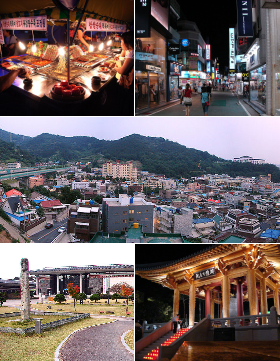
Gwangju (Korean: 광주; Korean: [kwaŋ.dʑu] ⓘ), formerly romanized as Kwangju, is South Korea's sixth-largest metropolis. It is a designated metropolitan city under the direct control of the central government's Home Minister. The city was also the capital of South Jeolla Province until the provincial office moved to the southern village of Namak in Muan County in 2005 because Gwangju was promoted to a metropolitan city and was independent of South Jeolla Province.
Key Information
Its name is composed of the words gwang (Korean: 광; Hanja: 光) meaning "light" and ju (주; 州) meaning "province". Gwangju was historically recorded as Muju (무주; 武州), in which "Silla merged all of the land to establish the provinces of Gwangju, Ungju, Jeonju, Muju and various counties, plus the southern boundary of Goguryeo and the ancient territories of Silla" in the Samguk sagi.[4] In the heart of the agricultural Jeolla region, the city is also famous for its rich and diverse cuisine.
History
[edit]
The city was established in 57 BC. It was one of the administrative centers of Baekje during the Three Kingdoms period.[5]
During the Imperial Japanese rule, the city was known as Kōshū. In 1929, a confrontation between Korean and Japanese students in the city turned into the Gwangju Student Independence Movement, a regional demonstration that culminated in one of the major nationwide uprisings against Imperial Japanese cruelty during the colonial period.[citation needed]
Modern industry was established in Gwangju, and a railway to Seoul was constructed. Some industries that took hold include cotton textiles, rice mills, and breweries. The construction of a designated industrial zone in 1967 encouraged growth in industry, especially in the sectors linked to the automobile industry.[citation needed]
In May 1980, peaceful demonstrations took place in Gwangju against Chun Doo-hwan, leader of the military coup d'état of 12 December 1979. The demonstrations were suppressed by military forces, including elite units of the Special Operations Command. The situation escalated after a violent crackdown, resulting in the Gwangju Uprising, where civilians raided armories and armed themselves. By the time the uprising was suppressed 9 days later, many hundreds of civilians and several police forces/soldiers were dead. After civilian rule was reinstated in 1987, a national cemetery was established to honor the victims of the incident.[6]
In 1986, Gwangju separated from South Jeolla Province to become a Directly Governed City (Jikhalsi), and then became a Metropolitan City (Gwangyeoksi) in 1995.[5]
Due to a variety of factors, including the ancient rivalry between Baekje and Silla, as well as the biased priority given to the Gyeongsang Province region by political leaders in the 2nd half of the 20th century, Gwangju has a long history of voting for left-leaning politicians[citation needed] and is the main stronghold for the liberal Democratic Party of Korea along with its predecessors, as well as the progressive Justice Party. [citation needed]
Gwangju has held many sports events such as 2002 FIFA World Cup, 2015 Summer Universiade, 2019 World Aquatics Championships.
Administrative divisions
[edit]Gwangju is divided into 5 districts ("Gu").
| Map | Name | Korean | Hanja | |
|---|---|---|---|---|
| Districts | ||||
| Buk District | 북구 | 北區 | ||
| Dong District | 동구 | 東區 | ||
| Gwangsan District | 광산구 | 光山區 | ||
| Nam District | 남구 | 南區 | ||
| Seo District | 서구 | 西區 | ||
- Not religious (50.0%)
- Buddhism (11.0%)
- Protestantism (25.0%)
- Catholicism (11.0%)
- Others (3.00%)
Demographics
[edit]| Year | Pop. | ±% |
|---|---|---|
| 1970 | 493,634 | — |
| 1980 | 727,600 | +47.4% |
| 1990 | 1,139,003 | +56.5% |
| 2000 | 1,352,797 | +18.8% |
| 2010 | 1,475,745 | +9.1% |
| 2020 | 1,477,573 | +0.1% |
| Source: [8][9] | ||
According to the census of 2015, 9.5% of the population followed Buddhism and 28.7% followed Christianity (20% Protestantism and 8.7% Catholicism). 61% of the population is irreligious.[10]
One of the largest ethnic enclaves of Koryo-saram (ethnic Koreans of the former Soviet Union) in South Korea is located in Gwangju: the Gwangju Koryoin Village.[11][12] Schools in the vicinity of the village, such as Ha-nam Jung-ang Elementary School, have significant proportions of Russian speakers as a result.[13]
Climate
[edit]Gwangju has a cooler version of the humid subtropical climate (Köppen: Cfa/Cwa) with four distinct seasons and rainfall year-round but particularly during the East Asian Monsoon Season in the summer months.
Winters, while still somewhat cold, are milder than in Seoul and cities further north due to the city's southwesterly position in the Korean peninsula. Summers are hot and humid with abundant precipitation, particularly in the form of thunderstorms. Gwangju is one of the warmest cities in Korea in the summer due to its geographic location.[citation needed]
| Climate data for Gwangju (1991–2020 normals, extremes 1939–present) | |||||||||||||
|---|---|---|---|---|---|---|---|---|---|---|---|---|---|
| Month | Jan | Feb | Mar | Apr | May | Jun | Jul | Aug | Sep | Oct | Nov | Dec | Year |
| Record high °C (°F) | 18.8 (65.8) |
22.6 (72.7) |
28.3 (82.9) |
30.4 (86.7) |
33.9 (93.0) |
37.2 (99.0) |
38.5 (101.3) |
38.5 (101.3) |
35.9 (96.6) |
31.1 (88.0) |
27.1 (80.8) |
19.9 (67.8) |
38.5 (101.3) |
| Mean daily maximum °C (°F) | 5.7 (42.3) |
8.3 (46.9) |
13.6 (56.5) |
19.9 (67.8) |
24.8 (76.6) |
27.9 (82.2) |
30.0 (86.0) |
30.9 (87.6) |
27.1 (80.8) |
21.9 (71.4) |
15.0 (59.0) |
8.0 (46.4) |
19.4 (66.9) |
| Daily mean °C (°F) | 1.0 (33.8) |
2.9 (37.2) |
7.5 (45.5) |
13.4 (56.1) |
18.7 (65.7) |
22.7 (72.9) |
25.9 (78.6) |
26.5 (79.7) |
22.2 (72.0) |
16.1 (61.0) |
9.6 (49.3) |
3.2 (37.8) |
14.1 (57.4) |
| Mean daily minimum °C (°F) | −2.7 (27.1) |
−1.5 (29.3) |
2.4 (36.3) |
7.8 (46.0) |
13.4 (56.1) |
18.7 (65.7) |
22.8 (73.0) |
23.2 (73.8) |
18.2 (64.8) |
11.2 (52.2) |
5.0 (41.0) |
−0.8 (30.6) |
9.8 (49.6) |
| Record low °C (°F) | −19.4 (−2.9) |
−17.7 (0.1) |
−10.7 (12.7) |
−4.5 (23.9) |
1.4 (34.5) |
7.2 (45.0) |
14.9 (58.8) |
12.6 (54.7) |
5.6 (42.1) |
−2.7 (27.1) |
−7.2 (19.0) |
−13.7 (7.3) |
−19.4 (−2.9) |
| Average precipitation mm (inches) | 32.6 (1.28) |
43.6 (1.72) |
61.9 (2.44) |
86.6 (3.41) |
91.4 (3.60) |
152.6 (6.01) |
294.2 (11.58) |
326.4 (12.85) |
145.0 (5.71) |
59.0 (2.32) |
50.2 (1.98) |
37.1 (1.46) |
1,380.6 (54.35) |
| Average precipitation days (≥ 0.1 mm) | 10.1 | 8.2 | 8.8 | 8.9 | 9.0 | 10.2 | 15.1 | 15.0 | 9.6 | 6.8 | 8.8 | 10.2 | 120.7 |
| Average snowy days | 9.9 | 6.3 | 2.4 | 0.3 | 0.0 | 0.0 | 0.0 | 0.0 | 0.0 | 0.0 | 1.1 | 8.4 | 28.4 |
| Average relative humidity (%) | 65.7 | 61.6 | 60.3 | 60.2 | 64.5 | 72.0 | 79.8 | 78.0 | 73.6 | 67.6 | 66.9 | 66.9 | 68.1 |
| Mean monthly sunshine hours | 161.4 | 170.5 | 201.0 | 214.1 | 227.9 | 169.9 | 143.1 | 169.0 | 174.4 | 208.5 | 167.4 | 156.9 | 2,164.1 |
| Percentage possible sunshine | 51.1 | 53.4 | 51.8 | 54.3 | 51.3 | 39.0 | 32.9 | 41.4 | 46.3 | 58.5 | 52.7 | 51.1 | 48.0 |
| Average ultraviolet index | 2 | 2 | 3 | 4 | 5 | 5 | 7 | 6 | 5 | 3 | 3 | 2 | 4 |
| Source 1: Korea Meteorological Administration (percent sunshine 1981–2010)[14][15][16] | |||||||||||||
| Source 2: Weather Atlas (UV)[17] | |||||||||||||
Education
[edit]Chonnam National University, Gwangju Institute of Science and Technology, and Gwangju Education University are public universities in Gwangju.
Honam University, Gwangju University, Gwangshin University, Gwangju Women's University, Nambu University, Chosun University, and Honam Christian University are private universities.
Gwangju Health University is a private community college offering associate degrees in humanities and social sciences and healthcare sciences, and a bachelor's degree in nursing.
Gwangju has 593 schools, consisting of 234 kindergartens, 145 elementary schools, 84 middle schools, 65 high schools, 1 science high school,[18] 7 junior colleges, 9 universities, 38 graduate schools, and 11 others (as of 1 May 2009) with a total of 406,669 students, or 28.5% of the total city population. The average number of students per household is 0.8.
Transportation
[edit]The city is served by the Gwangju Subway. An extension was completed in April 2008, with the remainder being completed in 2012. The first phase of a second line, which, when completed, will be an orbital loop line, will open in 2026.[19] There are two KTX stations in the city: Gwangju station and Gwangju Songjeong Station. Gwangju Songjeong Station connects to the Gwangju Subway and the local bus system. Now, the Songjeong station is mainly used.
Gwangju has an extensive system of public buses that traverse the city.[20] Bus stops and buses themselves contain stop information in Korean and English. Local buses, but not the subway or KTX, connect to the intercity Gwangju Bus Terminal known as U-Square.[21]
Gwangju is also served by the Gwangju Airport.
Tourism
[edit]This article needs to be updated. (June 2015) |
- Asia Culture Center – The Asia Culture Center (also known as the ACC) is a facility in downtown Gwangju designed to celebrate and explore Gwangju's artistic and democratic culture and history, as well as provide space to host exhibits, experiences, and events from international artists. It is built primarily below street level, though its design incorporates large amounts of natural lighting. There are five facilities: ACC Exchange, ACC Theater, ACC Creation, ACC Archive & Research, and ACC Children [22]
- Gwangju Biennale – This is a modern art festival that is held every two years. It was first launched in 1995. The Gwangju Biennale Exhibition Hall is at the Jung-oe Park Culture Center and the Science Center.
- Gwangju Culture & Art Center – The center regularly hosts events.Gwangju Culture & Art Center Official Website
- Gwangju Hyanggyo (Confucian School) – Gwangju Hyanggyo is in the Gwangju Park in Sa-dong. There are traditional houses here estimated as having been built during the 1st year of the Joseon period in 1392. This school continues to hold memorial ceremonies for Confucius twice a year. Admission is free. More about Gwangju Hyanggyo
- Gwangju National Museum – The museum houses a permanent collection of historical art and cultural relics that date back to the old Joseon and Goryeo periods of Korean history. The museum also organizes exhibitions and cultural learning activities that are open to the public.
- Gwangju 5.18 Road is the course about the Democracy Movement of 1980. The courses include the historical places. More about 5.18Road
- May 18th National Cemetery
- Food streets – Gwangju has numerous designated Food Streets where multiple restaurants serving dishes renowned to Gwangju can be found. These include Mudeungsan Boribap Street (a meal of barley with a variety of side dishes),[23] Duck Cook Street (oritang, a duck stew, and grilled duck),[24] Folk Tteokgalbi Street[25] (a meal of grilled minced pork or beef patties eaten wrapped in lettuce and served with ox bone soup and a variety of side dishes) and Kotgejang Baekban Street[26] (a meal of crabs preserved in soy sauce served with a variety of side dishes).
- Gwangju World Cup Stadium – It is a historical place for Korean soccer history. Because at this stadium in 2002 FIFA World Cup, South Korea national football team beat Spain soccer team in 3:5 at the quarter-Final, and advanced to the Semi-Final match with Germany in that World Cup, for the first time in the Asian soccer history.
Sport and culture
[edit]

- It is the home of Kia Tigers of the Korea Professional Baseball League (KBO).
- 2002 FIFA World Cup – Gwangju World Cup Stadium was one of the venues used for the World Cup and was where the South Korea national football team advanced to the semi-finals for the first time in its history by defeating Spain.
- It is the home of Gwangju FC of the K League.[27]
- Universiade – It was the venue for the 2015 Summer Universiade games.
- The 3rd Asia Song Festival an annual Asian pop music festival hosted by the Korea Foundation for International Culture Exchange, in 2006, was held at the Gwangju World Cup Stadium.[28]
- The International Design Alliance (IDA) appointed Gwangju as the host destination of the 2015 IDA Congress.
- Festivals are held in Gwangju. (List of festivals in Gwangju)
- 2019 FINA World Aquatics Championships
- 2014 Gwangju ACE Fair (Asia Content & Entertainment Fair)[29]
- The Ministry of SMEs said Gwangju was selected as the site for the creation of the "Green-Startup-Town." It is said that it will benchmark King's Cross Station, a successful case of urban regeneration in the UK, to establish a start-up hub (private research institute, research and development company, start-up company, etc.) at Gwangju Station.[30]
- It is the home of Gwangju AI Peppers of the V-League.
Cityscape
[edit]

- Mudeungsan – It is a mountain that is part of Mudeungsan National Park.[31]
International relations
[edit]Sister cities
[edit]Partnerships and cooperations
[edit]
Turin, Italy[33]
Seberang Perai, Malaysia (2013)[34]
Notable people
[edit]Art
[edit]Literature
[edit]- Han Kang – author of The Vegetarian and Human Acts and winner of the 2024 Nobel Prize in Literature
Entertainers
[edit]- Goo Hara – former member of kpop group KARA
- Jung Ho-seok (stage name J-Hope) – member of K-pop group BTS
- Jeong Yun-ho (stage name Yunho) – member of K-pop group ATEEZ
- Moon Geun-young – South Korean actress and singer
- Lee Seung-hyun (stage name Seungri) – former member of K-pop group Big Bang
- Jung Yun-ho (stage name U-Know) – member of K-pop group TVXQ
- Seo Hye-lin – member of K-pop group EXID
- Sim Jayoon (stage name YOON) – member of K-pop group STAYC
- Lee Gi-kwang – member of K-pop group Highlight
- Lee Sung-jong – member of K-pop group Infinite
- Chae Hyung-won – member of K-pop group Monsta X
- Im Chang-kyun (stage name I.M.) – member of K-pop group Monsta X (originally from Suwon)
- Bae Su-ji (stage name Suzy) – former member of K-pop group Miss A
- Gong Min-ji (stage name Minzy) – member of K-pop group 2NE1
- Kim Yu-bin – former member of K-pop group Wonder Girls
- Hong Jin-young – a trot singer
- Park Shin-hye – South Korean actress
- Jung Woo-seok – member of K-pop group Pentagon
- Lee Na-gyung – member of K-pop group Fromis 9
- Song Ha Young – member of K-pop group Fromis 9
- Seo Woobin – member of K-pop group Cravity
- Oh Seunghee – member of K-pop group CLC
- Lee Su-jeong (stage name Babysoul)- leader and member of K-pop group Lovelyz
- Bae Seung-min – member of K-pop group Golden Child
- Park Soeun – member of K-pop group Weeekly
- Lee Taeyeob (stage name Yoojung) – member of K-pop group OnlyOneOf
- Jang Seowon – member of K-pop group Lapillus
- Kim Yeunja (born 1959) – South Korean trot singer
- Joo Hyunmi (born 1961) – South Korean trot singer
- Jang Beomjoon (born 1989) – South Korean singer, former member of Busker Busker
- Lee Ha-joon (stage name Hajoon) – member of Korean indie-rock band The Rose
- Han Dongmin (stage name Taesan) – member of K-pop group Boynextdoor
Sports
[edit]- Ki Sung-yueng – International footballer
- An San – Olympic gold medalist in women's team, mixed team, and individual archery at the 2021 Tokyo Summer Games
- An Se-young – Badminton Player
- Kim Byunghyun (born 1979) – South Korean former baseball player
- Kang Jung-ho (born 1987) – South Korean former baseball player
- Moon "Oner" Hyeon-jun, (born 2002), professional League of Legends player, Jungler for T1
Politics
[edit]- Chi Hyun Chung – Bolivian politician and presidential candidate for 2019 and 2020 elections
- Elizabeth Lee – Australian politician and Leader of the Opposition of the Australian Capital Territory
Science
[edit]- Yi So-yeon – South Korean biotechnologist and astronaut, the first Korean to fly to space
See also
[edit]Notes
[edit]References
[edit]Citations
[edit]- ^ "Population statistics". Korea Ministry of the Interior and Safety. 2025.
- ^ "2023년 지역소득(잠정)". www.kostat.go.kr.
- ^ "Regional GDP, Gross regional income and Individual income". nosis.kr.
- ^ "Origin and History of Gwangju". www.gwangju.go.kr (in Korean). Archived from the original on 18 April 2018. Retrieved 18 April 2018.
- ^ a b "The History of Gwangju". Archived from the original on 30 June 2017. Retrieved 25 April 2016.
- ^ "May 18th Democratic Uprising". Archived from the original on 30 June 2017. Retrieved 25 April 2016.
- ^ "2024 종교인식조사 종교인구 현황과 종교 활동" [Status of religious population and religious activities in South Korea (2024)] (in Korean). 11 December 2024.
- ^ "World Urbanization Prospects". Archived from the original on 19 January 2020. Retrieved 20 February 2020.
- ^ "Population Census". Statistics Korea.
- ^ "2015 Census – Religion Results" (in Korean). KOSIS KOrean Statistical Information Service. Archived from the original on 26 February 2021. Retrieved 6 April 2021.
- ^ Jung-youn, Lee (24 February 2023). "[Weekender] Koryoin from Ukraine find new home in ancestors' land". The Korea Herald. Retrieved 8 October 2023.
- ^ "The long journey of Korejskij". Korea JoongAng Daily. 13 October 2020. Retrieved 8 October 2023.
- ^ "As multicultural students surge, Korea's classrooms change". Korea JoongAng Daily. 7 November 2023. Retrieved 1 January 2024.
- ^ "Climatological Normals of Korea (1991 ~ 2020)" (PDF) (in Korean). Korea Meteorological Administration. Archived from the original (PDF) on 29 January 2022. Retrieved 4 April 2022.
- ^ 순위값 – 구역별조회 (in Korean). Korea Meteorological Administration. Archived from the original on 7 October 2021. Retrieved 4 April 2022.
- ^ "Climatological Normals of Korea" (PDF). Korea Meteorological Administration. 2011. Archived from the original (PDF) on 7 December 2016. Retrieved 8 December 2016.
- ^ "Gwangju, South Korea – Detailed climate information and monthly weather forecast". Weather Atlas. Yu Media Group. Archived from the original on 18 September 2020. Retrieved 9 July 2019.
- ^ Gwangju science academy
- ^ "Work starts on next phase of Gwangju orbital metro line". Railway Gazette. 16 January 2024. Archived from the original on 16 January 2024. Retrieved 6 January 2025.
- ^ 광주광역시 버스정보. bus.gjcity.net. Archived from the original on 8 September 2016. Retrieved 29 July 2016.
- ^ U-Square (Gwangju Bus Terminal) (유스퀘어(광주종합버스터미널)). VisitKorea.or.kr. Archived from the original on 16 September 2016. Retrieved 29 July 2016.
- ^ "Asia Culture Center". www.acc.go.kr. Archived from the original on 3 November 2019. Retrieved 29 July 2016.
- ^ "Mudeungsan Boribap Street | Food Street | Things to Eat:: Tourism Portals(영문포털)". utour.gwangju.go.kr. Archived from the original on 10 September 2016. Retrieved 11 January 2022.
- ^ "Duck Cook Street | Food Street | Things to Eat:: Tourism Portals(영문포털)". utour.gwangju.go.kr. Archived from the original on 7 August 2016. Retrieved 11 January 2022.
- ^ "Folk Tteokgalbi Street | Food Street | Things to Eat:: Tourism Portals(영문포털)". utour.gwangju.go.kr. Archived from the original on 7 August 2016. Retrieved 11 January 2022.
- ^ "Kotgejang Baekban Street | Food Street | Things to Eat:: Tourism Portals(영문포털)". utour.gwangju.go.kr. Archived from the original on 7 August 2016. Retrieved 11 January 2022.
- ^ (in Korean) K-League news 4강 역사를 쓴 그곳, 광주 월드컵 경기장 Dream stadium of K-League Archived 16 February 2009 at the Wayback Machine
- ^ KOFICE 3rd Asia Song Festival Archived 29 August 2011 at the Wayback Machine 22 September 2006. Retrieved 2011-10-12
- ^ 2016 광주 ACE Fair. www.acefair.or.kr. Archived from the original on 3 November 2014. Retrieved 25 April 2016.
- ^ 이, 태수 (13 May 2021). 광주역 일대에 창업거점 '그린 스타트업 타운' 만든다. Yonhap News Agency (in Korean). Archived from the original on 13 May 2021. Retrieved 13 May 2021.
- ^ "Korea National Park". english.knps.or.kr. Archived from the original on 2 July 2010. Retrieved 25 April 2016.
- ^ "Sister Cities". gwangju.go.kr. Gwangju. Archived from the original on 2 February 2023. Retrieved 2 February 2023.
- ^ Pessotto, Lorenzo. "International Affairs – Twinnings and Agreements". International Affairs Service in cooperation with Servizio Telematico Pubblico. City of Torino. Archived from the original on 18 June 2013. Retrieved 6 August 2013.
- ^ "MPSP sets sights on city status". The Star. 1 August 2016. Archived from the original on 5 July 2018. Retrieved 4 July 2018.
Bibliography
[edit]- , Encyclopædia Britannica, 9th ed., Vol. VI, New York: Charles Scribner's Sons, 1878, pp. 390–394.
External links
[edit]- Official website (in English)
- Gwangju:Official Site of Korea Tourism Org Archived 29 September 2010 at the Wayback Machine
Gwangju
View on GrokipediaGeography
Location and Topography
Gwangju Metropolitan City is located in the southwestern part of the Korean Peninsula, within the central Honam region.[2] The city lies at coordinates approximately 35°9′ N latitude and 126°55′ E longitude.[8] It occupies a geographic basin bordered by mountainous terrain, particularly to the east.[9] The topography features a mix of low-lying urban plains and surrounding highlands, with Mudeungsan mountain rising to an elevation of 1,187 meters as the dominant eastern feature.[10] The metropolitan area's average elevation is 108 meters, while the city center sits at about 47 meters above sea level.[11] [12] Over 70 percent of the city's land consists of mountainous regions, influencing its urban layout and development patterns.[13] This basin setting provides relatively flat terrain in the core suitable for settlement, contrasted by steeper slopes in peripheral districts.[9]Urban Development and Cityscape
Gwangju's urban development accelerated in the post-Korean War era, with significant industrialization from the 1960s onward, transforming it into a key manufacturing and high-tech center in southwestern South Korea. By the 1990s, the city prioritized the construction of specialized industrial complexes in sectors such as photonics, optics, and advanced materials to foster economic diversification beyond traditional agriculture and textiles.[14][7] The city covers an area of 501.34 km² and is administratively divided into five districts—Buk-gu, Dong-gu, Seo-gu, Nam-gu, and Gwangsan-gu—accommodating a population of about 1.53 million residents as of 2024. Buk-gu, the most populous district, houses approximately 480,000 people, while Gwangsan-gu encompasses the largest land area, supporting suburban and industrial expansion. Overall population density averages around 3,000 persons per km², with higher concentrations in central urban zones reflecting vertical growth patterns.[7][15][16] Contemporary projects underscore Gwangju's push toward innovation-driven urbanism, including the Gwangju High-Tech National Industrial Complex, which contains 42% of firms across 14 regional sites, and the Gwangju Free Economic Zone focused on AI startups and eco-friendly automotive clusters. Since 2020, over 426.9 billion KRW has been invested in AI infrastructure, with ongoing bids for a national AI computing center requiring 2.5 trillion KRW for 50,000 GPUs by 2030. Infrastructure enhancements feature a semi-public bus network for transit and 3.8 billion KRW allocated in 2022 for road expansions and stream maintenance to bolster residential support.[17][18][19] Gwangju's cityscape blends dense downtown high-rises with mid-century concrete structures and modern landmarks, creating a skyline defined by functional verticality rather than iconic towers. Central districts exhibit uniform aesthetics of high-density apartments and commercial buildings, while peripheral areas in Gwangsan-gu include sprawling residential zones and industrial parks. Key visual elements include the Gwangju World Cup Stadium, constructed for the 2002 FIFA World Cup, and the Asia Culture Center, symbolizing the city's integration of sports, culture, and technology into its urban fabric.[20][21]Climate and Environment
Climatic Patterns
Gwangju experiences a humid subtropical climate classified as Cfa under the Köppen system, featuring four distinct seasons with hot, humid summers influenced by the East Asian monsoon and cold, relatively dry winters shaped by continental air masses.[22][23] The annual average temperature is approximately 12.8 °C (55.1 °F), with temperatures typically ranging from -8 °C (17 °F) in winter to 30 °C (86 °F) in summer, rarely exceeding 33 °C (92 °F) or dropping below -15 °C (5 °F).[22][24] Average annual precipitation totals around 1,238 mm (48.7 inches), concentrated heavily in the summer months due to monsoon activity, while winters see minimal rainfall and occasional light snow.[22] Winters, from December to February, are cold and dry, with average high temperatures of 5–7 °C (41–45 °F) and lows around -3 to 0 °C (27–32 °F); snowfall occurs sporadically, averaging 10–20 cm annually, but accumulation is limited by frequent thaws.[24] Spring, March to May, brings mild warming with highs rising from 12 °C (54 °F) to 22 °C (72 °F), accompanied by increasing humidity and rainfall that peaks in May at about 100–120 mm (3.9–4.7 inches), fostering cherry blossom blooms and agricultural activity. Summers, June to August, are long, warm, and oppressively humid, with average highs of 28–30 °C (82–86 °F) and July recording the highest precipitation at roughly 292 mm (11.5 inches), often from typhoons or prolonged rainy periods that contribute over 40% of the yearly total.[24] Autumn, September to November, offers comfortable conditions with highs dropping from 25 °C (77 °F) to 15 °C (59 °F), clear skies, and moderate rainfall of 50–100 mm (2–4 inches) per month, marking a transition to drier, cooler weather.| Month | Avg. High (°C) | Avg. Low (°C) | Precipitation (mm) |
|---|---|---|---|
| January | 6 | -3 | 25 |
| February | 7 | -2 | 40 |
| March | 12 | 2 | 70 |
| April | 18 | 8 | 100 |
| May | 23 | 13 | 110 |
| June | 27 | 18 | 170 |
| July | 30 | 21 | 290 |
| August | 30 | 21 | 240 |
| September | 26 | 17 | 180 |
| October | 21 | 11 | 70 |
| November | 15 | 5 | 50 |
| December | 8 | -1 | 30 |
Environmental Management
Gwangju Metropolitan City pursues carbon neutrality by 2045 under its Green New Deal policy, which integrates environmental management with economic and social objectives through public-private collaborations.[26] The city established the Carbon Neutral City Promotion Committee in partnership with citizens and stakeholders, developing 94 specific action plans to address emissions reduction, renewable energy adoption, and resilience building.[27] Air quality management focuses on mitigating fine particulate matter, with initiatives to deploy technologies reducing exposure in high-traffic or enclosed public areas such as schools, restaurants, hospitals, and underground facilities.[28] These efforts align with national trends where urban traffic volumes correlate inversely with pollutant concentrations like PM2.5 and NO2, prompting localized monitoring and emission controls.[29] Waste management employs South Korea's volume-based waste fee system, mandating designated plastic bags for residual non-recyclable waste to minimize landfill use and encourage separation of recyclables and food scraps.[30] Gwangju addresses rising municipal solid waste volumes through a 2025 resource recovery plan featuring incineration facilities for energy generation, alongside targeted food waste reduction aiming for 7,650 tons cut over five years via expanded RFID metering in apartment complexes.[31][32] Artificial intelligence applications, including road analyzers in vehicles, support efficient collection routing and urban waste tracking.[33] Urban green spaces contribute to environmental buffering, with over 391 parks developed providing approximately 13.39 m² per capita, including regenerated downtown areas via architectural follies and cultural projects to enhance biodiversity and public access.[34][35] However, maintenance challenges persist in some private parks, prompting special projects to balance preservation with urban density pressures.[36]History
Pre-Modern Era
Archaeological evidence indicates human presence in the Gwangju region during the Stone, Bronze, and Iron Ages, with artifacts such as jar burial tombs discovered along the Yeongsan River area.[37] The area was first systematically inhabited during the Mahan period, part of the Samhan confederacies in the southern Korean peninsula, with connections to settlements like Gusa Odan in Jinwon-myeon, Jangseong-gun, and Bulmi in Naju.[38] [37] During the Three Kingdoms period, the Gwangju vicinity fell under Baekje control, serving as one of its administrative centers designated as Mujin-ju, encompassing counties such as Mydongburi-hyeon (present-day Nampyeon), Bongnyong-hyeon (Naju), and Gulji-hyeon (Changpyeong).[38] [37] Following Baekje's fall in 660 CE and unification under Silla in 754 CE by King Gyeondeok, the region was reorganized into Muju within Namwon-kyung, comprising 15 counties and 32 districts.[38] [37] In the Later Three Kingdoms period around 892 CE, Kyeon Hwon reestablished Baekje influence in Jeolla Province, including Muju.[37] The Goryeo Dynasty marked the adoption of the name Gwangju in 940 CE during the reign of King Taejo, following the collapse of late Baekje in 936 CE when Singeom surrendered; a Dodok-bu administrative office was also established that year.[38] [37] Notable events included the 1237 rebellion led by Yi Yeon-nyeon against military exploitation and the resistance of the Sam-byeol-cho forces against Mongol invasions from 1270 to 1273, which extended influence to the Gwangju area from Jindo.[37] Under the Joseon Dynasty from 1392, Gwangju formed part of Jeolla Province's Jwa-do (left division), benefiting from its fertile plains for agriculture and trade.[38] [37] The region emerged as a center for Confucian scholarship, producing figures like Ki Dae-seung who advanced Neo-Confucian thought, and demonstrated military loyalty during the Imjin War (1592–1598), with leaders such as Go Gyeong-myeong and Kim Deok-ryeong organizing defenses against Japanese forces.[37] In 1894, local participation in the Donghak Peasant Movement, including Son Hwa-jung's activities, highlighted ongoing agrarian unrest.[37]Japanese Colonial Period and Liberation
During the Japanese colonial period, which began with Korea's annexation on August 22, 1910, Gwangju experienced both infrastructural development and cultural suppression under imperial rule.[39] The city's population expanded significantly, rising from approximately 33,000 residents in 1910 to 144,000 by 1944, driven by the establishment of modern facilities including banks, schools, a hospital, and a branch of the Bank of Chōsen, Japan's colonial central bank.[37] These changes reflected broader Japanese efforts to integrate and economically exploit the region, though they were accompanied by policies of forced assimilation, such as the promotion of Shinto practices and suppression of Korean language and identity.[40] Resistance in Gwangju manifested notably in the Gwangju Student Independence Movement of November 1929, which originated locally as a protest against Japanese discrimination, including harassment of Korean students by Japanese peers, and escalated into a nationwide uprising demanding greater rights and an end to colonial inequities.[40] This event, involving thousands of students, highlighted Gwangju's role as a center of anti-colonial activism, building on earlier movements like the March 1st Independence Movement of 1919, though it faced harsh repression by Japanese authorities.[41] Liberation came on August 15, 1945, following Japan's surrender in World War II, marking the end of 35 years of colonial domination and celebrated nationally as Gwangbokjeol, or "Restoration of Light Day."[42] In Gwangju, as across Korea, this event ended formal Japanese governance, though the city soon transitioned into postwar division and U.S. military occupation in the south, setting the stage for subsequent conflicts.[43]Post-Korean War Industrialization
Following the armistice ending the Korean War on July 27, 1953, Gwangju integrated into South Korea's broader reconstruction efforts, which emphasized light industry expansion under the First Five-Year Economic Development Plan (1962–1966). The city's economy shifted toward manufacturing, with textiles emerging as a primary sector, leveraging existing facilities established during the Japanese colonial era. For instance, Ilshin Spinning Inc., originally founded in 1935, operated as a central hub in Gwangju's Im-dong area, contributing to the production of cotton yarns and fabrics that supported national export drives.[44][45] This growth aligned with South Korea's export-oriented industrialization strategy, which propelled average annual GDP increases of around 9% from 1963 to 1973, though Gwangju's development focused predominantly on labor-intensive light industries rather than capital-intensive heavy sectors like steel or shipbuilding. Food processing, including rice milling, also expanded to process local agricultural output, aiding rural-urban economic linkages. However, the process exacerbated labor-capital tensions, as low wages and harsh working conditions in factories fueled worker unrest amid rapid urbanization and migration to the city.[46][47] Regional policies under the Park Chung-hee administration (1963–1979) directed heavier investments to southeastern provinces, leaving the Honam region—including Gwangju—with relative underdevelopment and fewer large-scale projects until the late 1970s and 1980s. By the end of the 1970s, manufacturing accounted for a growing share of local employment, but socio-economic disparities persisted, manifesting in protests over unequal resource allocation and industrial neglect. Industrial complexes, such as those planned for the Gwangju-Chonnam area, were prioritized in the late 1980s to relocate firms and stimulate balanced growth.[47][48]The 1980 Gwangju Uprising
The Gwangju Uprising erupted on May 18, 1980, triggered by student protests at Chonnam National University against the nationwide expansion of martial law declared on May 17 by the military regime under Chun Doo-hwan, who had consolidated power through a December 1979 coup following President Park Chung-hee's assassination.[49] Deployed paratroopers from the 7th and 11th Special Forces Brigades confronted demonstrators with clubs, rifle butts, and bayonets, inflicting severe beatings on unarmed students and bystanders, which sparked widespread outrage and drew thousands of citizens into the streets by evening.[50] Initial clashes resulted in several deaths, including the stabbing of student activist Kim Nam-sun, escalating tensions as reports of military atrocities spread.[51] Protests intensified on May 19, with larger crowds demanding the withdrawal of troops and an end to martial law; soldiers opened fire on demonstrators near the Provincial Office, killing at least 20 and wounding hundreds, prompting citizens to form human barricades and occupy key buildings.[50] By May 20, protesters had seized weapons from local police stations and an army depot, arming a citizen militia estimated at 2,000-3,000 to defend against further assaults, while establishing provisional committees to manage the city and broadcast appeals for support.[51] Military forces temporarily withdrew from central areas but conducted aerial surveillance and sniper attacks; during this standoff from May 21-26, armed civilians killed or wounded over 30 soldiers in skirmishes, though negotiations for peaceful resolution failed amid regime refusals to engage.[50] The uprising concluded on May 27 when the 20th Infantry Division and 31st Capital Defense Command, reinforced by marines, launched a coordinated armored assault to retake Gwangju, overcoming barricades and resistance with tanks and heavy gunfire, leading to the surrender of remaining fighters.[50] The Chun regime's initial report, following a brief investigation, tallied 144 civilian deaths and 85 wounded, alongside 22 soldiers and 4 police killed (with many military casualties attributed to friendly fire or civilian arms), though subsequent probes and eyewitness accounts have disputed these figures, suggesting up to several hundred civilian fatalities including disappearances.[51] [50] Allegations of North Korean agent instigation, used by the government to frame the events as a communist riot, lacked substantiation from U.S. intelligence reviews and later South Korean truth commissions, confirming the uprising as a spontaneous local response to perceived authoritarian overreach.[52]Democratization and Contemporary Growth
The 1980 Gwangju Uprising, later officially termed the Gwangju Democratization Movement, served as a foundational catalyst for South Korea's transition to democracy, inspiring sustained activism against authoritarianism. Building on this legacy, Gwangju's citizens engaged prominently in the June Democratic Struggle of 1987, a series of mass protests that forced constitutional revisions, including direct presidential elections and the restoration of fundamental freedoms, effectively ending military dictatorship.[53][54] Official recognition of the uprising advanced in the 1990s, with legislative measures enabling investigations and prosecutions of involved officials, alongside the creation of commemorative sites that entrenched Gwangju's identity as a democratic vanguard. These steps not only healed communal wounds but also cultivated a robust civil society, evidenced by annual May 18 observances that underscore ongoing commitments to human rights and governance accountability.[54] Amid political stabilization, Gwangju pursued economic diversification and urban expansion from the 1990s, establishing industrial complexes focused on photonics, optics, and later AI-driven sectors to transition from labor-intensive industries.[7][17] The Gwangju High-Tech National Industrial Complex, encompassing a significant share of regional high-tech firms, has anchored this shift, fostering innovation clusters in sustainable technologies and advanced manufacturing.[17] Iconic projects like the Gwangju World Cup Stadium, constructed for the 2002 FIFA World Cup and hosting matches such as the quarterfinal between South Korea and Spain on June 22, 2002, catalyzed infrastructure upgrades, boosted tourism, and enhanced the city's global profile.[55] Population dynamics reflect this progress, rising from 1,139,003 in 1990 to 1,488,024 by 2020 before stabilizing at 1,419,237 in 2023, attributable to job creation and improved living standards.[56][57] Today, Gwangju integrates its democratic heritage with forward-looking growth, positioning itself as a hub for cultural and technological advancement in Asia.[7]Government and Administration
Administrative Structure
Gwangju Metropolitan City functions as a directly governed entity equivalent to a province, with administrative autonomy from Jeollanam-do province and oversight by the central government's Ministry of the Interior and Safety. The city is divided into five districts (gu): Buk-gu, Dong-gu, Gwangsan-gu, Nam-gu, and Seo-gu, each responsible for localized governance including resident welfare, infrastructure maintenance, and community services. District offices operate under the city administration, with heads appointed by the mayor to implement policies tailored to urban and semi-rural areas within their boundaries; for instance, Gwangsan-gu encompasses the largest administrative area at approximately 85 square kilometers as of 2022.[58][59] The executive structure is headed by the mayor, elected by direct popular vote for a renewable four-year term, who directs city-wide policy, budgeting, and intergovernmental coordination. Supporting roles include two deputy mayors—one overseeing administrative affairs (including planning, youth policy, and safety bureaus) and the other managing culture, economy, labor, and urban development—alongside specialized offices such as the Gwangju Strategy Promotion Bureau. The current mayor, Kang Ki-jung, assumed office on July 1, 2022.[60][61] Legislative authority resides with the Gwangju Metropolitan City Council, a unicameral body comprising elected members who approve ordinances, budgets, and development plans. The council, chaired by Kyung-haeng Heo as of recent records, convenes to represent district interests and ensure accountability in municipal governance.[62]Local Politics and Governance
Gwangju operates under South Korea's local autonomy system, with a directly elected mayor serving as the executive head and a metropolitan council handling legislative functions, established following the 1995 Local Autonomy Act that restored elections after decades of authoritarian control.[63] The mayor, elected every four years, oversees city administration, budgeting, and policy implementation, while the 23-member council, also elected concurrently, approves ordinances and monitors executive actions.[62] As of 2025, Kang Ki-jung of the Democratic Party of Korea serves as mayor, having won the June 2022 local election with approximately 58% of the vote against the conservative People Power Party candidate.[64] Kang's administration emphasizes human rights initiatives, open government participation, and regional economic development, aligning with Gwangju's designation as a "Human Rights City" by the International Coalition of Cities for Human Rights since 2014.[65] The city council remains overwhelmingly controlled by the Democratic Party, reflecting consistent voter preference for progressive policies rooted in the region's pro-democracy legacy.[63] Local politics in Gwangju are heavily influenced by the 1980 Uprising, which galvanized opposition to military rule and fostered a strong anti-authoritarian ethos, leading to sustained support for center-left parties that champion democratization and social equity over conservative platforms.[66] This dynamic has resulted in minimal representation for conservative factions, with the People Power Party holding negligible influence in recent elections, as voters prioritize candidates tied to the uprising's commemorative narrative and human rights advocacy.[67] Governance challenges include balancing historical remembrance with modern priorities like AI industry attraction and sustainable development, though partisan dominance has streamlined policy execution while drawing criticism for limited ideological diversity.[64]Demographics and Society
Population Dynamics
Gwangju's population grew rapidly during South Korea's industrialization era following the Korean War, driven by rural-to-urban migration and economic opportunities in manufacturing and textiles. By the 2020 census, the city had reached 1,477,573 residents across its five districts, up from lower bases in the mid-20th century but signaling the onset of stagnation.[56] This growth reflected broader national urbanization patterns, with Gwangju benefiting from its designation as a metropolitan city in 1995, which spurred infrastructure development and attracted workers. However, annual population change turned negative at -0.34% between 2015 and 2020, as natural increase faltered amid declining births and rising deaths.[56] Recent data confirm a continued downward trajectory, with the population estimated at 1,419,237 in 2023, influenced by South Korea's ultralow total fertility rate of approximately 0.7 children per woman, which applies acutely to Gwangju. Births in the city dropped from 7,956 in 2021 to 7,446 in 2022, yielding negative natural growth as deaths outpace live births due to an aging populace where the median age approaches national highs exceeding 44 years. Projections from Statistics Korea indicate Gwangju entered negative overall growth prior to 2020, with further declines expected as the proportion aged 65 and over rises faster than in rural areas but still pressures local resources.[57][68][69] Net internal migration exacerbates depopulation, with consistent outflows of younger cohorts to Seoul and other economic hubs for better job prospects, a phenomenon termed "Tal-Gwangju" (Gwangju exodus). In March 2025, Gwangju recorded a net migration loss of 2,502 persons, part of a national pattern where non-capital regions lose residents to metropolitan concentration. This out-migration sustains a cycle of shrinking workforce and increasing elderly dependency, with limited inflows from foreign labor failing to offset domestic losses. By 2045, Statistics Korea forecasts Gwangju's median age surpassing 50, underscoring the need for policy interventions in housing, healthcare, and incentives to retain youth, though causal factors like high living costs and limited high-tech job diversity hinder reversal.[70][69][68]| Year | Population | Annual Change (%) | Key Factor |
|---|---|---|---|
| 2015 | ~1,492,000 (est.) | - | Pre-peak stabilization |
| 2020 | 1,477,573 | -0.34 (2015-2020 avg.) | Census peak; onset of decline |
| 2023 | 1,419,237 | Negative | Low births, net out-migration |
| Projected 2045 | Declining further | Negative growth sustained | Aging and migration losses |
Ethnic and Social Composition
Gwangju's population is overwhelmingly ethnic Korean, reflecting South Korea's broader demographic homogeneity. As of the most recent compiled data, the city's total population stands at approximately 1,477,573, of which 1,447,000 hold Korean citizenship, leaving foreign citizens at 30,573, or about 2% of residents.[15][56] This foreign segment has grown steadily, from lower figures in prior years, driven by labor migration, international marriage, and students, though it remains minimal compared to national urban centers like Seoul.[71] The foreign population in Gwangju mirrors national patterns, dominated by nationals from China (the largest group overall in South Korea, comprising 35.6% of foreigners as of mid-2025) and Vietnam (12.4%), alongside smaller cohorts from the United States, Thailand, and others.[72] Within the ethnic Korean majority, a distinct subgroup consists of Koryo-saram—descendants of Koreans deported to Central Asia under Soviet rule—who number around 60,000 nationwide and form one of South Korea's larger repatriated communities in Gwangju, often preserving unique cultural practices like the Koryo-mar dialect despite facing integration challenges.[73] Socially, Gwangju features a highly urbanized, educated populace aligned with South Korean norms, where over 80% reside in metropolitan settings and tertiary education attainment exceeds national averages due to institutions like Chonnam National University.[74] Religiously, the composition skews secular, with roughly 50-51% irreligious, mirroring 2023 national surveys showing 51% unaffiliated, followed by Protestantism (around 20%), Buddhism (17%), and Catholicism (11%).[75] Socioeconomically, the workforce of about 622,400 emphasizes trade, transportation, and services, though the city lags behind capital-region hubs in per capita income, contributing to a middle-class dominated structure with ongoing efforts to address regional disparities.[76]Economy
Industrial Base
Gwangju's industrial base centers on manufacturing, particularly the automotive sector, which has been bolstered since the establishment of a designated industrial zone in 1967 that spurred growth in vehicle-related industries. Kia Motors operates its largest domestic production facility in the city, known as Kia AutoLand Gwangju, making Gwangju South Korea's second-largest motor city after Ulsan. This plant, along with Gwangju Global Motors, supports an annual automotive production capacity of 720,000 vehicles, contributing substantially to local employment and economic output through assembly of models like the Seltos, with 159,965 units produced in 2023 alone.[77][78][79] Complementing automotive manufacturing, Gwangju has cultivated a high-tech cluster focused on photonics and optics since the 1990s through targeted industrial complex development and R&D investments. The Gwangju Science Valley hosts Korea's sole optical industry cluster, specializing in optics, digital IT appliances, and high-tech materials, supported by institutions like the Korea Photonics Technology Institute (KOPTI), which drives advancements in optical communication and LED technologies. The Gwangju High-Tech National Industrial Complex further emphasizes photonics, ICT convergence, and related fields, positioning the city as a national leader in these precision manufacturing areas.[80][7][17] Emerging high-value sectors include semiconductors and AI, with companies like Amkor Technology establishing operations for advanced packaging and firms such as Alps Korea contributing to electronics assembly. The Gwangju Free Economic Zone promotes these as future growth engines, integrating AI with manufacturing processes. Overall, manufacturing employs approximately 21.83% of the city's workforce, with subsectors like computer and electronic product manufacturing accounting for 3.9% of total employment, reflecting a shift toward technology-intensive production amid national industrial policies.[81][18][76]Economic Challenges and Innovations
In 2023, Gwangju's gross regional domestic product (GRDP) expanded by 1.4% year-on-year at chained 2020 prices, reaching 51.9 trillion won at current prices, though this trailed the national average and reflected per capita GRDP of 35.45 million won—equivalent to 76.3% of the South Korean figure.[82] Key drags included a 6.2% contraction in construction and a 2.3% decline in wholesale and retail trade, alongside a 4.1% drop in gross fixed capital formation driven by reduced construction investment.[82] These setbacks underscore broader vulnerabilities in traditional sectors amid South Korea's shift toward high-tech and export-led growth, where Gwangju has historically lagged due to limited early industrialization compared to coastal hubs.[7] To counter these challenges, Gwangju has prioritized innovation through the Gwangju Free Economic Zone (GJFEZ), established as Korea's sole AI-centric free economic zone, integrating artificial intelligence with eco-friendly mobility, smart energy, and healthcare.[18] The zone features specialized districts, including a 1.111 km² AI convergence complex in Buk-gu (projected completion 2025, 5,032 billion won investment) for AI startups and R&D, smart energy areas in Nam-gu emphasizing grids and efficiency (completed 2023), and a 1.845 km² future automotive cluster in Gwangsan-gu focused on autonomous vehicles and green parts.[18] Complementing this, the 2020 Gwangju-type AI-Green New Deal targets carbon neutrality and energy self-reliance by 2045, with milestones like citywide renewable electricity by 2035 and RE100 for enterprises by 2030, supported by renewable installations, fuel cells, and charging infrastructure.[41] The initiative includes 411.6 billion won in AI investments by 2024 for data centers and talent programs, positioning Gwangju as an AI hub to attract global firms and foster industrial convergence.[41][83] These efforts aim to diversify beyond legacy manufacturing, such as automotive assembly, toward sustainable, tech-driven growth.[83]Infrastructure
Transportation Networks
Gwangju's public transportation system integrates buses and a single metro line, forming the primary means of intra-city mobility. The Gwangju Metro Line 1, managed by the Gwangju Transportation Corporation, extends 20.1 kilometers eastward from Pyeongdong Station in Gwangsan-gu to Nokdong Station in Dong-gu, encompassing 20 stations that link residential areas, the central business district, and Gwangju Airport.[84] Service operates from approximately 5:30 a.m. to midnight, with headways of 5-10 minutes during peak hours, and fares start at 1,250 KRW using a transportation card for seamless transfers to city buses.[85] Buses, operated under a semi-public model with private companies handling routes under municipal oversight, cover extensive intra-city and suburban paths, including areas underserved by rail, and support integrated ticketing with the metro via prepaid cards.[86] Intercity rail connectivity centers on Gwangju Songjeong Station, the terminus for the Honam High-Speed Railway's KTX services, which commenced operations on the Osong to Gwangju section in April 2015. This line shortens travel time from Seoul's Yongsan Station to Gwangju to about 90 minutes at speeds up to 300 km/h, enhancing economic links to the capital.[87] Conventional rail services via the Honam Line also serve Gwangju Station for regional destinations. Intercity buses depart from terminals such as the Gwangju General Terminal, providing routes to Seoul, Busan, and nearby cities like Jeonju, often as a cost-effective alternative to rail. Air travel is facilitated by Gwangju Airport in Gwangsan-gu, which primarily handles domestic flights to Gimpo Airport in Seoul and Jeju Island, with additional cargo operations. The facility supports up to 2.94 million passengers annually across its passenger terminal and manages 56,000 tons of cargo, utilizing two 2,835-meter runways shared with military use.[88] Airport limousine buses and subway Line 1 provide ground access, with the full subway journey to central Gwangju taking 38 minutes.[89] The city's road infrastructure includes national expressways such as the Honam Expressway, linking Gwangju northward to Daejeon and beyond, and the Gwangju-Daegu Expressway, spanning 175.3 kilometers eastward to Daegu. Local enhancements like the Gwangju Second Beltway, featuring multi-lane sections with interchanges, tunnels, and bridges, alleviate urban congestion and support circumferential traffic flow.[90] These networks underpin freight and personal vehicle movement, complementing public options amid Gwangju's emphasis on bus and road dominance historically due to underdeveloped rail until recent decades.[86]Utilities and Urban Services
The water supply in Gwangju is managed by the Gwangju Metropolitan Waterworks Authority, which oversees production, distribution, and quality control to ensure safe tap water for residents. The system delivers approximately 780,000 cubic meters per day, expanded from an initial capacity of 800 cubic meters daily in the 1920s, drawing primarily from sources like Lake Juam and treated at facilities including the Deoknam Water Treatment Plant (440,000 m³/day capacity) and Yongyeon plant. Reservoirs such as Dongbok provide storage of up to 99,530 thousand cubic meters to support stable supply amid regional demands.[91][92][93] Electricity distribution falls under the national monopoly of Korea Electric Power Corporation (KEPCO), which handles transmission and retail across Gwangju's urban grid, integrating efforts for renewable energy expansion and grid modernization in the Honam region. Residential consumption constitutes roughly 25% of the city's total electricity use, reflecting broader patterns of urban demand influenced by climate and efficiency measures. KEPCO's operations include substation management, with recent designations of over 100 sites in Gwangju to address saturation and support distributed generation.[94][95][96] Wastewater treatment is primarily a local government responsibility, with facilities like the Gwangju No. 1 Sewage Treatment Plant and public systems such as the Pyeongdong 3rd facility (initial phase capacity of 1,000 tons per day) processing effluents to meet national environmental standards. Additional plants, including Yangbul (20,000 m³/day), employ advanced processes like Proteus NDN for nutrient removal and reuse. Ongoing projects, such as improvements to the No. 1 plant, underscore efforts to enhance efficiency amid scrutiny over procurement practices.[97][98][99] Solid waste management adheres to South Korea's volume-based waste fee system, which charges based on disposal volume via designated bags to incentivize reduction and recycling, with Gwangju generating about 1,000 tons daily across municipal streams. Approximately 400 tons are directed to incineration, supporting national goals for minimal landfilling and energy recovery from waste-to-energy facilities. Local initiatives promote separation of recyclables and food waste, aligning with broader sustainability targets.[100][31] Urban services include enhanced management of underground utilities through a Korean-style rating system introduced via inter-agency agreements, improving geospatial data for maintenance of pipes, cables, and facilities to prevent disruptions. The city integrates these with smart city frameworks for efficient public infrastructure oversight.[101]Education and Innovation
Higher Education Institutions
Gwangju serves as a hub for higher education in southwestern South Korea, hosting a mix of national research universities, specialized institutes, and private institutions that collectively enroll tens of thousands of students and emphasize fields like science, engineering, medicine, and education.[102] The sector contributes to regional innovation, with institutions collaborating on research in biotechnology, materials science, and regional development, though enrollment and funding levels reflect South Korea's competitive higher education landscape where national universities often receive greater government support than private counterparts.[103] Chonnam National University (CNU), established in 1952, is the flagship public institution with its primary campus in Buk-gu, Gwangju, spanning 1,764 acres and serving as a comprehensive university with strengths in agriculture, medicine, and engineering.[104] It enrolls approximately 29,608 students, including 1,603 international students from 66 countries, supported by 2,820 faculty members across 20 colleges and graduate schools.[105] CNU ranks in the 901-950 band globally per QS World University Rankings 2026, reflecting its research output in areas like marine sciences and biomedical engineering, bolstered by facilities such as the Chonnam National University Hospital.[103] [106] The Gwangju Institute of Science and Technology (GIST), founded in 1993 as a national research-oriented graduate school, focuses exclusively on science, engineering, and technology, operating without undergraduate programs to prioritize advanced research and producing high-impact publications in photonics and nanotechnology.[102] It leads regional rankings for research intensity and attracts international talent through English-taught programs.[107] Private universities include Chosun University, established in 1953, which offers programs in humanities, sciences, and health sciences with an emphasis on practical training; Gwangju University, founded in 1980 and enrolling about 9,930 students across fields like business and social welfare; and Honam University, known for vocational and community-oriented education.[107] [108] Specialized institutions such as Gwangju National University of Education, created in 1993 to train elementary school teachers, maintain smaller enrollments of around 2,204 students focused on pedagogy and child development.[109] These private and specialized entities often face resource constraints compared to national peers, relying on tuition and regional partnerships for sustainability.[110]Research and Technological Contributions
The Gwangju Institute of Science and Technology (GIST), founded in 1993 as a graduate-level research university, emphasizes advancements in fields including semiconductors, biotechnology, and high-tech industries to support national scientific progress and regional economic balance.[111] [112] GIST has produced notable outputs tracked by the Nature Index, reflecting its contributions to peer-reviewed publications in high-impact journals from August 2024 to July 2025.[113] In 2023, it ranked first in South Korea for startup performance and was named the nation's top entrepreneurship university by Maeil Business Newspaper and the Korea Business Association.[114] Chonnam National University (CNU), a flagship national institution in Gwangju, drives research across biomedical and other domains, with its outputs similarly documented in the Nature Index for the 2024-2025 period.[115] CNU's Biomedical Research Institute provides dedicated facilities and resources for clinical and scientific studies, including innovations like real-time force-sensing biopsy needles for cancer diagnosis.[116] [117] In a milestone for national universities, CNU exceeded 200 billion KRW in annual research funding, enabling expanded contributions to local and national development through specialized centers.[118] [119] Gwangju's technological ecosystem extends to innovation hubs like Gwangju Technopark and the Gwangju High-Tech National Industrial Complex, which focus on photonics, ICT, artificial intelligence, and smart manufacturing to foster industry growth.[17] [120] These initiatives support prototype development, technology convergence, and AI-driven projects, positioning Gwangju as a regional leader in green technologies and digital innovation.[121] [83] Gwangju Innopolis further advances interdisciplinary research by hosting councils for emerging technologies, drawing on institutional expertise to promote practical applications.[122] Recent achievements include GIST graduate students securing wins at the 31st Samsung Human-Tech Paper Award in February 2025 for engineering innovations, alongside faculty recognitions like IEEE best paper awards for advancements in electrical engineering.[123] [124] Gwangju-based firms have showcased AI innovations in content creation and security at CES 2025, highlighting the city's growing role in global tech exports.[125]Culture and Leisure
Cultural Heritage and Arts
Gwangju preserves several historical districts reflecting its early modern development, notably the Yangnim-dong area, which features buildings from the late 19th and early 20th centuries, including the first Western-style church established in 1901 and missionary residences that symbolize the introduction of Christianity and modernization in the region.[126] The Gwangju Folk Museum exhibits artifacts illustrating traditional lifestyles, folk customs, and regional history, drawing from collections that highlight Jeolla Province's agrarian and communal heritage.[127] Complementing this, the National Gwangju Museum houses over 30,000 artifacts, including Baekje-era relics, Baekje Buddhist sculptures, and undersea treasures from Muan, emphasizing the area's ancient cultural continuity.[128][129] In traditional arts, Gwangju serves as a key center for Honam regional culture, encompassing Jeolla provinces' performance traditions such as pansori narrative singing and shamanistic rituals preserved through local transmission centers like the Gwangju Traditional Culture Center, which includes exhibition halls dedicated to intangible heritage practices.[130][131] The Gwangju Culture & Art Center functions as a hub for traditional Korean opera, dance, and music, hosting performances that maintain these forms amid contemporary programming.[132] Gwangju's modern arts scene thrives through institutions like the Gwangju Museum of Art, which displays contemporary Korean works including landscape paintings and hosts rotating exhibitions, and the Gwangju Art Street, a 300-meter corridor behind Jungang Market dedicated to local artists' displays and sales since its establishment to promote traditional and emerging crafts.[133][134] The city gained recognition as a UNESCO Creative City for Media Arts in 2014, fostering digital and multimedia expressions alongside events like the annual May Art Festival.[135] Notable biennials anchor Gwangju's international arts profile: the Gwangju Biennale, launched in 1995 as Asia's oldest contemporary art biennial, features global exhibitions at sites like the Biennale Hall, while the Gwangju Design Biennale, initiated in 2005, emphasizes innovative design practices every two years.[136][137] These events, held in even years for the art biennale, integrate local heritage with forward-looking artistic discourse, attracting over 500,000 visitors in recent editions.[138]Sports and Public Events
Gwangju serves as a hub for professional sports in South Korea, particularly in baseball and football. The Kia Tigers, a KBO League baseball team established in 1982 and relocated to Gwangju as the Haitai Tigers before rebranding, compete at Gwangju-Kia Champions Field, which opened in 2014 as one of the league's modern venues. The team has secured 11 championships, contributing to its status as one of the KBO's most successful franchises.[139][140] In football, Gwangju FC participates in the K League 1, having earned promotion after clinching the 2022 K League 2 title. The club plays at Gwangju Football Stadium, a venue dedicated to soccer following renovations. Larger matches and events utilize Gwangju World Cup Stadium, inaugurated in 2002 with a capacity of 44,118 seats to host FIFA World Cup games. This facility now supports teams like Gwangju Sangmu FC and hosts national competitions.[141][142][143] Public events in Gwangju encompass cultural festivals and major sporting gatherings. The city annually hosts events such as the Gwangju Kimchi Festival, featuring tastings of regional varieties, typically held in October. Street culture festivals like G-Festa, Asia's largest of its kind, occur in late September to early October, integrating performances, exhibitions, and biennales. The Asia Culture Center organizes ongoing programs, including Asia Culture Week with diverse Asian arts displays.[144][145][146] Gwangju has been selected to host the 2028 National Sports Festival, marking its first time in 21 years and featuring competitions across multiple disciplines for amateur athletes nationwide. In 2025, the city anticipates events tied to the 45th anniversary of the May 18 Democratization Movement alongside sports and cultural programs. These gatherings underscore Gwangju's role in fostering community engagement through athletics and festivities.[147][148]Tourism Attractions
Gwangju serves as a destination for tourists interested in natural landscapes, historical sites, and contemporary arts, with attractions drawing over 10 million visitors annually as of recent years.[149] The city's tourism emphasizes its mountainous terrain, cultural museums, and markets, supported by infrastructure like the Gwangju Tourist Information Centers located at key sites including the Kim Dae-jung Convention Center and Gwangju Bus Terminal.[150] Mudeungsan National Park stands as a primary natural attraction, designated a UNESCO Global Geopark in 2022, featuring hiking trails through granite peaks and valleys with seasonal foliage peaking in autumn.[151] The park spans 75.5 square kilometers and includes sites like the Jeungsimsa Temple, accessible via monorail for easier ascent, attracting hikers for its biodiversity and panoramic views.[152] Historical tourism centers on the May 18 Democratic Cemetery, established in 1985 to honor victims of the 1980 Gwangju Uprising, with the adjacent May 18 Memorial Park hosting exhibits and the National Cemetery drawing reflective visitors year-round, especially on May 18 commemoration events.[153] Complementing this, the Gwangju National Museum, opened in 1978, houses over 30,000 artifacts from prehistoric to Joseon-era relics, including Baekje kingdom treasures, with free admission promoting educational tourism.[154] Cultural hubs like the Gwangju Biennale Exhibition Hall, part of the Asia Culture Center complex opened in 2013, showcase international contemporary art through biennial events held since 1995, featuring rotating exhibits that attracted 500,000 visitors in the 2021 edition.[154] Street-level appeal includes the 1913 Songjeong Station Market, a preserved early 20th-century market with over 200 vendors offering local foods like tteokbokki and fresh produce, revitalized as a heritage site in 2013.[155] Family-oriented sites such as Gwangju Family Land, operational since 1985, provide amusement with a 83-meter Ferris wheel and rides across 400,000 square meters, appealing to domestic tourists especially during weekends.[154] Artistic neighborhoods like Yangnim-dong feature galleries and cafes in historic Western-style buildings from the 1910s, fostering a bohemian vibe for cultural exploration.[156] These attractions underscore Gwangju's role as a regional hub, with guided tours available through cultural heritage commentators covering themed routes.[157]Notable People
Artists and Entertainers
Gwangju has produced several prominent figures in South Korean entertainment, particularly in K-pop and acting, reflecting the city's vibrant youth culture and proximity to Seoul's industry hubs. Jung Ho-seok, known professionally as J-Hope, was born in Gwangju on February 18, 1994, and rose to fame as the lead dancer and rapper of the global boy band BTS, contributing to albums like Map of the Soul: 7 which sold over 4 million copies in 2020.[158] Bae Su-ji, better known as Suzy, born on October 10, 1994, in Gwangju, debuted with miss A in 2010 and transitioned to acting, starring in dramas such as Dream High (2011), which garnered her Best New Actress awards at the KBS Drama Awards.[159] Park Shin-hye, born on February 18, 1990, in Gwangju, established herself as a leading actress with roles in Stairway to Heaven (2003) and The Heirs (2013), the latter achieving viewership ratings above 20% and earning her multiple Baeksang Arts Awards nominations.[158] Lee Hye-ri, mononymously Hyeri, born June 9, 1994, in Gwangju, gained recognition as a member of Girl's Day and for her role in Reply 1988 (2015), which drew average ratings of 18.8% and solidified her as a top Hallyu star.[160][161] In music, Goo Ha-ra, born January 3, 1991, in Gwangju, was a key member of KARA, whose single "Mister" (2009) topped charts and sold over 2.3 million digital copies, though her career ended tragically with her death on November 24, 2019, amid personal struggles.[159] Jung Yun-ho, known as U-Know Yunho, born February 6, 1986, in Gwangju, leads TVXQ, with the group selling over 15 million albums worldwide since 2003.[159] These individuals highlight Gwangju's outsized influence on K-pop, despite comprising less than 2% of South Korea's population, often crediting local upbringing for their perseverance.[161]Intellectuals and Scientists
Gwangju serves as a hub for scientific research through institutions like the Gwangju Institute of Science and Technology (GIST), established in 1993 as a research-oriented graduate university emphasizing advanced studies in physics, engineering, and biotechnology.[162] GIST has produced innovations such as a 2022 model for dynamically adjusting videogame difficulty based on player facial expressions detected via webcam, developed by researchers including Jinseok Jang, aiming to enhance user engagement through emotional analysis.[163] Faculty contributions include Jaeyoung Lee's work on electrocatalytic CO₂ reduction to alcohols like ethanol, published in 2025, which advances carbon capture and utilization technologies using cost-effective catalysts. Prominent scientists affiliated with GIST include theoretical physicist Kim Jihn-eui, who served as chair professor from 2011 to 2013 and is recognized for contributions to particle physics, particularly axion models resolving the strong CP problem in quantum chromodynamics.[164] Kim Minkyung, a professor at GIST, became the first Korean recipient of the 2024 Young Investigator Award from the Optical Society of America for advancements in nanophotonics and optical materials.[165] In biotechnology, Young-Joon Kim, a full professor, has authored over 118 publications with more than 3,645 citations, focusing on life sciences applications.[166] Chonnam National University (CNU), founded in 1952 and located in Gwangju, excels in agricultural sciences, life sciences, and engineering, securing top rankings in national research funding as of 2017–2018.[167] CNU's biology department ranks 13th in South Korea, with over 30,822 publications and 740,870 citations accumulated by 2025, supporting empirical advancements in genetics and environmental studies.[168] While specific individual scientists from CNU's roster are less highlighted in global metrics compared to GIST, the university's graduate programs have fostered interdisciplinary research, including biorobotics and medical sciences, contributing to regional innovation ecosystems.[169] Intellectual discourse in Gwangju intersects with its historical democratization movements, influencing social scientists, though fewer verifiable ties to formal academia exist compared to natural sciences; for instance, minjung theorists drew from local resistance narratives, but primary figures like poet Kim Nam-ju (1945–1994), associated with South Jeolla's cultural milieu, emphasized proletarian realism over empirical methodologies.[170] Overall, Gwangju's academic output prioritizes causal mechanisms in physics and biology, evidenced by institutional patent filings and peer-reviewed outputs exceeding national averages in targeted fields.[115]Political Figures and Athletes
Kim Dae-jung, who served as President of South Korea from 1998 to 2003, was a prominent dissident leader originating from the Gwangju area and played a key role in the region's pro-democracy movements, including opposition to authoritarian rule following the 1980 Gwangju Uprising.[171] In sports, An Se-young, a badminton player hailing from Gwangju, achieved international acclaim by winning the gold medal in women's singles at the 2024 Summer Olympics in Paris, marking South Korea's first Olympic badminton singles title since 1996.[172] Kang Jung-ho, a professional baseball third baseman and shortstop born on April 5, 1987, in Gwangju, rose to prominence in the Korea Baseball Organization before signing with Major League Baseball's Pittsburgh Pirates in 2015, where he posted a .254 batting average over four seasons despite off-field challenges.[173]International Relations
Sister Cities and Partnerships
Gwangju maintains formal sister city relationships with seven international cities and provinces, established to foster cultural understanding, economic collaboration, and people-to-people exchanges based on shared historical or developmental interests.[174] The earliest partnership dates to 1968 with Tainan City in Taiwan, emphasizing cultural and youth exchanges such as orchestra visits.[174] Subsequent agreements include San Antonio in the United States (1982), focusing on arts and economic delegations; Guangzhou in China (1996), promoting trade fairs and cultural programs; and Medan in Indonesia (1997), involving student homestays and business visits.[174] Later additions encompass Sendai in Japan (2002) for sports and cultural activities like flower arranging; Changzhi in China (2014) centered on tourism; and Nghe An Province in Vietnam (2022), targeting e-sports, agriculture, and education.[174] These relationships support initiatives like reciprocal delegations, joint events, and economic cooperation, aligning with Gwangju's role as a hub for regional development in South Korea.[174]| Partner | Country | Establishment Date |
|---|---|---|
| Tainan City | Taiwan | September 17, 1968[174] |
| San Antonio | United States | February 4, 1982[174] |
| Guangzhou | China | October 25, 1996[174] |
| Medan | Indonesia | September 24, 1997[174] |
| Sendai | Japan | April 20, 2002[174] |
| Changzhi | China | December 17, 2014[174] |
| Nghe An Province | Vietnam | October 27, 2022[174] |


