Hubbry Logo
CathedraCathedraMain
Open search
Cathedra
Community hub
Cathedra
logo
8 pages, 0 posts
0 subscribers
Be the first to start a discussion here.
Cathedra
Cathedra
from Wikipedia

The cathedra of the Pope in the apse of St. John Lateran, the cathedral of Rome
Modern cathedra at the Cathedral of Our Lady of the Angels in Los Angeles
Cathedra (19th century) showing arms of the Episcopal Diocese of Pennsylvania, at the Church of the Good Shepherd (Rosemont, Pennsylvania)

A cathedra is the throne of a bishop in the early Christian basilica.[1] When used with this meaning, it may also be called the bishop's throne. With time, the related term cathedral became synonymous with the "seat", or principal church, of a bishopric.[1]

The word in modern languages derives from a normal Greek word καθέδρα [kathédra], meaning "seat", with no special religious connotations, and the Latin cathedra, specifically a chair with arms.[citation needed]

It is a symbol of the bishop's teaching authority in the Catholic Church, the Orthodox Church, and the Anglican Communion churches.[citation needed]

Etymology

[edit]

The English word "cathedra", plural cathedrae, comes from the Latin word for "armchair", itself derived from the Greek (καθέδρα). After the 4th century, the term's Roman connotations of authority reserved for the Emperor were adopted by bishops. It is closely related to the etymology of the word chair.

Cathedrae apostolorum

[edit]

The term appears in early Christian literature in the phrase cathedrae apostolorum, indicating authority derived directly from the apostles.[2][3]

Ex cathedra

[edit]

The doctrine of papal infallibility, the Latin phrase ex cathedra (literally, "from the chair") was proclaimed at the First Vatican Council by Pius IX in 1870 as meaning "when, in the exercise of his office as shepherd and teacher of all Christians, in virtue of his supreme apostolic authority, the Bishop of Rome defines a doctrine concerning faith or morals to be held by the whole Church."[4][5]

Cathedra as bishop's see

[edit]

Tertullian (c. 155 – c. 240?) was the first to use cathedra in the meaning of a bishop's see.[5]

Cathedrals as a bishop's seat

[edit]

Eventually, the main church of a diocese, used as the primary church by its bishop, received the title 'cathedral'.[1] The cathedral is literally the church into which a bishop's official cathedra is installed.[citation needed]

The Joint International Commission for Theological Dialogue Between the Catholic Church and the Orthodox Church makes use of the term cathedral to point out the existence of a bishop in each local church, in the heart of ecclesial apostolicity.[6]

Notable examples

[edit]

Cathedra Petri

[edit]
Bernini's massive sculptural reliquary for the Cathedra Petri, the "Chair of Peter", is in St. Peter's Basilica, Rome, and placed above and behind one of the altars

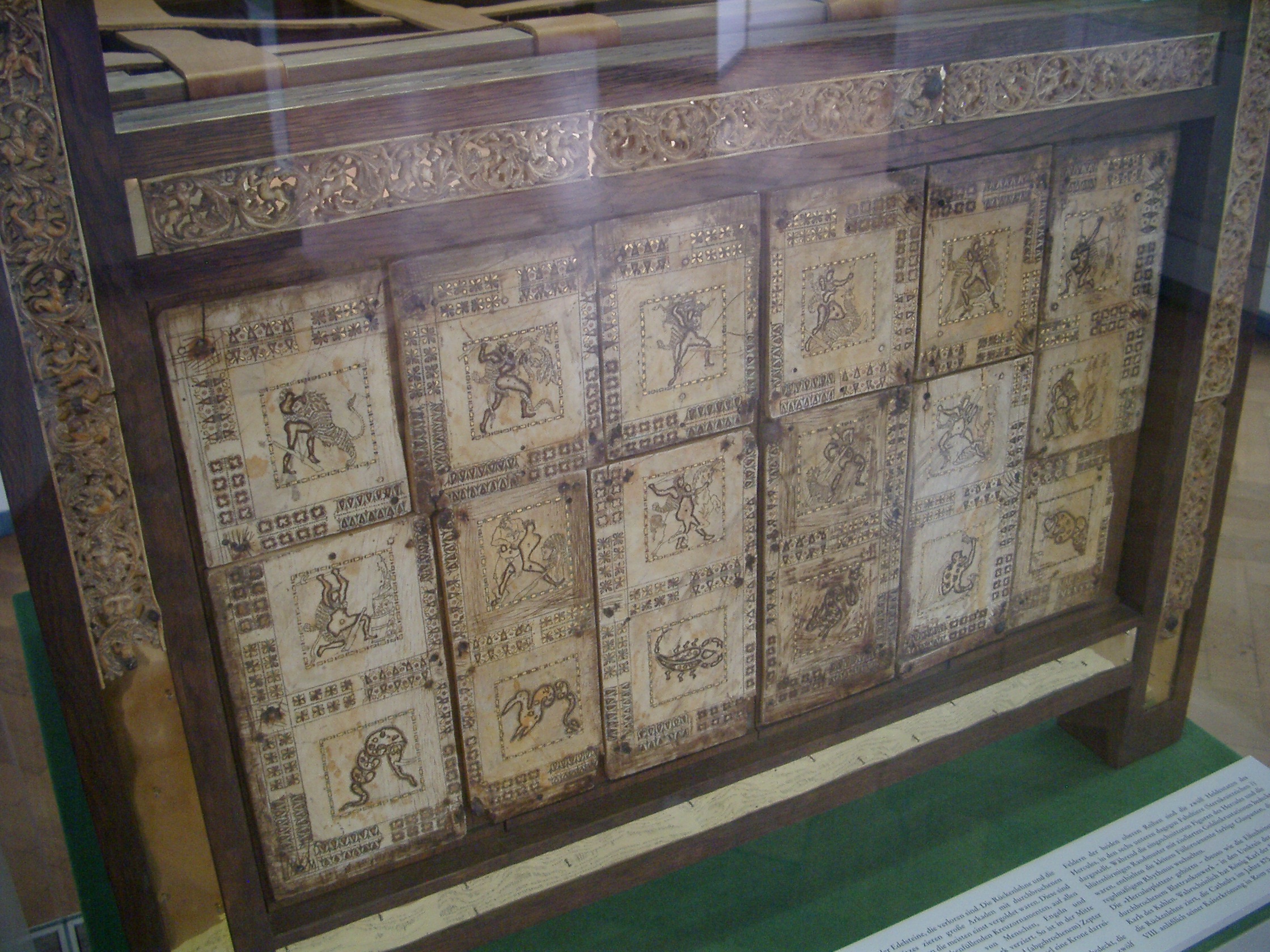
The definitive example of a cathedra is that encased within the Triumph of the cathedra Petri designed by Gian Lorenzo Bernini in 1657, and completed and installed in St Peter's Rome in 1666. As early as the 8th century, an ancient wooden chair overlaid with ivory plaques depicting The Twelve Labours of Heracles and some of the constellations,[7] was venerated as the episcopal chair of St. Peter. It is a Byzantine throne with framed fragments of acacia wood, encased in the oak carcass and reinforced with iron bands. It was long believed to have been used by the Apostle Saint Peter, but the Holy See recognises that the chair was a gift from Holy Roman Emperor Charles the Bald to Pope John VIII in 875.[8] Several rings facilitated its transportation during processions. Pope Alexander VII commissioned Bernini to build a monument to display this relic in a triumphant manner. Bernini's gilded bronze throne, richly ornamented with bas-reliefs, encloses the relic. On January 17, 1666, it was solemnly set above the altar of Saint Peter's Basilica in Vatican City. Greater than life-sized sculptures of four Doctors of the Church form an honour guard: St. Ambrose and St. Athanasius on the left, and St. John Chrysostom and St. Augustine on the right.

Celebrated on February 22 in accordance with the calendar of saints, the Feast of Cathedra Petri (the Feast of the Chair of Peter the Apostle) honours the founding of the church in Rome and gives thanks for the work of Saint Peter.

Chair of Bishop Maximianus

[edit]

A fifth- or sixth-century bishop's throne decorated with elaborate ivory carving is preserved in the sacristy of the cathedral at Ravenna. It bears a monogram in front, "Maximianus ep.", which gave it its name. The identity of the bishop is given by the 1908 Catholic Encyclopedia as Maximianus of Constantinople (d. 431), considered as more likely than Maximianus of Ravenna (d. 556).[5]

Chair of St. Augustine

[edit]

The Chair of St. Augustine represents one of the most ancient extant cathedrae in use. Named after the first Archbishop of Canterbury, St. Augustine of Canterbury, it is made of Purbeck Marble or Bethesda marble and dates to sometime between the 6th and 12th centuries. Those who argue for an older date suggest that it may have been used to crown the kings of Kent. Canterbury Cathedral, in which the cathedra is housed, maintains that the chair was once part of the furnishings of the shrine of St. Thomas Becket, since dismantled.[9] Since the Middle Ages, it has always been used in the triple enthronement of an Archbishop of Canterbury. He is seated on the throne in the quire as Diocesan Bishop, in the chapter house as titular abbot, and in St. Augustine's chair as Primate of All England. This is the only occasion in which the cathedra is used. A second cathedra is used for other occasions at which the archbishop is present.

Placement

[edit]

The early Christian bishop's throne, or cathedra, stood in an elevated position behind the altar, near the wall of the apse.[1] It had been the position of the magistrate in the apse of the Roman basilica, which provided the model type—and sometimes were adapted as the structures—for early Christian basilicas.[citation needed]

Western churches

[edit]

In the Middle Ages, as altars came to be placed against the wall of the apse, the practice of placing the cathedra to one side (mostly left) became standard.[citation needed]

In the Roman Catholic Church since the Second Vatican Council, the altar is often free-standing. The cathedra in cathedrals built or renovated after Vatican II is sometimes placed behind the altar, as in ancient Roman basilicas.

In Anglican practice, the cathedra tends to be placed to one side in the choir, although in more contemporary practice, it is commonly placed on the gospel side of the chancel (i.e., to the left of the altar, as one looks at it from the front).

Eastern churches

[edit]

Eastern Orthodox and Byzantine Rite Catholic churches have a throne for the bishop in the apse behind the holy table, with seats for the priests (Greek: synthranon) arranged to either side. This location is referred to as the "high place" and represents the presence of Christ presiding over the services, even when the bishop is not present and therefore an icon of Christ is often placed above the bishop's throne. The bishop ascends to the high place only during the divine liturgy, at the Trisagion. For this reason, the consecration of a bishop takes place at the Trisagion, so that he may ascend to the high place for the first time as a bishop during the liturgy at which he is consecrated.

Another throne is provided for the bishop in the nave of the church:

  • In the Greek Orthodox Church practice, this is normally located along the southern wall of the church, on the kliros. In this style, it is one of the monastic choir stalls (kathismata), only more elaborately carved, usually at the top of three steps, and with a canopy above it. During the divine liturgy, the deacon ascends to this throne to read the gospel, facing west.
  • In the Russian Orthodox Church practice, the kafedra (Russian: кафедра, káfedra) is a large square platform set in the very center of the nave, with a removable chair or faldstool placed on it. This arrangement is a remnant of the ancient bemah (Greek: amvon), borrowed from the Jewish synagogue, which stood in the center of the church in ancient times. Sometimes during the liturgy, the deacon stands on this platform, facing east, to read the gospel.

An orlets is usually placed at both the high place and the throne in the nave. An orlets is usually kept permanently on the Russian kafedra, even when the chair is removed; the orlets is, however, removed when a deacon stands on the kafedra to read the gospel.

See also

[edit]

References

[edit]
[edit]
Revisions and contributorsEdit on WikipediaRead on Wikipedia
from Grokipedia
A cathedra (Latin for "chair") is the official throne or seat of a in the church of a , from which he presides over liturgical functions, delivers teachings, and exercises his pastoral as successor to the apostles. The term derives from the kathédra, meaning "seat" or a place to sit, often with a backrest, and it symbolizes the bishop's stability, (teaching office), and role in guiding the faithful in faith, hope, and charity. In , the cathedra is typically an elevated, ornate structure—often made of marble, wood, or ivory—positioned in the behind the altar, underscoring the bishop's preeminence among the . It is considered the oldest of episcopal , predating other symbols like the crosier or ring. The origins of the cathedra trace back to the early , where the development of the episcopal office and monepiscopacy (single leadership) by the third century CE necessitated a designated for the amid the presbyters' benches. Influenced by Roman basilica designs and the seats of magistrates, as well as biblical imagery of divine like Solomon's, the cathedra evolved from simple rock-hewn seats in to more prominent fixtures in public churches following the in 313 CE. Early textual evidence appears in the (third century CE, ), describing the 's at the east end of the church, a practice formalized by the of in 398 CE, which required it to be elevated above priests' seats. Archaeological examples, such as the cathedra of Maximianus (546–556 CE) in , illustrate its artistic and symbolic refinement during . In the Catholic and Episcopal traditions, the cathedra holds profound theological significance, representing the from Christ to Peter and the . For the of (the ), the cathedra in St. John Lateran Basilica serves as the primary seat, distinct from the Chair of St. Peter in Vatican Basilica, which commemorates Peter's ministry and is enshrined in Gian Lorenzo Bernini's (completed 1666). The phrase ex cathedra ("from the chair") denotes infallible papal teaching on matters of faith and morals, a defined at the in 1870, emphasizing the cathedra's enduring role in doctrinal authority. The Feast of the Chair of St. Peter, celebrated on , honors this legacy, highlighting unity among the universal Church's particular churches.

Etymology and Terminology

Linguistic Origins

The term "cathedra" originates from the ancient Greek word καθέδρα (kathedra), composed of kata- meaning "down" and hedra meaning "seat" or "base," denoting a chair or any seated position without inherent religious significance. In classical Greek literature, it referred to everyday furniture, such as benches or stools used for sitting, emphasizing a position of rest or support rather than authority. This basic sense carried over into Hellenistic usage, where it could imply a place for lecturing or instruction, though still primarily denoting a physical object. Adopted into Latin as cathedra during the Roman period, the word retained its core meaning of "" or "" but increasingly connoted a seat of , particularly for teachers or public figures. In Latin usage during the Roman period, the word increasingly connoted a seat of , particularly for teachers or public figures, symbolizing intellectual or magisterial in rhetorical and philosophical contexts. This evolution highlighted the seat as an emblem of teaching power, a nuance that distinguished it from simpler terms like sedes (seat) and aligned it with roles involving or governance. The earliest attestations of cathedra in Christian patristic writings appear in the late 2nd to early , where it begins to symbolize authority derived from apostolic foundations. , in his De Praescriptione Haereticorum (c. 200 AD), uses the phrase cathedrae apostolorum to refer to the "thrones" or seats of the apostles in churches they established, such as those in , , and , underscoring their enduring doctrinal authority against heresies. By the , figures like Optatus of Milevis invoked similar imagery in works such as Contra Parmenianum Donatistam, applying cathedra to episcopal seats as symbols of and unity in the North African church. The cathedrae apostolorum thus represented the collective chairs of the apostles, embodying the foundational teaching authority transmitted through their successors in early Christian communities.

Religious and Idiomatic Uses

In Christian tradition, particularly within the Roman , the term "ex cathedra" refers to a papal pronouncement made with the full authority of the office of St. Peter, rendering it infallible on matters of faith and morals. This concept, meaning "from the chair," symbolizes the speaking as the supreme teacher and shepherd of the universal Church, protected from error by divine assistance. The doctrine was formally defined at the in 1870 through the dogmatic constitution , which states that the Roman Pontiff, "when he speaks ex cathedra... by the divine assistance promised to him in blessed Peter, is possessed of that with which the divine Redeemer willed that his church should be endowed for defining doctrine regarding faith or morals." The term "cathedra" also denotes the bishop's see, signifying the or over which a presides from his official seat. This usage underscores the cathedra as the central symbol of the bishop's and role within his territory, extending the of the "" to encompass the entire scope of his . In this , the cathedra represents not merely a but the enduring locus of episcopal , binding the bishop's responsibilities to the faithful under his care. Etymologically, the word "cathedral" derives directly from "cathedra," referring to the principal church in a that houses the 's and thus serves as the seat of his authority. This linkage emphasizes the cathedral's role as the spiritual and administrative heart of the , where the exercises his magisterial functions during solemn liturgies and assemblies. The term evolved in to distinguish such churches from others, highlighting their unique status tied to the presence of the cathedra. Idiomatically, expressions like the "Chair of Peter" (Cathedra Petri) extend the cathedra's symbolism to represent the primacy of the papacy, evoking St. Peter's apostolic authority as the foundation of the Church's unity. Celebrated liturgically on in the , this feast honors the cathedra as an emblem of the Pope's , tracing back to early Christian of Peter's teaching chair in . The Cathedra Petri thus serves as a potent for the unbroken succession of papal authority, fostering ecclesial communion across the global Church.

Ecclesiastical Role and Significance

As the Bishop's Throne

The cathedra functions as the principal throne of a within his church, serving as an elevated and frequently ornate seat that symbolizes his teaching authority (potestas docendi) and jurisdictional oversight in the . Constructed typically from durable materials such as marble, wood, or stone, it is often raised on a platform of two or three steps and positioned to allow the to preside visibly over the assembly during solemn liturgies. This throne underscores the 's and role as shepherd, distinguishing his episcopal ministry from that of presbyters. In liturgical practice, the cathedra plays a central role in key rites, where the delivers homilies, proclaims , and conducts ordinations or installations from its position. For instance, during episcopal ordinations in the Catholic rite, the newly consecrated ascends the cathedra to receive the symbols of his , affirming his commitment to governing the local church. In the Orthodox tradition, the cathedra, typically the central seat within the synthronon (a tiered structure for ), facilitates the 's blessings and oversight in hierarchical Divine Liturgies. These uses highlight the cathedra's integration into the sacred rites, elevating the 's presence as a focal point of communal and doctrinal instruction. The is distinctly reserved for the or a visiting with permission, setting it apart from other seats such as the presider's chair, which may use during Masses in the . This exclusivity reinforces its unique status as the emblem of episcopal authority, prohibiting its use by lower clergy to maintain the hierarchical order. Canon law in both Catholic and Orthodox traditions mandates the presence of a cathedra in the bishop's principal church to designate it as the , thereby establishing the seat of governance and liturgical primacy. In the , the cathedra similarly symbolizes the bishop's teaching and pastoral authority in the .

Relation to Church Authority and Cathedrals

The serves as the physical embodiment of the 's "see," symbolizing his spiritual and administrative jurisdiction over the as the successor to the apostles in governing the local church. Placed prominently in the , it represents the fixed seat from which the exercises his oversight, teaching, and sanctifying roles, ensuring the unity and of the faithful under his care. This symbolism underscores the 's as derived from Christ through apostolic transmission, making the a tangible sign of the 's structure. Historically, the term "cathedral" derives directly from "cathedra," denoting the church that houses the bishop's throne and thus qualifies as the principal seat of diocesan authority; only those churches containing this throne bear the designation of cathedral, distinguishing them from other parish or monastic churches. This nomenclature emerged in early Christianity to emphasize the cathedra's centrality in defining the diocese's mother church, where the bishop's presence and governance are most manifest. The cathedral, therefore, is not merely an architectural feature but the institutional hub where the bishop's jurisdictional power is exercised, reinforcing the hierarchical order of the church. In ecumenical councils and diocesan synods, the cathedra symbolizes the bishop's presiding authority, as the is required to lead such gatherings to foster communion and address local church needs. This function extends to broader ecumenical settings, where the presence of bishops from their sees highlights collective apostolic governance. Doctrinally, the cathedra reinforces the principle of by visibly linking the bishop's teaching and governing authority to the unbroken chain from the apostles, ensuring the preservation of authentic faith and unity in the church. As a of this succession, it attests to the bishop's role in transmitting the apostolic mandate, particularly in magisterial acts where he speaks from his see to bind the faithful. This connection is evident in the church's tradition, where the cathedra in the serves as a perpetual reminder of the episcopal office's divine institution.

Historical Development

Early Christian Period

In the early Christian period, the cathedra emerged as a symbol of episcopal authority within modest worship spaces, initially in house churches before transitioning to more formal basilical structures. During the first three centuries, when was often persecuted, believers gathered in private homes adapted for communal prayer and , where the presided from a simple raised seat or bench denoting leadership. By the late third century, as communities grew, these arrangements began to incorporate designated seating for , foreshadowing the formalized . A key textual reference appears in the , a fourth-century compilation reflecting earlier traditions, which instructs: "In the middle let the 's throne be placed, and on each side of him let the presbytery sit down; and let the deacons stand near at hand." This placement emphasized the 's central role in and governance and drew from apostolic practices outlined in epistles like those of Paul, which urged respect for church overseers. The adoption of the cathedra was heavily influenced by Roman architectural and civic traditions, particularly the adaptation of basilicas for Christian use following the in 313 CE. Roman basilicas served as public halls for legal proceedings, featuring an at one end where magistrates sat on an elevated cathedra—a large chair symbolizing judicial authority—to dispense laws and judgments. Early Christians repurposed these structures, relocating the bishop's seat to the behind , transforming secular power symbolism into oversight. This shift is evident in Constantine's church commissions, such as the original , where the cathedra occupied the apse to signify the bishop's teaching and unifying role amid doctrinal disputes. The Council of Nicaea in 325 CE further underscored the cathedra's implications for episcopal authority by establishing canons that defined bishops' jurisdictional rights and procedures, reinforcing the throne as the physical embodiment of diocesan leadership. Convened by Emperor Constantine, the council addressed and church order, decreeing in Canon 4 that bishops should be appointed by provincial peers to maintain hierarchical stability, implicitly tying authority to the bishop's established seat. These measures helped standardize the cathedra's role across emerging Christian sees, promoting unity in an era of expansion. Archaeological evidence from , a third-century Syrian frontier town, provides tangible insight into proto-cathedral seating in pre-Constantinian house churches. Excavated in , the site's Christian building—dating to around 232–256 CE—features an assembly hall with benches along walls capable of seating 50–70 worshippers, including a presumed elevated spot for the presider, akin to a bishop's , adjacent to a room. This layout reflects early adaptations of domestic spaces for liturgical use, with the leader's position highlighting communal hierarchy before basilical grandeur.

Medieval and Post-Medieval Evolution

During the medieval period, the cathedra transitioned from rudimentary stone benches to ornate structures that integrated luxurious materials and symbolic elements, reflecting the growing prestige of episcopal authority. In the , Byzantine artisans crafted the Throne of for the of , featuring a wooden core sheathed in over two dozen panels carved in with scenes from the Life of Christ, prophets, and evangelists, bordered by vine-scroll motifs. This elaboration marked a shift toward using for its associations with purity and exotic value, often sourced from elephant tusks via trade routes from and . By the , Roman workshops produced marble cathedrae with intricate sculptural details, such as the throne linked to Pope Hadrian I's era (772–795), which displayed peacocks and crosses evoking eucharistic themes amid Carolingian stylistic influences. Wood carvings also proliferated, as seen in Anglo-Saxon and Ottonian examples where or was incised with geometric patterns or figural s to denote hierarchical status. The 11th–12th centuries saw further innovations, with Italian centers like producing ivory panels specifically for cathedrae, including narrative friezes integrated into the throne's backrest and arms to support liturgical functions. Relics were often placed near these thrones or adjacent altars, transforming the cathedra into a focal point for and amplifying its role as a conduit for during episcopal consecrations. These embellishments not only enhanced aesthetic splendor but also reinforced the bishop's magisterial role in an era of expanding church influence. The (1075–1122), a protracted struggle between papal reformers and Holy Roman Emperors over clerical appointments, intensified the cathedra's symbolism as the unassailable seat of spiritual sovereignty. Amid debates where secular rulers sought to confer episcopal symbols like rings and staffs, the embodied the bishop's independent teaching authority (cathedra deriving from for "seat"), insulated from lay interference and rooted in . Papal bulls such as Gregory VII's (1075) implicitly elevated this imagery, positioning the cathedra as a bulwark against imperial encroachments on autonomy. In post-Reformation Protestant contexts from the 16th to 18th centuries, cathedrae underwent significant adaptations, often simplified or repurposed to align with doctrines emphasizing congregational equality over hierarchical pomp. In Lutheran and Calvinist regions, former Catholic cathedrals were converted, with ornate episcopal furnishings sometimes dismantled or downplayed to suit reformed worship. Anglican churches in retained cathedrae in cathedrals but adapted them to reflect a balance between and Protestant . The 19th and 20th centuries witnessed restorations that underscored continuity with medieval forms, countering Enlightenment-era secularization. In the Vatican, displayed the ancient Cathedra Petri relic publicly in 1867 during basilica renovations, framing it within Bernini's 17th-century bronze enclosure to affirm Petrine primacy amid Italian unification threats. Twentieth-century efforts, including post-World War II consolidations in St. Peter's and other European cathedrals, employed techniques like chemical cleaning and structural reinforcement to preserve and elements, as in the 1960s Vatican restorations that restored original polychromy while adhering to liturgical reforms from the Second Vatican Council. These interventions, often funded by ecclesiastical commissions, prioritized historical fidelity to maintain the cathedra's role as an enduring emblem of apostolic governance.

Notable Examples

Cathedra Petri

The Cathedra Petri, also known as the , is a revered wooden relic preserved within in , traditionally identified as the episcopal throne of the Apostle Peter, the first Bishop of Rome. This ancient oak chair, measuring approximately 1 foot 10 inches in height and 2 feet 11 inches in width, features iron rings for portability and is adorned with plaques depicting classical motifs, including and geometric patterns, likely added later for reinforcement with wood. The relic's documented history dates to the , when it was presented as a gift to by , King of , in 875, during a period of Carolingian influence on the papacy; it was initially housed in the and later moved several times for protection, including to the and other altars. Veneration of the chair as Peter's seat emerged in the , with liturgical feasts recorded as early as the under , though the physical artifact itself is not from the but reflects evolving traditions of Petrine authority. In the 17th century, commissioned to enclose the relic in a monumental bronze , completed between 1657 and 1666 and positioned above the basilica's main altar. This gilded reliquary depicts the chair elevated on a platform supported by four massive statues of the Doctors of the Church—Saints , Augustine, Athanasius, and —rising from swirling clouds, with golden rays emanating from a central featuring stained-glass rays and the dove of the , symbolizing divine enlightenment and the transmission of apostolic teaching. Theologically, the Cathedra Petri embodies the primacy of Peter as instituted by Christ (Matthew 16:18–19) and serves as an enduring symbol of the Pope's magisterial authority, representing the unity of the Church and the successor of Peter's role in safeguarding faith and doctrine. The relic was publicly displayed in St. Peter's Basilica from October 27 to December 8, 2024, for the first time in approximately 150 years, allowing veneration near the tomb of St. Peter during the Solemnity of the Immaculate Conception. Debates over the relic's authenticity persist, as early patristic witnesses like and affirm Peter's episcopal role in but provide no direct evidence for this specific chair, which scholarly analysis dates to the Carolingian era with ivory elements possibly originating from 6th–9th-century workshops in or the rather than apostolic times. The relic gained heightened symbolic prominence during the (1869–1870), where its invocation in the constitution Dei Filius underscored , declaring that from "this Chair of Peter" the saving doctrine of Christ would be professed against errors, reinforcing the of the Pope's supreme jurisdiction and in ex cathedra teachings.

Other Prominent Cathedrae

The Throne of , a mid-6th-century episcopal seat from , , exemplifies early Byzantine craftsmanship in furniture. Constructed with a wooden frame overlaid by 21 finely carved ivory panels, it measures about 1.5 meters in height and features reliefs of biblical narratives, including the and on the front beneath the 's monogram, scenes from Joseph's life on the armrests, and episodes from Christ's infancy and miracles on the back. Commissioned during Justinian I's reign for , the throne symbolized imperial and religious authority, blending artistic excellence with theological emphasis on key Christian figures. Today, it resides in the Archiepiscopal Museum of , where its preservation highlights the enduring legacy of 's role as a Byzantine cultural hub. In , the Chair of St. Augustine at serves as the ceremonial cathedra for the , embodying the site's foundational Christian history despite its medieval origins. Fashioned from in a Roman-inspired design, this stone throne dates to approximately 1220, replacing an earlier version lost to a fire in 1174 during the cathedral's rebuilding after the murder of . Named for St. Augustine of Canterbury, the 6th-century missionary dispatched by Pope Gregory the Great to evangelize Anglo-Saxon in 597, the chair lacks direct ties to the saint's era or North African provenance but evokes his pivotal role in establishing the English church. Positioned behind the high altar since 1977, it remains in active use for archiepiscopal enthronements, representing institutional continuity amid historical upheavals. Across these examples, cathedrae demonstrate diverse materials suited to symbolic durability and artistic expression: ivory-over-wood for the ornate throne, emphasizing portability and intricate detailing; solid stone like in for permanence and grandeur; and, in broader historical contexts, occasional metal elements such as or gilt for enhancement and protection against wear. Their survival through wars, fires, and restorations—such as the throne's relocation to a amid medieval conflicts or 's post-1174 reconstruction—owes much to as relics of authority, with ongoing conservation ensuring their cultural impact endures. This resilience highlights cathedrae's role not merely as seats but as tangible links to ecclesiastical heritage.

Placement and Design

In Western Churches

In Roman Catholic cathedrals, the cathedra is typically positioned behind the main within the , often elevated on a platform to enhance visibility for the during the celebration of and other solemn liturgies. This placement aligns axially with the , ensuring the bishop's presence is central to the liturgical action and accessible to the congregation. Design features of the cathedra adhere to post-Tridentine standards, emphasizing dignity and symbolism, as codified in the instructions of following the . These include the potential for a surmounting baldacchino or canopy (ciborium) when aligned with an canopy, crafted from materials like wood or to denote . Inscriptions, such as the bishop's or scriptural references, may adorn the to underscore its role in teaching and governance. In Anglican cathedrals, the cathedra maintains symbolic elevation as a focal point for diocesan gatherings. Lutheran cathedrals exhibit variations in design. Modern adaptations in renovated Roman Catholic basilicas frequently incorporate simpler, functional cathedrae to align with post-Vatican II liturgical reforms, sometimes featuring movable elements for flexibility in worship arrangements. For instance, the Cathedral of Our Lady of the Angels in features a contemporary wooden cathedra with symbolic motifs, balancing tradition with practicality.

In Eastern Churches

In Eastern Orthodox and , the cathedra is positioned within the synthronon, a semicircular or tiered structure of benches in the behind the , which serves as seating for the and underscores the hierarchical order during services. This placement integrates the bishop's into the communal arrangement of the , distinguishing it from elevated Western apse designs by emphasizing collective clerical participation. The cathedra itself features simpler designs compared to Western elaborations, typically constructed from wood or stone with embroidered fabric covers, reflecting Byzantine artistic traditions that emerged in the and evolved through multi-tiered forms by the Middle Byzantine period. These elements prioritize functionality and symbolic restraint, often carved in basswood or similar materials to evoke ancient prototypes while accommodating liturgical needs. During the , the bishop ascends the cathedra, located centrally in the synthronon behind the holy table, to perform key blessings, such as after the Trisagion Hymn, where the priest blesses the with the words, "Blessed are You upon the throne of the glory of Your kingdom, enthroned upon the Cherubim always, now and forever and to the ages of ages." Historically, the cathedra in Hagia Sophia's seven-tiered synthronon exemplified this tradition in 6th-century , providing a central elevated seat amid benches. In modern restorations, such as the reconstructed in —consecrated in 2000 as the patriarch's seat—the synthronon and cathedra maintain Byzantine influences through tiered stone and wooden elements integrated into the . Similarly, 19th-century restorations of Greek Orthodox churches in , like the Galatasaray Church, preserved cathedra designs in synthronon structures to honor historical liturgical layouts.

Secular and Modern Interpretations

Academic and Professorial Contexts

In academic contexts, the term "cathedra," derived from the Latin for "chair" or "seat," metaphorically shifted from its ecclesiastical origins to denote the authoritative teaching position of a professor, symbolizing intellectual leadership and institutional prestige. This usage emerged in medieval European universities, where lecturers physically sat in a cathedra during instruction, echoing the bishop's role as teacher and drawing on the ancient Roman association of the chair with magisterial authority in education. The concept formalized the professorial role as one of enduring scholarly oversight, distinct from transient speaking platforms. By the 18th and 19th centuries, this tradition influenced the structure of universities in , particularly in German-speaking regions, where the equivalent "Lehrstuhl" (teaching chair) represented not only an individual position but often the headship of a departmental unit, emphasizing the professor's responsibility for a field of study. In Eastern European academia, such as in and , the term evolved into "katedra," directly signifying an academic department under a leading professor's guidance. This adaptation underscored the cathedra's role in perpetuating disciplinary knowledge and authority within secular institutions. In contemporary usage, especially in U.S. higher education, "chair professor" or "endowed chair" refers to a prestigious, funded academic appointment that supports and excellence, often named after donors to attract top scholars. These positions blend the historical symbolism of with modern financial endowments, providing resources beyond standard salaries. For instance, in theological faculties at universities like the University of , "cathedra" explicitly names chairs in areas such as historical , retaining a subtle nod to religious symbolism while functioning as a secular academic unit. Unlike a or , which serves merely as a functional stand for notes or delivery during lectures, the cathedra connotes permanence and hierarchical stature, historically elevating the occupant as the definitive voice in their domain. This distinction highlights the term's emphasis on sustained intellectual governance rather than momentary oration.

Contemporary Symbolic Uses

In the realm of 20th- and 21st-century , the cathedra has inspired symbolic reinterpretations that extend beyond its origins, often serving as a motif for divine or institutional amid critiques of power structures. Barnett Newman's 1951 abstract painting Cathedra, housed in the , exemplifies this shift; its vast ultramarine blue canvas, interrupted by one white and one sky-blue vertical "zips," symbolizes the biblical as described in the , evoking a sense of sublime presence and mystical connection in the aftermath of . Newman, drawing from Jewish theological traditions, used the title—Latin for "" or "seat"—to convey an encounter with the transcendent, positioning the work as a meditative response to human suffering and the erosion of traditional spiritual icons. The painting's monumental scale and vibrating further critique modern alienation by inviting viewers into a contemplative space that challenges conventional representations of . Literary uses of the cathedra in the late 20th and early 21st centuries frequently employ the related phrase "ex cathedra"—meaning "from the chair"—as a for dogmatic or unquestioned pronouncements, highlighting institutional rigidity and power dynamics. In Dana Gioia's 2014 essay on mid-century magazines, the term describes the authoritative, papal-like tone of editorial declarations in Vice Versa, portraying such statements as emblematic of cultural gatekeeping and the imposition of literary . This metaphorical extension underscores critiques of intellectual , where "ex cathedra" evokes the unassailable voice of established institutions, much like Umberto Eco's explorations of semiotic in medieval-inspired narratives, though Eco's works more broadly allegorize dogmatic structures without direct reference to the itself. Such usages in contemporary prose and criticism reflect a broader cultural of how symbols of perpetuate ideological control. Digital media has further amplified the cathedra's symbolic role through virtual reconstructions that democratize access to its historical significance, fostering educational dialogues on authority and heritage. Virtual reality tours of St. Peter's Basilica, including the Vatican's official 360-degree immersive experience, feature the Cathedra Petri—a gilded bronze throne encasing the presumed seat of St. Peter—as a central emblem of papal primacy, allowing users to navigate the apse and reflect on its role in ecclesiastical power. Similarly, AI-enhanced digital twins of cathedrals, such as those developed for Notre-Dame de Paris post-2019 fire—including a July 2025 project by Microsoft in partnership with Iconem and the French government that creates a detailed 3D replica with interior elements like episcopal thrones—simulate historical contexts, emphasizing the cathedra's enduring symbolism in virtual environments that blend preservation with interactive learning. These representations transform the cathedra from a static relic into a dynamic tool for exploring themes of unity and critique in global cultural narratives.

References

Add your contribution
Related Hubs
User Avatar
No comments yet.