


Community hub
Recent from talks
Contribute something
Nothing was collected or created yet.
Eppstein
View on Wikipedia | This article needs additional citations for verification. (October 2022) |
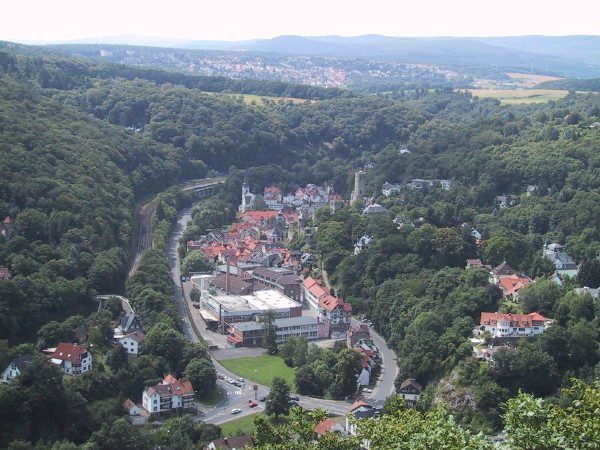
Eppstein (German pronunciation: [ˈɛpˌʃtaɪn] ⓘ) is a town in the Main-Taunus-Kreis, in Hesse, Germany. Eppstein lies west of Frankfurt am Main, around 12 km north east of the state capital Wiesbaden, and is at the edge of the Taunus mountains. The ruins of the Eppstein castle is a prominent landmark, and houses a museum.
Key Information


Geography
[edit]Neighbouring municipalities and areas
[edit]To the north, Eppstein borders the city of Idstein (Rheingau-Taunus-Kreis) and the municipality of Glashütten (Hochtaunuskreis). To the east is the city of Kelkheim, to the south the city of Hofheim, and to the west the city of Wiesbaden and the municipality of Niedernhausen.
City arrangement
[edit]Eppstein consists of five areas: Bremthal, Ehlhalten, Eppstein, Niederjosbach and Vockenhausen.
Bremthal
[edit]

Bremthal has a rapid-transit railway stop on line S2. With approximately 5000 inhabitants, Bremthal is the most populous quarter of Eppstein, and is the economic and cultural centre. Bremthal has several associations e.g. a brass band, Germania singing association, Liederkranz singing association, an association of small animal breeders and a volunteer fire brigade.
Bremthal was founded by the Lords of Eppstein in the 10th/11th century because the narrow valley around their castle did not allow for arable land. Bremthal's church, St. Margareta, was built in 1889. The church has a baptismal font (1749) from an earlier church on the site.
A small skate park and forest adventure path off the Wildsachsenerstraße are fun for children.
Niederjosbach
[edit]Niederjosbach has a rapid-transit railway stop on line S2 as well as a bus connection to the Wiesbadener transportation network.
Motorway connections are about 3 minutes away. In Niederjosbach is a large campsite, the very well-maintained terrace-like "Taunuscamp", which is on the Sonnenhang. It is open all year round. The GCC - Gusbacher Carnevalsclub - organizes several meetings annually, and on "carnival Tuesday", a noteworthy parade by the village's local associations; two sport clubs, two singing clubs, a fruit and horticulture club, church choir, fire-brigade, "Gusbacher chaoten" (carnival parade organisers), federation of housewives, German Red Cross local association and neighbourhood municipalities. There is an industrial area and several craft enterprises, as well as an urban kindergarten with three groups. The Catholic community centre "Am Honigbaum" ("at the honey tree") is used for church and also for private and other social meetings. The place has been part of Eppstein since 1972. The Niederjosbach coat of arms has a silver fir tree on a red background.
Vockenhausen
[edit]Vockenhausen is the seat of the mayor. It has around 4500 people. The administration is distributed between the two city halls in Vockenhausen and Eppstein. On the Vockenhäuser "Gemarkung" are the Freiherr-vom-Stein-Schule (comprehensive school) and the Burg-Schule (primary school).
This "Stadtteil" of Eppstein was founded around 1100 by the Lords of Eppstein and belonged to them until they died out in 1535. Historically, the area was a site for manufacturing. A number of mills (e.g. for grinding grain, dye-making, leather-tanning, and iron extraction) made use of the stream that runs through the town.
The sculpture before the Vockenhausen turn-off between Alt-Eppstein and Bremthal is a reminder of Vockenhausen's "Schmelzmühle" (smelting mill) as well as Vockenhausen's two well-known artists Robert and Ella Bergmann-Michel, who lived at the mill from the 1920s until their deaths.
The sunny hillside of Vockenhausen is home to many families and Eppstein's elementary and middle schools; the valley has a number of traditional German, as well as Greek, Italian, and Chinese restaurants, a few bakeries, guest houses, hair salons, doctors' offices, a tanning and waxing salon, drugstores, dry cleaners/post office, and local grocery stores.
The "Bergstraße" — also called the "Schmerzberg" ("Pain Mountain") during an annual 1 May bike race — goes over the hill to Alt-Eppstein.
Ehlhalten
[edit]
Ehlhalten is the part with the fewest inhabitants (about 1350) but the largest area due to its rather big forests. According to legend, Ehlhalten once provided a cutter that tailors used at the water of the brook in Ehlhalten. As the water rose and fell, affecting the measurement of the inch, people cried: "Elle halten!" ("hold the inch!"), leading to the name Ehlhalten.
Ehlhalten was also the name of a settlement in the municipal forest near a source. It was burned down however by soldiers and destroyed completely. In 2004 Ehlhalten competed in the final of the series "Dolles Dorf" on hr television, winning a third prize in this show about villages in Hesse.

Mayors
[edit]- Ralf Wolter, (2000-2009)
- Peter Reus (independent), 2009-2013
- Alexander Simon, since 2013
Economy
[edit]Transport
[edit]Eppstein station is on the Main-Lahn Railway and is served by line S 2 of the Rhine-Main S-Bahn, running between Niedernhausen and Dietzenbach via Frankfurt and the town is around 3 km from the A3 Autobahn. Bundesstraße 455 passes through the town.
Local industry
[edit]The Stanniolfabrik Eppstein is in the central part Eppstein, beneath the castle. They are manufacturing tin foil and similar metal foils for highly specialised applications. It has become famous due to an appearance in the television series MythBusters, because they supplied lead foil for the lead ballon myth.
RUCO printing inks (A. M. Ramp & Co GmbH) also has a facility here.
Education
[edit]for the educational system in Germany, see Education in Germany
Eppstein has two primary schools and one comprehensive school. In addition, the Hessen-Thüringen bank academy is located here. The Eppstein-Rossert music school and the Eppstein music society offer instruction in various musical instruments.
Primary schools
[edit]In Eppstein Vockenhausen, near the training and sports centre at the Bienroth, is the "Burg-Schule" (castle school). It is somewhat larger with approx. 300 pupils than the "Commenius-Schule," which is the primary school for pupils from Eppstein's parts Bremthal and Niederjosbach.
Freiherr-vom-Stein-Gesamtschule
[edit]Eppstein's comprehensive school, the Freiherr-vom-Stein-Gesamtschule, is located at the sports and school centre "Am Bienroth". Five-hundred and sixty students in the fifth to tenth years attend the school, which is divided into three sections: Hauptschule (year 5 to 9), Realschule and Gymnasium (both year 5 to 10). A special feature of the school is the annual exchange of students with Eppstein's twinned town of Kenilworth, England, as well as a school in Tours, France. Every two years the school also hosts an exchange with the Bornova Anadolu Lisesi in İzmir, Turkey.
The school is known for a tragic attack: on 3 June 1983 a man shot three children, one teacher and a police officer dead. The attacker then committed suicide. 14 were injured.
Town partnerships
[edit]Eppstein is twinned with four towns:[3]
 Aizkraukle, Latvia since 1998
 Kenilworth, England since 1994
 Langeais, France since 1986
 Schwarza, Thuringia, Germany


Buildings
[edit]
The ruins of the Eppstein castle (first mention in 1122 as "Ebbensten") give character to the old city centre of Eppstein.
The museum in Eppstein's castle is in the one building within the castle walls which was spared breakup in the early 19th century. The museum contains baroque altar in the back, which Eppstein's Catholics acquired when they used the building as their chapel after the valley church (Talkirche) became Protestant during the Reformation. Upstairs are some books written by early travel writers who refer to Eppstein, including a copy of Dumas's Le chateau d'Eppstein, as well as paintings of the castle, some painted by members of one of the first painters' colonies in Germany—the "Kronberger Malerkolonie." At the foot of the castle, in the middle of the historical old city, is the Talkirche (Valley Church), which today accommodates Eppstein's evangelical parish.
Eppstein's turn-of-the-century train station (1903) has been newly renovated and houses not only an RMV counter (Rhine-Main bus and commuter train information counter), the Bürgerbüro (citizens' information center), but also a restaurant/cafe.
The Villa Anna, above the train station, was built in the 1880s by the wealthy Frankfurt businessman Alfred von Neufville. Its grounds were designed by the famous landscaper Andreas Weber (who also designed the Frankfurt Zoo). With 200 exotic trees and bushes, its park is one of only two "Bergparks" (mountainside parks) in all of Hesse.
The Neufville Tower was built by the Neufvilles to house their private art collection and to serve as their "Jagdhaus" (hunting lodge).
Eppstein's beautification society keeps up a number of scenic overlooks, most of them built over a century ago during the flowering of Eppstein as a "Luftkurort" (climatic spa town).
The "Pionier-Tempel," an iron structure, earlier nicknamed the "omnibus" or "tram temple," is a five-minute walk from the train station. It was built in 1889 by the 2nd company of the "pionier" (engineer) battalion XI from Mainz-Kastel. In four days, 500 men cut the forest path between the Eppstein train station and Wildsachsen for the transport of timber. When they finished, in keeping with the late 18th-century English tradition of landscape gardens dotted by gazebos and observation points, they built the scenic overlook.
The Kaisertempel with its Doric columns was built in 1894 as a memorial to commemorate the Prussian victory in the Franco-Prussian War (1870/71), which unified the German Empire under King Wilhelm I of Prussia. From the temple, there is a wonderful view of Eppstein as far as Bremthal.
Meetings
[edit]The annual bicycle race Rund um den Henninger-Turm (around the Henninger tower) runs through Eppstein, on the first of May each year.
Since 2003 the Taunus Trails mountain bike marathon, open to everyone, takes place each summer.
Regular events at the castle include the Burgfestspiele (castle festival) in summer. In the inner court of the castle, drama groups present classic works as well as new productions. Another notable highlight is the Saxdays.
Notable people from Eppstein
[edit] |
.jpg)
- Johann Adam Freiherr von Ickstatt, (1702–1776), director of the University of Ingolstadt,
- Theodor Fliedner (1800–1864), pastor and innovator of the apostolic deacon's office.
- Alfred Bickel (1918–1999), Swiss football player and coach.
- Andreas Paulus (born 1968), international lawyer and judge of the Bundesverfassungsgericht.
- Felix Mendelssohn Bartholdy (1809–1847), musician
- Robert Michel (1897–1983), typographer, graphic artist and testpilot
- Ella Bergmann-Michel (1895–1971), painter, photographer and documentary filmmaker
References
[edit]- ^ "Ergebnisse der letzten Direktwahl aller hessischen Landkreise und Gemeinden" (XLS) (in German). Hessisches Statistisches Landesamt. 5 September 2022.
- ^ "Alle politisch selbständigen Gemeinden mit ausgewählten Merkmalen am 31.12.2023" (in German). Federal Statistical Office of Germany. 28 October 2024. Retrieved 16 November 2024.
- ^ "Städtepartnerschaften". Burgstadt Eppstein (in German). Retrieved 2025-06-27.
- Picard, Bertold (1997), Eppstein castle in the Taunus: Medieval fortress - residence of the lords of Eppstein - romantic ruin (2., rev. ed.), Eppstein: Dr.- und Verl.-GmbH Eppsteiner Zeitung, OCLC 75814680
- Picard, Bertold (1968), Eppstein im Taunus: Geschichte der Burg, der Herren und der Stadt (in German), Frankfurt am Main: Kramer, OCLC 264870774
External links
[edit]- Official site
- There is literature about Eppstein in the Hessian Bibliography
- Literature on Eppstein in the German National Library catalogue
Towns and municipalities in Main-Taunus-Kreis district | ||
|---|---|---|
 | ||
| International | |
|---|---|
| Geographic | |

Eppstein
View on GrokipediaHistory
Founding and medieval development
The origins of Eppstein trace back to its castle, which is first documented in a 1122 record as a possession of the Archbishopric of Mainz.[6] According to legend, the castle was founded by a knight named Eppo, who rescued Berta von Bremthal from bandits at the site, though according to legend, earlier ties exist with Count Eberhard of Königundergau, mentioned in 927.[7] By 1124, it was referred to as "castrum Epenstein," and in 1204 as "castrum Eppenstein," indicating its role as a fortified stronghold in the Taunus region.[6] The noble family of Eppstein, originating from Hainhausen around 1130, adopted the castle's name and served as ministerials to Mainz, expanding their influence through inheritance from the Counts of Nürings by the late 12th century.[7] The town of Eppstein was founded around 1200 by the Lords of Eppstein as a settlement in the Schwarzbachtal valley directly below the castle, serving as a strategic base for their growing estates in the Taunus, Spessart, and Wetterau regions.[3] Early 13th-century records mention a fief held by Count Gottfried von Delkenheim, transitioning control to the Eppstein lords by 1318.[6] The settlement's position facilitated trade and defense, with the castle providing oversight. By 1299, it was described as "in valle sub castro Eppenstein," highlighting its dependence on the fortress.[6] Medieval development accelerated in the 14th century, marked by the granting of Frankfurt-style city rights in 1318 by King Ludwig IV to Count Gottfried IV von Eppstein, making it the first such town in the modern Main-Taunus-Kreis.[6] Fortifications, including gates, were completed around this time, enclosing the growing Altstadt with half-timbered houses and supporting a diverse economy centered on agriculture, viticulture, and fruit cultivation since the Middle Ages.[6] Ironworks operated from the 14th century, and a silver smelter existed before 1593, while the lords claimed minting rights in 1355, confirmed by Emperor Charles IV, producing coins like goldgulden and pfennige.[6] In 1335, Ludwig IV permitted the settlement of 10 Jewish families, contributing to urban diversity.[6] Gottfried I von Eppstein (c. 1180–1223) exemplified the family's early prominence.[7] By the late 15th century, economic pressures led to the sale of half the castle and town to the Hessian Landgrave in 1492.[3]Lords of Eppstein and noble rule
The Lords of Eppstein (German: Herren von Eppstein) were a prominent noble family of medieval Germany, originating from the region around Mainz and establishing their power base in the Taunus area. First documented in 1107 as the Lords of Hainhausen in the vicinity of the Mainz archbishops, the family adopted the name Eppstein from their ancestral castle, known since its first mention in 1122, around 1189 and located in what is now the Main-Taunus district.[8] By the 12th century, they had expanded their holdings significantly between the lower Main River and the middle Lahn, particularly in the Wetterau region along the Nidda River and its tributaries, through strategic marriages and feudal grants.[8] As vassals (Lehnsherren) to influential houses such as the Counts of Nüringen, Gleiberg, and Nassau, the Eppsteins forged alliances with other leading families, including the Bolanden, Katzenelnbogen, and Nassau lines, which bolstered their regional authority.[8] The family's rise was marked by ecclesiastical influence, with four members serving as Archbishops of Mainz between 1200 and 1305, enhancing their political and economic leverage in the Holy Roman Empire. Siegfried II of Eppstein (died 1230) and his son Siegfried III (died 1249) were early examples, followed by Werner (died 1284) from one branch and Gerhard II (died 1305) from another.[8] The main lineage descended from Gottfried II (1223–1278), whose descendants divided into two primary branches: one led by Gerhard II, which became extinct in 1284, and the elder line under Gottfried's successors. Key figures included Eberhard I, who through marriage claimed the nearby Königstein Castle, and Gottfried VII, who inherited the County of Diez. In 1420, Eberhard II received Königstein and Kransberg as part of a fraternal division, consolidating the family's control over strategic Taunus territories.[8] Under the Lords of Eppstein, the town of Eppstein itself emerged as a foundational element of their domain, with the family establishing the settlement around 1200 directly below their castle to support administrative and economic functions. Alt-Eppstein, the original core of the town, was granted municipal rights (Stadtrechte) in 1318, reflecting the lords' efforts to develop a fortified urban center amid their growing feudal obligations.[3] Noble rule in Eppstein emphasized manorial oversight, toll collection, and judicial authority, with the castle serving as the administrative hub for surrounding villages like Bremthal, Ehlhalten, Niederjosbach, and Vockenhausen. The family's governance extended to mining rights, trade routes along the Main, and military service to higher overlords, though financial strains from wars and inheritances began eroding their stability by the late 15th century.[8][3] The noble rule of the Eppsteins waned due to successive extinctions and sales of assets. In 1492, financial pressures prompted the sale of half the castle and town to the Landgrave of Hesse, creating a divided lordship that persisted for centuries.[3] The elder line died out in 1522, and the younger in 1535 with the death of the last male heir, Gottfried IX. Their remaining Eppstein holdings passed to the House of Stolberg-Wernigerode in 1535 and then to the Electorate of Mainz (Kurmainz) in 1581 through further inheritance.[8][3] This dual administration—Hessian on one side and Mainz on the other—continued until 1803, when the territories were secularized and incorporated into the Duchy of Nassau, marking the definitive end of Eppstein-specific noble rule. By the late 18th century, the Hessian-Darmstadt branch had withdrawn its local administrator, diminishing the town's medieval prominence under noble oversight.[3]Modern era and incorporation
In the 19th century, Eppstein underwent significant administrative shifts amid the broader reorganization of German territories. Following the dissolution of the Holy Roman Empire in 1806, the town was incorporated into the Duchy of Nassau, where it formed part of the Amt Königstein from 1816. Agriculture, particularly wine and fruit cultivation, remained the economic mainstay, supporting a population of 749 in 1817, though small-scale industries employed 58 artisans by 1853. The arrival of the railway in 1903 enhanced connectivity to Frankfurt, transforming Eppstein into a popular summer resort known as the "Pearl of the Nassau Switzerland," attracting visitors to its scenic Taunus landscapes and historic castle ruins.[6] The early 20th century saw further institutional developments, including the establishment of the Theodor-Fliedner-Stiftung in 1900, which founded a deaconess station, and the construction of the Catholic St. Laurentius Church in 1903. During World War II, Eppstein experienced the impacts of aerial bombings, with incidents reported in the surrounding areas, and was occupied by American forces on March 29, 1945, as Allied troops advanced through the region. Post-liberation, a company of the U.S. 70th Infantry Division was stationed in the town from May 13, 1945, amid the chaotic early occupation period. In 1945, Eppstein became part of the newly formed state of Greater Hesse, which was reorganized as the Land of Hesse in 1946 within the American occupation zone, integrating into the Regierungsbezirk Wiesbaden and the Main-Taunus-Kreis.[6][9][10][11] The Hessian territorial reform of the 1970s marked a pivotal phase in Eppstein's modern development. In 1950, the Hessian state ministry restored the town's right to the "Stadt" designation, which it had lost centuries earlier. On January 1, 1971, the municipality of Niederjosbach merged with Bremthal. This was followed by the larger consolidation on January 1, 1977, when Eppstein united with the independent municipalities of Bremthal (including Niederjosbach), Ehlhalten, and Vockenhausen to form the contemporary city, expanding its area and population to 12,311 by 1990. This incorporation reflected broader efforts to streamline local governance in Hesse, preserving Eppstein's historical core while integrating surrounding rural districts.[3][6]Geography
Location and physical features
Eppstein is a town in the Main-Taunus-Kreis district of the state of Hesse, Germany, situated in the Frankfurt Rhine-Main metropolitan region. It lies approximately 20 kilometers west of Frankfurt am Main and 12 kilometers northeast of Wiesbaden, at the eastern periphery of the Taunus mountain range. The town's geographical coordinates are roughly 50°08′ N latitude and 8°24′ E longitude, with its municipal area spanning 24.19 square kilometers.[12][13][14] The landscape of Eppstein is characterized by the undulating, forested hills of the Vordertaunus, the eastern section of the Taunus mountains, which feature rocky outcrops, steep slopes, and elevations ranging from about 150 meters to over 300 meters above sea level. Much of the terrain is wooded, contributing to its designation as part of the Nassauische Schweiz (Nassau Switzerland) scenic area, known for its picturesque valleys and natural beauty. The town is embedded in this hilly environment, with its core settlement at around 200-250 meters elevation, providing a blend of urban and rural features.[1][12] A prominent physical landmark is the Eppstein Castle ruins, a medieval structure situated on a hilltop at approximately 200 meters above sea level, overlooking the town and surrounding valleys. Hydrologically, the area is drained by the Schwarzbach, a 32-kilometer-long right tributary of the Main River, which originates in the eastern Hintertaunus and flows through the municipal territory; its main tributaries, the Dattenbach (catchment area 48.5 square kilometers) and Daisbach (catchment area 42.2 square kilometers), converge near Eppstein-Vockenhausen, forming an upper catchment basin of about 90.7 square kilometers that influences local water management and flood risks.[1][15]Administrative divisions
Eppstein is administratively divided into five Stadtteile (districts): the core area of Eppstein, Bremthal, Ehlhalten, Niederjosbach, and Vockenhausen.[1] These districts function as semi-autonomous local units within the town, each with its own historical character and community facilities, such as kindergartens and local associations.[1] The current structure resulted from the Hessian territorial reform (Gebietsreform) in the 1970s. In 1971, the municipality of Niederjosbach was incorporated into Bremthal.[3] On January 1, 1977, Eppstein merged with the independent municipalities of Bremthal (including Niederjosbach), Ehlhalten, and Vockenhausen to form the expanded town of Eppstein, as mandated by Hessian state law.[3] This consolidation aimed to streamline administration and enhance regional efficiency in the Main-Taunus-Kreis district. Each Stadtteil retains distinct administrative representation through local advisory councils (Ortsbeiräte) and a spokesperson (Ortsvorstand), which address district-specific issues while operating under the town's central administration based in Eppstein.[16] The districts collectively cover an area of approximately 24.19 square kilometers, with Eppstein serving as the administrative and cultural hub.[3]Demographics
Population trends
The population of Eppstein has evolved from a small medieval settlement to a mid-sized suburban town, influenced by economic shifts, territorial expansions, and regional migration patterns toward the Frankfurt metropolitan area. Historical records indicate modest growth in the early modern period, with the core town (excluding later-incorporated districts) numbering around 179 inhabitants in 1700, rising to 204 by 1725 and 446 by 1750, driven by agricultural stability and local trade. By 1817, the figure reached 749, reflecting gradual urbanization, though a slight decline to 718 occurred by 1885 amid rural depopulation trends in Hesse.[17] The 20th century marked accelerated expansion, particularly after World War II. In 1961, the core population stood at 1,986, bolstered by industrial development and commuter influxes. A pivotal change came with the 1977 Hessian territorial reform, which merged Eppstein with the neighboring communities of Niederjosbach, Vockenhausen, Ehlhalten, and Bremthal, nearly quadrupling the administrative population overnight to approximately 12,000 by 1981. This incorporation reflected broader West German efforts to consolidate municipalities for administrative efficiency, significantly altering demographic scales in the Main-Taunus-Kreis. Pre-merger census data for the combined areas show 7,378 residents in 1970, underscoring the reform's impact.[17][18] Post-merger trends have been characterized by steady, moderate growth followed by stabilization. The population rose from 11,999 in the 1987 census to 13,297 in 2011 and 13,314 in 2022, averaging an annual increase of about 0.5% in recent decades, attributed to housing developments and proximity to Frankfurt's job market. However, annual fluctuations occur due to births, deaths, and net migration; for instance, the total rose slightly from 13,008 at the end of 2023 to 13,070 by December 31, 2024, with overall density stabilizing at around 540 inhabitants per square kilometer, indicating a mature suburban profile with limited further expansion potential.[18][19][20]| Year | Population | Scope | Source |
|---|---|---|---|
| 1700 | 179 | Core town | LAGIS Hessen |
| 1817 | 749 | Core town | LAGIS Hessen |
| 1961 | 1,986 | Core town (pre-merger) | LAGIS Hessen |
| 1970 | 7,378 | Combined areas (pre-merger) | City Population |
| 1987 | 11,999 | Post-merger town | City Population |
| 2011 | 13,297 | Post-merger town | City Population |
| 2022 | 13,314 | Post-merger town | City Population |
| 2023 | 13,008 | Post-merger town | HSL |
| 2024 | 13,070 | Post-merger town | HSL |
Composition and migration
Eppstein's population is predominantly German, with non-German residents comprising approximately 15.7% of the total as of June 30, 2024. This equates to 2,055 registered foreigners in a total population of 13,082 inhabitants, reflecting a diverse community influenced by regional economic opportunities near Frankfurt.[21] [22] The gender distribution among foreigners is nearly balanced, with slight variations over time, and the overall town demographics show 49% males and 51% females.[22] Migration patterns in Eppstein have contributed to modest population stability amid broader regional trends of urbanization and commuting to nearby metropolitan areas. In the first half of 2024, the town recorded 439 inflows and 367 outflows, resulting in a positive migration balance of +72 individuals.[22] This contrasts with the prior year, when net migration was negative (-89 in the first half of 2023), highlighting fluctuating internal and international movements driven by employment in the Main-Taunus-Kreis.[23] Combined with a slight natural increase (+2 from 60 births and 58 deaths in early 2024), these dynamics led to a net population gain of 74 residents during the period.[22] The foreign population's share has remained relatively steady, supporting integration efforts through local initiatives like the town's Integration Commission, which addresses needs of diverse groups including EU citizens, guest workers' descendants, and recent refugees.[21] While detailed nationality breakdowns at the municipal level are limited, the composition aligns with Hessian patterns, featuring significant representation from European countries such as Turkey, Italy, and Poland, alongside growing numbers from Eastern Europe and Asia due to labor migration.[24] Overall, Eppstein's demographics underscore a community shaped by balanced yet dynamic migration, with the foreign segment playing a key role in countering aging trends in the region.[22]Government and politics
Local administration
Eppstein's local administration operates under the Hessian Municipal Code (Hessisches Gemeindegesetz, HGO), which establishes a system of communal self-government. The town is governed by a dual structure comprising a legislative body and an executive body, with day-to-day operations handled by professional administrative departments. The administration is housed in two main buildings: Rathaus I at Hauptstraße 99 in the Vockenhausen district, which serves as the seat of the mayor and hosts key political meetings, and Rathaus II at Rossertstraße 21 in the central Eppstein area, accommodating additional services including the municipal library.[25][26] The legislative authority is the Stadtverordnetenversammlung, the city council consisting of 37 elected representatives who serve five-year terms. This body holds the highest decision-making power, approving budgets, land-use plans, and major policies, with its resolutions binding on the executive. The council is elected through direct universal suffrage, and following the most recent election in 2021, the composition includes the CDU with 16 seats, the Greens (GRÜNE) with 7, the Free Voters (FWG) with 6, the SPD with 5, and the FDP with 3; a new election is scheduled for 2026. Meetings are public and occur regularly, with agendas and minutes accessible via the town's online information system.[27][28][29] The executive branch is the Magistrat, a 12-member body that prepares council decisions, executes policies, and manages routine administration within allocated resources. It comprises the full-time mayor (Bürgermeister), elected directly by citizens for a six-year term; the first city councillor (Erste Stadträtin), elected by the council for a concurrent six-year term; and 10 honorary city councillors (Ehrenstadträte), elected by the council for five-year terms. The Magistrat convenes weekly in non-public sessions to oversee operations. Current party representation in the Magistrat aligns broadly with the council: CDU (4), Greens (2), FWG (2), SPD (1), and FDP (1). The mayor, Alexander Simon (CDU), has led since 2013 and was re-elected in May 2025 with 75.61% of the vote for a third term beginning November 14, 2025; he oversees Dezernat I, encompassing urban planning, environmental protection, civil engineering, water and sewage management, and disaster protection. The first city councillor, Sabine Bergold, elected in 2014 and re-elected in 2019, manages Dezernat II, covering finance, personnel, social services, culture, and public order; her term concludes in February 2026.[30][31][32][33][34] The professional administration supports the Magistrat through specialized Fachbereiche (departments), coordinated under the two main deanships. Key departments include Stadtplanung & Umwelt (urban planning and environment), Tiefbau, Wasser & Kanal (civil engineering, water, and sewage), Soziales (social affairs), and Finanzen (finance). In April 2024, a reorganization merged green spaces and leisure facilities with the construction yard into a new Fachbereich Grünanlagen & Bauhof, while climate protection management was integrated into building operations to enhance efficiency. The BürgerBüro at Am Stadtbahnhof 1 in Vockenhausen provides citizen services such as registrations and permits, ensuring accessible administrative support. Eppstein also maintains advisory bodies like Ortsbeiräte (district councils) for its five city parts and an Integrationskommission for integration matters, fostering participatory governance.[35][36][37]Mayors and elections
The mayor of Eppstein serves a six-year term and is elected directly by the city's residents in accordance with Hessian municipal law. The position is full-time and oversees the city's administration, representing Eppstein in regional and state matters. Since 2013, the office has been held by members of the Christian Democratic Union (CDU), reflecting the party's strong local presence.[31] Alexander Simon, a trained lawyer, has been mayor since November 2013, following his election on September 22, 2013, where he secured 51.1% of the vote in the first round against three opponents: Julia Ostrowicki (SPD) with 31.8%, Jens Knigge (independent) with 15.7%, and Hans-Jürgen Saur (independent) with 1.3%. He was reelected on May 26, 2019, with 70.9% against Nadja Gneupel (FDP), who received 29.1%. In the most recent election on May 25, 2025, Simon ran unopposed and garnered 75.6% approval from voters, with a turnout of 38.7%, securing his third term until 2031.[38] Prior to Simon, Peter Reus served as mayor from 2009 to 2013. Ralf Wolter (CDU) held the position from 2000 to 2009, and Richard Hofmann (CDU) led for 32 years from 1968 to 2000, focusing on post-war reconstruction and urban development.[32][39] Eppstein's city council (Stadtverordnetenversammlung), with 37 members, is elected every five years and handles legislative matters, including budgeting and local ordinances. The council elects the first alderman (Erster Stadtrat) from its ranks. In the 2021 local elections held on March 14, turnout was 58.4% among 10,277 eligible voters. The CDU remained the largest party with 42.5% of the vote and 16 seats, followed by the Greens (19.5%, 7 seats), Freie Wählergemeinschaft (FWG, 16.4%, 6 seats), SPD (13.4%, 5 seats), and FDP (8.3%, 3 seats). This composition continued a trend of CDU dominance since the 2016 elections, where they also held 16 seats with 41.2%. The next council elections are scheduled for 2026.[29]| Party | 2021 Vote % | 2021 Seats | 2016 Vote % | 2016 Seats |
|---|---|---|---|---|
| CDU | 42.5 | 16 | 41.2 | 16 |
| GRÜNE | 19.5 | 7 | 15.8 | 6 |
| FWG | 16.4 | 6 | 17.1 | 6 |
| SPD | 13.4 | 5 | 15.6 | 6 |
| FDP | 8.3 | 3 | 9.4 | 3 |