
_(lanD0040a).jpg/250px-1898_Lane_County_Courthouse_(Lane_County,_Oregon_scenic_images)_(lanD0040a).jpg)


_(lanD0040a).jpg)
Community hub
Recent from talks
Contribute something
Nothing was collected or created yet.
Lane County, Oregon
View on Wikipedia
Lane County is one of the 36 counties in the U.S. state of Oregon. As of the 2020 census, the population was 382,971,[2] making it the fourth-most populous county in Oregon. The county seat is Eugene, the state's second most populous city.[3] It is named in honor of Joseph Lane, Oregon's first territorial governor. Lane County comprises the Eugene, OR Metropolitan Statistical Area. It is the third-largest MSA in Oregon, and the 144th-largest in the country.[4][5]
Key Information

![Lane County Courthouse in Eugene, built in 1898 and demolished in 1959[1]](https://en.wikipedia.org/wiki/File:1898_Lane_County_Courthouse_(Lane_County,_Oregon_scenic_images)_(lanD0040a).jpg)


History
[edit]Lane County was established on January 29, 1851. It was created from the southern part of Linn County and the portion of Benton County east of Umpqua County. It was named after the territory's first governor, Joseph Lane.[6] Originally it covered all of southern Oregon east to the Cascade Mountains and south to the California border. When the Territorial Legislature created Lane County, it did not designate a county seat. In the 1853 election, four sites competed for the designation, of which the "Mulligan donation" received a majority vote; however, since it was contiguous to the "Skinner claim" both became part of the new county seat known as Eugene.
In 1846, Elijah Bristow and his wife, the former Susannah Gabbart, had become the first white settlers to build a claim cabin within the present-day boundaries of Lane County, near Pleasant Hill. They had crossed the plains to California in the previous year, and came north with Eugene F. Skinner, Captain Felix Scott, and William Dodson.[7] As their party entered the valley between the Coast Fork and Middle Fork of the Willamette River, Bristow gazed around and exclaimed, "What a pleasant hill! Here is my home!"[8]
In 1852, John Diamond and William Macy led an exploration party to survey a shortcut for the Oregon Trail across the Cascade Range. The shortcut over the Willamette Pass became known as the Free Emigrant Road. Around 250 wagons with 1,027 people left the usual Oregon Trail route at Vale, Oregon, and followed Elijah Elliott through the central Oregon high desert. This became known as the Elliott Cutoff. When they reached what is now Bend, they sent scouts to the south to look for the road. Once settlers in the Willamette Valley discovered the emigrants were coming, a huge rescue effort was launched as the emigrants were out of supplies and in dire condition. The emigrants of this wagon train doubled the population of Lane County in 1853.[9]
The county has been vastly reduced from its original size by several boundary changes. One of the first changes gave it access to the Pacific Ocean, when it acquired the northern part of Umpqua County in 1853. With the creation of Wasco County in 1854, it lost all of its territory east of the Cascade Mountains. Minor boundary changes occurred with Douglas County in 1852, 1885, 1903, 1915, and 1917; with Linn County in 1907 and with Benton County in 1923.
Geography
[edit]


According to the United States Census Bureau, the county has a total area of 4,722 square miles (12,230 km2), of which 4,553 square miles (11,790 km2) is land and 169 square miles (440 km2) (3.6%) is water.[10] Lane County is one of two Oregon counties that extend from the Pacific Ocean to the Cascades (the other is Douglas County.)[11] A portion of the Umpqua National Forest is in Lane County. Portions of the Willamette, McKenzie, and Siuslaw rivers run through the county.
Adjacent counties
[edit]- Lincoln County (northwest)
- Benton County (north)
- Linn County (northeast)
- Deschutes County (east)
- Klamath County (southeast)
- Douglas County (south)
National protected areas
[edit]- Oregon Islands National Wildlife Refuge (part)
- Siuslaw National Forest (part)
- Umpqua National Forest (part)
- Willamette National Forest (part)
Demographics
[edit]| Census | Pop. | Note | %± |
|---|---|---|---|
| 1860 | 4,780 | — | |
| 1870 | 6,426 | 34.4% | |
| 1880 | 9,411 | 46.5% | |
| 1890 | 15,198 | 61.5% | |
| 1900 | 19,604 | 29.0% | |
| 1910 | 33,783 | 72.3% | |
| 1920 | 36,166 | 7.1% | |
| 1930 | 54,493 | 50.7% | |
| 1940 | 69,096 | 26.8% | |
| 1950 | 125,776 | 82.0% | |
| 1960 | 162,890 | 29.5% | |
| 1970 | 213,358 | 31.0% | |
| 1980 | 275,226 | 29.0% | |
| 1990 | 282,912 | 2.8% | |
| 2000 | 322,959 | 14.2% | |
| 2010 | 351,715 | 8.9% | |
| 2020 | 382,971 | 8.9% | |
| 2024 (est.) | 382,396 | [12] | −0.2% |
| U.S. Decennial Census[13] 1790–1960[14] 1900–1990[15] 1990–2000[16] 2010–2020[2] | |||
2020 census
[edit]| Race / Ethnicity (NH = Non-Hispanic) | Pop 1980[17] | Pop 1990[18] | Pop 2000[19] | Pop 2010[20] | Pop 2020[21] | % 1980 | % 1990 | % 2000 | % 2010 | % 2020 |
|---|---|---|---|---|---|---|---|---|---|---|
| White alone (NH) | 261,505 | 265,391 | 286,075 | 297,808 | 298,507 | 95.01% | 93.81% | 88.58% | 84.67% | 77.95% |
| Black or African American alone (NH) | 1,566 | 2,040 | 2,391 | 3,102 | 4,352 | 0.57% | 0.72% | 0.74% | 0.88% | 1.14% |
| Native American or Alaska Native alone (NH) | 2,471 | 3,017 | 3,268 | 3,418 | 3,355 | 0.90% | 1.07% | 1.01% | 0.97% | 0.88% |
| Asian alone (NH) | 2,919 | 5,419 | 6,390 | 8,169 | 9,404 | 1.06% | 1.92% | 1.98% | 2.32% | 2.46% |
| Native Hawaiian or Pacific Islander alone (NH) | x [22] | x [23] | 562 | 732 | 947 | x | x | 0.17% | 0.21% | 0.25% |
| Other race alone (NH) | 1,184 | 193 | 534 | 514 | 2,377 | 0.43% | 0.07% | 0.17% | 0.15% | 0.62% |
| Mixed race or Multiracial (NH) | x [24] | x [25] | 8,865 | 11,805 | 26,249 | x | x | 2.74% | 3.36% | 6.85% |
| Hispanic or Latino (any race) | 5,581 | 6,852 | 14,874 | 26,167 | 37,780 | 2.03% | 2.42% | 4.61% | 7.44% | 9.86% |
| Total | 275,226 | 282,912 | 322,959 | 351,715 | 382,971 | 100.00% | 100.00% | 100.00% | 100.00% | 100.00% |
The racial and ethnic make up of the county was 77.9% non-Hispanic White, 1.1% African American, 0.9% Native American, 2.5% Asian, 6.9% mixed race of two or more, and 9.9% Hispanic.
2010 census
[edit]As of the 2010 census, there were 351,715 people, 145,966 households, and 86,938 families living in the county.[26] The population density was 77.2 inhabitants per square mile (29.8/km2). There were 156,112 housing units at an average density of 34.3 units per square mile (13.2 units/km2).[27] The racial makeup of the county was 88.3% white, 2.4% Asian, 1.2% American Indian, 1.0% black or African American, 0.2% Pacific islander, 2.8% from other races, and 4.2% from two or more races. Those of Hispanic or Latino origin made up 7.4% of the population.[26] In terms of ancestry, 21.8% were German, 14.9% were English, 13.8% were Irish, and 5.3% were American.[28]
Of the 145,966 households, 26.3% had children under the age of 18 living with them, 44.3% were married couples living together, 10.6% had a female householder with no husband present, 40.4% were non-families, and 28.9% of all households were made up of individuals. The average household size was 2.35 and the average family size was 2.87. The median age was 39.0 years.[26]

The median income for a household in the county was $42,923 and the median income for a family was $55,817. Males had a median income of $43,383 versus $32,745 for females. The per capita income for the county was $23,869. About 10.0% of families and 16.7% of the population were below the poverty line, including 17.1% of those under age 18 and 8.7% of those age 65 or over.[29]
Lane County is the fourth-most populous county in Oregon. It grew more slowly from 2000 to 2010 than did the three larger counties, Multnomah (the most populous Oregon county), Washington and Clackamas.[30]
2000 census
[edit]As of the census[31] of 2000, there were 322,959 people, 130,453 households, and 82,185 families living in the county. The population density was 71 people per square mile (27 people/km2). There were 138,946 housing units at an average density of 30 units per square mile (12/km2). The racial makeup of the county was 90.64% White, 0.78% Black or African American, 1.13% Native American, 2.00% Asian, 0.19% Pacific Islander, 1.95% from other races, and 3.32% from two or more races. 4.61% of the population were Hispanic or Latino of any race.
There were 130,453 households, out of which 28.50% had children under the age of 18 living with them, 48.90% were married couples living together, 10.00% had a female householder with no husband present, and 37.00% were non-families. 26.60% of all households were made up of individuals, and 9.10% had someone living alone who was 65 years of age or older. The average household size was 2.42 and the average family size was 2.92.
In the county, the population was spread out, with 22.90% under the age of 18, 12.00% from 18 to 24, 27.50% from 25 to 44, 24.40% from 45 to 64, and 13.30% who were 65 years of age or older. The median age was 37 years. For every 100 females there were 96.90 males. For every 100 females age 18 and over, there were 94.70 males.
The median income for a household in the county was $36,942, and the median income for a family was $45,111. Males had a median income of $34,358 versus $25,103 for females. The per capita income for the county was $19,681. About 9.00% of families and 14.40% of the population were below the poverty line, including 16.10% of those under age 18 and 7.50% of those age 65 or over.
Government
[edit]Lane County is governed by a County commission. Commissioners are elected officials and serve four-year terms. The current commissioners are:
- David Lovell, Springfield
- Ryan Ceniga, West Lane
- Heather Buch, East Lane
- Laurie Trieger, South Eugene
- Pat Farr, North Eugene
In presidential elections from the 1950s through the 70s, Lane County mostly leaned towards Republican candidates, but returned to a solidly Democratic county in 1984, coming to often back Democratic candidates in statewide elections by broad margins. It is one of many counties dominated by college towns that swung heavily Democratic in this period.
Through much of the mid-1800s and the first half of the 20th century, the region served as a stronghold for the pro-slavery National Democratic Party. In the 1920s the county was considered the state headquarters for the Ku Klux Klan. Major Luther I. Powell, a resident of the county and Klan leader, led early efforts to establish the Klan, first in Eugene and then across Oregon.[32]
Lane County is currently one of 11 counties in Oregon in which therapeutic psilocybin is legal.
Politics
[edit]| Year | Republican | Democratic | Third party(ies) | |||
|---|---|---|---|---|---|---|
| No. | % | No. | % | No. | % | |
| 1880 | 1,012 | 47.05% | 1,092 | 50.77% | 47 | 2.19% |
| 1884 | 1,251 | 48.92% | 1,232 | 48.18% | 74 | 2.89% |
| 1888 | 1,593 | 51.60% | 1,368 | 44.31% | 126 | 4.08% |
| 1892 | 1,902 | 45.71% | 828 | 19.90% | 1,431 | 34.39% |
| 1896 | 2,215 | 44.94% | 2,594 | 52.63% | 120 | 2.43% |
| 1900 | 2,521 | 53.13% | 2,037 | 42.93% | 187 | 3.94% |
| 1904 | 3,501 | 65.88% | 1,166 | 21.94% | 647 | 12.18% |
| 1908 | 3,313 | 54.91% | 2,174 | 36.04% | 546 | 9.05% |
| 1912 | 1,986 | 26.43% | 2,596 | 34.55% | 2,931 | 39.01% |
| 1916 | 7,253 | 51.70% | 5,880 | 41.92% | 895 | 6.38% |
| 1920 | 7,714 | 61.97% | 3,986 | 32.02% | 747 | 6.00% |
| 1924 | 8,551 | 59.90% | 3,255 | 22.80% | 2,469 | 17.30% |
| 1928 | 13,647 | 74.96% | 4,213 | 23.14% | 345 | 1.90% |
| 1932 | 10,547 | 43.70% | 11,073 | 45.88% | 2,517 | 10.43% |
| 1936 | 8,309 | 34.31% | 13,926 | 57.51% | 1,980 | 8.18% |
| 1940 | 15,349 | 48.13% | 16,286 | 51.07% | 255 | 0.80% |
| 1944 | 17,690 | 54.60% | 14,375 | 44.37% | 332 | 1.02% |
| 1948 | 20,843 | 55.27% | 15,606 | 41.39% | 1,260 | 3.34% |
| 1952 | 35,693 | 63.83% | 19,960 | 35.69% | 266 | 0.48% |
| 1956 | 35,264 | 56.15% | 27,534 | 43.85% | 0 | 0.00% |
| 1960 | 36,148 | 52.49% | 32,596 | 47.34% | 118 | 0.17% |
| 1964 | 24,139 | 32.53% | 49,785 | 67.10% | 276 | 0.37% |
| 1968 | 39,563 | 49.12% | 34,521 | 42.86% | 6,465 | 8.03% |
| 1972 | 47,739 | 48.62% | 46,177 | 47.03% | 4,271 | 4.35% |
| 1976 | 46,245 | 42.67% | 56,479 | 52.12% | 5,643 | 5.21% |
| 1980 | 54,750 | 43.59% | 52,240 | 41.59% | 18,614 | 14.82% |
| 1984 | 61,493 | 48.86% | 63,999 | 50.85% | 360 | 0.29% |
| 1988 | 47,563 | 39.73% | 69,883 | 58.38% | 2,256 | 1.88% |
| 1992 | 41,789 | 27.52% | 74,083 | 48.78% | 35,990 | 23.70% |
| 1996 | 48,253 | 34.52% | 69,461 | 49.69% | 22,073 | 15.79% |
| 2000 | 61,578 | 40.46% | 78,583 | 51.64% | 12,027 | 7.90% |
| 2004 | 75,007 | 40.35% | 107,769 | 57.98% | 3,096 | 1.67% |
| 2008 | 63,835 | 34.90% | 114,037 | 62.35% | 5,038 | 2.75% |
| 2012 | 62,509 | 36.37% | 102,652 | 59.73% | 6,689 | 3.89% |
| 2016 | 67,141 | 34.98% | 102,753 | 53.53% | 22,056 | 11.49% |
| 2020 | 80,336 | 36.15% | 134,366 | 60.46% | 7,551 | 3.40% |
| 2024 | 77,376 | 36.62% | 125,775 | 59.53% | 8,134 | 3.85% |
Economy
[edit]As of 2022, Lane County has the fifth-largest gross domestic product among Oregon's 36 counties, totaling $17.55 billion.[35]
Tourism has become a key driver of the local economy, with direct visitor spending reaching $1.1 billion in 2023, and total travel spending hitting a record $1.4 billion.[36]
PeaceHealth Medical Group is the largest private employer in Lane County, followed by the University of Oregon, Eugene 4J School District, and U.S. Government.[37]
Growth in the next decades is predicted to shift away from timber and agriculture to services, manufacturing of transportation equipment, printing and publishing, and high technology.
Communities
[edit]

Incorporated cities
[edit]Census-designated places
[edit]Other unincorporated communities
[edit]- Ada
- Alpha
- Alvadore
- Austa
- Belknap Springs
- Blachly
- Blue River
- Camp Creek
- Canary
- Cedar Flat
- Cheshire
- Cloverdale
- Crow
- Culp Creek
- Cushman
- Deadwood
- Deerhorn
- Dexter
- Disston
- Dorena
- Elmira
- Finn Rock
- Glenada
- Glenwood
- Goldson
- Goshen
- Greenleaf
- Heceta
- Horton
- Indiola
- Inlow
- Jasper
- Lancaster
- Latham
- Leaburg
- Linslaw
- London Springs
- Lorane
- Low Pass
- Mabel
- Malabon
- Mapleton
- Marcola
- McKenzie Bridge
- Minerva
- Mohawk
- Nimrod
- North Beach
- Noti
- Pleasant Hill
- Rainbow
- Riverview
- Saginaw
- Santa Clara
- Siltcoos
- Swisshome
- Tide
- Tiernan
- Trent
- Triangle Lake
- Unity
- Vaughn
- Vida
- Walden
- Walker
- Walterville
- Walton
- Wendling
- Westlake
- Wildwood
Former communities
[edit]- Alma
- Bethel, now part of Eugene
- Black Butte
- Bohemia City
- Divide
- Irving, now part of Eugene
- Luper
- McCredie Springs
- Natron
- Thurston, now part of Springfield
Education
[edit]School districts include:[38]
- Alsea School District 7J
- Bethel School District 52
- Blachly School District 090
- Creswell School District 40
- Crow-Applegate-Lorane School District 66
- Eugene School District 4J
- Fern Ridge School District 28J
- Harrisburg School District 7J
- Junction City School District 69
- Lincoln County School District
- Lowell School District 71
- Mapleton School District 32
- Marcola School District 79J
- McKenzie School District 68
- Monroe School District 1J
- Oakridge School District 76
- Pleasant Hill School District 1
- Siuslaw School District 97J
- South Lane School District 45J
- Springfield School District 19
See also
[edit]References
[edit]- ^ "About Us". Lane County Historical Society. Archived from the original on February 21, 2013. Retrieved October 30, 2012.
Lane County Courthouse, NE corner of 8th Avenue and Oak Street, Eugene; Lane County Jail on left. Lane County Courthouse was built in 1898 and torn down in 1959. — Catalog Number: CS284
- ^ a b "State & County QuickFacts". United States Census Bureau. Retrieved May 15, 2023.
- ^ "Find a County". National Association of Counties. Archived from the original on May 31, 2011. Retrieved June 7, 2011.
- ^ "Annual Estimates of the Population of Metropolitan and Micropolitan Statistical Areas: April 1, 2000 to July 1, 2008". www.census.gov. Archived from the original (XSL) on July 31, 2009. Retrieved January 13, 2022.
- ^ "OMB Bulletin No. 10-02: Update of Statistical Area Definitions and Guidance on Their Uses" (PDF). United States Office of Management and Budget. December 1, 2009. Archived (PDF) from the original on October 9, 2022. Retrieved January 18, 2010.
- ^ Gannett, Henry (1905). The Origin of Certain Place Names in the United States. Government Printing Office. p. 180.
- ^ Walling, Albert G. (1884). Illustrated History of Lane County Oregon. Lane County, Oregon: Printing house of A. G. Walling. p. 476. ASIN B009QBROJE.
- ^ Friedman, Ralph (1990). In Search of Western Oregon. Caldwell, Idaho: Caxton Press. p. 707. ISBN 0-87004-332-3.
Elijah Bristow.
- ^ Sullivan, William L. (2002). Thurman, Paula (ed.). Exploring Oregon's Wild Areas (3rd ed.). The Mountaineers Books.
- ^ "2010 Census Gazetteer Files". United States Census Bureau. August 22, 2012. Retrieved February 26, 2015.
- ^ "About Lane County". Official Lane County web site. Archived from the original on October 16, 2008.
- ^ "County Population Totals and Components of Change: 2020-2024". United States Census Bureau. Retrieved May 15, 2025.
- ^ "U.S. Decennial Census". United States Census Bureau. Retrieved February 26, 2015.
- ^ "Historical Census Browser". University of Virginia Library. Retrieved February 26, 2015.
- ^ Forstall, Richard L., ed. (March 27, 1995). "Population of Counties by Decennial Census: 1900 to 1990". United States Census Bureau. Retrieved February 26, 2015.
- ^ "Census 2000 PHC-T-4. Ranking Tables for Counties: 1990 and 2000" (PDF). United States Census Bureau. April 2, 2001. Archived from the original (PDF) on February 26, 2015. Retrieved February 26, 2015.
- ^ "1980 Census of Population - General Population Characteristics - Oregon - Table 58 - Persons by Race and Table 59 - Total Persons and Spanish Origin Persons by Type of Spanish Origin and Race (p. 39/24-39/32)" (PDF). United States Census Bureau.
- ^ "1990 Census of Population - General Population Characteristics - Oregon - Table 5 - Race and Hispanic Origin" (PDF). United States Census Bureau. p. 9-30.
- ^ "P004: Hispanic or Latino, and Not Hispanic or Latino by Race – 2000: DEC Summary File 1 – Lane County, Oregon". United States Census Bureau.
- ^ "P2: Hispanic or Latino, and Not Hispanic or Latino by Race – 2010: DEC Redistricting Data (PL 94-171) – Lane County, Oregon". United States Census Bureau.
- ^ "P2: Hispanic or Latino, and Not Hispanic or Latino by Race – 2020: DEC Redistricting Data (PL 94-171) – Lane County, Oregon". United States Census Bureau.
- ^ included in the Asian category in the 1980 Census
- ^ included in the Asian category in the 1990 Census
- ^ not an option in the 1980 Census
- ^ not an option in the 1990 Census
- ^ a b c "DP-1 Profile of General Population and Housing Characteristics: 2010 Demographic Profile Data". United States Census Bureau. Archived from the original on February 13, 2020. Retrieved February 23, 2016.
- ^ "Population, Housing Units, Area, and Density: 2010 - County". United States Census Bureau. Archived from the original on February 13, 2020. Retrieved February 23, 2016.
- ^ "DP02 SELECTED SOCIAL CHARACTERISTICS IN THE UNITED STATES – 2006-2010 American Community Survey 5-Year Estimates". United States Census Bureau. Archived from the original on February 13, 2020. Retrieved February 23, 2016.
- ^ "DP03 SELECTED ECONOMIC CHARACTERISTICS – 2006-2010 American Community Survey 5-Year Estimates". United States Census Bureau. Archived from the original on February 13, 2020. Retrieved February 23, 2016.
- ^ Buri McDonald, Sherri (February 24, 2011). "Low-growth pains". The Register-Guard. Archived from the original on February 1, 2013. Retrieved June 2, 2011.
- ^ "U.S. Census website". United States Census Bureau. Retrieved January 31, 2008.
- ^ Lay, Shawn (2004). The Invisible Empire in the West. University of Illinois Press. ISBN 978-0-252-07171-3. Retrieved December 30, 2024.
{{cite book}}:|website=ignored (help) - ^ Leip, David. "Dave Leip's Atlas of U.S. Presidential Elections". uselectionatlas.org. Retrieved April 11, 2018.
- ^ The leading "other" candidate, Progressive Theodore Roosevelt, received 1,815 votes, while Socialist Eugene Debs received 773 votes, Prohibition candidate Eugene Chafin received 343 votes.
- ^ "Gross Domestic Product by County and Metropolitan Area, 2022 | U.S. Bureau of Economic Analysis (BEA)".
- ^ "Travel lane county - Annual report FY2023". marketing.eugenecascadescoast.org.
- ^ "Lane County Principal Employers".
- ^ Geography Division (December 18, 2020). 2020 CENSUS - SCHOOL DISTRICT REFERENCE MAP: Lane County, OR (PDF) (Map). U.S. Census Bureau. Retrieved December 24, 2024. - Text list
Further reading
[edit]- Velasco, Dorothy (1985). Lane County: an illustrated history of the Emerald Empire. Donovan, Dianne. Lane County Historical Society. Northridge, California: Windsor Publications. ISBN 9780897811408. OCLC 12313097.
External links
[edit]

- Official Lane County Website
- Convention and Visitors Association of Lane County, Oregon
- Lane County History Museum—information on the history of Lane County
Places adjacent to Lane County, Oregon | ||||||||||||||||
|---|---|---|---|---|---|---|---|---|---|---|---|---|---|---|---|---|
| ||||||||||||||||


Municipalities and communities of Lane County, Oregon, United States | ||
|---|---|---|
| Cities | 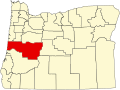 | |
| CDPs | ||
| Other communities |
| |
| Ghost towns | ||
| Indian reservation | ||
| Footnotes | ‡This populated place also has portions in an adjacent county or counties | |

| International | |
|---|---|
| National | |
| Geographic | |
| Other | |

Lane County, Oregon
View on GrokipediaHistory
Indigenous Peoples and Pre-Settlement Era
The Willamette Valley, encompassing much of present-day Lane County, was inhabited by bands of the Kalapuya people, a linguistic and cultural group whose territories extended across the valley floor and adjacent uplands. Specific bands in the Lane County region included the Chelamela along the Long Tom River and other Kalapuyan groups such as the Mohawk or McKenzie bands to the east.[7][8] These semi-nomadic societies organized around autonomous villages, with seasonal migrations driven by resource availability; winter villages were typically situated in sheltered valley locations for acorn gathering, camas bulb harvesting, and salmon fishing, while summer movements followed game and root crops in upland areas.[9][10] Archaeological evidence indicates human occupation in the region dating back thousands of years, with multicomponent sites like 35-LA-3 in Lane County revealing artifacts from pre-contact Native American activities spanning several millennia, including stone tools and faunal remains suggestive of hunting and processing economies. Investigations along the Long Tom River and in the Pleasant Hill Valley have uncovered village remnants, lithic scatters, and botanical evidence tied to Kalapuyan resource use, confirming adaptation to the valley's oak savannas, wetlands, and riverine ecosystems without reliance on agriculture.[11][12] Pre-contact population estimates for the broader Willamette Valley Kalapuyans range from 10,000 to 20,000 individuals, supported by ethnographic accounts and ecological carrying capacity analyses of the resource-rich valley. However, epidemics of introduced diseases—such as malaria in 1830, likely carried inland via coastal trade networks—decimated these populations prior to significant European overland settlement, reducing Kalapuyan numbers by up to 90% in some estimates through cascading mortality from lack of immunity and disrupted social structures.[10][8][13] This demographic collapse, evidenced by abandoned village sites and oral histories recorded post-contact, altered the ecological landscape by reducing human-induced fire regimes that maintained valley grasslands.[14]European Settlement and County Formation
European settlers began arriving in the Willamette Valley, including the area that would become Lane County, in significant numbers during the 1840s via the Oregon Trail, drawn by the promise of fertile land for farming and the mild climate suitable for agriculture.[15] The U.S. Congress's passage of the Donation Land Claim Act on September 27, 1850, accelerated this migration by granting up to 640 acres of public land to white male settlers over 18 who resided on and cultivated their claims for five years, with half that amount for their wives, effectively incentivizing family-based homesteads and timber exploitation in the region's abundant forests.[15] This federal policy, the most generous land distribution in U.S. history, legitimized provisional claims dating back to 1843 and spurred thousands of migrants from the Midwest and East Coast to stake territory south of the Linn County line, where soil quality and water access from the Willamette River supported wheat, oats, and livestock production.[15] Lane County was formally established on January 28, 1851, by the Oregon Territorial Legislature, carved from the southern portion of Linn County and initially encompassing a vast area extending to the Pacific Coast and California border before later boundary adjustments.[1] Named in honor of Joseph Lane, Oregon's first territorial governor who arrived in 1849 and advocated for settler interests as a U.S. Army veteran and Democrat, the county's provisional seat was set at Eugene City, a burgeoning farm community founded in 1846 by settlers like Eugene Skinner. [16] The formation reflected broader territorial organization efforts amid rapid population growth, with early governance focused on land surveys, road building, and claim disputes under the Donation Act framework. Initial settlement faced tensions with indigenous Kalapuya bands, whose traditional seasonal migrations and camas root harvesting overlapped with settler encroachments on valley lands.[17] These conflicts, including sporadic raids and thefts amid resource competition, were largely quelled through a series of federal treaties negotiated between 1853 and 1855, which extinguished native title to Willamette Valley lands and facilitated removals to reservations east of the Cascades by 1856.[18] Ratified between 1854 and 1859, these agreements—covering tribes in the region—cleared legal obstacles to homesteading, enabling unchecked agricultural expansion without further large-scale violence in the county.[18]Industrial Boom and 20th-Century Development
The timber industry in Lane County experienced significant expansion after 1900, driven by improved rail access that enabled efficient log transport from inland forests to processing hubs in Eugene and Springfield. These cities became central milling centers, with operations like the Booth-Kelly Lumber Company exemplifying large-scale production that processed vast quantities of Douglas fir and other species from the Willamette Valley and surrounding ranges. By the early 1920s, timber harvesting had intensified, with loggers extending operations beyond waterways into more remote areas, supported by mechanized equipment and company railroads.[19][20][21] Agriculture and timber dominated Lane County's economy in the 1920s, employing thousands in logging and milling amid national construction booms, though the Great Depression curtailed output until wartime recovery. Peak employment in the county's lumber sector occurred in June 1955, with 13,519 workers covered by unemployment compensation, reflecting sustained growth from the 1920s through the 1950s as mills scaled up for domestic housing and export demands. World War I spurred initial surges in wood production for European shipments, while World War II generated acute demand for plywood, crates, and structural timber, elevating Oregon's harvest volumes and temporarily offsetting pre-war slumps through federal contracts and infrastructure needs.[21][22][23][24] Urbanization in Eugene gained momentum from the University of Oregon's mid-20th-century expansion, as enrollment rose from around 3,000 in the 1920s to over 10,000 by the 1950s, drawing faculty, students, and support industries that diversified beyond timber and fostered retail and service sectors. Concurrent highway developments, including the establishment of the state system in 1913 and subsequent paving of routes like the McKenzie Highway, improved freight movement for logs and products while enabling commuter growth, linking rural timber camps to urban centers and contributing to population increases in the Eugene-Springfield corridor.[25][26][27][28] ![Eugene Springfield aerial 02.jpg][float-right]Post-2000 Challenges and Transitions
The implementation of the Northwest Forest Plan in 1994 led to sustained reductions in federal timber harvests, with effects persisting into the post-2000 era and contributing to job losses in Lane County's forest products sector, as rural communities in the plan's implementation area experienced ongoing socioeconomic decline.[29][30] Structural shifts, including decreased availability of harvestable federal forests, further eroded employment in logging and wood products manufacturing, prompting local efforts to transition away from resource extraction dependency.[31][32] Economic diversification gained momentum in the 2000s, with expansion in higher education and technology sectors offsetting some timber losses; the University of Oregon and related institutions bolstered knowledge-based employment, while tech startups and innovation hubs emerged in Eugene, fostering a shift toward service- and skill-intensive industries.[33][34] This adaptation was tested by the 2008 recession, during which Lane County's unemployment rate, aligned with the Eugene-Springfield metropolitan statistical area, averaged 11.7% annually from 2009 to 2010 amid widespread job cuts across manufacturing and construction.[35] The 2020 Labor Day wildfires presented a severe environmental and economic shock, as the Holiday Farm Fire alone scorched over 173,000 acres in Lane County, destroying more than 1,300 homes and businesses while necessitating evacuations for thousands of residents.[36][37] The blazes exacerbated timber supply constraints by consuming valuable stands, contributing to statewide losses estimated at $7.5 billion in Oregon timber value, and strained local recovery efforts through infrastructure damage and prolonged rebuilding in affected communities like Blue River.[38][37]Geography and Environment
Topography and Physical Features
Lane County encompasses 4,554 square miles of land with highly varied topography, extending from Pacific Ocean coastlines through forested mountain ranges.[39] The central Willamette Valley forms a broad alluvial lowland averaging around 400 feet in elevation, flanked westward by the low-relief Coast Range, characterized by evergreen forests and elevations up to 4,000 feet, and eastward by the steeper, volcanic Cascade Range rising to over 10,000 feet.[40][41] Coastal features include marine terraces, shifting sand dunes of the Oregon Dunes, and estuaries, while inland areas feature river floodplains, foothills, and glaciated peaks.[40] Elevations range from sea level at the Siuslaw River mouth to 10,357 feet at South Sister in the Cascades.[42] The county's hydrology is dominated by several major rivers that shape its physical landscape and drainage patterns. The Willamette River traverses the valley northward, augmented by the McKenzie River, which originates from Cascade snowmelt and highland springs, providing significant sediment and water flow.[43] The Siuslaw River drains the western Coast Range and coastal strip, supporting dune-stabilized wetlands and floodplain ecosystems. These rivers have demonstrated high variability, with the 1964 Christmas Flood producing peak discharges exceeding historical records—such as 280,000 cubic feet per second on the Willamette at Eugene—leading to extensive valley inundation and erosion due to prolonged heavy precipitation and rapid snowmelt.[44][45][46] Valley soils, primarily alluvial deposits and clay loams like the Jory series formed from weathered basalt, exhibit high fertility with good drainage and nutrient retention, facilitating agricultural viability through deep root zones and organic matter accumulation.[47][48] Upland areas contrast with thinner, rocky soils on steep slopes, limiting cultivation but supporting timber resources in coniferous forests covering much of the ranges.[49]Climate and Natural Disasters
Lane County features a temperate maritime climate, with mild winters averaging around 40°F and warm summers averaging about 70°F, as recorded at the Eugene Mahlon Sweet Airport station operated by the National Weather Service. Annual precipitation averages approximately 47 inches, predominantly occurring from October through May, contributing to lush vegetation but also seasonal flooding risks. Historical data from NOAA indicate relatively stable precipitation patterns, with wetter periods in El Niño years and variability tied to Pacific weather oscillations, though long-term trends show no statistically significant departure from 20th-century norms in the Willamette Valley portion of the county.[50] The county is vulnerable to riverine flooding, especially along the Willamette, McKenzie, and Siuslaw Rivers, due to heavy rainfall, snowmelt, and steep watersheds. The February 1996 flood, driven by subtropical moisture surges and warm temperatures melting deep snowpack, caused severe inundation across northern Lane County, damaging infrastructure and prompting federal disaster declarations. Similarly, the December 1964 flood, one of the most extreme events on record for western Oregon rivers, resulted from prolonged rains on saturated soils and snowmelt, leading to record crests on the Willamette River near Eugene and widespread erosion. Other significant floods occurred in 1972 and periodically since, with Lane County maintaining floodplain management to mitigate recurrence.[51][52] Wildfires represent a recurrent threat, fueled by dry summers, dense forests, and wind events in the Cascade foothills and coastal zones. The September 2020 Holiday Farm Fire, sparked by lightning amid extreme heat and drought, burned 173,393 acres primarily in eastern Lane County, destroying 768 homes and damaging hundreds more structures while prompting evacuations of thousands. This event contributed to Oregon's record-breaking 2020 fire season, which exceeded 1 million acres statewide, highlighting the county's exposure in wildland-urban interfaces.[53] Earthquake hazards stem from the county's proximity to the Cascadia Subduction Zone, capable of generating magnitude 8.7–9.2 events, with geological records documenting 19 such quakes in the past 10,000 years averaging every 300–600 years. A full-rupture event carries a 37% probability within the next 50 years, potentially causing intense shaking, tsunamis along the coast, and landslides in Lane County's terrain, with modeled impacts including building collapses and disrupted utilities in urban areas like Eugene. Local seismic monitoring by USGS underscores ongoing low-magnitude activity as precursors to larger risks.[54][55]Adjacent Counties and Boundaries
Lane County occupies a central position in western Oregon, with its northern boundary coinciding with the southern limits of Linn County, Benton County, and Lincoln County as defined by state statute.[56] The eastern and southern boundaries adjoin Douglas County, encompassing transitions from the Willamette Valley to the Cascade foothills and southern forested regions. To the west, the county extends to the Pacific Ocean, primarily through the Siuslaw River watershed, which delineates coastal access without direct county adjacency westward.[57] These boundaries facilitate inter-county resource dynamics, particularly in shared watersheds like the upper Willamette River basin extending into Benton and Linn counties, where collaborative management addresses hydrologic flows crossing administrative lines. The Siuslaw River, originating within Lane County and flowing westward to the ocean, underscores independent coastal watershed control while influencing regional marine resource considerations. Interstate 5 provides a vital north-south linkage, traversing from Benton County southward through the county into Douglas County, supporting economic and logistical exchanges.[58] Boundary delineations, rooted in 19th-century county formations, have remained stable since Lane County's establishment in 1851, with minor adjustments reflected in Oregon Revised Statutes; no significant recent territorial changes have occurred.[59] This configuration promotes cross-county cooperation in areas such as emergency response and environmental monitoring, given the overlap in natural features like river systems and mountain ranges.[60]Natural Resources and Protected Lands
Federal land ownership dominates Lane County's landscape, with approximately 88 percent devoted to forest use and the majority managed by agencies such as the U.S. Forest Service (USFS) and Bureau of Land Management (BLM). The Willamette National Forest covers extensive areas in the Cascade Mountains within the county, while the Siuslaw National Forest includes coastal sections featuring old-growth stands, waterfalls, and dunes.[61] BLM holdings are scattered, primarily in a checkerboard pattern across western Lane County, totaling around 166,852 acres managed by the Siuslaw Field Office when including adjacent areas.[62] Key natural resources include timber from coniferous forests dominated by Douglas-fir and true fir species, which historically supported a major logging industry.[63] Geological surveys identify minerals such as silica, stone, and limited metallic deposits, though extraction remains minor compared to forestry.[64] Hydropower generation draws from rivers like the McKenzie, contributing to regional energy production amid Oregon's overall reliance on hydroelectric facilities.[65] Protected lands emphasize preservation, with over 86,000 acres of roadless areas in the Willamette National Forest and wilderness designations like Cummins Creek in the Siuslaw National Forest safeguarding biodiversity hotspots.[66] USFS data highlight diverse ecosystems supporting native flora and fauna, including salmon habitats and old-growth-dependent species, tracked through inventories and state biodiversity centers.[67] These designations limit extraction to promote ecological stability, evidenced by timber harvest reductions from Oregon's statewide peaks of 7-9 billion board feet annually in the late 20th century to sustainable levels averaging 3.8 billion board feet in recent years (2017-2021).[68] [69] In Lane County, BLM harvests exemplify this shift, dropping from 7 million board feet in 2002 to lower volumes amid regulatory constraints and fire salvage priorities.[70]Demographics
Historical Population Trends
Lane County's population expanded from approximately 4,780 residents in the 1860 U.S. Census, shortly after its formation in 1851, reflecting initial waves of Euro-American settlers drawn by fertile Willamette Valley lands and Oregon Trail migration.[71] Growth accelerated in the late 19th and early 20th centuries amid timber harvesting, agricultural development, and infrastructure improvements like railroads, which facilitated resource extraction and urban concentration around Eugene.[72] By 1910, the population reached 36,166, increasing steadily at rates of 1-2% annually through the mid-20th century, fueled by industrial employment and post-World War II economic expansion.[72]| Decade | Population | Percent Change |
|---|---|---|
| 1910 | 36,166 | — |
| 1920 | 47,320 | +30.9% |
| 1930 | 54,743 | +15.7% |
| 1940 | 69,468 | +26.9% |
| 1950 | 125,783 | +81.1% |
| 1960 | 167,783 | +33.4% |
| 1970 | 222,158 | +32.4% |
| 1980 | 275,226 | +23.9% |
| 1990 | 282,912 | +2.8% |
| 2000 | 322,959 | +14.2% |
Census Data: 2000, 2010, and 2020
According to the 2000 United States Census, Lane County had a population of 322,959.[77] The 2010 Census recorded 351,715 residents, an increase of 28,756 people or 8.9% from the previous decade.[78] By the 2020 Census, the population reached 382,971, reflecting growth of 31,256 individuals or 8.9% over 2010 levels.[79]| Census Year | Population | Change from Previous Decade |
|---|---|---|
| 2000 | 322,959 | - |
| 2010 | 351,715 | +28,756 (8.9%) |
| 2020 | 382,971 | +31,256 (8.9%) |
Recent Estimates and Projections (2021-2025)
The U.S. Census Bureau estimated Lane County's population at 383,000 as of 2023, reflecting minimal change from the 2020 census figure of 382,971 amid a broader slowdown in growth rates.[2] Annual population growth in the county averaged approximately 0.7% from 2012 to 2024, per data from the Oregon Employment Department, though recent years have seen rates near zero or negative due to stagnant natural increase and variable net migration.[81] This deceleration aligns with state-level trends, where Oregon's overall population rose by just 0.7% from 2020 to 2024.[82] Projections for 2024 and 2025 indicate continued modest or flat growth, with estimates ranging from 379,000 to 382,600 residents, assuming low annual changes of 0.1% or less.[83] [84] Local forecasts from the Eugene area emphasize slowing expansion, finalized preliminarily in 2024 and expected to confirm subdued increases through mid-decade, driven by limited job gains and housing constraints.[74] Net migration has been influenced by post-pandemic remote work opportunities, which initially supported inflows from higher-cost areas, but these have been offset by recurring wildfires exacerbating air quality issues and evacuation risks in rural zones.[85] Events like the 2025 Emigrant Fire, which burned over 23,000 acres in southeastern Lane County, highlight ongoing environmental pressures that may deter long-term settlement.[86] Housing data underscores population pressures, with low vacancy rates—such as 1.2% for owner-occupied units in the Eugene housing market area as of early 2024—contributing to affordability challenges despite some rental availability around 6-7%.[87] [88]Socioeconomic Composition
Lane County, Oregon, exhibits a predominantly White population, with approximately 80.2% identifying as non-Hispanic White in 2022, reflecting a slight decrease from 84.7% in 2010 amid broader diversification trends.[89] Hispanic or Latino residents comprise about 11% of the population, while multiracial individuals account for roughly 6%, based on recent American Community Survey (ACS) estimates.[90] These figures underscore limited ethnic diversity compared to national averages, with smaller shares of Black (around 1%), Asian (2%), and Native American (1%) populations.[83] The county's median household income stood at $69,311 in 2023, marking a 6.38% increase from the prior year but remaining below Oregon's statewide median of $88,740.[2] This income level supports a middle-class socioeconomic profile in urban cores like Eugene and Springfield, though disparities persist, with rural areas experiencing lower earnings tied to declining timber and agricultural sectors. Poverty affects 15.3% of residents as of 2023, a 5.29% decline year-over-year, yet rates climb higher in non-metropolitan zones due to job losses in traditional industries and limited service access.[2] Educational attainment aligns with socioeconomic patterns, with 33.4% of adults aged 25 and older holding a bachelor's degree or higher in 2023, concentrated in urban areas benefiting from institutions like the University of Oregon.[91] High school graduation or equivalency reaches 93.1% countywide, exceeding the national average, but rural pockets lag due to economic transitions away from manual labor roles.[92] These metrics highlight urban-rural divides, where higher education correlates with elevated incomes and reduced poverty in city centers versus resource-dependent outskirts.Government and Administration
County Governance Structure
Board of Commissioners and Key Officials
The Lane County Board of Commissioners comprises five members, each elected from a single-member district to staggered four-year terms as stipulated in the county's home rule charter. The board holds legislative and executive authority over county operations, including budget adoption and policy implementation within state limits. Elections occur in even-numbered years, with terms commencing January 1 following certification.[93][94] In January 2025, the board selected David Loveall, representing District 2 (Springfield area), as chair; Loveall assumed office on January 1, 2023, after winning election in November 2022, with his term expiring December 31, 2026. Ryan Ceniga, District 1 commissioner, was appointed vice chair for 2025; Ceniga also began his first term January 1, 2023, following the 2022 election, and filed for re-election in October 2025 to seek a second term. Other sitting commissioners include veteran member Pat Farr and Heather Buch, contributing to the board's continuity in administrative oversight.[95][96][97] The commissioners collectively approve the annual budget and allocate resources across departments; for fiscal year 2023-24 (July 1, 2023, to June 30, 2024), the board adopted a total budget of $1.1 billion, addressing a $7.26 million general fund deficit without layoffs or service reductions. This process involves reviewing departmental requests, revenue projections—including property taxes and state/federal grants—and prioritizing expenditures for public services. The board also coordinates with state and federal entities to secure grants, such as those for infrastructure and public health, supplementing local revenues.[98][99] Key administrative official Steve Mokrohisky serves as county administrator, managing day-to-day operations, implementing board policies, and supervising approximately 2,500 employees across departments. Appointed to the role prior to 2021, Mokrohisky reports directly to the board and handles executive functions like contract negotiations and intergovernmental relations.[100]Fiscal Management and Budgeting
Lane County's General Fund, which supports core operations including public safety and administration, derives approximately 30% of its resources from property taxes, totaling $53 million in the proposed FY 2025-26 budget of $178.8 million.[101] Remaining revenues include state-shared funds such as video lottery allocations, transient lodging taxes, and timber harvest payments, alongside fees for services and intergovernmental transfers.[102] This structure highlights a dependency on stable local taxation for discretionary spending, with public safety accounting for about 75% of such allocations to maintain essential services amid fluctuating external revenues.[103] Federal and state grants play a critical role in non-General Fund areas, particularly infrastructure and health; the Road Fund, for instance, relies on state gas taxes, highway user fees, and federal timber revenues from National Forests to fund maintenance and construction, comprising a significant portion of its $50-60 million annual resources.[104] Health and human services similarly depend on federal grants for programs like Medicaid administration, offsetting local budget pressures but exposing the county to shifts in national funding priorities.[105] These grants enhance efficiency by targeting specific needs but introduce volatility, as evidenced by recent reductions in community corrections funding contributing to broader shortfalls.[106] Fiscal challenges have driven conservative budgeting in recent years; the FY 2024-25 adopted budget incorporated cuts and layoffs to address emerging deficits, while the FY 2025-26 proposal confronts a $6.3 million structural General Fund gap through $9 million in reductions, including position eliminations, without fully curtailing infrastructure investments.[104][103] Monthly transparency reports detail expenditures and revenues, revealing per-capita outlays rising modestly with population stability around 382,000, though grant dependencies have strained reserves amid inflation and service demands.[107] Overall, management prioritizes balanced funds—totaling over $1.2 billion across 34 funds—emphasizing one-time revenues for capital projects to avoid recurring deficits.[108][2]Politics
Political Alignment and Voting History
Lane County, Oregon, displays a Democratic-leaning political alignment in presidential elections, largely attributable to the progressive urban core centered in Eugene, which accounts for a significant portion of the county's population. In the 2020 presidential election, Joseph R. Biden Jr. secured 134,366 votes (60.5 percent), compared to 80,336 votes (36.1 percent) for Donald J. Trump.[109] This outcome mirrors trends in prior cycles, where Democratic candidates have consistently outperformed Republicans since the late 20th century, with margins widening amid population growth in university-adjacent areas.[110] A pronounced urban-rural divide characterizes the county's voting patterns, countering narratives of uniform liberalism by highlighting conservative strongholds in outlying timber-dependent communities. Rural precincts, encompassing areas like Veneta and Oakridge, exhibit higher Republican support, often exceeding 50 percent in presidential contests, rooted in economic reliance on resource extraction industries.[111] In contrast, Eugene's precincts deliver overwhelming Democratic majorities, driven by academic, tech, and service-sector demographics. Voter registration as of November 2024 reflects this split, with Democrats comprising the largest affiliated group at approximately 38 percent, Republicans at 25 percent, and non-affiliated voters at 35 percent, enabling Democratic pluralities in countywide tallies.[112] Historically, Lane County's conservative timber-era base—fueled by logging booms through the mid-20th century—eroded following federal environmental restrictions, such as the 1990s Northwest Forest Plan, which slashed harvest levels and shifted economic dependencies toward urban services and education.[113] This transition amplified Eugene's influence, transforming the county from a swing area in earlier decades to a reliable Democratic bastion in statewide races. Ballot measure outcomes underscore partisan fault lines, with environmental protections passing at rates above 60 percent in recent cycles (e.g., sustaining land-use restrictions under Oregon's Measure 49 in 2007), while tax-limitation initiatives, appealing to rural fiscal conservatives, often fail amid urban opposition.[114]Recent Elections (2016-2024)
In the 2016 presidential election, Lane County recorded voter turnout of approximately 80%, aligning with Oregon's statewide average and reflecting high engagement in national contests.[115] Turnout dipped in subsequent local and midterm elections, such as the 2018 general election, where participation fell below 70% countywide, enabling incumbents to retain seats on the Board of Commissioners with narrower margins amid lower scrutiny.[116] This pattern persisted through 2022 and 2024, with presidential-year turnout exceeding 75%—reaching over 82% in 2020—while primary and off-year local races often saw rates under 50%, reducing competition and favoring candidates with established local networks.[117] Commissioner races in 2022 highlighted incumbency advantages in a top-two primary system. In District 5, incumbent Heather Buch advanced over challenger Kyle Blain with a lead in early returns, securing reelection in the general election due to voter familiarity and limited turnout.[118] District 2 saw David Loveall, an established contender, outpace Joe Berney to advance and win, underscoring how name recognition sustains advantages in nonpartisan contests with subdued voter participation.[118] No commissioner positions were contested in the 2024 cycle, as terms are staggered every four years, allowing sitting officials to maintain influence without electoral tests.[119] Lane County voters approved Oregon Ballot Measure 110 in the November 2020 general election, supporting the statewide initiative by a margin mirroring the 58.5% yes vote that decriminalized personal possession of small amounts of drugs like methamphetamine and fentanyl, replacing criminal penalties with a $100 fine and diverting cannabis taxes to behavioral health services.[120] High turnout in that presidential year amplified progressive outcomes on such measures. By 2024, amid rising overdose deaths—Oregon recorded over 1,200 in 2023, many in urban counties like Lane—the state legislature enacted House Bill 4035 in March, partially rolling back decriminalization by reclassifying possession as a Class C misdemeanor punishable by up to 30 days in jail, effective September 1, 2024, without a ballot referendum but influenced by post-2020 public backlash evident in local discourse.[121]Policy Debates and Partisan Divides
Lane County's policy debates reflect a pronounced rural-urban ideological divide, with Eugene and surrounding urban areas favoring progressive measures such as sanctuary policies and stringent environmental regulations, while rural communities prioritize property rights, reduced land-use restrictions, and economic reliance on federal timber revenues. Eugene, as part of Oregon's Sanctuary Promise Act framework, has maintained policies limiting cooperation with federal immigration enforcement, a stance reaffirmed by Lane County commissioners in a 3-2 vote on April 22, 2025, to uphold immigrant protections amid national debates over border security.[122][123] This urban preference contrasts with rural skepticism toward such measures, where residents often view them as diverting local resources from core services, exacerbating tensions in a county where urban voters dominate partisan outcomes but rural areas bear disproportionate economic burdens from federal land ownership.[124] Rural policy advocacy centers on easing property restrictions to enable housing and agricultural development, clashing with urban-driven environmental overlays. In October 2025, Lane County delayed amendments to rural housing codes following public outcry over expanded riparian protections, coastal shoreland rules, and Willamette River Greenway standards, which rural landowners argued unduly limit development on private parcels zoned for residential or resource use.[125] Earlier approvals, such as the unanimous August 2023 decision to permit accessory dwelling units in rural residential zones, highlight incremental wins for property rights but underscore ongoing friction with state-mandated urban growth boundaries that confine expansion and favor conservation over rural economic needs.[126] These divides manifest in broader land-use disputes, where urban interests push for reserves preserving farmland and forests against sprawl, while rural stakeholders decry lost tax bases and regulatory overreach.[127] Federal land management, encompassing over 50% of Lane County's acreage as Oregon and California (O&C) railroad grant lands administered by the Bureau of Land Management, fuels partisan contention over timber harvest levels and resultant county payments. Timber revenues, mandated to fund 50% of gross sales to O&C counties like Lane, totaled $27.7 million distributed across 18 western Oregon counties in April 2025, yet declining harvests due to environmental litigation and policy shifts have created fiscal instability, with Lane receiving approximately $7.8 million in the prior major allocation.[128][129] Rural conservatives argue that federal restrictions on logging—prioritizing habitat preservation over sustained yield—erode county tax equivalents, forcing reliance on volatile payments that substitute for untaxable public lands, while urban progressives support conservation to mitigate wildfire risks and biodiversity loss.[130] This impasse intensified in 2025 amid expirations of programs like Secure Rural Schools, prompting rural advocacy for congressional reauthorization, though urban-dominated state priorities often sideline such pleas.[131] The 2025 Oregon legislative session yielded mixed outcomes for Lane County funding, with rural pleas for stabilized revenues meeting partial urban-aligned investments but failing to resolve structural deficits tied to federal dependencies. Lawmakers allocated $14.5 million toward Lane's behavioral health stabilization center, reflecting bipartisan nods to urban public health needs, yet broader rural funding requests—such as reversing declines in assessment functions and bolstering timber-impacted services—saw limited gains amid state budget constraints.[132] State cuts to community corrections funding in September 2025 forced Lane officials to explore local offsets, highlighting how Salem's progressive priorities, influenced by urban majorities, constrain rural fiscal autonomy despite empirical needs for diversified revenue amid federal uncertainties.[133][134] These debates underscore causal links between land management policies and county solvency, with rural areas advocating market-driven resource use against urban regulatory frameworks that, while environmentally oriented, empirically strain local budgets.[129]Law, Public Safety, and Social Challenges
Crime Statistics and Trends
In Lane County, property crimes consistently outnumber violent crimes, with burglary, larceny-theft, and motor vehicle theft comprising the majority of reported incidents, as documented in FBI Uniform Crime Reporting (UCR) data aggregated for Oregon jurisdictions. For the primary urban center of Eugene, the 2021 property crime rate stood at approximately 3,226 per 100,000 residents, compared to a violent crime rate of 354 per 100,000—roughly ten times lower—reflecting broader patterns where opportunistic thefts dominate over interpersonal violence.[135] These figures exceed Oregon's statewide averages, with Eugene's burglary and theft rates approximately double the state benchmarks for similar metrics, based on localized UCR submissions.[135] [136] Post-2020 trends in Lane County's urban areas showed an initial uptick in reported property crimes, coinciding with pandemic-related disruptions to policing and prosecutorial leniency, before stabilizing or declining by 2023 amid statewide reductions. Oregon's preliminary 2023 UCR data indicated property index crimes decreased across major cities including Eugene, aligning with a 25% drop in such offenses relative to peak years, though rates remained elevated compared to pre-2020 baselines. Violent crimes followed a similar trajectory, with Eugene's calls for service rising modestly in 2021 (total up 0.2% from 2020, public-initiated up 6.6%), but official UCR metrics emphasize reported incidents over unverified underreporting claims, providing verifiable counters to anecdotal inflation.[137] The Lane County Sheriff's Office, responsible for unincorporated areas, operates under chronic staffing constraints, maintaining only three deputies and one sergeant per shift to patrol a county larger than several U.S. states, resulting in average response times of 25-30 minutes or longer for non-emergencies.[138] Patrol staffing levels are roughly half those of comparable Oregon counties like Clackamas or Deschutes, exacerbating delays amid an average of 180 daily calls for service. This understaffing contributes to strained resource allocation, though it has not correlated with disproportionate underreporting in UCR data, which relies on agency submissions rather than response efficacy.[138]Drug Policy Failures and Measure 110 Rollback
In November 2020, Oregon voters approved Measure 110, which decriminalized possession of small amounts of controlled substances such as less than one gram of heroin, methamphetamine, or LSD, converting it from a misdemeanor to a civil violation punishable by a maximum $100 fine, with revenues from cannabis taxes directed toward addiction treatment and recovery services.[139] The measure took effect on February 1, 2021, aiming to reduce incarceration and prioritize health-based responses, but empirical data revealed significant unintended consequences, including a sharp rise in drug-related harms.[140] In Oregon, unintentional drug overdose deaths increased by 41% in 2021 alone, compared to a national rise of 16%, with synthetic opioids like fentanyl implicated in the majority of cases.[141] A peer-reviewed analysis attributed 182 additional overdose deaths in 2021 directly to the policy's implementation, representing a 23% excess over projected trends absent decriminalization.[142] Lane County experienced elevated overdose rates relative to state averages, with fentanyl driving much of the surge; statewide, illicitly manufactured fentanyl-related deaths quadrupled from 223 in 2020 to 843 in 2022, and total overdose fatalities reached 1,833 in 2023, more than tripling from pre-Measure 110 levels around 500-600 annually.[143][144] County-level data from the Oregon Alcohol and Drug Policy Commission highlighted Lane among jurisdictions with persistently high overdose death rates, exacerbated by open-air drug markets and polysubstance involvement, where fentanyl appeared in 48% of 2022 overdose deaths alongside amphetamines in 56%.[145][146] The policy correlated with a 67% statewide drop in possession arrests post-2021, reducing deterrence and enabling visible public drug use, which Eugene Police Department officials linked to heightened associated criminality.[147][148] In Lane County, while citations were issued under Measure 110, enforcement waned, contributing to untreated addiction and overdose spikes without commensurate treatment uptake.[149] Treatment infrastructure funded by Measure 110's $302 million in cannabis tax allocations proved inadequate and mismanaged, with slow spending, grant misuse, and service gaps; an audit revealed networks in multiple counties, including some in Lane's region, failed to deliver services for extended periods in 2023, and only a fraction of funds reached frontline programs amid administrative delays.[150][151] Lane County's deflection initiatives, intended as alternatives to arrest, remained under-resourced pre-rollback, with limited referrals and no significant dent in overdoses or usage rates, underscoring causal failures in scaling evidence-based interventions amid decriminalization's removal of coercive pathways to care.[152][153] Facing mounting evidence of policy shortcomings, Oregon lawmakers passed House Bill 4002 in March 2024, recriminalizing simple drug possession as a misdemeanor punishable by up to 180 days in jail or probation with treatment mandates, while preserving deflection options; Governor Tina Kotek signed it, with provisions effective September 1, 2024.[154][155] In Lane County, the rollback prompted renewed arrests and citations by the Eugene Police Department starting September 2024, alongside expanded deflection programs to divert low-level offenders to services, though early data showed arrests averaging 170 weekly statewide post-implementation, below pre-Measure 110 peaks but above violation-era lows.[148][156] Critics of decriminalization, drawing on causal analyses, argued the experiment empirically validated the need for accountability mechanisms to curb supply-driven harms like fentanyl contamination, while proponents attributed rises primarily to national opioid trends—a claim contested by state-specific excess mortality estimates.[157][158]Homelessness and Public Health Crises
The 2025 Point-in-Time (PIT) count, conducted on January 29, documented 3,509 individuals experiencing homelessness in Lane County, marking a 14% increase from the 3,085 recorded in 2024.[159] [160] This rise occurred amid ongoing shelter expansions, with 914 people in emergency shelters and 96 in transitional housing, suggesting that supply constraints and policy tolerances for street living have exacerbated visible unsheltered populations, estimated at over 2,000 based on prior-year breakdowns where unsheltered comprised the majority.[159] [161] Chronic homelessness, defined as long-term or repeated episodes often tied to untreated disabilities or behavioral issues, affected a significant portion, with sheltered chronic cases rising to 46% of the sheltered total by 2024 from 25% in 2020, indicating failures in preventive interventions despite increased funding allocations.[159] These trends reflect causal factors such as permissive encampment allowances under local ordinances, which have prolonged exposure to elements and delayed transitions to stability, as evidenced by stagnant per-capita shelter utilization rates.[162] The Lane County Community Health Assessment for 2024-2025 highlights intertwined public health strains, including a 20% food insecurity rate in 2022 driven by rising costs outpacing incomes, which correlates with heightened malnutrition risks among the unsheltered.[163] Rural areas face acute declines in healthcare access, with transportation barriers and provider shortages amplifying untreated conditions like infectious diseases from communal living.[164] [163] Encampment management imposes substantial fiscal burdens, with repeated clearances in urban and rural zones—such as those along highways and public lands—requiring coordinated police and public works efforts that strain budgets, as seen in localized operations costing tens of thousands per site in comparable county jurisdictions.[165] These activities, necessitated by health code violations and public complaints, underscore policy shortfalls in enforcing occupancy restrictions, perpetuating cycles of displacement without resolution.[166]Economy
Primary Industries and Employment Sectors
Health care and social assistance, along with education services, constitute the largest employment sectors in Lane County, driven by institutions such as the University of Oregon and regional hospitals. The University of Oregon, based in Eugene, supports thousands of direct and indirect jobs through its operations, research, and student spending, contributing to broader economic activity in the county. Total nonfarm employment reached 174,000 in 2023.[34][167] Manufacturing, particularly in wood products and timber processing, remains a core industry, with the timber sector alone employing over 4,300 workers as of 2024 data; these roles often involve logging and milling from federal forest lands subject to harvest regulations. Timber wages exceed the county average by 26%.[168] Agriculture, centered in the Willamette Valley, includes crops like berries, vegetables, and grass seed from 2,375 farms spanning 180,201 acres, generating $137.6 million in market value of products sold in 2022; however, its employment share has diminished amid a transition to service-oriented sectors.[169] Retail trade and leisure/hospitality, bolstered by tourism to natural sites and events tied to the university, provide additional employment, though these have lagged pre-pandemic levels with hospitality still down 700 jobs from 2019 benchmarks in 2023.[170]Labor Market Dynamics (Unemployment and Growth)
In April 2025, the unemployment rate in Lane County stood at 3.9 percent, up slightly from 3.7 percent in April 2024, reflecting a modest softening in labor market conditions amid national economic headwinds such as elevated interest rates and slowing consumer spending.[171] Total nonfarm payroll employment totaled approximately 181,700, marking a year-over-year decline of 600 jobs, or 0.4 percent, as seasonally adjusted Bureau of Labor Statistics data indicate persistent hiring caution tied to broader cyclical downturns in discretionary sectors. This contraction contrasts with pre-2023 growth trajectories, where external shocks like supply chain disruptions had previously buoyed recovery but now contribute to stagnation through reduced capital investment. Sectoral performance revealed resilience in health care and social assistance, which maintained steady employment levels due to inelastic demand for medical services, even as overall job losses mounted. Conversely, manufacturing shed positions amid external pressures including higher energy costs and diminished export demand, exacerbating the county's total employment dip.[172] These dynamics align with state-level patterns, where manufacturing output has been constrained by federal monetary policy tightening since 2022, limiting reinvestment and expansion. Labor market tightness eased further, with an estimated 1.6 unemployed workers per job opening in 2024, signaling a shift from the acute shortages of the early post-pandemic period to a more balanced but sluggish matching process influenced by geographic immobility and skill mismatches.[173] This ratio, derived from Oregon Employment Department vacancy surveys, underscores reduced employer urgency in filling roles, causally linked to decelerating population inflows and federal immigration policy constraints that have curbed labor supply growth since 2023.[174] Overall, these indicators point to a labor market vulnerable to exogenous slowdowns, with limited internal catalysts for rebound absent policy shifts toward deregulation or fiscal stimulus.Economic Dependencies and Regulatory Impacts
Lane County's economy exhibits significant vulnerabilities stemming from its heavy reliance on federal land management, with approximately 88 percent of the county's landscape classified as forestland, the majority under federal ownership by agencies such as the U.S. Bureau of Land Management and U.S. Forest Service. This dependency has historically tied local revenues and employment to timber harvesting on these lands, but federal policies, including restrictions under the Endangered Species Act (ESA), have constrained harvests, leading to fiscal strains for timber-dependent counties like Lane. For instance, ESA compliance requirements, enforced through habitat conservation plans (HCPs), have resulted in reduced timber outputs on state and federal forests to protect listed species such as the northern spotted owl, contributing to revenue shortfalls that exacerbate budget crises in rural areas.[175][176][177] Timber harvest levels in Oregon, including Lane County, have declined amid these regulatory frameworks, with lawsuits alleging ESA violations further delaying or curtailing logging operations and associated economic activity.[177] Critics argue that such environmental regulations, while aimed at species preservation, impose disproportionate costs on local economies by limiting active forest management and harvest volumes, which in turn reduce payments to counties from federal timber sales—historically a key funding source for services in O&C (Oregon and California) counties like Lane.[131] This has perpetuated higher unemployment in lumber-dependent sectors, with Lane County's economy showing persistent sensitivity to fluctuations in wood products manufacturing, where regulatory hurdles contribute to job instability beyond broader market cycles.[178] In the housing sector, regulatory impacts intersect with supply constraints from limited timber availability and land-use restrictions, pushing median home prices above $400,000 amid a softening market in 2025.[179][180] Sales activity increased early in the year but faced uncertainty by mid-2025, with median sale prices around $455,000 in September, down 3.2 percent year-over-year, as buyers grappled with affordability amid stalled development projects tied to environmental permitting delays.[180][181] Green policy frameworks, including HCPs that prioritize habitat over harvest, have been faulted for exacerbating these shortages by restricting timber supplies needed for construction, thereby inflating costs and hindering job growth in related industries.[182] This dynamic underscores broader critiques that over-reliance on federal oversight and stringent regulations stifles economic resilience in resource-dependent regions.[183]Infrastructure and Transportation
Road Networks and Major Highways
Interstate 5 constitutes the central north-south artery of Lane County's transportation infrastructure, extending through the county's length and facilitating primary freight and commuter movement between California, the Willamette Valley urban core, and Washington.[184] Oregon Route 99 runs parallel to I-5 in segments, historically as U.S. Route 99, and supports local traffic with business loops in Eugene and Springfield.[185] Oregon Route 126 intersects these at key points, providing east-west linkage from the Pacific Coast through Florence and Eugene toward the McKenzie River Pass, enabling access to coastal and Cascade regions.[186] Lane County oversees approximately 1,436 miles of county roads, encompassing rural arterials, collectors, and local access routes that connect unincorporated areas to state highways and urban centers.[187] These roads, maintained by the county's Public Works department, include pavement in predominantly good to fair condition as of recent assessments, though funding constraints from state sources exacerbate wear.[188] The network supports diverse land uses, from timberlands to agricultural zones, but faces empirical maintenance pressures evidenced by deferred repairs on aging surfaces. The county manages 429 bridges spanning creeks, rivers, and highways, with inspections revealing a subset requiring intervention due to structural deficiencies or functional obsolescence, such as sufficiency ratings below fair thresholds in older spans.[189][190] Traffic congestion manifests prominently in the Eugene-Springfield corridor along I-5, where annual average daily traffic exceeds 50,000 vehicles in peak segments, leading to measurable delays as documented in regional congestion management processes.[191] Bridge conditions, per Oregon Department of Transportation protocols, underscore backlogs, with at least 14 county bridges classified as structurally deficient or obsolete as of 2019 evaluations, reflecting broader infrastructure strain from high usage and limited replacement cycles.[192][193]Public Transit and Airport Facilities
The primary public transit provider in Lane County is the Lane Transit District (LTD), which operates fixed-route bus services throughout the Eugene-Springfield metropolitan area and extends rural routes to surrounding communities.[194] LTD's network includes over 30 routes, featuring the EmX bus rapid transit lines that connect key urban corridors between Eugene and Springfield with dedicated lanes and stations.[195] These services emphasize accessibility, with all buses equipped for wheelchair users and bicycle transport.[196] LTD ridership has shown post-pandemic recovery, with fiscal year 2024 (July 2023 to June 2024) recording 6,295,676 passenger boardings, a 6% increase from 5,955,728 in fiscal year 2023.[197] Fiscal year 2023 marked a 20% rise from the prior year, reflecting gradual rebound from COVID-19 lows amid urban-focused demand limited by the county's rural expanses.[197] [198] Eugene Airport (EUG), located northwest of Eugene, serves as the county's main aviation facility and Oregon's second-busiest airport by passenger volume.[199] In 2023, it handled 1.7 million passengers, supporting regional connections primarily to West Coast hubs via airlines like Alaska and United.[200] The airport features a single terminal with commercial flights, general aviation, and cargo operations totaling 1.0 million pounds in 2023.[200] Intercity rail service is provided by Amtrak Cascades, offering daily trains from Eugene Station to Portland, Seattle, and Vancouver, BC, along the Pacific Northwest corridor.[201] This service supplements local transit but remains limited in frequency and scope compared to bus operations, with connections integrated via LTD buses at the downtown station.[202]Recent Developments and Projects
In summer 2025, Lane County initiated a series of pavement preservation projects utilizing chip seal and slurry seal treatments to extend the lifespan of county roads and prevent more extensive future repairs. These efforts, managed by the Lane County Road Maintenance Division, targeted multiple road segments amid ongoing funding constraints for maintenance.[203] Construction on Gilham Road in north Eugene commenced on April 14, 2025, focusing on safety enhancements including new sidewalks, ADA-compliant ramps, and pavement resurfacing from Ayres Road to Sterling Park Place. The project, funded partly by federal grants secured by Lane County, addresses pedestrian access gaps and aims to reduce collision risks in a high-traffic residential corridor, with major work scheduled for completion by December 31, 2025, and daily impacts from 7:00 a.m. to 7:00 p.m. including detours and lane closures.[204][205][206] The Oregon Department of Transportation advanced I-5 paving improvements from Halsey to the Lane County line in 2024-2025 to alleviate congestion and enhance surface conditions, though broader widening proposals in the region have sparked debate over environmental impacts and long-term efficacy amid rising traffic volumes. Local stakeholders in Lane County have advocated for such expansions to provide traffic relief, citing persistent bottlenecks, while critics question their alignment with sustainable transport goals.[207][208] Federal funding supported bridge retrofits in Lane County, including $549,387 allocated in November 2024 for seismic upgrades to the Chambers Street Bridge in Eugene as part of the Metropolitan Transportation Improvement Program, prioritizing structural resilience in an earthquake-prone area. Additional county bridge projects draw on federal aid programs to address aging infrastructure, though execution faces delays due to local funding shortfalls.[209][188]Communities
Incorporated Cities and Urban Centers
Lane County's incorporated cities form the core urban fabric, with Eugene and Springfield dominating as the twin anchors of the Eugene-Springfield Metropolitan Statistical Area, which encompasses much of the county's population and economic activity. Eugene, the county seat with an estimated population of 178,213 in 2025, functions as the primary hub for higher education, culture, and government services, largely driven by the presence of the University of Oregon, which enrolls over 24,000 students and supports research and innovation sectors.[210] Springfield, immediately adjacent to Eugene and with 60,569 residents, contrasts by prioritizing industrial and commercial development, featuring zones dedicated to manufacturing, logistics, and employment-generating sites as outlined in its comprehensive economic plans.[211] Smaller incorporated cities contribute specialized roles, often tied to regional geography and historical economies. Florence, on the Pacific Coast with approximately 9,465 inhabitants, centers on tourism, recreation, and marine-related industries due to its position near the Oregon Dunes National Recreation Area.[212] Cottage Grove, in the southern Willamette Valley boasting 10,629 residents, maintains an agricultural orientation, fostering agri-businesses and local food production initiatives like commercial kitchens and food hubs supported by state grants.[213][214] Veneta, further west with 5,157 people, emphasizes small-scale and specialty agriculture in the fertile valley soils, attracting horticulture and sustainable farming operations.[215][216] These urban centers highlight a divide where Eugene and Springfield concentrate advanced amenities such as universities, hospitals, and entertainment venues, while smaller cities like Cottage Grove and Veneta offer more community-scale services aligned with agrarian lifestyles, potentially exacerbating access differences for rural-adjacent populations seeking specialized urban resources.[217]| City | 2025 Population Estimate | Primary Economic Focus |
|---|---|---|
| Eugene | 178,213 | Education, government, culture |
| Springfield | 60,569 | Manufacturing, logistics |
| Cottage Grove | 10,629 | Agriculture, local food production |
| Florence | 9,465 | Tourism, coastal recreation |
| Veneta | 5,157 | Specialty agriculture, horticulture |
Census-Designated and Unincorporated Places
Lane County encompasses several census-designated places (CDPs) and unincorporated communities, which function as non-incorporated settlements without autonomous local government, relying instead on county-level administration for public services including law enforcement, fire protection, and utilities. These areas often exhibit fragmented boundaries due to partial annexations into nearby cities, leading to service provision challenges such as inconsistent infrastructure maintenance and coordination gaps between county and municipal providers.[219] Dispersed populations exacerbate these issues, with limited tax bases straining resources for road repairs and emergency response in remote locales.[219] The county's CDPs vary in size, with larger ones near urban edges supporting commuter populations and smaller coastal or riverine ones oriented toward recreation and resource extraction. The following table summarizes key CDPs based on 2020 U.S. Census data:| CDP | 2020 Population | Notes |
|---|---|---|
| Santa Clara | 11,239 | Suburban area northwest of Eugene, featuring residential neighborhoods and proximity to industrial zones.[220] |
| River Road | 8,732 | Semi-rural corridor east of Eugene along the Willamette River, with agricultural and light commercial elements.[221] |
| Heceta Beach | 1,912 | Coastal settlement south of Florence, emphasizing beachfront access and seasonal tourism.[222] |
| Mapleton | 527 | Inland valley community tied to forestry and small-scale manufacturing.[223] |