Hubbry Logo
EurogameEurogameMain
Open search
Eurogame
Community hub
Eurogame
logo
8 pages, 0 posts
0 subscribers
Be the first to start a discussion here.
Contribute something
Eurogame
Eurogame
from Wikipedia
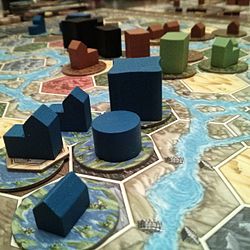
Detailed view of the board during Terra Mystica gameplay

A Eurogame, also called a German-style board game, German game, or Euro-style game (generally just referred to as board games in Europe), is a class of tabletop games that generally feature indirect player interaction, lack player elimination, and provide multiple ways to score points.[1] Eurogames are sometimes contrasted with American-style board games, which generally involve more luck, conflict, and drama.[2] They are usually less abstract than chess or Go, but more focused on economic competition than wargames. Likewise, they generally require more thought and planning than party games such as Pictionary or Trivial Pursuit.

History

[edit]
The 1999 Hasbro version of Acquire

Due in part to postwar aversion to products which glorified conflict, the 3M series of strategy and economic games, including Acquire, became popular in Germany. They offered a style of gameplay without direct conflict or warfare and led the way for designs that focused on resource management and competitive strategy through more peaceful means.[3][4]

German family board games

[edit]

The genre developed as a more concentrated design movement in the late 1970s and early 1980s in Germany. The genre spread to other European countries such as France, the Netherlands, and Sweden.[citation needed] During this time, board games in Europe often featured shorter play times than their American counterparts, along with rules that encouraged all players to remain engaged until the end, thereby reducing the risk of early elimination.

Settlers of Catan

[edit]

Although German-style designs were already popular within Germany, The Settlers of Catan, first published in 1995, paved the way for the genre outside Europe.[5] While it was not the first Eurogame and not the first to achieve popularity outside Germany, it became more successful than any of its predecessors. Millions of copies were sold in Germany alone. The game's success brought new interest, investment, and attention to this genre of board games emphasizing mechanics other than direct conflict. Game designers like Reiner Knizia became popular globally. Knizia's notable designs include Amun-Re, Blue Moon City, Ingenious, Keltis, Lord of the Rings, Medici, Modern Art, Ra, Taj Mahal, Tigris and Euphrates, and Through the Desert. Many of his designs incorporate mathematical principles, such as his repeated use of auction mechanics.[6]

Growth in the 21st century

[edit]
A game of Agricola being set up

As the market expanded, some designers began creating deeper, more complex games often referred to as “gamer’s games” or “expert games.” Titles such as Agricola (2007) by Uwe Rosenberg and Terra Mystica (2012) by Helge Ostertag and Jens Drögemüller introduced more detailed resource management, longer playing times, and heightened decision depth. These games often came with multiple paths to victory, ensuring replay value and a variety of strategies for enthusiasts. Residents of Germany purchased more board games per capita than any other country as of 2009.[7] While many Eurogames are published and played in Anglophone markets such as the United States and the United Kingdom, they occupy a niche status there.[7] Other games in the genre to achieve widespread popularity include Carcassonne, Puerto Rico, TransAmerica, Ticket to Ride, Alhambra, Brass, Terraforming Mars, Concordia and Ark Nova. Today, Eurogames remain an important segment of the board gaming industry, appreciated for their emphasis on strategy, thoughtful interaction, and lack of player elimination that allows all participants to remain engaged. While Germany still leads in per capita board game purchases, the popularity of Eurogames has spread worldwide, and many titles now receive international distribution and acclaim. Conventions in Germany gather thousands of fans annually, and 204,000 attended Essen Spiel in 2024.[8]

Characteristics

[edit]

Eurogames tend to be focused on presenting a complex challenge to players. They feature individual economic competition and resource management rather than direct conflict,[9] and have a limited amount of luck.[10] They also differ from abstract strategy games like chess by using themes tied to specific locales.[3] Eurogames also emphasize the mechanical challenges of their systems over having the systems match the theme of the game. They are generally simpler than the wargames that flourished in the 1970s and 1980s from publishers such as SPI and Avalon Hill, but still often have a considerable depth of play.

One consequence of the increasing popularity of this genre has been an upwards in complexity. Games such as Puerto Rico that were considered quite complex when Eurogames proliferated in the U.S. after the turn of the millennium are now the norm, with newer high-end titles like Terra Mystica and Tzolkin being significantly more complex.[citation needed]

Incentive for social play

[edit]
A four-player game of Ticket to Ride near the end of the game

Eurogames tend to be well-suited to social play. In contrast to games such as Risk or Monopoly, in which a close game can extend indefinitely, Eurogames usually have mechanics to limit the playing time. Common mechanisms include a predetermined winning score, a set number of game turns, or depletion of limited game resources. Playing time varies from a half-hour to a few hours, with one to two hours being typical. Generally, Eurogames do not have a fixed number of players like chess or bridge. Although there is a sizeable body of Eurogames that are designed for exactly two players, most games can accommodate between two to six players (with varying degrees of suitability). Six-player games are somewhat rare; examples include Power Grid and Caverna (the latter supporting seven-player games). Some require expansions, such as The Settlers of Catan or Carcassonne. Players usually play for themselves, rather than in a partnership or team.

A growing number of Eurogames support solo play with modified rulesets.[11] To win, the player either has to achieve specific single-player campaign goals or beat the score of a simulated opponent that takes actions according to special rules outlined in the scenario. Recent Eurogames suitable for solo play include Wingspan,[12] Terraforming Mars, and Spirit Island.[citation needed]

Terraforming Mars basic three-player game (shows the board, the player boards, and the players' cards at the end of a game round)

No player elimination

[edit]

Another prominent characteristic of these games is the lack of player elimination.[13] Eliminating players before the end of the game is seen as contrary to the social aspect of such games. Most of these games are designed to keep all players in the game as long as possible, so it is rare to be certain of victory or defeat until relatively late in the game. Related to no-player-elimination, Eurogame scoring systems are often designed so that hidden scoring or end-of-game bonuses can catapult a player who appears to be in a lagging position at end of play into the lead. A second-order consequence is that Eurogames tend to have multiple paths to victory (dependent on aiming at different end-of-game bonuses) and it is often not obvious to other players which strategic path a player is pursuing. Balancing mechanisms are often integrated into the rules, giving slight advantages to lagging players and slight hindrances to the leaders. This helps to keep the game competitive to the very end, an example of which is Power Grid, where the turn order is determined by number of cities (and biggest power plant as the tie-breaker), such that players further ahead are handicapped in their option of plays.

Game mechanics

[edit]
Samurai is a game of tile placement, set collection, and area control.

A wide variety of often innovative mechanics are used, and familiar mechanics such as rolling dice and moving, capture, or trick-taking are avoided. If a game has a board, the board is usually irregular rather than uniform or symmetric (such as Risk rather than chess or Scrabble). The board is often random (as in The Settlers of Catan) or has random elements (such as Tikal). Some boards are merely mnemonic or organizational and contribute only to ease of play, such as a cribbage board; examples of this include Puerto Rico and Princes of Florence. Random elements are often present but do not usually dominate the game. While rules are light to moderate, they allow depth of play, usually requiring thought, planning, and a shift of tactics through the game.

Stewart Woods' Eurogames cites six examples of mechanics common to eurogames:[3]

  • Tile placement – spatial placement of game components on the playing board.
  • Auctions – includes open and hidden auctions of both resources and actions from other players and the game system itself.
  • Trading/negotiation – not simply trading resources of equivalent values, but allowing players to set markets.
  • Set collection – collecting resources in specific groups that are then cashed in for points or other currency.
  • Area control – also known as area majority or influence, this involves controlling a game element or board space through allocation of resources.
  • Worker placement or role selection – players choose specific game actions in sequential order, with players disallowed from choosing a previously selected action.

Low randomness

[edit]

Eurogame designs tend to de-emphasize luck and random elements.[14] Often, the only random element of the game will be resource or terrain distribution in the initial setup, or (less frequently) the random order of a set of event or objective cards. The role played by deliberately random mechanics in other styles of game is instead fulfilled by the unpredictability of the behavior of other players.

Themes

[edit]
Cartagena's theme is the real 1672 pirate-led jailbreak from the fortress of Cartagena.

Examples of themes are:

  • Carcassonne – build a medieval landscape complete with walled cities, monasteries, roads, and fields.
  • Puerto Rico – develop plantations on the island of Puerto Rico, set in the 18th century.
  • Power Grid – expand a power company's network and buy better plants.
  • Imperial – as an international investor, influence the politics of pre-World War I European empires.
  • Bruxelles 1893 – take the role of an Art Nouveau architect during the late 19th century and try to become the most famous architect in Belgium.[15]

Game designer as author

[edit]

Although not relevant to actual play, the name of the game's designer is often prominently mentioned on the box, or at least in the rule book. Top designers enjoy considerable following among enthusiasts of Eurogames. For this reason, the name "designer games" is often offered as a description of the genre. Recently, there has also been a wave of games designed as spin-offs of popular novels, such as the games taking their style from the German bestsellers Der Schwarm and Tintenherz.

Industry

[edit]

Designers

[edit]
Reiner Knizia and Bernd Brunnhofer at the Deutscher Spielepreis awards at Spiel 2003 in Essen, Germany

Designers of Eurogames include:

Events

[edit]
At Deskohraní [cs] 2008, players trade currencies and place tiles to build an Andalusian palace in Alhambra.

The Internationale Spieltage, also known as Essen Spiel, or the Essen Games Fair, is the largest non-digital game convention in the world,[3][30] and the place where the largest number of Eurogames are released each year. Founded in 1983 and held annually in Essen, Germany, the fair was founded with the objective of providing a venue for people to meet and play board games, and show gaming as an integral part of German culture.

A "World Boardgaming Championships" is held annually in July in the U.S. state of Pennsylvania. The event is nine days long and includes tournament tracks of over a hundred games; while traditional wargames are played there, the most popular tournaments are Eurogames and it is generally perceived as a Eurogame-centered event. Attendance is international, though players from the U.S. and Canada predominate.

Awards

[edit]

The most prestigious German board game award is the Spiel des Jahres ("Game of the Year").[3][31] The award is very family-oriented, with shorter, more approachable games such as Ticket to Ride and Elfenland usually preferred by the award committee.

In 2011, the jury responsible for the Spiel des Jahres created the Kennerspiel des Jahres, or connoisseur's game of the year, for more complex games.[3]

The Deutscher Spielepreis ("German game prize") is also awarded to games that are more complex and strategic, such as Puerto Rico. A few games have had broad enough appeal to win both awards: The Settlers of Catan (published 1995), Carcassonne (published 2000), and Dominion (published 2008).

Influence

[edit]

Xbox Live Arcade has included popular games from the genre, with Catan being released to strong sales[32] on May 13, 2007, Carcassonne being released on June 27, 2007.[33] Lost Cities and Ticket to Ride soon followed. Alhambra was due to follow later in 2007 until being cancelled.[34][35]

The iPhone received versions of The Settlers of Catan and Zooloretto in 2009. Carcassonne was added to the iPhone App Store in June 2010. Later, Ticket to Ride was developed for both the iPhone and the iPad, significantly boosting sales of the board game.[36]

See also

[edit]

References

[edit]
[edit]
Revisions and contributorsEdit on WikipediaRead on Wikipedia
from Grokipedia
A Eurogame, also known as a German-style or Euro-style , is a genre of tabletop that originated in , particularly Germany, and emphasizes player-driven decision-making, indirect competition for resources, and elegant mechanics that prioritize skill over luck, typically without player elimination or direct confrontation. These games often feature high-quality components, such as wooden meeples or cubes, and themes centered on peaceful activities like building, trading, or farming, with playtimes generally limited to 1-2 hours to maintain engagement for all participants. Eurogames emerged in the mid-20th century amid a post-World War II cultural shift in Germany toward family-friendly entertainment, evolving from simpler parlor games into more sophisticated designs by the 1960s and 1970s. The genre gained significant momentum in the 1990s, fueled by the annual Spiel des Jahres award—established in 1979 to recognize innovative family games—and the global breakthrough of Settlers of Catan in 1995, which introduced complex yet accessible strategy to broader audiences. The term "Eurogame" itself was coined around 1995 by game enthusiast Dave Howell to describe this emerging style as it crossed into North American markets. Key characteristics include minimal randomness (often mitigated through strategic choices), short turn downtimes, multiple paths to victory, and mechanics such as worker placement, tile-laying, area control, and resource management, all designed to foster indirect interaction rather than aggressive conflict. Unlike traditional American board games like Monopoly, which rely heavily on dice and can lead to prolonged play or elimination, Eurogames promote balance and replayability, appealing to both casual players and enthusiasts. Notable examples include Carcassonne (tile-placement city-building), Puerto Rico (role-selection economy simulation), Agricola (farming resource management), and Ticket to Ride (route-building strategy), many of which have inspired expansions, variants, and hybrid genres in contemporary board gaming. This design philosophy has profoundly influenced the modern board game industry, contributing to its expansion beyond Europe and into a multibillion-dollar global market.

Overview

Definition

A Eurogame, also known as a German-style board game, is a style of board game originating from Europe, particularly Germany, that emphasizes strategy, indirect player interaction, and elegant mechanics over luck or direct conflict. These games focus on thoughtful decision-making and balanced competition, often featuring abstract or economic themes that promote social play without aggressive confrontation. Eurogames emerged in the 1970s and 1980s as a distinct category, termed "German-style games" to differentiate them from the dominant in American hobby gaming during that era. This development reflected European design priorities, favoring accessible, family-oriented experiences over complex simulations of warfare. Typical components in Eurogames include high-quality materials such as wooden pieces for resources or meeples, sturdy cards, and modular boards or tiles, contributing to their tactile appeal and replayability. Most are designed for 2 to 6 players and last 30 to 120 minutes, making them suitable for evening sessions or group gatherings without overwhelming time commitments. Core principles of Eurogames center on , where players optimize limited assets; engine-building, through mechanics like worker placement to develop efficient systems; and balanced , ensuring equitable opportunities and minimal randomness to highlight .

Distinctions from Other Board Game Styles

Eurogames, often referred to as designer board games originating from , particularly , distinguish themselves from American-style games—commonly termed "Ameritrash"—through a focus on elegant , indirect , and balanced play experiences rather than thematic immersion and high-stakes conflict. While Ameritrash games emphasize narrative-driven adventures with direct player confrontation, such as battles or betrayals, Eurogames prioritize efficiency in and strategic optimization, where players compete passively by outmaneuvering one another in shared systems like market fluctuations or tile placement. This contrast is evident in components as well: Eurogames typically use simple, abstract pieces like wooden meeples and cubes to represent resources, avoiding the elaborate plastic miniatures and detailed artwork that enhance the in Ameritrash titles. A core divergence lies in the treatment of randomness and player interaction. Eurogames minimize luck by employing mechanisms that allow players to mitigate chance, such as drafting cards with known probabilities or using dice in controlled ways, ensuring outcomes hinge more on skill than fortune; in contrast, Ameritrash games embrace variability through frequent dice rolls or random draws that introduce tension and unpredictability, often tied to thematic events like combat resolutions. Interaction in Eurogames is indirect and non-eliminative, fostering a sense of fairness where no player is sidelined early, unlike the direct attacks, alliances, and potential eliminations that heighten drama in Ameritrash designs. For instance, in the Eurogame Agricola, players vie for farm resources without attacking each other, whereas Twilight Imperium in the Ameritrash vein involves interstellar wars and negotiations. Compared to abstract games like Chess or Go, Eurogames incorporate light thematic elements and variable setups to add replayability and accessibility, rather than relying on fixed, theme-less rules that demand pure tactical mastery on a unchanging board. Abstracts emphasize universal strategy without narrative, often resulting in longer, more cerebral sessions, while Eurogames use themes—such as building a medieval city in Carcassonne—to contextualize mechanics without overshadowing them, making the games more approachable for casual players. Eurogames also contrast sharply with party games, which prioritize quick, lighthearted social dynamics over strategic depth. like Codenames focus on rapid or voting for immediate fun in large groups, with minimal rules and high replayability through humor or bluffing, whereas Eurogames require thoughtful planning and multi-turn strategies that reward analysis, typically suiting smaller player counts and extended sessions. This makes Eurogames less ideal for boisterous gatherings but more engaging for those seeking intellectual challenge without overt confrontation. Hybrid games that blend these styles, such as Ticket to Ride with its light train-building theme and accessible scoring or Clank! incorporating dungeon-crawling adventure into engine-building, illustrate the evolving boundaries and broad appeal of Eurogame principles, which emphasize scalability for family play and balanced engagement across diverse player counts. These distinctions contribute to Eurogames' popularity for their , allowing newcomers to grasp core loops quickly while offering depth for veterans.

History

Origins in European Family Games

The roots of Eurogames trace back to the post-World War II era in , where the cultural landscape emphasized family bonding and non-violent entertainment as a response to the collective guilt known as Kriegsschuld. Board games became a wholesome activity to foster social cohesion among families, particularly the Kriegskinder () and Kriegsenkel (war grandchildren) generations, shifting away from militaristic themes prevalent in earlier . This period saw publishers prioritizing accessible designs that promoted replayability and short playtimes, aligning with societal needs for low-conflict, inclusive play. In the 1970s, the German board game market underwent a significant transformation, moving from complex to family-oriented titles through the efforts of major publishers like and Kosmos. , established in 1883, expanded its focus on high-quality family games post-war, with editor Erwin Glonnegger shaping timeless designs in the 1950s and 1960s that emphasized strategy and education. Kosmos, originating in 1822 as a book publisher, began incorporating board games that appealed to broad audiences, contributing to a boom in innovative mechanics. The establishment of the award in 1978 by German critics further catalyzed this shift, rewarding accessible games and boosting the market's emphasis on balanced, non-eliminative play. Key early influences included adaptations of international titles like (originally 1964 by Sid Sackson), which received German editions from publishers such as Schmidt Spiele in the late 1960s and 1970s, introducing economic strategy and tile-placement mechanics with minimal randomness. Abstract and card-based games also gained traction, highlighting replayability through simple yet deep without player elimination, as seen in precursors to later designs. Notable early titles included Hare & Tortoise (1973, awarded in 1979 by ), a stressing , and simpler card games that promoted strategic interaction. By the mid-1990s, works like (1994 by Andreas Seyfarth, published by Hans im Glück and winner of ) exemplified this evolving style with area control and scoring without direct conflict. This foundational period in the German market laid the groundwork for broader expansion, culminating in international breakthroughs like The Settlers of Catan.

Breakthrough with Settlers of Catan

The breakthrough for Eurogames came with the 1995 release of The Settlers of Catan (originally Die Siedler von Catan), designed by German architect and game designer and published by Franckh-Kosmos Verlag (Kosmos). Teuber, who had previously created several family-oriented games, drew inspiration from themes of settlement and to craft a multiplayer for 3-4 players, emphasizing balanced expansion on a fictional island. The game's core mechanics revolve around collecting resources—such as brick, lumber, wool, grain, and ore—through dice rolls on a modular hex-based board, where players build roads, settlements, and cities to score victory points. Resource trading among players serves as a central social mechanic, allowing negotiation and bartering at rates of 4:1 with the bank or better through player deals, while the dice-driven production is mitigated by a balanced number distribution (2-12) to promote steady growth rather than extreme luck. Notably, the game features no player elimination, ensuring all participants remain engaged until a winner reaches 10 points, typically in 60-90 minutes of play. Debuting at the Internationalen Spieltage fair in , , in October 1995, The Settlers of Catan quickly captured attention with its innovative design, selling out its initial print run of 5,000 copies on the spot and achieving 400,000 units sold in within the first year. This rapid domestic success prompted Kosmos to ramp up production, and an English-language edition followed in 1996, licensed to for North American distribution, which broadened its reach across and the . The modular board, assembled from 19 hexagonal tiles each representing resource terrains, introduced replayability by varying layouts and probabilities each , while the trading system fostered interaction without direct conflict, distinguishing it from more confrontational American-style games. These elements collectively positioned as a bridge between casual family play and strategic depth, appealing to a wide audience. The game's initial reception was overwhelmingly positive, earning the prestigious (Game of the Year) award in 1995, along with the and Essen Feather, for its elegant balance of accessibility and strategy. This acclaim sparked widespread "Catan" enthusiasm in , with sales surging to over 500,000 copies by 1996, and facilitated exports that introduced Eurogame principles to international markets, including the U.S., where it won the Origins Award in 1996. By blending social negotiation, variable setups, and elimination-free progression, The Settlers of Catan not only sold millions in its early years but also catalyzed a surge in Eurogame popularity, inspiring publishers to seek similar designs.

Expansion in the 21st Century

The 2000s marked a significant boom in Eurogame development and popularity, building on the momentum from earlier breakthroughs. Key titles like (2002), designed by Andreas Seyfarth and published by Alea, introduced innovative mechanics such as role selection and shared-turn structures, influencing subsequent designs. Similarly, Agricola (2007) by , released by Lookout Games, emphasized resource management and worker placement in a farming theme, earning widespread acclaim for its strategic depth. This period solidified the genre's appeal through accessible yet challenging gameplay, with annual releases proliferating at conventions. The Internationale Spieltage , held in , , emerged as the premier global hub for Eurogames during this , attracting over 150,000 visitors by the mid-2000s and serving as a launchpad for major titles. The event's focus on European-style games fostered industry networking, prototyping, and international distribution, transforming it into an essential venue for publishers and designers. In the , Eurogames underwent a digital shift, integrating technology to enhance accessibility and community engagement. Platforms like Catan Universe, launched in 2017 by United Soft Media, provided digital versions of The Settlers of Catan with online multiplayer, rule tutorials, and expansions, enabling play across devices. Crowdfunding platforms further revolutionized production, with funding ambitious projects; for instance, Scythe (2016) by Jamey Stegmaier and Stonemaier Games raised $1.8 million from nearly 18,000 backers, supporting high-production values and widespread retail success. These innovations expanded the genre's reach beyond physical tabletops, including broader digital ports of Eurogames on apps like Board Game Arena. The 2020s brought adaptations to evolving player preferences, particularly following the , which spurred a surge in solo and Eurogames for isolated play. Titles emphasizing self-contained strategies, such as engine-builders with automated opponents, saw increased demand as consumers sought engaging home entertainment. By 2025, Essen set a record with 220,000 attendees, highlighting ongoing growth. Trends at events like Essen also emphasized , with publishers adopting eco-friendly components like recycled materials and plant-based inks to reduce environmental impact. Hybrid adaptations blending board and elements gained traction, alongside interactive titles; for example, Vantage by Stonemaier Games, released in 2025, incorporates roguelike mechanics in an open-world setting for 1-6 players. Globally, the market, driven significantly by Eurogames, expanded to over $15 billion as of 2025, reflecting broader accessibility and digital integration. In , the genre's influence grew through localized editions, such as culturally adapted versions of popular Euros, boosting adoption in markets like and via partnerships with regional publishers.

Core Characteristics

Emphasis on Social Interaction

Eurogames prioritize indirect player interaction through mechanics that encourage collaboration and competition without direct confrontation, fostering a social atmosphere conducive to conversation and shared decision-making. Trading resources or negotiating deals, as seen in games like The Settlers of Catan, allows players to engage in voluntary exchanges that build alliances and spark dialogue, rather than mandating aggressive takeovers. Similarly, shared board elements, such as area majority systems in El Grande, where players vie for influence in regions by placing pieces without eliminating opponents, promote ongoing negotiation over territory control and strategic positioning. These designs emphasize harmony in player-to-player dynamics, creating opportunities for trust-building and collective problem-solving during play. Social incentives in Eurogames are embedded in rules that reward and dynamics, minimizing to keep all participants engaged and positive. For instance, that facilitate open bargaining, like or resource swaps, incentivize players to discuss strategies aloud, enhancing group cohesion without the risk of personal attacks. This approach aligns with the genre's of balanced play, where turns are structured to reduce —ensuring minimal waiting so everyone remains involved in the social flow—and ties into the avoidance of player elimination, which sustains inclusive interaction throughout the session. Psychological studies on tabletop games highlight how such elements build relationships by improving communication skills, , and in a low-pressure environment, ultimately reducing stress and combating isolation. Representative examples illustrate these social emphases vividly. In , the tile-laying process invites debates over optimal placements, as players strategically position meeples to claim features while anticipating others' moves, leading to lively discussions about board development. To prevent "kingmaking"—where a trailing player arbitrarily decides the winner—Eurogames often incorporate tiebreakers or scoring adjustments that maintain fairness and encourage personal accountability, preserving the social enjoyment without frustration. Overall, these features make Eurogames ideal for fostering meaningful connections, as players balance individual goals with group harmony.

Elimination-Free Play and Balance

One of the defining features of Eurogames is the absence of player elimination, ensuring that no participant is knocked out early and all remain active until the end of the game. This design choice promotes continuous engagement by avoiding the frustration of sidelined players, a rooted in the genre's emphasis on fair competition and social harmony. Catch-up , such as bonus actions or resource advantages for trailing players, further support this by allowing those behind to regain footing without punishing leaders excessively. Balance in Eurogames is achieved through symmetric starting positions, where all players begin with equivalent resources and opportunities, minimizing initial disparities and emphasizing strategic decisions over luck-based advantages. Variable scoring systems, including hidden objectives or end-game bonuses, prevent runaway leads by keeping victory paths viable for everyone and obscuring the frontrunner to maintain tension. These techniques ensure equity, as designers prioritize mechanics that reward efficient play rather than early dominance. A prime example is Power Grid, where turn order for resource purchases and city building reverses based on the number of connected cities, giving the player with the fewest an advantage in acquiring cheaper materials and optimal map spots, thus enabling laggards to compete effectively during auction phases. Similarly, in Tigris & , victory is determined by the lowest score across four color-coded categories (representing , temples, farms, and settlements), forcing players to pursue multi-objective strategies and avoid over-specialization, which balances progress and heightens interaction. The intent behind these elements is to sustain player involvement over sessions typically lasting 90 to 120 minutes, fostering a collaborative yet competitive atmosphere where frustration is minimized and strategic depth is accessible to all.

Mechanics and Strategy Depth

Eurogames feature a variety of signature mechanics that emphasize elegant and tactical , with worker placement being one of the most prominent. In this system, players deploy limited worker tokens to claim actions from a shared board, preventing opponents from accessing those spots until replenished, which creates tension and forces prioritization of efficiency. Agricola exemplifies this mechanic, where players place family members on action spaces to gather resources like wood, clay, and food, balancing immediate needs with long-term farm development to score points at game's end. Tile-laying mechanics similarly drive spatial strategy and indirect competition, as players extend a communal by matching edges of drawn tiles to existing ones, scoring based on enclosed features like roads, cities, or fields. , a foundational Eurogame, uses this approach: players draw landscape tiles depicting medieval and place them to build interconnected features, deploying meeples to claim control and earn points when segments complete, rewarding foresight in tile orientation and placement timing. Deck-building receives a Euro twist in games like Race for the Galaxy, where players simultaneously select phases from a shared pool to explore, develop, settle, or produce cards representing interstellar empires, effectively constructing personalized engines from a common deck without direct confrontation. This mechanic integrates role selection with card play, allowing players to optimize their tableau for victory points through synergies like military boosts or trade bonuses, highlighting Eurogames' focus on multi-use components over pure acquisition. Strategy in Eurogames often unfolds through layered decision trees, offering multiple paths to that encourage adaptive play rather than a single dominant approach. For instance, players might pursue balanced resource accumulation for steady point gains or aggressive expansion to deny opponents key actions, with outcomes hinging on how well one exploits interlocking systems like action blocking or bonus triggers. Optimization puzzles form a core challenge, where limited turns demand precise allocation of resources to maximize efficiency, as seen in the "strategy ladder" model of game depth, which quantifies progressive mastery through increasingly sophisticated heuristics and search-based planning. In the 2020s, innovation trends have leaned toward combo engines that chain player actions for exponential gains, blending accessibility with depth. (2019) illustrates this by letting players attract birds to habitats via dice-rolling actions that improve over time, creating combos where bird powers generate eggs, cards, or food to fuel further placements and end-game goals like set collection. Titles like Vantage (2025) extend this into open-world exploration, where players build modular engines across a planetary map using discoverable cards for resource combos, adapting strategies to emergent synergies in a yet strategically rich framework. Eurogame rules often employ a progressive teaching structure, starting with core actions and gradually introducing complexities like advanced scoring or expansions to build player confidence without overwhelming initial play. This layered approach ensures , allowing newcomers to grasp basics in 10-15 minutes before delving into strategic nuances, while veterans uncover deeper interactions through repeated sessions.

Minimal Randomness and Accessibility

Eurogames emphasize minimal randomness to ensure that outcomes are predominantly driven by player skill rather than chance, creating a fair and predictable experience that rewards strategic planning. Random elements, if included, are generally limited to the initial game setup or minor draws during play, allowing subsequent decisions to be largely deterministic. This approach contrasts with styles reliant on frequent luck-based mechanics, as Eurogame designers intentionally constrain variability to avoid swingy results that could undermine player agency. For example, in The Settlers of Catan, dice rolls determine resource generation, but their impact is mitigated through interpersonal trading and proactive placement choices that enable players to adapt and recover from suboptimal rolls. Accessibility is a cornerstone of Eurogame design, achieved through user-friendly features that lower for diverse players. plays a key role, with dual-coded symbols and visuals replacing extensive text to facilitate comprehension across languages and reduce . Rulebooks are typically concise, featuring streamlined explanations, visual aids, and modular learning paths that enable quick onboarding without overwhelming newcomers. These elements ensure the games appeal to families and casual groups, promoting inclusivity while maintaining depth for experienced players. The focus on fosters high replayability, as varied player decisions generate emergent strategies rather than rote repetition dictated by . In Eurogames, players engage in optimization puzzles, evaluating efficiency ratios—such as resource conversion rates or yields—to maximize long-term gains, which encourages repeated plays to explore different approaches. Scalable difficulty further supports this by incorporating expansions or modules that layer on , allowing beginners to start simple and veterans to challenge themselves with advanced rulesets. By 2025, digital advancements have enhanced accessibility through AI-integrated apps and platforms that simulate opponents and provide tutorial guidance, enabling solo practice to build strategic intuition without group coordination. These tools analyze decision-making patterns and offer real-time feedback, significantly shortening the for intricate .

Thematic Elements and Narrative

Eurogames frequently draw on historical and economic themes to frame their strategic challenges, such as medieval trading and in The Settlers of Catan, where players build settlements on an island through indirect competition. Nature-based themes also appear prominently, as seen in Wingspan, which simulates bird habitats and ecosystems via card-driven engine-building flavored with avian behaviors and facts. Abstract economic motifs, like resource optimization in colonial-era trading simulations, further characterize the genre, emphasizing without overt conflict. The narrative in Eurogames typically serves a supportive role, providing light through artwork and component illustrations rather than deep lore or scripted events, allowing to remain accessible and player-driven. For instance, thematic flavoring integrates subtly, such as bird cards in evoking sanctuary management through habitat-specific abilities, enhancing immersion without complicating rules. This approach prioritizes thematic resonance over elaborate storytelling, using visual elements to unify the experience and encourage emergent player narratives during sessions. In the 2020s, Eurogame themes have diversified beyond traditional economic and historical settings, incorporating sci-fi elements like alternate-history mechs and territorial expansion in Scythe, set in a 1920s Europe. Cultural motifs have also gained traction, exemplified by Azul's inspiration from Portuguese tilework, where players draft and arrange mosaics to adorn a palace wall, blending abstract strategy with artistic heritage. This evolution reflects broader design trends toward varied, inclusive backdrops while preserving the genre's focus on elegant, theme-integrated play. Critics have noted that early Eurogame themes can feel "thin" or abstracted, potentially erasing historical complexities like colonial exploitation in economic simulations, which prioritizes mechanical efficiency over nuanced representation. However, modern designs counter this with evocative artwork that amplifies thematic depth, as in 's detailed illustrations of factional intrigue, making otherwise "dry" mechanics more engaging without relying on heavy narrative. Such advancements address longstanding perceptions of superficial theming by leveraging visual storytelling to heighten player connection.

Design Philosophy

Role of the Game Designer

In Eurogames, the game designer holds a prominent position, often credited directly on the box cover alongside the title, emphasizing their individual authorship much like a or filmmaker. This visibility underscores the designer's central role in crafting the game's core identity, from mechanics to overall experience. A key aspect of this prominence is the extensive iterative prototyping process, where designers refine concepts through repeated testing and revision. For instance, spent four years developing The Settlers of Catan (1995), tinkering with prototypes in his basement and testing weekly iterations with his family to simplify mechanics and achieve balance, transforming initial ideas into a landmark title. The philosophy of Eurogame design centers on an "authorial voice," where the designer imbues mechanics and themes with personal perspective, creating a cohesive that guides player interaction. While collaboration with publishers is common—providing feedback on feasibility and market fit—designers typically retain creative control to preserve their vision, ensuring the final product reflects their intent rather than purely commercial adjustments. This approach allows for innovative expressions, such as integrating thematic elements like to evoke strategic tension without overt conflict. Notable practices include leveraging playtesting networks in , coordinated by organizations like the Spieleautorenzunft (Game Authors Guild), which facilitate regional groups for blind testing and feedback among peers. In the 2020s, digital tools like have become essential for remote prototyping, enabling designers to simulate components, automate rules, and conduct virtual playtests efficiently, especially amid global disruptions. Designers face challenges in balancing with market expectations, as Eurogames must appeal to broad audiences while pushing , often requiring compromises on ambitious ideas to ensure accessibility. The rise of indie designers via platforms like has democratized entry, allowing self-funded creators to bypass traditional publishers and directly engage communities, though it demands strong marketing to meet backer expectations and avoid overpromising.

Component Quality and Production

Eurogames are renowned for their emphasis on high-quality components that enhance , tactile appeal, and , setting them apart from many American-style games that often rely on cost-effective print-on-demand production with thinner materials. Standard components include wooden meeples—small, abstract player pieces typically carved from or for a smooth, weighted feel—and custom-folded boards made from thick, laminated cardboard to withstand repeated folding and handling. Playing cards frequently feature a linen-finish texture, achieved through an embossed that provides a subtle grip and reduces wear from shuffling, contrasting with the smoother, more prone-to-sliding glossy finishes common in mass-market American games. Manufacturing of Eurogame components is concentrated in key global hubs, with dominating for cost efficiency in of and basic wooden elements, while European facilities, particularly in the , specialize in premium processes like laser-cut wooden pieces and intricate die-cutting for boards and tokens. Factories such as O.K. Oriens Karton in the employ advanced lamination and cutting techniques to ensure precise, high-fidelity components, often used by publishers like Czech Games Edition for titles emphasizing craftsmanship. This European approach allows for tighter and customization, though it increases lead times compared to 's rapid, scalable output via manufacturers like Longpack Games. In recent years, sustainability has become a growing priority in Eurogame production, with 2025 releases incorporating eco-friendly materials such as FSC-certified wood for meeples and recycled plastics for tokens, as seen in Stonemaier Games' Finspan, which uses squishy eggs molded from recycled plastic in its deluxe edition. Platforms like have played a pivotal role by enabling publishers to fund these higher-cost sustainable options through community backing, allowing for innovations like soy-based inks and water-based varnishes without compromising quality. Other examples include games like Life in Reterra, which utilize entirely FSC-sourced paper and wood to minimize environmental impact while maintaining durable standards. These production standards contribute to Eurogames' typical retail prices of $40 to $80, which reflect the added costs of premium materials and ethical but are justified by the components' —wooden pieces and cards often lasting hundreds of plays without degradation—and their aesthetic contribution to immersive . prototypes, initially crafted with simpler materials, evolve into these polished finals through iterative testing to ensure the end product aligns with the game's .

Industry Landscape

Key Designers and Publishers

Klaus Teuber, a German designer, gained international acclaim for The Settlers of Catan (1995), which exemplified Eurogame principles through balanced and trading mechanics, helping to globalize the genre. , another influential German designer, pioneered worker placement in titles like Agricola (2007), emphasizing strategic family farming simulation with minimal luck and high replayability. Vital Lacerda from specializes in dense, thematic Euros such as Lisboa (2017) and (2014), integrating historical and industrial elements with multi-layered action systems for experienced players. Elizabeth Hargrave represents the rising visibility of women in Eurogame design with (2019), an engine-building game focused on that combines accessibility with strategic depth, encouraging broader participation from underrepresented groups. Emerging talents in 2025 have increasingly emphasized solo modes in Euros, adapting multiplayer strategies for single-player experiences to meet growing demand for independent play. Publishers have played a pivotal role in shaping Eurogames, with German companies dominating due to their focus on quality production and innovative mechanics. Kosmos Spiele, founded in 1822, has released key titles like The Castles of Burgundy (2010), prioritizing elegant components and strategic depth. Hans im Glück, established in 1983, is renowned for Carcassonne (2000) and other tile-laying games that highlight and player interaction without elimination. Outside Germany, Days of Wonder, launched in 2004, excels in approachable Euros such as Ticket to Ride (2004), blending route-building with family-friendly rules. Z-Man Games contributes through publications like Pandemic (2008), fostering cooperative elements in the genre, while Fantasy Flight Games bridges Euro and thematic styles with complex adaptations like Twilight Imperium, though leaning hybrid. International collaborations among publishers have expanded reach, localizing designs for diverse markets. The Eurogame industry relies on licensing for global editions, allowing designs to adapt culturally while maintaining core mechanics, which has driven growth through widespread distribution. Expansions serve as a primary , extending game life with new content like additional modules or scenarios, often accounting for significant post-launch sales without overhauling the original experience. This model supports ongoing by designers, who collaborate with publishers to iterate on successful formulas.

Major Events and Conventions

The International Spieltage, commonly known as Essen Spiel, is the premier annual convention for Eurogames, held every October in , Germany, since its founding in 1983 by Friedhelm Merz Verlag. As the world's largest public fair for board games, it serves as a central hub for showcasing new Eurogame releases, with the 2025 edition featuring 948 exhibitors from 50 countries presenting over 1,700 new products to more than 220,000 attendees. The event's expansive halls facilitate direct interaction between designers, publishers, and players, fostering the discovery of innovative and themes central to the Eurogame . Beyond Essen, other major conventions provide platforms for Eurogames, including crossovers into international markets. , North America's largest gaming convention founded in 1968 by , hosts significant Eurogame presence through dedicated demo areas and exhibitor booths, attracting over 70,000 attendees annually and bridging American gamers with European-style titles. Similarly, the UK Games Expo, the United Kingdom's largest hobby games event since 2007, drew more than 42,000 unique visitors in 2025, emphasizing Eurogame playtesting and sales alongside family-friendly options. These gatherings highlight Eurogames' global appeal while maintaining focus on and accessibility. The prompted a shift to online conventions post-2020, utilizing platforms like for virtual Eurogame events. BoardGameGeek's BGG@Home in 2020 replaced the in-person BGG.CON with digital sessions, enabling remote play of complex Euros via simulated tables and free access to digital prototypes. Virtual Gaming Con, also in 2020, further popularized this format by scheduling multiplayer sessions on , sustaining community engagement during lockdowns. These events play a crucial role in Eurogame development through prototyping demos, on-site sales, and networking opportunities that connect designers with publishers. At Essen Spiel 2025, for instance, interactive Eurogame trends emerged prominently, with exhibitors demoing titles featuring enhanced player agency and modular components. Community-building aspects, such as organized tournaments for competitive Euros and designer signings, further strengthen ties among enthusiasts, influencing the evolution of balanced, elimination-free gameplay.

Awards and Critical Recognition

The , established in 1979, is the most prestigious award for family-friendly board games in the Eurogame genre, emphasizing accessibility and broad appeal. It recognizes games that excel in innovative yet simple mechanics suitable for non-experts, with the 2025 winner being Bomb Busters by Hisashi Hayashi, a cooperative bomb-defusing game praised for its strategic depth within an easy-to-learn framework. The award's companion, the Kennerspiel des Jahres introduced in 2011, targets more complex Eurogames for experienced players; in 2025, it was awarded to Endeavor: Deep Sea by Carl de Visser and Jarratt Gray, highlighting underwater exploration with resource management and tactical decision-making. Other notable awards include the International Gamers Awards (IGA), founded in 1999 to honor strategy board games including Eurogames, judged by an international panel of critics for excellence in design and replayability; recent winners like Revive (2023) underscore the genre's focus on civilization-building mechanics. The Golden Geek Awards, voted annually by the BoardGameGeek community since 2006, celebrate diverse categories such as heavy and medium-weight Eurogames; in 2024 (announced in 2025), SETI won for heavy games with its astrophysics-themed engine-building, while Harmonies took medium-weight for its tile-laying puzzle elements. Selection criteria across these awards prioritize innovation in gameplay, playability for target audiences, integration of theme with mechanics, and overall production quality, including clear rules and attractive components. The jury, comprising around 10 German journalists and critics, follows a rigorous process: eligible games published in the prior year are submitted by , individually evaluated through playtesting, narrowed to three nominees by majority vote, and the winner selected via consensus at a spring meeting. Similar expert-driven juries oversee the IGA, focusing on without excessive complexity, while Golden Geek relies on community nominations and ballots for broader representation. These awards significantly validate Eurogame design principles and drive industry growth by boosting visibility and sales; for instance, The Settlers of Catan's 1995 Spiel des Jahres win propelled it to over 32 million copies sold worldwide, transforming it into a genre-defining title. In 2025, trends reflect evolving preferences, with awards increasingly honoring games incorporating solo modes for inclusive play and sustainable themes, as seen in nominees like eco-focused resource games emphasizing environmental strategy.

Global Influence

Spread and Adoption Worldwide

Eurogames began penetrating the market in the mid-1990s through the efforts of , which acquired rights to several German titles starting in 1995. The pivotal moment came with the 1996 English-language release of The Settlers of (originally Die Siedler von Catan), which Mayfair Anglicized and marketed broadly, leading to a surge in popularity. This game's success, bolstered by its 1995 award, ignited a boom in Eurogame adoption, with selling approximately 15 million copies worldwide by 2011 and becoming a mainstream hit in the by the late . Today, strategy games, including Euro-style titles, account for a significant portion (around 40%) of sales as of 2024, reflecting sustained growth among hobbyists. Beyond , Eurogames have seen widespread localization in , where publishers adapt titles for local audiences. In , has released Japanese editions of prominent Eurogames, such as Azul in 2018, facilitating accessibility through translated rules and culturally resonant packaging. Similarly, in , the board game market has embraced Euro titles, with major publishers partnering to import and localize games emphasizing strategy and resource management, contributing to a sector valued at US$378 million in 2025. Growth in has accelerated in 2025, driven by affordable print editions tailored for emerging consumers, as part of the region's rapid expansion in modern board gaming. Adoption worldwide has faced challenges, particularly in cultural translation of themes, where abstract or European historical motifs require to avoid alienation in diverse markets. remains a significant issue in regions like , where counterfeit Eurogames undermine official sales, prompting publishers to develop companion apps and digital integrations as countermeasures. By 2025, Eurogames have achieved substantial global scale, exemplified by Catan's enduring sales exceeding 45 million copies worldwide. In emerging markets such as and , hybrid Eurogames—blending traditional mechanics with local cultural elements or digital features—have gained traction, supporting amid rising demand for accessible games.

Impact on Broader Board Game Culture

Eurogames have significantly influenced the design of traditionally conflict-heavy Ameritrash games by introducing elements of strategic and reduced direct confrontation, leading to the rise of hybrid designs often termed "Euro-American hybrids." For instance, , a dungeon-crawler with depth, incorporates Euro-style such as card-driven initiative and scenario-based optimization, tempering its thematic intensity with balanced player agency and minimal luck, as noted by its designer Isaac Childres who draws from Eurogame principles to prioritize complex mechanisms over randomness. This hybridization, evident in games like and , has blurred genre lines, fostering "Eurogamy" blends that combine immersive themes with efficient engine-building, making high-stakes adventures more approachable and replayable. Beyond design, Eurogames have driven cultural shifts by normalizing strategy-based gaming in mainstream audiences and educational settings. The accessibility of titles like has paved the way for board games to enter popular media, exemplified by Netflix's 2025 announcement of multiple adaptations including live-action films and , highlighting how Eurogame mechanics translate to narrative-driven storytelling and broadening appeal beyond hobbyists. In education, Euro-style games promote such as and collaboration; resources from Extension emphasize their role in developing decision-making and social interaction among students, with examples like used in classrooms to teach resource allocation without elimination mechanics. By 2025, Eurogame legacies continue to evolve, particularly through solo modes that have inspired widespread digital app integrations for hybrid play. Publishers like Stonemaier Games have standardized automated opponents (e.g., Automa decks) in titles such as Wingspan and Viticulture, enabling solitary strategic depth that mirrors multiplayer experiences, and these have spurred apps for digital automation, as explored in academic analyses of hybrid digital boardgames that credit Euro designs for facilitating seamless physical-digital transitions during distanced play. Additionally, Eurogame production standards have advanced industry-wide sustainability efforts, with European publishers leading in FSC-certified materials and reduced plastic use, as detailed in the 2025 "Green Transition at Play" report, which attributes the shift to Eurogame emphasis on high-quality, eco-conscious components influencing global manufacturing norms. Despite these contributions, Eurogames face criticisms for formulaic , where mechanics like worker placement and point optimization often overshadow thematic integration, leading to perceptions of repetitive "pasted-on" narratives in heavier titles. However, they are widely credited for sparking an accessibility boom in the and beyond, introducing elegant rulesets that prioritize quick learning curves and inclusive play, as articulated in analyses of Eurogame evolution that highlight their role in revitalizing the hobby for diverse audiences. This duality underscores Eurogames' enduring impact: while accused of , their streamlined approach has democratized strategic gaming, influencing everything from casual family nights to professional paradigms.

References

Add your contribution
Related Hubs
Contribute something
User Avatar
No comments yet.