Hubbry Logo
ScrabbleScrabbleMain
Open search
Scrabble
Community hub
Scrabble
logo
8 pages, 0 posts
0 subscribers
Be the first to start a discussion here.
Contribute something
Scrabble
Scrabble
from Wikipedia

Scrabble
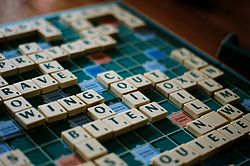
A game of English-language Scrabble in progress
ManufacturersHasbro (within U.S. and Canada)
Mattel (outside U.S. and Canada)
DesignersAlfred Mosher Butts
PublishersJames Brunot
Publication1948; 77 years ago (1948)
GenresWord game
Board game
Players2–4
Setup time2–4 minutes
Playing timeTournament game: 50–60 minutes
ChanceMedium (letters drawn)
SkillsVocabulary, spelling, anagramming, strategy, counting, bluffing, probability
WebsiteOfficial website (Hasbro)
Official website (Mattel)

Scrabble is a word game in which two to four players score points by placing tiles, each bearing a single letter, onto a game board divided into a 15×15 grid of squares. The tiles must form words that, in crossword fashion, read left to right in rows or downward in columns and are included in a standard dictionary or lexicon.

American architect Alfred Mosher Butts invented the game in 1931. Scrabble is produced in the United States and Canada by Hasbro, under the brands of both of its subsidiaries, Milton Bradley and Parker Brothers. Mattel owns the rights to manufacture Scrabble outside the U.S. and Canada. As of 2008, the game is sold in 121 countries and is available in more than 30 languages; approximately 150 million sets have been sold worldwide, and roughly one-third of American homes and half of British homes have a Scrabble set.[1][2][3][4] There are approximately 4,000 Scrabble clubs around the world.[4]

Equipment

[edit]

Scrabble is played on a 15x15 board, containing 225 squares. Certain squares are premium squares, which multiply the number of points awarded: eight dark red "triple word" squares, 17 pale red "double word" squares, of which one, the center square (H8), is marked with a star or other symbol, 12 dark blue "triple letter" squares, and 24 pale blue "double letter" squares. In 2008, Hasbro changed the colors of the premium squares to orange for TW, red for DW, blue for DL, and green for TL, but the original premium square color scheme is still preferred for Scrabble boards used in tournaments.[5]

Blank Scrabble tile
Scrabble tile for "C"
Scrabble tile for "R"
Scrabble tile for "A"
Scrabble tile for "B"
Scrabble tile for "L"
Scrabble tile for "E"
The name of the game spelled out in game tiles from the English-language version. Each tile is marked with its point value, with a blank tile—the game's equivalent of a wild card—played as the word's first letter. The blank tile is worth zero points.

An English-language set contains 100 tiles, 98 of which are marked with a letter and a point value between 1 and 10. Each tile's point value is based on its frequency in English, with vowels and common letters such as L, N, R, S, and T worth 1 point, and rare letters such as Q and Z worth 10 points. The remaining two tiles are blank and carry no value. Other language sets use different letter set distributions with different point values. Tiles are usually made of wood or plastic and are 19 by 19 millimetres (0.75 in × 0.75 in) square and 4 mm (0.16 in) thick, slightly smaller than the squares on the board. Each player uses a rack that conceals their tiles from other players.

A B C D E F G H I J K L M N O
1
WS

LS

WS

LS

WS
1
2
WS

LS

LS

WS
2
3
WS

LS

LS

WS
3
4
LS

WS

LS

WS

LS
4
5
WS

WS
5
6
LS

LS

LS

LS
6
7
LS

LS

LS

LS
7
8
WS

LS

LS

WS
8
9
LS

LS

LS

LS
9
10
LS

LS

LS

LS
10
11
WS

WS
11
12
LS

WS

LS

WS

LS
12
13
WS

LS

LS

WS
13
14
WS

LS

LS

WS
14
15
WS

LS

WS

LS

WS
15
A B C D E F G H I J K L M N O
  Triple word score
  Double word score
  Triple letter score
  Double letter score
The official Scrabble board design

History

[edit]
Alfred Butts manually tabulated the frequency of letters in words of various length, using examples in a dictionary, the Saturday Evening Post, the New York Herald Tribune, and The New York Times.[6] This was used to determine the number and scores of tiles in the game.

In 1931 in Poughkeepsie, New York, the American architect Alfred Mosher Butts created the game as a variation on an earlier word game he invented, called Lexiko. The two games had the same set of letter tiles, whose distributions and point values Butts worked out by performing a frequency analysis of letters from various sources, including The New York Times. The new game, which he called Criss-Crosswords, added the 15×15 gameboard and the crossword-style gameplay. He manufactured a few sets himself but was not successful in selling the game to any major game manufacturers of the day.[7]: 98 

In 1948, James Brunot,[8] a resident of Newtown, Connecticut, and one of the few owners of the original Criss-Crosswords game, bought the rights to manufacture the game in exchange for granting Butts a royalty on every unit sold. Although he left most of the game (including the distribution of letters) unchanged, Brunot slightly rearranged the "premium" squares of the board and simplified the rules; he also renamed the game Scrabble, a real word that means "scratch frantically".[7]: 100  In 1949, Brunot and his family made sets in a converted former schoolhouse in Dodgingtown, Connecticut, a section of Newtown. They made 2,400 sets that year but lost money.[9]

In 1952, unable to meet demand himself, Brunot licensed the manufacturing rights to Long Island-based Selchow and Righter, one of the manufacturers that, like Parker Brothers and Milton Bradley Company, had previously rejected the game. "It's a nice little game. It will sell well in bookstores," Selchow and Righter president Harriet T. Righter remembered saying about Scrabble when she first saw it.[10] In its second year as a Selchow and Righter product, 1954, nearly four million sets were sold.[11][7]: 104  Selchow and Righter then bought the trademark to the game in 1972.[12]

Meanwhile, JW Spear acquired the rights to sell the game in Australia and the UK on January 19, 1955.[7] In 1986, Selchow and Righter was sold to Coleco, which soon afterward went bankrupt. Hasbro then purchased Coleco's assets in 1989, including Scrabble and Parcheesi.[12] Mattel then acquired JW Spear in 1994.[7] Since then, Hasbro has owned the rights to manufacture Scrabble in the U.S. and Canada, and Mattel has held the rights to manufacture the game in other parts of the world.[12]

Scrabble logo used by Mattel from 2013 to 2020
Scrabble logo used by Hasbro in the United States and Canada until 2008

In 1984, Scrabble was turned into a daytime game show on NBC. The Scrabble game show ran from July 1984 to March 1990,[13] with a second run from January to June 1993. The show was hosted by Chuck Woolery. Its tagline in promotional broadcasts was, "Every man dies; not every man truly Scrabbles."[14] In 2011, a new TV variation of Scrabble, called Scrabble Showdown, aired on The Hub cable channel, which is a joint venture of Discovery Communications, Inc. and Hasbro.

Scrabble was inducted into the National Toy Hall of Fame in 2004.[15]

Evolution of the rules

[edit]

The "box rules" included in each copy of the North American edition have been edited four times: in 1953, 1976, 1989, and 1999.[16]

The major changes in 1953 were as follows.

  • It was made clear that:
    • words could be played through single letters already on the board,
    • a player could play a word parallel and immediately adjacent to an existing word provided all crossing words formed were valid,
    • the effect of two premium squares was to be compounded multiplicatively.
  • The previously unspecified penalty for having one's play successfully challenged was stated: withdrawal of tiles and loss of turn.

The major changes in 1976 were as follows.

  • It was made clear that the blank tile beats an A when drawing to see who goes first.
  • A player could pass their turn, doing nothing.
  • A loss-of-turn penalty was added for challenging an acceptable play.
  • If final scores are tied, the player whose score was highest before adjusting for unplayed tiles is the winner;[17] in tournament play, a tie is counted as half a win for both players.[5]

The editorial changes made in 1989 did not affect gameplay.[16]

The major changes in 1999 were as follows.

  • It was made clear that:
    • a tile can be shifted or replaced until the play has been scored,
    • a challenge applies to all the words made in the given play.
  • Playing all seven tiles is officially called a "bingo" in North America and a "bonus" elsewhere.
  • A change in the wording of the rules could have been interpreted as meaning that a player may form more than one word on one row on a single turn.

Rules

[edit]

Before the game, a word list or dictionary is selected in order to adjudicate any challenges during the game. In tournament play, the word list is specified in advance, typically the NASPA Word List, the Official Scrabble Players Dictionary, or Collins Scrabble Words. All 100 tiles are placed into an opaque bag. One player is selected to go first; a commonly used method is for each player to draw one tile from the bag, and whoever draws a letter alphabetically closest to A goes first (blanks supersede A). Each player then draws seven tiles and places them on their rack, hidden from other players.

A game of Scrabble in French

Gameplay

[edit]

On every turn, the player at turn can perform one of the following options:

  • Pass, forfeiting the turn and scoring zero.
  • Exchange one or more tiles for an equal number from the bag, scoring zero. This can only be done if 7 or more tiles remain in the bag.
  • Play at least one tile on the board, adding the value of all words formed to the player's cumulative score.

The first play of the game must consist of at least two tiles and cover the center square (H8). Any play thereafter must use at least one of the player's tiles to form a "main word" (containing all of the player's played tiles in a straight line) reading left-to-right or top-to-bottom. Diagonal plays are not allowed. At least one tile must be adjacent (horizontally or vertically) to a tile already on the board. If the play includes a blank tile, the player must designate the letter the blank represents; that letter remains unchanged for the rest of the game unless the play is challenged off. The player announces the score for that play, and then draws tiles from the bag equal to the number of tiles played, so that there are seven tiles on their rack. If there are not enough tiles, the player draws any remaining tiles instead. If the game is played using a clock, the player starts the opponent's clock after announcing the score and before drawing tiles. Players may keep track of tiles played during the game.

If a player has made a play and not yet drawn a tile, any other player may choose to challenge any or all words formed by the play. The challenged word(s) are then searched in the agreed-upon word list or dictionary. If at least one challenged word is unacceptable, the play is removed from the board, and the player scores zero for that turn. If all challenged words are acceptable, the challenger loses their turn. In tournament play, players are not entitled to know which word(s) are invalid or the definitions of any challenged words. Penalties for unsuccessfully challenging an acceptable play vary in club and tournament play and are described in greater detail below.

End of game

[edit]
A game of magnetic Pocket Scrabble approaching its end, when players have fewer than seven tiles remaining

The game ends when either:

  • One player has played every tile on their rack ("playing out") and no tiles remain in the bag (regardless of the tiles on the opponent's rack).
  • At least six successive scoreless turns have occurred and either player decides to end the game. This typically occurs when neither player can form a valid play. (For several years, a game could not end with a cumulative score of 0–0, but that is no longer the case, and such games have since occurred a number of times in tournament play, the winner being the player with the lower total point value on their rack and thus a score less negative than the opponent's.[18])
  • In tournament play, when either player exceeds 10 minutes of overtime.

At the end of the game, each player's score is reduced by the sum of the values of their unplayed tiles; if a player plays out, the sum of all other players' unplayed tiles is added to that player's score. This rule differs slightly in most tournaments; a player who plays out adds twice this sum, and the opponent's score is unchanged.

Scoring

[edit]
Premium square colors
Square Original version Mattel version (2020-) Mattel version (2012–2020) Hasbro Version (2008–2014)
Double letter (DLS) Light blue Dark blue Light blue Bright blue
Triple letter (TLS) Blue Hot pink Blue Green
Double word (DWS) Pink Yellow Yellow Red
Triple word (TWS) Red Light green Red Orange

The score for a play is determined as follows:

  • The value of each tile is indicated with a point value (between 1 and 10, with blanks worth zero points), and the score of every new word formed is equal to the sum of the point values of the letters in that word. If a play covers any premium squares (such as DLS or TWS squares), the point value of the corresponding letter or word is multiplied by 2 or 3 respectively. The center star is also a DWS square.
  • Premium squares only apply when newly placed tiles cover them. Any subsequent plays do not count these premium squares. A play that covers a DWS or TWS multiplies the value of the entire word(s) by 2 or 3, including tiles already on the board.
  • If a newly placed word covers both letter and word premium squares, the letter premium(s) is/are calculated first, followed by the word premium(s).
  • If a player makes a play where the main word covers two DWS squares, the value of that word is doubled, then redoubled (i.e. 4× the word value). Similarly, if the main word covers two TWS squares, the value of that word is tripled, then re-tripled (9× the word value). Such plays are often referred to as "double-doubles" and "triple-triples" respectively.
  • If a player plays all seven of their tiles on their turn (known as a "bingo" in North America and as a "bonus" elsewhere), a 50-point bonus is added to the score of the play.

Scoreless turns can occur when a player passes, exchanges tiles, loses a challenge, or otherwise makes an illegal move. A scoreless turn can also occur if a play consists of only blank tiles, but this is extremely unlikely in actual play.

Scoring example

[edit]

See the example board at right.

Example of a Scrabble game using Quackle, an open-source program. The plays QUITE, MES(QUITE), INFaNCY, and RECO(UN)TS score 48, 57, 88, and 40 points, respectively.

Suppose Player 1 plays QUITE 8D, with the Q on a DLS and the E on the center star. Because the center star is a DWS, the score for this play is points.

Player 2 extends the play to form the word MES(QUITE) 8A with the M on the TWS at 8A. The score for this play is points. The Q is not doubled, as the Q was not played on this turn.

Player 1 plays INFaNCY 9D with a blank A, forming five 2-letter words, QI, UN, IF, TA, and EN. Because several additional words were formed, each new word is scored separately. The score for this play, without the 50-point bonus, is

points. Because all 7 tiles were played on this turn, a 50-point bonus is added, and the score for this play is points.

Player 2 plays RECO(UN)TS E4 through the word UN. Because this word covers two DWS squares, the score for this word is quadrupled, and the score for the play is points. Player 1 is ahead 136–97.

Acceptable words

[edit]

All words of length 2 to 15 letters that appear in the agreed-upon dictionary or lexicon are acceptable words in Scrabble, as are all their inflected forms and plurals. Words that contain apostrophes, are hyphenated or capitalized (such as proper nouns) are generally not allowed unless they also appear as acceptable entries; for example, words such as HERES, JACK and TEXAS, while typically containing an apostrophe or considered a proper noun, have unrelated meanings and are therefore acceptable in major Scrabble lexicons. Acronyms and abbreviations are generally not allowed unless they have separate entries (such as AWOL, RADAR, SCUBA, and WYSIWYG[19]). Variant spellings, slang or offensive terms, archaic or obsolete terms, and specialized jargon words are acceptable if they meet all other criteria for acceptability, but archaic spellings (e.g., NEEDE or MAKETH) are generally not acceptable words. Foreign words are generally not allowed in English-language Scrabble unless they have been incorporated into the English language, such as the words QI,[20] KILIM, and PATISSERIE.

Vulgar and offensive words are generally excluded from the Official Scrabble Players Dictionary but allowed in club and tournament play. The North American Scrabble Players Association removed slurs from its lexicon in 2020, after conducting a poll of its members.[21] Mattel removed 400 derogatory terms from its official word list in 2021, in response to the Black Lives Matter movement, with the company's head of games saying: "Can you imagine any other game where you can score points and win by using a racial epithet? It’s long overdue."[22] This does not exclude players from playing these words, as it is within the rules of the game to play unacceptable words (at the risk of losing a challenge).

There are two popular competition word lists for English-language Scrabble:

The first predominates in the U.S., Canada, and Thailand, and the second in English Scrabble in the rest of the world. There is also a large community of competitive Collins players in North America, with its own NASPA rating system.

NWL and OSPD

[edit]

Today's NASPA Word List (NWL), published by NASPA Games, descends from the Official Tournament and Club Word List (a non-bowdlerized version of the Official Scrabble Players Dictionary) and its companion Long Words List for longer words. The current version of NWL is NWL2023,[23] effective February 2024, and the Official Scrabble Players Dictionary, published by Merriam-Webster, is currently in its seventh edition of 2022. NWL includes all current OSPD words, plus several hundred offensive words and genericized trademarks such as KLEENEX; as of 2020, it no longer includes words judged to be personally applicable offensive slurs.

The NWL and OSPD are compiled using a number of major college-level dictionaries, principally those published by Merriam-Webster. If a word appears, at least historically, in any one of the dictionaries, it is included in the NWL and the OSPD. If the word has only an offensive meaning, it is included only in the NWL. The key difference between the OSPD and the NWL is that the OSPD is marketed for "home and school" use, without words which their source dictionaries judged offensive, rendering the Official Scrabble Players Dictionary less fit for official Scrabble play. The OSPD is available in bookstores, while the NWL is available only through NASPA.

Collins Scrabble Words

[edit]

In all other English-speaking countries, the competition word list is Collins Scrabble Words 2021 edition, known as CSW21 (Versions of this lexicon before 2007 were known as SOWPODS). Historically, this list has contained all OTCWL words plus words sourced from the Chambers and Collins English dictionaries, but recent editorial decisions have caused greater discrepancies between CSW and NWL. CSW is commonly used to adjudicate major tournaments outside North America.

Tournaments are also played using CSW in North America, particularly since Hasbro ceased to control tournament play in 2009. NASPA, the Word Game Players Organization, and Collins Coalition (CoCo) all sanction CSW tournaments, using separate Elo rating systems.[24]

Challenges

[edit]

The penalty for a successfully challenged play is nearly universal: the offending player removes the tiles played and forfeits their turn. (In some online games, an option known as "void" may be used, wherein unacceptable words are automatically rejected by the program. The player is then required to make another play, with no penalty applied.)

The penalty for an unsuccessful challenge (where all words challenged in the play are deemed valid) varies considerably, including:

  • "Double Challenge", in which an unsuccessfully challenging player must forfeit the next turn. This penalty is most common in North American (NASPA- or WGPO-sanctioned) tournament play,[5] and is the standard for North American, Israeli, and Thai clubs. Because loss of a turn generally constitutes the greatest risk for an unsuccessful challenge, it provides the greatest incentive for a player to "bluff", or play a "phony" – a plausible word that they know or suspect to be unacceptable, hoping their opponent will not challenge it. Or a player can put down a legal word that appears to be a phony hoping the other player will incorrectly challenge it and lose their turn.
  • "Single Challenge"/"Free Challenge", in which no penalty whatsoever is applied to a player who unsuccessfully challenges. This is the default rule in Ireland and the United Kingdom, as well as for many tournaments in Australia, although these countries do sanction occasional tournaments using other challenge rules.
  • Modified "Single Challenge" (or "5-point challenge"), in which an unsuccessful challenge does not result in the loss of the challenging player's turn, but is penalized by a 5-point (or other specified point) penalty. The rule has been adopted in Singapore (since 2000), Malaysia (since 2002), South Africa (since 2003), New Zealand (since 2004), and Kenya, as well as in contemporary World Scrabble Championships (since 2001) and North American (NASPA-sanctioned) Collins tournaments, and particularly prestigious Australian tournaments.[25] Some countries and tournaments (including Sweden) use a 10-point penalty instead. In most game situations, this penalty is much lower than that of the "double challenge" rule. Consequently, such tournaments encourage greater willingness to challenge and discourage playing dubious words.

Under tournament rules, a player may request to "hold" the opponent's play to consider challenging, provided that the opponent has not yet drawn replacement tiles. The holding player's clock still runs, and the opponent cannot draw replacement tiles for 15 seconds or until the hold is released but may draw tiles afterward (which must be kept separate). If a player successfully challenges, the opponent must reveal any replacement tiles before returning them to the bag.

Competitive play

[edit]

Club and tournament play

[edit]

Tens of thousands play club and tournament Scrabble worldwide. The rules and equipment in tournament Scrabble differ somewhat from those typically found in casual play. For example, all tournament (and most club) games are played with a game clock and a set time control, and are only between two players (or occasionally, two teams of players). A player who goes overtime does not immediately lose the game (as in chess), but is instead assessed a 10-point penalty per minute.[26][27] Also, the original wooden tiles are not allowed in tournaments as it is possible for players to "feel" the tiles in the bag (especially blank tiles);[11] thus, molded plastic tiles are often used. Players are allowed tracking sheets containing the tile distribution, from which tiles can be crossed off as they are played.

Regularly held major tournaments include:

  1. The WESPA Championship (formerly the World Scrabble Championship): an invitational championship organized by WESPA.
  2. The Scrabble Players Championship (formerly North American Scrabble Championship): organized by NASPA Games, an open event attracting several hundred players, held around July–August every year in the United States.
  3. The National Scrabble Championship: organized by the Association of British Scrabble Players (ABSP) and held every year in the United Kingdom.
  4. The Brand's Crossword Game King's Cup: the largest tournament in the world. Held annually in Thailand around the end of June or the beginning of July.
  5. The UK Open: the largest Scrabble tournament in Europe, held annually in Coventry in England, since 2008.

Other important tournaments include:

  1. The World Youth Scrabble Championships: entry by country qualification, restricted to under 18 years old. Held annually since 2006.
  2. The National School Scrabble Championship: entry open to North American school students. Held annually since 2003.
  3. The Canadian Scrabble Championship: entry by invitation only to the top fifty Canadian players. Held every two to three years.
  4. The Singapore Open Scrabble Championship: international Singapore championship held annually since 1997.

Scrabble clubs typically meet weekly and may typically hold one or more open, sanctioned tournaments per year.

Records

[edit]

The following records were achieved during international competitive club or tournament play, according to authoritative sources, including the book Everything Scrabble by Joe Edley and John D. Williams Jr. (revised edition, Pocket Books, 2001) and the Scrabble FAQ.[28] When available, separate records are listed based upon different official word lists:

  1. OTCWL, the North American list, also used in Thailand and Israel, known today as the NASPA Word List (NWL);
  2. OSW, formerly the official list in the UK;
  3. SOWPODS, the combined OTCWL+OSW list now used in much of the world, known today as Collins Scrabble Words.

To date, new editions or revisions of these lists have not been considered substantial enough to warrant separate record-keeping.

  • High game (OTCWL) – 830 by Michael Cresta (Massachusetts), at the Lexington (Massachusetts) club, October 12, 2006. Cresta defeated Wayne Yorra 830–490.[29][30]
  • High game (OTCWL) in a tournament game – 803 by Joel Sherman (New York), at a tournament in Stamford, Connecticut, December 9, 2011. Sherman defeated Bradley Robbins 803–285, playing a record-tying seven bingos and sticking Robbins with the Q.[31]
  • High game (OSW) – 793 by Peter Preston (UK), 1999.[32]
  • High game (SOWPODS) – Toh Weibin set a record score of 850 at the Northern Ireland Championships on January 21, 2012. The winning margin of 591 points is also believed to be a record.[33][34][35]
  • High combined score (OTCWL) – 1320 (830–490) by Michael Cresta and Wayne Yorra, in a Lexington, Massachusetts, club, 2006.[29][30]
  • High combined score (OTCWL) in a tournament game – 1134 (582–552) by Keith Smith (Texas) and Stefan Rau (Connecticut), Round 12 of the 2008 Dallas Open. (Rau's losing score of 552 included three phony words that were not challenged.)[36]
  • High combined score (OTCWL) in a tournament game with no phony words played – 1127 (725–402) by Laurie Cohen (Arizona) and Nigel Peltier (Washington), in a tournament in Ahwatukee, Arizona, February 16, 2009.[37]
  • High combined score (SOWPODS) – 1210 (721–489) by Edward Okulicz (Australia and Michael McKenna (Australia), at the 2013 Janboree in NSW.[38]
  • Highest losing score (OTCWL) – 552 by Stefan Rau (Connecticut) to Keith Smith's (Texas) 582, Round 12 of the 2008 Dallas Open.[36]
  • Highest tie game (OTCWL) – 502–502 by John Chew and Zev Kaufman, at a 1997 Toronto Club tournament.[39]
  • Highest tie game (SOWPODS) – 532–532 by Sinatarn Pattanasuwanna (Thailand) and Tawan Paepolsiri (Thailand) at the 2012 World Youth Scrabble Championship.[40]
  • Highest opening move score (OTCWL)MuZJIKS (with a blank for the U) 126 by Jesse Inman (South Carolina) at the National Scrabble Championship, 2008.[41] The highest possible legal score on a first turn is MUZJIKS 128, using an actual U rather than a blank. (Note: The odds of drawing MUZJIKS without blanks is 9 in 432,325,411, or 1 in [42])
  • Highest opening move score (SOWPODS)BEZIQUE 124 by Sam Kantimathi (1993),[43] Joan Rosenthal[44] and Sally Martin.[44]
  • Highest single play (OTCWL)QUIXOTRY 365 by Michael Cresta (Massachusetts), 2006.[29][30]
  • Highest single play (SOWPODS)CAZIQUES 392 by Karl Khoshnaw.[45]
  • Highest average score, multi-day tournament (OSPD) – 503 by James Leong (Saskatchewan) over 12 rounds at Brandon, Man., 2015.[46] 484 by Doug Brockmeier (California) over 12 rounds at Elmhurst, Illinois, 2011.[47] 471 by Chris Cree (Texas) over 18 rounds at the Bayou Bash in Houston, Tex., 2007.[48]
  • Highest average score, multi-day tournament (SOWPODS) – 499.94 by Nigel Richards (MY) over 16 rounds at the 7th Lim Boon Heng Cup, Singapore, 2009.[49]
  • Highest average score, one day tournament (SOWPODS) – 548 by Jackson Smylie of Toronto, Ontario, over 5 rounds at Caledon, Ontario
  • Highest average score, one day tournament (OTCWL) – 532 by Jackson Smylie over 4 rounds at North American Scrabble Championship early bird in Las Vegas

Two other records are believed[citation needed] to have been achieved under a British format known as the "high score rule", in which a player's tournament result is determined only by the player's own scores, and not by the differentials between that player's scores and the opponents'. Play in this system "encourages elaborate setups often independently mined by the two players",[32] and is significantly different from the standard game in which defensive considerations play a major role. While the "high score" rule has led to impressively high records, it is currently out of favor.[citation needed]

  • High game score – 1,049 by Phil Appleby of Lymington, Hampshire, UK, on June 25, 1989, in Wormley, Hertfordshire, UK. His opponent scored just 253 points, giving Appleby a record victory margin of 796 points.
  • High single play – CAZIQUES for 392, by Saladin Karl Khoshnaw[45] in Manchester, UK, in April 1982.

Much higher-scoring plays are possible (e.g., plays covering three TWS squares), but extremely unlikely to occur without elaborate setups by both players. The highest reported score for a single play is 1786 points using the word oxyphenbutazone creating seven additional words simultaneously.[50] When only adding the word SESQUIOXIDIZING to these official lists, one could theoretically score 2015 (OSPD) and 2044 (SOWPODS) points in a single move.[51] The highest reported combined score for a theoretical game based on SOWPODS is 4054 points, constructed by Nathan Hedt of Australia.[52] Other records are available for viewing at Total Scrabble, an unofficial record book that includes the above as sources and expands on other topics.

In August 1984, Peter Finan and Neil Smith played Scrabble for 153 hours at St. Anselm's College, Birkenhead, Merseyside, setting a new duration record. A longer record was never recorded by Guinness Book of Records, as the publishers decided that duration records of this nature were becoming too dangerous and stopped accepting them.[53]

Software

[edit]

Computer players

[edit]

Maven is a computer opponent for the game created by Brian Sheppard. The official Scrabble computer game in North America uses a version of Maven as its artificial intelligence and is published by Atari. Outside North America, the official Scrabble computer game is published by Ubisoft. Quackle is an open-source alternative to Maven of comparable strength, created by a five-person team led by Jason Katz-Brown.[54] A Qt cross-platform version of Quackle is available on GitHub.[55]

Video game versions

[edit]

Video game versions of Scrabble have been released for various platforms, including IBM PC compatibles, Mac, Amiga,[56] Commodore 64,[57] ZX Spectrum,[58] Game Boy, Game Boy Color, Game Boy Advance,[59] Nintendo DS,[60] PlayStation,[61] PlayStation 4, PlayStation Portable,[62] iPod, iOS, Game.com, Palm OS, Amstrad CPC, Xbox 360, Kindle,[63] Wii,[64] and mobile phones.

The Nintendo DS version of Scrabble 2007 Edition made news when parents became angry over the game's AI using potentially offensive language during gameplay.[65]

Web versions

[edit]

Several websites offer the possibility to play Scrabble online against other users, such as the Internet Scrabble Club, Pogo.com from Electronic Arts (North America only), and woogles.io.

Facebook initially offered a variation of Scrabble called Scrabulous as a third-party application add-on. On July 24, 2008, Hasbro filed a copyright infringement lawsuit against its developers.[66] Four days later, Scrabulous was disabled for users in North America,[67] eventually reappearing as "Lexulous" in September 2008, with changes made to distinguish it from Scrabble. By December 20, Hasbro had withdrawn its lawsuit.[68]

Mattel launched its official version of online Scrabble, Scrabble by Mattel, on Facebook in late March 2008.[69][70] The application was developed by Gamehouse, a division of RealNetworks that was licensed by Mattel.[70] Since Hasbro controls the copyright for North America with the copyright for the rest of the world belonging to Mattel,[69] the Gamehouse Facebook application was available only to players outside the United States and Canada.[70] The version developed by Electronic Arts for Hasbro was available throughout the world.

When Gamehouse ceased support for its application, Mattel replaced it with the Electronic Arts version in May 2013. This decision was met with criticism from its userbase.[71] The Hasbro version continues to be available worldwide but now uses IP lookup to display Hasbro branding to North American players and Mattel branding to the rest of the world. Electronic Arts have also released mobile apps for Android and iOS, allowing players to continue the same game on more than one platform.

As well as facilities to play occasional games online, there are many options to play in leagues.[72]

In 2020, the license for Scrabble passed from Electronic Arts to Scopely, which launched the app Scrabble GO on March 5, 2020, with the Electronic Arts version discontinued on June 5, 2020.[73] The new app was very different, leading to protests, and Scopely soon began to offer a 'Classic' version, without some of the extras initially offered: "this updated mode is reimagined to reflect the ask for a streamlined experience. Features such as boosts, rewards and all other game modes are disabled", the company announced.[74]

Variations

[edit]

Super Scrabble

[edit]

A new licensed product, Super Scrabble, was launched in North America by Winning Moves Games in 2004 under license from Hasbro, with the deluxe version (with turntable and lock-in grid) released in February 2007. A Mattel-licensed product for the rest of the world was released by Tinderbox Games in 2006. This set comprises 200 tiles in slightly modified distribution to the standard set and a 21×21 playing board.

National versions

[edit]

Versions of the game have been released in several other languages.

The game was called Alfapet when it was introduced in Sweden in 1954, but since the mid-1990s, the game has also been known as Scrabble in Sweden. Alfapet is now another crossword game, developed by the owners of the name Alfapet. A Russian version is called Erudit. A Hebrew version is called Shabets Na (שבץ נא). Versions have been prepared for Dakotah, Haitian Creole, Dakelh (Carrier language), and Tuvan.[75]

For languages with digraphs counted as single letters, such as Welsh and Hungarian, the game features separate tiles for those digraphs.

An Irish-language version of Scrabble was published by Glór na nGael in 2010. The previous year the same organisation published the Junior version of the game and two years later it republished Junior Scrabble using a two-sided (and two skill level) board.

Television game show version

[edit]

In 1987, a board game was released by Selchow & Righter, based on the game show hosted by Chuck Woolery that aired on NBC from 1984 to 1990 (and for five months in 1993). Billed as the "Official Home Version" of the game show (or officially as the "TV Scrabble Home Game"), gameplay bears more resemblance to the game show than it does to a traditional Scrabble game, although it does utilize a traditional Scrabble gameboard in play.

Games based on Scrabble

[edit]

There are numerous variations of the game. While they are similar to the original Scrabble game, they include minor variations. For example, Literati draws random tiles instead of providing a finite number of tiles for the game, assigns different point levels to each letter and has a slightly different board layout, whereas Lexulous assigns eight letters to each player instead of seven. Words with Friends uses a different board layout and different letter values, as does Words of Gold.

A duplicate Scrabble tournament in La Bresse, France

Duplicate Scrabble is a popular variant in French speaking countries. Every player has the same letters on the same board and the players must submit a paper slip at the end of the allotted time (usually 3 minutes) with the highest scoring word they have found. This is the format used for the French World Scrabble Championships but it is also used in Romanian and Dutch. There is no limit to the number of players that can be involved in one game, and at Vichy in 1998 there were 1,485 players, a record for French Scrabble tournaments.

Scarabeo [it] is a variant that is much more popular in Italy than the original game. It features a 17×17 grid of cells and peculiar rules.[76]

Popular among tournament Scrabble players is Clabbers. In Clabbers, any move that consists of anagrams of allowable words is allowed. For example, because ETAERIO is allowable in ordinary Collins Scrabble, EEAIORT would be allowable in Clabbers.[77]

A junior version, called Junior Scrabble, has been marketed. This has slightly different distributions of frequencies of letter tiles to the standard Scrabble game.

Word games similar to or influenced by Scrabble include Bananagrams, Boggle, Dabble, Nab-It!, Perquackey, Puzzlage, Quiddler, Scribbage, Tapple, Upwords, and WordSpot.

There are also number-based variations, such as Equate.

Gameboard formats

[edit]

The game has been released in numerous gameboard formats appealing to various user groups. The original boards included wood tiles and many "deluxe" sets still do.

Tile Lock editions

[edit]

Tile Lock editions of Scrabble[78] and Super Scrabble[79][80] are made by Winning Moves and feature smaller, plastic tiles that are held in place on the board with little plastic posts. The standard version features exactly the same 100 tiles as regular Scrabble. The Tile Lock Super Scrabble features the same 200 tiles that are in Super Scrabble.

Travel editions

[edit]

Editions are available for travelers who may wish to play in a conveyance such as a train or plane or to pause a game in progress and resume later. Many versions thus include methods to keep letters from moving, such as pegboards, recessed tile holders and magnetic tiles. Players' trays are also designed with stay-fast holders. Such boards are also typically designed to be reoriented by each player to put the board upright during the game, as well as folded and stowed with the game in progress.

  • Production and Marketing Company, 1954 – metal hinged box, Bakelite tiles inlaid with round magnets, chrome tile racks, silver-colored plastic bag and cardboard box covered with decorative paper. The box, when opened flat, measures 8+12 in × 7+34 in (22 cm × 20 cm) and the tiles measure 12 in (13 mm) square.
  • Spear's Games, the 1980s – boxed edition with pegboard, plastic tiles with small feet to fit snugly in the pegboard. Racks are clear plastic, allowing some sorting while holding tiles fairly snugly. The set comes with a drawstring plastic bag to draw tiles and a cardboard box. It is possible to save a game in progress by returning the board to the box. There is a risk of players' trays being mixed and upset, and the box lid, held on by friction, is subject to upset.
  • Selchow & Righter, 1980s – pocket edition with plastic "magnetic" board and tiles. Tile racks are also plastic with an asymmetrical shape to provide a handhold. All elements fit in a plastic envelope for travel and to permit a pause in the game. Plastic letters are very small and tend to lose their grip if not placed with slight lateral movement and if they are not perfectly clean. The game format is extremely small, allowing Scrabble games for backpackers and others concerned about weight and size.
  • Hasbro Games, 2001 – hinged plastic board with clear tile-shaped depressions to hold tiles in play. Board is in a black, zippered folio such that board and tiles may be folded for travel, even with the game in play. The reverse side of the board contains numbered mounts for racks, holding tiles face down, allowing secure and confidential storage of tiles while a game is paused. Some versions have tile racks with individual tile slots, thus not permitting easy sorting of tiles in a rack. The board, when opened up, measures 24.5 cm × 21.0 cm (9+34 in × 8+14 in), and the tiles are 12.3 mm × 12.3 mm × 6.7 mm (12 in × 12 in × 14 in) in size.

Deluxe editions

[edit]

At the opposite end, some "deluxe" or "prestige"[81] editions offer superior materials and features. These include editions on a rotating turntable, so players can always face the board, with the letters upright and a raised grid that holds the tiles in place.[82][83] Also available are alternative Scrabble boards, often made of glass[84] or hardwood, that have superior rotating mechanisms and personalized graphics.

Large print and braille editions

[edit]

An edition has been released (in association with the Royal National Institute of Blind People (RNIB))[85] with a larger board and letters for players with impaired vision.[86] The colours on the board are more contrasting, and the font size has been increased from 16 to 24 point. The tiles are in bold 48 point, and have braille labels. A separate braille edition is also available.[87]

World's Smallest edition

[edit]

Released by Super Impulse, "World's Smallest Scrabble"[88] measures 3 × 1.75 × 0.5 inches. It has the full gameplay of the standard version, with a board, a case, and 99 magnetic tiles. It is available worldwide, with Hasbro branding in the U.S. and Canada and Mattel branding elsewhere.

[edit]

Books

[edit]

Numerous books about Scrabble have been published, including nonfiction titles helping players improve their game, and fiction titles using the game as a plot device. These include:

  • Merriam-Webster's The Official Scrabble Player's Dictionary, the Seventh Edition of which was published in 2023. The OSPD is the consistently best-selling official Scrabble book.[citation needed]
  • Collins' Scrabble Dictionary: The Official Scrabble Solver, the Sixth Edition of which was published in 2022.
  • Word Freak by Stefan Fatsis (2001), an introduction to tournament Scrabble and its players. While writing the book, Fatsis became a high-rated tournament player.
  • The Scrabble Player's Handbook, edited by Stewart Holden and Kenji Matsumoto, and written by an international group of tournament players, which gives the information a serious player needs to advance to successful tournament play. Not to be confused with Drue K. Conklin's 1976 The Official Scrabble Player's Handbook, The Scrabble Player's Handbook is available for free online.[89]

Documentaries

[edit]

Numerous documentaries have been made about the game, including:

  • Scrabylon (2003), by Scott Petersen, which "gives an up-close look at why people get so obsessed with that seemingly benign game"
  • Word Slingers (2002), by Eric Siblin and Stefan Vanderland (produced for the Canadian Broadcasting Corporation), which follows four expert Canadian players at the 2001 World Championship in Las Vegas
  • Lost for Words (2004) by Joshua Whitehead
  • Word Wars (2004) by Eric Chaikin and Julian Petrillo, about the "tiles and tribulations on the Scrabble game circuit"

Game shows

[edit]

Scrabble has been adapted into multiple television game shows.

See also

[edit]

References

[edit]

Further reading

[edit]
[edit]
Revisions and contributorsEdit on WikipediaRead on Wikipedia
from Grokipedia

Scrabble is a crossword-style for two to four players in which participants score points by forming interlocking words from individual letter tiles placed on a 15-by-15 grid. The game utilizes a set of 100 tiles distributed according to English letter frequencies, with players drawing seven tiles per turn to construct valid words according to official dictionaries, earning points based on letter values and premium board squares for double or triple word and letter scores.
Invented in 1938 by Alfred Mosher Butts, an unemployed American architect during the , the game originated as an attempt to blend elements of crossword puzzles, anagrams, and chance, initially prototyped without a scoring system and named Lexiko before evolving into Criss Cross Words with added board premiums. Butts refined the tile distribution by analyzing letter frequencies in dictionaries, newspapers, and Scrabble's precursors like the New York Times crossword, ensuring empirical balance in gameplay probabilities. Unable to secure commercial interest, Butts partnered with entrepreneur James Brunot in 1947, who renamed it Scrabble and began limited production in 1949; sales surged after 1952 when independently stocked sets, prompting a licensing deal with Selchow & Righter that year, followed by Hasbro's acquisition in 1986. Scrabble's enduring appeal stems from its , combining knowledge, management, and , with over 150 million sets sold worldwide and annual U.S. sales exceeding two million units. Competitive play, governed by organizations like the North American Scrabble Players Association, features tournaments using official word lists such as the or Tournament Word List, though recent editions have sparked debate by removing offensive slurs to promote inclusivity while preserving game . Cheating incidents, including smuggling at events, have occasionally marred high-level competitions, underscoring the game's reliance on verifiable . Variants like with expanded boards and , alongside digital adaptations, have extended its reach, but the core analog experience remains defined by interpersonal wordplay and calculated risk in tile exchanges.

Game Components

Board and Tile Specifications

The Scrabble board is a grid measuring 15 squares by 15 squares, comprising 225 playable spaces in total. Designated premium squares on the board provide score multipliers: double letter score squares (typically ), triple letter score squares (dark blue), double word score squares ( or ), and triple word score squares (). The center square functions as a double word score and is often marked with a symbol. The standard tile set for English-language Scrabble contains 100 tiles, including 98 letter tiles distributed by frequency in English usage and 2 blank tiles. Blank tiles bear no letter or point value and may substitute for any letter chosen by the player, though they score zero points regardless of the letter they represent or any premium square they occupy for word multipliers. Letter tiles feature engraved letters and point values on their faces, with the distribution and values as follows:
PointsLetters (with counts)
0Blanks (2)
1A (9), E (12), I (9), L (4), N (6), O (8), R (6), S (4), T (6), U (4)
2D (4), G (3)
3B (2), C (2), M (2), P (2)
4F (2), H (2), V (2), W (2), Y (2)
5K (1)
8J (1), X (1)
10Q (1), Z (1)
This distribution reflects empirical analysis of letter frequencies in printed English, assigning higher point values to rarer letters to balance gameplay. The total face value of all letter tiles sums to 187 points.

Letter Distribution and Probabilities

The standard English-language edition of Scrabble includes 100 letter tiles in total, with the distribution designed to approximate the relative frequencies of letters in typical English usage. This setup ensures that common letters like E appear more frequently, facilitating playable words, while rare letters like or are scarcer. The two blank tiles, which have no inherent letter or point value but can substitute for any letter, are not assigned to specific frequencies. Alfred Mosher Butts, the game's inventor, derived this distribution through manual analysis of letter occurrences in sources including dictionaries, periodicals such as the Saturday Evening Post, and newspapers like the , aiming to reflect empirical patterns in written English rather than uniform equality. His counts prioritized overall viability for over strict proportionality to any single corpus, resulting in minor deviations from pure frequency rankings—for instance, S appears less often than T despite comparable usage rates in some analyses. The table below details the tile counts per letter:
LetterTilesProbability
A99%
B22%
C22%
D44%
E1212%
F22%
G33%
H22%
I99%
J11%
K11%
L44%
M22%
N66%
O88%
P22%
Q11%
R66%
S44%
T66%
U44%
V22%
W22%
X11%
Y22%
Z11%
Blank22%
Probabilities represent the likelihood of drawing a bearing that letter (or blank) from a full, unshuffled , calculated as the tile count divided by 100; these remain constant across draws assuming no tiles are removed permanently, though partial bags alter effective odds mid-game. This fixed distribution influences strategic play, as players must adapt to the inherent scarcities—e.g., the 1% chance of necessitates pairing it with U for validity in most cases.

Player Aids and Accessories

Tile racks, essential for concealing a player's seven letters from opponents, are typically constructed from wood or plastic and measure approximately 7.5 inches in length, 0.75 inches in width, and 0.85 inches in height to securely hold standard Scrabble tiles upright. Official Hasbro sets include four such racks per game, designed to prevent tiles from slipping during play. The tile bag, a drawstring pouch usually made of cloth or fabric, contains the 100 letter tiles at the start and facilitates blind draws of seven tiles per player; premium versions in deluxe editions feature durable materials for repeated use. Score pads, comprising pre-printed sheets with grids for up to four players and space for 20-30 turns, enable precise tracking of points, bonuses, and totals; Hasbro offers official packs of 80 sheets measuring 6 by 9 inches for this purpose. In tournament settings governed by organizations like WESPA, digital or analog timers enforce time controls, with players allocated segments such as 25 minutes per game plus increments; replacement clocks compatible with Scrabble rules, like the ZMF-II model, are available for approximately $40-45. The , published by under license, serves as a reference for word validation in non-competitive play, containing over 180,000 acceptable words while excluding offensive terms; tournament play relies instead on computerized lists like .

History

Invention by Alfred Mosher Butts

Alfred Mosher Butts (1899–1993), an architect from , developed the foundational concepts of Scrabble during the after being laid off from his firm in 1931. Analyzing popular parlor games, Butts classified them by core mechanics—number-based (like dice), move-based (like chess), and word-based (like s)—and sought to blend elements of anagrams, crossword puzzles, and chance to create an engaging word game. His first iteration, named Lexiko, featured players drawing nine random letter tiles from a pool to form words, without a board or scoring system. Butts refined this into Criss Cross Words by introducing a 15-by-15 grid board that permitted intersecting words, reducing the draw to seven tiles per player, and adding point values inversely proportional to in English usage. To establish the tile distribution of 100 letters—including two blanks—Butts tallied occurrences on front pages of and cross-referenced dictionaries, determining that twelve letters (E, T, A, O, I, N, S, H, R, D, L, U) comprise approximately 80 percent of typical text. He limited abundant letters like S to four tiles for gameplay balance and assigned higher scores to scarce ones, such as 10 points each for Q and Z, 8 for J and X, and 1 for common vowels and consonants. Butts handcrafted prototypes, starting with cardboard squares for tiles and progressing to plywood versions with wooden racks, producing around 100 sets for personal sales and testing among friends, though the game garnered no interest from manufacturers at the time.

Licensing and Commercial Launch

Alfred Mosher Butts, having developed prototypes of his in the late under names such as Lexiko and Criss-Cross Words, approached major game manufacturers including and but faced repeated rejections due to perceived lack of commercial viability. In 1948, Butts granted and distribution to James Brunot, an entrepreneur and acquaintance, in exchange for royalties on sales, allowing Brunot to refine the rules, redesign components, and rename the game Scrabble. Brunot secured a for Scrabble on December 1, 1948, marking the formal establishment of the game's under his production. Brunot and his wife Helen established initial production in an abandoned one-room schoolhouse in Dodgingtown, Connecticut, where they, along with family and friends, hand-assembled sets at a rate of approximately 12 per hour. Commercial launch began in 1949 with output of 2,251 to 2,400 sets, though sales generated losses of around $450 due to slow initial adoption despite gradual popularity among niche groups. Demand surged in 1952 following high-volume orders from Macy's executive Jack Straus, who observed strong in-store performance and committed to large purchases, prompting Brunot to license manufacturing rights to Selchow & Righter Co. to scale production for the U.S. and Canada markets. This licensing enabled Scrabble's broader commercial availability, with Selchow & Righter handling distribution while Brunot retained oversight until selling the trademark in 1972.

Post-War Growth and Rule Refinements

Following the end of , Scrabble's commercial trajectory began modestly under James Brunot, who had licensed production rights from Alfred Mosher Butts in 1947 and commenced manufacturing in 1948 after simplifying the game's rules and renaming it. Initial output was handmade in Brunot's home, yielding 2,251 sets in 1949, which resulted in a $450 loss due to limited demand. Sales incrementally improved to 1,632 units in 1950 and 4,859 in 1951, reflecting gradual word-of-mouth adoption among small circles but constrained by artisanal production rates of a few dozen sets weekly. A pivotal surge occurred in , when department store placements—particularly after executive Alfred Butt (no relation to the inventor) endorsed it—drove orders beyond Brunot's capacity, reaching 200 sets per week by summer and accumulating a 2,500-unit backlog upon his return from vacation. By early 1953, production hit 6,000 sets weekly amid tens of thousands of pending orders, prompting Brunot to license manufacturing to Selchow & Righter in of that year to scale output industrially. This transition enabled explosive growth, with nearly 4 million sets sold in 1954 alone, quadrupling prior cumulative totals and establishing Scrabble as a staple. Concurrently, rule refinements emphasized clarity and playability to support broader accessibility. Brunot streamlined Butts' original framework by removing select premium squares near the board's center to reduce complexity, introducing a 50-point bonus for using all seven tiles (the "bingo"), and clarifying interlocking word formation without diagonals. The inaugural 1948 rules comprised 15 numbered directives, specifying blue and red premium spaces for double/triple letter and word scores. Subsequent iterations refined these: 1949 editions expanded to 20 rules, standardizing terminology (e.g., "squares" over "spaces"), mandating one primary new word per turn, and detailing blank substitution. By 1953, under Selchow & Righter's edition, rules condensed to 18, incorporating explicit parallel word validation, formalized exchange procedures, and multiplied premiums (e.g., 4x or 9x for combined double/triple squares). These adjustments minimized ambiguities in scoring and placement, fostering consistent without altering core mechanics like the 15x15 grid or letter distributions.

Core Mechanics

Setup and Turn Sequence

To set up the game, the 15×15 premium square board is placed centrally among 2 to 4 players seated around it. All 100 letter , including 2 blanks, are placed face down in the opaque bag and shaken to randomize. Each player then draws 7 from the bag and places them on their personal rack, keeping them hidden from opponents. To select the first player, all participants draw one each; the player holding the alphabetically closest to "A" (with blanks considered last) takes the initial turn, after which these are returned to the bag, which is resealed and reshuffled. The first player must form a complete word of at least 2 letters using 2 to 7 tiles from their rack, placing it horizontally or vertically to cover the central board square (position H8), which doubles the word's score value. This initial play establishes the board's orientation, with subsequent words required to connect to existing tiles at least at one point, forming valid horizontal and vertical intersections that create additional complete words where tiles meet. Tiles must remain face up once placed and cannot be rearranged mid-turn. On each turn, including the first, a player has three options: place tiles to form one or more new words adjoining existing play (the standard action); exchange any number of tiles (up to all 7) for an equal number drawn from the bag, forfeiting the turn without scoring or placing; or pass the turn without action. After placing tiles, the player announces the score (detailed in separate scoring rules), records it, and immediately draws replacement tiles to restore their rack to 7, unless fewer than 7 remain in the bag. Play then proceeds clockwise to the next player.
The image above depicts tiles placed during active play, illustrating the interlocking central to turn progression.

Word Placement and Validity

Words must be formed by placing letter tiles in a continuous straight line either horizontally from left to right or vertically from top to bottom, with diagonal orientations prohibited. All tiles played in a single turn must lie in one such row or column to create at least one complete main word of two or more letters; any adjacent tiles touched by this placement must simultaneously form additional complete words in fashion. The initial play requires one letter to occupy the central premium square (marked by a star), which doubles the word score but does not count as a letter score multiplier for that tile. Subsequent turns demand that the new word(s) adjoin at least one previously placed word, sharing a common tile horizontally or vertically without gaps or isolated extensions. A valid extension can hook onto an existing word's end (e.g., adding "S" to pluralize), create parallel words alongside it, or intersect at any point, provided all resulting words meet validity criteria. Word validity requires acceptance in an official or , such as for casual North American play or the for tournaments, encompassing nouns, verbs, interjections, and other parts of speech—including archaic, obsolete, or infrequently used terms—but excluding proper nouns (e.g., names of people, places, or brands), standalone prefixes/suffixes, abbreviations, contractions, hyphenated compounds, or words with apostrophes or diacritics unless explicitly listed without them. Official rules do not prohibit repeating the same word multiple times in a game or even in a single turn via parallel plays, provided each instance forms valid connecting words according to the dictionary and placement rules; short words may repeat frequently due to tile availability and board setup, while some informal house rules may restrict duplicates. Foreign words adopted into English may qualify if dictionary-listed, but players cannot consult references mid-turn to verify; challenges occur post-play against the agreed . In competitive settings, the director or software adjudicates based on the prevailing word list, with invalid plays incurring penalties like tile loss or point deductions.

Scoring Calculations and Examples

The score for each play in Scrabble is determined by summing the point values of the letters placed to form the primary word and any additional words created orthogonally, applying multipliers from premium squares where applicable, and adding a 50-point bonus for using all seven (known as a bingo). Each letter bears a fixed point value printed on it, ranging from 0 for blanks to 10 for Q and Z, with blanks able to represent any letter but scoring 0 regardless. The following table lists the standard point values for English-language Scrabble :
PointsLetters
0Blanks (×2)
1A (×9), E (×12), I (×9), L (×4), N (×6), O (×8), R (×6), S (×4), T (×6), U (×4)
2D (×4), G (×3)
3B (×2), C (×2), M (×2), P (×2)
4F (×2), H (×2), V (×2), W (×2), Y (×2)
5K (×1)
8J (×1), X (×1)
10Q (×1), Z (×1)
Premium squares on the 15×15 board modify scores: light blue squares double the value of a letter placed on them (double-letter score, or DL), dark blue squares triple it (triple-letter score, or TL), light red squares double the entire word score (double-word score, or DW), and dark red squares triple it (triple-word score, or TW). These multipliers apply only the first time a tile covers the square; subsequent uses of the same square yield no bonus. Blanks placed on letter premium squares score 0 but still trigger the multiplier for the word total if on a word premium. To calculate a play's score, first sum the base values of all letters in the main word and any new crossing words, then apply letter premiums by multiplying the affected letters' values (e.g., a 10-point on a TL becomes 30 points). Next, sum these adjusted values for each new word and multiply each by any word premiums it touches—multipliers compound if a single word covers multiple (e.g., two DW squares yield ×4). Add the resulting word scores together, then append the 50-point bingo bonus if applicable. For example, placing "CAT" (C=3, A=1, T=1) with no premiums scores 5 points total. If the A lands on a DL square, it becomes 2 points, yielding (3+2+1)=6. Placing it on a TW square after letter adjustments triples the sum: 6×3=18. A more complex play forming "QUIZ" (Q=10, U=1, I=1, Z=10) on a DW square scores (10+1+1+10)×2=44; adding a bingo bonus if using all tiles makes it 94. In plays creating multiple words, each new word scores independently with its own premiums applied before summing. For instance, extending an existing word with "BE" (B=3, E=1) to form "BEE" and a crossing "BED" (using existing letters plus new D=2), with the new E on a DL, scores "BEE" as (3+2+1)=6 and "BED" as (3+1+2)=6, totaling 12 if no word premiums. High-scoring plays often combine bingos with triple-word squares; the theoretical maximum for a seven-letter bingo on a TW with optimal letters and premiums exceeds 200 points, though practical maxima depend on board position and available tiles.

Challenges, Penalties, and Game End

In standard Scrabble play, a challenge occurs when a player disputes the validity of one or more words formed during the opponent's previous turn, typically announced before beginning their own turn. The disputed play is verified against the agreed-upon dictionary; if any word is invalid, the entire play is removed from the board, the tiles returned to the challenger's rack, no points are scored for that turn, and the player who made the play forfeits their turn. If all challenged words are valid, the challenger loses their upcoming turn without further penalty in casual rules. Penalties in casual games are limited to the loss of turn for unsuccessful defenses or challenges, with no monetary or point deductions beyond forfeited scoring opportunities. In competitive tournament settings governed by organizations like the North American Scrabble Players Association (NASPA), challenges follow a similar verification process but incorporate procedural safeguards, such as neutralizing a game clock during verification to prevent time loss disputes. Some international tournaments, including those under the World English-language Scrabble Players Association (WESPA), impose additional penalties for unsuccessful challenges, such as a 5- or 10-point deduction from the challenger's score or added time penalties, to deter frivolous disputes and maintain game pace. NASPA rules, effective as of their 2016 update, emphasize precise challenge announcements and allow for multi-word verification without separate penalties if errors involve shared contributions, prioritizing fairness in high-stakes play. The game concludes under standard rules when the tile bag is depleted and one player exhausts their rack by playing their final letter, at which point remaining tiles in opponents' racks are tallied and subtracted from their scores while added to the winner's total. Alternatively, the game ends if no further legal plays are possible after the bag is empty, with scores adjusted by deducting unplayed rack values from each player's total. In tournament play, an additional termination condition applies: six consecutive turns scoring zero points (including passes) ends the game immediately, with final rack deductions applied to determine the winner. These endpoints ensure decisive resolution while accounting for strategic retention.

Lexicon and Word Acceptance

Official Dictionaries for

In , the (OSPD), published by in collaboration with , serves as the primary reference for casual and recreational play. The seventh edition, released on November 25, 2022, contains over 100,000 playable words limited to two through eight letters, incorporating variant spellings and coverage of Canadian and terms where relevant to American usage. This edition excludes words deemed inappropriate for school environments, such as those with primarily offensive meanings, and terms whose status remains uncertain, prioritizing accessibility for general audiences. For competitive Scrabble under the governance of the North American Scrabble Players Association (NASPA), the (NWL) functions as the authoritative lexicon in the United States and , superseding prior lists like the Official Tournament and Club Word List (OTCWL). The current NWL2023 edition took effect for all sanctioned club and tournament play on February 29, 2024, encompassing words up to 15 letters and reflecting updates from major dictionaries without the recreational restrictions of the OSPD. Unlike the OSPD, the NWL permits words with secondary offensive connotations if their primary definitions are neutral or non-offensive, enabling broader strategic depth in rated events while maintaining fidelity to empirical linguistic evidence from sources like the and Merriam-Webster's unabridged entries. The distinction arises from divergent priorities: the OSPD emphasizes , consumer-market viability with length caps suitable for standard tile sets, whereas the NWL prioritizes comprehensive for high-stakes play, including inflections and proper nouns absent from casual lists. NASPA restricts full NWL distribution to members and licensed developers to enforce and prevent unauthorized replication, contrasting with the OSPD's public availability in print and digital tools. Both draw from vetted etymological and usage data, but tournament rulings under NWL resolve challenges via NASPA's dictionary committee, which cross-references against peer-reviewed lexicographic standards rather than relying solely on publisher endorsements.

Collins Scrabble Words for International Play

Collins Scrabble Words (CSW) constitutes the authoritative for English-language Scrabble competition in international contexts, encompassing permissible words for tournament and club play outside the and . Compiled by under the Collins brand, it derives primarily from the , integrating variants from global Englishes such as those spoken in , , , and the , while adhering to Scrabble-specific criteria that exclude most proper nouns, abbreviations, and inflected forms not meeting standard validity rules. The foundation of CSW traces to the SOWPODS list, an amalgamation of the North American (OSPD) and the British-derived Official Scrabble Words (OSW), with "SOWPODS" serving as an of those acronyms. This combined resource emerged to unify international adjudication following divergences in regional lists during the . Collins formalized and first published CSW in 2007, supplanting prior informal distributions and establishing a standardized, proprietary edition for global use. Editions update periodically to reflect lexical shifts, with major releases in 2012 (CSW12), 2015 (CSW15), 2019 (CSW19), 2021 (CSW21), and 2024 (CSW24). The 2024 iteration, unveiled on August 15, 2024, incorporates approximately 2,000 additions—such as terms like "doomscroll" and technical neologisms—to its predecessor’s 279,073 entries, yielding over 281,000 valid words, and becomes effective for sanctioned events starting January 1, 2025. These updates prioritize empirical inclusion based on evidence of usage frequency and acceptance across English variants, rather than prescriptive judgments. Administered under the World English-language Scrabble Players Association (WESPA), CSW governs adjudication at events like the World Scrabble Championship, where challengers reference it to validate plays. Its expansive scope—exceeding the North American word list by roughly 30,000 terms—accommodates greater lexical diversity, including dialectal forms (e.g., British "grey" alongside American "gray") and niche vocabulary, thereby demanding broader study for competitive proficiency but fostering adaptability to evolving . Tournament variants may employ "family-friendly" subsets omitting potentially offensive terms, though full CSW remains standard for elite international circuits.

Updates to Word Lists Including 2024 Additions

The NASPA Word List 2023 (NWL2023), the official lexicon for competitive Scrabble in the United States and Canada, took effect for tournament and club play on February 29, 2024. This edition, the third major revision under NASPA's stewardship, incorporates words validated against primary sources including the Merriam-Webster dictionaries and other American English references, expanding the total valid word count while maintaining exclusions for proper nouns, abbreviations, and offensive terms deemed unacceptable by the NASPA Games Dictionary Committee. No further NASPA-specific update occurred in 2024, though study tools like NASPA Zyzzyva version 3.4.2, released October 17, 2024, added support for international lists alongside NWL2023. In contrast, the international lexicon saw a significant revision with the release of Collins Scrabble Words 2024 (CSW24) on August 15, 2024, managed by the World English-language Scrabble Players' Association (WESPA) in coordination with Collins Dictionary. This update added 1,814 new words—primarily drawn from the 14th edition of the Collins English Dictionary and cross-referenced with recent North American lists—bringing the total to approximately 280,000 entries, with 845 of the additions being 3-to-8-letter words suitable for common gameplay. It also removed three words classified as offensive and obsolete variants, reflecting ongoing curation to balance linguistic evolution with playability. CSW24 emphasizes contemporary usage, incorporating slang and terms from global English variants, such as "yeet" (to throw forcefully), "" (an emoticon-derived expression of ), "qameez" (a variant of ), "cryptid" (a creature like Bigfoot), and British/Australian colloquialisms like "bagsy" (to claim something) and "peng" (attractive). These inclusions, while expanding strategic options—particularly high-value words like "qameez" (Q on a triple-letter score)—have sparked debate among players on whether rapid adoption prioritizes recency over stability, though WESPA's process prioritizes verifiable attestation over subjective merit. Collins 24.0, released October 31, 2024, provides quizzing support for the new list.

Competitive Landscape

Governing Bodies and Tournament Formats

The North American Scrabble Players Association (NASPA), founded in 2009 as a , serves as the primary for rated competitive Scrabble play in the United States and , sanctioning tournaments, maintaining player ratings, and enforcing rules distinct from casual home play. NASPA licenses the Scrabble trademark from for official tournament use and publishes the (NWL), derived from the with adjustments for competitive validity. It succeeded the earlier National Scrabble Association amid disputes over governance and player representation, emphasizing equitable competition and club-level organization. Internationally, the World English-language Scrabble Players Association (WESPA), established in 2003, coordinates English-language tournaments outside , including world championships and national affiliations, while licensing the game from in regions like , , and . WESPA adopts (CSW) as its lexicon standard, facilitating global consistency, and organizes events like the annual WESPA Championship, with the 2025 edition scheduled for , , hosted by the Scrabble Association of Ghana. Both bodies collaborate on cross-regional play but maintain separate ratings systems and rule interpretations to accommodate regional preferences. Competitive tournaments typically employ the Swiss pairing system, where players are matched against opponents of similar win-loss records across multiple rounds, minimizing mismatches and allowing broad participation without elimination until the end. Games use digital clocks with a standard 25-minute per player for all moves, incurring a 10-point penalty per minute or fraction thereof for , to enforce pace and under pressure. Divisions are divided by skill ratings—often (above 2000), Advanced, Intermediate, and Beginner—to ensure fair matchups, with winners determined by spread (point differential) as a after game wins. Major events include NASPA's North American Scrabble Championship (NASC), held biennially with divisions drawing hundreds of players, and WESPA's flagship international title, which rotates hosts and features top global competitors. Formats may vary slightly by event scale, incorporating round-robin preliminaries for smaller fields or progressive pairings, but all adhere to codified rules prohibiting coaching, tile tracking aids beyond memory, and requiring challenge verification against official lexicons. Ratings adjust post-tournament based on performance against expected opponents, fostering long-term skill progression.

Advanced Strategies and Player Profiles

Tile tracking constitutes a cornerstone of expert Scrabble play, wherein competitors systematically record deployed letters to deduce the bag's residual composition and approximate adversaries' holds. This enables probabilistic forecasting of draws—such as identifying vowel-deficient states that favor consonant-heavy anagrams—and circumvents redundant tile selections, while informing endgame exchanges where the final rack's value can swing outcomes by 20-50 points. Practitioners often prioritize monitoring high-value letters (J, , X, ) and multipliers like the four S tiles and two blanks, as their scarcity amplifies strategic leverage; for instance, retaining an untracked permits bingo extensions unavailable otherwise. Bingo procurement, entailing seven-tile placements for a fixed 50-point premium atop base scoring, demands rack stewardship toward versatile stems—common prefixes or suffixes like -ING or -ERS that interface with board spots. Experts employ "" maneuvers, deploying 1-2 tiles to cull unpromising holds and replenish toward bingo probability, with studies indicating racks balancing R, S, T, L, N, E yield bingos at rates exceeding 1 per 10 turns under optimal conditions. drills on 100-200 probable bingos, derived from letter frequencies (e.g., E at 12 tiles, A at 9), further elevate hit rates, as top players convert 15-20% of turns into such plays versus under 5% for amateurs. Positional mastery involves offensive board sculpting—aligning plays parallel to existing words to harvest multiple cross-scores—juxtaposed with defensive constriction, sealing "hot spots" via low-point blockers that thwart opponent bingos or triple-word accesses. Endgames pivot to arithmetic precision: with the emptied, players compute rivals' feasible scores from tracked remnants, opting for "holds" that cap adversary yields below their own, often yielding 20-30 point margins in closed scenarios. These tactics, validated in , correlate with ratings above 2000 on scales like WESPA's, where average game scores surpass 450. Among elite practitioners, Nigel Richards of stands preeminent, clinching the World Scrabble Championship in 2007, 2011, 2013, 2018, and 2019—five titles unmatched by peers—and amassing over 100 international victories, including the 2008 National Scrabble Championship. His edge manifests in endgame supremacy, with analyses of 400+ games revealing he outscores opponents by averages of 15 points in final racks via exhaustive simulation of leaves. Richards further exemplifies adaptability, memorizing 200,000+ French words to capture that language's 2015 world title sans fluency, and replicating the feat in Spanish for the 2024 championship in , where he prevailed unbeaten in 21 of 24 matches against native speakers. Current WESPA rankings spotlight David Eldar of at second, with consistent top finishes in events like the 2023 World Championship, buoyed by balanced aggression in open boards; Hubert Wee of ranks third, noted for defensive prowess in Asian circuits. These figures, drawn from sanctioned play aggregating thousands of games, underscore how sustained 2,000+ ratings demand integrated strategy, with Richards' anomaly—triumphs across lexicons via rote over semantic grasp—highlighting Scrabble's tilt toward mechanical efficiency over linguistic intuition.

Verified Records and Milestones

The highest verified winning score in a sanctioned competitive Scrabble game is 876 points, achieved by Hasham Hadi Khan against an opponent scoring 151 points during the 6th Open Scrabble Championship on August 23, 2014, using the Collins lexicon for international play. In North American tournament play under the NASPA TWL lexicon, the record stands at 830 points by Michael Cresta in 2006, followed by Joel Sherman's 803 points in 2011. The highest confirmed single-turn score in tournament play is 392 points, scored by Karl Khoshnaw of the with the word "CAZIQUES" on April 11, 1982, leveraging multiple premium squares including triple-word and double-letter bonuses. This remains the benchmark for verified high-scoring plays in sanctioned events, surpassing other notable turns like Michael Cresta's 365-point "QUIXOTRY" in the same 830-point game. Nigel Richards of holds the record for the most World Scrabble Championship titles, winning five in English-language play (2007, 2011, 2013, 2018, and 2019), along with championships in French (2015, 2019) and Spanish (2024) despite lacking fluency in those languages. Richards also achieved the highest peak rating of 2298 in WESPA-sanctioned events, reflecting dominance through extensive study and strategic depth rather than reliance on probabilistic memorization alone. Key milestones include the inaugural World Scrabble Championship in 1991, organized by and later governed by bodies like ABSP and WESPA, establishing standardized international competition. The formation of the North American Scrabble Players Association (NASPA) in 2011 marked a shift from the National Scrabble Association, introducing school-level divisions and refined rating systems to broaden competitive access while maintaining sanctioning integrity. These developments have sustained growth, with over 4,000 rated players tracked by WESPA as of 2025.

Variants and Adaptations

Official Expansions and Oversized Versions

, released by in 2004, expands the standard game with a 21×21 grid board containing 441 playable squares, compared to the original 15×15 board's 225 squares, and includes 200 wooden letter tiles—double the conventional 100—with a revised distribution to support longer plays and reduced tile depletion. This variant incorporates more double and triple word score spaces alongside quadruple word premiums, facilitating elevated scores often exceeding 1,000 points per game while maintaining core rules like seven-tile draws and word validation against official dictionaries. Designed for 2 to 4 players aged 8 and up, it emphasizes skill over luck through increased board space, though its larger footprint demands more table area. The WS Game Company produces officially licensed oversized editions under Hasbro authorization, such as the Giant Deluxe Edition, which scales components to 50% larger than standard—including an oversized rotating wooden board with raised grid, enlarged embossed wooden tiles measuring approximately 0.75 inches square, and mahogany-finished racks—for improved visibility and tactile play, particularly in group settings. These editions retain the 15×15 board layout and 100-tile set but prioritize premium materials like construction over gameplay alterations, positioning them as heirloom-quality variants rather than rule-expanding ones. Production occurs in with design in , ensuring compatibility with standard Scrabble rules and accessories.

Regional and Themed Customizations

Scrabble has been localized into at least 29 languages worldwide, including , Hebrew, Icelandic, and Welsh, with each version featuring tile distributions adjusted to reflect the frequency of letters or characters in the respective language's . For instance, the Greek edition utilizes 104 tiles with point values ranging from 1 to 10, accommodating the language's unique alphabet and digraphs. These adaptations maintain the standard 15x15 board and core rules but incorporate official lexicons tailored to the language, ensuring play aligns with native vocabulary and grammar. Manufacturers like (for ) and (for international markets) produce these regional versions, often with bilingual options in areas of linguistic overlap, such as English-Spanish sets. Over 150 million sets have been sold across more than 120 countries, reflecting the game's adaptation to diverse phonological and orthographic systems. Themed customizations involve licensed editions that overlay franchise-specific artwork, vocabulary bonuses, or component modifications onto the base game, primarily to appeal to fans of particular media properties while preserving fundamental mechanics. offers sets such as the Edition, which integrates Hogwarts-themed tiles and board graphics but requires standard English word formation. Similarly, The Op Games' Scrabble: National Parks Edition awards bonus points for placing nature-related terms, linking play to environmental themes without altering core scoring. These themed variants, often produced under license, number in the dozens across publishers, including junior editions with characters like from , which simplify rules for younger players via pictorial aids and themed prompts. Such customizations prioritize marketability over gameplay innovation, with empirical sales data indicating strong performance in niche demographics but no significant deviation from the original's lexical challenges.

Compact, Accessible, and Derivative Games

Compact versions of Scrabble, designed for portability, include the Hasbro Gaming Road Trip Series Scrabble, which features a sleek portable case for on-the-go play. Licensed editions such as the WS Game Company Scrabble Deluxe Travel Edition utilize a folding wooden case with magnetic closures and recessed tile storage to prevent piece loss during travel. These editions maintain standard rules while minimizing size, often with snap-in or magnetic tiles for stability on uneven surfaces like car rides or airplanes. Accessible adaptations address visual impairments through specialized tiles and boards. Low-vision versions offer large-print, high-contrast tiles with half-inch letters and rotating boards for easier access. Scrabble sets include raised and print on tiles and a 15-inch rotating board, enabling play by touch for blind players alongside sighted ones. In 2024, introduced Scrabble Together, a double-sided board variant with one side for classic play and the other for cooperative mode featuring goal cards, helper cards, and simplified scoring to reduce intimidation and games for beginners or casual groups. Derivative games build on Scrabble's mechanics but alter core elements for new experiences. , created in 2006 by Abraham and Rena Nathanson, eliminates the board and turns, requiring players to race individually using banana-shaped tiles to form personal crosswords until all letters are used. Inspired by lengthy Scrabble sessions, it emphasizes speed and anagrams without scoring premiums. Duplicate Scrabble, a variant, provides all players identical letter sets and board states each round, with simultaneous play or bidding to determine the highest-scoring move, promoting skill over luck in tile draws. These adaptations highlight Scrabble's influence on word-game design, prioritizing fairness, pace, or collaboration.

Digital Implementations

Algorithmic AI Opponents

Algorithmic AI opponents in Scrabble utilize computational methods to generate legal moves and evaluate their , primarily through efficient word validation structures and probabilistic simulations rather than exhaustive game-tree search, given the game's vast state space exceeding 10^20 possible configurations. Move generation relies on directed acyclic word graphs (DAWGs) or generalized additive DAWGs (GADDAGs), which enable rapid enumeration of valid plays by anchoring extensions to existing board words and checking against official lexicons like the Tournament Word List. These structures prune invalid sequences early, reducing computation from brute-force permutations of a player's seven-tile rack. Evaluation of candidate moves employs simulations, where thousands of random game continuations are sampled from the post-move board state, incorporating probabilistic tile draws from the and opponent rack estimates derived from played letters and leave probabilities. Each simulation approximates the move's equity—typically scored as points plus future —by averaging outcomes until game end, with s adjusting for factors like board tempo, leave strength (e.g., vowel-consonant balance), and unplayed high-value tiles. This approach outperforms simpler greedy scoring (maximizing immediate points) by 20-30% in simulated win rates against human-level play, as it accounts for long-term positional advantages like opening lanes or blocking premiums. Endgames, with fewer tiles, permit exact solving via branch-and-bound or , but midgame decisions remain due to imperfect information on opponent racks. Prominent implementations include Quackle, an open-source released in 2005 by developers John O'Laughlin and Jason Katz-Brown, which integrates GADDAG-based generation with depths of 4-8 plies and logUCB selection for move , achieving equivalent to top human experts in blind self-play tests. Quackle's simulations incorporate opponent modeling by inferring rack distributions from , improving equity estimates by up to 5% over static assumptions, as demonstrated in extensions for adaptive playstyles. Maven, a competing , applies 3-ply lookahead with pattern-based heuristics for rack , emphasizing leave optimization and has been reimplemented in academic projects to benchmark against Quackle, showing comparable win rates of around 50% in head-to-head matches against elite players. Both engines underscore that AI strength derives from simulation volume—often 10,000+ rollouts per turn on modern hardware—rather than depth, enabling real-time decisions under tournament time controls of 25 minutes per game. Despite advances, these AIs do not dominate humans consistently, with expert players winning 40-60% of games against Quackle via strategic (baiting opponent errors) or exploiting simulation biases toward average outcomes over high-variance plays. Ongoing research integrates , such as for reward functions approximating human intuition on leave values, but empirical tests show marginal gains over pure due to Scrabble's reliance on lexical knowledge over positional abstraction. These algorithms power digital opponents in training tools and apps, facilitating analysis of historical games by recomputing optimal moves with 90%+ accuracy against pro decisions.

Console and Mobile Adaptations

released Scrabble adaptations for home consoles as part of the series, starting with the original title on November 11, 2008, for platforms including , , , , and . A dedicated Scrabble expansion or standalone version followed, supporting local and online multiplayer for up to four players, with features like progress tracking and virtual opponents. Later iterations appeared in compilations such as the Hasbro Family Fun Pack, which included Scrabble alongside other titles for and , with a notable release on June 30, 2015. These versions preserved core mechanics like tile placement on a digital board and dictionary validation using official word lists, while adding console-specific controls and graphical enhancements. Handheld console ports, also handled by EA, extended accessibility; for instance, a and edition launched on March 19, 2009, emphasizing portable play with touch-screen tile manipulation. Earlier efforts included Ubisoft's adaptation on March 28, 2002, and a 1991 for , focusing on solo or two-player modes with standard scoring. Mobile adaptations began with EA's and version on March 24, 2009, integrating Connect for cross-platform play and asynchronous multiplayer. EA expanded to broader mobile support, delivering Scrabble across major digital platforms by early 2009, including prior iPod and mobile iterations licensed by . Following EA's license expiration, launched the official Scrabble GO on March 5, 2020, for and Android, introducing customizable tiles, special modes, and elements while retaining classic rules. This app supports real-time and turn-based multiplayer, with over 10 million downloads by April 2020. Both EA and Scopely versions used -approved dictionaries, ensuring fidelity to the board game's , though mobile implementations prioritized social features and in-app purchases over pure simulation.

Web-Based and App Platforms

Playscrabble.com, launched by in partnership with and on April 13, 2022, serves as the primary official web-based platform for Scrabble, coinciding with National Scrabble Day. It enables real-time player-versus-player matches globally, solo play against computer opponents, and features the official Scrabble dictionary and rules without requiring downloads. The site emphasizes casual and competitive , supporting cross-platform access via browsers. Scrabble GO, developed by under license from , represents the flagship official mobile application, available on and Android since its major update in 2018 as a successor to earlier electronic versions. The app integrates classic Scrabble gameplay with additional modes, customizable tile collections unlocked via in-app progression, and multiplayer options including asynchronous matches with friends. It adheres to official word lists from for North American play, with over 500,000 reviews averaging 4.3 stars on as of 2023, reflecting broad user adoption despite criticisms of monetization elements like purchasable boosts. These digital platforms prioritize accessibility over tournament-level fidelity, omitting advanced features like club ratings or Collins variants used in international , which has drawn player feedback favoring unofficial sites for serious practice. Hasbro's implementations focus on broadening appeal through and daily challenges, generating revenue via ads and microtransactions while maintaining core scoring mechanics from the physical game.

Societal Role and Analysis

Cognitive and Educational Applications

Scrabble has been employed in educational settings to enhance acquisition and proficiency, particularly among learners. Classroom-based interventions using the game have demonstrated improvements in students' ability to recognize and form words, with pre- and post-test designs showing statistically significant gains in mastery for elementary and secondary pupils. For instance, in English as a contexts, Scrabble activities increased word retention and usage by encouraging active letter arrangement and peer competition, outperforming traditional rote methods in controlled trials. These applications leverage the game's to promote engagement, though effects are most pronounced in structured sessions rather than casual play. Cognitively, participation in Scrabble correlates with enhanced visuospatial and anagram-solving skills, as evidenced by comparisons between competitive players and novices. Expert players exhibit superior performance in tasks requiring rapid and tile manipulation, suggesting the game hones perceptual-motor coordination and . studies reveal distinct brain activation patterns in Scrabble experts during visual word recognition, with increased connectivity in regions associated with lexical processing, indicating experience-dependent neural adaptations. Among older adults, regular engagement in like Scrabble is linked to preserved cognitive functioning, including such as inhibition and flexibility, though causal direction remains uncertain due to self-selection biases in observational data. In therapeutic contexts, Scrabble supports language rehabilitation by fostering problem-solving and verbal fluency, with anecdotal and small-scale applications in speech therapy for patients. However, empirical evidence for broad cognitive transfer—such as generalizing Scrabble-derived skills to unrelated domains—is limited, as laboratory tests show domain-specific expertise rather than widespread enhancement. Educational implementations must account for these constraints, prioritizing Scrabble as a supplementary tool rather than a for linguistic or cognitive deficits, given the predominance of short-term, low-powered studies over longitudinal randomized trials.

Cultural Representations in Media

Scrabble was adapted into a television on , hosted by , which premiered on July 2, 1984, and ran daily for six years until 1990, with a brief revival in 1993. The format combined elements of Hangman and Scrabble, featuring two contestants solving word puzzles on a giant board using numbered tiles revealed by an electronic scanner, while avoiding penalty "stoppers" and earning bonus "Chuck Bucks" through punny clues. The 2004 documentary Word Wars, directed by Eric Chaikin and Julian Petrillo, examines the competitive Scrabble circuit by profiling four expert players preparing for and competing in the 2002 U.S. National Championship in . It highlights the psychological intensity and strategic depth of tournament play, portraying participants as obsessive word enthusiasts whose lives revolve around memorizing dictionaries and optimizing tile plays. Scrabble frequently appears in sitcoms to depict interpersonal dynamics, humor from obscure or invented words, and minor conflicts. In the Seinfeld episode "The Stakeout" (Season 1, Episode 2, aired May 31, 1990), Jerry challenges his mother's use of the fabricated word "quone" during a family game, leading to a discussion on defining new terms. Similarly, in Friends Season 2, Episode 17 ("The One with Two Parts, Part 2," aired February 9, 1995), Ross and Chandler's game is interrupted when Ross's pet monkey Marcel swallows the "K" tile from "kidney," escalating into a comedic emergency. These scenes underscore Scrabble's role as a domestic activity prone to disputes over validity and scoring. In films, Scrabble serves as a prop for character development or plot revelation, often emphasizing intellectual tension or casual bonding. In Rosemary's Baby (1968), based on Ira Levin's novel, protagonist Rosemary rearranges Scrabble tiles to form an revealing her neighbors' sinister intentions. Smart People (2008) features academics and engaging in Scrabble matches that mirror their emotional guardedness, with the game's tiles prominently displayed on the promotional poster. Snow Cake () depicts characters and playing a variant called "Comic Book Scrabble," using made-up terms like "BAANG" to reflect themes of and . Comic strips portray Scrabble as a catalyst for childish rebellion against rules. In , a 1986 Sunday strip shows Calvin overturning the board in frustration during a game with Hobbes, while a 1987 weekday strip has him defending the nonsense word "ZQFMGB" on a double-word score. Literature occasionally integrates Scrabble into narratives of competition or mystery, as in Queen of the Tiles (2023) by Hanna Alkaf, where an online tournament unravels a plot among Malaysian players. These representations collectively frame Scrabble as a versatile symbol of wit, frustration, and human connection, though fictional depictions often exaggerate rule-bending for comedic effect over tournament rigor.

Empirical Benefits Versus Overstated Claims

Competitive Scrabble play has been associated with enhanced visual word recognition, with expert players identifying valid English words versus nonsense strings approximately 20% faster than non-players in controlled tasks. This advantage correlates with distinct neural activation patterns during lexical decision-making, as functional MRI studies of expert players reveal greater engagement in brain regions linked to rapid orthographic processing compared to novices. In educational contexts, quasi-experimental interventions using Scrabble have demonstrated statistically significant improvements in students' vocabulary mastery, with pre- and post-test score gains averaging 15-25% in small cohorts of language learners. These effects stem from the game's mechanics, which require anagramming limited tiles under time pressure, reinforcing pattern recognition and lexical retrieval without rote memorization. Board games including Scrabble contribute to executive function development, such as planning and , through strategic tile placement and opponent anticipation, as evidenced in reviews of modern gaming's impact on in adults. For older adults, preliminary interventions pairing Scrabble with therapy have shown modest gains in memory recall and , with one study reporting reduced cognitive decline rates over 12 weeks in community health settings, though sample sizes were under 50 participants and lacked long-term follow-up. Cross-sectional data further link frequent engagement, like Scrabble, to preserved global in aging populations, with odds ratios for impairment reduced by 0.7-0.8 in multivariate models adjusting for education and lifestyle. However, claims of broad cognitive transfer—such as Scrabble preventing or boosting general —exceed empirical support, as skill enhancements remain largely domain-specific to verbal and do not extend to unrelated tasks like solving or numerical reasoning. Educational marketing often amplifies vocabulary gains without accounting for , where motivated learners self-select into gaming interventions, inflating apparent effects in non-randomized studies. Peer-reviewed evidence for via Scrabble aligns with general findings on cognitive apps: targeted improvements in practiced skills occur, but far-transfer to untrained domains, like everyday problem-solving, is negligible or absent in rigorous trials. Assertions of Scrabble as a comprehensive " exercise" for youth, encompassing math or beyond wordplay, lack causal validation, as scoring arithmetic is secondary to lexical and untested in isolation. Thus, while Scrabble yields verifiable linguistic benefits, its portrayal as a universal cognitive in popular media overlooks these constraints, prioritizing anecdotal enthusiasm over controlled outcomes.

Key Debates and Challenges

Inclusion of Controversial Terms in Lexicons

In Scrabble's official lexicons, the inclusion of terms considered offensive—such as racial slurs, ethnic epithets, and profanities—has sparked ongoing debate between preserving linguistic completeness and mitigating potential harm in gameplay. The Official Scrabble Players Dictionary (OSPD), intended for consumer and non-tournament use, has long expurgated such words to align with family-oriented editions, omitting hundreds of entries present in broader dictionary sources like Merriam-Webster, as documented in lists of excluded terms from OSPD6 compared to the tournament-oriented Official Tournament and Club Word List (OTCWL, now NWL). For competitive play, the NASPA Word List (NWL) historically retained these terms to mirror empirical word usage in English dictionaries, enabling over 100 slurs and vulgarities to be playable as of 2017. Tensions peaked in 2020 amid broader cultural pressures, when NASPA's executive committee announced the removal of 236 offensive slurs from the NWL2020 edition, effective for clubs and tournaments starting August 24, 2020, following consultations with and internal committee review. This purge targeted terms like the N-word, homophobic slurs such as "bumboy," and ethnic derogations, with NASPA framing the change as aligning with evolving standards of inclusivity in organized play. Community discussions, including votes among directors, revealed divisions: some players advocated exclusion to prevent discomfort or endorsement of bigotry, while others argued that Scrabble, as a lexicon-based , should reflect unfiltered reality without subjective , potentially distorting strategic play and historical word validity. Critics of the removal, including lexicographers and purists, contend that such edits prioritize subjective offense over first-principles fidelity to language data, as offensive terms constitute verifiable entries in source dictionaries and have been used in high-level play without implying approval—evidenced by pre-2020 tournament records where slurs appeared in championship games. Post-2020, the policy applies only to sanctioned NASPA events in North America, leaving international bodies like the World Scrabble Championship under Collins Scrabble Words—which retains most slurs—to continue unrestricted use, highlighting regional inconsistencies in lexicon standards. Empirical impacts remain limited, with no large-scale data showing reduced participation from inclusion, though the change has prompted splinter discussions on alternative word lists for uncensored play.

Censorship Efforts in Consumer Editions

In July 2020, , the owner of Scrabble in , collaborated with the North American Scrabble Players Association (NASPA) to remove 236 terms deemed offensive, including racial and ethnic slurs, from the official tournament used in competitive play. This action followed public pressure amid heightened sensitivity to derogatory language, with simultaneously updating the game's official rules to explicitly prohibit slurs "in any form of the game," extending the restriction beyond tournaments to casual consumer play. Prior to this, had progressively eliminated offensive words from consumer dictionaries with each new printing since at least 1994, ensuring that standard home editions relied on sanitized lexicons like the (OSPD), which excluded slurs but permitted broader vocabulary in tournament contexts. The changes sparked significant backlash among competitive players, who argued that excluding valid English words—regardless of —compromised the game's as a complete lexicon-based challenge, potentially altering strategies reliant on rare terms. NASPA's decision led to resignations, with some players quitting organized tournaments over the perceived prioritization of ideological concerns over linguistic completeness; one estimate suggested hundreds of competitive players disengaged following the bans. In international markets, similar efforts emerged in 2021 when , which licenses Scrabble outside , directed the removal of approximately 419 words from the (CSW) list—expanding beyond slurs to include other terms flagged as offensive—prompting further outrage and player attrition in global circuits. These censorship initiatives in consumer-adjacent rules and lists reflect broader cultural shifts toward content sanitization, but they diverged from earlier practices where dictionaries like the North American Word List (NWL) retained slurs to preserve the full scope of playable English, distinguishing competitive Scrabble from family-oriented editions. maintained that the updates aligned with ongoing dictionary refinements for consumer accessibility, yet critics contended that formalizing bans in rules encroached on player autonomy in home games, where house rules traditionally governed disputes. No empirical data on overall consumer sales impact has been publicly released, though the moves coincided with no reversal despite vocal opposition from the player base.

Effects on Game Fidelity and Player Autonomy

Changes to Scrabble's official lexicons, particularly the removal of offensive terms, have raised concerns about preserving the game's fidelity to the English language and its standardized rules. In July 2020, the North American Scrabble Players Association (NASPA), governing body for competitive play in the U.S. and Canada, announced the removal of 236 racial and ethnic slurs from its Tournament Word List (TWL), effective September 2020, overriding an advisory panel's recommendation against the change. This decision, supported by Hasbro, aimed to foster inclusivity amid heightened social sensitivities following the George Floyd protests, but it deviated from prior practices where tournament lexicons retained such terms despite consumer editions' sanitization since 2011. Game fidelity—the adherence to a consistent, comprehensive representation of valid English words—suffers when lexicons are edited for non-linguistic criteria like offensiveness, as this introduces subjective judgments that undermine the objective baseline players rely on for strategy and validation. Scrabble's core mechanic demands words verifiable against a fixed , reflecting letter frequencies and usage derived from empirical data, such as Alfred Butts' original 1930s analysis of English texts. Removing slurs, though rarely played due to their low tile frequency and strategic risk, erodes this completeness; for instance, affected terms like certain seven-letter combinations could enable bingos worth 50 extra points, subtly altering optimal rack management and board control in high-level play. While quantitative score impacts appear minimal—slurs constitute a tiny fraction of the and are infrequently deployed—the qualitative shift compromises the game's , where validity stems from linguistic reality rather than editorial fiat, potentially invalidating years of player study and memorized word lists. Player , the freedom to select and defend word plays within established rules, is curtailed by such interventions, as competitors must conform to an evolving, externally imposed standard that prioritizes social norms over lexical exhaustiveness. NASPA's survey of approximately 1,200 members revealed division, with 46% opposing any removal and only 33% supporting it, leading to resignations and protests; players like Nicky Deco described the changes as "sucking all the fun out of Scrabble," reflecting frustration over lost agency in a game demanding rote knowledge of obscure terms. Similar effects emerged internationally: in 2021, the list excised over 400 offensive terms, prompting further quits among competitive players who viewed it as an arbitrary restriction on strategic depth. In casual settings, house rules preserve greater by allowing disputed words via personal dictionaries, but tournament enforcement ties fidelity to NASPA or World English-language Scrabble Players Association (WESPA) decrees, reducing players' control and fostering reliance on adjudicators or apps updated to the sanitized lists, which also propagate to digital platforms. This dynamic highlights a tension: while bans mitigate interpersonal offense in shared play, they impose a homogenized that limits expressive range, echoing broader critiques of institutional biases favoring sensitivity over unfiltered data.

References

  1. https://commons.wikimedia.org/wiki/File:Alfred_Butts_letter_frequencies.JPG
  2. https://en.wikibooks.org/wiki/Scrabble/Challenging
Add your contribution
Related Hubs
Contribute something
User Avatar
No comments yet.