Hubbry Logo
logo
Faun
Community hub

Faun

logo
0 subscribers
Read side by side
from Wikipedia
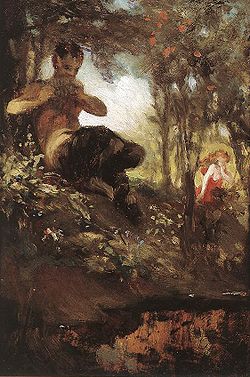
A faun, as painted by Hungarian painter Pál Szinyei Merse in 1867
A drawing of a Faun.

The faun (Latin: Faunus, pronounced [ˈfäu̯nʊs̠]; Ancient Greek: φαῦνος, romanizedphaûnos, pronounced [pʰâu̯nos]) is a half-human and half-goat mythological creature appearing in Greek and Roman mythology.

Originally fauns of Roman mythology were ghosts (genii) of rustic places, lesser versions of their chief, the god Faunus. Before their conflation with Greek satyrs, they and Faunus were represented as naked men (e.g. the Barberini Faun). Later fauns became copies of the satyrs of Greek mythology, who themselves were originally shown as part-horse rather than part-goat.

By the Renaissance, fauns were depicted as two-footed creatures with the horns, legs, and tail of a goat and the head, torso, and arms of a human; they are often depicted with pointed ears. These late-form mythological creatures borrowed their look from the satyrs, who in turn borrowed their look from the god Pan of the Greek pantheon. They were symbols of peace and fertility, and their Greek chieftain, Silenus, was a minor deity of Greek mythology.[1]

Origins

[edit]
Nymph and Faun (cast in lead) in the National Museum of Scotland, Edinburgh

Romans believed fauns stirred fear in men traveling in lonely, faraway or wild places. They were also capable of guiding men in need, as in the fable of The Satyr and the Traveller, in the title of which Latin authors substituted the word Faunus. Fauns and satyrs were originally quite different creatures: whereas late-period fauns are half-man and half-goat, satyrs originally were depicted as stocky, hairy, ugly dwarves or woodwoses, with the ears and tails of horses. Satyrs also were more woman-loving than fauns, and fauns were rather foolish where satyrs tended to be sly.

Ancient Roman mythological belief included a god named Faunus often associated with bewitched woods, and conflated with the Greek god Pan[2][3] and a goddess named Fauna who were goat people.

In art

[edit]

The Barberini Faun (located in the Glyptothek in Munich, Germany) is a Hellenistic marble statue from about 200 BCE, found in the Mausoleum of the Emperor Hadrian (the Castel Sant'Angelo) and installed at Palazzo Barberini by Cardinal Maffeo Barberini (later Pope Urban VIII). Gian Lorenzo Bernini restored and refinished the statue.[4]

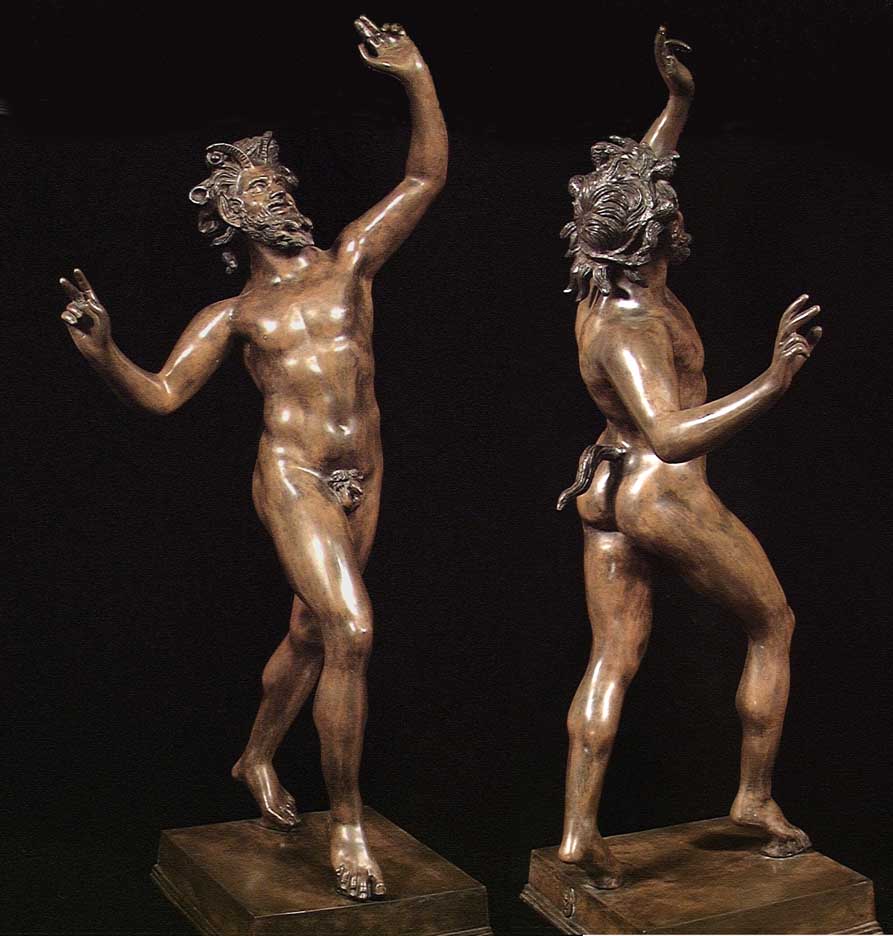
The House of the Faun in Pompei, dating from the 2nd century BCE, was so named because of the dancing faun statue that was the centerpiece of the large garden. The original now resides in the National Museum in Naples and a copy stands in its place.[5]

The French symbolist Stéphane Mallarmé's well-known masterpiece L'après-midi d'un faune (published in 1876) describes the sensual experiences of a faun who has just woken up from his afternoon sleep and discusses his encounters with several nymphs during the morning in a dreamlike monologue.[6] The composer Claude Debussy based his symphonic poem Prélude à l'après-midi d'un faune (1894) [7] on the poem, which also served as the scenario for a ballet entitled L'après-midi d'un faune (or Afternoon of a Faun) choreographed to Debussy's score in 1912 by Vaslav Nijinsky.

In fiction

[edit]
Faun (satyr) of Praxiteles in the Capitoline Museum, Rome

See also

[edit]

References

[edit]
Revisions and contributorsEdit on WikipediaRead on Wikipedia
from Grokipedia
A faun is a class of rustic deities in Roman mythology, typically depicted as half-human and half-goat creatures possessing a man's upper body combined with a goat's horns, pointed ears, legs, hooves, and tail.[1] These beings embody the wild, untamed aspects of nature and are renowned for their lustful and playful dispositions, often portrayed as companions to the god Bacchus (the Roman equivalent of Dionysus).[2] Fauns served as fertility spirits and guardians of woodlands, flocks, and fields, symbolizing the vitality and unpredictability of rural life. The term "faun" derives from Faunus, the name of an ancient Italic god of forests, plains, and herds, whose plural form Fauni referred to this group of lesser divinities; over time, the word evolved in English from late Middle English usage.[1] In artistic representations, such as Hellenistic and Roman sculptures like the Barberini Faun—a renowned marble statue discovered in Rome—fauns are often shown in dynamic, erotic poses that highlight their sensual and inebriated revelry, underscoring their association with wine, music, and pursuit of nymphs.[3] Closely akin to the Greek satyrs, fauns differ in Roman lore by emphasizing pastoral guardianship rather than purely chaotic wilderness, though the two concepts frequently merged in later Greco-Roman culture.

Definition and Characteristics

Physical Appearance

In ancient Roman literature, fauns are consistently portrayed as humanoid creatures possessing the upper body of a man and the lower body of a goat, blending human and caprine features to evoke their rustic, woodland nature. This hybrid form includes a human torso and arms, transitioning at the waist into goat-like legs ending in cloven hooves, which enable swift navigation through forested terrains.[4] Authors such as Horace describe them with "goat's feet" (pedes... caprini), emphasizing the anatomical fusion that distinguishes fauns from fully human figures. Key appendages further define their appearance: fauns bear horns protruding from the forehead, often depicted as prominent and curving backward, alongside pointed, animalistic ears and a short, goat-like tail. Ovid, in his Metamorphoses, groups fauns among rustic deities with such features, implying their horned heads and tailed forms as standard in divine retinues.[5] These elements, including the bristly hair covering their lower limbs, underscore a wild, untamed aesthetic, with the horns varying in shape—sometimes straight and lyre-like, other times more spiraled—across poetic references. Virgil evokes this in the Eclogues, where fauns participate in dances, their horned silhouettes blending with the pastoral landscape.[6] Variations in faun depictions appear in the extent of fur coverage and horn morphology, reflecting regional or authorial emphases on their feral qualities. While some accounts, like those in Horace's Odes, highlight fuller pelage on the legs for a more beastly aspect, others minimize it to accentuate the humanoid upper form. The cloven hooves and agile, sinewy goat legs are recurrent, symbolizing their affinity for mountainous and sylvan environments, as noted in Ovid's Fasti where fauns inhabit wooded groves. This physicality occasionally ties to playful woodland pursuits, though their form primarily serves to embody nature's dual spirit of humanity and animality.[4]

Behavioral Traits and Symbolism

Fauns in Roman mythology were characterized by their mischievous and lustful dispositions, often portrayed as rustic spirits indulging in wild revelries amid the woodlands and fields. They served as companions to the gods Dionysus (Bacchus) and Pan (Faunus in Roman tradition), joining in ecstatic dances, heavy drinking, and pursuits of nymphs, reflecting their hedonistic and impulsive nature. This behavior underscored their role as fertility daimones, whose antics promoted the vitality of the natural world.[4][7] A key aspect of faun behavior was their deep affinity for music and nature, frequently depicted playing the panpipes—also known as syrinx—in woodland settings to accompany dances and summon companions. These musical pursuits not only highlighted their joyful, playful side but also served to invoke the rhythms of the wild, blending harmony with chaos during nocturnal gatherings. In myths, such as those involving Dionysian processions, fauns led these revelries, embodying unrestrained merriment that bordered on disorder.[4] Symbolically, fauns represented the untamed wilderness and the primal, instinctual facets of human nature, contrasting Roman ideals of order and civility. As embodiments of fertility, they symbolized the generative power of the earth, ensuring bountiful harvests and livestock through their protective presence in rural landscapes. They also evoked the dual forces of nature's benevolence and ferocity, guarding sacred groves while warning travelers of perils in remote areas. For instance, in Virgil's Aeneid, fauns inhabit the prophetic woods of Faunus, illustrating their role as ancient guardians of Italic wilds and oracles of fate.[4][8]

Mythological Origins

Role in Roman Mythology

In Roman mythology, Faunus served as the chief deity associated with fauns, embodying the protective spirit of the countryside as a god of forests, plains, fields, and wildlife. He was revered for safeguarding agriculture and livestock, ensuring the fertility of crops and herds through his epithet Inuus, which denoted his role in making cattle prolific. As a prophetic figure, known as Fatuus, Faunus delivered oracles, particularly through dream incubation at sacred sites like the grove of Tibur near the well of Albunea, as prominently featured in Virgil's Aeneid; however, this portrayal is considered by scholars to be largely an Augustan literary construct with limited pre-Imperial evidence.[9] The festivals traditionally honoring Faunus have been subject to scholarly debate. The Lupercalia, observed on February 15, has been linked to him in ancient sources like Ovid's Fasti, involving young priests called Luperci who ran naked through the streets of Rome, striking women with goatskin thongs to promote fertility and avert evil; however, this association is considered weak and disputed by modern scholarship, tied more broadly to themes of purification and the wild rather than definitively to Faunus. Another purported celebration, the Faunalia on December 5, is mentioned in literature such as Horace's Odes and Ovid's Fasti as focusing on his patronage of shepherds and flocks, with offerings of cakes and wine in rural settings to invoke bountiful harvests, though its existence as a formal festival lacks calendar evidence and remains questionable. These events, where attested, highlighted Faunus's integration into Italic religious practices, though some aspects may reflect later literary enhancements predating or blending with Greek influences, emphasizing his role in agrarian prosperity and communal well-being.[9] Fauns, as lesser woodland spirits, functioned as attendants to Faunus, populating the wild landscapes and participating in rural cults where they embodied the untamed forces of nature. They were invoked in oracular contexts, delivering cryptic prophecies or warnings to travelers in remote areas, often through eerie sounds or visions that instilled both fear and guidance, with roots in Republican literature predating the more developed figure of Faunus. In these cults, fauns supported Faunus's prophetic authority, appearing in sacred groves to relay divine messages during rituals.[9] Prominent myths further illustrated Faunus's narrative significance. In Virgil's Aeneid, Faunus prophesies to King Latinus, his son, that his daughter Lavinia must wed a foreign groom to secure the future of their lineage, an oracle that foreshadows Aeneas's arrival and the eventual founding of Rome through Trojan-Italic union. Another tale, recounted by Ovid in the Fasti, depicts Faunus's ill-fated encounter with Hercules: mistaking the hero—disguised in Queen Omphale's attire—for the queen herself during a night in a cave, Faunus attempts an assault but is repelled and beaten by the awakened Hercules, an episode explaining the nudity of Lupercalia participants to avoid such deceptions. These stories positioned Faunus and his faun attendants as integral to heroic and foundational Roman lore.[10]

Relation to Greek Counterparts

The concept of the faun in Roman mythology emerged as a native rustic deity associated with the god Faunus, whose name derives from the Latin Faunus, likely rooted in an Indo-European term for "favored" or "propitious," reflecting his role as a benevolent pastoral spirit.[11] However, fauns conceptually evolved through Greek influences, where early Roman contact with Hellenic myths led to the assimilation of satyrs—Greek woodland fertility spirits known from the term sátyros, of uncertain etymology but possibly linked to notions of "hairiness" or "saturation" in revelry—into the Roman pantheon, particularly during the Republic's expansion into Greek territories from the 3rd century BCE onward, facilitating a broader Hellenization of Roman religion and mythology.[12] This syncretism transformed the originally indigenous fauns, who embodied prophetic and agrarian benevolence, into figures bearing closer resemblance to their Greek counterparts while retaining distinct Roman characteristics.[4] Key distinctions between fauns and satyrs highlight cultural divergences: Greek satyrs, as companions of Dionysus, were depicted as chaotic, lecherous, and perpetually inebriated beings symbolizing untamed wilderness and ecstatic revelry, often portrayed in ancient vase paintings and texts like those of Euripides as pursuing nymphs with unrestrained passion.[13] In contrast, Roman fauns maintained a more orderly and pastoral nature, tied intrinsically to Faunus as oracular guides for shepherds and farmers, emphasizing fertility of the fields over Dionysian excess, as noted in Virgil's Georgics where they appear as protective rural entities rather than disruptive forces.[4] While both shared hybrid traits such as goat-like legs and horns, symbolizing their liminal connection to nature, satyrs originally featured equine elements in Archaic Greek art before shifting to caprine forms under Roman influence.[12] This cultural exchange extended to theater, where Greek satyr plays—humorous interludes following tragedies at Dionysian festivals, as described by Aristotle in the Poetics—influenced Roman comedic forms like the fabula Atellana, rustic farces featuring masked stock characters akin to satyrs in their bawdy, countryside antics.[14] By the Imperial period, the boundaries blurred further, with fauns and satyrs often conflated in literature and art, as seen in Ovid's Metamorphoses, underscoring Rome's adaptive synthesis of Greek vitality with indigenous tradition.[4]

Artistic Depictions

In Ancient Art

In ancient Greco-Roman art, fauns—often interchangeable with satyrs in visual representations—were frequently depicted as hybrid creatures embodying rustic vitality and Dionysian revelry. These figures appeared across various media, including vase paintings, frescoes, mosaics, and sculptures, reflecting their mythological roles as woodland spirits and companions to the god Bacchus. Early influences from Greek satyr imagery shaped Roman faun iconography, with artists emphasizing themes of dance, pursuit, and inebriation to convey untamed nature.[15] Vase paintings, primarily from Greek workshops but adopted in Roman contexts, often portrayed fauns in dynamic processions or pursuits of nymphs, highlighting their playful yet predatory nature. For instance, Attic red-figure lekythoi from the 5th century BCE show fauns with erect phalluses chasing nymphs amid floral motifs, underscoring fertility and eroticism. In Roman adaptations, such scenes transitioned to wall paintings and mosaics, as seen in Pompeian frescoes from the 1st century CE, where fauns dance sensually with nymphs during Bacchic processions, their goat legs and tails contrasting with graceful human forms. A notable example is the erotic mosaic of a satyr and nymph from the House of the Faun in Pompeii, depicting the pair in an intimate embrace that evokes mythological pursuits.[16] Sculptures provided three-dimensional expressions of faun vitality, with bronze and marble works capturing motion and emotion. The Dancing Faun from the House of the Faun in Pompeii, a Roman bronze copy of a 2nd-century BCE Greek original, shows a faun mid-leap on tiptoe, arms raised in ecstasy, embodying uninhibited joy without additional attributes. Similarly, the Barberini Faun, a Hellenistic marble statue circa 220 BCE, depicts a reclining faun in drunken repose, draped in leopard skin with pointed ears and a tail, his twisted torso revealing anatomical tension and vulnerability. These statues, often placed in domestic atria, served as focal points for evoking mythological ambiance.[2][15] Iconographic elements consistently marked fauns as nature deities, including goat horns, hooves, and tails symbolizing wildness, alongside accessories tied to Bacchic rites. Wreaths of ivy or pine adorned their heads, signifying revelry and eternal life, while panpipes (syrinx) in their hands evoked pastoral music. The thyrsus—a fennel staff topped with a pine cone and wrapped in ivy—appeared in some depictions, linking fauns to Dionysian processions and fertility. Regional variations emerged through Etruscan influences on early Roman art, where faun-like satyrs featured on temple antefixes and bronzes with exaggerated features like equine ears and beards, blending local daemon figures with Greek imports to inform Roman sculptural styles.[4][17]

In Renaissance and Modern Art

During the Renaissance, artists revived classical mythological motifs, including fauns, to evoke pastoral idylls and sensual harmony with nature, often drawing from ancient prototypes while infusing humanistic vitality. Gian Lorenzo Bernini's marble sculpture Bacchanal: A Faun Teased by Children (ca. 1616–17), created in collaboration with his father Pietro, depicts a drunken faun playfully grappling with putti over grapes, challenging antique conventions through dynamic, intertwined forms that blend humor and eroticism.[18] Similarly, Titian's Nymph and Faun (ca. 1570), attributed to his studio, portrays a nude nymph embracing a kneeling faun against a Venetian landscape, symbolizing erotic pastoral bliss inspired by ancient poets like Theocritus and reflecting the era's fascination with classical sensuality in private collections.[19] In the 19th and early 20th centuries, faun imagery evolved within Art Nouveau, where organic, flowing lines emphasized nature's wild allure and symbolic fertility. At the Museum of Applied Arts in Budapest, a ceramic vase (ca. 1900) features a dynamic faun entwined with floral motifs, its naturalistic pose aligning with the style's excessive curves to represent untamed vitality and harmony between human and natural forms.[20] This romanticized portrayal shifted fauns from overt eroticism toward emblematic expressions of wilderness and instinct. By the modern era, particularly in Pablo Picasso's works, fauns became abstracted symbols of primal freedom and mythological subversion, departing from realistic anatomy to explore psychological and formal innovation. In his etching Le Faune (The Faun) (1958), Picasso renders a tousled, wild-haired faun with urgent, cubist-inspired strokes, evoking untamed liberty amid his broader engagement with Greek myths in ceramics and prints.[21] Similarly, Faun Musician No. 5 (1948) at the Art Institute of Chicago distorts the figure into angular, playful forms, transforming the faun into a modernist icon of creative spontaneity and escape from convention.[22] Overall, faun depictions transitioned from Renaissance sensuality to modern symbolism, increasingly embodying liberation and the raw spirit of nature over literal eroticism.

Literary and Fictional Representations

In Classical Literature

In Virgil's Aeneid, fauns appear as indigenous woodland deities inhabiting the ancient groves of Latium, coexisting with nymphs in a pastoral setting that underscores the rustic origins of Roman lands.[23] Specifically, in Book 8, Virgil describes the site of Pallanteum as once held by "indigenous fauns and nymphs," emphasizing their role in the untamed, pre-civilized landscape before Evander's settlement.[24] Faunus, the chief faun and prophetic god, further embodies this pastoral and oracular dimension; as the father of King Latinus, he delivers a divine oracle in Book 7, instructing Latinus to wed his daughter Lavinia to a foreign prince destined to found a great lineage, thus foretelling Aeneas's arrival and the founding of Rome.[25] Ovid's Metamorphoses portrays fauns as part of the sylvan pantheon, wild spirits and rustic gods subordinate to Jupiter's cosmic rule, highlighting their place in the natural order amid transformations of the world. In Book 1, during Jupiter's assembly of the gods, he claims dominion over "demigods, wild spirits, nymphs, fauns and satyrs, and sylvan deities of the hills," positioning fauns as eternal inhabitants of wooded realms untouched by human civilization.[26] This depiction reinforces their symbolic ties to untamed fertility and the primal wilderness, often in prophetic or advisory contexts akin to Faunus's oracular interventions. Horace's Odes evoke fauns in idyllic rustic scenes, celebrating their protective presence in the countryside through hymnic invocations that blend pastoral tranquility with seasonal rituals. In Ode 3.18, addressed directly to Faunus as "lover of the flying nymphs," the poet offers an annual sacrifice of a lamb or kid during the Lupercalia festival, beseeching the god to benignly traverse his Sabine farm and safeguard flocks, kids, and tender lambs from harm, thus idealizing Faunus as a benevolent guardian of rural life.[27] Similar rustic motifs appear in Ode 1.17, where Faunus's influence enhances the serene, shadowed groves near the Bandusian spring, evoking a harmonious idyll of nature's bounty.[28] Roman drama adapted Greek satyr play elements into comedic forms, incorporating faun-like figures for bawdy, processional interludes that echoed the rustic antics of their Greek counterparts, though Plautus's surviving works primarily feature human characters in palliatae comedies with occasional mythological allusions rather than direct faun choruses.

In Modern Fiction and Media

In 20th-century fantasy literature, fauns transitioned from their classical associations with rustic mischief toward more nuanced, often sympathetic portrayals that emphasized themes of hospitality and moral complexity. A prominent example is Mr. Tumnus in C.S. Lewis's The Lion, the Witch and the Wardrobe (1950), where the faun initially attempts to betray the young protagonist Lucy Pevensie under duress from the White Witch but ultimately aids her, embodying a struggle between fear and loyalty. This depiction draws on faun mythology to illustrate self-control over base impulses, contrasting with more unrestrained satyric figures in Lewis's broader oeuvre.[29] Guillermo del Toro's 2006 film Pan's Labyrinth features a enigmatic faun who serves as a guide and taskmaster to the child protagonist Ofelia in a fantastical realm paralleling the horrors of post-Civil War Spain. The faun, portrayed as ancient and morally ambiguous, tests Ofelia's innocence through perilous quests, blending benevolence with deception to underscore themes of sacrifice and rebellion against tyranny. This character reimagines the faun as a liminal figure bridging reality and myth, evoking both wonder and dread in a dark fairy-tale narrative.[30][31] In video games and role-playing media, fauns appear as playable or allied characters, often highlighting agility, nature affinity, and playful curiosity. In the Spyro series, Elora the faun in Spyro 2: Ripto's Rage! (1999) acts as a scholarly ally to the dragon protagonist, using her knowledge of Avalar to orchestrate resistance against the villain Ripto, portraying fauns as clever strategists integrated into diverse fantasy societies. Similarly, in Dungeons & Dragons (particularly in 5th edition sourcebooks), fauns—interchangeable with satyrs in some settings like the Forgotten Realms—are depicted as fey creatures reveling in music and revelry while serving as guides or combatants, with racial traits emphasizing charisma and woodland survival.[32][33] This shift in 20th- and 21st-century depictions reflects a broader evolution in fantasy media, where fauns evolve from predominantly villainous or instinct-driven antagonists in earlier myths to multifaceted allies or antiheroes, often symbolizing harmony between human and natural worlds amid modern conflicts. Academic analyses note how authors like Lewis layered classical faun imagery with Christian allegory to humanize these beings, fostering empathy in readers and viewers.[34]

Cultural Legacy

Symbolism and Interpretations

In ancient Roman mythology, fauns embodied the duality of human and animal natures, representing the tension between civilized rationality and primal wilderness. As rustic spirits linked to the god Faunus, they symbolized fertility and the nurturing aspects of the natural world, often invoked for agricultural abundance and the fruitfulness of fields and flocks. This hybrid form—upper body human, lower body goat—highlighted nature's ambivalent essence, blending joyful celebration with unpredictable danger, as fauns were believed to inspire both fear in remote wilds and protective guardianship over rural life.[35][36] In modern psychological interpretations, fauns have been analyzed through Freudian and Jungian lenses as manifestations of the unconscious. Freudian theory views the faun as a potent symbol of the id, embodying raw, instinctual drives—particularly sexual urges—that reside beneath the veneer of societal restraint. This perspective aligns with the faun's mythological lustfulness, interpreting it as an eruption of repressed desires demanding acknowledgment. Complementing this, Jungian archetypes frame the faun as an embodiment of the "wild self" or shadow, the untamed, instinctual aspects of the psyche that integrate the repressed animalistic elements into wholeness; akin to the wild man archetype, it urges confrontation with one's primal vitality to achieve psychological balance.[37][38][39] The symbolism of fauns in gender and sexuality has evolved from pagan associations with unbridled lust to contemporary queer iconography. In their original context, fauns represented virile, hedonistic masculinity tied to Dionysian revelry, evoking fertility through overt sexual pursuit of nymphs and embodying pagan eroticism as a celebration of life's generative forces. Over time, this imagery has been reinterpreted in queer theory as a disruptive emblem of non-normative desire, with fauns and related figures like satyrs serving as codes for fluid gender expression and same-sex attraction, notably through artistic performances that subvert heteronormative boundaries.[35][40][41]

Influence on Contemporary Culture

Sociologist Douglas Ezzy documented a controversial pagan festival in rural Australia (pseudonym: Faunalia) that ran from 2000 to 2009, attracting around 80 participants for five-day rituals emphasizing embodied experiences, eroticism, and confrontation with mortality, often held in natural settings to honor themes of fertility and the wild.[42] This event integrated faun-inspired elements through its namesake and focus on sensual, nature-connected practices, fostering community bonds and personal transformation, and has influenced studies of modern paganism.[42] Faun costumes remain popular in secular festivals worldwide, including Renaissance fairs, Halloween celebrations, and Carnival events, where participants don horned masks, goat legs, and rustic attire to embody playful woodland spirits.[43] These outfits, often handmade with fur and antlers, appear in cosplay communities and commercial offerings from sites like Etsy, reflecting fauns' enduring appeal as symbols of revelry and escapism in festive contexts.[44] Neopagan and Wiccan traditions incorporate faun imagery into rituals for nature worship, drawing on their association with forest deities like Faunus and Pan to invoke fertility, raw elemental energy, and harmony with the earth.[45] In practices such as Faery Faith—a branch of contemporary paganism—faun-like beings represent nature spirits central to earth-centered ceremonies, promoting ecological reverence and seasonal cycles through dance, music, and offerings in woodland groves.[45] Globally, fauns influence advertising, extending their mythological roots into everyday expressions of wildness and sustainability. Coca-Cola's 2021 ads depict satyr-like figures in fantastical scenarios to promote refreshment and adventure, blending ancient motifs with modern consumer appeal.[46]

References

User Avatar
No comments yet.