Hubbry Logo
search
logo

Field extension

logo
Community Hub0 Subscribers
Read side by side
from Wikipedia

In mathematics, particularly in algebra, a field extension is a pair of fields , such that the operations of K are those of L restricted to K. In this case, L is an extension field of K and K is a subfield of L.[1][2][3] For example, under the usual notions of addition and multiplication, the complex numbers are an extension field of the real numbers; the real numbers are a subfield of the complex numbers.

Field extensions are fundamental in algebraic number theory, and in the study of polynomial roots through Galois theory, and are widely used in algebraic geometry.

Subfield

[edit]

A subfield of a field is a subset that is a field with respect to the field operations inherited from . Equivalently, a subfield is a subset that contains the multiplicative identity , and is closed under the operations of addition, subtraction, multiplication, and taking the inverse of a nonzero element of .

As 1 – 1 = 0, the latter definition implies and have the same zero element.

For example, the field of rational numbers is a subfield of the real numbers, which is itself a subfield of the complex numbers. More generally, the field of rational numbers is (or is isomorphic to) a subfield of any field of characteristic .

The characteristic of a subfield is the same as the characteristic of the larger field.

Extension field

[edit]

If is a subfield of , then is an extension field or simply extension of , and this pair of fields is a field extension. Such a field extension is denoted (read as " over ").

If is an extension of , which is in turn an extension of , then is said to be an intermediate field (or intermediate extension or subextension) of .

Given a field extension , the larger field is a -vector space. The dimension of this vector space is called the degree of the extension and is denoted by .

The degree of an extension is 1 if and only if the two fields are equal. In this case, the extension is a trivial extension. Extensions of degree 2 and 3 are called quadratic extensions and cubic extensions, respectively. A finite extension is an extension that has a finite degree.

Given two extensions and , the extension is finite if and only if both and are finite. In this case, one has

Given a field extension and a subset of , there is a smallest subfield of that contains and . It is the intersection of all subfields of that contain and , and is denoted by (read as " adjoin "). One says that is the field generated by over , and that is a generating set of over . When is finite, one writes instead of and one says that is finitely generated over . If consists of a single element , the extension is called a simple extension[4][5] and is called a primitive element of the extension.[6]

An extension field of the form is often said to result from the adjunction of to .[7][8]

In characteristic 0, every finite extension is a simple extension. This is the primitive element theorem, which does not hold true for fields of non-zero characteristic.

If a simple extension is not finite, the field is isomorphic to the field of rational fractions in over .

Caveats

[edit]

The notation L / K is purely formal and does not imply the formation of a quotient ring or quotient group or any other kind of division. Instead the slash expresses the word "over". In some literature the notation L:K is used.

It is often desirable to talk about field extensions in situations where the small field is not actually contained in the larger one, but is naturally embedded. For this purpose, one abstractly defines a field extension as an injective ring homomorphism between two fields. Every ring homomorphism between fields is injective because fields do not possess nontrivial proper ideals, so field extensions are precisely the morphisms in the category of fields.

Henceforth, we will suppress the injective homomorphism and assume that we are dealing with actual subfields.

Examples

[edit]

The field of complex numbers is an extension field of the field of real numbers , and in turn is an extension field of the field of rational numbers . Clearly then, is also a field extension. We have because is a basis, so the extension is finite. This is a simple extension because (the cardinality of the continuum), so this extension is infinite.

The field

is an extension field of also clearly a simple extension. The degree is 2 because can serve as a basis.

The field

is an extension field of both and of degree 2 and 4 respectively. It is also a simple extension, as one can show that


Finite extensions of are also called algebraic number fields and are important in number theory. Another extension field of the rationals, which is also important in number theory, although not a finite extension, is the field of p-adic numbers for a prime number p.

It is common to construct an extension field of a given field K as a quotient ring of the polynomial ring K[X] in order to "create" a root for a given polynomial f(X). Suppose for instance that K does not contain any element x with x2 = −1. Then the polynomial is irreducible in K[X], consequently the ideal generated by this polynomial is maximal, and is an extension field of K which does contain an element whose square is −1 (namely the residue class of X).

By iterating the above construction, one can construct a splitting field of any polynomial from K[X]. This is an extension field L of K in which the given polynomial splits into a product of linear factors.

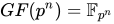
If p is any prime number and n is a positive integer, there is a unique (up to isomorphism) finite field with pn elements; this is an extension field of the prime field with p elements.

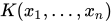
Given a field K, we can consider the field K(X) of all rational functions in the variable X with coefficients in K; the elements of K(X) are fractions of two polynomials over K, and indeed K(X) is the field of fractions of the polynomial ring K[X]. This field of rational functions is an extension field of K. This extension is infinite.

Given a Riemann surface M, the set of all meromorphic functions defined on M is a field, denoted by It is a transcendental extension field of if we identify every complex number with the corresponding constant function defined on M. More generally, given an algebraic variety V over some field K, the function field K(V), consisting of the rational functions defined on V, is an extension field of K.

Algebraic extension

[edit]

An element x of a field extension is algebraic over K if it is a root of a nonzero polynomial with coefficients in K. For example, is algebraic over the rational numbers, because it is a root of If an element x of L is algebraic over K, the monic polynomial of lowest degree that has x as a root is called the minimal polynomial of x. This minimal polynomial is irreducible over K.

An element s of L is algebraic over K if and only if the simple extension K(s) /K is a finite extension. In this case the degree of the extension equals the degree of the minimal polynomial, and a basis of the K-vector space K(s) consists of where d is the degree of the minimal polynomial.

The set of the elements of L that are algebraic over K form a subextension, which is called the algebraic closure of K in L. This results from the preceding characterization: if s and t are algebraic, the extensions K(s) /K and K(s)(t) /K(s) are finite. Thus K(s, t) /K is also finite, as well as the sub extensions K(s ± t) /K, K(st) /K and K(1/s) /K (if s ≠ 0). It follows that s ± t, st and 1/s are all algebraic.

An algebraic extension is an extension such that every element of L is algebraic over K. Equivalently, an algebraic extension is an extension that is generated by algebraic elements. For example, is an algebraic extension of , because and are algebraic over

A simple extension is algebraic if and only if it is finite. This implies that an extension is algebraic if and only if it is the union of its finite subextensions, and that every finite extension is algebraic.

Every field K has an algebraic closure, which is up to an isomorphism the largest extension field of K which is algebraic over K, and also the smallest extension field such that every polynomial with coefficients in K has a root in it. For example, is an algebraic closure of , but not an algebraic closure of , as it is not algebraic over (for example π is not algebraic over ).

Transcendental extension

[edit]

Given a field extension , a subset S of L is called algebraically independent over K if no non-trivial polynomial relation with coefficients in K exists among the elements of S. The largest cardinality of an algebraically independent set is called the transcendence degree of L/K. It is always possible to find a set S, algebraically independent over K, such that L/K(S) is algebraic. Such a set S is called a transcendence basis of L/K. All transcendence bases have the same cardinality, equal to the transcendence degree of the extension. An extension is said to be purely transcendental if and only if there exists a transcendence basis S of such that L = K(S). Such an extension has the property that all elements of L except those of K are transcendental over K, but, however, there are extensions with this property which are not purely transcendental—a class of such extensions take the form L/K where both L and K are algebraically closed.

If L/K is purely transcendental and S is a transcendence basis of the extension, it doesn't necessarily follow that L = K(S). On the opposite, even when one knows a transcendence basis, it may be difficult to decide whether the extension is purely separable, and if it is so, it may be difficult to find a transcendence basis S such that L = K(S).

For example, consider the extension where is transcendental over and is a root of the equation Such an extension can be defined as in which and are the equivalence classes of and Obviously, the singleton set is transcendental over and the extension is algebraic; hence is a transcendence basis that does not generate the extension . Similarly, is a transcendence basis that does not generates the whole extension. However the extension is purely transcendental since, if one set one has and and thus generates the whole extension.

Purely transcendental extensions of an algebraically closed field occur as function fields of rational varieties. The problem of finding a rational parametrization of a rational variety is equivalent with the problem of finding a transcendence basis that generates the whole extension.

Normal, separable and Galois extensions

[edit]

An algebraic extension is called normal if every irreducible polynomial in K[X] that has a root in L completely factors into linear factors over L. Every algebraic extension F/K admits a normal closure L, which is an extension field of F such that is normal and which is minimal with this property.

An algebraic extension is called separable if the minimal polynomial of every element of L over K is separable, i.e., has no repeated roots in an algebraic closure over K. A Galois extension is a field extension that is both normal and separable.

A consequence of the primitive element theorem states that every finite separable extension has a primitive element (i.e. is simple).

Given any field extension , we can consider its automorphism group , consisting of all field automorphisms α: LL with α(x) = x for all x in K. When the extension is Galois this automorphism group is called the Galois group of the extension. Extensions whose Galois group is abelian are called abelian extensions.

For a given field extension , one is often interested in the intermediate fields F (subfields of L that contain K). The significance of Galois extensions and Galois groups is that they allow a complete description of the intermediate fields: there is a bijection between the intermediate fields and the subgroups of the Galois group, described by the fundamental theorem of Galois theory.

Generalizations

[edit]

Field extensions can be generalized to ring extensions which consist of a ring and one of its subrings. A closer non-commutative analog are central simple algebras (CSAs) – ring extensions over a field, which are simple algebra (no non-trivial 2-sided ideals, just as for a field) and where the center of the ring is exactly the field. For example, the only finite field extension of the real numbers is the complex numbers, while the quaternions are a central simple algebra over the reals, and all CSAs over the reals are Brauer equivalent to the reals or the quaternions. CSAs can be further generalized to Azumaya algebras, where the base field is replaced by a commutative local ring.

Extension of scalars

[edit]

Given a field extension, one can "extend scalars" on associated algebraic objects. For example, given a real vector space, one can produce a complex vector space via complexification. In addition to vector spaces, one can perform extension of scalars for associative algebras defined over the field, such as polynomials or group algebras and the associated group representations. Extension of scalars of polynomials is often used implicitly, by just considering the coefficients as being elements of a larger field, but may also be considered more formally. Extension of scalars has numerous applications, as discussed in extension of scalars: applications.

See also

[edit]

Notes

[edit]

References

[edit]
[edit]
Revisions and contributorsEdit on WikipediaRead on Wikipedia
from Grokipedia
In abstract algebra, a field extension consists of a base field KK and a larger field LL such that KK is a subfield of LL, allowing LL to be viewed as a vector space over KK.[1][2] The dimension of this vector space, denoted [L:K][L:K], is called the degree of the extension and measures its "size" relative to KK; extensions with finite degree are termed finite extensions.[3][4] Elements αL\alpha \in L are classified as algebraic over KK if they satisfy a nonzero polynomial equation with coefficients in K[x]K[x], or transcendental otherwise; an extension L/KL/K is algebraic if every element of LL is algebraic over KK, and transcendental if it contains at least one transcendental element.[1][2] All finite extensions are algebraic, but infinite algebraic extensions exist, such as the field of all algebraic numbers over the rationals Q\mathbb{Q}.[3] Simple extensions, generated by adjoining a single element α\alpha to KK to form K(α)K(\alpha), have degree equal to the degree of the minimal polynomial of α\alpha over KK when α\alpha is algebraic.[2][4] Field extensions underpin key results in algebra, including the existence of splitting fields for polynomials—minimal extensions where a given polynomial factors completely into linear terms—and tower laws for degrees in chains of extensions, where [L:K]=[L:F][F:K][L:K] = [L:F] \cdot [F:K] for intermediate fields.[1] They are central to Galois theory, which studies the symmetries of extensions via Galois groups to determine solvability of polynomials by radicals, as in classical problems like angle trisection or cube duplication.[3][4] Examples include Q(2)/Q\mathbb{Q}(\sqrt{2})/\mathbb{Q} (degree 2, algebraic) and R/Q\mathbb{R}/\mathbb{Q} (infinite degree, transcendental elements like π\pi).[2]

Definitions and Basic Terminology

Field extensions

A field extension is formally defined as a pair of fields LL and KK, denoted L/KL/K, where KK is a subfield of LL.[5] In this setup, LL contains an isomorphic copy of KK via an injective field homomorphism, ensuring that the algebraic structure of KK is preserved within LL.[3] Common notation for such extensions includes LKL \supseteq K or KLK \subseteq L, with the embedding ι:KL\iota: K \to L typically taken as the identity map when KK is literally a subset of LL.[5] This embedding guarantees that the addition and multiplication operations in LL restrict exactly to those in KK, maintaining compatibility between the fields.[3] As a basic property, LL forms a left vector space over KK, where scalar multiplication is defined using the multiplication in LL.[5] The operations of addition and multiplication in LL thus extend those of KK naturally, allowing elements of KK to act as scalars on elements of LL. It is important to distinguish a field extension from a mere set inclusion: not every superset of a field qualifies as an extension unless equipped with an embedding that aligns the field operations precisely.[3] Without this embedding, the structure may fail to preserve the field axioms or compatibility. The concept of field extensions was introduced by Leopold Kronecker in the 19th century, primarily in the context of algebraic number theory, to study rings of algebraic integers within larger fields.[6]

Subfields

A subfield of a field $ K $ is a subset $ F \subseteq K $ that forms a field under the addition and multiplication operations induced from $ K $.[7] Equivalently, a subfield is a subring of $ K $ that is itself a field, meaning it contains the multiplicative identity of $ K $ and every nonzero element of the subring has a multiplicative inverse within the subring.[7] Subfields satisfy closure properties inherent to fields: they are closed under addition and multiplication, contain the additive identity 0 and the multiplicative identity 1 of $ K $, and are closed under additive inverses.[8] Additionally, for every nonzero element $ a \in F $, the multiplicative inverse $ a^{-1} $ lies in $ F $.[8] These properties ensure that the subfield operations align perfectly with those of the ambient field $ K $. The prime subfield of $ K $ is the smallest subfield of $ K $, defined as the intersection of all subfields of $ K $.[9] This prime subfield is unique and isomorphic to $ \mathbb{Q} $ when the characteristic of $ K $ is 0, or to the prime field $ \mathbb{F}_p $ when the characteristic of $ K $ is a prime $ p $.[10] Every subfield of $ K $ contains the prime subfield, and subfields of $ K $ correspond precisely to the subrings of $ K $ that are fields under the induced operations.[7] Intermediate fields arise as subfields strictly between the prime subfield and $ K $, forming chains such as $ P \subset F_1 \subset F_2 \subset \cdots \subset K $, where $ P $ denotes the prime subfield.[11] The collection of all subfields of $ K $, ordered by inclusion, constitutes a partially ordered set with the prime subfield as the least element and $ K $ as the greatest.[12]

Degree of a field extension

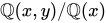
In field theory, given a field extension L/KL/K where KK is a subfield of LL, the degree of the extension, denoted [L:K][L : K], is defined as the dimension of LL considered as a vector space over KK.[13] This dimension measures the "size" of the extension in a linear algebraic sense. Every field extension L/KL/K admits a Hamel basis, which is a linearly independent set over KK that spans LL as a KK-vector space; the existence of such a basis relies on the axiom of choice.[14] The extension is finite if this basis has finite cardinality nn, in which case [L:K]=n[L : K] = n, a positive integer; otherwise, the degree is infinite.[13] Notably, [L:K]=1[L : K] = 1 if and only if L=KL = K.[13] For infinite-degree extensions, the cardinality of a Hamel basis can vary; for instance, the extension Q(x)/Q\mathbb{Q}(x)/\mathbb{Q} of rational functions has countably infinite degree, while R/Q\mathbb{R}/\mathbb{Q} requires an uncountable basis of cardinality equal to the continuum.[13] In transcendental extensions, the vector space dimension is infinite, and the transcendence degree—defined as the cardinality of a maximal algebraically independent subset over KK—provides a measure of the "transcendental part" of the extension, often aligning with the structure of purely transcendental cases like rational function fields.[15]

Properties of Field Extensions

Simple extensions

A field extension L/KL/K is called a simple extension if there exists some αL\alpha \in L such that L=K(α)L = K(\alpha), meaning LL is generated by adjoining a single element α\alpha to KK.[16] This element α\alpha is known as a primitive element for the extension L/KL/K.[17] The elements of a simple extension K(α)K(\alpha) can be expressed as rational functions in α\alpha with coefficients in KK, specifically of the form p(α)/q(α)p(\alpha)/q(\alpha), where p(x)p(x) and q(x)q(x) are polynomials in K[x]K[x] and q(α)0q(\alpha) \neq 0.[17] If α\alpha is algebraic over KK, then the elements are precisely the linear combinations i=0n1ciαi\sum_{i=0}^{n-1} c_i \alpha^i with ciKc_i \in K, where nn is the degree of the minimal polynomial of α\alpha over KK.[18] The primitive element theorem states that every finite separable extension L/KL/K is simple, i.e., L=K(α)L = K(\alpha) for some αL\alpha \in L.[16] The proof relies on the linear independence of certain conjugates of the generators, allowing the construction of a primitive element as a suitable linear combination that avoids finitely many "bad" values which would cause dependencies.[18] In particular, all finite extensions in characteristic zero are simple, as separability holds automatically there.[16] Not all finite extensions are simple; for instance, the extension Fp(X,Y)/Fp(Xp,Yp)\mathbb{F}_p(X,Y)/\mathbb{F}_p(X^p, Y^p) has degree p2p^2 but requires at least two generators and admits no primitive element.[17] Infinite extensions can also be simple, such as the transcendental extension Q(π)/Q\mathbb{Q}(\pi)/\mathbb{Q}.[16] For a simple finite extension L=K(α)L = K(\alpha), the degree [L:K][L:K] equals the degree of the minimal polynomial of α\alpha over KK.[18] This follows from the fact that {1,α,,αn1}\{1, \alpha, \dots, \alpha^{n-1}\} forms a basis for LL as a vector space over KK, where n=[L:K]n = [L:K].[17]

Tower law for degrees

The tower law, also known as the multiplicativity of degrees, states that for a tower of field extensions KMLK \subseteq M \subseteq L, the degree of the overall extension satisfies [L:K]=[L:M][M:K][L : K] = [L : M] \cdot [M : K], provided the individual degrees are finite.[19] This relation extends multiplicatively to any finite tower of extensions by induction on the length of the chain.[19] To sketch the proof for the finite case, suppose {ui1i[M:K]}\{u_i \mid 1 \leq i \leq [M : K]\} is a basis for MM as a vector space over KK, and {vj1j[L:M]}\{v_j \mid 1 \leq j \leq [L : M]\} is a basis for LL as a vector space over MM. Then the set {uivj}\{u_i v_j\} forms a basis for LL as a vector space over KK, establishing the dimension equality [L:K]=[L:M][M:K][L : K] = [L : M] \cdot [M : K].[19] This multiplicativity arises specifically because field extensions behave as vector spaces, where dimensions multiply in towers; it does not hold in general for extensions of rings, where modules may lack unique ranks.[20] In the infinite case, if at least one of [L:M][L : M] or [M:K][M : K] is infinite, then [L:K][L : K] is also infinite, and the equality holds in the sense of cardinal multiplication of the dimensions as vector spaces.[20] The tower law facilitates degree computations in composite extensions; for instance, adjoining square roots successively yields [Q(2):Q]=2[\mathbb{Q}(\sqrt{2}) : \mathbb{Q}] = 2 and [Q(2,3):Q(2)]=2[\mathbb{Q}(\sqrt{2}, \sqrt{3}) : \mathbb{Q}(\sqrt{2})] = 2, so by the tower law, [Q(2,3):Q]=4[\mathbb{Q}(\sqrt{2}, \sqrt{3}) : \mathbb{Q}] = 4.[21]

Finite versus infinite extensions

A field extension $ L/K $ is finite if its degree $ [L : K] $ is a finite positive integer, meaning $ L $ is a finite-dimensional vector space over the base field $ K $. Every finite extension is algebraic, in the sense that every element of $ L $ satisfies a polynomial equation with coefficients in $ K $.[22] This algebraicity follows from the fact that a basis of $ L $ over $ K $ allows any element to be expressed as a linear combination, leading to a characteristic polynomial of bounded degree.[22] An extension $ L/K $ is infinite if $ [L : K] = \infty $, so $ L $ is not finite-dimensional over $ K $. Infinite extensions may be algebraic, as in the case of the algebraic numbers Q\overline{\mathbb{Q}} over the rationals Q\mathbb{Q}, or transcendental, involving elements not satisfying any polynomial over $ K $, such as R/Q\mathbb{R}/\mathbb{Q} which contains elements like π\pi.[22] Every field extension $ L/K $ possesses a transcendence basis, defined as a maximal subset of $ L $ that is algebraically independent over $ K $; the cardinality of any such basis is the transcendence degree of the extension. The transcendence degree is zero if and only if the extension is algebraic, and the extension is finite if and only if the transcendence degree is zero and the resulting algebraic extension has finite degree.[23] Infinite extensions thus allow for transcendence bases of positive cardinality, enabling the decomposition of $ L $ into a transcendental part followed by an algebraic extension. Finite extensions exhibit properties analogous to those of finite-dimensional vector spaces, such as the existence of bases, traces, norms, and determinants for $ K $-linear maps from $ L $ to itself.[22] These features do not hold for infinite extensions, where linear maps may lack such invariants. For example, the tower law states that degrees multiply in finite towers of extensions, but infinite degrees prevent similar multiplicative behavior.[22] In certain contexts, such as number fields, finite extensions $ L/\mathbb{Q} $ ensure that the integral closure of $ \mathbb{Z} $ in $ L $ is finitely generated as a $ \mathbb{Z} $-module.[24]

Illustrative Examples

Rational to algebraic number fields

A fundamental example of a finite algebraic extension is Q(2)/Q\mathbb{Q}(\sqrt{2})/\mathbb{Q}, which has degree 2.[19] The standard basis for this extension as a vector space over Q\mathbb{Q} is {1,2}\{1, \sqrt{2}\}, and the minimal polynomial of 2\sqrt{2} over Q\mathbb{Q} is x22x^2 - 2.[19] Every element in Q(2)\mathbb{Q}(\sqrt{2}) can be uniquely expressed as a+b2a + b\sqrt{2} with a,bQa, b \in \mathbb{Q}. For extensions adjoining multiple square roots, consider Q(2,3)/Q\mathbb{Q}(\sqrt{2}, \sqrt{3})/\mathbb{Q}. This has degree 4, obtained via the tower QQ(2)Q(2,3)\mathbb{Q} \subseteq \mathbb{Q}(\sqrt{2}) \subseteq \mathbb{Q}(\sqrt{2}, \sqrt{3}), where each step has degree 2.[25] The extension is simple, generated by the primitive element 2+3\sqrt{2} + \sqrt{3}, whose minimal polynomial over Q\mathbb{Q} is x410x2+1x^4 - 10x^2 + 1.[25] More generally, quadratic fields take the form Q(d)/Q\mathbb{Q}(\sqrt{d})/\mathbb{Q} for square-free integers d1d \neq 1, each of degree 2 over Q\mathbb{Q}.[26] The discriminant of such a field is Δ=d\Delta = d if d1(mod4)d \equiv 1 \pmod{4} and Δ=4d\Delta = 4d otherwise, which measures the "ramification" in the extension.[27] The ring of integers OK\mathcal{O}_K is Z[d]\mathbb{Z}[\sqrt{d}] if d2,3(mod4)d \equiv 2, 3 \pmod{4} and Z[1+d2]\mathbb{Z}\left[\frac{1 + \sqrt{d}}{2}\right] if d1(mod4)d \equiv 1 \pmod{4}.[27] All quadratic extensions are simple, as guaranteed by the primitive element theorem for finite separable extensions.[18] Quadratic fields play a key role in number theory, particularly for solving Diophantine equations such as Pell's equation x2dy2=±1x^2 - d y^2 = \pm 1, where solutions correspond to units in the ring of integers.[28] In quadratic fields, the norm map NQ(d)/Q(a+bd)=a2db2N_{\mathbb{Q}(\sqrt{d})/\mathbb{Q}}(a + b\sqrt{d}) = a^2 - d b^2 and trace map TrQ(d)/Q(a+bd)=2a\mathrm{Tr}_{\mathbb{Q}(\sqrt{d})/\mathbb{Q}}(a + b\sqrt{d}) = 2a provide multiplicative and additive invariants, previewing their generalization via field automorphisms in broader contexts.[29]

Function fields and transcendental extensions

A classic example of a transcendental field extension is the rational function field C(t)\mathbb{C}(t) over the complex numbers C\mathbb{C}, where tt is an indeterminate, consisting of all quotients of polynomials in tt with coefficients in C\mathbb{C}.[30] This extension has transcendence degree 1, meaning {t}\{t\} forms a transcendence basis, and it is of infinite degree as a vector space over C\mathbb{C}.[30] Unlike algebraic extensions, tt satisfies no minimal polynomial over C\mathbb{C}, highlighting its transcendental nature.[31] Elements of C(t)\mathbb{C}(t) are formal expressions f(t)/g(t)f(t)/g(t), where f,gC[t]f, g \in \mathbb{C}[t] and g0g \neq 0, with equality defined by cross-multiplication after clearing common factors.[32] The extension admits no finite basis as a vector space over C\mathbb{C}, as powers of tt and their inverses generate infinitely many linearly independent elements.[33] A real analog is R(x)/R\mathbb{R}(x)/\mathbb{R}, the field of rational functions in xx over the reals, which similarly exhibits transcendence degree 1 and models real rational functions on the line.[32] Function fields like C(t)/C\mathbb{C}(t)/\mathbb{C} play a central role in algebraic geometry, where they model the rational functions on algebraic curves, with the transcendence degree corresponding to the dimension of the curve (here, 1 for a curve).[34] In complex analysis, such fields relate to meromorphic functions on Riemann surfaces, providing a field-theoretic framework for studying holomorphic forms and divisors on these surfaces.[35] Transcendental extensions of this type are inherently non-algebraic, distinguishing them from finite extensions where every element satisfies a polynomial equation over the base field.[30]

Cyclotomic extensions

A cyclotomic extension is the field extension Q(ζn)/Q\mathbb{Q}(\zeta_n)/\mathbb{Q}, obtained by adjoining a primitive nnth root of unity ζn\zeta_n to the rational numbers Q\mathbb{Q}, where ζn\zeta_n satisfies ζnn=1\zeta_n^n = 1 and no smaller positive exponent works.[36] The degree of this extension is [Q(ζn):Q]=ϕ(n)[\mathbb{Q}(\zeta_n) : \mathbb{Q}] = \phi(n), where ϕ\phi denotes Euler's totient function, which counts the number of integers up to nn that are coprime to nn.[36] The minimal polynomial of ζn\zeta_n over Q\mathbb{Q} is the monic nnth cyclotomic polynomial Φn(x)\Phi_n(x), defined as Φn(x)=(xζ)\Phi_n(x) = \prod (x - \zeta), where the product runs over all primitive nnth roots of unity ζ\zeta, and it has degree ϕ(n)\phi(n).[37] For example, when n=5n=5, ϕ(5)=4\phi(5) = 4, so [Q(ζ5):Q]=4[\mathbb{Q}(\zeta_5) : \mathbb{Q}] = 4, and the minimal polynomial is Φ5(x)=x4+x3+x2+x+1\Phi_5(x) = x^4 + x^3 + x^2 + x + 1.[37] The extension Q(ζn)/Q\mathbb{Q}(\zeta_n)/\mathbb{Q} is Galois, hence normal and separable, with Galois group Gal(Q(ζn)/Q)\mathrm{Gal}(\mathbb{Q}(\zeta_n)/\mathbb{Q}) isomorphic to the multiplicative group of units modulo nn, denoted (Z/nZ)×(\mathbb{Z}/n\mathbb{Z})^\times, which is abelian.[36] This abelian structure makes cyclotomic extensions fundamental in class field theory and Galois theory. Cyclotomic fields have been instrumental in proofs of Fermat's Last Theorem, especially in Kummer's approach using unique factorization failures in rings of cyclotomic integers and subsequent developments involving class numbers and units.[38] The field Q(ζn)\mathbb{Q}(\zeta_n) contains all mmth roots of unity for mm dividing nn, as these are polynomials in ζn\zeta_n.[36] For a fixed prime pp, the cyclotomic fields Q(ζpk)\mathbb{Q}(\zeta_{p^k}) for k=1,2,k = 1, 2, \dots form an infinite tower of extensions, each of degree p over the previous one, leading to the cyclotomic Zp\mathbb{Z}_p-extension of Q\mathbb{Q}.[38] An explicit power basis for Q(ζn)\mathbb{Q}(\zeta_n) as a vector space over Q\mathbb{Q} is {1,ζn,ζn2,,ζnϕ(n)1}\{1, \zeta_n, \zeta_n^2, \dots, \zeta_n^{\phi(n)-1}\}, reflecting the simplicity of the extension generated by a single algebraic element.[36]

Algebraic and Transcendental Extensions

Algebraic extensions

An element α\alpha in an extension field LL of a field KK is said to be algebraic over KK if there exists a non-zero polynomial f(x)K[x]f(x) \in K[x] such that f(α)=0f(\alpha) = 0.[3] The minimal polynomial of α\alpha over KK, denoted mα(x)m_\alpha(x), is the monic irreducible polynomial in K[x]K[x] of least degree that has α\alpha as a root.[39] Thus, mα(α)=0m_\alpha(\alpha) = 0, and every algebraic element satisfies its minimal polynomial.[40] A field extension L/KL/K is algebraic if every element of LL is algebraic over KK.[20] Such extensions include simple extensions obtained by adjoining a single algebraic element α\alpha, where the degree [K(α):K][K(\alpha):K] equals the degree of the minimal polynomial deg(mα)\deg(m_\alpha).[3] An algebraic extension L/KL/K is finite if and only if [L:K][L:K] is finite, in which case LL is generated by finitely many algebraic elements over KK.[41] The algebraic extensions of KK are closed under finite unions, meaning the compositum of finitely many algebraic extensions of KK is again algebraic over KK.[20] The algebraic closure of KK, denoted Kˉ\bar{K}, is a maximal algebraic extension of KK that is algebraically closed, meaning every non-constant polynomial in Kˉ[x]\bar{K}[x] has a root in Kˉ\bar{K}.[41] Any two algebraic closures of KK are isomorphic over KK.[41] For example, the algebraic closure Qˉ\bar{\mathbb{Q}} of the rationals Q\mathbb{Q} consists precisely of the algebraic numbers, which form an algebraically closed field of infinite degree over Q\mathbb{Q}.[40] In algebraic extensions, particularly over Q\mathbb{Q}, an element α\alpha is integral over Z\mathbb{Z} (an algebraic integer) if its minimal polynomial over Q\mathbb{Q} has integer coefficients and is monic.[39] For a basis of a finite algebraic extension, the discriminant measures the "overlap" between basis elements and is defined as the determinant of the trace form matrix on the basis.[20]

Transcendental extensions

In field theory, an element α\alpha in a field extension L/KL/K is called transcendental over KK if it is not algebraic over KK, meaning there does not exist a nonzero polynomial f(x)K[x]f(x) \in K[x] such that f(α)=0f(\alpha) = 0.[42] A subset SLS \subseteq L is algebraically independent over KK if no finite nonempty subset of SS satisfies a nontrivial polynomial relation with coefficients in KK, or equivalently, the evaluation map K[xssS]LK[x_s \mid s \in S] \to L sending each xsx_s to ss is injective.[42] A transcendence basis for L/KL/K is a maximal algebraically independent subset BLB \subseteq L over KK, and every such basis has the same cardinality, called the transcendence degree of L/KL/K, denoted tr.deg(L/K)\operatorname{tr.deg}(L/K).[43] A key property of field extensions is that every extension L/KL/K admits a transcendence basis BB, and moreover, LL is algebraic over the purely transcendental extension K(B)K(B), where K(B)K(B) is the field generated by KK and the elements of BB.[42] Thus, any field extension can be viewed as a tower consisting of a purely transcendental extension followed by an algebraic extension.[43] For example, if uu is transcendental over C(t)\mathbb{C}(t), then tr.deg(C(t,u)/C)=2\operatorname{tr.deg}(\mathbb{C}(t,u)/\mathbb{C}) = 2, with {t,u}\{t, u\} serving as a transcendence basis.[43] Purely transcendental extensions of finite transcendence degree nn are isomorphic to the rational function field K(x1,,xn)K(x_1, \dots, x_n).[42] The transcendence degree can be infinite, as in the case of R/Q\mathbb{R}/\mathbb{Q}, where tr.deg(R/Q)\operatorname{tr.deg}(\mathbb{R}/\mathbb{Q}) equals the cardinality of the continuum.[44] In general, if tr.deg(L/K)>0\operatorname{tr.deg}(L/K) > 0, then the extension degree [L:K][L : K] is infinite, since even a purely transcendental extension of positive finite degree has infinite degree over KK.[42] Transcendence degrees play a crucial role in the study of function fields; for instance, Lüroth's theorem states that any subfield LL with KLK(t)K \subsetneq L \subsetneq K(t) (where tt is transcendental over KK) has transcendence degree 1 over KK and is itself a simple transcendental extension K(u)K(u) for some uLu \in L.[45] This highlights the uniqueness of transcendence degree 1 extensions in the univariate case, with applications to the birational geometry of curves.[45]

Special Types of Extensions

Normal extensions

A field extension L/KL/K is called normal if it is algebraic and every irreducible polynomial fK[x]f \in K[x] that has at least one root in LL splits completely into linear factors in L[x]L[x].[46] This condition ensures that LL contains all conjugates of any element over KK, preserving the full structure of minimal polynomials.[47] For finite extensions, L/KL/K is normal if and only if LL is the splitting field over KK of some polynomial fK[x]f \in K[x].[46] In the general algebraic case, including infinite extensions, L/KL/K is normal if and only if LL is the splitting field over KK of some family of polynomials in K[x]K[x].[48] Normal extensions exhibit several key properties. The intersection of any finite collection of normal extensions of KK contained in a common algebraic closure is again a normal extension of KK.[49] Moreover, if L/KL/K is normal, then the Galois group Gal(L/K)\mathrm{Gal}(L/K) (defined as the group of KK-automorphisms of LL) acts transitively on the roots in LL of any irreducible polynomial in K[x]K[x].[50] Finite normal extensions are Galois precisely when they are also separable.[51] For example, cyclotomic extensions Q(ζn)/Q\mathbb{Q}(\zeta_n)/\mathbb{Q}, where ζn\zeta_n is a primitive nnth root of unity, are normal because they are the splitting fields of the irreducible cyclotomic polynomials Φn(x)Q[x]\Phi_n(x) \in \mathbb{Q}[x].[47] In contrast, the extension Q(23)/Q\mathbb{Q}(\sqrt[3]{2})/\mathbb{Q}, adjoining only the real cube root of 2, is not normal, as the minimal polynomial x32x^3 - 2 has one root in the extension but its other two complex roots are missing.[46]

Separable extensions

A polynomial fK[X]f \in K[X] over a field KK is called separable if it has distinct roots in a splitting field over KK, meaning no root has multiplicity greater than one; equivalently, ff and its formal derivative ff' are coprime in K[X]K[X], so gcd(f,f)=1\gcd(f, f') = 1.[52][53] An algebraic extension L/KL/K is separable if every element αL\alpha \in L has a separable minimal polynomial over KK; for finite extensions, this holds if and only if the number of distinct KK-embeddings of LL into an algebraic closure of KK equals the degree [L:K][L:K].[52][54] In fields of characteristic zero, every irreducible polynomial is separable (since f0f' \neq 0), so every algebraic extension is separable.[52][53] In characteristic p>0p > 0, inseparable extensions exist; a basic example is the purely inseparable extension Fp(t)/Fp(tp)\mathbb{F}_p(t)/\mathbb{F}_p(t^p) of degree pp, where tt is transcendental over Fp\mathbb{F}_p and the minimal polynomial of tt over Fp(tp)\mathbb{F}_p(t^p) is Xptp=(Xt)pX^p - t^p = (X - t)^p, which has a multiple root.[55][52] The separable closure of a field KK exists as a Galois extension inside an algebraic closure of KK, consisting of all elements separable over KK; it is the compositum of all finite separable extensions of KK.[56] Moreover, the compositum of any two separable extensions of KK contained in a common extension is itself separable over KK.[52][57] Separable polynomials split into distinct linear factors in normal extensions, distinguishing separability from normality by focusing on root multiplicity rather than completeness of splitting.[52]

Galois extensions

A Galois extension is a finite field extension L/KL/K that is both normal and separable, meaning every irreducible polynomial over KK with a root in LL splits completely into linear factors in LL, and the minimal polynomial of every element of LL over KK has distinct roots.[58] Equivalently, LL is the splitting field over KK of a separable polynomial.[59] The associated Galois group Gal(L/K)\mathrm{Gal}(L/K) is defined as the group AutK(L)\mathrm{Aut}_K(L) of all field automorphisms of LL that fix KK pointwise, and for a finite Galois extension, the order of this group equals the degree of the extension: Gal(L/K)=[L:K]|\mathrm{Gal}(L/K)| = [L:K].[60][58] The fundamental theorem of Galois theory establishes a bijective, order-reversing correspondence between the subfields of LL containing KK and the subgroups of Gal(L/K)\mathrm{Gal}(L/K).[58] Specifically, each subgroup HGal(L/K)H \leq \mathrm{Gal}(L/K) corresponds to its fixed field LH={xLσ(x)=x σH}L^H = \{ x \in L \mid \sigma(x) = x \ \forall \sigma \in H \}, and each intermediate field KMLK \subseteq M \subseteq L corresponds to the subgroup Gal(L/M)\mathrm{Gal}(L/M); the degree [L:M][L:M] equals H|H| where H=Gal(L/M)H = \mathrm{Gal}(L/M), and normal subgroups correspond to Galois subextensions.[61][58] This lattice isomorphism provides a deep connection between the algebraic structure of the field extension and the group-theoretic structure of its automorphism group.[58] A field extension L/KL/K is Galois if and only if it is finite, normal, and separable.[58] For infinite Galois extensions, the theory extends by equipping the Galois group with the Krull topology, making it a profinite group (an inverse limit of finite groups), and the fundamental theorem holds for closed subgroups and their fixed fields.[62][63] In such cases, the extension is the union of finite Galois subextensions, and the profinite structure captures the topology induced by open normal subgroups corresponding to finite quotients.[58] Key properties of Galois extensions include the fact that the discriminant of a separable polynomial defining the extension (or more generally, of the extension itself via the different ideal) is nonzero, reflecting the separability condition.[58] Galois theory plays a central role in determining solvability by radicals: a polynomial over a field of characteristic zero is solvable by radicals if and only if the Galois group of its splitting field is a solvable group.[58] For example, the extension Q(2)/Q\mathbb{Q}(\sqrt{2})/\mathbb{Q} is Galois with Gal(Q(2)/Q)Z/2Z\mathrm{Gal}(\mathbb{Q}(\sqrt{2})/\mathbb{Q}) \cong \mathbb{Z}/2\mathbb{Z}, generated by the automorphism sending 2\sqrt{2} to 2-\sqrt{2}.[59][58]

Generalizations and Applications

Ring extensions

A ring extension consists of commutative rings AA and BB with a ring homomorphism ι:AB\iota: A \to B such that BB is an AA-algebra via ι\iota, meaning BB is also a module over AA through the action induced by ι\iota.[64] In this setup, BB need not be a field even if AA is, and elements of BB are not necessarily invertible, unlike in field extensions where the codomain inherits the division ring structure.[65] An integral extension is a special case where every element bBb \in B is integral over AA, satisfying a monic polynomial f(x)=xn+an1xn1++a0A[x]f(x) = x^n + a_{n-1} x^{n-1} + \cdots + a_0 \in A[x] with f(b)=0f(b) = 0.[64] Key results include the going-up theorem, which states that for a prime ideal pA\mathfrak{p} \subset A, there exists a prime ideal qB\mathfrak{q} \subset B such that qA=p\mathfrak{q} \cap A = \mathfrak{p}, and chains of primes in AA can be lifted to chains in BB of the same length; the going-down theorem holds under additional conditions like normality of AA.[66] These theorems highlight how integral extensions preserve certain ideal-theoretic properties, such as lying-over (every prime in AA contracts from some prime in BB) and incomparability (corresponding primes have the same height).[67] In the context of Dedekind domains, if AA is a Dedekind domain and BB is its integral closure in a finite extension of the fraction field of AA, then BB is also a Dedekind domain, preserving unique factorization of ideals into primes.[24] This is crucial in number theory, where for extensions of number fields, ramification occurs when a prime ideal pA\mathfrak{p} \subset A factors in BB with some prime powers having exponent greater than 1, measured by the ramification index e(q/p)e(\mathfrak{q}/\mathfrak{p}) for qA=p\mathfrak{q} \cap A = \mathfrak{p}.[68] Notably, field extensions are integral precisely when they are algebraic, as every algebraic element satisfies a monic minimal polynomial over the base field.[64] Unlike field extensions, where BB is automatically a finite-dimensional vector space over AA if algebraic, ring extensions generally lack such a structure; instead, one considers whether BB is flat or projective as an AA-module, properties that ensure exactness of tensor products or lifting of projectives, but these do not hold universally without additional assumptions like freeness.[69]

Extension of scalars

In the context of a field extension L/KL/K, the extension of scalars provides a method to change the base field of a vector space while preserving its module structure. Given a vector space VV over KK, the extended space VL=VKLV_L = V \otimes_K L is naturally an LL-vector space, where the LL-action is defined by $ \ell \cdot (v \otimes \ell') = v \otimes (\ell \ell') $ for $ v \in V $, $ \ell, \ell' \in L $.[70][71] This construction arises from viewing LL as a KK-module via the inclusion and forming the tensor product, which endows VLV_L with the structure of an LL-module.[70] Key properties of this extension include the preservation of dimension for finite-dimensional spaces and conditions related to flatness. If dimKV=n<\dim_K V = n < \infty, then dimLVL=n\dim_L V_L = n, with a basis for VLV_L given by {1bibi}\{1 \otimes b_i \mid b_i\} where {bi}\{b_i\} is a basis for VV.[70] Moreover, since any field extension L/KL/K renders LL flat as a KK-module (as it is a free KK-module of rank equal to the degree if finite, or more generally a vector space), the functor VVLV \mapsto V_L is exact, preserving exact sequences of KK-vector spaces.[72][71] This mechanism is foundational in algebraic geometry, where it facilitates the study of schemes over varying base fields by pulling back quasicoherent sheaves or vector bundles along base change morphisms, and plays a central role in descent theory for ensuring properties descend effectively under faithfully flat extensions.[71][73] For instance, consider a Q\mathbb{Q}-vector space VV; extending scalars to R\mathbb{R} yields VR=VQRV_{\mathbb{R}} = V \otimes_{\mathbb{Q}} \mathbb{R}, which is an R\mathbb{R}-vector space of the same dimension as VV, effectively "complexifying" or realifying the structure while maintaining linear independence relations.[70] Field extensions naturally induce scalar extensions on associated modules, transforming KK-linear structures into LL-linear ones compatibly with the extension map.[71]

Applications in algebra and geometry

Field extensions play a crucial role in algebra, particularly in determining the solvability of polynomial equations by radicals, as established through Galois theory. In this framework, a polynomial is solvable by radicals if and only if its splitting field over the rationals has a solvable Galois group, a result originating from Galois's work on the quintic equation. This criterion not only resolves classical problems like the unsolvability of the general quintic but also extends to broader classes of equations, enabling the classification of solvable extensions via group-theoretic properties. In fields of characteristic p, Artin-Schreier theory provides an analogous tool for constructing cyclic extensions of degree p, where the extensions are generated by roots of equations of the form x^p - x = a for a in the base field not already in the image of the Artin-Schreier map. This construction is fundamental for understanding the structure of extensions in positive characteristic, paralleling Kummer theory in characteristic zero and facilitating the study of differential equations over such fields.[74] In number theory, field extensions underpin class field theory, which describes all abelian extensions of a number field as corresponding to ideals in its ring of integers via the Artin map. This generalization of Galois theory to infinite abelian groups connects algebraic structures to arithmetic, with applications to the distribution of primes in extensions. L-functions, such as Dirichlet L-functions for cyclotomic extensions, encode information about the arithmetic of these fields, including their zeta functions and regulator constants, which are central to the study of units and class numbers.[75] Geometric applications arise in the study of algebraic curves, where the function field of a curve over a base field captures its birational geometry, with extensions corresponding to branched covers. The Riemann-Hurwitz formula quantifies the ramification in such covers, relating the genus of the extension field to that of the base via the degree and ramification indices: for a separable extension K/k of function fields of curves, 2g_K - 2 = [K:k](2g_k - 2) + \sum (e_P - 1), where g denotes genus and e_P the ramification index at place P.[76] Modern developments highlight the role of p-adic extensions in local number theory, where completions of global fields yield insights into global arithmetic via local-global principles. Anabelian geometry, as pursued in Grothendieck's program, posits that the algebraic fundamental group of a variety, derived from étale extensions, recovers the variety's isomorphism type, bridging field extensions to topological reconstruction. Étale cohomology further employs Galois extensions to define sheaf cohomology on algebraic stacks, providing tools for motivic cohomology and arithmetic geometry beyond classical topology.[77] Hilbert's 13th problem concerns the decomposability of algebraic functions into superpositions of functions of fewer variables, with resolutions involving towers of algebraic extensions showing that certain polynomials require towers of height greater than 1, as measured by the resolvent degree.[78] The Ax-Lindemann-Weierstrass theorem implies that if α is algebraic over the rationals, then e^{iα} is transcendental over ℚ(π) unless α/π is rational, linking algebraic and transcendental extensions in complex analysis.

References

User Avatar
No comments yet.