


Community hub
Recent from talks
Contribute something
Nothing was collected or created yet.
King's Daughters
View on Wikipedia
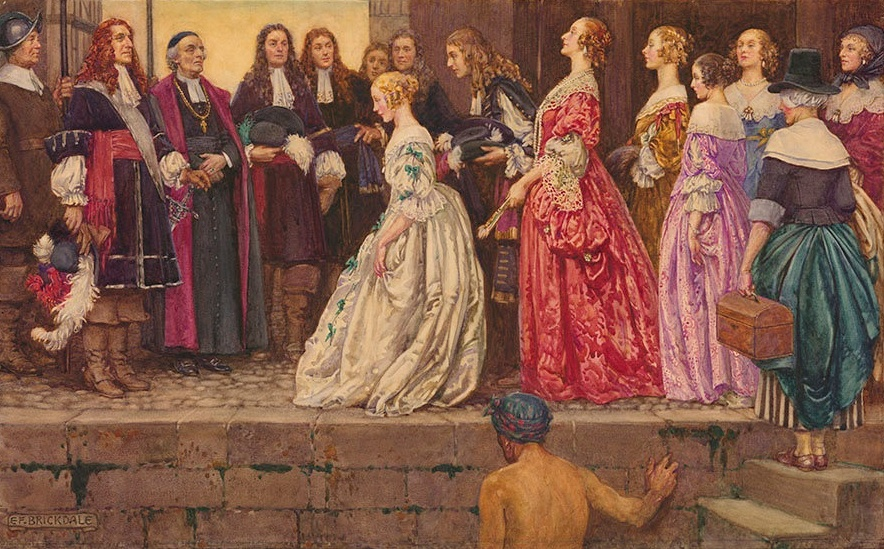
The King's Daughters (French: filles du roi [fij dy ʁwa], or filles du roy in the spelling of the era) were the approximately 800 young French women who immigrated to New France between 1663 and 1673 as part of a program sponsored by King Louis XIV. The program was designed to boost New France's population both by encouraging Frenchmen to move to the New World, and by promoting marriage, family formation, and the birth of French children in the colony. The term refers to those women and girls who were recruited by the government and whose travel to the colony was paid for by the king.[1][2] They were also occasionally known as the King's Wards.
Origins
[edit].jpg)
- 12–15 (10.0%)
- 16–25 (57.0%)
- 26 and older (22.0%)
- Unknown (11.0%)
New France, at its start, was populated mostly by men: soldiers, fur traders, and missionary priests. Settlers began to develop farms and by the mid-17th century, there was a severe imbalance between single men and women in New France. The small number of female immigrants had to pay their own passage, and few single women wanted to leave home to move and settle in the harsh climate and conditions of New France. At the same time, officials noted the population growth of the competing English colonies, which had more families, and they worried about France's ability to maintain its territorial claims in the New World.[3]
To increase the French population and the number of families, the Intendant of New France, Jean Talon, proposed that the king sponsor passage of at least 500 women. The king agreed, and eventually, nearly twice the number were recruited. They were predominantly between the ages of 12 and 25, and many had to supply a letter of reference from their parish priest before they would be chosen for immigration to New France. They were intended to marry men in the colony in order to establish families and more farms.
Marguerite Bourgeoys was the first person to use the expression filles du roi in her writings.[4] A distinction was made between King's Daughters, who were transported to New France and received a dowry at the king's expense, and women who emigrated voluntarily using their own money.[5] Other historians used chronological frameworks to determine who could be called a fille du roi.[6] Research by the historical demographer Yves Landry determines that there were in total about 770 to 850 filles du roi[7] who settled in New France between 1663 and 1673.[8]
The title "King's Daughters" was meant to imply state patronage, not royal or noble parentage; most of the women recruited were commoners of humble birth. As a fille du roi, a woman received the king's support in several ways. The king paid one hundred livres to the French East India Company for each woman's crossing, as well as furnishing her trousseau.[9] The Crown also paid a dowry for each woman; this was originally set at four hundred livres, but as the Treasury could not spare such an expense, many were simply paid in kind.[10]
Those chosen to be among the filles du roi and allowed to emigrate to New France were held to scrupulous standards, which were based on their "moral calibre" and whether they were physically fit enough to survive the hard work demanded by life as a colonist. The colonial officials sent several of the filles du roi back to France because they were deemed below the standards set out by the king and the intendant of New France.[11]
As was the case for most emigrants who went from France to New France, 80 per cent of the filles du roi were from Paris, Normandy and the western regions.[12] Almost half were from the Paris area, 16 per cent from Normandy and 13 per cent from western France. Most came from urban areas,[13] with the Hôpital-Général de Paris and the Saint-Sulpice parish being big contributors.[14] Many were orphans with meagre personal possessions, and with a relatively low level of literacy.[15] Socially, the young women came from different backgrounds but were all very poor. They might have been from an elite family that had lost its fortune, or from a large family with children "to spare."[16] Officials usually matched women of higher birth with officers or gentlemen living in the colony,[17] sometimes in the hopes that the nobles would marry the young women and be encouraged to stay in Canada rather than return to France. A few women came from other European countries, including Germany, England, and Portugal.[18]
Integration into New French society
[edit]| Year | Arrivals[19] |
|---|---|
| 1663 | 36 |
| 1664 | 1 |
| 1665 | 80–100 |
| 1666 | 0 |
| 1667 | 109 |
| 1668 | 80 |
| 1669 | 149 |
| 1670 | c. 165 |
| 1671 | 150 |
| 1672 | 0 |
| 1673 | 60 |
| Total | 832–852 |
The women disembarked in Quebec City, Trois-Rivières, and Montreal. After their arrival, their time to find husbands varied greatly. For some, it was as short as a few months, while others took two or three years before finding an appropriate husband.[20] For the process of choosing a husband, and the marriage, most couples would officially get engaged in church, with their priest and witnesses present.[21] Then, some couples went in front of the notary, to sign a marriage contract.[22] Marriages were celebrated by the priest, usually in the woman's parish of residence.[23] While the marriage banns customarily were to be published three times before a wedding could take place, the colony's need for women to marry quickly led to few filles du roi having marriage banns announced.[24] It is known that 737 of these filles du roi were married in New France.[25]
The marriage contracts represented a protection for the women, both in terms of financial security if anything were to happen to them or their husband, and in terms of having the liberty to annul the promise of marriage if the man they had chosen proved incompatible.[26] A substantial number of the filles du roi who arrived in New France between 1669 and 1671 cancelled marriage contracts; perhaps the dowry they had received made them disinclined to retain a fiancé with whom they found themselves dissatisfied.[27]
An early problem in recruitment was the women's adjustment to the new agricultural life. As Saint Marie de L'Incarnation wrote, the filles du roi were mostly town girls, and only a few knew how to do manual farm work. This problem remained but, in later years, more rural girls were recruited.[citation needed]
There were approximately 300 recruits who did not marry in New France. Some had a change of heart before embarking from the ports of Normandy and never left, while some died on the journey. Others returned to France to marry, and a few remained single.
Integration in Ville-Marie
[edit]Prior to the King's Daughters, the women who immigrated to Ville-Marie, otherwise known as Montreal, had been recruited by the Société Notre-Dame de Montréal founded in 1641 in Paris.[28] Amongst these women were Jeanne Mance and Marguerite Bourgeoys.[29] When the first filles du roi arrived in Montreal, they were taken in by Bourgeoys.[30] Initially, there were no comfortable lodgings to receive them, but in 1668 Bourgeoys procured the Maison Saint-Gabriel, a large farmhouse in which to house them.[31]
End of recruitment and growth of the settlement
[edit]The program was a resounding success. It was reported that in 1670, most of the women who had arrived the previous year, 1669, were already pregnant and by 1671, a total of nearly 700 children were born to the filles du roi. The colony was expected to gain population self-sufficiency soon afterward.[32]
By the end of 1671, Talon suggested that it would not be necessary to sponsor the passage of girls for the next year, and the king accepted his advice.[19] The migration briefly resumed in 1673, when the king sent 60 more girls at the request of Buade de Frontenac, the new governor, but that was the last under the Crown's sponsorship.[19] Of the approximately 835 marriages of immigrants in the colony during this period, 774 included a fille du roi.[33] By 1672, the population of New France had increased to 6,700, from 3,200 in 1663.[33]
Two-thirds of all Canadians of French descent can trace their lineage to one of the filles du roi. [34]
Rumors and legends
[edit]
The idea that the filles du roi were sex workers has been a rumor ever since the inception of the program in the 17th century. It seems to have arisen from a couple of misconceptions, both contemporary and modern, about immigration to French colonies in the New World. The first of these, which took root long before the first fille du roi emigrated, was that Canada was a penal colony. While there were two campaigns in the mid-17th century that involved the immigration of French criminals to Canada in exchange for their records being expunged, they were both short-lived. These programs resulted in little more than setting a precedent for viewing Canada as a place where those "of questionable morality" could be sent for some reason or the other.[35]
The popularization of the idea that the filles du roi in particular were sex workers can be traced to an account by the Baron de Lahontan of his time in New France;[36] several earlier sources made the same assertion, including Saint-Amant, Tallement des Réaux, and Paul LeJeune. In his account, Lahontan refers to the filles du roi as being "of middling virtue", and wrote that they had emigrated in the hopes of religious absolution.[37] As early as 1738, Claude Le Beau countered his portrayal in an account of his own journey to New France, as did Pierre François Xavier de Charlevoix in his 1744 work.[38]
Out of nearly 800 filles du roi, only one, Catherine Guichelin, was charged with prostitution while living in Canada, after she was abandoned by her husband.[36] She appeared before the Sovereign Council of New France under the charge of carrying out "a scandalous life and prostitution" on 19 August 1675. Her two children were "adopted" by friends, and she was banished from Quebec City. She was reported to have turned to sex work after her husband, Nicholas Buteau, abandoned the family and returned to France. She later gave birth to many children out of wedlock. Guichelin had at least two marriage contracts cancelled. She also wed twice more after returning to Sorel, Quebec, then Montreal.[39]
The ships carrying the filles du roi would travel up the Saint Lawrence River, stopping first at Quebec City, then at Trois-Rivières, and lastly at Montreal.
Notable descendants
[edit]- Saint André Bessette, "Brother Andre", descendant of fille du roi Anne Le Seigneur (1649-1733). Anne Le Seigneur has been mis-identified as Anne Seigneur by Peter Gagne in his book "King's Daughters and Founding Mothers: The Filles du Roi, 1663-1673."[40]
- Hillary Clinton, descendant of filles du roi Madeleine Niel[41][42] and Jeanne Ducorps dite Leduc.[41]
- Angelina Jolie, descendant of fille du roi Denise Colin.[43]
- Madonna (Madonna Louise Ciccone), descendant of fille du roi Anne Seigneur (1649-1733).[44] Her mother's ancestors are all French-Canadian from the 17th century.[45] This is the same Anne Le Seigneur who was the grandmother of Saint André Bessette.
- Hall of Fame ice hockey player Bernie "Boom Boom" Geoffrion was a direct descendant of Marie Priault, a King's Daughter. She married Pierre Joffrion, a farmer and former grenadier from the Carignan-Salières Regiment, shortly after her arrival in 1669.[46]
- Louis Coutlée, one of the descendants of Catherine Guichelin, became a founding father of Ottawa, Ontario, later Canada's capital. He descended from Marie Vacher, one of Catherine's illegitimate children. He was the first sheriff of Ottawa (after serving in the lower Canadian Militia during the Anglo-American War of 1812 with his father.[47])
- Coutlée's son, Dominique-Amable Coutlée, served as a member of Parliament in Canada.[48][49]
- Tom Bergeron, descendant of Marguerite Ardion, as revealed in the August 30, 2015, episode of Who Do You Think You Are?
- Chloë Sevigny, descendant of fille du roi Marguerite Lamain, as revealed on the PBS series Finding Your Roots[50]
- Andrée Champagne, descendant of fille du roi Marguerite Samson and husband Jean Beaugrand dit Champagne.
- Rodolphe Girard, descendant of fille du roi Isabelle Aupe and husband Pierre Lavoie.
See also
[edit]
.svg)

Notes
[edit]- ^ Lanctot 1952, pp. 9, 102.
- ^ Gagné, Peter J. (2002). Before the King's Daughters The Filles à Marier, 1634-1662. Quintin Publications.
- ^ Hallowell, Gerald (2004). The Oxford companion to Canadian history. Don Mills, Ontario: Oxford University Press. ISBN 978-0195415599. OCLC 54971866.
- ^ Landry 1992, p. 19.
- ^ Landry 1992, p. 20.
- ^ Landry 1992, p. 21.
- ^ Landry 1992, p. 44.
- ^ Landry 1992, p. 33.
- ^ Landry 1992, pp. 73–74.
- ^ Landry 1992, p. 75.
- ^ Lanctot 1952, p. 212.
- ^ Landry 1992, p. 54.
- ^ Landry 1992, p. 108.
- ^ Landry 1992, pp. 57–58.
- ^ Marshall, Bill (1 January 2005). France and the Americas: culture, politics, and history : a ... Vol. 2. p. 439. ISBN 9781851094110.
- ^ Landry 1992, p. 51.
- ^ Landry 1992, p. 68.
- ^ Lanctot 1952, pp. 22, 103, 115, 117, 126.
- ^ a b c Trudel, Marcel (1997). La seigneurie de la Compagnie des Indes occidentales, 1663-1674. Les Editions Fides. ISBN 9782762118681.
- ^ Landry 1992, p. 131.
- ^ Landry 1992, p. 145.
- ^ Landry 1992, p. 146.
- ^ Landry 1992, p. 140.
- ^ Landry 1992, p. 149.
- ^ Landry, Yves (1992). Orphelines en France pionnières au Canada: Les filles du roi au XVIIe siècle. Montreal: Leméac Éditeur Inc.[page needed]
- ^ Landry 1992, p. 150.
- ^ Landry 1992, p. 152.
- ^ Beaudoin & Sévigny 1996, p. 8.
- ^ Beaudoin & Sévigny 1996, p. 12.
- ^ Beaudoin & Sévigny 1996, p. 60.
- ^ Beaudoin & Sévigny 1996, p. 61.
- ^ Juliana L’Heureux, "Les Filles du Roi", Portland (Maine) Press Herald, March 19, 1998.
- ^ a b "Le peuplement d'un pays". Musée de la civilisation. 1998. Archived from the original on November 1, 2013. Retrieved March 21, 2012.
- ^ "Filles du roi: the Founding Mothers of New France", JSTOR July 9, 2025
- ^ Lanctot 1952, pp. 20.
- ^ a b "King's Daughters, Casket Girls, Prostitutes". Library of Congress Global Gateway. Retrieved 2 November 2007.
- ^ Lanctot 1952, pp. 159.
- ^ Lanctot 1952, pp. 25, 33, 192, 195.
- ^ Les Filles du Roy, Section 3 Archived April 28, 2009, at the Wayback Machine
- ^ "Frère André - Alfred Bessette, 1845 - 1936".
- ^ a b "Hillary Rodham Clinton's French-Canadian Ancestry" (PDF). Archived from the original (PDF) on August 23, 2012.
- ^ "SFRSC-King's Daughters". 2021. Retrieved September 11, 2021.
- ^ "Ascendance d'Angelina Jolie".
- ^ "Madonna and Lady Gaga" (PDF). Archived from the original (PDF) on November 3, 2013. Retrieved March 31, 2013.
- ^ "Ancestry of Madonna". Perche-Quebec.com. Retrieved July 6, 2019.
- ^ Geoffrion Family Genealogy
- ^ Irving, L. Homfray (1908). Officers of the British Forces in Canada during the War of 1812-15. Welland Tribune Print.
{{cite book}}:|work=ignored (help) - ^ "Bytown or Bust". Archived from the original on 2010-09-18. Retrieved 2009-08-11.
- ^ Généalogie du Québec
- ^ "Season 5, Episode 8: Hard Times". PBS Finding Your Roots. February 26, 2019. Archived from the original on February 14, 2019. Retrieved March 5, 2019.
References
[edit]- Beaudoin, Marie-Louise; Sévigny, Jeannine (1996). "Les premières et les filles du roi à Ville-Marie". Montreal: Maison Saint-Gabriel.
{{cite journal}}: Cite journal requires|journal=(help) - Lanctot, Gustave (1952). "Filles de joie ou filles du roi". Montreal: Les Éditions Chantecler Ltée.
{{cite journal}}: Cite journal requires|journal=(help) - Landry, Yves (1992). "Orphelines en France pionnières au Canada: Les filles du roi au XVIIe siècle". Montreal: Leméac Éditeur Inc.
{{cite journal}}: Cite journal requires|journal=(help)
Further reading
[edit]- King's Daughters and Founding Mothers: The Filles du Roi, 1663-1673, Peter J. Gagné, 2 volumes, Quintin, 2000
- King's Daughters, The, Joy Reisinger and Elmer Courteau (Sparta, 1988)
- Alone in an Untamed Land: The Filles du Roi Diary of Hélène St.Onge, Maxine Trottier (fiction)
- Bride of New France, Suzanne Desrochers (fiction)
- Promised to the Crown, Aimie K. Runyan, Kensington Publishing Corp. (fiction)
- Duty to the Crown, Aimie K. Runyan, Kensington Publishing Corp. (fiction)
External links
[edit]
- "Filles du roi: the Founding Mothers of New France", JSTOR July 9, 2025
- "A list of the Daughters and their husbands, Andre Therriault". Archived from the original on 2010-04-14.
- The documentary, The Scattering of Seeds: the Creation of Canada
- The Kings Daughters by Thomas J. Laforest[permanent dead link], first published in Heritage Quest, issue #22 May/June 1989.
- Silvio Dumas (1972). "Les filles du Roi en Nouvelle-France, étude historique avec répertoire biographique". Québec, Québec: Société historique de Québec. Archived from the original on 2014-10-06. Retrieved 2012-03-21.
- A list of the King's Daughters compiled by the Programme de recherche en démographie historique (PRDH)
New France (1534–1763) | |
|---|---|
| History | |
| Colonies |
|
| Towns and villages |
|
| Forts | |
| Governments |
|
| Laws | |
| Economy | |
| Society | |
| Missionary groups | |
| Wars | |

| National | |
|---|---|
| Other | |

King's Daughters
View on GrokipediaHistorical Background
Demographic Imbalances in Early New France
In the early decades of New France, established as a French colony in 1608, the settler population remained sparse and heavily skewed toward males, reflecting the colony's initial prioritization of resource extraction over permanent settlement. By 1663, the total European population hovered around 3,000 individuals, concentrated primarily in Quebec and surrounding areas, with growth rates lagging far behind those of contemporaneous English colonies due to high mortality, disease, and limited immigration.[7][8] This demographic structure stemmed from the dominance of transient male occupations, including fur traders, soldiers, and short-term contract laborers known as engagés, who comprised the bulk of arrivals and frequently returned to France upon contract expiration, exacerbating population instability.[9] Gender ratios were particularly lopsided, with women constituting approximately one-sixth of the adult population—roughly 400 to 500 females amid 2,500 to 3,000 total settlers—creating a male-to-female disparity of about 6:1 in many settlements.[10] This imbalance arose because early recruitment targeted men for the physically demanding fur trade, military defense against Indigenous conflicts, and exploratory ventures, while few women immigrated independently due to the high costs of passage and the absence of structured incentives for families.[9] The Compagnie des Cent-Associés, chartered in 1627 under Cardinal Richelieu to foster self-sustaining colonies through family-based agriculture, failed to materialize balanced demographics, as trade profits incentivized temporary male labor over familial relocation, leading to chronic shortages of women for marriage and reproduction.[8] These imbalances yielded causal consequences for colonial viability, including birth rates insufficient to sustain replacement levels—estimated at under 20 live births per 1,000 inhabitants annually in the 1650s—and a high rate of male emigration, with up to 50% of engagés departing after three-year terms, preventing the accumulation of a stable populace.[11] Without adequate women, family formation stalled, rendering settlements vulnerable to assimilation through intermarriage with Indigenous groups or attrition from British encroachments in Acadia and the Hudson Valley, as sparse, male-dominated outposts struggled to expand territorially or demographically against competitors.[10] Richelieu's vision of populous, agrarian habitations as a bulwark against rival powers thus encountered practical barriers rooted in the economic pull of the fur trade, which prioritized extractive mobility over rooted communities.[9]French Royal Initiatives for Colonization
The Company of One Hundred Associates, established by Cardinal Richelieu in 1627, held a monopoly on trade and colonization in New France with a mandate to transport 4,000 settlers within 15 years, offering subsidies to encourage family migration. However, the company prioritized fur trade profits over permanent settlement, resulting in an average of only 160 immigrants annually over the subsequent 25 years and repeated financial shortfalls. By 1660, the colony's European population hovered around 3,000, predominantly male due to high male migration for trade and military roles, exacerbated by severe winters, scurvy outbreaks, and Iroquois raids that deterred family establishment.[12] [13] Under Jean-Baptiste Colbert's mercantilist framework as Louis XIV's controller-general from 1665, French policy shifted toward fostering self-sufficient colonies to bolster national wealth through balanced trade and population growth, rather than mere resource extraction. Colbert viewed New France as integral to an economically integrated empire, advocating state-directed incentives for emigration to achieve demographic stability and agricultural expansion.[14] [15] In 1663, Louis XIV revoked the company's charter, assuming direct royal administration of the colony to enforce these priorities, including military reinforcements against Indigenous threats and systematic population policies.[16] [10] Prior to this royal pivot, informal efforts by religious orders provided limited precursors to structured female migration; for instance, Ursulines and other groups facilitated the arrival of approximately 262 filles à marier—unmarried women seeking marriage—between 1634 and 1662, often through private or ecclesiastical sponsorship without state-scale funding. These small cohorts, averaging fewer than a dozen annually, failed to address the acute gender imbalance, as male settlers outnumbered women by ratios exceeding 3:1, hindering natural population increase and long-term viability.[17] [18] Such ad hoc measures underscored the need for centralized intervention, as voluntary and subsidy-driven family recruitment yielded insufficient results amid economic disincentives and environmental hardships.[19]Establishment of the Program
Royal Decree and Motivations under Louis XIV
In 1663, Jean Talon, the Intendant of New France, recommended to Jean-Baptiste Colbert, Louis XIV's Minister of Finance and advisor on colonial affairs, the systematic recruitment and transport of marriageable women to address the colony's acute gender imbalance, where male settlers vastly outnumbered potential brides.[1] Louis XIV approved this initiative as part of his broader absolutist strategy to strengthen New France through directed population growth, marking the formal inception of the Filles du Roi program under royal sponsorship.[3] Colbert oversaw recruitment in France, emphasizing healthy women capable of establishing families, while Talon managed distribution upon arrival to ensure swift integration.[1] The core motivations stemmed from pragmatic demographic engineering to avert stagnation and vulnerability in the colony, which by the early 1660s had fewer than 3,500 European inhabitants, predominantly men engaged in fur trading or military service.[1] This imbalance hindered permanent settlement and family formation, risking depopulation and weakening French claims to North American territories amid competition from English and Dutch colonies.[3] By importing women—ultimately around 770 between 1663 and 1673—Louis XIV sought to enforce high fertility rates, foster Catholic French cultural continuity, and create a self-sustaining population base capable of expanding and defending holdings through natural increase rather than reliance on intermittent male migration.[1][3] Policy implementation included full state funding for transatlantic passage, costing the Crown approximately 60 livres per woman, along with a standard dowry of 50 livres upon marriage, supplemented by a trousseau of linens, clothing, and household essentials valued at an equivalent amount.[1][3] To accelerate unions, male settlers faced disincentives such as temporary bans on fur trading if they failed to wed promptly after ships arrived, typically pressuring marriages within weeks rather than months. These measures tied incentives directly to reproductive outcomes, aligning with Louis XIV's vision of empire-building via enforced familial stability without private enterprise dominating colonial demographics.[1]Administrative Organization and Funding
The Filles du Roi program was coordinated through the royal administration in France and New France, with primary oversight by the intendant Jean Talon starting in 1665, under the guidance of Minister Jean-Baptiste Colbert.[1] Recruitment and embarkation were managed by port officials at key departure points including Dieppe, Rouen, and La Rochelle, where groups of women were assembled for transatlantic voyages.[3] In the colony, distribution upon arrival was facilitated by local religious orders, such as the community led by Marguerite Bourgeoys in Montreal, ensuring logistical support without direct involvement in matrimonial arrangements.[1] Funding was provided entirely by the French Crown, with an allocation of 100 livres per woman to cover recruitment fees (10 livres), a basic trousseau (30 livres), and passage costs (60 livres).[1] Additional dowries ranging from 50 to 200 livres were granted to select participants between 1667 and 1672, depending on social status and marital matches, though these were not universal.[1] The expenditures supported the program's goal of rapid demographic expansion, anticipated to yield returns through increased colonial tax revenues and a larger pool of military recruits for defense against territorial threats.[6] Over the decade from 1663 to 1673, approximately 768 women were dispatched in phased shipments, with the highest volume occurring between 1665 and 1669 under Talon's intensified administration.[3] The initiative concluded after 1673, as the influx achieved a viable gender ratio in the colony, reducing the urgency for further state-sponsored immigration.[1]Profile and Recruitment of Participants
Selection Criteria and Sources
The selection of the Filles du Roi targeted young, unmarried women aged approximately 12 to 30, with the majority between 15 and 25 years old upon recruitment, primarily from modest urban or rural backgrounds in France.[1] These women often included orphans, domestic servants, or migrants from impoverished families in regions such as the Parisian basin (accounting for around 40-50% of recruits), Normandy, and other northern provinces, motivated by prospects of land ownership and economic stability absent in France.[20] [2] Historical analyses of parish records and notarial contracts indicate a total of about 770 such women, vetted through rigorous checks for physical health, moral character, and practical skills like sewing, embroidery, or rudimentary agriculture to ensure suitability for colonial life.[21] [22] Royal edicts and recruitment practices explicitly barred individuals with criminal records or reputations for immorality, such as prostitution, prioritizing those from legitimate, working-class families to foster stable colonial foundations.[23] Empirical reviews of primary documents, including family origins traced via baptismal and marriage acts, reveal that over 90% hailed from verifiable legitimate lineages, with many possessing average literacy levels comparable to their French peers and demonstrating voluntary participation driven by poverty alleviation rather than coercion.[1] [21] This self-selection process, informed by promises of dowries and housing, underscored their status as respectable participants rather than societal outcasts, as corroborated by demographic studies countering unsubstantiated myths of moral laxity.[22]Preparation and Incentives Offered
The women selected for the Filles du Roi program, often originating from urban orphanages, hospitals, and impoverished families in France, underwent preparatory training primarily in religious institutions such as Ursuline convents and the Hôpital Général in Paris.[24] This instruction focused on essential domestic skills, including sewing, cooking, childcare, and basic housekeeping, equipping them for colonial life while emphasizing moral and religious education.[25] Prior to departure, participants signed engagement contracts that explicitly affirmed their voluntary participation, granted them the freedom to select spouses upon arrival, and allowed rejection of unsuitable matches, with provisions for return to France if unmarried after six months.[6] Economic incentives formed a core attraction, transforming the program into a pathway for upward mobility from France's urban slums. The crown provided each woman with a royal dowry equivalent, consisting of a trousseau valued at 50 livres for unmarried participants (100 livres for widows), including clothing, linens, household goods, and provisions for one year's sustenance.[25] [26] Husbands, typically settlers or former soldiers, received complementary bounties of 50 livres upon marriage, along with eligibility for 50-arpent land grants in seigneurial concessions, contingent on establishing a family and demonstrating agricultural commitment.[27] These measures evidenced participant agency, as evidenced by near-universal marriage rates within months of arrival and minimal returns to France, reflecting prospects superior to domestic poverty amid high urban mortality and limited opportunities.[6] The structured incentives aligned with royal population goals under Louis XIV, prioritizing family formation over coercion, as corroborated by archival contracts and demographic records showing sustained fertility and settlement.[25]Journey and Integration
Transatlantic Voyage Conditions
The transatlantic voyages of the Filles du Roi typically lasted 2 to 3 months, departing from French ports such as La Rochelle, Dieppe, and Honfleur during the sailing season from May to October to avoid winter ice and storms.[28] Ships followed established trade routes across the Atlantic to the mouth of the Saint Lawrence River, then proceeded upstream to Quebec, with some groups continuing to Trois-Rivières or Montreal. After 1665, following the arrival of French troops under the Carignan-Salières Regiment, voyages often occurred in naval convoys for protection against privateers and enemy vessels, enhancing logistical security compared to earlier unregulated crossings.[23] Examples include the Le Saint-Jean-Baptiste, which made multiple trips carrying dozens of women between 1665 and 1671, and the L'Aigle d'Or, which transported 36 Filles du Roi in 1663 over 111 days.[29] Onboard conditions were crowded, with women housed in lower holds alongside provisions, crew, and sometimes soldiers, but royal oversight ensured basic provisioning of food, water, and medical supplies to minimize risks. Selected for health prior to departure, the women underwent inspections, and ships carried physicians or apothecaries for en route care, contrasting with higher-death private migrations lacking state support. Mortality remained low at approximately 5%, with around 60 deaths recorded across roughly 800-850 sent from 1663 to 1673, attributable to diseases like scurvy or dysentery rather than systemic neglect.[28][30] Ship manifests and port records from Quebec confirm these figures, showing no patterns of mass fatalities or ship losses specific to Filles du Roi transports.[31] Psychologically, the group dynamic fostered resilience, as women traveled in cohorts bound by a shared colonial purpose, often with clerical accompaniment providing religious counsel and morale support during isolation and seasickness. Contemporary administrative logs, including those from intendant Jean Talon, report no widespread abuse or disorder, emphasizing disciplined conduct under chaperonage.[29] This structured environment, informed by royal directives, differentiated the voyages from anecdotal tales of unregulated 17th-century migrations.[28]Arrival, Distribution, and Initial Marriages
The Filles du Roi arrived in New France primarily at Quebec City from 1663 to 1673, with many ships docking there before dispersal to other settlements such as Trois-Rivières and Montreal. Approximately 70 percent of the women ultimately settled in Quebec City, 18 percent in Montreal, and 12 percent in Trois-Rivières.[6][25] Upon disembarkation, the women received temporary housing and supervision from religious communities to ensure their safety and orderly integration, including the Ursulines in Quebec City and the Congrégation de Notre-Dame in Montreal. These arrangements provided room and board until marriage, preventing vagrancy amid the colony's sparse population and frontier conditions.[6][25] The distribution process emphasized rapid family formation through a supervised matching system, where women interviewed prospective suitors—often soldiers from the Carignan-Salières regiment, habitants, artisans, or farmers—and could reject unsuitable candidates. Marriages were documented via notarial contracts stipulating the transfer of royal dowries, generally 50 livres for matches with soldiers or settlers and 100 livres for officers, alongside provisions like trousseaus and land grants for grooms. The average interval from arrival to marriage spanned four to five months, with the vast majority occurring within six months and only 3 percent exceeding 16 months.[25][6][6] Initial adaptation to colonial life posed challenges, particularly for urban recruits unaccustomed to agrarian demands, yet mutual economic reliance in these unions fostered stability, evidenced by low repatriation rates—only 33 of roughly 770 women returned permanently to France. Community oversight and the incentives tied to marriage further minimized disruptions during this transitional phase.[6][25]