Hubbry Logo
Fire-and-forgetFire-and-forgetMain
Open search
Fire-and-forget
Community hub
Fire-and-forget
logo
8 pages, 0 posts
0 subscribers
Be the first to start a discussion here.
Fire-and-forget
Fire-and-forget
from Wikipedia
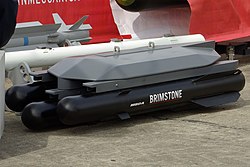
The RAF's Brimstone missile is a fire-and-forget anti-tank missile.

Fire-and-forget[1][2] is a type of missile guidance which does not require further external intervention after launch such as illumination of the target or wire guidance, and can hit its target without the launcher being in line-of-sight of the target. This is an important property for a guided weapon to have, since a person or vehicle that lingers near the target to guide the missile (using, for instance, a laser designator) is vulnerable to attack and unable to carry out other tasks.

Generally, information about the target is programmed into the missile just prior to launch. This can include coordinates, radar measurements (including velocity), or an infrared image of the target. After it is fired, the missile guides itself by some combination of gyroscopes and accelerometers, GPS, onboard active radar homing, infrared homing optics, and anti-radiation homing. Some systems offer the option of either continued input from the launch platform or fire-and-forget.

Fire-and-forget missiles can be vulnerable to soft-kill systems on modern main battle tanks, in addition to existing hard-kill systems. As opposed to unguided RPGs which require a hard-kill system (a counter projectile(s) used to destroy the incoming missile), fire-and-forget missiles can often be jammed by means such as electro-optical dazzlers.

Examples

[edit]

Many of these are infrared homing missiles; some of the remainder (e.g. AIM-120) are active radar guided.

Modern PARS 3 LR fire-and-forget missile of the German Army

See also

[edit]

References

[edit]
Revisions and contributorsEdit on WikipediaRead on Wikipedia
from Grokipedia
Fire-and-forget is a type of system in which the weapon autonomously tracks and homes in on its target after launch, requiring no further manual input or line-of-sight tracking from the operator. This capability allows the launching platform—such as a , , , or ship—to immediately relocate or take evasive action, enhancing survivability in . The core principle relies on onboard sensors and processors that acquire the target prior to or immediately after firing, using methods like passive , active , or imaging infrared seekers to maintain guidance throughout the flight path. For instance, infrared-guided systems detect heat signatures from engines or exhaust, while radar-based variants emit their own signals to illuminate and track targets independently. These autonomous systems emerged prominently in the late as advancements in seeker and enabled reliable terminal homing without external illumination. Key advantages of fire-and-forget munitions include reduced operator exposure to enemy fire, increased engagement rates against multiple or moving targets, and operational flexibility in adverse weather or cluttered environments. However, they can be vulnerable to countermeasures like flares, , or electronic jamming that disrupt onboard sensors, necessitating robust anti-jam features in modern designs. Notable examples span various domains: the provides man-portable anti-tank capability with a top-attack profile for armored vehicles; the enables beyond-visual-range air-to-air intercepts; and the RIM-116 RAM offers rapid shipboard defense against incoming cruise missiles. These systems have become integral to modern militaries, revolutionizing tactical engagements by prioritizing speed and autonomy over continuous guidance.

Overview

Definition

A fire-and-forget system is a type of guided , such as a or , that autonomously tracks and engages a designated target after launch without requiring further operator input or continuous line-of-sight guidance from the launching platform. This capability allows the operator to immediately relocate, seek cover, or engage additional threats, enhancing survivability in scenarios. Unlike command-guided or wire-guided systems, fire-and-forget rely on self-contained and homing technologies to complete the independently. Key characteristics of fire-and-forget systems include onboard sensors for and tracking, integrated for sustained flight, and terminal homing mechanisms that enable precise impact. These systems typically operate in lock-on before launch (LOBL) mode, where the target is acquired and locked via the launcher's sensors prior to firing, or lock-on after launch (LOAL) mode, which permits autonomous by the missile's post-launch for greater flexibility in obscured or dynamic environments. The is achieved through advanced , such as or radar-based, that process environmental data in real-time to correct the flight path without external commands. The basic operational sequence begins with pre-launch target identification and lock-on using the launch platform's sighting system, followed by missile launch and initial boost phase. Once airborne, the weapon's onboard guidance autonomously adjusts its toward the target, culminating in terminal homing and upon intercept. This sequence minimizes exposure time for the operator and supports rapid salvo firing. The term "fire-and-forget" emerged in U.S. military contexts in the early 1970s with the Heliborne Laser Fire and Forget Missile program (initiated in fiscal year 1972), intended to develop autonomous guidance but resulting in the semi-active laser-guided AGM-114 Hellfire missile. Later variants, such as the AGM-114L Longbow Hellfire, achieved true fire-and-forget capability using radar homing.

Comparison to Other Guidance Systems

Fire-and-forget guidance systems stand in contrast to command guidance approaches, where an operator maintains continuous control over the missile's flight path after launch through methods such as wire, radio, or laser links. In command guidance, steering commands are generated at the launch platform based on real-time tracking of both the missile and target positions, often requiring the operator to remain exposed in a line-of-sight position throughout the engagement. For instance, the BGM-71 TOW anti-tank missile employs wire-guided command guidance, with the operator optically tracking and manually steering the weapon via a joystick, which limits launcher mobility and increases vulnerability to counterfire. This ongoing human intervention contrasts sharply with fire-and-forget autonomy, as command systems demand sustained operator attention and can only handle one missile at a time per controller. Semi-active homing represents another key distinction, relying on an external source to illuminate the target post-launch, such as a operated by the launching platform or a forward observer. The missile's seeker detects and homes in on reflections from this illumination, but the designator must remain active until impact, effectively tethering personnel or assets to the target area and restricting tactical flexibility. Examples include semi-active laser variants of the missile, which require continuous laser designation to guide the weapon, preventing the operator from disengaging immediately after firing. Unlike fire-and-forget systems, this dependency on external support exposes operators to detection and retaliation, particularly in contested environments where maintaining illumination demands prolonged exposure. Active homing missiles incorporate self-contained , such as onboard , for , but many still require initial target cues or midcourse updates from the launch platform, differentiating them from pure fire-and-forget operations. Fire-and-forget is effectively a specialized subset of active homing, where the achieves full without any post-launch assistance, locking onto the target prior to or at launch and tracking it independently thereafter. In comparison, inertial or GPS guidance systems navigate via pre-programmed trajectories using internal accelerometers, gyroscopes, or signals, providing precise path-following to fixed coordinates but lacking real-time or terminal homing against moving threats. These preset-path methods excel in area suppression or strikes on stationary but cannot adapt to evasive maneuvers without additional sensors. Tactically, fire-and-forget systems enable "" maneuvers, permitting operators to launch the missile and rapidly relocate to avoid or detection, a critical advantage over line-of-sight command or semi-active methods that demand stationary . This reduced exposure enhances survivability in high-threat scenarios, allowing or crews to engage multiple targets sequentially without prolonged risk, whereas command and semi-active systems constrain forces to defensive or static positions during guidance. Overall, these distinctions underscore fire-and-forget's role in promoting offensive mobility and minimizing operator involvement compared to more operator-intensive alternatives.

History

Early Developments

The origins of fire-and-forget systems trace back to precursors, where early guided munitions laid the groundwork for autonomous targeting despite relying on operator input. The German , introduced in 1943, was a radio-controlled that featured semi-autonomous flight dynamics after release from an aircraft, allowing it to glide toward a target under manual corrections via a line-of-sight radio link and tail flares for tracking. While not fully fire-and-forget due to its dependence on continuous human guidance, the represented a foundational shift toward precision munitions, achieving combat success such as sinking the Italian battleship Roma on September 9, 1943, and influencing subsequent developments in seeker technologies. Post-World War II advancements accelerated with the introduction of truly autonomous infrared-homing missiles. The U.S. AIM-9 Sidewinder, developed starting in 1953 at the Naval Ordnance Test Station in China Lake, California, became operational in 1956 as one of the first air-to-air missiles with fire-and-forget capability, using a passive infrared seeker to autonomously track heat signatures without post-launch guidance from the pilot. This breakthrough enabled short-range engagements within visual range, marking a pivotal evolution from command-guided systems to self-contained homing. In the 1960s and 1970s, guided munitions evolved further toward greater autonomy, driven by operational needs during conflicts like the . The U.S. series of laser-guided bombs, first introduced in 1968, transitioned from earlier unguided ordnance by incorporating semi-active seekers that homed on a designated spot, reducing reliance on wire or radio guidance while still requiring external illumination for terminal homing. Similarly, the Soviet AT-2 Swatter (), entering service in 1960, served as an early with initial manual command-to-line-of-sight radio guidance, but later variants in the late 1960s adopted semi-automatic command-to-line-of-sight with infrared terminal homing for partial autonomy. The (1955–1975) was a key driver, exposing the vulnerabilities of wire-guided systems and unguided bombs—such as high sortie rates and pilot exposure to defenses like SA-2 surface-to-air missiles—prompting investments in precision-guided munitions to enhance survivability and accuracy, with bombs achieving near-zero-miss rates in operations like Linebacker II. Early fire-and-forget systems, particularly seekers like , faced significant limitations including short effective ranges limited to visual distances and high susceptibility to countermeasures such as flares or environmental factors like and smoke, resulting in low combat success rates during the . These constraints underscored the need for ongoing refinements in seeker sensitivity and counter-countermeasure technologies.

Key Milestones and Modern Evolution

In the 1980s, fire-and-forget systems saw significant advancements in seeker technologies, enhancing all-weather and day-night capabilities for air-to-ground munitions. The missile, initially operational in 1972, underwent key upgrades during this decade, including the AGM-65D variant, first flight tested in 1983 and achieving initial operating capability in 1986, which incorporated an imaging infrared (IIR) seeker for improved in low-visibility conditions. Concurrently, the missile achieved initial operating capability in 1984, designed primarily for helicopter platforms like the AH-64 Apache to deliver precision anti-armor strikes with semi-active transitioning toward greater autonomy. These developments marked a shift from line-of-sight dependencies, enabling launchers to disengage post-firing while seekers independently tracked targets. The 1990s and 2000s expanded fire-and-forget applications through platform integrations and autonomous targeting features. In 2001, the MQ-1 Predator unmanned aerial vehicle demonstrated the first combat use of Hellfire missiles in Afghanistan on October 7, integrating the system for remote, beyond-visual-range strikes and revolutionizing drone-based precision engagements. The UK's Brimstone missile, entering service in 2005, introduced advanced millimeter-wave radar seekers with autonomous target selection, allowing lock-on after launch and discrimination of moving vehicles in cluttered environments during operations in Iraq and Afghanistan. These integrations emphasized reduced operator involvement, with Brimstone's dual-mode guidance enabling fire-and-forget modes over ranges up to 60 kilometers. Advancements in the focused on multi-mode seekers and high-speed concepts to counter evolving threats. The Joint Air-to-Ground Missile (JAGM), with development beginning in 2008 and first flight in 2010, combined , millimeter-wave , and semi-active seekers for versatile fire-and-forget operations across rotary- and fixed-wing platforms, achieving initial operational capability in 2019. DARPA's hypersonic programs, including the (HTV-2) tests in 2010 and 2011, explored glide vehicle technologies that laid groundwork for autonomous, fire-and-forget hypersonic strike systems capable of maneuvering at Mach 20 speeds. Globally, China's PL-15 , featuring with an AESA seeker, entered service around 2018, providing beyond-visual-range fire-and-forget intercepts over 200 kilometers and proliferating to allies like . By the 2020s, enhancements and counter-unmanned aerial system (UAS) roles further evolved fire-and-forget architectures. Israel's Spike NLOS missile received ongoing upgrades from Rafael, incorporating electro-optical/ seekers with for enhanced in non-line-of-sight engagements up to 32 kilometers, as demonstrated in U.S. Army evaluations in 2023. Emerging counter-drone applications, such as U.S. Command's 2025 solicitations for drone-launched, jam-resistant fire-and-forget munitions, integrated AI for GPS-denied targeting of small UAS threats. In May 2025, the achieved its first confirmed combat use. Additionally, in October 2025, the Spike NLOS advanced to Phase 2 of the U.S. Army's Mobile Long-Range program. These developments underscore a trend toward AI-driven seeker and multi-domain proliferation, with non-Western adoption accelerating operational versatility.

Technical Principles

Guidance Mechanisms

Fire-and-forget systems operate through a sequence of guidance phases that enable autonomous target engagement after launch, relying on onboard processing to maintain trajectory without external input. The core principle involves initial target acquisition followed by self-directed corrections, distinguishing these systems from those requiring continuous operator guidance. In the launch phase, the achieves pre-launch target lock using onboard sensors to designate prior to initiation. typically begins with solid rocket motors that provide initial boost, propelling the away from the platform while the transitions to active operation. This phase ensures safe separation and sets the foundation for subsequent autonomous flight. During the mid-course phase, the employs inertial navigation systems, often supplemented by data links for initial trajectory corrections, to proceed toward the target's predicted location while gradually shifting to full onboard . Inertial measurement units track and orientation to maintain course, allowing the system to cover the majority of the flight distance independently. This segment prioritizes efficiency in reaching the terminal engagement zone without real-time external commands. The terminal phase focuses on homing through continuous target tracking, where the missile executes precise maneuvers to intercept while using algorithms to discriminate against potential countermeasures such as flares or jamming. Seekers, which may include radar or infrared types, provide the necessary data for final adjustments, ensuring high accuracy in the closing stages. Autonomy here is complete, with the system relying solely on internal algorithms to refine the intercept path. Fire-and-forget systems operate with full independence, where no further human intervention occurs post-launch, maximizing operational tempo by eliminating the need for sustained platform exposure. Error correction during homing relies on algorithms, a that commands proportional to the line-of-sight rate between the and target, enabling efficient intercept without excessive maneuvering. This method minimizes miss distance by aligning velocity vectors toward the predicted collision point, forming the basis for in autonomous systems.

Seeker and Autonomy Technologies

Infrared (IR) seekers represent a primary for fire-and-forget systems, enabling passive detection of target heat signatures without emitting signals that could reveal the missile's position. These seekers typically employ focal plane arrays (FPAs) to capture in the mid-wave or long-wave IR , allowing operation in low-visibility conditions such as night or adverse . Cooled FPAs, which use cryogenic cooling to reduce thermal noise, provide superior sensitivity and resolution for long-range engagements against high-contrast targets. In contrast, uncooled FPAs offer a cost-effective alternative for short- and mid-range applications, with smaller size and lower power consumption, though they exhibit higher noise equivalent temperature differences that limit resolution in cluttered environments. Radar seekers, particularly active millimeter-wave variants operating in the 35–94 GHz bands, facilitate all-weather by transmitting and receiving pulses to track targets independently of environmental factors like or . These systems support fire-and-forget modes through onboard that maintains lock after launch, with pulse-Doppler techniques distinguishing moving targets from ground clutter via velocity discrimination. (SAR) integration enhances imaging capabilities, generating high-resolution maps (down to 0.3 m resolution) by synthesizing a larger antenna aperture during flight, enabling precise even against stationary or relocatable objectives. Imaging seekers, encompassing electro-optical (EO) and IR variants, provide visual or thermal scene reconstruction for target identification, minimizing collateral damage by confirming intent through scene analysis rather than mere heat or radar returns. EO seekers utilize charge-coupled device (CCD) or complementary metal-oxide-semiconductor (CMOS) sensors to capture visible-light imagery, supporting day operations with resolutions sufficient for distinguishing vehicle types at several kilometers. When fused with IR, these systems enable 24/7 functionality, allowing the missile to lock onto pre-designated features within the image for autonomous homing. Autonomy in fire-and-forget systems relies on onboard processors executing target recognition algorithms, such as and , to classify and track objectives in real time without external input. These software frameworks process seeker data streams—often at frame rates above 30 Hz—using techniques like template correlation to align observed scenes with stored reference models, achieving accuracies over 85% in controlled tests. Post-2010 developments have integrated (AI), particularly models like convolutional neural networks, to enhance against decoys or varying backgrounds; for instance, AI-driven enables adaptive decision-making during the terminal phase, enhancing performance in dynamic scenarios. To counter jamming and , advanced seekers incorporate frequency agility in designs, where the transmitter rapidly hops across multiple bands (e.g., 76–81 GHz) to evade electronic countermeasures and maintain . Multi-spectral fusion further bolsters resilience by combining data from IR, , and EO sensors, leveraging complementary strengths—such as 's penetration and IR's thermal contrast—to reduce rates and preserve high detection probabilities against camouflaged or obscured targets.

Examples

Air-to-Ground and Anti-Tank Systems

Fire-and-forget air-to-ground and anti-tank systems enable launch platforms, such as and helicopters, to engage armored or ground targets without maintaining continuous guidance, relying instead on onboard seekers for terminal homing. These munitions typically employ electro-optical, , or seekers to lock onto targets pre-launch or post-launch, enhancing operator by allowing immediate evasion or repositioning. warheads predominate in these systems, designed to penetrate armored vehicles by generating a high-velocity metal jet that defeats reactive armor and achieves depths equivalent to 7 or more times the charge's cone diameter. The , developed by the in the 1970s, exemplifies early fire-and-forget air-to-ground capability with its electro-optical in variants like the AGM-65B and imaging infrared seeker in the AGM-65D. These seekers provide precision against armored targets, with a range exceeding 22 km at medium altitude and a 125-pound shaped-charge optimized for anti-tank roles. During the 1991 , over 5,100 Mavericks were fired by U.S. forces, achieving an 80-90% success rate in launches and guidance to target, primarily against Iraqi armor and bunkers. The , introduced in the 1980s for helicopter platforms like the AH-64 Apache, incorporates laser-guided variants such as the AGM-114K with semi-active laser homing and infrared options, alongside the fully autonomous AGM-114L Longbow variant using millimeter-wave radar for true fire-and-forget operation. Lock-on after launch (LOAL) capability in these models allows firing up to 11 km in high-trajectory mode from rotary-wing assets, with an 8-9 kg tandem shaped-charge warhead penetrating modern reactive armor. In combat, Hellfire variants have demonstrated high reliability, with an 83% successful engagement rate in operational tests and widespread use in conflicts like the , where Apaches using Hellfire destroyed hundreds of Iraqi armored vehicles. The , a staple U.S. anti-tank system since the 1970s, is primarily wire-guided with semi-automatic command to line-of-sight (SACLOS) control but explored limited fire-and-forget enhancements through the canceled TOW-FF program in the early 2000s, which aimed to integrate autonomous seekers. Standard variants maintain a 3.75 km range and tandem (HEAT) shaped-charge warhead capable of defeating explosive reactive armor, achieving over 90% hit rates in controlled tests despite lacking full autonomy. European efforts include the developmental (formerly TRIGAT-LR), a joint -- project initiated in 1987, featuring fire-and-forget imaging infrared guidance with fiber-optic data links for mid-course updates and a range beyond 5 km. and the withdrew from the program in 2001, leaving to pursue integration on platforms like the , with a multi-purpose shaped-charge for anti-tank and light structure roles. As of 2025, has received over 1,000 missiles, integrated on the helicopter. Similarly, the French anti-tank missile received infrared upgrades in the MILAN 3 variant for jam-resistant pulsed-beacon guidance and thermal imaging sights, extending night operations to 2 km, though it retains manual SACLOS tracking rather than full fire-and-forget autonomy; its tandem penetrates over 1,000 mm of equivalent rolled homogeneous armor. In controlled evaluations, these systems consistently exceed 90% success rates against static armored targets, underscoring their precision in anti-tank scenarios, though real-world performance varies with environmental factors like smoke or countermeasures.

Surface-to-Air and Other Applications

Fire-and-forget surface-to-air missiles represent a critical evolution in air defense, enabling rapid engagement of aerial threats without continuous operator input. The AIM-9X Sidewinder, developed by the United States as an advanced variant of the AIM-9 series in the late 1990s and entering service in the early 2000s, employs passive imaging infrared homing for target acquisition, allowing high off-boresight targeting angles up to 90 degrees and autonomous homing post-launch. This capability stems from its focal plane array seeker, which enhances resistance to countermeasures and support close-range air-to-air intercepts from fighter aircraft like the F-35. The FIM-92 Stinger, a man-portable air-defense system (MANPADS) introduced by the U.S. Army in the late 1970s, exemplifies portable fire-and-forget technology for low-altitude threats. Its passive infrared homing seeker enables shoulder-fired launches with no post-launch guidance required, achieving effective ranges of up to 4.8 kilometers against helicopters and fixed-wing aircraft. Over 30 variants have been produced, with the Stinger RMP (Reprogrammable Microprocessor) enhancing seeker performance against evolving infrared decoys since the 1980s. Naval applications of fire-and-forget principles are integrated in systems like the , a ship-launched derived from the and operational since the 1970s. Early versions relied on , but the Evolved Sea Sparrow Missile (ESSM, RIM-162) variant, introduced in the , incorporates an active seeker for true fire-and-forget operation, enabling autonomous against anti-ship missiles and at ranges exceeding 50 kilometers. This upgrade supports vertical launch systems on platforms such as Arleigh Burke-class destroyers, providing layered defense without continuous illumination. Beyond traditional air defense, fire-and-forget autonomy extends to underwater threats via the U.S. Navy's Mk 48 , a weapon in service since the with significant upgrades. The Mk 48 ADCAP (Advanced Capability) mod 7 features broadband sonar for passive and active homing, supporting autonomous fire-and-forget modes where the independently acquires and pursues submerged targets after launch from , though wire-guidance remains an option for real-time updates. Its swim-out propulsion and countermeasure resistance allow effective engagements at depths up to 1,000 meters and speeds over 55 knots. Counter-unmanned aerial vehicle (UAV) systems have adopted fire-and-forget designs to address proliferating drone swarms, as seen in Raytheon's interceptor, a small expendable UAS developed in the for the U.S. . Launched from ground or aerial platforms, the Block 2+ variant uses an advanced electro-optical/ seeker and to autonomously detect, track, and neutralize small UAVs mid-flight, achieving over 170 confirmed intercepts in testing by 2025. Integrated into systems like the Army's Low, Slow, Small UAV Integrated Defeat System (LIDS), it operates in GPS-denied environments with minimal operator intervention. Emerging non-lethal applications focus on drone defense prototypes post-2020, such as the MERLIN-Interdictor , which deploys autonomous drones equipped with BolaWrap to entangle and neutralize rogue UAVs using tethers without kinetic destruction. Tested in 2025, this fire-and-forget approach allows remote launches that home in on targets via onboard sensors, prioritizing disruption over elimination in urban or civilian scenarios.

Advantages and Limitations

Operational Benefits

Fire-and-forget systems enhance operator mobility and survivability by permitting immediate relocation after launch, thereby minimizing exposure to enemy counterfire. For instance, the allows the gunner to fire and then take cover, move to a new position, or engage another target without maintaining line-of-sight guidance. Similarly, the Longbow HELLFIRE variant provides helicopters with the ability to launch and remask rapidly, improving overall platform survivability in contested environments. These systems also accelerate engagement speeds through their capacity for simultaneous multi-target operations, avoiding the guidance overload associated with command or semi-active homing munitions. The Brimstone missile, for example, enables rapid fire-and-forget salvos against multiple fast-moving targets, allowing platforms like maritime vessels to conduct coordinated strikes without dedicated target illumination. This autonomy supports higher sortie rates and reduces the cognitive burden on operators during dynamic combat scenarios. By eliminating the requirement for continuous line-of-sight or external designation, fire-and-forget technologies extend operational ranges and facilitate standoff attacks beyond visual range. Modern anti-tank guided missiles, such as advanced variants with imaging infrared , achieve standoff distances up to 5 km, enabling engagements from concealed or elevated positions that would be infeasible with wire-guided or laser-dependent systems. Furthermore, this independence from illuminators or spotters enhances cost-effectiveness by streamlining force structures and reducing the logistical demands for support personnel or equipment in forward operations. In real-world applications, these benefits translate to markedly improved hit probabilities in fluid battlefields, often ranging from 85% to 95% depending on environmental factors and target types. The , for example, has a manufacturer-reported 94% engagement success rate based on testing, with early combat reports from the Ukraine conflict (as of 2022) indicating hit rates around 90%. In recent conflicts such as (as of 2025), these systems have shown high initial effectiveness but are increasingly integrated with unmanned technologies like drones for enhanced targeting.

Challenges and Drawbacks

Fire-and-forget systems remain susceptible to various countermeasures that can deceive or disrupt their onboard seekers, thereby reducing their effectiveness against defended targets. Infrared-guided variants, such as the anti-tank missile, are particularly vulnerable to infrared decoys like flares, which emit intense heat signatures to lure the seeker away from the actual target. Similarly, radar-homing fire-and-forget missiles, including the air-to-air variant, can be countered by —clouds of metallic strips that create false radar echoes—or electronic jamming that overwhelms the seeker's receiver with , causing it to lose track or acquire decoys instead of the intended target. These soft-kill measures are widely deployed on modern armored vehicles and aircraft, highlighting the ongoing cat-and-mouse dynamic between missile designers and countermeasure developers. Target discrimination poses significant challenges for fire-and-forget systems, especially in cluttered or urban environments where distinguishing between legitimate threats and objects or non-hostile entities is difficult without human intervention. Autonomous may generate false positives by locking onto unintended targets, such as nearby or heat sources, leading to mission failure or unintended engagements. The absence of real-time operator override exacerbates risks, as the missile proceeds to impact based solely on its pre-programmed algorithms, potentially violating principles like distinction and proportionality. Technical constraints further limit the reliability and operational envelope of these systems. Seeker electronics, powered by onboard batteries, have finite lifespans. Optical and seekers are also highly dependent on environmental conditions, with , , or heavy severely degrading performance by attenuating the seeker's line-of-sight or thermal imaging capabilities, rendering the system ineffective in adverse . The high and complexity of fire-and-forget impose substantial logistical burdens. Development and production expenses are elevated due to advanced seeker integration and autonomy features; for example, the Block II costs approximately $1.4 million per unit (as of FY2020), reflecting the intricate electronics and testing required. Maintenance challenges arise from the precision components, which demand specialized handling and frequent to ensure seeker functionality, straining resources in field deployments. Ethical concerns surrounding fire-and-forget systems have intensified in the post-2010 era, particularly regarding reduced human oversight in lethal . Critics argue that the of target selection and engagement to algorithms diminishes and increases the risk of unintended casualties, fueling debates on whether such aligns with standards in warfare. This has prompted international discussions on regulating lethal autonomous weapons, emphasizing the need for meaningful human control to mitigate ethical dilemmas.

Applications and Future Directions

Military Uses

In air forces, fire-and-forget missiles have been integrated into fighter jets to enable beyond-visual-range (BVR) combat, allowing pilots to engage targets without maintaining continuous guidance. The AIM-120 Advanced Medium-Range (AMRAAM), a radar-guided fire-and-forget system, serves as the U.S. Air Force's primary BVR interceptor, with the AIM-120D variant providing enhanced range and performance. This integration is prominent in platforms like the F-35 Joint Strike Fighter, where the Weapons Division supports AMRAAM loading and employment for networked air superiority operations. In ground forces, fire-and-forget technology has revolutionized anti-tank roles for units, shifting from operator-guided systems to autonomous targeting. The , fielded by the U.S. Army and Marine Corps since the late , is a man-portable, infrared-guided missile that locks onto targets before launch, enabling the operator to seek cover immediately after firing. Replacing wire-guided predecessors like the , the Javelin has been deployed in , scout, and combat engineer units for medium-range anti-armor engagements. Naval warfare employs fire-and-forget missiles for ship self-defense against incoming threats, enhancing response times in dynamic maritime environments. The Evolved SeaSparrow Missile (ESSM) Block 2, a surface-to-air interceptor, incorporates an active seeker for fire-and-forget capability alongside semi-active modes, allowing ships to engage anti-ship missiles and aircraft without continuous illumination. Developed as a cooperative program, ESSM is launched from vertical launch systems on U.S. vessels, providing layered defense in fleet operations. In asymmetric conflicts, man-portable air-defense systems (MANPADS) with fire-and-forget guidance have empowered less-equipped forces against superior air threats, altering conflict dynamics. Systems like the , an infrared-homing MANPADS, have been supplied to Ukrainian forces since 2022, where their fire-and-forget operation enabled rapid engagements against low-flying Russian aircraft and drones during the early phases. While primarily state-provided, such weapons have proliferated to non-state actors in various theaters, including through captures or diversions, amplifying their impact in by denying air support to adversaries. Doctrinal shifts in U.S. have evolved from Vietnam-era line-of-sight guidance, which required operators to maintain exposure during missile flight, to modern emphasizing autonomous weapons for distributed lethality. Post-Vietnam reforms, such as the doctrine of the 1980s, incorporated fire-and-forget systems like the Hellfire missile to support deep strikes and , reducing vulnerability in contested environments. This transition aligns with network-centric principles, where sensors, command nodes, and effectors share data to cue fire-and-forget launches, enhancing joint operations across domains.

Emerging Technologies and Developments

Recent advancements in (AI) and are enhancing fire-and-forget systems through autonomous target selection capabilities, enabling munitions to adapt to evolving threats without human intervention. DARPA's AI Next Campaign, launched in 2018 and ongoing into the 2020s, focuses on developing explainable AI systems that can reason with common sense knowledge to support trustworthy autonomy in defense applications, including target identification and engagement. This includes efforts like the ASIMOV program, which establishes benchmarks for ethical military machine autonomy, ensuring AI-driven systems can reliably select and prosecute targets in dynamic environments. Such technologies counter adversarial countermeasures, such as electronic jamming, by allowing real-time adaptation during flight. Internationally, similar AI integrations are pursued, such as in Europe's Responsible AI in Defence initiatives. Integration of fire-and-forget warheads with hypersonic vehicles represents a key development, aiming to deliver rapid, autonomous strikes against high-value targets. The U.S. Air Force's AGM-183A Air-Launched Rapid Response Weapon (ARRW), a boost-glide hypersonic reaching speeds of Mach 6.5–8, has undergone multiple tests in the , including a successful flight in 2022 and a final end-to-end test in March 2024 whose results informed broader hypersonic efforts despite the program's cancellation later in 2024. The program was revived in 2025, with guidance emphasizing inertial and GPS-aided navigation for autonomous operation post-launch and a focus on conventional warheads for time-sensitive targets aligning with fire-and-forget principles; the FY2026 budget allocates $387.1 million for procurement as of 2025. Other nations, like with the Kinzhal , have operational hypersonic systems incorporating autonomous guidance elements. Swarm capabilities are emerging through coordinated drone networks that employ shared fire-and-forget targeting, allowing collective decision-making for enhanced lethality. Post-2020 prototypes, such as those tested by U.S. Special Operations Command (SOCOM), include small, jam-proof missiles launched from medium drones for multiple autonomous strikes in GPS-denied environments. AI-powered swarms, demonstrated in combat scenarios like Ukraine's 2025 operations—including the "Spider Web" strikes in June—enable groups of drones to autonomously select and engage targets through distributed algorithms, marking a shift toward scalable, emergent targeting behaviors. Directed energy hybrids are incorporating laser-based seekers to enable non-kinetic effects in fire-and-forget frameworks, expanding beyond traditional explosives. High-energy lasers, producing beams over 1 kilowatt, can degrade or dazzle sensors on incoming threats, with U.S. Department of Defense (DOD) prototypes like the Tactical High-power Operational Responder (THOR) tested since 2014 for counter-drone roles that integrate autonomous guidance. These systems offer graduated responses, from temporary disruption to destruction, and annual DOD investments exceeding $1 billion support maturation for hybrid applications where lasers guide or augment kinetic warheads. Challenges in these developments include international regulations on lethal autonomous weapons, with ongoing UN discussions emphasizing ethical and legal constraints. In May 2025, UN Secretary-General reiterated calls for a global ban on such systems, citing risks to , while the Group of Governmental Experts on Lethal Autonomous Weapons Systems (GGE on LAWS) convened sessions in 2025 to advance treaty negotiations. These efforts, supported by 161 states in a 2024 UN First Committee resolution leading to General Assembly adoption, mandate expanded consultations in 2025 to regulate in targeting and engagement.

References

Add your contribution
Related Hubs
User Avatar
No comments yet.