
.svg/250px-Flag_of_the_Valencian_Community_(2x3).svg.png)


.svg/2000px-Flag_of_the_Valencian_Community_(2x3).svg.png)
Community hub
Recent from talks
Contribute something
Nothing was collected or created yet.
Flag of the Valencian Community
View on Wikipedia.svg) | |
| Senyera | |
| Use | Civil and state flag   |
|---|---|
| Proportion | 2:3 (not formalised by law) |
| Adopted | 1 July 1982 |
| Design | Four red stripes on a yellow field crowned over a blue band by the hoist. |
.svg) | |
| Use | Civil flag   |
| Proportion | 1:2 |
The flag of the Valencian Community and of the city of Valencia, known as Reial Senyera (Valencian pronunciation: [reˈjal seˈɲeɾa], "Royal Senyera"), is the traditional Senyera, composed of four red bars on a yellow background, crowned with a blue strip party per pale next to the hoist.[1] It was adopted on 1 July 1982.
It is an historical derivation of the Senyera, the heraldic symbol of the Crown of Aragon, also used today with few variations in all the former kingdoms and counties which were a part of this crown.
History of the flag
[edit]As many other flags of medieval origin, the Senyera, or "Senyal Reial" (royal ensign), was used in those years as the arms of the King of Aragon. While not existing still in the Middle Ages, the concept of national flag as understood today, the true symbol of the nationality was constituted on the royal shield.

It is traditionally considered that a Senyera was granted by James I of Aragon as the arms of Valencia following the Christian conquest from Moorish rule in 1238, although the earliest sources related to this are dated in 1377, when the City Council agreed to replace the old arms used for seals with a new one with the Senyera.[2] While the origins of the usage of the Senyera as a coat of arms remain unclear in the agreement, a crown in the helm and two "L" as supporters were added, according to an honour awarded by Peter IV of Aragon for the loyalty and courage shown by Valencians to him in several wars such as the War of the Two Peters against the Kingdom of Castile.
This Valencian coat of arms began to be used in textile standard as a pennon, including the crown in a fringe, although the blue colour was slightly different. It was bipartida, meaning two swallow tails, or abocellada (Spanish: abocelada), that's only one swallow rounded and higher tail. The latter is one of the two shapes used and officially regulated today,[3] together with the rectangle, for Valencian municipalities.[4]
The only currently preserved pennon, commonly considered a copy of the original, was made in the 17th century and is kept, though very damaged, at the City Historical Archive of Valencia.
Historical flags
[edit]-
 The Pennon of the Conquest of Valencia.
 Unknown ratio
 -
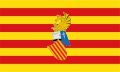 Flag used by Pre-autonomous Council of the Valencian Country (1979–1980). 2∶3
 -
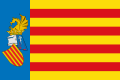 Proposed flag during the Statute of Benicassim.
 Unknown ratio
 -
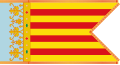 Historical version of the Valencian senyera, between 15th and 18th centuries. Unknown ratio


.svg)
Political Flags
-
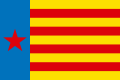
 Valencian nationalism estrelada.
 Unknown ratio
 -


.svg)
Gallery
[edit]-
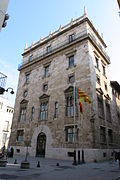 Hoisted at the Palau de la Generalitat
 -
 Flying at top of Torres de Serranos (Valencia)
 -
 Another senyera hoisted at Tower of Serrans
 -
 At top of Torres de Quart (Valencia)


_a_les_Torres_de_Serrans.JPG)

Flag protocol
[edit]The flag of Valencia is to be hoisted both outside and inside of each and every public and civil building of the Valencian Community, without endangering the prominence and most honorable place of the Flag of Spain. It has to be hoisted at the right of the National flag (left from viewer's point). The Flag of Valencia should not be larger than the Flag of Spain nor smaller than the flags of other entities.[5]
See also
[edit]References
[edit]- ^ Estatuto de Autonomía de la Comunidad Valenciana [Statute of Autonomy of the Valencian Community] (Ley Orgánica 5/1982, 4) (in Spanish). Vol. 164. 1 July 1982. pp. 18813–18820 – via BOE.
- ^ Manual de Consells. 1375–1383. f. 87r. A-17 – via Arxiu Municipal de València (AMV).
- ^ Por el que se regulan los símbolos, tratamientos y honores de las entidades locales de la Comunidad Valenciana (PDF) (Decret 116/1994, 12.2) (in Spanish and Catalan). Vol. 2302. 21 June 1994. pp. 7411–7420 – via DOGV.
- ^ Examples of this shape are the official flags of Vall de Gallinera and Betxí. See Consell Tècnic d’Heràldica i Vexil·lologia (2019). Escuts i banderes dels municipis de la Comunitat Valenciana [Coats of arms and flags of the Valencian Community municipalities] (in Spanish and Catalan). Valencia, Spain: Generalitat Valenciana. pp. 228, 270. ISBN 978-84-482-6420-8.
- ^ Por la que se regulan los símbolos de la Comunidad Valenciana y su utilización (Ley 8/1984, Título V) (in Spanish). Vol. 23. 4 December 1984. pp. 2256–2262 – via BOE.
External links
[edit]
- Spanish Vexillological Society on the Valencian flag Spanish Only
- Organic Law of the valencian Statute Spanish only
- Catalan vexilological society on the Valencian flag Spanish only
- butronmaker.blogspot.com Historic images
Flag of the Valencian Community
View on GrokipediaDesign and Elements
Physical Description
The flag of the Valencian Community is rectangular with proportions of 1:2 (height to width).[4] It features a traditional Senyera consisting of a yellow field (or in heraldic terms) bearing four equally spaced horizontal red bars (gules), each spanning the full width of the flag and positioned symmetrically within the yellow background.[5] Along the hoist side, a vertical blue stripe (azure) is overlaid, upon which the official coat of arms of the Valencian Community is centered.[5] The red bars are arranged such that the yellow field is divided horizontally into nine equal parts, with the four red bars each occupying two-ninths of the height and the intervening yellow spaces one-ninth each, ensuring balanced spacing from top and bottom.[2] The blue stripe extends the full height of the flag and has a width approximately equal to one-third of the flag's total width, though exact dimensions may vary slightly in practice while maintaining heraldic proportions.[2] The official model specifies use of silk or taffeta for ceremonial versions, with durable fabrics for general use.[4]Colors and Proportions
The flag comprises a vertical blue stripe along the hoist side adjacent to a yellow field with four equally spaced horizontal red bars. The colors follow heraldic conventions: azure for the blue stripe, or (gold-yellow) for the field, and gules for the bars.[1][2] No statutory chromatic specifications exist, such as Pantone matches or RGB values, permitting variations in modern reproductions while adhering to traditional shades; proposed technical standardization of the blue using CIELAB coordinates per UNE norms remains unimplemented.[6] The blue stripe conventionally occupies one-quarter of the hoist width, with the red bars each spanning one-fifth of the yellow field's height, positioned as the second, third, fourth, and fifth bands from the top.[2] Overall proportions lack legislative definition but are standardly 2:3 in contemporary depictions, aligning with common Spanish regional flag ratios, though historical versions occasionally used 1:2.[7][8] This flexibility reflects the flag's evolution from medieval precedents without rigid modern codification.[9]Coat of Arms Integration
The coat of arms, or emblema, of the Valencian Community derives directly from the historical heraldry of the Kingdom of Valencia, featuring the core senyera elements shared with the flag. Defined in Article 6 of Ley 8/1984, de 4 de diciembre, the emblema consists of a shield inclined to the right (partido y cortado), of or (gold) with four pales of gules (red), timbred with a silver helmet crowned and mantled in azure embroidered with a silver cross patée curvilínea, for crest a dragon nascient of or, winged, langued and dented of gules and silver.[9] This design, implanted by King Peter IV the Ceremonious in the 14th century, represents the ancient royal arms of Valencia under the Crown of Aragon.[1] While the official flag—described in Article 2 of the same law as the traditional senyera of four red bars on yellow background with a blue stripe along the hoist—does not superimpose the full coat of arms, the integration manifests in their mutual foundation on the senyera charge.[9] The flag serves as a simplified banner of arms, emphasizing the quartered pales without the helmet, mantling, or dragon, which are reserved for the emblema's more ceremonial form. This distinction preserves the flag's vexillological clarity for widespread use, as mandated to fly prominently in public buildings, while the emblema appears on seals, documents, and the estandarte (a carmine field bearing the arms with golden fringe, per Article 7).[9][1] Historically, this heraldic linkage traces to medieval precedents where banners and shields interchangeably displayed the Aragonese bars, adapted for Valencia post-conquest in 1238. The 1982 adoption via the Autonomy Statute (Article 4) and subsequent 1984 law codified the separation to avoid cluttering the flag, aligning with principles of effective flag design prioritizing visibility from afar. No provisions in the regulating legislation authorize routine superposition of the emblema onto the flag, distinguishing it from variants like the city of Valencia's senyera coronada with a central crown.[9]Historical Origins and Evolution
Roots in the Crown of Aragon
The flag of the Valencian Community derives from the senyera, the traditional banner of the Crown of Aragon consisting of four red bars (* pals*) on a yellow (golden) field, which symbolized the union of Aragonese territories including Aragon proper, Catalonia, and later Valencia. This design predates the 13th century and was employed as a royal standard by the Aragonese monarchy, reflecting heraldic continuity from the Kingdom of Aragon's expansion.[10] The senyera's adoption in Valencia stemmed directly from the military campaigns of King James I of Aragon, who incorporated the region into the Crown following its conquest from Muslim rule.[3] James I's conquest culminated on September 28, 1238, when Valencian Muslim defenders surrendered the city, prompting the hoisting of the Penó de la Conquesta—a triangular pennon variant of the senyera—atop the tower of Alí-Bufat (later Torre del Temple) as a formal sign of capitulation and Aragonese sovereignty. This event marked the banner's introduction as a symbol of Valencian subjugation and subsequent governance under the Crown, with the original penó preserved to this day as the world's oldest extant battle flag. James I explicitly granted the senyera to the city of Valencia by late 1238, establishing it as the municipal emblem and linking local identity to the broader Aragonese heraldic tradition.[3][11] Under the Crown of Aragon, the Valencian senyera retained its core form without the additional blue stripe sometimes associated with Catalan variants, emphasizing fidelity to the original four-bar Aragonese pattern. Historical records indicate occasional augmentations, such as a proposed fifth bar representing Valencia itself, but these did not supplant the standard design used in official contexts.[12] The banner's persistence through the 14th and 15th centuries underscores its role in affirming loyalty to the Aragonese dynasty amid the Crown's Mediterranean expansions, predating modern regional autonomy by centuries.[3]Medieval Usage and Variations
The introduction of the Senyera to Valencia occurred during the conquest led by James I of Aragon, culminating on September 28, 1238, when Muslim defenders raised the Penó de la Conquesta—a pennon bearing four red bars on a gold field—from the tower of Alí Bufat to signal surrender.[3] This artifact, approximately 2 meters long and inscribed with "año 1238," represents the oldest extant physical flag globally and was subsequently preserved as a relic, first in the Monastery of Sant Vicent de la Roqueta until 1838, then transferred to Valencia's municipal archives.[11] [3] James I formalized the Senyera's role by granting it to Valencia as the emblem of its newly established free municipality, embedding the design—derived from the royal arms of the Crown of Aragon—into local governance and identity within the nascent Kingdom of Valencia.[3] Throughout the 13th to 15th centuries, the flag served as a standard for royal, military, and civic purposes, reflecting Aragon's dominion over the territory reconquered from Almohad rule.[3] Medieval variations primarily manifested in shape and application rather than core coloration or barring. Royal and expeditionary uses favored elongated pennons or swallow-tailed banners for visibility in battle, as exemplified by the Penó de la Conquesta, while urban and institutional contexts employed rectangular forms akin to the Senyera's traditional layout.[3] By the late medieval period, particularly from the 14th century onward, some representations incorporated auxiliary heraldic motifs, such as crosses of St. George or local escutcheons, though these did not alter the fundamental four-bar composition inherited from Aragonese sovereignty.[3] Naval ensigns occasionally featured striped adaptations for distinction at sea, underscoring the flag's adaptability across terrestrial and maritime domains under the Kingdom's juries and fueros.[11]Modern Reconstructions and 19th-Century Revival
In the 19th century, the Senyera experienced a resurgence in Valencia amid a cultural renaissance that highlighted regional heritage and traditions, fostering a renewed emphasis on symbols tied to the medieval Kingdom of Valencia. Regionalist movements, influenced by broader European Romantic nationalism, adopted the flag to assert local identity against centralized Spanish governance, incorporating it into festivals, literary works, and public displays that evoked historical autonomy. This revival, while not escalating to full-fledged nationalism, marked a shift from post-Nueva Planta suppression toward symbolic reclamation, with the Senyera appearing in events like early commemorations of the 1238 conquest.[13][14] Modern reconstructions of the Senyera have focused on scientific analysis and faithful replication of historical variants to support preservation, education, and ceremonial use. The Instituto Valenciano de Conservación y Restauración de Bienes Culturales (IVCR+i) conducted detailed examinations of the 1545 Real Senyera, identifying four primary colors—red, yellow, bluish-gray, and green—along with metallic elements, to guide facsimile production. These efforts ensure accurate reproduction of period materials, fringes, and proportions for public parades and museum displays.[15][16] In 2025, Valencia's city council allocated 185,000 euros for a new replica incorporating embroidered details, cords, tassels, and textile components, scheduled for debut in the October 9 parade by 2027, replacing worn versions and adhering to strict heraldic protocols. Such initiatives reflect ongoing institutional commitment to vexillological accuracy, drawing on archival artifacts like the Pennon of the Conquest to reconstruct swallow-tailed or guidon forms from the 15th to 18th centuries.[17][18]Adoption and Political Context
Post-Franco Transition Debates
During the Spanish transition to democracy after Francisco Franco's death on November 20, 1975, debates over the flag of the Valencian Community emerged as part of broader identity conflicts known as the Battle of Valencia. These centered on whether to adopt the plain Senyera—a quartered flag of four red bars on gold, shared with the Crown of Aragon and Catalonia—or the version with a distinctive blue stripe (franja blava) along the hoist, historically associated with the city of Valencia. Proponents of cultural affinity with Catalonia, drawing from Joan Fuster's 1962 essay Nosaltres els valencians, argued for the unadorned Senyera as a symbol of shared Països Catalans heritage, dismissing the blue stripe as a modern or municipal addition lacking kingdom-wide precedent.[19][20] Opposing this view, groups coalescing into Blaverism—a movement emphasizing Valencian specificity against perceived Catalan overreach—defended the franja blava as essential to distinguish the flag from Catalonia's, citing documentary evidence of its use in Valencia from the 15th century onward, possibly tracing to privileges granted by King James I in the 13th century. Blaverists, often aligned with conservative and regionalist factions, viewed the plain Senyera as an imposition eroding local history, leading to protests including the burning of unadorned flags at Valencia's city hall during celebrations on October 9, 1979, Valencian Community Day. These clashes reflected deeper tensions over language normalization and autonomy scope, with Blaverist actions sometimes turning violent against Catalanist offices and publications.[21][19][20] The Pre-autonomous Council (Consell Preautonòmic), established in 1978 under socialist leadership, adopted the plain Senyera from 1979 to 1980, fueling Blaverist mobilization and riots in Valencia that year. During negotiations for the Autonomy Statute at Benicàssim in 1978, proposals included variants without the blue stripe, but street protests and political pressure from Blaverist sympathizers across parties compelled compromise. Academic analyses note Blaverism's heterogeneous nature, encompassing both reactionary elements resisting democratic reforms and genuine defenders of foral traditions, though its anti-Catalan rhetoric often amplified divisions. The debate's resolution favored the blue-fringed version, equating it to the city flag, as enshrined in the 1982 regulations, prioritizing empirical historical usage over ideological unity claims.[22][19]1982 Official Adoption
The flag of the Valencian Community received official status on 1 July 1982 through Organic Law 5/1982, enacting the Statute of Autonomy for the region under Article 143 of the Spanish Constitution of 1978.[5] This legislation formalized the autonomous institutions following the transition to democracy, with the flag defined in Article 4 as a core identifying symbol alongside the official language and capital.[5] Article 4, paragraph 1 precisely describes the design: "La Bandera de la Comunitat Valenciana es la tradicional Senyera compuesta por cuatro barras rojas sobre fondo amarillo, coronadas sobre franja azul junto al asta."[5] This configuration positions the four red stripes on a yellow field atop a horizontal blue stripe along the hoist, drawing from medieval precedents of the Senyera while incorporating the blue element associated with the historical Kingdom of Valencia's maritime and institutional banners.[5] The statute's preamble underscores the flag's role in expressing the Valencian people's historical identity within the Spanish state, avoiding novel inventions in favor of established heraldic continuity.[5] Paragraph 2 of Article 4 delegates to a future law of Les Corts Valencianes the determination of the region's proper heraldic symbology, encompassing the three provinces of Castellón, Valencia, and Alicante.[5] The law was approved by the Cortes Generales and sanctioned by the King, entering into force upon publication in the Boletín Oficial del Estado on 10 July 1982, thereby establishing the flag's legal equivalence to other autonomous community emblems.[5] This adoption concluded initial post-transition efforts to codify regional symbols, setting the basis for subsequent regulatory details in Law 8/1984 on symbol usage.[23]Role in Valencian Autonomy Statute
The Estatuto de Autonomía de la Comunitat Valenciana, enacted through Organic Law 5/1982 on July 1, 1982, formally designates the flag as an official symbol of the autonomous community in Article 4.1, describing it as "la tradicional Senyera compuesta por cuatro barras rojas sobre fondo amarillo, coronadas sobre franja azul junto al asta."[24] This provision codifies the flag's design—four red bars on a yellow field, with a blue vertical stripe at the hoist side and a crown atop the bars—establishing its legal equivalence to other regional emblems like the coat of arms and anthem outlined in subsequent articles.[24][25] By embedding the flag's specification within the statute's foundational articles on identity and symbols (Título Preliminar), the law integrates it into the constitutional framework governing Valencian self-governance, affirming its role as a marker of historical nationality as recognized in Article 1.[24] The statute's approval by the Spanish Cortes Generales on June 25, 1982, and ratification via referendum on October 10, 1982, thereby enshrined the flag as a protected element of regional sovereignty, subject to protocols for display and precedence alongside Spanish national symbols.[5] This legal entrenchment resolved prior transitional uncertainties from the pre-autonomous period, providing a binding reference for official usage by institutions like the Generalitat Valenciana.[24] Amendments to the statute in 2006 (Organic Law 1/2006) did not alter the flag's description, preserving its original formulation amid broader expansions of competencies, which underscores its enduring statutory stability as a core identifier of Valencian autonomy.[26] The provision's precision in design elements also serves to delineate the flag from analogous Aragonese-derived banners, ensuring its distinct application in regional administration and public ceremonies.[24]Symbolism and Interpretations
Traditional Meanings
The traditional Senyera of the Valencian Community originates from the banner granted by King James I of Aragon after the conquest of Valencia from Muslim rule on October 9, 1238, symbolizing the establishment of Christian sovereignty and the kingdom's allegiance to the Crown of Aragon.[27] This design, formalized in 1261 when James I swore the Furs de València and bestowed a copy of his royal standard upon the realm, embodies royal protection and the historical privileges extended to the Land of Valencia.[27] The core elements—four red bars (gules) arranged horizontally on a yellow (or) field—replicate the ancient arms of the House of Aragon, denoting imperial authority and the unification of territories under Aragonese rule.[1] The yellow field traditionally signifies the monarch's generosity and favor toward the Valencian populace, as granted post-conquest, while the red bars evoke the martial valor and bloodshed associated with defending the realm and the faith during the Reconquista.[28] A vertical blue stripe (azur) positioned adjacent to the hoist, documented in records from 1348 and officially recognized by 1377, represents the royal enamel of the Aragonese kings, underscoring lineage, justice, and the enduring bond of fealty.[28] [29] The quartered crown atop the blue stripe, introduced circa 1365–1383 by Peter IV in gratitude for Valencian resistance against Castilian forces in the War of the Two Pedros (1356–1369), further emphasizes the emblem's role as a marker of royal privilege and loyalty.[27] In medieval heraldry, the Senyera functioned as a battle standard and civic ensign, signifying not only territorial governance but also the contractual liberties (furs) upheld between the crown and Valencian institutions, as evidenced in portolans from around 1410 and municipal ordinances by 1449.[27] This interpretation prioritizes the flag's practical role in affirming jurisdictional autonomy within the composite monarchy, distinct from mere ornamental legend.[29]
Regional Identity Associations
The Senyera functions as a primary symbol of regional identity for the Valencian Community, linking inhabitants to the medieval Kingdom of Valencia founded after the 1238 conquest by James I of Aragon, which granted the territory its initial heraldic banner derived from the Crown of Aragon.[13] This association emphasizes historical resilience, as the flag endured suppressions during the 18th-century Nueva Planta decrees and the Franco dictatorship (1939–1975), emerging as an emblem of restored regional pride during the democratic transition.[13] Official statutes mandate its display in public buildings, positioning it as a marker of civic continuity and collective heritage distinct from broader Spanish or neighboring identities.[1] In contemporary usage, the flag embodies Valencian self-perception tied to foral traditions—autonomous legal customs rooted in medieval charters like the Furs de València—rather than linguistic or ethnic unification with adjacent regions.[1] It appears ubiquitously in cultural events, such as the October 9 Day of the Valencian Community, where ceremonies at Valencia's Palau de la Generalitat feature hoistings that celebrate the 1238 Battle of Valencia, fostering associations with local sovereignty and historical conquest narratives.[30] Sports entities like Valencia CF incorporate it in kits and anthems, framing the Senyera as a conduit for "pride and love for our land," thereby embedding it in everyday expressions of territorial attachment.[31] Regionalist movements since the 19th-century Renaixença revival have leveraged the flag to promote awareness of Valencian-specific history, including agricultural cooperatives (huertos) and irrigation systems like the Acequia de Rovella, which symbolize adaptive governance under the ancient kingdom.[13] Surveys indicate strong attachment, with over 70% of residents in 2020 polls identifying positively with regional symbols like the Senyera, often prioritizing it over national ones in local contexts, though without widespread secessionist connotations.[14] This reflects a pragmatic identity centered on economic autonomy—Valencia's ports and citrus exports—and cultural festivals like Las Fallas, where Senyera motifs adorn monuments, reinforcing communal bonds over ideological abstraction.[13]Distinctions from Similar Flags
The flag of the Valencian Community, known as the Reial Senyera, shares the foundational senyera pattern of four red horizontal bars (paleways gules) on a yellow (or) field with the flags of other former Crown of Aragon territories, including Catalonia, Aragon, and the Balearic Islands, reflecting their common medieval heraldic heritage from the 12th century onward.[2] However, it is distinguished by a vertical blue band (banda azure) positioned adjacent to the hoist side, which overlays or borders the senyera stripes and typically bears the regional coat of arms centered upon it.[2] This blue element, absent in the plain senyera of Catalonia—whose official flag consists solely of the four bars without additional charges or bands—serves as a primary visual differentiator, emphasizing Valencian regional specificity over shared Aragonese origins. In comparison to Aragon's flag, which superimposes a complex centered coat of arms (featuring the senyera, the cross of Íñigo Arista, and other symbols) directly onto the unadorned stripes in a 2:3 ratio, the Valencian version prioritizes the hoist-side blue band, with the coat of arms (depicting a crowned senyera on a blue field) integrated into that azure section rather than the field center. The Balearic Islands' flag similarly quarters the senyera with a heraldic escutcheon but lacks any blue hoist element, instead emphasizing partitioned arms including the red cross of Saint George. These modifications in the Valencian design, formalized in the 1982 autonomy statute, underscore a deliberate heraldic adaptation to incorporate local symbolism, such as allusions to the Mediterranean Sea via the blue or historical ties to the Order of Montesa, avoiding the undifferentiated senyera associated with broader Catalan or pan-Aragonese identities.[2] The official proportions of 2:3 further align it with modern Spanish regional standards, though historical variants occasionally deviated.[3]Usage, Protocol, and Legal Status
Official Regulations
The official regulations governing the flag of the Valencian Community are set forth in Ley 8/1984, of 4 December, which regulates the symbols of the Valencian Community and their utilization, in accordance with Article 6 of the Statute of Autonomy of the Valencian Community.[32] [1] Article 2 of the law defines the flag as the traditional senyera, consisting of four red bars on a yellow field, with a blue stripe positioned along the hoist side.[33] The legislation does not prescribe precise proportions, colors in standardized systems such as Pantone, or exact dimensions, relying instead on historical and traditional forms; however, administrative practice and vexillological standards commonly employ a 2:3 ratio, aligning with the proportions of the Spanish national flag.[2] Article 8 mandates that the flag must be hoisted outside and accorded a position of prominence inside all public and civil buildings throughout the Valencian Community, subordinate only to the honor position reserved for the flag of Spain.[1] [33] In official acts and ceremonies, the Valencian flag presides alongside the Spanish flag and other authorized symbols, ensuring its integration into civic life without supplanting national precedence.[34] Local entities, such as municipalities, may adopt complementary symbols under Ley 8/2010 on local regime, but these must not conflict with or obscure the Community flag's display in shared contexts.[35] The law implicitly and explicitly prohibits alterations to the flag's design, including the addition of emblems, acronyms, or inscriptions from political parties, trade unions, or private entities, to preserve its integrity as a public symbol.) Unauthorized modifications or uses that could degrade its dignity—such as commercial exploitation or disrespectful handling—are not permitted, with the intent to maintain the flag's role in fostering regional identity within the framework of Spanish sovereignty.[34] Compliance is enforced through administrative oversight by the Generalitat Valenciana, though no specific penal provisions are detailed in the 1984 law itself.[32]Protocols for Display
The flag of the Valencian Community must fly outside and occupy a preferred position inside all public and civil buildings within its territory, alongside the Spanish national flag.[33] This obligation, established under Article 8 of Ley 8/1984, de 4 de diciembre, ensures the symbol's prominence in official settings without subordinating the national flag.[9] In multi-flag displays, positioning follows strict precedence to honor the Spanish flag's superiority. When an odd number of flags are hoisted together, the Valencian flag occupies the position to the right of the Spanish flag (viewer's left). For an even number, it is placed immediately to the left of the Spanish flag (viewer's right).[9] Local municipal flags, if present, follow the regional flag in the sequence, with the European Union flag typically last unless otherwise specified by protocol.[36] During official ceremonies and public acts, the flags are arranged horizontally or vertically per the same order, with the Spanish flag in the central or right-central position depending on the total count. Hoisting occurs at sunrise and lowering at sunset, unless extended by authority for commemorative events, and the flag must remain fully visible and untorn.[36] In mourning periods, such as national or regional declarations of grief, the flag may be flown at half-mast only upon order from the President of the Generalitat Valenciana, following the Spanish flag's lead.[37] Private or non-official displays lack mandatory protocols but are encouraged to respect the flag's dignity, avoiding alterations or uses that could degrade its symbolic value, as per general Spanish vexillological norms integrated into regional practice.[36] Violations of public display rules, such as improper positioning or neglect in official buildings, can result in administrative sanctions under the oversight of local and regional authorities.[35]Equivalence with National Symbols
The flag of the Valencian Community, as established in Article 4 of the Statute of Autonomy (Ley Orgánica 5/1982, de 1 de julio), serves as an official emblem representing regional identity and is mandated for display alongside the Spanish national flag in public institutions and events within the territory.[5] This arrangement reflects the autonomous framework under the Spanish Constitution, where regional symbols complement national ones without supplanting them. Ley 8/1984, de 4 de diciembre, which governs the regulation and utilization of Valencian symbols, requires the regional flag to be hoisted externally and to hold a preferential interior position in all public and civil buildings, coexisting with the Spanish flag to integrate regional insignia into civic life.[23] When displayed jointly, the Spanish flag occupies the position of preeminence and highest honor, followed by the Valencian flag in the same horizontal plane, ensuring national sovereignty takes precedence while affording the regional banner prominent visibility.[23] National protocol under Ley 39/1981, de 28 de octubre, reinforces this hierarchy, stipulating that the Spanish flag must always claim the most distinguished spot among grouped banners, with no other flag permitted to exceed its dimensions or prominence.[37] In practice, this means the Valencian flag flies at equal height to the national one in regional settings like the Palau de la Generalitat but adheres to sequential ordering—typically Spanish on the observer's left or central for odd-numbered arrays—symbolizing unity within Spain's decentralized structure rather than parity of sovereignty.[23] Such provisions prevent any implication of equivalence in legal authority, prioritizing empirical state hierarchy over symbolic parity.Controversies and Disputes
Blaverism and Anti-Catalan Reactions
Blaverism emerged during Spain's transition to democracy in the late 1970s as a regionalist reaction against perceived Catalanist efforts to subsume Valencian identity within a broader Catalan framework, particularly the "Països Catalans" concept articulated by Joan Fuster in his 1962 book Nosaltres, els valencians. Adherents, often aligned with conservative and unionist sentiments, emphasized symbols distinguishing Valencia from Catalonia, including the Valencian flag's blue stripe (franja blava), a feature added to the city of Valencia's banner in the mid-19th century but elevated as a marker of separate heritage.[19][38] The flag dispute crystallized in 1979 when the Pre-autonomous Council of the Valencian Country adopted the pure senyera—four red bars on yellow without the blue stripe or crown—as the provisional emblem on April 25, prompting Blaverist accusations of cultural assimilation. Massive protests ensued, including a demonstration on October 6, 1979, against this symbol, viewed by opponents as identical to the Catalan flag.[39] Tensions peaked on October 9, 1979, during Valencian Community Day celebrations in Valencia's city hall plaza, where members of the Grup d'Acció Valencianista hurled an incendiary device at the hoisted senyera cuatribarrada, igniting it in a symbolic rejection of the "Catalanized" version. This act, part of broader clashes injuring dozens and involving thousands, underscored Blaverist commitment to the senyera real with its blue fringe and royal crown, historically tied to the Kingdom of Valencia's foral traditions.[40][41] These anti-Catalan reactions influenced the 1982 Statute of Autonomy, which enshrined the flag as "quartered in gold and gules, with a blue stripe at the hoist and the royal crown in the center," affirming the Blaverist-preferred design over purist alternatives. While successful in preserving this distinction, Blaverism faced criticism for associations with ultra-right violence, including nearly 70 bombings and assaults by linked groups between the late 1970s and 1980s, though proponents framed such actions as defensive against institutional Catalanist promotion in media and academia.[42]Cultural Battle of Valencia
The Cultural Battle of Valencia denotes the intense ideological clashes during Spain's democratic transition in the late 1970s and early 1980s, centering on Valencian regional identity, language policy, and symbolic representations including the flag. Blaverists, emphasizing a distinct Valencian essence tied to Spanish unity and historical foral traditions, contested the adoption of symbols perceived as aligning Valencia with broader Catalan nationalism, such as the plain four red bars (senyera) without distinctive Valencian modifications like the blue quarter. In contrast, fusterian autonomists promoted cultural affinities with Catalonia, favoring the unadorned senyera as a marker of shared linguistic and historical heritage.[43][44] The flag emerged as a primary battleground following the Pre-autonomous Council's decision on April 25, 1979, to adopt the four-bar senyera as the provisional emblem, devoid of the blue stripe historically associated with Valencia's municipal and regional variants. This choice ignited protests from blaverist groups, who viewed the plain design as an imposition of pancatalanismo and demanded retention of the "senyera coronada" with franja blava to underscore separation from Catalan symbols. Tensions escalated into street violence, notably on May 11, 1979, when the flag was first hoisted at the Palau de la Generalitat, prompting confrontations between supporters and opponents.[39][44][27] Climactic disturbances occurred on October 9, 1979, during Valencia's Diada celebrations, where blaverist ultras assaulted marchers displaying the provisional senyera, leading to injuries, arrests, and widespread disorder that overshadowed the event. These riots, numbering in the hundreds of incidents, reflected deeper societal divisions, with blaverists framing the flag dispute as a defense against cultural assimilation. The conflicts persisted until the 1982 Statute of Autonomy formalized the senyera with the coat of arms at center—omitting the blue quarter explicitly—but leaving interpretive ambiguities that fueled ongoing symbolic debates.[40][45][46] This episode entrenched the flag as a litmus test for identity politics, with blaverism leveraging it to mobilize against perceived threats, while autonomists decried the violence as reactionary suppression of regional expression. Empirical surveys from the era, such as those by the Valencian Institute of Statistics, indicated majority support for a unique Valencian flag variant, though political polarization amplified minority extremisms on both sides. The battle's legacy persists in periodic revivals, as seen in 2023 governmental rhetoric invoking "batalla cultural" against pancatalanismo, underscoring the flag's enduring role in identity contestation.[47][48]Ongoing Symbolic Tensions
In recent years, symbolic tensions surrounding the Valencian flag have centered on its use during annual commemorations like the 9 October Día de la Comunitat Valenciana, where traditionalist organizations such as Lo Rat Penat have accused institutions of undermining the Real Senyera's prominence. On 9 October 2025, during the Te Deum in Valencia Cathedral, Lo Rat Penat and the Real Acadèmia de Cultura Valenciana protested the archbishop's refusal to allow their historic Real Senyera—characterized by the crowned design with blue hoist stripe—inside the temple, interpreting it as a deliberate break from longstanding protocol that prioritizes the flag's entry ahead of other elements.[49][50] This incident echoed broader grievances, including a 2 October 2025 refusal by the PSOE's Valencia city council spokesperson to process with the Senyera into the cathedral, signaling partisan resistance to its ceremonial centrality.[51] Further disputes arose over perceived intrusions of non-Valencian symbols, with Lo Rat Penat condemning the display of what they identified as the Catalan senyera—lacking the blue stripe and crown—in official 9 October posters in municipalities like Xàtiva and Pèg, framing it as an intentional cultural assimilation effort aligned with Països Catalans ideology.[52] In response, Valencian president Carlos Mazón issued a decree on 17 September 2025 barring public subsidies to groups promoting estelades (Catalan-derived independence flags with stars) or the Països Catalans concept, aiming to safeguard the official Senyera's distinctiveness amid ongoing nationalist pressures.[53] These episodes highlight persistent debates over design elements like the blue hoist franja, which blaverist advocates maintain as a medieval addition for regional differentiation from the Aragonese-Catalan senyera, against simpler variants favored by pro-Catalan or independence-leaning factions.[54] While the Senyera Coronada enjoys statutory protection under the 1982 Estatut d'Autonomia, such conflicts underscore unresolved identity frictions, with traditionalists viewing deviations as erosions of Valencian sovereignty rooted in the 1238 Conquest.[21]Cultural and Social Impact
Public Reception
The flag of the Valencian Community, known as the Reial Senyera, garners widespread public support as a core symbol of regional identity and historical continuity, evidenced by its routine display on public buildings, during civic events, and in expressions of communal solidarity. Adopted officially in 1982 per the Statute of Autonomy, it draws on medieval traditions tracing to the conquest by James I of Aragon in 1238, with the quartered design incorporating the blue stripe and crown reflecting armorial elements formalized over centuries.[1] Its popularization accelerated in the 19th century amid Valencia's economic expansion, extending use of the crowned variant from Burriana to Denia and embedding it in local customs and festivities.[21] This enduring appeal manifests in the flag's unique royal privileges, such as not being lowered except in reverence to divine authority, a distinction underscoring public esteem for its regal heritage.[55] In contemporary contexts, the flag has served as a rallying emblem during crises, notably after the October 29, 2024, DANA floods, where mud-encrusted versions affixed to residences captured widespread sentiment of resilience and attachment, circulating prominently in media and social imagery.[56] Official ceremonies, such as the October 8, 2025, honoring event led by city officials, further highlight institutional and public veneration, with the banner escorted in processions symbolizing collective patrimony.[57] While broadly accepted, the design faces critique from subsets favoring a "pure" four-barred Senyera without the blue quarter or crown, often tied to linguistic or ideological preferences for alignment with broader Catalan symbols; such views, however, remain marginal in official and mainstream usage, with political initiatives like Vox's 2024 push to restrict non-official variants in legislative settings reflecting defense of the established form among significant portions of the populace.[58]Use in Regional Events
The flag of the Valencian Community, known as the Reial Senyera, plays a central role in the annual Day of the Valencian Community on October 9, which commemorates the conquest of Valencia by King James I of Aragon in 1238. During the festivities in Valencia city, the historic Reial Senyera—preserved since the medieval period—is carried in a solemn procession from the Municipal Historical Museum to the Ayuntamiento, where it presides over official acts from the main balcony, a practice observed since at least 1365.[59] [60] At noon, the flag is ceremonially lowered amid fireworks, parades, and traditional dances, symbolizing regional autonomy and historical continuity, with replicas widely displayed across the Valencian Community's municipalities.[61] [62] In Las Fallas, the UNESCO-recognized festival held annually from March 1 to 19 in Valencia and surrounding areas, the Senyera is integrated into the cultural displays as a marker of local identity, often flown from commission headquarters (falla sites) and incorporated into fallero attire and monuments that critique contemporary issues while honoring Valencian heritage.[63] Participants in the parades and pyrotechnic events use the flag to evoke communal pride, with its red-and-yellow bars contrasting against the burning ninots on March 19, though official protocols limit certain symbolic additions to avoid partisan alterations.[64] The flag also appears in other regional fiestas, such as the Moros y Cristianos reenactments in towns like Alcoy and Villena, where historical processions feature it alongside medieval banners to represent the Kingdom of Valencia's legacy during mock battles commemorating the Reconquista, typically in April or September depending on the locality. In these events, the Senyera underscores territorial distinctiveness, with groups (filàs) incorporating it into costumes and floats to affirm non-Catalan regionalism amid debates over shared Iberian symbols.[65]Influence on Valencian Identity
The Senyera Coronada, adopted following James I of Aragon's conquest of Valencia in 1238, has served as a foundational emblem of Valencian autonomy and historical continuity, representing the establishment of the Kingdom of Valencia within the Crown of Aragon.[13] This flag, featuring four red stripes on a yellow field with a blue quarter and crown, evokes the realm's distinct legal and cultural framework, including its Furs or charters, which persisted until the Nueva Planta decrees of 1707-1716 suppressed regional privileges after the War of the Spanish Succession.[13] By symbolizing resilience against centralizing forces, it anchored early notions of Valencian particularism.[29] During the 19th-century Renaixença cultural revival, the Senyera reemerged as a potent symbol of regional identity, championed by figures like Vicent Boix to rally sentiment against cultural assimilation under liberal centralism.[29] Regionalist movements adopted it to assert Valencian heritage, linking it to medieval prosperity and linguistic traditions, thereby fostering a collective pride that distinguished Valencia from Castilian dominance.[13] This period marked the flag's transition from heraldic banner to popular icon, influencing literature, festivals, and political discourse. In the democratic transition after Francisco Franco's death in 1975, the Senyera became central to identity formation amid debates over autonomy statutes, with the blue quarter—added in variants from the 14th century—emphasized by Blaverists from 1977 to 1983 to reject pan-Catalan claims and affirm a separate Valencian nationality.[20] These disputes, pitting distinctivists against integrationists, shaped the 1982 Statute of Autonomy's recognition of the traditional Senyera, reinforcing its role in delimiting cultural boundaries, particularly regarding language normalization where Valencian usage lagged behind Catalan norms.[20] The flag's prominence in public rallies and institutional displays during this era helped consolidate a post-dictatorship identity focused on historical sovereignty rather than broader linguistic unions.[13] Contemporary usage sustains this influence, as the Senyera adorns public edifices, Fallas festivals, and sporting venues like Valencia CF matches, evoking shared narratives of endurance and self-determination.[13] Its vitality, as noted in cultural analyses, mirrors the robustness of Valencian collective memory, countering homogenization pressures while navigating persistent symbolic tensions.[29]References
- https://es.wikisource.org/wiki/Ley_8_1984_CV