



Community hub
0 subscribers7 pages, 0 posts
Recent from talks
Be the first to start a discussion here.
Be the first to start a discussion here.
Be the first to start a discussion here.
Be the first to start a discussion here.
Contribute something
Welcome to the community hub built to collect knowledge and have discussions related to List of Burmese flags.
Nothing was collected or created yet.
List of Burmese flags
View on Wikipediafrom Wikipedia
This is a list of flags used in Myanmar (also known as Burma).
State/Union Flag
[edit]| Flag | Date | Use | Description |
|---|---|---|---|

|
21 October 2010[1] | State Flag[2] of Republic of the Union of Myanmar, also called the Union Flag[3] | A horizontal triband of yellow, green and red; charged with a large white five-pointed star at the centre |
| Variants | |||
.svg)
|
Vertical[4] | ||
Flags of administrative divisions
[edit]States
[edit]| Flag | Date | Use | Description |
|---|---|---|---|

|
1986[5] | Flag of Chin State | Hornbill on a branch within a white circle surrounded by 9 white stars atop a blue-red-green horizontal triband |

|
2010 | Flag of Kachin State | Blue circle with white mountains defaced with Manaw poles on a green field |

|
2010 | Flag of Kayah State | A Kinnara centred on a red-blue-green horizontal triband |

|
Flag of Kayin State | Blue-white-red horizontal triband with a white star inset on top-left of blue band | |
.svg)
|
8 June 2018[6] | Flag of Mon State | Yellow Hamsa on a red field |

|
Flag of Rakhine State | Emblem of Rakhine, a Shrivatsa, on a blue disk in the centre of a white-red horizontal bicolour | |

|
12 February 1947[7] | Flag of Shan State | White circle, representing the moon, on a yellow-green-red horizontal triband |
Regions
[edit]| Flag | Date | Use | Description |
|---|---|---|---|

|
2022 | Flag of Ayeyarwady Region | Seal of Ayeyarwady Region on a blue field |

|
c. 2018 | Flag of Bago Region | Female hamsa perched on a male hamsa within a white circle bordered in green on a dark blue field. The text ပဲခူးတိုင်းဒေသကြီး ("Bago Region") is above the birds. |

|
2021 | Flag of Magway Region | Seal of Magway Region on a yellow field with the text မကွေးတိုင်းဒေသကြီး ("Magway Region") above the seal in green. |
.svg)
|
2010 (except 2021) | Flag of Mandalay Region | Seal of Mandalay Region on a red field |
.svg)
|
30 September 2019 [8] | Flag of Sagaing Region | Seal of Sagaing Region centred on a yellow-blue-red horizontal triband with the text စစ်ကိုင်းတိုင်းဒေသကြီး ("Sagaing Region") above the seal within the yellow band. |

|
2010 | Flag of Tanintharyi Region | Naga facing forward with a white star above on a red-blue-green horizontal triband |

|
2022 | Flag of Yangon Region | Inner portion of the Seal of Yangon Region centred on a yellow-green-red horizontal triband with the text ရန်ကုန်တိုင်းဒေသကြီးအစိုးရအဖွဲ့ ("Yangon Region Government Group") on a white banner below the seal. |
Union territory
[edit]| Flag | Date | Use | Description |
|---|---|---|---|

|
Flag of the Naypyidaw Union Territory | Seal of the Naypyidaw Union Territory on a teal-blue field |
Self-administered zones and divisions
[edit]Self-administered zones
[edit]| Flag | Date | Use | Description |
|---|---|---|---|

|
2017[9] | Flag of the Danu Self-Administered Zone[10][11][12] | Blue over yellow bicolour with a green disc at the centre charged with a white flower |

|
Flag of the Kokang Self-Administered Zone | Blue-red-green horizontal triband charged with a white star and 8 white circular rings forming an arc above the star. | |

|
Flag of the Naga Self-Administered Zone[13][12] | White over red bicolour with a green square in the upper hoist charged with two crossed spears and a tribal headdress | |

|
Flag of the Pa Laung Self-Administered Zone | Red circle on a light blue-yellow-green horizontal triband. | |

|
1955 | Flag of the Pa'O Self-Administered Zone[12] | White star within a blue canton on a red-green horizontal bicolour |
Self-administered divisions
[edit]| Flag | Date | Use | Description |
|---|---|---|---|
|
|
Flag of the Wa Self-Administered Division | There is no official flag, the flag of Myanmar is used |
Military flags
[edit]| Flag | Date | Use | Description |
|---|---|---|---|
_of_Myanmar.svg)
|
Flag of the Myanmar Armed Forces (Tatmadaw)[14][15] | A horizontal triband of red, white and blue; charged with a large yellow five-pointed star at the centre [16] | |
.svg)
|
Flag of the Ministry of Defence (Myanmar) |
Commander-in-Chief
[edit]| Flag | Date | Use | Description |
|---|---|---|---|
.svg)
|
2015 | Flag of the Commander-in-Chief of Defence Services[17][18] | A red, dark blue, light blue horizontal tricolour defaced with five golden stars under golden logo of Tatmadaw[16] |
.svg)
|
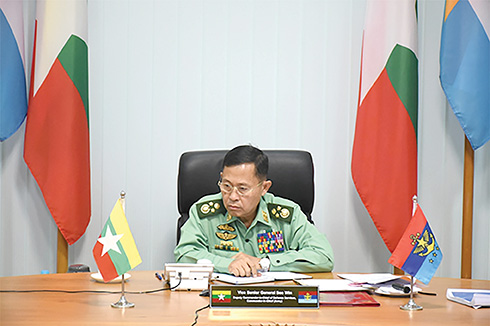
2015 | Flag of the Deputy Commander-in-Chief of Defence Services[19] | A red, dark blue, light blue horizontal tricolour defaced with four golden stars under golden logo of Tatmadaw |
_flag_of_Myanmar.svg)
|
c. 2015 | Flag of the Office of the Commander-in-Chief (Army) | A red defaced with four golden stars under golden logo of Tatmadaw |
_flag_of_Myanmar.svg)
|
c. 2015 | Flag of the Office of the Commander-in-Chief (Navy) | A dark blue defaced with four golden stars under golden logo of Tatmadaw[20] |
_flag_of_Myanmar.svg)
|
c. 2015 | Flag of the Office of the Commander-in-Chief (Air Force) | A light blue defaced with four golden stars under golden logo of Tatmadaw |
Army
[edit]| Flag | Date | Use | Description |
|---|---|---|---|

|
c. 1994 | Flag of the Myanmar Army | A horizontal triband of blue, red and blue; charged with a large white five-pointed star at the centre |

|
Ceremonial Guidon of the Myanmar Army |
Regional Military Commands
[edit]| Flag | Use | Description |
|---|---|---|

|
Flag of the Northern Command | |

|
Flag of the North Western Command | |

|
Flag of the North Eastern Command | |

|
Flag of the Eastern Command | |

|
Flag of the Eastern Central Command | |

|
Flag of the Triangle Region Command | |

|
Flag of the Western Command | |

|
Flag of the Naypyitaw Command | |

|
Flag of the Central Command | |

|
Flag of the Southern Command | |

|
Flag of the South Western Command | |

|
Flag of the Yangon Command | |

|
Flag of the South Eastern Command | |

|
Flag of the Coastal Region Command |
Common flags
[edit]| Flag | Use | Description |
|---|---|---|

|
Flag of the Infantry and Light Infantry | A red field charged with Bandula badge: a white ancient Burmese helmet crossed by a white sword and a white spear |

|
Flag of the Artillery Corps | |

|
Flag of the Engineering Corps | |

|
Flag of the Signal Corps | |

|
Flag of the Armour Corps | |

|
Flag of the Medical Corps | |

|
Flag of the Corps of Supply and Transport | |

|
Flag of the Ordnance Services | |

|
Flag of the Corps of Electrical and Mechanical Engineering | |

|
Flag of the Defence Industries | |

|
Flag of the Security Printing Works | |

|
Flag of the Recovery and Resettlement Units | |
|
|
Flag of the Border Guard Forces[21] | Recently, Tatmadaw ordered to change the arm patch of Border Guard and People’s militia.[22] |
Battalions
[edit]| Infantry Battalions | |

|
Flag of the No. (14) Infantry Battalion |
Divisions
[edit]| Light Infantry Divisions | |

|
Flag of the No. (11) Light Infantry Division |

|
Flag of the No. (22) Light Infantry Division |

|
Flag of the No. (33) Light Infantry Division |

|
Flag of the No. (44) Light Infantry Division |

|
Flag of the No. (55) Light Infantry Division |

|
Flag of the No. (66) Light Infantry Division |

|
Flag of the No. (77) Light Infantry Division |

|
Flag of the No. (88) Light Infantry Division |

|
Flag of the No. (99) Light Infantry Division |

|
Flag of the No. (101) Light Infantry Division |
Navy
[edit]| Flag | Date | Use | Description |
|---|---|---|---|

|
1994 | Naval ensign of the Myanmar Navy | White field with a red canton charged with a white five-pointed star and a blue anchor in the lower fly [20] |

|
Commissioning pennant of the Myanmar Navy |
Air Force
[edit]| Flag | Date | Use | Description |
|---|---|---|---|

|
c. 2010s | Air force ensign of the Myanmar Air Force | A seagull field defaced with the Union Star in the canton, with the Myanmar Air Force crest to the fly |
Law enforcement flag
[edit]| Flag | Date | Use | Description |
|---|---|---|---|

|
Flag of the Myanmar Police Force | Three vertical bands of yellow, blue and red with a union star in the middle | |

|
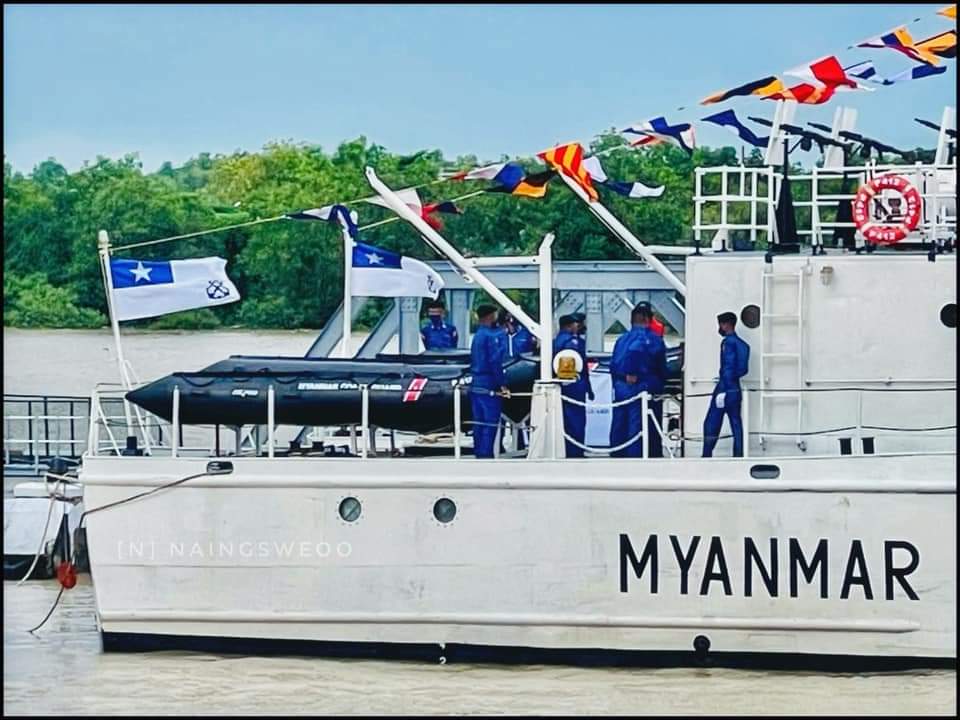
Ensign of the Myanmar Coast Guard | White field with a blue canton charged with a white five-pointed star and two blue anchor crossed in the lower fly [23] |
Ministry flags
[edit]| Flag | Date | Use | Description |
|---|---|---|---|

|
Flag of the Ministry of Education | ||
|
|
Flag of the Ministry of Defence[24] | A red field charged with logo of Tatmadaw | |

|
Flag of the Ministry of Home Affairs[25] | A horizontal triband of blue, yellow and green; charged with a black text of Burmese word for "Home Affairs" (ပြည်ထဲရေး) on the yellow band. |
Religious flags
[edit]| Flag | Date | Use | Description |
|---|---|---|---|

|
1956 | Sasana Flag, the flag of Buddhism in Myanmar | Vertical bands of blue, yellow, red, white, light pink and the vertical band of the combination of these five colours' rectangular bands.[26] |

|
A variant using pink in place of light pink | ||

|
1954 | Flag of the Republic of the Union of Myanmar Islamic Religious Affairs Council | A red field defaced with a green rectangular canton with the Takbir in the upper hoist[27] |

|
Flag of the Young Men's Buddhist Association | A horizontal triband of yellow, green and red; charged with a yellow circle at the centre; a green Swastika on that circle and each of the four red alphabets — "Y", "M", "B", "A" — inside each blank between the arms of Swastika [28] |
Political flags
[edit]


.svg)
.svg)
_and_(1946-1970).svg)


Other
[edit]| Flag | Date | Use | Description |
|---|---|---|---|

|
2021 | Three-finger salute flag | A red field charged with a white three-finger salute symbol. Flown in opposition against the 1st February Coup |
Armed groups
[edit]


.png)


.png)

.png)


_Flag.svg)


.png)


Historical flags
[edit]National
[edit]| Flag | Date | Use | Description |
|---|---|---|---|

|
c. 1300s – c. 1500s | Flag used in the Hanthawaddy Kingdom | A green field with a golden hamsa in the centre |

|
c. 1510s – 1752 | National flag of the Second Burmese Empire under the Taungoo Dynasty | A golden field charged with a black peacock |
.svg)
|
c. 1752 – 1885 | National flag of the Third Burmese Empire under the Konbaung Dynasty | A swallowtail with white field charged with a green peacock biting a flower branch on a red disk (the sun) in the centre of the field [29][30][31][32] |

|
1824 – 1942; | Union Flag of The United Kingdom used as the State flag of British Burma | |
| 1945 – 4 January 1948[33] | |||
.svg)
|
6 February 1939 – 30 March 1941;[34] | National Flag of British Burma | British Blue Ensign with the Union Jack occupying one quarter of the field placed in the canton and defaced with the Badge of Burma: a peacock on a golden disk |
| 1945 – 3 January 1948 | |||
.svg)
|
30 March 1941 – 1942[34] | National Flag of British Burma | Union Jack removed and the badge moved to centre |
.svg)
|
1942–1943 | Flag of Japanese occupied Burma | |

|
1 August 1943[34][35] – 1945 | State flag of the State of Burma | |
.svg)
|
1943–1945 | Stylized variant flag of the State of Burma | |
.svg) Vertical:[36] .svg)
|
4 January 1948[33] – 3 January 1974[37] | Former National Flag of the Union of Burma | A red field defaced with a blue rectangular canton in the upper hoist, and a big white star with five small white stars inside the rays of it in the canton.[36] |
.svg)
|
3 January 1974[37]–21 October 2010[1] | Former State Flag of the Socialist Republic of the Union of Burma (1974–1988), later, the Union of Myanmar (1988–2010) | The background is red field with blue rectangular canton in the upper hoist. Inside the blue canton are the 14 equal-sized white stars surrounding the paddy ears and the gear.[38] |
Governmental
[edit]| Flag | Date | Use | Description |
|---|---|---|---|
.svg)
|
1753–1885 | Royal Standard used in royal occasions by the Konbaung Dynasty[39] | A red peacock sewn on a white silk flag |
.svg)
|
1886–1937 | Standard of the Viceroy and Governor-General of India[40] | Union Jack with the Order of the Star of India in the centre, surmounted by the Tudor Crown. |
.svg)
|
1939–1948 | Standard of the Governor of Burma[40] | Union Jack with the Badge of Burma in the centre |
.svg)
|
1952–1974 | Former Government Ensign of the Union of Burma[41] | A blue field with the national flag in the canton. |

|
1948–1962 | Former presidential flag of the Union of Burma [41][40] | An orange field background charged with a peacock in the centre |
Embassy
[edit]| Flag | Date | Use | Description |
|---|---|---|---|
.png)
|
1949 | Flag hoisted at the Embassy of the Union of Burma to the Republic of China in Nanjing[42] | National flag with Palace city wall on lower fly |
Civil
[edit]| Flag | Date | Use | Description |
|---|---|---|---|

|
1886–1937 | Civil Ensign of the British Raj used after the Annexation of Burma in 1886 | British Red Ensign with the Union Jack occupying one quarter of the field placed in the canton and defaced with the Order of the Star of India. |
.svg)
|
1952–1974 | Former Civil Ensign of the Union of Burma[41] | |
.svg)
|
1974–2010 | Former Civil Ensign of the Socialist Republic of the Union of Burma, later, the Union of Myanmar |
Military
[edit]Commander-in-Chief
[edit]| Flag | Date | Use | Description |
|---|---|---|---|
.svg)
|
1948–2010 | Former Flag of the Commander-in-Chief of Defence Services[43] | with a triband of light blue, red and dark blue, and a large golden five-pointed star at the centre [44][45] |
2.svg)
|
2010–2014 | Former Flag of the Commander-in-Chief of Defence Services[40] | |

|
1948 – c. 1994 | Former Flag of the Commander-in-Chief of the Army[41] | Guidon with red-blue-red triband and a small white five-pointed star at the centre of the blue stripe |
.png)
|
1948–1974 | Former Flag of the Chief of Air Staff[43] | Guidon with stratos background charged with Air Force's roundel |
War flags of the Royal Burmese Armed Forces
[edit]| Flag | Name (in Burmese) |
Description |
|---|---|---|
| သတ္တရုဇေယ | Golden field charged with a green disk with a latte rabbit on it, at the centre | |
| မဟာသတ္တရု | Latte field charged with a bīlūḥ holding up both hands with weapons | |
.png)
|
သတ္တရုဇမ္ဗူ | A horizontal triband of red, latte and red; with a chinthe in the latte band. |
.png)
|
ရွှေပြည်လက်ဝဲ | A horizontal triband of red, blue and red |
.png)
|
ရွှေပြည်ဝရဇိန် | A horizontal triband of blue, red and blue |
.png)
|
ရွှေပြည်တမွတ်စံ | A horizontal triband of red, mallard and red |
.png)
|
ရွှေပြည်မှန်ကင်း | A horizontal triband of red, william and red |
.png)
|
ရွှေပြည်နတ် | A horizontal triband of red, falu and red |
.png)
|
ရွှေပြည်စက်ထိ | A horizontal triband of yellow, white and yellow |
.png)
|
ရွှေပြည်တံဆိပ် | A horizontal triband of green, yellow and green |
Army
[edit]| Flag | Name (in Burmese) |
Date | Use | Description |
|---|---|---|---|---|

|
သတ္တရုမြဇမ္ဗူ | c. 1784–1885 | War flags of the Burmese Royal Armed Forces[46] | Golden field charged with a red disk with a golden peacock on it, at the centre |
.svg)
|
1853-1876 | Flag used by European mercenaries from Burmese Royal Artillery | ||
.svg)
|
1942–1945 | War flag of the Imperial Japanese Army in Burma | ||

|
1941 | (First) flag of the Burma Independence Army | A white field with a red peacock in the centre [47] | |
.png)
|
1942 | (Second) flag of the Burma Independence Army | A green field with a peacock in the centre and thunderbolts in the corners [48] | |
|
|
သုံးရောင်ခြယ်အလံ | 1942 | (Third) flag of the Burma Independence Army | A horizontal triband of yellow, green and red; charged with a peacock on a white disk at the centre |

|
1942–1945 | Flag of the Burma Defence Army, later, the Burma National Army | A horizontal triband of yellow, green and red; charged with a stylized red peacock at the centre | |

|
တော်လှန်ရေးအလံ | 1945 | Flag of the anti-fascist resistance guerrillas and the Burma National Army, later, Patriotic Burmese Forces | A red field with a white five-pointed star in the upper hoist [36] |

|
1948–c. 1994 | Former flag of the Burma Army, later, Myanmar Army | A horizontal triband of red, blue and red, charged with a small white five-pointed star at the centre of the blue stripe |
Navy
[edit]| Flag | Date | Use | Description |
|---|---|---|---|

|
1824–1942; | Navy Ensign of Royal Navy, in British Burma | British White Ensign: a white field defaced with the Saint George's Cross, and the Union Jack placed in the canton. |
| 1945 – 4 January 1948[33] | |||

|
1886–1937 | Navy Jack of British Indian Navy, used when Burma was a province of British India | British Blue Ensign with the Union Jack occupying one quarter of the field placed in the canton and defaced with the Order of the Star of India |
.svg)
|
1942–1945 | Former Navy Ensign of the Imperial Japanese Navy in Burma | |
.svg)
|
1948–1974 | Former Naval Ensign of the Union of Burma Navy[41] | A white field defaced with Saint George's Cross and the national flag's canton in the canton |
.svg)
|
1974–1994 | Former Naval Ensign of the Union of Burma Navy, later, the Myanmar Navy[49] |
A horizontal bicolour, sky blue over navy blue, with a white large five-pointed star at the centre [50] |
Air Force
[edit]| Flag | Date | Use | Description |
|---|---|---|---|
.svg)
|
1948–1974 | Former Air Force Ensign of the Burmese Air Force | |

|
1974 – c. 2010 | Former Air Force Ensign of the Burmese Air Force, later, the Myanmar Air Force[43] |
A dodger blue field defaced with the Union Star in the canton, with the Myanmar Air Force crest to the fly |
Administrative Divisions
[edit]States
[edit]| Flag | Date | Use | Description |
|---|---|---|---|
.jpg)
|
1974–2010 | Former flag of Kachin State | A dark blue field charged with mountains |
.svg)
|
1974–2018 | Former flag of Mon State | A blue field charged with a yellow hamsa in the centre and the text မွန်ပြည်နယ် (meaning "Mon State") underneath it |
.svg)
|
1974–2010 | Former flag of Kayah State | A Kinnara centred on a red-blue-green horizontal triband; a small blue canton defaced on the red band; inside the canton, 14 equal-sized white stars surrounding the paddy ears and the gear |
Divisions / Regions
[edit]| Flag | Date | Use | Description |
|---|---|---|---|
.svg)
|
1974–2010 | Former flag of Ayeyarwady Division | A stylized orange map of Ayeyarwady Region in a white box on top a field of white and blue waves with the text ဧရာဝတီတိုင်း ("Ayeyarwady Division") above the map |
.svg)
|
2010–2022 | Former flag of Ayeyarwady Division | Seal of Ayeyarwady Region with the text ဧရာဝတီတိုင်းဒေသကြီး ("Ayeyarwady Region") above on a white field |

|
1974–2010 | Former flag of Bago Division | A blue field with a golden hamsa, and the text "ပဲခူးတိုင်း" ("Bago Division") under the bird |

|
2010 – c. 2019 | Former flag of Bago Region | A blue field with a golden hamsa, and the text "ပဲခူးတိုင်းဒေသကြီး" ("Bago Region") under the bird |

|
1974–2010 | Former flag of Magway Division | An orange field with the red text "မကွေးတိုင်း" (meaning "Magway Division") |
| 2010–2021 | Former flag of Magway Division | A yellow field charged with former seal (2010–2021) | |
.svg)
|
1974–2010 | Former flag of Mandalay Division | |
|
|
2010–2021 | Flag of Mandalay Region | Seal of Mandalay Region on a red field Is also the current Flag |

|
2021–2022 | Former flag of Mandalay Region | Seal of Mandalay Region on blue background |
.svg)
|
1974–2010 | Former flag of Sagaing Division | A green field with a yellow Burmese leograph and the yellow text "စစ်ကိုင်းတိုင်း" (meaning "Sagaing Division") |
.svg)
|
2010–2019 | Former flag of Sagaing Region | A red field with a Burmese leograph and the text "စစ်ကိုင်းတိုင်းဒေသကြီး" (meaning "Sagaing Region") [51][52][53] |
.svg)
|
1974–2010 | Former flag of Tanintharyi Division | A dark blue field with the text "တနင်္သာရီတိုင်း" (meaning "Tanintharyi Division") |

|
1974–2010 | Former flag of Yangon Division | |
.svg)
|
2010–2022 | Former flag of Yangon Region |
Political flags
[edit]| Flag | Date | Party | Description |
|---|---|---|---|

|
2015–2019 | Confederate Farmers Party | |

|
2014–2019 | Kachin Democratic Partymy | |

|
2013–2019 | Kachin State Democracy Party | |

|
2010–2014 | Rakhine Nationalities Development Party | |
.svg)
|
1962–1988 | Burma Socialist Programme Party | |
|
|
1958–1964 1945–1958 |
Union Party Anti-Fascist People's Freedom League |
|

|
1942–1943 | Poor Man's Party | |

|
1930-1950s | Thakins |
Armed groups
[edit]| Flag | Date | Use | Description |
|---|---|---|---|

|
1999–2013 | Vigorous Burmese Student Warriors | |

|
1995–2005 | Shan State National Army | |

|
1985–1996 | Mong Tai Army | |

|
1978–2009 | Karenni National People's Liberation Front | |

|
1964–1975 | Shan State Army | |

|
1960–1996 | Shan United Revolutionary Army |
Former national flag proposals
[edit]| Flag | Date | Use | Description |
|---|---|---|---|
.svg) |
Proposed in 2006 | Flag proposed for Myanmar at the 2006 Plenary Session of the National Convention | A horizontal tricolour of green, yellow and red, with a white five-pointed star in the canton |
.svg) |
Proposed in 2019 | The National League for Democracy's proposed flag for Myanmar | A red field with a blue canton, in which there is a large white five-pointed star surrounded by a circle of 14 small white five-pointed stars |
%27s_proposal_2019.svg) |
Proposed in 2019 | The Shan Nationalities League for Democracy's proposed flag for Myanmar | A light blue field with a large white five-pointed star surrounded by a circle of eight small white five-pointed stars, with three horizontal stripes of yellow, green and red in the hoist |
%27s_proposal_2019.svg) |
Proposed in 2019 | The Zomi Congress for Democracy's proposed flag for Myanmar | A light blue field with a white map of Myanmar in the centre surrounded by an orange oval ring |
%27s_proposal_2019.svg) |
Proposed in 2019 | The National Unity Party's proposed flag for Myanmar | A yellow-brown field with a grey oval in the centre surrounded by a black ring and containing a map of Myanmar displaying the individual states and regions of the country in various colours |
See also
[edit]
References
[edit]- ^ a b "Prime Minister attends hoisting of State Flag of Republic of the Union of Myanmar" (PDF). The Global New Light of Myanmar. News and Periodical Enterprise, Ministry of Information, Union of Myanmar. 22 October 2010.
- ^ Article 437 (a), Chapter XIII, Constitution of the Republic of the Union of Myanmar, (2008)
- ^ The Union Flag Law (law) (in Burmese). The State Peace and Development Council. 21 October 2010.
- ^ "President Obama Promises Support for the People of Burma". obamawhitehouse.archives.gov. 19 November 2012.
- ^ "ချင်းပြည်နယ်အလံဒီဇိုင်းရေးဆွဲသူ ဒေါက်တာတမ်အောင်လိန်းကွယ်လွန်" [Chin State Flag Designer Dr Tam Aung Lin dies]. Zalen Media (in Burmese). 20 November 2020.
- ^ Khant, Naung (8 June 2018). "Mon State Hluttaw approves picture of golden hamsa on red background as Mon State flag". Burma News International. Retrieved 21 August 2018.
- ^ ပပ်ႉလၵ်းၼမ်း မုၵ်ႉၸုမ်းၸၢဝ်းၶိူဝ်းတႆး၊ ၼႃႈ – ၂
- ^ ကောင်းခန့်လင်း(မုံရွာ) (8 October 2019). "စစ်ကိုင်းတိုင်းဒေသကြီး ကိုယ်စားပြု အလံနှင့် လိုဂိုအသစ်ကို ပြောင်းလဲအသုံးပြုမည်" [The new flag and logo representing Sagaing Region will be changed]. Eleven Media Group Co., Ltd (in Burmese).
- ^ "ဓနုအမျိုးသားနေ့နဲ့ ရိုးရာဝတ်စုံသတ်မှတ်" [Dhanu National Day and traditional costumes]. BBC (in Burmese). 29 November 2017.
- ^ https://www.facebook.com/%E1%80%93%E1%82%8F%E1%80%AF%E1%80%9C%E1%80%B0%E1%80%99%E1%80%BA%E1%80%AD%E1%80%B3%E1%80%B8-%E1%80%99%E1%80%BA%E1%80%AC%E1%80%B8%E1%80%9A%E1%80%A5%E1%80%B9%E1%80%B1%E1%80%80%E1%80%BA%E1%80%B8%E1%80%99%E1%82%88-1649294585312928/photos/1978268092415574 [user-generated source]
- ^ https://www.facebook.com/photo/?fbid=503330114241094&set=pcb.503330430907729 [user-generated source]
- ^ a b c "Self-Administered Zones (Myanmar)".
- ^ "Union Minister U Kyaw Tint Sweattends 2019 Naga New Year ceremony". www.msco.gov.mm. Government of Myanmar. Retrieved 10 December 2019.
- ^ [1] from myintmyat (28 March 2017). "Parade of 74th Anniversary Armed Forces Day held". Office of the Commander-in-Chief of Defence Services.
- ^ [2] from MNA (28 March 2019). "Military parade to mark 74th Anniversary of Armed Forces Day held in Nay Pyi Taw". Myanmar Digital News.
- ^ a b https://www.myanmar-now.org/en/news/commander-in-chief-says-constitution-can-be-repealed Commander-in-chief says constitution can be repealed
- ^ [3] from "State Administration Council Chairman Commander-in-Chief of Defence Services Senior General Min Aung Hlaing holds talks with Commander-in-Chief of the Royal Cambodian Armed Forces General Vong Pisen through video conferencing". myawady.net.mm. Nay Pyi Taw. 8 December 2021.
- ^ Parade of the 76th Anniversary Armed Forces Day held;Chairman of the State Administration Council Commanderin-Chief of Defence Services Senior General Maha Thray Sithu Min Aung Hlaing delivers address / seniorgeneralminaunghlaing.com.mm
- ^ Vice-Chairman of the State Administration Council Vice-Senior General Soe Win holds phone talks with Australian Vice-chief of Defence Force yesterday. Photo: MNA from MNA (February 2021). "Vice-Senior General holds discussions with Australian Vice-chief of Defence Force over phone". Global New Light of Myanmar.
- ^ a b Burmese Flags (Myanmar) from The World Flag Database. Flags.net (21 October 2010). Retrieved on 27 May 2011.
- ^ "Myanmar Bangladesh border meeting".
- ^ "Myanmar military ordered to change the arm patch of Tachileik Border Guard".
- ^ https://pbs.twimg.com/media/FBBC-J-XsAAqbGd.jpg [bare URL image file]
- ^ "Ministries". Myanmar National Portal.
- ^ "Ministry of Home Affairs". The Republic of the Union of Myanmar Ministry of Home Affairs.
- ^ အရှင်စန္ဒောဘာသ(ရွှေဘို) (1995). သာသနာ့အလံတော် (in Burmese). ရွှေပုရပိုက်စာပေ.
- ^ "Islamic Religious Affairs Council Myanmar". Facebook.
- ^ "YMBA အသင်းသူ/သားများအနေဖြင့် YMBA ဗဟိုအမှုဆောင်များအား ကြိုတင်အသိပေးတင်ပြခြင်းမရှိဘဲ မိမိသဘောဆန္ဒအလျောက် မီဒီယာများကိုဖြေကြားခွင့်မပြု". People Media (in Burmese). 11 January 2021.
- ^ Mister Maung Hmaing (1914). ဒေါင်းဋီကာ [Peacock Details].
- ^ ဝရဇိန် (ဆရာစံမြေ) (September 2011). မြန်မာ့သမိုင်းဝင်အလံများနှင့် မြန်မာခေါင်းဆောင်မျာ [Myanmar's Historical Flags And Myanmar Leaders].
- ^ Page 6, Part 2, Treatise about State Seals and State Flags Used Through Successive Periods In Myanmar.
Presenter = Yi Yi Nyunt, Director, Nationalities Youth Resources Development Degree College Sagaing, Department of Education and Practising, Ministry of Border Affairs, Republic of the Union of Myanmar - ^ ဗန်းမော်တင်အောင် [in Burmese]. မြန်မာနိုင်ငံတော်သမိုင်း [Myanmar State History].
- ^ a b c Burma Celebrates Independence 1948. British Pathé. 1948. VLVA9I02D6F29HT6UH95ALQGCYMK.
- ^ a b c Hubert de Vries (27 March 2012). "Myanmar Burma Part 2". hubert-herald.nl.
- ^ Nippon News, Number 166, Nippon News, No. 166, August 11, 1943 (video) (in Japanese). NHK International Inc. 11 August 1943.
- ^ a b c ဗိုလ်အေးမောင် (1955). နိုင်ငံတော်အလံနှင့်နေ့ထူးများ THE NATIONAL FLAG AND THE SIGNIFICANT DAYS OF THE UNION OF BURMA (in Burmese). Rangoon: Burma Translation Society.
- ^ a b မောင်အုန်းဖေ (May 2004). ဒီဟာအစ ဒီလိုဗျ.
- ^ မြန်မာဖတ်စာ ဒုတိယတန်း (Grade-3) [Myanmar Textbook for Second Standard (Grade-3)] (in Burmese). Ministry of Education, Government of the Union of Myanmar. 2006. p. 1.
- ^ "နိုင်ငံတော်အလံအား ချစ်ခင်မြတ်နိုးတန်ဖိုးထားပါ". myawady.net.mm.
- ^ a b c d Hubert de Vries (11 June 2010). "Myanmar Burma Part 1". hubert-herald.nl.
- ^ a b c d e Pedersen, Christian Fogd (1971). Bedells, John (ed.). The International Flag Book in Colour. London. p. 72. ISBN 07137-0536-1.
{{cite book}}: CS1 maint: location missing publisher (link) - ^ "ဒီမိုကရက်တစ် တရားမျှတမှုကို ကိုယ်တိုင် ကျင့်ဆောင်ခဲ့တဲ့ တရားဝန်ကြီးချုပ်". BBC (in Burmese). 13 August 2010.
- ^ a b c Vries, Hubert de (5 April 2012). "Myanmar Burma Part 3". hubert-herald.nl.
- ^ "Senior General Than Shwe in India to discuss trade and security". PIME AsiaNews. 20 July 2010.
- ^ Gleeson, Sean (18 July 2017). "Whatever happened to the tyrant Than Shwe?". Southeast Asia Globe.
- ^ နတ်မောက် ဘုန်းကျော် (March 2014). ရှေးခေတ် မြန်မာ့တပ်မတော်မှတ်စုများ [Ancient Burmese Army Notes] (in Burmese).
- ^ Jowett, Phillip (25 June 2020). Windrow, Martin (ed.). Japan's Asian Allies 1941–45. Osprey publishing. p. 17.
- ^ Jowett, Phillip (25 June 2020). Windrow, Martin (ed.). Japan's Asian Allies 1941–45. Osprey publishing. p. 27.
- ^ Jane, Fred T. (2004). Saunders, Stephen (ed.). Jane's Fighting Ships (2004–2005) (107th ed.). Jane's Information. p. 488. ISBN 0-7106-2623-1.
- ^ "A photo posted on Facebook by a Navy Officer". Facebook.
- ^ 2014 Yangon Region Chief Minister Cup, Regions and States Sport Tournament [4] [5]
- ^ https://myanmar.mmtimes.com/sites/myanmar.mmtimes.com/files/styles/mmtimes_ratio_c_normal_detail_image/public/news-images/5-myo-win-tun-230-f2.jpg?itok=P-TEXhBb [bare URL image file]
- ^ "မ်ိဳး တံဆိပ္ရိုက္ on Facebook". Facebook. Archived from the original on 30 April 2022.[user-generated source]
![[1]](https://cincds.gov.mm/sites/default/files/E14_6.JPG)
![[2]](http://www.mdn.gov.mm/sites/default/files/inline-images/DSC_0141-copy.jpg)
![[3]](https://myawady.net.mm/sites/default/files/912211.jpg)
![[4]](http://www.ispeyangon.com/sites/default/files/new-349.jpg)
![[5]](http://www.ispeyangon.com/sites/default/files/new-361.jpg)

List of Burmese flags
View on Grokipediafrom Grokipedia
The list of Burmese flags documents the national, subnational, ethnic, military, and historical vexilla employed in Myanmar (formerly Burma), a multi-ethnic Southeast Asian state marked by successive kingdoms, British colonial administration from 1885 to 1948, independence amid civil strife, and military governance since 1962.[1] The current national flag, a horizontal tricolour of yellow, green, and red stripes with a white five-pointed star at the center symbolizing unity, was adopted on 26 January 1974 under the Burmese Socialist Programme Party's constitution, replacing the independence-era peacock design to reflect socialist ideals and ethnic cohesion.[2] Subnational flags include those of seven ethnic-based states (e.g., Kachin, Kayah, and Shan) and seven predominantly Bamar regions (e.g., Yangon and Mandalay), often featuring local symbols alongside the national star, as well as designs for self-administered zones like Kokang and Naga, which accommodate minority autonomy amid persistent insurgencies by groups such as the United Wa State Army.[3] Historical flags trace back to pre-colonial eras, such as the Konbaung Dynasty's white umbrella on red (1752–1885) and colonial-era Union Jack variants, while military ensigns of the Tatmadaw incorporate crossed swords and rifles, underscoring the armed forces' central role in national identity and control.[1] These flags illustrate Myanmar's fragmented polity, where official designs coexist with rebel and ethnic variants reflecting unresolved federal tensions and autonomy demands.[4]
The flag of Ayeyarwady Region consists of a light blue field bearing the region's seal at the center. This design succeeded a prior version with alternating wavy blue and white stripes evoking the Irrawaddy Delta's waterways, overlaid with a white rectangle containing a brown outline map of the region and its name in white Burmese script on a blue wave. The current seal-centered flag entered use by December 2022.[17] Bago Region
Bago Region's flag displays a blue background with a yellow-outlined rooster emblem, symbolizing vigilance, and the name "Bago Region" inscribed below in yellow Burmese script. The design traces to observations in 2002, with textual updates post-2008 to align with the constitutional shift from "division" to "region" status.[18] Magway Region
The present flag of Magway Region features a light orange field with the region's seal positioned centrally. It replaced an earlier orange banner with the regional name rendered in red Burmese script across the middle. The seal version was documented in active use by December 2022.[19] Mandalay Region
Mandalay Region employs a flag with its seal on a red field, adopted around 2010 following administrative restructuring. This design persisted through 2021 and remains in official contexts as of 2022 public displays.[20] Sagaing Region
Sagaing Region's flag, adopted by the regional assembly on 30 September 2019 and effective from 1 October 2019, centers the region's seal on a horizontal tricolour of yellow, blue, and red, with the name "Sagaing Region" above the seal in the upper yellow band. The design emerged from a public contest announced 11 September 2019, awarding the creator 500,000 Myanmar kyat.[21][22] Tanintharyi Region
Tanintharyi Region's flag incorporates the regional seal or traditional naga motif facing forward with a white star above, updated in 2010 to reflect post-socialist administrative forms. Earlier variants from 1974–2010 emphasized division-era symbolism.[23] Yangon Region
The Yangon Region flag mirrors national proportions in a Spanish fess arrangement of yellow over double-width green over red horizontal stripes, with the region's seal at the center. This configuration was confirmed in use by early 2022.[24]
National and Administrative Flags
State/Union Flag
The State/Union Flag of Myanmar features three equal horizontal stripes of yellow at the top, green in the middle, and red at the bottom, overlaid by a large white five-pointed star centered across all three bands.[5] This design was officially adopted on 21 October 2010, replacing the prior socialist-era flag in use since 1974, as stipulated in the 2008 Constitution ratified in 2011.[6][7] The yellow stripe symbolizes solidarity and unity among the nation's peoples, the green stripe denotes peace and tranquility, and the red stripe represents courage and decisiveness.[7] The central white star signifies the harmonious coexistence of Myanmar's diverse ethnic groups within the union structure.[6] The flag's proportions are 5:9, and it is flown vertically in certain ceremonial contexts, such as on ships, with the star oriented upright.[5] This emblem serves as the primary national symbol for the Republic of the Union of Myanmar, encompassing both state and union-level representation.[6]Flags of States
The seven states of Myanmar—Chin, Kachin, Kayah, Kayin, Mon, Rakhine, and Shan—feature official flags that draw on local ethnic motifs, often adopted or formalized following the 2008 Constitution's administrative framework, though specific dates vary by state.[8] These designs typically emphasize cultural symbols such as animals, figures, or astronomical elements to represent indigenous heritage and regional identity, distinct from the national tricolour. The flag of Chin State consists of a horizontal tricolour of blue, red, and green, bearing a central disc depicting hornbills perched on a flowering bush, encircled by nine white five-pointed stars symbolizing the state's ethnic subgroups.[9] It has been officially recognized in government contexts, though the precise adoption date remains undocumented in available records.[9] Kachin State's flag displays a green field with a central white emblem incorporating traditional motifs, such as crossed elements evoking unity and heritage among Kachin peoples.[10] No formal adoption date is recorded, but it aligns with post-2010 administrative symbolism.[10] Kayah State's flag features horizontal stripes of red (top), blue (middle), and green (bottom), with a yellow dancing figure in the blue stripe and a central emblem; the design was updated after 2010 to replace references to the prior national flag.[11] Kayin State's flag is divided horizontally into red (top) and green (bottom) stripes, charged with two white crossed swords in the center, symbolizing martial tradition among the Karen ethnic groups.[12] Mon State's flag, adopted on 8 June 2018 by the state assembly, comprises a red field with a central golden hamsa (mythical swan), measuring 6 feet by 4 feet, replacing an earlier blue design with a rooster; the hamsa evokes Mon cultural legends of prosperity and vigilance.[13] Rakhine State's flag is a horizontal bicolour of white over red, with a navy blue disc centered bearing a white traditional emblem (the Shrivatsa, an auspicious mark from Arakanese history).[14] Shan State's flag, adopted on 7 February 1947 coinciding with Shan National Day and the Panglong Agreement, consists of equal horizontal stripes of yellow-ochre (top), green, and red (bottom), with a central white disc representing the moon; the colors denote Buddhism and rice fields (yellow), verdant landscapes and agriculture (green), and bravery (red), while the disc signifies purity and peace.[15][16]Flags of Regions
Ayeyarwady RegionThe flag of Ayeyarwady Region consists of a light blue field bearing the region's seal at the center. This design succeeded a prior version with alternating wavy blue and white stripes evoking the Irrawaddy Delta's waterways, overlaid with a white rectangle containing a brown outline map of the region and its name in white Burmese script on a blue wave. The current seal-centered flag entered use by December 2022.[17] Bago Region
Bago Region's flag displays a blue background with a yellow-outlined rooster emblem, symbolizing vigilance, and the name "Bago Region" inscribed below in yellow Burmese script. The design traces to observations in 2002, with textual updates post-2008 to align with the constitutional shift from "division" to "region" status.[18] Magway Region
The present flag of Magway Region features a light orange field with the region's seal positioned centrally. It replaced an earlier orange banner with the regional name rendered in red Burmese script across the middle. The seal version was documented in active use by December 2022.[19] Mandalay Region
Mandalay Region employs a flag with its seal on a red field, adopted around 2010 following administrative restructuring. This design persisted through 2021 and remains in official contexts as of 2022 public displays.[20] Sagaing Region
Sagaing Region's flag, adopted by the regional assembly on 30 September 2019 and effective from 1 October 2019, centers the region's seal on a horizontal tricolour of yellow, blue, and red, with the name "Sagaing Region" above the seal in the upper yellow band. The design emerged from a public contest announced 11 September 2019, awarding the creator 500,000 Myanmar kyat.[21][22] Tanintharyi Region
Tanintharyi Region's flag incorporates the regional seal or traditional naga motif facing forward with a white star above, updated in 2010 to reflect post-socialist administrative forms. Earlier variants from 1974–2010 emphasized division-era symbolism.[23] Yangon Region
The Yangon Region flag mirrors national proportions in a Spanish fess arrangement of yellow over double-width green over red horizontal stripes, with the region's seal at the center. This configuration was confirmed in use by early 2022.[24]
Union Territory Flag
The flag of the Naypyidaw Union Territory features a cyan or light blue field with the official seal of the territory centered upon it.[25] The seal includes a stylized outline map of the Naypyidaw region and Burmese script denoting the territory's name, symbolizing its status as Myanmar's administrative capital district.[25] Naypyidaw, designated as the Union Territory in 2005 upon relocation of the capital from Yangon, maintains this design to represent its unique administrative role distinct from states and regions.[25] The flag's proportions are reported as approximately 1:53, though exact specifications remain undocumented in official records.[25]Self-Administered Zones
The Self-Administered Zones comprise five ethnic enclaves—Danu, Kokang, Naga, Pa Laung, and Pa-O—established under Myanmar's 2008 Constitution to afford limited autonomy to minority groups, with official designations announced by decree on 20 August 2010.[3] These zones, primarily in Shan State except Naga in Sagaing Region, feature flags tied to their administering ethnic organizations or local selections, though usage has varied amid conflicts, including insurgent takeovers in Kokang (2015 onward) and Pa Laung (2023).[26] [27] [28]- Danu Self-Administered Zone (Shan State): The flag, representing the Danu people, was adopted in 2017 following a local vote among five proposed designs.[26]
- Kokang Self-Administered Zone (Shan State): The zone's flag has been in use since 2010, though practical control shifted to the Myanmar National Democratic Alliance Army after clashes in 2015, rendering central authority nominal by 2024.[26] [27]
- Naga Self-Administered Zone (Sagaing Region): Comprising Leshi, Lahe, and Namyun townships, the zone employs a dedicated flag since its 2010 inception, amid ongoing Naga ethnic advocacy for expanded territory.[26] [29]
- Pa Laung Self-Administered Zone (Shan State): The flag is a horizontal tricolour of green-white-green with a central red disc; green denotes the land and forests, white unity and peace, and red bravery and sacrifice, aligned with Ta'ang (Palaung) revolutionary symbolism dating to the 1963 insurgency. The Palaung State Liberation Army captured key towns like Namhsan in December 2023, supplanting prior administration.[28] [26]
- Pa-O Self-Administered Zone (Shan State): The primary flag is that of the Pa-O National Organisation, which governed the zone until 2021.[26]
Self-Administered Divisions
The Wa Self-Administered Division, the only such division in Myanmar, was established on 20 August 2010 and includes six townships—Hopang, Mongmao, Pangwaun, Namphan, Pangkham, and Matman—within Shan State.[3] This administrative unit grants limited autonomy to the Wa ethnic group under the 2008 Constitution, though the area operates with significant de facto independence under United Wa State Party (UWSP) control, which maintains its own governance structures separate from central Myanmar authority.[30] The flag used in the Wa Self-Administered Division aligns with that of the UWSP and Wa State, featuring a red field with a central yellow five-pointed star, a design influenced by the group's communist history and alliances with the People's Republic of China.[30][31] This emblem symbolizes unity and resistance, hoisted alongside the Myanmar national flag in official ceremonies within the division, reflecting the UWSP's dual recognition of nominal Myanmar sovereignty while asserting local control.[32] No distinct administrative flag unique to the division's governmental apparatus has been officially documented apart from the UWSP's standard.[26]Official Military and Security Flags
Commander-in-Chief Flag
The flag of the Commander-in-Chief of the Defence Services, the supreme commander of Myanmar's Tatmadaw (armed forces), features three horizontal stripes in red, dark blue, and sky blue, with a central golden emblem of the Tatmadaw—a crossed sword and baton over a star—and five gold five-pointed stars arranged in an arc below the emblem, denoting the holder's five-star general rank. This design reflects the multi-branch nature of the armed forces, with the stripes representing the army (red), navy (dark blue), and air force (sky blue). The flag's earliest documented use dates to March 2010 under Senior General Than Shwe, then Commander-in-Chief, and it underwent modifications by 2014 to align more closely with national flag elements while retaining its core military symbolism. It remains in active service as of 2018, flown at official events and headquarters associated with the position. A variant for the Deputy Commander-in-Chief (concurrently Commander-in-Chief of the Army) mirrors the design but substitutes four gold stars for the five, signifying a four-star rank. Prior to the 2010 design, earlier iterations for army-specific commanders, such as from 1989, incorporated a saltire of sword and spear surmounted by a traditional Burmese helmet, though these predate the unified Defence Services role.[33]Army Flags
The flag of the Myanmar Army, designated Tatmadaw Kyee, features three equal horizontal stripes of red over blue over red, with a white five-pointed star centered on the blue stripe; this design distinguishes the army branch within the broader Tatmadaw structure and has been observed in official military contexts since at least the post-independence era.[34] A variant with a notably smaller central star served as the army's ensign from Burmese independence in 1948 until approximately 1994, reflecting early organizational heraldry before standardization efforts under subsequent military regimes. Specialized army units maintain derivative flags incorporating branch emblems. The artillery corps flag, documented at army bases, integrates tank-related insignia on a comparable triband base, emphasizing operational roles in mechanized warfare. Similarly, the engineers' flag employs colors akin to historical British stable belts—red, blue, and yellow—with engineering symbols overlaid, underscoring the army's engineering corps responsibilities in infrastructure and fortification. Regional Military Commands (RMCs), numbering 14 as of the 2010s and overseeing army operations across divisions, utilize customized flags with command-specific emblems on red fields; for instance, the Yangon Command employs a red star within a white circle, while the Coastal Region Command features localized insignia tied to Tanintharyi operations. Ceremonial guidons for general officers, used in parades such as Armed Forces Day events, adopt swallow-tailed forms with the national emblem and rank indicators, hoisted during equestrian reviews.[35] Unit-level flags, such as those for the 409th Light Infantry Division, display numeric identifiers in Burmese script encircled on red grounds, facilitating identification in field deployments. The Army Air Corps, handling aviation support, operates under flags blending army motifs with aerial elements, as evidenced in official military publications.[36] These designs collectively reinforce hierarchical command and operational specialization within the Myanmar Army, which comprises over 350,000 personnel as the dominant Tatmadaw branch.[37]Navy Flags
The naval ensign of the Myanmar Navy, adopted in 1994, consists of a white field with a red canton in the upper hoist charged with a white five-pointed star and a blue anchor in the lower fly, proportioned at a 5:9 ratio.[38] This design superseded the prior bicolour ensign used from 1974 to 1994, which featured horizontal stripes of sky blue over navy blue with a centred white five-pointed star.[38] Earlier, from Burmese independence in 1948 until 1974, the ensign was a white flag with a blue canton containing six white five-pointed stars—one larger central star surrounded by five smaller ones—in a 5:9 ratio.[38] The naval jack mirrors the national flag but adapted to a 5:9 ratio for maritime display.[38] Commissioning pennants for active warships include a red fly divided by a white section bearing a red cross.[38] Senior naval rank flags are swallow-tailed blue pennants featuring a white anchor; higher ranks incorporate a lion and white stars. The admiral's flag displays four stars, vice admiral three, rear admiral two, and commodore one, while the fleet commander's lacks stars.[38] These designs derive from official depictions in Myanmar Navy materials and observations by vexillologists, with the current ensign confirmed via flag manufacturer inventories as of 2021.[38]Air Force Flags
The ensign of the Myanmar Air Force features a light blue field, with the national flag of Myanmar placed in the upper hoist-side canton and the service roundel positioned in the lower fly. The roundel comprises a white triangle bordered in blue, enclosing a central yellow field, reflecting the national colors and used as aircraft marking insignia applied in six positions on service aircraft. [39] This design draws from British colonial aerial traditions, adapted post-independence for the Tatmadaw's air branch established in 1947. The flag of the Commander-in-Chief of the Air Force incorporates a light blue field with the national flag in the canton, overlaid by a central golden emblem of crossed wings and stars denoting air command authority, used from the 1970s onward amid military reorganizations._flag_of_Myanmar.svg) Historical variants, such as the Chief of Air Staff flag from 1948 to 1974, featured similar blue fields but with earlier rank-specific devices before standardization under the State Law and Order Restoration Council in 1988.[40] No distinct ceremonial or parade flags unique to the Air Force beyond the ensign and command variants are documented in official records, with the service relying on the overarching Tatmadaw red-field banner for joint operations.[41]Law Enforcement Flags
The Myanmar Police Force, Myanmar's primary national law enforcement agency established on 1 April 1964 under the Ministry of Home Affairs and reorganized on 1 October 1995, uses a flag consisting of a horizontal tricolour of yellow, blue, and red stripes with a white five-pointed star centred in the blue stripe.[42] [33] This design, adopted after 1974, flies at police stations alongside the national flag and may include a double-sided unit badge near the hoist.[42] Specialized branches employ variants of the tricolour flag distinguished by unit-specific badges, such as the Railways Police Force flag observed nationwide with a railway emblem and the Criminal Investigation Department (formerly FBI) flag featuring a CID badge at dedicated facilities.[42] The Border Guard Police, a border security unit established in 2013 as part of the Myanmar Police Force, operates without a documented distinct flag and aligns with the standard police design for operational purposes.[42] A historical police flag variant, reported post-1974, featured reversed red-blue-yellow stripes (1:2:1 proportions) with a quadruple concentric blue-and-white star, though it has been superseded by the current tricolour.[42] The Bureau of Special Investigation uses the tricolour base with its own badge overlay, reflecting internal differentiation within the force structure.[42]Ministry Flags
The Ministry of Home Affairs flag consists of a horizontal tricolour of blue, yellow, and green bands, charged at the center with the black Burmese script for "Home Affairs" (ပြည်ထဲရေး).[43] The Ministry of Defence flag features a red field bearing the central emblem of the Tatmadaw, Myanmar's armed forces, which oversees national security functions under this ministry.[44].svg) The Ministry of Border Affairs employs a white flag with its emblem centered, reflecting its role in border security and regional stability efforts established in 2011.[45] The Ministry of Education flag is green with the ministry's emblem at the center; variants exist with the emblem inverted or incorporating textual elements around the design.[45] The Ministry of Hotels and Tourism uses a blue flag displaying the ministerial emblem, which includes a map of Myanmar, aligned with its objectives for tourism promotion since 1992.[45]Non-State and Civil Flags
Religious Flags
The Sasana Flag (သာသနာ့အလံတော်), adopted in 1956, represents Theravāda Buddhism, the state religion practiced by approximately 88% of Myanmar's population. It consists of six vertical bands—blue (symbolizing the air element and space), yellow (earth), red (fire), white (water), light orange or pink (the Buddha's aura), and a central composite band merging the prior colors—overlaid with five horizontal stripes at the top denoting the primary hues of the aura emanating from the Buddha at enlightenment. This design adapts the international Buddhist flag to local Theravāda interpretations, where the pinkish mañjeṭṭha hue signifies the Buddha's robes, and is flown at monasteries, pagodas, and during Vesak celebrations to denote ecclesiastical authority and unity.[46] The flag of the Republic of the Union of Myanmar Islamic Religious Affairs Council, established in 1954, serves as an emblem for the country's Muslim communities, numbering about 4% of the population and including Bamar Muslims, Rohingya, and others. It modifies the 1948–1974 State Flag of Burma with horizontal red-white-blue stripes and Islamic motifs, such as crescents or Arabic script, to signify religious governance and coordination of mosques and madrasas under the council's purview. This flag underscores organizational efforts amid historical tensions, including restrictions on Islamic practices post-1962 military rule.[47] Among Muslim subgroups, the Rohingya ethnic flag incorporates religious symbolism, featuring green (peace), white (purity), and gold fields with a central ancient coin emblemizing heritage and the Shahada (Islamic declaration of faith) denoting piety. Documented since the mid-20th century by scholars like A.F.K. Jilani, it is used by diaspora and insurgent groups in Rakhine State to assert cultural and confessional identity, though its display has been curtailed by state policies since the 1982 Citizenship Law.[4] No standardized national flags exist for Myanmar's Christian denominations (about 6-8% of the population, concentrated among Chin, Kachin, Karen, and Naga groups), which instead incorporate crosses into ethnic banners during church services or resistance activities; for instance, Kachin Independence Army flags blend Christian symbols with tribal motifs to reflect converted highland animist traditions since 19th-century Baptist missions.[4]Political Party Flags
The National League for Democracy (NLD), established on September 27, 1988, as a pro-democracy opposition party, employs a flag consisting of a red field with a white five-pointed star in the upper hoist canton and a central yellow fighting peacock emblem. The peacock motif, derived from anti-colonial student activism during the British era and symbolizing resistance against authoritarianism, has been associated with the party since its inception and remains a key identifier in democratic movements. The Union Solidarity and Development Party (USDP), formed in 2010 as the political successor to the military-backed Union Solidarity and Development Association (USDA, established 1993), features a green field with a red canton bearing a white five-pointed star. This design echoes the USDA's emblem and aligns with the party's alignment with state institutions, having secured 59.8% of seats in the 2010 general election amid criticisms of electoral irregularities. The Burma Socialist Programme Party (BSPP), the sole ruling party under the revolutionary council from 1962 until its dissolution in 1988 following mass protests, utilized a red field with two white five-pointed stars arranged vertically in the canton. This flag reflected the party's implementation of the Burmese Way to Socialism, a policy framework emphasizing nationalization and isolationism that led to economic stagnation, with GDP growth averaging under 1% annually from 1962 to 1987.Flags of Armed Groups and Resistance Organizations
The flags of armed groups and resistance organizations in Myanmar primarily belong to ethnic armed organizations (EAOs) seeking greater autonomy or federalism, as well as post-2021 coup resistance forces affiliated with the National Unity Government (NUG). These groups, including the Karen National Liberation Army (KNLA), Kachin Independence Army (KIA), Arakan Army (AA), Ta'ang National Liberation Army (TNLA), and People's Defence Force (PDF), have intensified operations against the military junta following its February 1, 2021, seizure of power, capturing significant territories in ethnic border regions by 2024. Flags are deployed in controlled areas, on captured junta bases, and in propaganda to assert legitimacy and rally support, often featuring ethnic motifs like suns, lions, or rifles to evoke heritage and defiance.[48][49] Karen National Liberation Army (KNLA), the armed wing of the Karen National Union (KNU) founded in 1947, uses a horizontal tricolour flag of red (top), white, and blue stripes, with a white square canton in the upper hoist bearing a red rising sun emitting nine rays over a landscape symbolizing hope and ethnic identity. The design dates to the late 1940s amid early independence struggles and remains in use during ongoing clashes in Kayin State, where the KNLA controls swathes of territory as of 2024.[50][51] Kachin Independence Army (KIA), established February 5, 1961, as the military arm of the Kachin Independence Organisation, flies a horizontal bicolour of red over green, representing blood sacrifice and verdant homeland, sometimes augmented with a central white emblem of crossed swords and a star for unity. This flag has been prominently raised at border points and seized sites, such as near the Myanmar-China frontier in November 2024, amid offensives that displaced over 100,000 by late 2023.[52][53] Arakan Army (AA), formed in April 2009 under the United League of Arakan, employs a red field with a central white disc enclosing a traditional Rakhine emblem of a lion combating a naga (serpent), symbolizing historical Arakanese sovereignty and resistance. The flag gained visibility during 2024 advances in Rakhine State, where the AA, part of the anti-junta Northern Alliance, overran multiple junta outposts by mid-year.[54][55] Ta'ang National Liberation Army (TNLA), the armed wing of the Palaung State Liberation Front active since 1992, utilizes a flag mirroring the Ta'ang ethnic design: horizontal stripes of yellow, red, and black with a central emblem of a traditional Palaung motif denoting land fertility and struggle. It has been hoisted in northern Shan State operations, including joint 2023-2024 offensives with allies that captured Laukkai town, housing 25,000 residents, in January 2024.[28] People's Defence Force (PDF), the NUG's irregular armed wing formed May 5, 2021, with over 100 battalions by 2023, displays a red field bearing a central white emblem of unity motifs such as rifles or a peacock-derived symbol echoing pre-junta democratic aspirations. The flag signifies civilian resistance, appearing at liberated sites like junta bases near the Thai border seized in April 2024, amid coordination with EAOs under the 4K Coalition framework.[56][48]Historical Flags
Pre-Colonial and Kingdom Flags
Evidence for standardized flags in pre-colonial Burma is limited, as primary sources are scarce and the modern concept of national flags emerged later in history. Burmese kingdoms primarily utilized royal standards, military banners, and symbolic ensigns featuring auspicious motifs from Theravada Buddhist and indigenous traditions, such as the peacock (U Dauŋ), which denoted sovereignty, vigilance, and divine protection—a symbol traceable to at least the medieval period. These were deployed in warfare, royal processions, and diplomatic displays rather than as uniform state symbols.[1][57] The earliest attributed design appears in the Hanthawaddy Kingdom (c. 1287–1539), a Mon-led realm in southern Burma, where a banner from approximately 1300–1500 depicted a yellow peacock in profile on a green field. This may represent a royal or dynastic standard rather than a territorial flag, reflecting Mon cultural influences and the peacock's role as a protective emblem in Southeast Asian iconography. Historical records, including European accounts, provide indirect confirmation of such bird-motif banners, though exact colors and proportions vary in reconstructions due to reliance on secondary depictions.[1][58] For the Pagan Empire (849–1297), the first polity to unify much of modern Myanmar's core territories under Bamar rule, no specific flags are documented in surviving inscriptions, chronicles, or archaeological evidence. Instead, royal authority was conveyed through gilded umbrellas (hti) atop pagodas and processional banners with geometric or floral patterns, as inferred from temple reliefs and Pali texts describing military arrays. The absence of flag-like vexilla aligns with broader pre-modern Asian practices, where symbolic standards prioritized religious cosmology over heraldic uniformity.[59][1] During the Taungoo Dynasty (1510–1752), which achieved imperial expansion into Siam and Laos, flag usage likely continued with peacock-derived or solar emblems on white or colored fields, but verifiable designs remain unconfirmed amid fragmented records. European observers noted Burmese war banners in the 16th century, often plain or with animal figures, yet these lack precise attribution to Taungoo rule, highlighting the era's focus on mobile armies over fixed insignia.[1] The Konbaung Dynasty (1752–1885), the final pre-colonial regime, formalized the peacock flag as its primary royal standard: a white field with a central green peacock facing left, emblematic of founder Alaungpaya's (r. 1752–1760) adoption of the bird after a legendary encounter. Flown atop the royal barge Hmannan Karen and in battles like those against Qing China (1765–1769) and Siam (1767), it symbolized dynastic legitimacy until British forces captured Mandalay in 1885, with the design persisting in court rituals. French traveler accounts from the 1850s corroborate the white-peacock configuration, distinguishing it from earlier variants.[1][57].svg)National Flags
The first national flag of independent Burma was adopted on 24 September 1947 alongside the constitution and first hoisted on 4 January 1948 upon independence from Britain. It featured a red field with a blue canton containing a large white five-pointed star encircled by five smaller white five-pointed stars positioned between its points. The large star symbolized the Union of Burma, while the smaller stars represented its five major administrative divisions: Burmese, Shan, Karen, Kachin, and Chin. The colors carried specific meanings: red for bravery and resistance against fascism, blue for peace and the sky, and white for purity and honesty. This design remained in use until 3 January 1974.[60] Following the adoption of a new socialist constitution, the flag changed on 27 December 1973, taking effect on 3 January 1974 when Burma became the Socialist Republic of the Union of Burma. The new version retained a red field and blue canton but replaced the stars with a white emblem depicting a fourteen-toothed cogwheel (symbolizing industrial workers) partially encircled by fourteen stalks of paddy rice (representing peasants and agriculture), surrounded by fourteen white five-pointed stars denoting the fourteen states of the union. Color symbolism shifted slightly to emphasize red for courage and decisiveness, blue for peace and integrity, and white for purity and virtue. A minor adjustment to the emblem occurred in 1988 after the military coup, removing explicit socialist references amid a transition to a nominal multiparty system, though the overall design persisted until 21 October 2010.[61] The current national flag, adopted on 21 October 2010 under State Peace and Development Council Law No. 8/2010 and the 2008 Constitution, consists of horizontal stripes of yellow (top), green (middle), and red (bottom) with a large white five-pointed star centered and extending across all three bands in a 2:3 proportion. This tricolour design evokes earlier independence-era proposals while symbolizing national solidarity (yellow), peace and prosperity (green), courage and patriotism (red), and unity (star). It replaced the 1974 flag as part of reforms preceding multiparty elections.[2][62]Governmental and Embassy Flags
The presidential flag of the Union of Burma, in use from 1948 to 1962, consisted of an orange field charged with a central green peacock, drawing on traditional Burmese royal symbolism associated with the Konbaung Dynasty.[60] This design reflected the office's head-of-state role under the 1947 constitution, prior to the 1962 military coup that abolished the presidency.[60] A government ensign was introduced in 1952 for non-warship vessels operated by state entities, featuring a blue field with the 1948 national flag (red with blue canton and six white stars) in the upper hoist canton; it remained in service until the 1974 national flag redesign.[60] This ensign distinguished official maritime activities from civil or military ones, aligning with post-independence protocols for state property.[60] Embassies of Burma historically displayed the national flag, as no distinct diplomatic variant was standardized..png) A notable exception occurred in 1949 at the embassy in Nanjing, where, amid the Chinese Civil War siege by communist forces, a circular emblem depicting a Burmese palace city wall was added to the national flag to prevent misidentification with the Republic of China flag..png) Such ad hoc modifications underscored practical necessities in volatile diplomatic contexts but were not adopted as policy..png)Colonial Era Flags
British Burma, annexed progressively through the Anglo-Burmese Wars of 1824, 1852, and 1885, operated as a province of British India from 1886 until 1937, during which the Union Flag of the United Kingdom served as the primary state flag, supplemented by the Red Ensign of the British Raj for maritime and official purposes.[58][1] The governor's personal standard throughout this period and into the post-1937 era consisted of the Union Jack defaced at the center with the seal of Burma: a green and blue peacock emblem on a golden disk, reflecting continuity from pre-colonial royal symbolism of the Konbaung dynasty despite the imposition of British colonial authority.[1] Upon separation from India in 1937, establishing Burma as a distinct crown colony, a dedicated colonial flag was introduced in 1939 as the civil ensign and government flag: a Blue Ensign with the Union Jack in the canton and defaced in the fly with the badge of Burma, depicting a green peacock standing on a golden disk.[58][63] This design, measuring in standard proportions with the peacock symbolizing native heritage under British oversight, remained in use from 6 February 1939 until the Japanese invasion on 30 March 1941, after which it was suppressed during the Axis occupation of 1942–1945.[58] It was reinstated by pro-Allied Burmese forces and British reoccupation from 1945 until Burmese independence on 4 January 1948, marking the end of formal colonial flag usage.[58][63] Specialized variants included the flag of the Rangoon Harbour Commission, a Red Ensign defaced in the lower fly with a white disk bearing three black ships, a golden garland, and the inscription "Commissariat port of Rangoon" under a crown, employed for port administration until at least 1939.[1] An alternative colonial representation prior to 1939 involved a plain blue field bearing the Burmese seal, though less commonly documented in official capacities.[1] During the wartime resistance against Japanese forces (1942–1945), pro-British Burmese units occasionally flew a red flag defaced with the pre-1939 British badge before transitioning to variants with a white star, though these were provisional and not standard colonial ensigns.[63]Military Flags
The flag of the Myanmar Armed Forces, known as the Tatmadaw, consists of a red field charged with the central golden emblem of the armed forces, which incorporates crossed swords and a star symbolizing military strength and unity.[64] This flag is prominently displayed at military parades and events, holding precedence over individual service branch flags. The Ministry of Defense flag features a design similar to the Tatmadaw flag but includes an orange border around the emblem. It represents the administrative oversight of the armed forces under the Ministry of Defense, established as part of Myanmar's governmental structure administering national security.[44] The Myanmar Army, the largest branch of the Tatmadaw, employs a flag with a horizontal triband of red over blue over red, centered with a white five-pointed star. Specialized units within the army use variant flags, such as the artillery flag observed at bases featuring tank-related insignia, and the engineers' flag with emblems akin to construction tools overlaid on a patterned field. The flag of the Commander-in-Chief of the Defense Services is a horizontal tricolor of red, dark blue, and sky blue, bearing the golden Tatmadaw emblem above five golden stars denoting the rank; this design has been in use since approximately 2014, replacing an earlier rectangular variant. The Vice Commander-in-Chief's flag mirrors this but with four stars. Regional Military Commands, numbering fourteen in the army structure, display distinct flags often incorporating numeric or emblematic elements specific to their jurisdiction, such as the "8" emblem for certain commands. Ceremonial guidons for senior officers during horseback parades feature swallow-tailed designs with service-specific patterns.Administrative Division Flags
Myanmar's administrative divisions, comprising seven ethnic minority states, seven Bamar-majority regions, the Naypyidaw Union Territory, and self-administered zones and divisions under the 2008 constitution, employ flags adopted locally for ceremonial and symbolic purposes. These flags lack uniform national regulation and often incorporate regional geography, fauna, ethnic emblems, or textual elements in Burmese script, with usage confined to divisional offices and events. Vexillological records document such flags, though official adoption decrees are sporadic and primarily occur via regional assemblies.[8] Among the regions, Ayeyarwady Region's flag consists of alternating wavy blue and white horizontal stripes evoking the Irrawaddy Delta's waterways, overlaid with a white rectangle containing a brown outline map of the region and the name in white Burmese script on a blue stripe.[17] Bago Region utilizes a blue field bearing an outlined yellow rooster emblem denoting vigilance, with the regional name in yellow Burmese script below.[65] Magway Region's design features an orange background with the name rendered in red Burmese script across the center.[19] Sagaing Region established its flag alongside a new logo on 30 September 2019, effective from 1 October 2019, to represent local identity.[66] Yangon Region's flag modifies the national pattern by superimposing the regional seal at the center.[24] State flags similarly emphasize cultural symbols; Mon State's comprises a red field with a central golden male hamsa bird, measuring six by four feet in approved dimensions.[13] Shan State's red ensign includes a white disc symbolizing the moon and the purity of the Shan people.[15] Rakhine State's flag draws from historical designs incorporating regional motifs.[14] Self-administered zones and the Wa Self-Administered Division, granting limited autonomy to ethnic groups within larger states, maintain distinct flags aligned with communal identities, as documented for Danu, Kokang, Naga, Pa-O, and Wa entities.[26] Naypyidaw Union Territory employs a flag reflecting its status as the capital district.[8] These divisional flags persist amid political transitions, including post-2021 military administration, without reported changes to designs.[8]Political and Armed Group Flags
Flags associated with political parties and armed groups in Myanmar reflect ethnic identities, ideological affiliations, and resistance against central authority, often featuring symbolic animals, stars, and bicolors tied to historical struggles since independence in 1948. These designs frequently draw from pre-colonial motifs or socialist iconography, used by groups operating in border regions amid ongoing civil conflicts involving over 20 major ethnic armed organizations.[4] National League for Democracy (NLD) flag consists of a red field with a white canton bearing a white star and a central yellow fighting peacock emblem, symbolizing democratic resistance; adopted around 1988 and used until the party's deregistration following the 2021 coup.[67] Union Solidarity and Development Party (USDP) flag features a green field with a red canton containing a white star; established in 2010 as the successor to the military-backed Union Solidarity and Development Association. Communist Party of Burma (CPB) employed variants including a red field with a red star fimbriated in gold and hammer-and-sickle emblem post-1985, alongside earlier red and white flags with stars; active from 1939 until major defeats in the 1980s. Among armed groups, the Kachin Independence Army (KIA), military wing of the Kachin Independence Organization, uses a red-over-green bicolor with two white crossed swords in the center; in use since the 1961 insurgency.[68][4] The Karen National Union (KNU) flag is a horizontal tricolor of red, white, and blue, representing Karen ethnic identity and political aspirations; employed by its armed wing, the Karen National Liberation Army, since the 1940s.[51][69] Arakan Army (AA) flag displays a red field with a central white circle enclosing a traditional emblem, such as a lion or historical Arakan symbol; adopted by this Rakhine ethnic armed group founded in 2009.[54] The Myanmar National Democratic Alliance Army (MNDAA), operating in Kokang, utilizes a flag with red background, yellow star, and communist symbols including hammer and sickle; formed in 1989 from Communist Party splinter.[70][71] Pa-O National Organization (PNO) flag is dark green with a dark blue section and white star; associated with Pa-O self-administered zone and its armed elements since the 1960s.[4][72] Other groups like the New Mon State Party (NMSP) feature a golden drake on a bicolor field, symbolizing Mon resistance.[4] Post-2021 coup resistance organizations, including People's Defense Forces, often adopt NLD or pre-1962 national flags rather than unique designs.[4]Proposed and Variant Flags
Former National Flag Proposals
In November 2006, during a plenary session of the National Convention convened by the military government to draft a new constitution, a design for a revised national flag was proposed. The design featured three equal horizontal stripes of green, yellow, and red from top to bottom, with a white five-pointed star positioned within the green stripe near the hoist. The colors were intended to symbolize solidarity (green), peace and development (yellow), and courage or bravery (red), while the star represented the unity of the Burmese federation. This proposal drew from earlier tricolors, including the flag of the Japanese puppet State of Burma (1943–1945), but replaced symbolic elements like the peacock with the star to denote the union. Although it served as a basis for further discussion, the final adopted flag in 2010 rearranged the stripes to yellow over green over red and centered the star, rendering the original configuration unadopted.[73] In July 2019, four opposition political parties submitted alternative national flag designs to the Pyidaungsu Hluttaw's Constitutional Amendment Committee, arguing that the 2010 flag lacked broad consultation and public endorsement during its adoption under military oversight. These proposals aimed to amend the constitution to restore a flag more reflective of independence-era symbolism or federal aspirations, but none garnered sufficient parliamentary support (requiring over 75% approval) and were ultimately rejected.[74] The National League for Democracy (NLD), led by Aung San Suu Kyi, proposed a red field with a blue canton in the upper hoist bearing a large central white star encircled by fourteen smaller white stars, directly referencing the 1948–1974 independence flag's structure while incorporating the socialist-era (1974–2010) motif of multiple stars for administrative divisions. This design received 395 votes in the assembly on July 24, 2019, but failed to meet the threshold.[74][75] The Shan Nationalities League for Democracy (SNLD) suggested a hybrid: the upper third comprising the 2010 flag's yellow, green, and red stripes without the star, overlaid on a lower two-thirds of United Nations blue featuring a large white star surrounded by eight smaller ones. The eight stars symbolized major ethnic nationalities, with blue evoking a peaceful federal union as envisioned in the 1961 Taunggyi ethnic conference; the proposal emphasized federalism over the centralized 2010 design.[74] The Zomi Congress for Democracy (ZCD) advocated a United Nations blue field with a white outline map of Myanmar centered within a gold oval, prioritizing geographic unity without additional ethnic or historical symbols.[74] The National Unity Party (NUP), a remnant of the former military-backed regime, proposed a khaki (tan) field—said to represent soil, agriculture, social classes, and scholarly traditions—with an off-white oval framed in black containing a multicolored map of the country, intended to encapsulate political history through layered hues.[74]Resistance and Alternative Flags
The fighting peacock flag, a red banner featuring a central golden peacock in a combative stance, originated as a symbol of Burmese nationalism during the anti-colonial era and was officially used from 1943 to 1974. Following the military coup on February 1, 2021, it reemerged as a primary emblem of civilian resistance, waved by protesters in Yangon and other cities to signify opposition to the State Administration Council (SAC) junta and evoke the pre-socialist democratic period.[76] [77] Demonstrators hoisted it alongside portraits of Aung San Suu Kyi during rallies commemorating the coup's anniversaries, with its adoption reflecting a rejection of the post-2010 national flag associated with military rule.[78] The National Unity Government (NUG), established on April 16, 2021, by ousted lawmakers from the National League for Democracy (NLD) and allies, formed the People's Defence Force (PDF) as its armed wing on May 5, 2021, to coordinate defensive actions against junta advances.[79] The PDF's flag consists of a red field with a central white disk enclosing a blue fighting peacock, mirroring the resistance symbolism of the peacock motif while asserting the NUG's claim to legitimate defensive authority; it appears in joint operations with ethnic armed organizations and at captured junta outposts.[56] This design distinguishes PDF units from historical ethnic flags but aligns with broader anti-junta coalitions, as evidenced by its display during offensives in 2023–2024 that seized over 300 junta bases.[48] In ethnic-majority border regions, resistance alliances like the Three Brotherhood Alliance—comprising the Myanmar National Democratic Alliance Army (MNDAA), Ta'ang National Liberation Army (TNLA), and Arakan Army (AA)—have raised their respective flags over recaptured territories since October 2023, symbolizing local autonomy aspirations amid the civil war.[48] These groups, long active in insurgencies predating the coup, intensified coordination with NUG/PDF forces post-2021, using flags to demarcate liberated zones; for instance, the MNDAA's flag, tied to Kokang Chinese interests, features red-white-blue stripes with stars, reflecting ethnic self-determination rather than national unification proposals. Such displays underscore tactical alliances against the SAC, though underlying ethnic federalism demands diverge from Bamar-centric resistance symbols like the peacock flag.[49]References
- https://commons.wikimedia.org/wiki/File:Flag_of_Mandalay_Region.svg
- https://commons.wikimedia.org/wiki/File:Flag_of_Tanintharyi_Region.svg
- https://commons.wikimedia.org/wiki/File:Flag_of_Myanmar_Islamic_Religious_Affairs_Council.png
- https://commons.wikimedia.org/wiki/File:Flag_of_the_Karen_National_Union.svg
- https://commons.wikimedia.org/wiki/File:Flag_of_the_Myanmar_National_Democratic_Alliance_Army.svg