Hubbry Logo
FlamboroughFlamboroughMain
Open search
Flamborough
Community hub
Flamborough
logo
8 pages, 0 posts
0 subscribers
Be the first to start a discussion here.
Flamborough
Flamborough
from Wikipedia

Flamborough is a village and civil parish in the East Riding of Yorkshire, England. It is situated approximately 4 miles (6 km) north-east of Bridlington town centre on the prominent coastal feature of Flamborough Head.

Key Information

The most prominent man-made feature of the area is Flamborough Head Lighthouse. The headland extends into the North Sea by approximately 6 miles (10 km). To the north, the chalk cliffs stand at up to 400 feet (120 m) high. For information about its founding, see Thorgils Skarthi.

According to the 2011 UK Census, Flamborough parish had a population of 2,161,[1] an increase on the 2001 UK Census figure of 2,121.[2]

The name Flamborough probably derives from the Old Norse personal name Flenn and the Old English burh meaning 'fortification'. Alternatively, the first element could be derived from the Old Norse fleinn meaning arrow, perhaps used in a topographical sense. Tradition holds that the village was founded by Fleyn (or Kormak), the brother of Skarthi (the founder of Scarborough).[3]

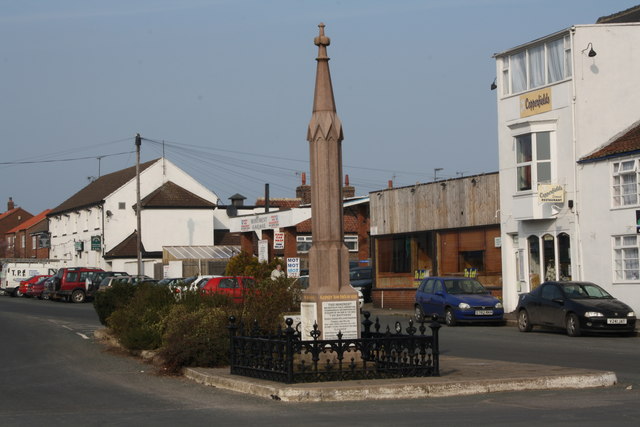
The church of St Oswald stands in the village and was designated a Grade II* listed building in 1966 and is now recorded in the National Heritage List for England, maintained by Historic England.[4] The village centre contains a number of shops and public houses. The Royal Dog and Duck is at Dog and Duck Square.

In the village are the fragmentary remains of Flamborough Castle, a medieval fortified manor house.[5]

St Oswald's Parish Church

In 1823 the village was a parish in the Wapentake of Dickering. Flamborough was recorded as "merely a fishing village" with a "very ancient station, formerly of some note". The population at the time was 917, half of which constituted the families of fishermen. Occupations included eleven farmers, two blacksmiths, two butchers, two grocers, seven carpenters, four shoemakers, three tailors, a stonemason & flour dealer, a bacon & flour dealer, a weaver, a corn miller, a straw hat manufacturer, and the landlords of the Sloop, the Board and the Dog and Duck public houses. Also listed was a schoolmaster and a gentlewoman. Four carriers operated in the village, destinations being Hull and York twice a week, and Bridlington, daily. With St Oswald's Church was a Methodist and a Primitive Methodist chapel.[6]

Between 1894 and 1974 Flamborough was a part of the Bridlington Rural District, in the East Riding of Yorkshire.[7] Between 1974 and 1996 it was part of the Borough of North Wolds (later Borough of East Yorkshire), in the county of Humberside.

According to local legend, the village is haunted by the ghost of a suicide known as Jenny Gallows.[8]

The Royal Dog and Duck

Flamborough, with its holiday camps and a caravan park, is a holiday destination during the summer months. The village holds an annual Fire Festival on New Year's Eve which in 2017 attracted 5,000 people.[9]

In 2016 North Landing was used in the filming of the Dads Army film.

In 2018 the beach at Flamborough was used in the filming of the ITV drama Victoria.[10]

Local news and television programmes are provided by BBC Yorkshire and Lincolnshire and ITV Yorkshire. Television signals are received from the Belmont TV transmitter. [11]

Local radio stations are BBC Radio Humberside, Hits Radio East Yorkshire & North Lincolnshire, Capital Yorkshire, Greatest Hits Radio Yorkshire Coast, Nation Radio East Yorkshire, and This is The Coast.

Flamborough is served by Bridlington Free Press and the East Riding Mail.

See also

[edit]

References

[edit]
[edit]
Revisions and contributorsEdit on WikipediaRead on Wikipedia
from Grokipedia
Flamborough is a coastal village and in the , , situated on the chalk headland approximately 4 miles (6 km) northeast of , renowned for its dramatic 400-foot (120 m) white cliffs, seabird colonies, and maritime heritage. The parish encompasses about 2,111 residents as of the 2021 UK Census, reflecting a slight increase from the 2,161 recorded in 2011, and covers an area of fertile surrounding the rugged headland that protrudes into the . Historically, Flamborough has been a community since the , with evidence of early settlements, and it gained prominence in the through the construction of its first in 1674—an octagonal chalk tower that remains one of England's earliest surviving examples, though it was never operational. The village's economy and identity have long been tied to the sea, marked by events such as the tragic 1909 fishing disaster commemorated by plaques, and it was designated a Heritage Coast in 1979 to preserve its natural and cultural features. Flamborough Head is a key ecological site, designated as a (SSSI), (SAC), and (SPA) for its globally significant seabird populations, including tens of thousands of puffins, guillemots, razorbills, kittiwakes, and gannets that nest on the cliffs from spring to summer. The headland features three Local Nature Reserves—South Landing, Danes Dyke, and the Head itself—established in 2002, supporting diverse wildflowers, grazing wildlife, and coastal paths like the King Coast Path. Maritime navigation is highlighted by the current , built in 1806 by at a cost of £8,000 to guide vessels after numerous shipwrecks, featuring innovative red-flashing optics and automated since 1996. Today, the area attracts visitors for , , and exploring sea caves and stacks, while the village maintains a conservation area to protect its historic buildings and fishing traditions.

Geography

Location

Flamborough is a village and in the , . It centres on a projecting into the and is situated approximately 4 miles (6 km) northeast of and 27 miles (43 km) northeast of Hull. The geographical coordinates of the village are 54°06′56″N 0°07′30″W. The encompasses , a extending about 6 miles (10 km) into the . It is bordered by the to the east and north, with the parish of Reighton to the north. Inland to the west lie the , while the Humber Estuary is located further south across the region.

Physical geography

forms a prominent jutting into the , defined by steep white cliffs that rise to heights of up to 400 feet (120 m). These cliffs are composed of from the Northern Province Chalk Formation, deposited around 75–100 million years ago in a shallow tropical sea and reaching a thickness of approximately 400 m in the area. The 's horizontal layering and resistance to erosion, enhanced by secondary , create a distinctive saucer-shaped basin compressed by regional faulting within the Howardian–Flamborough Fault Zone. The coastal environment showcases classic erosional landforms shaped by wave action and tidal forces over centuries, exploiting weaknesses in the faulted chalk structure. Sea caves, such as those at Selwicks Bay, develop where waves enlarge vertical and horizontal joints, sometimes forming through-caves or blowholes; these can evolve into natural arches when breaches headlands, which later collapse to produce isolated stacks on wave-cut platforms. Stacks, like those near North Landing, stand as remnant towers amid narrow shore platforms strewn with cobbles and boulders, with retreat rates varying from less than 0.3 m per year in sheltered southern sections to more active northern . Inland from the cliffs, the village of Flamborough occupies a low-lying plateau supporting expansive grasslands, with minimal topographic relief beyond subtle undulations from glacial deposits. A key natural feature is Danes Dyke, a prehistoric earthwork spanning 2.5 miles (4 km) across the , comprising a ditch 8–12 m wide and up to 6 m deep flanked by a bank up to 20 m wide and 7 m high, constructed during the as a defensive barrier isolating the . The region's hydrology is dominated by the permeable , which limits surface freshwater sources like streams or rivers due to rapid infiltration, necessitating reliance on abstraction for local supplies. Yields from boreholes in the vary widely, supporting public and agricultural needs, while the coastal exposure to prevailing waves and —driven by Atlantic swells and semi-diurnal tidal ranges of 5–6 m—intensifies marine influences on the landscape.

Climate

Flamborough features a temperate , classified as Cfb under the Köppen-Geiger system, strongly influenced by its proximity to the and the warming effects of the North Atlantic Drift, which moderates temperatures to produce mild winters and cool summers without extreme seasonal variations. Based on data from 1991–2020 for the nearby area, annual mean temperatures average 10–11°C (50–52°F), with lows typically reaching 3–4°C (37–39°F) and highs around 17–18°C (63–64°F); annual rainfall totals 600–700 mm, concentrated in autumn and winter months when wetter conditions prevail. Prevailing southwesterly winds dominate throughout the year, with average speeds around 10 knots, but the area's exposure to the leads to frequent gales in winter, occasionally reaching 50 knots, contributing to along the cliffs. Summer often brings common due to cooler sea temperatures interacting with warmer air masses. Temperature extremes are moderated by maritime influences, with record highs up to 28°C (82°F) in summer and lows to -10°C (14°F) in winter, though such events are rare and typically accompanied by strong winds exacerbating on exposed coastal features.

History

Origins

The name Flamborough derives from elements, likely Fleinn (a meaning '' or 'barb') combined with borg or burh, denoting a 'fort' or fortified settlement, thus interpreting as 'Fleinn's fort'. Tradition attributes its founding to a Viking named Fleyn (or Flayn), brother of Thorgils Skarthi—the raider who established Scarborough around 966 CE—during Norse incursions in the . This reflects the strong Scandinavian influence in the region following Viking settlements in eastern . Prehistoric evidence points to human activity in the area from the , around 2000 BCE, when the Beaker People arrived, as indicated by fragments of their characteristic bell-shaped discovered at sites like Beacon Hill. These artifacts suggest burial practices and cultural transitions associated with incoming continental influences that reshaped Britain's population and technology during this period. By the , approximately 1000 BCE, the landscape featured significant defensive works, including Danes Dyke—a substantial earthwork bank and ditch spanning about 4 kilometers across the Flamborough peninsula to isolate it from mainland threats, likely constructed or reinforced against tribal invasions from the west. Roman presence in the vicinity is attested by scattered finds, including coarse wares and querns, unearthed near coastal cliffs and at Sewerby, implying temporary use for signaling, quarrying, or transient camps rather than permanent structures. No evidence supports a major Roman settlement here, consistent with the area's peripheral role in the broader coastal defenses during the four centuries of occupation from the 1st to 5th centuries CE. In the early medieval period, following Viking dominance, Anglo-Saxon influences reemerged in the region as part of the Kingdom of , blending with Norse elements in local and . The settlement is recorded in the of 1086—spelled as Flamenburgh or variants like Flaneburg—under the hundred of Hunthow, with just 0.5 households (one smallholder) and a taxable value of 10 shillings in 1086, down sharply from 24 pounds in 1066, reflecting post-Conquest disruptions and partial wasteland. This entry underscores a modest and agrarian community amid the uplands, which aided natural defenses.

Development

Following the of 1066, Flamborough was integrated into the feudal structure of , with the manor passing from King Harold's holdings to Norman control. By the , the Constable family, descended from Norman lords who held the office of Constable of Chester, became the primary landowners in Flamborough, establishing their influence over the area for approximately 400 years. The family fortified their residence, constructing Flamborough Castle in the early as a fortified to assert authority amid regional tensions, though a license to crenellate was granted in 1351 by Edward III, enhancing its defensive features with chalk walls and a pele tower. During the 14th and 16th centuries, Flamborough's lords played roles in national conflicts, including the Wars of the Roses. Sir Marmaduke Constable (c. 1457–1518), a prominent member of the family from Flamborough, served as a soldier and courtier under Edward IV, Richard III, and notably Henry VII, holding positions such as Sheriff of and commanding the English left wing at the in 1513. His loyalty to the Tudor regime solidified the family's status, but later generations faced upheaval; Sir Robert Constable's leadership in the 1536 rebellion against Henry VIII's policies led to his execution in 1537 and the confiscation of family estates, disrupting local land tenure and economic ties. The 1539 further impacted the area by severing monastic land grants and tithes that had supported regional agriculture and fisheries, contributing to economic instability in Flamborough. In the , Flamborough expanded as a , with families relying on traditional boats for coastal and whitefish catches, fostering community growth around the South and North Landings. Maritime infrastructure advanced with the construction of the old in 1674 by Sir John Clayton, one of England's earliest surviving lighthouses, intended to guide ships along the hazardous chalk cliffs though it was never lit. Administratively, the parish remained part of the Dickering Wapentake in the , a historic subdivision encompassing northeastern coastal lands. By 1823, the population had reached 917, with fishermen and their families comprising roughly half, underscoring the village's maritime orientation.

Recent history

During the , Flamborough emerged as an important , with its centered on the and other fisheries alongside . In 1831, the village was described as a parish in the Dickering wapentake with a population of 975, where the inhabitants were principally employed in and farming, while was carried on to a considerable extent. The opening of the York and North Midland Railway to in October 1846, with extension to in 1847, enhanced connectivity to the area, enabling easier transport for fish and visitors, which supported the port's growth and laid foundations for . In the , Flamborough's coastal position led to significant defensive fortifications during the s, particularly in the Second World War when it formed part of the Coastal Crust strategy to deter German . Approximately 28,000 pillboxes were constructed along Britain's coasts and inland post-Dunkirk in 1940, with several hexagonal and polygonal examples remaining at to protect vulnerable bays from landings and sabotage, accommodating small teams of soldiers in bullet- and shell-proof structures. After 1945, the local experienced a gradual decline due to , quotas, and decommissioning, shifting economic focus toward as visitors were drawn to the dramatic chalk cliffs and heritage sites. Administratively, Flamborough formed part of Bridlington Rural District from 1894 until 1974, after which it was incorporated into the larger county until 1996, when it rejoined the re-established . Entering the 21st century, Flamborough has gained prominence through media and community events, while addressing environmental challenges. In 2016, the remake of the comedy film was filmed at locations including North Landing and , utilizing the area's coastal scenery to depict wartime Britain. The annual Flamborough Fire Festival, a Viking-themed , has supported local charities; for instance, the 2018 event raised over £4,000 for community groups. In 2018, scenes for the third series of the ITV historical drama Victoria were shot on Flamborough's beaches, featuring actress in period attire against the chalk cliffs. Ongoing coastal erosion poses a persistent threat to 's cliffs, which erode slowly at 0.2-0.5 meters per year but form distinctive features like caves and stacks. Management strategies under the Flamborough Head to Gibraltar Point Shoreline Management Plan (SMP3) emphasize protection of the site's geological value and internationally important habitats, with approaches including no active intervention in some areas to allow natural processes while monitoring risks through Environment Agency-approved policies. In the 2020s, preservation efforts have intensified as part of the Heritage Coast designation, focusing on conserving the unique outcrop, sea caves, and through initiatives like the 2022 Heritage Coast Review, which highlights collaborative land management by organizations such as the Yorkshire Wildlife Trust to balance recreation and conservation. In September 2025, the 246th anniversary of the (1779) was commemorated with a festival in and the rededication of a toposcope at , highlighting its maritime history.

Administration and demographics

Governance

Flamborough holds status and is governed at the local level by the Flamborough Council, an elected body of nine councillors responsible for managing community services such as applications, of spaces, and local amenities. The council operates independently but coordinates with higher authorities on broader issues, holding regular meetings to address parish matters. At the district level, Flamborough forms part of the , established in 1996 following the abolition of . The parish is included in the Bridlington North ward, which elects councillors to the for oversight of services like housing, education, and . This structure replaced earlier fragmented administrations, providing a single tier of for the area. Historically, Flamborough's administration evolved from the medieval Wapentake of Dickering, a subdivision of the used for local governance and justice. Under the Local Government Act 1894, it became part of the Rural District, which handled rural affairs until 1974. From 1974 to 1996, the area was incorporated into the Borough of North Wolds—later renamed the Borough of East Yorkshire—within the of , reflecting broader regional reorganizations. In terms of national representation, Flamborough lies within the Beverley and parliamentary constituency, represented by Graham Stuart, a Conservative MP, since 2010. Prior to in 2020, the area fell under the constituency for the .

Population and economy

The population of Flamborough was recorded as 2,121 in the 2001 Census, 2,161 in the 2011 Census, and 2,111 in the 2021 Census. With a area of 12.43 km², this equates to a of approximately 170 people per km² in 2021, characteristic of rural coastal communities in . The reflects a significantly aging population, with 41.9% of residents aged 65 and over in 2021, higher than the East Riding average and indicative of trends in retirement migration to coastal areas. Ethnically, the population is predominantly , comprising 99.7% of residents according to 2021 Census data, with minimal representation from other ethnic groups typical of isolated rural parishes. Religiously, remains the majority faith, accounting for 61% of the population in 2021, with the holding the dominant position through local parish churches and historical ties. Historically, Flamborough's economy in the 19th century centered on and . In , the parish had a of 917, with at least half involved in , including around 150 active fishermen who operated from the exposed coastal waters using traditional cobles for inshore catches like and . complemented this, focusing on arable farming suited to the shallow, stony chalk soils derived from the underlying Flamborough Chalk Formation, which supported crops such as cereals and root vegetables on the well-drained . In the modern era, the economy has shifted toward tourism and services, driven by the area's natural coastal attractions. Summer visitors are drawn to the chalk cliffs and beaches, boosting seasonal employment in hospitality and retail, while caravan parks such as Thornwick Bay and Flamborough Caravan Park accommodate thousands of holidaymakers annually, contributing significantly to local revenue. Unemployment stood at approximately 2.6% in the East Riding of Yorkshire as of 2023, reflecting stable but low-wage service sector jobs. Median household income was around £32,000 as of financial year ending 2020, consistent with broader East Riding figures and indicative of modest economic conditions in a tourism-dependent rural setting. The post-World War II decline in fishing further accelerated this transition, reducing the fleet and redirecting labor to land-based activities.

Landmarks

Architectural landmarks

Flamborough Castle is the ruined remains of an early 14th-century fortified , constructed by the influential family, who held the estate from that period until Sir Robert Constable's execution in 1537 for his role in the Pilgrimage of Grace. The structure received a license for crenellation in 1351, enhancing its defensive capabilities, though contemporary accounts described it more as a manor place than a full castle. Today, only parts of the central tower and associated earthworks survive above ground, making it a rare example of a medieval fortified manor with national significance due to its archaeological and architectural value; it is protected as a under the Ancient Monuments and Archaeological Areas Act 1979 and designated as a Grade II listed building. St Oswald's Church, dedicated to the patron saint of fishermen, originated in the early , with its arch featuring roll-mouldings and scalloped capitals as a key surviving Norman element. The church underwent significant rebuilding in 1864 by architect R. G. Smith of Hull, incorporating features such as the three-light west window and two-light belfry openings with , while a south porch was added in 1893 and the west tower in 1896. Notable interior elements include a 12th-century font adorned with lozenge ornamentation and a 15th-century screen from Priory, featuring fretted and painted canopies; the church also houses a with a fragmented of Sir Marmaduke Constable, who died in 1520, depicting a at the heart as a symbol of avarice. Recognized for its special architectural and historic interest, the church has been Grade II* listed since 1966 under the Planning (Listed Buildings and Conservation Areas) Act 1990. The lighthouses at represent key maritime heritage structures designed to safeguard shipping along the hazardous coast. The Old Lighthouse, an octagonal tower built in 1674 from coursed rubble with stone dressings and parapet, stands approximately 79 feet tall and was commissioned by Sir John Clayton as a private venture but never lit due to insufficient funding from shipowners. Instead, it served as a and later as a marine telegraph station from around 1840 until the early , earning Grade II* listed status in 1949 and scheduled monument protection for its rarity as a complete 17th-century survival. The New Lighthouse, constructed in 1806 by to the design of architect Samuel Wyatt at a cost of £8,000, replaced earlier attempts and features a 26.5-meter (87-foot) tapered cylindrical tower of white-painted with a lantern gallery. Automated in 1996 and still operational, it originally used an oil-burning catoptric lens producing 13,860 in a distinctive pattern of two white flashes followed by one red, later electrified in 1940 and updated with modern optics to guide deep-sea and coastal vessels around the . Flamborough village retains a cluster of 18th-century cottages and traditional buildings constructed primarily from local chalkstone and thatched with wheat straw from surrounding fields, reflecting the area's and agricultural heritage during a period of 17th- to 19th-century expansion. Among these, the Royal Dog and Duck pub stands as a longstanding known for serving the local seafaring community with real ales and hearty fare in a cozy, split-level interior largely unchanged since the early .

Natural landmarks

Flamborough Cliffs , spanning 36 hectares and managed by the Wildlife Trust, is a key coastal site renowned for its colonies. It hosts tens of thousands of breeding pairs, including puffins visible from mid-May to mid-July, as well as kittiwakes, gannets, guillemots, razorbills, fulmars, and various , contributing to the broader Flamborough and Coast colony that supports over 400,000 overall. The reserve forms part of the Flamborough Head (SSSI), designated for its ornithological importance, and offers cliff-top walkways for viewing, with access points at North Landing and Thornwick Bay. Danes Dyke Nature Reserve covers 148 acres of within a dramatic on the Flamborough Head Heritage Coast, recognized as a Local Nature Reserve and SSSI for its ecological value. The site's includes ash, elm, lime, beech, sycamore, hawthorn, elder, snowdrops, winter aconites, and bluebells, supporting diverse ground cover that enhances . It provides for breeding landbirds such as blackbirds and robins, wintering migrants from , bats, and including ringlets and small tortoiseshells, with recent hedge planting to bolster invertebrate and bird populations. The beaches and bays along Flamborough's coast offer accessible natural features, with North Landing serving as a sheltered ideal for launching traditional cobles and trips to explore nearby caves. Thornwick , adjacent to the , is a popular site for hunting, where visitors can find ammonites and other Cretaceous-era specimens exposed in the formations. These areas complement the region's , providing rock pools and pebbly shores that support intertidal life. Marine environments around , encompassed by the SSSI and protected under the EU Birds Directive as part of the and Bempton Cliffs , sustain colonies and harbour porpoises. The seals haul out on rocky ledges, with the population growing in recent years, while porpoises frequent the offshore waters, contributing to the area's status as a Sensitive Marine Area and for marine .

Culture and community

Traditions and events

Flamborough's includes the legend of Jenny Gallows, a young woman who reputedly committed suicide by jumping into a well or chalk pit on the in the 19th century, after which her ghost is said to haunt the cliffs and , appearing to those who circle the site eight times. Local tales from the 18th and 19th centuries also describe activities along the coast, with North Landing known for its smugglers' caves used to hide goods during that era. The village's heritage remains a core tradition, centered on inshore and potting, where local fishermen demonstrate the craft of building and deploying pots from boats, preserving skills passed down through generations. These demonstrations highlight the community's deep ties , including superstitions such as avoiding the word "last" when referring to the end of a pot line to ward off bad luck. Annual events foster community spirit, including the Flamborough Fire held on , featuring a Viking-themed torch-lit , fireballs, drums, and a display that drew over 2,500 attendees in 2022. The Flamborough Bird Observatory hosts open days and , such as the Seawatch Festival in late with guided seawatching sessions and ringing demonstrations, and Migweek in October offering public insights into . Summer sailing events nearby, like the Bridlington Sailing Coble in July, include regattas with traditional coble boats racing and demonstrations, reflecting Flamborough's maritime culture. Local pubs such as the Seabirds Inn and the North Star serve as vital social hubs, where residents gather for meals and events, strengthening community bonds in this coastal village. These traditions and gatherings often receive coverage from BBC Yorkshire, highlighting Flamborough's vibrant local scene.

Notable residents

(c. 1401–1441) was a and prominent landowner in Flamborough, where he held significant estates; upon his death, an inquisition post mortem recorded his heir as his son Robert, aged 18 or more, confirming his role in local land management and feudal obligations. Sir Marmaduke Constable (c. 1457–1518), born to the Flamborough branch of the Constable family, rose as a and during the late and early Tudor era; he fought at the in 1485 supporting Henry VII and later commanded the English left wing at the in 1513, contributing to the decisive victory over . The Constable family's seat at Flamborough Castle underscored their enduring local influence. Elizabeth Broadingham (d. 1776), from a local Flamborough family, gained notoriety for her involvement in the murder of her husband, John Broadingham, a smuggler; convicted of petit for aiding her lover Thomas Aikney in him, she was executed by burning at on 20 March 1776, marking one of the last such sentences in . John Clarkson Major (1826–1895), born in Flamborough to a local family, became a successful manufacturing who, with partner E. L. Turner, pioneered tar distillation technology and established Midland Tar Distillers; he later entered politics as a Liberal MP for from 1885 until his death, reflecting ties to the region's industrial and fishing heritage through his early life.

Transport

Access by road

Flamborough is accessible primarily via the B1255 road from , a distance of approximately 4 miles along a scenic coastal route that includes opportunities for roadside parking. The B1255 connects directly to the village center and extends northward to North Landing and Thornwick Bay. Parallel to this, the A165 trunk road serves as the main inland artery, linking Flamborough to from the south via a junction at Well Lane roundabout and to Scarborough from the north through Reighton and Bempton. Local roads within Flamborough, such as South Landing Road, consist of narrow lanes leading to beaches and coastal areas, with steep gradients near the cliffs that impose restrictions on heavy vehicles to prevent damage and ensure safety—access to the via this road is limited to authorised vehicles only. Other routes like the B1259 provide access to the lighthouse and Selwicks Bay, maintaining the area's rural character while accommodating light traffic. Cycling and walking options enhance road access, with Route 1 running nearby through and linking to off-road cliff-top paths in the vicinity. These paths form part of the Coast Path, offering pedestrian routes along the headland's elevated terrain for non-motorized exploration. Parking facilities include limited village car parks managed by the East Riding of Yorkshire Council, as well as pay-and-display lots at nature reserves like South Landing and North Landing. Demand peaks in summer, leading to congestion and full occupancy, with streets becoming particularly busy during tourist season. Visitors are advised to arrive early or use overflow areas to avoid overflow onto narrow residential lanes.

Public transport

Flamborough lacks its own railway station, with the nearest being railway station, approximately 4 miles (6.4 km) to the south. This station lies on the Hull–Scarborough line and is served by trains connecting to destinations such as Hull, , , and Scarborough, with additional services operating on the route. Public bus services to Flamborough are primarily provided by East Yorkshire Buses' route 14, which runs from to Flamborough North Landing via Sewerby Hall and Thornwick Bay. The service operates approximately hourly during the day, with departures from Bridlington between 07:20 and 18:25, and the journey to central Flamborough takes about 17 minutes. From 31 August 2025, a winter timetable applies, eliminating evening journeys after 18:25. Seasonal extensions of related coastal routes, such as to and Scarborough, operate during peak summer periods but are reduced or suspended in winter. Other transport options include community dial-a-ride services operated by H.A.R.T. Community Transport, offering door-to-door minibuses for residents in the Flamborough area who face difficulties using regular ; fares are £2.50 for a single trip, with bookings required via 01964 536684 and support from . Taxis are readily available in for short transfers to Flamborough, and a scenic 4-mile (6.4 km) clifftop walking path connects the two locations. Accessibility features are limited by the area's rural setting, with no evening bus services under the winter timetable and reduced frequencies outside peak daytime hours. Seniors aged 60 and over can access free off-peak travel on local buses across via the pass, issued by , while a Senior Railcard provides a one-third discount on rail fares nationwide. Additionally, a national £3 single bus fare cap applies throughout 2025, benefiting concessionary and standard passengers alike.

References

Add your contribution
Related Hubs
User Avatar
No comments yet.