


Community hub
Recent from talks
Contribute something
Nothing was collected or created yet.
Coble
View on Wikipedia
.jpg)
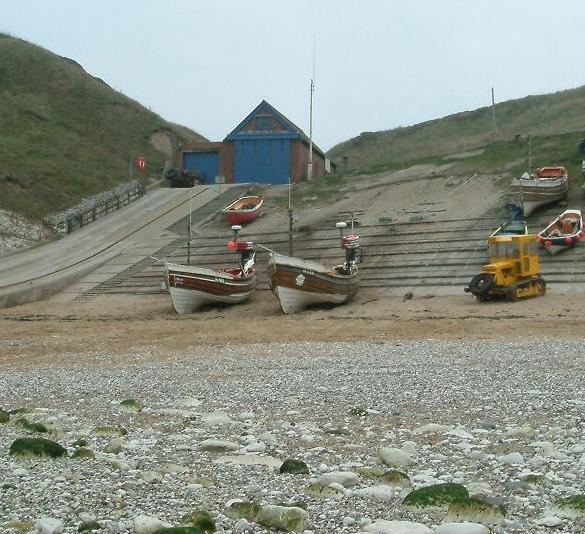
The coble is a type of open traditional fishing boat which developed on the North East coast of England.[1] The southernmost examples occur around Hull (although Cooke drew examples at Yarmouth, see his Shipping and Craft[2] series of drawings of 1829); the type extends to Burnmouth just across the Scottish border.
The distinctive shape of the boat — flat-bottomed and high-bowed — arose to cope with the particular conditions prevalent in this area. Flat bottoms allowed launching from and landing upon shallow, sandy beaches; an advantage in this part of the coast where the wide bays and inlets provided little shelter from stormy weather. However, fishermen required high bows to sail in the dangerous North Sea and in particular to launch into the surf and to land on the beaches. The design contains relics of Norse influence, though in the main it shows Dutch origin.
A Scottish version of the coble, much shallower and beamier than the English type, serves for salmon-fishing off beaches near Arbroath and Montrose in Angus. These cobles have a less refined construction than their southern counterparts. Ghillies employ a smaller, better-built version for fly fishing on Scottish rivers.
Local boat-builders constructed the clinker-built cobles locally as required, without the use of plans. The craftsmanship on many boats gave them a long working life. They had a reputation as dangerous to sail for an inexperienced crew, but in the hands of experts could move both safely and speedily.
Today[update], surviving cobles generally use diesel engines, removing the need for the distinctively shaped lug sail. In a further concession to comfort, a tarpaulin shelter often covers the bow.
The Northumberland coastal village of Newbiggin-by-the-Sea has a pub called "The Coble" named in tribute to these boats. A park, Coble Dene, in nearby North Shields is likewise named after the vessel.[citation needed]
See also
[edit]References
[edit]- ^ Chisholm, Hugh, ed. (1911). . Encyclopædia Britannica. Vol. 6 (11th ed.). Cambridge University Press. p. 612.
- ^ Cooke, Edward William (1829). Sixty five plates of shipping and craft, drawn and etched by E. W. Cooke. London.
External links
[edit]- The Coble and Keelboat Society
- World of Boats at Eyemouth ~ Seahouses Coble
Example of a Northumberland, Seahouses coble named "Boy's Own" - built for Robert Rutter in 1933. - National Maritime Museum Cornwall
Example of Northumbrian coble "Sunshine" from ca 1880 - Yacht Design Database
NMMC also has an online database list of yacht designs mentioned in yachting magazines which includes several cobles - Portsoy Organisation for Restoration and Training project to investigate and document the Scottish coble's construction and video about the project
- Scottish National Dictionary definitions
- Salmon Net Fishing Association of Scotland regarding the "net and coble" method


Coble
View on GrokipediaEtymology and History
Origins of the Name
The term "coble" for the traditional fishing boat derives from Old English "cuople", first recorded in the 10th-century glosses to the Lindisfarne Gospels, evolving through late Middle English "cobel," recorded around 1400–1450.[5][3] It is probably of Celtic origin, comparable to the Welsh "ceubal" or "ceubol," denoting a skiff or ferryboat, and ultimately stems from Late Latin "caupulus," referring to a small ship.[5] This etymological path reflects the vessel's roots in early British maritime traditions, evolving specifically to describe flat-bottomed coastal craft suited for inshore fishing.[6] The earliest documented uses in English appear in the 10th century in the Lindisfarne glosses, with further records in the 15th century, initially in northern regions. For instance, a 1420 record from Barnard Castle mentions "do et lego Galfrido Mawer meliorem cobyll," indicating a bequest of a superior coble.[7] By the 16th century, references proliferate in Yorkshire documents, such as a 1527–1528 entry for "a coble called the Margarete" in Hornsea Beck and a 1542 bequest of "a quarter of a coble" in Owthorne, highlighting shared ownership among fishermen.[7] These early attestations consistently apply the name to sea-fishing boats with flat bottoms, typical of the northeast coast from Northumberland to Yorkshire.[7] The boat-specific usage of "coble" developed distinctly within English maritime lexicon, tied to local fishing practices rather than broader linguistic borrowings unrelated to vessels.[8] This evolution underscores its adaptation for open-water launches from beaches, distinguishing it as a regional term for practical, oar- and sail-propelled craft by the early modern period.[8]Historical Development
The coble has roots dating back over a millennium, with design influences from Norse settlers evident in the clinker-built construction reminiscent of Viking longships, and from Dutch traders, who contributed to the boat's stable, open design suited for inshore operations. It developed as a distinct type of fishing vessel along England's North East coast, spanning from Hull to Berwick-upon-Tweed, where it was primarily employed for North Sea fisheries. Local fishermen adapted these elements to create a versatile craft capable of launching from exposed beaches, supporting the region's growing demand for herring, cod, and haddock catches amid expanding trade networks.[9][10][3] By the 19th century, the coble had become a standardized feature of coastal life, with early visual documentation appearing in Edward William Cooke's 1828 publication Fifty Plates of Shipping and Craft. These etchings captured cobles beached at low tide during herring fisheries, illustrating their exaggerated sheer and flared bows in operational settings along Yorkshire's shores, such as near Scarborough—marking the first detailed artistic records of the vessel in use. This period saw the coble's role solidify in local economies, with fleets operating from small ports to sustain communities through seasonal fishing.[11][3] The design spread to southern Scotland by the early 1800s, where adaptations emerged for regional salmon fisheries, particularly along the Angus coast near Arbroath and Montrose, featuring shallower drafts and broader beams to navigate estuarine waters and beach landings. These Scottish variants supported net-and-coble methods in river mouths like the Tweed and Tay, integrating into established fishing practices while retaining core English influences. However, traditional coble use declined sharply after World War II, as mechanization— including engine fittings and larger trawlers—replaced sails and manual operations, rendering the labor-intensive craft obsolete for commercial fishing by the mid-20th century.[12][10][13]Design and Construction
Hull and Structural Features
The traditional coble features a clinker-built hull, characterized by overlapping planks that provide flexibility to withstand the rough seas of the North East England coast. This construction method uses local timbers such as larch for the planking and oak for the frames, allowing the boat to flex without cracking under wave impact. The hull begins with a central horizontal plank known as the "ram," which serves as the primary longitudinal strength member in place of a traditional vertical keel, enabling a flat bottom that enhances stability when beached on sandy shores.[14][3][15] The coble's hull design is optimized for coastal operations, with a high, sharply curved bow that cuts through waves efficiently and a shallower stern facilitating easy beaching. This raked bow, prolonged into a heavy horizontal ram, combined with flat floors and a small transom stern, facilitates easy launching and retrieval from beaches, aided by the deeper draft forward than aft for stability in waves. Typical dimensions include a length of 20 to 30 feet, a beam of 7 to 10 feet, and a draft of 2 to 3 feet (shallower aft), though variations exist to suit local conditions; side keels or "drafts" extend aft to aid in grounding without tipping.[14][16][17] These boats are hand-crafted by local boatbuilders using empirical knowledge rather than formal plans, a practice that contributes to their renowned durability in harsh marine environments. The absence of a deep keel further supports shore-based operations, while the robust wooden construction has allowed many cobles to remain in service for decades with proper maintenance. Scottish adaptations tend to be beamier for stability in different fishing grounds.[3][16][18]Propulsion and Rigging
The traditional propulsion system of the coble centered on a single dipping lug sail set on an unstayed mast raked aft and positioned amidships, enabling efficient handling in coastal conditions.[16] This square-shaped sail, equipped with multiple reefing points, could be quickly reduced in size during storms by tying in reefs, while the high bow facilitated easy sail management and tacking.[16] The sail was hoisted via a single halyard and secured with bowlines led to the windward bow, allowing for rapid deployment and adjustment without complex rigging.[16] For auxiliary or calm-water use, particularly in harbors, cobles employed long sweeps or oars rowed from thwarts, providing maneuverability when wind was insufficient.[16] Steering was managed by a large, deep, elongated rudder hung on the transom, projecting well below the hull to counter leeway and double as a makeshift centerboard, with a simple tiller for direct control.[2] This design offered precise responsiveness during beach launches and landings, essential for open-coast operations, as the rudder could be easily unshipped to avoid damage on grounding.[2] By the mid-20th century, following World War II, cobles increasingly adopted inboard diesel engines as primary propulsion, rendering the traditional lug sail largely obsolete while some vessels retained sail compatibility for auxiliary use in light winds.[3] These small, lightweight engines, often rated around 10-20 horsepower, were installed to enhance reliability for inshore fishing, with propeller tunnels added to protect blades from beach operations.[3] Oars continued as emergency backups until engine technology matured.[3]Regional Variations and Usage
English Coble Characteristics
The English coble features a narrower and deeper hull design optimized for the turbulent waters of the North Sea, distinguishing it from broader regional variants through its emphasis on open-sea stability over shallow-water maneuverability.[19][10] Clinker-built with oak frames and larch planking, typical vessels measure 27 to 35 feet in length and 10 to 11 feet in beam, incorporating a deep forefoot for cutting through steep waves and a flat bottom aft to facilitate beaching.[20][19][21] This construction, often partially decked with a small cuddy forward, allowed crews of 3 to 5 fishermen to pursue herring via drift netting or cod and haddock through long-line fishing, primarily from ports like Scarborough and Whitby.[20][22][10] Seaworthiness was paramount, with the high-bowed profile and substantial rudder enabling the coble to handle gales and short, steep North Sea swells effectively, often rigged simply with lug sails for quick response under sail.[22][10] Launching and recovery from steep, shingle beaches—such as those at Scarborough's western sands—relied on manual effort, capstans (winches), or log rollers to navigate the gradient, a process that underscored the boat's robust bilge keels and lifting rudder design.[20][21] Prior to the 1850s, English cobles played a vital role in early lifeboat services, exemplified by the 1786 conversion of a coble into the first purpose-built lifeboat at Bamburgh Castle under Dr. John Sharp, which patrolled shores and rescued shipwrecked mariners during storms.[23] Iconic examples persist at Flamborough Head's North Landing, where cobles like those used for inshore potting remained operational until the 1970s, hauling pots for crab and lobster in the face of persistent North Sea challenges.[19][21]Scottish Coble Adaptations
Scottish cobles represent a distinct regional adaptation of the traditional clinker-built vessel, tailored for the demands of salmon fishing in Scotland's riverine and estuarine environments. These boats feature a shallower draft and broader beam compared to their English counterparts, enabling navigation in shallow waters and enhanced stability for deploying seine nets. This design prioritizes maneuverability over seaworthiness, allowing crews to operate effectively in tidal estuaries rather than exposed coastal seas.[24][25][26] The hull's flat bottom and high bow facilitate beaching and handling nets in rivers such as the Tay and Tweed, where salmon netting has been a primary application. Smaller variants, typically 12-15 feet in length, were particularly suited for upstream work, including fly fishing by ghillies along coastal stretches from Arbroath to Montrose in Angus. These compact boats, often rowed by oars, supported crews of 2-4 individuals who shared in the catch, emphasizing quick handling in confined spaces. Larger estuary models reached 18-21 feet, accommodating the weight of nets while maintaining the vessel's inherent agility.[24][26][25] By the late 19th century, Scottish cobles proliferated in response to organized salmon fisheries, with numerous examples built in Angus by local companies in dedicated boat sheds. This expansion integrated the vessels into longstanding Highland fishing practices, where ghillies and clan-based crews employed them for both netting and rod fishing, preserving Norse-influenced construction techniques like clinker planking.[24]Cultural and Modern Significance
Role in Fishing Communities
The coble served as an economic cornerstone for coastal villages in Northumberland and Yorkshire from the 18th to the 20th century, enabling inshore fishing that sustained families through seasonal harvests of salmon, herring, and whitefish.[10] These open boats, suited to launching from beaches, supported small-scale fisheries where crews of four to six men operated from ports like Amble, Newbiggin-by-the-Sea, and Staithes, often targeting migratory fish runs that dictated annual rhythms of work and income.[27] In local folklore, the coble emerged as a potent cultural symbol.[28] This legacy endures in place names inspired by the vessel, including The Coble Inn in Newbiggin-by-the-Sea, a 17th-century pub tied to fishing heritage, and Coble Dene Park in North Shields, a green space evoking the boat's regional prominence.[29] Coble construction and launches reinforced community bonds in these villages, with local boatbuilders—often fishermen themselves—collaborating in informal networks to craft vessels from oak and larch, turning annual boat-building and launching ceremonies into major social occasions that strengthened regional identity.[31] These events, marked by communal feasts and storytelling, highlighted the coble's role beyond mere utility, embedding it in the social fabric of northeast England until the mid-20th century decline of traditional fisheries.[10]Preservation and Contemporary Use
In recent decades, traditional cobles have been adapted into modern motorized versions equipped with outboard or inboard diesel engines, often incorporating fiberglass reinforcements for improved strength and reduced maintenance, enabling their use in leisure fishing, tourism charters, and recreational sailing along the North Sea coast.[16][32] These adaptations maintain the vessel's characteristic high bow and stability for beach launching while addressing the demands of contemporary operations.[33] Preservation initiatives have focused on registering surviving cobles under UK heritage vessel schemes, including the National Register of Historic Vessels established in 2000 following the National Historic Ships Project initiated in 1995, to document and protect their maritime legacy.[34][35] National Historic Ships UK maintains listings of significant examples, such as the Three Brothers, the sole surviving sailing coble built in Bridlington in 1912, which underwent major restoration in 2024 to restore its original rigging and hull integrity.[36][37] Key restoration projects include the Margaret (SH 232) at Filey Bay, rebuilt in 2021-2022 by Scarborough Marine Heritage Centre using traditional clinker planking on oak frames, highlighting community efforts to revive beach-launching traditions.[38] In Berwick-upon-Tweed, preservation centers on maintaining wooden cobles for ongoing salmon netting on the River Tweed, with vessels like those operated by the River Tweed Wild Salmon Company restored periodically to sustain the net-and-coble method amid regulatory changes.[39][40] Annual festivals celebrate coble heritage, including the Bridlington Sailing Coble Festival established in 2016, which draws up to 18 traditionally rigged vessels for demonstrations and races and continues annually, most recently on July 19-20, 2025, and the Staithes Festival of Arts and Heritage since 2012, featuring talks and displays on local coble fishing amid the village's cobbled streets and harbor.[41][42][43][44] As of 2023, an estimated 20-30 cobles remain active across England and Scotland, with sailing examples participating in heritage events and motorized variants employed for coastal patrols by maritime trusts and private charters.[41][33] These vessels face ongoing challenges from climate change, including accelerated beach erosion on exposed North Sea shores, which hinders traditional launching and storage practices.[45][46]References
- https://en.wiktionary.org/wiki/coble
- https://www.alltrails.com/trail/[england](/page/England)/tyne-and-wear/coble-dene-park-chirton-dene-park-and-royal-quays-marina