Hubbry Logo
logo
Florin
Community hub

Florin

logo
0 subscribers
Read side by side
from Wikipedia
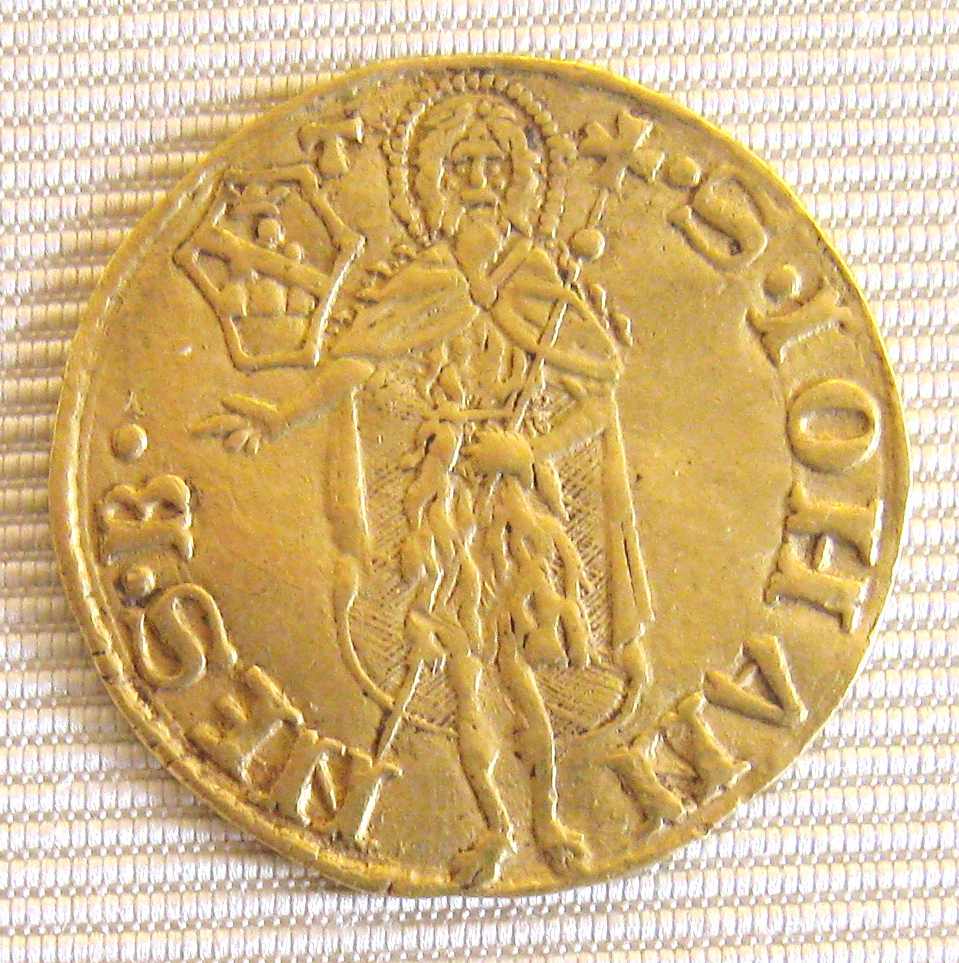
The back of an Italian florin coin
Florin from the Środa treasure

The Florentine florin was a gold coin (in Italian Fiorino d'oro) struck from 1252 to 1533 with no significant change in its design or metal content standard during that time.[1]

It had 54 grains (3.499 grams, 0.1125 troy ounces) of nominally pure or 'fine' gold[2] with a purchasing power difficult to estimate (and variable) but ranging according to social grouping and perspective from approximately 140 to 1,000 modern US dollars. The name of the coin comes from the Giglio bottonato (it), the floral emblem of the city, which is represented at the head of the coin.[3]

History

[edit]

The fiorino d'oro (gold florin) was minted in the Republic of Florence after the sack of Constantinople by the Fourth Crusade disrupted the minting of fine gold coins in the Byzantine Empire. It came to be accepted across Europe like the Byzantine Solidus had been. The territorial usage of the lira and the florin often overlapped; where the lira was used for smaller transactions (wages, food purchases), the florin was for larger transactions such as those used in dowries, international trade or for tax-related matters.[4]

The first minting of the florin occurred in 1252. At the time the value of the florin was equal to the lira, but by 1500 the florin had appreciated; seven lire amounted to one florin.[4]

In the 14th century, about 150 European states and local coin-issuing authorities made their own copies of the florin. The most important of these was the Hungarian forint, because the Kingdom of Hungary was a major source of European gold (until mining in the New World began to contribute to the supply in the 16th and 17th centuries, most of the gold used in Europe came from Africa).[citation needed]

The design of the original Florentine florins was the distinctive fleur-de-lis badge of the city on one side and on the other a standing and facing figure of St. John the Baptist[5] wearing a cilice. On other countries' florins, the inscriptions were changed (from "Florentia" around the fleur, and the name of the saint on the other), and local heraldic devices were substituted for the fleur-de-lis. Later, other figures were often substituted for St. John. On the Hungarian forints, St. John was re-labelled St. Ladislaus, an early Christian king and patron saint of Hungary, and a battle axe substituted for the original's sceptre. Gradually the image became more regal looking.[citation needed]

Other coins

[edit]
Gold florin or "Beiersgulden", struck in Holland under John of Bavaria
Gold florin or "Philippus goudgulden", struck in Dordrecht under Philip the Fair

The term florin was borrowed elsewhere in Europe. A variant of the florin was the Rheingulden, minted by several German states encompassing the commercial centers of the Rhein (Rhine) River valley, under a series of monetary conventions starting in 1354, initially at a standard practically identical to the Florentine florin (98% gold, 3.54 grams). By 1419, the weight had been slightly reduced (to 3.51 grams) and the alloy was substantially reduced (to 79% gold). By 1626, the alloy had been slightly reduced again (to 77% gold), while the weight was more substantially reduced (to 3.240 grams). In 1409, the Rheingulden standard (at the time 91.7% gold) was adopted for the Holy Roman Empire's Reichsgulden.[6]

The Dutch guilder is symbolized as Fl. or ƒ, which means florijn (florin).

The English coin first issued in 1344 by Edward III of England is also known as a florin. Originally valued at six shillings, it was composed of 108 grains (6.99828 grams) of gold with a purity of 23 carats and 3+12 grains (or 23+78 carats)[7][8] – and more recently (minted between 1849-1967 although circulating alongside the decimal ten pence coin until 1993 when it was withdrawn due to a resizing) relating to a British pre-decimal silver coin (later nickel silver) also known as a two shilling (or two bob) "bit" (abbreviation 2/-) worth 24 pence or one-tenth of a pound.

In Ireland, a silver florin coin (worth one-tenth of an Irish pound, with Irish inscription flóirín) was minted between 1928 and 1943; it became cupronickel in 1943 and was withdrawn from use on 1 June 1994.[9]

The Hungarian forint, first introduced in 1325 under King Charles Robert, is named after the florin.[10]

See also

[edit]

References

[edit]

Bibliography

[edit]
[edit]
Revisions and contributorsEdit on WikipediaRead on Wikipedia
from Grokipedia
The florin is a historical gold coin first introduced by the Republic of Florence in 1252, marking the revival of gold coinage in Western Europe after a hiatus of several centuries and quickly establishing itself as a widely accepted international currency in medieval trade across Europe and the Mediterranean.[1][2] Weighing approximately 3.5 grams of nearly pure 24-carat gold, the coin featured the fleur-de-lis emblem of Florence on the obverse and an image of Saint John the Baptist, the city's patron saint, on the reverse, with its design remaining largely unchanged until minting ceased in the early 16th century around 1531.[3][4][5] The florin's stability and purity made it a benchmark for value, influencing the economic boom of Florence and serving as a model for subsequent coinages, including the adoption of similar gold coins in regions like Aragon by 1346.[6][2] Due to its prestige, the name "florin" (derived from the Italian fiorino, meaning "little flower" in reference to the lily emblem) was later applied to various silver and other metal coins in other countries, perpetuating its legacy into the modern era.[1] In England, a gold florin was issued under Edward III in 1344 valued at six shillings, while a silver version worth two shillings followed in 1849 as part of early decimalization efforts, circulating until 1967.[7] Similar florins appeared in the Netherlands as a major reserve currency during the 17th and 18th centuries, and in British colonies like Australia, New Zealand, and post-independence Ireland, where it denoted a two-shilling piece until decimalization in the 20th century.[8][1][9] Today, while most historical variants are no longer in circulation, the Aruban florin remains the official currency of Aruba,[10] and the name endures in numismatic collections and as a symbol of medieval economic innovation, with surviving Florentine examples valued for their historical significance and rarity.[11]

Etymology and Origins

Name Derivation

The term "florin" originates from the Italian word fiorino, a diminutive form of fiore, meaning "flower" in Italian and derived from the Latin flōs.[12] This linguistic root directly references the lily emblem of Florence, the city where the coin was first issued.[13] In the 13th century, Florence had established itself as Europe's preeminent banking center, driven by influential merchant families such as the Bardi, Peruzzi, and Acciaiuoli, who handled papal finances and international trade.[14] This financial prominence elevated the fiorino from a local coin to a widely recognized standard for gold currency across the continent, with its name becoming synonymous with high-value monetary exchange.[15] The word "florin" transitioned into medieval Latin as florenus before entering various vernacular languages, reflecting the coin's pan-European influence.[16] By the 14th century, it had been adopted into English, appearing in literary works such as Geoffrey Chaucer's The Pardoner's Tale, where it denoted a gold coin of significant worth.[1] This adoption marked the term's integration into English numismatic vocabulary, enduring as a descriptor for subsequent currencies.[17]

Initial Minting in Florence

In the 13th century, several Tuscan communal cities—including Florence, Pisa, Lucca, Siena, Arezzo, and others—operated their own mints, reflecting the political autonomy and economic development of medieval Tuscany. These mints primarily issued silver coins, such as grossi, denari, and minor denominations. Pisa, Lucca, and Siena focused on silver grossi and related coins, while Arezzo produced both communal and episcopal issues. Florence had minted silver grossi (known as fiorino d'argento) and piccoli prior to 1252.[18][19] The Republic of Florence initiated the minting of the gold florin, known as the fiorino d'oro, in 1252 as a direct response to the widespread debasement of silver coinage across Europe, which had undermined confidence in monetary systems and hindered long-distance trade. This innovation marked the return of stable gold currency to Western Europe after centuries of predominantly silver-based economies, with Florence leveraging its burgeoning commercial prowess to establish a reliable medium of exchange. The decision was driven by the city's need for a high-value coin that could support expanding mercantile activities without the vulnerabilities of fluctuating silver standards.[20][21] The florin was struck to precise specifications: weighing 3.53 grams of 24-carat gold (fine gold), with a diameter of about 20 mm, making it compact yet durable for transport by merchants. Its intrinsic value was set equivalent to one Florentine lira of silver, comprising 20 soldi or 240 denari, which anchored it to the local money of account while providing a premium for international transactions. This design emphasized purity and uniformity, reflecting Florence's commitment to trustworthiness in commerce, and the coin's obverse featured the city's heraldic lily (fleur-de-lis), while the reverse depicted the standing figure of Saint John the Baptist, the patron saint of Florence.[21][22][5] As a stable international currency, the florin served primarily the needs of merchants engaged in cross-border trade, backed by Florence's dominant wool industry—which processed and exported high-quality textiles—and its pioneering banking sector, where families like the Bardi and Peruzzi facilitated credit and remittances across Europe and the Mediterranean. The coin's reliability fostered economic integration, enabling Florentine traders to conduct business from England to the Levant without constant revaluation risks. Production maintained these standards with no significant alterations in design or gold purity for nearly three centuries, underscoring the florin's role as a benchmark until 1533, when minting ceased amid the Republic's economic decline and political transformation under Medicean rule.[23][24][21]

Historical Florins in Europe

Florentine Gold Florin

The Florentine gold florin, first minted in 1252, rapidly gained acceptance as a de facto gold standard across medieval Europe, circulating widely in trade networks from England to the Middle East between 1252 and 1533.[25] Its consistent standard of 3.54 grams of fine gold, maintained without major redesigns over nearly three centuries, earned it trust among merchants and rulers, serving as a benchmark for other gold currencies like the Venetian ducat.[26] Production volumes were substantial, with estimates indicating annual mintages of 350,000 to 400,000 coins in the 14th century alone, contributing to a total exceeding 13 million florins struck during its run.[26] The florin's high purity and unchanging weight stabilized commerce by providing a reliable medium for high-value transactions, equivalent to a skilled worker's monthly wage, and reduced counterfeiting risks through its reputation for integrity, which deterred debasement attempts in international exchanges.[27][1] This stability underpinned Florence's emergence as a banking center, where the coin facilitated international contracts and bolstered trust in Florentine financial houses, indirectly fostering innovations like double-entry bookkeeping to manage complex trade ledgers.[27] Widely imitated in regions including Spain, France, the Netherlands, Germany, and Hungary, the florin dominated Mediterranean and overland trade routes, enabling seamless payments across diverse economies.[26] By the 16th century, the florin's prominence waned amid an influx of New World precious metals that flooded European markets with gold and silver, driving inflation and diminishing the relative value of older standards.[1] The rise of competing mints, such as Portugal's gold cruzado, further eroded its role, as these newer coins adapted to shifting trade dynamics and offered alternatives in an increasingly globalized economy.[28] Minting ceased in 1533, marking the end of the florin's era as Europe's premier gold coin.[26]

English Silver Florin

The English silver florin was introduced in 1849 under Queen Victoria as Britain's first step toward decimalization of its currency, valued at one tenth of a pound sterling or two shillings.[29] It weighed 11.3 grams and consisted of 0.925 fine silver, containing approximately 0.3364 ounces of pure silver.[30] Although intended to facilitate a decimal system, the florin remained part of the traditional pounds, shillings, and pence (£sd) currency for over a century, with approximately 414,000 pieces minted in its debut year.[30] The name derived from the medieval Florentine gold florin, adapting its legacy to a silver denomination for domestic use.[31] The original design, engraved by William Wyon, featured an obverse with a crowned Gothic bust of Victoria facing left, inscribed VICTORIA REGINA and the date.[7] The reverse displayed four crowned cruciform shields emblematic of the United Kingdom's nations, with national flowers in the angles and the denomination below.[32] Subsequent iterations evolved the portrait style—shifting to Young Head in 1880 and Jubilee Head in 1887—while the 1887 reverse incorporated crossed scepters behind the shields, inscribed ONE FLORIN TWO SHILLINGS.[33] These changes reflected artistic and monarchic transitions, but the coin's core purpose and value persisted. The florin circulated extensively, with annual mintages often exceeding millions, such as nearly 4 million in 1853, supporting everyday transactions in the £sd system.[34] Silver content dropped to 50% in 1920 amid economic pressures, and in 1947, it transitioned to cupro-nickel composition to conserve resources post-World War II.[35] Production continued until 1967, after which the coin aligned with the 10p in the new decimal system introduced in 1971; it was fully demonetized in 1993 alongside the larger pre-decimal 10p.[35]

Adaptations in Other Regions

Dutch and Austrian Florins

The Dutch florijn, commonly known as the guilder (gulden), originated in 1434 when Duke Philip the Good of Burgundy introduced it in the County of Holland as a gold coin valued equivalently to the Florentine florin, marking an early adaptation of the Italian model for northern European trade.[36] Silver versions followed in the 16th century, with Holy Roman Emperor Charles V minting the silver Carolus gulden in 1521 to standardize circulation across his territories, including the Low Countries.[37] By the 17th century, the guilder had evolved into the backbone of Dutch commerce, particularly through its role in the Dutch East India Company (VOC), established in 1602, where it served as the primary unit of account for spice trade and colonial ventures, underpinning the Netherlands' Golden Age economic dominance.[38] The currency was formalized as the national unit in 1816 under the Kingdom of the Netherlands and persisted until replaced by the euro in 2002, symbolized by ƒ (derived from florijn).[39] A representative example is the silver florin minted from 1680 to 1817, weighing 10.61 grams at 0.920 fineness, which facilitated everyday transactions and international exchange.[40] In Austria, the florin (gulden) emerged in 1754 under Empress Maria Theresa as part of the Habsburg Empire's monetary reforms, established via the 1753 Austro-Bavarian mint convention to unify coinage across the realm and valued at 60 kreuzers for stable regional trade.[41] Primarily silver-based, with denominations like the thaler equivalent to two florins containing 23.39 grams of fine silver at 0.833 fineness, it supported Central European commerce amid the empire's expansion.[42] The florin endured until 1892, when it was supplanted by the gold-backed crown following adoption of the gold standard, though earlier reforms such as the 1857 coinage treaty with the German Customs Union decimalized it into 100 heller and reduced silver content to combat shortages.[43] These Habsburg adjustments, including the 1868 reductions in silver for smaller kreuzer coins, reflected efforts to maintain fiscal stability during wars and economic pressures.[41]

British Commonwealth Florins

The florin coins issued across the British Commonwealth represented an extension of the imperial currency system, adapting the English silver florin model to local contexts in dominions and former colonies during the 20th century. Valued at two shillings within the pounds, shillings, and pence (£sd) framework, these coins promoted economic cohesion through standardized specifications while incorporating regional symbols to reflect national identities. Production typically occurred at the Royal Mint in London or local facilities, with materials shifting from silver to cupro-nickel amid wartime shortages and cost considerations, until widespread decimalization rendered them obsolete between the 1960s and 1970s.[44] In Australia, the florin was introduced in 1910 as part of the first Commonwealth coinage, minted initially in 92.5% silver at 11.31 grams with a diameter of 28.5 mm, equivalent to two shillings or 24 pence. The obverse featured effigies of reigning British monarchs—from George V to Elizabeth II—while reverses showcased Australian motifs, such as the coat of arms featuring a kangaroo designed by William Henry James Blakemore starting in 1910, later including commemorative issues like the 1934-35 Centenary florin depicting a shield and map of Australia. Composition changed to cupro-nickel in 1947 due to silver conservation during World War II, with production continuing until 1963; the coin was demonetized on February 14, 1966, alongside the transition to decimal currency.[45][46] New Zealand's florin followed a similar trajectory, debuting in 1933 as the country asserted greater monetary independence from British coinage, struck in silver until 1947 and then cupro-nickel, maintaining the two-shilling denomination with a weight of 11.31 grams and 28.5 mm diameter. The reverse prominently displayed the kiwi bird, a native icon symbolizing national fauna, alongside ferns, while the obverse bore monarch portraits from George V onward; this design, selected after public competitions emphasizing local themes, circulated until 1965. The coin remained legal tender until July 10, 1967, when decimalization introduced the 20-cent piece, though low-mintage years like 1935 and 1946 are notable for collector value due to rarity.[47] South Africa's florin, introduced in 1923 upon the formation of the Union, was minted in sterling silver (92.5% purity, 11.31 grams) until 1947, when it switched to cupro-nickel, valued at two shillings to align with imperial standards and facilitate trade. Obverses depicted British sovereigns such as George V and VI, with reverses featuring the Union coat of arms—a quartered shield with springbok, protea, and wagon wheel—designed by George Kruger Gray to evoke South African heritage. Issued primarily at the Pretoria Mint (established 1923), production spanned until 1960, with the coin withdrawn in 1961 following the adoption of the decimal rand currency, though it supported the economy during the gold boom era.[48] The Irish Free State (later Republic of Ireland) florin, first circulated on December 12, 1928, marked a post-independence assertion of sovereignty, initially in 75% silver (higher than the British equivalent) at 11.31 grams and 28.5 mm, denoting two shillings. Designed by Percy Metcalfe, the obverse showed the adapted Brian Ború harp with "SAORSTÁT ÉIREANN" (1928-1939) or "ÉIRE" (post-1939), while the reverse illustrated a salmon leaping upstream, symbolizing Irish fauna and mythology. Material changed to cupro-nickel in 1951, with minting continuing until 1971; although withdrawn from circulation with decimalization on February 15, 1971—replaced by the equivalent 10p coin retaining the salmon design—it remained legal tender until 1994.[49] A brief silver trial striking of a florin-pattern coin occurred in Canada around 1870 during early Dominion coinage experiments, but it never entered standard production, with the country instead adopting decimal quarters and halves from that year. Overall, Commonwealth florins underscored economic interdependence, their discontinuation tied to post-colonial shifts and decimal reforms that modernized trade across the network of former British territories.

Modern Currencies Named Florin

Aruban Florin

The Aruban florin (AWG), also known as the Aruban guilder, was introduced on January 1, 1986, following Aruba's attainment of status aparte as an autonomous country within the Kingdom of the Netherlands, separate from the Netherlands Antilles.[10][50] It replaced the Netherlands Antillean guilder at par and serves as the official currency of Aruba, subdivided into 100 cents.[10] The florin is pegged to the United States dollar at a fixed rate of 1 USD = 1.79 AWG, a policy maintained since its inception to ensure monetary stability in Aruba's open, tourism-dependent economy.[10][50] The currency's symbol is ƒ or Afl., reflecting its historical ties to the Dutch guilder or florin tradition.[50] Issuance and circulation of the Aruban florin are managed by the Central Bank of Aruba (Centrale Bank van Aruba), established in 1986 to oversee monetary policy, including the peg and financial stability.[10] Current banknote denominations include 10, 25, 50, 100, and 200 florins, while coins are available in 1, 5, 10, 25, and 50 cents, as well as 1, 2½, and 5 florins.[51][52] The designs emphasize Aruban identity, incorporating elements of local wildlife—such as the green iguana on the 100-florin note, the burrowing owl on the 50-florin, and the rattlesnake on the 25-florin—alongside cultural motifs like pre-Columbian pottery patterns and natural landscapes.[51][53] These features, introduced in series from 1986 onward and updated in 2019 for enhanced security, highlight Aruba's flora, fauna, and heritage without depicting specific historical figures.[51][53] The florin's stability has contributed to low inflation in Aruba, averaging 1.7% in 2024, supported by the tourism sector that drives the majority of the economy through visitor spending.[54][55] As the successor to the Netherlands Antillean guilder, it preserves the "florin" nomenclature in the Dutch Caribbean context, even after the Netherlands adopted the euro in 2002.[50] This continuity underscores its role as the only active modern currency retaining the historical European florin name.[50]

Legacy and Discontinued Variants

The Surinamese florin, also known as the guilder, served as the official currency of Suriname from 1962 until its discontinuation on January 1, 2004, when it was replaced by the Surinamese dollar at an exchange rate of 1,000 guilders to one dollar.[56] This transition addressed severe inflation and economic instability, with the old notes and coins remaining legal tender for a short period post-reform.[57] In the case of Malta, the florin functioned as a subunit equivalent to two shillings within the pre-decimal Maltese pound system until the adoption of decimal currency in May 1972, after which the lira was divided into 100 cents.[58] Various African colonies under British influence briefly employed the florin denomination, notably the East African florin introduced in 1920 as a temporary measure to counter rising silver prices affecting the Indian rupee; this coin, valued at two shillings, circulated in Kenya, Uganda, and Tanganyika before being withdrawn in favor of the shilling in 1921.[59] Similar short-lived uses occurred in regions like British West Africa, where the two-shilling piece was termed a florin.[60] More recent discontinuations include the Irish florin, a two-shilling coin from the pre-decimal era that persisted as the ten-pence piece after Ireland's 1971 decimalization and was fully withdrawn on June 1, 1994, coinciding with the introduction of a smaller ten-pence coin and the broader shift toward the euro in 1999.[61] In Australia, the florin—valued at two shillings—was minted until 1963 and discontinued with the country's decimalization on February 14, 1966, replaced by the twenty-cent coin.[62] New Zealand followed suit, phasing out its florin in 1967 upon introducing the decimal dollar, with the two-shilling coin supplanted by the twenty-cent equivalent.[63] The term "florin" endures in numismatics as a descriptor for historical two-shilling or gold coin variants, influencing cataloging and valuation in collector markets worldwide.[1] Culturally, the florin symbolizes medieval commerce and appears in literature, including Geoffrey Chaucer's works like The Knight's Tale, where it references expenditures in gold florins for elaborate constructions, reflecting its role as a unit of wealth in 14th-century England.[64] While many variants have ended, the Aruban florin remains an active exception since 1986.[1]

Design and Specifications

Iconography and Symbolism

The Florentine gold florin, introduced in 1252, featured on its obverse the lily (giglio) emblem of Florence accompanied by the inscription "FLORENTIA," symbolizing the city's identity and purity as derived from the flower's association with the Virgin Mary and civic pride.[26] On the reverse, it depicted St. John the Baptist, Florence's patron saint, standing in a pose of blessing while holding a cross, representing spiritual legitimacy, divine protection for the republic, and the saint's role in baptismal purity.[26][65] In the English silver florin, first issued in 1849, the obverse portrayed Queen Victoria wearing a Gothic crown, evoking medieval heritage and monarchical continuity, while the reverse displayed cruciform shields of England, Scotland, and Ireland intertwined with a rose, thistle, and shamrock, symbolizing the unity of the United Kingdom under the crown. Later designs evolved to include Britannia seated on a reverse from 1902 onward, embodying national strength, imperial dominion, and maritime power as a female personification of Britain. Dutch florins, or guilders, incorporated heraldic shields on their reverses, often featuring a crowned lion rampant holding a sword and arrows, signifying the sovereignty, martial prowess, and independent spirit of the Netherlands as rooted in the Dutch Republic's coat of arms.[66] Austrian florins displayed the double-headed imperial eagle on the reverse, a Habsburg emblem denoting dominion over East and West, sacred imperial authority, and the multi-ethnic empire's overarching sovereignty.[67] In the modern Aruban florin, coins such as the 25-cent piece feature the aloe plant alongside the coat of arms, representing the island's natural heritage, historical economic reliance on aloe exports, and indigenous environmental identity.[68][69] Across historical variants, florin iconography commonly retained floral motifs like the lily to echo the coin's etymological roots in "flos" (flower), underscoring themes of growth and civic renewal from the original design.[26] Early religious figures, such as St. John the Baptist, lent ecclesiastical endorsement and moral authority to the issuing powers, affirming divine favor in medieval commerce.[65] By the 19th and 20th centuries, designs shifted toward nationalistic emblems—shields, lions, eagles, and local flora—emphasizing state unity, imperial reach, and cultural distinctiveness in an era of nation-building.[67][66]

Physical Characteristics Across Eras

The medieval Florentine gold florin, introduced in 1252, was crafted from 3.5 grams of 0.986 fine gold, measuring approximately 20 mm in diameter, with a plain edge; its value as a stable trade coin was maintained through strict standards of weight and purity, often verified by weighing rather than counting.[26][70][71] This composition ensured high purity, equivalent to 54 grains of fine gold, setting a benchmark for European coinage standards.[72] In the 19th century, the English silver florin weighed 11.3 grams of sterling silver at 0.925 fineness, with a diameter of 28.5 mm and a reeded edge for anti-counterfeiting protection.[73] By 1920, its silver content was reduced to 0.500 fineness while retaining the same weight and dimensions, reflecting efforts to conserve precious metals.[74] Post-World War II, from 1947 onward, the florin transitioned to cupro-nickel alloy (75% copper, 25% nickel), maintaining the 11.31-gram weight and 28.3 mm diameter to sustain circulation amid resource shortages.[75] Dutch guilder variants, equivalent to florins, featured silver coins from 1818 to 1837 weighing 10.77 grams at 0.893 fineness, with diameters around 30 mm; subsequent issues adopted varying alloys, including reductions in silver content to 0.720 fineness by the mid-20th century while keeping similar weights near 10 grams.[76] The modern Aruban florin includes a 2.5 florin coin made of nickel-plated steel, weighing 10.3 grams and measuring 30 mm in diameter, exemplifying the shift to durable base metal compositions for everyday use. Across eras, florin coins evolved from high-purity gold (0.986 fine) in medieval times to sterling silver standards, then to debased silver and eventually base metal alloys like cupro-nickel, driven by economic pressures that prioritized affordability and longevity over intrinsic value.[26][75]

References

User Avatar
No comments yet.