Hubbry Logo
Chess clockChess clockMain
Open search
Chess clock
Community hub
Chess clock
logo
8 pages, 0 posts
0 subscribers
Be the first to start a discussion here.
Chess clock
Chess clock
from Wikipedia
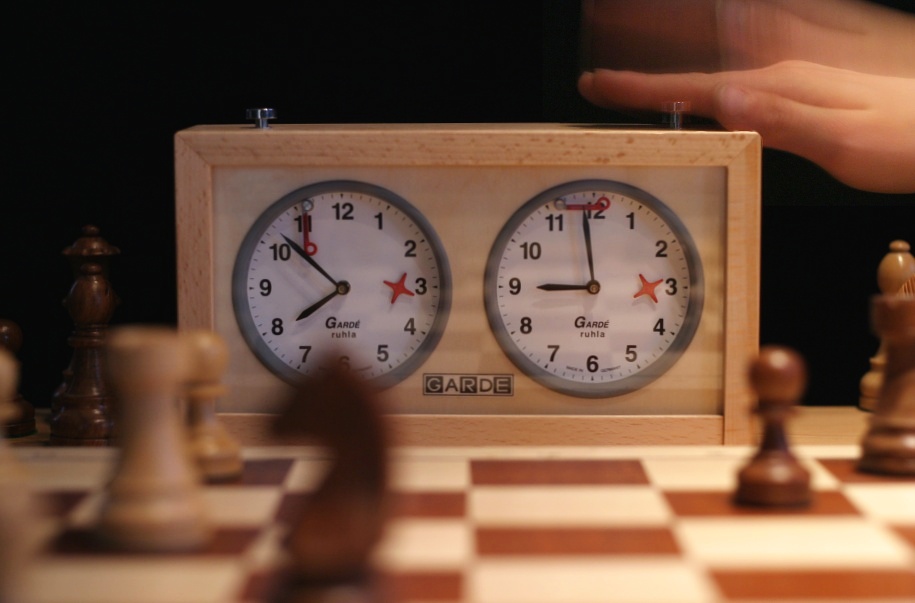
An analog chess clock

A chess clock is a device that comprises two adjacent clocks with buttons to stop one clock while starting the other, so that the two clocks never run simultaneously. The clocks are used in games where the time is allocated between two parties. The purpose is to keep track of the total time each party takes and prevent delays. Parties may take more or less time over any individual move.

Chess clocks were first used extensively in tournament chess, beginning with a competition at the London 1883 tournament. They are often called game clocks, as their use has since spread to tournament Scrabble, shogi, Go, and nearly every competitive two-player board game, as well as other types of games. Various designs exist for chess clocks and different methods of time control may be employed on the clocks, with "sudden death" being the simplest.

Description

[edit]

A chess clock consists of two adjacent clocks with buttons to stop one clock while starting the other, so that the two clocks never run simultaneously.[1] The devices are used in chess and other two-player games where the players move in turn. The purpose is to keep track of the total time each player takes for their own moves, and ensure that neither player overly delays the game.[2]

Invented by Thomas Bright Wilson of Manchester Chess Club, the clocks were first used during competition at the London 1883 tournament.[3] Chess clocks were first used extensively in tournament chess, and are often called game clocks. Their use has since spread to tournament Scrabble,[4] shogi, Go, and nearly every competitive two-player board game, as well as other types of games. They have also been used in some legal settings where each side or party is allotted a specific amount of time for arguments.[5]

Designs

[edit]

Analog game clocks

[edit]
A typical analog chess clock

Analog clocks are equipped with a "flag" that falls to indicate the exact moment the player's time has expired. Analog clocks use mechanical buttons. Pressing the button on one player's side physically stops the movement of that player's clock and releases the hold on the opponent's.

The drawbacks of the mechanical clocks include accuracy and matching of the two clocks, and matching of the indicators (flags) of time expiration. Additional time cannot easily be added for more complex time controls, especially those that call for an increment or delay on every move, such as some forms of byoyomi.

Early development of digital game clocks

[edit]
A brown chess clock with blue buttons along the bottom. A digital display shows the time remaining for each side
Digital chess clock

In 1973, to address the issues with analog clocks, Bruce Cheney, a Cornell University electrical engineering (EE) student and chess player, created the first digital chess clock as a project for an undergraduate EE course.[6] Typical of most inventions, it was crude compared to the products on the market many years later and was limited by the technology that existed at the time. For example, the display was implemented via red LEDs, which required significant power and, as a result, the clock had to be plugged into a wall outlet. The high cost of LEDs at the time meant that only one set of digits could be displayed: that of the player whose turn it was to move. This meant that each player's time had to be multiplexed to the display when their time was running. In 1973, LSI chips were not readily or cheaply available, so all the multiplexing and logic was enabled using chips consisting of four two-input TTL NAND gates, resulting in excessive power consumption. Being plugged into the wall is obviously a major drawback, but had one advantage: the timebase for the clock was driven off a rectified version of the alternating current mains frequency. Each player had a separate counter and, in a parallel to the original mechanical architecture, one player's counter was disabled while the other's was running. The clock only had one mode: time ran forward. It could be reset, but not set. It did not count the number of moves. But it successfully addressed the original goals of the project (accurate and matched timing).

The first commercially available digital chess clock was patented in 1975 by Joseph Meshi and Jeffrey R. Ponsor. They named it the Micromate-80.[7] There was only one made[8] and this was tested by chess players in multiple tournaments. Three years later a much-improved Micromate-180 was produced alongside Meshi's MBA thesis, "Demand Analysis for a New Product (The Digital Chess Clock)", at San Diego State University, while Meshi and Ponsor continued to develop digital gaming.[9]

[edit]
Digital chess clock connected to a board that automatically senses when moves have been made.

Digital clocks and Internet gaming have spurred a wave of experimentation with more varied and complex time controls than the traditional standards. Time control is commonly used in modern chess in many different methodologies. One particularly notable development, which has gained quite wide acceptance in chess, was proposed by former world champion Bobby Fischer, who in 1988 filed for US patent 4,884,255 (awarded in 1989) for a new type of digital chess clock. Fischer's digital clock gave each player a fixed period of time at the start of the game and then added a small amount after each move.[10] Joseph Meshi called this "Accumulation" as it was a main feature of his patented Micromate-180 (US Patent 4,247,925 1978).[9]

The increment time control was first used in the privately organised 1992 Fischer–Spassky match, and quickly became popular in the wider chess world, being subsequently used in the FIDE World Chess Championship 1998.[11] Nowadays most top level tournaments and tournaments outside the United States use Fischer's system. An increasing number of lower level tournaments in the US are also starting to use Fischer's system. Other aspects of Fischer's patent, such as a synthesized voice announcing how much time the players have, thus eliminating the need for them to keep looking at the clock, have not been adopted.[10]

On March 10, 1994, a patent application was filed by inventors Frank A. Camaratta Jr. of Huntsville, Alabama, and William Goichberg of Salisbury Mills, New York, for a game timer especially suitable for playing the game of chess, which employed a (simple) "delay" feature. The game timer provides, among other features, a user-definable delay between the time the activation button is pressed and the time that the activated clock actually begins to count down. United States Patent 5,420,830 was issued on May 10, 1995, and subsequently assigned to the United States Chess Federation by the inventors. As with the Fischer clock, the benefit of the delay clock is to reduce the likelihood that a player with positional or material superiority will lose a match solely because of the expiration of time on that player's time clock.[12] In the United States, delay is still widely used, but increment is becoming more popular.[13]

Timing methods

[edit]

Sudden death: The simplest time control is "sudden death", in which players must make a predetermined number of moves in a certain amount of time or forfeit the game immediately. A particularly popular variant is blitz chess, in which each player is given a short time, such as five minutes, on the clock in which to play the entire game.

X moves per Y minutes: in longer time control games, time control is usually specified in a certain number of moves in a certain time. Traditionally the first time control is at move 40. At the World Chess Championship 1986, for instance, the time control was 40 moves in 2½ hours, and 16 moves per hour thereafter.[14] Sometimes, after a certain move, it reverts to sudden death; for instance, 90 minutes for the first 40 moves, then an extra 30 minutes for each player for the rest of the game (ensuring the maximum game length is 4 hours: 2 hours maximum for each player).

Increment (also known as Bonus and Fischer since former World Chess Champion Bobby Fischer patented this timing method): a specified amount of time is added to the player's main time each move, unless the player's main time ran out before they completed their move. For example, if the time control is 90+30 (ninety minutes of main time per player with a thirty-second increment each move), each player gets an additional thirty seconds added to their main time for each move, unless the player's main time ran out first. Under FIDE and US Chess rules, the increment is applied to the first move as well. For example, for 3+2 each player starts with three minutes and two seconds on the first move. Not all digital clocks automatically give the increment for move one and thus for those that don't, the increment time has to be added manually to the main time so each player gets the increment for move one.

Increment can also begin later than move 1. For instance, at the World Chess Championship 2024, the time control was 120 minutes per side for the first 40 moves, and an extra 30 minutes for the rest of the game, with a 30-second increment per move starting from move 41.[15]

Bronstein delay (named after Grandmaster David Bronstein who invented this timing method): this timing method adds time but, unlike Increment, the maximum amount of time is not always added. If a player expends more than the specified delay then the entire delay is added to the player's clock, but if a player moves faster than the delay, only the exact amount of time expended by the player is added. For example, if the delay is ten seconds and a player uses ten or more seconds for a move, ten seconds is added after they complete their move. If the player uses five seconds for a move, five seconds is added after they complete their move. This ensures that the main time left on the clock can never increase even if a player makes fast moves. As with Increment, the delay time is applied to the first move under FIDE and US Chess rules.

Simple delay (also known as US delay): with this timing method, the clock waits for the delay period each move before the player's main time starts counting down. For example, if the delay is ten seconds, the clock waits for ten seconds each move before the main time starts counting down.

Bronstein delay and Simple delay are very similar, but not equal. Mathematically, Bronstein delay and Simple delay are identical; the amount of time allotted to each player is equivalent at all stages of the game. For this reason, the two delays are interchangeable in the FIDE laws of chess.[16] In practice, however, Bronstein delay and Simple delay display time differently. In Bronstein delay, the amount of time is added after the move has been made; this distinction may be crucial when a player is running out of time.[17]

The advantage of Bronstein delay is that a player can always quickly see exactly how much time they have for their next move without having to mentally add the main and delay time. The advantage of Simple delay is that a player can always tell whether the time that is counting down is the delay time or the main time. For example, in a game with a 5-second delay, when a player presses their clock with 1 second remaining, the clock will display with 1 second remaining, and the 5-second delay is counted separately on their next turn. In Bronstein, the 5 seconds are immediately added, and the clock will display 6 seconds. Simple delay is the form of delay most often used in the US, while Bronstein delay is the form of delay most often used in most other countries.

See also

[edit]

References

[edit]

Further reading

[edit]
[edit]
Revisions and contributorsEdit on WikipediaRead on Wikipedia
from Grokipedia
A chess clock is a timing device consisting of two interconnected time displays used in chess competitions to enforce time controls by ensuring that only one player's clock runs at a time, with each player starting the opponent's clock by pressing a button after completing their move. This mechanism prevents excessive delays and promotes fair play by allocating a fixed total time or per-move limits to each player, after which a falls or the display reaches zero to indicate time forfeiture. The invention of the chess clock addressed the problem of prolonged games in the , when matches could last up to 14 hours due to players stalling without time restrictions, leading to the use of unreliable sandglasses or pocket watches in early tournaments. In 1883, Thomas Bright Wilson, a member of the Chess Club, developed the first mechanical analog chess clock, which featured two dials and was first employed at International that year, marking a pivotal advancement in standardized play. Joseph Henry Blackburne, a prominent English chess master, is sometimes credited as a co-inventor for refining the design, which was soon produced commercially by Fattorini & Sons. Over time, chess clocks evolved from analog models with falling flags to digital versions introduced in 1973 by Bruce Cheney, a student, offering greater precision and eliminating mechanical failures common in earlier devices. A significant innovation came in 1988 when patented a digital clock incorporating an increment system, adding a small fixed time (such as 30 seconds) to a player's remaining time after each move to encourage faster decision-making without sacrificing depth in classical games. Today, under regulations, chess clocks are mandatory for all official over-the-board tournaments and support various formats, including classical (e.g., 90 minutes plus 30-second increment), rapid, and blitz, with digital models dominating due to their accuracy and features like audible signals.

Overview

Definition and Purpose

A chess clock is a specialized timing device consisting of two interconnected displays, each tracking the time allocated to one player in turn-based games such as chess, with only one display running at any given time to ensure precise measurement of individual thinking time. This dual-timer mechanism prevents the simultaneous accrual of time for both players and includes indicators, such as flags on analog models or digital alerts, to signal when a player's time has expired. The primary purpose of the chess clock is to enforce equitable time allocation between opponents, promoting decisive and efficient play while standardizing competitive formats in tournaments. By limiting the duration each player can spend on moves, it discourages stalling tactics that could otherwise prolong games indefinitely, thereby maintaining fairness and enabling organizers to schedule multiple rounds within a day. In practice, after completing a move on the board, a player stops their own and activates the opponent's, alternating control seamlessly. Originating in the to address delays in matches where early sand-timers proved insufficient for accurate per-player tracking due to their imprecision and impracticality in alternating use, the chess clock now serves as a mandatory element in most formal events governed by regulations, including all timed competitions.

Basic Components and Operation

A chess clock consists of two independent timers, each dedicated to one player, integrated into a single device that ensures only one timer runs at any given time. These timers are typically displayed via analog hands or a digital readout, allowing players to monitor their remaining time clearly. A key component is the shared start/stop mechanism, often a or positioned between the displays, which players press to alternate between timers. Additionally, each includes an indicator for time expiration, such as a mechanical flag on analog models that falls when time runs out, or a visual/ on digital versions. In operation, the chess clock promotes fair time tracking by allocating an equal initial time period to both players, such as 90 minutes each in a standard game. The game begins with making the first move on the board, followed by pressing the clock's mechanism with the same hand used to move the piece, which stops White's and activates Black's. Thereafter, after completing each move—defined as releasing the piece on its destination square—the active player must promptly press the clock to halt their own and start the opponent's, repeating this alternation throughout the game. If a player's expires, indicated by the falling or a , they lose on time unless they can claim a draw under the Laws of Chess (e.g., insufficient material to or the 50-move rule) before the falls. For interruptions like disputes or adjournments in classical play, the clock can be paused by an arbiter, with both players' remaining times recorded to resume accurately later. This pausing ensures equitable handling of external delays without penalizing either side's thinking time. Players are responsible for operating the clock correctly, including avoiding excessive force or hovering over the button, to prevent penalties.

History

Origins and Early Adoption

The introduction of time controls in chess emerged in the mid-19th century to address the exhaustion caused by untimed games, which could span 20 hours or more over several days, leading to player fatigue and disputes over move validity. Early attempts relied on double-faced sand timers or hourglasses, with the first documented use occurring in 1861 during the match between and Ignác Kolisch, enforcing a limit of 24 moves in 2 hours. These devices, however, suffered from inaccuracies influenced by temperature and uneven sand flow, as well as the logistical challenge of rapid flipping between players. Recognizing these limitations, Thomas Bright Wilson, secretary of the Manchester Chess Club, developed the first mechanical chess clock in 1883—a double-sided featuring a tumbling mechanism that automatically stopped one face while starting the other upon activation. Blackburne, a prominent English chess master, collaborated on its refinement, including the integration of a visual system to signal time expiration, improving reliability over sand timers. Manufactured by Fattorini & Sons of , this innovation marked a pivotal shift toward precise, mechanical timing in competitive play. The new clock made its debut at the 1883 London International Tournament, the first major event to employ mechanical timing with a control of 30 moves in 2 hours, replacing cumbersome sand timers and enabling faster-paced competitions among top players like and . This debut demonstrated the clock's practicality in preventing interminable sessions and promoting decisive play. By the 1890s, mechanical chess clocks had proliferated across international , becoming essential for maintaining schedules and mitigating fatigue from extended deliberations. Their adoption accelerated , notably at the 1889 New York —the Sixth American Chess Congress—where they enforced standardized time limits, ensuring equitable conditions for participants including and Max Weiss. This widespread integration by the decade's end established clocks as indispensable to formal chess, paving the way for more rigorous competitive standards.

Evolution Through the 20th Century

Following the initial of the mechanical chess clock in 1883, the early saw significant advancements in analog designs, leading to greater reliability and standardization. By the , manufacturers had developed standardized analog clocks featuring improved winding mechanisms that reduced the frequency of manual resets and enhanced precision during long tournaments. emerged as a leading manufacturer from the 1890s onward, producing high-quality congress timers with oak casings and dependable movements often sourced from German makers like HAC, which became staples in international play. Key developments in the mid-20th century included the introduction of electromechanical clocks in , which incorporated self-winding features to automate timekeeping and minimize in flag falls. These innovations, precursors to fully electronic models, improved upon purely mechanical systems by integrating basic electrical components for more consistent operation. Post-World War II, further enhancements focused on durability, with robust casings and shock-resistant movements designed for rigorous use in global events; for instance, during the 1950s world championships, such as the 1954 Botvinnik-Smyslov match, standardized mechanical clocks with these upgrades ensured reliable performance under tournament pressures. The transition to digital technology accelerated in the 1970s with the creation of the first electronic prototypes, including Bruce Cheney's 1973 digital clock developed at , which introduced precise electronic timing without mechanical hands. By the , commercial digital clocks with LCD displays became widely available, influenced by broader advancements in and ; notable examples include the 1975 Micromate-80 by Joseph Meshi and Jeffrey Ponsor, and the 1985 DGT prototype by Ben Bulsink, which offered programmable time controls and paved the way for modern standards. These shifts marked a profound , enabling more complex time management while maintaining the core purpose of fair play.

Designs and Types

Analog Mechanical Clocks

Analog mechanical chess clocks feature a dual wind-up mechanism consisting of two independent spring-driven s, each equipped with hour and minute hands to display elapsed time on separate dials within a unified case. These timers are interconnected by a central or pivoted system that allows a player to stop their own clock while simultaneously starting the opponent's upon pressing, ensuring precise alternation without overlap. When a player's allocated time expires, an mechanism—typically a small red or black pennant positioned above the dial—falls automatically to signal the end, preventing premature claims and providing visual confirmation of time loss. This relies on purely mechanical components, including geared escapements for consistent timekeeping and rear winding keys for initial setup. Key features include an audible click produced by the button or lever actuation, which confirms the switch and adds a tactile satisfaction to gameplay, along with adjustable winding to accommodate various time controls by setting the hands to the starting duration, such as 30 or 60 minutes per side. Early models often used brass or wooden cases for durability and aesthetic appeal, while later versions incorporated plastic housings to improve portability and reduce weight without compromising reliability. These clocks require manual winding before each game, typically providing up to four hours of operation on a full wind, and lack electronic components, making them self-contained and independent of external power sources. Notable examples include the Jaques Congress Chess Timer, introduced in the 1890s with movements sourced from the Hamburg American Clock Company and assembled in the UK, and the BHB Special Mechanical Clock, a mid-20th-century German-engineered model featuring a expanded five-minute scale for better visibility in endgames and a sturdy plastic exterior. These devices dominated chess tournaments from their invention in 1883 by Thomas Bright Wilson—first employed at the —through the late 1980s, revolutionizing competitive play by enforcing strict time limits and promoting efficient . Prior to their adoption, sandglasses were used, but mechanical clocks offered greater accuracy and reusability, becoming essential for official events under organizations like . Despite the rise of digital alternatives, analog mechanical clocks persist in traditional clubs, casual settings, and among collectors valuing their craftsmanship and nostalgic appeal, with models like the BHB remaining in production for heritage purposes.

Digital Electronic Clocks

Digital electronic chess clocks utilize quartz-based timing mechanisms to deliver precise measurements, typically accurate to within one second per hour, surpassing the potential inaccuracies of mechanical analogs. These devices, which began appearing in the as electronic prototypes, have become standard in competitive chess for their reliability and adaptability to modern time controls. Central to their design are LCD or LED displays that provide clear visibility of time elapsed and remaining, often showing seconds from the game's start to aid in precise monitoring. Programmability stands out as a core feature, with many models offering 20 or more pre-set time controls alongside slots for user-defined settings, facilitating quick adjustments for different formats. Battery-powered operation, typically using AA batteries for extended use up to 500 hours, ensures portability, while auto-start functionality activates the opponent's upon a player's clock press, streamlining . Auditory alerts, such as beeps for low remaining time or move completion, further enhance usability by providing immediate feedback without visual distraction. These clocks offer distinct advantages, including electronic safeguards that minimize tampering risks compared to mechanical flags or hands, and intuitive interfaces that simplify configuring complex setups like or increments in seconds. Their precision supports fair play in fast-paced events, and integration capabilities with electronic chessboards enable automated move detection and digital game broadcasting in advanced setups. Overall, they promote efficiency in tournaments by reducing setup time and errors associated with manual adjustments. Among common models, the DGT 3000, FIDE-approved and launched in 2014, features a large 35 x 130 mm display, 24 pre-set modes, five custom slots, and connectivity to DGT electronic boards for live game transmission. The Chronos GX, with its touch-sensitive buttons, includes four blitz presets, eight tournament controls, and support for both delay and increment modes, making it versatile for casual and competitive use. The Excalibur GameTime II provides over 90 presets, customizable options up to three time periods per game, and a 19-second delay function, appealing to players across chess and other board games like .

Specialized Variants

The Fischer clock, patented by chess grandmaster in 1988, introduces an increment system where a fixed amount of time—such as 30 seconds—is added to a player's remaining time after each move, building on a predetermined base time allocation. This design mitigates the risk of time forfeits in prolonged games by rewarding efficient play, and it was first realized in digital chess clocks during the 1990s, influencing modern tournament standards. A related innovation, the Bronstein delay, was proposed by grandmaster in 1969 as an alternative to pure increment systems. In this mechanism, a preset delay period (e.g., 10 seconds) begins counting down only after a player starts their move; upon completing the move and pressing the clock, the full delay is added back if the move took less time than the delay, but nothing is added if it exceeded the delay, effectively capping the bonus to prevent excessive accumulation. Chess clocks have been adapted for other board games with specialized timing needs, such as Go and . For Go, the DGT1005 Byo-yomi timer supports Japanese-style overtime, where players receive a base time followed by multiple short periods (e.g., 5 periods of 25 seconds per move) to complete remaining moves, ensuring games conclude within limits. Similarly, the DGT1006 timer features a one-period countdown with an adjustable delay option, allowing players to set ratios like 12-minute games with a 10-second delay per turn to accommodate the game's pacing. Other specialized variants address accessibility and logistical challenges in play. The DGT is a speaking digital chess clock designed for visually impaired players, announcing remaining time, opponent time, and move counts via audio at the press of a button, enabling participation in standard tournaments. For international events with multi-stage time controls, models like the Tournament Pro Chess Clock support dual time configurations, such as 90 minutes for the first 40 moves followed by 30 minutes for the rest, facilitating compliance with regulations across borders.

Time Control Methods

Traditional Fixed-Time Systems

Traditional fixed-time systems in chess allocate a predetermined total duration for each player to complete all their moves, without any additions or increments per move. These methods dominated competitive play from the mid-19th century through the late , emphasizing cumulative time usage tracked by the chess clock until a player's falls, signaling time expiration and loss. In such systems, the clock runs only during a player's turn, alternating between opponents, with no provisions for time recovery or bonuses, ensuring games conclude within scheduled bounds. Classical time controls, a hallmark of traditional systems, structured play around specific move limits within fixed periods, often followed by adjournments if games extended. For instance, in the , standards typically required 2.5 hours for the first 40 moves, followed by 1 hour for the next 20 moves, after which unfinished games could be adjourned for resumption later. By the , this evolved to 2 hours for the first 40 moves, then 1 hour for the remainder, reflecting adjustments to accommodate improving defensive play and longer games while maintaining fixed totals. These controls were implemented using analog mechanical clocks, where time accumulated solely on the active player's side until the move was completed and the clock pressed, promoting deliberate pacing in openings and middlegames but often leading to adjournments in complex endgames. Sudden death formats represented a simpler variant of fixed-time systems, assigning a single total time allotment for the entire game per player, such as 30 minutes each, with immediate loss upon flag fall. Gaining traction in the for serious s after initial use in casual or speed play, sudden death eliminated multiple stages and adjournments, bridging classical and quicker chess by guaranteeing completion within the fixed period. FIDE's early adoption included 5-minute sudden death for blitz events starting in the 1970s, standardizing short, fixed totals that prioritized speed and decisiveness. The simplicity of these systems facilitated tournament scheduling and reduced administrative complexity, as rounds ended predictably without extensions. However, they drew for inducing rushed decisions, particularly in endgames, where time could compromise strategic depth and lead to suboptimal play.

Increment and Delay Mechanisms

Increment mechanisms in chess clocks add a fixed amount of time to a player's remaining time after each move is completed and the clock is pressed, encouraging sustained thoughtful play throughout the game. For instance, a 30-second increment means that 30 seconds are credited immediately following each move, regardless of the time spent on it. The total effective time for a player can thus be calculated as the base time plus the product of the number of moves made and the increment value, providing a scalable resource that grows with game length. The increment system, patented by in 1988 and first used in the 1992 World Chess Championship rematch between and Spassky, adds a fixed amount of time to a player's remaining time after each move is completed and the clock is pressed. The Bronstein delay, a variant of delay timing named after Soviet grandmaster , functions similarly to increment but adjusts the added time based on usage during the move, effectively deducting any unused portion from the subsequent turn's allocation. In this mode, upon pressing the clock to start an opponent's turn, a fixed delay period—such as 10 seconds—is temporarily added to the player's reserve; the clock then runs normally, but only the unused portion of that delay is retained after the move if the player finishes within it, with no addition if exceeded. For example, a 10-second Bronstein delay pauses the effective for up to 10 seconds at the onset of each turn, simulating a brief while penalizing excessive deliberation by forgoing the full credit. Since the early 2000s, the International Chess Federation (FIDE) has mandated increments in most official tournament events to ensure fair time management and avert chaotic time scrambles, particularly in extended games; this requirement, formalized in FIDE's 2001 time control revisions, mandated 40 moves in 75 minutes followed by 15 minutes sudden death plus a 30-second increment per move for tournaments awarding international title norms. Increments have since become standard in official play, with current FIDE classical controls typically 90 minutes for the first 40 moves plus 30 minutes for the remainder with a 30-second increment per move (as of 2023). In September 2025, FIDE launched a pilot project for a "fast classical" control of 45 minutes plus 30-second increment. Increments and delays collectively prevent premature time losses, allowing players to maintain composure in prolonged middlegames and endgames.

Usage and Strategy

Tournament Standards and Rules

In official FIDE tournaments, chess clocks must conform to strict standards outlined by the FIDE Technical Commission to ensure fairness and reliability. Electronic clocks are mandatory for World and Continental Championships, as well as the , while mechanical clocks are permitted in other FIDE-registered events provided they feature a visible, non-reflective indicator and operate silently. All clocks used in a must be identical in type and model, neutral in design without any player-specific markings, and selected from approved lists, such as the DGT 3000 or DGT 2500 models. The setup of the chess clock follows precise protocols to maintain equity. Prior to the game, the arbiter sets both time displays to the agreed-upon , ensuring equal starting time for both players, and positions the clock between the players for optimal visibility. initiates the clock procedure by completing their first move and then pressing the clock with the same hand used to make the move, thereby stopping their own time and starting the opponent's; this action must occur immediately after the move to avoid penalties, and subsequent moves follow the same sequence of stopping one's clock and activating the opponent's. Clocks are required for all events with time controls, while shorter rapidplay and blitz formats—such as 10 minutes plus 5 seconds increment per move—adapt these rules with specialized supervision to handle faster play. Penalties for clock mishandling are enforced rigorously to uphold the integrity of the game. If a player's falls—indicating the expiration of their allotted time—before they complete the required moves, they lose the game by time forfeit, unless the position is a draw due to insufficient material for . In cases of disputes, such as a claimed fall or clock malfunction, the arbiter intervenes by stopping both clocks to investigate and resolve the issue, potentially adjusting times based on evidence or replacing defective . For classical games involving adjournments—though now rare in official tournaments—the arbiter records the exact time on each clock at the interruption and resumes play with those settings, ensuring continuity.

Time Management Techniques

Players employ various techniques to strategically manage their time on the chess clock, aiming to maintain an advantage throughout the game. One common approach is to make early moves quickly, particularly in the opening phase, by relying on memorized lines and preparation to build a substantial time buffer for later stages. This allows players to allocate more time to complex calculations without falling into time trouble. For instance, grandmasters often spend only 10-20 seconds on familiar opening moves to preserve reserves for the middlegame. In critical positions, such as tactical middlegame battles, players must balance depth of analysis with speed, especially under clock pressure. Training to calculate accurately in limited time helps mitigate errors, as excessive deliberation can deplete reserves needed for the endgame. With increment rules providing added seconds per move, players can pace extended thinks on key decisions, using the extra time to refine evaluations without rushing suboptimal plays. This mechanism, briefly referenced in time control methods, enables sustained focus in prolonged games. Time trouble, often defined as the final five minutes on the clock, significantly heightens the risk of blunders due to rushed decisions and heightened stress. Studies and game analyses show that error rates spike in this phase, with players overlooking simple tactics or hanging pieces. To counter this, experts recommend practicing rapid and endgame techniques to execute moves efficiently when time is scarce. Psychological tactics also play a role in time management, where players may intentionally stall by repeating moves or delaying non-critical decisions to induce on an opponent low on time. This can force hasty responses, increasing the likelihood of opponent errors without violating rules. Such strategies exploit the mental strain of the clock, turning time into a . A notable example of time pressure's impact occurred in Garry Kasparov's 1997 rematch against Deep Blue, where in Game 1, he navigated intense clock constraints in a complex position to secure a win, demonstrating resilience under duress. Advice for balancing time across phases emphasizes minimal expenditure in the opening (about 20-30% of total time), deeper investment in the middlegame for (40-50%), and cautious precision in to avoid fatal slips. This allocation prioritizes conceptual depth in high-stakes moments while ensuring a safety margin against time exhaustion.

Modern Developments

Online and Software-Based Clocks

Online and software-based chess clocks are digital timers embedded within web-based platforms, enabling with synchronized timing across participants. Major platforms such as and feature real-time clock displays that update instantaneously for both players, showing remaining time in a prominent format above the board. These clocks support a range of time controls categorized by game duration: bullet games, typically under 3 minutes per player (e.g., 1|0 or 2|1); blitz games from 3 to 10 minutes (e.g., 5|0 or 3|2); and rapid games exceeding 10 minutes (e.g., 15|10). The server-synced nature ensures accuracy by processing moves and time deductions centrally, minimizing discrepancies from local device variations. A key feature is the integration of customizable controls, including the Fischer increment, which adds a fixed bonus time (often 1-10 seconds) to a player's clock after each move, a system patented by Bobby Fischer in 1988 and adopted by online platforms in the early 2000s to promote thoughtful play in faster formats. Platforms allow users to select these options when creating games, with notations like "10|5" indicating 10 minutes base time plus 5 seconds per move. To address technical issues, Lichess compensates for network lag by adjusting recorded move times, while both sites impose penalties for prolonged disconnects, such as automatic forfeits after 15-30 seconds of inactivity, to maintain fairness. Chess.com provides guidance on mitigating user-side lag but relies on reconnection attempts during brief interruptions. The adoption of these clocks surged post-2020 due to the , which restricted in-person tournaments and drove online participation; Chess.com's user base grew from approximately 44 million in October 2020 to over 100 million by mid-2021, with peak daily games exceeding 10 million, and further surpassing 200 million members as of April 2025. This period highlighted their reliability for global events, further enhanced by integrations that enable real-time streaming. 's , for instance, allows developers to stream ongoing games between users for broadcasts, supporting features like live updates for tournaments. Similarly, Chess.com's Published Data and Events page facilitate embedding game data into streaming platforms for professional and casual viewers.

Portable and App-Integrated Devices

Portable and app-integrated chess clocks have emerged as versatile tools for casual players, travelers, and training enthusiasts, leveraging technology to provide compact, customizable timing solutions that extend beyond traditional hardware. These devices often combine software applications with optional physical components, enabling offline use while offering features tailored to personal practice sessions. Unlike always-connected online platforms, they prioritize standalone functionality for on-the-go gaming, such as during commutes or informal matches. Smartphone apps dominate this category, with examples like the Chess Clock app providing a free, ad-free timer that supports delay and increment modes for various time controls, making it highly portable on Android and devices. Another notable hybrid is the Tap N Set digital clock, which integrates with a dedicated app via NFC technology; users program time settings on their phone and tap to transfer them to the physical device, supporting delay, increment, and multiple game modes for enhanced portability. The DGT e-Board further exemplifies syncing, allowing a wooden electronic chessboard to connect wirelessly to mobile apps or computers for move recording and clock integration during physical play. Key features include detailed analytics on time usage per move to help players review pacing efficiency. Voice commands enable hands-free operation, with apps such as Karuah Chess incorporating for starting timers or switching turns, ideal for solo training. In the 2020s, discussions of AI-assisted pacing have advanced, exploring concepts like to dynamically adjust increments based on and player history, promoting balanced without overwhelming beginners. These devices support diverse applications, including training modes with variable controls for skill-building exercises, such as customizable blitz or rapid sessions in the Chess Clock app. Compatibility with physical boards via sensors, like the DGT e-Board's piece detection syncing to app-based clocks, allows seamless hybrid setups for over-the-board practice. By 2025, integrations with VR environments have risen in popularity, with apps like OnBoard Chess for Meta Quest enabling immersive sessions that incorporate real-time clock timers alongside connectivity for virtual tournaments.

References

Add your contribution
Related Hubs
User Avatar
No comments yet.